

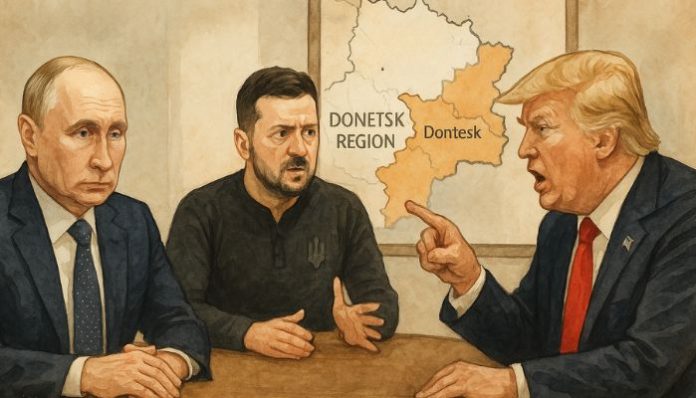
On 15th August (local time) Russian President Vladimir Putin reportedly told United States President Donald Trump that Moscow would end its war only if Ukraine surrendered the eastern Donetsk region. According to a Financial Times report, Putin made the demand during his meeting with the former US president in Alaska. He suggested that ceding Donetsk would allow Russia to freeze the frontline, particularly in the southern Kherson and Zaporizhzhia regions. Notably, Russian troops have already brought most parts of the territory under their control.
Trump relays message to Zelensky and Europe
A day later, the message was conveyed to Ukrainian President Volodymyr Zelensky and European leaders during a joint call by Trump. He pushed for a full peace agreement rather than a limited ceasefire. Following the discussion with leaders including German Chancellor Friedrich Merz and French President Emmanuel Macron, Trump wrote on the social media platform Truth Social, “The best way to end the horrific war between Russia and Ukraine is to go directly to a Peace Agreement, which would end the war, and not a mere Ceasefire Agreement, which often times do not hold up.” He added that if progress was made, a further meeting with Putin would be scheduled.
Why Donetsk is central to the conflict
Donetsk has been the centre point of the conflict between Russia and Ukraine since 2014. Russia already controls around 70% of the region. Ukraine, on the other hand, maintains a heavily fortified western belt of cities critical to its eastern defences. Complete control of Donetsk would be the most significant prize for Russia since the full-scale war between Russia and Ukraine began. It would cement its fastest territorial gains since late 2023. On the contrary, losing Donetsk would compromise the stability of the entire eastern front for Kyiv.
Zelensky stands firm
Media reports quoted unnamed sources close to President Zelensky saying that he has refused to concede Donetsk. However, he is reportedly prepared to discuss broader territorial matters with Trump when the two leaders meet in Washington on 18th August. Reports also suggested he could consider a three-way meeting involving Putin. However, the Kremlin has categorically denied any such arrangement, saying it was never on the table in Anchorage, Alaska.
European unease grows
Trump’s earlier hints at possible land swaps have unsettled European capitals. Many leaders were reassured when Trump warned Putin of “severe consequences” if Moscow refused to halt the war. However, the Alaska talks delivered no results on a ceasefire. Instead, they provided Putin with an opportunity to project himself on the world stage. The meeting was marked by a red-carpet reception and light-hearted exchanges with Trump before the formal discussions began between the two leaders.
Why Putin wants all of Donetsk
Putin’s demand for complete control over Donetsk revealed a desire to achieve diplomatically what Russian forces have been struggling to accomplish militarily. Ukraine has established a 31-mile-long fortress belt of cities and defences in Donetsk since 2014. Russian troops have repeatedly encountered strong resistance along that fortress line. According to the Institute for the Study of War, breaking through could take several years under current conditions.
In the prolonged battle for the region, Russia has committed significant equipment and manpower over the past 17 months. Despite the challenges, Russia has gradually advanced closer to the city. If Russia secures Donetsk through negotiations, it would be positioned to threaten Kharkiv and Dnipropetrovsk next. That would force Ukraine to hastily build new, but weaker, defensive lines. Controlling Donetsk would strengthen Russia’s strategic position in the region, raising concerns among Western leaders.
Putin-Trump Alaska talks failed
The Alaska summit ended without any breakthrough on the Russia-Ukraine war, despite Trump claiming it was “extremely productive.” His threats of sanctions contrasted with the red-carpet welcome accorded to Putin, while the absence of Ukraine from the talks drew sharp criticism. The meeting, expected to produce at least a ceasefire roadmap, instead highlighted the gulf between appearances and outcomes, with Trump shifting the responsibility for peace squarely onto Zelensky and European nations.


