

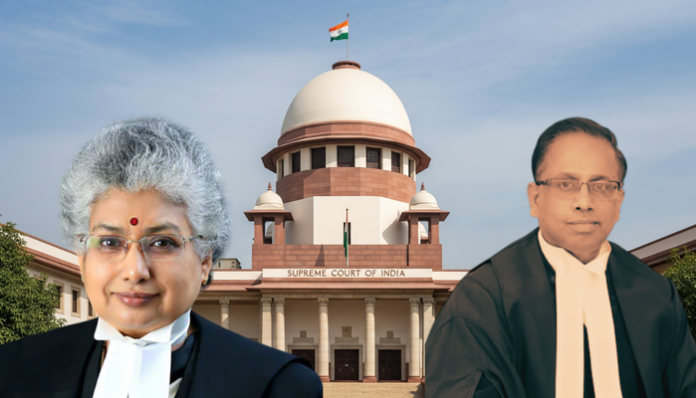
The Supreme Court on Tuesday (12th August), directed the Home Secretaries of all the states and the Union Territories (UT) to immediately release all the convicts languishing in jail beyond their sentence period.
A bench of Justices BV Nagarathna and Justice KV Viswanathan issued the direction during the hearing of the plea for release filed by Sukhdev Yadav alias Sukhdev Pehalwan, who was convicted in the high-profile Nitish Katara murder case. Pehalwan The top court said that all the convicts who are in jail even after completing their sentence time should be released if no other cases are pending against them. The court also ordered the release of Pehalwan, noting that he had served his full term.
The court directed a copy of the order to be sent to the National Legal Services Authority of India (NALSAR), which will ensure that the copy is further forwarded to the District Legal Services Authorities (DSLSAs) for further implementation.
Background of the case
In June this year, the Supreme Court granted a 3-month furlough to Sukhdev Pehalwan after he approached the court against a Delhi High Court order of November 2024, which dismissed his furlough plea. While granting him furlough, a bench of Justices Ujjal Bhuyan and K Vinod Chandran noted that he had spent 20 years in jail, which was his full sentence, without remission.
Sukhdev Pehalwan was convicted in the 2002 Nitish Katara murder case and was granted 20 years in jail in October 2016. Along with him, former cabinet minister DP Yadav’s son Vikas Yadav and his cousin Vishal Yadav were each granted a 25-year jail term without remission. All three of them were convicted of killing Nitish Katara after kidnapping him from a marriage party on the intervening night of February 16 and 17, 2002, because of Katara’s alleged affair with Vikas Yadav’s sister.
The problem of Convicts and undertrials illegally languishing in jails calls for greater attention
The present verdict of the Supreme Court highlights a grave problem of convicts and undertrials languishing in jails even after serving their sentence or being granted bail by the court.
In June this year, the Supreme Court ordered the ₹5 lakh compensation to be paid by the Uttar Pradesh government to a person who spent 28 days in jail even after being granted bail because of a minor technical error in the bail order. Calling it a travesty of justice, the apex court ordered a judicial enquiry into the case to determine accountability.
In a similar case in September 2023, the Gujarat High Court directed the state government to provide a compensation of ₹1 lakh to an accused, who was kept inside the jail for three years after securing regular bail. The accused was granted bail in September 2020, but was released from jail in September 2023, a day before the date of the hearing of his case. The accused remained in jail for three years after getting bail, as the jail authorities failed to see, due to the COVID-19 pandemic, an Email containing the bail order of the High Court. Interestingly, the accused was released temporarily and was given furlough on a few occasions during his incarceration but the jail authorities did not bother to check the court records during th entire time. The High Court also reprimanded the Sessions Court for not ensuring that the bail order was implemented.
In October 2023, the Delhi High Court adopted a stern approach in a case of illegal detention. The High Court directed ₹50,000 to be paid to a person from the salary of the police officers, who had kept him illegally detained and locked up for half an hour. The victim was illegally detained by the police on mere suspicion of committing a crime, without any formal arrest, FIR or Daily Diary entry.
Lack of proper framework to address the problem
These examples point out how a mere technical error or omission by the jail authorities and courts can cost an individual his freedom and precious time. This calls for greater accountability of the jail authorities as well as the judiciary. Institutions are meant to serve individuals and society and not the other way round. Currently, India does not have a specific legislation for addressing the problem of illegal detention. In cases of illegal detentions, courts usually invoke Article 21 of the Constitution to grant compensation. However, some provisions in International law expressly address the problem of illegal detention. For example, Article 9(5) of the International Covenant on Civil and Political Rights (ICCPR), to which India is a signatory, provides that victims of illegal detention shall have an enforceable right to compensation.
While many such instances of convicts and undertrials illegally languishing in jails have time and again come up before courts, the courts are only able to provide relief on a case-by-case basis due to the lack of a proper framework to keep track of the people locked up in jails and the legal provisions to provide them compensation and ensure the accountability of authorities.


