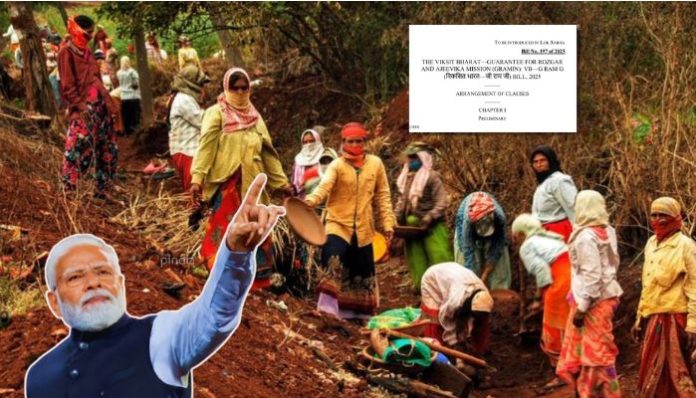
The Modi government is set to propose the Viksit Bharat Guarantee for Rozgar and Ajeevika Mission (Gramin) on the 16th of December 2025 in the Lok Sabha. The VB-G RAM G legislation is meant to repeal the existing Mahatma Gandhi National Rural Employment Guarantee Act (MGNREGA). While the proposed legislation comes with marked improvement on the MGNREGA or MNREGA, the left liberal cabal has started outrage and downplaying VB-G RAM G as a mere old product in new packaging.
In this vein, Congress MP Priyanka Gandhi said, “Whenever a scheme’s name is changed, think about how many offices, stationery & other elements are involved that incur costs.”
On renaming of MNREGA to Pujya Bapu Gramin Rozgar Yojana, @priyankagandhi educates-
— BhikuMhatre (@MumbaichaDon) December 15, 2025
"Whenever a scheme’s name is changed, think about how many offices, stationery & other elements are involved that incur costs"
MT…Govt Schemes/Assets RENAMED to glorify Dynast Nehru Family?… pic.twitter.com/w8BcctiXMP
The Congress leader, however, did not mention that during Congress rule in the past, the names of numerous airports, roads, government schemes, scholarships and even offices were changed after Congress leaders, including former Prime Ministers Jawaharlal Nehru, Indira Gandhi and Rajiv Gandhi.
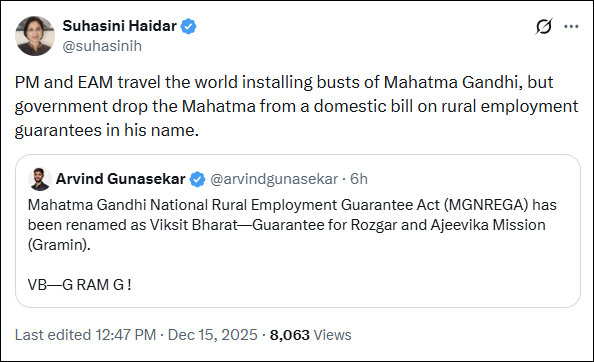
‘Journalist’ Suhasini Haidar asserted that while Prime Minister Narendra Modi goes around the world installing busts of Mohandas Karamchand Gandhi, he drops the latter’s name from a domestic bill on rural employment guarantees in his name.
“PM and EAM travel the world installing busts of Mahatma Gandhi, but government drop the Mahatma from a domestic bill on rural employment guarantees in his name,” Haidar wrote.
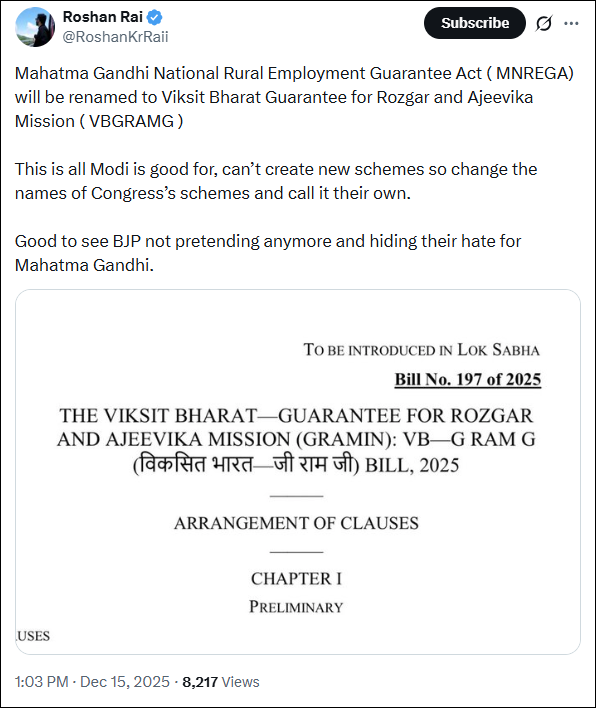
One pro-Congress troll suggested that the Central government not retaining MK Gandhi’s name in the proposed legislation meant to replace MNREGA, amounts to “hatred” for Gandhi. “This is all Modi is good for, can’t create new schemes so change the names of Congress’s schemes and call it their own. Good to see BJP not pretending anymore and hiding their hate for Mahatma Gandhi,” he wrote.
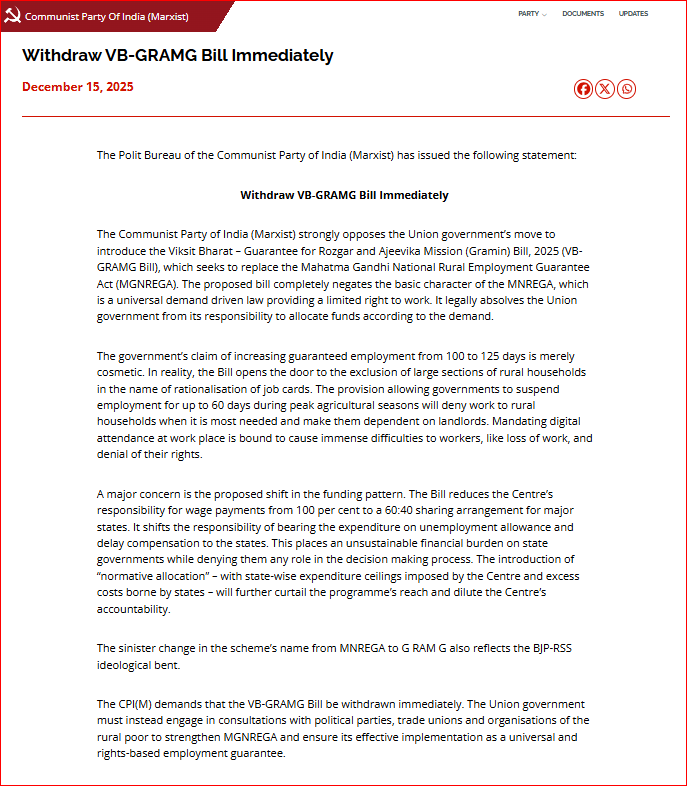
The Communist Party of India (Marxist) has demanded withdrawal of the bill, calling it a “sinister change” reflecting the BJP-RSS ideological bent.
Contrary to the leftist narrative, VB G RAM G is not mere rebranding but a comprehensive overhaul
While the anti-BJP parties and the left-liberal ecosystem are needlessly outraged over the ‘name change’ of MGNREGA to VB-G RAM G, the proposed legislation is a substantive upgrade, rather, an overhaul framed to modernise rural employment, boost infrastructure, and align with the Modi government’s Viksit Bharat 2047 Vision of transforming India into a developed nation.
Enacted in 2005, the MGNREGA provided a demand-driven safety net; however, it grappled with multifaceted challenges, including leakages, uneven implementation, in addition to limited long-term asset creation. The new VB-G RAM G addresses these challenges head-on by boosting worker entitlements, improving accountability, and fostering cooperative federalism required for sustainable growth.
The VB-G RAM G metamorphoses MGNREGA from a reactive welfare scheme to a proactive mission for rural employment. While the MGNREGA offered 100 days of employment per household, the new legislation, if implemented, will provide 125 days of work per household. This will ensure rural households have higher income security. In addition, the increased working days will potentially add Rs 20,000 to Rs 30,000 to the annual income for millions of workers.
Previously, the wage payment was done fortnightly with delays up to 15 days. Under VB-G RAM G, the wages will be disbursed weekly, ensuring a quicker and reliable cash flow for labourers/workers.
The funding split arrangement has also been modified. Earlier, the Centre provided 90 per cent of the funding; now there will be a 60:40 funding split between the Centre and State, respectively. In the context of special states, the Centre-State ratio will be 90:10. The more balanced funding ratio will ensure greater state accountability and also curb scope for financial strain and misuse.
“If the legislation is implemented across the country, the total estimated annual requirement of funds on wage, material and administrative components is ₹1,51,282 crores (Rupees one lakh fifty-one thousand two hundred eighty-two crore), including the state share. Of this, the estimated Central share is ₹95,692.31 crores (Rupees ninety-five thousand six hundred ninety-two crore and thirty-one lakhs,” the draft of the VB-G RAM G Bill reads.
Contrary to the assertion that a normative funding approach would weaken the 100-day work guarantee, the guarantee is bolstered with employment days increased to 125. The Centre emphasises forecasting accuracy shown by FY 2024-25 when allocation matched demand perfectly.
While MGNREGA’s demand-driven approach led to unpredictable budgeting and uneven implementation, the VB G RAM G adopts a normative approach based on objective parameters. This would enable better planning and resource predictability.
The VB-G RAM G Bill 2025 focuses not only on generating rural employment but also on creating durable infrastructure. For this, the bill had framed four priority verticals:
- Water security through water-related works
- Core-rural infrastructure
- Livelihood-related infrastructure
- Special works to mitigate extreme weather events
The MNERGA or MGNREGA works were scattered across many categories without a robust national strategy. The new legislation, however, focuses on four major types of works, ensuring durable assets that directly support water security, core rural infrastructure, livelihood-related infrastructure creation and climate adaptation.
The new legislation also provides for a localised and spatially integrated planning. The VB-G RAM G Bill mandates Viksit Gram Panchayat Plans, prepared by panchayats themselves and integrated with national spatial systems like PM Gati-Shakti, GIS mapping, biometric attendance, geo-tagging, and AI-driven audits under the Viksit Bharat National Rural Infrastructure Stack. This would dramatically slash leakages and ensure transparency.
Leftist propaganda portal The Wire argues that the new bill will sideline panchayats and empower dashboards, saying that “MGNREGA trusted Gram Sabhas & Panchayats to plan works based on local needs – G RAM G mandates GIS tools, PM Gati Shakti layers & central digital stacks. Local priorities are filtered through a Viksit Bharat National Rural Infrastructure Stack.”
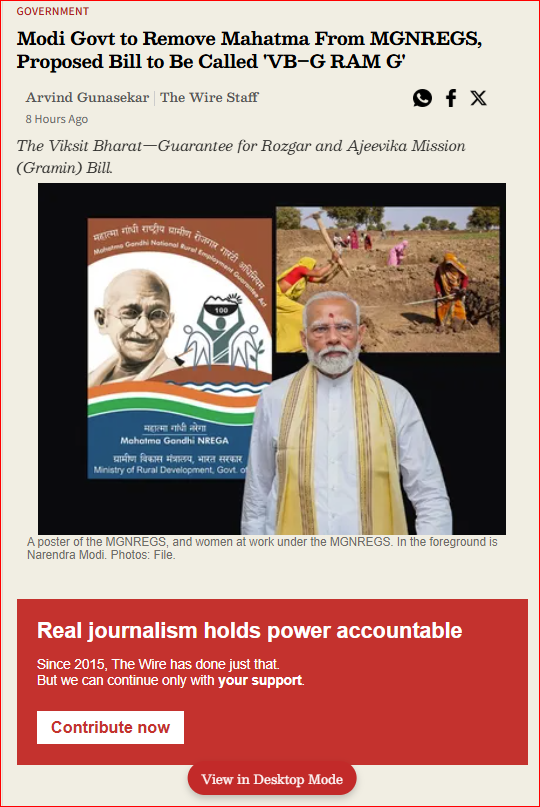
The Wire insinuated that the Central government does not trust Gram Panchayats regarding work planning; however, the legislation clearly states that work plans or Viksit Gram Panchayat Plans will be prepared by the panchayat and will be integrated with national spatial systems. In short, it is not a case of Centre trusting dashboards more than panchayats but Centre integrating the vanguard of planning—Gram Panchayats and dashboards for effective and transparent rural development.
While the left liberal ecosystem claims that for rural workers, the integration of technology into the scheme would mean that a tech failure would result in exclusion without appeal, it is obvious that the Central and State governments will work towards habituating workers to relevant tech and ensuring that payment and identification systems like Aadhaar-Based Payment System (ABPS) and NREGA Mobile Monitoring System, function properly.
Notably, electronic wages (already 99.94% in 2024-25) continue with full biometric and Aadhaar-based verification, eliminating wage theft. It is, however, important that the governments work towards ensuring that the discrepancies in the existing ABPS, which could lead to the deletion of numerous job cards from the system, are fixed.
A particularly significant provision in the proposed VB-G RAM G Bill 2025 is the 60-day annual pause during peak agricultural seasons. This will allow workers to shift to higher-paying farm labour without losing the employment guarantee scheme benefits. This will potentially help stabilise rural wages and food production. In addition, special relaxations will be provided during disasters.
Elaborately, under the new legislation, as State governments will be able to notify periods aggregating up to 60 days during peak sowing/harvesting when MGNREGA work stops, this will help prevent labour shortages during critical farm operations and avoid labour being diverted away to guaranteed-wage worksites. In addition, stopping public works during peak agricultural season would prevent artificial wage inflation that raises food production costs. It must also not be forgotten that the 60-day no-work period is aggregated and not continuous.
The leftist propagandists are labelling the 60-day annual pause during peak agricultural seasons as “labour control” and “state-managed labour supply”, arguing that the pause strips workers of their choice, wages and even dignity. However, the 60-day pause addresses a longstanding issue of labour shortages during the peak agricultural season. Contrary to the misleading narrative peddled by left liberals, the 60-day pause is not the Centre’s blunt “don’t work, don’t earn” message to workers but a framework empowering workers with bargaining power and seasonal options while also backing national agriculture by preventing worker shortages during sowing/harvesting seasons.
The new legislation is designed in such a fashion as to ensure that not only workers but farmers also benefit. Under the G RAM G, prioritised water works improve irrigation, groundwater and multi-season cropping potential (supported by the 68,000+ Amrit Sarovar water bodies achievement).
Water security, focus on core and livelihood rural infrastructure development, including roads, Storage, markets, and production assets, will boost local connectivity and rural business activity, in addition to supporting income diversification.
What necessitated VB-G RAM G despite efforts to improve MNREGA
The Central government says that while there have been significant improvements in various aspects linked to MNREGA when the numbers of fiscal year 2013-2014 are compared to those of FY 2023-24, the deep structural problems necessitated a comprehensive overhaul.
In terms of women’s participation, the number has gone up from 48 per cent to 56.74 per cent. The number of Aadhaar-seeded active workers has risen from 74 lakhs to 12.11 crore. Workers on the Aadhaar-Based Payment System (ABPS) stand presently at 11.93 crore. Geo-tagged assets in the fiscal year 2023-24 are recorded to be more than 6 crores. Similarly, electronic payments have skyrocketed from 37 per cent to 99.99 per cent. In another major gain recorded for MNREGA in the decade of the Modi government, individual assets have surged from 17.6 per cent to 62.96 per cent.
Despite the successes, attendance bypassing, fund misappropriation, and assets failing to match expenditure, and several other issues persisted. In West Bengal, an investigation unearthed non-existent works, rule violations, and fund misuse, leading to a freeze.
As per the Central government’s data, in 2024–25, misappropriation totalled ₹193.67 crore across states. Only 7.61% of households completed 100 days in the post-pandemic period. In a nutshell, leakages, weak verification, and poor compliance could not be handled with quick fixes and required a new and robust framework.
The pivot from being a central sector to a centrally-sponsored scheme is not meant to shift accountability and responsibility solely to the state governments, but to ensure that allocated funds are put to the right use as per the local needs and are not misused. The bill’s provision that “Any expenditure incurred by a State in excess of its normative allocation shall be borne by the State government…” promotes state accountability and efficiency, given that states already handle implementation. A capped and predictable 60:40 funding split model ensures fiscal discipline and incentivises states to prioritise high-impact works and better planning. In the event of natural disasters or calamities, the Central government will provide extra support, ensuring that states are not left helpless during a crisis.
“It said that predictable normative allocation aids budgeting, while states can request extra support during disasters, and better oversight reduces long-term losses from misappropriation,” the Centre states.
Conclusion
The anti-BJP cabal is indulging in performative politics by needlessly fixating over the ‘name change’ or the so-called ‘Sanghification’ of government schemes merely because MK Gandhi’s name was which was inserted in the NREGA’s name by the Congress government in 2009, has not been retained in VB-G RAM G. MNREGA’s Gandhi branding was a UPA-era add-on to the original NREGA, it is not sacrosanct and its discontinuation in the new bill does not amount to hating on, disrespecting or erasing MK Gandhi. While the opposition and its supportive ecosystem are trying to stir a foolish ‘Bapu’s insult’ debate, the Viksit Bharat Guarantee for Rozgar and Ajeevika Mission (Gramin) provides tangible upgrades, which, with proper implementation, hold potential to revolutionise the rural economy and empower workers financially and socially.