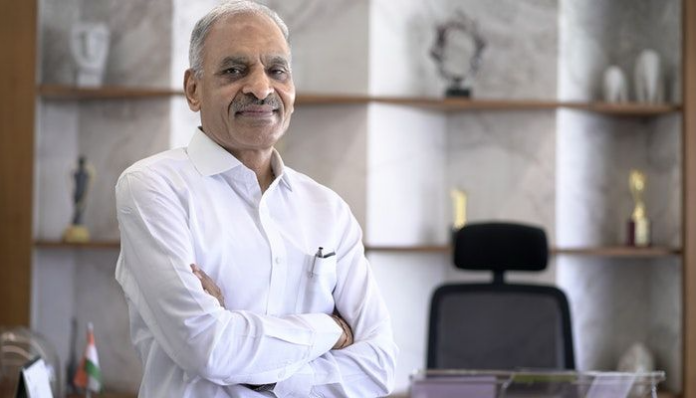
On the eve of Republic Day, Satyanarayan Nuwal, the founder and chairman of Solar Industries India Limited, was conferred the Padma Shri for Trade and Industry. His company manufactured the “Nagastra” weapon systems used in “Operation Sindoor” last May, reported The Times of India. He is the chairman of Solar Defence and Aerospace Limited (SDAL), which is perhaps the first and largest private military-grade explosives manufacturing facility in the nation. Notably, SDAL also provided boosters for BrahMos missiles.
Nuwal, who was chosen for his exceptional contributions to industry and society, is the only businessman from Vidarbha of Maharashtra to have bagged the esteemed honour in recent years. “I did not expect that such a big honour would be conferred on me. The award only adds to my commitment towards the country, and profit is not the objective in running the defence business,” he voiced while speaking to the TOI.
Nuwal is a first-generation businessman who started modestly in the mid-1990s as a supplier of commercial explosives to Coal India Limited. He frequently travelled alone and waited on train platforms. However, he successfully entered into defence when his company began producing military-grade explosives in 2010.
The 74-year-old recounted, “It was an entirely new field for a private-sector company to enter. I used to hear about the supply-side challenges faced by the armed forces and realised that the country needs more players. Considering the scenario, we decided to make a small contribution towards the country’s defence.”
During his visit to the SDAL facility this month, Defence Minister Rajnath Singh confirmed that the company’s Nagastra drone-mounted loitering munition hit enemy objectives precisely during India’s pivotal military action. “In America or any other country, they can launch four missiles simultaneously. But our Bhargavastra fires 60 micro-missiles at once. No such system exists anywhere else in the world to date,” Nuwal had informed Singh at the time. Bhargavastra is a multi-layer micro-missile Anti-Drone or Counter-Unmanned Aerial System (C-UAS).
#WATCH | Nagpur, Maharashtra: Satyanarayan Nandlal Nuwal, Founder and Chairman of Solar Industries India Ltd, says, "In America or any other country, they can launch four missiles simultaneously. But our Bhargavastra fires 60 micro-missiles at once. No such system exists… pic.twitter.com/Vd1cLYC1g1
— ANI (@ANI) January 18, 2026
The union minister was also told about the Pralay short-range ballistic missile. “We make so many motors of Pralay but our capability is that we can manufacture the whole missile,” a company official mentioned, outlining that they could develop the entire missile in only two months if given the chance.
#Solar #Pralay #Nagpur
— Dr. Ajayshree Singh Sambyal (@AjayshreeSamby3) January 18, 2026
"Sir we make so many motors of Pralay but our capability is that we can manufacture the whole missile, Sir if given the opportunity we can manufacture the whole missile. Two in a month sir"🙂🙂🙂
एक ही दिल है सत्यनारायण सर कितनी बार जीतोगे pic.twitter.com/VtNccuezVr
Furthermore, SDAL created SE-BEX-2, considered the most potent high-energy material after an atomic bomb and twice as potent as conventional trinitrotoluene (TNT). It was the first private entity to provide the Army with a whole munitions system, including multimodal hand grenades that replaced the outdated models.
The company started off as a military manufacturer by filling orders for Pinaka rockets. Afterwards, it produced multimodal grenades, the first complete systems built by a commercial enterprise, adding another milestone to its record. It then grew over time to produce anti-drone devices and drones. SDAL recently purchased land in Nagpur’s Mihan-SEZ to create robotics-based and artificial intelligence technologies.
The humble beginnings
Nuwal is among the richest persons in India with a net worth of $5.2 billion (more than ₹46,500 crore), according to the Forbes list. His company is widely recognised in the field of defence and was the initial corporation in India to be granted a government licence to produce explosives for the armed forces. However, the individual who established this business empire originated from a modest family in Rajasthan’s Bhilwara. His father was a government accountant who stressed the value of developing business acumen early in life.
Nuwal was unable to continue his studies after 10th grade because of financial constraints after which he tried his hand at small businesses as he spent a year in Mathura with his gurudev. He noted, “More than education, I was interested in doing business,” in a Forbes interview.
He experimented with a variety of ventures, such as manufacturing fountain pen ink, leasing companies and even a transportation company after returning home. Meanwhile, Nuwal was married at the young age of 19 as the load of obligations continued to mount. He left home to provide for his family and went to Chandrapur in Maharashtra in 1977 to work with a relative. He had to spend nights at the train station since he was unable to afford basic living expenses.
Nuwal met Abdul Sattar Allah Bhai, who owned a gunpowder depot and was licensed to use explosives. He negotiated renting the place for ₹1,000 per month but the amount was too much for him. His firm eventually flourished and he started getting substantial orders from coal mines. His company evolved to become a consignment agency by 1984 and he was a crucial explosives dealer by 1990.
A new light dawns
The 1990s marked a turning point for him when he founded Nagpur-based Solar Industries in 1995 because of his extensive experience in this field. He managed ₹60 lakh from the bank along with other savings and began producing slurry explosives and soon ventured into the production of bulk explosives alongside detonators. Coal India Limited was listed as one of the company’s major clients. The public sector undertaking (PSU) has been using the explosives for its mines.
The business made the decision to go public in 2006 when it had a net profit of about ₹11 crore and a turnover of ₹78 crore. The funds were mostly utilised to build up the operation and set up 13 production facilities. Solar Industries opened six plants in Zambia, Ghana, Nigeria, Turkey, Tanzania and South Africa while its units already spanned 29 cities in nine states. It also started its plants in Thailand, Indonesia and Australia.
Furthermore, it was the first private business to be granted a government licence to produce weapons and explosives for the country’s armed services. Nuwal understood that ammunition would ultimately have to be produced domestically. Hence, he commenced developing capacity for expansion into ammunition, including grenades, medium and large calibre ammunition as well as high energy explosive (HMX) and HMX compounded products, propellants and warheads.
Solar Industries was awarded an ammunition order for the delivery of multi-mode hand grenades (MMHG) valued at around ₹450 crore to be delivered over a two-year period. For the first time in the annals of India’s defence, it distinguished itself as the first private entity to be awarded an ammunition order.
Chairman of Sandeep Metallics, a division that manufactures ammunition round systems, Sandeep Agrawal also explained Nuwal’s hardships as a self-made entrepreneur who began as an explosives supplier to the mining industry. He expressed, “Over the years, he came up with systems which were never put in place by private industries in the defence sector. He started investing in the sector in 2010, and only now the company started getting dividends, though the commitment remains strong.”
The company is currently one of India’s key private-sector partners in strategic weapons manufacturing for multiple Defence Research and Development Organisation (DRDO)-made missiles, such as Pralay, Pinaka, Akash and other guided weapon systems. It is also a major supplier of solid rocket motors and propulsion systems.
Similarly, Nuwal is now well known for transforming Solar Industries into a worldwide-renowned corporation while upholding a strong commitment to social responsibility. Likewise, his steadfast support for social welfare, education, and community development earned him appreciation across the country. His Padma Shri award emphasises not just his career accomplishments but also his vital role in nation-building.