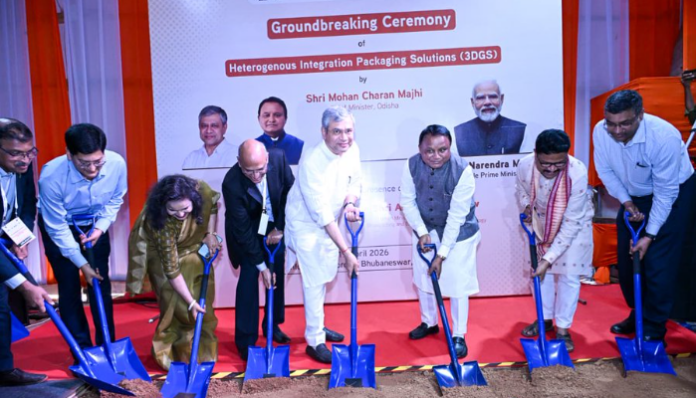
On 19th April (Sunday), the foundation for the nation’s first cutting-edge 3D chip packaging facility was laid at Bhubaneswar’s Infovalley in the presence of Minister of Electronics and Information Technology Ashwini Vaishnaw, along with Odisha Chief Minister Mohan Charan Majhi, as well as other dignitaries.
The occasion marked a turning point for India’s aspirations in the semiconductor industry and Odisha’s rise as a future-oriented technology attraction. It is an important leap towards expanding the “Aatmanirbhar Bharat” policy in high-end electronics production and strengthening the indigenous semiconductor ecosystem. Odisha will house one of the most innovative chip packing systems in the global market, owing to the start of this venture in the Khordha district.
World’s most advanced semiconductor technology comes to Odisha.
— Ashwini Vaishnaw (@AshwiniVaishnaw) April 19, 2026
Groundbreaking of India’s first 3D Glass Chip Packaging Unit, along with Odisha CM @MohanMOdisha Ji. pic.twitter.com/4cpBGj9Iky
3D Glass Solutions Inc (3DGS) of the United States is responsible for the operation through its fully incorporated Indian company, Heterogeneous Integration Packaging Solutions Private Limited (HIPSPL). It is a greenfield, vertically integrated ATMP (Assembly, Testing, Marking and Packaging) unit with embedded glass substrate and sophisticated packaging. It is scheduled to cost Rs 1,943.53 crore in total, including Rs 799 crore in approved central fiscal assistance and an additional Rs 399.5 crore in support from the state.
High-growth sectors, including data hubs, artificial intelligence, machine learning, 5G/6G (Generation) communications, automotive radar, defence electronics, aerospace applications and photonics, will be served by the installation. The aim is to reach full-scale volume manufacturing by August 2030, with commercial production predicted to commence by August 2028.
A grand achievement in future innovation
“A high-tech industry coming to Odisha is a matter of pride. This is an advanced technology. Normally, a silicone substrate is used in the manufacturing of chips, and now the technology of advanced 3D Glass substrate will be employed. We will also work to double the capacity after the completion of the first phase of the plant,” Vaishnaw expressed. According to him, Odisha, which has historically been recognised for its capabilities in minerals, metals and energy, is now slowly carving out a name for itself in sophisticated sectors like electronics, IT and semiconductors.
The union minister highlighted that this effort will greatly improve the country’s semiconductor value chain and referred to it as one of the most novel manufacturing undertakings of its kind. He added that three other bids pertaining to electronics and semiconductors are underway, and two semiconductor assignments have already been sanctioned for Odisha under the India Semiconductor Mission.
Odisha breaks ground of India's 1st 3D Glass Chip Packaging Unit at speed with faster approvals. 🇮🇳
— E&IT Department Odisha (@EIT_Odisha) April 19, 2026
Chips for the world will be packaged with most advanced technology from Odisha. pic.twitter.com/Ylv4HZOL6T
Majhi also described the event as a “historic milestone” for Odisha and India. He pointed out that Global tech giants such as Intel, Lockheed Martin and Applied Materials are linked to inventive packaging technologies, and their interest in the state is a reflection of its growing industrial power.
“The products manufactured in the state will support next-generation sectors such as Artificial Intelligence, high-performance computing, defence electronics, telecommunications and advanced digital systems. Odisha is ready to play a pivotal role in realising Prime Minister Narendra Modi’s vision of making India self-reliant in semiconductor and electronics manufacturing,” he announced.
The chief minister mentioned that the plant is planned to supply 70,000 glass panels, 50 million assembled units and about 13,000 upgraded 3DHI (Heterogeneous Integration) modules annually.
He conveyed that large-scale job prospects for engineering graduates, diploma holders and Industrial Training Institutes (ITI) students will be made possible by Odisha’s rising semiconductor ecosystem, which will contribute to its transformation from an economy dependent on resources towards one driven by technology.
Today, from the soil of Odisha, India took a defining step in its semiconductor journey. I was delighted to join Hon'ble Union Minister Shri @AshwiniVaishnaw Ji for the groundbreaking ceremony of the nation's first advanced 3D glass substrate packaging facility, a historic… pic.twitter.com/ruDUsn6rHm
— Mohan Charan Majhi (@MohanMOdisha) April 19, 2026
According to IT Secretary S Krishnan, the government will be ensuring a “close eye” on the endeavour, which might put the nation “on the map” in terms of modern chip packing.
Majhi also described the event as a “historic milestone” for Odisha and India. He pointed out that Global tech giants such as Intel, Lockheed Martin and Applied Materials are linked to inventive packaging technologies and their interest in the state is a reflection of its growing industrial power.
“The products manufactured in the state will support next-generation sectors such as Artificial Intelligence, high-performance computing, defence electronics, telecommunications and advanced digital systems. Odisha is ready to play a pivotal role in realising Prime Minister Narendra Modi’s vision of making India self-reliant in semiconductor and electronics manufacturing,” he announced.
The chief minister mentioned that the plant is planned to supply 70,000 glass panels, 50 million assembled units and about 13,000 upgraded 3DHI (Heterogeneous Integration) modules annually.
He conveyed that large-scale job prospects for engineering graduates, diploma holders and Industrial Training Institutes (ITI) students will be made possible by Odisha’s rising semiconductor ecosystem, which will contribute to its transformation from an economy dependent on resources towards one driven by technology.
According to IT Secretary S Krishnan, the government will be ensuring a “close eye” on the endeavour, which might put the nation “on the map” in terms of modern chip packing.
What are 3D glass semiconductors
The brand-new site in Odisha will utilise glass-based substrates and 3D stacking technologies, in contrast to conventional semiconductor manufacturing, which mostly involves silicon wafers and planar (2D) packaging. These enable the vertical integration of several chip components, significantly boosting processing power within a single footprint. For sophisticated nodes, glass substrates offer superior thermal stability, reduced signal loss and better accuracy.
The future of computing itself is influenced by the potential of 3D glass chip technology. It is crucial to stack chips vertically and integrate various components (logic, memory, sensors) as devices such as smartphones and autonomous systems need more power in smaller spaces. Faster AI models, more effective data centres, and advanced defensive electronics could all be made accessible by this “heterogeneous integration.”
Gordon Moore, a co-founder of Intel, created Moore’s Law in 1965, which predicted that the number of transistors on a chip would nearly double every two years, resulting in exponential spikes in processing power while lowering prices. It was the semiconductor industry’s guiding idea for many years. This pace has slowed, though, as chips move closer to their physical and thermal constraints at advanced nodes. It has brought the industry into new solutions such as improved packaging, chiplets and 3D integration to maintain performance gains.
A remarkable evolution in the supply chain
The value of the project is determined by the technology layer it seeks to achieve rather than by the size or scope of the investment. Its emphasis on capacity, intellectual property, and ecosystem positioning suggests an arrangement away from assembly-led manufacturing and in favour of deeper involvement in the global semiconductor value chain.
The facility particularly focuses on the IP-intensive portion of semiconductor production, whereas conventional ATMP units work with imported substrates and standardised methods. Furthermore, the glass-ceramic packaging platform of 3DGS has above 100 patents from 31 active patent families worldwide. Materials engineering, manufacturing techniques, device architectures and system-level integration are covered by these patents. Notably, India’s presence in these regions has been restricted thus far.
Both locally produced glass substrates and organic substrates from outside sources will be primarily supported by the unit, as early commercial activities will take place while the local ecosystem flourishes. The intention is to eventually switch entirely to glass-based innovative packaging. Glass substrates serve stronger connectivity density, elevated dependability and better thermal control. These features are vital for defence-grade hardware, advanced computing systems and AI accelerators.
This could also result in an upstream alteration in sourcing as Indian system integrators, OEMs (Original Equipment Manufacturers) and government vendors might get advanced packaged components in the country and do not have to approach packaging clusters in Taiwan and South Korea. This builds up supply resiliency and gives industries like data centres, telecom infrastructure, aircraft and defence electronics a higher degree of authority over a key hardware stack layer.
India’s ambition for semiconductor growth
The India Semiconductor Mission, a state-backed campaign to create a full-stack semiconductor ecosystem from fabrication and packaging to design and display manufacturing, was introduced in 2021 with an investment of Rs 76,000 crore. 10 semiconductor projects excess of Rs 1.6 lakh crore, have been sanctioned in 6 states comprising fabrication facilities, OSAT (Outsourced Semiconductor Assembly and Test) units and design-linked incentives.
According to reports, the government is developing the subsequent edition of the blueprint and might accept a proposal that would amount to approximately $11 billion.