

Prime Minister Narendra Modi’s visit to the Netherlands has emerged as one of the most significant chapters of his ongoing five-nation Europe and West Asia tour. After visiting the UAE, PM Modi travelled to the Netherlands, where his visit concluded on Sunday, 17th May. The visit, held at the invitation of Dutch Prime Minister Rob Jetten, became remarkable because India and the Netherlands elevated their ties to a full-fledged “Strategic Partnership.”
During the visit, both countries announced 17 major outcomes covering sectors such as semiconductors, defence, agriculture, education, water management and cultural cooperation. However, among all the agreements and announcements, one development stood out for its long-term importance to India’s water security and climate planning: the Dutch decision to support Gujarat’s ambitious Kalpasar Project.
Dutch expertise for Gujarat’s mega water project
One of the biggest highlights of the entire diplomatic visit was the signing of a momentous Letter of Intent (LoI) between the two nations. This agreement directly brings world-class Dutch hydraulic engineering expertise to Gujarat’s highly ambitious Kalpasar Project.
Signed formally between India’s Ministry of Jal Shakti and the Netherlands’ Ministry of Infrastructure and Water Management, the LoI establishes a framework for technical cooperation focused on coastal and water engineering. This collaboration is set to significantly strengthen India’s regional water security.
The Kalpasar Project is one of India’s most ambitious proposed water infrastructure plans. It aims to build a massive dam across the Gulf of Khambhat to create a giant freshwater reservoir. Dutch experts will assist India in areas such as tidal management, salinity control, delta engineering and coastal water infrastructure.
This cooperation deal between both countries is significant because the Netherlands is one of the countries in the world that is acknowledged as having immense expertise in water engineering and flood management. Around 26% to 30% of the Netherlands sits below sea level. Being located beneath sea level, the Dutch engineers have devised innovative methods for controlling floods, saltwater intrusion, and freshwater reserves.
PM Modi visits the iconic Afsluitdijk Dam
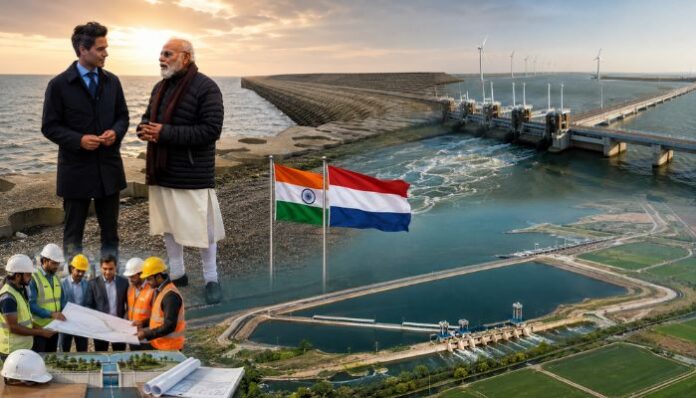
During his visit to the Netherlands, PM Modi also travelled to the famous Afsluitdijk dam along with Prime Minister Rob Jetten. The visit attracted major attention because the Afsluitdijk project is considered one of the greatest examples of modern water engineering in the world.
Prime Minister Narendra Modi accompanied by the Prime Minister of the Netherlands, Rob Jetten visited the iconic Dutch water management structure, the Afsluitdijk. The visit underscored the shared commitment of both nations to innovative water management solutions, climate… pic.twitter.com/9dQYYjIKFP
— IANS (@ians_india) May 17, 2026
The visit was not just symbolic. According to the Ministry of External Affairs (MEA), the Afsluitdijk project has direct relevance to Gujarat’s Kalpasar Project because both involve large-scale coastal engineering, freshwater storage and flood protection systems.
Sharing his experience on X, PM Modi highlighted the importance of Dutch expertise in water management.
“An area in which the Netherlands has done pioneering work is water management. The entire international community can learn a great deal from this. This morning, I had the chance to visit the Afsluitdijk and gain insight into the key features of this project. I am grateful to Prime Minister Rob Jetten for accompanying me here. We are committed to bringing modern technology to India, designed to assist with irrigation, flood protection, and the expansion of the inland waterway network,” PM Modi said.
An area in which the Netherlands has done pioneering work is water resources. There is a lot the entire global community can learn from them.
— Narendra Modi (@narendramodi) May 17, 2026
This morning, I had the opportunity to visit the Afsluitdijk and understand the salient features of this project. I am thankful to PM… pic.twitter.com/dYFfiAuzKZ
MEA spokesperson Randhir Jaiswal also described the visit as an important moment for future India-Netherlands cooperation.
“A symbol of engineering excellence and innovation! Accompanied by PM Rob Jetten of the Netherlands, PM Narendra Modi visited the iconic Afsluitdijk Dam, a symbol of Dutch excellence in water management, flood protection and freshwater storage. The visit highlighted the relevance of Dutch expertise for India’s Kalpasar Project in Gujarat, which aims to create a freshwater reservoir and dam near the Gulf of Khambhat,” Jaiswal posted on X.
A symbol of engineering excellence and innovation!
— Randhir Jaiswal (@MEAIndia) May 17, 2026
Accompanied by PM Rob Jetten of the Netherlands, PM @narendramodi visited the iconic Afsluitdijk Dam, a symbol of Dutch excellence in water management, flood protection and freshwater storage.
The visit highlighted the… pic.twitter.com/P62t0hmLye
Kalpasar is inspired by a similar Dutch engineering success
The broader idea behind PM Modi’s visit to the Afsluitdijk was clear: India wants to learn from Dutch expertise while planning the Kalpasar Project.
There are many similarities between Gujarat’s proposed project and the Dutch dam. Both involve dealing with seawater, tidal movements, freshwater storage and coastal engineering challenges. The Netherlands has already spent decades solving many of the same technical issues that India could face during the Kalpasar project.
This is why Dutch technical support is seen as highly valuable for Gujarat. Experts believe the Netherlands’ experience in managing massive coastal water systems can help India avoid costly engineering and environmental mistakes in the future.
Why the Afsluitdijk Dam matters
The Afsluitdijk is one of the Netherlands’ most famous engineering achievements and has played a central role in the country’s long battle against flooding and seawater intrusion.
The 32-kilometre-long barrier dam was originally completed around 80 years ago. It separates the North Sea from the IJsselmeer freshwater lake and protects large parts of the low-lying Netherlands from severe floods.
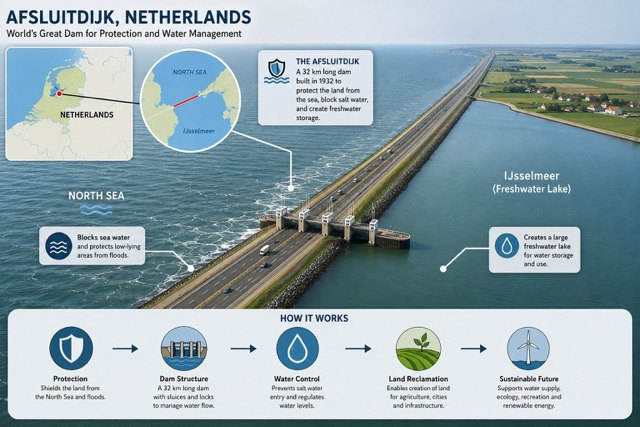
But the project is not just about flood defence. The Afsluitdijk also supports freshwater storage, transport connectivity, navigation and renewable energy generation. Today, the Netherlands is modernising the structure through a massive “Afsluitdijk 2.0” programme designed to prepare the country for future climate challenges.
The upgraded project is being redesigned to withstand storms expected only once every 10,000 years. It includes stronger locks, advanced water discharge systems, fish migration corridors and renewable energy technologies using tidal flows, solar energy and wind power.
Dutch authorities estimate the modernisation project will cost around €800 million.
The Afsluitdijk has also become an example of how modern infrastructure can serve multiple purposes at once: flood control, freshwater security, climate resilience, transport, tourism and renewable energy.
What is the Kalpasar Project?
The Kalpasar Project has been discussed in Gujarat since the 1970s and is considered one of India’s most ambitious long-term water infrastructure proposals.
The idea first emerged in 1975 when the Gulf of Khambhat was identified as a possible location for tidal energy generation. Over time, the project expanded into a much larger plan focused on freshwater storage, flood control, irrigation and transport connectivity.
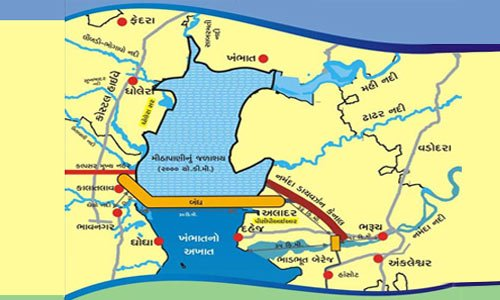
The original idea is to create a new freshwater reservoir by building a dam between Bhavnagar and Bharuch in the Gulf of Khambhat in Gujarat, and stop the inflow of seawater into the Gulf. This project will connect Saurashtra and South Gujarat.
The revised plan has three major components.
The first is the main Kalpasar dam that would connect the Bhavnagar district to the Bharuch district across the Gulf of Khambhat.
The second is the Bhadbhut barrage on the Narmada River near Bharuch. Its purpose is to prevent seawater intrusion and divert freshwater into the reservoir system.
The third component is a massive canal network that would distribute water across Saurashtra and nearby regions.
The project’s estimated cost has now risen to around ₹85,000-90,000 crore. If the project receives final approval and is found technically and environmentally feasible, experts estimate that construction alone could take between 12 and 15 years. The full project timeline could stretch close to two decades.
Water, irrigation and transport benefits
The Kalpasar Project is being planned as a multi-purpose infrastructure system.
The biggest objective is freshwater storage. Water flowing from rivers into the Gulf of Khambhat would be stored before entering the sea. This could help reduce water shortages in Bhavnagar and large parts of Saurashtra. The stored water could also support Kutch and other drought-prone regions currently dependent on the Narmada Canal system.
BOOST FOR KALPSAR PROJECT IN GUJARAT: Accompanied by Netherlands PM Rob Jetten, Indian Prime Minister Narendra Modi visits the iconic Afsluitdijk Dam, a symbol of Dutch excellence in water management, flood protection and freshwater storage. The visit highlights the relevance of… https://t.co/9bJDfNXkL7 pic.twitter.com/zJ0N1Titpm
— DeshGujarat (@DeshGujarat) May 17, 2026
Apart from drinking water, the project is expected to improve irrigation for agriculture across Saurashtra and South Gujarat.
Another major benefit would be flood control. By regulating water flow more efficiently, authorities believe the project could reduce flood risks in nearby regions.
The project also proposes building a massive 10-lane transport corridor on top of the dam. This could sharply reduce travel distance between Bhavnagar and Bharuch, directly connecting Saurashtra with South Gujarat and improving trade and logistics.
Climate change and the future of water infrastructure
PM Modi’s visit to the Afsluitdijk also reflects a much larger global conversation around climate change and water security.
Across the world, rising sea levels, unpredictable monsoons, glacier melt, prolonged droughts and extreme rainfall are forcing governments to rethink traditional infrastructure systems.
India faces a particularly difficult challenge because some regions suffer from severe floods while others struggle with water scarcity at the same time.
Projects like Kalpasar are part of a new approach focused on long-term climate resilience. But such mega-projects also raise difficult environmental, ecological and financial questions.
The Dutch model demonstrates that future infrastructure systems may need to combine flood defence, freshwater storage, renewable energy, transport connectivity and environmental management together instead of treating them separately.
PM Modi’s visit secures critical International support
At present, the Kalpasar Project is still in the planning stage. The Gujarat government recently informed the assembly that the Detailed Project Report (DPR) is being finalised. After that, it will require approval from both the state and central governments.
According to officials, around 43 technical studies have been commissioned for the project, with over 25 already completed.
This is where PM Modi’s Netherlands visit becomes strategically important. By securing Dutch cooperation, India now has access to some of the world’s best expertise in coastal engineering, flood protection and freshwater reservoir planning.
The Netherlands has already dealt with many of the same geographical and engineering challenges that Kalpasar may face. Dutch support could therefore play a major role in improving the project’s design, environmental safeguards and long-term sustainability.
India’s interest in the Dutch model is not only about engineering expertise. It is also about preparing for a future where climate resilience, water security and sustainable infrastructure may become some of the most important pillars of national development planning.


