
The scrutiny surrounding digital news platform Newslaundry has acquired another troubling dimension after journalist Jyoti Yadav publicly recounted her experience of being isolated and hounded by the organisation after she pursued a story that it had itself considered worth covering.
Yadav, in a series of Instagram stories, recalled an episode from 2019 when she was a 25-year-old cub reporter at ThePrint. She said she had pitched a story examining how Narendra Modi’s “carefully cultivated” image as a powerful, authoritative and “alpha” leader was perceived by rural women.
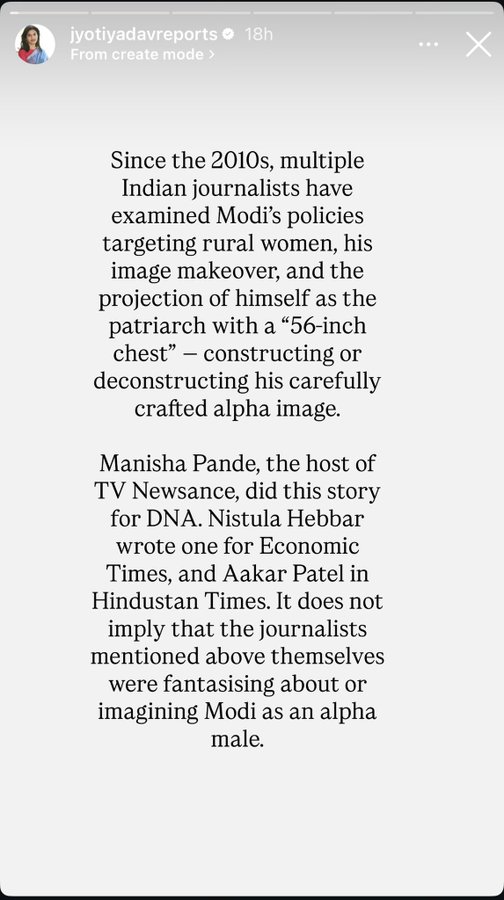
According to Yadav, the subject was hardly unique to her. She pointed out that journalists across publications had examined Modi’s image, including Newslaundry’s own Manisha Pande, Nistula Hebbar of The Economic Times and Aakar Patel of Hindustan Times.
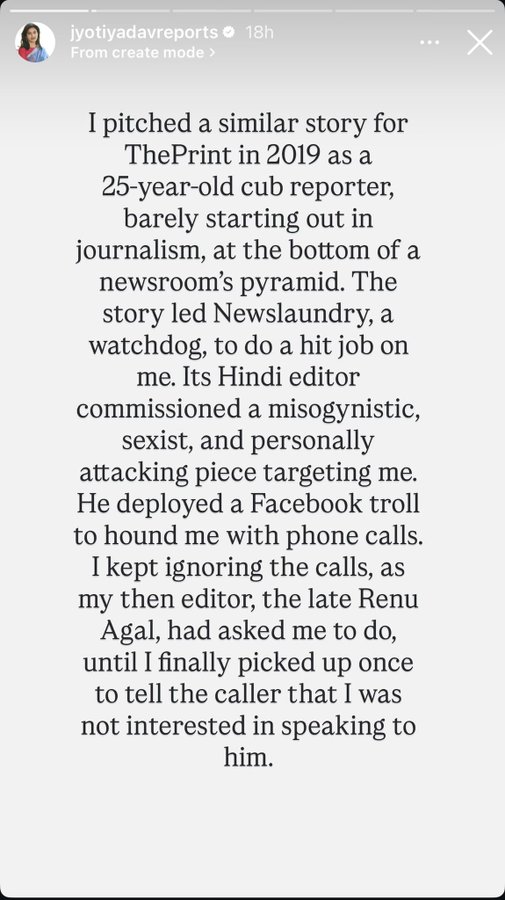
Yet, she alleged, Newslaundry chose to turn the story into a personal attack on her.
The irony becomes sharper when the publication’s 2019 Hindi article is revisited. Authored by Dipankar Patel, the article carried the headline: “रिपोर्टर की कल्पना में द प्रिंट ने बनाया मोदी को सेक्स सिंबल!”, effectively accusing ThePrint’s story of attempting to establish Narendra Modi as a sex symbol among rural women.
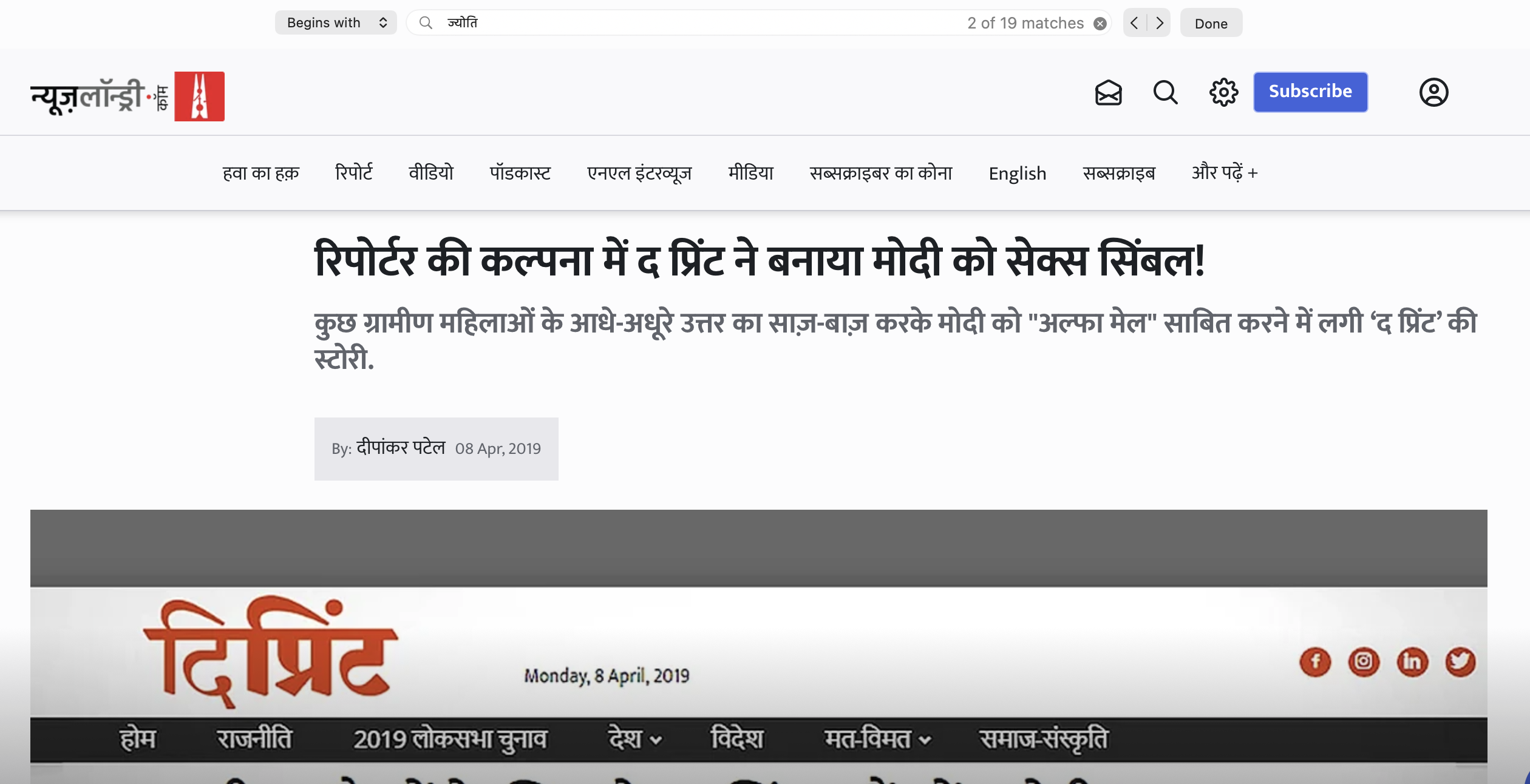
The article went well beyond criticism of the methodology or framing of the story. It repeatedly questioned Yadav’s journalistic judgement, described the piece as sensationalist and sexually obsessed, and sought to dissect her reporting choices.
It questioned why Yadav had asked rural women whether they would marry Modi, whether descriptions of Modi as confident, well-dressed, authoritative and capable of taking action against wrongdoers could legitimately be interpreted as sexual attraction, and whether references to Modi’s photographs with celebrities such as Priyanka Chopra and Ivanka Trump had any relevance to rural women’s perceptions.
The article even challenged Yadav’s understanding of the term “sex symbol”, contrasting her explanation with the dictionary definition of sexual attractiveness.
There can certainly be legitimate disagreement over whether Yadav’s 2019 report justified the headline or whether the methodology supported the conclusions drawn from it. Journalism should be open to such criticism. But that is precisely what makes Yadav’s latest account significant: she says Newslaundry did not merely critique the report. It singled her out personally despite other journalists having explored essentially the same broad subject.
‘A hit job’ on a young reporter
In her Instagram stories, Yadav says she pitched the story to ThePrint in 2019, when she was just beginning her career. According to her account, the story subsequently “led Newslaundry, a watchdog, to do a hit job on me.”
She alleges that its Hindi editor commissioned a “misogynistic, sexist, and personally attacking piece” targeting her and that a Facebook troll was used to repeatedly call her.
Yadav says she initially ignored the calls on the advice of her then editor, the late Renu Agal, but eventually answered one call and told the caller she was not interested in speaking to him.
The more serious allegation concerns the manner in which the Newslaundry article was produced and promoted.
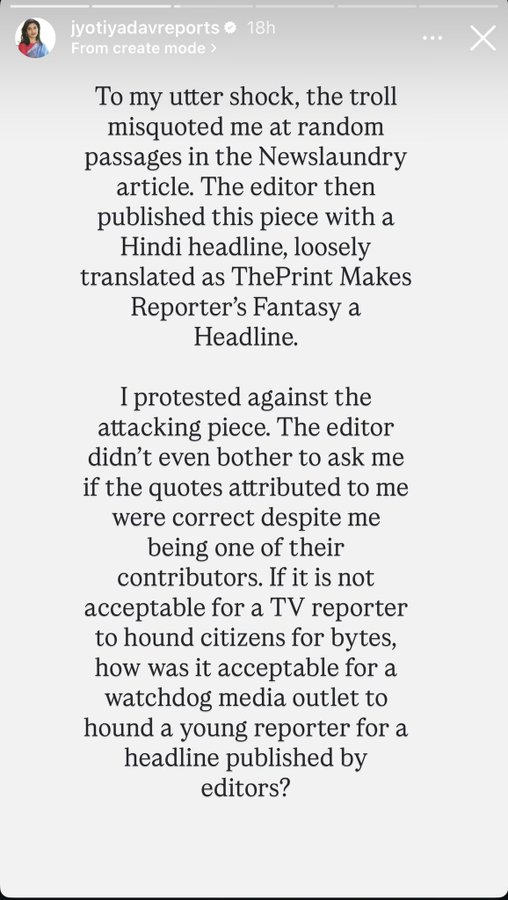
Yadav says the Facebook account used to contact her misquoted her at random passages from the Newslaundry article.
She says she protested against the article, but that the editor did not bother to ask whether the quotations attributed to her were accurate, despite her being a contributor to the organisation.
That allegation raises a basic editorial question: if a publication considers a journalist’s reporting sufficiently problematic to warrant a detailed takedown, why would it not seek clarification from the journalist before publishing quotations attributed to her?
More importantly, why was a story examining the media’s construction of Modi’s public image transformed into a personalised attack on a young woman reporter?
Yadav also points to what she sees as an obvious double standard.
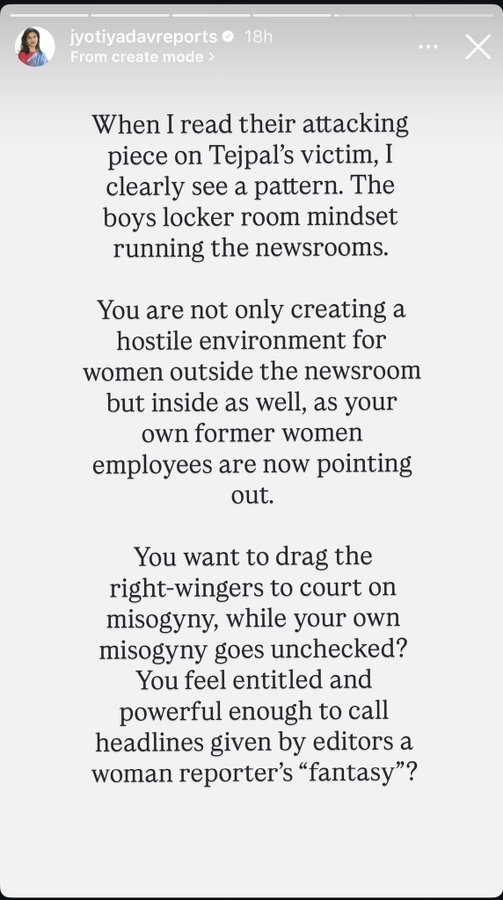
“If Newslaundry deemed it worthy of a hit job, why not include their own editor, Manisha Pande, who had written a similar article?” she asks.
Exposing the Left’s hypocrisy, Yadav wrote: “You want to drag the right-wingers to court on misogyny, while your own misogyny goes unchecked?”
She argues that, at its lowest, the episode could have been understood as two women reporters arriving at similar journalistic questions, one at ThePrint and one at Newslaundry. Instead, she says, the publication chose to isolate and target her.
The Tejpal connection
That account assumes greater significance today because Newslaundry is itself facing questions about the treatment of women within its newsroom.
The organisation’s current controversy erupted into the open after the conviction of former Tehelka editor-in-chief Tarun Tejpal. The Bombay High Court recently overturned Tejpal’s earlier acquittal in the 2013 sexual assault case and sentenced him to 10 years’ rigorous imprisonment.
The timing is uncomfortable for Newslaundry because the organisation has a particularly long association with the Tejpal controversy.
In 2012, Newslaundry published an interview with Tejpal, discussing journalism, ground realities and the media’s tendency towards simplistic narratives. The interview remains available on Newslaundry’s website.
But the far more controversial episode came in 2014, when Newslaundry published an open letter by Nirupama Sekhri, sister of Newslaundry co-founder Abhinandan Sekhri, addressed to the woman who had accused Tejpal of sexual assault.
The article was not merely sympathetic to Tejpal. It questioned the complainant’s status as a victim and referred to her as a victim of “bubblegum feminism”. It questioned her conduct and suggested that the incident had been portrayed as something far more serious than it was.
Newslaundry subsequently published a defence of its decision to carry the article, arguing that it was providing a counterpoint to what it described as a one-sided media narrative.
That old article has now been removed from the website, with Newslaundry subsequently explaining that it no longer reflected the values guiding its journalism.
The irony of that history is difficult to miss. A publication that once devoted considerable editorial space to questioning a sexual-assault complainant’s conduct is now being asked to answer questions about allegations concerning the treatment of women who worked inside its own newsroom.
Former employees begin speaking out
Those allegations have come from multiple former employees.
Former Newslaundry senior correspondent Sumedha Mittal publicly said she hoped the organisation would reflect as seriously on sexual-harassment complaints within its own newsroom as it had on the Tejpal article. Former employee Priyanka Ishwari separately raised concerns about alleged workplace conduct, including an allegation that senior journalists shouted at women editors and threatened them during work calls.
But the accounts did not stop there.
On August 10, journalist Sayantan Ghosh also publicly recounted his experience of working at Newslaundry, alleging that the newsroom environment was deeply toxic and that co-founder Abhinandan Sekhri used abusive language towards employees.
Ghosh said that when he received an offer from Newslaundry, he understood that he would work as a trainee journalist for three or four months and could subsequently be hired if his work was good. He described it as, essentially, an unpaid internship, something he was willing to accept because he was young and wanted to become a journalist.
But, according to Ghosh, what he encountered after moving to Delhi was very different from what he had expected.
“The space, as I experienced it, was extremely toxic. The language used by Abhinandan Sekhri towards employees was deeply hurtful to me. People around me told me that this was ‘normal’ in the media—that this was how newsrooms functioned and that one had to develop a thick skin.”
Ghosh said he had previously worked in mainstream newsrooms, including The Telegraph and The New Indian Express, but had never encountered editors abusing reporters or interns in the manner he experienced at Newslaundry.
“So when I was told that such behaviour was ‘normal’ in the media, I could not accept it. It was not normal to me. For everything, in my experience, the person in question was abused. I had never seen people speak to their own employees in that manner before. But I was repeatedly told that this was simply how things were.”
According to Ghosh, the experience became so traumatic that one particular incident remained etched in his memory.
He recalled writing a story on Section 66A and alleged that the abuse directed at him afterwards was so severe that he fled the office.
“One day, after I wrote a story on Section 66A, the abuse was so harsh that I remember lying to the person I was reporting to and fleeing. I stayed in Delhi for another week, until my parents could arrange a train ticket, and then I returned to Kolkata.”
Ghosh said he had considered writing about the experience several times but remained silent because he feared being bullied or intimidated and began questioning whether he was simply being “too sensitive”.
“I questioned whether I was being too sensitive, whether this really was ‘normal’, whether I simply did not understand how the media worked.”
His decision to speak now, he acknowledged, could invite criticism.
“I know the kind of responses that are waiting for me. I know what will be said and I know that many people may question me. Maybe I am prepared today. But I think I should have spoken about this much earlier.”
Ghosh’s account is significant because it adds an allegation of workplace toxicity from a former male employee to the allegations concerning the treatment of women that have surfaced in recent days.
It should, however, be treated as an allegation and an account of his personal experience, rather than as an established finding against any individual. Sekhri and Newslaundry should be allowed to respond to the specific allegations.
Allegations from women employees
The accounts from women who previously worked at Newslaundry are particularly relevant to the questions now being raised about its workplace culture.
Sumedha Mittal, a former senior correspondent, said she hoped Newslaundry would “reflect just as seriously” on sexual-harassment complaints within its own newsroom.
Priyanka Ishwari, another former employee, alleged that women editors were subjected to inappropriate conduct by senior male journalists.
“Also hope they train senior journos not to scream at women editors and threaten them saying ‘Kabse dekha raha hun mein tereko’ over work calls. Training male reporters to behave professionally around female colleagues and not make the office a boy’s lockeroom maybe too much to ask?”
Again, such public allegations do not by themselves establish that a particular act of harassment occurred or that any complaint was mishandled. But when multiple former employees independently raise concerns about the same workplace environment, they warrant scrutiny rather than dismissal.
There is also a separate historical issue involving Vikram Kilpady, who worked at Newslaundry.
Journalist Lamat R Hasan had previously described an alleged 2005 incident involving Kilpady, saying she was “almost” raped. Recounting the incident, she said:
“He turned violent, pulled my hair, grabbed my wrists, held me against a wall and then pushed me on the bed. My attempts to break free failed. I started crying. He let me go. That’s the closest I have come to being raped.”
Kilpady was subsequently associated with Newslaundry, which itself published an article about the allegations against him during the #MeToo period.
The point is not to suggest that employment at Newslaundry establishes guilt in relation to an allegation made years earlier. It does not. The relevant question is instead how media organisations evaluate allegations of serious misconduct when deciding whom to employ, platform or defend, and whether they apply the same standards internally that they demand of others.
When the ‘watchdog’ becomes the subject
These allegations, by themselves, do not establish that any particular complaint was mishandled or that a particular employee committed harassment. That determination belongs to the appropriate internal or statutory mechanisms.
But the accumulation of accounts is difficult to ignore.
One former employee describes a toxic workplace and alleged verbal abuse. Former women employees have raised concerns about workplace conduct and sexual-harassment complaints. Another journalist, Jyoti Yadav, says she was personally targeted by the organisation after it chose to scrutinise her reporting.
The common thread is not necessarily the nature of each allegation. It is the question of power.
What happens inside a newsroom when editors exercise enormous power over young reporters? What happens when criticism is directed not at someone’s journalism but at their character? And what safeguards exist when the people responsible for enforcing professional standards are themselves accused of violating them?
This is where Yadav’s account becomes relevant to the present controversy.
Her allegations do not concern sexual harassment. They concern the treatment of a young female journalist who says she was personally targeted after her work became the subject of a Newslaundry attack.
That distinction matters.
One should not conflate allegations of editorial bullying with allegations of sexual harassment. But together, the accounts being placed in the public domain raise a broader question about newsroom culture: what happens when women inside or outside an organisation become inconvenient to the people exercising editorial power?
Yadav’s allegation is particularly striking because she says the same basic subject had been examined by Newslaundry’s own Manisha Pande and by other established journalists.
She therefore asks a question that goes beyond the 2019 article: why was she isolated and targeted?
“When I read their attacking piece on Tejpal’s victim, I clearly see a pattern,” Yadav wrote in her Instagram stories. “The boys locker room mindset running the newsrooms.”
That is an allegation, not a judicial finding. But it is precisely the sort of allegation that an organisation committed to accountability should be willing to answer with facts rather than rhetoric.
The POSH Questions
And that scrutiny is no longer confined to social media.
The Delhi Commission for Women has taken cognisance of allegations concerning Newslaundry’s handling of workplace sexual-harassment complaints and the functioning of its Prevention of Sexual Harassment mechanism, according to a report by Storyboard18 cited in the material surrounding the controversy. The commission’s chairperson, Lata Gupta, said the matter was sensitive and that the commission was examining the available information before deciding on further action.
Newslaundry, for its part, has rejected the broader allegations.
Editor-in-Chief Manisha Pande has said that the organisation’s workplace-harassment committee acted on every complaint it received and that dismissals and suspensions were imposed wherever warranted. She has also said that none of those complaints was against the organisation’s CEO and that an external member of the committee conducted a POSH training programme in November 2025.
Those responses deserve to be placed on record. But they also leave legitimate questions unanswered.
How many complaints have actually been received over the years? How many were formally investigated? What were the findings? How many resulted in disciplinary action? Was the Internal Complaints Committee properly constituted throughout? Were employees informed whenever its composition changed? And were mandatory POSH and gender-sensitisation requirements consistently followed?
These are not questions that can be dismissed as an attack on independent journalism.
Indeed, the larger issue is not whether Newslaundry is “anti-government”, “left-wing”, “right-wing” or anything else. A publication’s ideological position does not exempt it from the standards it expects from everyone else.
If an organisation routinely lectures governments, corporations, political parties and media houses about institutional accountability, it cannot reasonably object when the same questions are directed at its own newsroom.
Accountability cannot be selective
Newslaundry has built much of its public identity around challenging powerful institutions and demanding accountability from those who believe their stature puts them beyond scrutiny. Its journalism frequently asks institutions to explain how they treat the vulnerable, how complaints are handled and whether internal systems actually work.
It is now facing those questions itself.
And this time, the demand for answers is not coming from a government ministry or a political party. It is coming from former employees, women journalists and a statutory women’s commission examining the allegations.
The lesson from the Tejpal case should be obvious. Institutions cannot decide for themselves which allegations deserve to be taken seriously based on who is making them, how powerful the accused person is, or how inconvenient the allegations may be.
The conviction of Tejpal has made that point painfully relevant.
For Newslaundry, the question now is not whether it can produce another statement defending itself. It is whether it is prepared to subject its own institutional practices to the same level of scrutiny it demands from everyone else.
The organisation has every right to dispute allegations against it. But if it answers that its internal mechanisms functioned properly, then transparency about those mechanisms should not be treated as an unreasonable demand.
Because accountability cannot be a principle reserved for political opponents.
And feminism cannot begin and end at the newsroom door.