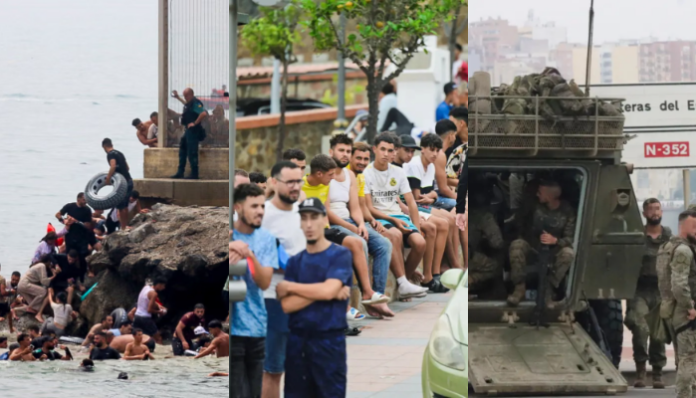
Spain had to send troops to Ceuta, an exclave in Africa bordering Morocco and the Mediterranean Sea, after thousands of illegal immigrants arrived from Morocco within a few hours in one of the most serious border breaches in years on 30th July (Thursday). Several people were killed while trying the perilous sea trip as Madrid deployed forces to re-establish law and order in response to the unexpected influx in its North African enclave. According to the government, 60 soldiers and 200 specialised police officers rushed from the mainland to support the local forces.
At least 18 individuals perished while attempting to flock to Ceuta. A recent increase in attempted crossings for several days led local authorities to seek assistance from the government of Spain. However, unrest erupted in the latest incident after border control appeared to have collapsed. The Spanish government’s team in the enclave reported that the bodies of 9 persons have been found by officials.
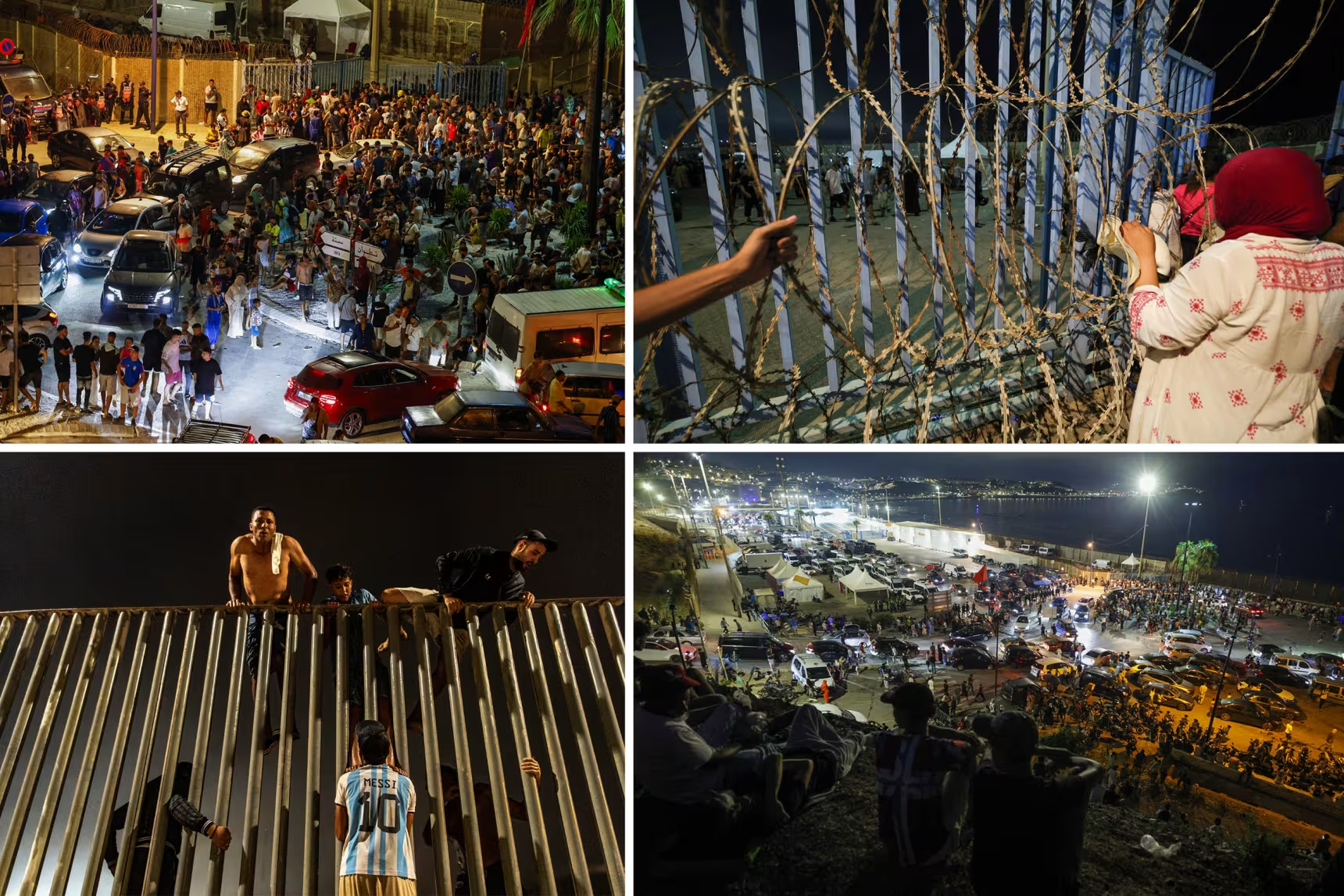
According to analysis from the interior ministry, 49,000 unlawful immigrants stormed Ceuta in a single day. The videos showed large groups of people trying to scale the border fence or move past the Tarajal breakwaters between the Moroccan and Spanish territory.
🇪🇸 Insane footage from the Moroccan border with Spain: thousands of migrants are gathering at the border
— Visegrád 24 (@visegrad24) July 30, 2026
This is exactly what Spanish Prime Minister Sanchez was aiming for. pic.twitter.com/Fb1pEKU0jj
Thousands swam around the border jetty by sliding down concrete embankments into the sea. Rubber rings and flippers quickly covered the beaches on the Spanish side as the new arrivals started to celebrate and even shouted “Viva Espana” (Long live Spain) to express their joy.

Pedro Sanchez, the prime minister of Spain, assured that his government “is fully committed to providing an immediate response to the situation in Ceuta,” and is assembling “all necessary resources, working with Moroccan and international authorities” as well as planning the appropriate actions “to restore normalcy as soon as possible.” He also intimated the same to the Spanish president.
Sanchez appealed, “This is the moment to build solutions, with responsibility and cooperation.” He was also scheduled to visit the region on Friday.
El Gobierno de España está volcado en dar una respuesta inmediata a la situación en Ceuta.
— Pedro Sánchez (@sanchezcastejon) July 30, 2026
Estamos movilizando todos los recursos necesarios, trabajando con las autoridades marroquíes e internacionales, y preparando las medidas necesarias para recuperar la normalidad lo antes…
The interior ministry declared, “The Armed Forces will reinforce the Guardia Civil in the exercise of its powers and any others that may be necessary to maintain civil security in the city of Ceuta.” The current number of soldiers in the tiny 18.5 square kilometres of area stands at 80 and would likely be doubled along with coast guard ships and diving teams.
The ministry also stated that the Moroccan government is working “faithfully and permanently with Spain” to manage the issue and their police are stopping “numerous people” who want to get across the border. It conveyed that the two nations decided to cooperate “for the return, as soon as possible, of all the people who entered Ceuta illegally.”
There was widespread conflict in the Moroccan town of Bni Nsar, which borders the Spanish territory. People who were trying to cross over clashed with authorities, hurled stones and set police cars on fire. Security personnel were injured and many arrests had been made.
Sigue la marcha de miles de marroquíes hacía la frontera de Ceuta. pic.twitter.com/qv97e0ptFz
— David Santos (@davidsantosvlog) July 30, 2026
The ministry reported being “acting in coordination to respond with the utmost speed and efficiency to the situation in Ceuta.” It informed that more resources have been directed “to guarantee security and control of migration as well as the necessary humanitarian aid, so that no lives are put in danger at sea.” Interior Minister Fernando Grande-Marlaska would also visit the region “to monitor the situation” and meet officials on Friday.
Demand to introduce national emergency
“The situation is absolute chaos. It’s not possible to give precise numbers but there are thousands of migrants crossing,” Rachid Sbihi, head of the association that represents Spain’s Guardia Civil in Ceuta, disclosed while talking to the Associated Press. He added that the border has completely broken down, highlighting, “There is no more room for anyone.” The local authorities have accused Madrid of being too slow to react to the overcrowding at the reception centres.
The chief of the Ceuta regional administration, Juan Jesus Vivas, urged the Spanish government to proclaim an emergency on the grounds of national security, requesting the mobilisation of the army and additional police on the border “to guarantee the inviolability of the frontier and citizen safety.” This came after the city’s board of spokespersons met and came to a unanimous decision.
He mentioned, “I spoke out to warn of the extreme gravity of the migration crisis we are enduring,” remarking that the matter continues to intensify with “another night of mass arrivals, nearly a thousand people waiting outside the CETI (Temporary Migrant Reception Centre), our resources completely overwhelmed, and another life lost at sea.”
1.- La declaración de emergencia nacional al amparo de lo previsto en la normativa sobre seguridad nacional
— Gobierno de Ceuta (@GobiernodeCeuta) July 30, 2026
Vivas compared the unfolding circumstances with “a humanitarian and social emergency” of national proportions. “We cannot face this pressure alone, pressure that has resulted in the arrival of between 1,500 and 2,000 people in just 10 days, equivalent to 2% of our population,” he conveyed, adding that “with every passing hour, the situation becomes more difficult.”
Italy considers pausing open border arrangement
On the other hand, the Italian government announced that it could impose “extraordinary measures” in response to the development. Prime Minister Giorgia Meloni wrote, “The images coming from Ceuta are striking and demonstrate, once again, that uncontrolled illegal immigration poses a concrete threat to the security of Europe’s borders,” on social media.
She also held a meeting with Interior Minister Matteo Piantedosi and asserted, “Italy will not stand by and watch. We are convening the relevant bodies, and following these meetings, we are prepared to intervene with extraordinary measures to defend the borders and the safety of citizens, including the suspension of the Schengen Area with Spain.”
Le immagini che arrivano da Ceuta sono impressionanti e dimostrano, ancora una volta, che l’immigrazione clandestina fuori controllo rappresenta una minaccia concreta per la sicurezza dei confini europei.
— Giorgia Meloni (@GiorgiaMeloni) July 30, 2026
Mi sono confrontata con il Ministro dell’Interno Matteo Piantedosi.…
“On illegal immigration, we will not yield an inch: defending the borders, stopping human traffickers, and ensuring effective repatriations will continue to be the line of this Government,” Meloni warned.
What caused the problem
The Strait of Gibraltar divides Ceuta, which is on the northern coast of Morocco, from mainland Spain. The small autonomous area only has around 85,000 people. The people frequently swim from the Moroccan town of Fnideq to Ceuta, a roughly 5-kilometre journey, while some try to cross the land border from the next town of Belyounech, which is at a shorter distance. Others try to make their way through Melilla, another Spanish enclave.
This month, the Supreme Court of Spain ruled that infiltrators who are intercepted at sea en route to Ceuta or Melilla, cannot be promptly sent back to Morocco. These two share the European Union’s only land border with Africa. Notably, the order is only applicable for illegal immigration through the sea. Spain can deport immigrants who cross the land border to Ceuta or Melilla immediately, as per the court order. This decision heavily incentivised people to attempt the crossing by water.
This is the reason why such a large number of Moroccans took boats and swam to Ceuta, instead of taking the easier route of crossing the land border. The Supreme Court order was widely spread on social media, and the illegal immigration mafia took advantage of the order to ship thousands of people to Spain.
Guardia Civil spokesperson said, “It has been a slow trickle since the Supreme Court’s ruling but today has been an explosion,” reported Reuters. Multiple businesses have also been shuttered in Ceuta.
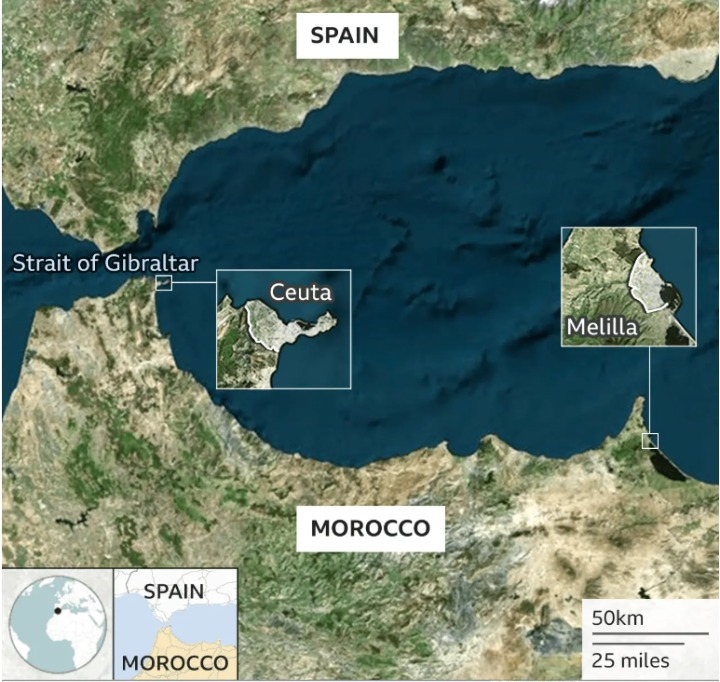
Ceuta and Melilla present exceptional cases because it is technically feasible to enter them “by sea,” avoiding a land border and without crossing the Strait of Gibraltar or the Mediterranean. Human trafficking organisations have been accused by the interior ministry of abusing the verdict to “encourage the flow of undocumented migrants.”
Moreover, the Spanish government also offers amnesty and temporary residency to people who can prove they made it into the country without permission. The law, which was enforced this year, only applies to those who can establish that they were in the country at the time it went into effect. Italy’s Foreign Minister Antonio Tajani drew a parallel between the policy enforced through a royal decree and the troubling scenes in Ceuta.
Sono favorevole alla chiusura dello spazio Schengen con la Spagna e ho piena fiducia nell’operato del Ministro Piantedosi. L’immigrazione irregolare e incontrollata rappresenta un pericolo per la sicurezza nazionale. Le immagini che arrivano da Ceuta dimostrano come la scelta del…
— Antonio Tajani (@Antonio_Tajani) July 30, 2026
The precise reason behind the ongoing problem is unclear, but the pictures are evocative of a similar incident at the border crossing in May 2021, when over 10,000 people from Morocco and sub-Saharan Africa flooded the area only in days triggering a massive diplomatic face-off. Morocco was accused of lowering border controls after Spain allowed Polisario Front commander Brahim Ghali to undergo medical treatment in its hospital. He is viewed as a separatist leader by Rabat.
The lesson for India
India has been plagued by the significant issue of infiltration in relation to Bangladeshi and Rohingya Muslims for decades, which has not only been neglected but even facilitated by opposition parties such as the All India Trinamool Congress (AITC) to strengthen their voter base at the expense of national interest and security.
Furthermore, the Supreme Court has intervened on behalf of these people periodically. In August of last year, it announced its intention to determine whether the illegal Rohingyas residing in the country should be classified as “refugees” or “illegal immigrants.”
The apex court annulled the judgement of the Foreigners Tribunal as well as the order from the Gauhati High Court and recognised Rahim Ali, a suspected illegal immigrant from Bangladesh as an Indian citizen. It asserted to identify inconsistencies in the evidence and procedural errors throughout the investigation.
The crisis of illegal immigration is consistently expanding, with conservative estimates indicating that there could be over 20 million such people in just one state, Karnataka. Thus, the deteriorating condition in Spain acts as a sobering reminder for the nation and its institutions, including the judiciary, regarding the growing challenge at home that requires a viable and effective response instead of any efforts to defend, justify or endorse it.