

The nationwide protests that erupted over the NEET-UG 2026 paper leak are finally beginning to subside. The Cockroach Janta Party, which led the prolonged agitation at Jantar Mantar against the leak, has moved on to other demands like the resignation of the Prime Minister and Home Minister, and withdrawal of cases against criminals. With the re-examination completed and results declared, the medical aspirants for this year have turned their attention to the ongoing counselling and admission processes.
Yet the deeper problem of paper leaks shows no sign of disappearing. In Jharkhand, students continue a determined protest into its third week over alleged irregularities and leaks in JPSC and JSSC recruitment examinations, while in Punjab political and student groups remain agitated over recent cheating scandals and demands for accountability. This underscores how the menace of compromised public examinations has become a stubborn, never-ending national affliction.
In fact, paper leaks have become one of the most corrosive afflictions of India’s competitive examination landscape. What was once regarded as an occasional scandal seems to have turned into a recurring national crisis that strikes at the heart of meritocracy. Across recruitment tests for government jobs, teacher eligibility examinations, board examinations and high-stakes entrance tests for professional courses, the unauthorised circulation of question papers before examination day has repeatedly forced cancellations, re-tests and protracted investigations. The human toll is measured not only in wasted years of preparation and financial ruin for families, but also in eroded public trust and, in the most tragic cases, the loss of young lives.
Not just cancellation of exam, but cancellation of years of sacrifice by families
The fury that erupts after each major leak is most intense among middle-class and lower-middle-class families, and for reasons that go far beyond abstract notions of fairness. For these households, education is frequently the single largest investment of their lives. Parents sell jewellery, take high-interest loans, remortgage modest homes or divert every spare rupee into coaching fees, hostel accommodation and study materials. For millions of Indian youth, competitive examinations are not merely academic assessments; they are the sole vehicles for socio-economic mobility. However, the recurring phenomenon of exam paper leaks has metamorphosed into a systemic crisis, threatening the very foundation of meritocracy in the country.
In coaching hubs such as Kota, Sikar or smaller centres across Bihar, Rajasthan and Maharashtra, families routinely spend 1-3.5 lakh rupees a year, sometimes for three or four successive attempts. The preparation demands years of gruelling labour, immense psychological pressure, and the sacrifice of youth. The unwritten contract is clear: the child will study with monastic intensity, the parents will sacrifice present comfort for future security, and the examination system will reward genuine effort with a place in a government medical college or a stable public-sector job.

When a paper is leaked, that contract is shredded. The child who has woken at four every morning for years discovers that wealthier or better-connected competitors may have seen the questions in advance. The financial outlay is sunk. The opportunity cost of lost years cannot be recovered. For many families, the medical profession represents not merely a career but the surest available ladder of social mobility in a society where government employment still confers status, security and respectability. The sense of betrayal is therefore existential. It is not surprising that protests draw large numbers of ordinary parents and students rather than only professional agitators, or that despair has in some cases led to suicide. The leak is experienced as a direct assault on the one pathway that seemed to reward diligence over privilege.
The outrage surrounding paper leaks is uniquely visceral among India’s middle and lower-middle classes. For affluent families, education abroad or paid management quotas in private colleges serve as reliable safety nets. For the middle class, however, the public examination system is the only legitimate pathway out of financial stagnation.
When a paper is leaked, it does not just cancel an exam; it nullifies years of familial sacrifice. It circumvents merit, allowing wealthy, undeserving candidates to buy seats that rightfully belong to impoverished, hard-working students. The subsequent delays, legal battles, and re-examinations force a heavy financial and psychological burden onto families who simply cannot afford another year of coaching, rent, or deferred employment.
The problem is neither new nor confined to any single examining body. Over the past two decades, dozens of major examinations have been compromised. From the All India Pre-Medical Test in 2015, which the Supreme Court ordered to be cancelled after large-scale irregularities, through successive Staff Selection Commission controversies, Central Board of Secondary Education board paper leaks in 2018, and a string of state-level recruitment and teacher eligibility scandals, the pattern has been consistent. Organised networks of middlemen, compromised officials, coaching intermediaries and solver gangs have exploited every weak link in the examination chain. An analysis of cases between 2002 and 2025 showed that meaningful convictions of senior officials remained rare even after hundreds of arrests. The result is a cycle of outrage, temporary administrative responses and eventual return to business as usual, until the next scandal erupts.
Focus on NEET: Structural vulnerability
Nowhere has this crisis been more acute or more publicly painful than in the National Eligibility cum Entrance Test for undergraduate medical admissions. NEET-UG, conducted by the National Testing Agency, is the sole gateway to medical, dental and AYUSH seats across the country. While many recruitment and entrance exams at both national and state levels frequently suffer leaks, the medical entrance exam, NEET-UG, has become the crown jewel for the “solver mafias” due to a combination of high stakes, logistical flaws, and organised crime.
First, the astronomical stakes and immense competition play a major role. With over 2.4 million candidates competing for roughly 1.1 lakh medical seats, the desperation to secure a rank is immense. The prestige and lifetime earning potential of a medical degree make parents vulnerable to the promises of the paper leak syndicate.

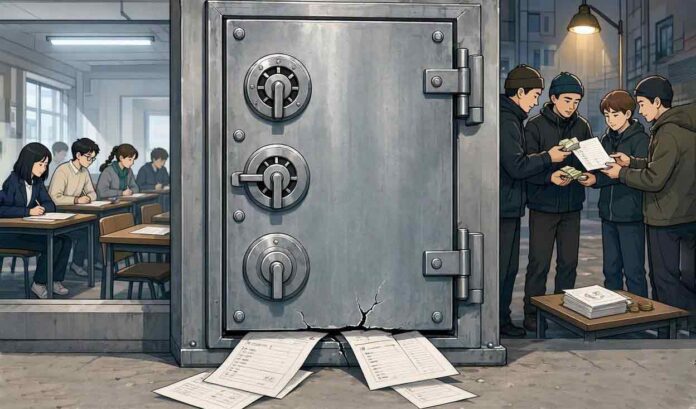
In 2024, the examination was overshadowed by a localised but well-documented leak at a centre in Hazaribagh, Jharkhand. Question papers were removed from sealed trunks after they had arrived from a bank vault, digitally copied, solved by a group of medical students in minutes before the exam and transmitted to aspirants who had paid substantial sums. The Central Bureau of Investigation later identified more than 140 direct beneficiaries. Although the Supreme Court declined to order a full nationwide cancellation, the episode left deep scars and prompted the first serious legislative response.
Two years later, the damage was far greater. On 3 May 2026, more than 22 lakh candidates sat the NEET-UG examination. Within days, a widely circulated “guess paper” containing several hundred questions was found to match a large proportion of the actual paper, particularly in chemistry and biology. Investigations by Rajasthan’s Special Operations Group and subsequently by the CBI revealed that the leak had originated not from the printing or distribution stage but from inside the paper-setting process itself. Subject experts empanelled by the National Testing Agency, including a retired chemistry lecturer and a biology teacher, had access to the master question pool. They memorised or transcribed questions, dictated them during private sessions at coaching classes, and allowed the material to be compiled into a digital document that travelled through WhatsApp and Telegram groups across multiple states. Prices reportedly ranged from tens of thousands of rupees to several lakhs depending on the stage of circulation. The National Testing Agency cancelled the entire examination on 12 May, ordered a re-test for 21 June, and the matter was handed to the CBI.
The re-examination proceeded under heightened security, and results were eventually declared in July, with approximately 11.21 lakh candidates qualifying. Yet the political and social fallout was severe. Street protests continued for weeks, several aspirants died by suicide amid the uncertainty, and the then Union Education Minister had to resign. The episode confirmed what many observers had long suspected: that NEET is uniquely vulnerable.

The high-stakes nature of the examination amplifies the incentive to leak the paper. With roughly one lakh medical seats available, of which only a fraction are in low-fee government colleges, the difference between success and failure can determine a family’s economic trajectory for a generation. Coaching centres, whose commercial reputation depends on the number of successful candidates they produce, form a ready market for any advance information. The absence of an upper age limit or attempt restriction further enlarges the pool of desperate, multi-year aspirants who become potential customers for leaked material. In short, scarcity, physical logistics and a vast commercial ecosystem of preparation combine to make NEET an especially attractive target.
Anatomy of a leak: Why the system keeps failing
Several structural features explain this vulnerability. Unlike the Joint Entrance Examination – Main for engineering courses, which is conducted by NTA as a computer-based test across multiple shifts and days, NEET remains a single-day, pen-and-paper examination taken by more than two million candidates simultaneously.
The recurring failures stem from vulnerabilities at nearly every stage of the testing life cycle. The traditional pen-and-paper model is a nightmare built on archaic logistics. Question papers are drafted by subject experts, moderated, translated into multiple languages, sent to physical printing presses, packed into sealed trunks or cartons, transported across thousands of kilometres by road or rail, and temporarily stored in bank vaults, warehouses or school strong rooms before final distribution to examination centres. Every physical transition point becomes an opportunity for theft.

Investigations into successive scandals have repeatedly shown that the printing stage is among the most frequent points of compromise, followed closely by transport and last-mile storage. In some cases, the breach has occurred even earlier, at the paper-setting stage itself, when empanelled experts with legitimate access to the master question pool have memorised or transcribed questions and passed them into coaching networks.
This is how the leak took place this year, as three experts in Physics, Chemistry and Biology noted the questions while translating them at a confidential section of NTA headquarters and passed them to their students at coaching classes. Interestingly, the 2026 paper was not supposed to be leaked; they were dictated to the students to note down as part of their regular class notes. But one person collected the notebooks, compiled the questions, typed them as question papers, and sold them to others. The paper then reached Telegram, after which it was detected.
This fragility is severely exacerbated by an over-reliance on outsourcing. Despite having conducted more than 270 examinations and handled over 6.6 crore candidate registrations since its inception in 2018, the National Testing Agency operates with a strikingly thin permanent establishment—only a few dozen posts filled largely by deputation, supplemented by large numbers of contractual and outsourced personnel.
Critical functions such as printing, logistics, biometric verification, centre management and even elements of question-paper handling are routinely contracted to private agencies, local transport companies and administrators of private schools. Accountability becomes almost impossible to enforce when responsibility is fragmented across so many loosely supervised parties. A single compromised employee at a press, a courier depot or a centre strong room can undo months of security protocols.
Adding to these physical and organisational vulnerabilities are distinct technological disadvantages. The rapid advent of encrypted messaging applications such as Telegram and WhatsApp allows a paper leaked in a remote village or a private residence to be broadcast almost instantly to thousands of paying clients across the country before authorities can even mobilise a response. In the 2026 NEET case, the material circulated for nearly two days in the form of a disguised “guess paper” containing hundreds of questions; in earlier episodes, solved papers travelled from Hazaribagh to Patna within hours. Once digitised, the material is almost impossible to contain.
These operational weaknesses are reinforced by deeper structural incentives. The extreme scarcity of government medical seats and secure public-sector jobs creates a lucrative black market in which organised “exam mafias” invest substantial capital. Solver gangs, middlemen, coaching intermediaries and sometimes even candidates themselves form interlocking networks that treat a successful leak as a high-return commercial enterprise.
Weak and delayed enforcement compounds the problem: arrests are frequent, yet convictions of key organisers remain rare, and trials drag on for years. The result is a system that looks increasingly sophisticated on paper yet continues to fail at the points where human frailty, commercial temptation and logistical complexity intersect. Until the chain of custody is radically shortened, permanent institutional capacity is strengthened, and the economic prize of a compromised examination is reduced, the anatomy of the next leak will continue to look depressingly familiar.
What steps are being taken
In response to the escalating crisis, the government has been forced to take both legislative and administrative action. To provide a stringent legal deterrent, the government introduced The Public Examinations (Prevention of Unfair Means) Act, 2024, explicitly targeting the organised syndicates rather than just the students. It makes exam-related offences cognizable and non-bailable, carrying severe penalties including imprisonment ranging from 3 to 10 years and fines up to ₹1 crore for those facilitating leaks.
The Act criminalised a wide range of unfair practices, including leakage of question papers, tampering with answer sheets, impersonation and collusion, and prescribed imprisonment of three to five years together with fines. It came into force in June 2024.
Alongside legal measures, the K. Radhakrishnan Committee was constituted in the wake of the 2024 NEET controversy to recommend systemic overhauls. Submitting its comprehensive report in October 2024, this high-level expert panel proposed radical changes to the NTA. Central to their recommendations was the implementation of Computer-assisted Secure Pen-and-Paper Testing (CPPT). To eliminate the risks of printing and transport, the committee proposed sending highly encrypted question papers electronically to local servers at the exam centres, which would be decrypted and printed on-site just minutes before the exam begins, while students still take the test using traditional pen and paper.
The report also called for robust institutional restructuring through the creation of 1,000 “Secure Testing Centres” across India, thereby reducing the NTA’s reliance on vulnerable private institutions. Furthermore, to definitively prevent impersonation by proxy solvers, the committee advised the use of multi-stage authentication, utilising Aadhaar, biometrics, and AI-based analytics from the initial application stage right through to final admission.

After the 2026 NEET cancellation and the ensuing protests, the government moved swiftly to amend the law. The Public Examinations (Prevention of Unfair Means) Amendment Act, 2026, which received presidential assent after being passed by both houses of Parliament last month, substantially increased penalties. Individuals now face five to ten years’ imprisonment and fines up to fifty lakh rupees. For organised crime, the minimum sentence is seven years, and the fine may reach ten crore rupees. Service providers face higher financial penalties and longer debarment periods. Crucially, the amendment introduces statutory timelines: investigations must be completed within two months and trials in specially designated fast-track courts within three months of the charge sheet.
Administrative measures have accompanied the legal changes. Dozens of National Testing Agency officials were terminated. A high-powered task force headed by Nandan Nilekani, with members including the former ISRO chairman S. Somanath, the IIT Madras director V. Kamakoti and other experts in technology, security and administration, was constituted to recommend structural and technological reforms. The government has also spoken of a multi-layered security protocol for future NEET examinations, including unique serial numbers linked to individual candidates, air-gapped systems for translation, and enhanced packaging. Whether these measures will prove durable remains to be tested.
What can stop the menace: Necessary reforms
While laws and committees look good on paper, the catastrophic events of 2026 prove that implementation remains woefully inadequate. Legislation and task forces are necessary but insufficient. The deeper solutions must address both the operational vulnerabilities and the underlying scarcity that fuels the black market. To permanently eradicate the menace of paper leaks, India must adopt a multi-pronged approach that moves beyond temporary fixes.
The physical custody chain must be shortened or eliminated wherever possible. Computer-based testing, already used successfully for JEE Main, removes the need to print, transport and store physical papers. Where pen-and-paper remains unavoidable for reasons of digital access or subject requirements, encrypted digital transmission followed by just-in-time printing inside secured centres under continuous CCTV monitoring can drastically reduce exposure. Multiple randomised question sets, or even unique papers assembled algorithmically from large calibrated question banks, would make any single leaked document far less valuable.
The paper-setting process itself requires rigorous insulation. Subject experts who set or review questions should be subjected to strict conflict-of-interest declarations, temporary isolation from coaching networks, and continuous monitoring. The practice of repeatedly engaging the same individuals who maintain parallel commercial interests must end. Computerised randomisation of question selection from large question banks can further reduce the power of any single insider.
Technology must be deployed not merely for surveillance but for design. Adaptive testing, blockchain-secured question banks, biometric multi-factor authentication at every stage, and artificial-intelligence monitoring of anomalous patterns can raise the cost and complexity of successful leaks to a point where they become commercially unattractive.
Institutional capacity and accountability must be strengthened. The National Testing Agency needs permanent professional leadership, adequate staffing, independent oversight and transparent audit mechanisms. Fast-track courts and time-bound investigations will only deter if they lead to actual convictions and asset seizures. Whistle-blower protections and rewards for information that prevents leaks could disrupt networks from within.
The government must achieve total technological autonomy by ceasing to outsource critical exam infrastructure. Establishing a sovereign digital network specifically for examinations, equipped with end-to-end encryption and subjected to aggressive, regular cybersecurity audits, is absolutely non-negotiable for future security.
Strict regulation of the coaching industry is also essential. The demand for leaked papers is directly proportional to the immense pressure placed on students by these massive businesses. Implementing the Radhakrishnan panel’s recommendations to oversee and regulate coaching institutes will help curb the financial extortion and toxic competition that constantly fuels the leak syndicates.
Most fundamentally, the scarcity of opportunities must be eased. Expanding the number of affordable medical seats, improving the quality of school education so that coaching becomes less indispensable, and creating more diverse pathways into the professions would lower the economic premium attached to any single examination. As long as a government medical seat remains a life-changing lottery ticket, organised crime will find ways to exploit it.
Conclusion
Paper leaks are more than administrative failures; they are a quiet assault on the social contract that tells ordinary Indian families that hard work and talent can still overcome modest origins. The middle and lower-middle classes have invested their savings, their children’s childhoods and their hopes for intergenerational progress in an examination system that has repeatedly proved permeable to money and influence. The recent NEET scandals have made the human cost impossible to ignore.
Stricter laws, technological upgrades and institutional reform are all underway, yet lasting success will depend on whether India is prepared to treat examination integrity as a national priority equal to infrastructure or defence. Only when the system becomes so secure that leakage is both extremely difficult and economically irrational, and only when genuine opportunity is sufficiently abundant that the prize is no longer worth the crime, will the menace finally recede. Until then, every cancelled examination and every shattered dream will continue to exact a price that the country can ill afford.



