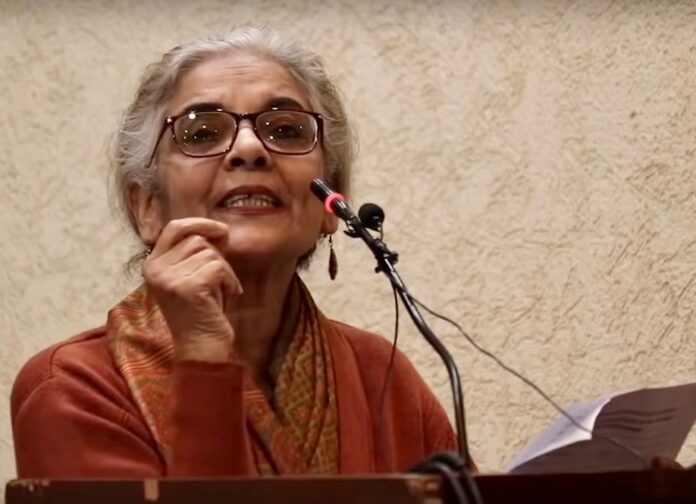
On the eve of Independence Day, Sardar Patel Vidyalaya in Delhi cancelled the appearance of Zoya Hasan as chief guest for its flag-hoisting and scholarship award ceremony. She had been invited to address students on “pluralism.” But the school subsequently cancelled her invitation after protesters allegedly belonging to VHP raised concerns against her presence.
Delhi Police confirmed the school informed them of the threat and that officers were deployed only for protection; the decision to cancel was the school’s. The programme proceeded with another speaker.
While the episode might have disappointed Ms Hasan, the far-left The Wire appeared considerably more agitated by it. It rushed to wrap the incident in emotive language, branding the protesters “goons” and casting Hasan as the supposed victim of an assault on pluralism.
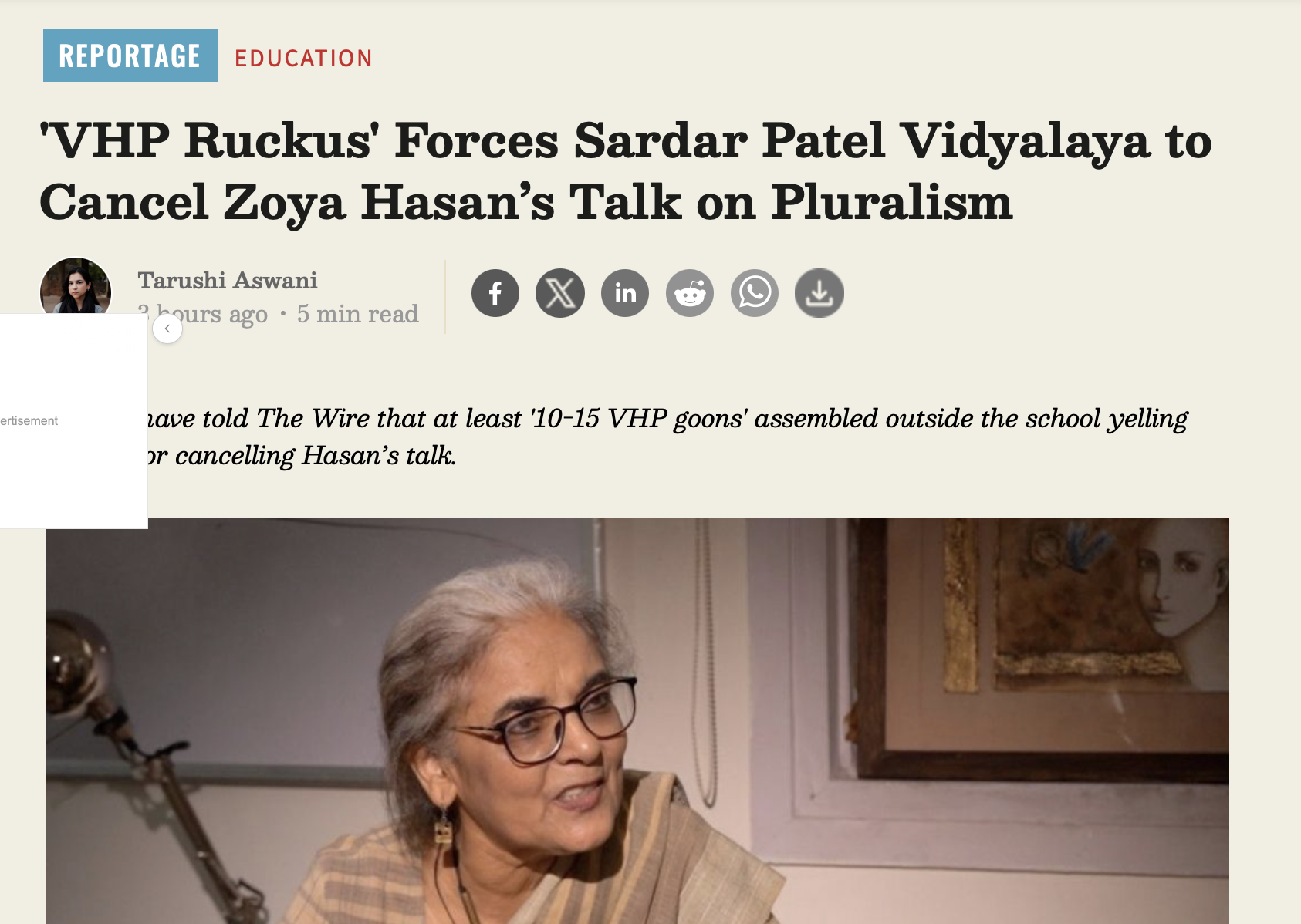
But even its own report could not sustain that sweeping narrative without caveats: after citing sources who claimed that 10-15 VHP members had gathered outside the school, The Wire acknowledged that the VHP itself had not confirmed their presence and that some teachers said they had not seen any such persons outside their campus.
However, this was never merely about one cancelled lecture. It was about whether a school should hand an Independence Day platform before children to a figure whose entire public career has been defined by sharp, polarising and partisan political interventions disguised as neutral academic scholarship.
Who Is Zoya Hasan, really?
Hasan is Professor Emerita at Jawaharlal Nehru University, former Dean of the School of Social Sciences. That institutional perch gave her influence. She has used it consistently as an ideological campaigner, not a detached academic.
Her books focus on the Congress and the rise of the BJP. Congress After Indira examines the party in detail. Ideology and Organization in Indian Politics frames the transformation of Indian politics as the replacement of an earlier secularism by “Hindutva nationalism.”
She occupied a prominent place in the liberal-left intellectual ecosystem that thrived under the UPA. She served on bodies such as the National Commission for Minorities, the National Integration Council, CABE and the National Book Trust. In 2010 she publicly urged the UPA-II government toward more “inclusive” policies. This is the classic Delhi establishment circuit: universities, minority commissions, textbook committees and commentary platforms overlapping to shape discourse in one direction.
Anti-CAA activist, not observer
Hasan’s most consequential recent role has been her opposition to the Citizenship Amendment Act. The law offers an expedited path to citizenship for persecuted non-Muslim minorities from Pakistan, Bangladesh and Afghanistan. Hasan did not merely critique it from an ivory tower. She co-authored co-authored When People Protest: Mobilising for Equal Citizenship in India, a work that glorified the anti-CAA movement, its mobilisation strategies, and its demands for equal citizenship.
Zoya Hasan also portrayed the anti-CAA protests in strongly celebratory terms, particularly highlighting the role of Muslim women at Shaheen Bagh. She described them as being “in the vanguard” and the “life and soul” of resistance to the CAA, while arguing that their mobilisation represented a major assertion of citizenship, democratic rights and public participation. Hasan has also characterised the protests as a significant moment of democratic renewal, presenting the movement not merely as opposition to a law but as a broader struggle over the idea of citizenship and the Indian state.
Her writings treat the protests as democratic mobilisation for equal citizenship while casting the law itself as an assault on constitutional values. It is nothing but a part of the Left’s sustained campaign against CAA that lent academic legitimacy to prolonged street protests. When such a figure is invited to lecture schoolchildren on “why pluralism matters,” the invitation is not neutral. It is an endorsement of a specific, divisive ideology with a twisted political reading of citizenship and nationhood.
The Ambedkar cartoon episode
In 2012, while serving on the National Monitoring Committee linked to NCERT political science textbooks, Hasan defended a controversial cartoon depicting B.R. Ambedkar seated on a snail (representing the slow constitution-making process) with Nehru holding a whip behind him. The cartoon triggered parliamentary uproar for disparaging the chairman of the Drafting Committee. Advisers Yogendra Yadav and Suhas Palshikar resigned after the government ordered its withdrawal.
Hasan took the opposite position. She criticised the campaign for removal and argued that the review process had failed to grasp the “complexities.” For those who found the image offensive in a school textbook, her defence of it is revealing. The same academic associated with that controversy was later presented to schoolchildren as an authority on India’s civic values.
From CAA to Palestine: Consistent polarisation
Hasan’s interventions extend beyond domestic contests. In November 2024, Gurugram University cancelled a discussion she was scheduled to deliver titled “Palestinian Struggle for Equal Rights: India and Global Response.” The university called the topic controversial; Hasan denounced the decision as “censorship.” The pattern is consistent: she selects India’s and the world’s most charged issues, frames them in the language of rights and justice while targeting the Modi government and Hindu nationalism, then cries foul when institutions decline the controversy.
She has written critically of the VHP, Bajrang Dal and other Sangh-linked organisations, linking them to vigilantism and communal violence. Her public commentary routinely portrays BJP politics through the lens of majoritarianism, intolerance and suppression of dissent. This is not the record of a neutral commentator on pluralism. It is the record of an ideological actor who has repeatedly placed herself at the centre of India’s most divisive debates.
The school platform question
The VHP and others who objected to her invitation were not inventing a problem. They were responding to a clear record: an outspoken critic of the Modi government, active anti-CAA campaigner, defender of a textbook cartoon many found insulting to Ambedkar, and vocal pro-Palestine voice, being given the Independence Day stage before schoolchildren to speak on “pluralism.”
Peaceful protest against that choice is democratic pushback, not “goon” behaviour. A school’s first duty is the safety of its students; security concerns justified the cancellation. The deeper failure lies with the school for selecting such a polarising figure in the first place. An Independence Day ceremony is a civic occasion, where nationalist voices should be encouraged and platformed. It should not be turned into an event where dubious individuals who use their academic credentials to attempt ideological indoctrination are feted.
Hasan has every right to her views and to advocate them. Institutions that claim to value pluralism and the careful formation of young minds have a corresponding responsibility not to present ideological campaigners as neutral authorities. The episode at Sardar Patel Vidyalaya simply forced that question into the open. It was one more round in the long contest over who gets to define nationalism, pluralism and India’s constitutional identity, and whether schools should serve as platforms for one side of that contest.