A routine Dubai-to-Tel Aviv flight turned into a terrifying fight for survival at 34,000 feet on Wednesday, September 30.
Inside the cockpit of flydubai Flight FZ1073, an Omani co-pilot turned on the captain, stabbing him and attempting to take control of the aircraft as it flew towards Israel with around 180 people on board.
The captain fighting back against him was an Indian Gujarati.
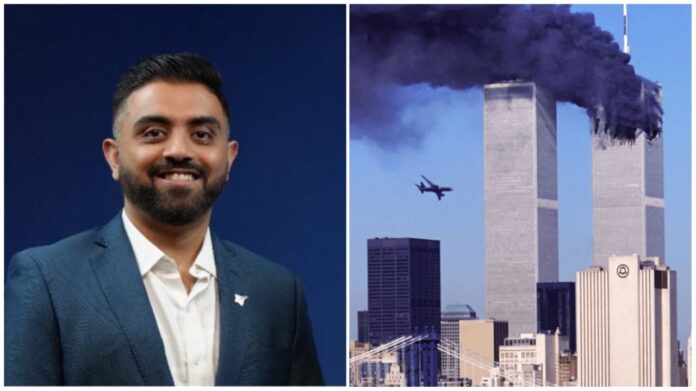
Captain Smit Machchhar, an experienced Indian aviator and former SpiceJet pilot, is now at the centre of an extraordinary aviation emergency that investigators have described as an attempt to carry out a “9/11”-style attack.
On September 11, 2001, hijacked passenger aircraft were deliberately turned into weapons and used to attack targets in the United States. Twenty-five years later, an Israel-bound passenger aircraft appears to have come frighteningly close to becoming the weapon in another mass-casualty attack.
This time, however, the cockpit did not remain under the attacker’s control.
An Indian captain fought back.
The Indian captain at the centre of the crisis
Machchhar has been identified as the pilot in command of Flight FZ1073.
According to his professional profile and reports from Indian media, he has more than 13 years of commercial aviation experience and approximately 9,750 hours of flying experience, primarily on Boeing 737 aircraft. More than 6,400 of those hours were accumulated as a pilot in command.
Before joining flydubai, Machchhar spent around 11 years with SpiceJet in India.
He eventually became a senior commander and later a Line Training Captain, meaning that he was entrusted with training and checking other pilots.
In June 2022, he joined flydubai as a direct-entry captain.
His experience includes the Boeing 737-800 and Boeing 737 MAX variants—the same aircraft family involved in Wednesday’s emergency.
That experience would prove critical when the flight suddenly descended thousands of feet, and the cockpit descended into chaos.
A knife attack at 34,000 feet
Flight FZ1073 had taken off from Dubai and was heading towards Tel Aviv.
Then something went horribly wrong.
According to Israeli officials and passenger accounts, the Omani co-pilot attacked Machchhar with a knife inside the cockpit. Passengers heard shouting and subsequently saw blood.
The aircraft’s flight path changed dramatically.
Flight-tracking data showed the Boeing 737 falling by approximately 14,300 feet in just 37 seconds during the most dramatic phase of the incident. The aircraft also transmitted emergency signals, including the internationally recognised 7500 code for unlawful interference.
For the passengers, there was no way of knowing what was happening.
For Israel’s air-defence authorities, the 7500 transmission raised the terrifying possibility that a passenger aircraft headed towards Tel Aviv had been hijacked.
Israeli fighter jets were scrambled.
And then came the revelation that made the incident even more disturbing.
According to Israeli officials, this was not necessarily a conventional hijacking.
It was an attempt to crash the aircraft itself.
‘He tried to do 9/11’
An Israeli official quoted by N12 described the incident in stark terms, saying that one pilot stabbed the other and attempted to “do 9/11”, either by taking control of the aircraft and bringing it down or deliberately crashing it.
Israeli Prime Minister Benjamin Netanyahu also said the co-pilot had attempted to crash the plane and praised those who intervened to prevent the disaster. Reuters reported that Israeli officials were treating the incident as a deliberate attack, while the investigation into the exact motive and sequence of events continued.
The language is striking because of what Flight FZ1073 represented.
It was an ordinary passenger aircraft. It was carrying civilians. It was travelling towards a major population centre.
And, according to the initial probe, the attacker was already sitting inside the cockpit.
The fight did not end in the cockpit
Machchhar was stabbed but fought back.
As the aircraft descended rapidly, passengers near the front realised something was seriously wrong. Some rushed towards the cockpit after hearing screams.
Passengers and crew members managed to enter the cockpit and help restrain the alleged attacker.
Other pilots travelling on the aircraft also became involved in bringing the situation under control.
The aircraft eventually stabilised and was diverted towards Saudi Arabia.
That intervention appears to have prevented the crisis from becoming something far more catastrophic.
Passengers and a crew member managed to break into the cockpit and restrain the attacker, while other pilots helped safely land the aircraft. All passengers ultimately emerged unharmed.
From Tel Aviv to Tabuk
Instead of continuing towards Tel Aviv, FZ1073 headed for Saudi Arabia.
The damaged aircraft eventually landed safely at Tabuk in northwestern Saudi Arabia.
Both pilots were injured and taken to hospital.
The passengers survived.
The aircraft did not crash.
And the flight never became the mass-casualty weapon that the attacker wanted it to become.
Who was the attacker?
Israeli and international reports have identified the co-pilot as an Omani national.
According to Israeli reporting, investigators are examining his background, his security clearance and how he was permitted to operate a flight into Israel.
The motive, however, remains a matter for investigators.
This distinction matters.
While Israeli officials have described the incident as a terrorist attack and said the co-pilot attempted to crash the aircraft, the investigation is still underway. Flydubai itself has not publicly adopted that characterisation and has referred to the event simply as an incident.
An Indian pilot between 180 people and catastrophe
There is an unmistakable irony in the identity of the man who found himself at the centre of this extraordinary crisis.
Smit Machchhar was not flying a fighter jet.
He was not on a military mission.
He was flying a commercial passenger aircraft from Dubai to Tel Aviv.
Yet when the cockpit itself became the source of the threat, the responsibility for preventing catastrophe fell on the captain, the remaining crew and the passengers who rushed towards the danger.
Machchhar had already been stabbed.
The aircraft was plunging.
The cockpit was covered in blood.
And yet the captain fought back.
His more than 9,000 hours of experience could not have prepared him for every detail of what happened on Wednesday. But the training, discipline and composure expected of an airline captain were suddenly being tested in the most extreme circumstances imaginable.