A series of significant events has been playing out in the United States, and interestingly, India and Indians seem to be at the centre of many of them. In fact, it would not be wrong to say that the country and its people have been weighing heavily on the mind of the Trump administration.
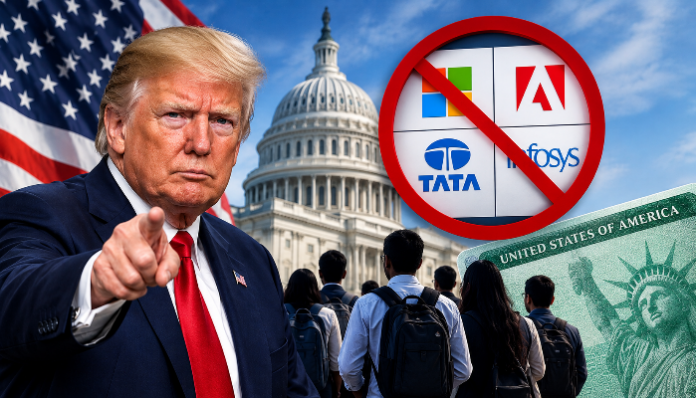
In its latest heavy-handed move, Washington has suspended the Permanent Labour Certification (PERM) program for Microsoft, Adobe, Capgemini and other major Information Technology (IT) companies that served as a key step towards permanent residency for skilled foreign workers.
The announcement is especially crucial for India because it includes Infosys, Tata, Wipro, Hindustan Computers Limited (HCL) and Cognizant. Indian IT firms have been major actors in America’s technology and outsourcing industries.
Indian experts have historically made up a substantial portion of the H-1B workforce. Therefore, the decision could be pivotal to the long-term immigration plans of these workers whose employers are sponsoring their green card applications or were preparing for it.
More importantly, this is another redux of the Trump administration’s disruptive policy shift directed towards Indians.
It has rolled out multiple such measures, from demanding $100,000 for the H-1B visa and overhauling the H-1B visa lottery system, to proposing multi-thousand-dollar fees alongside increased audits and scrutiny by federal authorities, under the banner of taking a tough stance against “foreign workers and students,” which specifically targets the community.
President Donald Trump had even issued an executive order prohibiting federal agencies from hiring or subcontracting foreign workers, with a focus on those with H-1B visas, which he suspended earlier.
However, these developments are neither isolated incidents nor entirely spontaneous occurrences. On the contrary, they are a conscious effort, aimed at appeasing the racist, anti-Indian and Hinduphobic sections of the MAGA (Make America Great Again) support base of Trump.
The fundamental claim which lies at the centre of this xenophobia is that Indian employees have replaced Americans in the US. This rhetoric has even received endorsement from the nation’s top leadership.
“Our message to Microsoft is: You’re a great American company, but you’ve got to hire great American workers,” Vice President JD Vance stated, accusing the aforementioned IT businesses of “abusing” the visa system and prioritising “foreign workers” over Americans. However, the administration was met with a swift response from the companies, refuting the allegations.
The reality remains that the circumstances taking shape in the country are not anchored in accuracy but rather constitute a pernicious propaganda intended to damage India, a phenomenon that has repeatedly manifested through intensely hostile commentary aimed at New Delhi or blatant Hinduphobia that has been evident among white Christian nationalists there.
The tariff row: How Trump administration attacked India over Russian oil purchases
The Trump administration’s hostility toward India shone through when it blamed the country for the Ukraine war and slapped 50% tariffs, including 25% for Russian oil purchases, to pressure it into ending energy imports from Russia. This antagonism was compounded by a glaring contradiction. Washington had previously urged New Delhi to continue the procurement to help stabilise global energy markets.
However, when the Modi government refused to comply with their demands and asserted its sovereign right to make decisions in its own national interest, the Trump administration reacted with petulant retaliation.
Interestingly, China, which buys a large portion of Russian oil, did not face any such action. Furthermore, European nations were continually supplied Russian gas as the West collectively criticised India, and the US wanted to punish it for its alleged “insubordination.”
However, the episode transcended a mere diplomatic standoff between the two sides, as the US directly held India responsible for the conflict only for consuming Russian oil and not buckling under the pressure. Trump had threatened, “India will continue to pay massive tariffs if they do not cease buying oil from Russia.”
Afterwards, the rate was reduced to 18% due to a bilateral agreement, but he reiterated, “India was getting 50% tariffs dropped down to 18%, but they have to agree to stop buying Russian oil,” framing this as a prerequisite to sever energy ties with Moscow.
“Trump has applied aggressive economic leverage, for example, secondary tariffs on India, to try to make it harder for the Russians to get rich from their oil economy. It is meant to force Russia to the negotiating table and stop the killing,” Vance had similarly argued, justifying the unwarranted targeting of India.
The entire Trump lobby maintained this strategy of regularly invoking India’s name in connection with the Ukraine dispute to wrongly assign it accountability. US Treasury Secretary Scott Bessent even dragged industrialists Mukesh Ambani and Gautam Adani into it, claiming that the centre was taking oil from Russia to fill their pockets at the expense of citizens. The intention was to stoke political tensions with unsubstantiated statements.
Washington has wielded tariffs as leverage against India to compel adherence to American objectives. It is even considering 100% tariffs on Russian trading partners, including India. The US Trade Representative (USTR) has further suggested imposing additional 12.5% tariffs on products from India and other countries over goods produced using “forced labour,” after which the Indian government outlined the absence of adequate evidence in the probe.
Trump has characterised India as a “high tariff” country that was not a “good trading partner,” which “used to really rip us off” while also threatening to impose sweeping tariffs on many occasions. He even pushed Apple Inc.’s executive chairman Tim Cook to limit investments in manufacturing facilities in India, reiterating accusations of “high tariffs.”
“I said to Tim, we put up with all the plants you built in China for years, but we are not interested in you building in India. They can take care of themselves very well,” he recounted.
When anti-India rhetoric gets the stamp of approval at the highest levels of power
The Trump administration’s actions to pander to its pro-Nazi and white nationalist voters encompass not merely acting on conspiracy theories about Indian workers, but also instrumentalising obnoxious stereotypes to vilify the community and expose them to greater risk.
Last month, the US Department of Homeland Security shared an AI-produced image patterned after a poster from the acclaimed “Transformers” film series. Designated “Transformers: America for Americans,” it combined a formidable Transformer with the Homeland Security seal, positioned along with a photograph of a bearded Indian man with a brown complexion and a religious head covering.
The poster read, “Self-deport or find out,” and “Get off our roads, you don’t know how to drive, Mr Singh.” The egregiously racist upload was fiercely condemned, especially by the Indians, who also highlighted how a government department was peddling such a narrative, which could have serious real-world consequences for many members of the community residing in the nation.
This, however, represents merely a minor incident within the broader tide of anti-India sentiment regularly articulated by the Trump administration, including the president himself.
In April, he posted a four-page transcript of alleged podcaster Michael Savage’s comments regarding birthright citizenship in the US, in which the latter attacked individuals from China and India for “abusing the privilege.” The racist whined, “A baby here becomes an instant citizen, and then they bring the entire family in from China or India or some other hellhole on the planet.”
This also sparked considerable outcry, as Trump’s choice to amplify the offensive message drew criticism as “disgraceful” and “unbecoming of his office.” It was stated that the action could potentially endanger diplomatic ties with strategic partners for the sake of political gain.
His deputy Vance, who is married to an Indian named Usha, is predictably the other pea in this racist pod. He dehumanised Indian workers as “indentured servants” while pronouncing the decision to bar the eight IT companies, triggering a decisive reaction from the Modi government, which labelled his comments as “unwarranted” and “deeply offensive.”
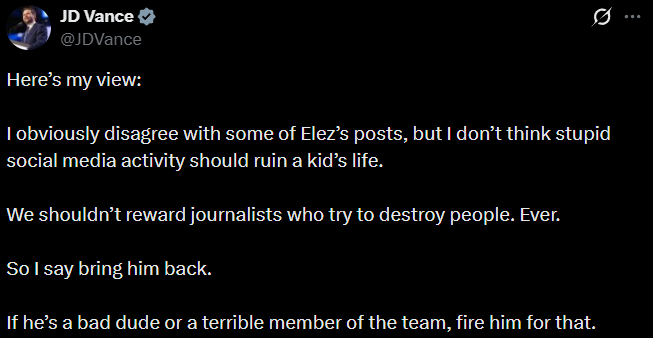
Vance, soon after taking the oath of office, advocated for the reinstatement of Marko Elez, a now-defunct Department of Government Efficiency (DOGE) employee who wanted to “normalise Indian hatred.” His derogatory rants became public, which forced him to resign. However, Elon Musk, supported by Vance, recruited Elez again following a poll conducted on X, in a disturbing act to effectively legitimise racism.
It is also important to note that Vance has openly voiced his desire to convert his wife, who comes from a Hindu background, to Christianity, despite her reluctance. She had supported him during his spiritual journey, but this is the manner in which he chose to reciprocate by delivering such a remark before his MAGA supporters.
Conclusion
Megalomanic Trump, driven by a personal vendetta against India for rightly refusing to credit him for the ceasefire during “Operation Sindoor,” and his entire administration have actively courted the White supremacists harbouring racist sentiments and deep-seated prejudice against Indians and Hindus.
These groups have not only attacked the country and its people, but also ridiculed Hinduism, its religious festivals, and Gods, even calling for the destruction of statues of Hindu deities. This bigotry forms the ideological foundation of the current American rulers.
Trump administration has chosen to exploit the same, instead of countering it, to advance their political agenda by marginalising an already vulnerable community and systematically discriminating against this segment of society. The regulatory action targeting IT firms is an element of this propaganda campaign, which has escalated to such proportions that political expediency has taken over both reason and rationality.