

In March 2026, Union Home Minister Amit Shah declared in Parliament that the government’s promised target of making India free of Naxalism has been achieved.
The menace of Left-wing terrorism in India took nearly six decades to be thwarted, after the violent movement began in Naxalbari in 1967. The government’s figures pointed to thousands of Maoist surrenders and arrests, alongside hundreds killed in security operations. ’Surrender or die’ was the Modi government’s final message to the Naxals. Many surrendered; those who didn’t died in massive anti-Naxal operations carried out by the paramilitary and state police forces.
What began as a rebellion against exploitation in the forested heartlands of India metastasised into one of the longest-running armed insurgencies against the Indian State. Maoists claimed to fight for tribal communities and landless labourers, yet their campaign brought killings, landmines, extortion and attacks on infrastructure. Entire regions of central India remained isolated from development and public services for decades.
The contradiction is striking. A movement promising liberation and rights kept dozens of tribal and rural communities trapped between terrorist violence, state security operations and longstanding deprivation of basic infrastructure like roads and schools. The idealistic revolution that was romanticised by countless ‘intellectuals’ in books, poems and lectures brought nothing but bloodshed and deprivation for the people.
And India’s experience is hardly unique.
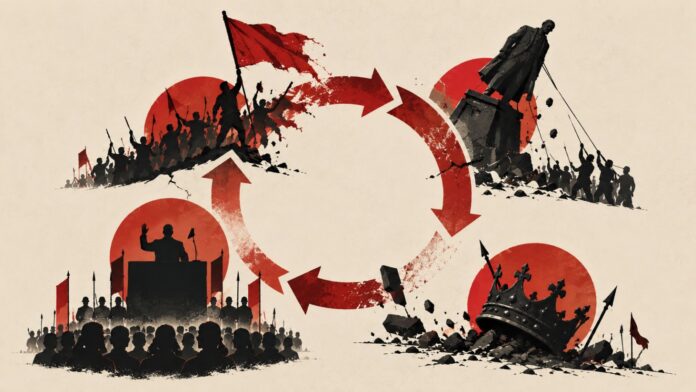
There is something strangely seductive about the idea of ‘revolution’. The promise is simple: overthrow an unjust order, sweep away everything that is wrong, and build a better society. It is an idea that has captivated intellectuals, students, political movements and idealists for centuries. But what happens after the slogans fade, the crowds disperse, and the old government falls?
History offers some uncomfortable answers.
The French Revolution began with promises of liberty and equality, only to descend into the Reign of Terror before Napoleon eventually crowned himself emperor. Russia’s Bolsheviks promised workers and peasants a new society, but the Soviet system produced political repression and a powerful ruling elite. Mao’s China experienced devastating famine and millions of deaths before economic reforms under Deng Xiaoping transformed its trajectory.
Iran’s 1979 revolution presents an especially revealing irony. Leftists, liberals and religious groups united against the Shah, but Ayatollah Khomeini’s clerical establishment eventually consolidated power and persecuted many former allies. The coalition that overthrew an authoritarian ruler produced another authoritarian, theocratic system.
The common danger is that removing a government does not automatically create institutions capable of protecting freedom.
Bangladesh’s 2024 uprising began with student grievances over job quotas and escalated amid a brutal state crackdown. Sheikh Hasina fled, but the transition also brought retaliatory violence, attacks on minorities, political uncertainty and a shattered economy. Nepal’s Maoists, meanwhile, fought a decade-long insurgency, entered mainstream politics and eventually became part of the establishment that a new generation challenged in 2025.
French philosopher Raymond Aron’s book ‘The Opium of the Intellectuals’ explored Leftist intellectuals’ fascination with revolutionary ideology. Aron questioned why educated thinkers sometimes preferred the dramatic promise of revolution to the slow, imperfect work of reform. Revolution offers heroic thrill and excitement. Reform demands negotiation, patience, compromises and continuous improvements over a long period of challenges.
But there is an important distinction here. Revolutions against colonial rule or governments that deny meaningful political participation cannot be equated automatically with attempts to bypass functioning democratic institutions. Nor is peaceful protest against an elected government inherently undemocratic.
Protest, dissent and demands for accountability are themselves essential democratic freedoms. But democracies change governments via voting, not via violence.
The deeper question is what happens when political movements abandon persuasion and institutional change in favour of violence or the belief that only their preferred outcome is legitimate.
That brings the story back to Bastar. As Maoist violence recedes, the challenge is to deliver what decades of conflict denied many communities: functioning schools, healthcare, roads, communications, land rights and economic opportunities.
Indian Leftists romanticise the idea of ‘revolution’ just because they have failed to gather public support during the voting process. Their relentless rejection of the democratic process and elections sends the message to the public that their votes do not matter; only the Left-liberal opinion matters. Neha Bora calls the violence in Bangladesh ’ inspiring ’, and Prashant Bhushan declares that regime change will be done. These incidents only betray the hypocrisy of the so-called Leftists in India. They have no respect for the people’s mandate, but want external forces to bring down an elected government just because they don’t like the party that is currently in power.
Long-term improvements are brought by reforms and economic growth. That process lacks the drama and thrill of revolution. It requires budgets, administration, accountability and years of sustained effort that only a democratic system can deliver.
Perhaps that is the central paradox. Destroying an old order can happen in days; building a fairer and more prosperous society can take generations. The enduring test of any political movement is not how dramatically it challenges power, but whether it leaves ordinary people with greater freedom, security and opportunity. The thrilling, dramatic revolution that the Leftists worldwide get excited over offers only chaos and anarchy, not solutions.
The full article can be read here in Chapter 1 Magazine.


