Home Blog Page 1138

Surpassing Predecessors: ‘Mehengai’ disappears from election campaigns as Inflation in India reduces to the lowest during Narendra Modi’s term among all PMs

Inflation, or “Mehengai,” is a term that often sends shivers down the spine of any economy, especially when it skyrockets. High inflation rates can strain both the pockets and patience of citizens. So, it’s pretty impressive when a leader manages to keep it under wraps. This is the tale of Prime Minister Narendra Modi, whose tenure has been marked by what appears to be an exceptional control over inflation rates in India.

Now, if you’ve been keeping an ear out for the opposition’s views, you might have been led to believe that inflation management under PM Modi has been less than stellar. But the people of India continue to re-elect him. The opposition says it’s just Modi’s magic of marketing, almost looking like they are scurrying for convenient reasonings and do not know the ground realities.

On the other hand, it is noteworthy that since 2014, ‘Mehengai’ or high prices have almost disappeared from election campaigns. For a country that has battled with persistent inflation, that’s no small feat.

So, really, how good is PM Modi’s Inflation Management?

Looking at the Data

To get to the bottom of this, I put on my detective hat and dove into records stretching back to the time of India’s independence in August 1947. Thanks to various databases such as EPW Foundation, IMF, MOSPI-GOI, and the Reserve Bank of India’s Monthly Bulletins, I was able to line up the inflation figures under different Prime Ministers of India for a comparative analysis.

And what do you know? PM Modi has emerged with the best record on inflation compared to all other Prime Ministers of India. This probably explains why ‘Mehengai’ has taken a backseat in the minds of the voters for last 10 years. The data is represented in the chart below:
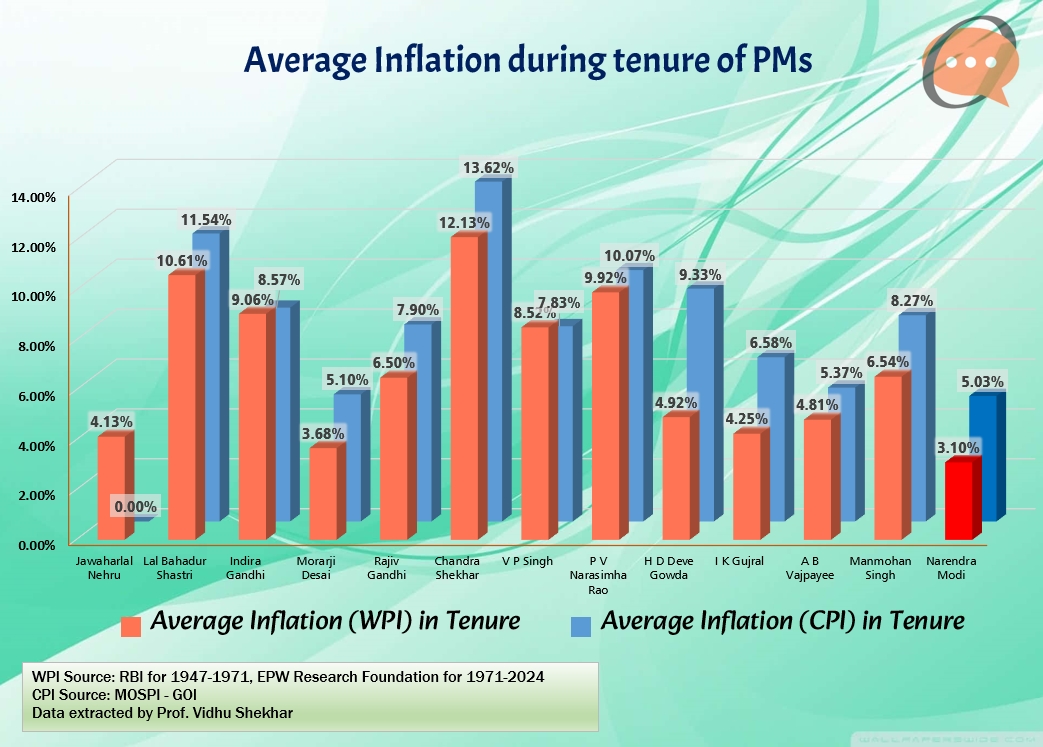
The table represents the average inflation rates during the time each Prime Minister of India was in office. We have used both the Price Indexes that are used in Inflation: WPI (Wholesale Price Index) and CPI (Consumer Price Index). WPI measures the price increase at a wholesale level, which is the price stores pay when they buy large amounts of products. CPI measures the price increase of a basket of goods and services that retail households typically use, such as food, transport, etc.

The reason both have been used is that till 2012, inflation in India was taken based on WPI. Post 2012, it has been measured in CPI. Also, For PM Nehru, the CPI numbers were unavailable as CPI was not measured during his tenure. So, for the sake of complete comparison, we used both inflation data.

As can be seen, PM Modi tops the chart in both numbers! At an average WPI inflation rate of 3.1%, he has done better than even PM Nehru, who has the same rate of 4.13%. He has done far better than the Economist PM Manmohan Singh who had 6.54% in WPI and  8.27% for CPI.  That is almost double that of PM Modi, who has a WPI of 3.1% and CPI inflation of 5.03%. Other Congress PMs also have pretty high numbers. Indira Gandhi is at 9%! Rajiv Gandhi at 8%!

In fact, PM Modi’s inflation management is so exceptional that at 5.03% CPI Inflation, it is exactly in the middle of the RBI target of 4% to 6% inflation.
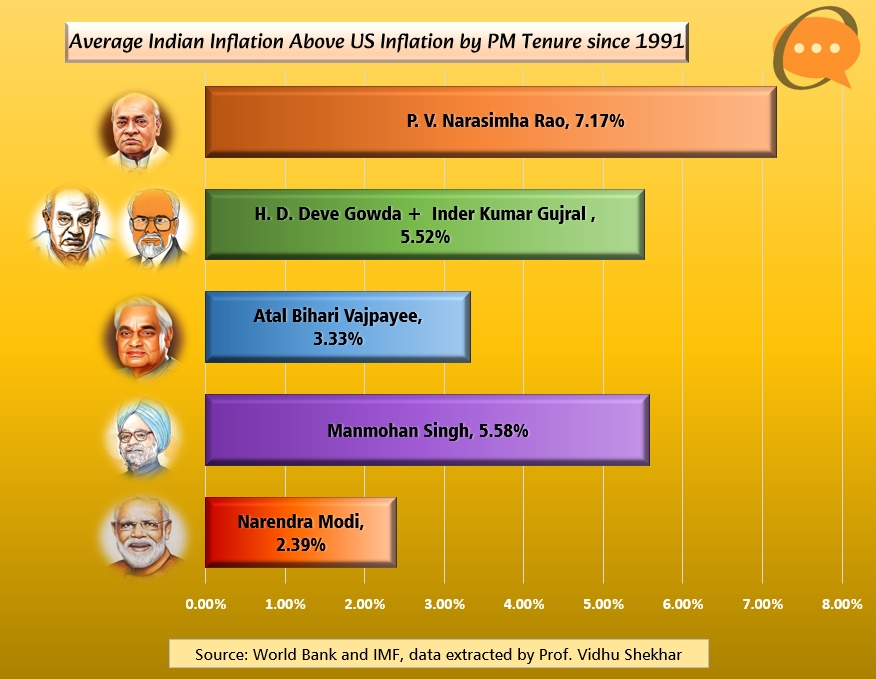
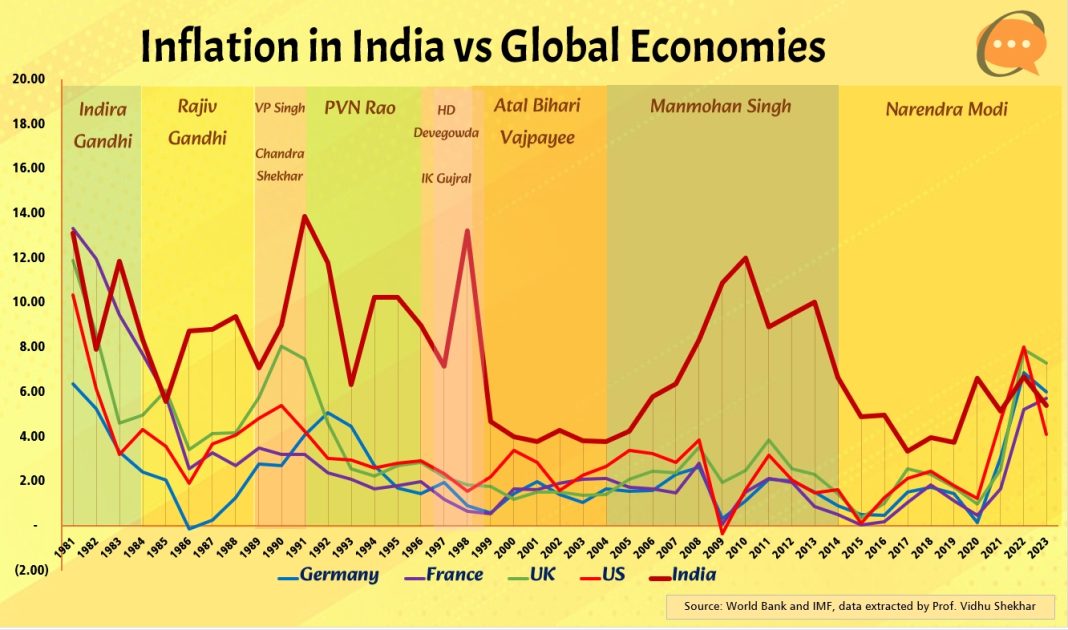
A quick address to doubters who might say that global factors impact inflation or Central Banks control inflation – at the end of the article, I have added a graph of India’s inflation vis-a-vis global top economies. And you see, there, too, PM Modi has outperformed other PMs of India. Also, the data shows that there is a stark difference in inflation numbers from PM to PM. In fact, as soon as UPA took over, inflation started increasing, and as soon as PM Modi came, inflation went down. This shows that PM and Government have a large role in Inflation dynamics.

How Did PM Modi Manage it

You might think this is all just good fortune, but the reality is far from it. Even when the pandemic rattled the world, India’s inflation didn’t hit the dreaded double digits, despite several countries of the world suffering multidecade high Inflation numbers. In fact, in 2022, the US had higher inflation than India, a rarity.

So, how did PM Modi pull this off? The magic lies in a mix of savvy economic strategies.

First, he spearheaded the cleanup of supply chain inefficiencies, introducing reforms like the Goods and Services Tax and integrating digital processes. Prior to GST reforms, trucks used to wait at each state’s border for days on end. Delay, huge fuel cost, and over and above that, bribe at every naka. With GST, all this went away. The delivery of goods became faster and cheaper. Less fuel was consumed, too. This effectively led to lower consumption of oil in the economy for each unit of production, known as the Oil intensity of an economy. India has seen an increasingly low oil intensity since 2014. So, despite the increase in oil prices, the impact on inflation was muted. A massive push toward renewables also helped in that.

But PM Modi didn’t stop there. Social justice through direct benefit distribution is fundamental in a large country like India. Modi Schemes are well known for that, and are in fact touted as a reason why PM Modi returned to power in 2019 with an increased Majority.

But that’s half of the story. Some earlier governments, including PM Singh, also focused on benefit distribution. But, they focused only on benefit distribution! And that is problematic. See, if you only distribute money but do not focus and increase the production capability of the economy, things will quickly become expensive, and Mehengai, so to say, will rise because now the same number of goods in the economy is being chased by more money! This will end up short-circuiting all the distributive justice as increased money in hand becomes worthless due to increased prices. For every increase in social distribution, one must increase the production as well.

That’s where UPA 2 and PM Singh failed, but PM Modi excels. He not only has Modi Schemes for the poor, giving them Direct benefits but also encourages Industry and has Modi Schemes for Industries, such as Production Linked Schemes (PLI). He, therefore, focused equally on distribution and production – the work of a true economist!
It must also be noted that Prime Minister Modi’s policies favor in-kind benefits over cash handouts, such as directly giving food, rather than cash to buy food, or money in exchange for building houses etc. This in-kind approach allows the government to ensure that assistance reaches the intended recipients in the most direct manner possible. Furthermore, it aids in the government’s inflation control efforts. By providing goods and services directly, the government can prevent demand-driven price increases, helping to keep inflation in check.

In the world of economics, where numbers often tell the complete story, these inflation rates under PM Modi’s tenure are speaking volumes. It seems the lower inflation rates aren’t just a fluke; they’re a testament to strategic economic planning and policies that have effectively managed inflation in India. Even in economics, PM Modi seems to be outdoing great erudite PMs of old India.
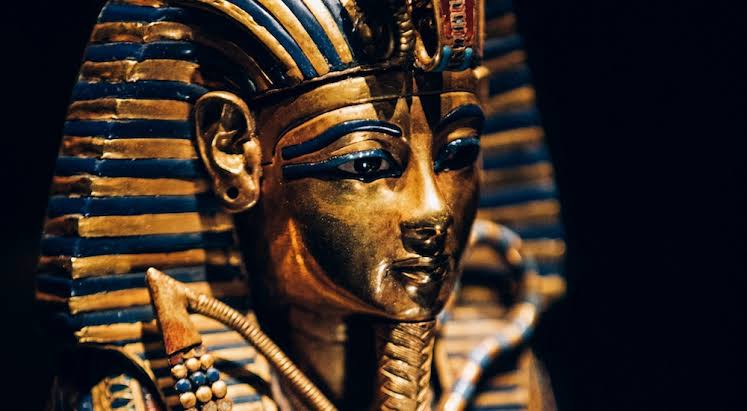
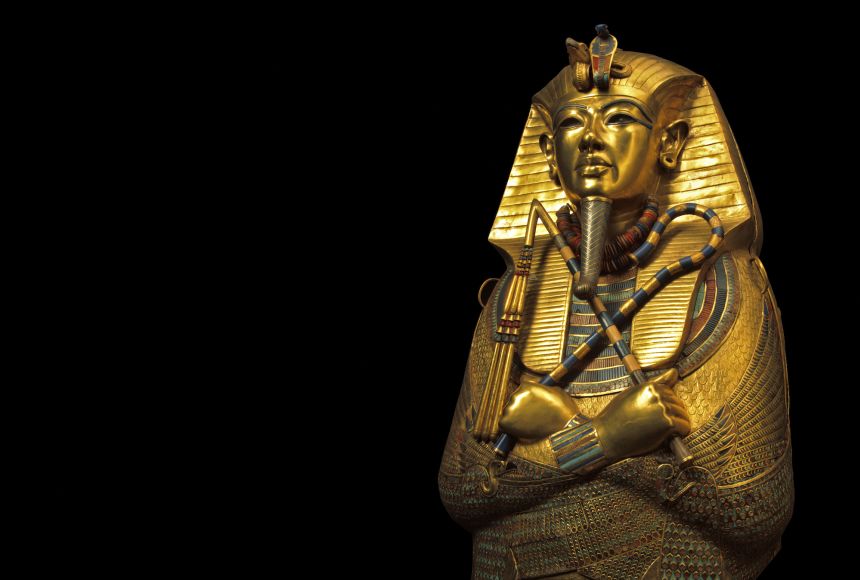
The mystery of ‘Pharaoh’s curse’ solved: Scientists claim they have uncovered the enigma of mystifying King Tutankhamun tomb deaths

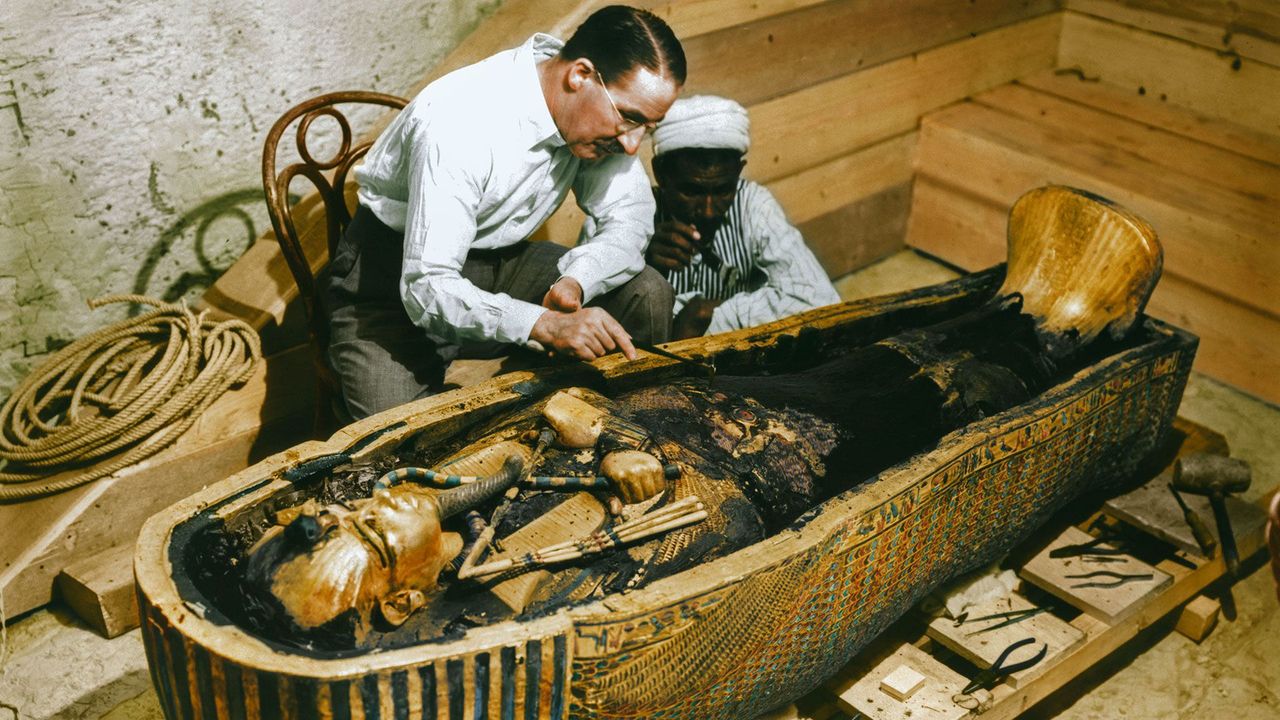
Archaeologists have long been perplexed by the eerie legend surrounding King Tutankhamun’s tomb in Egypt, fearing it may be connected to the mysterious deaths of several excavators who uncovered it in 1922.

More than a century later, a scientist asserts to have unravelled the enigma of the notorious “Pharaoh’s Curse.” Toxic levels of radiation, stemming from uranium and hazardous residues are thought to have persisted within the tomb since its sealing over 3,000 years ago, as detailed by Ross Fellowes in last month’s edition of the Journal of Scientific Exploration (JSE).

The radiation levels within Tutankhamun’s tomb are sufficiently elevated that individuals who encounter it are at significant risk of developing fatal radiation sickness and cancer.

In his study, Fellowes noted, “Both contemporary and ancient Egyptian populations exhibit unusually high rates of hematopoietic cancers, affecting the blood, bone, and lymphatic system, which are commonly attributed to radiation exposure.”

Nevertheless, this radioactivity extends beyond Tutankhamun’s tomb.

A scientist examining King Tutankhamun’s tomb

Fellowes disclosed that “exceptionally high radiation levels have been recorded in ruins of Old Kingdom tombs” and are prevalent across various sites in Egypt.

“Radiation has been identified using Geiger counters at two locations near the pyramids in Giza,” he stated, further noting the detection of radon, a radioactive gas, in “numerous underground tombs at Saqqara.” These measurements were determined to be “extremely radioactive.”

“Contemporary research validates the presence of exceedingly elevated radiation levels in ancient Egyptian tombs, exceeding accepted safety thresholds by a factor of ten,” the study revealed.

There’s also speculation that the builders of these ancient tombs were conscious of the hazards, as indicated by ominous warnings etched onto the walls.

“The essence of the curse was explicitly engraved on certain tombs, with one translated ominously as, ‘those who disturb this tomb will suffer death from an illness that no physician can discern,'” Fellowes elaborated.

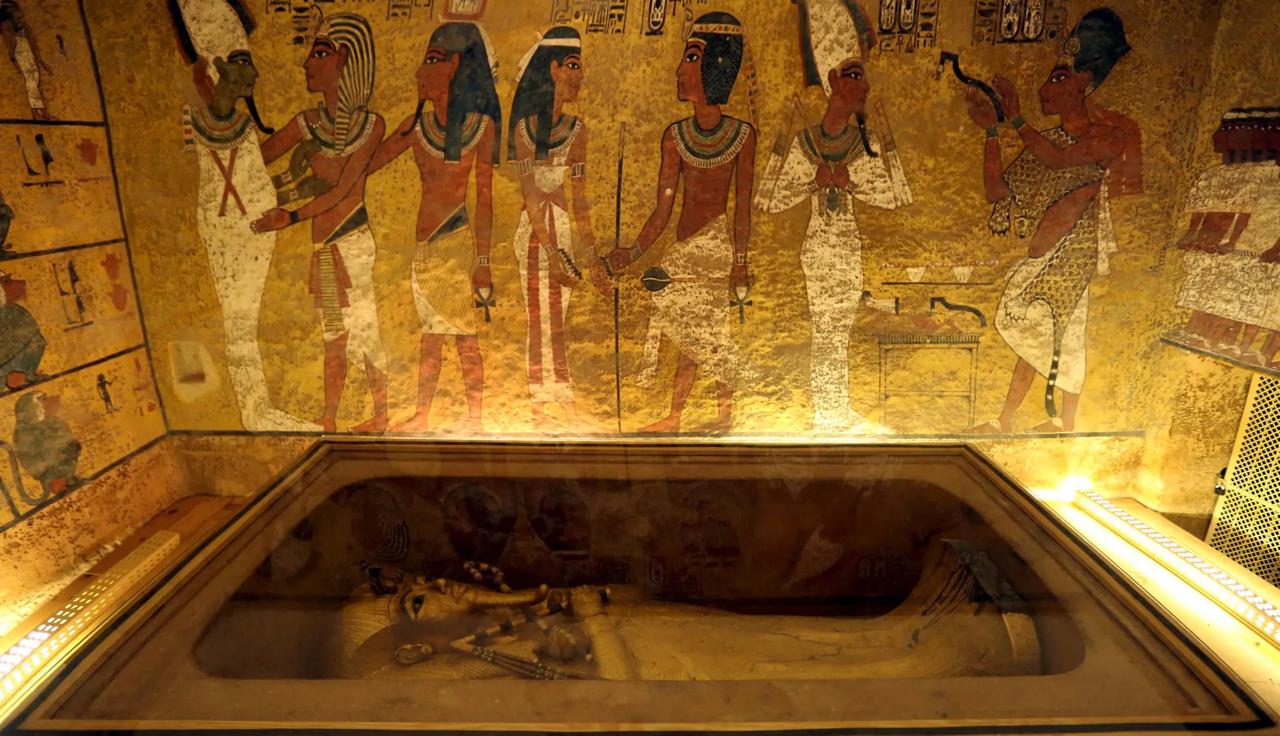
The tomb of Tutankhamun

Further foreboding translations such as “forbidden” due to the presence of “evil spirits” likely exacerbated the belief that supernatural curses haunted the ancient locations. These apprehensions heightened with the enigmatic demise of Lord Carnarvon, the financier of the 1922 excavation, who purportedly explored the treasure-filled chambers—and numerous others following the tomb’s unsealing.

“Carnarvon succumbed to death within weeks, amid an ambiguous diagnosis of blood poisoning and pneumonia,” Fellowes detailed.

Out of the 26 individuals present during the opening of the tomb, six passed away within a decade from a range of causes including asphyxia, stroke, diabetes, heart failure, pneumonia, poisoning, malaria, and X-ray exposure.

While these deaths may seem peculiar, the theory of the curse was likely fueled by the unusual occurrences surrounding the tomb’s opening.

Carnarvon reportedly suffered from a mosquito bite that resulted in severe infection.

The murals at the Tutankhamun’s tomb also talk about mysterious deaths during Pharoah’s time

During the tomb’s unveiling, Cairo experienced an unusual power outage and a sudden sandstorm, as reported by National Geographic. Additionally, during the excavation, Carnarvon’s beloved dog purportedly emitted a haunting howl before abruptly collapsing and dying.

From a historical standpoint, the unearthing of the tomb in the Valley of the Kings stands as one of the most captivating discoveries, offering contemporary society a window into the journey of Egyptian royalty into the afterlife.

Inside Tutankhamun’s tombs lay an array of artefacts totalling five thousand items, encompassing solid gold funeral shoes, statues, games, and peculiar animal figures.

The excavation team dedicated a decade to meticulously clearing the tomb of its treasure trove.

The unveiling and examination of the tomb are also recognized as the starting point for the modern era of Egyptology.

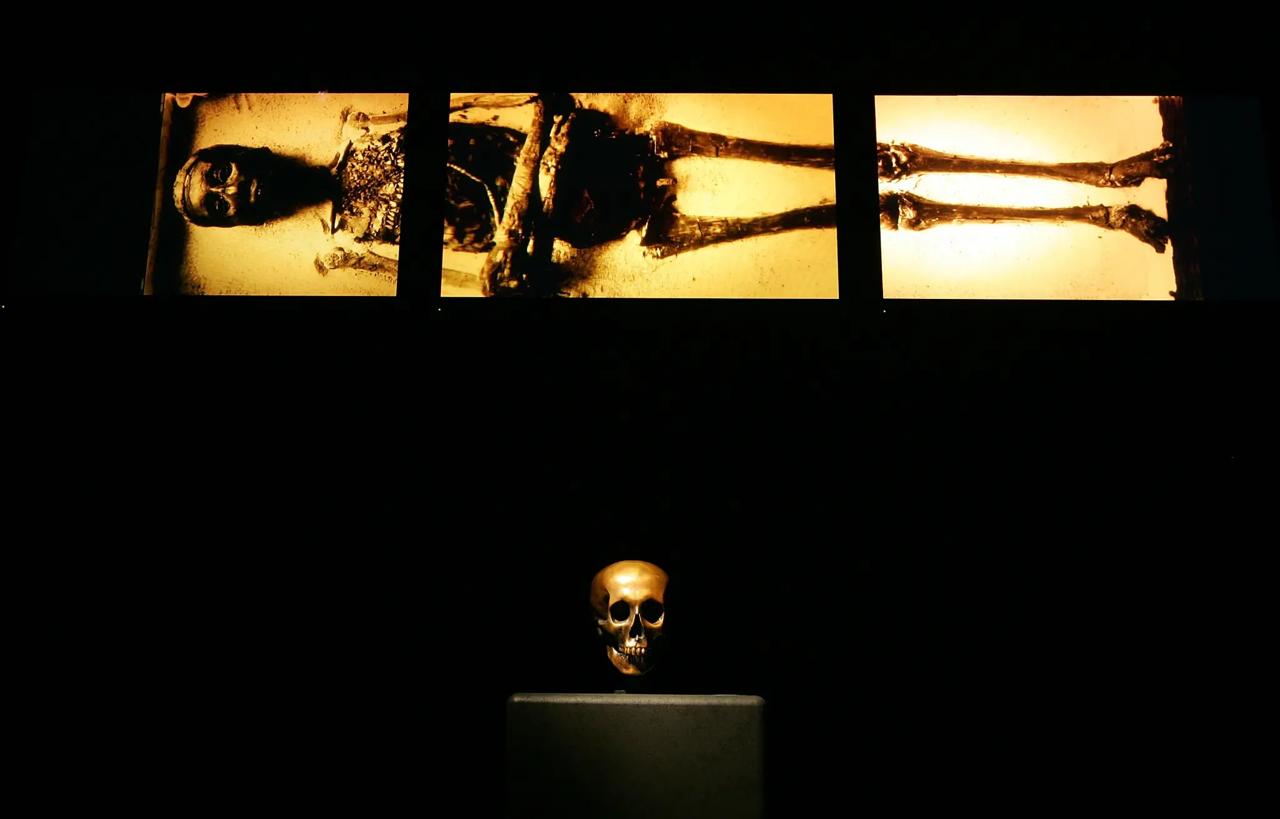
Tutankhamun assumed the role of pharaoh at around nine or ten years old, reigning from 1332 BC to 1323 BC. Nonetheless, he passed away before reaching the age of 18.

There are no surviving records that shed light on the circumstances surrounding Tutankhamun’s death, leaving the enigma of the young pharaoh’s demise unresolved.

However, Tutankhamun is believed to have experienced various health issues, likely stemming from the fact that his parents, Akhenaten and Nefertiti, were siblings.

Iran says Indians onboard the Israel-linked ‘MSC Aries’ ship will be released soon, had seized the vessel amidst tensions with Israel

Foreign Minister of Iran Hossein Amirabdollahian has announced that the crew onboard the Israel-linked ship, seized by Iranian authorities, had been granted consular access and were expected to be freed, as reported by Iranian media on Saturday (27th April). The container vessel, MSC Aries, carries a crew of 25 members, 17 of whom are Indian nationals. One of the Indian crew members, a woman named Ann Tessa Joseph, was released earlier. She safely returned home on the 18th of April.

On Saturday, the Iranian Foreign Minister told his Portuguese counterpart Paulo Rangel that the humanitarian issue of the release of the ship’s crew was of serious concern to Iran. He added that the crew would be handed over to their ambassadors in Tehran.

Abdollahian said, “The human issue of the freedom of the ship’s crew is of serious concern to us, and we have announced consular access, freedom, and transfer to their ambassadors in Tehran.” However, the release timeline is still unclear, that is, when will these crew members be released. 

Earlier, the Indian External Affairs Ministry (MEA) stated that there were certain “technicalities involved” in the return of the remaining 16 Indian crew members. However, MEA Spokesperson Randhir Jaiswal assured that the Indian nationals were in contact with their family members and were in good health.

Jaiswal had said, “These 16 people, we had asked consular access for, which we got. Our officers went there and met. They are in constant touch with their families. Their health is good and they have no problems of any kind onboard the ship. As far as their return is concerned, there are certain technicalities involved, there are some contractual obligations, once that is done, when they’ll return it will depend on that.” 

Notably, the Iranian Revolutionary Guards seized MSC Aries in the Strait of Hormuz on 13th April. When it was en route to Mumbai, the IRG raided the vessel by helicopter. The development came amidst the ongoing Israel-Iran tensions as the former was accused of striking the Iranian consulate in Damascus earlier this month. 

MSC Aries is a Portuguese-flagged container ship and it is associated with London-based Zodiac Maritime which is part of Israeli billionaire Eyal Ofer’s Zodiac Group.

According to the Iranian Foreign Ministry, the Aries was seized for “violating maritime laws” and there was no doubt it was linked to Israel. 

Last week while responding to reporters’ questions, an Iranian FM Spokesperson said, “The vessel was diverted into Iran’s territorial waters as a result of violating maritime laws and not answering calls made by Iranian authorities.” 

MSC, which operates the Aries, confirmed Iran had seized the ship. They said it was working “with the relevant authorities” for its safe return and the wellbeing of its 25 crew.

TV Actress Krishna Mukherjee accuses ‘Shubh Shagun’ producer of harassment and threats; producer Kundan Singh denies allegations and promises legal action against her

TV actress Krishna Mukherjee, who rose to fame with her popular TV show ‘Yeh Hai Mohabaatein’, on Friday, April 26, leveled serious allegations of harassment and intimidation against Kundan Singh, the producer of her last TV show, ‘Shubh Shagun’. However, hours after she made the allegations, producer Kundan Singh denied them. He also asserted that the actress had previously leveled similar allegations against two employees of the show, saying that they were later found out to be “false”. Kundan Singh stressed that he would be taking legal action in this matter. 

Notably, the row erupted after Krishna Mukherjee took to her Instagram handle, where she claimed that acting in her last show, ‘Shubh Shagun’ was the worst decision of her life. According to her, she is depressed and anxious and the reason why she is not doing any show is because she was harassed so many times by the Production house and producer of her last show. Krishna also alleged that the producer didn’t pay her dues for around five months. 

Krishna Mukherjee added that her family had asked her not to go public with the allegations as they were scared that the accused could harm her for doing so. 

The caption of her Instagram post read, “My hands are still shivering while writing this but I had to. I am suffering from Anxiety and Depression bcz (sic) of this. We hide our emotions and show the brighter side on social media. But this is the Reality. My family was asking me not to post bcz they are still scared what if these people harm you? But why should I be scared ? This is my right and I need justice.” She also tagged the show’s producer, Kundan Singh. 

The post had her picture along with the text in which she narrated the alleged incident. 

Calling her decision to act in Shubh Shagun TV show “the worst decision”, the actress wrote, “It all started when I started doing my last show ‘Shubh Shagun’ for ‘Dangal tv’.” According to the post, once she was allegedly harassed when she decided not to shoot as she was unwell and they had not cleared her dues for some time. 

Krishna Mukherjee alleged, “The production house and the producer @kundan.singh.official has harassed me so many times. They even once Locked me in my makeup room bez (sic) I was unwell and I decided not to shoot bez they were not paying me for my work.., they were banging my makeup room’s door as if they will break it when I was changing my clothes.” 

Mukherjee further alleged that she was threatened when she approached the office of the production house to get her dues of 5 months. 

The text from Krishna Mukherjee added, “I feel unsafe. I asked for help from so many people but nothing. Nobody could do anything about it. People ask me why I am not doing any show? This is the reason. I am Scared what if the same thing happen again? I need Justice.” 

Responding to the allegations, Kundan Singh, the show’s producer, shared a post to refute the allegations as “rumours”. He argued that the allegations were made for personal grudges/financial claims and the caption read, “Beware of Lies”. 

Apart from denying the allegations, Kundan Singh announced that he would be taking strict legal action in this matter. Singh wrote, “It’s sad to see how it’s so easy for some people to make false accusations, I must clarify that All the accusations being made are false and frivolous, and strict legal action will be taken against all the culprits.”  

In his post, Kundan Singh claimed that the TV actress had leveled exactly the same allegations against two staffers and filed an FIR against them. According to him, back then, he along with the production house, had supported her and fired the employees. However, as per him, the allegations were later found to be false. 

Kundan Singh added, “I must bring in the Notice of Public at large that @krishna_mukherjee786 had put the exact same allegations against two people from the production house and filed an FIR on 04/10/2022 (A copy of FIR is in my possession as a piece of evidence).” 

Kundan Singh continued, “Also as a disciplinary action I even fired both the employees immediately, though later on we came to know that the allegations she put on them were false and only the sake to settle her personal grudge.” 

Further, she took a step ahead for false financial claim, we had reached out to her for legal preceding but she refused to come which is already in the record of CITY CIVIL COURT, MUMBAI, the post added. 

Kundan Singh stated that it’s disheartening to see how someone he supported so much is now putting fake allegations against him just to defame him and extract her benefit, but we per him, they have decided to take Strong legal action against this wrong publication in the public domain. 

According to Kundan Singh, this is the third attempt when Krishna Mukherjee made false allegations for “wrongful gains”. The TV producer concluded by saying, “This is the third wrong attempt she did for the sake of her wrongful gain, Social media is a platform to share your views but not a place to share false rumors, everyone who along with Krishna Mukherjee have been sharing the false news, please keep in mind that Lies may run fast, but the truth eventually overtakes them. BEWARE OF FAKE ALLEGATIONS AND PEOPLE WHO MISUSE SOCIAL MEDIA.” 

Uttarakhand: Shopkeeper Atharuddin sends obscene texts to minor Hindu girl who had gone to his shop for mobile recharge, threatens to abduct her

A video from Haldwani in Uttarakhand is going viral on social media where some people are seen dragging a shopkeeper out and beating him on the street. A crowd, including women, gathered around as a result of the occurrence. The people are accusing the young man of practising love jihad. Subsequently, everyone is heard discussing about catching and bringing him to the police station. The incident transpired on 25th April.

“This is an incident from Haldwani, Uttarakhand. Hindus rent out shops to Muslims in greed for the rent and they start going their jihad. He (the culprit) operated a mobile shop. He used to send messages to any girl who came to him for recharge. It is love jihad. Boycott them economically and socially,” highlighted social media user Anil Sharma while sharing the 1:39 minute-long footage.

Background of the incident

The case pertained to the Kotwali area of Haldwani. A woman living there filed a police complaint on 25th April and charged that her 17-year-old minor daughter had gone to recharge a mobile phone a few days ago. The shop is named ‘Delhi Mobile Shop’ and is run by Atharuddin who took the number of the girl. Later he started sending dirty messages to her. OpIndia has screenshots of some of the texts sent by him.

The minor girl repeatedly called Atharuddin ‘brother’ in the messages, however, he refused to refer to himself as such and forced her to make friends with him. A lot of messages have been deleted. He also claimed that he saw her in his dreams. Her mother also revealed in the complaint that he attempted to deceive the minor by referring to himself as a Sikh.

The complaint disclosed that the perpetrator didn’t stop there and even followed the girl to her college stop. He used to molest her and tried to hold her hand on the way. She also shared her ordeal with an acquaintance who went to the store to complain to Atharuddin who started fighting and arguing with the person and challenged, “Do what you want to do. I am not afraid of anyone. I will abscond the girl in front of everyone.”

Furthermore, he threatened to murder the individual. The mother divulged that the threat had terrified her daughter and she has descended into a state of mental depression as well as quit eating and drinking. She expressed the fear of something untoward with her daughter. She demanded strict action against the Muslim youth in the complaint. OpIndia has a copy of it. Police have taken Atharuddin into custody. The case is being investigated and legal action is underway. OpIndia contacted the Nainital Police in this matter, but they haven’t responded. The report will be updated if they choose to answer.

OpIndia spoke with Haldwani-based Bajrang Dal worker Joginder Singh Rana, also known as Jogi. According to him, the culprit resides on Mukhani Road in Haldwani with his whole family. He is almost 10 years older than the victim. Joginder Rana informed that Atharuddin does not even have valid documents to run the shop and asserted to have found numbers of many other Hindu girls in his mobile along with objectionable chats with them.

Betraying the God for the desire of votes: Smriti Irani on Rahul Gandhi’s anticipated visit to Ram Mandir

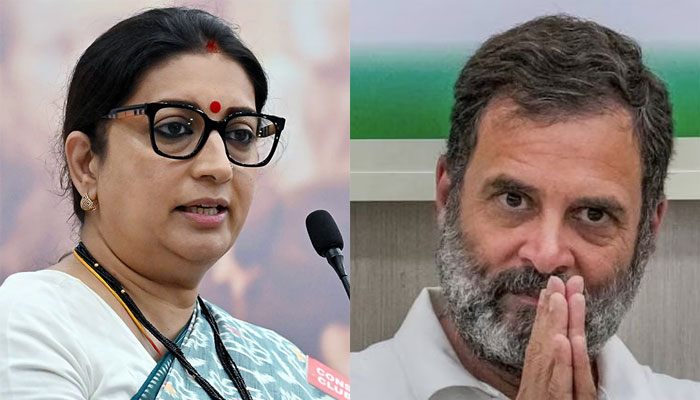
Union minister Smriti Irani attacked Congress leader Rahul Gandhi on 26th April over his anticipated visit to the Ram Mandir in Ayodhya before his potential journey to Uttar Pradesh’s Amethi. She asserted that those who doubted the existence of Lord Ram are now going to the Ram Mandir during election season to get votes, which is tantamount to betraying the god. She accused the Congress “Shehzade” of turning down an invitation to the temple’s inauguration event, yet going there now in hopes of acquiring votes.

She declared, “Up until now, we have been looking for issues in Amethi and currently, we are seeking Congress candidate. We have been informed that the Congress candidate will come here following today’s polling in Wayanad, but not before stopping by the Ram Mandir. They turned down the invitation to the consecration ceremony of the temple and now they’re going there because they believe it will help them receive votes which means they’re going to betray God as well. That’s the reason I say that those who cheat God to attract humans can never be ours. We have no need for those who are not followers of Lord Ram.”

The minister further charged, “They talked about relations here (in Amethi) and they went to Wayanad. Rahul Gandhi named Wayanad “his home” while submitting a nomination there. We have seen people change their colours, but this is the first time we have seen anyone change families. Even a woman keeps the respect of the parental family when she goes to her in-laws’ place after marriage, however, this guy (Rahul Gandhi) is strange.”

The Bharatiya Janata Party leader added, “He had little regard for relationships and didn’t even acknowledge the fact that people had put up with him for so long, even throughout his time absent (as an Amethi MP). You are all aware that casting one vote for Lotus (BJP party symbol) on 20th May will result in free rations for the impoverished for the following five years, 6,000 rupees in bank accounts for each farmer and benefits from Ayushman Bharat Yojna up to five lakh rupees. You don’t know one thing though that Congress has stated that the wealth of every citizen will be assessed.”

Smriti Irani defeated Rahul Gandhi in the 2019 Lok Sabha elections from Amethi which was once considered a bastion of the Gandhi family. Sanjay Gandhi, Rajiv Gandhi and Sonia Gandhi were elected from this seat. Rahul Gandhi has been winning from there since 2004.

Exclusive: AAP spent over ₹1500 crores on advertising since 2015, ad expenditure of Delhi Govt increased by 408% in past 5 years under Kejriwal

The Arvind Kejriwal-led-Aam Aadmi Party (AAP) government has spent a whopping ₹1585.87 crores on advertising since it came to power in Delhi in 2015.

The revelation was made through two Right to Information (RTI) replies obtained by activist Vivek Pandey, one of which has been exclusively accessed by OpIndia.

In his tweet, Vivek Pandey shared how the total advertisement expenditure has grown by 408% in last 5 years under AAP government.

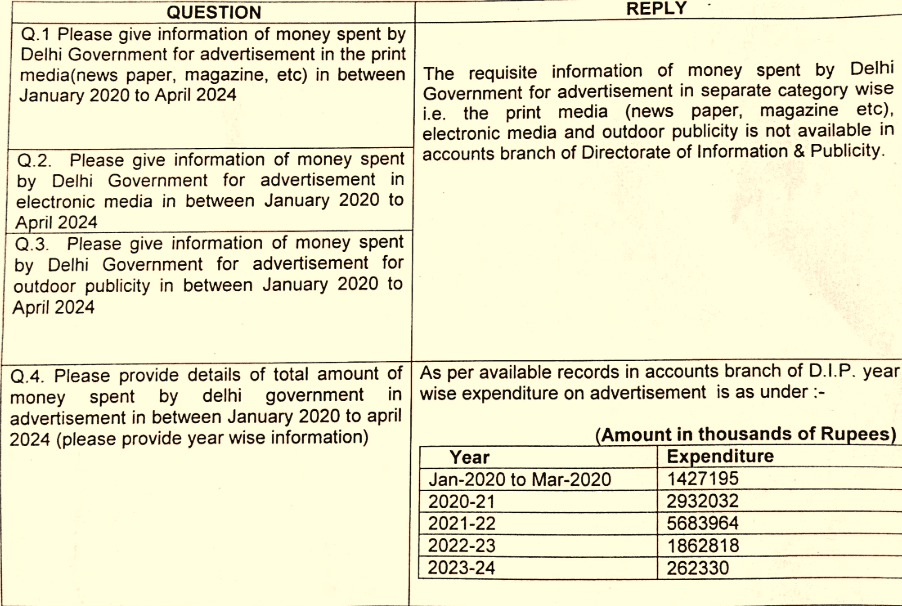
Pandey had sought information from the Directorate of Information and Publicity about the expenditure of the Delhi government on advertising since 2020.

Screengrab of the RTI reply obtained by Vivek Pandey in April 2024

In an RTI reply obtained by the activist on Thursday (25th April), the Directorate of Information and Publicity informed that the AAP government spent ₹293.20 crores in the Financial Year 2020-2021, ₹568.39 crores in the Financial Year 2021-2022, ₹186.28 crores in Financial Year 2022-2023 and ₹26.23 crores in the Financial Year 2023-2024.

The advertisements, borne on taxpayer’s money, were displayed across various forms of media such as electronic and print. OpIndia accessed another RTI, filed by activist Vivek Pandey in November 2020.

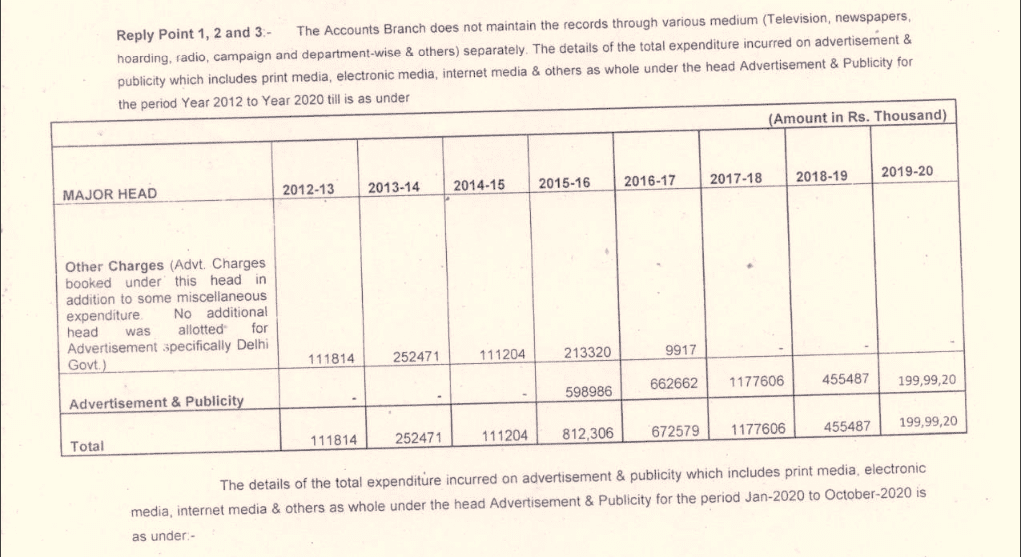
The RTI reply provided year-wise expenditure on advertising by the Delhi government since 2012-2013. Given that Arvind Kejriwal formed his government in February 2015, we took into account the money spent on advertising since the Financial Year 2015-2016.

Screengrab of the RTI reply obtained by Vivek Pandey in November 2020

According to the RTI, the Arvind Kejriwal-led-government spent ₹81.23 crores (FY2015-2016), ₹67.25 crores (FY2016-2017), ₹117.76 crores (FY2017-2018), ₹45.54 crores (FY2018-2019) and ₹199.99 crores (FY2019-2020) on advertising.

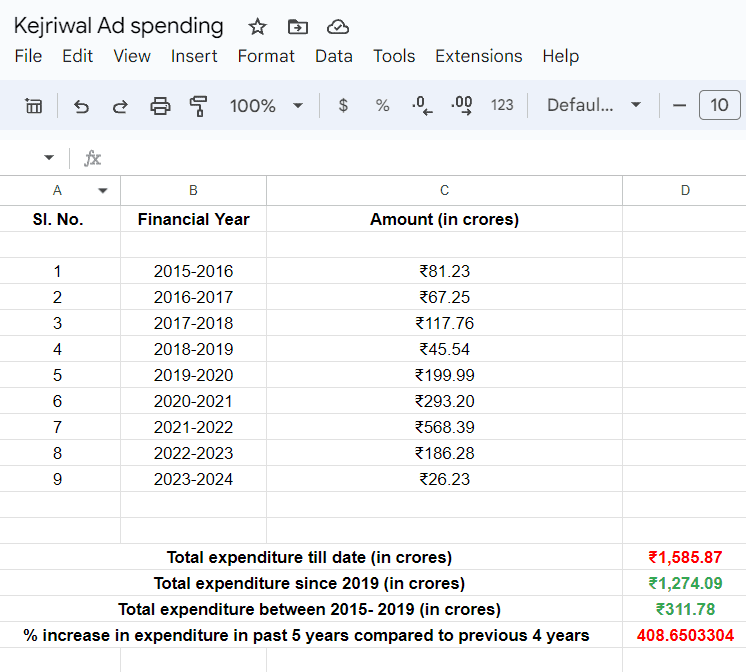
It implies that the Delhi government spent a total of ₹311.78 crores on ads between 2015 and 2019. If we compare both the RTI replies and add the expenditure incurred on ads, it turns out that the Kejriwal government spent ₹1274.09 crores in the past 5 years (2019-2024).

The amount stands at a staggering ₹1585.87 crores if we account for the last 9 years of the AAP government in Delhi. As evident from the RTI replies, spending on ads increased tremendously since 2019.

Simplified table depicting year-on-year ad expenditure from 2015-2024

When OpIndia compared the ad expenditure of AAP between 2019-2024 (last 5 years) and 2015-2019 (previous 4 years), we found an increase of 408.65% in spending.

Punjab: Several govt buildings defaced with Pro-Khalistan graffiti in high-security zone in Bathinda; US-resident SFJ terrorist Pannun claims responsibility

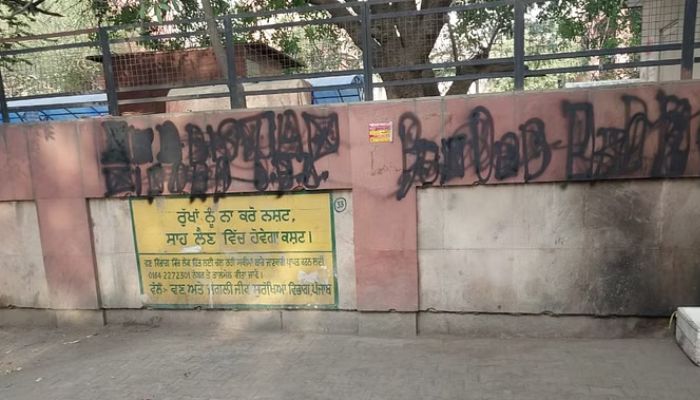
The walls of several government offices in a high-security zone in Punjab’s Bathinda were defaced with pro-Khalistani graffiti on Saturday morning (27th April). The Pro-Khalistani graffiti was found written on the walls of Bathinda’s mini secretariat complex, which is a high-security zone. It is pertinent to note that the secretariat is less than 100 yards away from the residence of the Additional Director General of Police (ADGP) and it is a few yards away from the SSP’s office. 

Unidentified Khalistani miscreants had spray painted Pro-Khalistani slogans outside the walls of the office of the Deputy Commissioner, a women’s police station, a post office, and the court premises. Following the incident, the state administration rushed to the spot and removed the graffiti from the walls of these government and administration offices. They have launched an investigation into the matter and are analysing all the nearby CCTVs to apprehend the perpetrators. 

As per reports, the miscreants had written that there should not be any political party in Punjab, neither BJP, SAD, nor Congress. Additionally, the banned Khalistan organisation Sikh for Justice (SFJ) has claimed responsibility for the act. Reportedly, SFJ terrorist Gurpatwant Pannun has released a video to claim responsibility for the act.  

Several incidents have taken place since last year where miscreants defaced public walls and pillars with pro-Khalistan graffiti. These incidents were reported across several States including Haryana, Punjab, Rajasthan, Himachal Pradesh, and Delhi.

Last year, miscreants spray painted pro-Khalistan slogans on the walls of five metro stations in Delhi. Back then, slogans like ‘Delhi will become Khalistan’ and ‘Khalistan Referendum Zindabad’ were found on walls of Punjabi Bagh, Shivaji Park, Madipur, Paschim Vihar, Udyog Nagar, Maharaja Surajmal Stadium, and Nangloi metro stations. The development came at a time when India was hosting the G20 summit across several states in the country.  

Later, the Delhi Police arrested two members of the banned Khalistani terror outfit led by Gurpatwant Singh Pannun, Sikhs For Justice (SFJ), from Punjab in connection with the incident. One of the arrested accused in this case was identified as Preetpal, who was arrested on 31st August, last year. 

West Bengal: BJP worker found dead in Purba Medinipur district, family accuses TMC leaders of kidnapping and killing him, demands CBI probe

An 18-year-old BJP worker was found dead in Purba Medinipur district on Friday (26th April), West Bengal Police said. They added that the deceased was Dinabondhu Middya, a BJP worker.

Dinabondhu Middya was found in a betel-leaf farm in Goramahal village in the Mayna area of the district. As per reports, it is alleged that his body was found in a suspicious state as while it was hanging, parts of the body were touching the ground and there were injury marks as well. 

Following the incident, Middya’s family accused TMC leaders of “kidnapping and murdering” him. However, the state’s ruling party, Trinamool Congress rejected the charge.   

The mother of the deceased BJP worker, Henarani Middya said, “My son was missing since Wednesday. We were being threatened by a few members of the TMC for quite some time. I am sure that my son was murdered by them.” 

Speaking with reporters, she named TMC leaders Buddhadeb Mondal, Kamal Putiya, Swapan Bhowmick, and two others for continuously threatening them. She added, “They work for TMC. They used to come to our house continuously and used to physically assault my mother-in-law and injured her head. They also used indecent language to harass us.” She also demanded a CBI investigation into her son’s alleged murder case. 

According to the Bengal Police, after receiving a missing person’s complaint, they started searching for Middya. Later, with the help of his mobile tower location, they found the body. They added that the body had been sent for post-mortem examination. 

Alleging TMC leaders’ involvement in the death of the BJP worker, the saffron party described TMC as a ‘Talibani Party’ whose motive is to Murder by Cruel means. 

Taking to X, BJP West Bengal wrote, “TMC is a Talibani (T) Party whose motive is to Murder (M) by Cruel(C) means. Dinabandhu (Dhananjay) Midya, 18 years old. His father, Sudarshan Midya, is an active BJP worker in Goramahal village. Since Wednesday, he has been missing. He was found hanging last night (Thursday). There are signs of injury on his body. In the hanging state in which the body was found, some parts of the body are touching the ground.” 

https://twitter.com/BJP4Bengal/status/1783693632098258983

Additionally, BJP MP Locket Chatterjee also condemned the murder of Dinabandhu Midya and accused TMC goons of committing the crime. She also stated that TMC’s Taliban’s tactics of silencing opposition voices with brutality must be vehemently opposed.

Leader of Opposition in the West Bengal Assembly and senior BJP leader Suvendu Adhikari asserted that the TMC is resorting to more violence as it is losing more grounds electorally. 

He also demanded that the investigation should be handed over to the CBI stating that otherwise, the state police would destroy evidence. The BJP leader also extended support – legal and otherwise to the bereaved family.  

Meanwhile, speaking with PTI, TMC MLA Nasiruddin Ahamed rejected the allegation that the state’s ruling party leaders were involved in the alleged murder case of the BJP party worker.

It is pertinent to note that in West Bengal, pre- and post-poll phases have been marred with violence with the ruling party, TMC, accused of intimidating other opposition parties and being involved in the large-scale politically condoned violence in the state. 

USA: Columbia University bans anti-Israeli protest leader over calls for Jewish genocide; 550 arrested across US campuses over support for terror group Hamas

One of the organisers of the anti-Israel rallies at New York-based Columbia University, 20-year-old Khymani James, was barred from the campus following the release of a clip in which he was heard vehemently expressing that Zionists “don’t deserve to live” and should be murdered which led to massive outrage at the institution. Later, the student leader apologised and said that he “mis-spoke in the heat of the moment” and was “unusually upset.”

Columbia University stated on 26th April that Khymani James was prohibited from entering the campus. The remarks were uploaded on Instagram in January by Khymani James, who has served as a spokesperson for the anti-Israel protestors. James threatened, “Be grateful that I’m not just going out and murdering Zionists.” The statements were made both before and after he was summoned for a disciplinary hearing by the Columbia University administration.

Khymani James said, “I don’t fight to injure or for there to be a winner or a loser, I fight to kill,” in a post. The comments were then shared widely which sparked the backlash against the University. The University released a statement which read, “Calls of violence and statements targeted at individuals based on their religious, ethnic, or national identity are unacceptable and violate university policy.”

On 26th April, James alleged, “I affirm the sanctity of all life and the movement for liberation. This applies to all people regardless of their race, religion, gender, sexual orientation, or nationality. All people deserve to be safe from physical harm.” However, he then said, “I am frustrated that the words I said in an Instagram Live video have become a distraction from the movement for Palestinian liberation. I misspoke in the heat of the moment, for which I apologize.”

Students who sparked nationwide anti-Israel protests, however, have declared that they have reached a standstill with officials and that they plan to stay in their camp until their demands are satisfied. Protesters at campuses around the country are calling for institutions to sever financial ties to Israel and divest from businesses they claim are supporting Israel. Meanwhile, the demonstrations have turned anti-semitic in several universities and have scared Jewish students away from the universities.

Rallies by students protesting Israel’s counter-offensive against Hamas terror attack have spread around the United States in the wake of the arrest of over 100 activists at Columbia University last week. Major campuses have had close to 550 arrests linked to protests in the last week. Police employed tasers and chemical irritants to break up anti-Israeli demonstrations.

The Israel-Hamas war began over six months ago on 7th October 2023, when Hamas terrorists, in a shock attack, invaded Southern Israel from land, sea, and air to kill over 1,200 Israelis, kidnapped over 254 Israeli and foreign nationals, which prompted Israel to launch a retaliatory ground action after weeks of aerial bombardment on the Palestinian enclave.