Home Blog Page 1340

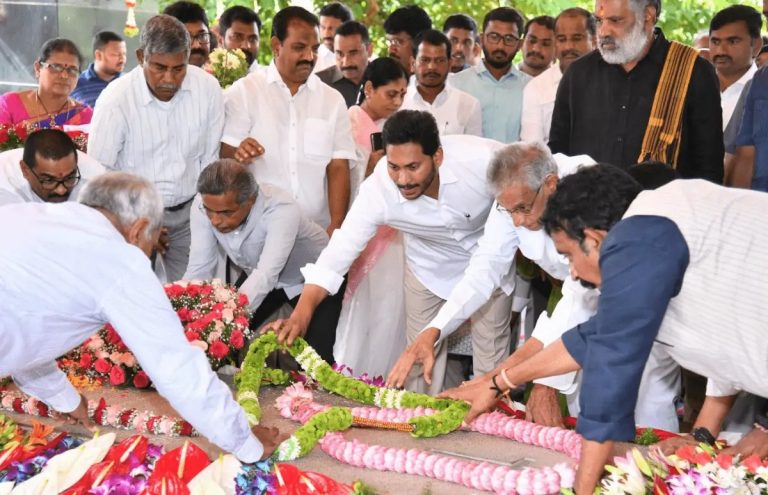
Murder, betrayal, religion, and politics – The real shady palace intrigue of Andhra Pradesh’s YSR family that will put any fictional series to shame!

According to Dr. Sanjaya Baru, media advisor to then Prime Minister Manmohan Singh once wrote that whenever the then Chief Minister of Andhra Pradesh, Dr. Y.S.Rajashekhar Reddy visited Delhi, Manmohan Singh always used the same welcome line – “Welcome Dr. Reddy, we are here because you are there”.

Manmohan Singh was referring to the massive victory that Congress scored in the combined Andhra Pradesh under YSR’s guidance (34/42 seats in 2004 and 33/42 in 2009). While he was still the CM, YSR died in a helicopter accident in September 2009. 

His son Y.S.Jagan Mohan Reddy assumed that he would be made the Chief Minister. Sonia Gandhi was not in favor of doing so. Jagan split the party and left Congress. CBI then arrested Jagan for indulging in corruption when YSR was Chief Minister. Jagan became the leader of the opposition in 2014 and the Chief Minister in 2019. 

Up until now, I haven’t told you anything that hasn’t been widely known (outside of AP, I mean). The lesser-known aspect, outside of the state, is the amazing palace intrigue of the YSR family that will put any TV series to shame! This article intends to bring out recent happenings in this family that cover murder, betrayal, religion, and of course politics! 

YSR’s own brother – Y.S.Vivekananda Reddy

Y.S. Vivekananda Reddy was murdered in March 2019. On April 16, 2022 – the CBI arrested Y.S.Viveka’s cousin brother – Y.S. Bhaskar Reddy as the main conspirator behind this murder! Bhaskar Reddy’s son, Avinash Reddy is the current YSRCP MP from the Kadapa constituency. Kadapa constituency has been the traditional stronghold of the YSR family – YSR represented it from 1989 to 1999. Y.S. Viveka represented it from 1999 to 2009. Y.S. Jagan represented it from 2009 to 2014. For the first time, someone outside of the direct bloodline of YSR was announced as a candidate and he won both in 2014 and 2019 from the YSRCP party. 

That MP, Y.S.Avinash Reddy, is also named by the CBI as the co-conspirator in the murder of YSR’s own brother. How come someone outside the direct bloodline of YSR was made to represent Kadapa in 2014 (and in 2019)? Enter Y.S. Jagan’s wife – Y.S. Bharati. Y.S. Bharati’s mother and Y.S.Avinash Reddy’s father are siblings! 

What is the CBI case? That Mr. Y.S. Bhaskar Reddy conspired along with his son and hired goons to hack Y.S. Vivekananda to death. Bhaskar Reddy and his son worked towards defeating Viveka in the 2017 MLC elections. And that Y.S.Avinash Reddy was amongst the first at the scene and declared to the press that this was a death by heart attack! 

Currently, the case still hasn’t been solved. Jagan, who was in opposition when the murder happened, demanded a CBI inquiry. After becoming CM, he strongly opposed it. Y.S. Viveka’s daughter had to approach the High Court to get a CBI inquiry done. She submitted a damning petition to the Court, on Jagan. All these years, Jagan routinely did an emotional drama in the Assembly with some filmy dialogues. With the damning CBI chargesheet out, it reflected very poorly on Jagan that he continues to shelter the very family that killed his own uncle. Will it have an electoral impact? Time will tell! 

YSR’s daughter – Y.S.Sharmila

After Y.S.Jagan quit the Congress, he continued his yatra across the state. The yatra was titled Odarpu Yatra (Condolence Visits) – he claimed to be visiting the homes of the people who died unable to bear the news of YSR’s death! Jagan was arrested by the CBI in corruption cases, and that’s when his sister Y.S. Sharmila entered the fray! She continued to walk in this yatra (walked ~3000 km over 10 months in 2012-13) and deliver political speeches for the entire duration that Jagan was in jail. Though she campaigned in both, she didn’t contest the 2014 and 2019 elections. 

Suddenly in early 2021, Sharmila announced that she has had huge differences with Jagan and is not on talking terms with him anymore. In leaked reports and in a detailed interview, we got to know some details of the unsavory arguments that happened between Jagan and Sharmila. She announced the setting up of a new party in Telangana – the YSRTP. She yet again walked 3000 km in Telangana but her party remained a dud. She eventually merged it with the Congress party, and is now appointed as the President of the Andhra Pradesh Congress. 

As soon as she was appointed, the loyal soldiers of Y.S.Jagan started attacking her with fierce language on social media. This led to a furious Sharmila spilling more beans about their feud – which further led to Jagan’s portrayal in a very bad light. She also claimed that she has a 50% share in the family newspaper and channel – Sakshi. All along, people assumed that this was fully owned by Jagan himself. Though Sharmila’s appointment will not revive a dead Congress in the state, her utterances in response to the attack from Jagan’s party are bound to help the opposition TDP-Jana Sena combine. Jagan’s image of being a caring human has already taken a beating with the CBI case on the murder of his uncle. With his sister now revealing hitherto unheard titbits, the elections just heated up more!

YSR’s wife – Y.S.Vijayamma

Though not a politician, she was the one who contested the Pulivendula MLA seat that YSR represented. Along with her daughter, Sharmila, she was instrumental in the YSRCP winning 15 out of 18 by-poll seats in June 2012, when Jagan was in jail. Jagan made her the Honorary President of YSRCP. However, when the feud between her son and daughter happened, she took the side of her daughter Sharmila. She resigned from the post of Honorary President of YSRCP and moved her base to stay close to her daughter Y.S. Sharmila. She resigned at a public meeting of the YSRCP cadre and the cold vibes with which Jagan handled the entire situation were there for everyone to see. The entire family recently met for the engagement of Sharmila’s son and the cold vibes at the group picture became the talk of the media for a full day! 

Where does all of this leave Y.S.Jagan?

For the Sankranthi festival, Y.S.Jagan spent nearly 1.5 crores worth of public money to build a temple set in his house. He had to do this because his wife, Y.S. Bharati, does not go to temples (In case you folks didn’t know – the entire family is practicing staunch Christians). This led to a political slugfest on how he is splurging money for erecting sets at his home just to accommodate his wife’s wishes. Y.S. Bharati is also his business partner in almost all of his businesses (Bharati Cements is named after her. Jagati publications, which runs the family newspaper & channel, is a word combination of Jagan and Bharati…and so on!)

In the 2019 elections, YSRCP had continuously campaigned that Chandrababu Naidu had backstabbed his father-in-law, NTR. In contrast, Y.S.Jagan was portrayed as this loving son, doting brother, and all that. That image lies shattered now. Jagan is just 52 years of age, so he will continue to play a prominent role in the politics of AP at least for 2 more decades. The family intrigue only promises to become more intriguing! 
Supreme Court halts Lok Sabha Privilege Committee summons to Bengal chief secretary and DG over mistreatment to BJP’s Sukanta Majumdar

On 19th February, The Supreme Court paused the parliamentary panel proceedings against government officials in Bengal over a complaint by BJP MP Sukanta Majumdar.

The development came after the West Bengal government approached the Supreme Court over the Parliament’s Privilege Committee summons to the state’s Chief Secretary and Director General (DG). The committee issued the summons after a complaint was filed by Bharatiya Janata Party (BJP) leader Sukant Majumdar. In its plea, the state vouched for the officials and said that the petitioners were senior government officials who managed good conduct. However, because of the committee summons, they are being projected as “perpetrators”.

Speaking to News18, Congress’s Rajya Sabha MP and Senior Advocate Abhishek Manu Singhvi confirmed that the West Bengal government has filed a plea in the apex court. Singhvi is representing DG in the court on the matter. He said the state government had pleaded with the court to scratch the privilege motion against the DG.

As per the reports, Sukant Majumdar and other BJP leaders wanted to visit Sandeshkhali. However, the state police stopped them, leading to a scuffle. During the incident, Majumdar fell on the road and was hospitalized. Later, he filed a complaint against the DG, accusing him of breaching the privilege.

The notice by the Privilege Committee was sent to the DG, CS, Additional SP and SP, asking them to appear before the committee on or before 19th February. Following the notice, TMC targeted the committee of turning blind eye to the incident where TMC leader and expelled MP Mahua Moitra was “dragged” out of Krishi Bhavan or when TMC MPs were “manhandled” by Delhi police.

The state has claimed that though MPs have privilege, Majumdar was travelling as BJP state president in this case. Furthermore, reports suggest that the state has included video evidence to prove police did not “push” Majumdar, leading to him falling on the road.

Speaking to News18, Majumdar said the atrocities and misbehaviour done to him by West Bengal police was alarming. “That is why I have complained to the Privilege Committee, and the committee asked them to appear.” He accused TMC of shielding the officers at the behest of the state government. Accusing police of compromising his health, Majumdar said, “When I fainted, they did not allow my car to come out of the hotel for 20 minutes. They compromised my health. They also compromised with the security as they shifted me to the hospital that was one hour away in a police car from the location where the scuffle took place.”

Majumdar, designated Z security by the centre and J security by the state, accused the state police of allowing the escort car with CISF Jawans to accompany him to the hospital. “I am a Z category protected MP. Why have you not allowed my security personnel to move with me? If something happens in between that transportation from the hotel to the hospital, who will be responsible for that incident?” he added.

Sandeshkhali horror

Tensions have been high in Sandeshkhali since January when local women staged protests demanding the arrest of Sheikh Shahjahan and his accomplices Uttam Sardar and Shibu Prasad Hazra. The Sandeshkhali women have accused them of forcibly acquiring land, pumping saltwater into fields to render them unusable, and engaging in institutional sexual harassment. The women have accused them of sexually assaulting women “night after night and release them only when they are satisfied”.

On 8th February this year, hundreds of women in Sandeshkhali took to the streets to protest against land grabbing, non-payment of wages and sexual violence committed by Sheikh Sahajahan and his two aides. While TMC leader Shibu Prasad Hazra was arrested on 17th February over land grabbing and sexual exploitation of women in Sandeshkhali, the primary accused, Sheikh Shahjahan, is still on the run from the law enforcement authorities.

The National Commission for Scheduled Castes (NCSC), on 16h February, after its visit to Sandeshkhali in West Bengal, submitted a report recommending the President’s rule in the state, citing complete lawlessness. The report was submitted to President Droupadi Murmu. NCSC Chairperson Arun Halder also met with the President. 

Halder said the President had assured the NCSC team that she would look into the matter and take action. The NCSC team was also allegedly misbehaved with by several police officials when it tried to enter Sandeskhali to meet with victims of sexual assault.

The West has de-hyphenated India and Pakistan, Indian media needs to follow suit and not help vested interests peddle their propaganda

The Indian media often enters a state of hyperactivity, whether reporting on the recently conducted elections in Pakistan or the visits of their cricket team. This persistent mindset within the Indian media detrimentally affects efforts to de-hyphenate India and Pakistan.

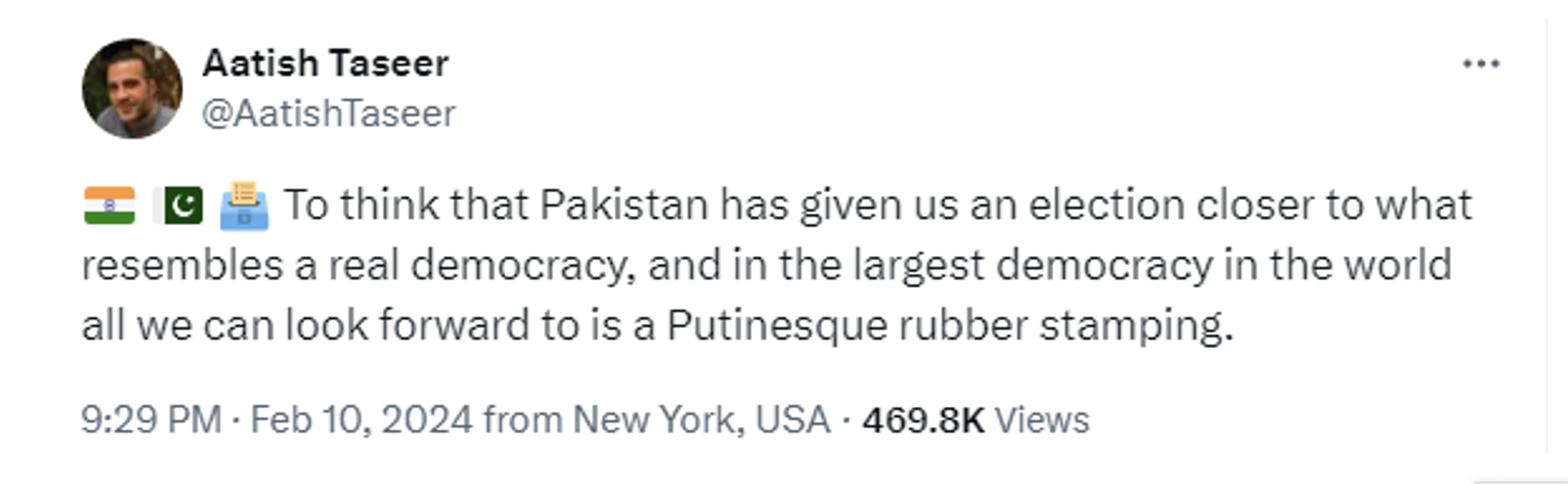
Commentators in the international and regional media persist in equating India and Pakistan across various parameters. While this narrative may align with Pakistan’s perspective, it distinctly undermines the Indian narrative. For instance, during the recent Pakistan election, a prominent commentator on South Asia, Aatish Taseer tweeted the following:

Tweet by Aatish Taseer

This tweet was subsequently amplified by prominent Twitter handles in India, once again hyphenating India and Pakistan in the eyes of regional and international audiences. As mentioned previously, Taseer’s tweet highlights the questionable history of Pakistan’s elections, yet inadvertently tarnishes the rich democratic legacy of India in the process.

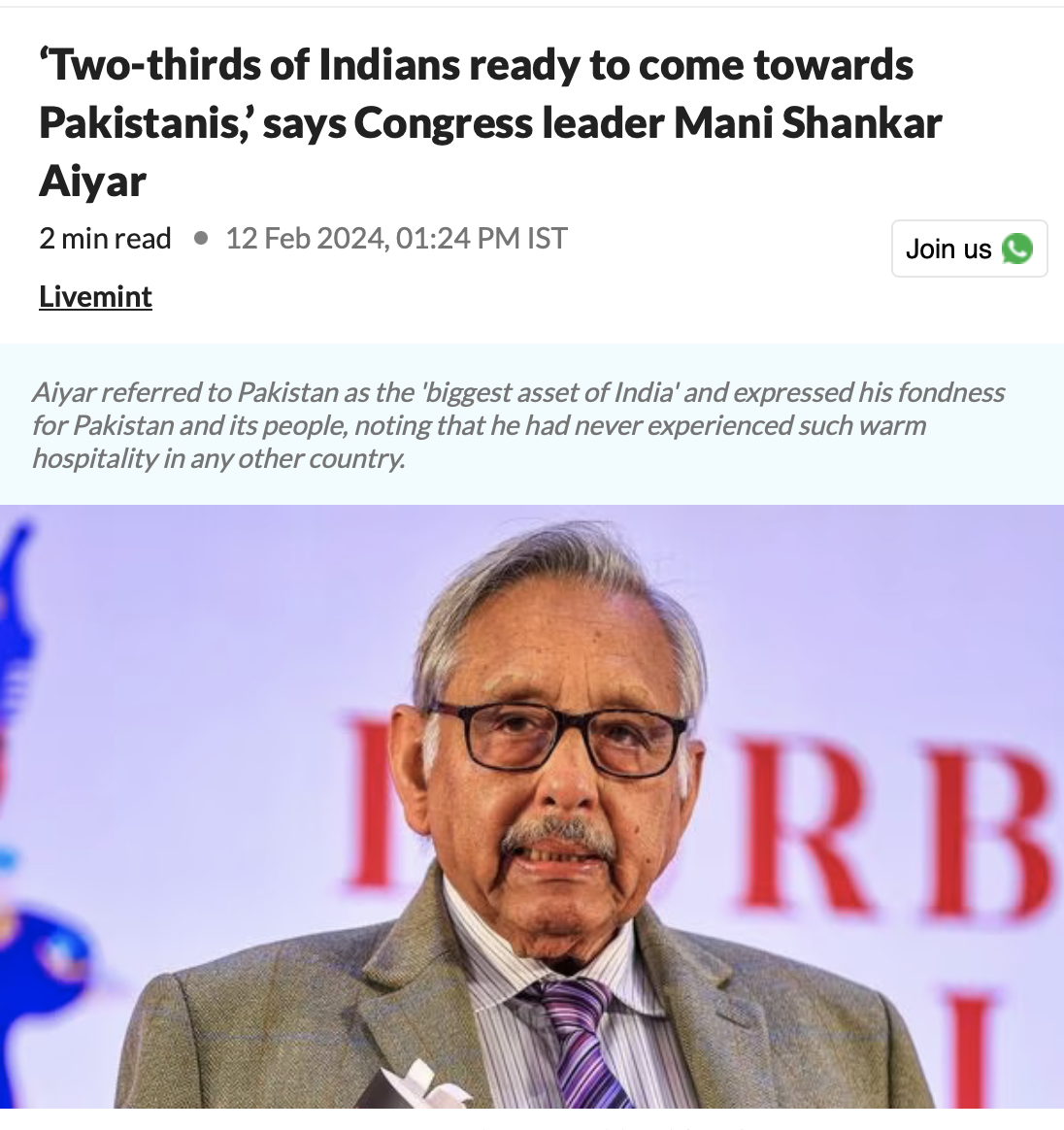
Another story published by a leading online media portal insinuates that the Indian public holds some emotional allegiance to their Pakistani counterparts. While these efforts to hyphenate India and Pakistan persist, it becomes increasingly crucial for the Indian perspective on global issues to be forcefully articulated. Achieving this necessitates concentrated efforts both at the national and international levels.

Article published by Live Mint

For a considerable duration, the West grouped the two countries due to similarities in culture, demographics, and economic situations. The hostility between these nations was often regarded as an internal issue, even when significant problems like terrorism in Kashmir emerged; these were seen as confined to their specific region. The Western stance refrained from separating India and Pakistan, as it was hesitant to acknowledge India as a significant global player. The simplest approach was to consistently juxtapose India and Pakistan, thereby confining India’s stature and influence solely to the South Asian region.

However, two significant factors altered this perspective: 1. The 9/11 terrorist attacks; 2. India’s emergence as a global economic power after the 1990s. The 9/11 attacks reshaped the Western perception that terrorism was solely limited to India and could profoundly impact their territory. This event reversed the narrative, compelling the West—previously advocating moral solutions to the terrorism issue through bilateral talks between India and Pakistan—to invest billions in the ‘War on Terror’ within what was considered ‘enemy’ territory.

The West, recognizing Pakistan as an international concern, perceived India, a responsible and stable democracy, as a potential long-term ally. This shift significantly contributed to disassociating India and Pakistan in the eyes of Western audiences.

Another pivotal factor contributing significantly to the disassociation was India’s ascension as a major economic powerhouse following the liberalization measures of the 1990s. The growth of India’s middle class, the surge in IT exports, and the increasing purchasing power of the Indians compelled even India’s adversaries to normalize their relations.

In contrast, Pakistan experienced a series of undemocratic military takeovers and relied on multiple IMF bailout packages. Presently, Pakistan grapples with one of its severest political and economic crises, while India has been officially acknowledged as the world’s fifth-largest economy, witnessing a consistent rise in foreign reserves annually.

This stark contrast has once again prompted the global audience to view India and Pakistan through separate lenses, further reinforcing their de-hyphenation.

However, a disappointing factor persists—the Indian media, driven by the pursuit of TRP ratings, continues to disproportionately cover Pakistan, thus perpetuating the hyphenation of India and Pakistan. This portrayal misguides the global audience, creating an impression that Pakistan holds a significant interest of India.

In reality, the nuclear threat posed by Pakistan has been debunked as a bluff, trade between the two countries is minimal with negligible impact on India’s economy, and the Indian government has unequivocally articulated its stance on the Kashmir issue through the abrogation of Article 370. Despite this, the Indian media remains fixated on events such as visits by Pakistani ministers, even though the Pakistani political class lacks substantial power, with the military controlling most aspects, especially those related to India. The persistence of this mindset within the Indian media confines their focus to regional issues, disregarding the larger global perspective.

Amidst this narrative, a notable aspect has been the approach adopted by the Indian bureaucracy and government. Under the leadership of Prime Minister Modi, the current Indian government has unequivocally shifted Pakistan from being one of the most preferred nations to the least preferred. The government has been diligent in highlighting India’s growth trajectory to both domestic and international audiences, strategically avoiding excessive focus on Pakistan-related issues that might align India within the same column as Pakistan. This approach has effectively positioned India as a significant emerging power in Asia. External Affairs Minister Mr. Jaishankar has adeptly conveyed this stance on numerous platforms, both within India and on the international stage.

The Indian media must transition into a global entity, extending its reach beyond regional boundaries. However, this shift necessitates a transformation in mindset, shifting away from age-old preoccupations with domestic and regional affairs. Instead, there’s a need to cover international issues from an Indian perspective, establishing credibility among global decision-makers.

The role of the Indian media holds significant weight—both in elevating India’s image as a substantial international player and in effectively advocating the Indian narrative amid the intensifying global discourse. While it’s a reality that we cannot alter our neighbors, it’s crucial not to excessively focus on them, inadvertently elevating their status while potentially diminishing our standing as a global power.

Sandeshkhali: Woman whose complaint led to TMC leader Shibu Hazra’s arrest says her home was attacked by ‘men wearing police uniform

0

The woman whose complaint against Trinamool Congress (TMC) leader Shibu Prasad Hazra in Sandeshkhali, North 24-Parganas, led to his arrest, stated that several men dressed in “police clothes” had attacked her house on Saturday (17th February). The alleged attack came a day after charges of gangrape and attempt to murder were added to the case against Hazra after the woman’s deposition before the magistrate of Basirhat court.

Speaking about the attack, the complainant woman said that she was not at home when the men wearing police uniforms barged in. She said that the attackers were intoxicated, threatened her family and dug a hole in the roof of her house. Reports say that the attackers were angry with the woman for complaining of sexual assault.  

“I sent my two daughters to my relative’s house. I was in hiding fearing attack for deposing in front of the magistrates accusing Shahjahan’s two henchmen Shibaprasad Hazra and Uttam Sardar. The youngest daughter was at home with my elderly father-in-law as my husband has also taken refuge in a relative’s house…They first dug a hole on the thatched wall by hitting non-stop and then inserted a stick through it to beat my daughter and her grandfather,” the woman said as reported by TNIE.

Speaking to The Hindu, the complainant said, “Last night, I was not at home. A group of miscreants came and attacked the house. They hurled abuses at me and my father-in-law. They wanted to kill me. Had I been at the house at night, they would have certainly killed me.”

The woman said that after filing the complaint, the police had not provided her with any protection. “After I complained to the authorities, I thought that they would spare me, but things are becoming more difficult every day. We deserve at least some dignity,” she said.

On Sunday, Shibu Prasad Hazra was produced before the Basirhat magistrate’s court where his bail plea was rejected. Hazra was remanded to police custody for eight days. This came after police stated that Hazra is influential and that his questioning was necessary to gather evidence.

The survivor narrated how Shibaprasad and Uttam, who had been apprehended by police during the recent unrest in Sandeshkhali, had sexually assaulted her five months prior in the local party office. “I was asked to go there at night to attend a meeting. I narrated my plights before the magistrate,” she said.

Reportedly, a police team arrived at the survivor’s house to record her statement regarding the alleged attack, however, the woman did not lodge a complaint. The police have also denied receiving any complaint regarding the incident.

The survivor said that even after the arrests of TMC leaders Uttam Sardar and Shibu Prasad Hazra she did not feel safe since their supporters are roaming freely.

As reported earlier, the survivor gave a statement before the magistrate under Section 164 of the Code of Criminal Procedure, the police expanded the charges to include Sections 376D (gangrape) and 307 (attempt to murder). Following this, Shibu Prasad Hazra, who was “missing” after women of Sandeshkhali alleged systemic rape and sexual assault, was arrested on Saturday (17th February).

Addressing a press conference on Saturday, West Bengal Director General of Police Rajeev Kumar said sections of rape have been added to the First Information Report (FIR). According to him, a woman did not make any allegations when the police spoke to her but made a statement before a magistrate under section 164 of the Criminal Procedure Code (CrPC).

Sandeshkhali horror

Tensions have been high in Sandeshkhali since January when local women staged protests demanding the arrest of Sheikh Shahjahan and his accomplices Uttam Sardar and Shibu Prasad Hazra. The Sandeshkhali women have accused them of forcibly acquiring land, pumping saltwater into fields to render them unusable, and engaging in institutional sexual harassment. The women have accused them of sexually assaulting women “night after night and release them only when they are satisfied”.

On 8th February this year, hundreds of women in Sandeshkhali took to the streets to protest against land grabbing, non-payment of wages and sexual violence committed by Sheikh Sahajahan and his two aides. While TMC leader Shibu Prasad Hazra was arrested on 17th February over land grabbing and sexual exploitation of women in Sandeshkhali the primary accused Sheikh Shahjahan, is still on the run from the law enforcement authorities.

The National Commission for Scheduled Castes (NCSC) on Friday (16h February) after its visit to Sandeshkhali in West Bengal submitted a report recommending the President’s rule in the state citing complete lawlessness. The report was submitted to President Droupadi Murmu. NCSC Chairperson Arun Halder also met with the President. 

Halder said the President had assured the NCSC team that she would look into the matter and take action. The NCSC team was also allegedly misbehaved with by several police officials when it tried to enter Sandeskhali to meet with victims of sexual assault.

‘Modi face of Hindu terror’: Khalistanis desecrate Tricolour, make ‘gaumutra’ jibe in Vancouver while Canada holds workshops for Indian officials on ‘rule of law’

0

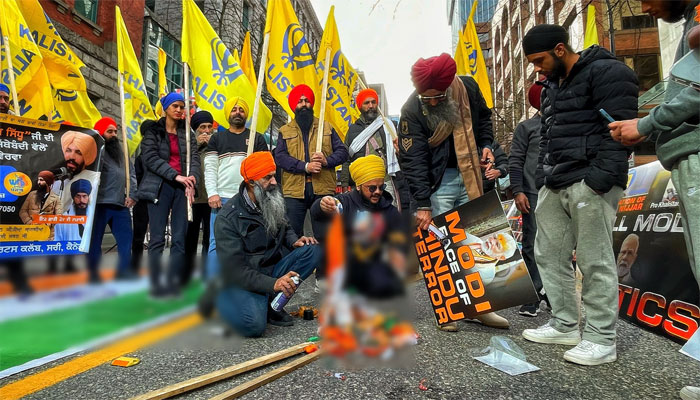
On 18th February (local time), Khalistani terrorists gathered outside the Indian consulate in downtown Vancouver in Canada burning two Tricolours and tearing another apart in protest against the Indian government. The vandals made made anti-India and anti-Hindu statements in Punjabi through loudspeakers. They shouted slogans like “Shame on India” and used cow urine jibes to target Hindus. Reports suggest that the protest took place to mark eight months since the murder of Khalistani terrorist Hardeep Singh Nijjar in Canada.

While anti-India activities are on the rise and anti-state forces like Khalistanis get a free-run in Trudeau’s Canada, Canadian officials are holding “workshops” for their Indian counterparts to “teach them” about the “rule of law”. Reports suggest that these workshops are aimed at informing Indian officials that Canada’s legal system is different. Furthermore, the Canadian system sees extremism and terrorism differently from India. In a statement” senior bureaucrat Weldon Epp said, “How India defines extremism or even terrorism does not always compute in our legal system.”

While Canada attempts to teach Indian officials, videos of Khalistanis going on a rampage are doing rounds on social media video. A video shared by a journalist showed a Khalistani burning the Indian flag. The separatists were holding placards that read “Modi face of Hindu terror”.

There was a poster in the frame that had photos of pro-Khalistani Sikh preacher Amritpal Singh, who is currently lodged in jail, and Deep Sidhu, a pro-Khalistani actor-turned-leader who died in a car accident in 2022. Deep Sidhu had started the “Waris Punjab De” organisation that Amritpal Singh took over after Sidhu’s death.

Another video shared by a journalist shows a Khalistani using “gaumutra” (cow urine) jibe against Hindus. “Our time is coming. Do whatever you want. Cow urine drinkers and dung worshipers, put all the efforts you want.” He then continued to threaten to demolish the Indian embassy and claimed that the “Khalistan embassy” would be built in its place.

Hardeep Singh Nijjar and accusations against India

In June 2023, Khalistani terrorist Hardeep Singh Nijjar was murdered in Canada by unknown assailants. He was killed as a result of an alleged gang war. Soon after his death, pro-Khalistani elements accused the Indian government of killing Nijjar. In September 2023, Canadian Prime Minister Justin Trudeau accused India of killing Nijjar on Canadian soil. Nijjar, who had fled India in the 1990s on a fake passport, was granted Canadian citizenship. Following the accusations, Canada expelled a top Indian diplomat. India rubbished the allegations and expelled a top Canadian diplomat in retaliation.

Furthermore, 40-odd Canadian diplomats living in India were asked to leave in October 2023. Canada, which has a history of meddling in India’s affairs, failed to give any substantial evidence against India to support the accusations of killing Nijjar. Canada only said that they have “credible allegations” against India. On several occasions, India asked for evidence, but Canada failed to provide it.

Newslaundry paints Islamists as ‘victims’ to justify violence in Haldwani, accuses police and Uttarakhand govt of ‘provoking’ Muslim mobs

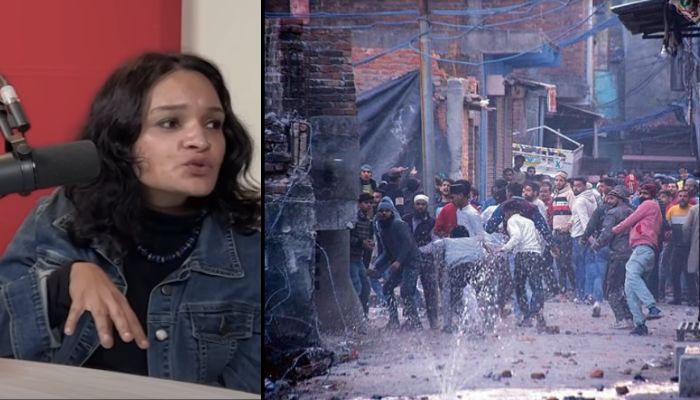
Nine days after Islamists unleashed mayhem in Haldwani city in the Nainital district of Uttarakhand, Newslaundry on Saturday (17th February) resorted to justifying the outbreak of violence following police action on an illegal madrassa-mosque.

‘Journalists’ associated with the leftist propaganda outlet joined hands first to deny and then contextualise the Islamist violence against police personnel.

At about 14:55 minutes into their podcast, one Sumedha Mittal claimed, “Prashant and I had gone there for 5 days…I don’t think we have been able to make sure that the true picture of the violence has come out. This is because there was no access.”

“On 8th February i.e. the night when the violence broke out, a curfew was imposed on the entire city of Haldwani. As the days went by, the curfew restrictions were relaxed for the Haldwani city but for Banbhoolpura area i.e. the locality where the mosque and the madrassa were razed,” she further added.

The propaganda artist shrewdly claimed that there was not ‘enough information’ about how the riots unfolded in Haldwani and insinuated that the law enforcement authorities somehow came in the way of the ‘truth’ by imposing a curfew.

Sumedha Mittal failed to address the fact that the curfew was imposed in the first place due to the extent of arson, stone pelting, violence and the deteriorating law and order situation in Haldwani.

Manisha Pande calls rioters ‘crowds’, paints them as victims

‘Managing Editor’ of Newslaundry, Manisha Pande, however, conceded that the rioters ran rampage in Haldwani but carefully substituted ‘violent Muslim mobs’ with ‘crowds.’

“With Haldwani, what seems to have happened is the crowd got really out of control and angry. It’s true that they went on a rampage and attacked the police but you are antagonising them in such a way…” she was heard saying.

Manisha Pande then painted the Islamists as ‘victims’ who were somehow left with no option but to retaliate against police action. “You are coming for their houses, places of worship, schools without any notice or warning. You know you are creating a situation,” she brazened out.

She however left out an important detail. The local administration had the requisite permission to carry out the demolition drive. Manisha Pande thus effectively endorsed violence as a means to oppose civic action against illegal encroachments.

Newslaundry propagandists leave no stone unturned

Newslaundry’s Editor-in-Chief Raman Kirpal tried to portray the District Magistrate Vandana Singh in a bad light for ordering ‘firing on rioters.’ “That used to be a huge thing but now nobody is even talking about it,” he lamented during the podcast.

We have more than enough evidence and eyewitness testimonies that suggest that the violence by Islamists in Haldwani was pre-planned. The administration was thus forced by Islamists to take stringent measures to put an end to the orgy of violence.

In that light, the police firing on rioters for carrying out arson and attacking police personnel was thus justified. Raman Kirpal left out this important context to insinuate that the law enforcement authorities somehow fired gunshots at innocent civilians.

Jayashree Arunachalam of Newslaundry then casually claimed that ‘Muslim mobs’ were provoked by the State government. “It’s basically a pattern. You attack Muslims enough until someone responds and then you use that response as a sort of excuse for State violence.”

Riots in Haldwani

On 8th February this year, Islamists resorted to stone pelting and arson in Uttarakhand’s Haldwani area. The frenzied mob attacked authorities who went there to demolish a madrasa, which was built on illegally encroached govt land near the Banbhulpura police station.

The Islamists pelted stones at the policemen and Haldwani Municipal Corporation workers present there. Later, they surrounded the police station and went on to set fire to the vehicles stationed outside the Banbhulpura police station.

The mob also set a transformer on fire, resulting in a power outage in the area. Several journalists and administration officials were trapped inside the police station as a mob surrounded the Banbhulpura police station.

Newslaundry whitewashes Mira Road violence against Hindus

Days after Islamists ran riots in the Mira Road suburb in the Thane district of Maharashtra, Newslaundry came to their rescue on 27th January.

In a YouTube video titled ‘Godi media’s u-turn on Ram Mandir | Hypocrisy Ki Seema?’, the leftist media outlet not only whitewashed the Islamist violence against Hindus but dubbed the bulldozer action against the accused as ‘majoritarian revenge.’

“Can one move on when you have another set of people who celebrated January 22nd with an ugly spirit of revenge…This was reaction number two to the Ram Mandir inauguration,” Newslaundry ‘journalist’ Manisha Pande brazened out.

“Two days after the communal clash, 15 shops demolished in Mumbai suburb’s Haidary Chowk area,” the video featured the screenshot of an article by The Indian Express.

This is a classic trope used by leftist media to deviate public discourse from the chronology of events. On 21st January this year, frenzied Muslim mobs attacked Hindus when they were carrying out a procession through the Mira Road suburb.

The incident took place on the eve of the Ram Mandir Pran Prathistha. The Hindu devotees were raising the religious chant of ‘Jai Shri Ram’ and had adorned their vehicles with saffron (bhagwa) flags.

This drew the ire of the intolerant ‘minority’, who wasted no time in launching an unprovoked attack on the Hindus. The frenzied Muslim mobs vandalised cars, stomped on saffron flags, manhandled and injured a Hindu woman and assaulted other Hindu men.

All of this happened only because a group of Hindus took out a religious procession through a ‘Muslim area’, a supposedly no-go zone for adherents of other religious communities.

While Islamists are habituated to getting away with their ‘street veto’, the police cracked down on them and arrested 13 men. The city administration also promptly swung into action and bulldozed the illegal encroachments of the accused.

Newslaundry cunningly omitted the entire context and chain of events to dub the bulldozer action as some form of ‘revenge’ by the majority community.

“As communal tensions hit Mira Road in Mumbai, listen to what the MLA Geeta Bharat Jain had to say…”, ‘journalist’ Manisha Pande claimed.

She conveniently glossed over the fact that it was the Islamists who started the violence, thus forcing law enforcement to take matters into their own hands.

One of the keywords used frequently by Newslaundry, perhaps to woo their core audience, is ‘majoritarianism’. In the video posted by the leftist propaganda outlet on 27th January, it left no stone to portray Islamists as the harbingers of peace and reconciliation.

Through its rhetoric and ’emotional appeal’, Newslaundry gave the impression that the violence that broke out in the wake of Ram Mandir Pran Prathistha was the doing of the ‘majority’ Hindu community.

The guilt-tripping did not end with painting Muslims as victims and Hindus as aggressors. ‘Journalist’ Manisha Pande went a step ahead and put the onus of ‘inclusive behaviour’ exclusively on the Hindu community.

“The journey ahead for us as a nation depends on what India chooses between peace, reconciliation, moving ahead or revenge and ugly majoritarian politics,” she ranted.

The two-pronged strategy used by Newslaundry was to deny any wrongdoing against the Hindu community and at the same time ask the victimised lot to be more accommodating of the aggressors.

Breakthrough in fourth round of Centre-farmers talks: Govt proposes 5-year plan for purchase of crops at MSP, ‘Delhi Chalo’ march halted temporarily

0

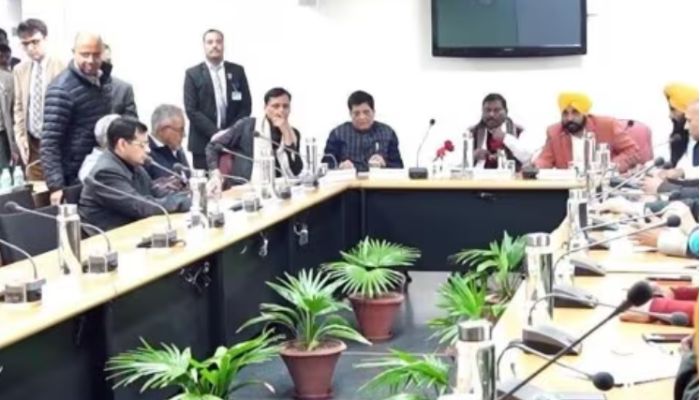
The Centre has presented a five-year plan for the purchase of pulses, maize and cotton crops by government agencies at minimum support prices. This comes following the fourth round of talks between the Centre and farmers on Sunday (18th February).

Representing the government was the panel comprised of Union Minister of Agriculture and Farmer Welfare Arjun Munda, Union Minister of Commerce and Industry Piyush Goyal, and Minister of State for Home Affairs Nityanand Rai.

Minister Piyush Goyal said that the talks were “positive” stating that the farmers raised various concerns. The proposal by the government includes a five-year plan for the procurement of key crops by the government agencies at MSP.

“We proposed a solution involving cooperative societies like NAFED entering into five-year contracts with farmers, ensuring purchases at MSP without quantity limitations,” said Union Commerce and Industry Minister Piyush Goyal.

The Union Minister highlighted the proposal’s focus on diversification into pulses, cotton and maize with MSP assurances without limitations on the quantity.

He said, “This approach will save Punjab’s farming, improve the groundwater table, and save the land, which is already under stress, from getting barren.”

Additionally, Goyal said that several policy matters discussed cannot be finalised immediately as they need broader representation. He added that deliberations will continue to take place.

Following the government’s proposal, the farmers have decided to halt the ‘Delhi Chalo’ march temporarily while they go through the proposal and decide on the further plan of action.

The farmers have said that they will discuss the proposal over two days from February 19-20 and seek the opinion of experts before arriving at a decision.

Farmer leader Sarwan Singh Pandher said, “We will discuss in our forums on February 19-20 and take the opinion of experts regarding it and accordingly take a decision.”

He added that a decision on loan waivers and other demands is pending and hoped that the same will be resolved in the next two days. He Pandher said that the march will resume at 11 am on 21st February if all issues are not resolved.

The farmer’s panel comprised of representatives from Samyukta Kisan Morcha (non-political) and the Kisan Mazdoor Morcha (KMM).

As per reports, the unions are planning to gherao the residences of BJP leaders in Punjab for three days and make toll barriers free for commuters from February 20-22.

SKM is scheduled to meet in Delhi on 22nd February to decide on further demands and plan of action.

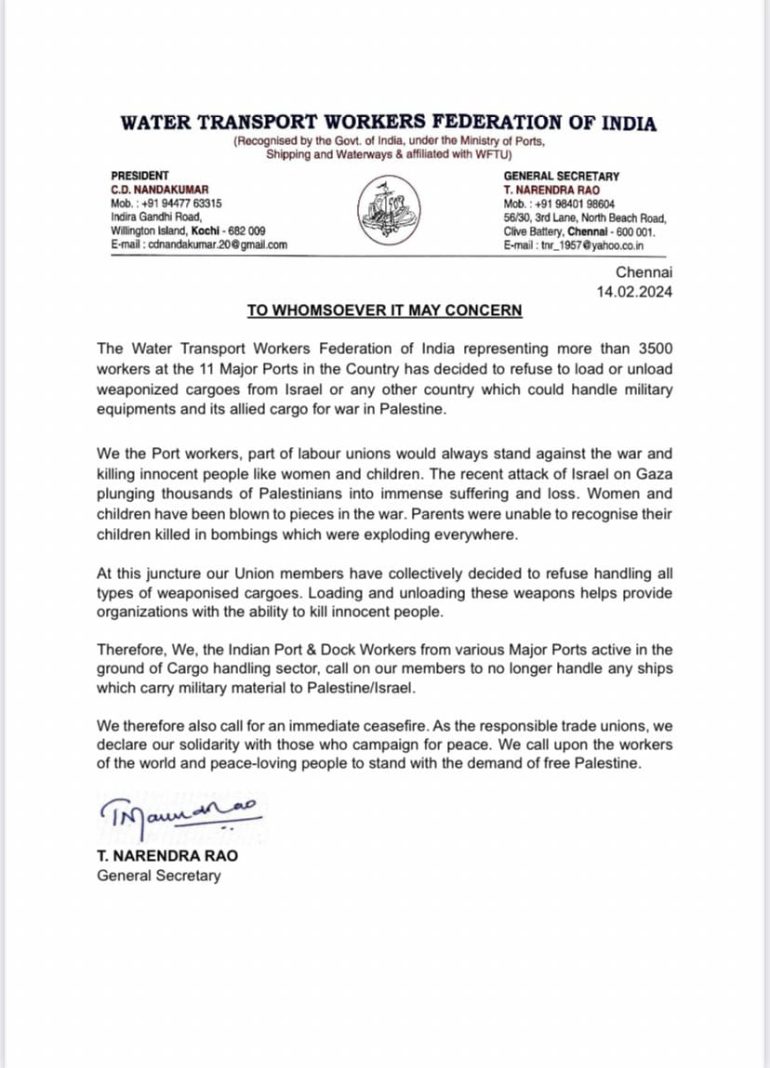
CPM-associated port workers federation declares support for Palestine, says it will not load or unload cargo from ships carrying weapons to Israel

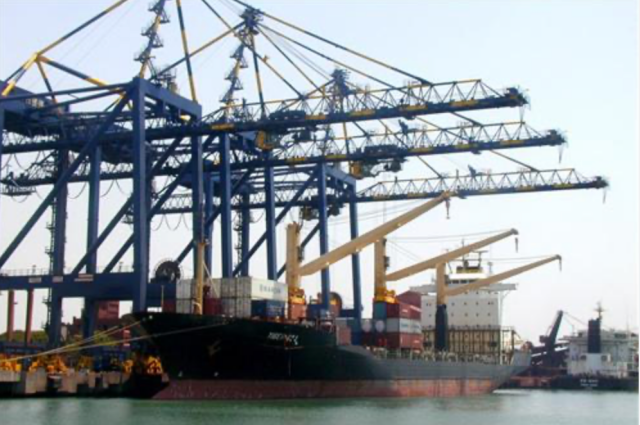
The Water Transport Workers Federation of India, a trade union of workers across 11 Indian ports, has stated that they will not load or unload cargo from ships that are carrying weapons from Israel or any other country to be sent to the conflict zone in the Israel-Hamas war. The Federation represents about 3500 workers across 11 Indian ports.

In a statement released on February 14, the Federation has stated that they always stand against wars that kill innocent women and children. Describing the current Israeli operation in Gaza as a devastating war that is killing countless children, the Federation has stated that the Union members have collectively decided to refuse to handle all kinds of weapons-related cargo because loading and unloading ships helps further the war.

The federation has called all port and dock workers associated with their organisation to stop working on any ship that carries weapons or military equipment to Israel or Palestine.

The federation has also called for an immediate ceasefire in Gaza.

The statement by the Water Transport Workers Federation of India

It is notable here that similar action was seen in other countries like Spain and Belgium where some port workers have asked their members to refuse to handle military cargo to Israel.

As per reports, General Secretary T Narendra Rao of the federation has stated that the federation in India is affiliated to the World Federation of Trade Unions, and at a meeting held in Athens after the Gaza war started, representatives from the Palestinian trade unions explained what is going on there. As a result, the federation has decided to not handle any cargo that is carrying weapons to help Israel ‘kill more people’.

A report in Mint also quoted Rao as saying that they have not encountered any such ship so far. The statement was given to ‘express solidarity with Palestine’, he insisted. The statement has come amid reports that a Hyderabad-based joint venture linked to the Adai Group has manufactured and sent 20 military drones to Israel.

It is notable here that The Water Transport Workers Federation of India is affiliated with the Centre for Indian Trade Unions, the labor wing of the Communist Party of India (Marxist).

Israel has declared an all-out war against Hamas after Hamas terrorists attacked Israeli civilians on October 7, killing over 1300 civilians including hundreds of women and children.

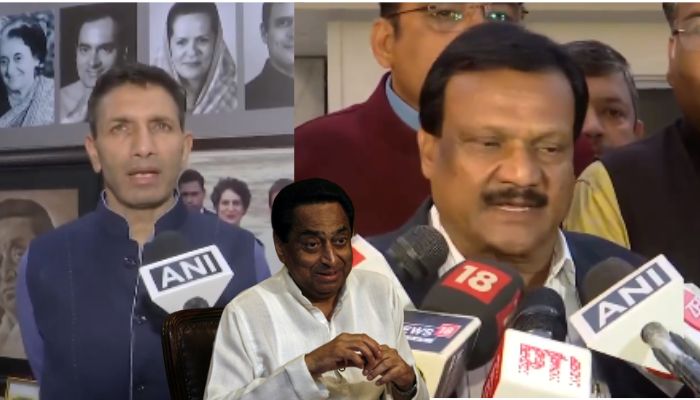
‘Will continue to be Congress person’: Kamal Nath joining BJP is media conspiracy, say Congress leaders after talking with the former MP CM

Amid strong media buzz that Former Madhya Pradesh Chief Minister and Veteran Congress leader Kamal Nath along with his son, Nakul Kamal Nath, will soon join the BJP, Congress leaders have rejected it claiming it to be ‘rumours’ and media ‘conspiracy’. Congress leaders Sajjan Singh Verma and state Congress President Jitu Patwari told media persons that they held talks with the Former state CM Nath who assured them that he is not joining the BJP and all such media reports are ‘rumours’. 

Congress leader Sajjan Singh Verma spoke with reporters after meeting Kamal Nath at his Delhi residence on Sunday (18th February). Following his meeting, Verma asserted that Nath told him that he is not thinking about leaving the Congress party. 

Congress leader Verma said, “I had a discussion with him (Kamal Nath). He said that right now his focus is on how the caste equations will be on 29 Lok Sabha seats in Madhya Pradesh. He said that he has not thought about anything like that (of leaving the party)…”

According to Verma, Kamal Nath has also spoken to Rahul Gandhi over the phone and discussed the Bharat Jodo Nyay Yatra which will enter Madhya Pradesh soon, adding that Kamal Nath has not made any decision on leaving the party. He added that the buzz around Kamal Nath’s switch to the BJP has been created by the media.

Further, refuting media reports about Kamal Nath’s switch to BJP, Madhya Pradesh Congress President Jitu Patwari blamed the media for ‘tarnishing’ the image of Kamal Nath and his long association with the Congress party. He asserted that during his talk with Kamal Nath, he reassured that he will continue to be a Congress person.

Claiming it to be a media conspiracy, Patwari alleged, “The rumours that Kamal Nath going to BJP, this is an example of how media can be misused. This was a conspiracy made against Kamal Nath. I spoke to him and he said that all these things are just rumours, and he is a Congress person and will continue to be a Congress person…he will continue to have Congress ideology till his last breath. This is his own thoughts, he said this…”

Earlier during his sudden visit to Delhi, Kamal Nath was asked about his possible resignation from Congress to join the BJP. In reply, he told the media, “If there’s any such thing, will inform you (media persons) first,” however, he didn’t categorically deny or reject his possible switch. 

Yesterday, the speculations of Nakul Nath’s possible desertion from Congress gained strength when he removed the party name from his X (formerly Twitter) bio. It came a day after Madhya Pradesh BJP chief VD Sharma said that several Congress leaders were ‘pained’ by the decision of the Congress leadership to reject the invitation for the Ram Mandir Pran Pratishtha. 

However, within hours, Senior Congress leader Digvijay Singh had tried to put media speculations to rest claiming that such reports are just “breaking news hunting” and the man who had been close to the Nehru-Gandhi family couldn’t leave the Gandhi family.

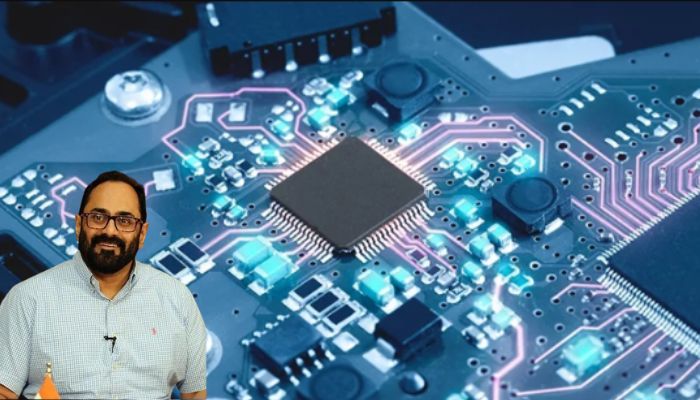
Two multi-billion dollar full-fledged semiconductor fabs coming up soon in India apart from testing and packaging plants: MoS IT Rajeev Chandrashekhar

On 18th February (Sunday), Minister of Electronics and IT Rajeev Chandrasekhar stated that two full-fledged semiconductor fabrication plants with multi-billion dollar investments are soon coming up in India. These semiconductor plants will be beside the several chip assembly and packaging units already launched and announced.  

In an interview with PTI, Minister Chandrashekhar confirmed that the two projects include the USD 8 billion proposal submitted by Israel-based Tower Semiconductors and the other project by Tata Group. 

He said, “I am happy to share this with you (PTI) and you are probably the first one I’m sharing this with. In the near term, two full-blown fabs are going to come up in India. These are going to be multi-billion-dollar fabs in the 65, 40, and 28-nanometer technology and there are going to be a host of other packaging proposals that we are evaluating.”

He made this announcement while responding to a question on the USD 8 billion investment proposal submitted by Tower Semiconductors as well as the status of the semiconductor roadmap in India.  

He emphasised that the projects would be approved in the third term of Prime Minister Narendra Modi if they cannot be cleared before the Lok Sabha elections.

Minister Chandrasekhar said, “I can safely tell you that the names that you mentioned have submitted these big, very credible, very significant investment proposals. There are other announced proposals by Tata as well in the fab. We see this happening in a very, very quick short term.” 

Last week it was reported by the Indian Express that Israel-based chip manufacturing company Tower Semiconductor has submitted its proposal to set up a chip fabrication plant in India worth around $8 billion. The company will reportedly manufacture 65 nanometre and 40 nanometre chips in India. These chips are used in several sectors, including automotive and wearable electronics. Tower has not finalised the location of the project. Reportedly the company has chosen BC Jindal group as its partner for the project.

The company had earlier announced a $3 billion plant in Karnataka in partnership with international consortium ISMC. However, the project didn’t go ahead due to a proposal to merge the company with Intel. In August 2023, the Intel-Tower merger was called off due to regulatory issues in some countries.

Notably, at the Vibrant Gujarat Summit held in Gift City in January, Tata Sons Chairman N. Chandrasekaran announced that the company will set up a semiconductor fabrication plant in the country, apart from the testing and packaging facility in Assam which was earlier announced. He said that the company has identified Dholera in Gujarat as the location for its semiconductor fabrication unit, and negotiations will be finalised soon. “We are about to complete negotiations and start work in 2024,” Chandrasekaran said during the summit.

On Thursday (15th February), Minister Chandrasekhar announced that the plant in Assam will be finalised soon, and the state will soon have its first-ever semiconductor packaging plant worth nearly Rs 25,000 crore. The semiconductor packaging plant will be established in partnership with the Assam Government and TATA Group. The project was announced in December 2023, and the plant will come up in Jagiroad near Guwahati. However, at that time the investment for the project was reported to be Rs 40,000 crore.

As per reports, the Union government has so far received four proposals to set up semiconductor manufacturing plants as well as 13 proposals for chip Assembly, Testing, Monitoring, and Packaging (ATMP) units.

Another semiconductor assembly and testing facility was announced last week by Murugappa Group’s CG Power and Industrial Solutions, Renesas Electronics America Inc and Thailand-based Stars Microelectronics. Foxconn has set up a joint venture with Indian IT giant HCL Group to set up a semiconductor Outsourced Assembly and Testing (OSAT) unit in India. Foxconn has also filed a fresh application for setting up a semiconductor fab in the country after the proposed venture with Vedanta was called off. Reportedly, the Taiwanese company has tied up with STMicroelectronics NV for the manufacturing plant.

These proposals are in addition to a Rs 22,516-crore chip assembly plant in Gujarat which is being set up by US-based memory chip maker Micron. Phase 1 of the plant will be operational by early 2025.

The Minister slammed the UPA government stressing that India’s semiconductor story is very akin to that of electronics in the country. He stated that the government before 2014, the UPA government, ignored electronics and for 75 years, India was a “classic case of missed opportunity” in semiconductors.

Contrasting the work of UPA and PM Modi-led government, Minister Chandrashekhar said, “In 2012 Intel wanted to set up a plant here, and they found no support and they walked away. When the prime minister launched this (semiconductor) program in 2020 January, we knew we had to work very fast, and smartly and we had to in essence play catch up for the last 75 years of lost opportunity. We have made significant progress in a broad spectrum of areas: semiconductor design, startups, research, talent, packaging, and fabrication.”

It is pertinent to note that domestic electronics manufacturing has increased by over four-fold in the last ten years from Rs 1,80,454 crore (USD 29.8 billion) electronics manufacturing in FY 2013-14 to Rs 8,22,350 crore (USD 102 billion) in FY 2022-23, as per government data. This is further expected to grow up to Rs 23,95,195 crore (USD 300 billion) by 2026. 

The Minister further added, “India has played a big role in that shift in the last five years. India will play a big role in the coming five years to a decade. In electronics manufacturing, we were almost absent. To put it in the words of Tim Cook (Apple CEO). Three years ago there were no Apple phones being manufactured in India. We were importing 100 percent of all mobile phones. Today we are exporting USD 10-12 billion of Apple and Samsung mobile phones.” 

He stated that the government wants to do USD 300 billion of electronics manufacturing by the year 2026-27.

As per official data, India has now reached a stage where 99.2 percent of mobile handsets being used in the country are manufactured domestically. From being an importer in the segment, India has now become an exporter.