Home Blog Page 167

Delhi police bust ISIS module running Pakistan sponsored ‘Khilafat model’, arrested terrorist Ashhar Danish had a postgraduate degree in English

0

Delhi Police’s special cell has busted a ISIS terror module which was hatching a Pakistan handler-sponsored “Khilafat model” in the country. The police nabbed five people from four different states identified as Ashhar Danish, Sufiyan Abubakar Khan, Aaftab Ansari, Huzaifa Yaman and Kamran Qureshi.

Additional commissioner (special cell) Pramod Kushwaha said that the accused had hatched a “two-fold plan,” first forming a Khilafat-style group and then executing Ghazwa-e-Hind style jihad.

“Their plan was two-fold. First, they had to form a Khilafat-style group. They have their own team, which is called Lashkar, and after that, they had to do jihad, Ghazwa-e-Hind type, on the basis of their distorted concept of understanding of Islam. Plus, some targeted killings were to be tasked to them,” Kushwaha said.

The police recovered large quantities of objectionable material from them, like Sulphur powder, sulphuric acid, nitric acid, sodium bicarbonate, pH weighing checker, ball bearings and equipment which can be used for making an IED, wires, motherboards, laptops and mobile phones, plus weapons and cartridges.

A total of 11 people were picked up in the case, out of which five have been arrested. As per police, Ashhar Danish from Ranchi is the leader of the group who was pretending to be running a professional company. Therefore, he used to code CEO, and in his inner group, his code was Ghazwa leader. They were also trying to acquire land using the name of an NGO.

He reportedly had a postgraduate degree in English. Ashhar Danish came from an educated background. His father is a lawyer while his mother is a teacher. He is an expert in making bombs

“They had an internal group, these are highly radicalised boys,” added Kushwaha.

Ashhar Danish was nabbed from Ranchi, Sufiyan Abubakar Khan and Aaftab Ansari were arrested from Delhi, while Huzaifa Yaman was arrested from Nizamabad, Telangana, and Kamran Qureshi was arrested from Rajgarh, Madhya Pradesh.

Delhi Police said that the accused were trained in making IEDs and even cartridges. Police also recovered “incriminating drawings” from the accused. According to the police, the suspects revealed that their handler was teaching them to assemble IEDs online and told them to buy various of items including chemicals to make a bomb.

Kushwaha said, “This was a homegrown operation. So, acquiring weapons, including making IEDs, even cartridges, they were told to prepare on their own. Some incriminating drawings have also been found from them.”

Delhi Police have filed an FIR against the accused under offences of promoting propaganda to create enmity between communities, disturbing religious harmony, and possessing illegal weapons.

The central agencies are analysing the digital devices seized from the suspects to track their contacts and possible international links. The police added that the arrests have averted a possible terror strike in the country.

Rajasthan High Court upholds order cancelling the license of meat shops near Hindu temple, dismisses claim that the place of worship was ‘private’

The Rajasthan High Court recently dismissed petitions challenging the order cancelling the license of meat shops situated within a 50-metre radius of a place of worship.

The petitions were filed against the order of the District Collector, Jaipur, passed on February 17, 2025, which cancelled the license of meat shops lying in the vicinity of a temple. The said order invoked Clause 4 of a Standard of Procedure (SoP), which was issued under Section 269 read with Section 340 of the Rajasthan Municipalities Act, 2009.

Every temple is a public property unless proved otherwise: HC

The petitioners contended that the cancellation of the license was unwarranted as the temple in question was merely a private temple and not a public temple registered with the Devasthan Department.

Refusing to accept the argument presented by the petitioners, a single bench of Justice Anoop Kumnar Dhand said that every temple is a public property unless proved otherwise. The judge noted that the temple was located in an open area and was accessible to all.

“If a temple is situated in an open area and is accessible to the public, it will be construed as a public temple. Public temples are considered to be dedicated to the public at large or a section thereof for worship,” Justice Dhand said.

“This Court finds no substance in the arguments of the counsel for the petitioner that the temple situated within a 50-meter radius of the petitioners’ meat shops is not a public temple,” the Judge noted in its order dated September 1, 2025.

Describing a temple, the judge said, “A temple is a place of worship dedicated to a specific deity or deities, where individuals or groups perform their religious activities, prayers or ceremonies. Temple means a place, by whatever designation known, used for public religious worship where anyone can worship, and the same is accessible to the public at large.”

“These petitions do not contain any merit or substance which warrants any interference of this Court. These writ petitions are found to be devoid of merit and the same are hereby rejected. Stay applications and all pending application(s), if any, also stand dismissed,” the court said in the dismissal order.

Under Yogi govt, 60 lakh youth have got jobs, UP has received investment proposals of over 45 lakh crores in the private sector in 8 years

0

The state of Uttar Pradesh has experienced a boost in investments marked by a remarkable increase in employment opportunities under the Yogi government. As per data shared by the Mission Rozgar initiative of the UP government, ₹45 lakh crore in investment proposals have been received over the last eight years.

Of the ₹45 lakh crore in investment proposals, over ₹15 lakh crore worth of projects have already been implemented on the ground, creating a massive increase in employment. In UP, more than 60 lakh youth have got jobs in the last 8 years, driven by the growth in investments.

UP’s significant employment rise is a hallmark of robust policies, coordination of the state government with the central government to implement various schemes and the state government’s consistent efforts to drive industrial growth in India’s most populous state. On Thursday, CM Yogi Adityanath shared that 60 lakh youth have got private sector jobs, while addressing the public in the Gorakhpur Industrial Development Authority (GIDA) area.

CM Yogi laid foundation stone and inaugurated projects worth Rs 2,251 crore in GIDA area.

Initiatives undertaken by the UP government to boost economic growth have displayed a strategic and significant shift under Chief Minister Yogi Adityanath, who, since 2017, has prioritised infrastructure and investment, evidenced by Uttar Pradesh’s rise from 7th to 2nd in India’s ease of doing business rankings by 2024, challenging the narrative that northern states lag in economic development.

PM Modi hosts Mauritius PM Navinchandra Ramgoolam in Varanasi callng it spiritual union of a family, several MoUs and a Special Economic Package announced

Prime Minister Narendra Modi on 11 September 2024 hosted Mauritius Prime Minister Dr. Navinchandra Ramgoolam in Varanasi for bilateral discussions that underscored the deep cultural and strategic bonds between the two nations. The talks, part of Ramgoolam’s week-long state visit to India from September 9 to 16, resulted in several key agreements, a special economic package, and commitments to expand cooperation across sectors from energy to space exploration.

This marks Ramgoolam’s first overseas bilateral visit since assuming office in November 2024, reciprocating Modi’s trip to Mauritius in March 2025. The visit began with arrival in Mumbai on September 9, where Ramgoolam, accompanied by his wife Veena, six cabinet ministers, senior officials, and a business delegation, engaged with prominent Indian industry leaders and presided over a business forum.

The delegation arrived in Varanasi yesterday evening, setting the stage for Thursday’s high-level talks. Modi welcomed Ramgoolam to his parliamentary constituency, describing the meeting as a “spiritual union” rather than mere diplomacy, highlighting centuries-old cultural ties that have flowed from India to Mauritius like the eternal Ganga River.

In his press statement during the joint session, PM Modi emphasized Mauritius’s role in India’s “Neighbourhood First” policy and the “MAHASAGAR” vision for maritime security and growth in the Indian Ocean region. He noted that the two countries elevated their relationship to an “Enhanced Strategic Partnership” during his March visit and reviewed progress across bilateral, regional, and global issues. Modi congratulated Ramgoolam on the recent Chagos Agreement, calling it a “historic milestone” for Mauritius’s sovereignty and reaffirming India’s support for decolonization efforts.

Prime Minister Ramgoolam echoed the sentiment of familial bonds, stating in his remarks that he and Modi had “held deep exchanges on pressing global challenges” and would continue collaborating. “This visit has reaffirmed that the ties between Mauritius and India are not defined merely…” he said, trailing into praise for the enduring partnership. The Mauritian leader’s comments aligned with the broader theme of shared dreams and destiny, particularly as both nations commemorate the 125th birth anniversary of Sir Seewoosagur Ramgoolam, Mauritius’s founding father and architect of Indo-Mauritian relations.

A centrepiece of the discussions was India’s announcement of a Special Economic Package worth $25 million, aimed at bolstering Mauritius’s infrastructure, job creation, and healthcare. Modi described the package not as aid but as “an investment in our shared future,” with specific initiatives including the establishment of the first Jan Aushadhi Kendra (affordable medicine center) outside India in Mauritius, an AYUSH Centre of Excellence, a 500-bed Sir Seewoosagur Ramgoolam National Hospital, and a Veterinary School and Animal Hospital.

Foreign Secretary Vikram Misri elaborated in a special MEA briefing that this includes a grant of approximately ₹96 crore for Phase II of high-impact community development projects.

Infrastructure projects under the package encompass the Chagos Marine Protected Area, an Air Traffic Control (ATC) Tower at SSR International Airport, and expansions of highways and ring roads. On the economic front, building on last year’s launch of UPI and RuPay cards in Mauritius, the leaders agreed to advance trade settlements in local currencies to reduce dependency on foreign exchange.

Energy cooperation emerged as a key area, with India supporting Mauritius’s transition to sustainable sources. This includes supplying 100 electric buses (10 already delivered), a Comprehensive Partnership Agreement in the energy sector, and assistance for a 17.5 MW floating solar power plant at Tamarind Falls, with an NTPC team set to visit Mauritius soon to finalize details with the Central Electricity Board (CEB).

Human resource development remains a cornerstone, with over 5,000 Mauritians trained in India to date. PM Modi highlighted the ongoing training of the first batch of 500 Mauritian civil servants in Mussoorie, as agreed during his March visit. New commitments include establishing a Directorate of Science and Technology in Mauritius and launching Mission Karmayogi training modules there, focusing on civil service capacity building.

Education and innovation ties were further strengthened through Memoranda of Understanding (MoUs) between the Indian Institute of Technology (IIT) Madras and the University of Mauritius, as well as between the Indian Institute of Plantation Management (IIPM) Bengaluru and the University of Mauritius. These aim to boost research, education, and innovation collaboration.

Maritime security featured prominently, with India reaffirming its role as a “first responder and net security provider” in the Indian Ocean. Ongoing efforts include refitting a Mauritius Coast Guard ship in India and training 120 officers. A renewed MoU on hydrography will facilitate joint surveys, navigation charts, and data sharing for Mauritius’s Exclusive Economic Zone (EEZ) over the next five years.

The visit culminated in the signing of seven MoUs and agreements, as mentioned below:

  1. Memorandum of Understanding on Cooperation in the Field of Science and Technology between the Department of Science and Technology, Government of India and the Ministry of Tertiary Education, Science and Research, Republic of Mauritius
  2. Memorandum of Understanding between Council of Scientific and Industrial Research – National Institute of Oceanography, and Mauritius Oceanography Institute
  3. Memorandum of Understanding between Karmayogi Bharat under the Department of Personnel and Training and the Ministry of Public Service and Administrative Reforms, Government of Mauritius
  4. Memorandum of Understanding on Cooperation in the field of Power Sector
  5. Memorandum of Understanding regarding Indian grant assistance for Implementation of Phase II of Small Development Projects
  6. Renewal of the Memorandum of Understanding in the field of Hydrography
  7. Agreement between the Government of India and the Government of Mauritius on Cooperation for the Establishment of Telemetry, Tracking, and Telecommunications Station for Satellites and Launch Vehicles and for Cooperation in the fields of Space Research, Science and Application

The talks also touched on broader regional priorities, such as a free, open, and prosperous Indian Ocean, with India committing to enhance Mauritius’s maritime capabilities. The two leaders exchanged views on global matters, including climate change and economic recovery.

During his stay, Prime Minister Ramgoolam is expected to attend the Ganga Aarti on Thursday evening and visit the Kashi Vishwanath Temple on Friday morning before departing. He will reportedly visit Ayodhya also. PM Modi left Varanasi after hosting Ramgoolam for lunch, and travelled to Dehradun for an aerial survey of the flood affected places in Uttarakhand.

Rahul Gandhi’s ‘vote chori’ document was made out of India? Congress tries to defend itself as tech details hint at foreign collaboration

Congress leader Rahul Gandhi, known for peddling the ‘vote chori’ conspiracy theory to defame the Election Commission of India (ECI), has now come under the scanner.

On Wednesday (10th September), it came to light that the document, which Gandhi presented during his infamous press conference on 7th August this year, was prepared in the country of Myanmar.

The revelations were first made by a prominent X (formerly Twitter) handle ‘khurpenchh’. In a 7-tweet thread, the account shared compelling evidence that the ‘vote chori’ document of Rahul Gandhi was created outside India.

Congress leader Rahul Gandhi had shared the document on his website, which was hyperlinked to the text ‘Vote Chori Proof.’

A total of 3 PDF files could be found in a Google Drive folder named ‘Rahul Gandhi’s Presentation.’ The files contain the English, Hindi and Kannada versions of the document presented the Congress leader in his 7th August presentation.

The X (formerly Twitter) handle ‘khurpenchh’ analysed the metadata of the files. For the unversed, metadata is information about a file which is different from the content of the file.

Information such as author, creation date, time and size is furnished by the metadata of a file. It makes it easy to use, search and organise data.

In its analysis, the X user ‘khurpenchh’ found that all three versions of Rahul Gandhi’s presentation have been created in the Myanmar Standard Time (MMT).

MMT refers to the timezone of Myanmar, which is 6 hours and 30 minutes ahead of Coordinated Universal Time (UTC). For context, Indian Standard Time (IST) is 5 hours and 30 minutes ahead of UTC.

PDF files created in India will have the exact UTC + 5:30 and not 6:30, as evident from metadata analysis of the Congress leader’s vote chori document.

The X user ‘khurpenchh’ further pointed out that the use of VPNs (Virtual Private Networks) and file sharing through Google Drive does not alter the embedded metadata of PDFs.

The exposé evidently rattled the Congress ecosystem, which unleashed its IT cell trolls and attack dogs on X (formerly Twitter) to counter the grave charges against Rahul Gandhi.

On Thursday (11th September), Congress spokesperson Supriya Shrinate sought the help of ChatGPT to save face, but it was largely in vain.

She alleged that the discrepancy in the timezone was due to a software configuration issue/ Adobe bug.

This one-hour discrepancy is not evidence of relocation; it’s a common artifact. Adobe products often exhibit timestamp “oddness” where offsets mismatch, especially in metadata fields,” she claimed.

X (formerly Twitter) handle ‘khurpenchh’ highlighted how Adobe addresses bugs immediately and fixes them right away. It pointed out the exact software versions and asked to specify which bug changed IST to MMT.

It further stated that the PDF was created using Adobe Illustrator and it did not make sense to compare it with other Adobe products such as Lightroom and Bridge.

When some Congress sponsored trolls presented the case of a ‘timezone related bug’ in Lightroom, the X handle pointed out that the said bug was fixed 14 years ago and that there was no such bug in Adobe Illustrator (which was used to create Rahul gandhi’s vote chori document).

Supriya Shrinate and Rahul Gandhi are yet to respond to these serious charges.

It is important to note that Rahul Gandhi’s political career has been mired in controversies surrounding involvement of foreign powers.

Be it the Congress signing a Memorandum of Understanding (MoU) with the Chinese Communist Party or Rahul Gandhi’s mysterious foreign trips, his political manoeuvres continue to remain under the nation’s spotlight.

His secret meetings with foreign officials, social media influence campaigns managed by bots from Kazakhstan, Russia and Indonesia bring more public scepticism for the grand-old party.

Congress’ plans to open its office in hostile nation like Turkey, dubious social media activity and coordinated effort to repeatedly cast aspersions on the Indian electoral system without any shred of evidence is thus alarming.

Malayali actress Navya Nair fined ₹1.14 lakh by Australian authorities for wearing jasmine flowers in her hair: Read what happened

0

Malayali actress Navya Nair inadvertently landed herself in the soup while travelling to Australia to attend Onam celebrations. The actress was fined AUD 1,980 (₹1.14 lakh) at Melbourne Airport in Australia for carrying jasmine flowers without informing the Australian customs department.

Nair was going to attend the Onam celebrations organised by the Malayali Association of Victoria. She posted pictures of herself on the flight on Saturday (6th September), in which she could be seen dressed up in a saree and wearing jasmine flowers in her hair.

As per reports, the actress opened up about the incident during a recent interview. Nair said that she was shocked by the hefty amount of the penalty and even requested the Australian agricultural department to waive it. “I was kind of shocked. It’s a significant penalty. The thing is that I was not carrying flowers in my bag. The flowers were in my hair, so it was nothing hidden, but I didn’t declare it because I missed it. They mentioned that parts of plants and flowers are included. The sniffer dogs sniffed it because I had kept the flowers in my bag at the beginning of my travel,” Nair said in a conversation with HT City.

She reportedly sent an email to the authorities requesting waiver of the fine before the deadline for payment of the fine. “I have 28 days’ time for payment. They also told me that I can send an email telling all these details to the agriculture department. So, I sent them an email that night itself. I am just waiting for a reply. I have asked them to waive off the amount, and if they don’t waive off, then I have read in many articles that they charge 300 dollars, and they charged AUD 1980, and it is written 6 units, so I don’t know what it is. As a foreigner, I had no idea,” Nair added.

Nair explained that the fine was imposed as per the law of the country, but she tried to explain to the authorities that she did not do it intentionally. “It’s the law of a country, and I have to abide by it. I have no other option. I requested them and tried to tell them that it was not intentional. On a humanitarian aspect, they can simply take the flowers and keep them there. They could have let me go because I didn’t have any intention, but I think it depends on the officers, so I cannot comment on that,” she said.

“Before I came here, it was my father who bought jasmine for me. He cut it into two parts and gave it to me. He asked me to wear one in my hair from Kochi to Singapore, since it would wither by the time I reached. He told me to keep the second one in my handbag so I could wear it on the onward journey from Singapore. I put it in my carry bag,” Nair revealed.

Pointing out the silver lining in the case, the actress said that the incident has caught the media’s attention and has alerted other Malayali people, who would now be more careful regarding the customs rules. “My issue has become very popular with all the Malayalis, so they will be more alert in doing things. These rules are quite strict and very rigid. So it’s not very easy. The declaration form is a very small paper, which can be easily missed by travellers,” the actress cautioned.

What are the rules that Nair inadvertently violated

According to the rules of Australia’s Department of Agriculture, Fisheries and Forestry, passengers can carry up to 6 small boxes or bouquets of fresh flowers on a flight or cruise ship after first declaring them. This is because plants and flowers are capable of carrying insects, bacteria, viruses and fungi, which are considered biosecurity risks. After such items are declared by passengers, they are verified by biosecurity officers to check if they are free from pests before entering the country.

Charlie Kirk’s brutal assassination in Utah: As Trump orders USA flag to be flown at half mast, Left-Liberals celebrate murder in public

American conservative activist, Charlie Kirk, was shot dead on Wednesday (10th September, local time) during a talk at the Utah Valley University. A staunch ally of US President Donald Trump, Kirk often travelled to colleges to discuss political issues such as abortion, immigration and transgender issues.  

He advocated free speech, traditional values, and open debate on campuses, hosting events and media like “The Charlie Kirk Show.” Charlie Kirk is survived by his wife and two children.

The 31-year-old political activist’s assassination has shocked and saddened his supporters and the extended American right-wing. The founder of Turning Point USA, was fatally shot in the neck while h was addressing the crowd at Utah Valley University.

US President Donald Trump described the killing of Charlie Kirk as a “dark moment for America” and accused the “radical left” of inciting such political violence across the country. In an address late Wednesday (local time), Trump paid tribute to Kirk, calling him a “patriot” and a “martyr for truth and freedom”, while expressing condolences to Kirk’s wife Erica and their two children.

However, woke-liberals are drawing joy from Kirk’s brutal assassination.

Social media is replete with left-liberals posting videos celebrating Kirk’s assassination. Many are also sharing their “who’s next” lists, which include names of other prominent conservative voices like Ben Shapiro.

Liberals are making TikTok videos wherein they are seen cheering over Kirk’s killing. “Charlie Kirk was just shot in the neck at a Utah event”, wrote a woman, danced and made weird faces expressing her happiness.

A trans activist, Sophie Molly, wrote on X, “Charlie Kirk was a cunt. Good riddance.”

One Bluesky user quoted a post which said “He (Charlie) is f%*ked…”, and wrote, “Fingers crossed! He’s nothing but a cancer on society, and actually proud of it. Getting rich by being a malignant national tumor. Same as Andy Ngo, the late Rush Limbaugh, et al.”

Another one wrote, “He deserved it. Enjoy it.”

One transactivist Mara Rhodus wrote, “Just to be clear, Charlie Kirk has spouted pro-2A shit on the graves of children and violent bullshit about women like me for his entire career, so I’m absolutely going to dance on his fucking grave. Tired of pretending like this isn’t deserved.”

The video which recorded the moment a bullet struck Kirk’s neck is being widely shared across social media platforms with gleeful comments like, “Live by the sword, die by the sword”. Numerous videos have surfaced online featuring individuals mocking Charlie Kirk with their deranged laughter and comments praising the assassin. Many even called for more such acts against conservative activists.

Not only the woke liberal social media users, but liberal media cabal has also been accused of rejoicing over Kirk’s death. It has been alleged that during a TMZ livestream, staff were cheering and clapping in apparent delight just before announcing Kirk’s demise.

Rajdeep Sardesai falsely claims that Modi govt approves projects only before elections in states, asks some silly questions: A fact check

On 11th September, Journalist Rajdeep Sardesai made a serious allegation against the Narendra Modi government, accusing it of approving major infrastructure projects for electoral benefit. Referring to a Railway doubling project and an Expressway project going through Bihar, in a post on ?, Sardesai alleged that the project has been approved just before the state’s assembly elections.

Notably, the Cabinet Committee on Economic Affairs yesterday approved two major infrastructure projects totalling ₹7,616 crore. One is doubling of Bhagalpur – Dumka – Rampurhat single railway line section in Bihar, Jharkhand and West Bengal totalling 177 km with total cost of ₹3,169 Crore, and the other is 4-lane greenfield access-controlled 82.4 km Mokama-Munger section of the Buxar-Bhagalpur High-Speed Corridor in Bihar with an outlay of ₹4447.38 Crore. As mentioned, the railway track doubling project goes through 3 states including Bihar, while the access-controlled highway project lies within Bihar.

Alleging that both projects have been approved only due to upcoming Bihar assembly elections, Rajdeep Sardesai posed 5 questions – why are mega projects for states unveiled only at election time, is there any rigorous audit on how the money is actually spent, are the rules different for Centre and opposition ruled states, what would happen if we had one nation, one election, is it fair to say that one party’s freebies/ ‘revadi’ is another party’s welfare/development bonanza.

Rajdeep Sardesai has posed these questions based on completely false and baseless claims, because it is completely wrong to allege that the Modi govt approves mega projects only at election time. NDA government’s push for infrastructure is well known, and at almost every cabinet meeting, such mega projects are regularly approved. In the last few months, the government has approved several such projects across in India. Such projects cover states ruled by both NDA and non-NDA parties, and states where no elections are due recently.

Here are some such big projects announced in recent months:

DateProjectStatesAmount
27 August 2025Railway multi tracking projectsKarnataka, Telangana, Bihar, Assam₹12,328 Crore
27 August 2025New railway line projectGujarat₹2,526 Crore
19 August 2025Green Field Airport at Kota-BundiRajasthan ₹1,507.00 Crore
19 August 20256-lane access-controlled Capital Region Ring RoadOdisha₹8,307.74 Crore
12 August 2025700 MW Tato-II Hydro Electric Project Arunachal Pradesh₹8,146.21 Crore
8 August 20254-lane Marakkanam – Puducherry RoadTamil Nadu ₹2,157 Crore
31 July 2025Railway multi tracking projectsMaharashtra, Madhya Pradesh, West Bengal, Bihar, Odisha, and Jharkhand ₹11,169 Crore
1 July 20254-Lane Paramakudi – Ramanathapuram RoadTamil Nadu ₹1,853 Crore
11 June 2025Railway multi tracking projectsJharkhand, Karnataka and Andhra Pradesh₹6,405 Crore
28 May 2025Railway multi tracking projectsMaharashtra and Madhya Pradesh₹3,399 Crore
28 May 20254-Lane Badvel- Nellore Highway Andhra Pradesh₹3,653.10 Crore
30 April 2025Greenfield High-Speed CorridorMeghalaya and Assam₹22,864 Crore
9 April 20256 lane access controlled Zirakpur BypassPunjab and Haryana ₹1,878.31 Crore
9 April 2025Railway multi tracking projectsAndhra Pradesh and Tamil Nadu₹1,332 Crore
4 April 2025Railway multi tracking projectsMaharashtra, Odisha, and Chhattisgarh₹18,658 Crore
28 March 20254-Lane Highway project  Bihar₹3,712.40 Crore
28 March 2025Kosi Mechi Intra-State Link ProjectBihar₹6,282.32 Crore
19 March 20256- lane access controlled Greenfield HighwayMaharashtra ₹4,500.62 Crore
5 March 2025Govindghat to Hemkund Ropeway project Uttarakhand₹2,730.13 Crore
5 March 2025Sonprayag to Kedarnath Ropeway projectUttarakhand₹4,081.28 Crore
Total  ₹66,039.06 Crore

The above table clearly shows how Rajdeep Sardesai is lying to make fake allegations against the union government. In the last six months, the govt has approved several similar infrastructure projects every month. Yesterday’s approval of two projects was just part of such regular approvals.

Moreover, a look at the states in the table shows how Rajdeep Sardesai’s claim of approving elections only before elections and discrimination against opposition states is also completely wrong. Major projects have been approved in states where there are no assembly elections scheduled, and several projects have been approved in non-NDA ruled states, like Tamil Nadu, Karnataka, West Bengal, Punjab, Meghalaya etc.

Now, here are the answers to Rajdeep Sardesai’s questions

1) Why are mega projects for states unveiled only at election time?

Ans. Wrong claim, mega projects for states are unveiled all the time, not only at election time, as seen above.

2) Is there any rigorous audit on how the money (obtained from us taxpayers) is actually spent?

Ans. This is a silly question coming from a veteran journalist. CAG audits all the spendings of the government, including infrastructure projects. Railways, NHAI and other relevant implementing organisations have their own internal audits.

Moreover, not all of these projects are entirely govt funded, many projects include financial contribution from the private sector.

3) Are the rules different for Centre and opposition ruled states? Discriminatory federalism underlying ‘double engine’ politics?

Ans. The above list shows this is another false claim. Several big infrastructure projects are in non-NDA ruled states. Road and Railway projects span multiple states and it is not even possible to construct them on based of the ruling party.

Note: The term ‘Opposition-ruled’ used by Rajdeep Sardesai is an oxymoron, because opposition means not in the government, there can’t be any ‘opposition-ruled government’, he most probably wanted to mean ‘non-NDA ruled’.

 4) What would happen if we had one nation, one election?

Ans. Rhetorical question with no link with the subject. Also, it is already established that projects are approved without any election.

 5) Is it fair to say that one party’s freebies/ ‘revadi’ is another party’s welfare/development bonanza?

Ans. Another silly question, capital expenditure on infrastructure projects are not freebies or ‘revadi’, they are literally the opposite. Freebies are direct payments to people, while these are capital expenses that will create major infrastructures, generate jobs, and contribute to overall economic development of the places where they are located.

In conclusion, the steady stream of projects approvals in 2025, including in often in states far from polls and ruled by non-NDA parties, proves how Rajdeep Sardesai is shamelessly lying. These projects reflect a commitment of the Modi government to national infrastructure under initiatives like PM Gati Shakti, and have nothing to do with elections or the ruling party of the state.

Nepal Gen Z protesters support former Chief Justice Sushila Karki as interim PM after government collapse, her BHU background reflects deep connection with India 

0

The wave of Gen Z protests in Nepal has shaken the country so much that the government has collapsed. Now, discussions about forming an interim government are moving fast, and one name has started gaining strong support: that of Nepal’s first female Chief Justice, Sushila Karki.

On Wednesday, 10th September, young protesters held a virtual vote where many backed Karki for the top post. A Nepali student told ANI, “My immediate concern is law and order. To maintain it, the country needs someone who knows the law well. For this, Sushila Karki is the right option.”

Army in command after coup

According to the media reports, Karki has already given her consent to take charge as the interim Prime Minister during a phone call with Nepal’s army. The army is currently in command after the collapse of the government. Gen Z protest leaders are now planning to sit with army officials to finalise who will head the interim government. If all goes smoothly, Sushila Karki could soon become Nepal’s new interim Prime Minister.

Nepal’s first female chief justice

Sushila Karki is known as the first female Chief Justice of Nepal. But her tenure as Chief Justice was quite short. Karki was the Chief Justice of the Supreme Court of Nepal from 11th July 2016 to 6th June 2017.

Sushila Karki was removed from the post of Chief Justice on charges of giving biased judgments. An impeachment motion was brought against her. This motion was brought after her court decided to overturn the government’s decision.

The allegations against Karki were proved in the investigation, and she was suspended before her retirement in 2017. However, during her tenure as Chief Justice, Sushila Karki made important decisions related to transitional justice and election disputes in Nepal.

Sushila Karki is a popular figure in the anti-corruption movement that has been simmering for months in Nepal.

Why Gen Z sees hope in Karki

The recent protests in Nepal have been driven mostly by young people frustrated with corruption, unemployment, and poor governance. For them, Karki’s image as a fearless judge who stood up to political pressure makes her a natural choice. Her legal background and reputation for standing firm on justice add to her appeal as someone who can restore order and fairness during a turbulent time.

Sushila Karki’s connection with India

Sushila Karki’s connection to India has also come to light. Born on 7th June 1952, in Biratnagar, Nepal, Sushila completed her graduation in India. Sushila Karki has obtained a postgraduate degree in political science from Banaras Hindu University (BHU).

Earlier, in an interview, Sushila Karki said that she is impressed by Indian leaders; Indians consider her a sister. Karki said, “I greet Modi ji. For me, Modi ji is a very influential leader.” Recalling her days of studying at BHU, she said, “I studied in BHU… I have many friends in India. I still remember my teachers in BHU. The relationship with India is very good and it goes back many years. India has helped Nepal a lot. Indians always wish well for Nepal.”

In a post on X, Prime Minister Narendra Modi appealed to Nepal’s citizens to maintain peace and order, while Beijing also said it hoped social order and national stability would be restored as soon as possible.

Till now, 30 people have been killed and over 500 injured in clashes with security forces. Curfew was imposed in several cities, including Kathmandu, to control the situation.

Protesters have been demanding an end to “institutionalised corruption and favouritism” in governance. They want the government to be more accountable and transparent in its decision-making processes.

Amid devastating floods, Jammu and Kashmir witnesses massive anti-govt protests and curfew: Here is what happened

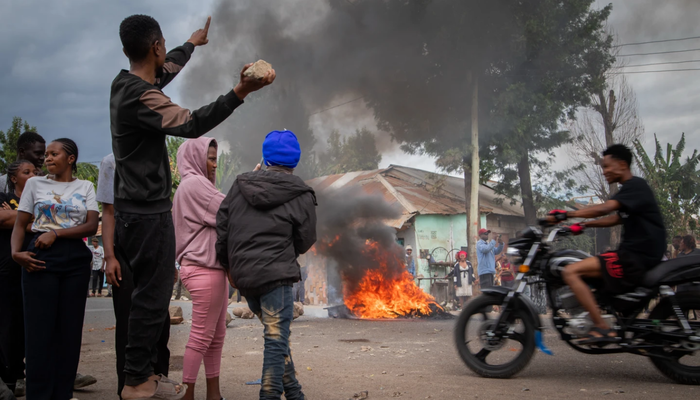
In Jammu and Kashmir, a massive row has erupted over the arrest of Aam Aadmi Party (AAP) MLA Mehraj Malik. Amid apprehensions of possible disturbances to peace and order, the district administration of Doda has imposed restrictions under Section 163 of the Bhartiya Nagarik Suraksha Sanhita (BNSS) on Tuesday (9th September 2025).

The prohibitory order comes at a time when tensions in Doda have been simmering over the detention of Doda MLA Mehraj Malik under the Public Safety Act (PSA). Reports say that the anti-government protests in Doda and some other areas in Jammu’s Chenab Valley are the biggest since the 2019 scrapping of Article 370.

In addition to Doda, Kishtwar district also saw protests in support of Mehraj Malik. Notably, the protests came at a time when Doda and many other districts in Jammu and Kashmir are already grappling with floods.

Reports say that AAP MLA Mehraj Malik was arrested a day after he used unparliamentary language against the Doda Deputy Commissioner and his family. A video of him abusing Doda DC, Harvinder Singh, went viral on social media. Malik had accused DC Singh of not releasing pending dues in favour of a family whose structure was reportedly used for two years by the health department. The AAP MLA was also protesting against slapping of PSA against a person from his constituency.

In an official order issued on Tuesday, Additional District Magistrate (ADM) Anil Kumar Thakur stated that the measures have been taken as a precaution to maintain public safety and tranquillity in the district.

The restrictions will remain in force until further notice. “Whereas, in view of the prevailing situation, there is apprehension that incidents regarding breach of peace, tranquillity and law & order may occur in District Doda by way of mobilising unlawful assemblies of the public,” read the official order safeguarding life and property of citizens within the territorial jurisdiction of District Coda.

Therefore, I, Anil Kumar Thakur, JKAS, Addl. District Magistrate, Doda, in exercise of the powers vested in me under section 163 of BNSS, 2023, do hereby impose the following restrictions in the entire territorial jurisdiction of District Coda till further orders,” the order further said.

According to the order, “assembly of four or more persons shall be prohibited, no person shall be allowed to resort to provocative speeches, slogans or gestures which may disrupt peace and harmony, and no person is allowed to move with lathies or sharp-edged weapons.”

Earlier in the day, Shamas Din Malik, father of Mehraj Malik, said that his son was wrongly charged under the Public Safety Act (PSA) mentioning that the court will decide the legality of his arrest. Malik, representing Doda assembly constituency, was booked under provisions of the Jammu and Kashmir Public Safety Act 1978 (PSA)on Monday on grounds of his activities being prejudicial to the maintenance of public order. Preventive detention under the PSA was found necessary in the interest of maintaining public order and safeguarding law and order in the region.

Tweet by Omar Abdullah

Besides Aam Aadmi Party leaders, Jammu and Kashmir Chief Minister Omar Abdullah has also expressed support for Mehraj Malik. He that the MLA’s detention affects the trust of people in democracy. Referring to the Hazratbal Shrine row, Abdullah complained that only innocents were being “harassed” while there was no action against those who played with their religious sentiments.

“I am not able to understand what he did to get detained under such a strict law like the PSA? Was there any incident of stone-pelting? On the contrary, there is no action against those who played with our religious sentiments and spoiled the atmosphere at the Hazratbal Shrine. Only innocents are being harassed. But no action is being taken against those who hurt our religious sentiments. Booking the MLA under PSA will affect people’s trust in Jamhuriyat (democracy),” Abdullah told the media.

Poonch DGPC General Secretary Harcharan Singh, however, has welcomed Malik’s arrest and said, “I am thankful to the LG administration and Omar Abdullah government for the arrest of the Doda MLA… He used to promote drugs and abused an IAS officer…”