Home Blog Page 1709

Israel forms special unit ‘Nili’ to ‘hunt and eliminate’ Hamas terrorists responsible for the October 7 terror attack

The Israeli security agencies Mossad and Shin Bet have reportedly established a new unit to track down and eliminate perpetrators of the 7th October attack by Hamas. According to Israeli media reports, the new unit will be named after the World War I-era Jewish underground organisation “Nili”. It is an acronym for a Hebrew phrase that translates as “the Eternal One of Israel will not lie.”

Mossad is the intelligence unit of Israel, while Shin Bet is the country’s internal security service.

Nili will have the dedicated task of hunting down and eliminating every Hamas terrorist who was involved in the terrorist attacks and ground invasion in Southern Israel, two weeks ago.

The new unit, Nili, has been specifically set up to dismantle Hamas’s special commando unit Nukhba (“elite”) within the military wing of the Palestinian terror outfit. On 7th October, terrorists of this Nukhba unit, thousands in numbers, infiltrated Israel and carried out mass killings, rapes, and abducted over 250 Israeli and foreign nationals to Gaza. The Hamas terrorists invaded southern Israel through land, sea and air, killing over 1400 people and injuring many more.

A large number of Hamas terrorists who had entered Israel were killed by Israeli forces, but others managed to sneak back into the Gaza Strip. Many of them abducted civilians and took them to Gaza, and continue to keep them hostage. Now this Nili unit will be responsible for hunting down those Hamas terrorists who went back to Gaza after the massacre near the Gaza border in Israel.

As per Israeli media, the members of Nili will function independently from other Command and Control units. Those units are focused on neutralising strike cells and high-ranking terrorists. On the other hand, this particular mission is distinct which is why the Nili will have both field operatives and intelligence personnel.

The establishment of the new unit comes days after Israeli airstrikes in the Gaza Strip killed several top commandos and operatives of Hamas. The Israeli Defence Forces (IDF) have already announced the death of several Nukbha commanders including Billal al-Qedra, who headed the unit’s southern Khan Younis battalion, and Ali Qadi, a company commander. 

On 18th October, the IDF announced that it killed over 10 terrorists of Hamas’ Nukhba unit while targeting top terror figures in the Gaza Strip.

A day earlier, on 17th October, an Israeli airstrike in Gaza reportedly killed Ayman Nofal who was the head of Hamas’s Central Gaza Brigade. On the same day, IDF announced that around 14 family members of Hamas Chairman Ismail Haniyeh died in its airstrikes when it hit a house belonging to the Hamas leader in Gaza. It was reported that Haniyeh’s brother and nephew also died in that airstrike. 

At a time when an Israeli ground offensive is looming large, Israel has issued a warning that every Hamas terrorist faces death. However, two accused masterminds who hatched the 7th October attack are at the top of Israel’s hit list. They are Hamas military commander Muhammad Deif and political leader Yahya Sinwar.

(Yahya Sinwar, Image Source – Times of Israel)

Israel has asserted that Sinwar is “a dead man walking”. Following the terrorist attack on Israel, its Defense Minister Yoav Gallant pronounced, “Hamas terrorists have two options: Be killed or surrender unconditionally. There is no third option.” 

Sinwar was among the founding members of Hamas in 1987 during the First Intifada or uprising. He spent 23 years in Israeli jails where he learned Hebrew but in 2011, he was one among 1,100 Palestinian prisoners who were exchanged for the release of a French-Israeli soldier Gilad Shalit.

Notably, Sinwar and Deif both were born in the Khan Younis refugee camp in Gaza. In 2015, both of them were added to the most wanted International terrorist list of the United States. 
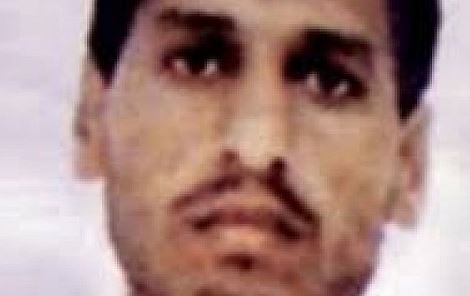
(Only full face picture of Deif, it is 20 year old picture, Image Source – Times of Israel)

Contrary to Sinwar, much less is known about Israel’s number one public enemy for the past two decades Deif who is the commander of the Izz ad-Din al-Qassam Brigades, Hamas’s military wing. He has been accused of organising suicide attacks, kidnappings, and other raids. However, there is only one known full-face photo of Deif which is at least 20 years old.

While an Israeli ground invasion of Gaza is imminent, the timing of it still remains unclear. However, Senior Israeli commanders have been making public references to such preparations amid questions about when an operation might be launched. 

According to a statement issued by Israel’s military on 22nd October (Sunday), the commanding officer of Israel’s ground forces, Maj. Gen. Tamir Yedai has been meeting in recent days with soldiers training for “ground maneuvering.” 

In the wake of the ground invasion, the Israeli military has been reiterating its warning for civilians in Gaza to move to the southern part of the enclave. It has warned them to leave the Northern part of the enclave or be ready to be treated as a supporter of terrorists

Elon Musk offers to give one billion dollar to Wikipedia, if they change their name to this

It is not a secret that Elon Musk hates left-media, as he frequently criticises the left-liberal media houses. He also has equal disdain for Wikipedia, given the fact that the online encyclopaedia has a well-known leftist bias. Earlier he had slammed Wikipedia and its ‘motivated’ editors for information manipulation and distortion of facts. 

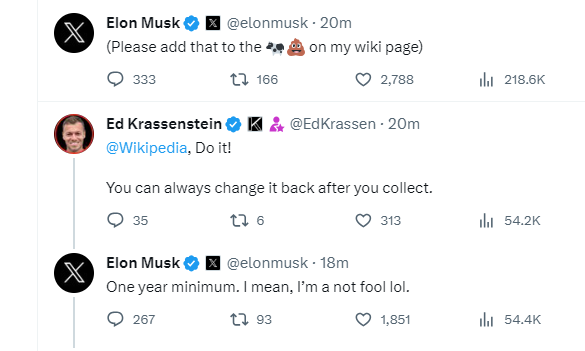
He also seems to be irritated with the constant appeals for donations by Wikipedia. On 22 October, he offered $1 billion to the site, with a condition. On X (Twitter) which he owns now, Elon Musk said that he will give Wikipedia a billion dollars if they change their name to ‘Dickipedia’.

He tweeted, “I will give them a billion dollars if they change their name to Dickipedia”. He was tagging one of his previous tweets, in which he had posted the image of a Wikipedia banner message from 2022 headlined ‘Wikipedia is not for sale’. The banner was used to seek monetary contributions from users. Elon Musk posted the image of a portion of the banner with the Sleeping Face Emoji.

Offering a billion dollars in exchange for remaining Wikipedia to ‘Dickipedia’, Musk also asked to add this information to his Wiki page.

He further added that his offer to rename the site is “in the interests of accuracy,” indicating what he thinks about Wikipedia.

When journalist Ed Krassenstein asked Wikipedia to accept the offer, saying that they could revert after collecting the money, Elon Musk said that the new name would have to be there for at least 1 year.

“One year minimum. I mean, I’m a not fool lol,” he responded.

One user replied with a screenshot of a Wiki page about a parody collection of satirical biographies “about people who are dicks,” Musk responded that he loved ‘Dickipedia’.

Elon Musk is a business magnate who heads Electric Car company Tesla, spacecraft maker SpaceX which also operates Starlink satellite internet service, infrastructure firm Boring, and social media site X (formerly Twitter). He is also co-founder of Neuralink, OpenAI and PayPal.

Congress Govt in Karnataka allows Hijab to make a comeback, allows women to wear Islamic attire; should reach exam center an hour early for ‘screening’: Details

0

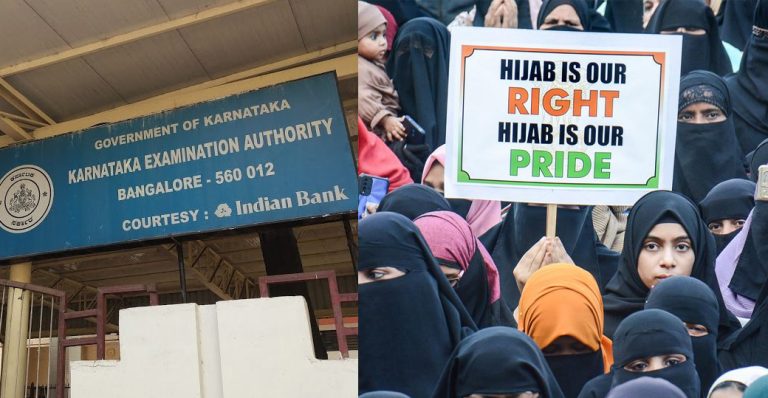
The Karnataka Examinations Authority is scheduled to hold exams in order to fill 670 direct recruitment positions in a variety of government agencies and boards on 28 and 29 October and the dress code for the examination has been released by the board. It has allowed candidates to put on hijabs to take the test notwithstanding that there continues to be a dispute regarding the same in the state.

The decision to permit the wearing of the Islamic head cover during examinations has followed months of debate about their acceptance in educational settings. However, those with hijabs have to show up at the location an hour early to be screened. It has been established that applicants who choose to wear hijabs during the exam need to adhere to certain rules. Clothes with embroidery, flowers, brooches, long sleeves and jeans are prohibited.

Minister of Higher Education Dr MC Sudhakar declared that hijab will be permitted and claimed that any restriction on it would violate people’s rights. “The hijab issue was not part of the discussion. Some want to raise objections to small things. But we cannot infringe on the rights of people. Even in NEET, candidates are allowed to wear hijab,” he remarked after attending a meeting with Chief Minister Siddaramaiah to address the State Education Policy and appointments in vacancies.

He confirmed that candidates would be contacted an hour prior to the test to undertake extensive background checks that would eliminate any possibility of malpractice.

The recommendation for male candidates is to dress in simple low-pocketed pants and half-sleeved shirts. Jeans, kurta pyjamas, full-sleeve shirts and other outfits with embroidery are not acceptable. The exam is intended to fill a number of positions including Keonics and Karnataka Food and Civil Supplies Corporation on corporation boards.

Karnataka Hijab Row

The Udupi Hijab dispute in Karnataka arose in late 2021 which concerned Muslim female students in the state who wanted to wear hijabs as part of their school uniforms which led to major protests and legal battles as well as spread to other parts of the country.

The debate started in January 2022. A Udupi college turned away a number of Muslim students who were wearing hijabs to class. There were countless images on social media depicting college administrators forbidding students who donned the head covers from entering their campuses. Afterwards, the college administration contended that the hijab was not included in the uniform dress code that the students had been instructed to follow.

The administration had requested that female students forgo the hijab during their time in college, in accordance with the new state regulations. Eight female students consistently disobeyed the rule and claimed it inhibited them from practising their faith.

A student of PES College of Arts, Science and Commerce in Mandya named Muskan Zainab who rose to fame owing to her theatrics during the row was disclosed to have links to the banned radical Islamic organisation Popular Front of India through her father Abdul Sukoor who was a leader of the extremist outfit. The development had exposed the role of the group behind the controversy.

The girl came to the limelight after she was seen yelling “Allahu Akbar” in a niqab in response to Hindu students who were chanting “Jai Shree Ram.” They were protesting against the Muslim students who were screaming Islamic slogans in hijab and burqa inside the institution.

India-Canada ties going through a difficult phase, sought diplomatic parity due to continuous interference in Indian affairs: EAM S Jaishankar

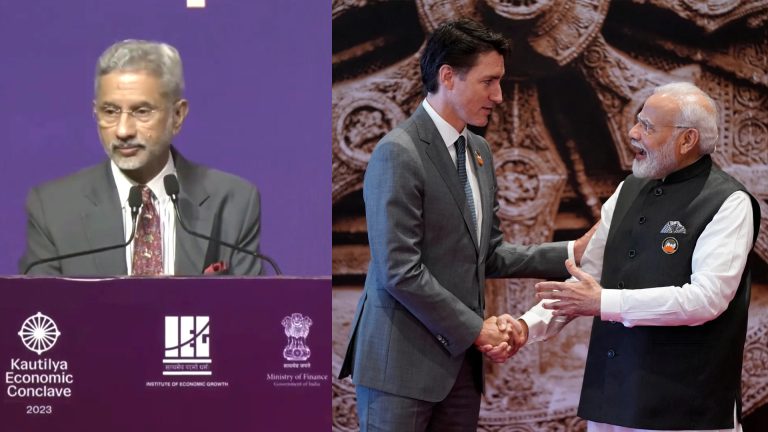
On 22nd October (Sunday), External Affairs Minister Dr. S Jaishankar asserted that India-Canada ties are going through a “difficult phase,” talking about the deterioration of diplomatic ties. He also explained why India stopped visa services in Canada and asked Canada to reduce its diplomatic presence in India. Speaking at the Kautilya Economic Conclave, the minister said that India has problems with “certain segments of Canadian politics”. 

Minister Jaishankar said that Canada violated the Viena convention by not providing security to Indian diplomates, which forced India to stop visa services, as the environment was no longer safe for them. He said, “the big concern which people have is on visas. And, you know, some weeks ago, we stopped issuing visas in Canada, because it was no longer safe for our diplomats to go to work to issue visas. So their safety and security was the primary reason we had to temporarily stop the issue of visas.”

However, minister Jaishankar added that the govt is reviewing the situation, and the visa services may be restored if the situation is found favourable. “We’re tracking it very closely. My hope, My expectation is that the situation would improve, in the sense that our people would have greater confidence in being able to do their basic duty as diplomats,” he said. The minister added that “ensuring safety and security of diplomats is the most fundamental aspect of the Vienna Convention.”

“In Canada, our diplomats are not safe. So if we see progress there, I would like very much to resume the issue of visas. My hope, this is something that should happen very, very soon,” he added.

Talking about asking Canada to remove 41 diplomats from India, Jaishankar highlighted that India sought diplomatic parity as there were concerns about “continuous interference” in Indian affairs by the Canadian side. He also pointed out that the Vienna Convention which is the guiding International rule regarding this issue also provides for parity.

Jaishankar noted, “Parity is very much provided for by the Vienna Convention, which is the relevant international rule on this. In our case, we invoked parity because we had concerns about continuous interference in our affairs by Canadian personnel.”

Regarding Canadian diplomatic interference in Indian affairs, he noted that a significant amount of the information hasn’t been shared with the public yet. According to him, more details could come up over a period of time which would make the public understand why India had to take those steps. 

The Minister added, “We haven’t made much of that public. My sense is over a period of time more stuff will come out and people will understand why we had the kind of discomfort with many of them which we did.” 

Jaishankar’s remark comes days after Canada announced the withdrawal of 41 of its diplomats from India. Following the withdrawal of its diplomats, Canadian Foreign Minister Melanie Joly alleged that India’s actions were “contrary to international law.” 

She accused India of violating the Vienna Convention on diplomatic relations. Contrary to the allegations, EAM Jaishankar pointed out that parity is provided under the Vienna Convention which India invoked to counter “continuous interference”. 

Regarding strained ties with Canada, Jaishankar said he hopes that the situation will improve and Indian diplomats will be able to perform their basic duties with confidence.

He said, “Ensuring the safety and security of diplomats is the most fundamental aspect of the Vienna Convention. And right now that is what has in many ways been challenged in Canada that our people are not safe, our diplomats are not safe.”

Subsequently, on the issue of visa issuance, Jaishankar emphasised that the issuance of visas will resume once there is any progress in the safety of Indian diplomats in Ottawa. He added, “If we see progress in the safety of our diplomats in Canada, we would like to resume issuance of visas there.”

Uttar Pradesh government forms three-member SIT to probe foreign funding received by state madrasas

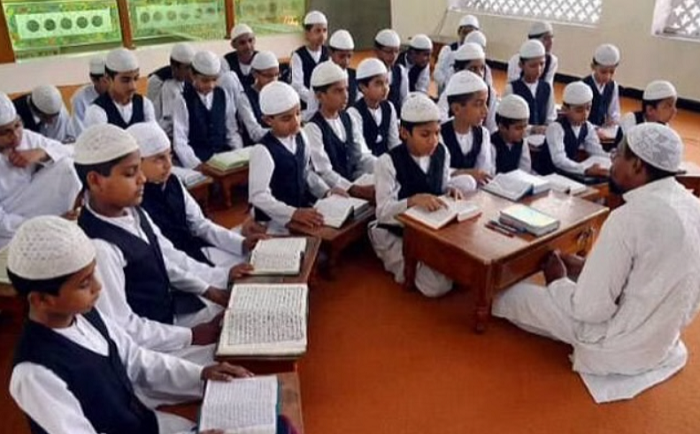
In a major development in the Uttar Pradesh government’s efforts to track foreign funding of madrasas in the state, the CM Yogi Adityanath-led government has formed a three-member Special Investigation Team (SIT). The SIT headed by Additional Director General, UP ATS Mohit Agarwal will investigate the funds received by the madrasas in the state from sources in foreign countries.

It is worth noting that in Uttar Pradesh, there are over 25,000 madrasas, with roughly 16,500 of which are recognised by the UP Board of Madrasa Education.

According to Uttar Pradesh ATS ADG Mohit Agarwal, the SIT during its investigation will be reviewing the accounts of madrasas that receive funds from abroad. Furthermore, the SIT will analyse how the money collected through foreign funding is utilised. The three-member SIT will investigate if foreign funds received by state madrasas are being used for illegal activities such as terrorism, conversion and so on.

It is worth recalling that in February this year, the state government had initiated an exercise to track the source of money that is reaching over 1,500 unrecognised madrasas in the Indo-Nepal border areas. In October last year, it was revealed in a state government survey that there are over 7,500 unrecognised madrasas in the state. The Uttar Pradesh government had on September 1 last year announced that it would survey unrecognised madarsas of the state to ascertain information such as details of teachers and students, curriculum, and its affiliation with any non-government organisation.

Last year, OpIndia published a series of detailed ground reports regarding the mushrooming of mazars and other illegal religious structures along the sensitive Indo-Nepal border.

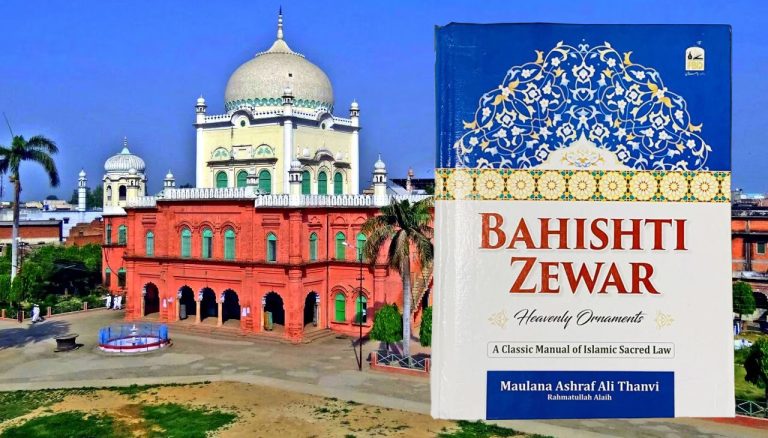
Darul Uloom removes book Bahishti Zewar that legitimises sexual exploitation of minor girls after NCPCR notice

0

Following an action by the National Commission for Protection of Child Rights, the Islamic seminary Darul Uloom Deoband has removed the controversial book Bahishti Zevar prescribed by it from its curriculum, which violated the Protection of Children from Sexual Offences Act and legitimised sex with minors and animals, said NCPCR chairperson Priyank Kanoongo on Sunday.

The book Bahishti Zevar by Maulana Ali Thanvi, which contained objectionable, improper, and illegal content on children, was removed from the curriculum after the NCPCR wrote to the district administration of Saharanpur in Uttar Pradesh to inquire into the matter earlier in July this year.

“Maulana Ashraf Ali Thanvi’s book Bahishti Zewar, which explains the methods of sexual exploitation of minor girls, was being used by Madrasa Darul Uloom Deoband Saharanpur for issuing fatwas and teaching children. On which @NCPCR_ took cognizance and issued a notice to the district administration. District Administration Saharanpur, taking immediate action, has informed that the use of the said book has been stopped and the related fatwas have also been removed from the website of Darul Uloom Deoband,” Priyank Kanoongo said in his Hindi post on X on Sunday.

He further said that further investigation into the matter is underway.

NCPCR took action on a complaint lodged by the child education-focused social organisation ‘Manushi’ against the Darul Uloom Islamic organisation.

Manushi alleged that Darul Uloom was using books and religious rulings to impart teachings to children that condoned inappropriate conduct with minors, deceased individuals, and animals.

The complainant also provided excerpts from the book that were cited in the religious rulings posted on Darul Uloom Deoband’s website. The book contained objectionable and unlawful content regarding children. On initial examination, the content presented in the complaint appeared to contravene legal provisions.

One of the sections in the book said that a mere bath after sexual intercourse with a minor girl is enough to legitimise the act. Another shocking section on page 271 is a passage justifying sex with a dead woman, a minor girl or an animal. 

(This news report is published from a syndicated feed. Except for the headline, the content has not been written or edited by OpIndia staff)

Iran: 16-year-old girl, who was attacked by police for not wearing a hijab, declared ‘brain dead’

0

On 22 October, Iranian state media shared that a teenage girl named Armita Geravand, who had been assaulted by police in Tehran metro earlier this month is reportedly “brain dead.” The police attacked Geravand because she had broken Iran’s strictly implemented hijab policy. She had slipped into a coma after the attack.

The Iranian state media reported, “Follow-ups on the latest health condition of Geravand indicate that her condition of being brain dead seems certain despite the efforts of the medical staff.” 

The news of her hospitalisation was initially made public by human rights organisations like Kurdish-Iranian Hengaw. These groups shared images of the 16-year-old on social media which clearly showed her on life support and unconscious with a bandage over her head and a breathing tube.

However, the Islamic Republic denied the incident which transpired on 1st October on the Tehran subway.

Armita Geravand attacked for not wearing a Hijab

Two well-known rights activists had shared that the girl was attacked by security personnel in the Tehran metro for breaking the country’s draconian hijab legislation which had left her in critical condition in hospital after falling into a coma. One of the activists informed, “We are following her case closely. She is in a coma at the Intensive Care Unit of the hospital and her condition is critical. Her relatives said there is a heavy presence of plainclothes security at the hospital.”

According to the second activist, the teenager’s parents were prohibited by security agents from speaking with human rights outfits or sharing her photo on social media. The activists only spoke under the condition of anonymity because of the delicate nature of the matter.

Masoud Dorosti, the head of the Tehran Metro Operating Company, claimed that there was no evidence of verbal or physical altercation between patrons and staff members in the CCTV recording. Iranian media proclaimed that an Iranian journalist was briefly apprehended when she visited the hospital to find out about Armita Geravand’s condition.

A rights group located in Iran called Dadban posted, “Iranian security institutions have said her condition was caused by low pressure, an often repeated scenario from such institutions.”

Her parents said in a video uploaded to the official news agency IRNA that their daughter had experienced a dip in blood pressure, lost her balance and struck her head inside the metro cabin. Her mother said, “I think my daughter’s blood pressure dropped, I am not too sure, I think they have said her pressure dropped.”

However, rights groups have demanded that the government release footage taken inside the cabin and argued that the remarks of her parents were under pressure.

“Once again a young woman in Iran is fighting for her life. Just because she showed her hair in the subway. It is unbearable. The parents of Armita Garawand do not belong in front of cameras, but have the right to be at their daughter’s bedside,” commented Germany’s Foreign Minister Annalena Baerbock on social media platform X (formerly Twitter).

The human rights activists fear that she might end up like 22-year-old Mahsa Amini, whose death at the hands of morality police last year set off months of widespread anti-government demonstrations.

Iran’s theocratic leadership imposed restrictions on women’s attire following a revolution that overthrew the secular government of Shah Mohammad Reza Pahlavi in 1979. Laws dictate that females cover their hair and dress in long and baggy outfits. Those who are found to be in violation risk arrest, penalties and public disgrace.

IMD predicts rare ‘Twin Cyclones’: Cyclone Tej in Arabian Sea, Hamoon in Bay of Bengal, the first such event since 2018

0

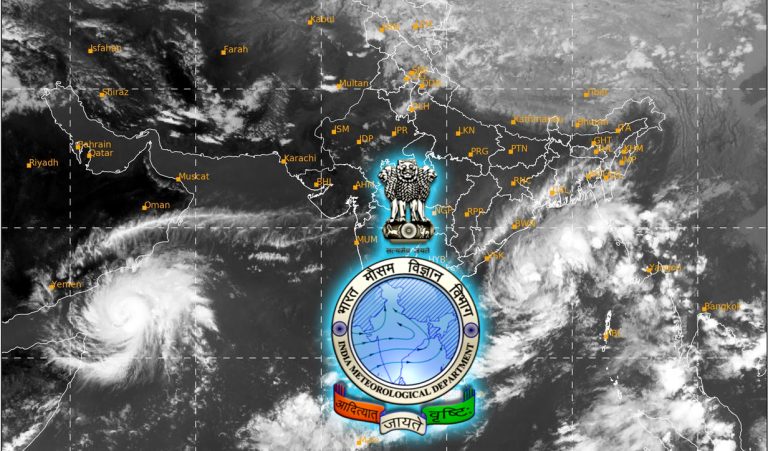
The India Meteorological Department (IMD) has predicted that India could brace a rare phenomenon as both the Bay of Bengal and the Arabian Sea are witnessing the formation of cyclones. Taking to X, IMD has been sharing updates on the twin cyclones including their direction, wind speed, and probable areas it could hit in the next few days. 

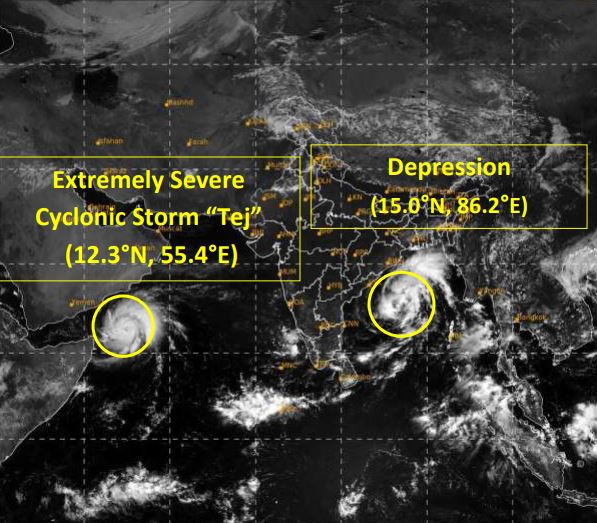
According to the IMD, a cyclone named ‘Tej’ is brewing in the Arabian Sea, while cyclone ‘Hamoon’ in the Bay of Bengal is still in a premature stage.

(Two storms are getting stronger in Indian water bodies, Image Credit – IMD)

Cyclone Tej intensifying into an Extremely severe cyclone

On 22nd October (Sunday), the IMD updated that Cyclone Tej is expected to turn into an ‘extremely severe cyclonic storm’ later in the afternoon in the Arabian Sea.

IMD tweeted, “The Very Severe Cyclonic Storm “Tej” (pronounced as Tej) over west central and adjoining southwest Arabian intensified into an Extremely severe Cyclonic Storm.”

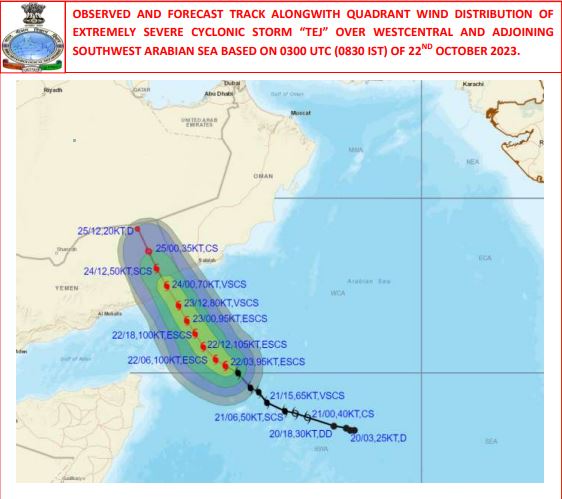
As per its morning weather bulletin, Cyclone Tej moved to the west-northwest at a speed of 18 kmph during the past six hours. At around 5.30 a.m. on Sunday, Cyclone Tej was located at the center of the southwest Arabian Sea.

The Meteorological department stated that the cyclone is very likely to cross the Yemen-Oman coast between Al Ghaidah in Yemen and Salalah in Oman in the early hours of 25th October.

(Predicted track of Cyclone Tej, heading towards Oman and Yemen, Image Credit – IMD)

In the wake of Cyclone Tej, the IMD has issued a warning for fishermen. In its warning, it has asked fishermen out at sea to immediately return to the coast. They have also received advice to avoid entering the southwestern Arabian Sea until 25th October and not venture into the west-central area of this water body until the night of 25th October.

Cyclone Hamoon could develop in the Bay of Bengal

According to the IMD prediction, Cyclone Hamoon will emerge in the Bay of Bengal and it will move close to the Andhra coast before getting diverted by the Western Disturbance. 

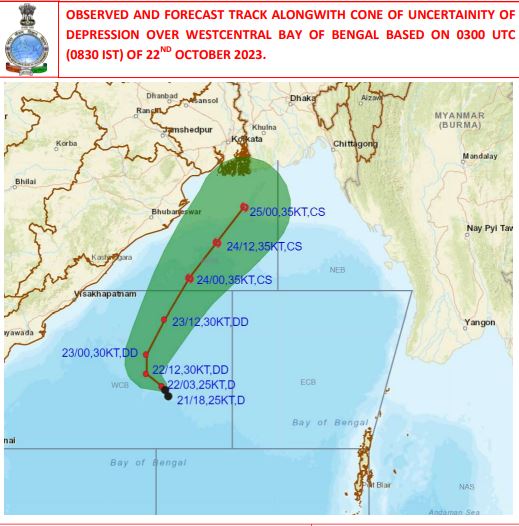
Earlier on Friday (20th October), the Amaravati unit of IMD reported a low-pressure area over the southwest and adjoining southeast Bay of Bengal. It predicted that the depression could likely intensify further into a depression over the West Central Bay of Bengal around 23rd October. If this storm develops, it will be named Hamoon.

(Predicted track of ‘Depression’, that could form into Cyclone Hamoon, Image Source – IMD)

Additionally, a private weather forecast service Skymet has stated that the system is likely to turn into a cyclonic storm by the 24 October.

Based on the formula followed for naming cyclones in the Indian Ocean Region (IOR), the name ‘Tej’ was suggested by India while Iran named ‘Hamoon’.

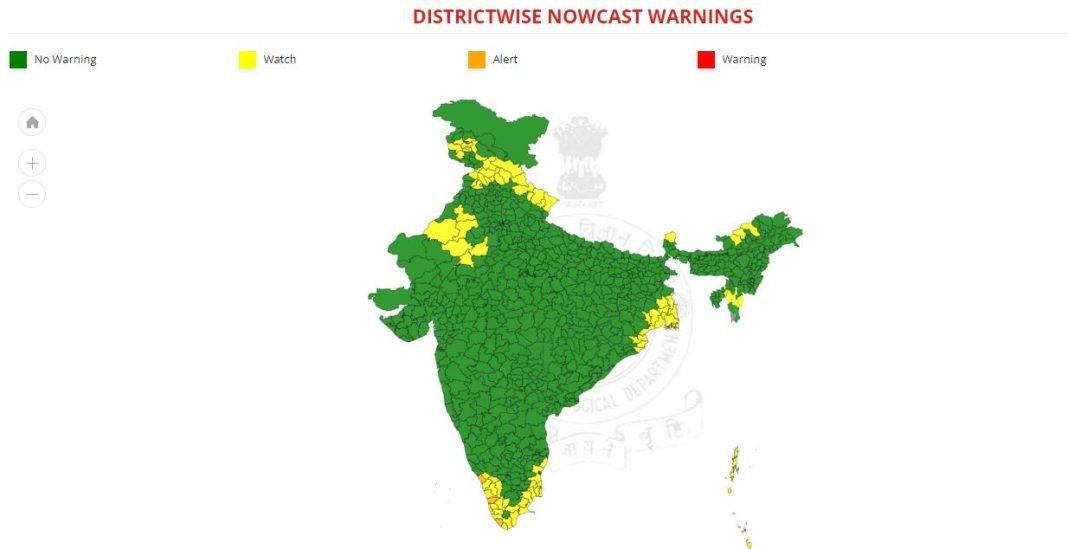
(District-wise warning update by IMD, green represents no warning, districts in yellow have been warned in the wake of cyclonic storms in Indian water bodies)

However, it is predicted that both these cyclones would not have a significant impact on the weather. The weather is expected to slightly change in Chennai and the coastal regions of Tamil Nadu, as the cyclones move away. But private weather forecasters have predicted that evening thunderstorm rains could likely persist in Kerala and interior parts of Tamil Nadu.

The occurrence of twin cyclones, each on both sides of the Indian coastline is a rare phenomenon. Even if both these storms — Tej and Hamoon, take shape, they will be separated by a considerable distance of 2,500 km. They will traverse along separate ways.

It is important to note that the rare phenomenon of twin cyclones was last observed in 2018. Back then, Cyclone Luban and Titli occurred simultaneously, over the Arabian Sea and the Bay of Bengal respectively.

‘You are very sexy, I want to become your friend’: Russian YouTuber harassed while filming in Delhi’s Sarojini Nagar, video goes viral

A man approached a Russian woman named Koko alias Kristina strolling through Sarojini Nagar, a well-known street market in Delhi and asked if she would want to become friends. However, his approach towards her was unfriendly and uncomfortable. The YouTuber who runs a YouTube channel named ‘Koko in India’ was visibly upset after the unwanted attention.

She mentioned, “My friend, I am in Sarojini Nagar,” at the beginning of the video when the individual could be witnessed following her after which he asked her to befriend him. “Would you like to be my friend,” he proposed to her in Hindi which brought her discomfort and she replied, “I don’t know you.”

However, her polite refusal didn’t deter him and he pressed, “We can know each other after being friends.” She denied and reiterated that she didn’t want any new friends to which he responded with a lewd remark and stated, “You are very sexy.” The entire episode rendered her quite uneasy and she ended the conversation with, “Okay, bye-bye,” and managed to avoid his unwelcome advances.

The Russian who is fluent in Hindi wrote, “He doesn’t want an Indian friend,” as she shared the footage of the awkward encounter on her official YouTube page.

Going by another video posted by the vlogger, it can be seen that the Russian woman had talked to the man earlier while looking for saree shops at Sarojini Nagar. She was talking to people on the street while roaming around, and he was among the people she talked to, who said he was originally from Ayodhya. After that, a South Delhi girl who recognised her talked to her and showed her where she could find good sarees. The vlogger is then seen entering a shop to buy sarees.

It seems that after the brief conversation, the youth continued to follow her, and asked for friendship because he is ‘bored’ with Indian friends and he finds her ‘sexy’.

Notably, this isn’t the first time that foreigners have faced harassment in India. A businessman named Navab Hayath Sharif was apprehended by the Bengaluru police in June of this year for acting inappropriately toward a foreign national. He was taken into custody from Chor Bazaar in Bengaluru’s Chickpet neighbourhood where he had manhandled and harassed Dutch YouTuber Pedro Mota as the latter was filming his vlog.

The Rajasthan Police arrested a reportedly mentally ill person named Deepak Jalani from Jodhpur for harassing a Korea-based vlogger in the city in April. He flashed his private part to the woman as she was shooting a vlog to showcase the beauty of the place. The incident was brought to the attention of the police when the clip became popular on social media.

Delhi Police caught three people, including a juvenile in relation to the molestation and abuse of a 22-year-old Japanese girl on the day of Holi in March this year. The unfortunate instance took place in the National Capital’s Paharganj region. The accused also belonged to the same area. They were captured touching her and smearing colour on her face as one of them cracked an egg on her head and shouted “Holi Hai, Holi Hai.”

‘Leave or you will be seen as supporters of terrorists’: Israel issues fresh warning to the residents of North Gaza

0

On 22nd October, Israel issued a fresh warning to the residents of Gaza. In a leaflet distributed by the Israeli forces, the Gaza residents have been urged to leave the northern part and relocate to the southern areas. Israel warned in the leaflet that if the residents fail to comply with the instructions, they could be perceived as supporters of a “terrorist organisation”. Notably, there were reports that Hamas had been forcefully stopping the residents of Gaza from leaving in an attempt to use them as human shields against Israeli strikes.

In the leaflet, the message read, “Urgent warning to residents of Gaza. Your presence north of Wadi Gaza puts your life in danger. Whoever chooses not to leave North Gaza to move to the south of Wadi Gaza might be identified as an accomplice in a terrorist organisation.”

The leaflets distributed in Gaza contained the Israel Defense Forces’ name and emblem. Furthermore, mobile phone audio messages were sent to the people living across the Gaza Strip, issuing the same warning. The message from Israel came in the middle of intensive aerial strikes on Gaza and its preparations for a potential ground incursion along the Gaza border.

The Israeli military has categorically said that they have no intentions to categorise anyone as a member of a terrorist group if they have not evacuated. Furthermore, they emphasised that the civilians were never the target and Israeli forces aimed at minimising harm to the civilians. IDF has urged the residents of Gaza to evacuate multiple times for their own safety.

The Deputy Chief of the Hamas rocket force killed

Meanwhile, IDF spokesperson Read Adm Daniel Hagari said in a statement on 22nd October that the deputy chief of the terrorist organisation Hamas’s rocket force and dozens of other terrorists were killed in overnight strikes on Gaza.

Israel Hamas war

On 7th October, hundreds of Hamas terrorists infiltrated Israel through various means, overwhelming the Iron Dome with over 5,000 rockets in a matter of few minutes. They also abducted hostages and took them to Gaza. In a counterattack on Hamas by Israeli forces, thousands have been reportedly killed in the Israel-Hamas war. The death toll in Israel from the Hamas attack has now surpassed 1,400, with over 3,300 injured, primarily civilians. Israel launched a major offensive against Hamas in Gaza, restricting power and water supply and blocking essential goods from entering the region. Over 400,000 Gaza residents were evacuated. India has launched its own Operation Ajay to evacuate Indians from Israel during this conflict.