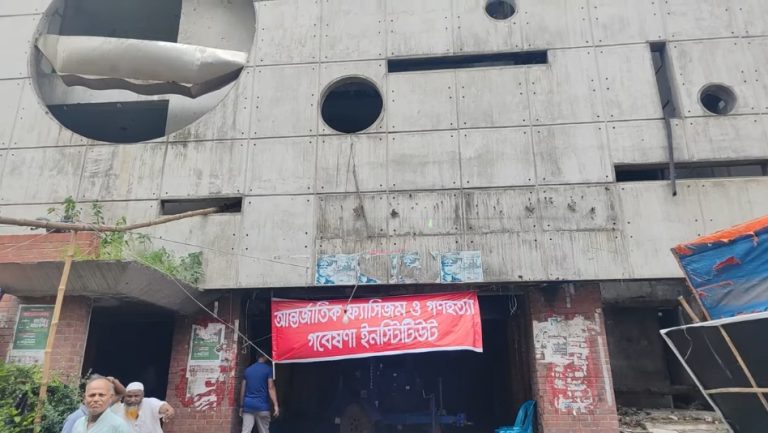
An unidentified group under the banner of the “International Institute on Fascism and Genocide” is trying to seize the headquarters of the Bangladesh Awami League located in the heart of the capital, Dhaka.
Every room in the building is being cleaned, but no one can say whose orders it is being done under. Those responsible for supervising the work say the cleanup work will be completed before the anniversary of the fall of Sheikh Hasina in the student-led uprising on August 5.
Shkhawat Hossain, who is in charge of supervising the cleaning work, told reporters, “This is an establishment from the era of the fascist Sheikh Hasina. We don’t want more fascists to be born here. That’s why we are taking it under control. No one’s permission is needed for this work”.
A banner reading “International Institute on Fascism and Genocide” hangs at the Awami League headquarters located at 23, Bangabandhu Avenue in Dhaka. 10-12 workers clean the building every day. Some say the 10-story building will be used as a rest house for those leading the movement against Sheikh Hasina.
The Bangladesh Awami League is a major political party in Bangladesh. Founded in 1949, it is the oldest existing party in the country. It played a vital role in the country’s struggle for independence.
The interim government has banned the activities of the Awami League led by Sheikh Hasina. After the fall of Sheikh Hasina, protesters burned down many of the party’s offices, including the Awami League headquarters.
Protesters are removing monuments of Sheikh Hasina and her father, Bangabandhu Sheikh Mujibur Rahman, one by one. Earlier, Protesters also demolished Sheikh Mujib’s 32, Dhanmondi house, which is being used as a Bangabandhu museum.
Sheikh Hasina was ousted in a Student-led uprising in August last year. After her fall, an interim government was formed under the leadership of Muhammad Yunus, Nobel Laureate. (
(This news report is published from a syndicated feed. Except for the headline, the content has not been written or edited by OpIndia staff)
11 people were injured in a mass stabbing incident at a Walmart store outside Traverse City in Michigan State of US on the evening of Saturday (26th July).
The incident occurred at around 6:00 pm, causing panic within the store. Police arrived immediately at the location and took the suspect into custody. He is currently behind bars.
The Grand Traverse County Sheriff’s Office is conducting the investigation, assisted by Michigan State Police. Emergency responders immediately came to the scene after the attack. The store was cordoned off, and several police vehicles, ambulances, and fire engines were spotted outside. Witnesses told of a panic atmosphere as customers scurried for cover.
Michigan State Police confirmed the incident on X (formerly Twitter). They shared that the stabbing was at a Walmart store and that the suspect had been apprehended. “The suspect is in custody, details are limited at this time,” they said.
Grand Traverse County Sheriff’s Office is investigating a multiple stabbing incident at the Wal-Mart in Traverse City. The suspect is in custody, details are limited at this time. A PIO is in route to the scene and details will be posted @mspnorthernmi and @MSPWestmi as they… pic.twitter.com/5MC2M2YZi4
As reported by The New York Times, Megan Brown, the Chief Communication Officer for Munson Healthcare, reported that all 11 injured people were taken to Munson Medical Centre in Traverse City. Six were critical and five were in serious condition late Saturday, she said.
Grand Traverse 911, in turn, took to Facebook that there is no current danger to the public. But they have requested that people avoid Walmart and surrounding areas since the investigation is still underway.
Walmart’s response to the incident
Joe Pennington, a Walmart spokesperson, indicated that the firm is assisting local law enforcement in their investigation. “We are cooperating with law enforcement and refer all questions to them,” he stated, according to the Associated Press.
Governor and federal response
Michigan Governor Gretchen Whitmer expressed her dismay, stating, “Our thoughts are with the victims and the community shaken by this heinous act of violence.” She further stated that her office is in contact with law enforcement authorities.
FBI Deputy Director Dan Bongino said in a social media post that bureau officials were responding to “provide any necessary support.”
The authorities have not yet confirmed the identity and background of the suspect.
Traverse City is situated approximately 25 miles east of Sleeping Bear Dunes and features stunning views and a cherry festival.
A major illegal religious conversion racket has been busted in Agra, Uttar Pradesh. The main target of the racket was Hindu girls, and the perpetrators conspired to convert them to Islam through deceit, allurements, and pressure. Investigation agencies suspect that the racket has links with terrorist organisations including Lashkar-e-Taiba and ISIS. A 21-year-old girl from Dehradun, Srishti, whose name was changed to Maryam by the gang, has exposed the entire modus operandi of the racket through her personal ordeal.
Speaking to Aaj Tak, Srishti revealed every character involved in the racket and how they conspired to lure Hindu girls. Agra Police conducted raids in seven states and arrested 11 accused including mastermind Abdul Rehman Qureshi, Ayesha alias Krishna, and others. Based on Srishti’s testimony, this report covers the details of how the racket operated, the methods used to trap girls, and the foreign funding network.
Srishti’s ordeal, trap began through Facebook
Srishti is a simple 21-year-old girl from Dehradun. She got trapped in this racket in 2020. She said, “It all began when a person named Mutalib contacted me on Facebook. He first befriended me and then started talking about his religion. He told me about Islam and gradually evoked curiosity in me.” Mutalib introduced Srishti to his sisters Sumaiya and Shafia so that she would trust them. After that, Srishti was connected to Ayesha and Abdul Rehman from Delhi.
Police investigation revealed that this racket targeted girls via social media, especially Facebook and online gaming platforms like Ludo. Girls from weak financial backgrounds and emotionally vulnerable ones were first lured into friendship. They were then radicalised using Islamic videos, propaganda content, and voice notes.
Srishti said, “I was added to WhatsApp groups where people like Javed, Abdul Rehman alias Rupendra Pratap, and another Abdul Rehman from Delhi were present. I was repeatedly pressured to accept Islam and get married.”
They offered better life as bait
Srishti revealed that Ayesha tried to exploit her financial condition. She said, “Ayesha asked me about the condition of my house and then lured me by saying that if I accepted Islam and agreed to become someone’s second, third, or fourth wife, I would be given a better home, security, and money. She said I would only be ‘invested in’ if I agreed to their conditions.”
The perpetrators systematically lured girls with the promise of financial help. Srishti was told that if she did not agree to marriage, she would not receive any help. She was introduced to several people, including Javed, Abdul Rehman (alias Rupendra), and another Abdul Rehman from Delhi. These people kept telling Srishti that following Islamic rules and agreeing to marriage was a precondition for help.
According to the police, the perpetrators first mentally prepared these girls. They were forced to choose Islamic names, recite the Kalma, and follow rules like wearing a hijab. Srishti’s name was changed to Maryam and she was told to record voice notes declaring herself a staunch Muslim. These notes were then used to raise funds from abroad, which Srishti herself admitted.
Plan to get girls out of their homes
A major part of the racket was planning to get the girls to leave their homes. Srishti said, “Ayan from Jharkhand told me that if I wanted to leave home, I had to reach a chowk in Dehradun alone. From there, a cab would take me to Delhi. A boy in Delhi would then drop me at some ‘safe place’ after a 10 to 12 hour journey.”
As part of this process, Srishti was instructed to break her phone and SIM card. Ayesha gave her a second-hand keypad phone and a fake SIM with Rs 4,000 to 5,000 so her identity and location would remain hidden.
ये देहरादून की सृष्टि हैं। इन्होंने आगरा के धर्मांतरण रैकेट के पूरे संगठित काम के बारे में बताया है। आयशा से लेकर अब्दुल रहमान तक, कैसे हिंदू लड़कियों को शिकार बनाते हैं। कैसे उन्हें घरों से गायब करवाते हैं कि वो पुलिस के हाथ न चढ़ें, हर बात का ब्यौरा है। ये आँखें खोलने वाला है। pic.twitter.com/5TImmvlhoK
— Shravan Shukla ePatrakaar (@epatrakaar) July 26, 2025
Srishti said, “I was taught how to break the phone and submerge it in water. I did all that, but I got scared and didn’t leave home. After that, they stopped helping me.” When Srishti refused to leave home, Abdul Rehman (alias Rupendra) pressured her to agree to become a third or fourth wife, or else no help would be given. Srishti rejected this pressure. The perpetrators then told her that their money had been spent on another girl who agreed to go with them.
Funding from several countries
Agra Police’s investigation revealed that this racket was receiving funding from the US, Canada, London, and Dubai. Srishti said, “A boy asked me to write my entire story so he could post it as a status on social media and raise funds. He was Ayesha’s fund manager and shared stories of other girls too.” These stories and voice notes were circulated abroad to show that girls had converted from Hinduism to Islam, based on which funding was raised.
Police found that Abdul Rehman’s nephew rerouted funding from London. This racket operated like ISIS, with different modules. One module worked on fundraising, another on radicalisation, and a third on hiding girls and arranging their nikah post-conversion. The investigation also suspects possible links to PFI and Pakistan-based terror outfits.
Role of jihadi teacher Ayesha
Ayesha alias Krishna was a key link in the racket. Srishti said, “Ayesha targeted girls above 18. She brainwashed them by preaching jihad. Ayesha used multiple numbers and bought second-hand phones.” Ayesha was arrested from Goa and her phone contained jihad-related videos and propaganda material.
Ayesha not only radicalised the girls but also helped them conceal their identities by giving them fake SIMs and phones. Srishti said, “I was taught that before leaving home, I must break the phone and submerge it in water. I was given a fake SIM, but I refused to leave home.”
Agra Police in action, Srishti’s testimony crucial
In March 2025, two sisters disappeared from Sadar Bazar Police Station in Agra, leading to the exposure of the racket. Police rescued the girls from Kolkata and uncovered the racket’s network with help from the cyber cell. A 100-member team conducted raids across seven states, including Uttar Pradesh, Uttarakhand, Goa, West Bengal, Delhi, Rajasthan, and Jharkhand, under Commissioner Deepak Kumar. Police arrested 11 accused, including Abdul Rehman Qureshi, Ayesha, Mohammad Ali, and Osama.
During the raids, police recovered conversion-related books and propaganda material written by Maulana Kaleem Siddiqui from Abdul Rehman’s house. Srishti’s testimony exposed each member of the racket. She said, “I was forced to recite the Kalma and choose an Islamic name. Abdul Rehman from Delhi asked me to send a voice note in which I had to say I am a staunch Muslim and want to migrate (Hijrat). That note was used to get foreign funding.”
Sleeper cells of the conversion gang dangerously active
Police traced dozens of girls across seven states. Several of them were so radicalised that counselling was ineffective. A photo of one victim holding an AK-47 has surfaced, indicating the dangerous intentions of the racket. The gang was preparing girls not just for conversion but also for terrorist activities.
Srishti said, “I managed to escape this trap, but many girls are still stuck. I want people to understand this conspiracy and not make such a mistake.” Her testimony has not only helped dismantle the racket but will also aid in tracing girls who have gone missing under its influence.
The exposure of the Agra conversion racket has highlighted the seriousness of the sleeper cell network spread across the country. This gang used social media, foreign funding, and organised modules to target Hindu girls. Srishti’s brave testimony and Agra Police’s swift action have brought the conspiracy to light.
UP ATS and police are now probing other members of the network and the sources of their funding. This case serves as a warning to society to stay alert on social media and not fall for any temptations.
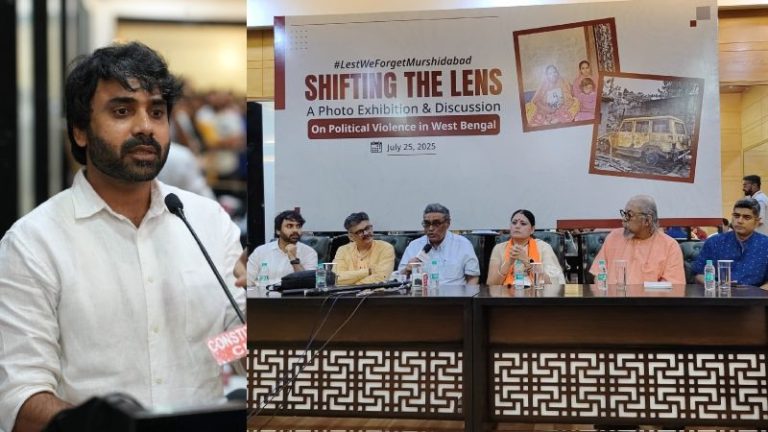
In a powerful and moving exhibition held at New Delhi’s Constitution Club on July 25, 2025, Organiser media unveiled a series of disturbing photographs documenting the Islamist mob violence that shook Murshidabad, West Bengal, in April this year. The exhibit, curated with photos captured on the ground by journalist Nishant Azad, aimed to ensure that the atrocities are not buried under political silence—and that justice is neither delayed nor denied.
The photos showcased chilling visuals: grieving widows and children of Har Govind Das and Chandan Das—idol makers who were brutally killed; shattered Hindu idols; torched vehicles; and desecrated temples. The heart-wrenching imagery left a lasting impact on the attendees, who included prominent figures like Kanchan Gupta (senior advisor to the I&B Ministry), veteran journalist and ex-Rajya Sabha MP Swapan Dasgupta, BJP MLA Agnimitra Paul, and Organiser editor Prafull Ketkar.
Swapan Dasgupta issued a stark warning: “West Bengal is on the brink of becoming West Bangladesh. If we remain silent today, tomorrow’s Bengal may be unrecognizable.”
Calling it not just a law-and-order issue but one of national security, Ketkar emphasized, “This isn’t just about TMC vs BJP. The real victims are women, Dalits, and the ordinary Hindu who is now the biggest target of political and religious violence.”
Agnimitra Paul revealed that nine Hindu temples were demolished and idol-makers were murdered simply for being Hindu. She accused TMC leader Inam-ul-Haq of masterminding the violence, alleging it was premeditated and not spontaneous. She also slammed the police for inaction and the BSF for being kept “on mute mode.”
The speakers drew parallels with Kashmir, noting the use of mosques to incite mobs and the eerie silence of the intellectual class. “We don’t want Asansol to become Anantnag,” one speaker declared.
Kanchan Gupta raised alarms over shifting demographics: “Murshidabad is a ticking time bomb. In Sundarbans, Hindus are now worshipping the Islamic folk deity Bonbibi, and Tablighi Jamaat is camping unchecked in sensitive regions.” He criticized Mamata Banerjee for promoting an Urdu-first narrative even on official letterheads.
Author Deep Halder remarked grimly: “If a Panchayat-style series were made in Bengal, it’d be named Mirzapur. Even local polls are soaked in blood here.”
Closing the event, VHP spokesperson Vinod Bansal said, “Bengali Hindus need not flee—they need to fight. This is not the time for fear but for unity and courage.”
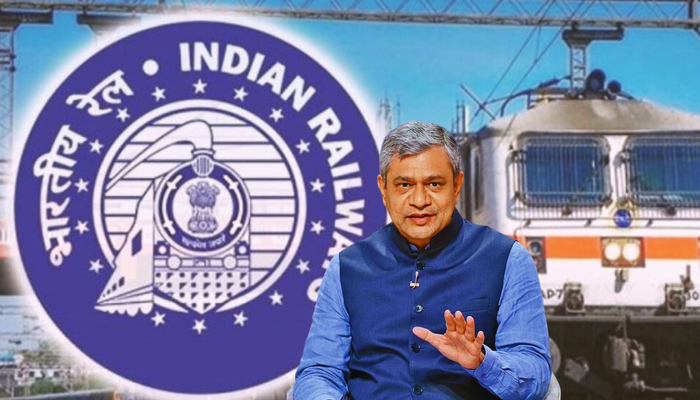
Due to the proactive measures adopted by the Ministry of Railway, the number of train accidents has significantly come down over the last year. Speaking in the Rajya Sabha on Friday (25th July), Railway Minister Ashwini Vaishnaw said that the case of train accidents reduced to 31 during 2024-25 compared to 135 cases during 2014-15. He added that only three train accidents have been recorded till June this year.
Responding to a query, the Minister said that a total of 1,711 train accidents happened between 2004 and 2014, which amounted to an average of 171 train accidents every year. However, this number has hit a record low in the last year.
Explaining the reason behind the reduced train accidents, Vaishnaw said that the Indian Railways adopted a number of measures to ensure the security of passengers. The measures include installing electronic interlocking systems at 6,635 railway stations, which has reduced the accidents caused by human error. Apart from this, interlocking systems have also been installed at 11,096 level-crossing gates to enhance safety at railway crossings.
Along with this, track circuiting has been done at 6,640 railway stations to electronically confirm the presence of a train on a railway track. Besides, the ‘Kavach’ technology adopted by the National Automatic Train Protection System in 2020 is being implemented in a phased manner.
The Railway Minister said that all the engines have been fitted with ‘vigilance Control Devices’ to ensure alertness of loco pilots. Retro-reflective sigma boards have been installed on the OHE masts to alert the pilot about low visibility during foggy weather. In addition to that, GPS-enabled ‘Fog Safety Devices’ have been provided to loco-pilots in fog-affected areas so that they can locate important points like railway signals and level-crossing gates in foggy weather.
Several Bangladeshi youth have gone to Pakistan to undergo training to become terrorists. This revelation was made in a news report by Ekkator TV on Friday (25th July).
As per the Anti-Terrorism Unit (ATU), the accused Bangladeshis joined the camps of Tehreek-e-Taliban Pakistan (TTP) and 9 other proscribed terrorist outfits.
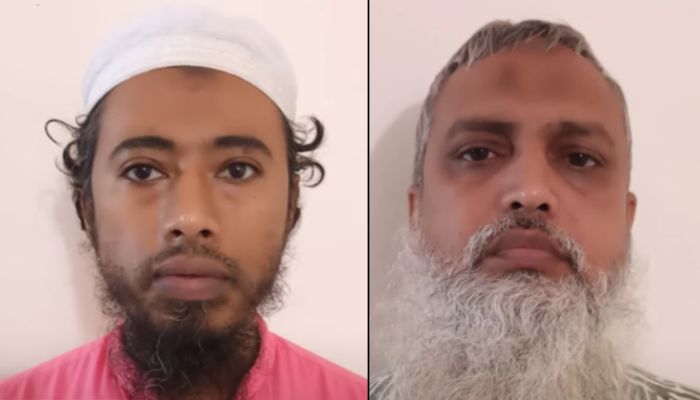
TTP, which is responsible for the 2014 Peshawar school massacre, is now spreading its wings in Bangladesh. Based on intelligence about its activities, ATU has arrested one Mohammed Faisal on 2nd July from Savar in Dhaka district.
During the interrogation, Faisal told ATU that he and his aide Zubair were inspired by the ideology of Tehreek-e-Taliban Pakistan (TTP).
The duo travelled to Pakistan via Saudi Arabia in September 2024, i.e. within a month of the undemocratic ouster of Sheikh Hasina.
Mohammed Faisal informed that his aide, Zubair, was killed during military action in Waziristan. He returned to Bangladesh via Dubai in November 2024 after undergoing training in Pakistan.
10 terror outfits trying to make inroads in Bangladesh
As per the Anti-Terrorism Unit, a Muslim youth named Al Imran has claimed to be the chief of the Bangladesh unit of TTP.
He had encouraged Mohammed Faisal, Rezal Karim Abrar, Asif Adnan, Zackaria Masood, Mohammed Salam to take part in jihad. The ATU had booked 6 of them under the Anti-Terrorism Act of 2009.
Interrogation of Mohammed Faisal has also led to the arrest of Shamin Mahfooz, the chief of the banned Jama’atul Ansar Fil Hindal Sharqiya. Mahfooz also has ties with the Tehreek-e-Taliban Pakistan (TTP).
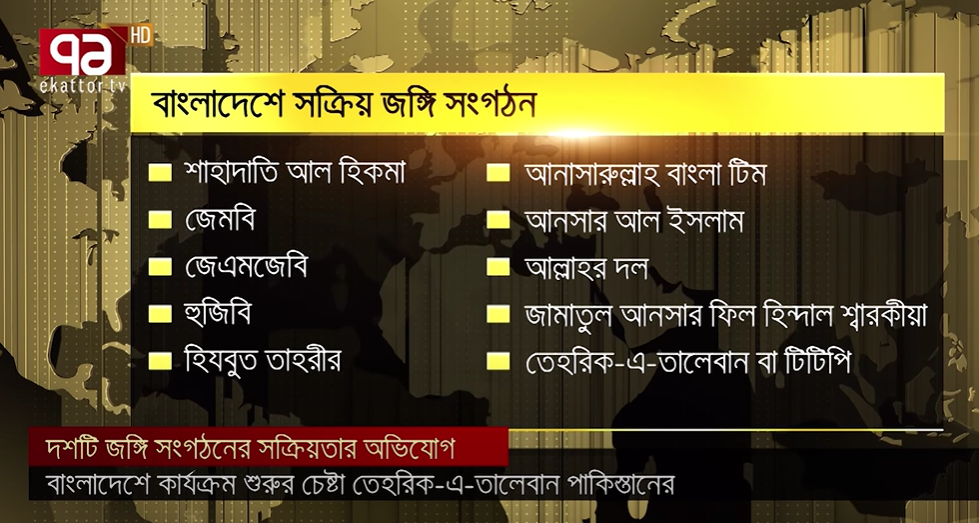
Screengrab of the 10 terror outfits currently active in Bangladesh, image via Ekkator TV
The Anti-Terrorism Unit in Bangladesh has pointed out that a total of 10 Islamic terror outfits are trying to make inroads in the country. These include
Shahadat-e al Hiqma
Jama’at Mujahideen Bangladesh (JMB)
Jagrata Muslim Janata Bangladesh (JMJB)
Harkat-ul-Jihad-al Islami Bangladesh (HuJI-B)
Hizb ut-Tahrir (Bangladesh)
Ansarullah Bangla Team
Ansar al-Islam
Allah’r Dal
Jama’atul Ansar Fil Hindal Sharqiya
Tehreek-e-Taliban Pakistan (TTP)
Rise of Islamism in Bangladesh under Muhammad Yunus
Bangladesh is gradually descending into the jaws of Islamism under the watch of ‘chief advisor’ to the interim government, Muhammad Yunus.
The situation is so grim that comparisons are being made with the Taliban rule, and genuine fears are being expressed about the country turning into Afghanistan.
After coming to power, Muhammad Yunus first revoked the ban on the radical Islamist outfit ‘Jamaat-e-Islami.’ Thereafter, he released the leader of the radical outfit ‘Ansarullah Bangla Team (ABT)’ Muhammad Jasimuddin Rahmani.
At the same time, Muhammad Yunus downplayed the targeted attacks on the Hindu community by violent Muslim mobs. He has gone on record from lamenting about attacks on Hindus to saying that the claims of atrocities are ‘exaggerated‘.
In that way, the controversial US asset was able to placate Islamic extremists. Given that Awami Legaue was against Islamism, the interim government first banned its student wing ‘Chhatra League,’ and then the parent party.
Under the watch of Muhammad Yunus, Bangladesh saw a drastic rise in vigilante Muslim mobs, which unleashed violence under the pretext of protecting the tenets of Islam.
These mobs were largely unorganised and called themselves ‘Tawhidi Janata (meaning Revolutionary People).’ They came under the spotlight over acts of vandalism and harassment of people.
The Yunus regime introduced new textbooks for primary and secondary students, which falsely claimed that the first declaration of independence of Bangladesh was made by Ziaur Rehman (a favourite icon of Muslim hardliners in Bangladesh).
The interim government also appointed a Hizb ut-Tahrir terrorist named Mohammad Azaz as the administrator for the Dhaka North City Corporation (DNCC).
The situation had become so grim that Bangladeshi ambassador to Morocco Mohammad Harun Al Rashid was forced to slam the Muhammad Yunus-led interim government in a scathing Facebook post in March 2025.
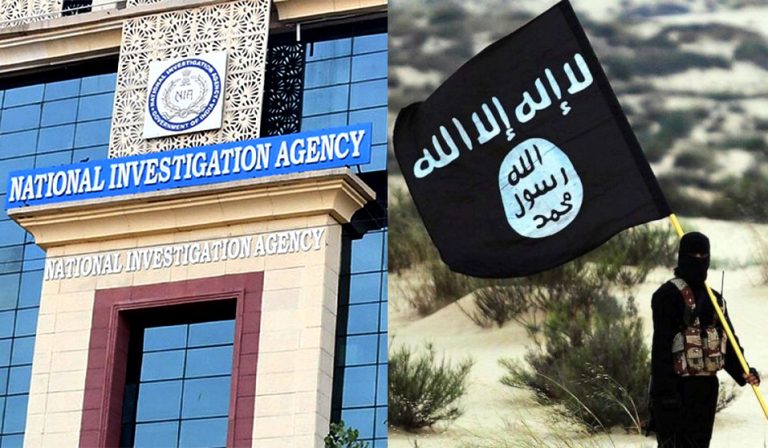
The National Investigation Agency (NIA) has chargesheeted a key perpetrator, a resident of Tamil Nadu, in an ISIS radicalisation and conspiracy case, the agency said on Saturday.
The accused, A Alfasith, hailing from Mayiladuthurai in Tamil Nadu, has been chargesheeted under various sections of the Indian Penal Code and sections 13 and 39 of the Unlawful Activities (Prevention) Act before the NIA Special Court in Poonamalle in Tamil Nadu. The chargesheet was filed on Friday.
The NIA said that Alfasith was closely associated with radicalised Islamists and die-hard supporters of ISIS, including Mohemmed Ashik and Sathik Batcha, who were involved in several terror-related cases in Tamil Nadu.
During the investigation, the NIA found sufficient evidence establishing that Alfasith and his associates circulated incriminating ISIS-related videos, documents, and images through social media platforms, targeting hundreds of young Muslim boys.
“They had created several WhatsApp and Telegram groups, such as ‘Islamic State’ and ‘Black Flag Soldiers,’ to promote unlawful activities threatening the unity, security, and communal harmony of the country,” the NIA said in a statement.
The anti-terror agency further said that their agenda was to spread ISIS ideology and radicalise the vulnerable youth.
“Investigations further revealed that Alfasith followed the activities of the global terrorist group ISIS, and had downloaded incriminating videos and documents from the ISIS-operated Telegram Channel ‘nashida33’ (Al Wala Val Baro),” mentioned the NIA.
The NIA is continuing its investigation to uncover the larger conspiracy behind the case in Tamil Nadu.
(This news report is published from a syndicated feed. Except for the headline, the content has not been written or edited by OpIndia staff)
India celebrates 26 years of its victory in the Kargil War this year, but the festivities have a deeper significance now. It has been almost three decades since India gave a strong response to Pakistan, only this time with a powerful retaliatory attack known as Operation Sindoor, which followed the Pahalgam terror attack. The courage of our soldiers remains unchanged, but the methods and means of war have changed totally.
In 1999, the Indian Army battled a hard war at the high-altitude mountains of Kargil, where Pakistani intruders had taken control of strategic positions surreptitiously. The war raged on for almost three months, from 3rd May to 26th July, and resulted in India re-taking all the areas along a 150-kilometre length.
India lost 527 men during that battle. The war was mainly fought by infantry troops, artillery regiments, and a few air strikes, making it one of the most intense face-to-face battles in recent memory.
Fast forward to 2025: Operation Sindoor
On 26th July 2025, while celebrating 26th Kargil Vijay Diwas, just a few months back, India achieved a new victory, Operation Sindoor. This operation was initiated after the horrific terror strike in Pahalgam, where terrorists sponsored by Pakistan martyred some Indian civilians. India responded by carrying out targeted attacks on terror bases within Pakistan and PoK.
This differed from Kargil in that it was not an infantryman’s war in close combat. This was a high-tech, no-contact war by means of missiles, drones, and air defence. But the message sent to Pakistan was the same: India would not accept terrorism or invasion. Same Enemy, Different Style of Response
Both Kargil and Sindoor were concerning halting Pakistan’s efforts to upset peace in Jammu and Kashmir. In 1999, Pakistan sought to internationalise the Kashmir dispute through the capture of territory. In 2025, the aim was to incite terrorism and goad India.
But in both instances, the Indian Armed Forces retaliated with a vengeance. Following Indian troops laying waste to nine terror camps in Pakistan in May 2025, Pakistan attempted to strike back by attacking Indian civilian and military establishments. But India struck back even more vigorously, attacking several Pakistani airbases and defence installations.
From defence to offence
One of the largest transformations between Operation Vijay and Operation Sindoor is India’s strategy. India fought primarily a defensive war in 1999, repelling Pakistani troops.
While Kargil was a protracted, gradual war with open combat, Operation Sindoor was swift and targeted. The main attacks took place in 25 minutes. And within four days, Pakistan requested a ceasefire, although India maintains that the operation continues.
Understanding the generations of war
Experts state that wars have evolved through the ages. The Kargil War was a Fourth Generation War, where technology was involved, but the bulk of the fighting was still direct on the ground. There were snipers, artillery, and close combat.
But Operation Sindoor was even more sophisticated, what some describe as Generation 4.5 warfare. That is, employing advanced high-tech weapons, drone aircraft, and precision-guided missiles to attack from a distance, without committing large forces to combat.
The Weapons that made the difference
In the Kargil War, the Indian Army used the Bofors FH-77B howitzer to devastating effect, employing its precision and firing range to drive competitors out of mountain posts. Infantry troops used the INSAS rifles, LMGs, SLRs, and support weapons like the Carl Gustav rocket launcher. MiG-21s and Mirage 2000 fighter aircraft of the Indian Air Force offered critical air cover and precision bombing, particularly during the recapture of key positions like Tiger Hill.
Times have changed by leaps and bounds today. The army now employs sophisticated rifles such as the SIG716i and AK-203, and sophisticated artillery such as the Dhanush and M777 ultra-light howitzers, ideal for mountainous terrain. The K9 Vajra self-propelled gun has also been included in India’s arsenal.
India also employed the BrahMos supersonic missile in a live combat scenario for the first time, targeting important Pakistani establishments like Rafiqui, Murid, and Rahim Yar Khan deep within enemy lines.
Drones, missiles, and anti-air defence
One of the largest highlights of Operation Sindoor was the employment of drones and anti-drone systems. India’s indigenous D4 Anti-Drone System, produced by DRDO, detected and destroyed enemy drones. Surface-to-air missiles and guns were employed by air defence teams to destroy projectiles from the other side of the border.
India’s Akash missile system, also developed by DRDO, was used to protect the skies. It can destroy enemy aircraft and drones from a distance of up to 30 km.
India has also used the MRSAM system in this attack. This is also a surface-to-air missile (SAM) system, but it is capable of hitting a longer distance than the AKASH system. This has also been developed by DRDO. It has been made in collaboration with Israel. MRSAM consists of supersonic missiles.
Suicide drones and smart warfare
One of the new missiles used was the Nagastra-1, a suicidal drone manufactured by an Indian company. It can travel for one hour and attack targets 20 km away. The drones are portable, compact, and lethal—ideal for present-day warfare.
India also employed L-70 anti-aircraft guns to destroy Pakistani drones. The guns, initially produced in Sweden but now produced in India, were used extensively during the operation.
The immense success of Akash, BraMos, C-UAS and other indigenous systems gives a major boost to the Indian defence sector and bolsters confidence in the capabilities of native manufacturers to increase self-reliance in the defence arena. With indigenous defence systems outclassing Chinese and Turkish technology, as seen in Operation Sindoor, these systems would play a significant role in curbing India’s dependence on foreign suppliers.
With Operation Sindoor’s success, India has made a giant leap towards self-reliance in defence and less reliance on foreign defence suppliers.
But how India wages its wars has changed entirely. With more intelligent weapons, quicker reactions, and smarter planning, India is better equipped than ever to address any danger. And right at the centre of it all, the bravery and sacrifice of our soldiers is still the same, always prepared, always without fear.
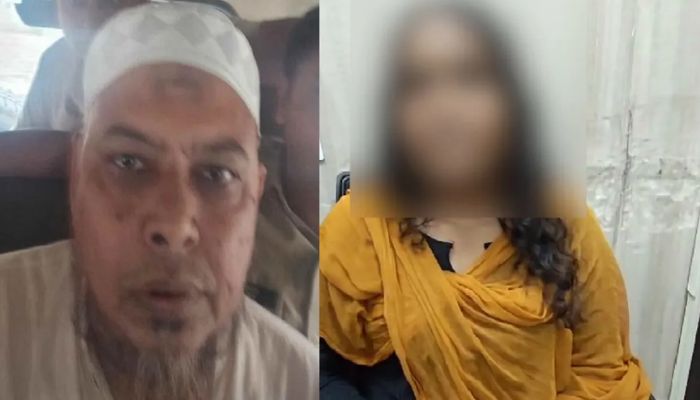
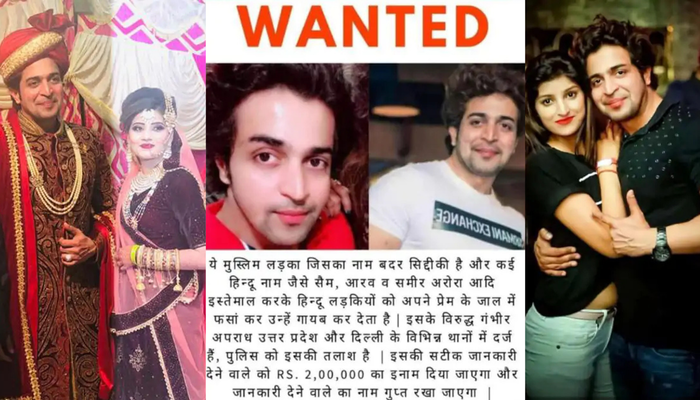
Investigation into the Balrampur Islamic conversion racket run by Jalaluddin aka Chhangur Baba has uncovered a vicious network of Jihadi activities spread across various districts. In the latest development in the investigation of the racket, the police came across a Muslim man named Badar Akhtar Siddiqui, a resident of Kidwainagar, Islamabad in the Lisari Gate police station area in Meerut. Badar is accused of abducting and converting multiple Hindu women.
Police are looking for Badar and his father, Mehmood Akhtar Siddiqui, who are on the run. Badar reportedly targeted and converted 5 Hindu women in Meerut and Noida, three of whom are still missing, and no information is available about their whereabouts.
Authorities sprang into action after Badar’s name emerged during the investigation into the Islamic conversion racket of Jalaluddin in Balrampur, Uttar Pradesh.
Bengaluru-based woman,who escaped Jalaluddin’s trap named Badar
Badar’s name came to notice following the statements of a Bengaluru-based woman, who was able to escape from the clutches of Jalaluddin’s conversion gang. The victim came into contact with a person, who introduced himself as Raju Rathore from Saharanpur, through social media. Raju Rathore, whose real name was Waseem, promised her that she would get her a job through Jalaluddin alias Chhangur Baba, on the condition that she came to Dubai.
The victim went to Dubai and talked to Jalaluddin over the phone, who told her that he would not be able to meet her there due to his ill health. Jalaluddin told her that his associate, Badar Akhtar Siddiqui, is present in Ad-Dilam city of Saudi Arabia, and he will guide her regarding religious conversion. “Badar and Waseem tried to force me to convert to Islam, but I did not give in. Therefore, they sent me back to India and threatened me not to disclose anything,” the victim told Dainik Bhaskar.
On April 19, 2025, the victim wrote e-mails to the President of India, the Prime Minister and the Uttar Pradesh Chief Minister narrating the entire episode. Subsequently, on June 6, 2025, she went to Gorakhpur and took part in the Janata Darbar of CM Yogi Adityanath and told him everything she knew about Jalaluddin’s gang. Thereafter, the authorities began an investigation against Jalaluddin.
Inspector Abdur Rehman who refused to file case against Badar suspended
Mention of Badar’s name in connection with Jalaluddin’s conversion gang led to the filing of a case in the disappearance of Asha Negi, who went missing six years ago. An FIR was lodged against Badar and his father at the Civil Lines police station on Thursday (24th July) on the instructions of SSP Dr Vipin Tada. Anil Negi, brother of the victim, who is a resident of Sanjay Nagar in the Civil Lines police station area, filed a complaint against him and his father. The victim’s family has reportedly been struggling to get a case registered against Badar and his father since 2019.
Ghaziabad Police Commissioner J Ravindra Gaur has suspended Ghaziabad Crime Branch Inspector Abdur Rehman, who refused to register the complaint of Asha Negi’s family in 2019, when he was posted at the Civil Lines Police Station in Meerut. A departmental enquiry has been initiated against him.
Speaking to Dainik Bhaskar, Advocate Vineet Choudhary, who has been handling Asha Negi’s case for the last six years, said that when police refused to help Asha’s family in 2019, he and her family decided to conduct a private investigation. In the investigation, they found that Badar had targeted 5 Hindu women, 3 of whom are missing.
Asha Negi from Meerut married Badar despite the opposition of her family
Asha Negi’s family is originally from the Pauri Garhwal district of Uttarakhand. The family came and settled in Meerut about a decade ago. In 2015, Asha Negi joined a local News Channel as an HR executive. Later on, she was transferred to the Noida office of the channel. While living in Noida, she met Mehmood Akhtar Siddiqui regarding an insurance policy. She submitted her documents with Mehmood to avail the insurance policy, and that’s how her contact details reached Badar Akhtar Siddiqui.
Badar, who used to work as a gym trainer and food supplement supplier in Meerut, started talking to Asha on the phone. In 2017, Asha converted to Islam and performed Nikah with Badar against the wishes of her family. They started living in Noida, and Asha lost touch with her family.
In 2019, Asha called her brother and told him that Badar had been beating her up and threatening to kill her. By that time, she had grown extremely suspicious of Badar and expressed the apprehension that something unfortunate might happen to her. She shared pictures of Badar’s passport, PAN Card, Aadhaar Card, and Voter ID with her brother.
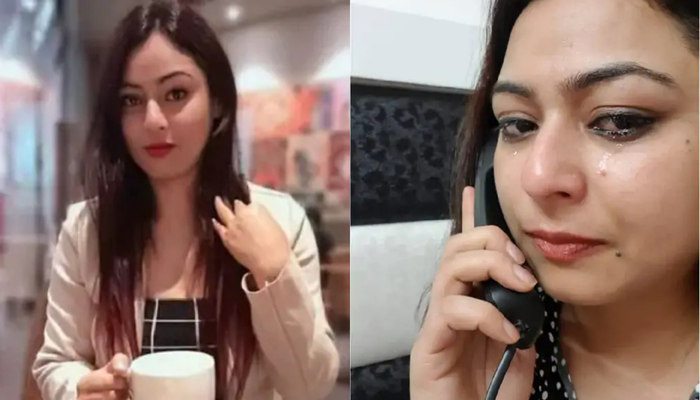
Asha Negi (Image via Dainik Bhaskar)
Asha told her brother that if something untoward happened to her, her family would be able to trace Badar using the documents. As she was talking to her brother on the phone, crying, she clicked a picture of herself and sent it to her brother. This is the last picture of Asha Negi with her family beside the 42-minute recording of her call to her brother. This was Asha’s last call to her family.
In December 2019, recovery agents of Bajaj Finance arrived at Asha Negi’s home in Meerut. They informed her family that an LED TV and an iPhone were bought in her name on an instalment plan, and the instalments are pending. They said that they first visited Asha’s Noida residence but did not find her there, and therefore, they came to her Meerut address.
After coming to know that Asha was not at her Noida residence, her mother, Basanti Negi, went to the Civil Lines police station in Meerut to file a missing person’s complaint on December 24, 2019. But Abdur Rehman, who at the time was posted at the Civil Lines Police Station, refused to file a case, saying that the case fell under Noida Police’s jurisdiction.
“We went to the house of her (Asha Negi) so-called husband in 2020. Badar’s parents were present at the house. They showed us an affidavit and said that they have severed all ties with Badar. They claimed that they had expelled him and that they did not know where he lived. Her mother told us that her son (Badar) was not a good man,” Asha Negi’s brother told Dainik Bhaskar.
Her brother said that he did not believe what Badar’s family said back then and added that he was sure that they were still in touch with him. He said that he has been doing the rounds of the police station since 2019, but no action has been taken. Asha’s family fears that she might not be alive or, if she is alive, she might have been smuggled to the Gulf countries. Asha’s helpless brother said that if she were alive, she would certainly have tried to contact her family by now.
Priya Tyagi from Meerut was brainwashed against her family by Badar
Priya Tyagi from Sarurpur, Meerut, was studying travel and tourism in Noida when she met Badar in a gym. Badar started talking to her regularly and won her trust. According to Priya Tyagi’s sister, Badar brainwashed Priya against her own family and promised her a luxurious lifestyle. Priya Tyagi visited her home once before she went missing in 2019. Her sister said that Priya’s behaviour was not good with her family members, as she was unhappy with them.
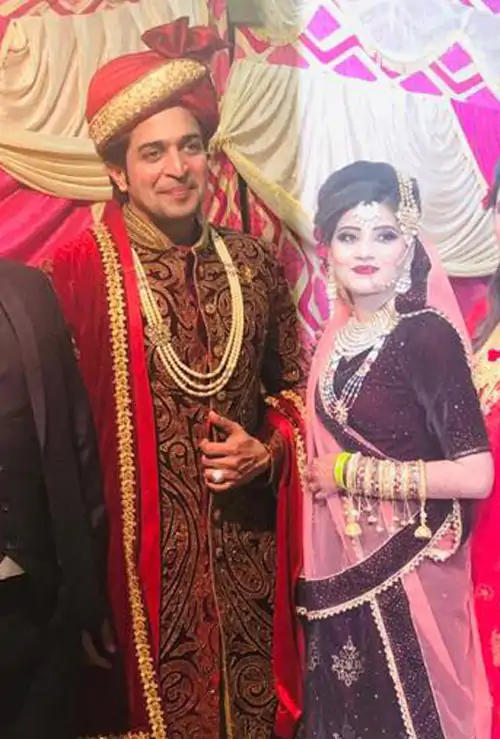
Victim Priya Tyagi with Badar Akhtar Siddiqui. (Image via Dainik Bhaskar)
Priya stopped performing Hindu rituals after meeting Badar, as told by her sister. She stopped fasting on Mondays, which she had been doing for a long time. Her sister said that Badar used to feed Priya special rice given by Jalaluddin. Priya’s family filed a case against Babar Siddiqui regarding her disappearance. Meerut Police’s crime branch has been investigating her case without success.
When Priya’s family started looking for her, they found out that Badar was in touch with many Hindu women, some of whom were missing like Priya. Her sister said that Badar had promised Priya that he would take her to Dubai for modelling. She also said that Priya often mentioned the name of Chhangur (Jalaluddin) while talking to her.
Soni from Delhi married Badar against her family’s wishes
Another victim of Badar, Soni, from the Nizamuddin area of Delhi, has also been missing since 2021. She had performed Nikah with Badar against the wishes of her family. Her mother could not bear the shock of Soni’s decision to marry Badar and passed away soon after her Nikah. Her family filed a missing persons complaint at the Chandni Mahal police station, but she has been untraceable.
Victim Soni with Badar Akhtar Siddiqui. (Image via Dainik Bhaskar)
The other two victims
One of the other victims also performed Nihar with Badar in 2015. However, she separated from him soon after and has been living in Delhi after remarrying. Another victim, who is an advocate from Delhi, filed an FIR in 2017 against Badar for molestation and rape. Badar managed to get bail in the case. Asha Negi’s name was mentioned in the documents filed by Badar for his bail application. The victim later withdrew her case, for unknown reasons.
Badar’s brother-in-law was a civil judge in Meerut
According to Advocate Vineet Choudhary, Priya Tyagi’s family lodged an FIR at the Sarurpur police station against Badar in 2021. The investigation of the case was entrusted to the Meerut Crime Branch. At that time, Badar’s brother-in-law was posted in Meerut as a Civil Judge. He, in the presence of another civil judge who was hearing the case against Badar, called the Investigating Officer of the Meerut Crime Branch and told him not to pressure Badar. The case has been pending ever since, and even the chargesheet has been filed after four years.
Case filed against Badar
A case was filed by Meerut Police on 24th July against Badar and his father regarding the disappearance of Asha Negi under Section 323 of the BNS and Sections 3 and 5 of the Uttar Pradesh Prohibition of Unlawful Conversion of Religion Act, 2021. With this, a total of two cases have been registered against Badar in Meerut, relating to the disappearance of Asha Negi and Priya Tyagi.
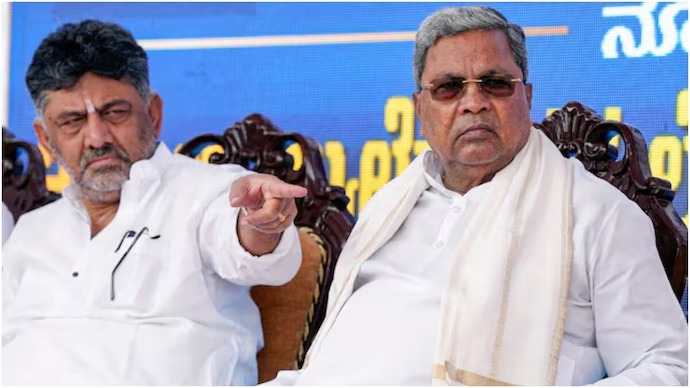
The tussle of War with words reached a new high after Karnataka’s deputy Chief Minister, DK Shivakumar’s officer, allegedly threatened the Special Duty Officers (SDOs) of Karnataka Chief Minister Siddaramaiah to assault his counterpart with a shoe in front of everyone.
The clash broke out at Karnataka Bhavan in Delhi amid a long verbal confrontation for power between Siddarmaiah and Shivakumar and growing speculation over a potential leadership change in the state.
The special Duty Officer to the Deputy Chief Minister, H Anjaneya, in a complaint, accused Mohan Kumar, Special Duty Officer to the Chief Minister, of allegedly threatening to assault him with shoes in front of other staff members.
“I was threatened to beat me with a shoe, and it has hurt my honour and dignity. Conduct a criminal trial against him (Kumar) and give me justice,” the officer’s complaint alleged.
The officer also alleged that he had been harassed and faced obstruction in the performance of his duties since Kumar took charge.
Raising concerns about his safety, the SDO assigned to Siddaramaiah stated, “If any untoward incident occurs, Kumar will be held accountable.”
In his complaint, he also accused Kumar of prior misconduct, alleging that he had once assaulted MM Joshi, disrespected senior officers, and displayed arrogance while serving as the Chief Minister’s special officer on duty.
Anjaneya further mentioned that he had earlier sought a transfer to avoid such confrontations. In response, Chief Secretary Shalini Rajneesh has ordered an investigation, and Resident Commissioner Imkongla Jamir confirmed that the complaint has been received.
Long battle for the Chair
The fight for the Chief Ministerial chair has been playing out for a long time. The harsh statements from the political leaders of Karnataka show that the eyes are on the chair. On July 13, KN Rajanna, Karnataka minister, claimed that CM Siddaramiah will continue as Chief Minister for the entire tenure. He also suggested that neither the party high command nor the MLAs are ready for a change in leadership.
“Yes, Siddaramaiah will be Chief Minister for five years. If change is there, only the high command and MLAs can do it. I think neither is ready to change now,” he said.
Asserting that it would be premature to say would be the party’s face in the state for the 2028 election cycle, Rajanna said, “Can anyone do an election without him (Siddaramaiah) in the Congress party? 2028 MLAs will decide who will be the Chief Minister. It won’t be decided now. All leaders, including Siddaramaiah, must be included for the next election. MLAs will then decide.”
Meanwhile, Congress MLA from Mandya, Ravi Kumar Gowda, seems to have sided with DK Shivakumar as he said the deputy CM deserves to be the Chief Minister, and when the time is right, he will become the CM.
“DK Shivakumar will become Chief Minister when the time comes. 138 MLAs support both DK Shivakumar and Siddaramaiah. When the time is right, DK Shivakumar too will become Chief Minister. When time and circumstance align, good things will happen. He definitely deserves to become Chief Minister, and he will become Chief Minister,” Gowda said.
Amid ongoing speculation over a possible leadership change in Karnataka, Deputy Chief Minister DK Shivakumar on July 12, stirred the pot by stating that one must make the most of opportunities when they arise. Speaking at the Kempegowda Jayanti event organized by the Bengaluru Advocates Association, Shivakumar remarked, “People keep fighting for positions. While you lawyers say you don’t want the chair, I say, when you get a good chair, sit on it. Opportunities are rare; grab them when they come.”
His comments have added fuel to the rumours of a potential leadership reshuffle in the state Congress.
However, Chief Minister Siddaramaiah dismissed all such talks soon after the meeting with Congress General Secretary and Karnataka in-charge, Randeep Singh Surjewala. He told reporters in Bengaluru, “Surjewala has clearly stated there is no change in leadership and that the issue isn’t even being discussed within the party. So, why the speculation?”
Shivakumar, who also returned from Delhi around the same time, avoided further remarks and deferred to Siddaramaiah’s statement, saying the Congress high command’s position on leadership had already been made clear.