A hate campaign against Hindu groups was started in the United States (US) in another instance of rising Hinduphobia across the globe. A resolution designating various Hindu organisations as severe hate groups and offshoots of the Rashtriya Swayamsevak Sangh (RSS) was accepted by the Teaneck Democratic Municipal Committee, a division of the New Jersey Democratic Party (RSS).
In the resolution, it was demanded that the government designate a number of American Hindu organisations as “domestic branches” of “foreign hate groups,” including the Hindu American Foundation (HAF), the Vishwa Hindu Parishad of America (VHPA), and SEWA International.
“Hindu nationalist organizations have infiltrated all levels of politics and were highly effective in blocking U.S. House Resolution 417 which was a congressional attempt to warn against the Hindu nationalist movement,” TDMC said, as per the press release. “Now, most local American elected officials remain unaware and unprepared to deal with the Hindu extremists,” it added.
Daniel Rosenblum, a TDMC member who voted in favour of the motion, told IAMC that Americans need to recognise that the “RSS’s roots stem from the same place as Italian fascism and German Nazism.” Following anti-Hindu violence in South Richmond Hills (New York), Plano (Texas), and Fremont (California), the resolution has sent tremors across the Hindu-American community in the United States.
On (August 24), a Mexican American woman assaulted a group of 4 Indians, following a racist rant in the parking lot of a business establishment in Plano in Dallas city of Texas. As per reports, the accused was identified as Esmi Armendarez Upton. The video of the nasty confrontation had gone viral on social media, leading to her arrest on Thursday (August 25).
“I hate you f*cking Indians…You come to our country and want everything free. I am Mexican-American. I was born here. Were you born here? Everywhere I go, you fucking Indians are there,” Esmi was heard saying.
OpIndia recently reported how new incidents of targeted hate crimes against the Hindu population and its temples in Canada, the US, and the UK by Khalistani and Islamic extremists indicate the unsettling patterns of increasing Hinduphobia in the West.
Even as India remains an outlier in heading off inflation and currency depreciation among major economies in the world, the Indian finance minister Nirmala Sitharaman recently attracted a barrage of online criticism for her informed comment on the strengthening American dollar vis-a-vis other currencies across the globe.
Nirmala Sitharaman says the rupee is not sliding but the dollar is strengthening
Speaking to reporters after attending the annual meetings of the International Monetary Fund (IMF) and the World Bank, Sitharaman said that the fundamentals of the Indian economy were strong and that inflation was low compared to other parts of the world.
“First of all I would look at it as not rupee sliding, I would look at it as dollar strengthening, dollar strengthening incessantly,” she said in reply to a question on the weakening rupee.
All other currencies around the world are performing against a strengthening dollar, she said.
“And I’m not talking technicalities, but it is a matter of fact that India’s rupee probably has withstood this dollar rate going up, the exchange rate in favour of dollar strengthening is there and I think the Indian rupee has performed much better than many other emerging market currencies,” she added.
Sceptics and leftist propagandists, whose knowledge of the world economy and factors affecting currency exchange rate is as poor as their grasp of the political aspirations of the country, made a beeline to mock the finance minister over the nimble-footed monetary policy India embraced in the wake of unprecedented inflation and accompanying volatility amid the Russia-Ukraine crisis.
Factors contributing to the inexorable rise of the USD
Firstly, there are several factors affecting the value of the currency. One of them is the interest rates that the reserve bank manages to control the circulation of money in the economy. The US Fed has hiked rates five times this year, most recently by three-quarters of a percentage point in September in their bid to fight inflation. The US is facing unprecedented inflation in decades, following the V-shaped recovery after the coronavirus pandemic brought the country to a standstill. The unemployment rate in the US is at record low levels, which has contributed to the skyrocketing inflation. These developments prompted the US Fed to continuously hike interest rates, which is nothing but an attempt to limit the amount of money available in the market. By raising interest rates, the Fed aims to sap money off the economy and induce it into a state of deflation to grapple with the rising prices.
However, this is just one aspect of the interest rate. The higher interest rates also provide investors with better returns in the US markets than elsewhere, which is one of the reasons why foreign investors pull money invested in different markets around the world and park it in the US market. This, in turn, increases the demand for American currency, USD, which raises the dollar’s value in the international market.
Further, the primacy of USD in international finance and trade, especially in energy trade, also has a domino effect in strengthening the American currency. The US dollar rules the roost of the world economy as compared to other currencies, including INR, Chinese Yuan, Russian ruble, etc. The preeminence of the dollar over economies also contributes to strengthening the American currency amid swelling inflation and global volatility.
To deal with the US Fed rate hike that strengthens the dollar, which in turn powers much of the world trade, countries take appropriate action to tame domestic inflation and price rise, which typically involves raising interest rates by the reserve banks of the respective countries. This is why the Reserve Bank of India raised interest rates in the last few months. But this measure involves a kind of spillover effect: It lowers demand not only for domestic output but also for imports, failing to take into account which could induce an unintentionally steep global downturn.
Countries across the globe have to navigate the tightrope of arresting inflation but not so much as ushering themselves into recession. Other factors have also contributed to the strengthening of the US dollar, but they are beyond the scope of this article. So when Nirmala Sitharaman said it is not the Indian rupee that is sliding but the US dollar that is strengthening, she accurately encapsulated the conundrum facing the Indian economy.
But one would assume social media trolls attacking the finance minister and taking swipes at her do not possess the mental capacity to grasp complex issues such as the world economy and the spillover effect of interest rates on currencies of other nations. Add to the mix the ongoing war between Russia and Ukraine, and the complexities compound further. However, opposition political leaders, even those with finance backgrounds, resorting to attacks underscores the desperation that has set in even though she has done a fairly decent job in controlling the depreciation of the rupee.
The Indian rupee outshines other major currencies in the world
While asserting that the US dollar has strengthened, Nirmal Sitharaman also said that India has outperformed some of the major economies in the world. Let’s look at how the rupee has fared against some of the top currencies in the world:-
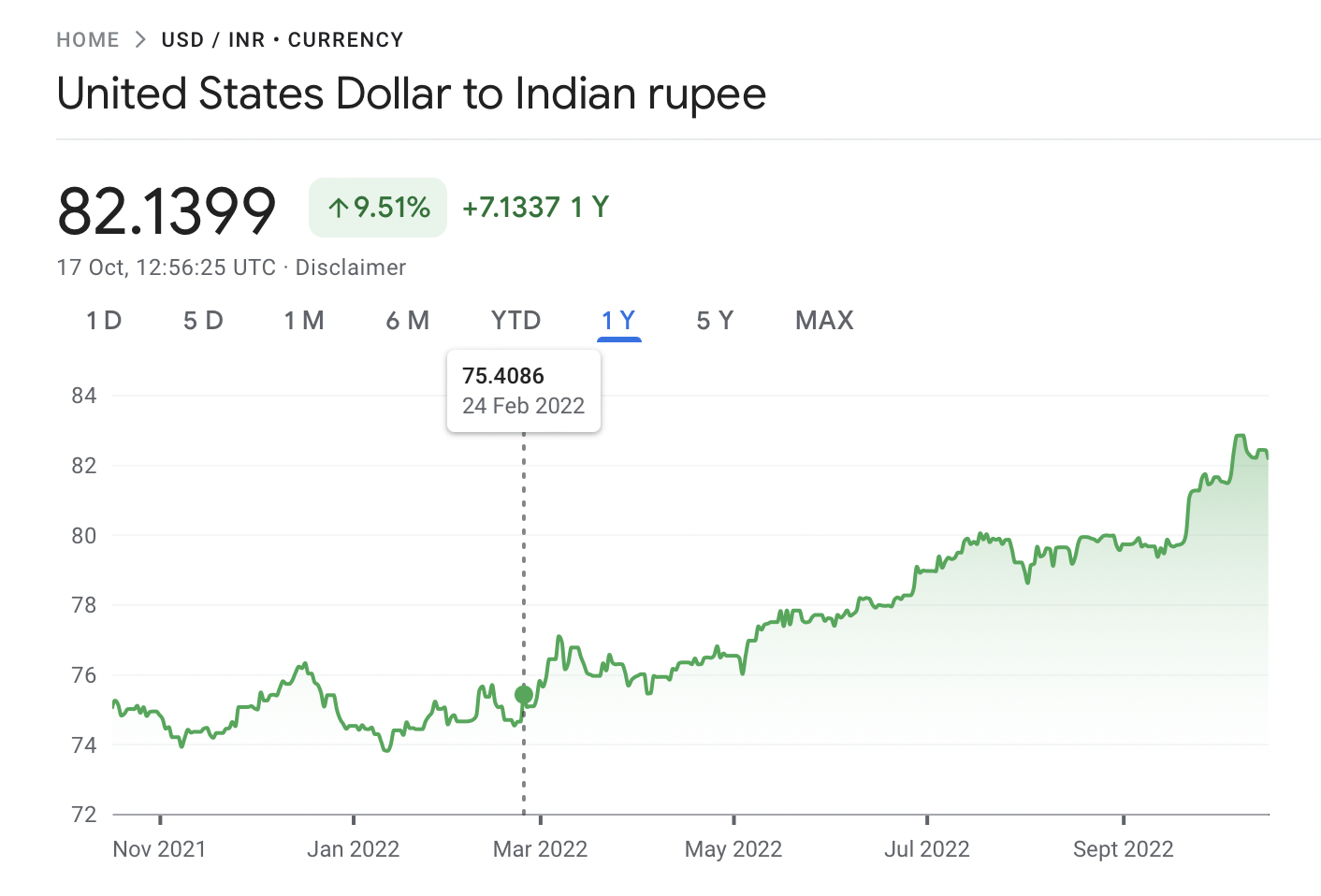
INR vs USD
Since the start of the Russia-Ukraine war on 24 February 2022, which acted as a stimulus to the global financial crisis, especially with the consumer food inflation that has reached record levels, given that Russia and Ukraine are both among the top exporters of wheat, and several African and Latin American countries are overtly dependent on Moscow and Kyiv for their grain requirement, the Indian rupee has depreciated against its US counterpart.
From 1 USD equal to Rs 74.64 on 24 February, it has come down to Rs 82.29 on 17 October, close to a 9 per cent fall in its value.
Source: Google Finance
However, the Indian rupee has outperformed several other major economies and has managed to limit its slide against the all-powerful dollar, thanks to timely intervention by the Indian government and the Reserve Bank of India.
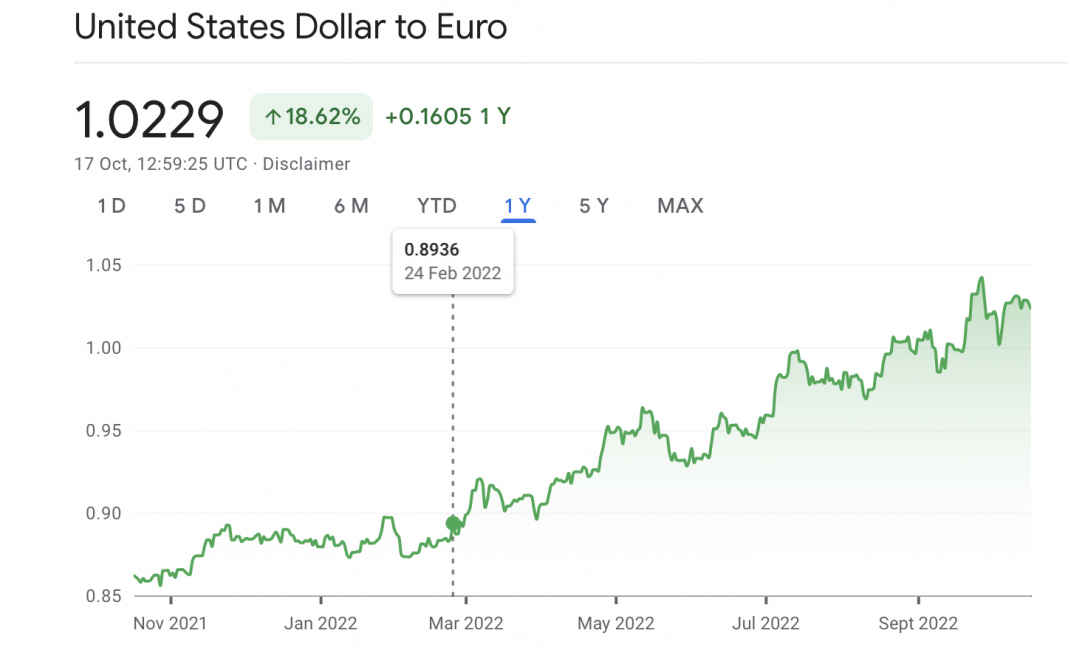
USD vs EUR
Before the start of the war, 1 USD amounted to 0.89 Euros, but today, i.e. on 17 October 2022, 1 USD is equivalent to 1.03 Euros, a staggering 17 per cent depreciation in its value in the course of close to 8 months.
Source: Google Finance
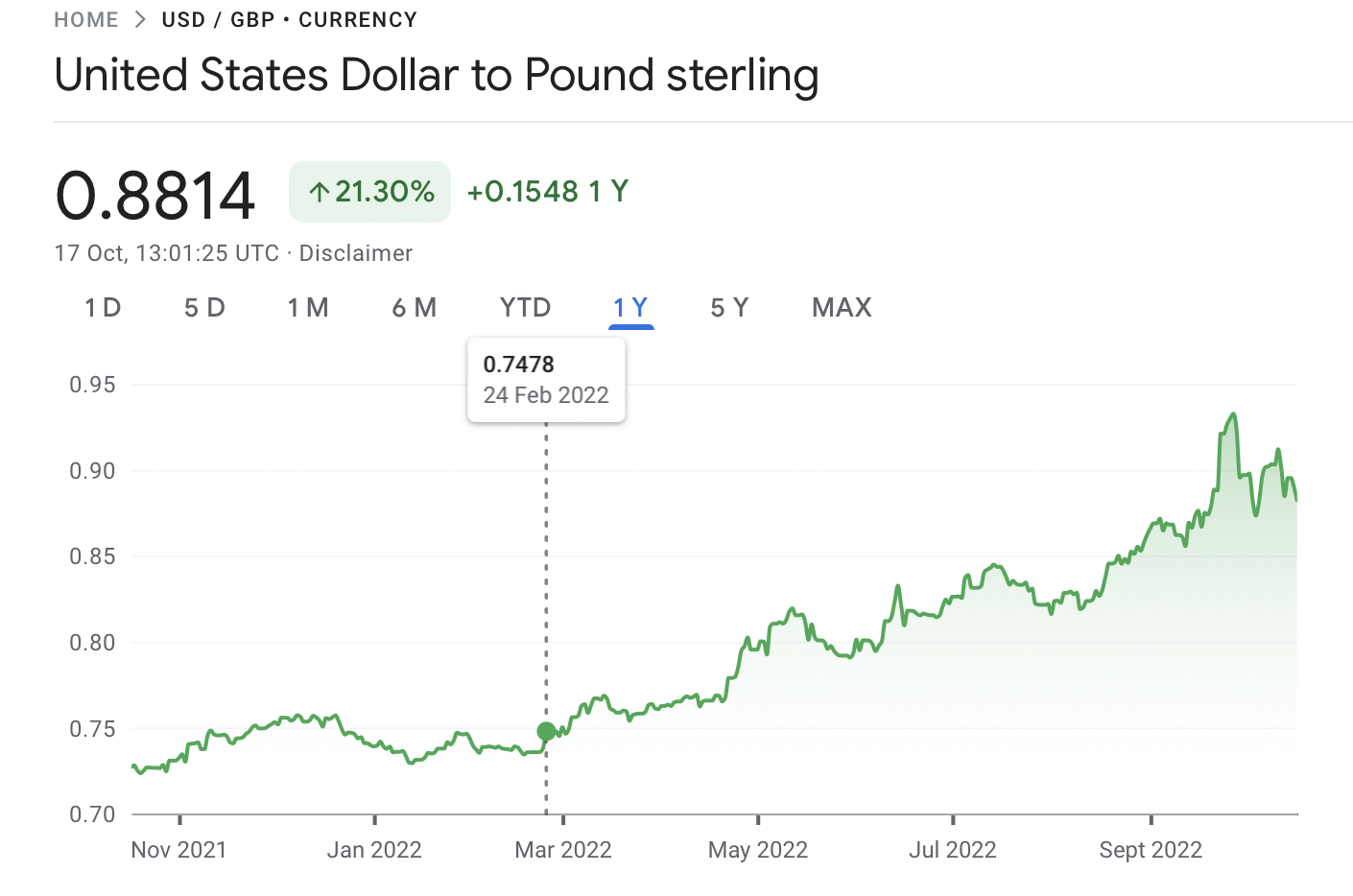
USD vs GBP
Similar is the case with the pound sterling, which has lost 18 per cent vis-a-vis the US dollar. On February 24, one dollar was equal to 0.75 GBP. However, on 17 October 2022, its value dropped to 0.89.
Source: Google Finance
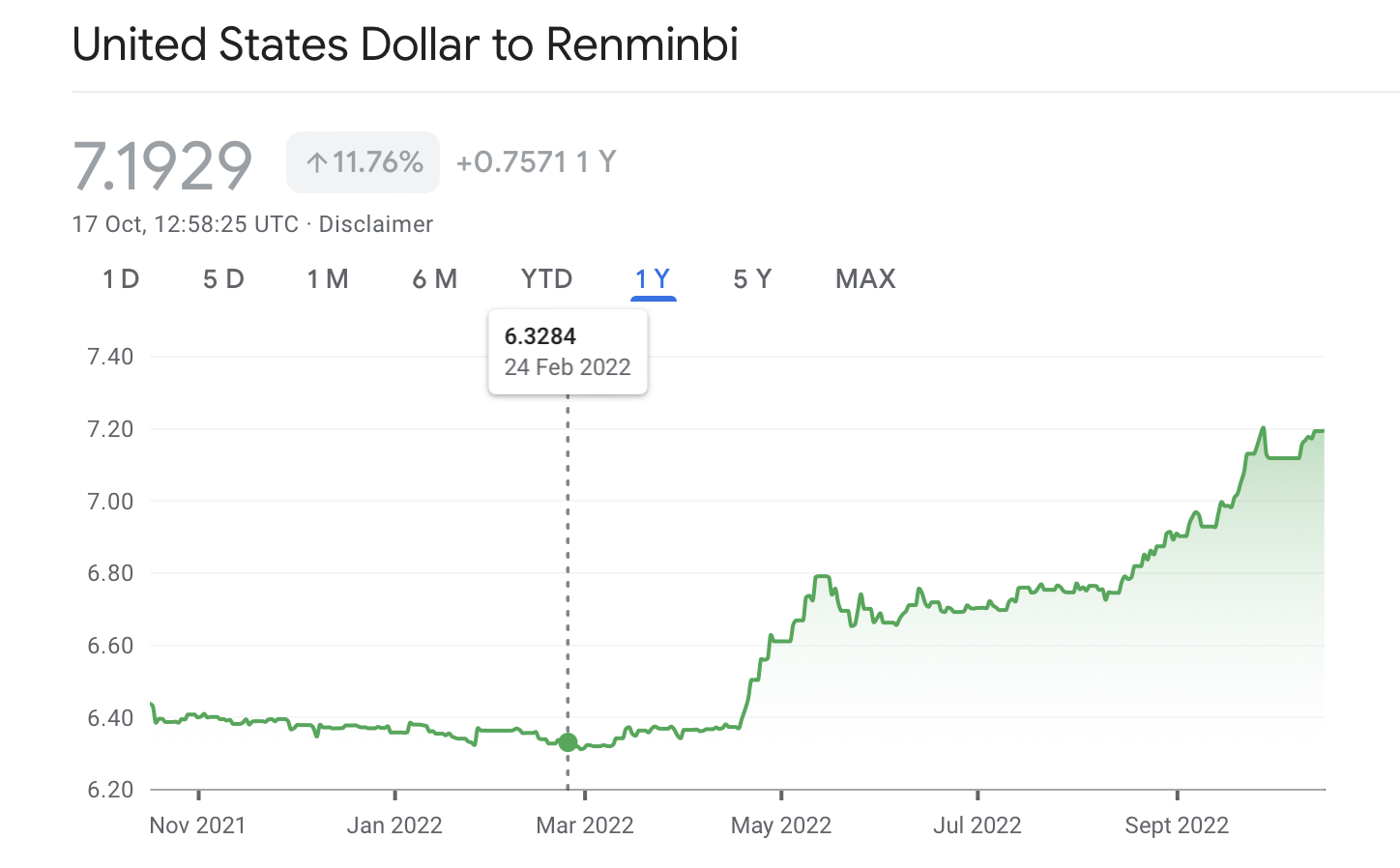
USD vs Chinese Yuan
Likewise, the Chinese Yuan, too, has lost considerably in the 8 months since the war began and amidst periodic rate hikes by the US Fed. One US dollar is currently equivalent to 7.2 Chinese Yuan while it was 6.33 Chinese Yuan before the start of the war in February 2022.
Source: Google Finance
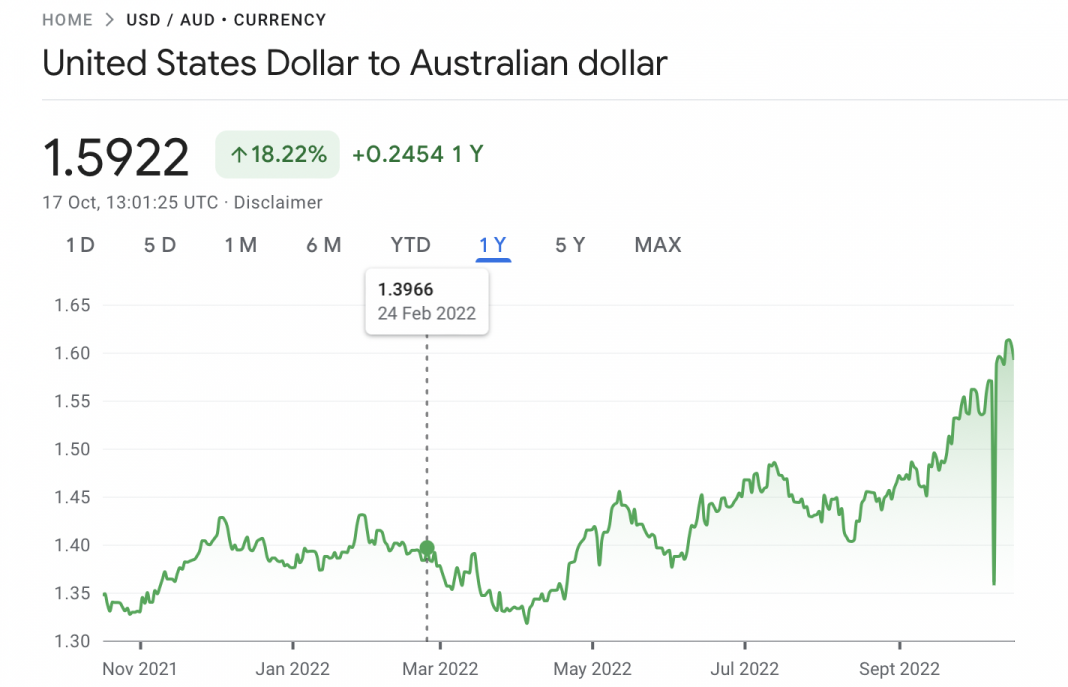
USD vs Australian Dollar
The Australian Dollar has also tanked amid record-level inflation and the Russia-Ukraine crisis. From 1 USD equal to 1.40 Australian dollar before the Ukraine-Russia conflict, it has slumped to 1.60 as of 17 October 2022, a 14 per cent drop in its value as against the US dollar as compared to 10 per cent slump faced by INR against USD.
Source: Google Finance
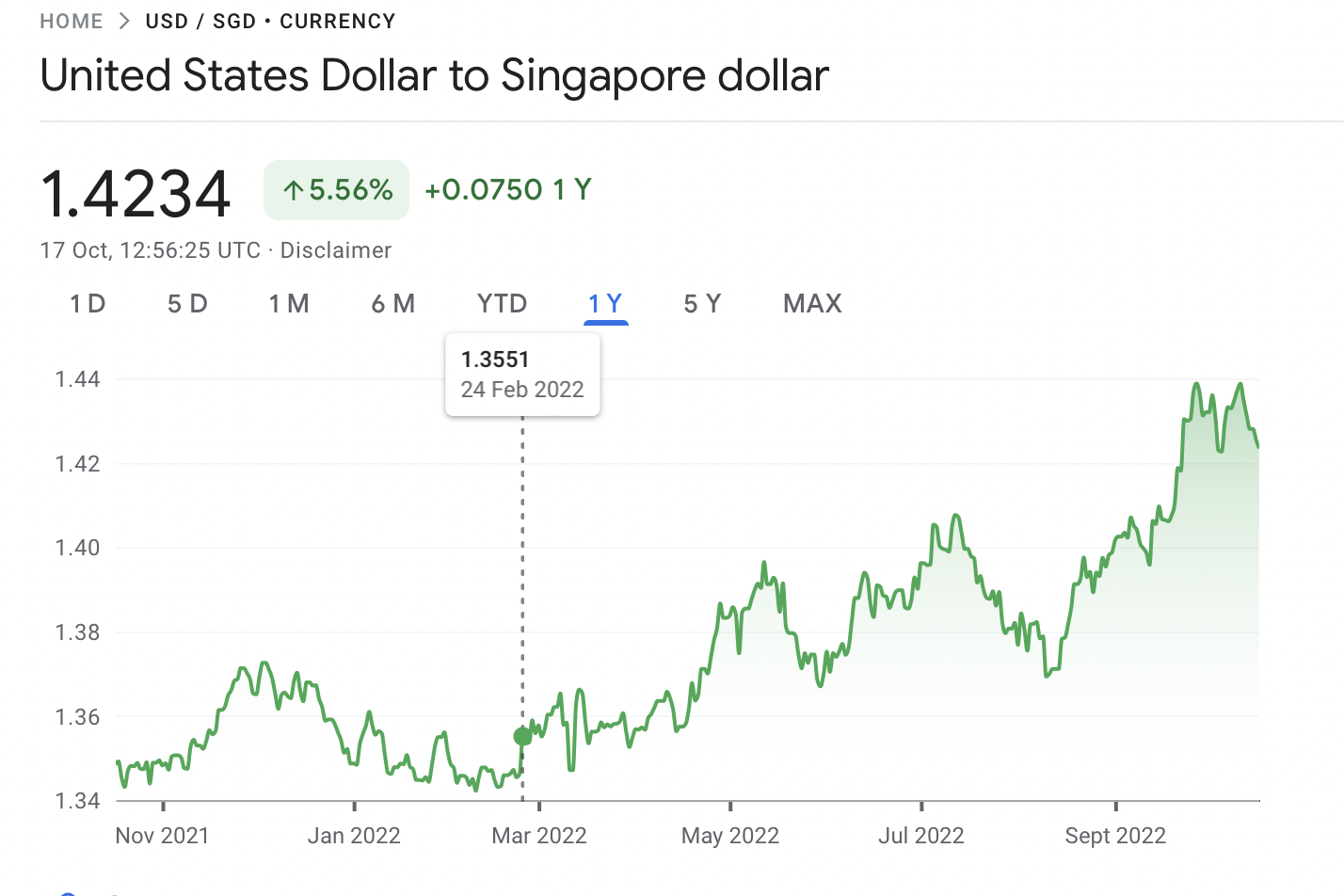
USD vs SGD
The Singaporean Dollar (SGD) remains one of the very few global economies that have fared better than the INR in terms of dealing with the USD rise. The USD is currently equivalent to 1.43 SGD, depreciating about 5 per cent in the 8 months since the war when it was 1.36 SGD.
Source: Google Finance
How India continues to be on firm financial footing amid uncertain global cues
Taken together, the Indian rupee has been among the pick of the currencies to push back against an ominously rising American dollar and months after the devastating bout of coronavirus outbreak cratered economies and brought countries to a standstill. While the Indian rupee has fallen 9 per cent in the last 8 months, most of the other major currencies have registered double-digit slumps, establishing India’s impressive handling of the economy, which also earned her the praise of the IMF officials, who recently lauded the Indian government for its efficient handling of multiple crises in an uncertain global environment.
While each country has a unique set of challenges and shares different geographical and geological attributes, strengths and weaknesses, the fact that the Indian rupee has performed significantly better than most of the major currencies in the world is a testament to the Indian government’s prowess in tackling once-in-a-lifetime kind of crisis, especially in the wake of a global pandemic that wreaked havoc and bled economies around the globe, underscoring their resolve to build a robust and resilient India that is as insulated as possible from the global shocks.
The Central Bureau of Investigation (CBI) is interrogating Aam Aadmi Party leader and Deputy Chief Minister of Delhi Manish Sisodia in connection with the Delhi liquor scam case. Sisodia was summoned to the CBI headquarters for questioning on Monday, October 17. As he is being grilled in the headquarters of the central agency, here are some questions which Sisodia might need to answer.
What was the reason behind the introduction of an excise policy in November 2021? Who was behind the sanctioning of the policy?
Who attended the early meetings on the policy and where were they conducted? What were the details mulled over in the discussion?
What were the advantages of the Delhi government’s excise policy?
Who made the ultimate decision to issue the tender notice, and who signed off on the tender terms and conditions?
What about R Gopi Krishan, the previous Excise Commissioner? What role did the former officer play in the policy’s implementation, and did he oppose it?
What was Vijay Nair’s involvement in developing the excise policy, and what are his ties to all of the liquor companies that received licences?
Was the excise policy opposed by Deputy Commissioner Anand Tiwari and Assistant Commissioner Pankaj Bhatnagar?
Why do licence holders deposit money in the bank accounts of their acquaintances – Amit Arora, Dinesh Arora, and Arjun Pandey?
Meanwhile, as Manish Sisodia faces the questions of the Central agency, the AAP leaders and workers continue to wreak havoc outside the CBI headquarters. Several of them have been allegedly protesting and attempting to disrupt the functioning of the CBI.
Manish Sisodia branded the allegations against him “completely fake” hours before he was scheduled to appear before the CBI in connection with the liquor policy case. “They want to arrest me by registering a fake case against me. I had to go to Gujarat for election campaigning in the coming days. These people are losing in Gujarat badly. Their aim is to stop me from campaigning there. Whenever I went to Gujarat, I told people that we will build schools like Delhi for your children in Gujarat too,” Sisodia claimed in a series of tweets this morning.
जब जब मैं गुजरात गया, मैंने गुजरात के लोगों को यही कहा कि हम गुजरात में भी आपके बच्चों के लिए दिल्ली जैसे शानदार स्कूल बनायेंगे। लोग बहुत खुश हैं। लेकिन ये लोग नहीं चाहते कि गुजरात में भी अच्छे स्कूल बनें, गुजरात के लोग भी पढ़ें और तरक़्क़ी करें।
Manish Sisodia went to Rajghat before going to the CBI for the interrogation. While with his supporters, Sisodia said that they should be proud if he is in jail.
On August 19, Manish Sisodia was raided by the investigating agency in connection with the national capital’s liquor scam. The Delhi Excise Policy of 2021-2022 is at the crux of the controversy. The Delhi government’s now-cancelled liquor policy was first planned in 2020. It modified the way alcohol was sold in Delhi once it came into effect in November 2021.
The Delhi Excise Policy 2021-2022 allowed for the entry of private businesses into the sector. While the goal of Excise Policy 2021-2022 was to eliminate black marketing and the booze mafia, the AAP government was promptly criticized over charges of corruption. In the new liquor policy, Naresh Kumar, who was appointed Chief Secretary of Delhi in April 2022, discovered inconsistencies and procedural failures.
As per a report by the Chief Secretary, it is alleged that irregularities were perpetrated in amendments to the Excise Policy, offering disproportionate favours to licensees, waiving/reducing licencing costs, extending L-1 licences without authorization, and so on. It is further alleged that illicit proceeds from these operations were channelled through private parties to interested public officers, who subsequently made fraudulent entries in their books of accounts.
The FIR was filed on August 17, after the recommendation of Delhi Lieutenant Governor Vinai Kumar Saxena for a CBI investigation into the Delhi Excise Policy 2021-22. Vijay Nair, the AAP’s communication in-charge and former CEO of entertainment and event management company Only Much Louder, Indospirit Group Managing Director Sameer Mahendru, and Hyderabad-based businessman Abhishek Boinpally have all been arrested in the case to date.
On 12 August 2022, a murderous attack on the author, Salman Rushdie, who was about to give a talk on the freedom of speech and expression at a New York literary event, delivered a mortal blow to people like us who held this liberty as a birthright.
In this creeping age of ‘wokeism’ and ‘cancel culture’ where people feel increasingly constrained about expressing themselves for fear of reprisal, the news of multiple stabbings of the celebrated literary figure was devastating.
On the tragic event, I wrote the following comment in TheNew York Times:
“It’s so sad, in Salman Rushdie’s case, a fatwa issued in 1989 was sought to be executed in 2022 by a man who wasn’t even born at that time nor was familiar with the context or controversy”.
As long as the power of fanaticism will keep growing on this earth, there will be an escalating necessity to preserve and promote the narratives of storytellers like Salman.
I was in New Delhi in 1989 when the controversy around the Satanic Verses erupted. I vividly remember at the initiative of the govt, the parliament passed a resolution banning the book. There was no discussion on the content, hardly any parliamentarian had read it. That was regretfully the respect shown to an author born in India and to free speech!
The Indian readers, in general, had no problem reading Salman, his innumerable accounts of Indian poverty, destitution or social divisions. In fact, they showed up in droves to listen to him after the ban on his travel was lifted.
Today, we have to stay vigilant and protect our right to free speech and expression that is constantly under assault from unexpected quarters.
The UK recently debated whether to remove the Holocaust from its school curriculum because it offended a section of the population. The story of 9/11 is also sought to be underplayed for the same reason.
Censorship imposed by the bullies on the freedom of putting across your own point of view (with civility), is a frightening proposition gripping the world.
Free countries appear to be giving into it.”
Spotlight on Salman Rushdie’s The Satanic Verses returns
The brutal attack on Salman Rushdie sent us back into the year 1988 when the publication of his novel, The Satanic Verses, set off a trail of murder, arson and turbulence all around the world. Interpreting the imaginary multilayered story in the novel as a blasphemous attack on Islam, the Islamists bombed six bookstores in the United Kingdom, two in California; a community newspaper in New York was bombed because it had defended people’s right to read the book.
The terrorizing effect of the Islamists’ rampage was grim. One-third of the American bookstores stopped displaying the book; it was banned in at least 21 countries. In 1989, the Shiite Supreme Leader of Iran, Ayatollah Ruhollah Khomeini issued a fatwa directing Muslims to kill Rushdie and his publishers.
In 1991, Hitoshi Igarashi, an academic Japanese translator of the book, was killed; an Italian translator, Ettore Capriolo, was stabbed and seriously wounded. In 1993, the novel’s publisher in Norway was shot but survived. Book companies in France, West Germany, Greece and Turkey decided not to publish it; but publishers in Finland, Norway and Italy went ahead. A Turkish translator, Aziz Nesin, was attacked by Islamist arsonists while praying with others. The fire killed 37 people, though Nesin escaped.
Muslim clerics and government officials of Islamic countries, in coordination with Islamic organizations, were instructing Muslims to hunt and kill Rushdie or anyone associated with the publication and distribution of the novel. They had placed a $2.5 million bounty on Rushdie’s head. The U.K. put Salman Rushdie under police protection at his home in the United Kingdom for the better part of a decade and broke diplomatic relations with Iran over the fatwa. Normal relations were restored only after Iran pledged that it would no longer seek Rushdie’s assassination, a policy denied by the successor Ayatollah.
India was one of the first countries to ban the book, deeming it “hate speech”. In the anti-Rushdie riots (February 1989), at least 12 people died and 40 were wounded in Bombay; three people were killed and more than 100 were injured in clashes between the police and the rioters in the northern state of Kashmir. Syed Abdullah Bukhari, the chief Imam of the largest mosque, Jama Masjid, in Delhi, “endorsed Iran’s condemnation of Mr Rushdie and the calls for his killing.”[4]
What was there in the Satanic Verses that angered the Islamists?
When the Satanic Verses was banned in India, Rushdie responded by saying that the book wasn’t actually “about Islam, but about migration, metamorphosis, divided selves, love, death, London and Bombay.”
Rushdie’s novel did refer to a few sets of verses in the Quran that created controversies around whether or not Muhammad, the founder of Islam, had allowed his followers to worship the pagan goddesses. In Mecca, during his campaign, when Muhammad was confronted by the resisting Meccan tribes, he is said to have accepted the existence of the three goddesses, al-Lat, al-Uzza, and al-Manat (Quran 53:19, 20). Later on, he denied having done so and claimed that Satan had put such verses in his mind to fool him; they weren’t the revelations sent by God. And, therefore, they were removed from the Quran.
Devout Muslims never believed that such “Satanic Verses” ever existed; they were also not willing to accept that their ancestors in Arabia followed the pagan tradition of worshiping idols. According to their faith, before Muhammad and Islam, the world was ignorant (al-jahilliyah) and, therefore, there couldn’t be any positive painting of the pre-Islamic era. Just as idol worship was taboo, critiquing Muhammad and Islam was also unendurable.
Despite the Islamic references, the novel-reading literary world might have treated The Satanic Verses as an entertaining fairy tale and put it back on the shelf after the enjoyment of reading it. This literary work was short-listed for the Booker Prize and was the winner of a Whitbread Book Award in the same year (1988).
The Islamists around the world were, however, angered by the subject matter of Islam, Muhammad and the verses in the Quran being imaginary themes of a novel. Salman’s satire or indirect references to Islamic figures or traditions were picked up by the Islamists as a deliberate attempt at insulting their faith and the Ummah (the global Islamic community).
Rushdie’s attempt to mend fences with unforgiving Islamists
Having received the heat and the furor the novel had created in the Islamic world and more particularly considering the statement of the Iranian president, Ali Khameinei, to the effect that the death sentence might be withdrawn if Salman Rushdie publicly apologized, the Indian-born British author, then only 41 years old, issued a three-sentence statement on 19 Feb 1989:
“As the author of The Satanic Verses, I recognize that Muslims in many parts of the world are genuinely distressed by the publication of my novel. I profoundly regret the distress that publication has occasioned to sincere followers of Islam. Living as we do in a world of many faiths, this experience has served to remind us that we must all be conscious of the sensibilities of others.”
On 24 Dec 1990, Salman Rushdie announced the affirmation of his faith in Islam and asked Viking-Penguin, the publisher of The Satanic Verses, neither to issue the book in paperback nor to allow it to be translated.
On 28 Dec 1990, he wrote a piece in The New York Times wherein he appeared to be trying hard to buy peace with the Islamists. In that endeavour, however, he penned expressions that could be seen as complete volte face to his rebellious-iconoclastic reputation as a literateur. It almost amounted to capitulation.
He began by “his decision to affirm the two central tenets of Islam — the oneness of God and the genuineness of the prophecy of the Prophet Muhammad” – and then, added:
“I have been finding my own way towards an intellectual understanding of religion, and religion for me has always meant Islam. That journey is by no means over. I am certainly not a good Muslim. But I am able now to say that I am a Muslim; it is a source of happiness to say that I am now inside, and a part of, the community whose values have always been closest to my heart.”
Pinning high hopes on the outcome of his meetings with a few Islamic scholars, Salman said, “Well, I’m now inside the family, and now Muslims can talk to Muslims and continue the process of reconciliation..” Salman Rushdie had been led into believing that in “many Muslim countries and communities around the world,” the ‘mood of affection’ had begun to replace ‘anger.’
What sounded like bending over backwards to please the Islamists, Rushdie wrote, “My meeting with the scholars, who declared themselves satisfied with my sincerity, is the traditional Islamic way of resolving an issue of alleged offence against Muslim sanctities.” He concluded by saying, “What I know of Islam is that tolerance, compassion and love are at its very heart.”
Even though Salman Rushdie appeared to be kneeling down before the Islamists to buy their forgiveness, to his credit, he didn’t give in to the pressure of ‘total withdrawal’ of the novel. Many of its readers had found The Satanic Verses to be of value, and “I cannot betray them,” he asserted.
Later on, Salman Rushdie disavowed his claim to embrace Islam and admitted that he had done so to get the fatwa lifted. He called his efforts to appease extremists (by accepting restrictions on the novel) the “biggest mistake of my life.” When Rushdie was asked if he still considered himself a Muslim, he replied: “I am happy to say that I am not.”
Islamic Terrorism and Freedom of Speech and Expression
Thirty two years later, when Rushdie fell victim to the Ayatollah’s fatwa in reality, it raised, to my mind, two leading questions:
First, why and how has the sense of revenge in the Islamic faith persisted for so long? It was mentioned somewhere that in the Shia sect the fatwas normally die with the death of the clergy who had issued them. Doesn’t this revenge killing come from the Islamic preachings or the Islamic cultural tradition?
In June 1989, a Guinean-born Lebanese man, calling himself Mustafa Mazeh, had blown himself up in a hotel in Paddington, West London, preparing a bomb to kill Rushdie. On the same pattern, Hadi Matar, a young man born in the US to Lebanese parents prepared himself to wreak vengeance on Salman Rushdie in 2022. Both Mustafa Mazeh and Hadi Matar, 32 years apart, appeared to be under the spell of the same Islamic preachings of Khomeini.
It’s important to note here that the internecine blood feuds between different sects of Islam were also a testimony to the enmity based on diverse theological interpretations of their faith and preachings: only “sword and blood” could settle a dispute. The Shia-Sunni mutual killings were as old as the founding of the faith itself.
The second question bothering me was if people in the free world had to really guard their freedom of speech and expression in such a way as not to be “offensive” or “insulting” to anyone. Is it true if Salman Rushdie hadn’t offended Muslims around the world, he wouldn’t have met fate as he did? After all, the Islamic terror had silenced or subdued a large part of the literary world that could have been more outspoken in critiquing Islamism or Muhammad. In 1988, the Left unreservedly extended full support to Salman Rushdie for his freedom of expression.
The free world could also be faced with a situation as to who would stand by them when their freedom of speech and expression sanctioned by the Human Rights Charter and separate constitutions were to be restricted or taken away: the politicians, the big tech companies, the media outlets or the people’s consciousness and power?
How dependable are the politicians?
Politicians couldn’t be trusted. They would prefer to be politically correct and pander to the Islamo-Leftists for votes. They usually spoke from both sides of their mouth. For example, Jimmy Carter, the former U.S. president, called Ayatollah Khomeini’s fatwa of death against Salman Rushdie “abhorrent” and declared it to be “our duty” to protect the author and “honour Western rights of publication and distribution.” But, in the same breath, he added that “we should be sensitive to the concern and anger” that prevailed among “the more moderate Moslems.” Jimmy Carter alleged that The Satanic Verses went “much further in vilifying the Prophet Mohammed and defaming the Holy Koran.”
Reputed for his advocacy for human rights, Jimmy Carter was a politician too. Stung by the Iranian US hostage crisis, and constantly engaged in Arab-Israel peace negotiations, he had a constituency in the Middle East and the Islamic world to win over. However, he was also a religious preacher at his church and knowledgeable about the challenges Christianity and other faiths faced against Islam. He had a grasp of Islam better than many followers of that faith. He should have explained how certain theological teachings of Islam were irreconcilable with the western concept of the freedom of speech and expression.
Freedom of Expression and the leading corporate info-tech companies
The major global tech companies like Facebook, Google and Twitter have greatly facilitated speedy information dissemination and empowered the weakest to communicate with the world. At the same time, however, they have put a garrote around the neck of every potential user, thereby holding their freedom of expression hostage. Recently, the suspension of President Trump’s Twitter and Facebook accounts while allowing Islamist terrorist organizations to use their services brought this contradiction to the fore. The giant tech companies can whimsically and indiscriminately make the playing field uneven.
The media outlets
Major media outlets were also mysteriously promoters of the Islamo-Leftist agenda of curtailing the freedom of speech and expression of people they disagreed with. To illustrate with an example, following the stabbing of Salman Rushdie, The New York Times, ran an opinion piece, wherein the writer, instead of unequivocally supporting the freedom of the author, revived the controversy around The Satanic Verses and stressed that the “battle lines” around the novel were “never clearly drawn.”
The writer apparently endorsed the arguments of the Islamo-Left that it was “wrong to give offence to certain people, certain groups, certain religions, and so on..” She stressed that the conversation over free speech had shifted among the “younger progressives” and a new “notion” was gaining ground that “offensive speech” was “violence.” They “increasingly critiqued the principle of free speech as too often providing cover for hate speech.”
The readers are the best guarantors of free speech and expression
An overwhelming number of the New York Times left-leaning readers didn’t buy this argument supposed to have been made by the ‘younger progressives’. Their consensus appeared to be: Words couldn’t “offend” and cause “violence” as long as the power to make a counter-speech was available. If censorship was sought to be imposed through coercive methods, both the Left and the Right would be tempted to resort to it. In Salman Rushdie’s own words, freedom of expression would cease to exist without “the freedom to offend”. There were many uncomfortable ways literature and art could question society, making fun of faith and its founder didn’t pass the threshold of hate speech.
Furthermore, it was not possible to produce any powerful creative art without offending someone. In the USA, the words of Martin Luther King Jr. offended millions, and so did the play, Hamilton. The art of Robert Mapplethorpe (a creative American photographer) and Robert Rauschenberg (an American painter and graphic artist), the writings of Toni Morrison, or virtually any artistic expression made millions feel affronted or insulted. If “comfort,” “sentiments” or “feelings” were the restraining considerations, one would never have challenged the perspective, preconceptions, biases, or interpretations of others.
In the author-reader relationship, moreover, the rule has always been very simple: “Don’t like it, don’t read it – no book should ever be banned or destroyed and no author should be attacked for what they write.”
With a sense of setback, one will have to give credit to the Islamists (and terrorists) who with the aid of the Leftists changed this rule of behaviour. Now, authors, opinion makers or public figures who could have spoken fearlessly and condemned attacks on the freedom of speech and expression preferred to stay silent.
In their defiant killing spree, the Islamists and their brain-washed terrorist foot soldiers seem to be telling the world that any critical or even allegorical reference to their Faith (that included the Founder, the Book and the Hadees) might cost them their lives. In India, the controversy surrounding the statement of Nupur Sharma, a BJP official, and the subsequent chain of murders by the Islamists were the latest examples of a murderous worldwide cult that is gaining in strength.
There’s no scope to be gloomy, however. In the end, the pen will be mightier than the sword and the tide of freedom and liberty will prevail.
Let’s be assured Salman Rushdie’s own words of confidence in the triumph of the freedom of expression over the forces of terror and death will keep inspiring the world.
“A poem will not stop a bullet. A novel cannot defuse a bomb. But we are not helpless. The battle is not only on the battlefield. Even after Orpheus was torn to pieces, his severed head, floating down the river Hebrus, went on singing, reminding us that song is stronger than death. We can sing the truth and name the liars. We can stand in solidarity with our fellows on the front lines and magnify their voices by adding our own …. We can emulate Orpheus and sing on in the face of horror, and not stop singing until the tide turns, and a better day begins.”
Bhojpuri actress Rani Chatterjee has come forward and revealed that MeToo-accused filmmaker and Bigg Boss contestant Sajid Khan touched her inappropriately and asked her about their breast size. Khan has already been accused of sexual harassment by several models, actresses, and even a female journalist. Celebrities such as Sona Mohapatra, Urfi Javed, Neha Bhasin, Mandana Karimi, and others have named Sajid Khan during the Me Too movement.
Rani Chatterjee, who has appeared in films including Devra Bada Satawela and Sasura Bada Paisawala, revealed she was called by Khan for the Himmatwala shooting. Speaking to Aaj Tak during an interview, she said Khan’s team contacted her during the shooting of the film and asked her to come to Khan’s house without any PR or manager.
She further added when she went to Khan’s house, he told her he would like to cast her for a song titled Dhokha Dhokha. He allegedly told her that he wanted to see her legs as she would be wearing a short lehenga. The situation was awkward for Rani who said he further asked her to show her knees.
Rani added Khan allegedly asked her about her breast size and questioned if she has a boyfriend or not. He also allegedly asked her about her sex life and questioned its ‘frequency’. She added he also tried to touch her inappropriately.
Rani said she did not come forward earlier as she thought no one would take a Bhojpuri actress seriously against a well-known director.
‘I cheated on a lot of girls’ old video of Sajid Khan surfaced
Amidst the controversy around Khan, an old video from an interview has resurfaced on social media platforms. The video was from the talk show ‘Koshish Se Kamyabi Tak’ hosted by Kiran Juneja. When Juneja asked him about his relationships, he said, “During the time I was continuously shooting for television when I was in my 20s, I had a loose character. I was going around with a lot of girls and lying to them. Though I never did anything wrong to them, I used to say ‘I Love You’ and ask them to marry me.” In a humourous mood, he said, “I would have married 350 times by now.” Khan said between the age of 30 and 35, he stopped going around with girls as he met someone special.
Sajid Khan controversy
It is notable that Sajid Khan’s participation in the 16th season of the reality show Bigg Boss has raised many eyebrows. People have expressed their anger on social media. Notably, actresses including Saoni Chopra, Sherlyn Chopra, Mandana Karimi and Aahana Kumra, among others, had accused Sajid Khan of sexual misconduct. Singer Sona Mohapatra also criticised his entry into the house.
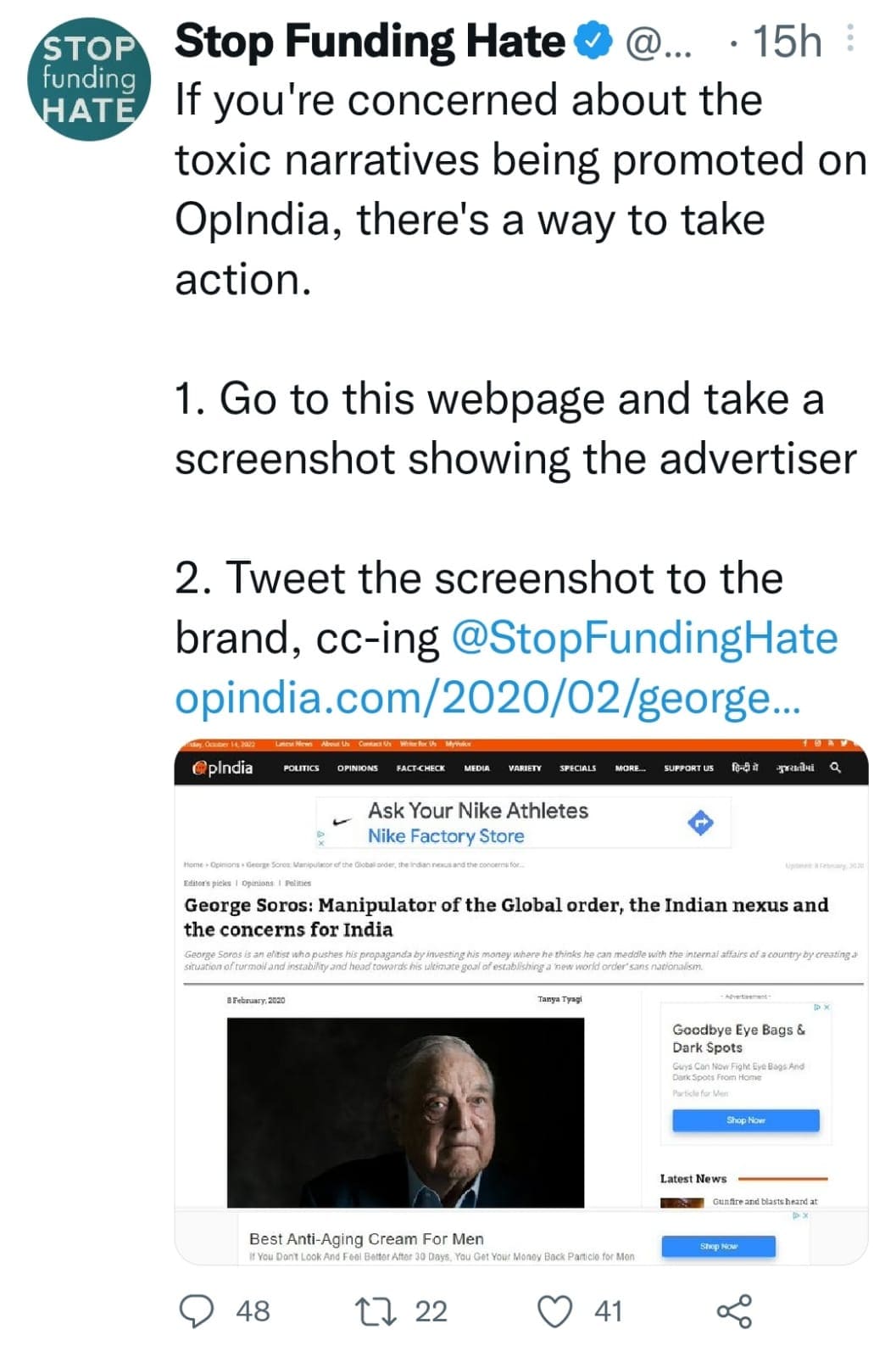
On Sunday (October 17), the anti-semitic organisation ‘Stop Funding Hate (SFH)’ went on an unhinged tirade against OpIndia after we exposed‘The Guardian’ for shielding, giving legitimacy to Islamists and their apologists who orchestrated attacks on the Hindu community in Leicester.
‘Stop Funding Hate’ desperately wanted to strip OpIndia of advertisement revenue for showcasing the true plight of Leicester Hindus to the world, who were left at the mercy of Islamists and their sympathisers in the media industry.
In a tweet, SFH wrote, “If you’re concerned about the toxic narratives being promoted on OpIndia, there’s a way to take action. Go to this webpage and take a screenshot showing the advertiser. Tweet the screenshot to the brand.”
Screengrab of the tweet by ‘Stop Funding Hate’
The anti-semitic organisation took particular offence to an OpIndia article, criticising businessman George Soros for disseminating anti-India narrative through leftist news portals.
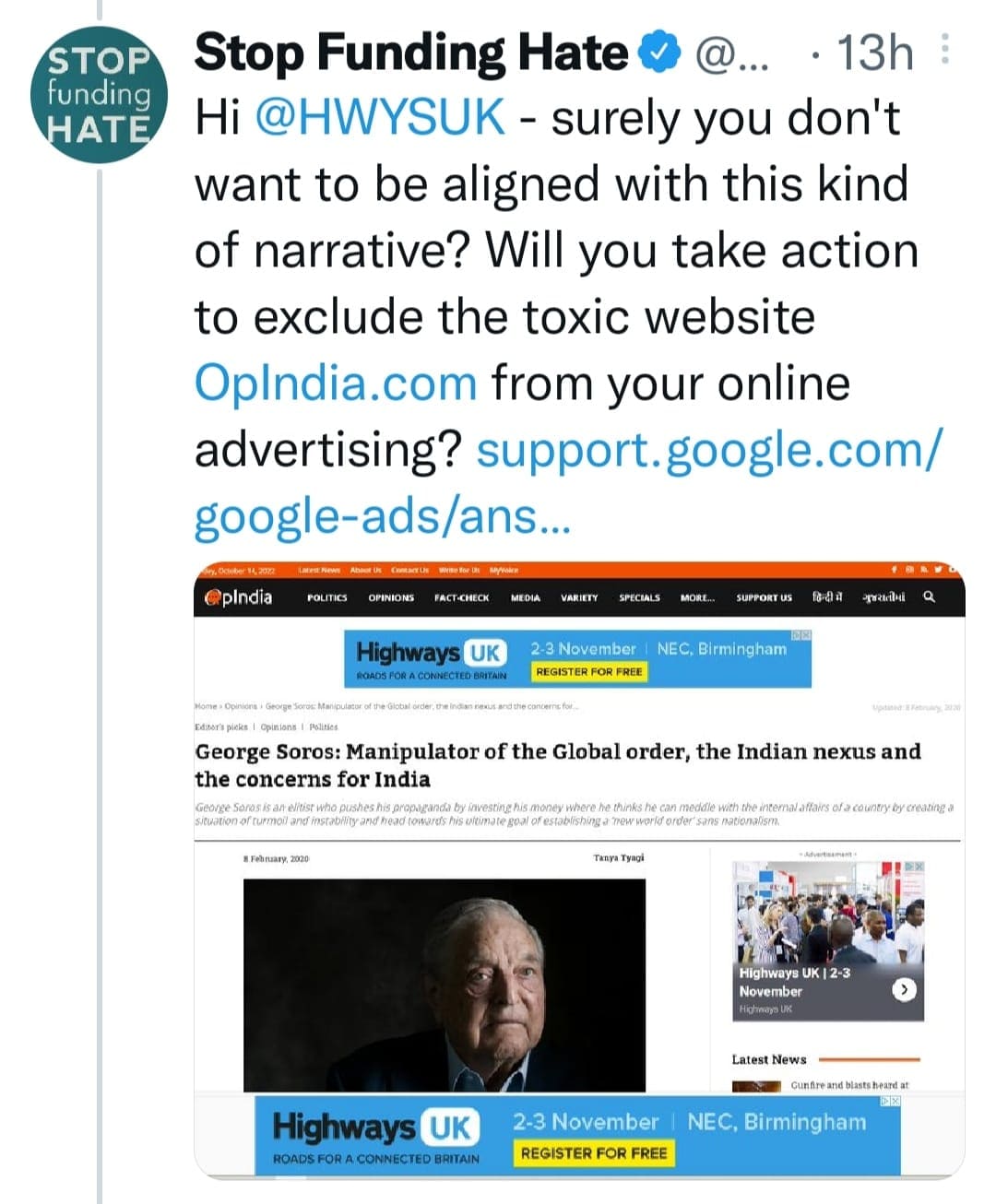
SFH pleaded with companies such as Highways UK, Vikings UK, and even Nike for placing their ads on the Opindia website. Miffed by the expose on Soros, it asked international firms to exclude Opindia from online advertising.
Screengrab of the tweet by ‘Stop Funding Hate’
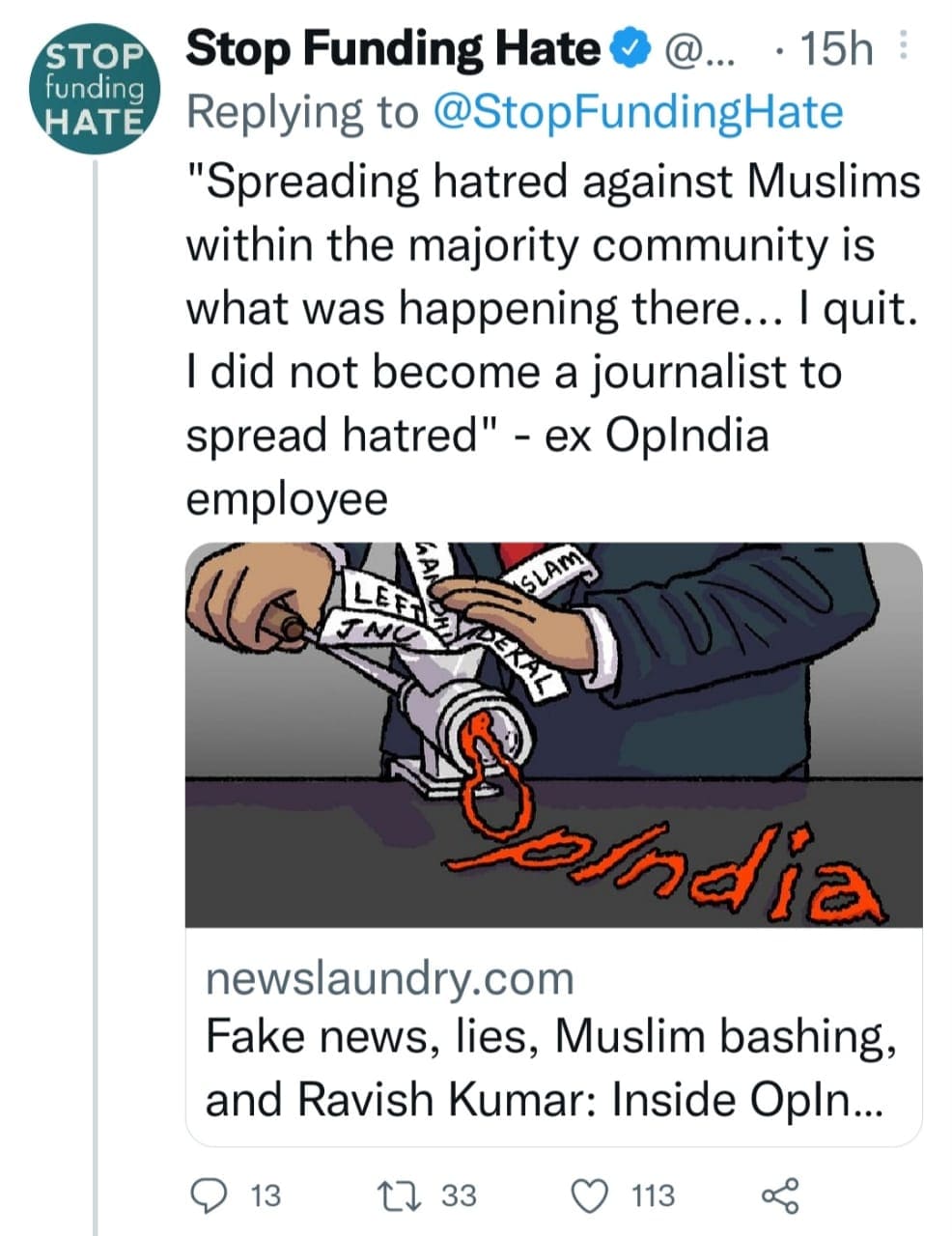
‘Stop Funding Hate’ then relied upon a propaganda piece by leftist rag ‘Newslaundry,’ which cited the ‘testimony’ of a fictitious ex-OpIndia employee to claim that we are spreading hate against the Muslim community.
Screengrab of the news report by NewsLaundry
The Guardian Debacle
The targeting of OpIndia by the anti-semitic organisation began after we exposed the tactics, adopted by The Guardian journalist Aina J Khan, to blame the violence against Hindus in Leicester on themselves.
In an intellectually dishonest piece, Khan had distinctly associated religious identity with groups of Hindu protestors, with phrases such as “unplanned protest of Hindu men,” and “Hindu men were filmed marching.”
However, she shrewdly chose not to point out the religious affiliation of the man who desecrated a Hindu temple and uprooted a saffron flag. In a bid to shield her co-religionist who desecrated the Hindu place of worship, Aina J khan used the bait of a ‘good Imam.’
We are aware of video circulating showing a man pulling down a flag outside a religious building on Melton Road. This appears to have taken place while officers were dealing with nearby public disorder. We do not tolerate violence or disorder and are investigating the incident.
The Guardian journalist thereby shifted the public discourse from the vicious attack on a temple by her co-religionist to the alleged benevolence of a ‘bystander’ Imam.
When OpIndia pointed out the obvious discrepancy in her reportage, Aina J Khan cried foul and dubbed the criticism as ‘Islamophobia.’
‘Stop Funding Hate’ tries to shut down the messenger
Given that OpIndia has been the frontrunner in debunking disinformation about the Leicester violence, ‘Stop Funding Hate’ sought to attack the messenger. In a bid to do so, it dug out old articles, quoted them out of context and begged companies to remove advertising from our platform.
Hi @OxfordSBS we’re guessing you’re unaware that your advertising is appearing on this article seeking to justify discrimination against Muslims? https://t.co/4ryRo14aht Will you take action to exclude OpIndia from your online advertising programme? – cc @NUSUKpic.twitter.com/IGLMweYcDj
— Stop Funding Hate (@StopFundingHate) May 29, 2020
In the words of our CEO Rahul Roushan, “Ads are there on the website as extra revenues and they never hurt anyone. However, the bulk of our revenues are in the form of voluntary payments by our readers, who pay us for the content they have already consumed.” However, this form of targeted harassment is bullying and an attempt to shut down dissenting voice that threatens to harm their narrative.
“We have left the rates on the consumer to decide, based on how much they have consumed and how much they can afford. We’ve seen students in tier II cities paying us as little as 10 rupees to working professionals in big cities paying Rs. 3 lakh. That’s what keeps us going, not ads,” he had said in 2020 when SFH had attacked us the last time.
As an organisation registered in the UK, SFH has every right to participate in the political debates of their country. However, an attempt to silence media portals in India due to their personal political preferences is a direct attempt at interfering with the politics of our country.
It is as sinister as election interference that the Left and Congress rails against. However, it sees no issue at all in targeting media portals abroad which would definitely impact political debates in the country.
Stop Funding hate is linked to UK’s Labour Party
Stop Funding Hate is closely linked to the Labour Party, has a history of antisemitism and has on its board members who seek to impose their own will on politics.
It is important to understand here that SFH is no different from FCRA NGOs such as Amnesty which openly attempt to influence the politics of the country, which is extremely problematic considering its links to the British government.
It is no different from Oxfam India which had urged the Congress party to form an ‘alliance’ with ‘civil society organisations’. It has tried its bullying tactic in the UK as well, against newspapers such as The Sun, Daily Mail and the Daily Express.
In response, they were subjected to much criticism although the usual Far-Left echo chamber cheered them on relentlessly. SFH partners with organisations such as National Union of Students, Accord, Citizens UK, Tell MAMA among others.
All of these are far-left organisations with no representation at all from the other end of the political spectrum. It also partners with the Centre for Hate Studies of the University of Leicester.
Stop Funding Hate has in its board members associated with far-left organisations. They have been described as ‘far-left Corbynistas’ in numerous publications.
Richard Wilson, one such board member, has been formerly associated with Amnesty International, the dubious NGO which is under investigation in India for alleged violation of FCRA laws and has a history of links with radical Islamic organisations.
On Sunday, October 16, Surendra Jain, the joint general secretary of the Vishwa Hindu Parishad, advised Muslim clerics to “pack their belongings” from Bhora Kalan after the recent controversy there. The remark was made in conjunction with allegations by the Hindu outfit that the Muslim community is attempting to grab land under the cover of restoration work in the Bhora Kalan village in Gurugram, Haryana.
Addressing a crowd at the ‘Trishul Deeksha’ program organized by the VHP in Manesar, Jain alleged that Muslims illegally captured the land in Gurugram’s Bhora Kalan village. He alleged that the Muslims in the village had entered the premises under the pretext of renovations and ultimately captured it.
The VHP leader was quoted by the Indian Express as saying, “12-13 years ago, only three Muslim families had come to Bhora Kalan and sought permission to offer namaz at a land meant for grazing goats… there was an understanding that no maulvi or anyone from outside would come. But slowly, people from outside started coming and tried to build a mosque.”
“Koi apke ghar mein ghuskar masjid banaega, aap sweekar karoge? (If someone walks into your house and starts building a mosque, will you allow it?) What happened in Bhora Kalan can happen tomorrow in Gurgaon, Manesar, Haryana, and the country. They want to convert the whole nation. Ye ibadat nahi, jihad hai (this is not Namaaz, this is jihad),” Jain added.
Surendra Jain issued a warning to the Muslim community, saying, “I want to tell those maulvis, pack up your belongings or else the people of Manesar will not leave you… Ye Hindu rashtra tha, hai aur rahega.”
Notably, the Vishwa Hindu Parishad (VHP) has long expressed concerns over the growing threat of land and love jihad, unlawful religious conversions, temple demolition, and hate speeches against Hindu beliefs and deities across the country. In fact, the Hindu organisation has stated that it intends to enroll more than one crore members by 2024 and increase its (Shakhas) units to one lakh, with 15 lakh Karyakartas striving to combat such threats.
On October 10, Leftist propaganda portal The Wire published a report with the title ‘If BJP’s Amit Malviya Reports Your Post, Instagram Will Take it Down – No Questions Asked’ authored by Jahnavi Sen, deputy editor, and executive news producer at the portal.
In the report, The Wire claimed that Bharatiya Janata Party’s IT Cell Chief Amit Malviya has such power in Meta, the parent company of Facebook and Instagram, that if he reports any post on the platform, it gets removed by the system, no questions asked. It further claimed that even if the publisher of the post that was removed from Instagram appeals against the removal, it does not get accepted by the system as “Malviya has privileges of being on the XCheck list.”
XCheck is a “Meta Program” that allegedly provides special privileges to high-profile users like actors, politicians, and other influential personalities on the social media platforms under Meta. The said program was first ‘exposed’ by Wall Street Journal in September 2021.
How it all started?
On October 6, The Wire reported that Instagram removed a photograph of Uttar Pradesh Chief Minister Yogi Adityanath’s ‘temple’ for violating its guidelines. As per the report, the image was uploaded by Instagram handle @cringearchivist, and it was removed over ‘sexual activity and nudity’ restrictions. There was, indeed, nothing sexual in the image that was uploaded. However, the mocked CM Yogi.
It seems that the publisher and The Wire presumed it was removed under the wrong category and thus began the investigation. Notably, @cringearchivist dislikes the Hindu RW section of Indian society, comparing them to the Nazis. In several posts, the group that runs the account has done so. After the removal of this post and some others, they even wrote to Meta criticizing them for removing content that is a “satirical attack on the Nazis.” Interestingly, they skipped the fact that they compared Hindus or Right Wingers to Nazis without any evidence or proof.
The Wire clearly noted that cringearchivist has a history of comparing Hindu RW to Nazis. Source: The Wire
The Wire’s report read, “In the past, @cringearchivist has posted several memes comparing the Hindu Right in India with Nazi Germany. Since one of the recent posts removed is also of that kind, the administrators are worried that older posts may too be flagged, perhaps leading to the entire account being taken down.”
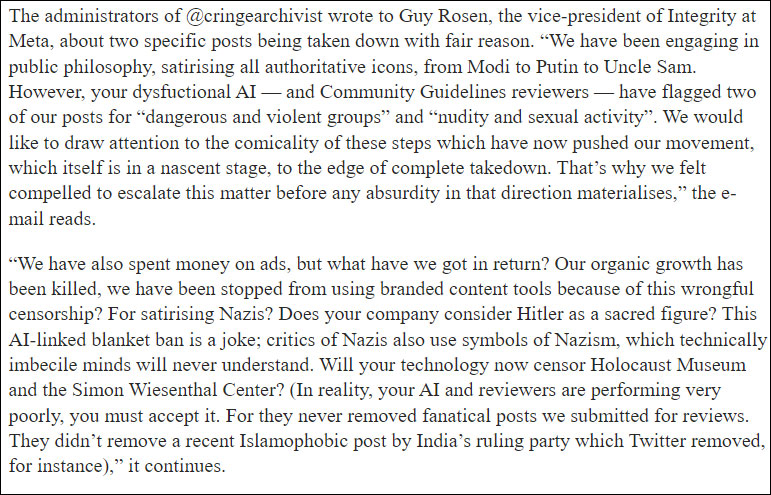
Interestingly, in communication with Guy Rosen, VP of Integrity at Meta, @cringearchivist admitted to spending money on its propaganda posts, and The Wire proudly published it in the report. It read, “We have been engaging in public philosophy, satirizing all authoritative icons, from Modi to Putin to Uncle Sam. However, your dysfunctional AI — and Community Guidelines reviewers — have flagged two of our posts for “dangerous and violent groups” and “nudity and sexual activity.” We would like to draw attention to the comicality of these steps, which have now pushed our movement, which is in a nascent stage, to the edge of complete takedown. We felt compelled to escalate this matter before any absurdity in that direction materializes.”
In a communication to Meta, cringearchivist admitted to having spent money to propagate posts against RW. Source: The Wire
It added, “We have also spent money on ads, but what have we got in return? Our organic growth has been killed, and we have been stopped from using branded content tools because of this wrongful censorship? For satirising Nazis? Does your company consider Hitler a sacred figure? This AI-linked blanket ban is a joke; critics of Nazis also use symbols of Nazism, which, technically, imbecile minds will never understand. Will your technology now censor Holocaust Museum and the Simon Wiesenthal Center? (In reality, your AI and reviewers are performing very poorly, you must accept it. For they never removed fanatical posts we submitted for reviews. They didn’t remove a recent Islamophobic post by India’s ruling party which Twitter removed, for instance).” As per The Wire, Rosen never replied to them.
‘Amit Malviya can get your post removed, no questions asked,’ claimed The Wire
Four days later, The Wire published the ‘explosive expose’ that the video of CM Yogi’s temple was allegedly flagged by none other than BJP IT Chief Amit Malviya. It further reported that the appeal against the removal was denied because of the privileges Malviya enjoyed for being on the XCheck list. Also, The Wire claimed that 100% of over 700 posts flagged from Malviya’s account were removed almost instantly.
The Wire also provided “proof” for its fantastical claims. They shared a document they claimed to be the review report for the post. The report suggested that it not only skipped auto-moderation, but the review was also not required just because Malviya has the so-called XCheck privileges.
Rebuttal from Meta
Soon after the report was published, Meta officials took onto Twitter to refute the claims made by The Wire. Communication personnel Andy Stone while replying to WSJ reporter Jeff Horowitz said, “Where to even begin with this story?! X-check has nothing to do with the ability to report posts. The posts in question surfaced for review by automated systems, not humans. And the underlying documentation appears to be fabricated.”
This was only the beginning of a ‘war of rebuttals’ between Meta and The Wire. Following Stone’s rebuttal, The Wire came up with another story on October 11, where they alleged that the documents they used were not fabricated. To support their wild allegations, The Wire shared a screenshot of an alleged mail by Andy Stone where he was upset that an internal document had been leaked to them. So much so, The Wire went ahead to call Stone a “pathological liar” based on a report on him from 2021. Though the report extensively criticized Stone, InputMag never called Stone a liar directly.
Next came Meta’s Chief Information Security Officer had to come out and clear the air that The Wire’s entire reporting is fabricated and based on forged documents. Guy Rosen, Meta’s CISO, shared a thread on Twitter where he detailed how The Wire’s reports don’t hold any water.
I wanted to set the record straight about two stories run this week by @thewire_in with untrue claims about Meta’s content moderation operations and processes. tl;dr these stories are fabrications. (1/6)
Rosen tweeted, “I wanted to set the record straight about two stories run this week by @thewire_in with untrue claims about Meta’s content moderation operations and processes. tl;dr these stories are fabrications.”
In the thread, Rosen shared that both the reports by The Wire are totally incorrect and contain misinformation about their cross-check program. Rosen also went on to share several anomalies in the reports, including email addresses not used by Andy Stone, URLs not in use, and addresses that aren’t used at their company. Guy Rosen ended his thread by hoping that The Wire is a victim of some hoax and is not actually promoting one itself. However, looking at The Wire’s track record of hitjobs, we seriously doubt that they are the victims here.
The AI checks on the image in question
From now on, as the to and fro between Meta and The Wire was no longer about the removal of the post or the image that was removed, it is essential to point out that several netizens and OpIndia checked if AI flags the photo in question.
Rohit Agarwal, who goes by the handle Techtradeguru on the social media platform Twitter, shared a thread where he checked the image with AI and found out most AI check platforms flagged the photograph as ‘person might be exposed’. The reason behind it could be the colour of the idol of CM Yogi and the person standing next to it.
(THREAD) ANOTHER PROOF THAT THE WIRE FALSELY ACCUSED META.
— Technical Trading Guru (Rohit Agarwal) (@techtradeguru) October 15, 2022
OpIndia also checked the image on multiple websites and confirmed what Agarwal was saying. Here are some screenshots of the results.
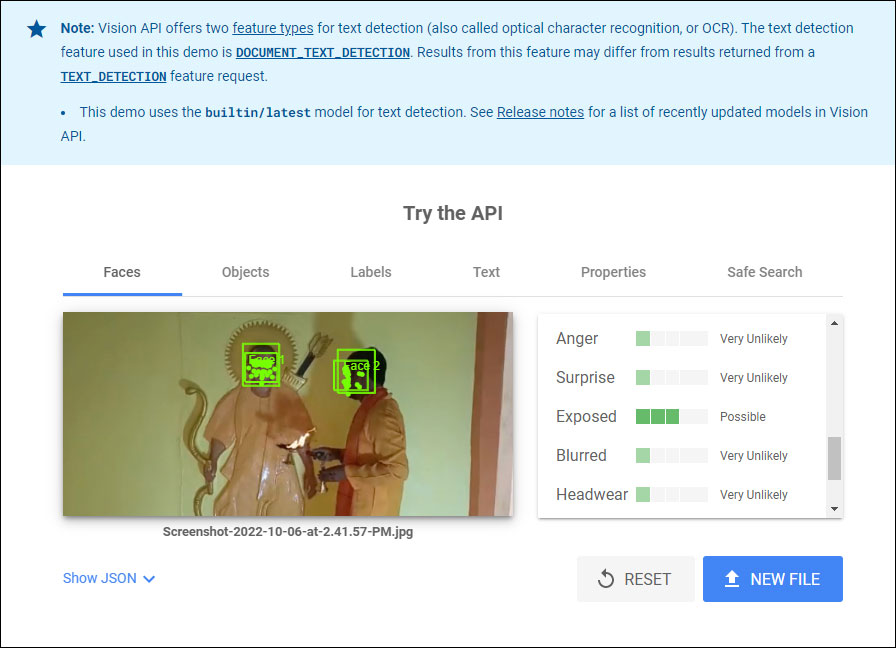
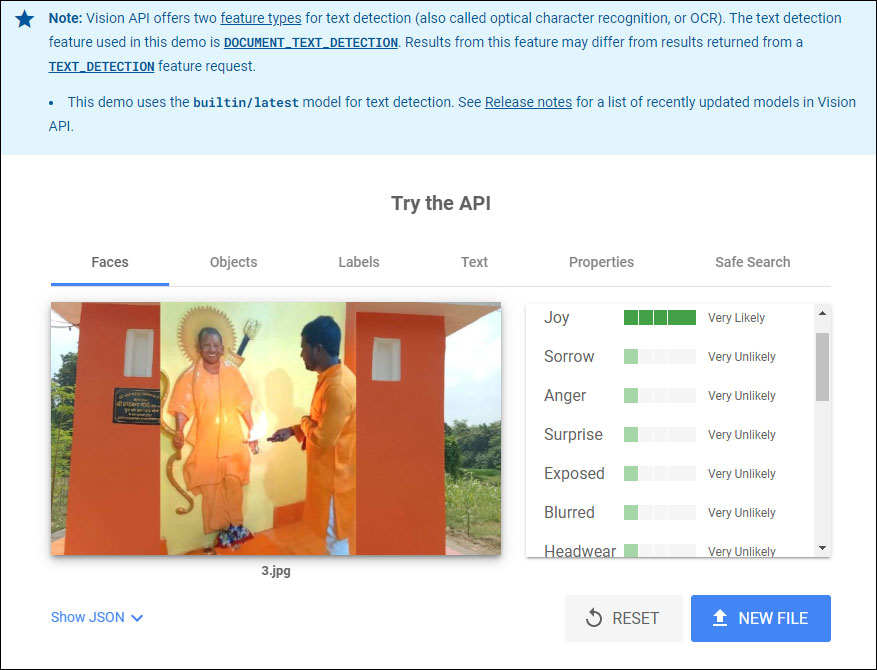
We used Google’s Cloud Vision API. The first image was sourced from The Wire while the others were sourced from Google Image Result on ‘Yogi Temple’. In the image sourced from Wire, it showed the possibility of the person in the image is exposed.
The Google AI marked the image as possibly exposed.
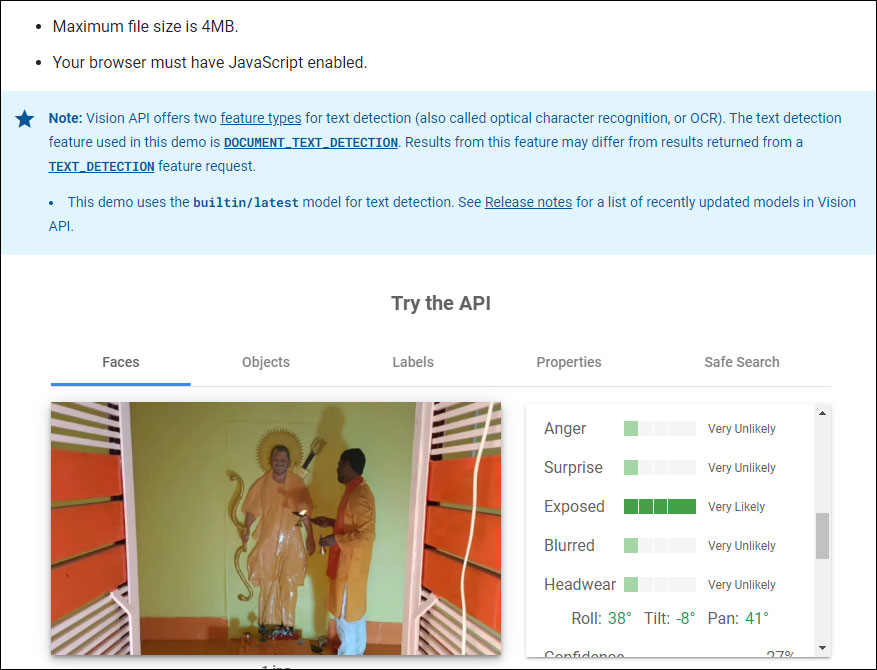
In the second image, the intensity of the possibility of an exposed person went high.
The Google AI marked the image as possibly exposed with higher intensity.
In the third picture, the AI showed ‘unlikely to be exposed’.
The Google AI marked the image as unlikely to be exposed.
It is clear that AI recognises the person to be exposed based on colours and angles of the photograph. It raises the question if the image was flagged by the system and The Wire allegedly fabricated the whole thing or if Malviya allegedly reported it.
The ‘language’ issue with the email that even ‘Liberal’ cabal rejected
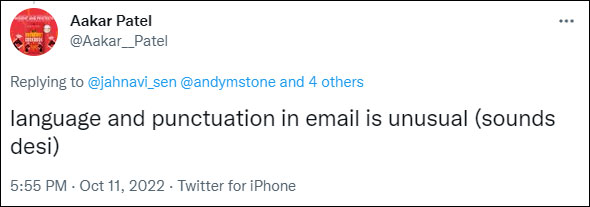
Then came the language used in the alleged email The Wire got its hands on via a source in Meta. Many netizens including members of the left-liberal cabal raised red flags. The most interesting retweet that we noticed during the whole fiasco was from former Amnesty India head and propagandist activist Aakar Patel, who is known for his anti-BJP stand. While replying to Jahnavi Sen, Aakar Patel looked down upon the language of the email that The Wire claimed was sent by Andy and said how the language and punctuation in the mail was unusual and ‘sounded desi’.
Source: Twitter
The typical colonial hangover suggested that emails were forged by an Indian because only they would use such language, thereby insinuating that the Americans have better grip over English.
In all that it is worth, there are a lot of speculations over the style of language claimed to have been used by Andy in the email. The native English speakers are brazened out over the language and have “confidently” said that Andy could not have written the email. Daniel Nazer, Senior IP & Product Counsel at Mozilla, while replying to Systems & Network Security Engineering Alec Muffett, who pointed out “bad English”, said, “It’s really sad to see them fall, and double down, for such an obvious fake. We need strong independent media willing to stand up to populist governments and big companies, but this ain’t it.”
Even a former colleague of Andy Stone stepped in to echo the language issues. Brent Kimmel of Squarespace who has worked with Andy as Tech expert, raised red flags over The Wire’s report. He pointed out that the ‘receipt’ confirmation made by the server only proves that the network request was made. He said, “It means nothing in terms of whether or not a person (let alone a specific person) received it, viewed it or interacted with it in any way. You simply can’t do “gotcha” journalism over email.”
4/x The specific mechanics of the medium just don’t allow for it.
Also, read the email and read like… Anything Andy ever wrote. Diction is completely off, obviously an ESL composer.
Furthermore, he pointed out that the language was not what Andy would have used. “Also, read the email and read like… Anything Andy ever wrote. Diction is completely off, obviously an ESL composer.”
Also, I haven’t spoken to @andymstone in roughly a decade, but I worked with him in a pretty high-pressure environment and I would have remembered if he spoke to his colleagues that way. He doesn’t.
He added that he hadn’t talked to Andy in over a decade but worked with him in a high-pressure environment. he said, “I would have remembered if he spoke to his colleagues that way. He doesn’t.”
Official Statement by Meta
In an official statement on October 12, Meta explained how The Wire’s reporting was “wrong”. In the press release, Meta said, “Two articles published by The Wire allege that a user whose account is cross-checked can influence content decisions on Instagram without any review. Our cross-check system was built to prevent potential over-enforcement mistakes and to double-check cases where a decision could require more understanding or there could be a higher risk for a mistake. To be clear, our cross-check program does not grant enrolled accounts the power to automatically have content removed from our platform.
While it is legitimate for us to be held accountable for our content decisions, the allegations made by The Wire are false. They contain mischaracterizations of how our enforcement processes work, and rely on what we believe to be fabricated evidence in their reporting. Here is what they got wrong:
The first article claims that a cross-check account has the power to have content removed from our platform with no questions asked. This is false. Cross-check has nothing to do with the ability to report posts to seek the removal of content. The posts in question were surfaced for review by automated systems, not user reports. The system is designed to ensure that enforcement decisions related to content posted by cross-check accounts are made accurately and with additional levels of human review. We don’t exempt anyone from our Community Standards and remove content that violates them if we see it. Information on cross-check has been shared publicly on our Transparency Center.
This article was also based on allegedly leaked screenshots from our internal tools. We believe this document is fabricated. The URL on that “report” is not in use. The naming convention is one we don’t use. There is no such report.
We did not identify a user report regarding the @cringearchivist content in September as reported.
The second story cites emails from a Meta employee – the screenshot included in the story has two emails – both are fake. There are no such emails.
The same story references an internal journalist “watch list.” No such list exists.
We accept scrutiny of our content decisions, but we fundamentally reject these false allegations based on what we believe to be fabricated evidence. We hope that The Wire is the victim of this hoax, not the perpetrator.”
The Wire tied itself in knots over allegations of fabricated screenshots
In its next report on the matter, The Wire further tied itself in knots. In its rebuttal to Meta’s assertions over previous reports, The Wire made several claims to justify its expose. However, most of their claims faced speculations and raised even more questions over the authenticity of the whole fiasco.
The first claim that The Wire made in their report was the emails they sent on the @fb.com extension were opened by the respective receivers. They used a technology called ‘superhuman’ that allows the sender to check if and how many times the receiver opened the email. This technology has been around for quite some time, and several email clients and extensions add the feature to your email clients.
Though OpIndia cannot verify independently as of now if what they are saying is true or not, ethically, The Wire, a platform that talks in length about privacy, has done something extremely unethical. Superhuman faced extreme criticism in 2019 over the feature. They were tracking the location of the receivers and logging them. After much criticism, they made several changes, and the CEO had to say that they were making the changes publicly.
It is noteworthy that experts in the field have raised concerns over the matter. Martin Obiols, a cybersecurity expert, said, “Do not praise people using clients that provide read-statuses for email. This is a huge privacy violation regardless of its purpose of doing it. I seriously do not understand how these tools are allowed under data privacy laws.”
Do not praise people using clients that provide read-statuses for email. This is a huge privacy violation regardless of the purpose of doing it.
I seriously do not understand how these tools are allowed under data privacy laws https://t.co/dXhZB1RPXY
Another important point is, as Superhuman has STOPPED tracking the location, there is another way to say that someone has read it. Say The Wire sent it to someone else in BCC or forwarded the email to someone else, and the other receiver opened the email. The tracking will be based on the same pixel image. In that case, it will show that the email was opened by the recipient.
Let’s take an example. Say I want to track if my boss Nupur J Sharma read the email I sent. I used Superhuman or another application to do so. She read I got the information, and it’s done. This was the first scenario. In the second scenario, I want to implicate my boss read the email but ignored to acknowledge it. In that case, I would BCC it to my personal email ID, or I will forward the email to someone else. When the email gets opened by me or someone else, I can show that my boss opened the email as there is no way to trace the location from where the email was opened. Now I am the devil at my office! This is why such tracking applications cannot be solid evidence in an expose like this.
The DKIM mumbo-jumbo!
Now, The Wire made its way to technical in the next step. The Wire claimed that they used a python-based open-source tool called dkimpy to verify if the email came from an authentic source or not. There is way too much technical jargon in the report that needs simplification. Basically, this tool allows the user to ensure of the email came from an authentic source or not. It checks the header (code-based technical information) of the email and matches it with the sender’s digital signature.
Ideally, this system not only traces the source but also provides information if anything was changed in the email during the transit. In case you are unaware, there are ways to modify the email while it travels from the source to the destination. Codes can be injected, information can be altered, and so on. This is why encryption of the data is essential.
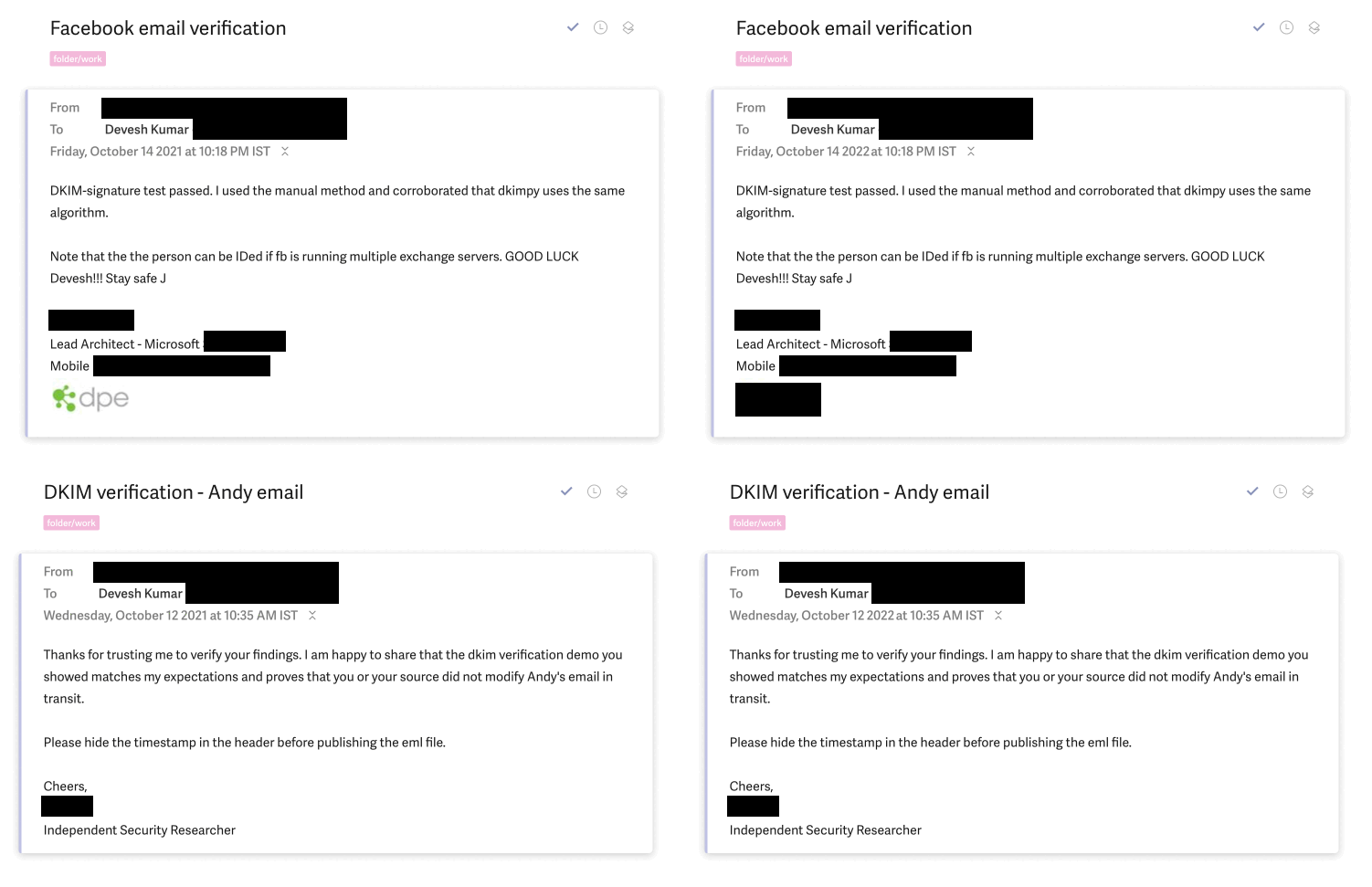
Anyway, this is where The Wire made a blunder that was noticed by a Twitter user Technical Trading Guru that goes by the handle @techtradeguru on Twitter. We will not go into the DKIM claim authenticity but point out the alleged photoshop saga that raised questions over The Wire’s report. Here is a GIF of two screenshots from The Wire that are allegedly photoshopped. More details about it can be read in our previous report.
The date was allegedly changed in photoshop without keeping the spacing in mind. Source: Techtradeguru.
Interestingly, they changed the date but did not change the day. The 2021 and 2022 calendars are not identical in terms of Days. That means 12 October and 14 October in 2021 and 2022 fell on different days of the week. Multiple Twitter users pointed out this particular mistake made by The Wire. In both screenshots, the days remained Friday and Wednesday respectively. Trying to justify this discrepancy, Wire claimed that it was due to the fact that the dates were incorrectly set on TailOS, a Linux-based portable OS. But netizens pointed out that even if the date is wrongly set in the system, it will not result in a mismatch between the day and date, if it shows the wrong date, it will show the day corresponding to that wrong date only.
It was pointed out by tech expert Pranesh Prakash in a detailed Twitter thread on The Wire’s latest report. He wrote, “Now, @thewire in is saying the incorrect dates are due to TailsOS being used and being set to the wrong date. Except, it doesn’t take a genius to realize that even were that true, TailsOS would show: Thursday, October 14, 2021 and Tuesday, October 12, 2021 NOT Fri & Wed.”
Another expert from Stanford Internet Observatory Alex Stamos detailed out the how DKIM verification video by The Wire proves nothing. He said, “The @fb.com/@meta.com argument is the weakest defense by Facebook. Clearly, the company’s O365/ProofPoint instance is setup to receive emails for either domain and various employees are sending from different domains. This argument is pretty much useless either way.”
3) The Wire’s DKIM verification video proves nothing. It would be trivial to fake the verification by dkimverify, as all you would need is a script in your path that prints “signature ok”. There are more complicated ways to fake this as well. pic.twitter.com/IS7FVYy4fC
He added, “The Wire’s DKIM verification video proves nothing. It would be trivial to fake the verification by dkimverify, as all you would need is a script in your path that prints “signature ok”. There are more complicated ways to fake this as well.”
4) @matthew_d_green noticed that the DKIM verification details in the header shown by The Wire do not match what he has received from https://t.co/v2TVEBVEId senders in the past. I have the same result. This is not strong evidence, but should be noted.https://t.co/yxDWxThQn5
Fruthermore, “What the video does show is that if the email is not legitimate then the person who made the video is in on the hoax. The Wire piece implies (but does not specify) that their own tech employee made the video.”
If this was a local time problem, then that should only affect a thick client, and it wouldn’t give you the exact time and date minus one year. It is unclear what kind of mail client these screenshots purport to come from, but there is no good explanation for the year mismatch. pic.twitter.com/1eWEzClLzI
Speaking about the date issue he said, “If this was a local time problem, then that should only affect a thick client, and it wouldn’t give you the exact time and date minus one year. It is unclear what kind of mail client these screenshots purport to come from, but there is no good explanation for the year mismatch.”
He said, “The most interesting part is the http://instagram.workplace.com login. I have never heard of this domain being used and it does not show up in recently leaked documents.”
The domain resolves, but so does any subdomain of https://t.co/7VwqWDDm1N (to the same cname). I expect this wildcard is meant to reduce DNS propagation latency when new customers setup their subdomains. pic.twitter.com/QH9Q1GMSVI
“The domain resolves, but so does any subdomain of http://workplace.com (to the same cname). I expect this wildcard is meant to reduce DNS propagation latency when new customers setup their subdomains,” he added.
Alex did not side with either The Wire or Meta. He provided scenarios from both sides and urged Meta to come out with a detailed response.
Microsoft’s employee helping The Wire in allegedly fabricated story
The Wire claimed that a Microsoft employee, one Ujjwal Kumar, based in Singapore has verified their fabricated email exchange with Facebook’s parent company ‘Meta’. Founding Editor of The Wire Siddharth Varadarajan has claimed that one Ujjwal Kumar, currently employed at Microsoft in Singapore, has ‘passed the DKIM test’.
Varadarajan shared a screenshot of an email sent by Ujjwal Kumar of Microsoft used the manual method and corroborated that the dkimpy, a library that implements DKIM (DomainKey Identified Mail) email signing and verification.
However, few hours later, Varadarajan deleted the tweet claiming that he had the consent of Ujjwal Kumar to share details, he has deleted the tweet.
Facebook uses Microsoft’s email services. The Wire tried to use the service provider to ‘verify’ details about one of their clients, quite likely without their consent and it seems, Microsoft’s Ujjwal Kumar agreed. However, Varadarajan’s ‘expert’ who ‘verified’ Facebook/Meta email as ‘authentic’ suddenly went from okay with being named to being ‘anonymous expert’ here.
The Wire’s accounts hacked, claimed Varadarajan
In another turn of events, the Wire’s Varadarajan claimed email accounts and social media accounts of people associated with The Wire and the company itself were hacked on October 16. Siddharth Varadarajan tweeted, “ALERT One of The Wire’s principal researchers on Meta lost access to his Gmail+Twitter accounts and some others at noon today. Whoever hacked him is sending suspicious phishing-type messages, like the one below. Please don’t respond to messages from [email protected] or DMs.”
In the next tweet, he wrote, “Needless to say, the Andy Stone email is safe and sound and will not fall into the hands of those keen to identify The Wire’s whistleblower in Meta in this manner.”
TMC’s Derek O’Brien to raise the issue during the winter session in the parliament
Trinamool Congress MP Derek O’Brien has now stepped in to give legitimacy to this. Taking to Twitter, O’Brien said that he would raise this issue in Parliament.
Will take this up in the winter session of #Parliament in November. We must. Keep fighting the good fight
— Derek O’Brien | ডেরেক ও’ব্রায়েন (@derekobrienmp) October 11, 2022
This, obviously, is not the first time O’Brien has chosen to raise inconsequential issues in Parliament in what appears to be his way of making up for lack of credibility otherwise. Back in 2018, O’Brien had threatened to name Twitter users in Parliament whom he found ‘offensive’ and those who ‘irritate him’.
Meta said The Wire fabricated evidence
On October 16, Meta announced that they were investigating the “evidence” about the existence of Instagram Workspace provided by The Wire and alleged that it was a fabricated video. In a tweet thread, Guy Rosen, Chief Information Security Officer (CISO) at Meta, said, “The latest video from The Wire does not show an internal Instagram system. Our investigation has identified a spoof created on October 13 using our enterprise Meta Workplace product.”
The spoof was set up as a free trial Workplace account under the name “Instagram” and using the IG brand as its profile pic. We’ve locked the account for violating policies and are continuing to investigate. We’ll provide further updates as warranted here: https://t.co/CiVFJsOvti
Meta further said that the spoof was set up using a free trial Workspace account and used the Instagram brand as its profile picture. After identifying the account, they locked it, and further investigation is underway. He said, “The spoof was set up as a free trial Workplace account under the name “Instagram” and using the IG brand as its profile pic. We’ve locked the account for violating policies and are continuing to investigate.” Meta also updated the statement about The Wire’s “expose” with the new findings.
Meta’s rebuttal came after The Wire claimed to have accessed a screen recording from its source at Meta, where the source claimed to have logged into the Instagram workspace account that Meta previously claimed does not exist.
The Wire claimed, “As is clear in the video, the URL that Meta has officially claimed “is not in use” is very much in use. New reports had been added on the day of the video’s recording. The video also showed the source navigating through the secure ‘instagram.workplace.com’ workspace and opening the notes section.”
“The Wire asked the source to run a timer while they were screen-recording to show that it was happening in real-time. Our team also ascertained that the video hadn’t been tampered with, using the video’s metadata (they have been removed from the file we have made public). Additionally, the cursor maintained consistency throughout the video’s duration, with no abrupt breaks,” it added.
However, the experts debunked the claims. Law and Policy expert Pranesh Prakash pointed out that The Wire’s claims were inconsistent with the video they posted. In a Twitter thread, he said that at one point in the video, the cursor did move abruptly. Pranesh posted the video and said, “Curiouser and curiouser: The cursor in the video released by The Wire abruptly jumps at 0:35, just at the moment when the person is logging into http://instagram.workplace.com.”
Curiouser and curiouser: The cursor in the video released by @thewire_in abruptly jumps at 0:35, just at the moment when the person is logging into https://t.co/2D5YYt6Dmb.
He also added a video uploaded by The Wire and trimmed a 5-second video out of it to show the ‘abrupt break’ of the cursor in the video. He said, “The Wire states: “Additionally, the cursor maintained consistency throughout the video’s duration, with no abrupt breaks.” I’ve clipped the moment the cursor disappears and reappears elsewhere, during the login sequence. I think this qualifies as an “abrupt break,” don’t you?”
The Wire’s initial source said they did not blame Malviya
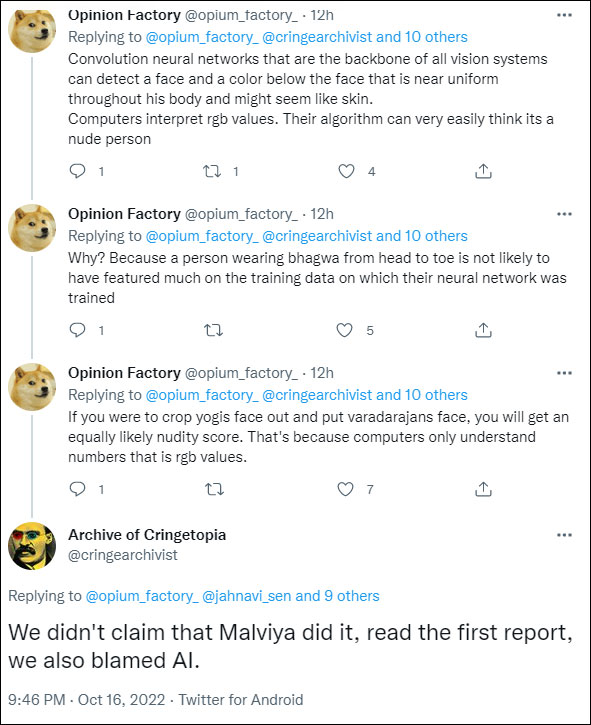
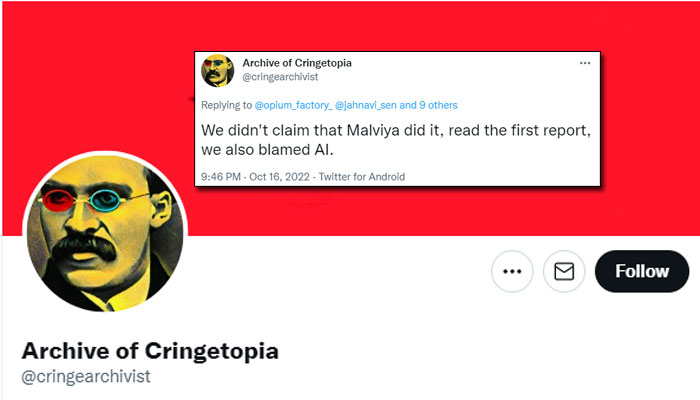
The satirical account named Cringearchivist on Instagram and Twitter, whose post was removed and the whole bullfight started, said he never blamed Malviya for the deletion. While replying to a Twitter user, Opinion Factory, Cringearchivist said, “We didn’t claim that Malviya did it, read the first report, we also blamed AI.”
Screenshot of Cringe Archivist saying he never said Malviya got his post removed
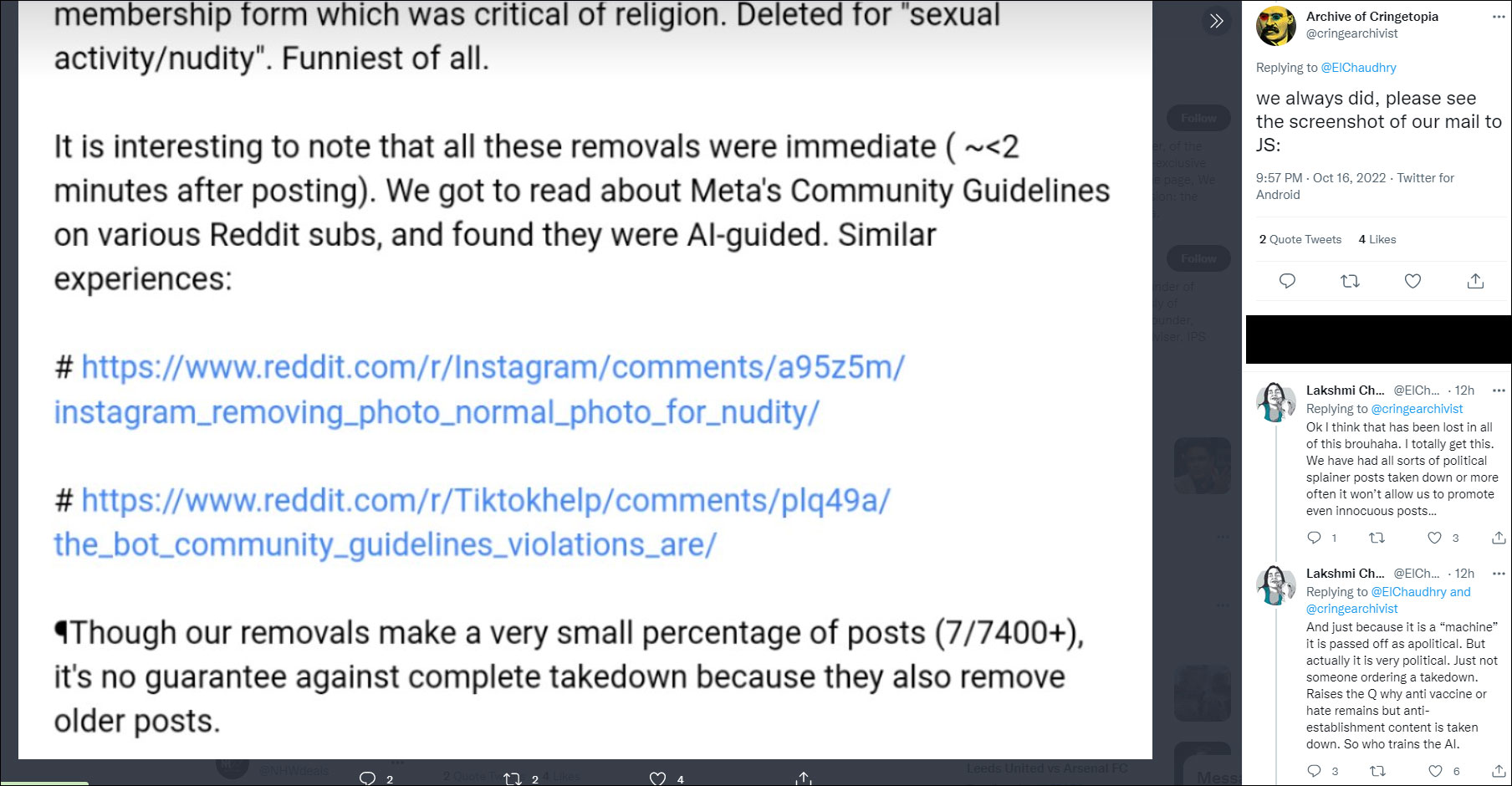
While replying to another Twitter user Lakshmi Chaudhry, Cringearchivist, said in the email sent to JS (JS is The Wire’s reporter Jahnavi Sen who broke the first story), they specifically mentioned AI and blamed it for the removal.
Mail to Jahnavi Sen
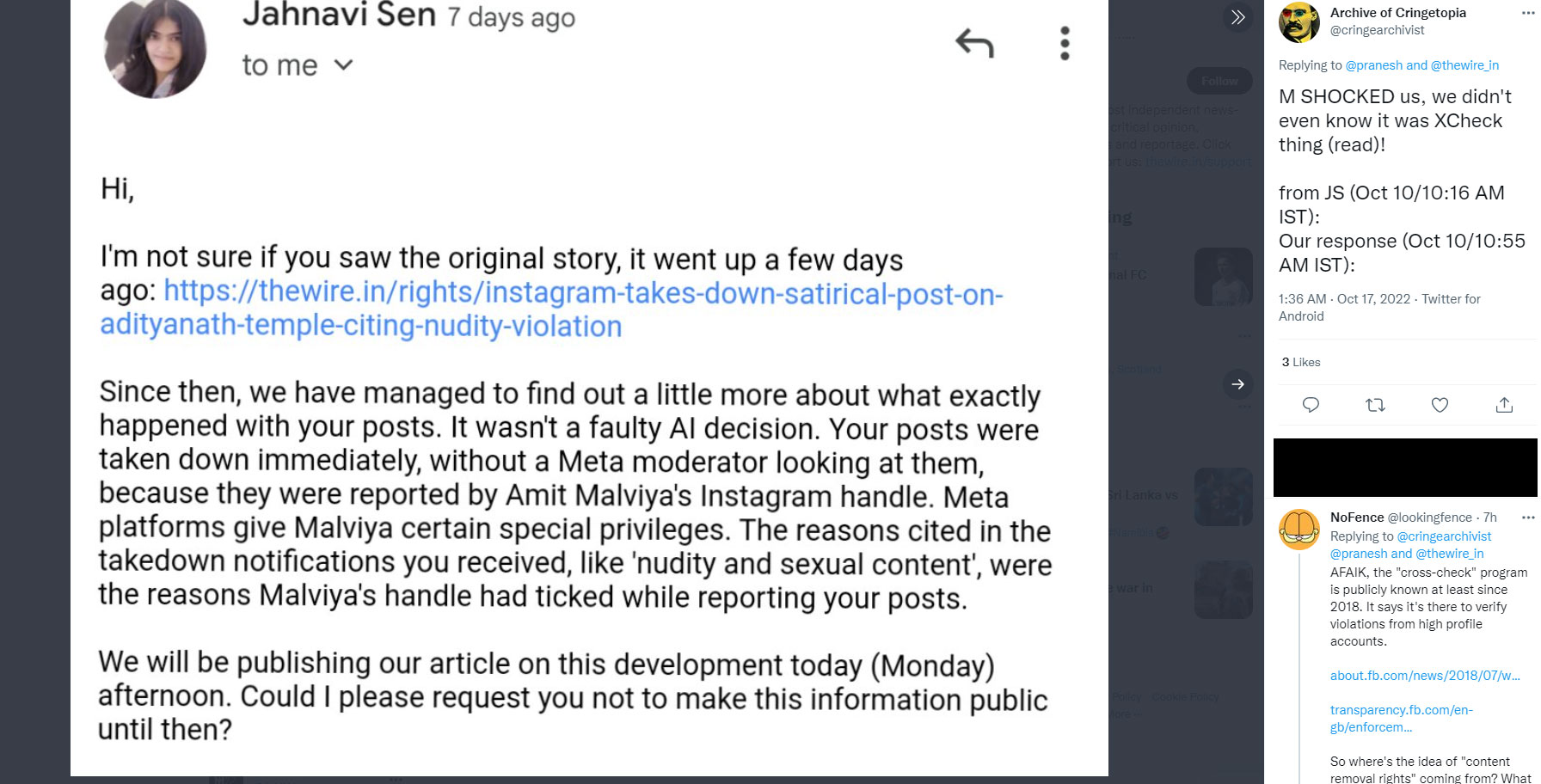
Now, another interesting aspect of the claims made by Cringearchivist is that they claimed to have no idea about the alleged involvement of Amit Malviya in the removal of the post, and it was informed by Sen herself via email.
Jahnavi Sen claims Malviya got it removed
In two screenshots shared by Cringearchivist, one was the email sent by Sen to them. In the email, Sen claimed that the removal of the post was not because of a “faulty AI,” but it happened because Amit Malviya reported it.
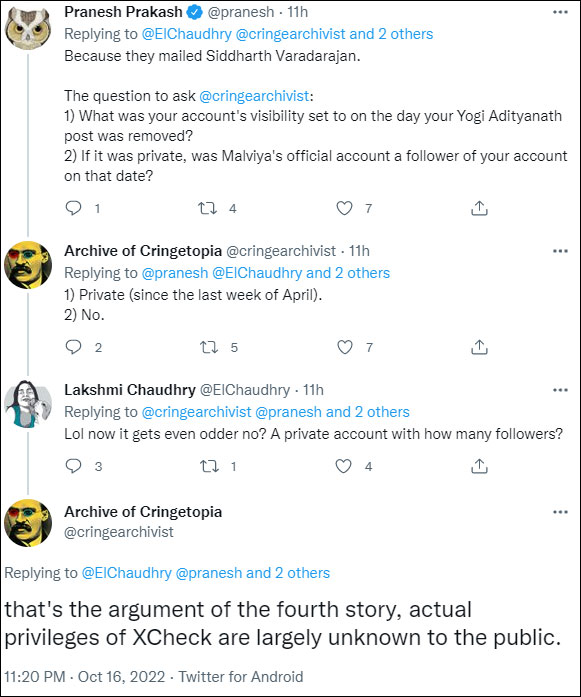
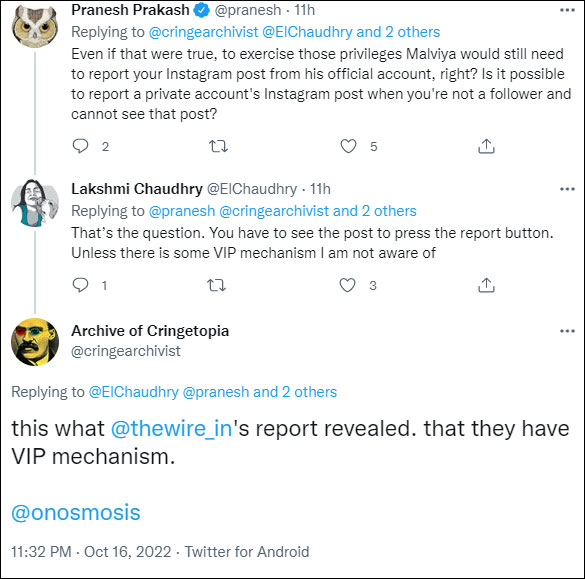
Furthermore, Cringearchivist claimed The Wire reporter never asked them when they made the account private on Instagram and if Malviya was following them. While replying to tech expert Pranesh (he has been quoted in other OpIndia reports as well), Cringearchivist revealed the information about when they went private and if Malviya followed them.
Further, @cringearchivist notes that @thewire_in did not follow up with them before the story alleging the X-Check/Amit Malviya connection.
The Wire’s reporter has ‘personal relationship’ with Meta insider
Days after making wild allegations against Meta and BJP IT Cell head Amit Malviya, whom they attributed to having superpowers to control workings within Facebook’s parent company, propaganda outlet The Wire has now backed out and cried victim. In a statement released on October 17, The Wire claimed they are not ‘ready to play this game further’. The Wire also revealed how one of their reporters working on this story had a personal relationship with the Meta ‘insider’.
Interestingly, in the statement published on their website they have skipped the portion where it reveals that The Wire’s reporter has a personal relationship with Meta’s ‘source’ who ‘leaked’ documents. The archived version of the same statement which contained this revelation can be obtained here. They added a disclaimer that they edited the website version of their statement to clear relationships with their sources in Meta. Except, instead of clearing, they ended up removing the damning fact that one of their reporters had a personal relationship with the said Meta ‘insider’.
To put things in perspective, Meta has dismissed all allegations by The Wire and said that the ‘evidences’ provided were fabricated.
The Wire, in its statement, claimed that Meta’s responses, where it said that all the evidence The Wire gave to claim how BJP IT Cell head Amit Malviya possesses some superpowers by virtue of being in an ‘elite list’ of users in ‘XCheck’, was fabricated were to goad them to give out more information about their source. This, when many tech experts, most of whom are actually Modi haters and dislike BJP to the core, have called out the shoddy reportage of The Wire. Even the images of so-called emails shared by The Wire were rejected by Meta as fabricated.
Meta categorically mentioned how the ‘workspace’ The Wire put up as evidence, was actually a spoof video made on a dummy/free trial version by someone and they are investigating it further. The Wire also claimed that Microsoft Asia’s employee Ujjwal Kumar, also helped them verify some mail as a legitimate email from Meta. Meta uses Microsoft email services and if an employee with Microsoft indeed indulged in this, it could likely tantamount to breach of client confidentiality, raising serious concerns about Microsoft’s privacy policy. OpIndia has written to Microsoft Asia regarding the concerns but we have not heard back from them yet.
OpIndia will keep an eye on the Meta Vs The Wire saga and report if there is any update in the future.
On October 16, Trinamool Congress (TMC) politician and former cricketer Kirti Azad took to Twitter and shared a photograph with an unsubstantiated quote by RSS leader MS Golwalkar, claiming that he was willing to tolerate British subjugation but not a government in the nation that granted Muslims and Dalits equal status.
The image shared by Azad has no signs of authenticity and was provided with no references. The image was shared on Twitter asking if it was true, insinuating that the remarks were made by Golwalkar in 1940. However, this does not seem to be the case. Several users clarified that the quote was never made by Golwalkar. A Twitter user shared a tweet, stating that this was never said by Golwalkar and that Kirti Azad should ‘Shut up and sit down.’
Another Twitter user Sushil Aggarwal stated that this remark was disowned by the RSS Chief and Golwalkar. He said, “The book mentioned was disowned by RSS and Guru Ji. So it does not contain the official view of RSS. Moreover, the contents of the book as quoted are doubtful. The official book of RSS thoughts is Bunch of Thoughts.”
The book mentioned was disowned by RSS and Guru ji. So it does not contain the official view of RSS. Moreover, the contents of the book as quoted are doubtful. The official book of RSS thoughts is Bunch of Thoughts.
Several other users pointed out that this quote was a fake one and this remark was never made by Golwalkar. However, Azad was yet to remove the misleading image from his account.
TMC leader Kirti Azad has a lengthy history of disseminating misinformation. Azad used social media in February this year to propagate false information about BJP leaders being assaulted in Uttar Pradesh during the state’s second phase of voting during the assembly elections.
Hi Kirti, amusing to see that you,Bhagwat Jha Azad’s son,can’t distinguish between the hinterlands of #WestBengal & #UttarPradesh!This is clip of a jihadi attack engineered by TMC on me on Election Day, April 30 2021.Having become a FAMILY DOORMAT you have lost your rationality! https://t.co/qfkH1XGlV4
— Dr. Anirban Ganguly অনির্বান গঙ্গোপাধ্যায় (@anirbanganguly) February 12, 2022
Dr Anirban Ganguly, a member of the BJP’s national executive committee, chastised Azad, the son of former Bihar chief minister Bhagwat Jha Azad and a former Congress politician, for failing to distinguish between West Bengal and Uttar Pradesh’s countryside.
Notably, the video Azad released purporting to be from Uttar Pradesh was really from West Bengal, when TMC goons heckled BJP’s Anirban Ganguly in Illambazar, West Bengal’s Birbhum, during the voting process for the last round of Bengal elections on April 30, 2021. During the West Bengal Assembly elections in 2021, Ganguly contested from the district’s Bolpur constituency.
Meta, the parent company of Facebook and Instagram, is in loggerheads with left-leaning news portal The Wire since October 10 when the latter accused the former of giving sort of “unlimited” powers to Bharatiya Janata Party’s IT Cell Chief Amit Malviya on Instagram. As per The Wire, Amit Malviya can get any post removed from the platform using his XCheck privileges and has got over 700 posts removed, no questions asked.
Now, the story has seen another turn as the satirical account named Cringearchivist on Instagram and Twitter, whose post was removed and the whole controversy started, said he never blamed Malviya for the deletion. While replying to a Twitter user, Opinion Factory, Cringearchivist said, “We didn’t claim that Malviya did it, read the first report, we also blamed AI.”
Initially, the blame was on “faulty AI”. Source: Twitter
While replying to another Twitter user Lakshmi Chaudhry, Cringearchivist, said in the email sent to JS (JS is The Wire’s reporter Jahnavi Sen who wrote the first story), they specifically mentioned AI and blamed it for the removal.
Cringearchivist did not name Malviya in first interaction with The Wire’s reporter. Source: Twitter
Now, another interesting aspect of the claims made by Cringearchivist is that they claimed to have no idea about the alleged involvement of Amit Malviya in the removal of the post, and it was informed by Sen herself via email.
In two screenshots shared by Cringearchivist, one was the email sent by Sen to them. In the email, Sen claimed that the removal of the post was not because of a “faulty AI,” but it happened because Amit Malviya reported it.
The Wire’s reporter informed Cringearchivist how the post was removed and claimed it was Malviya who reported it. Souce: Twitter
She wrote, “Then, we have managed to find out a little more about what exactly happened with your posts. It wasn’t a faulty Al decision. Your posts were taken down immediately, without a Meta moderator looking at them, because they were reported by Amit Malviya’s Instagram handle. Meta platforms give Malviya certain special privileges. The reasons cited in the takedown notifications you received, like ‘nudity and sexual content,’ were the reasons Malviya’s handle had ticked while reporting your posts.”
Going by the email, it is safe to say that Sen put the blame entirely on Malviya and not on AI. Now, the initial source of the whole bullfight between Meta and The Wire never named Malviya in the first place. How could he? They did not even know if Malviya could be involved. It was The Wire that pulled BJP and Malviya in the saga, and Cringearchivist, like an “innocent child,” sat down and did not say anything till now.
Another point that should be discussed is that Cringearchivist claimed The Wire reporter never asked them when they made the account private on Instagram and if Malviya was following them. While replying to tech expert Pranesh (he has been quoted in other OpIndia reports as well), Cringearchivist revealed the information about when they went private and if Malviya followed them.
Pranesh asked, “The question to ask @cringearchivist: 1) What was your account’s visibility set to on the day your Yogi Adityanath post was removed? 2) If it was private, was Malviya’s official account a follower of your account on that date?”
Cringearchivist claimed account was private since April and Malviya did not follow them. Source: Twitter
To these questions, Cringearchivist replied, “1) Private (since the last week of April). 2) No.”
Pranesh asked a genuine question. How Malviya managed to report a post within two minutes of getting published of an account that was private in the first place, and he was not even following it? He wrote, “Further, @cringearchivist notes that @thewire_in did not follow up with them before the story alleging the X-Check/Amit Malviya connection. So they didn’t bother to check with @cringearchivist whether Amit Malviya was following their private account to even see their post!”
Further, @cringearchivist notes that @thewire_in did not follow up with them before the story alleging the X-Check/Amit Malviya connection.
In one of the “explanations” that came from Cringearchivist about how Malviya did it, he said, “actual privileges of XCheck are largely unknown to the public.” Pranesh and Lakshmi both cornered Cringearchivist and pointed out that even to report a post, Malviya has to do it from his official account, which would have been possible only if he was following them on Instagram, which evidently, he did not.
Cringearchivist said, “This what The Wire’s report revealed. That they have VIP mechanism.” We would like to hold back from commenting on how bizarre this sounds.
Cringearchivist claimed extraordinary powers with Malviya because of X-Check privileges. Source: Twitter
There are a lot of bits and pieces that came from Cringearchivist in the last 24 hours that need deeper analysis. One can only hope to find a definite conclusion to the saga soon.