Home Blog Page 3228

Bodies reappear in Ganga, proving that last year’s media claims of bodies in the river due to unaccounted Covid deaths were wrong

As dead bodies reappear in Ganga, the concocted portrayal of the so-called unaccounted Covid-19 deaths in India by the so-called liberal world media is exposed once again. Today, when the Covid-19 cases and in turn the deaths due to the virus are well under control, bodies are appearing in Ganga and on its banks once again. While many people are calling the burial of the bodies on the banks of the holy river a ritual to attain salvation, others point their fingers toward the financial inability to execute proper cremation of the bodies.

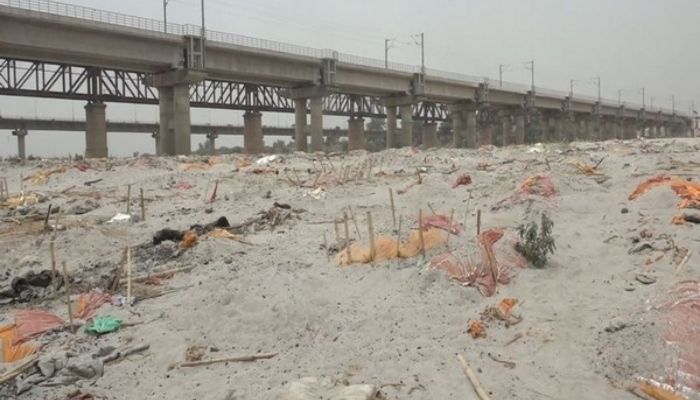
Last year, the wave of the Delta variant of the coronavirus hit India in the summer. As many bodies were seen floating in the holy river and many others were found buried in the sand on its banks, many sections of the so-called liberal media and especially the foreign media indicated that the situation has appeared due to the unaccounted Covid-19 deaths in the wave. The Phaphamau Ghat of Prayagraj attracted many parts of this selectively targeted criticism because the media showed it as a graveyard of sorts and saffron-colored clothes on temporarily erected poles indicating that bodies have been buried there. Though burying is not the primary Hindu way to perform the last rites, some have found it convenient while a few others identify it as a custom.

It is evident from the bodies found floating in the river this year that while reporting in the last year, the international media did not investigate the root cause behind the open burials. It was rather interesting in the hyped depiction of how the virus is playing havoc in the country and how the systems have crumbled under the high count of the cases and the deaths. It is however pertinent to note that this year the international media has chosen not to report the open burial of bodies near the banks of the river. There is a sharp decline in Covid-19 cases this year with high vaccination coverage being a major contributing factor to the country’s success in battling the pandemic.

According to a report by ANI, Teerthraj Patel, a local resident while attending a funeral of his relative said, “In Hinduism, the funeral is done by burning the pyre in which a lot of wood is used. Here, the body gets absorbed in the Ganga. There is nothing wrong with all this. The ghat is used by people from various districts. They are aware of the contraction of the river Ganga during the summer season. They know that when the river will expand during the rainy season, the bodies will be submerged in the river and their loved ones will get salvation. This is why there is a temporary burial in the sand.”

According to the report, the Prayagraj Municipal Commissioner Ravi Ranjan said, “We are urging people not to bury bodies there. An electric crematorium will be built there for which permission has been received from the concerned department. The work will be completed soon.”

While cremation is primary method of last rites of the dead among Hindus, some sections also practice burial. It is regularly seen on Ganga’s banks in some locations of Uttar Pradesh. Before 1988, the tradition of immersing dead bodies in Ganga was popular among the masses as they were deemed unfit for cremation. However, Supreme Court ruled against the practice and deemed it illegal to immerse dead bodies in the river.

There can be several reasons which make a dead body unfit for cremation according to tradition, such as if the person died of a snake bite, if it was an infant, if the person had some skin disease or if the person was a Sadhu. In these cases, it is advised, as per traditions, to bury the dead body.

Similarly, in some families, they do not cremate anyone but bury them alongside Ganga banks in shallow graves. These graves are then covered with bamboo sticks and Ram Naam Clothes that are considered sacred. Shringverpur Ghat and Phaphamau Ghat in Prayagraj are famous for such burials. Last year, amidst the ongoing Covid-19 pandemic, the media houses that were filled with reports that are totally disconnected from the Hindu traditions suddenly found these Ghats.

While such burials always took place on riverbanks at some places, the media splashed the images of such burial sites as the victims of Covid-19. Unable to cremate the bodies, they were forced to burry them, the media reports claimed, unaware of the facts. UP CM Yogi Adityanath had slammed the media reports, sharing old pre-Covid images showing bodies on the banks of Ganga.

It is evident from the current situation that the reality of the floating bodies in the Ganga is different than how it was reported in the second wave of Covid-19.
China slams US Under Secretary Uzra Zeya’s meeting with Dalai Lama in Dharamshala, calls it interference in internal affairs

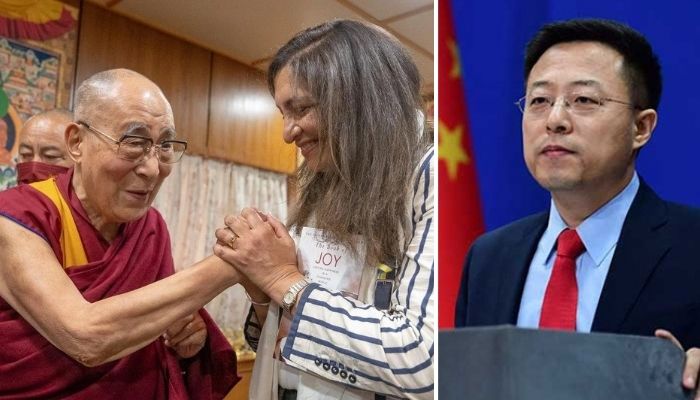
China on Thursday condemned the US Under Secretary for Civilian Security, Democracy, and Human Rights Uzra Zeya’s meeting with the 14th Dalai Lama in Dharamshala in India. Chinese Foreign Ministry Spokesperson Zhao Lijian called out Uzra Zeya’s visit as an ‘interference in its internal affairs’.

US Under Secretary Uzra Zeya, who is also the Special Coordinator for Tibetan Issues is on a visit to India and Nepal from May 17 to 22. On Thursday, she called upon the 14th Dalai Lama and representatives of the Tibetian Government in Exile in Dharamshala as part of her visit.

Chinese Foreign Ministry Spokesperson Zhao Lijian in his latest address to the media took this issue after the development from India came. He said, “The so-called Tibetan government-in-exile is an out-and-out separatist political group and an illegal organization completely in violation of China’s Constitution and laws. It is not recognized by any country in the world.” Lijian asserted that the 14th Dalai Lama is ‘not a purely religious figure’, but lies as a political exile who has long been engaged in separatist activities and attempted to split Tibet from China.

Calling out the appointment of the ‘Special Coordinator for Tibet Issues’ by the U.S, He said that the move is an interference in China’s internal affairs. “Tibet affairs are purely internal affairs of China, and brook no interference by any external forces,” he asserted. Zhao Lijian called out the U.S. side to take concrete actions “to honour its commitment to recognize Tibet as a part of China and not support Tibetan independence.”

The spokesperson said that China will continue to take ‘all necessary measures’ to resolutely safeguard its sovereignty, security, and development interests.

Meanwhile, US Under Secretary Uzra Zeya is in India “to deepen cooperation on human rights and democratic governance goals and to advance humanitarian priorities,” the office of the secretary said. On Wednesday, she met ‘civil society groups’ in New Delhi to “talk about their vital work to support shared US-India democratic values, including tolerance, free expression, and respect for human rights,” she tweeted.

Union minister Ashwini Vaishnaw makes test 5G call, services to be launched soon using made-in-India 5Gi stack that has been adopted by global telecom body

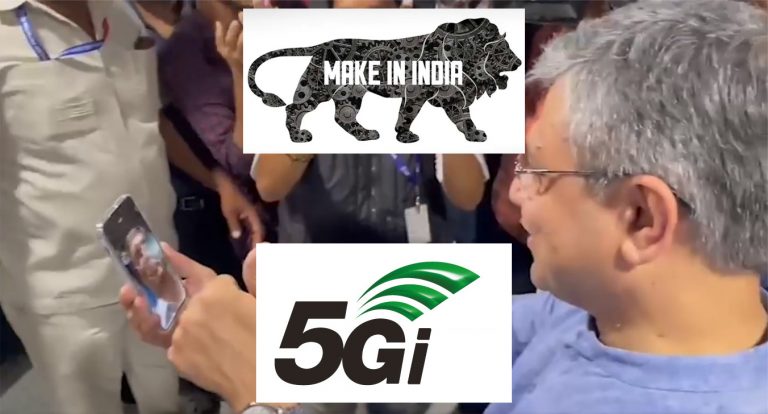
Although delayed by some time, India is all set to receive completely made-in-India 5G network soon. In a significant milestone in deployment of the next-generation telecom technology in the country, union minister Ashwini Vaishnaw today made successful test 5G call at IIT Madras.

Posting a video of the same, the minister of Railways, Communications, Electronics & Information Technology said that the entire end to end network for 5G is designed and developed in India. After making a video call using 5G network, the minister told the reporters that it is the realisation of prime minister Modi’s dreams. “His vision is to have our own 4G, 5G technology stacks developed in India, made in India, made for the world. We have to win the world with this entire technology stack”.

The 5G call was made by the minister after govt of India launched the 5G testbed for telecom companies to test their 5G equipment in India. On May 17th, PM Modi had launched the 5G testbed, developed under a multi-institute collaborative project by a total of eight institutes led by IIT Madras. Other institutions that are part of this project are IT Delhi, IIT Hyderabad, IIT Bombay, IIT Kanpur, IISc Bangalore, Society for Applied Microwave Electronics Engineering & Research (SAMEER) and Centre of Excellence in Wireless Technology (CEWiT).

In the absence of a 5G testbed, startups and industry players were forced to go abroad to test and validate their products to install on a 5G network. Now they will be able to do that in the 5G testbeds in India, which have been set up in five locations across India. The Test Bed project will enable a supportive ecosystem for Indian industry players and startups which will help them validate their products, prototypes, solutions and algorithms in 5G and other next-generation technologies.

Yesterday minister Ashwini Vaishnaw said that India’s own 5G stack, dubbed by the govt as 5Gi, will be ready around September-October this year. He had said that said India’s indigenous telecom stacks mark “big fundamental technological advancements”.

It is notable that instead of importing 5G technology, India has developed an indigenous 5G standard, in order to achieve made in India goals and also to stop relying on Chinese telecom majors. The 5Gi standard was developed under the supervision of Telecom Standard Development Society India and DoT, with contribution from several major IITs and IISc. The 5G standard developed in India has been named as 5Gi.

It is notable that the 5Gi standard already has been incorporated into the global 5G standard 3GPP (3rd Generation Partnership Project). In August last year, the International Telecommunications Union (ITU) had approved the 5Gi standard, the India’s homegrown 5G technology stack. Then in December 2021, the 5Gi was merged with 3GPP, marking the first time when a telecom technology developed in India was adopted by global body of telecom organisations.

“The merger of the 5Gi standard into 3GPP, enables a single common specification going forward, as well as creating a single radio access proposal for the ‘IMT.2020’ 5G family of standards (ITU-R),” 3GPP had said.

India’s 5Gi was created to meet specific requirements of the country not met by the global standard, and it includes enhancing the network coverage of mobile network to provide telecom service in rural areas. It uses a feature called Low Mobility Large Cell (LMLC), which can enhance the signal transmission range of a base station. It also includes doubling the power of mobile phones within global standard, which has been increased from 23dBm to 26dBm.

With inclusion of 5Gi into the 3GPP, the concerns that a separate 5G technology will fragment the sector has been answered, as now 5Gi will be implemented on a global scale under the aegis of 3GPP. Moreover, the 5Gi stack merged into 3GPP has been locked, and any further update will happen only under the supervision of the global body.

5Gi is India’s first contribution to the telecom sector, which was dominated by US, Europe and China. While it was originally developed as a domestic standard, it became part of the international standard after its adoption by 3GPP.

Leftist media portal The Wire journalist claims Red Fort sold off to Dalmia Group, here is how she is wrong

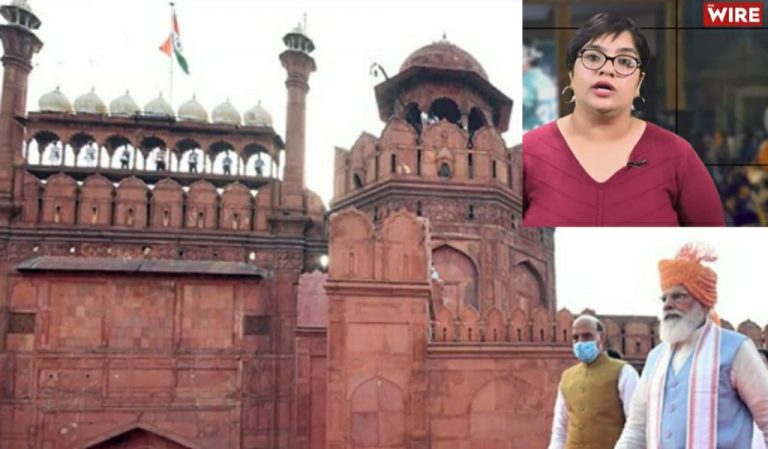
On May 19, Thursday, ‘journalist’ Sumedha Pal, working for the leftist propaganda website The Wire, took to Twitter to deride the central government by claiming that Modi has ‘sold off’ the iconic Red Fort to the Dalmia Group. This, however, is an entirely false claim made by the ‘journalist’ purely with an intent to belittle the Modi government. The truth is that the Red Fort was not ‘sold’ as claimed, but the Dalmia Group had ‘adopted’ the iconic property in 2018 under Modi Government’s ‘Adopt a Heritage’ initiative.

“None for Redfort cause they’ve sold it off to Dalmias,” The Wire ‘journalist’ Sumedha Pal, wrote on Twitter on Thursday, responding Rana Ayyub’s question on whether there will be a call to demolish the Red Fort because it was also built by Mughals.

In her Tweet glorifying the Mughals and mocking the BJP government at the centre, the Islamist propagandist Rana Ayyub, accused of keeping funds collected for philanthropic work, wrote, “This is the 75th year of Indian independence. Will Prime Minister Modi give his speech from the Red Fort built by the Mughals, considering your ideological forefathers have not built a single monument worth showcasing to the world. No calls of demolishing the Red Fort yet ?

In her eagerness to criticise the BJP government, The Wire’s ‘journalist’ soon concluded that “they,” referring to the BJP government, “sold” the Red Fort to the Dalmias. This is a blatant fabrication concocted solely to disparage the BJP government. Sumedha Pal would have done better had she read some of her own, if not any other portal’s archived reports before jumping at the opportunity to criticise the BJP government.

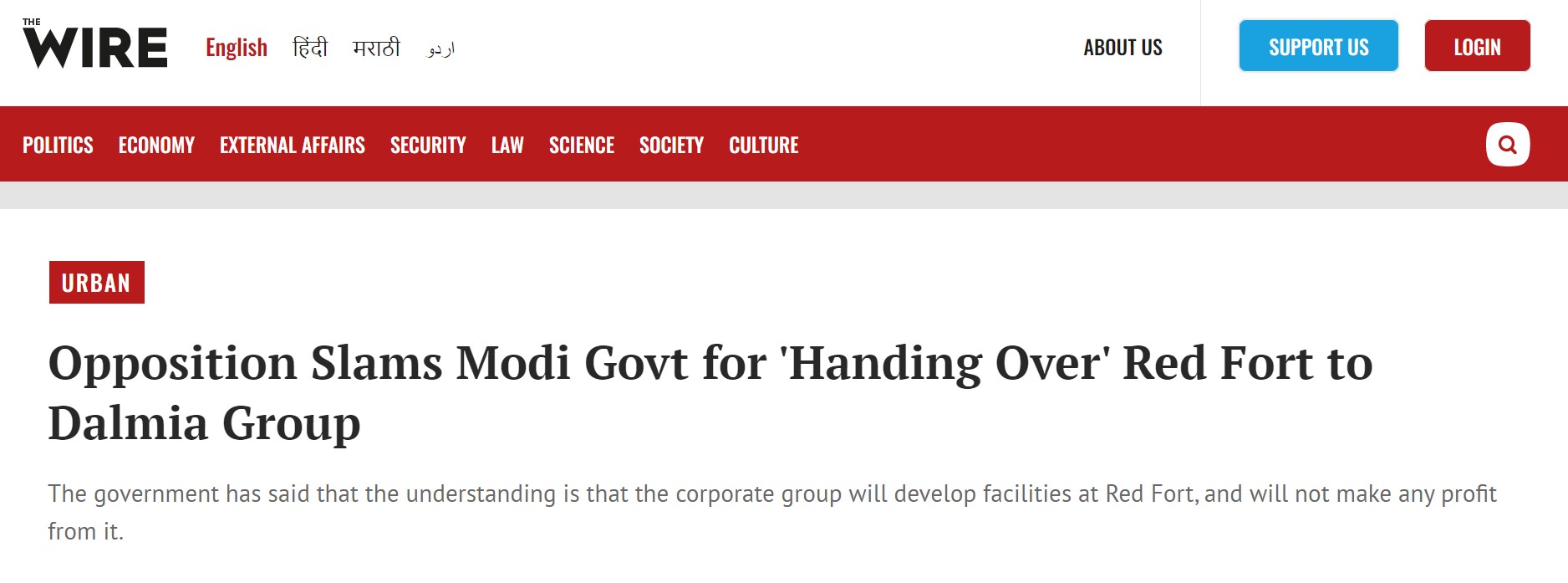
On April 29, 2018, the leftist news portal The Wire, had, in fact, published a detailed report ranting about how the opposition parties had been slamming the Modi Govt for ‘handing over’ Red Fort to the Dalmia Group. The report was titled, “Opposition Slams Modi Govt for ‘Handing Over’ Red Fort to Dalmia Group”.

Screengrab of The Wire report published on April 29, 2018

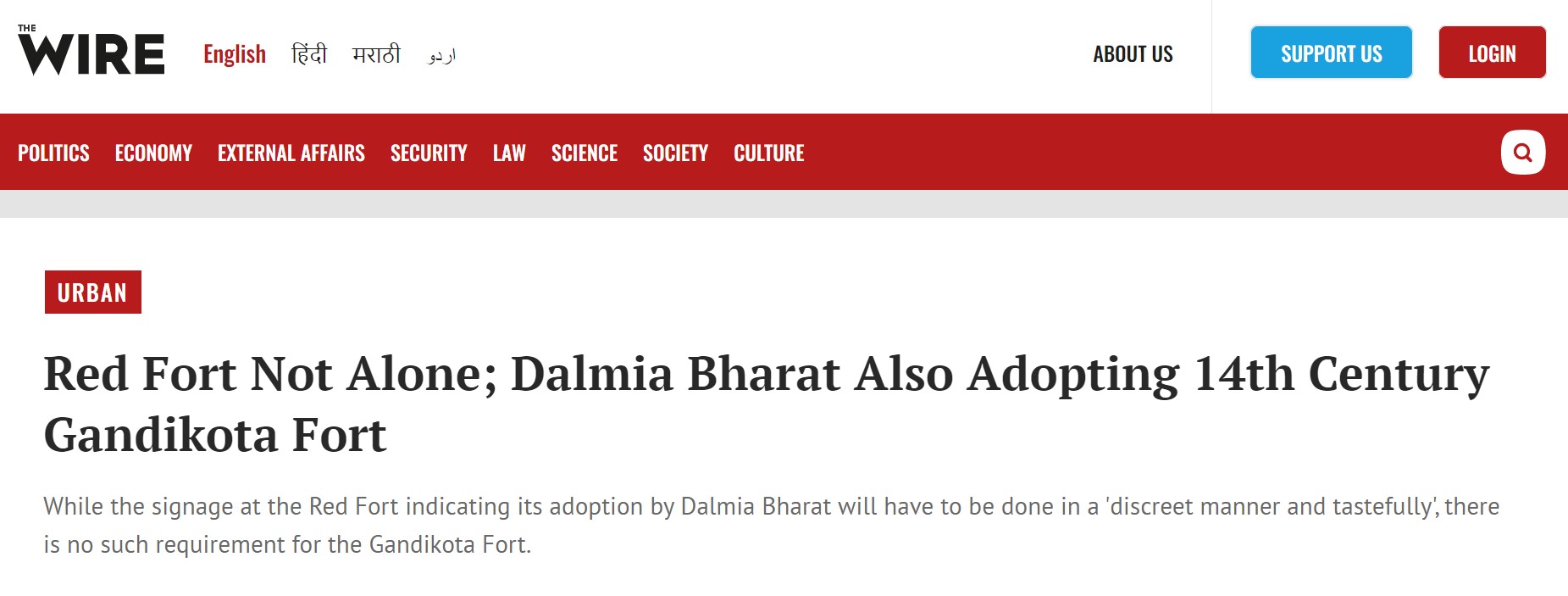
The next month, the leftist news portal published another article titled, “Red Fort Not Alone; Dalmia Bharat Also Adopting 14th Century Gandikota Fort”, rehashing the claim that the Dalmia Bharat group had indeed ‘adopted’ the iconic Red Fort under the government’s “Adopt a Heritage: Apni Dharohar, Apni Pehchaan” project.

Screengrab of The Wire report published on May 2, 2018

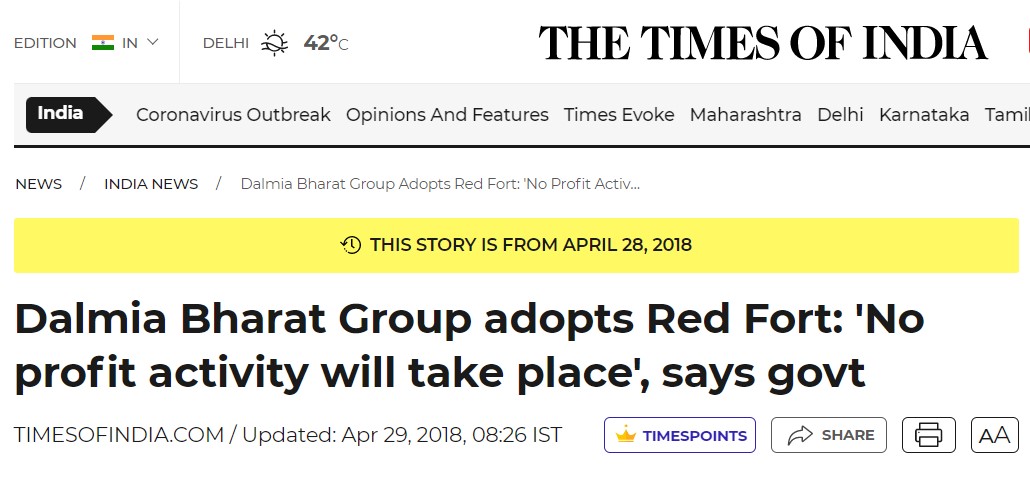
Many other media houses had also reported then, on how the Dalmia conglomerate went on to become the first corporate house in India’s history to adopt the 17th century Red Fort in a contract spanning five years. The sole purpose of the initiative was the upkeep of the heritage site.

TOI report published on April 29, 2018
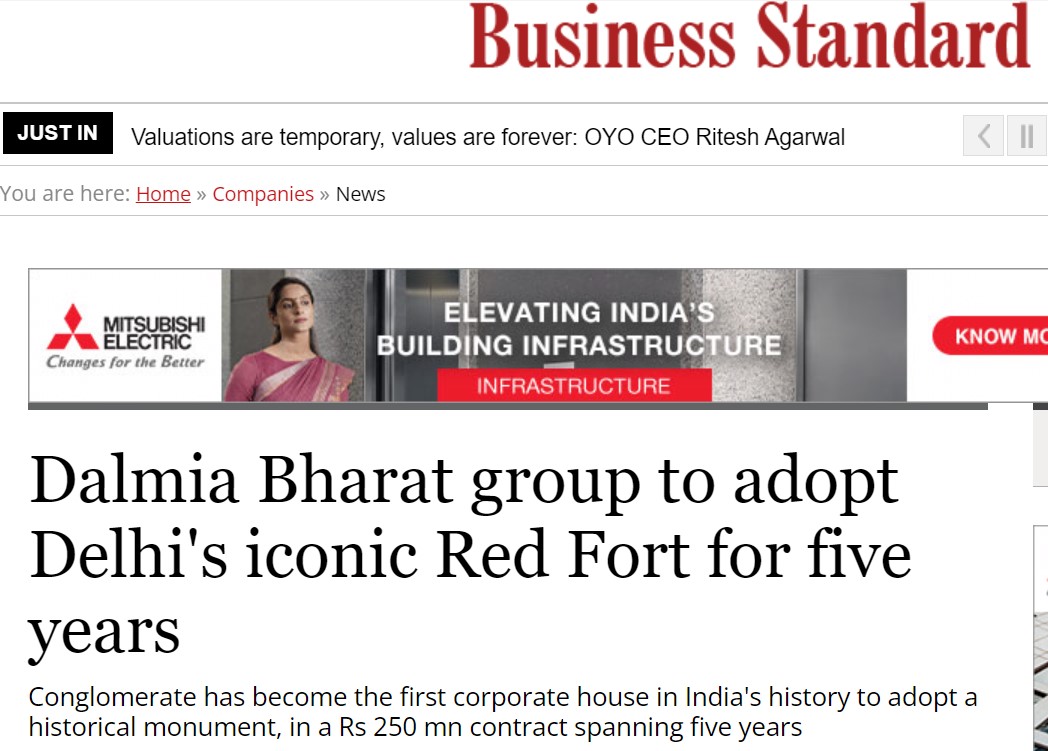
Business Standard report published on April 29, 2018

OpIndia had also written a report detailing the hypocrisy of the opposition parties over the Modi government’s ‘Adopt a Heritage’ scheme. We reported on how Trinamool Congress’ (TMC) Rajya Sabha member Derek O’Brien had displayed anger and outrage at the Government of India’s ‘Adopt a Heritage‘ initiative which aims to rope in private players for the development of basic and advanced tourist amenities and look after operation and management of these amenities. Derek, while voicing his anger referred to the same initiative as monuments being ‘sold’.

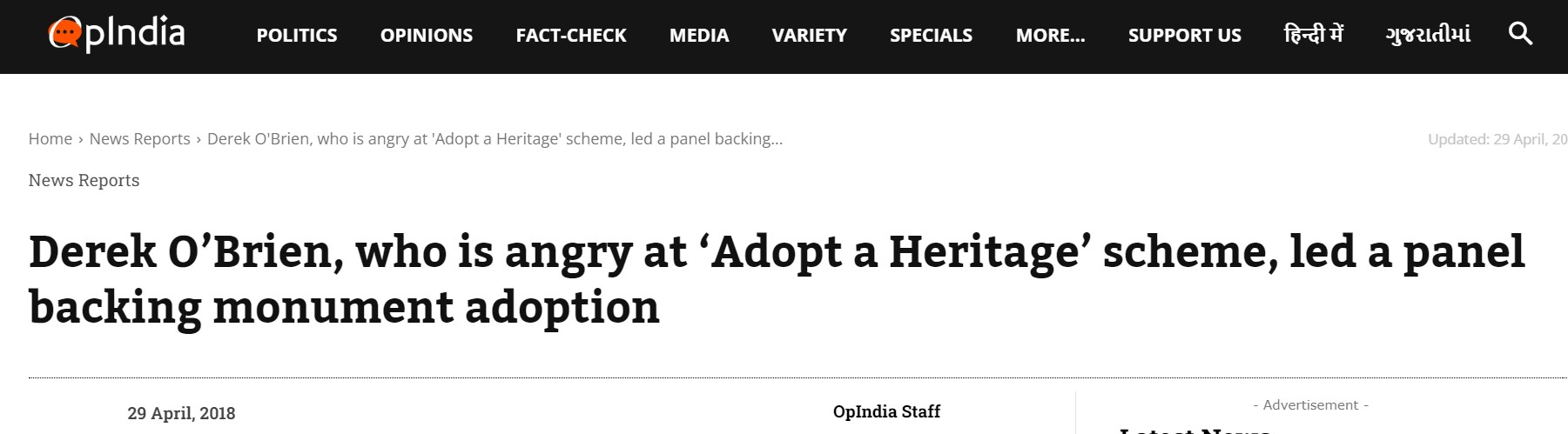
OpIndia report published on April 29, 2018

However, it had later come to light that the Standing Committee on Transport, Tourism and Culture, which was headed by Derek O’Brien himself, had not only welcomed the ‘Adopt a Heritage’ initiative but also recommended that major corporates may be compelled to adopt the heritage sites under CSR (corporate social responsibility).

The Modi govt had given the Red Fort for ‘adoption’ NOT ‘sold’ it to the Dalmia group

The cement manufacturing giant had ‘adopted’ not ‘bought’ (as proclaimed by The Wire journalist) the iconic Red Fort under the  ‘Adopt a Heritage Scheme’, a unique venture of the Ministry of Tourism in close collaboration with the Ministry of Culture and the Archaeological Survey of India (ASI) which envisages developing heritage sites, tourist sites and monuments across the length and breadth of the country in order to make them tourist-friendly so that the tourism potential and the cultural importance could be enhanced in a phased and planned manner.

President Ram Nath Kovind launched the project on World Tourism Day in September 2017. Under the initiative, the central government invited public and private sector companies, as well as individuals, to develop chosen monuments, heritage sites, and tourism destinations around India.

The company that would adopt a particular heritage property would be required to develop and maintain basic amenities such as drinking water, accessibility for the differently-abled and senior citizens, standardised signage, cleanliness, public conveniences, and illumination, as well as advanced amenities such as surveillance systems, night-viewing facilities, and tourism facilitation centres.

The sites/monuments were chosen based on tourist footfall and visibility and could be adopted for a five-year period by private and public sector enterprises and people (known as Monument Mitras).

The ‘oversight and vision committee,’ co-chaired by the Tourism Secretary and the Culture Secretary, selected the Monument Mitras based on the bidder’s ‘vision’ for the development of all services at the cultural site. There was no financial bid involved. The corporate sector was expected to support the site’s upkeep through corporate social responsibility (CSR) money. As a result, the Monument Mitras would have limited visibility on the site and on the Incredible India website.

Modi govt’s ‘Adopt a Heritage’ tourism scheme had covered 25 heritage sites until December 2020

In December 2020 it was reported that the Modi government’s ‘Adopt a Heritage’ tourism scheme had covered 25 heritage sites till then. The major monuments which have been handed over to the “Monument Mitras” include the historic Red Fort which has been allotted to the Dalmia Bharat Ltd, Qutub Minar (allotted to Yatra.Com), Safdarjung Tomb (allotted to Travel Corporation of India), and Jantar Mantar (allotted to SBI Foundation) among others.

Earlier in 2016, 14 PSUs including the Steel Authority of India (SAI), Indian Oil, UCO Bank, ONGC, had adopted over 18 monuments, including the monuments at Lodi Gardens, Khajuraho Temples, and the Ahom Monuments in Assam.

So it becomes reasonably clear that the Modi government has not sold the iconic Red Fort to the Dalmia group but had only given it for ‘adoption’ under its ‘Adopt a Heritage’, with the sole aim of maintaining heritage assets that have been neglected by the past regimes.

Delhi HC strikes down Arvind Kejriwal’s doorstep ration delivery scheme, says Delhi govt can’t use centre’s foodgrain for own scheme

On Thursday, The Delhi high court quashed the Aam Aadmi Party-led Delhi government’s doorstep delivery of ration scheme. The court affirmed that foodgrains provided by the Central Government cannot be used by the Delhi Government for this scheme.

The Delhi Sarkari Ration Dealers Sangh had filed a plea in the High Court challenging the doorstep ration delivery scheme or the Mukhya Mantri Ghar Ghar Ration Yojana, which was touted by the AAP as a visionary policy by Arvind Kejriwal. A group of Fair Price Shop (FPS) owners had submitted a plea in the Delhi High Court against the scheme. The shop owners had called the move beyond ‘ultra vires’ (beyond one’s legal power or authority).

A Division Bench of Acting Chief Justice Vipin Sanghi and Justice Jasmeet Singh delivered the verdict responding to the shop owners’ plea, saying that any such scheme framed by the GNCTD should comply with all the requirements of the National Food Security Act. While the court said that the govt is entitled to frame a scheme for doorstep delivery of foodgrains or rations to the beneficiaries under the Targeted Public Distribution System (TPDS), it has to be done from its own resources in compliance with the prevailing laws.

The court order said, “The Council of Ministers headed by the Chief Minister is bound to communicate its decisions/ resolutions, including any such scheme or proposal to the Lieutenant Governor, so as to enable him to examine the same and to take a call on whether, or not, he has a difference of opinion with any such scheme.”

The High Court further noted that the Delhi govt scheme does not comply with the provisions of the NFSA and TPDS Order, 2015. The Court also said that as the scheme was approved/ consented to by the Lieutenant Governor, it cannot be implemented in its present form.

The central govt had objected to the doorstep delivery of ration scheme saying that the fair price shop owners form an integral part of the National Food Security Act, and that the scheme mitigates the architecture of the Act.

Kejriwal’s Controversial Mukhya Mantri Ghar Ghar Ration Yojana

The scheme by the Arvind Kejriwal government was always a controversial one since its advent, as the Central Government maintained that the subsidised foodgrains allotted under the National Food Security Act are not permissible to be used for the state government scheme. The centre has also said that subsidised foodgrains allotted by it under the NFS Act can’t be used in a scheme with a different name. Any changes/amendments in the provisions of the Act, including nomenclatures used for distribution of NFSA foodgrains, can only be done through established Parliamentary procedures. Furthermore, The Central Ministry of Consumer Affairs, Food and Public Distribution pointed out that provision for household delivery of rations does not exist in the National Food Security Act (NFSA), 2013.

Due to these reasons, the central govt had told the Delhi govt that use of any new nomenclature/scheme for distribution of NFSA entitlements/foodgrains shall not be permissible. However, the central govt had added that they will not have any objection in the Arvind Kejriwal launches any ration scheme without mixing the elements of NFSA foodgrains.

Moreover, Delhi’s Lieutenant Governor Anil Baijal denied giving a green signal to the scheme and returned it for reconsideration. While the scheme was set to be launched in March 2021, the provisions in the bill had become a contentious issue among the BJP opposition and several Ration Dealers in the Delhi jurisdiction.

The issue revolved around the fact that Kejriwal’s state-specific food delivery scheme which includes doorstep delivery of packaged wheat flour, rice and sugar contested with the Central Government’s Antyodaya Anna Yojana (AAY) and Priority Household (PHH) categories of the NFSA Act. The Centre issues foodgrains at the scale of 35 Kg per family per month under the AAY scheme and at the scale of 5 Kg per person per month under the PHH category.

The Development of Food and Public Distribution (DFPD) had filed a special leave petition in the Supreme Court in October 2021 against the interim orders of the Delhi High Court calling out the implementation of Kejriwal’s Mukhya Mantri Ghar Ghar Ration Yojana will adversely impact numerous NFSA, 2013 beneficiaries. It clarified that doing so will thereby create an opaque parallel ccheme and will also affect the implementation of the One Nation One Ration Card Plan in Delhi.

However, On November 15, the apex court had declined to entertain a petition by the Centre and another by FPS owners against the Delhi High court interim order that allowed the AAP government to carry out the state government scheme on a temporary basis. However, in the latest ruling, the court has freshly asked the AAP government to step back and stop the scheme.

Odisha government renovates the Tara Tarini Shakti Peetha: Here are some stunning pictures from the majestic riverside temple

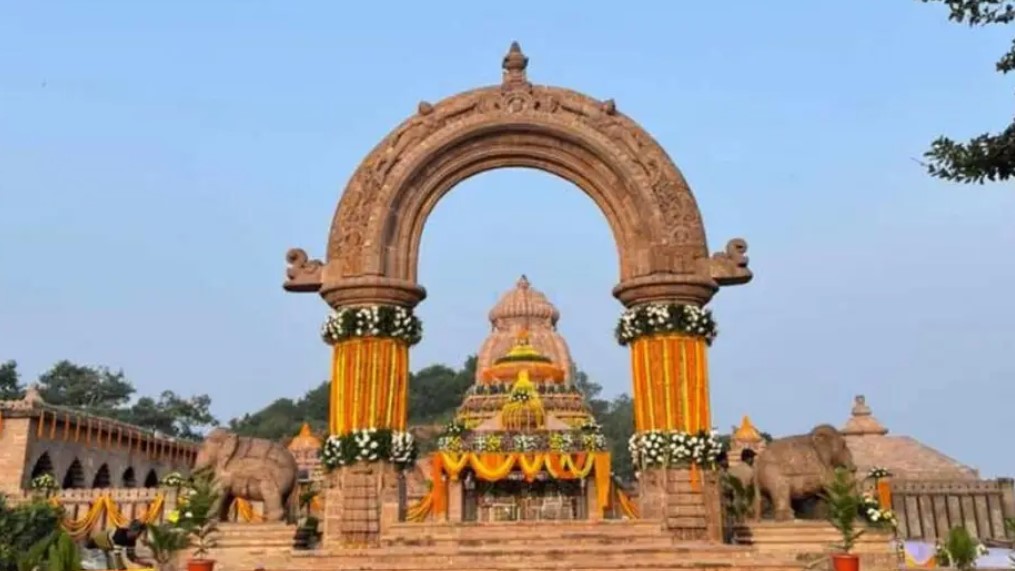
On Wednesday, May 18, Odisha Chief Minister Naveen Patnaik inaugurated the renovated Maa Tara Tarini Temple complex in the state’s Ganjam district and offered prayers to the deity. The Chief Minister praised the artists and artisans participating in the project, calling the new look of Ma Tara Tarini’s temple a “unique example of Odisha’s art, architecture, and sculpture.”

The Chief Minister had sanctioned Rs 100 crore for the beautification and development of Maa Tara Tarini Temple, one of the most revered temples placed on the Kumari hills at the banks of the Rushikulya river in the state. Earlier on May 17, Chief Secretary Suresh Chandra Mohapatra, Secretary VK Pandian and other officials visited the temple to take stock of the development work prior to the “Pratishtha Mahotsav”, a week-long celebration of the redeveloped temple complex of the Tara Tarini temple, one of the ancient Shakti Peethas in the country.

Following his visit to the divine shrine, Odisha CM Tweeted, “With continued efforts of #Odisha Govt & unwavering support of people of #Ganjam, #MaaTaraTarini temple has become a modern day masterpiece. The new temple boasts of an architecture that gives it a sense of holiness & is strongly connected with traditions.”

It is notable here that traditional Odia aesthetics, sculpture and artistic traditions have been given prominence in the design of the temple complex.

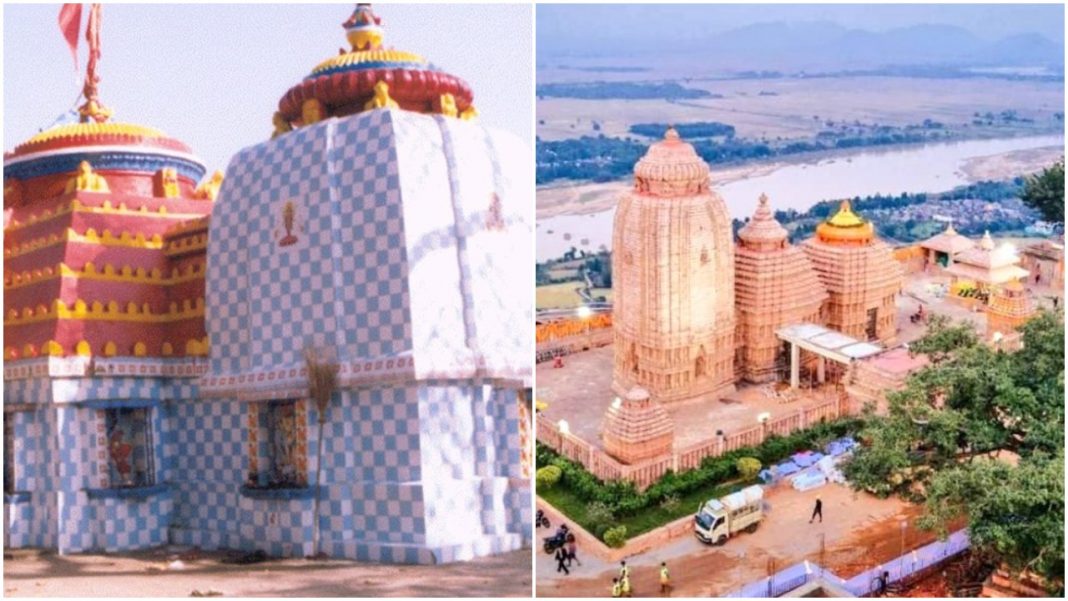
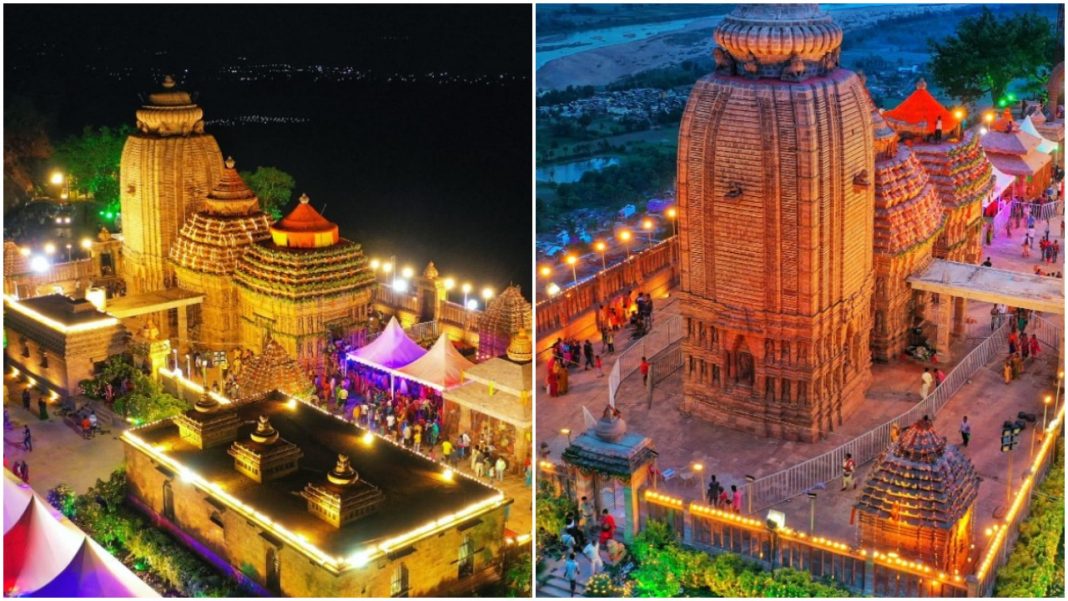
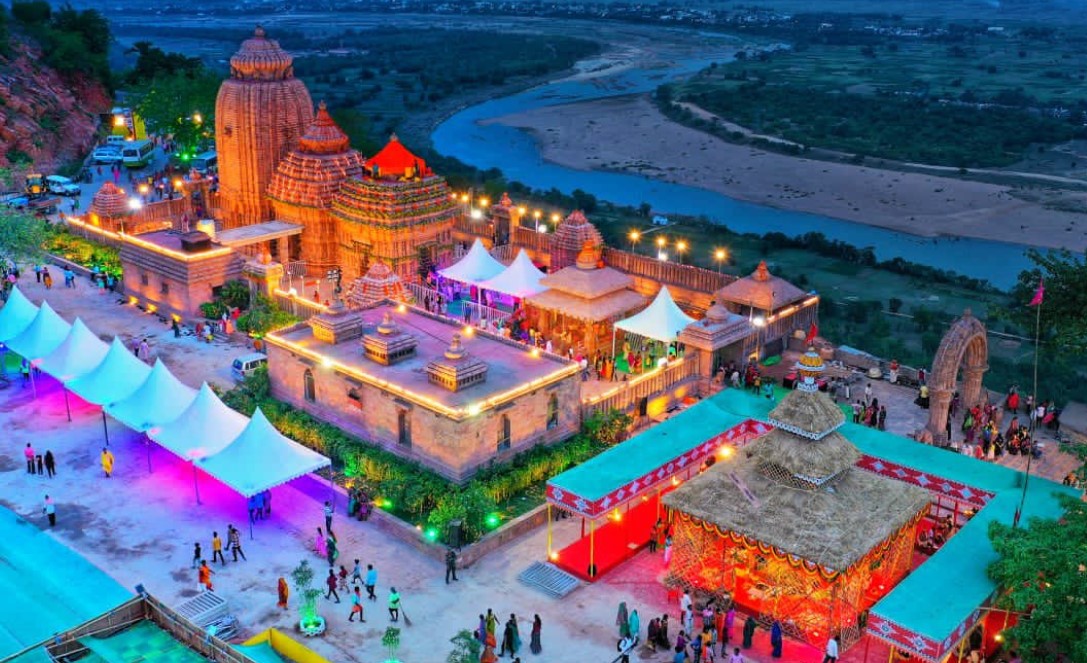
Below, on the left we have shared the look of the temple in its old form and on the right is the aerial view of Maa Taratarini temple in its present renovated form.

Before and after pictures of the Tara Tarini Shakti Peetha

The Shakti Peetha has been restored as a magnificent temple that embodies Odia heritage and is deeply connected to Odia sentiments. The periphery of the Shakti Peetha has received a complete makeover, including the renovation of the Singhadwar entrance with pilgrim amenities, pathway with drinking water facilities, interpretation centre, the mundan hall, public toilet, Prasad Sevan mandap, etc.

The renovated lion gate entrance (Singhadwara) has been designed like the famous Mukteshwar structure.

Source: pragativadi.com

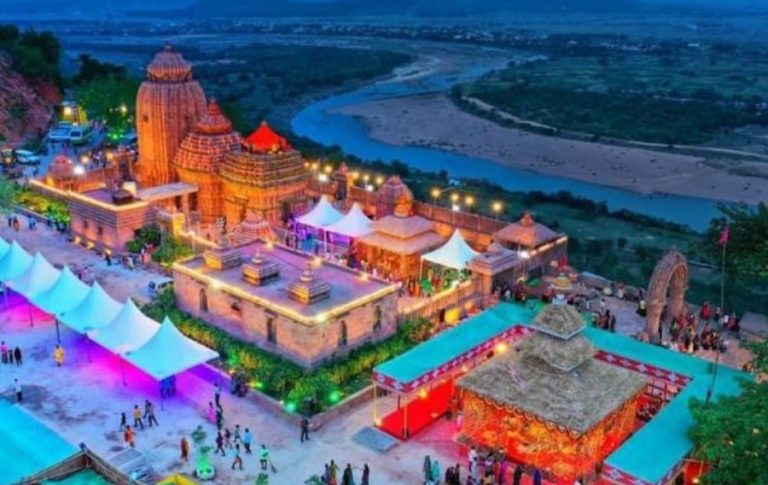
The shrine’s attractiveness is enhanced by the lighting included on the temple grounds. Social media users shared some stunning pictures of the night view of the temple complex. The renovated temple now features traditional Odia sculptures, and is designed like the ancient temples of the state, adorned with master craftsmanship.

Source: Twitter
source: Twitter

The history of the Tara Tarini temple in Odisha

Tara Tarini Temple is an ancient 17th-century temple on the Kumari hills on the bank of the Rushikulya river near Brahmapur city in Ganjam District, Odisha. It is one of the prominent Shakti Peethas and is worshipped as the Breast Shrine (Sthana Peetha) and manifestations of Adi Shakti. To access the temple’s sanctum sanctorum, one must climb 999 stairs.

Tara-Tarini was said to be the chief goddess of the Kalinga kingdom’s rulers. The stone idols of Mother Tara and Tarini are erected at this temple. Mata’s idols are adorned with gold and silver embellishments as well as precious stones. Two brass heads known as their Chalanti Pratima or living image are placed between them.

According to the ancient Puranas, the origin of Maa Tara Tarini is directly traced to Daksha Prajapati’s Jagna in Satya Yuga. The famous Shakta Peethas of Bimala, Tara-Tarini, Dakshina Kalika and Kamakshi originated from the limbs of the divine corpse of Devi Sati. Ancient texts like the Shiva Purana, the Kalika Purana, and the Devi Bhagabat attest to this fact.

Most of the households in southern Orissa have Mother Tara-Tarini as their presiding deity.

Bollywood, the pretence that they don’t even see the success of South Indian cinema and how the wheels are turning

Not many would be aware that Bollywood actor Anil Kapoor began his film career with the Telugu movie Vamsa Vruksham in 1980, which was remade from the National Award-winning Kannada film Vamsha Vriksha, adopted for the screen from SL Bhyrappa’s novel of the same name. This was after his debut in the 1979 film Humare Tumhare in a blink-and-you-miss role that is nowhere similar to the launchpad Hindi film debutants, rather star kids, get today. Kapoor went on to act in Mani Ratnam’s Kannada directorial debut Pallavi Anu Pallavi (it won three Karnataka State Film Awards) before finally breaking into the Hindi film industry as Raja in Yash Chopra’s 1984 action drama Mashaal. Interestingly, another of his hit films, Woh Saat Din, where he played the endearing Prem, a struggling musician who falls in love with his landlord’s granddaughter, was remade from the Tamil hit Andha 7 Naatkal.  

If we were to map the career of many Hindi film actors today, somewhere or the other there will emerge a connection with the South film industry. Inspirations, lift-offs, blatant copies or official remakes in Mumbai from successful reel ventures from the southern part of India notwithstanding, Bollywood’s step-motherly treatment of regional film industries is not just rankling but reeks of a patronizing and ignorant mindset about the business these industries do or the popularity they enjoy amongst movie lovers in different states.

While Anil Kapoor (amongst the very few who are not oblivious to the hold the south has in the movie sector), after the SS Rajamouli blitzkrieg RRR floored the nation, acknowledged that his career began with Telugu and Kannada films and that the south has always been making really good cinema, many in Bollywood pretend that Indian cinema is synonymous with only, and only Hindi movies. 

While this pigeonholing could be largely due to the NRI audience post-liberalization overdosing on stereotypical movies churned out by Hindi filmmakers, it cannot be denied that the masses gradually started disconnecting with this generalized format presenting India through an extremely loud, Karan Joharesque Punjabi prism. That India is rich in its variant indigenous cultures were ill-represented by most Hindi directors and storytellers. It turned out to be a conveyor belt mechanism of movie-making that India couldn’t identify with anymore.

Also, with celebrities engaging too much in urban chatterati instead of concentrating on what they should be doing more, making films, the formula for commercial success slipped away from Bollywood’s grip. Yet the halo of popularity floated thanks to heavy PR mechanisms and hyped media snippets that kept the industry in the limelight. Perhaps, this fake idea of superiority denied the actors and everyone involved in the Hindi film industry a brush with the reality that regional films are increasingly being preferred now. 

A recurring complaint also is that while rehashing the original script, Bollywood films distort the narratives that botch up their theme and relevance. For instance, one of the gripes with Akshay Kumar’s recent dud Bachchhan Pandey was that the styling of Kriti Sanon and Jacqueline Fernandez ruined the simple charm that Lakshmi Menon carried in the Tamil original Jigarthanda. Hindi films look more like the fashion ramp than a realistic canvas engaging the audience with top-class tales and histrionics.  

Earlier, we had several Hindi remakes from Tamil family dramas helmed by famous AVM Productions based in Chennai. Like Main Chup Rahungi starring Meena Kumari and Sunil Dutt was remade from Gemini Ganeshan-Savitri starring Kalathur KanammaGharana featuring Rajendra Kumar and Asha Parekh was copied from Telugu film Santhi Nivasam. There are many, many such examples. From the current crop, Amir Khan’s Ghajini was A R Murugadoss’s official Hindi remake of his Tamil superhit. Rowdy Rathore was copied from Telugu Vikramarkudu, Ajay Devgn’s Drishyam was lifted from Mohanlal’s successful originals while his Singham was inspired by the Tamil Singam. Shahid Kapoor’s Jersey is the official Hindi copy of Nani’s National Award-winning Telugu blockbuster while his Kabir Singh was lifted from Vijay Deverakonda’s Arjun Reddy. Lack of original scripts abounds as Hindi films continue churning copies from other regional films as well. A case in point is Dhadak, remade from the award-winning Marathi drama Sairat. Even as you read, Hrithik Roshan is completing his version of Vikram Vedha a lift-off from Vijay Sethupathi’s immensely successful Tamil original.

In a recent function, former politician and superstar Chiranjeevi narrated an incident that took place in Delhi around 1988 when he had come to receive the Nargis Dutt Award for Best Feature Film on National Integration for Rudraveena, directed by the legendary K Balachander. He noticed that in Rashtrapati Bhavan while there were huge frames mounted on the walls carrying posters of famous Hindi actors and films, the adulation of South film legends was conspicuous by its absence. What Chiranjeevi felt back then, must be the thought in every famous actor, director, musician and film personality working in Kannada, Telugu, Tamil or Malayalam film industries. How Mumbai grabs the limelight in the Indian cinema segment despite being inspired regularly by regional movies thanks to the lopsided media and PR narrative keeping only Bollywood in mass consciousness. 

But looks like the wheels of change are spinning at last with the shift helmed by recent pan-India money-spinners such as Baahubali-The Beginning and Conclusion, KGF 1 & 2, Pushpa-The Rise and RRR elbowing out just about every Hindi cinema in their wake. Not just movie lovers from separate cities, the Indian audience en masse has gravitated to these productions due to the sheer power of good storytelling, original content and technical soundness. Om Raut’s much anticipated Adipurush, to be released next year on Mahashivratri, will showcase Telugu star Prabhas as the hero Raghava and not a Bollywood actor. 

Ajay Devgn might cook up a verbal brawl with Kannada star Kiccha Sudeep on Twitter over Hindi being a superior language so everyone must learn it but the incident only reinstates brewing insecurity amongst these elitist celebrities as well as their disregard for India’s many official languages and that, in Bharat, a country known for cultural and language diversity, when it comes to cinema, the days of Bollywood monopoly are clearly over.

A love jihad victim, who had accused one Akram Qureshi of ‘trapping’ her by faking his identity and forcing her to convert to Islam, found dead in her house in Loni, Uttar Pradesh

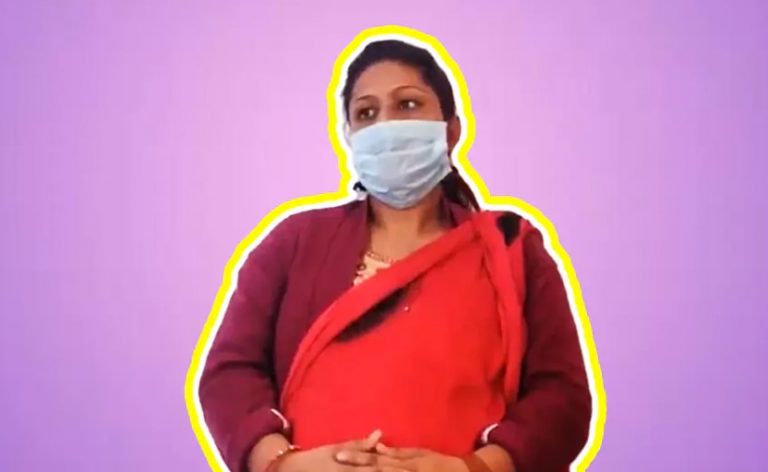
On May 18, Wednesday, a 32-year-old Hindu woman named Neetu Yadav was found dead in her house in Prem Nagar Colony in Loni, Ghaziabad, Uttar Pradesh. Neetu Yadav had in 2021, become a victim of grooming jihad. The woman had in November 2021 filed a police complaint against one Akram Qureshi, accusing him of faking his identity and lying about his marital status in order to enter into a relationship with her. He had also assaulted her while forcing her to convert to Islam and pressurised her to abort her child.

According to a report by Hindi daily Dainik Bhaskar, the grooming jihad victim was found hanging in her flat in Loni’s Prem colony. She used to run a clinic near the house. The police, who reached her house after getting information about the incident from Neetu Yadav’s neighbours, immediately took the body into possession and sent it for post-mortem.

While the police await autopsy reports, it has been said that prima facie it appears to be a case of suicide.

Loni Kotwali SHO Ajay Chaudhary said that no complaint has been filed in the woman’s suicide case. Following receipt of a complaint, further action will be taken.

Swarajya journalist Swati Goel Sharma took to her Twitter handle to Tweet about the unfortunate death of the Hindu woman. She had been in touch with the deceased since Swarajya had covered the story about Neetu Yadav being trapped by Akram Qureshi. The journalist said that though the police have called it a case of suicide she refused to believe that a woman like Neetu Yadav could have killed herself while knowing her daughter (with Akram) had no one other than her. She informed that she had last spoken to the deceased only 20 days before her death.

The case

On January 6, 2021, Swarajya reported how a 31-year-old Hindu woman from western Uttar Pradesh had filed a police complaint, accusing a Muslim man of lying about his marital status, entering into a relationship with her, and forcing her to convert to Islam.

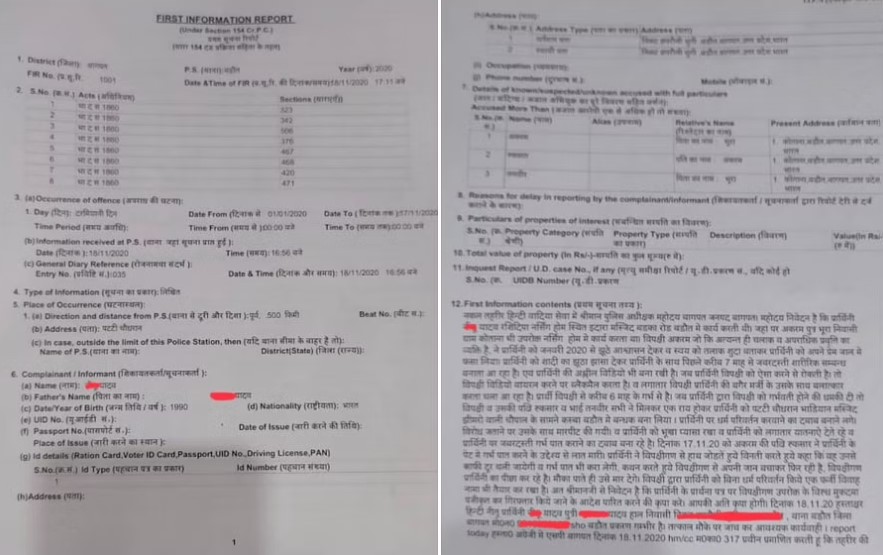
The police filed a first information report (FIR) based on the complaint and charged Akram Qureshi, his wife Rukhsar, and his brother Tanveer with IPC sections 323 (causing hurt), 342 (wrongful confinement), 506 (criminal intimidation), 376 (rape), 467 (forgery), 468 (cheating), 420 (cheating and dishonesty), and 471 (cheating and dishonesty) (using as genuine a forged document). Qureshi was arrested and sent to jail.

FIR filed in Neetu Yadav’s case in 2021 (source: Swarajya)

In her complaint, the woman, Neetu Yadav, stated that she met Akram in January 2020 when she joined a private nursing home named Rashidiya in Baraut city as a nurse. The duo worked together there.

Akram lied to her about being divorced and trapped her in a love affair. He lured her to get physically involved with him several times since January 2020, on the pretext of marriage. When she became pregnant, Akram, with the support of his wife Rukhsar and brother Tanveer, confined her and began pressuring her to abort the pregnancy and convert to Islam. They also assaulted her.

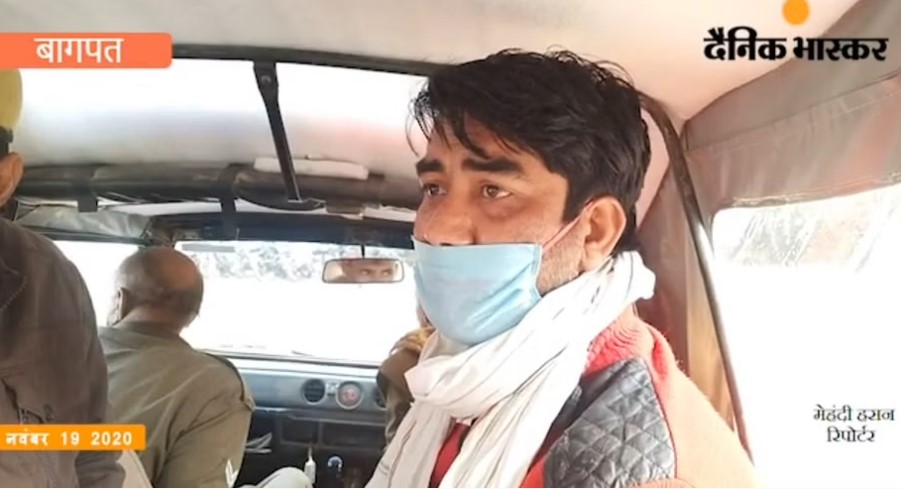
Accused Akram Quereshi

According to the complaint, Rukhsar hit her in the stomach on November 17th, after which Neetu begged them to leave her, vowing she would move far away from them and abort the pregnancy on her own.

Neetu Yadav on November 18, 2020, approached the police at Baraut police station of Baghpat district and an FIR was filed against Akram. The police apprehended him and sent him to jail.

Neetu, a native of Khekra village of Baghpat, got married in 2012 to a man from her Yadav caste in an alliance arranged by her family. The couple got divorced in 2017. After her divorce, she started living with her parents. A year later, her parents “threw her out of the house”. Neetu began to live in Loni town of Ghaziabad district as she got a part-time nursing job in a local nursing home. She completed her course and, by end of 2019, went to Baraut for a full-time nursing job in Rashidiya on a friend’s suggestion. Neetu Yadav has a son with her first husband and a daughter with Akram.

According to Dainik Bhaskar, Neetu Yadav had earlier too attempted to commit suicide. She had recently gotten married to Manish Gupta, however, the duo had been living separately for some time due to some personal differences. One Iqbal, who lives in the colony, had once taunted Neetu Yadav’s family about her separation, which had infuriated her. They had got into a verbal spat over the issue. Then too Neetu Yadav had tried hanging herself but her family had then saved her.

USA: Crampton Brophy, author of ‘How to murder your husband’ is on trial for murdering her husband

An American author who had written a piece titled “How To Murder Your Husband” is now on trial for killing her husband.

According to the reports, American author Crampton Brophy, the author of the title “How To Murder Your Husband”, is accused of killing her 63-year-old husband, Daniel Brophy. The author is accused of shooting her husband using a gun which she had bought on eBay.

Brophy is also the author of the “Wrong Never Felt So Right” series of novels that include “The Wrong Husband” and “The Wrong Lover”.

On June 2, 2018, Brophy was found dead by students in a class. He had been shot twice. The investigators had stated that the barrel from the Glock handgun used in the murder was purchased by the suspect on eBay.

According to the prosecution, the security camera footage had captured Crampton Brophy’s minivan outside the Oregon Culinary Institute on June 2, 2018, exactly the time her chef husband was killed in one of the school’s classrooms.

The prosecutors also alleged that the 71-year-old writer was struggling to make payments on her mortgage, however, she paid multiple life assurance policies that would pay out a total of $1.4 million in the event of her husband’s death.

“I do better with Dan alive financially than I do with Dan dead,” Crampton Brophy reportedly admitted before the court in Portland this week.

Earlier, Crampton Brophy had the court she has no memory of being there, however, she later acknowledged she must have been at the crime scene. She had insisted that she was in the area because she was driving around getting inspiration for a story.

“This is not a man I would have shot because I had a memory issue. It seems to me if I had shot him, I would know every detail,” the author had said.

Reportedly, Crampton Brophy admitted to having bought a Glock pistol, which she says was for her husband to protect himself when he went mushroom hunting in the woods. However, she contended that the missing barrel was purchased as part of research for an unfinished novel.

“There was a big separation between what was for writing and what was for protection,” she told the court.

That barrel that was used for killing has never been recovered.

Meanwhile, Crampton Brophy’s novel remains accessible online, and her books can still be bought on Amazon. Apparently, her blog on murdering a husband discusses methods and motivations for dispatching an unwanted spouse. These include financial gain and the use of a gun, although it notes guns are “loud, messy, require some skill.”

“But the thing I know about murder is that every one of us has it in him/her when pushed far enough,” the essay reads.

‘He enticed victim when she was 13’: In a Grooming Jihad case, Allahabad HC rejects bail of Anwar Ali who forced a minor to convert to Islam and do Nikah

On Wednesday, in a significant observation, the Lucknow bench of Allahabad High Court recognised the menace of Grooming Jihad and rejected the bail plea of a married Muslim man who lured a Hindu minor girl by disguising himself as a Hindu to marry her.

According to the reports, the Allahabad High Court bench of Justice Dinesh Kumar Singh denied bail to Anwar Ali, who is accused of trying to convert a minor Hindu to the Muslim religion and pressurising her to perform Nika with him.

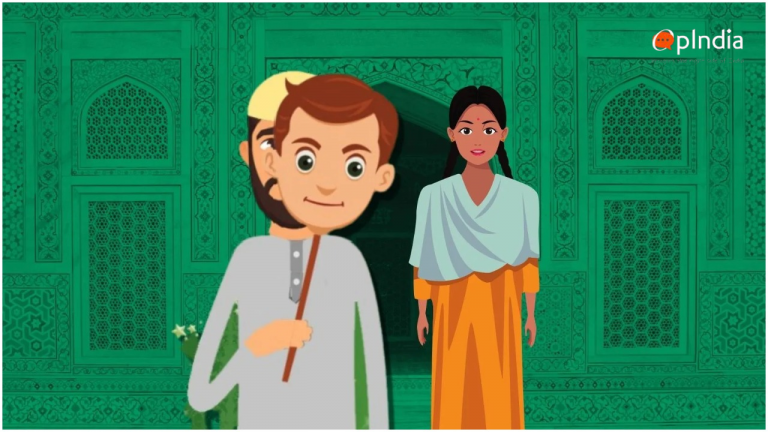
Anwar Ali had introduced himself to a minor girl through social media as ‘Raj’. Later, he enticed the girl, who was around 16 years and forced the girl to convert to Islam. Anwar Ali, who had disguised as a Hindu, later pressurised her to do Nikah with him.

The court said that the accused not only betrayed his wife and family, but also breached the trust of an innocent girl who believed him.

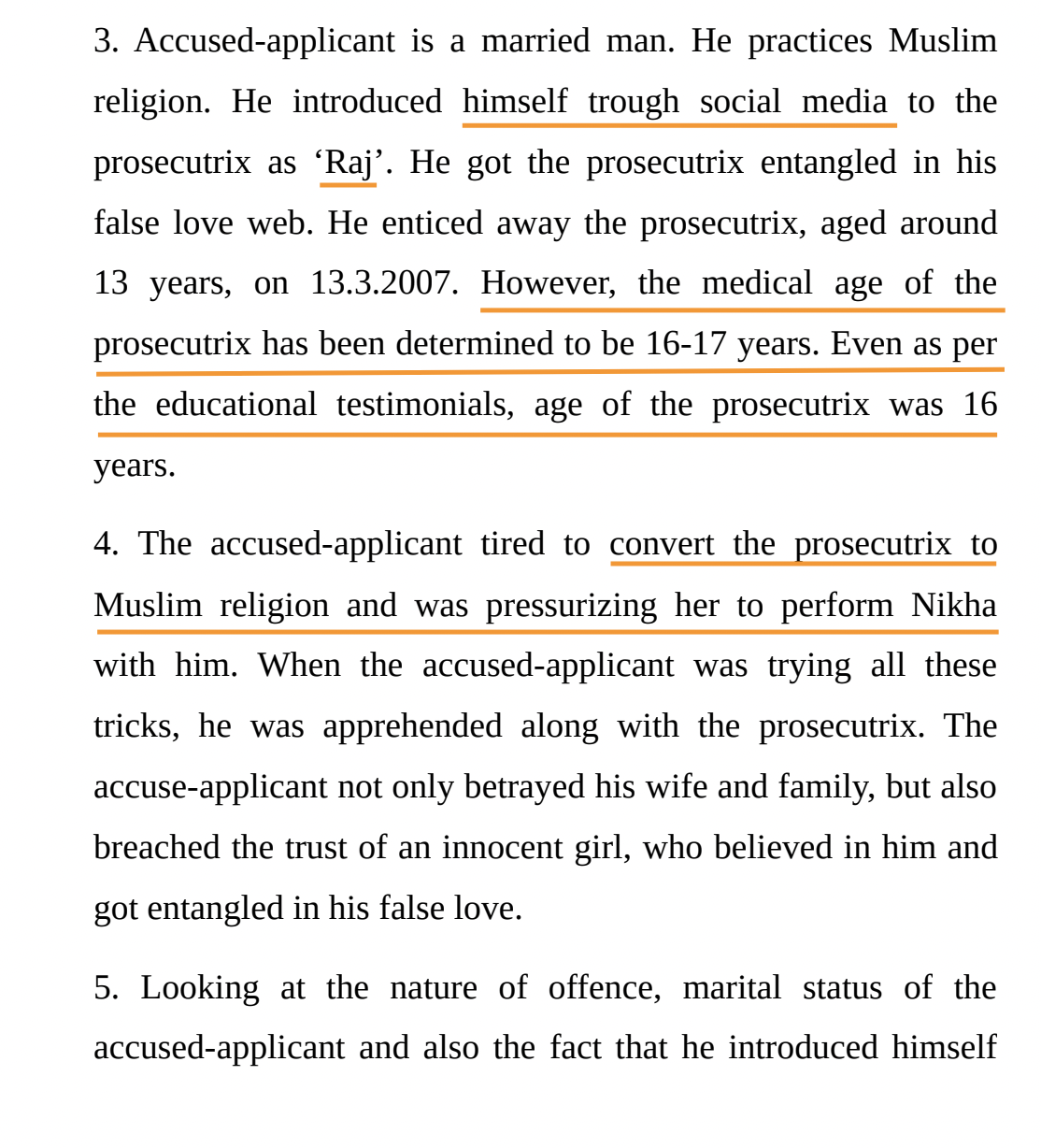
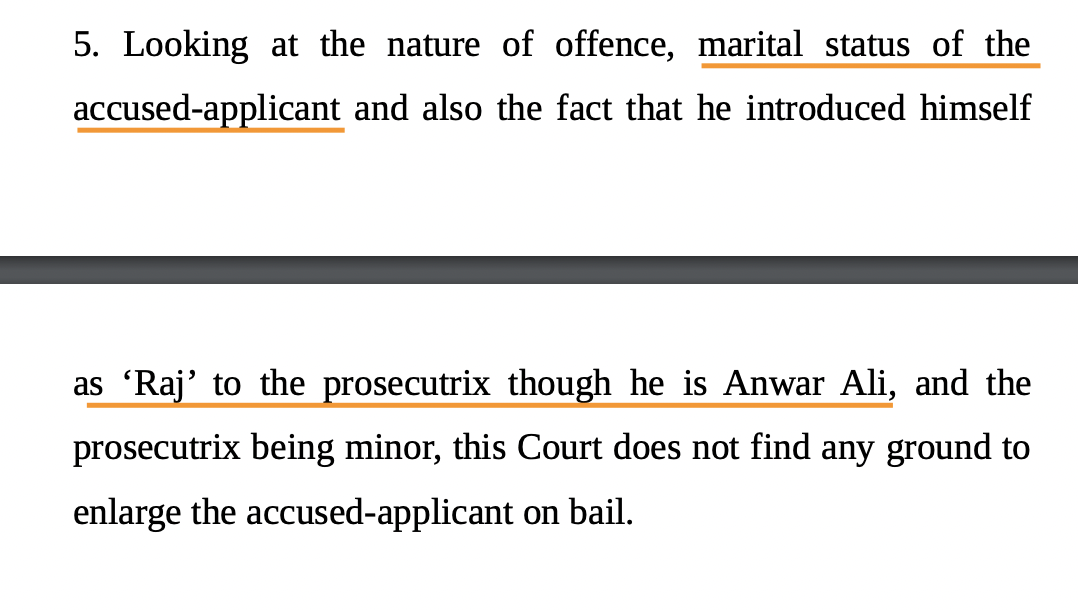
Allahabad High Court order cancelling bail of the love jihad accused Anwar Ali/ Image Source: Live Law

A case was registered against Anwar Ali after his real religious identity was revealed under sections 363, 366 and 376 of the IPC and POCSO Act for raping the minor girl. The accused was subsequently arrested by the Uttar Pradesh police.

Rejecting the bail application, the bench of Justice Dinesh Kumar Singh observed, “Looking at the nature of the offence, marital status of the applicant and also the fact that he introduced himself as ‘Raj’ to the prosecutrix though he is Anwar Ali, and the prosecutrix being minor (13 years), this court does not find any ground to enlarge the applicant on bail.”

Allahabad High Court order cancelling bail of the love jihad accused Anwar Ali/ Image Source: Live Law

The court said that the accused not only betrayed his wife and family but also breached the trust of an innocent girl, who believed in him and entered into a relationship with him.

Essentially, the Allahabad High Court’s order seems to have taken notice of the menace of Love Jihad crimes often perpetrated by Muslims against non-Muslims to convert the latter to Islam. The observations come as significant at a time when the ‘left-liberal’ establishment believes that there is no such conspiracy as ‘Love Jihad’, who often dismisses the phenomenon of Love Jihad as “a conspiracy theory developed by the proponents of Hindutva to invoke prejudice against the Muslims”.

Even as the ‘left-liberals’ alleged that Love Jihad is just a figment of imagination conjured up to further ‘Islamophobia’, there have been several incidents that conclusively debunk their assertion that Love Jihad is just another propaganda by the Hindutva proponents against the Muslims. Those incidents prove beyond any reasonable doubt that Love Jihad is a real menace affecting non-Muslim women.

Love Jihad cases:

Recently, a few days ago, an incident of grooming jihad had surfaced in the Saharanpur district of Uttar Pradesh, prompting activists from several Hindu organisations and the family of the victim to approach the SSP office and request assistance. The accused, an auto driver named Amjad, allegedly entrapped a woman in a ‘love affair’ before implicating her in a child theft case.

In another grooming jihad case, a man named Pappu Khan killed his girlfriend Dolly with an axe in Uttar Pradesh’s Mathura on Friday, May 6 2022. It is being reported that Dolly and Pappu Khan were both married with different spouses, but they had been living away from their homes in a live-in relationship with each other for the last one and a half years in the Shivnagar Colony area. 

In Mumbai, a 23-year-old man named Mohammed Ansari was arrested in connection to the brutal murder of an 18-year-old NEET aspirant girl named Sonam Shukla. The victim had gone missing after she left her home for tuition. As per the police, the teenager did not attend her tuition classes and instead went to one of her female friend’s houses before leaving the place. The 19-year-old had gone to the residence of Mohammed Ansari, a graduate student and a bakery owner, where he killed her over a heated argument with her.

Last month, a minor girl was raped, blackmailed and exploited by a man named Kasim who had allegedly claimed to be Rahul. Kasim had allegedly lured the girl into a relationship online by identifying himself as ‘Rahul’. He belonged to the same neighbourhood as the victim and had gradually gained her confidence, eventually raping her and making obscene video clips to blackmail her further.

Similarly, in another case, two Muslim men had abducted a Hindu girl in the Fatehpur district of Uttar Pradesh and tried to marry her after forcefully converting her to Islam. The Hindu girl was on her way to the main market when two Muslim men arrived on a bike and abducted her. She was taken to the nearby Mazar of Sayed Baba and was forced to convert her religion to Islam. One of the two men then made several attempts to do nikah with the girl but the girl kept on resisting.

On April 13, in a similar case, the Uttar Pradesh Police had arrested Shoaib, Suhail, Salman, Kallu, and Nurjahan for kidnapping a minor girl and forcing her to convert to her religion. A Muslim lady Nurjahan had played an important role in the case. She brainwashed the girl and helped the accused four to mishandle her.

The Haridwar police had arrested a youth named Sadiq who posed as a Hindu to befriend a minor girl and raped her thereafter. According to the FIR filed in the case on April 10, 2022, Sadiq had introduced himself as Ratan Tyagi to lure the Hindu girl. He then threatened her with her intimate pictures and sexually assaulted her.

Besides this, there are several similar cases of Love Jihad, where Muslim men have lied about their religious identity to trap innocent non-Muslim women to forcefully marry and sexually abuse them. OpIndia has documented several such cases over the last few years.