Home Blog Page 3349

Jharkhand ropeway accident: Man falls to death during rescue operation even as armed forces continue efforts to save lives

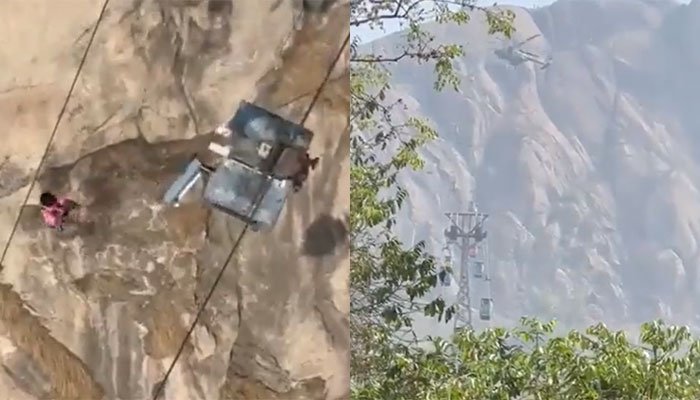
The rescue operation after the Tirkut Ropeway accident in the Deoghar district of Jharkhand is underway, and so far, over 40 people have been rescued by the agencies. Indian Air Force (IAF) is leading the rescue operation with support from Army, Indo-Tibetan Border Police (ITBP), Garuda commandoes and district administration. Two people, including a woman, have lost their lives.

The accident took place at the tourist location 20 KM from Deoghar. In an early-morning Twitter post, Deputy Commissioner (DC) Manjunath Bhajantri said that a total of ten out of 15 people had been rescued since morning. These 15 people could not be rescued on Monday due to extreme weather conditions and low visibility.

A woman who was among the rescued people was shifted to hospital on Sunday, where she succumbed to injuries that were sustained at the time of the accident. A man fell to death on Monday evening during the rescue operation.

Speaking to OpIndia, RK Mallick, Additional Director General of Jharkhand Police, said, “Proper inquiry has to be done by the agency that was carrying out the operation. They will be able to find out the reason for what happened. Only they can throw any light on that. It will not be proper for me to say anything. We have to wait for the assessment of the Air Force that was conducting the rescue operation.” ADG Mallick, who rushed from Ranchi to Deoghar after the ropeway accident, is overseeing the rescue operation.

There are a lot of speculations floating in the media about the reason behind the tragic accident during the rescue operation, but the clear reason can only be revealed by the Indian Air Force. OpIndia tried to reach out to the PRO of IAF but could not connect.

Hindustan Times quoted a rescued person saying that the accident took place at around 3:00 – 3:30 PM on Sunday. A total of 48 people were stranded in 12 of the 25 ropeway cars when the system halted following the rope down the line dislocated from the pulley. The rescue operation could be launched on Sunday evening but could not continue for long due to topography. The person said, “We had lost hope when we saw helicopters returning after doing two sorties. We could not sleep at night. We were provided food and water in the morning. I thank the rescue team for saving us.”

ITBP spokesperson Vivek Pandey said the rescue operation was difficult due to altitude and ropes. He said, “The first to be rescued were in the cabins that were only around 60 feet high from the ground. But risk increased as the height of the cabins progressively increased to over 500 feet, thus increasing the risk factor. The ITBP has previously conducted a similar rescue at a ropeway in Mussourie. We could not have risked trying to run the ropeway again as it is risk-prone to restart the system without a complete mechanical checking. So ultimately, the only option was to either provide anchors to the stranded and take them down or else airlift and land them at a safe place.”

BJP accused the Jharkhand govt of mismanagement

Jharkhand BJP president Deepak Prakash said in a statement that the tourism department failed to do routine maintenance for the past two years. He added that Hafizul Ansari, tourism minister of Jharkhand, failed to reach the accident site on Sunday though he was in Deoghar.

Speaking to OpIndia, Prakash said, “It was a complete failure of the state government. Thanks to Prime Minister Narendra Modi and Home Minister Amit Shah, who took cognizance of the matter and sent IAF, NDRF and Army for the rescue operation.”

Trikut Ropeway

As per the Jharkhand Tourism department, Trikut Ropeway is the highest vertical ropeway in India, with a maximum lens angle of 44 degrees. Located around 20 KM away from Baba Baidyanath Temple, Deoghar, its length is 766 meters. A total of 25 cabins are available with the capacity of four passengers per cabin.
India-US 2+2 meeting: Journalist rakes up the issue of Russian oil purchase, gets a befitting reply from EAM S Jaishankar

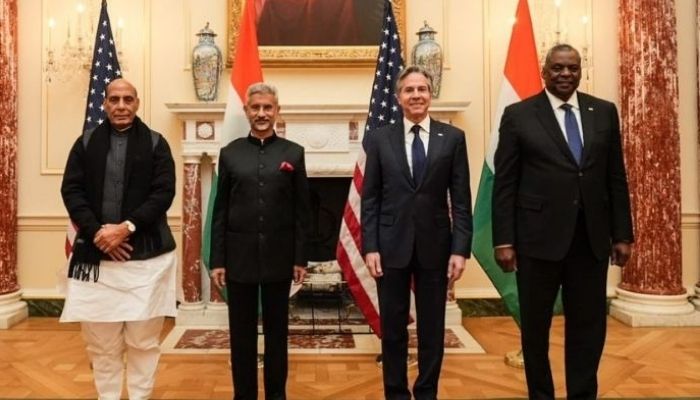
On Monday (April 11), External Affairs Minister S Jaishankar gave a befitting reply to a reporter, who had tried to raise the issue of Indian oil purchases from Russia during the 4th edition of the India-US 2+2 dialogue.

“I noticed you referred to oil purchases. If you are looking at energy purchases from Russia, I would suggest that your attention should be focused on Europe,” he emphasised.

Dr S Jaishankar pointed out, “We do buy some energy, which is necessary for our energy security. But I suspect looking at the figures. Our total purchases for the month will be less than what Europe does in an afternoon. So, you might want to think about it.”

S Jaishankar lambasts Western countries over its glaring hypocrisy on Russian oil imports

While speaking at the India-Uk Strategic Futures Forum earlier this month, Dr S Jaishankar reiterated that European countries were the biggest importers of Russian gas and oil.

While defending the decision to purchase Russian crude oil at discounted prices, the EAM emphasised that it was important for India to obtain good deals on energy supplies, at a time when global markets were volatile.

“It is interesting because we have seen for some time what looks almost like a campaign (against us) on this issue. When the oil prices go up, I think it is natural for the countries to go out into the market and look for what are good deals for their people,” he had remarked.

During a conversation with British Foreign Secretary of State Liz Truss, S Jaishankar emphasised that India purchased its majority of energy supplies from the Middle East. He pointed out that around 8% of the total oil imports were from the United States while less than 1% of crude oil purchases were from Russia.

He had added, “I am pretty sure if we wait two or three months and actually look at who are the big buyers of Russian oil and gas, I suspect the list would not be too different from what it used to be and I suspect we won’t be in the top 10 on that list.

Violence in Jawaharlal Nehru University over meat is just an excuse, the real aim is to humiliate Hindus

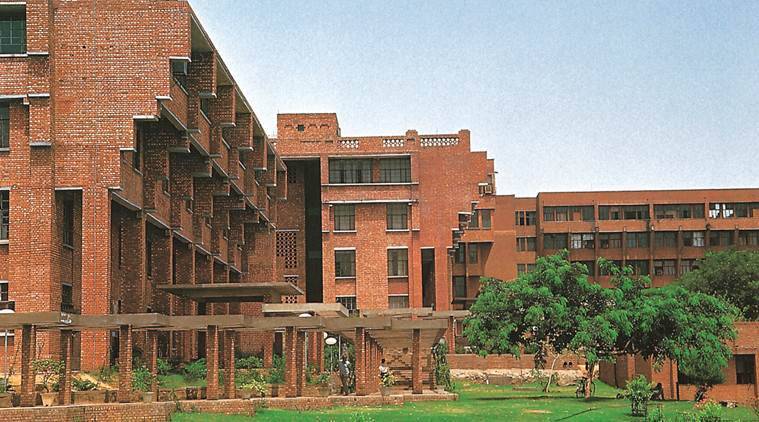
The latest incident of violence in Jawaharlal Nehru University (JNU) for serving meat is abhorrent, as such commotion has no place in an educational institution, let alone a university. Nothing gives a favourable impression to a university or institution when police vans and ambulances stop by every now and then. However, it appears that a certain segment of JNU has made it a badge of honour to continue drawing the attention of the authorities and the international community.

On the other hand, such violence on a Hindu holiday on the campus of an educated institution like JNU is not a mere coincidence. We are fully aware of JNU’s history and its milieu, which is infused with anti-Hindu air and partially secular water. With blood-splattered hands of ABVP activists to badly battered young learners, yesterday’s episode emphasises the campus-dominant left-liberal cabal’s conviction to dislodge the whole non-left existence off-campus.

Also, Why didn’t we hear something like this from Delhi University or Banaras Hindu University? Why is it exclusively JNU? This is because JNU has been specifically chosen by the anti-India and anti-Hindu forces looking at the stronghold of the left on the campus. Leaving aside the possibility of happenstance, no one knows how JNU appears in every single controversy, even if it didn’t originate there. This suggests that there is something fundamental that gets JNU embroiled in controversies from time to time. 

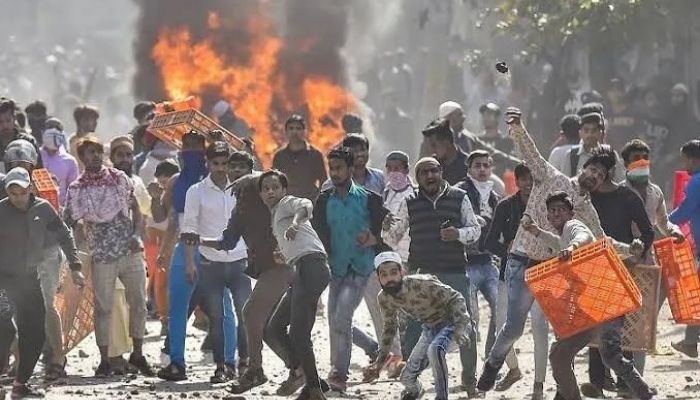
Surprisingly, the recent violence in JNU coincided with a wave of violence that erupted across the country on the eve of Ram Navami. Several reports have revealed stone-pelting and arson during Ram Navami festivities, particularly in Muslim-dominated localities. Looking at the sequence of events and the chronology, one may simply decipher what it implies.

The violence in JNU, according to the leftist student (so-called) unions, erupted over some concerns about serving meat in the canteens. While the consumption of meat is a question for another day, we are all very well aware of how meat has been politicised and used deliberately to harm the religious emotions of Hindus and Jains in recent times. This charge made by a certain element of the JNU adds another hand to the very same attempt.

Various ‘meat festivals,’ including ‘beef festivals,’ have been organised in the past by some sections of society in order to offend Hindus and Jains’ religious sentiments. Students Federation of India (SFI) and Democratic Youth Federation of India (DYFI), the students’ and youth wing of the Communist Party of India (Marxist), organised the ‘Beef Festival‘ in Kerala back in 2018.

Similarly, the motive for the violence at JNU was the Ram Navami festival, and the pretext of meat was used to continue demeaning Hindus. The major motive was to disturb the Hindu festival celebrations and then incite violence since there is always the chance to play the victim card in the end. And this has been a tried and tested formula. Be it the controversy surrounding the Hanuman stickers on the mirrors of the car or the deliberate vilification of the ‘Jai Shri Ram’ slogans, the left intelligentsia and their footsoldiers in places like JNU and other leftist bastions spare no time in inventing causes to guilt-trip Hindus and paper over the murderous tendencies of the Islamists.

Earlier yesterday, Ram Navami celebrations came under attack in 5 different Indian States, namely, Gujarat, West Bengal, Jharkhand, Madhya Pradesh and Karnataka. They were allegedly orchestrated by frenzied mobs, who were armed with stones and sticks, and determined to stop the Hindu processions from advancing through their ‘Muslim areas’. But the focus of the attention was not the stone-pelting that was witnessed during the processions but on an allegedly contrived controversy of some scuffle over the consumption of meat in JNU. A day later, the leftists are desperately trying to play the victim card, blaming the processions for being “provocative” while going through ‘Muslim areas’—a characterisation which is nothing but a contemporary manifestation of the divisive Two-nation theory.

Everyone is aware of JNU’s track record, and we all recall anti-India slogans on the campus a few years ago. JNU is being exploited to purposely promote the anti-India and anti-Hindu narrative. The recent incidence of violence at JNU was a similar attempt to humiliate Hindus on Ram Navami and inculcate fear that such incidents will become foreseeable if Hindus do not stick to their way of professing religion and allow them unjustified freedom across institutions and spaces to do whatever they want.

From Kashmir to Ram Navami: Quranic sanctions to ‘stoning’ the Devil and targeting of Kaafirs

Stone pelting was once an everyday phenomenon in the Kashmir Valley. Young children and grown men alike, dawned skull caps, unfurled ISIS flags and took to stoning the security forces in unison. However, with the abrogation of Article 370 in 2019, the cases of stone-pelting gradually began to drop. Today, it is close to nil.

However, it remained a central part of protests against the Indian Armed forces stationed in Kashmir. While sometimes stone-pelting was used by Islamists to agitate security forces, knowing fully well that the security personnel won’t use guns against them, at other times it was used as a tool to help besieged terrorists escape from being caught by the forces. Though it cannot be denied that several of the stone pelters were backed by the Pakistani deep state, the religious motivation behind it could not be understated.

Much like stone-pelting was used as an instrument of defiance against security forces in Kashmir, it was and has been routinely used to target Hindu processions when they pass through neighbourhoods that are now being referred to by the liberal intelligentsia as ‘Muslim areas’, which is nothing but a contemporary manifestation of the divisive Two-nation theory. Processions, carrying deities, often come under a volley of stones, followed by arson attacks, vandalism and violence, under the garb that they played devotional songs and hymns that ‘provoked’ the other side.

This was witnessed during the recent Hindu New Year celebrations in the Karauli district of Rajasthan where a Hindu procession, which was carried out after more than 7 years, witnessed stone-pelting and a wanton bout of violence and vandalism. Earlier yesterday, Ram Navami celebrations came under attack in 5 different Indian States, namely, Gujarat, West Bengal, Jharkhand, Madhya Pradesh and Karnataka. They were allegedly orchestrated by frenzied mobs, who were armed with stones and sticks, and determined to stop the Hindu processions from advancing through their ‘Muslim areas’.

As stone-pelting seems to be the default choice of action by the Islamists who get ‘provoked’ on something as fundamental as a procession being carried out from their ‘areas’ by non-Muslims, it is important to understand what the religious scriptures and commandments say about stone-pelting.

Stoning of the Satan in Islam

During the Islamic pilgrimage (Hajj) to Mecca, Muslims participate in a ritual called the Rami al-Jamarat. They hurl stones at 3 pillars (jamarat), believing it to be the abode of Satan. It must be mentioned that the Jamarat is located in Mina city, which is located east of Mecca.

The Islamic ritual mandates that Muslims collect 70 stones and throw them at the three pillars on the day of Hajj. The ritual is repeated for the following 3 days before the completion of the circumambulation of Kaaba.

“Narrated Ibn `Abbas: The Prophet made Al-Fadl ride behind him, and Al-Fadl informed that he (the Prophet ) kept on reciting Talbiya till he did the Rami of the Jamra (stoning of the Satan),” says Sahih al-Bukhari 1685.

Furthermore, the Sahih al-Bukhari 1748 notes, “Narrated Abdur-Rahman bin Yazid: When Abdullah, reached the big Jamra (i.e. Jamrat-ul-Aqaba) he kept the Ka`ba on the left side and Mina on his right side and threw seven pebbles (at the Jamra) and said, “The one on whom Surat-al- Baqara was revealed (i.e. the Prophet) had done the Rami similarly.”

A video of the ritual was shared by Qatar funded news outlet, Al Jazeera on Youtube. According to Islamic Finder, the stoning of Satan represents submission to the commandment of Allah.

“Throwing pebbles at the Satan is not as if Satan is present at the place, rather it is an exercise of faith: this act is a testament that the believers are able to resist the thoughts and desires that Satan puts in the believer’s mind,” it noted.

Islamic Finder further emphasised, “Even though a pilgrim is throwing a pebble at one of the pillars of Jamarat, but in fact, he or she is throwing them in the face of Satan as nothing annoys Satan more than a man following the command of Allah.”

Stoning to death for ‘adultery’

The Islamic practice of stoning is not just limited to pillars, assumed to be the embodiment of Satan. Adult men and women in Islamic countries are often flogged and stoned to death for committing the supposed sin of ‘adultery.’

Quran says in Chapter Number 24 (An-Nur) Verse 2:

“As for female and male fornicators, give each of them one hundred lashes, and do not let pity for them make you lenient in ˹enforcing˺ the law of Allah, if you ˹truly˺ believe in Allah and the Last Day. And let a number of believers witness their punishment.

Although there is no explicit mention of killing over adultery in the ‘Holy Book’, the authentic Hadith of Sahih Muslim (which contains the sayings of Prophet Muhammad) claims otherwise.

For instance, the Sahih Muslim Book 17, Hadith Number 4191 states

“Ubada b. as-Samit reported: Allah’s Messenger (may peace be upon him) as saying: Receive (teaching) from me, receive (teaching) from me. Allah has ordained a way for those (women). When an unmarried male commits adultery with an unmarried female (they should receive) one hundred lashes and banishment for one year. And in case of married male committing adultery with a married female, they shall receive one hundred lashes and be stoned to death.

A clarification for the disparity in punishment between Quran and Hadiths for adultery is explained in the Sahih Muslim Book 17, Hadith Number 4194. It states

“…I am afraid that with the lapse of time, the people (may forget it) and may say: We do not find the punishment of stoning in the Book of Allah, and thus go astray by abandoning this duty prescribed by Allah. Stoning is a duty laid down in Allah’s Book for married men and women who commit adultery when the proof is established, or it there is pregnancy or a confession.”

Conclusion

Given that Islamists are purists who adhere to the Quranic and Hadith sanctions in all its entirety, it cannot be ruled out that an idol-worshipping Hindu might appear as an embodiment of the ‘Devil’ to them. Also, several scholarly accounts claim that Islamic texts preach extermination of non-believers and apostates, and regard idolatry as one of the biggest ‘sins’.

It must be recalled that former Shia Waqf Board Chief Waseem Rizvi (converted to Jitendra Narayan Singh Tyagi) had last year appealed to the Supreme Court to remove 26 verses of the Quran, which called for the annihilation of infidels and disbelievers.

It is, most likely, for these reasons, that stone-pelting has become such a popular practice among Islamists. Whether it is their opposition to security forces, and by extension, to India’s sovereignty of Kashmir, or their antagonism towards processions carried out on Hindu festivals, they don’t flinch from resorting to stone-pelting, which has been widely cited in various Islamic texts.

Considering that the targeting of the Hindu festivals is a routine occurrence, can the indoctrination of bigotry, coupled with sanctions of the religious scriptures, be ruled out?

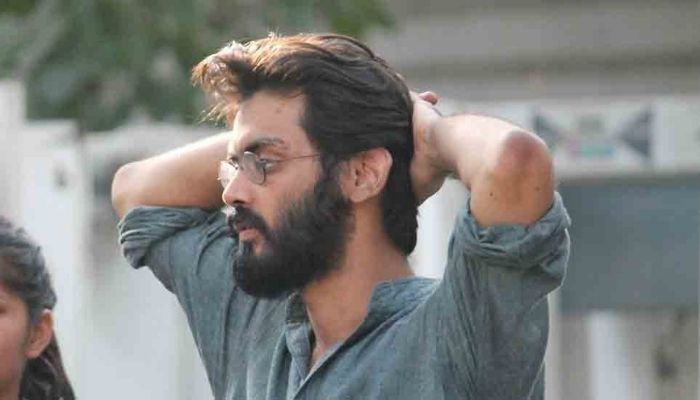
Sedition accused Sharjeel Imam denied bail again by Karkardooma Court in the Delhi Riots conspiracy case

The Karkardooma Court in Delhi denied bail to former JNU student and Islamist Sharjeel Imam in a case under the Unlawful Activities (Prevention) Act (UAPA) concerning the Delhi Riots in early 2020. The Delhi Court on Monday dismissed the bail plea moved by Imam over his connection with a case regarding a conspiracy into the Delhi riots of 2020.

Additional Sessions Judge Amitabh Rawat pronounced the order after hearing the arguments made by Advocate Tanveer Ahmed Mir appearing on behalf of Sharjeel Imam. Special Public Prosecutor Amit Prasad appeared for the prosecution.

Arguments by Mir on behalf of Sharjeel Imam

Advocating the bail plea for Imam, Advocate Tanveer Ahmed Mir asserted that no allegation of conspiracy can be framed against Imam while he was arrested in another riots case, days before the riots in Delhi started on the 24th of February. Mir contended that the act of conspiracy as alleged by the prosecution did not arise as his arrest had happened prior to the violence that took place. Mir asserted, “Arrest is prior, riots are later. I reiterate arrest is prior, riots are later.”

Mir said that we cannot have a system where conspiracies become endless and are rendered in perpetuity against the accused. He asked how conspiracies against Sharjeel Imam could continue even after his arrest. “We can’t have a situation where conspiracies become endless, suits a government case. Law of conspiracies by State has to be within boundaries, can’t be endless,” he added. “What act of mine post my arrest is being called into play for larger conspiracy, to cause the murder of who? Even at this stage of bail, if this kind of conspiracy is sustained, we will be turning the law of conspiracy on its head,” Mir asked on behalf of Sharjeel Imam.

Advocate Mir had argued that in order to deny bail in the matter, there has to be evidence of an overt act of conspiracy to cause a riot staged in a particular location which can be attributed to Imam.

Opposition to Imam’s bail plea

Special Public Prosecutor Amit Prasad who opposed the bail plea stated, “The arrest of Sharjeel Imam is not for conspiracy but for seditious speech prior to his arrest. So to say the arrest is for conspiracy is a misdirected argument. If a conspiracy was detected and investigative agencies were able to prevent riots from happening, even then it would be termed a conspiracy. What is being argued is not in line with the factual positioning of this case.”

Prasad referred to various events dating back to early December 2019, showing Imam’s alleged involvement in the criminal conspiracies following his speech and conversations with Islamist groups in the run-up to the riots. Inciteful speeches were delivered by Sharjeel Imam at Aligarh Muslim University (AMU) and Jamia Milia Islamia in Delhi during the anti-CAA-NRC protests. On January 24 this year, the Court had also framed charges of sedition, promoting enmity between different groups on grounds of religion, race, place of birth, imputations prejudicial to national integration, and public mischief under the Indian Penal Code, and indulging in unlawful activities under UAPA.

Hearing arguments from both sides, Additional Sessions Judge Amitabh Rawat dismissed the bail plea by Sharjeel Imam. The Islamist activist remains in custody since January 2020 after he gave calls for the separation of the north-eastern states from the rest of India.

Hinduphobic Instagram audio case: Accused Nadeem shifted to Assam from Rajasthan’s Bikaner, informs Guwahati police

0

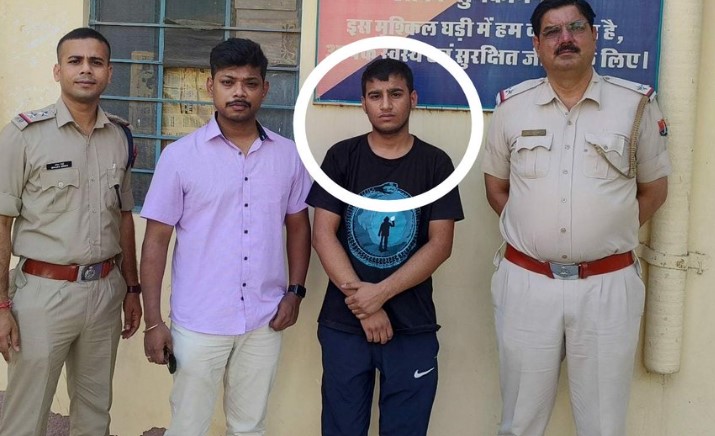
On April 6, an audio clip featuring Instagram influencer Sabnam and her friend Nadeem had gone viral where Nadeem was heard saying Hindus should be raped, identified, and killed. The accused Nadeem, who was arrested by Naya Shahar Police in Bikaner on Friday, April 8, is now being brought to Guwahati, Assam.

The Guhawati police Tweeted on April 11, that the accused Nadeem, who made communally insulting statements in a live Instagram chat, was in their custody with the Rajasthan police’s assistance. He is being brought to Guwahati, to be prosecuted in All Women PS Case no. 25/2022.

It may be recalled that the Naya Shahar Police in Bikaner had arrested Nadeem on April 8 and taken him into custody, while Instagram influencer Shabnam, a co-accused in the case was still at large. The action was taken based on a complaint filed by a local resident from the Pareek Chowk area, Rishi Kumar regarding the audio clip that went viral on Social media platforms. Police had filed a case under sections 295 (A) and 34 of the Indian Penal Code.

On April 6, in another Tweet, the Guwahati Police had informed that it had taken cognizance of the viral audio clip of an Instagram Influencer and her friend where they were calling for identifying, raping and killing Hindus. In reply to a Twitter user, Guwahati Police said that the matter had already been taken up.

The Hinduphobic audio clip went viral on social media

On Wednesday, an audio clip of Instagram Influencer Sabnam and her friend Nadeem went viral on social media platforms. During the conversation with Sabnam, Nadeem was heard making extremely vile, violent and abusive statements about Hindus, Hinduism and Hindu Gods. He said Hindus should be identified, raped and killed.

While Nadeem was abusing Hindus, Sabnam was giggling and praising his sense of humour. Nadeem alleged he saw three Hindus being killed in front of him, and no Hindu dared to come to their area. He further said if he had an AK47, he would kill Hindus himself. He claimed to have sexually exploited many Hindu women.

Sabnam had played the victim card and posted stories that she was getting rape and death threats in the DMs. She further claimed that she would commit suicide as the issue went out of hand and she could deal with it anymore.

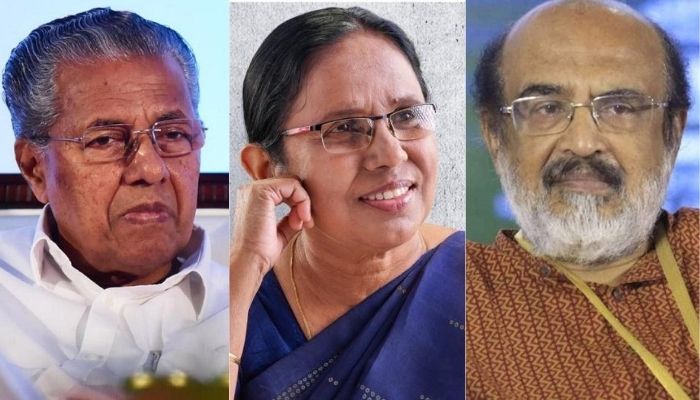
Kerala: CM Pinarayi Vijayan, former FM Thomas Isaac, and former health minister KK Shailaja ordered PPE kits at higher prices, RTI reveals

0

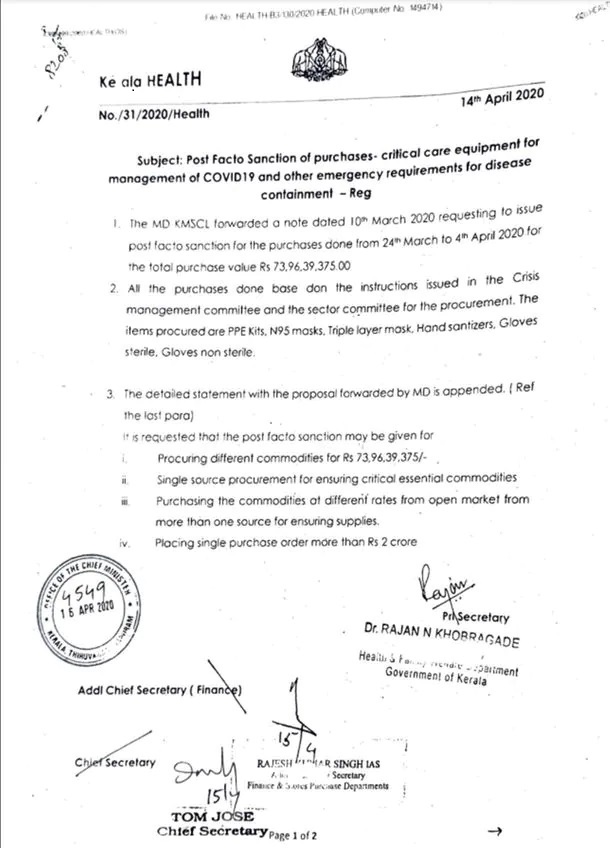
In response to an RTI application, it has been learned that Kerala Chief Minister Pinarayi Vijayan and former Finance Minister of the state TM Thomas Isaac had sanctioned the order of PPE kits at an increased rate during the First Wave of Covid-19 infections in India. In a controversy that had plagued the former Health Minister KK Shailaja who was accused of buying PPE kits at higher rates, it has now been learnt that the Chief Minister and the then Finance Minister were aware of the purchase.

A recent RTI shows that LDF leaders Pinarayi Vijayan and TM Thomas Issac were complicit in the purchase of expensive PPE kits in Kerala as both of them, along with KK Shailaja had sanctioned the purchase. In a purchase done by the Kerala Medical Services Corporation Limited (KMSCL) between March 24 to April 4, 2020, PPE kits worth Rs 1550 per unit were bought against Rs 450 per kit rate offered by a local Kochi-based company. KMSCL is a fully owned government Company that provides services to the various health care institutions under the Health Ministry of Kerala.

RTI response to the application filed. Courtesy: Mathrubhumi.com

According to the RTI response, the chief minister, finance minister, and the chief secretary had sanctioned the procurement of medical equipment like PPE kits, N95 masks, Hand Sanitizers, and Sterile and Non-sterile gloves with a total purchase value of Rs 73,96,39,375. With the rapidly rising Covid-19 infections in the state, bulk orders for procuring PPE kits were given to companies like IV Links, Careon, New Care, New Care Hygiene Products, Mahila Apparels and Fasten for a price range between Rs 304.5 to Rs. 446.25 Until March 23, 2020.

However as reported by TOI, after March 24, a bulk order at the suddenly increased rate of Rs 1550 per unit was given to ‘San Pharma’. This suggests that not just the former health minister KK Shailaja, but also the finance minister and Chief Minister were aware of the purchase of PPE at three-fold prices. The query was filed by an RTI activist cum Congress leader Adv CR Pranakumar.

Corruption allegations against KK Shailaja

KK Shailaja who was the health minister when Kerala was among the worst-hit states by Covid-19, was facing corruption allegations by the opposition for inflated expenditure during the purchase of PPE kits. Shailaja Teacher, who got several awards from Indian media for delivering the highest Covid cases in India, was dropped as a minister in the new cabinet of the Left government in Kerala after their re-election in 2021.

In a clarification, KK Shailaja justified the purchase of PPE kits at higher prices stating that the order was to be procured swiftly considering its size.

“We purchased PPE kits wherever they were available at higher prices. After some time, when the production picked up, including in foreign countries, the supply improved and the prices decreased. Then we were able to buy PPE kits, which we had earlier bought at Rs 1500/unit, at Rs 500,” she added while clarifying her stance in December 2021.

Watch: PTI lawmaker records a video inside Pakistan parliament, calls the newly elected PM Shehbaz Sharif an ‘international beggar’

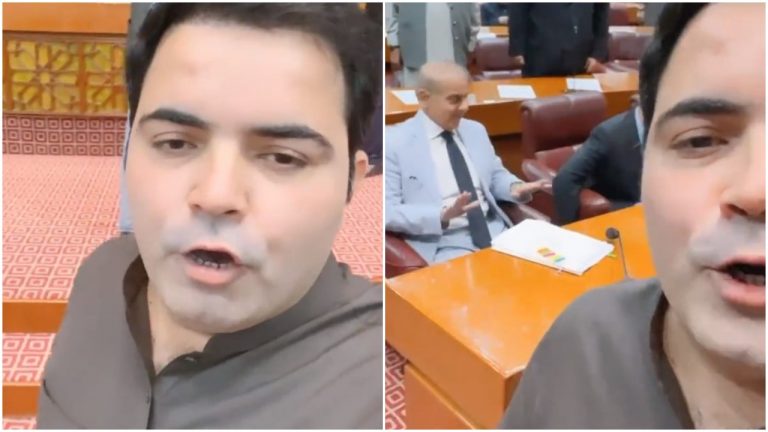
Amidst the political turmoil in Pakistan, a video has gone viral on social media wherein Imran Khan’s party Pakistan Tehreek-i-Insaf (PTI) MNA from Karachi Faheem Khan is heard calling the newly elected PM of the country Shehbaz Sharif an ‘international bhikari’ (beggar). The self-recorded video was captured in the National Assembly as the Imran Khan-led party members tendered their resignations, making way for opposition leader Shehbaz Sharif to take charge as the country’s next Prime Minister.

MNA Faheem Khan himself took to Twitter to share the video.

In the video, recorded hours before Shehbaz Sharif’s oath-taking as Pakistan’s PM, MNA Faheem Khan is heard saying, “Right now, I am standing in the National Assembly and I would like to show you an International beggar.” Khan turns the camera towards Shehbaz Sharif and added, “This is the man who himself is a beggar and calls the country a beggar. We are not beggars, we are an independent nation. These people are beggars.”

Meanwhile, on Monday, April 11, Shehbaz Sharif, the brother of former Prime Minister Nawaz Sharif and the leader of the opposition PML-N, was elected unopposed as Pakistan’s next Prime Minister, succeeding Imran Khan, who was ousted by a no-confidence vote on Saturday.

Imran Khan loses no-confidence motion

Imran Khan’s tenure as Prime Minister of Pakistan was finally over on Saturday night as he lost the no-confidence motion in Pakistan’s National Assembly. Khan joined the long list of Pakistani Prime Ministers who have failed to complete their full tenure as per the official Pakistani Constitution.

Since Pakistan’s inception, no PM has managed to survive the full term, and Imran Khan didn’t turn out to be an exception. This time, there was no direct coup by the Pakistan Army, and Imran was displaced by a show of opposition unity, and by America as per Imran’s party Pakistan Tehreek-e-Insaf (PTI). Pakistan Army, which had allegedly installed Imran as the PM of the country, didn’t come to his support as he lost the battle in Supreme Court and then the National Assembly.

In the run-up to the no-confidence vote, Imran Khan and his party colleagues repeatedly said that their government was being destabilized by a foreign power, namely the United States of America. They said that Imran Khan is being punished for visiting Russia ahead of the Russia-Ukraine war. However, this attempt to blame foreign powers didn’t work, and Imran Khan ended up losing his post as the Prime Minister of Pakistan.

The opposition parties in Pakistan had accused Khan of corruption and economic mismanagement, along with the prevailing high inflation and a weakening currency. While Imran tried to rally support around him through religion and by claiming a foreign conspiracy against Pakistan, eventually it wasn’t enough.

‘There was a love affair, who knows whether it was rape or she was pregnant’: Mamata Banerjee trivializes rape and murder of a 14-year-old girl

West Bengal Chief Minister Mamata Banerjee has decided to downplay the brutal rape and murder of a 14-year-old girl in Nadia’s Hanskhali village last Monday. The case in which a TMC leader’s son was named as the accused has shaken the people up as it involves a minor being raped and murdered. Mamata Banerjee stated that everyone was aware of the girl’s love affair, so one is left to wonder here whether it was an actual rape or pregnancy that went wrong.

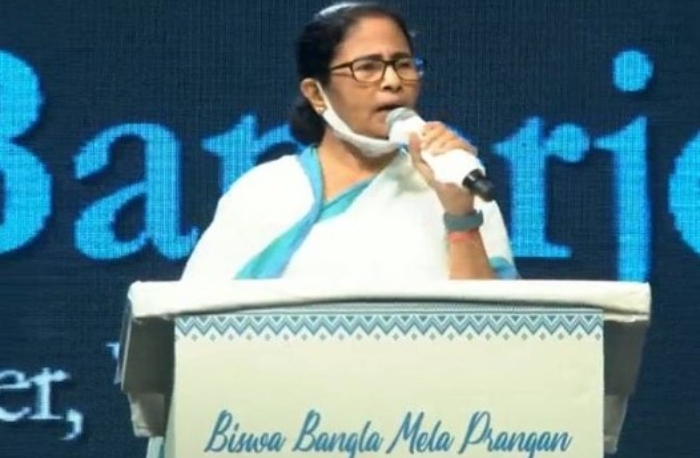
Speaking at the inauguration of the revamped Milan Mela, a permanent fair-ground opposite the Science City at the Eastern Metropolitan Bypass in Kolkata on the afternoon of April 11, Monday, the CM cast doubt on the rape aspect of the crime. In an obvious attempt to exonerate her party leader’s son from the heinous crime, Mamata Banerjee also went on to cast aspersions on the deceased minor girl’s character.

She said in Bengali, “As a layman, I am saying where would someone get the evidence whether she was actually raped or was she pregnant or was there any other reason, like someone beat her up or she died of some illness. There was a love affair for sure, her family knew about it, and their neighbors also knew about it. Now if a girl and a boy love each other, I cannot punish them”, said the WB Chief Minister Mamata Banerjee. “This is not Uttar Pradesh that I can do that in the name of Love Jihad”, said the West Bengal Chief Minister.

She further went on to lambast the media for politicizing the incident to defame the state.

Amit Malviya, a BJP leader, shared a snippet of her speech in which he condemned the CM’s abysmal reaction to such a heinous offense simply because the accused was the son of a TMC leader. Malviya Tweeted, “Shocking statement by Bengal CM Mamata Banerjee, who trivializes the brutal rape and murder of a 14-year-old girl in Nadia’s Hanskhali. She questions the victim and asks if it was a love affair or a case of unplanned pregnancy gone awry! Because the accused is TMC leader’s son.”

Many other social media users also criticized Mamata Banerjee for her insensitive remark on the Hanskhali incident. One recalled Mamata Banerjee’s similar whitewashing of the 2012 Park Street rape incident, where a woman was raped by five men after she exited a nightclub. Then too, Mamata Banerjee had said that it was not a case of sexual assault but a misunderstanding during a deal between a woman and her “client”.

Meanwhile, West Bengal BJP has called for a 12-hour bandh tomorrow, April 12, from 6 am to 6 pm protesting the Hanskhali rape and murder case of a minor. 

Public interest litigation has also been filed in the Calcutta High Court on Monday, demanding a CBI probe into the matter. It is likely to be heard on Tuesday.

It may be recalled that a Trinamool Congress leader’s son has been accused of raping a juvenile girl by inviting her to his birthday party. The girl died from heavy bleeding, and her body was allegedly cremated by the accused forcefully.

The girl’s family claimed that the main accused is Brajgopal the son of Gajna Gram Panchayat member Samar Gowla.

The police have arrested the accused and registered a case under the Protection of Children from Sexual Offences (POCSO) Act, 2012. The accused, the son of a local TMC dominated panchayat, was slapped with the charges of rape, murder, and suppressing evidence. 

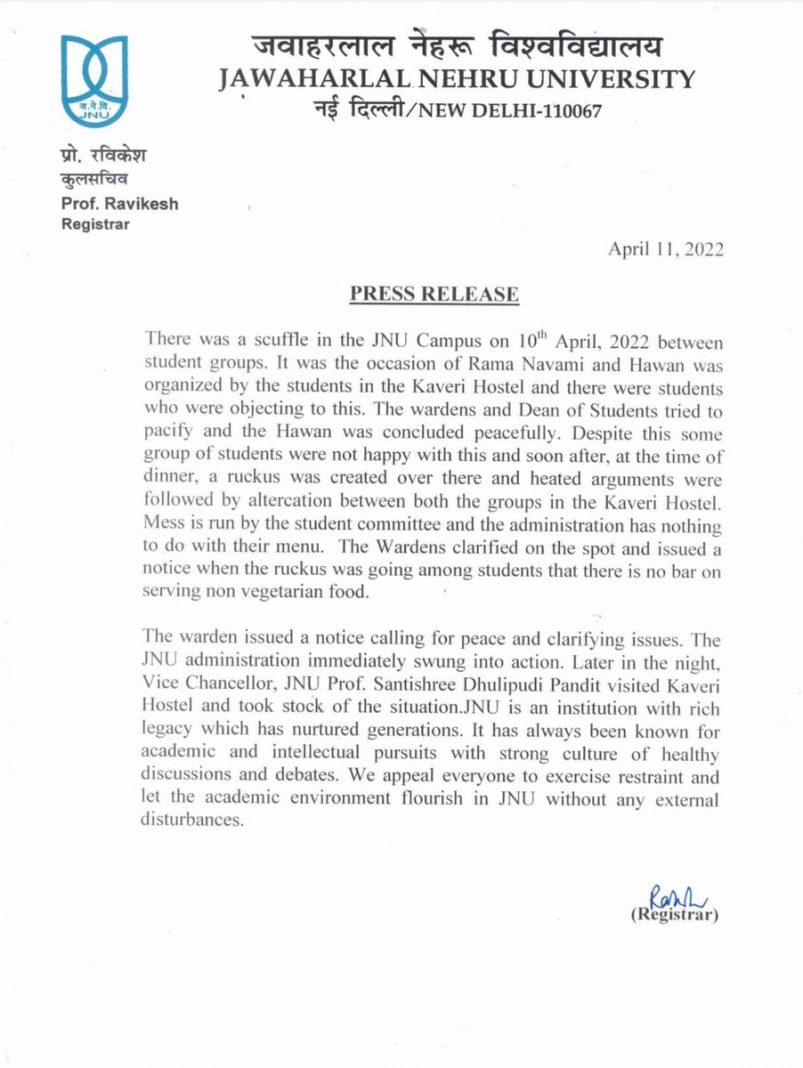
‘Some students objected to Hawan on Ram Navami’: JNU issues statement after campus fight

A day after the attack by Leftist student organizations on the residents of Kaveri Hostel during the Ram Navami celebrations, the Jawaharlal Nehru University issued an official press release clearing the air on the issue. In an appeal, the administration has asked the students to “exercise restraint and let the academic environment flourish in JNU without any external disturbances.”

The statement issued by JNU administration on Monday

On Monday, April 11, The Jawaharlal Nehru University has taken cognizance of the attack on Ram Navami Celebrations that were taking place in the Kaveri Hostel on Sunday. After various versions of the incident emerged in the media from the members of the RSS-affiliated-Akhil Bharatiya Vidyarthi Parishad (ABVP) and Left wing student organizations including the National Students Union of India (NSUI) and All India Students’ Association (AISA), the JNU administration has issued an official statement condemning the ruckus.

“There was a scuffle in the JNU Campus on 10 April 2022 between student groups. It was the occasion of Rama Navami and Hawan was organized by the students in the Kaveri Hostel and there were students who were objecting to this. The wardens and Dean of Students tried to pacify and the Hawan was concluded peacefully,” the statement noted.

The statement further added, “Despite this, some group of students were not happy with this and soon after, at the time of dinner, a ruckus was created over there and heated arguments were followed by an altercation between both the groups in the Kaveri Hostel. Mess is run by the student committee and the administration has nothing to do with their menu. The Wardens clarified on the spot and issued a notice when the ruckus was going among students that there is no bar on serving non-vegetarian food.”

Talking about the swift measures taken by the administration to calm the situation, the statement read, “The warden issued a notice calling for peace and clarifying issues. The JNU administration immediately swung into action. Later in the night. Vice-Chancellor, JNU Prof. Santishree Dhulipadi Pandit visited Kaveri Hostel and took stock of the situation. JNU is an institution with a rich legacy which has nurtured generations. It has always been known for academic and intellectual pursuits with a strong culture of healthy discussions and debates.”

What happened on Ram Navami night?

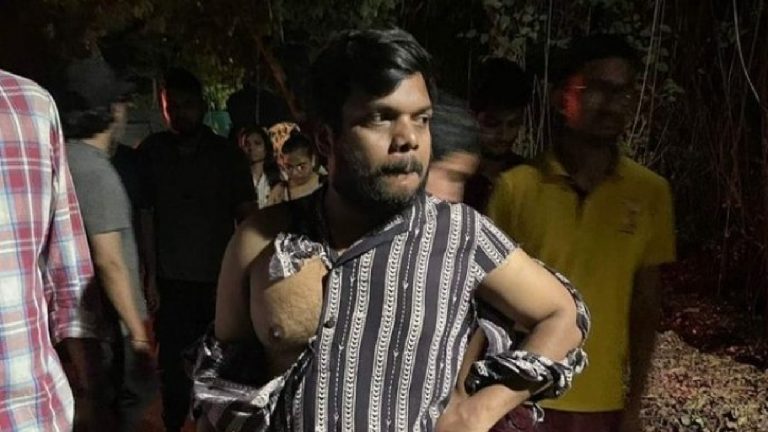
Reportedly, some members of ABVP had organised a Hawan and Puja on account of Ram Navami on Sunday, April 10 inside the JNU campus. The ABVP has accused the Left-wing student organizations and the National Students Union of India (NSUI) of stopping them from performing the Hawan and Puja at the Kaveri Hostel inside the JNU campus. However, the Leftist students have alleged that ABVP members had a scuffle with the mess manager as non-vegetarian food was being served on the day of Ram Navami.

The festivities finished in a tense environment with several ABVP members injured while seven of them sustained severe injuries.