Home Blog Page 3648

‘Gandhi’s politics is hollow and noisy, full of treachery and deceit’: Read what Dr Ambedkar said about the ‘Mahatma’

A lot of noise is being made over criticism of MK Gandhi after Kalicharan Maharaj’s recent speech at the Raipur Dharma Sansad. The Chhattisgarh government headed by Congress’ Bhupesh Baghel has now arrested Kalicharan and many people are asking an important question. Is MK Gandhi beyond criticism? Why are some political leaders so touchy and indignant about Gandhi being criticised?

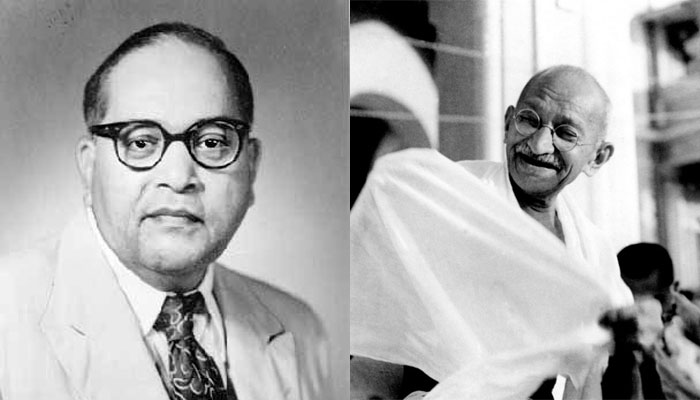
Author and scientist Dr Anand Ranganathan today shared some statements written by Dr BR Ambedkar wherein he had criticised MK Gandhi and his style of politics in a not so subtle manner.

Dr Ranganathan questioned those who are demanding the arrest of those criticising Gandhi if they would go after Dr Ambedkar too. While sharing an excerpt from an article Dr Ambedkar wrote about Gandhi, he said, “What Kalicharan Maharaj has said on Gandhi is nothing compared to what Dr Ambedkar had said on Gandhi, a tiny fraction of which I attach as proof. Dear bhakts of Mahatma Gandhi, let me see if you have the guts to go after Babasaheb. Bloody hypocrites.”

The excerpt Ranganathan shared was from the article ‘Is Gandhi A Mahatma?’ Dr Ambedkar wrote for a Marathi Magazine Chittra. It was published in its Dipavali Special Number, J 938. It is also available on page 66 of ‘Dr Babasaheb Ambedkar – Writings and speeches volume 17 part II‘ available on Ministry of External Affairs website.

In the article, Dr Ambedkar talked about how the politics of Gandhi was hollow and noisy. He said, “The politics of Gandhi is hollow and noisy. It is the most dishonest politics in the history of Indian polity. Gandhi was the man responsible for eliminating morality from politics and instead introduced commercialism in Indian politics. Politics has been denuded of its virtue.”

In the 1,800+ word article, Dr Ambedkar extensively talked about why he had a problem with Gandhi being referred to as Mahatma. He said he was sick of the question ‘Is Gandhi a Mahatma’. Explaining why the question annoyed him, he said, “Firstly, I hate all the Mahatmas and firmly believe that they should be done away with. I am of the opinion that their existence is a curse to the nation in which they are born. The reason why I say so is because they try to perpetuate blind faith in place of intelligence and reason. Secondly, I do not know what exactly people understand by the word Mahatma.”
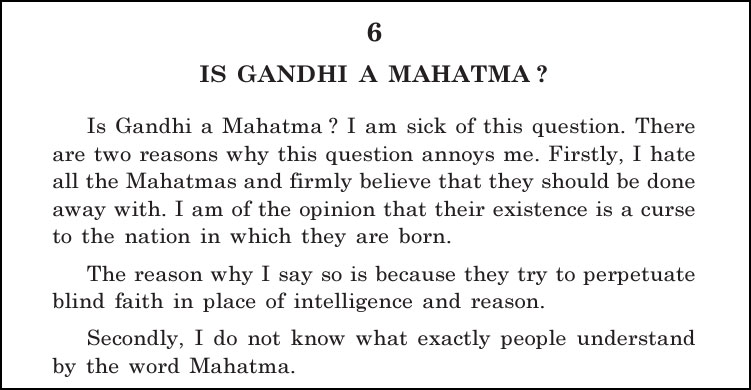
Excerpt from Is Gandhi A Mahatma?’ by Dr Ambedkar from ‘Dr Babasaheb Ambedkar – Writings and speeches volume 17 part II’ Source: mea.gov.in

Explaining how people were referred to as Mahatma in India at that time and how easy it was to become one, Dr Ambedkar said, “It is very easy for anybody to become a Mahatma in India by merely changing his dress. If you are wearing an ordinary dress and leading an ordinary life, even if you perform extraordinary noble deeds, nobody takes any notice of you. But a person who does not behave in normal manner and shows some peculiar trends and abnormalities in his character, he becomes a saint or a Mahatma.”
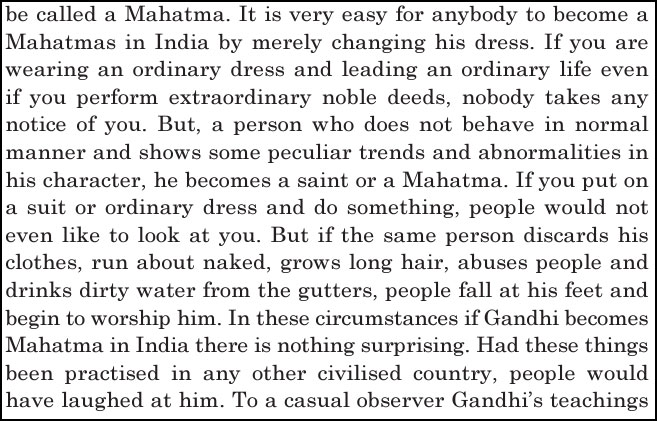
Excerpt from Is Gandhi A Mahatma?’ by Dr Ambedkar from ‘Dr Babasaheb Ambedkar – Writings and speeches volume 17 part II’ Source: mea.gov.in

Dr Ambedkar said he was not surprised Gandhi became Mahatma in India because people had the tendency to worship those who “discards his clothes, run about naked, grows long hair, abuses people and drinks dirty water from the gutters.” He added, “people fall at his feet and begin to worship him. In these circumstances if Gandhi becomes Mahatma in India there is nothing surprising.” Hinting India was an uncivilised country, Dr Ambedkar said, “Had these things been practised in any other civilised country, people would have laughed at him.”

Dr Ambedkar expressed his confusion why people fussed over Gandhi over the teachings like ‘Satya’ and ‘Ahimsa’ that originally came from Lord Buddha. “Nobody except an ignorant fool or congenital idiot would give credit to Gandhi for originality in this matter. There is nothing new in the pronouncement that ‘Truth and Non-violence’ are necessary for the preservation of human civilisation. There is nothing new that Gandhi has added to the maxim,” he said.

He added Gandhi did not provide answers to many questions regarding in what circumstances the world should uphold the noble principle of ‘truth’ and consider violence a ‘right action’. He said Gandhi’s character leaned more towards cunningness than seriousness or sincerity. “He has managed to keep himself in the forefront by means of cunning and inherent shrewdness. A person who has faith in his capacity and character faces the realities of life in a bold and manly manner,” Dr Ambedkar added.

“Treachery and deceit are the weapons of the weak. Gandhi has always used these weapons,” said Dr Ambedkar. He mentioned how during the Round Table Conference, he promised not to raise any objection against the demands to be tabled by the Depressed Classes. However, as soon as they tabled their demands, he objected to the same. “I call it a betrayal of the people belonging to the Depressed Classes,” Dr Ambedkar said. He added, “He went to the Moslems and told them that he would support their 14 demands if they in turn opposed the demands placed by the representatives of the Depressed Classes. Even a scoundrel would not have done this. This is only one instance of Gandhi’s treachery.”
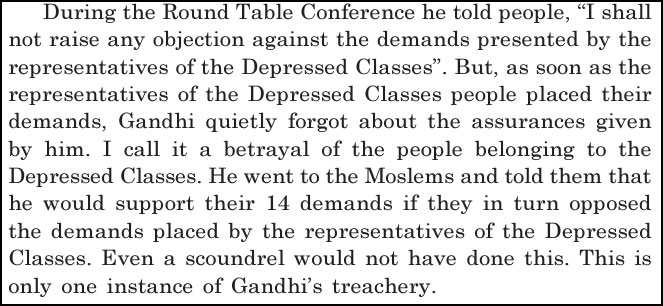
Excerpt from Is Gandhi A Mahatma?’ by Dr Ambedkar from ‘Dr Babasaheb Ambedkar – Writings and speeches volume 17 part II’ Source: mea.gov.in

He further added how Gandhi, in order to humiliate Nehru, opposed the proposals made to amend the Nehru Committee’s Report during an open session of Congress. He said, “The corrections which were proposed to be made in the Nehru Committee Report were suggested by Mr Jinnah for the benefit of his community. But, when Gandhi came to know about it, he thought a great deal more had been given to the Moslems by Pandit Motilal Nehru than what he wanted In order to humiliate Pt. Motilal Nehru he vehemently opposed these proposals.”

Dr Ambedkar also blamed Gandhi for the hostile relation between Hindus and Muslims. He said, “Hindu-Moslem hostility is the result of the deceitful action on the part of Gandhiji. This immensely pained me. There is an old saying which benefits the occasion (Bagal mein chhurri Munh mein Ram) : ‘God’s name on the lips and dagger under the armpit.’ If such a person can be called a Mahatma, by all means call Gandhi a Mahatma.”
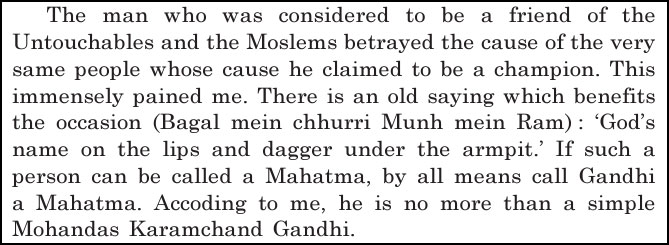
Excerpt from Is Gandhi A Mahatma?’ by Dr Ambedkar from ‘Dr Babasaheb Ambedkar – Writings and speeches volume 17 part II’ Source: mea.gov.in

He added, “The politics of Agarkar and Tilak was based on honesty and truth. It was not hollow and noisy. But the politics of Gandhi is hollow and noisy. It is the most dishonest politics in the history of Indian polity. Gandhi was the man responsible for eliminating morality from politics and instead introduced commercialism in Indian politics. Politics has been denuded of its virtue.”

Dr Ambedkar urged Hindus to find a way to get rid of the pernicious saintly idiosyncracies of Gandhiji in Indian public life. He said, “If the Hindu India does not realise it today, it will take a long time to retrace its steps. Majority of the Indian population is illiterate, ignorant and uncivilised. This may not be the fault of the people. The privileged few of the society have deliberately kept the masses ignorant and illiterate. As a matter of fact it is impossible to fight against the Mahatma on the strength purely of logic and rationalism.”

Dr Ambedkar questioned the saints and mahatmas of that time and equated Gandhi to them. He said they had learned the ways to befool people. He questioned if Hindu would try to change the minds of ‘mahatmas’ so that they try to serve India rather than themselves. 
Yogi, the UPYogi for Uttar Pradesh: An analysis of the transformation of UP and how BJP can continue its UPward move

Uttar Pradesh lies on the hallowed grounds that saw the rise and fall of various important chapters in Indian history. Modern India has seen a flux of political entities, leaders, trends and issues in Uttar Pradesh over the years. Pandit Govind Ballabh Pant, leader of the Congress Party, was the first Chief Minister to lead an elected Assembly in Uttar Pradesh in 1951, followed by Sampurnananda, Chandra Bhanu Gupta and Sucheta Kripalani.

Supported by Ram Manohar Lohia and Raj Narain, and Jana Sangh’s Nanaji Deshmukh, Chaudhary Charan Singh formed the first non-Congress government in 1967, leading the Samyukta Vidhayak Dal (SVD), a coalition that had parties as disparate as the Communist Party of India (Marxist) and Bharatiya Jana Sangha (BJS), along with the Swatantra Party, Republican Party of India and Praja Socialist Party. The next few decades saw a Congress resurgence (which also had six Chief Ministers from 1980 to 1988!) followed by the Janata Party experiment.

In 1991, the politics around Mandir and Mandal (Commission) saw the tussle between two OBC heavyweights: Mulayam (Singh Yadav) vs Kalyan (Singh), while the first Dalit-OBC coalition took power in UP in 1993, with Mulayam Singh Yadav and Mayawati allying to form the government. The latter would go on to become the first Dalit Chief Minister to be sworn in, in 1995. The next couple of decades saw the rise and fall of governments by Kalyan Singh (BJP), Ram Prakash Gupta (BJP), Rajnath Singh (BJP), Mayawati (BSP), Mulayam Singh Yadav (SP) and Akhilesh Yadav (SP).

Prime Minister Narendra Modi’s charisma, BJP’s caste arithmetic of wooing non-Jatavs, non-Yadav OBCs and upper castes, along with the reverse polarization of Hindu votes due to the excessive wooing of Muslim voters by SP and BSP, smart and aggressive social media campaigning by the BJP, infighting in the Samajwadi fold and a divided opposition helped the Bharatiya Janata Party to seize power in 2017. In a rather surprising move, instead of going for state bigwigs like Rajnath Singh, Uma Bharti or Keshav Prasad Maurya, the BJP opted for Yogi Adityanath, the politically powerful Sanyasi from Gorakhpur in eastern Uttar Pradesh, as its Chief Minister.

Yogi was a popular face who had been a Member of Parliament from Gorakhpur for five consecutive terms. A disciple of Mahant Avaidyanath who was himself a disciple of Mahant Digvijay Nath, he followed his Guru and Guru’s Guru in taking up the mantle of the Gorakhnath Math as well as pursuing an assertive Hindu brand of politics from Gorakhpur. He was controversial in certain sections of the populace and media, with Amnesty International even saying that “Adityanath has been one of Uttar Pradesh’s most polarising politicians.” However, many people across the state also felt that if there was anyone who could bring the complete disarray of UP under the SP’s Yadav factions, it had to be the Mahant from Gorakhpur. As we move towards the upcoming state election in Uttar Pradesh, let us look back at the last five years and see how the Yogi government has fared in Uttar Pradesh.

Gundaraj No More

Crime is one of the most debilitating factors that has hindered the growth and development of Uttar Pradesh over the decades. As per the data released by the National Crime Records Bureau (NCRB) in late March of 2021, the crime situation has considerably improved in the state. Uttar Pradesh has seen a reduction of rape cases from 59,445 in 2018 to 49,385 in 2020, with a charge sheeting rate of 77.1% in 2020, as well as among the highest conviction rate of such crimes today. This has been due to proactive steps taken by the Yogi government, which include women helpdesks, night security cover scheme, UP-122 India App, anti-Romeo squads and pink booths.

The state has also seen a sharp fall in instances of murder and cyber-crime. The NCRB has shared that the state government has also recorded a high rate of charge sheeting at 49.9% for cyber-crimes, although the number of cases has increased from 6,280 in 2018 to 11,097 in 2020. Police disposal of IPC crime cases has been positive with 2,81,162 cases charge sheeted in all (with a charge sheeting range of about 77%) and 3,65,628 cases disposed of, in 2020. Uttar Pradesh has seen a dramatic decline of almost 20% from the year 2016 to 2020, in cases of murder. 3,904 arms were seized from anti-national elements in 2020. There were about 1.6 murder cases per 1 lakh population in 2020. As per the NCRB data, the state went from 65,155 cases of violent crimes in 2018 to 51,983 in 2020. While the rate of total crime against individuals belonging to Scheduled Castes (SCs) has been 30.7% in 2020, the charge sheeting has been proactive with a rate of charge sheeting of 84.3% in 2020.

The government has prioritised stringent law enforcement (with 75 police districts and 75 AHT units in 2020) and undertaken legal, administrative and awareness-building activities to reduce crime in the state. One of the major positive turns in the manner in which the state government has handled police functioning is the transparency in postings and the establishment of stable tenures for personnel. Earlier Gundas and Bahubalis (strongmen) ran riot across Uttar Pradesh and while they still remain a menace, some drastic steps have helped in reducing their influence. In August 2020, the number of people who were booked under the National Security Act (NSA) was the highest in 4 years. Corruption has also been dealt with, with a strong hand, with 105 cases charge-sheeted in 2020 by the Anti‐Corruption Bureau, Vigilance and Lokayukta under Prevention of Corruption Act, 1988 and related sections of IPC.

This is even as the number of corruption cases reported rose briefly from 84 in 2018 to 134 in 2019, before decreasing to 62 in 2020. Recently, Chief Minister Yogi Adityanath said that the state administration had attached properties of criminals worth over ₹1,800 crores demolished illegal encroachments. There has been a relentless crackdown on certain infamous gangster-politicians of Uttar Pradesh such as Mukhtar Ansari (Bahujan Samaj Party) and Atiq Ahmed (Samajwadi Party). As per police reports, around 90 of Atiq Ahmed’s gang members have been arrested and properties connected to him worth ₹325 crores have been seized and frozen. while 244 members of Ansari’s gang have been acted against and properties worth ₹194 crores have been seized. In this way, the entire ecosystem around these gangster-politicians has been dismantled, thereby disabling them and removing the possibility of them operating their extortion rackets and other criminal syndicates.

Business, Economy and Employment

Uttar Pradesh suffered from various systemic problems, including misgovernance and corruption (with the Comptroller and Auditor General of India saying that the Akhilesh Yadav government allowed irregularities worth ₹97,000 crores under various departments between 2014 and 2017), which led to the state suffering from a lack of industrial and business contributions and investments thriving in the state. It was in the 14th position in the nationwide `Ease of Doing Business ranking. Today it is second in the rankings and third in the list of states with the highest Gross Domestic State Product (GSDP), as per the Ministry of Statistics and Programme Implementation (Government of India), with a nominal GDP of ₹17.05 lakh crore.

What led to this transformation?

In the past few years, the state government has taken a number of policy decisions to attract investment to the state, primary among which is to create an investor-friendly environment. This is closely tied to the clampdown on law and order problems in the state. In 2017, there was a consultation with various investor-friendly states like Gujarat and Karnataka to create a coherent policy on business, followed by various sector-specific policies.

Chief Minister Yogi Adityanath (right) with President of India Shri Ramnath Kovind (centre) and Governor of Uttar Pradesh Shri Ram Naik (left) at the concluding ceremony of the UP Investors’ Summit 2018. (Source: Wikimedia)

An Investors’ Summit in UP also helped boost this drive significantly. Over ₹17.05 lakh crore has been brought into the state as an investment over the last 4.5 years, with half of the same said to have materialised while the rest remains under process. Companies like Microsoft, Britannia, Brahmos, Bharat Dynamics Limited, AB Mauri and Samsung have established bases across Uttar Pradesh, from Chitrakoot and Lucknow to Jhansi and Noida. When it comes to the MSME sector, Uttar Pradesh has used the interesting One District One Product (ODOP) model under the Yogi government, which describes the model as follows

The UP Government’s One District-One Product Programme aims to encourage such indigenous and specialized products and crafts in UP that are found nowhere else – like the ancient and nutritious ‘Kala Namak’ rice, the rare and intriguing wheat-stalk craft, world-famous chikankari and zari-zardozi work on clothes, and the intricate and stunning horn-bone work that uses the remains of dead animals rather than live ones, a nature-friendly replacement for ivory.

Department of MSME and Export Production, Government of Uttar Pradesh

90 lakh MSMEs are said to have been established in the state, with the generation of 5 lakh self-employment opportunities each year. There is said to be an export of ₹89,000 crores and above from Uttar Pradesh, while the state is nationally placed first in food processing, handicrafts, ready-made garments and carpets. Innovative initiatives like the multimodal logistics hub in Greater Noida will be instrumental in attracting Foreign Direct Investment (FDI).

An Egalitarian Evocation

The growth story of Uttar Pradesh is not one of crony capitalism and isolated development of only specific sections or strata of society. The capital boom has trickled down to every section of the population, either through development policies, direct debit or infrastructure pushes. Housing and welfare have been major points that the government has focussed on. Recently, Yogi Adityanath highlighted that since coming to power in 2017, his government has provided houses to 42 lakh people from economically weaker sections of society.

In its last supplementary budget in the Assembly before the 2022 elections, ₹4,000 crores have been allocated for the provision of assistance to labourers of the unorganised sectors. Given the movement of migrant labourers during the COVID lockdown, the government has provided livelihood to 26 lakh labourers in 2021 and also decided to provide ₹500 as a monthly livelihood allowance to more than 3 crore labourers of the unorganised sector, including agricultural labourers, NREGA employees and street vendors.

The government has also kept aside ₹670 crores for increasing old-age and farmers’ pension. One of the benefits of having the same party (BJP) in the centre and the state has been the seamless integration of schemes and policy directions, with the state government has successfully implemented 42 central government-run schemes in the state. This particularly includes the central government’s crop insurance scheme – the Pradhan Mantri Fasal Bima Yojana (PMFBY), for which the state government has recently begun a statewide drive since 1 December 2021.

Housing under the PMAY scheme in Gorakhpur. (Source: PMAY)

The BJP government in UP has also tried to employ a two-pronged approach comprising of direct debit and employment generation to help citizens avail themselves of greater opportunities and resources. The government is said to have provided more than ₹5 lakh crore to people under the Direct Benefit Transfer (DBT) scheme while around 4.5 lakh youth of the state are said to have been employed in the past 4.5 years. Since the implementation of Kanya Sumangala Yojana on 1 April 2019, almost 11 lakh beneficiaries have received the advantage under this scheme, which envisages payment of ₹15,000 to a girl from the time of her birth up to the point she gets admission to graduation or diploma course. The government has doubled the per capita income of its citizens, from ₹43,000 per year in 2015-2016 to ₹95,000 in 2021.

In Conclusion

The UP government under Yogi Adityanath has reined in criminal elements and gangster-politicians in Uttar Pradesh, besides steering a massive push in investments and growth, which has not only benefitted the few but people from various cross-sections of society, in the state. The government has to look at truly emulating Narendra Modi’s slogan of sabka haath, sabka vikas‘ – development and welfare without discrimination. We can only hope that it does its best in these last few months of its stint, and its mandate is refreshed by the electorate in the state.

For, indeed, Yogi is Upyogi for Uttar Pradesh and BJP should be able to reclaim its UP-ward move!

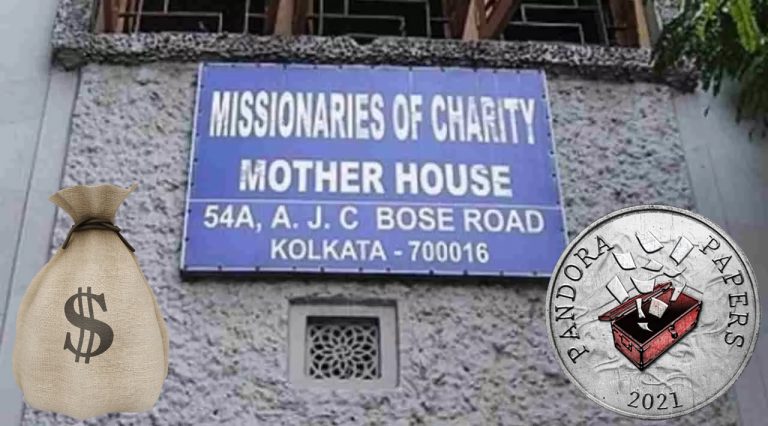
Missionaries of Charity received its second-highest foreign donation from a mysterious Panama-based firm: Details

Days after Missionaries of Charity had revealed that its FCRA renewal application was rejected for not meeting eligibility conditions as per rules, it has been found that the Christian evangelist organisation has been large amounts of money from a company based in tax haven Panama. Of the total ₹75 crores received as donations from foreign donors, more than 17% came from this mysterious company with links to companies named in Pandora papers.

Social media user named The Hawk Eye made the revelation on Twitter today, after going through the FCRA returns filed by Missionaries of Charity available on the FCRA website. As per the 76-page return filed by the NGO, it had received ₹75,19,03,116.67 from foreign sources in the financial year 2020-21 from 406 donors, including 347 individuals and 59 institutions.

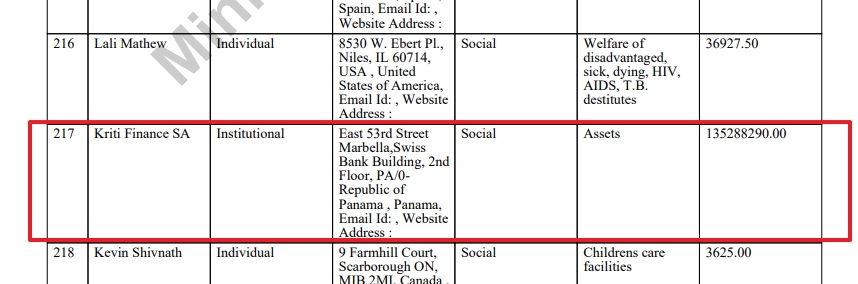
Among the donors, Missionaries of Charity in USA made the highest contribution of ₹44.19 crore in eight donations. However, the second-highest contributor for 2020-21 is a surprise, as it is Kriti Finance SA which donated a whopping ₹13,52,88,290.00 during the year. This is an asset management company based in Panama City in Panama.

From FCRA return of Missionaries of Charity

When The Haw Eye looked into the past FCRA returns of the NGO, it was found that another Panama based entity Simi Foundation has been donating large amounts of money to MOC. And the address of Simi Foundation is given as C/o Kriti Finance, which means Simi Foundation is directly linked with Kriti Finance. From 2016-17 to 2020-21, around ₹32 crore has been routed from these Panama based entities to Missionaries of Charity.

As Panama is known to be tax heaven, and little is known about this Kriti Finance, this raises questions on the source of funds that MOC received. It is almost certain that some other entities/individuals has routed the money using the Panama firm to Missionaries of Charity in India, and further probe is needed to reveal the actual source of this huge donation.

Interestingly, Kriti Finance SA’s Director and President is one Edgardo E. Diaz, who was named in the Pandora papers. Edgardo E. Diaz is also a Director and President in another Panama based company Barrymil Investments SA. Recently it was revealed that Wockhardt chairman Habil Fakhruddin Khorakiwala had incorporated this firm, and he and his family members hold shares in this offshore entity.

According to the Hawk Eye, Edgardo and two other directors of Barrymil are also directors of another Panama based company Furwood Investment, and all these entities are managed by the same law firm, Alemen, Cordero, Galindo & Lee.

Hawk Eye also questioned why this important link of Missionaries of Charity with the Panama based firm was not highlighted by media, especially Indian Express which had published the Pandora papers in India.

Former Maharashtra Home minister Anil Deshmukh’s family laundered Rs 50 Crores, sons, CA named in ED charge sheet

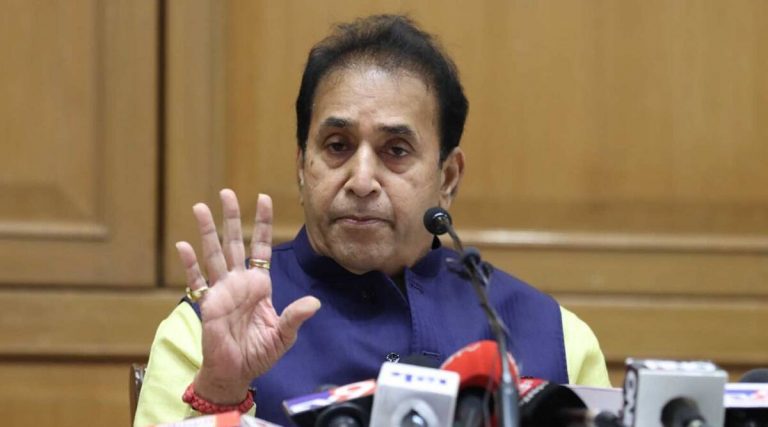
The Enforcement Directorate (ED) in its 7000 plus pages supplementary charge sheet against former Maharashtra Home Minister Anil Deshmukh has said that Deshmukh and his family members have laundered over Rs 50 Crores through different companies.

Deshmukh, who was till recently Maharashtra’s Home Minister, is a senior leader of the Nationalist Congress Party (NCP) is in jail after his arrest on November 2.

In the charge sheet filed before special PMLA Court in Mumbai, the ED further claimed Deshmukh was the primary beneficiary of the money laundering of a sum of Rs 4.7 Crore allegedly collected between December 2020-March 2021. ED said that the arrested Mumbai cop Sachin Vaze had extorted the said amount from bars and hotels across Mumbai on the instruction of Anil Deshmukh who was the Home Minister of Maharashtra.

ED has now formally named Deshmukh’s two sons Hrishikesh and Salil in the complaint besides their CA Bhavik Panjwani. In the previous charge sheet, ED had named 14 accused including Vaze.

Though, the ED so far has not recorded statements of Deshmukh’s sons about their role in the alleged money laundering. The ED has listed as many as 27 dummy companies under the indirect control of Deshmukh’s family.

These companies were used to launder money as the bribe amount was shown as donations made to Deshmukh’s trust, Sai Shikshan Sanstha by a few Delhi-based firms. The ED has rejected Deshmukh claiming that the money was loans and CSR (Corporate Social Responsibility) funds received from the companies.

The ED has attached the statements of former chief secretary of Maharashtra Sitaram Kunte and former Mumbai police commissioner Param Bir Singh.

Probe on Shiv Sena leader and transport minister Anil Parab continues

The ED probe has yet not concluded as the agency is still investigating whether Maharashtra transport minister Anil Parab laundered money through the transfer and posting of a dozen police officials. Vaze in his statement has claimed that Parab had received crores in bribe for transfers of police officers in Mumbai.

The ED has yet not received from Maharashtra Police the copy of the report prepared by former state intelligence department commissioner Rashmi Shukla. She had recorded telephonic conversations of some influential persons discussing transfer-posting of police officers in exchange for money.

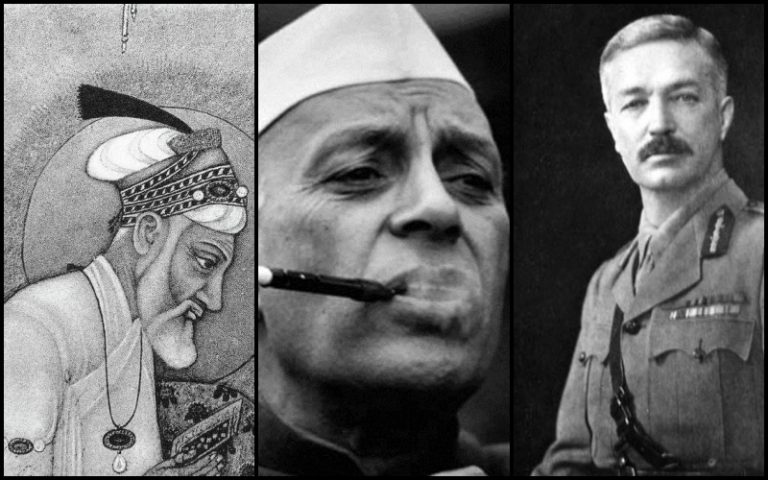
For the bad, we have our Hindu identity to credit, but for the good, we have a tough choice: Mughals, Nehru, or British?

Recently Naseeruddin Shah has come out with a gem of history. He says Mughals are like “refugees” – because they settled here. The Aussies must be kicking themselves. Why didn’t we have a brilliant historian like Shah saheb?! The British too came there as refugees and formed a “syncretic” culture with the indigenous tribes.

That brings us to this topic…that of history and who gets credit for past achievements.

It is so tough being a child or student in India. Especially of history. Our Politburo curated NCERT books tell us a lot of good stuff but we are still left confused by our army of intellectuals.

We are told almost every day that we should be ashamed of everything that is Indian particularly if it’s Hindu. Yet we are also told about the fantastic job done by some of our great leaders and rulers of the past like Aurangzeb, Pandit Nehru and the British.

Because of tough competition among various leftist intellectuals, “eminent” historians, Bollywood divas and heroes and media Pidis to credit these three for all the good things we are enjoying to this day, we are caught in a dilemma.

Who do we thank more? Mughals? British? Pandit Nehru?

Let’s argue for all three! See who “wins”!!

It’s the Mughals!

Depending on which intellectual genius you listen to, Mughals, particularly Aurangzeb has done so much for us, it is amazing we are still behind Bangladesh (yet another pearl of intellectual wisdom), let alone Japan! It must be Modi’s disastrous rule after 2014 that made us this poor! Didn’t Indira Gandhi “hatao” all garibi already by 70s? Or do we have to vote Rahul and then perhaps Rehan Vadra and his son as PM for that?

It is also somewhat strange that the Mughal benevolence has not benefited Pakistan, which is much more closer culturally and geographically to them. 

Everyone knows, thanks to Ms. Audrey the great historian, that Aurangzeb “protected” more temples than he may have destroyed. 

Yea, that’s why there are so many grand medieval temples in North India and the Gangetic plains, each one more dazzling than the other. On the contrary, in the South, where the golden rule of Aurangzeb was not in the good fortune of the people, there are practically no temples. One almost wishes Mughals or Aurangzeb visited Kanchi, Hampi, Talakkad, Madurai or Tanjore and helped us build some nice temples too. Those places are so barren now!

As if the great act of protecting temples is not enough, Mughals also left us much richer! Ask any leftist economist. In fact, they came as “refugees” because they probably took pity on our poor conditions and pathetic life and wanted India to match the glory of their native lands. 

What follows naturally is, all those Hindu or Jain kings that ruled before the Mughals avatar-ed in this wretched land to make enrich us, did a pretty bad job. So bad, you don’t even get to read about them in any official history book, other than a passing mention. Who’s Shivaji? Or should we skip the “ji” and just call him “Shiva” like Audrey wants us? The Guptas, Mauryas and others were just village chieftains with oversized ego like Vitalstatistix of Asterix comics.

In fact, Mughals taught us music too. Before that Rig Vedas were recited as prose without any tones. We never knew how to sing or play any instrument. All those idols of Saraswati etc., you see with musical instruments were just Sanghi myths. There is practically no mention of any music in Indian puranas unless inserted by Brahminical RSS historians. 

No, it’s the British and evangelicals

As if the Mughal contributions to our economy and its richness was not enough, the British too came to make us even more civilised! Of course, this line of “history” is not attempted as often as the Mughal line, given many of our liberal stalwarts that peddle this school of thought also are devoted serfs of the dynasty. But you can nevertheless see it in tweets, books and articles of eminent “liberals” now and then.

Fareed Zakaria, of CNN has been quoted from his book

… India’s political system owes much to the institutions put in place by the British over two hundred years ago…and built lasting institutions of government throughout the country–courts, universities, administrative agencies. 

To be fair to Zakaria, he also credits Congress, and hence Nehru dynasty for a lot of good that British did but had to be built on. How nice is he.

If praising British can be politically inconvenient, praising the evangelicals for their contribution to India is truly progressive. And to question the source of the funds or try trace it to colonial rule and the plunder of Indian wealth, a small part of which was routed through Church as “charity” is heresy and bigotry. 

No, no!!  It was Pandit Nehru!

But all those great deeds of Mughals pales into nothing if one were to consider what Pandit Nehru did for India!

A true Pidi will acknowledge that Mughals left us rich, cultured, educated, musically talented and glorious. But somehow we fell into bad ways. Until Panditji rescued us. 

In fact, if not for Nehru, concepts like going to school and getting educated were totally alien to us. Of course, Mughals gave us all that, but we forgot about them soon after they declined and fell about. Nehruji built dams, constructed IITs and other colleges and made sure we could all go to USA, get our H1-B visas and green cards so that we become American “termites”. 

Please don’t forward Whatsapp history and suggest Sri Visveswaraya or the Wodeyars (among others) too built colleges and dams.

What would we have done without him?! Elite liberal Sagarika Ghose at her pungent best, has the answer! Rahulji’s pasta dinner must have had lots of garlic. We will be “processing gaumutra” and there will be mandirs. So the conclusion is that if you go to a mandir, you are a gaumutra fan. No questions asked, no exceptions. 

You see she does not mention Churches because worshipping true Lord is never an issue for liberals. It is only false Gods that us Hindus worship that is at issue.  Attacking that is quite lucrative. 

And there will be no adult franchise even, if not for Nehru! Move over Gandhi, Patel, Azad, Ambedkar, Shastri, Rajaji et al, you guys did nothing! Only Nehru gave us all this!

So you see, now we are caught in a dilemma. For all the bad things about us, we know clearly where the problem lies – us remaining a Hindu and daring to say so. 

But for all the great things about India, we have a tough choice to make! Mughals, British or Nehru! Who’s your vote for?

Who is Kalicharan Maharaj and why is he trending

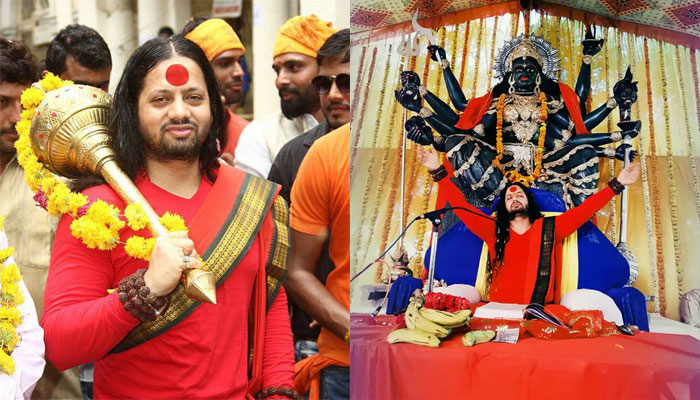
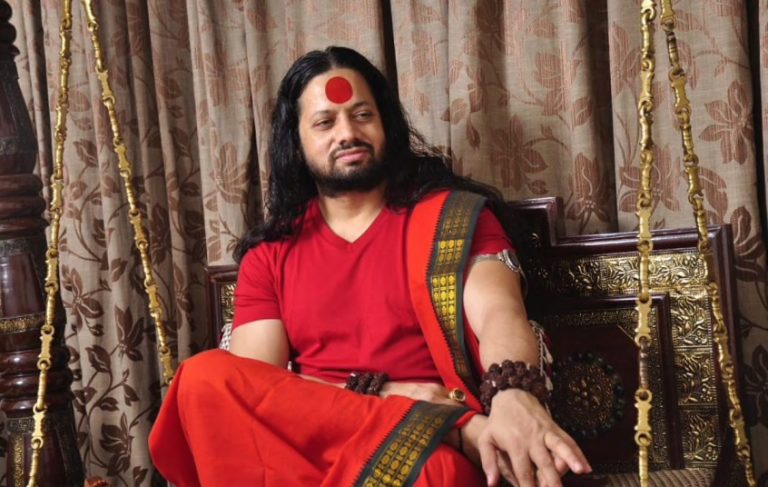
On December 30, Kalicharan Maharaj was arrested by Raipur Police for allegedly criticising Mahatma Gandhi during a speech in the ‘Dharm Sansad’ event in Chhattisgarh. Kalicharan Maharaj was born as Abhijit Dhananjay Sarag. Kalicharan Maharaj, who is often seen in a red robe with a round tilak on his head, is a Shiv and Kali devotee.

He hails from Shivaji Nagar, the old city of Akola, Maharashtra. Kalicharan’s father, Dhananjay Sarag, runs a medical shop.

Kalicharan belongs to the Bhavsagar community. His exact date of birth is unknown, but some reports suggest he was born in 1973. Kalicharan ‘Maharaj’ had quit studies after completing the 8th standard. He was sent to his aunt’s house after he left his studies in Indore. There, he learnt to speak Hindi and started going to Bhayyuji Maharaj’s ashram. Slowly, he started leaning towards spirituality and took Diksha from Bhaiyyuji Maharaj. He started to be known as ‘Kalicharan Maharaj’ after that.

Kalicharan Maharaj is quite popular and many of his videos chanting Mantras and Shlokas from Hindu scriptures have gone viral. he had tried his luck in civic polls in 2017 but did not succeed. There were rumours that he would contest the Lok Sabha elections in 2019.

Kalicharan Maharaj’s Shiva Tandav Stotra video

In 2020, Kalicharan Maharaj became a social media sensation after videos of him singing the Tandav Strotra went viral. The video was from Bhojeshwar Shiv Temple in Madhya Pradesh. His popularity secured the path for many such videos. One of the professionally rendered videos of his singing Tandav Strotra has gained over two crores views on YouTube.

Kalicharan Maharaj has been actively uploading videos on his official YouTube channel for over three years. Most of his videos have spiritual content, interviews and Katha Vachan. Another video of Kalicharan Maharaj that gained attention on YouTube was from 2018, in which he was seen singing Mahishasur Mardini Stuti.

In one of the videos available on his YouTube channel, during his address at an event, he talked about the problem of caste in Hindu society. He said, “The rotting problem of caste in Hindus create a division that leads to the destruction of Dharma.” He added Hindus should follow Shivaji Maharaj and break the chains of caste and get together under the banner of Hindutva. He said, “The invaders were able to conquer India because Hindus are divided. Shivaji Maharaj brought all Hindus together, and we should follow in his footsteps.”

In another video that gained over nine lakh views, Kalicharan Maharaj was seen visiting the temple elephant at Annpurneshwari Mandir in Mangaluru.

Kalicharan Maharaj has been in news recently after the Chhattisgarh government filed FIRs on him over the statements he made at the Raipur Dharma Sansad. He had criticised MK Gandhi and had held him responsible for the partition of India and the brutal massacre of lakhs of Hindus. The details of the speech that caused his arrest can be read here.

On December 30, he was arrested from MP’s Khajuraho by the Raipur police. The MP government has stated that the Raipur Police’s action arresting the Hindu leader in Madhya Pradesh was in violation of interstate protocols and the Raipur police had not informed the MP police before carrying out the operation.

Covid-19 third wave may peak in March, may not be half as severe as second, lockdown not required, predicts IIT Kanpur Professor

The new Covid-19 variant omicron remains a cause of concern as India is seeing a sudden spike in the number of cases related to the highly transmissible coronavirus variant that has fuelled record outbreaks in various countries in the world. India’s omicron cases rose to 961 across the country, an increase of 180 infections reported a day before, according to the Union Ministry of Health and Family Welfare on Thursday. On Wednesday, WHO warned that the new Covid-19 variant- omicron still poses a “very high” risk and could overwhelm healthcare systems.

The spread of omicron primarily due to loss of immunity: IIT Kanpur prof

Amidst the rising concerns, IIT Kanpur Professor and Padma Shri awardee Maninder Agarwal has said omicron variant is spreading rapidly primarily due to significant loss of immunity and not due to increased infectivity. By applying his mathematical model, SUTRA, Professor Aggarwal said that the peak in South Africa, where the new COVID-19 variant was first detected, came as per his assessment based on the ‘super model’ initiative.

Dr Agarwal, took to Twitter to provide a detailed study of the new variant based on the data from two other countries with a large spread of omicron- The UK and Denmark.

“A new phase started in SA from November 1 and stabilized after three weeks. Value of contact rate (beta) increased from 1 to 1.35 and reach (rho) increased from 0.86 to 1.04,” wrote Dr Agarwal explaining that the increase in rho beyond 1 suggests loss of immunity. “We may even assume the entire increase is due to this loss since it is believed that Omicron is bypassing natural immunity significantly,” he wrote, adding that if this data is taken as the base, then 18 per cent of the people there have lost their immunity in these countries. This increased the spread of omicron, said, Dr Agarwal.

In India, 80% of the population is immunised. In South Africa, vaccine-induced immunity was lower than in India. Moreover, in South Africa, the Pfizer vaccine has been administered which has shown lesser efficacy as compared to Covishield and Covaxin which have been predominantly administered in India.

Dr Agarwal further tweeted that one thing is certain that the omicron variant is bypassing vaccination immunity to a great level as compared to the natural immunity of the people. Currently, the contact rate in India is 0.54, the reach is 0.95 and the natural immunity is 83 per cent. If 20 per cent of people lose immunity, the parameter will change, he explained.

Number of infections in India during Covid-19 third wave would be half compared to second wave

Dr Agarwal said the current contact or beta rate in the UK is 0.52, down from 0.72 in the previous month. The same thing happened in Denmark. In the current situation, if we presume that 20 per cent of the naturally immune people in India lose their body immunity, then the third wave in India may peak in early March with anywhere between 1.8 lakh and 2 lakh Covid infections getting reported from across the country in a single day. The numbers would dip by the end of April.

The severity of the third wave, in terms of numbers, would, however, be half than what India saw during the second wave of the pandemic, said Dr Agarwal. It may be recalled that in May 2021, when India was experiencing the peak of the second wave of the Covid-19 pandemic the daily cases had crossed the 4 lakh mark. So as per Dr Agarwal, tough the third wave is inevitable it will be far less impactful than the second wave, which had hit India with an intensity that was perhaps unforeseeable. This definitely comes as a breather for the people of the country.

Speaking about the hospitalisation requirements during the third wave, Professor Manindra Agarwal has further estimated that approximately 2 lakh beds will be required when the third wave is at its peak in the month of March. He said that during the Delta wave, about 1 in 5 reported cases required hospitalization in India whereas during the omicron variant driven Covid third wave it can be assumed that 1 in 10 cases may require hospitalization in India.

Lockdown might not be necessary during third wave of Covid-19: Dr Agarwal

He further stated that, unlike South Africa, the omicron variant does not appear to have much of an impact on India at the moment. There is no indication of a lockdown. However, a complete assessment can be established only after the variant spreads widely in India.

Speaking about the rapid spread of the omicron variant which has pushed the UK into a state of emergency, Dr Agarwal was of the opinion that in the United Kingdom, though there is more vaccination (mainly mRNA vaccine) in terms of numbers, the seropositivity is lower. While in India, vaccination rates have risen, so has the seropositivity. He said that apart from vaccination, natural immunity has also developed in many people. In such a scenario, though India will experience the third wave, it will be less frightening than the delta variant driven second wave.

It may be noted that earlier, Prof Agarwal had predicted that the omicron wave in South Africa would peak anywhere between 18 to 23 December. He had, however, advised waiting a few more days.

Prof. Agrawal in the IIT’s Department of Computer Science and Engineering and the recipient of the first Infosys Prize for Mathematics and the Shanti Swarup Bhatnagar Award in Mathematical Sciences in 2003. He was involved with the national ‘super model’ initiative SUTRA, which tracks the Covid-19 infection in the country. Their assertions are significant because of their consistency in the past.

It may be recalled that in August Prof Agarwal had said that the third wave of coronavirus would arrive in a highly unlikely scenario that is only if a new virus strain emerges. Besides, by applying his mathematical model, SUTRA, Prof Agarwal had predicted the trajectory of the second surge in infections. He had predicted that the situation would worsen in May 2021, and rightly so, the second wave of Covid was at its worst during May this year with India recording its highest-ever surge of 4.14 lakh Covid cases in a single day.

In this study, the IIT Kanpur professor had also estimated the statewide exact peak time and graph fall date of the second wave of Covid and that too had proved accurate.

In an interview during the second wave, Professor Agarwal had also busted the rumours peddled by the leftist media and opposition parties that the Kumbh Mela in Uttrakhand was the primary reason for the resurgence of the Covid cases in India. Prof. Manindra Agrawal from the Indian Institute of Technology (IIT) Kanpur had confirmed that the Kumbh or the poll rallies for that matter, might have had a little impact on the second wave of the infection in India.

Kerala: Man stabs youth to death after finding him in his daughter’s room in the night, calls it an accident

0

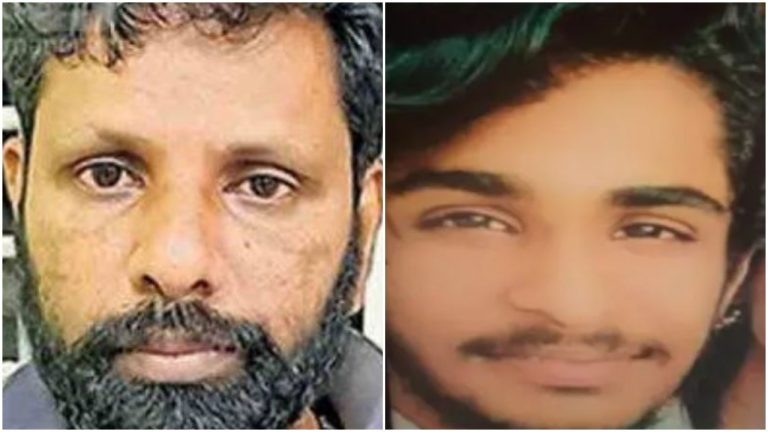
In the wee hours of Wednesday, December 29, a 19-year-old youth was mercilessly stabbed to death by a man for allegedly meeting his daughter in Pettah in Thiruvananthapuram, Kerala. According to the police the incident occurred at around 4 am, when the 51-year-old Lalan Simon, a resident of Chayakudi Lane at Pettah, stabbed Aneesh George, a resident of Pettah and a student of Bethany College when he found the latter in his daughter’s room. Lalan Simon has been arrested and charged with murder.

The police revealed that the Christian teenage boy and Simon’s daughter were part of the local church choir and were in a relationship. Lalan Simon and his wife knew about the relationship but did not approve of it. Lalan Simon hated the youth for being in a relationship with his daughter. On Wednesday, Aneesh George, who lived only about half a kilometre from Simon’s house, had visited the latter’s house to meet his daughter.

At around 4 am, when Simon found his daughter’s room locked from inside, he broke it open. On finding Aneesh George inside the room with his daughter, the miffed father stabbed the youth on his chest and his back. According to the Kerala police, Aneesh died as a result of serious stab wounds. Lalan’s wife was the one who called the cops and told them about the incident.

Simon, who went to the police station himself to surrender after the incident, at first told the police that he heard a loud noise from his daughter’s bedroom late at night, and mistaking Aneesh for a thief, stabbed him. The police, however, revealed that as per a preliminary investigation, they suspect the crime was motivated by a personal grudge. The Kerala police said that it appears that the accused stabbed the youth after confirming his identity.

“When Lalan knocked on the door, the girl, who was inside, repeatedly told him that there was no stranger in the room. Despite this, Lalan broke the door open and stabbed the victim. This proves that he knew who was inside and committed the crime intentionally,” said a police officer.

Some family members also told the police that Lalan knew Aneesh as his house was close to theirs and he also sang in the church choir along with their daughter.

Lalan has admitted to the crime, according to the police, and will appear in court on Thursday.

According to a report published in a local newspaper, Aneesh had entered Simon’s house through the sunshade. Fingerprint experts and the forensic team have reached Simon’s house where the incident took place. A pair of shoes belonging to the deceased youth has been recovered from the house. His body has been kept at the medical college hospital and will be handed over to his family members after the post mortem.

Meanwhile, the victims’ kins are in a state of shock after the news was broken to them by the police. “When the police told his parents that Aneesh had met with an accident, they were a bit surprised as they thought he was at home. Later, the police told them that he was no more,” said a family member.

Arrest of Kalicharan Maharaj for abusing “Mahatma” Gandhi: Why India needs to stop worshipping demi-Gods and evaluate history honestly

Kalicharan Maharaj, a seer who was a part of the Chhattisgarh Dharma Sansad has been arrested from Khajurao, Madhya Pradesh by the Chhattisgarh police. The MP police on its part said that the Chhattisgarh police violated interstate protocol by arresting him without informing the local police. The legality of the arrest aside, that the Chhattisgarh police sprung into action and almost desperately arrested Kalicharan Maharaj for “hate speech” without even informing the local police, perhaps shows the sort of pressure they must have been under from their political masters.

Let’s face it. In India, such alacrity by the policy is only shown when the political ruling class takes special interest in a case. In this particular case, one is hardly surprised that the ruling class of Chhattisgarh had an insurmountable urge to see Kalicharan Maharaj behind bars.

In Chhattisgarh Dharma Sansad, Kalicharan had made certain statements against “Mahatma” Gandhi.

During his speech at Dharma Sansad, Kalicharan Maharaj said, “India was cut into two parts in front of our eyes. Iran, Iraq and Afghanistan were already separated. Bangladesh and Pakistan got separated in front of our eyes by them. They used politics to separate these parts from India. That Har*mi Mohandas Karamchand Gandhi destroyed India. I bow down to Nathuram Godse Ji, who assassinated the Har*mi.”

He further added, “These ulcers of the society need to be surgically removed else they become cancer. I am not telling you to start riots. There is no need. You are not even ready. Muslims are prepared, you are not. If the Police were not there, we would have already been finished. There are saviours of religion among them.”

Kalicharan said far more. He spoke about Nehru becoming the Prime Minister even though Sardar Vallabhai Patel had more votes for the post, how the Police are controlled by leaders and are inherently against Hindus because of the leaders that control them, that there are several other competent leaders like Jyotiraditya Scindia, the partition and Gandhi’s role in it and most pertinently, how nobody can become the “father of the nation” since India has existed even before it became a nation-state.

For his statements, Kalicharan Maharaj was arrested under sections 505(2) and 294. Essentially, the police thought that his statements werecreating or promoting enmity, hatred or ill-will between classes and that he recited obscene words in public”.

The merits of the rest of the arguments made by Kalicharan were sidelined. The FIRs filed are primarily because he used the word “harami” for MK Gandhi and also hailed Nathuram Godse, who had assassinated the man popularly revered as a “Mahatma” by the politically illiterate class of the country.

Political correctness requires one to hail the arrest and take a moral high ground saying that abusive language has to be condemned, and since the language was used for a Mahatma like Gandhi, the arrest is justified. In fact, many, from the non-left itself, have gone as far as to condemn in unequivocal terms the Dharma Sansads held in Chhattisgarh and Haridwar, not even talking about why such words were uttered in the first place – unbridled aggression by sections of the Muslim community and an outburst owing to decades of suppressed history.

For the sake of this article, let’s do something radical – say it as it is.

For starters, let’s not pretend that we are adverse, as a society, to abusive language or aggressive speeches. When the champagne glass is empty and we sit in a group of friends, most Indians are as loose with their tongue as Kalicharan Maharaj was in public. We might not admit it because modern society requires us to wear masks as an extension of ourselves, but we are trying to be as honest as we possibly can here.

Kalicharan Maharaj is being hunted not because he used the word “har*mi” but because he dared to use it against the “Mahatma”. Fair enough. Let me play the part and admit that abusive language for leaders should not be condoned in any way, manner or form. Any debate about leaders, past or present, must adhere to linguistic purity that has become the societal norm.

In fact, hailing the assassination of a leader is something that absolutely cannot be condoned.

Had Nathuram Godse not done what he did, MK Gandhi would have been alive to answer for his sins. Tell the world why he was branded a racist in South Africa, why his “experiments with chastity” bordered on paedophilic, why he asked Gopal Patha to lay down his arms and not defend Hindus, why he told Hindus to “maintain brotherhood” while the Moplah Muslims massacred Hindus, why BR Ambedkar thought that Gandhi turned a blind eye to the massacre of Hindus, so on and so forth.

The assassination of Gandhi forced Hindus to deal with the legacy of the assassination, which meant forever defending Hindus from the “Hindu terrorism” trope furthered and branded with hot iron on the heads of unsuspecting Hindus.

However, while we can disown the assassination, there must also be space to discuss why Nathuram Godse, who was himself a “bhakt” of Gandhi, chose to assassinate his idol. Does the assassination itself take away Godse’s nationalism? Does the crime of the assassination take away from the fact Godse had legitimate concerns about Gandhi’s conduct towards Hindus and during the partition of India?

The fundamental and internalised-Abrahamic need of Indians to create demi-Gods makes any honest discussion on Gandhi and his follies redundant, almost taboo and the deification of Gandhi has relegated many significant events, significant for Indians at large and Hindus specifically, to historical obscurity.

Mark 7:9 in the Bible says, “And he said to them, “You have a fine way of rejecting the commandment of God in order to establish your tradition!”. While Jesus called upon humans to reject Pagan Gods in an attempt to “establish their own tradition” and follow the word of Jesus, the only true God, a similar Jesus-Allah-fication is a norm for Indians, especially with leaders eulogised as a political project.

Just like the Bible calls the quest of pagans to establish their own tradition blasphemous, the political class has Jesus-Allah-fied Gandhi, to a point where the heathens are jailed if they dare to question the Demi-God. No leader, past or present, is beyond criticism, least of all MK Gandhi who can arguably be called a genocide enabler – standing by and letting Hindus be mercilessly massacred. When even Gods are questioned, false Gods have no right to be above scrutiny.

The apotheosis of Gandhi had political motivations. After 1947, Congress systematically propagandized the narrative that it was solely the Congress party that won India its freedom and it was Mohandas Karamchand Gandhi with his enigmatic leadership who magically bestowed India with freedom through the sheer power of non-violence alone. Nehru’s Congress furthered this narrative because they chose to gain from it. Stalwarts like Netaji Subhash Chandra Bose needed to be pushed aside, the memory of Veer Savarkar needed to be tarnished, the contributions of various other freedom fighters needed to be sidelined so that the Congress party with Gandhi as its face and Nehru as his ever-faithful disciple came to be regarded as the saviour of Indians.

Nehru and Gandhi committed many unfortunate errors and harboured many problematic notions. And Nehru sought to bury all of them under the deification of Gandhi.

If India and Hindus do not consciously decide to terminate the deification of Gandhi, India will see history repeated, mercilessly so, because there exists no honest evaluation of the sins of Gandhi that led India to decades of unrest that continues to this day.

One may not like Kalicharan Maharaj and the words he used for Gandhi. One may not like the overt aggression displayed by Hindus in the Dharma Sansads. One might even feel that such speeches must be made in private and that “hate speech” cannot be condoned even if it limits itself to calls for self-defence. In fact, we might also feel that such elements are political pawns unleashed right before elections. However, making allowances for the state to arrest those who espouse political opinions that are converse to the popular narrative is a dangerous slope that can only lead to the society slipping down a dark abyss.

The edifice of our moral grandstanding might stand on the shoulders of Kalicharan Maharaj today, but when a society closes its eyes and refuses to evaluate history honestly, it is doomed to repeat it. The endorsement of imprisonment for a problematic political speech about the past is not the hill Hindus should choose to die on.

DGGI denies allegations that cash and gold recovered from UP businessman in mistaken identity, says Piyush Jain was raided based on specific input

0

Directorate General of GST Intelligence (DGGI) has denied allegations that they recovered almost ₹196 crore in cash and 23 kg gold form UP businessman Piyush Jain in a case of mistaken identity. The DGGI clarified that they had raided the correct man based on specific inputs after Samajwadi Party and Congress leaders had claimed that while the target was SP leader and businessman Pushpraj Jain, but raided Piyush Jain by mistake.

Yesterday Congress leader P Chidambaram had tweeted asking if the raid was a case of comedy of errors. He had asked if the wrong person Piyush Jain was searched instead of real target Pushpraj Jain.

Some social media users even claimed that Piyush Jain is linked with BJP, and thus while the target was SP’s Pushpraj Jain, BJP’s Piyush Jain was raided by mistake, they claimed.

The allegations that the wrong P Jain was raided started to do rounds after some BJP leaders had claimed that raided Piyush Jain had launched the Samajwadi perfume, which was wrong information. On Tuesday, SP chief Akhilesh Yadav had denied any connection of his party with Kanpur based businessman Piyush Jain, and had claimed that the arrested trader was actually linked with BJP. He had clarified that the Samajwadi Attar (perfume) was launched by SP MLC Pushpraj Jain and not Piyush Jain.

After this, allegations started to appear that while Pushpraj Jain was the real target, the DGGI raided Piyush Jain by mistake. Even Pushpraj Jain had also made the same allegation and had claimed that Piyush Jain is a ‘BJP-minded’ person, saying that while he is associated with SP for 20-22 years, Piyush Jain has no link with SP.

After these allegations of ‘mistaken identity’, the DGGI has clarified that there was no such mistake, and they were after Piyush Jain only. However, Piyush Jain was caught by chance, as they were originally targeting another businessman with the same initials, Praveen Jain. The case had started when the tax authorities had stopped a truck carrying pan masala near Ahmedabad, and had found several questionable invoices.  

After this, the Directorate General of GST Intelligence (DGGI), a law enforcement agency under the Union finance ministry fighting tax evasion, started a probe against the owner of the truck, Ganapati transport run by Praveen Jain. They subsequently raided the Pan Masala company Shikhar, also owned by Praveen Jain, and found more trucks loaded with the same pan masala with fake invoices issued to fictitious firms.

On further search, the officials had found that Praveen Jain’s relative Piyush Jain had supplied a key ingredient, a compound that gives a distinct scent to each brand of pan masala, against cash payments. The compound sales for around ₹2 lakh per kg, therefore Piyush Jain was receiving crores in cash against the supply. Following this trail, the officials arrived at the door of Piyush Jain, and made the surprise discovery of cash and gold worth around ₹284 crore.

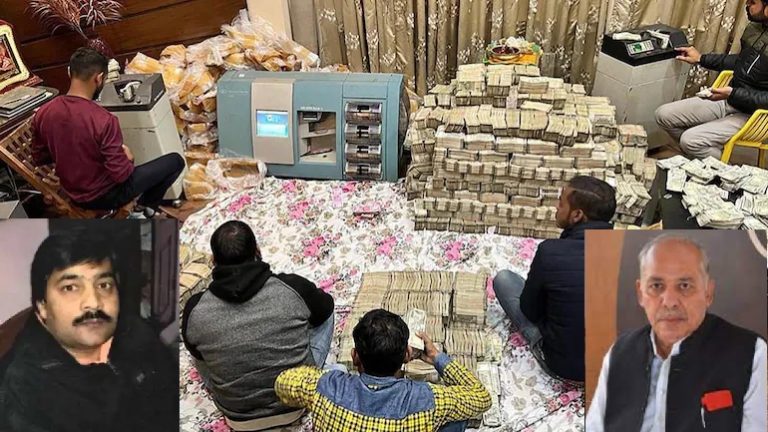
₹19 crore in cash and 23kg of gold was found in the modest-looking home in Kannauj, while ₹177.45 crore was found hidden in his grand house in Kanpur. The authorities had to take the help of SBI for machines and manpower to count all those ₹500 and ₹200 notes.

Therefore, DGGI had raided the correct person when they raided the houses of Piyush Jain, and the name of Pushpraj Jain never appeared in the case. It was not a case of mistaken identity as P Chidambaram and others are alleging.