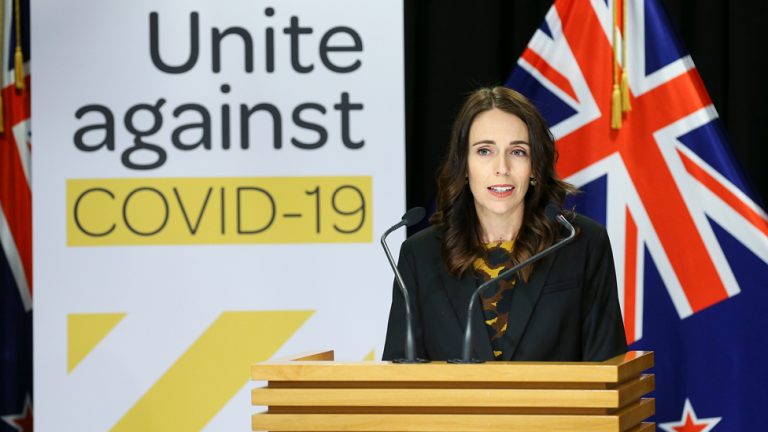
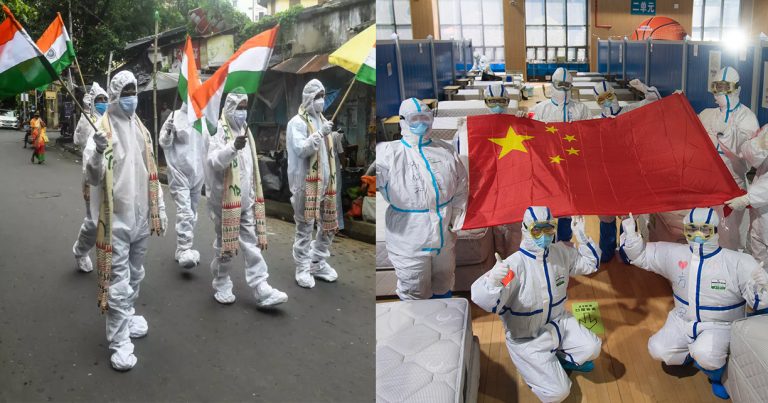
On June 16 (local time), Jacinda Ardern, Prime Minister, New Zealand, announced that it would take up to the end of the year to vaccinate all eligible citizens against Covid-19 infection. Notably, New Zealand, which has a population of fewer than 50 lakhs, had shut down its borders and used tough lockdown measures to virtually eliminate Covid-19 from its grounds. However, the government is now facing harsh criticism over the slow rate of vaccine rollout.
So far, only 560,000 people have received the first dose of the Pfizer vaccine, while 325,000 have received both doses. PM Andern said, “Based on the delivery and supply of vacancies, we are working towards taking to the end of the year for vaccinating all those who are eligible.” Interestingly, she added that the drive has been going “faster than expected”.
As per the plan laid down by the PM, those who are above the age of 60 will get the vaccine from July 28. From August 11, the vaccine will be rolled out for those who are above the age of 55. By late August, those above 45 will become eligible to get the vaccine, and those above 35 will be able to get the vaccine from October this year. The PM further added the country would receive a bulk supply of vaccine in October.
According to her, once the large population is vaccinated, it will be easier to manage the borders. However, some cautions would still be needed as more variants are being discovered across the world. The New Zealand government is consulting the experts on how and when it would be safe to open the borders and what kind of model the country should follow. She said, “Everyone is writing the rule book as we go. The difference we have is we have a different rule book to write. Once you get rid of an elimination strategy, it’s tough to come back to it. So for New Zealand, it’s about how do we preserve our position whilst having a little more freedom at the border.”
Foreign manufacturers are the most significant reason for the delay
As per the reports, New Zealand depends on foreign manufacturers for the supply of the vaccine, which is the biggest reason for the delay in the vaccination drive. The country is currently in the 120th position in managing vaccination drives, with the US tops the list, followed by India and Brazil. India has administered 26,55,19,251 doses so far. 21,58,48,080 have received at least one dose of the vaccine, while 4,96,71,171 have received both doses. On June 16, India administered 34,63,961 doses in a single day.
On June 15 (local time), Noor Bin Ladin, niece of 9/11 mastermind Osama Bin Laden, marked her protest against President Joe Biden’s summit with President Vladimir Putin by waving a “Trump won” flag. 33-year-old pro-Trump Ladin was riding a boat on Lake Geneva in Switzerland while donning a white bikini top with shorts. The protest took place a day before the much-anticipated meeting between the Presidents of the US and Russia. Reportedly she was almost arrested for organizing the protest.
Noor Bin Ladin, niece of Osama Bin Laden, is a Trump supporter. (Image: Noor Bin Ladin)
Bin Ladin, who is a Swiss national, has been a vocal supporter of former President Trump for years. She posted on her social media that two police boats came close to her small boat while she was protesting. Photographs and videos of her holding up a “Trump won” banner has been making rounds on social media. There was another boat on which there was a woman waving “Trump 2020” and American flags.
Noor Bin Ladin holding “Trump Won” flag in front of Swiss police
Bin Ladin shared photographs of the Swiss Police Officers in front of her boat as she waved the banner. She wrote, “Switzerland does not want the world to see this,” in the caption. She termed the summit a joke on Twitter and said, “TRUMP WON and all of this is theatrics.” She further added, “Joe Biden showed the whole world what a joke he is.”
This whole summit is a joke. TRUMP WON and all of this is theatrics.
President Putin is entertaining a senile pedo who’s sold out America to his globalist masters for years.
She also hit back at the President for his comments after the summit in which he claimed President Putin would face the consequences devastating to Russia if Alexei Navalny, the jailed opposition leader, dies. She said, “What about the consequences due to the Capitol Police killing Ashli Babbitt on 1/6?” She referred to the Trump supporter who had died after a cop shot her during the US Capitol riots on January 6.
What about the consequences due to the Capitol Police killing Ashli Babbitt on 1/6 ? https://t.co/RycqrK53S6
In September 2020, Noor Bin Ladin had formally announced support for former US President Donald Trump. During an interview with the New York Post, she claimed she was “attacked more for supporting Donald Trump than being related to the 9/11 mastermind.” Reportedly she also lost “a few so-called friends” after she announced her support for Trump. According to her, Trump was the only person who could prevent a future 9/11.
When 9/11 happened, Noor Bin Ladin was only 14 years old. The terrorist attack on September 11, 2001, planned and executed by her uncle Osama Bin Laden claimed the lives of close to 3,000 Americans. Yeslam Bin Ladin, half-brother of Osama Bin Laden, is her father. Her mother, Carmen Dufour, is a Swiss author who wrote a book about her life within the Bin Laden family in 2004. Noor and her sister were raised in Switzerland.
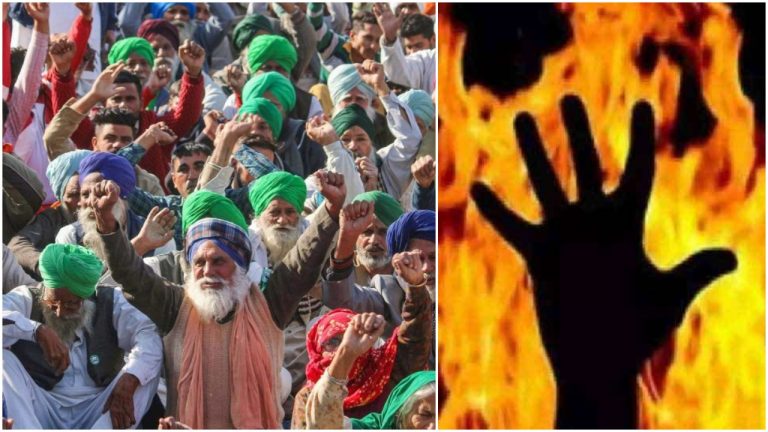
A protestor camping at the Tikri border has succumbed to burn injuries after fellow protestors allegedly set him ablaze at the protest site on Wednesday. Villagers say that this was a conspiracy to make him appear a ‘martyr’ against the farm laws.
According to journalist Amish Devgan, the protestors, who are illegally squatting at the public roads and grounds along the Tikri border to protest against the farm reforms, set a fellow protestor on fire over a dispute. The deceased person had consumed intoxicants with the protestors, who set him ablaze later after picking a fight, said the journalist.
The 42-year-old person from Kasar village, identified as Mukesh, has succumbed to burn injuries, said Amish Devgan.
Farm Law Protesters at Tikri set a villager who drank with them on fire after a dispute.He Dies of burns. Name of Died person is Mukesh from Kasar Village #FarmerProtest#BreakingNews
As per reports, casteist slurs were hurled towards Mukesh after which he was set on fire. A video of him being set on fire has gone viral on social media where one can hear casteist abuses being thrown at him before he was set ablaze.
The Haryana Police have registered a case against culprits based on the statement of the deceased person’s brother. The case has been registered under IPC sections – 302 (murder), said the police officials.
It was said in the statement that his brother had been to farmers’ protest where he was set ablaze, he had named some people. Postmortem has been done. Further probe will be done on basis of facts. It has been told to us that the accused are from Jind: Police officer Jaibhagwan pic.twitter.com/9aBCoVbTAK
Haryana Police officer Jaibhagwan said that the deceased had been to a farmers’ protest where he was set ablaze. According to his brother, the victim had named some people. The police said that they suspect that the accused are from Jind. Postmortem has been done, and the further probe will be done based on available details, the police officer added.
Details of the case
The incident took place at Kasar village near Bahardurgarh in Haryana. During wee hours on Thursday at 3 AM, some protesting ‘farmers’ at the border splashed fuel on Mukesh and set him on fire. He was immediately rushed to the hospital where he succumbed to the burn injuries.
As per police complaint by one Madan Lal, on Wednesday at around 5 PM, Mukesh had gone out and reached the protesting farmers’ site. Madan Lal later got to know that Mukesh was set on fire. He reached the site along with Sarpanch Toni Kumar and saw Mukesh being badly burnt.
During his treatment at hospital, Mukesh revealed that one Krishna first got him intoxicated and then set him on fire. However, he later succumbed to injuries.
Sarpanch demands removal of protesting ‘farmers’ over safety concerns
The Sarpanch of the village, Toni Kumar requested the administration to move the protesting ‘farmers’ away as they do not feel safe.
“These farmers should be moved away so that our mothers and daughters are safe. They come in group of four to urinate even though there is no toilet here. They move around shamelessly in fields. Sometimes they come in mob of 20. They play loud music all night long and drink. It has been six months now. We do not feel safe,” he said.
In the above video shared on Facebook by a page Sansar Kranti, one can hear the villagers say that casteist language was used against Mukesh. One villager also said how Krishan, one of the protesting ‘farmers’ said what is his problem if Mukesh dies, he would become a martyr (against the farm laws) and will get compensation. “Why bother saving him,” he said.
The villager further questioned the protesting farmers on resorting to such violence to get their things done. “If you really want to do something for someone, why don’t you do it in your own capacity. Why do you have to commit a crime, like killing/ someone in the guise of cause for farmers and then make him a martyr to get him some compensation,” they tell the reporter.
Farmer protest site has turned into a crime hot spot
This is not the first time that such crime incidents are being reported from the ‘farmer’ protests site along the borders surrounding the national capital. The ‘farmer’ protests site has lately turned out to be a crime hotspot as several allegations of rape, murder have surfaced from the site in the last few months.
In April, a 26-year-old anti-farm law protestor was murdered by a fellow farmer protestor near Kasar village near the Tikri border in Delhi. The victim has been identified as Gurpreet Singh, who was protesting against farm laws at the Tikri border. Singh was murdered by a fellow protestor Ranbir Singh alias Satta Singh over a monetary dispute.
Similarly, on March 25, a 60-year-old farmer named Hakam Singh was found dead with a slit throat. According to the police, Singh was murdered using a ‘sharp-edged weapon’. His dead body was discovered by other anti-farm law protestors in a field behind the new bus stand at the Tikri border. Incidents of rape have also been reported.
The micro-blogging site Twitter’s attempts to influence domestic politics in several countries including India and Nigeria, and the determined hard-hitting response by the respective governments have turned out to be a costly affair for the social media giant Twitter, reports Business Today.
Twitter’s war with sovereign nations has hit the company financially as shares of the micro-blogging site have taken a hit amid the tussle with the Indian government over the new IT rules. The cn onflicts with elected governments have affected the value of Twitter’s stocks by as much as 25 per cent at the NYSE.
Twitter lost its market cap ever since it picked up a fight with the Indian government.
The shares of Twitter closed at $43.48 on November 13 last year when the Indian government first sent a notice to Twitter for wrongly showing Leh as part of Jammu & Kashmir instead of the Union Territory of Ladakh. The deliberate act of Twitter to challenge India’s sovereignty over Leh had caused massive outrage, leading to social media users demanding a ban on Twitter.
Following the outrage, the shares of Twitter took a hit and the market cap of the firm in that session came to $34.58 billion.
However, the stock continued to rally upwards and reached $54.58 on February 3, 2021. The Modi government sent a notice to Twitter on the same day requesting to remove anti-India accounts that were inciting violence on the platform.
However, the micro-blogging site, which has a history of promoting such anti-India contents and on the contrary censuring nationalist contents, had decided to turn a blind eye to the Indian government request. Following that, the Indian government had sent a notice warning the social media company to suspend the anti-India accounts on the platform.
The market cap of Twitter took a slight hit as Twitter’s value stood at $43.45 billion during the session.
On February 8 this year, the Ministry of Electronics and Information technology sent a fresh directive to Twitter to remove over 1,000 accounts flagged by security agencies as those of Khalistan sympathisers or backed by Pakistan amid the ongoing farmer protests. However, Twitter once again ignored Indian government requests. In fact, the government of India was left frustrated after it found out that Twitter CEO Jack Dorsey promoted tweets that supported such contents put out by celebrities.
Strangely, the Twitter stock rose on that day to $58.20 on NYSE. The Market cap of the firm reached $46.33 billion.
A few weeks later, the stock even went on to hit a 52 week high of $80.75 on February 26, 2021. The stock had rallied 133.17% in the last year. On February 26 last year, the share stood at $34.63. The market cap of Twitter rose to $61.51 billion in the same session.
Interference into India’s domestic affairs has cost Twitter
Then began Twitter’s interference into India’s domestic affairs, in which the micro-blogging site took an active interest in promoting content specific to a particular ideology and censured nationalist contents. In the name of fighting fake news, the micro-blogging site marked tweets put out by nationalist accounts, BJP leaders and even government accounts as ‘manipulated media’, angering the ruling government.
Strangely, the ‘manipulated media’ tag was just limited to nationalist accounts as Twitter did not tag any accounts that espoused left-wing leanings and the accounts associated with the Congress ecosystem, even as such accounts propagated lies openly. The sinister designs of Twitter created a massive uproar in the country with social media users accusing Twitter of interfering in India’s political affairs.
Later that month, the government of India enforce the new IT rules. As usual, Twitter did not comply with the rules initially, however, asked for more time to follow the Indian laws. The tug-of-war with the Indian government had a bearing on its stocks as it hit a low of $50.11 on May 13.
The introduction of new IT rules to bring transparency in the operations of the social media platforms can be cited as a major factor for the crash in the stock.
On June 5, the Indian government sent a final notice to Twitter to comply with the new IT rules. Issuing “one last notice” to the micro-blogging site, the Centre warned of “resultant consequences” if it fails to comply with the new norms amid an escalating standoff with Twitter.
However, the Twitter once again failed to comply with the rules. Hence, the Indian government has promptly withdrew its intermediary status for not complying with the new Information Technology Rules, which came into force on May 26.
The loss of intermediary status meant that its top executives, including the country managing director, may now face police questioning and criminal liability under IPC over “unlawful” and “inflammatory” content posted on the platform by any user. The legal immunity that was provided to Twitter over content moderation in the country is officially over now.
The Indian government is reportedly unhappy with the brazenness of the social media company, which have been continuously evading compliance with Indian rules. The government believes that repeated reminders and even the temporary relaxation that was extended to social media giant as a “goodwill gesture” has not yielded results.
In addition to the non-compliance, the Uttar Pradesh Government has initiated action against Twitter India for failing to take down tweets that spread misinformation about a crime in the state. An FIR has been lodged against the social media platform in connection with the Loni incident after Twitter failed to flag the fake news put out by alleged fact-checkers.
On June 16, the day when Twitter lost its intermediary status in India after failing to comply with the Indian laws, Twitter’s stock closed at $59.93, down 0.50% on NYSE. The market cap of the firm fell $0.43 billion to $47.64 against the market cap of $48.07 billion in the previous session.
On Thursday, June 17, the stock stood at $59.93, a decline of 25.78% after touching a 52-week high of $80.75 on February 26. Since February 26, the firm has lost $13.87 billion or 22.54% in market cap till now.
It is clearly visible that the micro-blogging site is losing the battle it started against the Indian government, both in terms of politically and financially. One can only hope that Twitter awakes from its deep slumber and does a course correction soon.
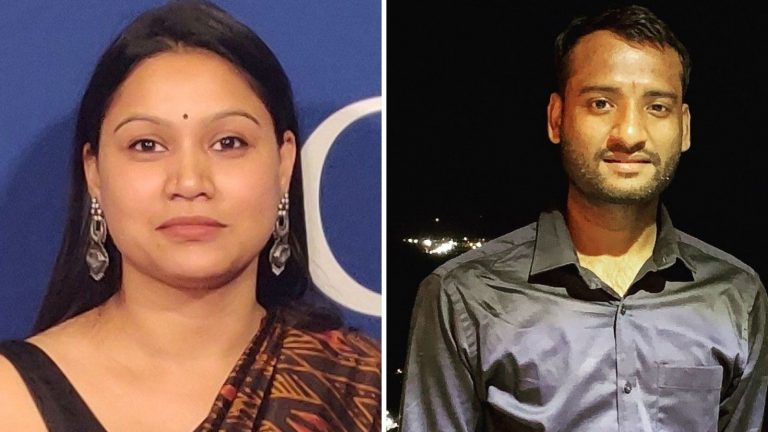
A case has been filed against Neha Dixit, a journalist associated with leftist media outlets like ‘The Wire’ and ‘Caravan’ who had accused RSS affiliate Sewa International of “trafficking children from tribal areas to indoctrinate them”.
Sharing an update, poll strategist and columnist Vivek Bansal who filed the case, Tweeted, “Complaint has been lodged against journalist @nehadixit123 under section 156(3) of CrPC in Patiala House court for accusing RSS of child trafficking. The matter will be taken up soon by Magistrate. I would like to thank my friend and advocate @AdvSidAcharya for his legal support.”
Complaint has been lodged against journalist @nehadixit123 under section 156(3) of CrPC in Patiala House court for accusing RSS of child trafficking. The matter will be taken up soon by Magistrate. I would like to thank my friend and advocate @AdvSidAcharya for his legal support. pic.twitter.com/RRWE3z9VN3
The complaint highlighted that the accusations made by Dixit are baseless with no factual merit and that the claims were engineered out of malice and personal vendetta.
Neha Dixit’s profile
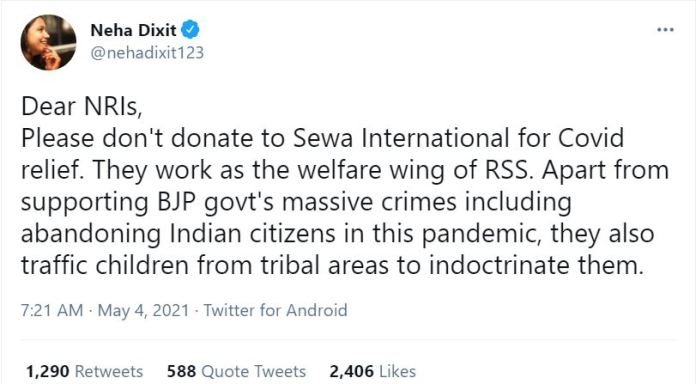
Dixit in her Tweet against Sewa International had urged the NRI audience to not donate to the organization which was working relentlessly towards Covid relief at that time.
Dixit’s Tweet read, “Dear NRIs, Please don’t donate to Sewa International for Covid relief. They work as the welfare wing of RSS. Apart from supporting BJP govt’s massive crimes including abandoning Indian citizens in the pandemic, they also traffic children from tribal areas to indoctrinate them.”
‘Journalist’ Neha Dixit’s Tweet
It becomes imperative to note here that ‘The Wire’ journalist had in 2016 also written an article for The Outlook where she had accused the two Sangh outfits, namely Rashtra Sevika Samiti and Sewa Bharati of tricking and trafficking 31 young tribal girls from Assam to Punjab and Gujarat to ‘Hinduise’ them.
A quick scroll through Dixit’s timeline will give one an idea of her leaning and ideology. From discrediting Ayushman Bharat to UP’s handling of the corona crisis, Dixit appears to be a habitual BJP hater.
While @myogiadityanath claimed there was no oxygen crisis in UP, acc to official data, over 20,000 died because of lack of oxygen. Watch this ground report from rural UP, where kin of dead narrate their ordeal & facing political pressure to withdraw complaints. RT https://t.co/CNC3dm3YWt
After a deliberate controversy was furthered by Dixit against the RSS, OpIndia had got in touch with Sewa Bharti’s Delhi chapter head Ramesh Agarwal, who opined that Sewa Bharti remains unfettered by such frivolous claims.
Also highlighting the relief work that Sewa Bharti had been carried out during the second wave of the pandemic, Ramesh Agarwal informed that the NGO has started “Pranavayu Sewa” facilities outside many Delhi hospitals for patients critically in need of oxygen.
Under this initiative, the NGO had converted hundreds of APML’s Household Trucks as Portable Medical Vans to provide oxygen to the people under the supervision of experienced medical staff.
45 kitchens of Sewa Bharati feeding 75,000 citizens was functioning in Delhi alone when the national capital was grappling with the pandemic.
RSS Swayamsevaks were also working in collaboration with temples like the Jhandewalan temple in Delhi, where thousands of free meals were being served to the poor and needy throughout the pandemic.
The scourge of COVID-19 has wreaked havoc on the contemporary world. More than 17 crore people have been infected around the world till date, with more than 37 lakh people succumbing to the dreaded pandemic. India has seen 2.84 crore people being infected, with 3.38 lakh casualties till date. While Biden and the US administration is still delving into the question of whether the pandemic originated from lab-leak in Wuhan, the key point is to strategize and fight the pandemic to the best of our abilities.
Prime Minister Narendra Modi announced a 21-day lockdown on 24 March 2020, along with announcing ₹15,000 crore stimulus for healthcare spending for boosting healthcare resources such as PPE kits, isolation wards, hospitals, ventilators and beds. By February 2021, COVID case counts had gone down and experts said that the country may not face a second wave. Demand for ventilators and hospital facilities had gone down, and healthcare workers were pleasantly surprised by India’s good fortune.
How did we go from this rosy picture to the grim one it acquired by April 2021? Corpses piled up in makeshift crematoriums and dead bodies were found floating in the River Ganga, an oxygen crisis emerged and hospital beds became scarce, black-marketing over medical equipment reared its head. The second wave came like a squall, destructive and more deadly than the first wave.
For this analysis and essay, I got the privilege of interacting and working with Ms. Xinxin Zhang, a friend from my Cambridge days, who lived in Wuhan and closely saw the steps being undertaken by the Chinese government to contain the pandemic. Regardless of the claims of their government, I will bank upon the word of my friend here to try to see how China has been able to reach a good position. Whether that is actually the reported 7-day average of only 20 cases today is a different story! While there may be people who will be apprehensive about these figures, it will be insightful to compare and see the strategies taken up by the two Asian giants, how they were similar and where they were different, and finally: what India got right and what it could have done better in its fight against COVID-19.
Wuhan Roadmap and the Chinese Response to COVID-19
The Chinese government (rather China’s first biosafety level 4 laboratory – the Wuhan Institute of Virology) has been blamed by many for the outbreak of the pandemic, and if proven to be the case, they must be held accountable for the same. If there is any negligence or intent involved, it will be regarded as among the worst crimes in human history. In a recent study conducted by Norwegian scientist Birger Sorensen and British Professor Angus Dalgeish, it was claimed that the COVID virus was not naturally occurring but was created by Chinese scientists in a laboratory, using forensic analysis of experiments undertaken in the laboratory between 2002 and 2019.
The British Intelligence has also recently said that the lab-leak theory can be feasible with Parliamentary Under-Secretary of State for COVID-19 Vaccine Deployment Nadhim Zahawi demanding the WHO to study the origins of the virus. On the other hand, a WHO report in late March 2021 concluded that it is highly unlikely that the virus was leaked from a lab. Whether this was due to political pressures and geopolitics and the report is not accurate or the people alleging the lab-leak theory are purely conspiracy theorists cannot be resolved without a comprehensive probe and analysis. I am apprehensive about the Biden probe as well, since it seems like a convenient tool to give the appearance of concern and an investigation that shall eventually close citing lack of evidence.
This essay is, however, not on that, since the time till which there isn’t definitive evidence this discussion is largely speculative. Whatever may be the reality of the origin of COVID and however distorted may be official figures of cases from China, the response from their government has been able to contain the virus significantly. Let us see what they did, to fight the pandemic.
China started with extreme measures at the beginning of the breakout. It implemented an unprecedented lockdown in Wuhan and across the country for over 2 months, besides building two large-capacity hospitals dedicated to treating COVID patients in Wuhan in ten days. Their government undertook consolidated national control, with mask-wearing and temperature check being made mandatory for all public places across the nation. Places as small as a district and a block had been classified by risk levels: high-risk, medium-risk and low-risk classes.
Unnecessary travelling in and out of high and medium risk areas was strictly prohibited until the risk level change to low risk. Mandatory quarantine is required for necessary travel in and out of high and medium risk areas. There have been unified travel policies in all domestic cities and provinces during the recovering phase. For instance, a negative nucleic acid testing report done within seven days has been required for any inter-city movement. They also undertook comprehensive information tracking, with measures such as Health QR code.
Everyone is required to obtain a “Health code” on his/her smartphone by filling out information including his/her health conditions, personal identifications, location and travel history. A green “Health code” indicates one doesn’t experience any COVID related symptoms or was exposed to any risks thus is considered to be “safe”. A green “health code” is required for one to enter any public places or travel to another city. There are other types of smartphone tracking programs that are widely required for public space entrance and inter-city travelling such as “Travel big data” in which it records the cities one has been to in the past 14 days.
The comprehensive information tracking system allows for quick and relatively accurate detection of new cases in the public and those who maybe affected. A major area they have paid attention to is rigorous testing regulation. When a new case emerge, a mass testing of all potential affected population is required to carry out. For instance, when there are ten new cases that emerge in a district, the population of the entire district, the neighbouring districts and even the entire city would be subject to mandatory testing.
The government undertook schemes to educate the public in scientific hygiene practices. Scientific hygiene practices such as frequent and thorough hand-washing, use of serving cutlery when eating with others are being widely promoted through modes such as public posters, mobile phones and televisions. There has been a call for rejection of non-scientific treatments and false or unofficial information related to COVID-19 in the public. Public places are being disinfected frequently, mask vendors and hand sanitisers are supplied in most public places.
There has been a major element of decentralisation that has worked wonders for China in its response to COVID. At the grassroots, the Residential Committees (RCs) played a critical role. These are not quite part of the state but rather institutions of self-governance. Such committees are instruments for the party to govern effectively and also exert political control. The RCs are supposed to implement policy, perform administrative tasks, help in mediating local disputes as well as help governmental agencies to maintain health and sanitation, public surveillance and care for the elderly.
When COVID struck, after the initial confusion, the Residential Committees took the initiative and charge to respond to the problem on the ground. For instance, the 7,148 communities in Wuhan were completely closed off. Rules of entry and exit were strictly enforced by community workers. Residents were not allowed to leave and non-residents were not allowed to access the community area other than for epidemic control or essential medical needs. Volunteers were assigned for different shifts at the gates of the communities, who would also check access passes. These volunteers would keep a tab on family members’ status and health condition, conduct regular temperature checks on residents at their homes as well as gather information regularly about travel history of the residents.
If there was anybody in self-quarantine or was aged, the RC workers would provide home delivery of daily food. They also traced contact, visited and registered each individual, placed sick individuals under community management and transferred them to designated medical units for quarantining. These volunteers and workers were mainly college students and youth, and this model was the ‘first line of defence’ of China that was pursued across the country.
The government of China supported these workers with incentivisation and support such as insurance, subsidies, publicity, provision of health equipment and other institutional support. While India has many such residential groups and committees, what lacks thereof is a centralised plan of action, which the RCs of China have. There must be clear channels to pass forward resources and authority from the central to the local bodies. Volunteers need to be utilised by local governmental organisations, which are empowered by higher authorities, to disseminate information, deliver services and promote social distancing.
The story is however not all-the-way rosy. The Chinese government formally notified WHO on 3 January 2020 that a ‘severe pneumonia of unknown etiology’ had been discovered in Wuhan. But for the first three weeks of the month, Chinese officials said there were only a few dozen confirmed cases and actively downplayed the risk of human transmission. From local officials to county governments, there was complacency across the board with regards to immediate actions and steps to be taken.
By the time the situation in Wuhan was completely out of control, other cities that were just an hour’s drive away were entirely unprepared. Even when an Imperial College study found that there had to be about 4,000 symptomatic people in Wuhan for it to have spread as far as Bangkok and Tokyo, the complacency and negligence were visible in how a large annual legislative meeting, as well as a pre-Chinese new year dinner with 40,000 families participating in the latter, was held in Wuhan on 18 January 2020.
The Chinese government and WHO downplayed growing concerns about whether the COVID-19 virus could be transmitted between humans. Maria Van Kerkhove, then-acting head of the emerging diseases unit of the WHO, on 14 January 2020 said that there had been “limited human-to-human transmission” in Wuhan. Zhong Nanshan, Chinese epidemiologist and Chinese government adviser, finally confirmed in an interview with the Chinese state media on 20 January 2020 that the virus could spread between people.
Externally, President Xi Jinping and his administration sought to downplay the threat that the virus posed and initially lobbied against ‘excessive actions’, be it an early declaration of a global health emergency or any form of a travel ban aimed at Chinese nationals. It was hypocritical of the government to change its mind on the wisdom of travel bans in late March 2020 when the virus was coming under control in China but was spreading unchecked in USA and Europe, so that foreign arrivals can be barred.
When it comes to the decentralised model of China in tackling COVID-19, there have been reports of shortages of food items and medical supplies on the ground, along with instances where Resident Committee members suffered from deteriorating mental and physical health, burnouts and frustration. Lack of training and standard (albeit encumbering) procedures of bureaucracy hampered the response on the ground.
Personally and more recently, I also do not appreciate and, in fact, highly condemn the way in which the Chinese State media and propaganda machinery have sought to use the crisis that came with the second COVID wave in India as an opportunity to undermine us. In May 2021, official accounts on Chinese platforms such as Baidu and Sina Weibo had posted messages mocking scenes of funeral pyres at cremation sites in India.
The Modi module and falling to the COVID-19 second wave
After the lockdown in March, the government faced the dilemma of how to undertake a balanced approach so as to protect both lives and livelihood. Taking a page out of how the country had faced and contained previous epidemics, India focused oncluster containment as well as breaking the chain of transmission in March 2020. Virus testing was put as a primary pillar of the response by the government with 52 labs named that were capable of virus testing by 13 March 2020. On the 14th, the National Institute of Virology was able to isolate a strain of the novel Coronavirus, thereby making India the fifth country to be able to do so.
On 17 March 2020, the Union Ministry of Health (Government of India) decided to allow private (pathology) laboratories to test for COVID, with the Pune-based Mylab Discovery Solutions becoming the first Indian company to have received regulatory validation for its RT-PCR test on 24 March 2020. In April 2020, the Institute of Genomics and Integrative Biology in Delhi developed a low cost paper-strip test that could detect the Coronavirus within an hour, with each test costing ₹500. On 16 April 2020, China dispatched 6,50,000 RNA extraction and rapid antibody test. In May 2020, the National Institute of Virology introduced the antibody test kit called ELISA for rapid testing, with it being able to process 90 samples in a single run of two and a half hours.
By the third quarter of 2020, India had attained the highest number of daily tests in the world! In terms of ways to tackle COVID-19, an insight was obtained from Rajasthan, where a combination of anti Swine flue, anti-malaria and anti-HIV drugs led to the recovery of three COVID-19 patients in March 2020. On 23 March 2020, the National Task Force for COVID-19 recommended the usage of hydroxychloroquine for the treatment of COVID-19 patients, especially high-risk cases.
India approved the use of the repurposed antiviral medication Favipiravir for the treatment of mild to moderate Coronavirus symptoms in June 2020, the use of Biocon’s repurposed medicine Itolizumab for treating chronic plaque psoriasis (a symptom of the disease) in July 2020, the use of Cadila Healthcare’s repurposed Peginterferon alfa-2b in April 2021 and the use of DRDO’s 2-deoxy-D-glucose, which was developed with Dr. Reddy’s Laboratories, as an adjunct or alternative therapy for treating moderate to severe cases of COVID-19, in May 2021.
When it came to medical supplies, India quickly became a leader and pioneer in the production of both vaccines and medical equipment. From having negligible capacity in previous years, India started producing 2 lakh N95 masks and 2 lakh PPE kits per day in May 2020, with Indian being the world’s second-largest producer of PPE body coveralls by the second half of May. Vaccine-wise, the Oxford-AstraZeneca vaccine, manufactured by the Serum Institute of India under the name Covishield, and Bharat Biotech’s vaccine Covaxin(BBV152), developed in association with the National Institute of Virology (NIV) and the Indian Council of Medical Research (ICMR), were approved for usage, with India launching its vaccination program on 16 January 2021.
In terms of precautions, the total lockdown of March 2020 entailed that all non-critical services and businesses were ordered closed except for pharmacies, grocery stores and hospitals, and there was a complete ban on citizens leaving their homes for non-essential purposes. The measure was so stringent and effective that the Stringency Index of the Oxford COVID-19 Government Response Tracker gave India’s response to COVID-19 the highest score of 100 based on 11 indicators. On 16 April 2020, districts were divided into zones using a colour-coded tier system based on incidence rates, classified as a “Red” (hotspot), “Orange”, or “Green” (little to no transmission) zone, with all of India’s major cities falling into Red zones.
Beginning from 20 April 2020, stores that sold farming supplies and agricultural businesses, along with cargo transport, banks, government centres distributing benefits and public works programmes, were allowed to resume operation, although Phases 3 and 4 of the lockdown extended till 31 May 2020, with small changes and relaxations. By mid-May 2021, around 18 of India’s states and union territories had some kind of state-wide and local restrictions. India had constituted various committees, advisory groups and task forces to guided the COVID-19 response of the country, including the National Technical Advisory Group on Immunisation (NTAGI) and the Integrated Disease Surveillance Programme (IDSP).
The Prime Minister and his office have led India’s COVID-19 response, with almost 70 review meetings having been held by it between January 2020 and May 2021. The Indian military and private entities have supported the Indian government’s response during the pandemic, in myriad ways. Not only did we try to fight the battle within our country around the first wave, we also helped other countries. The Indian government provided around 66 million doses of COVID-19 vaccines to 95 countries, of which 10.5 million doses were gifted while the others were COVAX and commercial obligations, between 20 January 2021 and late March 2021.
This benevolence was reciprocated during the second wave, when in late April 2021, international relief for COVID-19 to India significantly increased, with countries Romania, France, Ireland, Portugal, Belgium, Germany, Luxembourg, Sweden, Singapore, Bahrain, Thailand, Saudi Arabia, Russia, Taiwan, China, Bhutan, Kenya, Bangladesh, Switzerland, Kuwait, Poland, Israel, Netherlands and UNICEF having sent all manner of support and aid.
With all these steps, however, in September 2020, India was seeing almost 1,00,000 new COVID-19 cases each day. The economy was nosediving and hospitals were packed. But within four months, the COVID-19 cases in India dramatically declined, with there being only about 9,000 new daily cases by the end of January 2021. This sharp fall came with increased testing and prompt reporting to hospitals by COVID-19 patients. India’s strict mask policy also helped, with PM Modi’s move to wear a ask while appearing on television sending a clear message to the masses even as he led by example.
In many parts of India, such as in Mumbai, those not wearing a mask were handed tickets and fines by the police. Massive awareness building exercises have also helped. On phone calls, instead of simple ring-tones or songs-based caller-tunes, one hears government-sponsored messages warning everyone to wear masks, wash their hands and get vaccinated. A review of hundreds of scientific articles, published in PLOS One in September 2020, found that wet and warm climates seem to reduce the spread of COVID-19, thereby giving India an additional help, although research published in GeoHealth in December 2020 highlighted that urban India’s severe air pollution could increase COVID-19, both in the environment and within individuals’ bodies.
This happy story did not last long. We had the second wave in April 2021. One of the key aspects that may have led to problems was the lack of effective disease surveillance through Integrated Disease Surveillance and Response (IDSP) due to lack of manpower, funds and comprehensiveness. For instance, Integrated Disease Surveillance and Response (IDSP) doesnot track deaths due to COVID-19 of those not tested or deaths outside hospitals. A number of problems have also been found with the modelling and forecasting by the National COVID-19 Supermodel Committee by various commentators, with the committee saying that they had not been able to predict the second wave accurately, in May 2021.
To make matters worse, the Indian Council for Medical Research (ICMR) did not update the treatment protocol for COVID-19 between July 2020 and April 2021. A major cause of concern nationally has been the lack of epidemiologists in various positions in the state and national decision-making bodies and strategy-making units for COVID-19. More specifically with regards to the recent surge, it is shocking to see reports that the National Task Force for COVID-19 did not meet in February and March 2021 despite certain members claiming a second wave was imminent.
Other warnings with surges in cases in March, shortage in medical supplies particularly oxygen and an imminent second wave were brushed aside. More generally, the long-term and general issues of the Indian public health system posed a lot of problems for India’s response to the second wave. While political leadership and social cooperation saw even the Char Dham Yatra is conducted in a regulated way with only around 4.2 lakh pilgrims in 2020 as opposed to 38 lakh in 2019, there were instances where super-spreader events, mostly religious or political, took place, such as the Tablighi Jamaat congregation in Delhi in 2020, crowded election rallies organised by various parties in the run-up to the State elections in West Bengal, Tamil Nadu, Kerala and Assam and the Haridwar Kumbh Mela in 2021, although the Mela organisers have put forth a rebuttal claiming based on facts that the mega-event in Haridwar was not a super-spreader.
While measures were taken in some of these cases, I feel more could and should have been done. In general, people seemed to have felt a sense of accomplishment and complacency prematurely after the first wave had waned. Mask usage dropped, medical stockpile preparedness for a bigger wave was underwhelming. It almost seemed like the Battles of Tarain syndrome had returned: one victory made us so complacent that we were underprepared and caught out in the next battle we faced, with the same enemy. Infections have increased over time and yet the pace of vaccinations has not caught up. India has administered a whopping 150 million doses, making it the third-highest in the world.
However, the massive population of India means that only about 9% of Indians have received at least one dose and less than 2% are completely vaccinated. A glaring problem in this is the lack of quick and strong government support to private-sector vaccine R&D and manufacturing firms by the Indian government. To give some context, the United State invested $18 billion in this sector, through Operation Warp Speed, and placed orders for vaccines from May 2020 onwards.
On the other hand, the Indian government did not make its first official purchase of the vaccines produced in India until January 2021, with the idea seemingly being that domestically manufactured vaccines shall be made available for domestic use. This left these manufacturers cash strapped, with vaccine manufacturers like the Serum Institute being funded independently by entities such as the Bill and Melinda Gates Foundation. This was even as they had to balance sales domestically, to other low and middle income countries and also into the global vaccine distribution initiative known as COVAX. To make matters worse, these manufacturers have been unable to get raw materials easily, especially with export restrictions by major players like the United States.
In Conclusion
The Indian government is taking increasingly more proactive steps lately. The central government recently approved advance purchase payments for Bharat Biotech and Serum Institute worth over ₹4,500 crore in advance payment. Recently, the government announced a string of measures for dependents of those who lost their lives due to COVID, among other benefits such as utilising the PM Cares to pay for education, care of children orphaned by COVID.
For the first time, a pandemic has been declared a notified tragedy by the Ministry of Home Affairs of the Government of India, following the global spread of COVID, and thereby India’s Disaster Management (DM) Act has been invoked. India has faced an uphill task with its large population and dysfunctional federalism with the inability of governments across the country to prepare for the second wave and alleged lack of cooperation by state governments such as that of West Bengal under CM Mamata Banerjee.
Since China has a humongous population as well, we could look at what worked therein. What we can take from China’s approach to fight COVID-19, particularly its steps in Wuhan, is the effective use of stricter lockdowns (high penalties even when there are violations done by people during temporary relaxations), micro-containment strategies and modular approaches to fighting COVID (with temporary hospitals, evidence-based policy making at every phase of the pandemic as well as decentralising the command chain as much as possible into local units albeit with a well-planned modular elements, centralised planning and clear-cut timelines for, as well as expectations from, units on the ground).
We need not be led by the Chinese model at all, but it is pertinent to be informed about best practices that have yielded good results elsewhere, where there has been a large population fighting COVID, possibly supplementing our approach with any significant actions that may help our battle against the pandemic. This time let us not show triumphalism and declare victory on the virus so quickly, even if the second wave were to wane (hopefully soon).
We have to look towards short and local lockdowns in the event of future surges of the virus, even as we are some way off from herd immunity and our vaccination rate remains slow, with regards to percentage of our entire population. We must enforce regulations strictly and support and deploy research and development on vaccines as well as medical best practices to fight COVID-19.
In all of this, we must remember that the crisis we see looming in front of us is colossal, and along with strict policy and regulation by the central and state governments, needs proactive steps taken by, and discipline of, civil society and citizens. The more we are disciplined, decentralised and dedicated in fighting COVID, albeit with centralised planning and strategy, more likely are we to come out of this war against the pandemic, victorious.
Note: Later reports suggests the main accused’s name is Parvez Gujjar and not Parvesh Gujjar.
An occult practice going wrong being turned into ‘forced to chant Jai Shri Ram’- a religious hate crime. The tales of the Ghaziabad crime spread far and wide like Chinese whispers.
Some claimed that the old victim was kidnapped, threatened at gunpoint and made to say ‘Jai Shri Ram’ while some went a step ahead to claim he was also made to chant ‘Vande Mataram’. They said it all except what was being reported by the police basis the investigations and the ongoing probe.
Here is the chronology of what happened:
Abdul Samad-the occult amulet maker thrashed by a group of men
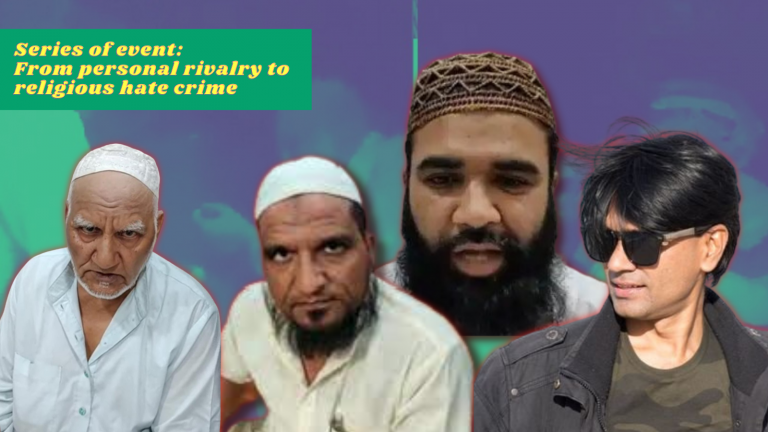
On June 5, 2021, Abdul Samad from Ghaziabad was allegedly thrashed by a Parvesh Gujjar, Aarif, Adil, Mushahid, Kallu and a few others for selling an amulet to the prime accused which allegedly had ‘adverse effects’ on his family. The accused in the crime had planned to seek revenge for the occult solution going wrong.
Samad’s elder son claims he submitted a written complaint to police
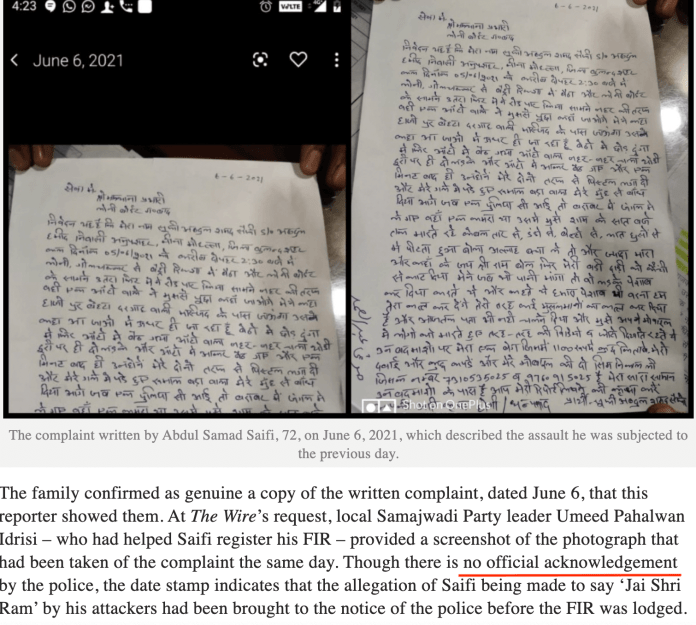
As per one report by The Wire, Samad’s elder son claimed he submitted a handwritten complaint to the Loni Border police station drafted with the help of Samajwadi Party leader Umed Pahalwan Idrisi. His son also claimed that no one in the family was involved in making ‘taveez’. However, the same was contradicted by other witnesses as well as Abdul in a video shot moments before he was thrashed. In the video, Abdul had admitted to have made the ‘taveez’ on instructions of Intezar, who acted as his agent for occult practices.
In the unstamped complaint, Babbu Saifi (Samad’s elder son) claimed that his father was picked up by a group of unknown men while he was on his dargah on the pretext of dropping him. He was then taken to an unknown location where he was thrashed, his long beard cut, made to chant ‘Jai Shri Ram’ every time he screamt ‘Allah’ on being hit and was asked to drink the urine of the attackers.
Screenshot of the report published by The Wire which features the handwritten complaint.
The said ‘complaint’ did not have any acknowledgment stamp from police so no evidence to suggest this was actually submitted by the victim.
FIR of assault filed
On June 7, 2021, the Loni Border Police Station registered an FIR basis the complaint and initiated investigations.
Ghaziabad (rural) SP Iraj Raja revealed, “In the first FIR, which was filed on June 7, the victim didn’t name anybody and neither told us about being abducted and thrashed and forced to chant Jai Shri Ram.”
SSP Amit Pathak too during a press conference revealed that three attackers Parvesh, Adil and Kallu were nabbed basis the information received by the victim. The three during the interrogation confessed to knowing Samad as opposed to the victim’s claim.
The police also highlighted the discrepancies in the victim’s narrative. The prime accused Parvesh, his family and other witnesses in the case had confirmed that the victim Samad was well known to the family and he had been visiting them for the last three months.
Alt News turns personal animosity into a religious hate crime
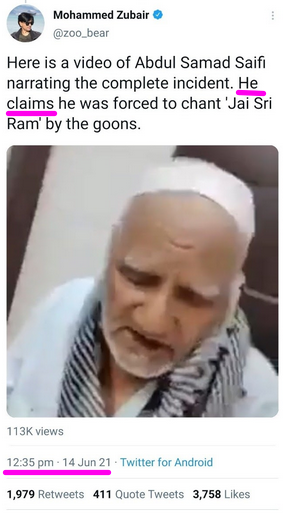
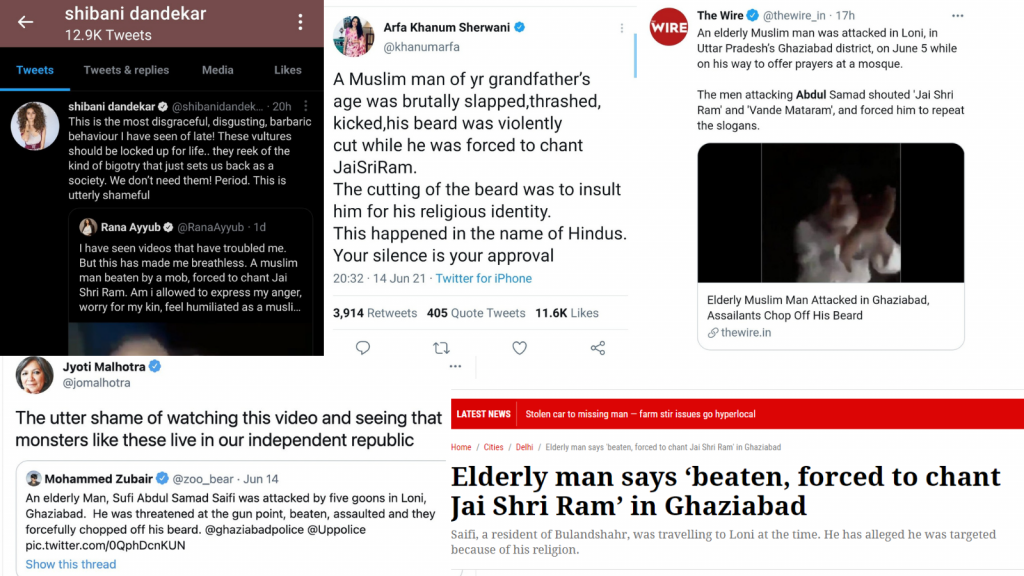
On June 14, Alt News co-founder Muhammed Zubair uploaded a muted video (which now stands deleted) of the incident where the victim was being assaulted and Tweeted that the man was threatened at gunpoint, beaten, assaulted and the perpetrators forcefully chopped off his beard.
Screenshot of Zubair’s deleted Tweet
Soon after, Zubair posted another video (also deleted) which was a Facebook live done by SP leader Idrisi with photos of SP leader Akhilesh Yadav hanging on the wall. Samad in this video showed the marks of assault and claimed that he was forced to chant ‘Jai Shri Ram’.
Screenshot of Zubair’s deleted Tweet
It is imperative to note that these videos were uploaded and made viral with the help of the left ecosystem and publications such as The Wire and TheQuint 10 days after the incident.
Tweets and articles on false claims
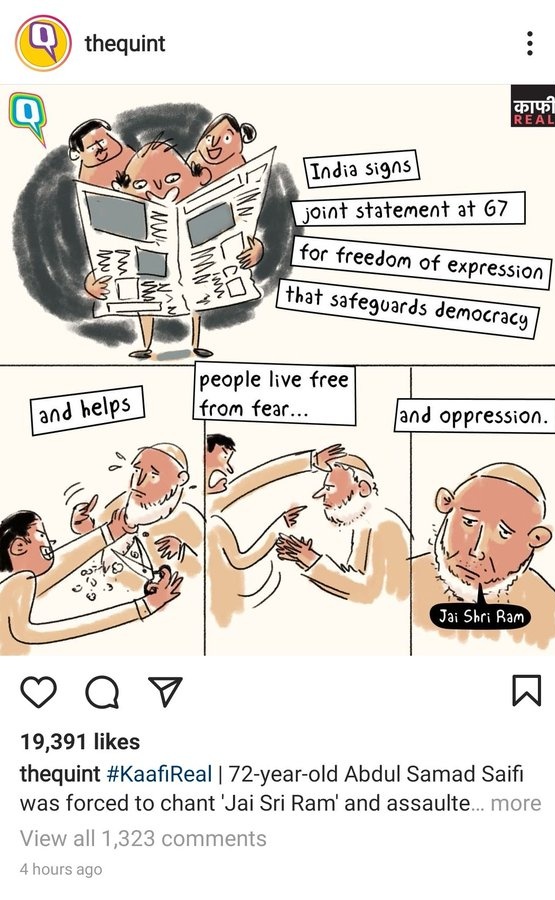
TheQuint also published a Hinduphobic cartoon on the incident which has since been taken down.
Hinduphobic cartoon by TheQuint
Ghaziabad police issues clarification
On the very same day, Ghaziabad police uploaded a video apprising of the case giving relevant details and kept the social media users updated with the development thereon.
उक्त वीडियो वायरल के संबंध में पीड़ित की तहरीर पर पूर्व में ही अभियोग थाना लोनी बॉर्डर पर पंजीकृत है मुख्य अभियुक्त वर्तमान में जेल में निरुद्ध है अन्य अभियुक्त गण की शीघ्र गिरफ्तारी कर प्रकरण में आगे की कार्रवाई की जाएगी । बाइट सीओ लोनी pic.twitter.com/1EeZ6h6RUO
The police clarified that there was no communal angle to the story.
Uttar Pradesh government takes cognizance
Despite multiple updates by the UP Police on the case, scores of articles and Tweets flooded the social media platforms turning a personal rivalry into a religious crime.
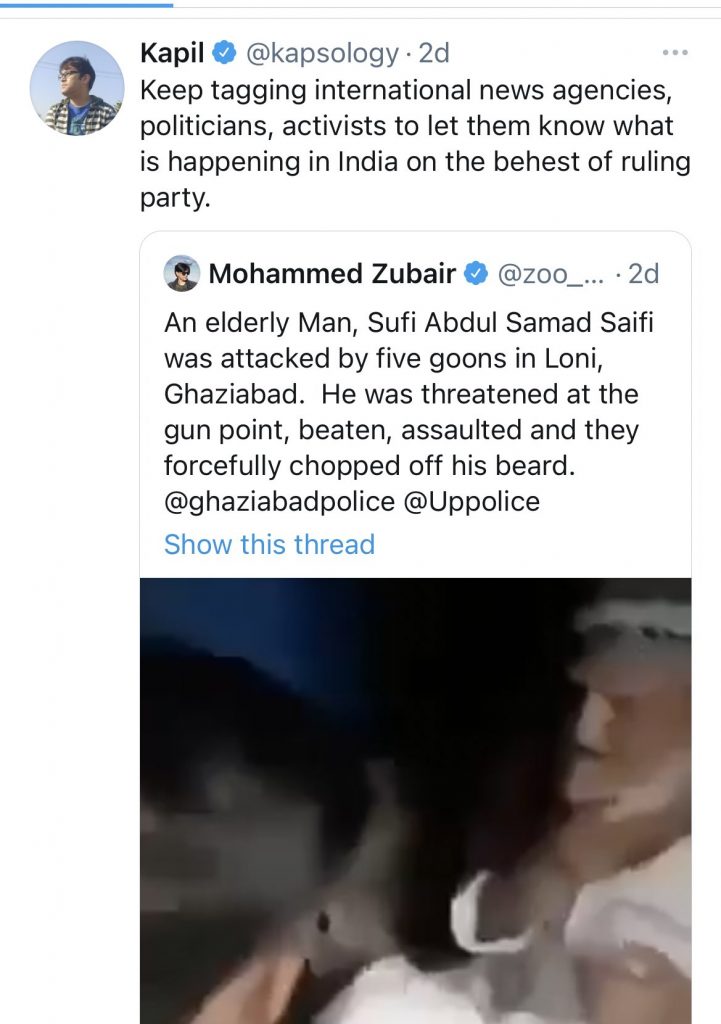
Attempts were made by the politicians to turn this into an international issue. One AAP leader urged netizens to tag international media to grab their attention.
Screenshot of Kapil’s Tweet
However, in an attempt to bring the hippodrome of fake news to an end, the Uttar Pradesh government filed an FIR on June 15 against Twitter for failing to flag the video with unverified claims as ‘manipulative’ and lack of action.
Alt News co-founder Zubair, Rana Ayyub, The Wire, Salman Nizami, Maksoor Usmani, Sama Mohammad and Saba Naqvi have also been booked for spreading misleading and fake news.
Zubair takes down videos
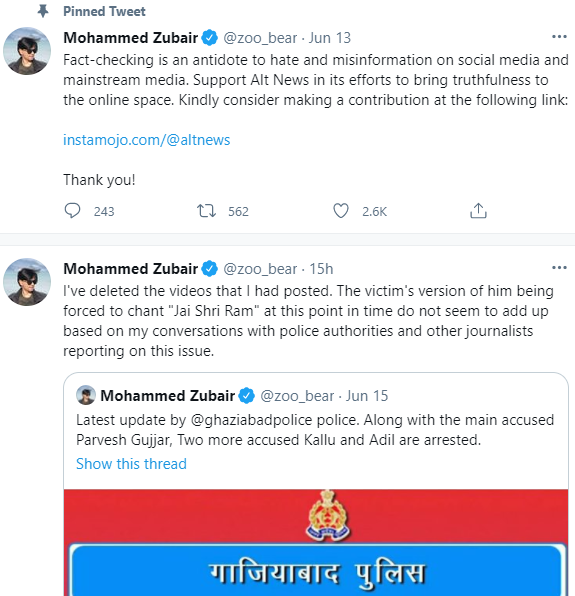
Following the FIR, Muhammed Zubair on June 15 took down the muted video of the incident where he claimed the victim was forced to chant ‘Jai Shri Ram.’
Screenshot of Zubair’s Tweet
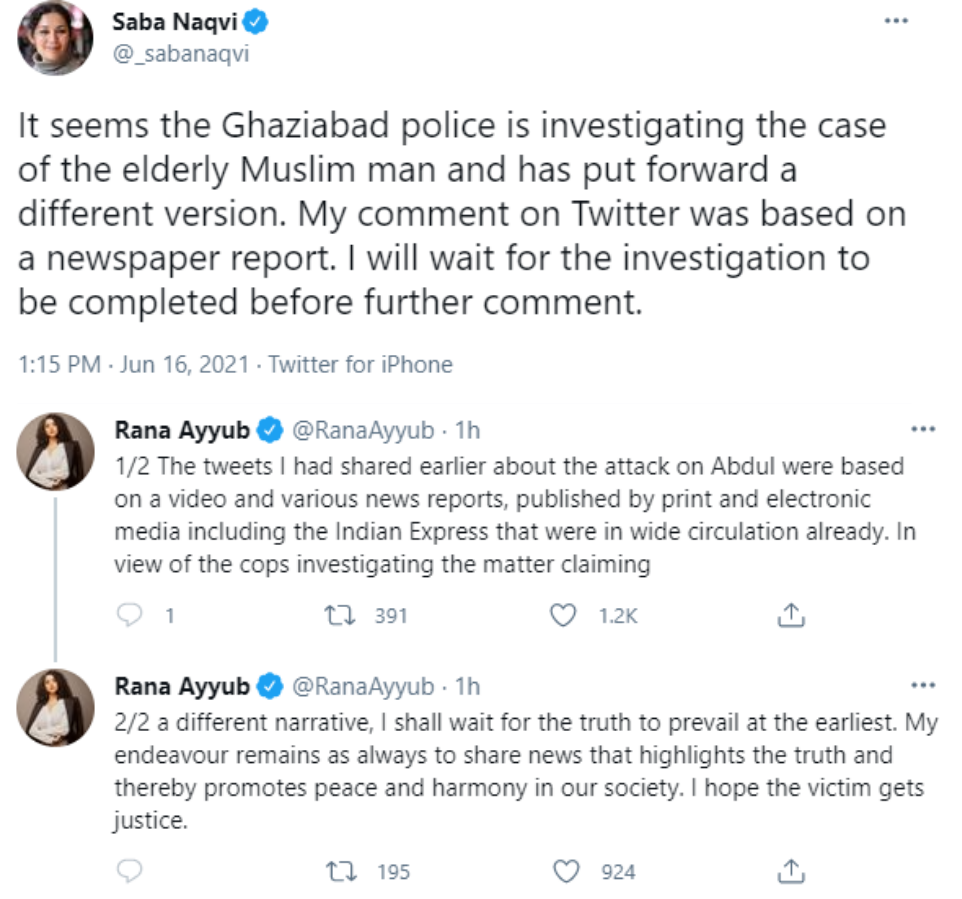
To follow the suit were Saba Naqvi and Rana Ayyub who declared they will wait for the police investigations to complete before commenting on the case.
Screenshot of Tweets made by Saba Naqvi and Rana Ayyub post the FIR
Ghaziabad police warns publishers from fanning communal tension
Uttar Pradesh Police in a press conference held on June 16 apprised about the FIRs registered against Twitter, The Wire and seven individuals.
SSP Amit Pathak also warned, “We are still watchful and if anyone is found furthering the narrative and deliberately publishes hateful content to disturb the communal harmony, strict action will be taken.
Ghaziabad: ट्विटर पर FIR के मामले को लेकर पुलिस एसएसपी अमित पाठक का बयान, कहा- ‘सोशल मीडिया पर ऐसे कंटेंट डाले गए जिससे कि लोगों की भडकाव की भावना पैदा हुई। कानूनी रूप से ट्विटर के खिलाफ कार्यवाही की जायेगी’ @ghaziabadpolice@TwitterIndia@UPGovtpic.twitter.com/eybVcizc1G
He added that the police is identifying other publishers too, who had fanned the false narrative trying to give the incident a communal colour.
Man who hired Abdul to make ‘tabeez’ reveals details
As investigation progressed, one Bauna Saddam revealed that he was introduced to occultist Abdul by his brother in law Intezar for a taveez. He said that Intezar had also introduced the accused Parvesh Gujjar to Abdul for similar taveez. However, as per Abdul, on Intezar’s instructions, he created ‘taveez’ which misfired for Parvesh.
Parvesh got Abdul to admit this and confronted Intezar. Soon, each side called their supporters and a fight broke out. In the same, Abdul was also thrashed.
In another video, one can see the occult material retrieved from Abdul Samad Saifi.
Ghaziabad police files a case against SP leader
Ghaziabad police has also registered a case against SP leader Umed Pahalwan Idris, who appeared in a Facebook Live video alongside the victim.
An FIR against him states, “The accused made an unnecessary video with the complainant and, without verifying the facts of the case, carried out religious discussions on his Facebook, which spread animosity in the community.”
“The accused attempted to give the incident a communal colour and disturb societal balance. This act hurt religious sentiments. The particular act presented a threat to law and order and tried to divide between Hindus and Muslim community,” it added.
However, attempts are still being made by several media houses to paint it as a communal and religious hate crime by calling the police records, statements and investigation a “narrative.”
While Delhi battles Covid and struggles to get over lockdown, AAP leaders are busy organising public gathering events over mundane “achievements”.
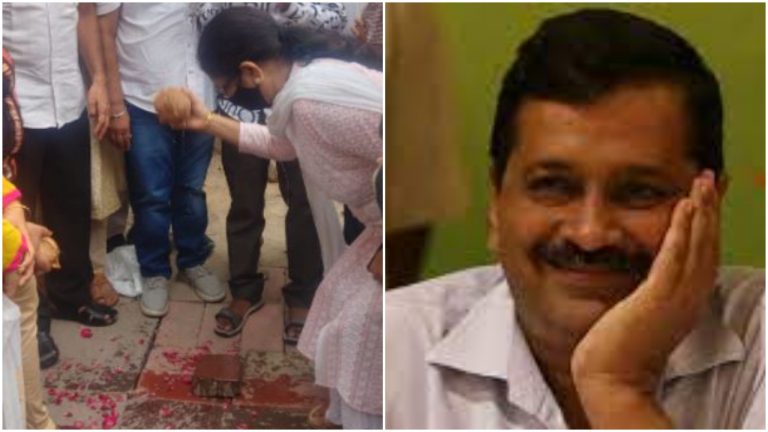
On Thursday Shiv Charan Goel, the Aam Aadmi Party MLA representing the Moti Nagar (Assembly constituency) in Delhi, took to Twitter to share with the Dilliwalas the Kejriwal government’s multitasking abilities.
He boasted of how even in these difficult circumstances, Delhi’s Aam Aadmi Party government took on the very remarkable task of building a speed breaker in Moti Nagar.
People in Delhi would be pleasantly delighted that the Kejriwal government was able to complete this onerous task of building a speed breaker on a Moti Nagar lane while ‘handling the pandemic’.
माननीय मुख्यमंत्री श्री अरविंद केजरीवाल जी के नेतृत्व में कोरोना कॉल में भी जारी है मोती नगर में विकास कार्य,
As seen in the pictures shared by the MLA on Twitter, the excited bunch of party members and supporters have huddled around what seems to be a piece of brick to normal eyes in the name of “inaugurating a speed breaker”.
In order to celebrate their monumental achievement of creating the masterpiece, the ecstatic AAP members thought it was acceptable to breach the social distancing rules, especially in a city like Delhi, which has, both during the first and second wave, experienced the worst of the pandemic.
Well, we on our part also tried our best to scrutinise the pictures shared by the AAP MLA but could not see the ‘speed breaker’ the MLA is gloating about in his Tweet. One probably needs the eye of an AAP leader to perceive the invisible!
The Delhites, on the other hand, who had probably given up hope in the AAP government, were astonished that Kejriwal had the foresight to take on such a challenging task and produce this architectural marvel in the midst of a global epidemic.
— हिमांशु त्यागी ??? (@Himanshu_Tyagii) June 17, 2021
It is incredible how the Kejriwal government never fails in bringing out the true spirits of the Delhiwalas!!
Well, while the AAP administration can’t stop bragging about the ‘development’ work it did during the pandemic, the MLA should be reminded of the criticism the Delhi government has received for mishandling the pandemic in the national capital.
AAP Govt’s handling of the Covid pandemic
Recently, the Supreme Court ripped into Delhi Govt over treatment of Coronavirus patients in its hospitals and handling of dead bodies.
During the suo motu hearing, the apex court called the situation in Delhi as horrendous, horrific and pathetic. It ripped into the lawyer appearing for the Delhi government for patients being stacked with dead bodies everywhere in its hospitals.
Even the Delhi High Court had slammed Arvind Kejriwal-led AAP government over the deteriorating coronavirus situation in the national capital.
The Delhi High Court had severely criticised the Kejriwal-led government for the rising number of cases in Delhi and asked why the administration did not take steps when cases were increasing in the city. In a scathing observation, the Delhi HC had stated that the city could soon become the ‘corona capital of the country’.
The West Bengal elections 2021 saw Mamata Banerjee return to power with a thumping majority. Post the victory, West Bengal saw a spate of unprecedented violence by TMC against those who fought on BJP ticket and those who supported the party. Thousands fled the violence and became refugees in Assam. Now, sources in the West Bengal administration indicate that the Mamata Banerjee government has instructed a large number of social media accounts and posts, talking about the violence in Bengal, to be deleted.
Sources in West Bengal administration indicate that the Government of West Bengal recently recommended large number of social media posts for blocking under section 69A of the Information Technology Act, 2000.
According to sources, over 200 social media posts from Facebook, Twitter and Youtube for blocking by citing reasons that these posts were a potential threat to public order in the state. These social media posts comprised of posts critical of Chief Minister Mamata Banerjee, posts about the murder of BJP workers and various communally sensitive posts showing disrespect to Hindu and Muslim religions.
Interestingly, sources also indicate that two-thirds of the posts that are being mentioned by the Mamta government have already been clocked by the request of the central government since they promoted enmity, however, one-third of those tweets that the Mamata government now wants blocked are those which could be called political criticism.
The central government, according to sources, never recommended these tweets for blocking because political criticism cannot be considered a threat to public order.
Interestingly, while Mamta Banerjee is requesting over 200 posts and accounts to be withheld because they supposedly criticised her, she has been going hammer and tongs against the central government, critiquing them for trying to make Twitter comply with Indian laws.
West Bengal Chief Minister Mamata Banerje on Thursday said the Central government is trying to bulldoze Twitter as it can’t control the microblogging platform anymore in the country.
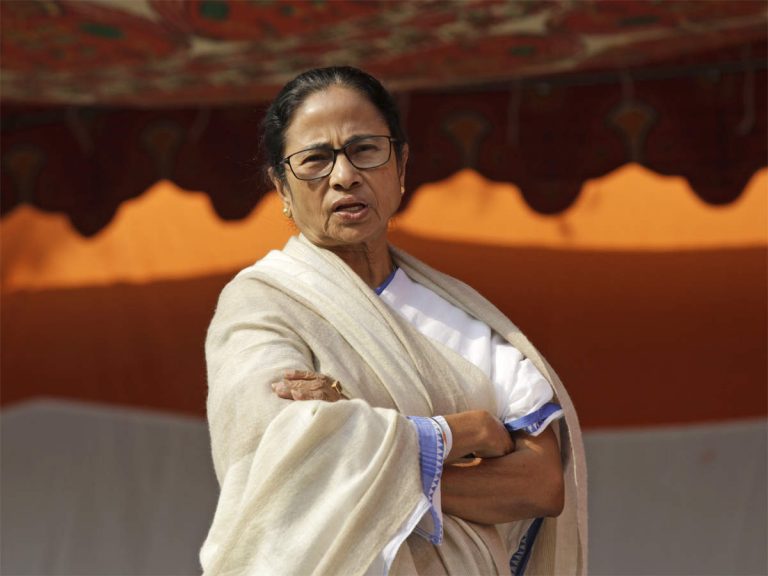
“Unfortunately, they (the Centre) can’t control Twitter that’s why they want to bulldoze them. Similarly, they can’t control me that is why they are trying to bulldoze my government in West Bengal. They should stop this,” Mamata said in a press conference.
Social Media giant Twitter has lost its intermediary status in India for not complying with the new Information Technology Rules, which came into force on May 26, reports Times of India.
According to the reports, as Twitter India did not comply with IT rules enforced by the Indian government and failed to appoint statutory compliance officers criminally liable for the content posted on the platform within the given time, the intermediary status of the platform has automatically lapsed.
The loss of intermediary status could mean that its top executives, including the country managing director, may now face police questioning and criminal liability under IPC over “unlawful” and “inflammatory” content posted on the platform by any user. The legal immunity that was provided to Twitter over content moderation in the country is officially over now.
The Indian government is reportedly unhappy with the brazenness of the social media company, which have been continuously evading compliance with Indian rules. The government believes that repeated reminders and even the temporary relaxation that was extended to social media giant as a “goodwill gesture” has not yielded results.
For over five thousand years, India has been home to one of the fascinating intellectual endeavours that humankind has ever recorded. India, one of the oldest civilizations in the world, has a strong tradition of science and technology. Ancient India was a land of sages and seers as well as a land of scholars and scientists.
From the ancient Vedic ages till today, the Indians have exhibited unmatchable deep understanding and mastery over knowledge across the spectrum. The ancient Indians have left us a great treasure of knowledge, and the rational interpretation of these ideas, which has become the basis of knowledge discovery across the civilization for several ages now. From astronomy to metallurgy, mathematics to medicine, the contribution of Indians to the global knowledge discovery is enormous.
The origins of the Indian scientific endeavours can be traced to the Vedic period, over three thousand years ago. The Indian scientists have made several discoveries, becoming one of the firsts to shed light on several scientific ideas much earlier than the inception of the very same ideas in the west. In addition to discovering and recording scientific phenomenons, the Indian sages had also absorbed the scientific methods of the other culture-areas in all true spirit, thus displaying a real scientific attitude.
In fact, what interesting is, such an effort by the ancient Indians has been characterised by prolonged observations, especially with the naked eye and simple tools, at times aided by techniques that we seem to discard as crude and primitive.
A fact of great significance is that Indians produced a vast literature on different aspects of astronomy, cosmology, numerology, measures of time, development of observatories, instruments etc. The ancient Indians were also the first to study the planetary motions, design calendars, study time and the inter-disciplinary nature of many of these above aspects.
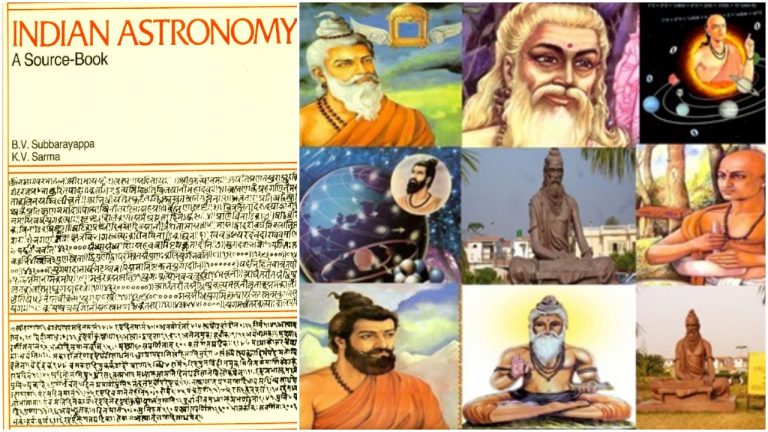
In a book titled “Indian Astronomy: A Source-Book”, the authors – BV Subbarayappa and KV Sharma, have recorded more than 3,000 such observations and discoveries by Indian scientists, astronomers and mathematicians over thousands of years. The book intends to provide a general insight into the scientific discoveries in the field of astronomy, numerology, a measure of times and several other aspects that were accomplished in ancient India.
About 3000 verses, written by the likes of the greatest Indian astronomers and thinkers like Aryabhata, Bhaskarcharya, Brahmagupta etc have been extracted from many original sources, mainly in Sanskrit, and presented with their translations in English and notes by the authors.
Here are few of them that shed light into understanding how ancient India was the cradle for one of world’s greatest scientific discoveries.
1. Qualifications of an Astronomer:
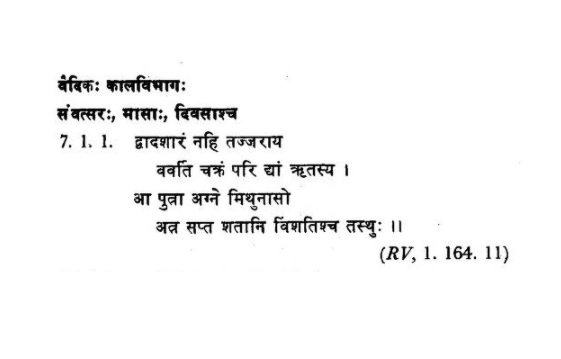
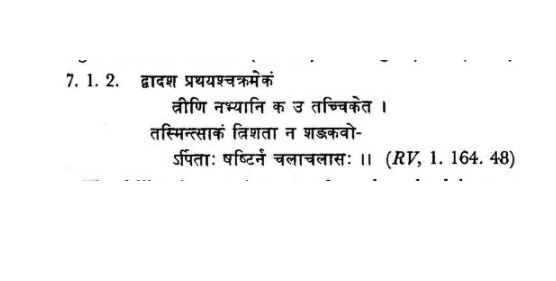
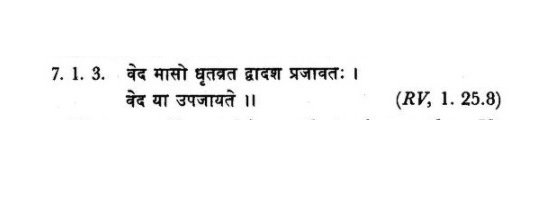
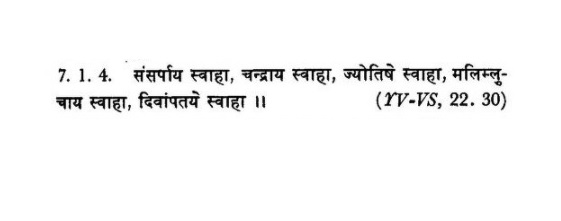
These passages in Sanskrit brings out the authenticity of the basic characteristics of Indian astronomy as it outlines the expertise expected of an astronomer in ancient times. The below verse outlines how there was utmost importance to accuracy in ancient ages and how one had to adopt the intricate methodologies to become an astronomer. More significantly, the ancient texts gave importance to observation and mathematically developed documentation to ensure that Indian astronomers did not indulge in speculation but on empirical data.
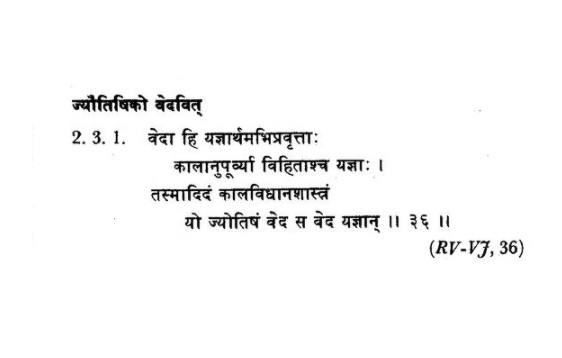
Here is a verse that sets eligibility standards for individual practising astronomy. The ancient verses written during the Vedic ages set rules to be followed by a person before the performance of sacrifices.
The Vedas state that a certain sequence of actions should be followed at appropriate times before performing sacrifices. Hence, he who knows astronomy, which is the science specifying time, knows the sacrifices and, so, is a Vedist, reads the verse written in Rig Veda.
Image Source: Sourcebook on Indian Astronomy, by BV Subbarayappa and KV Sarma
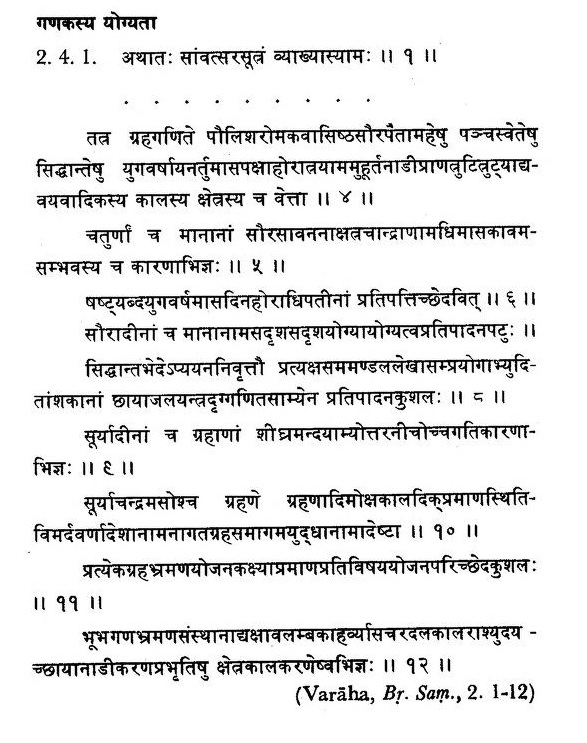
In his extraordinary encyclopaedia Brihat Samhita, the ancient Hindu astrologer, astronomer and polymath Varahamihira, has accounted for the detailed qualification one has to possess to become an astronomer. Varahamihira, who himself was an accomplished astronomer during the 6th century BC, was one of the first in the world to study and detail about the Sun in his treatise – Surya Siddhanta.
The below verse details the conditions for an individual to be qualified as an astronomer:
Image Source: Sourcebook on Indian Astronomy, by BVSubbarayappa and KV Sarma
The translation reads:
Among the astronomical calculations, the astronomer should be conversant with the various sub-division of time such as the yuga, year, solstice, season, month, fortnight, day and night, Yama (a period of an hour and a half), muhurta (forty-eight minutes or two ghatis), Nadi (equal to 24 minutes), prana (time required for one inhalation), truti (a small unit of time) and its further subdivisions, as well as with the ecliptic (or with geometry) that are treated of in the five Siddhantas entitled Paulisa, Romaka, Vasistha, Saura and Paitamaha. (4)
He should also be thoroughly acquainted with the reasons for the existence of the four measurement systems of the time, viz. Saura or the solar system, Savana, or the terrestrial time, i.e. the time intervening between the first rising of any given planet or star and its next rising, Nakshatra or sidereal, and Chandra or lunar, as well as for the occurrence of intercalary months and increasing and decreasing lunar days. (5)
He should also be well-versed with the calculation of the beginning and ending times of the cycle of sixty years, a yuga (a five-year period), a year, a month, a day, a horn (hour), as well as of their respective lords. (6)
He should also be capable of explaining, using arguments, the similarities and dissimilarities, and the appropriateness or otherwise of the different systems of measurement of time according to the solar and allied systems. (7)
Despite differences of opinion among the Siddhantas regarding the expiry or ending time of an Ayana (solstice), he should be capable of reconciling them by showing the agreement between correct calculation and what has been actually observed in the circle drawn on the ground using the shadow of the gnomon as well as water-instruments. (8)
He should also be well acquainted with the causes that are responsible for the different kinds of motions of the planets headed by the Sun, viz. fast, slow, southerly, northerly, towards perigee and apogee. (9)
He must be able to forecast, by calculation, the times of commencement and ending, direction, magnitude, duration, intensity and colour at the eclipses of the Sun and the Moon, as well as the conjunctions of the Moon with the five Taragrahas or non-luminous planets and the planetary conjunctions. (10)
He should also be an expert in determining accurately for each planet, its motion in yojanas, its orbit, other allied dimensions etc., all in terms of yojanas. (11)
He must be thoroughly acquainted with the Earth’s rotation (on its own axis around the Sun) and its revolution along the circle of constellations, its shape and such other details, the latitude of a place and its complement, the difference in the lengths of the day and night (lit. diameter of the day-circle), the carakhandas of a place, rising periods of the different signs of the zodiac at a given place, the methods of converting the length of shadow into time (in ghatis) and time into the length of the shadow and such other things, as well as those to find out the exact time in ghatis that has elapsed since sunrise or sunset at any required time from the position of the Sun or from the Ascendant, as the case may be. (12)
2. Concepts of Astronomy:
Shape of Earth:
Even thousands of years before the Western astronomers discovered the shape of the Earth, Indian astronomers had accurately predicted Earth’s shape as ‘spherical’.
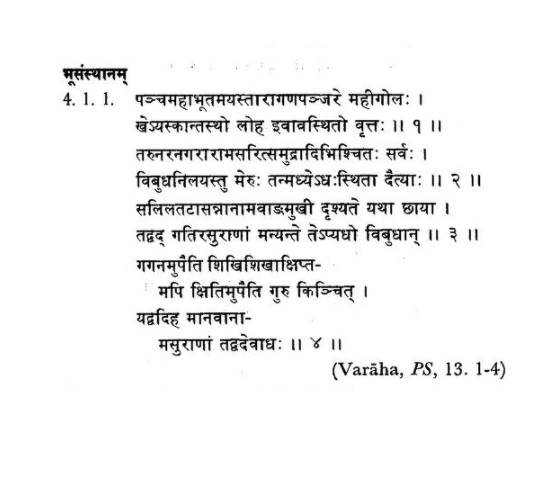
During Varahamihira’s period, the development of astrological and astronomical sciences reached a pinnacle. In his book Paulisa Siddhanta, Varahamihira gives an exact description of not only the share of the earth, i.e., spherical but also provides its topographical study in detail.
The verse in Paulisa Siddhanta accounts, Earth is spherical and constituted of the five elements, which stands poised in the region of space as if it is an iron ball held in position in a cage of magnets. (1)
Image Source: Sourcebook on Indian Astronomy, by BV Subbarayappa and KV Sarma
The whole earth surface is spotted by trees, mountains, cities, rivers, oceans, etc. The Meru mountain (forming the North pole) is the abode of the devas (gods). The Asuras (demons) are down below (i.e. at the South pole). (2)
Just as the reflection of the objects on the bund of a water source is upside down, so the asuras are (with respect to the devas.) The asuras, too, consider the devas to be upside down. (3)
Just as the flame of the fire, observed by men here, flares upwards, and anything is thrown up falls down towards the earth, the same upward flaring of the flame and the downward falling of a heavy object is experienced by the asuras (at the antipodal region). (4)
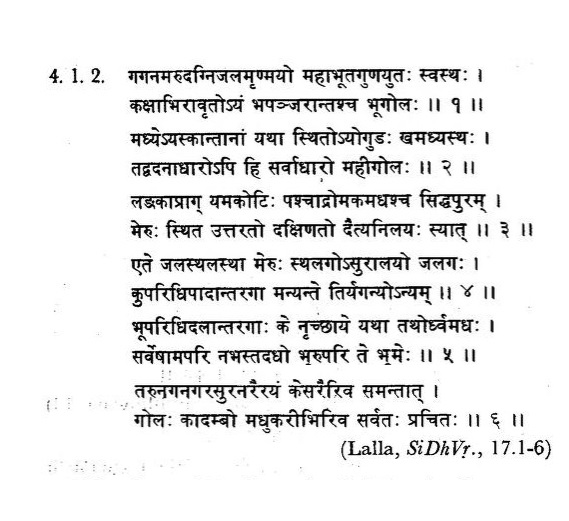
Below is another documentation by Varahamihira describing Earth and its close correspondence with Panchabhutas.
This sphere of Earth, made of akasa, air, fire, water and clay and thus having all the properties of the five elements, surrounded by the orbits (of the Moon, etc.), and extending up to the sphere of stars, remains in (the centre of) space. (1)
Image Source: Sourcebook on Indian Astronomy, by BV Subbarayappa and KV Sarma
Just as a ball of iron, when placed amidst pieces of magnets, remains suspended in space, in the same manner, this globe of Earth remains in space unsupported, while itself remaining the abode of all. (2)
The third verse says – Yamakoti is to the east of Lanka (which is in the middle of the Earth), and Romaka (Rome) is to the west. Siddhapura is beneath Lanka (just opposite); the Meru (mountains) is to the north, and the abode of the demons is to the south. (3)
These (four cities) are on islands. Meru is on the land, and the abode of the demons (in the south) is surrounded by water. These six places are believed to be situated transversely at a distance of one-fourth of the Earth’s circumference (that is 90°), each from the next one. (4)
Those who are at a distance of half the Earth’s circumference from each other are antipodes, just as a man (standing on the bank of a river) and his reflection in the water. The sky is above all. This (globe of Earth) is beneath it. The inhabitants are on the surface of the Earth. (5)
Cause of Earthquakes:
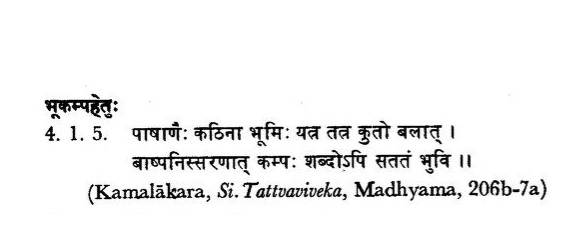
Kamalakara, an Indian astronomer and mathematician, who lived in Varanasi in the 17th century AD, gave the first detailed account of the causes of earthquake within Earth’s crust. However, the European geologists took another century to publish a basic understanding of Earth’s interiors and the phenomenon of Earthquakes.
Kamalara’s work on earthquake/ Image Source: Sourcebook on Indian Astronomy, by BV Subbarayappa and KV Sarma
In his book – Siddhāntatattvaviveka, Kamalakara has stated that the Earth’s crust is hard and rocky. Explaining the process of the earthquake, he writes, a fissure occurs due to lack of strength, gases emerge forcibly, causing the Earth to quake when there would also be constant terrific noise.
Motion of Earth:
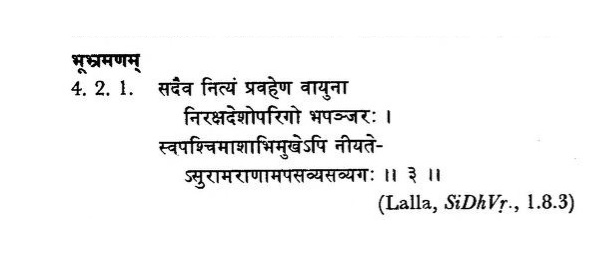
Similarly, Lalla, an Indian mathematician, astronomer, and astrologer, had discovered in the 8th century AD that the Earth travelled from west to east and if anyone viewed it from the north pole star Polaris, Earth turns left, i.e., counterclockwise.
The Indian astronomers made accurate discoveries on earth’s rotation and direction of rotation; centuries before, European astronomers came up with such predictions explaining concepts of Earth’s rotation.
Lallas’s documentation on Earth’s rotation on its axis and the direction of its rotation:
Image Source: Sourcebook on Indian Astronomy, by BV Subbarayappa and KV Sarma
The translation of Lalla’s work reads: The celestial sphere, at the Earth’s equator, is constantly carried towards the west by the Pravaha wind. To the gods (at the north pole), it appears to move (from the left) to the right and the demons (at the south pole from the right) to the left. (3).
Rotation of Earth:
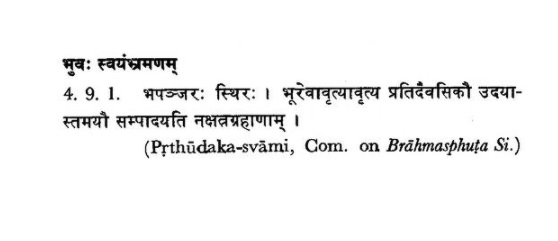
Chaturveda Prithudaka Swami, another astronomer, known for his exemplary work on mathematical equations, explained that it is only the Earth that is regularly rotating once a day, and the sphere of the stars is fixed, causing the rising and setting of the stars and the planets.
Image Source: Sourcebook on Indian Astronomy, by BV Subbarayappa and KV Sarma
In his book – ‘Commentaries on Brahmasphuṭasiddhanta‘, Prithudaka Swami explain the causes behind the phenomenon of days and nights.
Image Source: Sourcebook on Indian Astronomy, by BV Subbarayappa and KV Sarma
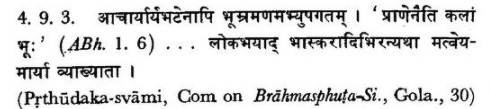
The translation of one of his works reads: The Earth’s rotation had been accepted by Aryabhata also, vide his words, ‘The Earth rotates through (an angle of) one second per one prana (of time). On account of (possible) adverse criticism by people, Bhaskara I and others explained the verse to give it a different meaning.
Image Source: Sourcebook on Indian Astronomy, by BV Subbarayappa and KV Sarma
Aryabhata, arguably the world’s oldest astronomer, had explained the rotation of Earth on its own axis. The above work of Aryabhata is mentioned in his masterpiece – Aryabhatiyam, which translated into, Rotation of the Earth also has been accepted by Acarya (Aryabhata). Note that there is a variant reading as ‘The Earth rotates through (an angle of) one second per one prana (of time).
Image Source: Sourcebook on Indian Astronomy, by BV Subbarayappa and KV Sarma
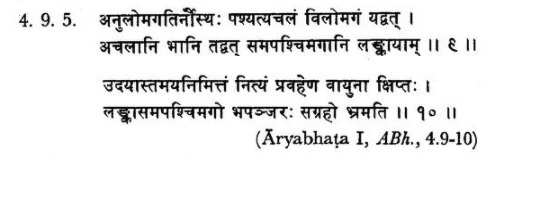
In his book, Aryabhata explains, Just as a man in a boat moving forward sees the stationary objects (on either side of the river) as moving backwards, so are the stationary stars seen by people at Lanka (on the equator), as moving exactly towards the west. (9)
(It so appears as if) the entire structure of the asterisms, together with the planets, moved exactly towards the west of Lanka, being constantly driven by the pro-vector wind to cause their rising and setting. (10)
Image Source: Sourcebook on Indian Astronomy, by BV Subbarayappa and KV Sarma
The earlier texts also had reference to the direction of the earth’s rotation. Makkibhatta, too has discovered that the Earth rotates on its own axis from west to east.
Dimensions of the Earth:
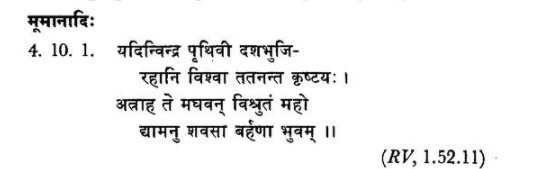
Rig Vedic verses, written more than 5,000 ago, had estimated the dimensions of Earth. Here is a Rig Vedic verse that mentions Mother Earth and its dimensions. It is by far the oldest document to speak, even though it does not explain details about the dimensions and size of the earth.
Image Source: Sourcebook on Indian Astronomy, by BV Subbarayappa and KV Sarma
The translation of the Rigvedic verse translated into: Oh (God) Indra, were this Earth to magnify itself tenfold (i.e., infinitely) and men who live on it multiplied day by day, then and then alone will the lauded might and glory of yours be as vast as the heavens.
Image Source: Sourcebook on Indian Astronomy, by BV Subbarayappa and KV Sarma
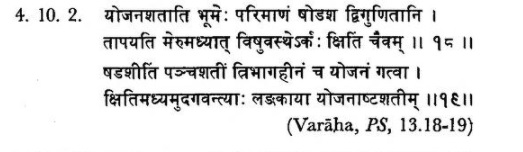
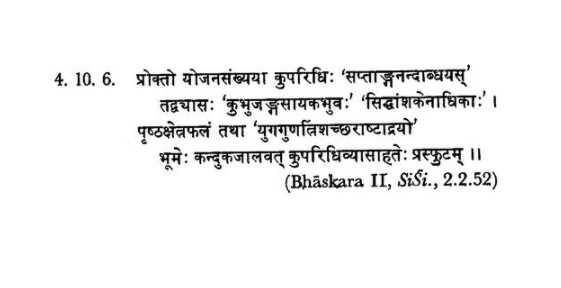
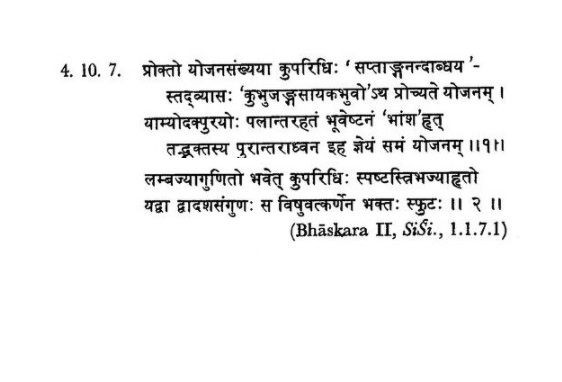
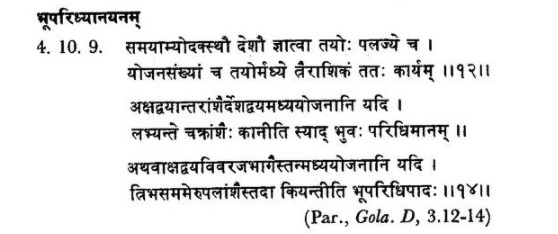
In his seminal work, Varahamihira builds on assumptions of Rigvedic times and accurately estimates the circumference of the earth as 3200 yojanas. Furthermore, each Yojana is estimated to be 12-15 km, which translates into nearly 38,000 km to 45,000 km, which is almost accurate to the current estimates.
Earth’s circumference is the distance around Earth and it is Measured around the Equator, it is 40,075.017 km.
When situated on the equator, the Sun is visible from pole to pole at all latitudes, making the day and night equal). The middle of the Earth (the North pole is meant here) is north of Ujjain by 586 2/3 yojanas. It is north of Lanka by 800 yojanas.
Earth: Diameter and Circumference
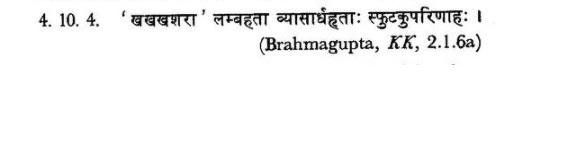
Similarly, in his book Khandakhadyaka, Brahmagupta had also estimated the circumference of the Earth. The above documentation in his book suggests that he had mathematically derived an accurate measurement of Earth’s circumference.
Image Source: Sourcebook on Indian Astronomy, by BV Subbarayappa and KV Sarma
The translation of Brahmagupta’s work reads: Multiply 5000 by thejja of the colatitude of the place and divide the product by the trijyd. The result is the correct circumference of the Earth at that place. (6a)
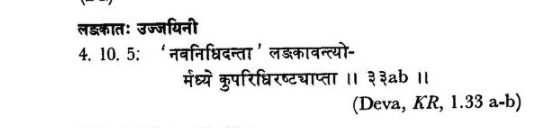
Deva, another ancient astronomer, too had come up with an accurate measurement of the Earth’s circumference. In addition to it, Deva had also calculated the distance between Ujjain (Madhya Pradesh) and Lanka (Sri Lanka), which was nearly 200 yojanas, approximately 3,000 km.
Image Source: Sourcebook on Indian Astronomy, by BV Subbarayappa and KV Sarma
The translation of the above reads: 3299 (yojanas) is the Earth’s circumference; this divided by 16 gives the distance between Lanka and Avanti (or Ujjayini.)
Similarly, Bhaskara II – in his major treatise Siddhanta Siromani, had said that that the circumference of the Earth sphere is said to be 4967 yojanas.
Image Source: Sourcebook on Indian Astronomy, by BV Subbarayappa and KV Sarma
Its diameter is 1581 1/24 yojanas. The surface area thereof is 7,85,034 square yojanas, for it is obvious that, as in the case of a spherical ball, the product of the Earth’s circumference and its diameter gives its surface area. (52),” Bhaskara II wrote in Siddhanta Siromani.
Interestingly, Bhaskar was one of the first to provide an accurate mathematical model to derive the circumference of the Earth. According to his estimation, Earth was 4967 yojana and its diameter 1581.
Image Source: Sourcebook on Indian Astronomy, by BV Subbarayappa and KV Sarma
As per Bhaskara II, a yojana is equal to the (distance between the two places*360)/(circumference-(difference in the latitudes of two places on the same terrestrial meridian in degrees).
In his book, Bhaskara II notes, The equatorial circumference of the earth multiplied by cos 0 and divided by R, or multiplied by 12 and divided by the hypotenuse of the right-angled triangle formed by the gnomon and the equinoctial midday shadow thereof, (hereafter called equinoctial hypotenuse), gives the circumference of the Earth parallel to the equator and passing through the locality (hereafter called the rectified circumference).
Estimating the earth’s circumference, Astronomer Nilakantha had accurately measured that the earth’s diameter is around 1050 yojans, i.e., 12,000 km.
Image Source: Sourcebook on Indian Astronomy, by BV Subbarayappa and KV Sarma
His above work reads: The terrestrial sphere is 1050 yojanas in diameter and it stands in the sky in the centre of the celestial sphere, as the lowest point.
Here is another ancient text giving us the mathematical formulae to determine the circumference of the earth.
Image Source: Sourcebook on Indian Astronomy, by BV Subbarayappa and KV Sarma
The above verse reads: Having fixed upon two places situated exactly north and south, determine their latitudes and the number of yojana-s between them. Then apply the rule of three: If their difference in latitudes causes the distance between the two places, how much (will the distance be) for the degrees in a circle (i.e., 360°)? The result will be the circumference of the Earth. (12-13)
The next verse explains: If the difference in degrees of the two latitudes is the yojanas between them, how many will the yojanas be for 90°, which is the latitude of Meru? This will give a quarter of the circumference of the Earth. (14).
3. Decimal numbers:
Indian mathematicians first recorded the Decimal number system, which is the basis of modern mathematics today. The ancient and medieval Indian mathematical works, all composed in Sanskrit, consisted of several sutras discussing the Decimal system of numbers.
It was Indians who gave the ingenious method of expressing all numbers by means of ten symbols – the decimal system. The simplicity of the decimal notation facilitated calculation, and this system invented by the Indians made the uses of arithmetic in practical inventions much faster and easier.
In his work Aryabhatiyam, Aryabhata explains the decimal system of numbers, where the corresponding place value of a digit is always 10 times as great as the place value of the digit to its right.
Image Source: Sourcebook on Indian Astronomy, by BV Subbarayappa and KV Sarma
The translation of Aryabhata’s work, originally written in Sanskrit: Eka (unit’s place), DaSa (tens place), Shatha (hundreds place), Sahasra (thousands place), Ayuta (ten thousand place), Niyuta (hundred thousand place), Prayuta (millions place), Koti (ten million place), Arbuda (hundred million place), and Vrnda (thousand million place) are, respectively, from place to place, every ten times the preceding. (2)
Astronomer-mathematician Sankara Varman, in the later part of the medieval era, also explained the decimal system that was enumerated by the likes of Aryabhata.
Image Source: Sourcebook on Indian Astronomy, by BV Subbarayappa and KV Sarma
The translation of the above work reads: Eka (1), Dasa (10), Shatha (100), Sahasra (1000), Ayuta (10,000), Niyuta (or Lakh, 10s), Prayuta (10^6 ), Koti (10^7), Arbuda (10^8), Vrnda (10^9), Kharva (10^10), Nikharva (10^11), Mahapadma (10^12), Sanku (10^13), Varidhi (10^14), Antya (10^15), Madhya (10^16), Parardha (10^17) are numbers, each tenfold of the previous.
Here is a Yajurvedic verse that also cites the usage of the decimal system of numbers in the Vedic era. In addition, the Yajurvedic hymns mention the usage of the decimal value system in its ritual practises.
Image Source: Sourcebook on Indian Astronomy, by BV Subbarayappa and KV Sarma
The translation of the hymn reads: O Agni, may these (sacrificial) bricks be my own milch-kine: one and a ten, a ten and a hundred, a hundred and a thousand, a thousand and a ten thou¬ sand, a ten thousand and a hundred thousand, a hundred thousand and a million, a ten million, a hundred million, a thousand million, a ten thousand million, a hundred thousand million, a million-million or billion. May these bricks be mine milch-kine in yonder world and in this world.”
4. Measures of Time
In India, a system of time measurement was in place as early as in Early Vedic Era, dating 2500 BCE. There are several references to the measurement of time in sa and Upanishads.
Here is a Rigvedic hymn explaining the way time was measured in the Vedic age. The above hymn reads that the division of time in Vedic era was on the basis of Year, Months and Days.
Image Source: Sourcebook on Indian Astronomy, by BV Subbarayappa and KV Sarma
The translation of the Rigveda hymn says: The wheel (of time) formed with twelve spokes revolves round the heavens without wearing out. O Agni! on it are 720 sons (viz. days and nights).
The above verse says time was divided into 12 spokes (hourly), with a combined 720 days and nights – making it 360 calendar days.
Another Rig Vedic hymn says: The fellies (or arcs) are twelve; the wheel is one; three-(partitioned) are the axles (or hubs); but who knows it? Within it are collected 360 (spokes), which are, as it were, movable and unmovable.
Image Source: Sourcebook on Indian Astronomy, by BV Subbarayappa and KV Sarma
According to Rig Veda, sage Dhrtavrata knew the twelve months. He also knows the month that is created, the Vedic documents reveals suggesting that the Vedic people knew and practised a sophisticated system of time consisting of 360 days, 12 months, which is almost identical to the Gregorian system of calendars which came thousands of years later and continued to be used even today.
Image Source: Sourcebook on Indian Astronomy, by BV Subbarayappa and KV Sarma
Here is another Yajurveda prayers for hailing interstellar objects such as sun, moon, stars, responsible for formation of day and nights.
Image Source: Sourcebook on Indian Astronomy, by BV Subbarayappa and KV Sarma
Oblation to (the intercalary month) Samsarpa, an oblation to the Moon, an oblation to the luminaries, an oblation to (the intercalary month) Malimluca, an oblation to the Sun, reads the Yajurveda verse.
Taittiriya Brahmanas also list the names of 13 months as per the Lunar system of calendar.
Image Source: Sourcebook on Indian Astronomy, by BV Subbarayappa and KV Sarma
The names of the thirteen months: Aruna, Arunarajas, Pundarika, Visvajit, Abhijit, Ardra, Pinvamana, Anna- van, Rasa-van, Iravan, Sarvausadha, Sambhara and Mahasvan.
The Taittiriya Brahmanas also mentions the names of 24 half-months (pakshas):
Image Source: Sourcebook on Indian Astronomy, by BV Subbarayappa and KV Sarma
The names of the 24 half-months are: Pavitra, Pavisyan, Puta, Medhya, YaSas, Yasasvan, Ayus, Amrta, Jiva, Jivisyan, Sarga, Loka, Sahasvan, Sahlyan, Ojasvan, Sahamana, Jayan, Abhijayan, Sudravina, Dravinodas, Ardrapavitra, Harikesa, Moda and Pramoda.
The Satapatha Brahmanas also mentions the Lunar year consisting of 354 days.
Image Source: Sourcebook on Indian Astronomy, by BV Subbarayappa and KV Sarma
Verily, they who perform the Full and New Moon sacrifices run a race. One ought to perform it for fifteen years. But, in these fifteen years, there are three hundred and sixty full moons and new moons. And, there are, in a year, three hundred and sixty nights; it is the nights he thus gains. (10), reads the Satapatha Brahmana.
Further, He should then sacrifice for another fifteen years. In these fifteen years, there are three hundred and sixty full moons and new moons, and there are in a year three hundred and sixty days; it is the days he thus gains, and the year itself he thus gains. (11)
The authors have documented more than 3,000 verses in their magnum opus, that shed light on the major scientific accomplishments by Indians hundreds of years even before their western counterparts had conceptualised these ideas.