Three Rohingyas, including two men and one woman, were detained at the Bhanga railway station in the Sribhumi district in Assam on Tuesday (16th April). According to the Times of India, the Rohingyas entered India illegally with the help of human traffickers. They reportedly paid 4000 Taka each to the human traffickers for the journey.
The three Rohingyas are said to be siblings named Zubair, Ummay Salima, and Kausar. The trio have reportedly lived in Bangladesh in Cox’s Bazar refugee camp, known as the world’s largest refugee camp, for nine years. They said they had entered India in search of employment and better opportunities. Their human traffickers, whom they referred to as Faruk and Ali, had assured them safe passage to India and employment opportunities in Delhi.
All three of them were detained by the Bhanga railway police when they were trying to travel to another state. However, their traffickers managed to escape. It is not clear which route they took to enter India. The authorities suspect that they entered India through the Tripura or Meghalaya border. Describing the route, Zubair told the authorities it had hilly terrain, but he could not identify the area.
BSF nabbed illegal immigrants and recovered 187 mobile phones
Last month, the Border Security Force (BSF) nabbed Bangladeshi nationals and 4 Rohingyas in the border villages of Meghalaya and Tripura. The BSF also seized around 187 second-hand mobile phones from the Sepahijala district of Tripura. The Bangladeshi nationals, including a woman and two Indian touts, were apprehended in Meghalaya. The four Rohingyas, including two women accompanied by two Indian touts, were reportedly detained in northern Tripura’s Dharmanagar.
In February this year, the Union Home Minister Amit Shah had directed authorities to intensify their operations against illegal immigrants and crack down on the entire network assisting Bangladeshi and Rohingya intruders illegally entering the country, obtaining documents, and settling in India.
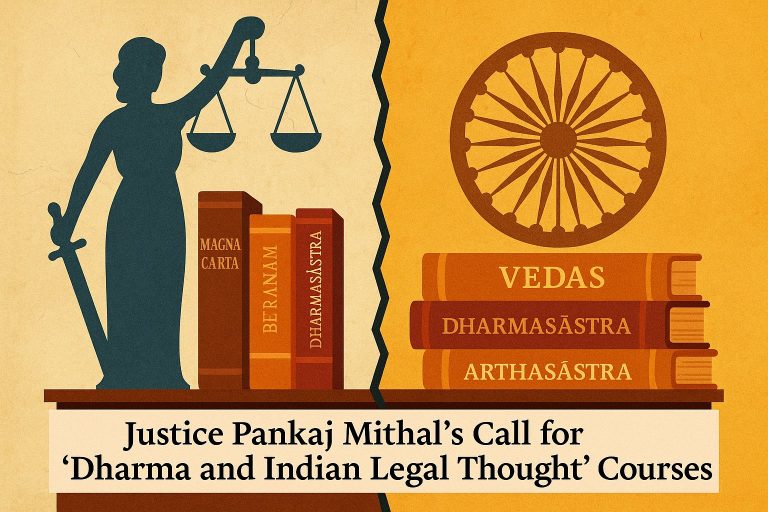
Justice Pankaj Mithal of the Supreme Court of India recently proposed that Indian law schools should introduce a course titled “Dharma and Indian Legal Thought” or “Foundations of Indian Jurisprudence.” His suggestion is not simply a call to add one more elective to an already packed curriculum, but an invitation to engage deeply with India’s own intellectual and legal heritage. This call compels us to revisit the structure and content of Indian legal education, which, to this day, remains disproportionately centred on Euro-American jurisprudence, to the neglect of indigenous traditions.
Today, Indian law students are required to understand Blackstone, Bentham, Austin, and Hart. They are expected to trace the lineage of Western law through Roman edicts, the Code of Hammurabi, the Magna Carta, and the Napoleonic Code. In contrast, limited structured exposure exists to foundational Indian texts such as the Vedas, Dharmaśāstras, the Arthaśāstra, or the epics Rāmāyaṇa and Mahābhārata. The consequence is a conceptual imbalance where students are left unaware of the deep jurisprudential reasoning embedded in India’s own civilizational history. These texts engage with jurisprudential questions concerning justice, governance, rights, duties, and the moral foundations of law. Their inclusion in academic discourse would not only provide continuity with India’s legal evolution but also offer a rigorous philosophical base for examining contemporary legal questions.
Ancient Indian Legal Texts as Jurisprudential Foundations
The Vedas and the concept of Ṛṭa provide the metaphysical foundation of Indian legal thought. In the śvetāśvataropaniṣadand and other early texts, Ṛṭa refers to a cosmic order, a principle of truth and balance that governs the universe. Later, Ṛṭa evolves into “dharma”, a broader moral-legal principle that governs not only individual conduct but also the functioning of society and polity. This contrasts with the Western concept of natural law, which, although also based on reason and morality, often posits a divine lawgiver external to the cosmos. In Indian thought, dharma is internal, not imposed from above but discovered through wisdom, practice, and dialogue.
The Mahābhārata, particularly the Śānti Parva, is perhaps the most elaborate legal-ethical dialogue in world literature. Yudhiṣṭhira’s questions to Bhīṣma cover the nature of justice, the duties of a king, the role of truth, and the complexity of moral choice. The repeated assertion that “dharma is subtle” (dharma sūkṣmaṣca) indicates a clear understanding that justice cannot be reduced to formulae. Bhīṣma’s principle, “that which leads to the welfare of living beings is dharma,” anticipates utilitarian concerns but grounds them in a moral context. In contrast, Western utilitarianism (e.g., Bentham and Mill) tends to rely on consequentialism devoid of intrinsic moral orientation.
Further in the Mahābhārata, the concept of rājadharma, i.e. duties of a ruler, is elaborated in practical terms. The king is bound by dharma, and his legitimacy derives from adherence to it. The threat of matsya-nyāya (“law of the fishes”) warns against anarchy when dharma is abandoned. There is even a proto-constitutional idea that the people have the right to revolt against a ruler who acts against dharma. This is similar in spirit to Locke’s right of rebellion against tyrants, but appears in Indian literature centuries earlier.
The Rāmāyaṇa reinforces legal-moral themes through narrative. Rāma, as Maryādā Puruṣottama, upholds justice (maryādā) even when it involves personal sacrifice. His actions emphasise the idea that rulers must embody public morality. Rāma’s kingdom, Rāma Rājya, becomes a cultural symbol for governance based on justice, order, and welfare. This image of ideal governance offers a benchmark similar to Plato’s “philosopher-king” but embedded in the Indian ethical worldview.
The Dharmaśāstra corpus, particularly the Manusmṛti, Yājñavalkya Smṛti, and Nārada Smṛti, constitutes structured efforts to codify laws. Contrary to popular perception, these texts were not fixed commandments but evolving bodies of law, often contested and reinterpreted by subsequent commentators. The Manusmṛti, for example, outlines a legal structure comprising civil law (dhanadharma), criminal law (daṇdadharma), and family law (strīdhana, āśraama-dharma). It emphasises proportionate punishment, procedural justice, and the king’s responsibility in adjudication.
These texts also reflect early forms of Alternative Dispute Resolution. They describe the role of community-based decision-making bodies such as kula (family assemblies), śreṇi (guild courts), and puga (associational courts). Their role was recognised formally, and their judgments considered binding unless overturned by the rāja sabhā. This resembles the tiered dispute resolution system in modern law and demonstrates that the principles underlying arbitration and mediation were well-established in ancient India.
The Yājñavalkya Smṛti presents more refined and arguably more progressive views, especially on women’s property rights and the role of evidence. It accepts the daughter’s right to inherit in the absence of a son, centuries before this became codified in modern Hindu law. It also outlines types of evidence such as documents (lekhya), witnesses (sākṣin), and possession (bhoga), forming a foundation for evidentiary rules.
Kautilya’s Arthaśāstra stands as a secular, pragmatic text. Composed around the 4th century BCE, it deals extensively with administrative, commercial, and criminal law. The Arthaśāstra is distinct from Dharmaśāstra in that its central concern is not religious duty but effective governance. Yet, it does not abandon ethical considerations. It holds that a king’s happiness lies in the welfare of his subjects, echoing the idea of fiduciary responsibility. Kautilya prescribes systems for the regulation of trade, the protection of consumer rights, and the prevention of corruption through a network of auditors and spies. The book includes a complex classification of crimes and punishments, rules of evidence, and procedures for statecraft and diplomacy. It also accepts local customs and guild rules as sources of law, paralleling modern notions of legal pluralism.
The Edicts of Aśoka, inscribed on rocks and pillars across the Indian subcontinent in the 3rd century BCE, constitute another important source. Aśoka embraced dhamma, which he defined in terms of compassion, tolerance, truthfulness, and charity. His edicts call for humane treatment of prisoners, welfare of animals, equitable treatment of all religious groups, and ethical governance. He appointed Dhamma Mahāmātras to implement these principles, functioning as proto-ombudsmen. Aśoka’s commitment to non-violence and pluralism aligns with modern human rights discourse. Unlike many ancient rulers, Aśoka institutionalised moral policy without imposing religious orthodoxy, a balance modern democracies also attempt to strike.
Law is not only a technical field but also a humanistic one. It is embedded in history, ethics, and society. Legal education must thus include reflective engagement with foundational ideas. Including ancient Indian legal texts provides this dimension. These texts promote a layered understanding of justice from individual ethics to institutional legitimacy.
Comparative Jurisprudence and Curriculum Innovation
In Western legal education, ancient sources are standard components of curricula. Roman law is a compulsory subject in many European law schools, especially in civil law countries like Germany, Italy, and France. It is studied not because Roman codes are directly applicable today, but because they shaped the conceptual language of private law and procedural reasoning. In the UK, legal history is taught to understand the evolution of equity, common law, and the constitutional tradition.
At Oxford University, Roman Law has been a mandatory subject since 1149. This long-standing tradition acknowledges that historical jurisprudence deepens analytical capacity. Students of law, by examining the legal thought of Cicero or Justinian, learn the methods of legal interpretation, categorization, and normative justification.
A similar rationale justifies the inclusion of Indian classical texts in Indian legal education. Texts such as Manusmṛti, Arthaśāstra, and Mahābhārata do not offer ready-made laws for the modern world, but they cultivate jurisprudential reasoning. They invite students to analyse competing principles, evaluate normative frameworks, and appreciate the socio-legal complexity that characterised pre-modern Indian society.
Incorporating these texts can be done within existing subjects such as Jurisprudence, Legal History, or Comparative Law. Alternatively, dedicated electives can be offered. Course design should prioritise critical engagement. For example, caste-based norms in Manusmṛti can be studied in contrast with egalitarian verses in the Mahābhārata and current constitutional values. The aim is to enable students to analyse indigenous sources with the same analytical rigour applied to Western theorists such as Austin, Hart, or Dworkin.
My Experience: A Case from Gujarat National Law University
As a law student at Gujarat National Law University, I had the opportunity to enrol in a course on Indian Legal History. Initially, I approached the subject with uncertainty, as legal education often emphasises statutes, case law, and modern theory. However, the course offered a distinctive intellectual experience. The course instilled in us the awareness that Indian legal philosophy is not monolithic. It contains contesting voices, reforms, and philosophical reflections. The critical study of these texts did not promote orthodoxy, but intellectual maturity. It provided historical context for understanding contemporary legal reforms and socio-legal attitudes. The course developed my analytical skills, broadened my jurisprudential vocabulary, and introduced me to a tradition of legal thought with both historical depth and contemporary relevance. It showed that concepts such as procedural fairness, equity, restorative justice, and environmental stewardship were not imports but part of India’s legal heritage.
Towards an Integrated and Rooted Legal Education
The inclusion of ancient Indian legal thought in legal curricula should not be viewed as nostalgic or nationalistic. It is a necessary correction to a longstanding imbalance. It aligns with global academic standards, enriches jurisprudential training, and promotes contextual legal understanding.
Justice Mithal’s proposal opens a path toward a more integrated and reflective legal education. It urges Indian law schools to draw from their intellectual heritage in shaping future jurists. Such a move would not displace modern legal knowledge but deepen it. A generation of lawyers equipped with knowledge of both Hart and Kautilya, both Dworkin and Bhīṣma, would be better prepared to address India’s legal challenges with intellectual confidence and ethical clarity.
Ultimately, law is not merely a system of rules but a vehicle of justice. Understanding how Indian traditions have conceptualised justice, from Ṛṭa to dharma to nyāya, is indispensable to creating a legal system that is both responsive to present needs and rooted in the wisdom of the past.
(The views expressed are inspired by the speech of Justice Mithal, who was speaking at the inaugural ceremony of the Legal Conclave commemorating 75 years of the Supreme Court of India.)
A violent clash in Nashik city of Maharashtra left twenty-one police officers injured and three police vehicles damaged as a mob protested against the demolition of an illegal dargah (shrine), per the judgement of the Bombay High Court. The incident unfolded late on the night of 15th April, leading the authorities to employ lathi-charges and tear gas to control the situation. Twenty-one individuals have been arrested in connection with the unrest.
#WATCH | Maharashtra: Nashik Municipal Corporation demolished Saat Peer Baba Dargah in Nashik earlier this morning. Bombay High Court had issued orders for the removal of the dargah, finding it unauthorised while hearing a plea.
On 1st April, the Nashik Municipal Corporation (NMC) issued a notice declaring the structure unauthorised and requesting its removal within 15 days. After no action was taken, civic administration, accompanied by police, executed the demolition on 16th April. According to officials, violence erupted shortly after midnight. Rapid dissemination of misinformation led to a gathering of over 400 people. Even with 500 police officers on the scene, the Muslim crowd engaged in stone-throwing, which compelled authorities to utilize tear gas.
Kiran Kumar Chavan, Deputy Commissioner of Police (DCP), Nashik informed, “The trustees of the dargah and local citizens had agreed to remove the construction. Accordingly, all of them had gathered on Tuesday at 11 am. At the same time, a crowd arrived from the direction of Usmania Chowk, and chaos broke out. The trustees and eminent citizens tried to reason with the mob. Senior police officers also attempted to calm the situation, but the crowd did not listen to anyone and began pelting stones.”
He stated that the police utilised tear gas canisters and conducted a mild lathi charge to disperse the throng. “In the stone-pelting, 21 police personnel sustained minor injuries. So far, 15 (number later rose to 21) individuals have been arrested in connection with the violence, and 57 two-wheelers allegedly used by the mob have been seized,” he added.
#WATCH | Maharashtra: At least 21 Police personnel injured when a mob attacked the Trustees of Saat Peer Baba Dargah in Nashik and residents who had gathered late last night to remove the dargah. The dargah was demolished by the Municipal Corporation this morning.
On 22nd February, the NMC cleared the occupation around the Kathe Galli area along the Pune highway by an order from the Bombay High Court. A group of local residents and representatives from Hindu organisations also assembled at the location and complained that the dargah was unauthorised. Nashik Central MLA Devyani Pharande also expressed similar views, emphasising that the anti-encroachment initiative was still unfinished. Nonetheless, the main structure continued to exist because of the protests and prevailing tensions.
#WATCH | Maharashtra: A dispute over an alleged illegal religious construction in the Kathe Galli area of Nashik's Dwarka led to a curfew being imposed here today.
Police personnel, security forces and barricades are in place to prevent any law and order issues. pic.twitter.com/dLQv3pVRbj
Following the directive from the high court, the trustees of Satpeer Dargah initiated the procedure to take it down when an aggressive crowd assembled to resist the action and began throwing stones. Nashik Commissioner of Police Sandeep Karnik conveyed, “As per the high court order, the process of removing the religious structure was taken up by the NMC with strict police arrangement. A violent mob gathered to oppose the removal of the structure and pelted stones at the police and the community leaders, who went to pacify them.”
SHARIAT FIRST? Officials razing an illegal Dargah in Nashik attacked. Municipality issued notice to remove unauthorized construction in 15 days, dargah committee did nothing. In 2024 more than 1000 Hindu religious encroachments were demolished across Maharashtra. No riots. pic.twitter.com/v7upHKUWUi
The top cop further mentioned, “The process of registering an FIR in connection with the violence is ongoing.” Vehicle traffic is restricted on the roadway adjacent to the structure until 18th April.
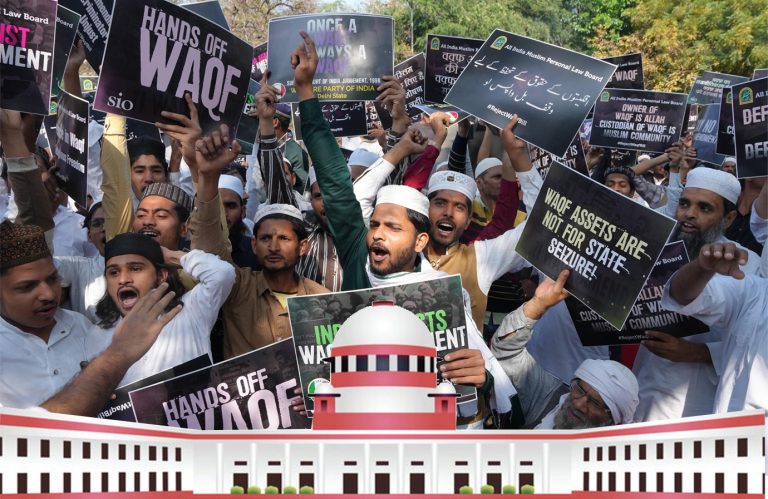
On 16th April, the Supreme Court of India began hearing a batch of petitions challenging the constitutional validity of the Waqf (Amendment) Act, 2025. Solicitor General Tushar Mehta appeared for the Union Government, and a three-judge bench comprising Chief Justice of India Sanjiv Khanna, Justice P.V. Sanjay Kumar and Justice K.V. Vishwanathan heard the matter. The petitions were represented by a score of advocates including Senior Advocate Kapil Sibal, Senior Advocate Rajeev Dhawan, Senior Advocate AM. Singhvi, Senior Advocate C.U. Singh and others.
Focus on whether SC or HCs should hear the matter
The bench was hearing over 70 petitions. There were two threshold questions the court needed to decide on. First, if the Supreme Court should hear the matter or remit it to the High Courts, and second, what exact issues the petitioners wish to argue.
CJI: 2 aspects we need answer: Whether we should entertain or send it to HC? Second what are the points you intend to argue. Second question will decide the first issue also.#WaqfAmendmentAct
Sibal opened his arguments challenging several provisions of the Act on the grounds of violating Article 26 of the Constitution, which gives Indian citizens the right to manage religious affairs. He criticised Section 3R of the Unified Waqf Management Act, asserting that it empowers the state to question a person’s faith by requiring proof of practising Islam for five years in order to create a waqf.
Sr Adv Kapil Sibal: Let me broadly address what the challenge is about. Through a parliamentary legislation what is sought to be done is to intervene in an essential and integral part of a faith. I refer to article 26 and many provisions of the act violates article 26 pic.twitter.com/cZ0bhfINXX
Heated debate over collector’s role and ‘waqf by user’
Sibal further objected to the provisions that allow government officials, particularly collectors, to unilaterally determine if a property is waqf. He claimed that such provisions amount to “a judge in his own cause”. He argued that ‘waqf by user’ is a long-recognised practice and it was upheld in the Ayodhya judgment as well. However, the law now effectively abolishes the provision of ‘waqf by user’.
Sibal: now it says… On and from the commencement of the Waqf (Amendment) Act, 2025, no waqf shall be created without execution of a waqf deed.”
CJI: what's the problem ?
Sibal: There is a concept of waqf by user. Suppose I have a property and I want an orphanage there. What…
However, CJI Khanna questioned what the problem was in registering the property. He asserted that registration helps to protect genuine claims. Simultaneously, he also acknowledged, “If you undo ‘waqf by user’, then there will be a problem.” The Court queried whether waqfs that have been declared by courts could now be denotified, while raising concerns over the provision.
Singhvi argued, if waqf by user is abolished, 4 lakh to 8 lakh properties that have been declared waqf by user will face an uncertain future. CJI pointed out there were reports that Delhi High Court is on waqf land and hinted that the court is concerned about the dubious claims under waqf by user.
Sr Adv AM Singhvi: 4 out of 8 lakhs are waqf by user .. imagine this now
CJI: When we were in Delhi HC we were told that the land is a waqf land!! Don't misunderstand us.. we are not saying all waqf by user is wrongly registered..
Notably, SG Mehta pointed out that it has been mandatory to register waqf properties as per the previous Acts as well. He said, “Registration of waqf was always mandatorily required. Even waqf by user had to go through waqf by registration. In the 1995 Act also it is compulsory.” He pointed out the provision of punishment is only if the person or the Muttawali fails to register the property, even if seen as per the provisions of 1995.
What is ‘Waqf by user’
The concept of Waqf by user was first introduced in the 1954 Act. It allowed properties to be considered waqf based on long-term usage for religious or charitable purposes without formal dedication. It was particularly relevant for public properties like graveyards and mosques. In 1995, the concept was expanded leading to the possibility that waqf property would remain waqf even if its usage stopped. The 2013 amendments reinforced the waqf board’s authority to determine and enforce this status, solidifying control over such properties.
Inclusion of non-Muslims in Waqf Boards questioned
Another major point of contention during the hearing was the new provision that allows non-Muslims to be members of Waqf Boards. Sibal and others argued that it was a violation of religious autonomy. Justice Vishwanathan clarified that ex-officio non-Muslim members were limited, but Sibal claimed, “Even one [non-Muslim] is too many.” The Court questioned SG Mehta, appearing for the Centre, if similar logic should apply to Hindu endowment boards.
CJI: so only 2 ex officio members will be Non muslims
Sibal: no no.. it says excluding ex officio members..2 is the minimum. All of them have to be Muslim as per article 26 and here only 10 out of 22 are Muslims. Here even one is too many.
SG Mehta clarified that the Waqf Council is an advisory body. The supervision by non-Muslims is not unprecedented. He, however, agreed to record in an affidavit that apart from two ex-officio members, only two non-Muslims will be part of the Waqf Boards. Notably, Sibal claimed in the court that any number of non-Muslims can be part of the Board according to the amendments enforced by the Act.
The issue of registering waqf only if person is Muslim for over five years
Wilson and Ahmadi expressed concerns over the provision that allows registration of property as waqf only if the person is Muslim for five years or more. While Wilson claimed that the government provides a “provision period of 5 years for a person to prove that he is a Muslim”, Ahmadi claimed if a person is not following Islamic practices like offering namaz five times a day, he might be deemed a non-Muslim.
Interim relief and broader implications
While concluding the hearing for the day, CJI Khanna noted that there is a need to balance equities and issued a tentative interim relief stating that properties declared as waqf by court, including waqf by user, will not be denotified. Proceedings by collectors may continue. However, they shall not be given effect to. Furthermore, only Muslims, barring ex-officio members, may be appointed to the board.
CJI: so only 2 ex officio members will be Non muslims
Sibal: no no.. it says excluding ex officio members..2 is the minimum. All of them have to be Muslim as per article 26 and here only 10 out of 22 are Muslims. Here even one is too many.
CJI also expressed concerns over the violence that has been happening in Murshidabad. He remarked, “One thing is very disturbing is the violence that is taking place. If the matter is pending here it should not happen.”
The matter is scheduled to continue on Thursday at 2 PM.
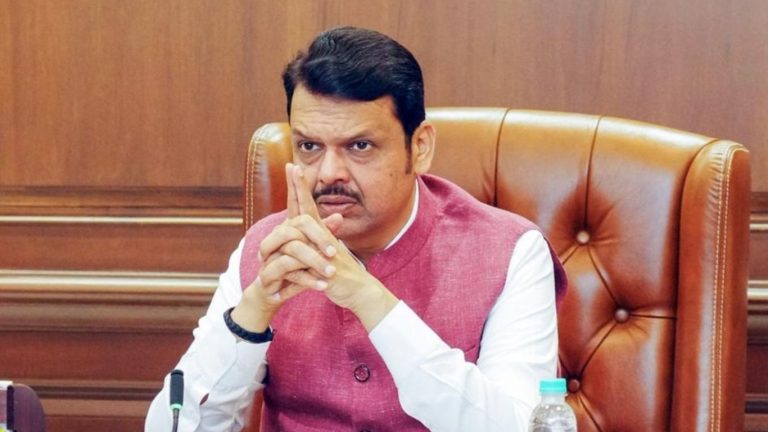
Maharashtra Women and Child Minister Aditi Tatkare on Tuesday (15th April) cleared the air about the recent controversy regarding the financial benefits provided to women under the Mukhya Mantri Majhi Ladki Bahin Yojana. The Devendra Fadnavis-led Mahayuti government had recently announced that certain beneficiaries under the Mukhyamantri Majhi Ladki Bahin scheme will receive ₹500 instead of ₹1500.
The opposition terms the scheme a political move
After the announcement, the opposition targeted the state government, calling the scheme a political move to lure the women voters during the elections. Shiv Sena (UBT) MP Sanjay Raut took a jibe at the Maharashtra government and said that the value of the votes of the women beneficiaries had reduced for the government, and that is the reason the government reduced the cash benefits. Congress leader Nana Patole also accused the state government of betraying the women in Maharashtra.
The government says no reduction in financial benefits under the scheme
Speaking in the state assembly, Aditi Tatkare addressed the allegations regarding the scheme. She said that there has been no reduction in the financial support under the scheme. However, around 7.74 lakh women who already receive ₹1,000 per month from the Namo Shetkari Mahasanman Nidhi scheme will be getting ₹500 under the Mukhyamantri Majhi Ladki Bahin scheme. She said that the scheme assures the maximum monthly financial support of ₹1500 to eligible women. Thus, if any woman is receiving financial support less than ₹1500 under any other scheme, then the rest of the amount up to the upper limit of 1,500 will be provided under the Mukhyamantri Majhi Ladki Bahin scheme.
दिनांक २८ जून २०२४ व दिनांक ३ जुलै २०२४ रोजी जाहीर करण्यात आलेल्या शासन निर्णयानुसार इतर कोणत्याही शासकीय योजनांचा लाभ न घेणाऱ्या महिलांना मुख्यमंत्री माझी लाडकी बहीण योजनेअंतर्गत १५०० रुपये दरमहा सन्मान निधी वितरित करण्यात येत आहे. तसेच, इतर शासकीय योजनांचा १५०० रुपयांपेक्षा कमी… pic.twitter.com/485UFXrRiq
The Maharashtra government on Wednesday (16th April) also clarified that no women have been excluded from the scheme and the financial assistance remains unchanged after July 3, 2024. Assuring that no changes in the financial assistance provided under the scheme have been made, Maharashtra Deputy Chief Minister Ajit Pawar said, “The budgetary allocation for the implementation of the scheme has been made and there is no question of scrapping it.”
Mukhyamantri Majhi Ladki Bahin scheme
The Mahayuti’s flagship scheme is aimed at providing the maximum monthly financial assistance of ₹1500 to all eligible women in Maharashtra. The eligibility criteria under the scheme include domicile of Maharashtra, annual family income of less than 2.5 lakh per annum, and age between 18 years to 65 years. The grounds of disqualification under the scheme include ownership of a four-wheeler and a government employment of any family member.
The number of beneficiaries under the scheme stood at 2.60crore before the 2024 state assembly elections. After the elections, the state government re-evaluated the number of beneficiaries under the scheme based on the eligibility criteria. Now, the number of beneficiaries under the scheme is 2.42 crore.
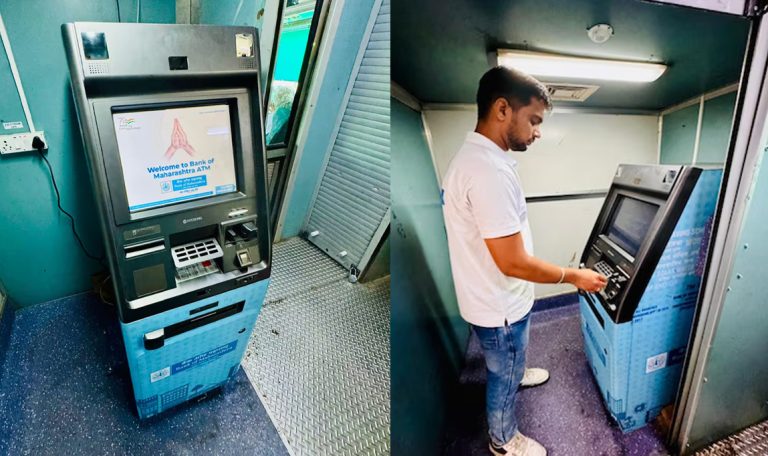
In a first, Indian Railways has installed an ATM on a trial basis — on the Manmad-CSMT Panchvati Express in Maharashtra.
Minister Ashwini Vaishnaw has shared a video of the ATM on a train on his X timeline.
ATM On Wheels initiative is in accordance with the Railway Board’s directive to explore innovative methods to boost railway revenue through non-fare revenue.
A meeting was held with all potential vendors on March 25, 2025. During the meeting, the concept of installing mobile ATMs on trains was proposed.
Similarly, a trial run was conducted on April 10, 2025, on 12110 Manmad-CSMT Panchvati Express. The mini pantry space was converted by the mechanical team into an ATM installation area.
“The ATM was properly secured for its maiden journey with rubber pads and bolts for vibration isolation. Two fire extinguishers have also been provided in the allotted space,” railways said.
In the quest to Viksit Bharat 2047, Indian Railways continued its transformative journey, paving the way for a new era of modernization and progress.
With a strong focus on meeting world class travel experience, boosting freight efficiency, and adopting advanced technologies, the Railways has solidified its role as a catalyst for national growth.
Modern stations, state-of-the-art trains, and innovative safety systems are reshaping the landscape of rail travel.
Under ‘Amrit Bharat Station Scheme’, 1,337 stations have been identified for redevelopment.
Indian Railways achieved 6,450 km of complete track renewal, 8,550 turnout renewals, and raised speeds to 130 kmph over 2,000 km in 2024
Indian Railways electrified 3,210 Rkm in 2024, extending the electrified BG network to 97 per cent with renewable energy capacity reaching 2,014 MW.
A record 136 Vande Bharat trains and the first Namo Bharat Rapid Rail were introduced, alongside 21,513 special train trips during peak seasons.
10,000 Locos being equipped with Kavach safety technology, 9000 technicians trained and bids invited for 15,000 Rkm.
(This news report is published from a syndicated feed. Except for the headline, the content has not been written or edited by OpIndia staff)
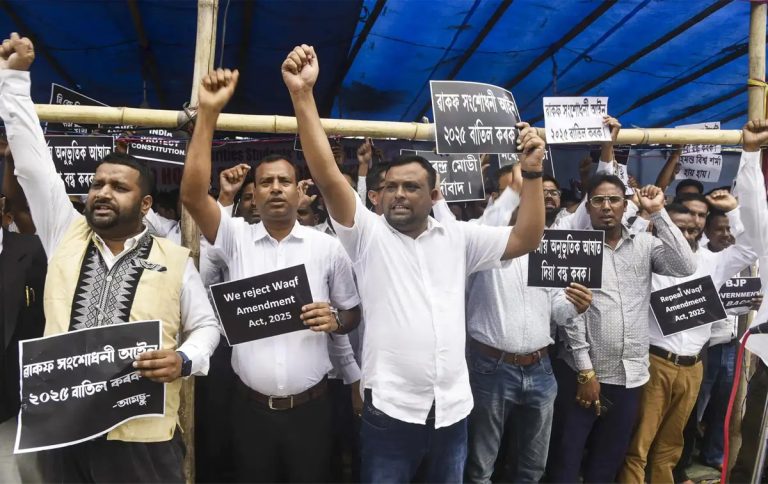
Assam Police arrested seven people in connection with an incident during the protest rally against the Waqf (Amendment) Act in Assam’s Cachar district recently.
Numal Mahatta, Superintendent of Police of Cachar district, said that on April 13 at about 09:30 am, about 300 persons assembled at Berenga village under Silchar police station and began a march towards Silchar town to protest against the Waqf (Amendment) Act.
“A police team from Silchar police station, along with all GOs, arrived at the spot to stop the mob from proceeding further and resorted to mild lathi charge to disperse the crowd. The mob has been dispersed, and regarding the incident, a case was filed in the Silchar police station. Last night, an operation was conducted in the Bagadahar and Kashipur area under the Silchar police station, and 7 accused persons primarily involved in the incident were picked up. They have been duly arrested and forwarded to judicial custody,” Numal Mahatta said.
The arrested persons were identified as Nazmul Islam Laskar alias Kablu, Bidar Laskar, Rohit Hussain Laskar, Dilwar Hussain, Rohit Ahmed Mazumder, Atikur Rahman Laskar and Riyajul Laskar.
Further investigation into this incident is ongoing.
On April 14, Superintendent of Police of Cachar Numal Mahtta said that the protest by the people was taken out without obtaining prior permission.
“The Model Code of Conduct is enforced in view of Panchayat polls, and without prior permission, they took out the protest rally. When we received the information, we reached the spot and dispersed the crowd. Some of them tried to create a law and order situation, but we brought the situation under control,” Numal Mahatta said.
“If anyone tries to violate the law, we are ready to take stern action against them. Now the situation is under control. We have registered a case. We have deployed security forces in this area to maintain the law and order situation,” he added.
Since its passing, the bill has faced several legal challenges in the Supreme Court, with AIMIM MP Asaduddin Owaisi, Congress MPs Mohammad Jawed and Imran Pratapgarhi, AAP MLA Amanatullah Khan, and Azad Samaj Party chief and MP Chandra Shekhar Azad moving the court against the act.
The Act seeks to focus on improving the management of waqf properties, empowering relevant stakeholders, improving the efficiency of survey, registration, and case disposal processes, and developing waqf properties.
(This news report is published from a syndicated feed. Except for the headline, the content has not been written or edited by OpIndia staff)
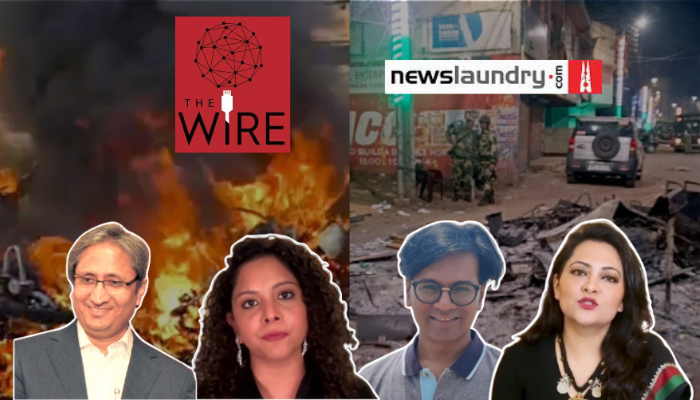
As communal violence ravaged Murshidabad, the All India Trinamool Congress leaders, including Chief Minister Mamata Banerjee (AITC or TMC) prioritized downplaying the situation, indulging in blame game, even accusing Hindus from other states and belittling the sufferings of the victims. Likewise, the Islamists and their liberal mouthpieces, including The Wire and Newslaundry, attempted to sanitize the anti-Hindu riots, framing them as a response to the apprehensions surrounding the Waqf Amendment Act.
They blamed the mainstream media for inflating an otherwise “normal situation” and questioned the legitimacy of the Hindu minority’s plight in Murshidabad. Arfa Khanum Sherwani of “The Wire” acknowledged that her religious brethren were responsible for the burning of Murshidabad, and even the authorities were not spared, but added that the videos coming from the region are not necessarily authentic or current.
She stated that they are only being circulated “to exaggerate the incidents,” as if the turmoil, testimonies of the victims and the reports coming from the area are not sufficient to disturb the conscience of any ordinary individual. As expected, she also reiterated the dubious narrative that the amendment of the Waqf law was an attempt to discriminate against Muslims.
She claimed, “Opposition leaders, Muslim organisations and those who believe in democracy, liberalism and equality have been worried that attempts are being made to provoke Muslims through the law and now Muslims have reacted. This is a conspiracy that needs to be understood.” What she essentially means is that if the second-largest majority in the country disapproves of a law, they might respond with a tantrum, which would be characterised as a provocation and seen as a conspiracy against them.
The reality, however, is that the only conspiracy in this situation had been against the Hindu community, as they were blamed for the passage of the act. She, ironically, insisted that the opposition and Muslim leaders are troubled by the unrest, while the fact is that these same individuals have been instrumental in inciting their voters to protest against the law through their deceitful rhetoric and propaganda.
Arfa soon switched to disparage the saffron party and accused, “This seems to be a deliberate plan, very similar to what the Bharatiya Janata Party (BJP) may have intended as a byproduct of the law. The situation has unfolded exactly as they might have wanted. This law has become a tool in the BJP’s hands, just ahead of the 2026 elections in West Bengal, which are just a year away.” Her remark seemed to imply as if the BJP had asked the Islamists to riot, or was it an admission that these radicals tend to resort to unrest under the guise of protest whenever they are in disagreement, and hence the party should have taken this into account.
Additionally, the legislation applies not just to West Bengal but to the entire nation, rendering the argument regarding elections both unreasonable and unfounded. It is also crucial to note that in India, elections occur at different times in various states each year. Should this mean that the centre has to consider the schedule of the polls to avoid making decisions for fear of criticism or backlash? Is this how governments run and nations are managed?
Absurd comparisons, twisting the truth
“Just two months ago, surveys showed that Mamata Banerjee’s support base had not diminished, despite 15 years of anti-incumbency. In fact, the BJP was up by only 1%. This means there is still strong support for Mamata Banerjee,” Arfa claimed while accusing the BJP of exploiting the situation. Her concerns appeared to be more focused on the state elections and the detrimental effects of the violence on Mamata Banerjee’s prospects for victory over the issues faced by the Hindu victims.
She subsequently drew ludicrous parallels with the Karni Sena and even referred to the Shaheen Bagh agitation, which played a significant role in the anti-Hindu riots in Delhi and the farmers’ protests, which were marred with multiple violent incidents including the attack on the Red Fort and police personnel on Republic Day, as peaceful demonstrations.
She then completely dismissed that the Hindu community was being targeted, asserting that they are the majority in the state. “BJP leader Suvendu Adhikari claims that this is religious persecution and an attack on Hindus. Such twisting of facts is concerning. Yes, one-third of West Bengal’s population is Muslim, but two-thirds are not. Still, a narrative is being spun that Hindus are under attack,” Arfa shamelessly declared. “West Bengal is a state with a large Muslim population, the second highest in India. Every third person here is Muslim,” she had stated earlier.
If the horrifying events that took place in Murshidabad do not qualify as religious persecution, then what does? The area is predominantly Muslim, and the minority faced attacks solely due to their religious beliefs. While the Muslims remained unaffected, the Hindus were forced to leave only to protect their lives.
She highlighted the inflammatory remarks made by West Bengal Minister Siddiqullah Chowdhury and then expressed admiration for Mamata Banerjee. “She is a strong, resilient leader, a street fighter who has never learned to bow down or accept defeat. She has a massive following, tight administrative control, and is a self-made politician, not born of dynastic privilege. Her contribution to women’s empowerment in Bengal is remarkable,” she lauded the TMC chief.
Significantly, women in Murshidabad have endured molestation and threats of rape from Muslim mobs. Is this how Hindu women are being empowered in West Bengal? The shortcomings of Mamata Banerjee’s administration and governance have been repeatedly laid bare, especially now in the riot-affected area. The truth is that the might and authority of Mamata Banerjee, as well as that of the opposition, appear to be reduced to mere ashes in the face of vote bank politics.
Blame news channels, no Hindu persecution
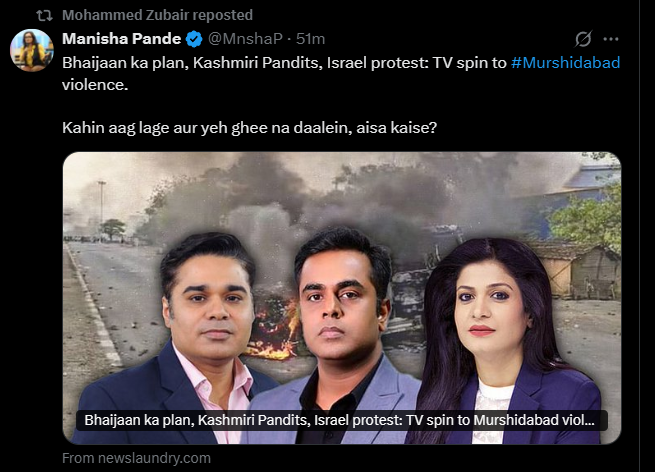
On 15th April, Newslaundry published a piece titled, “Bhaijaan ka plan, Kashmiri Pandits, Israel protest: TV spin to Murshidabad violence” attacking the news channels for reporting on the miserable condition of Hindus in Murshidabad in the wake of Islamist violence. “If mainstream news channels are to be believed, the eastern West Bengal district is a hub of ‘terrorism’ where a ‘Hindu exodus’ is underway as government authorities look the other way,” the article mocked.
It further alleged, “There have been reports of hundreds fleeing their homes to escape the violence. But no substantiated evidence has emerged so far confirming systematic targeting based on religious identity at such a scale. The narrative of Hindus being specifically victimised has primarily originated from Hindutva-affiliated sources and political actors, especially the BJP camp.”
One cannot realistically expect this media outlet to be forthright, particularly if it might displease its primary audience. Nevertheless, it is rather audacious of them to deceive their readers and consider them as gullible enough to believe whatever narrative is being promoted by the platform. A multitude of videos have appeared online illustrating the persecution of Hindus in Murshidabad, leading to their forced exodus.
Their residences have been set ablaze, robbed and defaced. Hindu women have been molested and received rape threats. They have been pressured to have sexual relations with their tormentors to ensure the safety of the men in their households. Several women have escaped with their newborns to avoid the violence. The drinking water supply in Hindu homes had been poisoned. Hindus have been assaulted, looted and threatened with death by the Muslim assailants, including minors. The situation bears a disturbing resemblance to that in Bangladesh and Pakistan.
However, for Newslaundry, it appears that even a Taliban-style execution of Hindus would not be sufficient to convey the community’s anguish. Similar to The Wire, Newslaundry is also committed to present distortion and disinformation in the name of facts. They understand that the attacks are directed solely at Hindus due to their religious identity. Yet, they are resolutely focused on minimizing the severe targeting of Hindus.
The article added, “While the West Bengal government and the state police are yet to make any official statements about claims of Hindus being forced to ‘flee’ Murshidabad, the Calcutta High Court has asked the state and the central government to submit detailed reports on the situation.” What government would genuinely be honest and inform that the situation is profoundly dire in the state it governs, specifically, a party like TMC that relies heavily on the Muslim community as its main voter base.
However, if everything were indeed satisfactory, why would the Calcutta High Court step in? What is the reason for the presence of central forces in West Bengal? Are the accounts from victims and the reports from the state somehow contrived? Are Hindus orchestrating attacks against themselves to frame Islamists?
Newslaundry further complained that the “news channels have thrown all (Press Council of India) regulations out the window and made unsubstantiated claims about Hindus becoming ‘refugees in their own country.’ Some invoked the plight of Kashmiri Pandits, some claimed a terrorist link to the violence, while some alleged a Bangladesh connection.” While it may not be suitable to make hasty assumptions, if a community is compelled to abandon its home due to violence from another group, what term could be used to describe it if not refugees?
Were Kashmiri Pandits not also driven from their homes due to Islamic terrorism? However, this cabal even denies their sufferings and derides movies like “The Kashmir Files,” which bravely represented the same on the big screen. It is a known fact that Murshidabad shares a border with Bangladesh. The unlawful influx from the country into India is also a well-documented reality.
Bangladeshi extremists, with the support of local political party leaders, reportedly played a role in the recent unrest in Murshidabad. According to sources citing an intelligence report, the violence in Murshidabad was carried out by members of two extremist groups located in Bangladesh: Ansarullah Bangla Team (ABT) and Jamaat-ul Mujahideen Bangladesh (JMB). The violence was perpetrated by Bangladeshis who were assisted by local political party leaders. The situation is being constantly monitored by the Union Home Ministry.
Accuse the BJP, Hindus and deflect blame
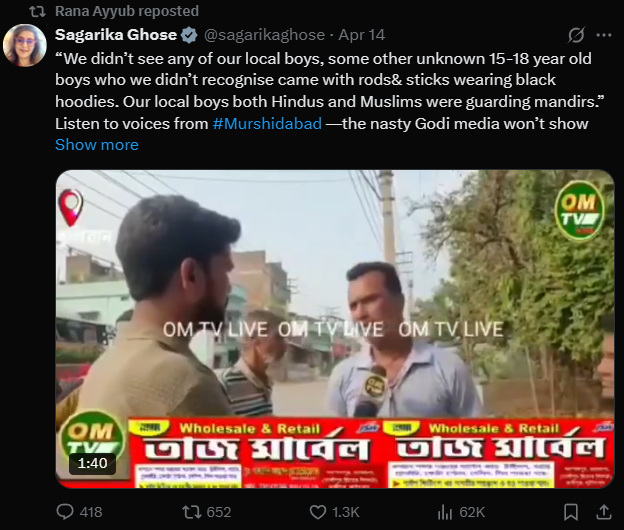
One of the favoured figures among extremist Muslims, Rana Ayyub, shared a tweet by Sagarika Ghose, TMC Rajya Sabha member, which allegedly referenced a man’s claim that non-local teenagers were assaulting the Hindus, while local Hindu and Muslim youths were defending the temple. The temple human chain trope has been extensively employed by this tribe, resulting in a complete loss of its originality and impact. Furthermore, the two purported journalists aimed to shift the blame from the Islamists to external parties, thereby undermining the hardships faced by the Hindu community.
The propaganda piece published by Newslaundry was also shared by radical Mohammed Zubair, who is associated with Alt News, notorious for catering to the Muslim fanatics in the name of fact checks. Each of them has been intent on aiding the culprits by manipulating the facts in their favour. The values of truth, justice and human rights, which they profess to uphold, are nowhere to be found as they do not fit their agenda. These lofty terms, anyway, are tools to further their propaganda and serve no other purpose for them.
Saba Naqvi asserted that the violent protests against the Waqf Act only serve to benefit the very forces responsible for enacting the legislation. Nonetheless, she failed to explain how because those behind the riots do not support or vote for the BJP. They are, in fact, supporters of “secular” parties like the TMC, which accounts for the seemingly submissive behaviour of opposition leaders towards them and their efforts to perpetually pander to them.
She invoked Mohandas Karamchand Gandhi and the idea of peaceful protests, knowing well that the Muslim fanatics are unconcerned with either. These statements are crafted merely to trick the unsuspecting.
I wish to qualify this tweet. Violent aggressive protest is counterproductive. Engagement with law, legal channels, conversations, Gandhian style protest and not positing it as a Muslim alone issue but a constitutional and federal matter involving all Indians would be prudent. https://t.co/GCjuWgy0nE
Ravish Kumar, another spokesperson for this infamous ecosystem and alleged journalist, quickly came to the defense of the rioters, asserting that the reports emerging from the state are inflated and unreliable. He argued that the accounts of violence in West Bengal should not be accepted without scrutiny. He maintained that many of these reports are propagated by what he refers to as “Godi media,” a pejorative term for news outlets that do not share his twisted ideology.
Conclusion
The Islamo-Leftist nexus is predictably engaged in negating the violent attacks on Hindus, claiming that they are not specifically aimed at the community. However, if this is true, it begs the question of why there have been no complaints from the Muslim community and why it is primarily Hindus who are fleeing their homes. Why have only Hindus experienced hardship while the other community remains largely unscathed by these brutal circumstances?
The truth is that propaganda, no matter how powerful, cannot overshadow the reality that Hindus have been targeted not only in Murshidabad but also in other regions due to their faith. The Waqf Act serves merely as a pretext for those who perpetrate violence against Hindus, as they are aware that parties like the TMC cannot risk offending them, given their reliance on their votes. Furthermore, their advocates in the media will readily defend them, regardless of their actions. This has been tried and tested over decades and is once again evident in Murshidabad.
Just as TMC did, these people also strive to misrepresent the truth and attribute blame to all but the actual culprits.
India-Bangladesh relations have been spiralling down since the Muhammad Yuus-led interim regime held the reins in Bangladesh after the fall of the Sheikh Hasina government following a violent uprising in August last year. After India announced the termination of its trans-shipment facility for Bangladesh on 9th April, Bangladesh on Sunday (13th April) suspended the import of yarn from India through land ports.
The land ports of Benapole, Bhomra, Sonamasjid, Banglabandha, and Burimari were the main entry points of Indian yarn into Bangladesh.
The Bangladesh interim government has cited losses to local textile millers due to imported raw materials for the garment industry as the reason behind the move. The government said that the local yarn manufacturers are not able to compete with imported yarn, which is cheaper. In February this year, the Bangladesh Textile Mills Association (BTMA) requested the interim government to cease yarn imports from India via land ports. The BTMA claimed local producers were facing significant financial losses due to cheaper rates of Indian yarn. This led to the interim government temporarily suspending imports via land ports in March this year.
As per reports, the interim government of Bangladesh closed three land ports and suspended one land port with India, citing a lack of necessary infrastructure. The decision made by the National Board of Revenue (NBR) of Bangladesh to protect the local textile and spinning sector did not sit right with Bangladeshi garment and knitwear exporters. The move is reportedly intended to increase imports from Pakistan. However, importing raw material from Pakistan is likely to increase the import time and prices multiple times as compared to the time taken in importing yarn from India. This will eventually affect the local garment exporters’ ability to compete in a global market.
India terminated the trans-shipment facility for Bangladesh
Earlier this month, India terminated the trans-shipment facility for Bangladesh, which allowed the latter to export its products to other countries through Indian seaports and airports. The facility, granted in 2020, allowed Bangladeshi exporters to ship their cargo to India by road or rail, from where they were further shipped to other countries. Under this facility, Bangladesh sent container trucks from the Petrapole Land Port located on the India-Bangladesh border, the largest land port in South Asia, to Kolkata port, Kolkata Airport’s air cargo complex, and Nhavasheva Port in Maharashtra. Similarly, Bangladeshi exporters could ship their products from Petrapole Land Port, Gede Land Port or Ranaghat Land Port using freight trains to Nhavasheva Port, also known as Jawaharlal Nehru Port. From the ports and airports in India, the cargo was then shipped to its final destination countries. Bangladesh’s textile sector benefited majorly from the facility.
India’s decision to terminate the trans-shipment facility came after Bangladeshi Chief Advisor Md Yunus made controversial remarks on North East India. During his four-day visit to China last week, Yunus pitched for the extension of the Chinese economy, saying that as Northeast India is landlocked, Dhaka is the “only guardian of the ocean for all this region”.
The Supreme Court’s Chief Justice’s bench will hear multiple petitions challenging the Waqf (Amendment) Act 2025 legislation at 2 p.m. on Wednesday.
Appearing on behalf of Hindu Sena chief Vishnu Gupta, Advocate Barun Kumar Sinha filed an intervention application in the Supreme Court, defending the recent amendments. “We have prayed that the amendment that was brought in in Waqf Act 1995 is absolutely in consonance with the Constitution of India. Nobody’s fundamental right has been violated. This amendment has been brought after the Govt of India carried out a very deep study on the complaints received from various parts of the country,” Sinha said.
He further added that the changes were introduced following an extensive government review of complaints across the country and were meant to reform “draconian provisions” of the original Act.
Sinha further said,” Those amendments are absolutely in the teeth of the Constitutional provisions. So, nobody’s fundamental right has been violated. So, we are challenging the very locus standi of the petitioners because these petitioners belong to some of the political parties, and those political parties have brought in these writ petitions. So, we will bring in all these facts before the Supreme Court and oppose any interim prayer made by these petitioners before the Supreme Court.”
Meanwhile, Advocate Pradeep Yadav, representing petitioners Tayyab Ahmed Sulemani and Anjum Qadri, confirmed that their pleas were listed before the Chief Justice’s bench at 2 PM.
Yadav said, “The petitions have been notified for 2 pm. The matter will be heard at 2 pm in the court of the Chief Justice. I am representing two people; we have two writ petitioners, one by Tayyab Ahmed Sulemani and the other by Anjum Qadri. Our argument on both writ petitions is that they should be admitted, following which we have demanded an interim stay. It means that there should be a stay on implementation.”
Furthermore, the YSR Congress Party (YSRCP) has filed a petition in the Supreme Court challenging the Waqf (Amendment) Act, alleging that the legislation violates fundamental Constitutional provisions and threatens the autonomy of Muslim religious institutions.
All India Majlis-e-Ittehadul Muslimeen (AIMIM) Member of Parliament Asaduddin Owaisi, Congress MPs Mohammad Jawed and Imran Pratapgarhi, MP Mahua Moitra, AAP MLA Amanatullah Khan, MLA from National People’s Party India (NPP) party in Manipur Sheikh Noorul Hassan, MP and President of the Azad Samaj Party Chandra Shekhar Azad, Samajwadi Party MP from Sambhal Zia Ur Rehman Barq, President of the Islamic cleric’s body Jamiat Ulema-i-Hind Maulana Arshad Madani, Kerala Sunni scholars’ body Samastha Kerala Jamiatul Ulema, Social Democratic Party of India, Indian Union Muslim League, and NGO Association for Protection of Civil Rights have already approached the top court against the Act.
The All India Muslim Personal Law Board (AIMPLB), Manoj Jha, Faiyaz Ahmad MP in Rajya Sabha from Bihar’s RJD, and RJD MLA from Bihar Muhammad Izhar Asfi have also challenged it.
The ruling party in Tamil Nadu, Dravida Munnetra Kazhagam (DMK), through its MP A Raja, who was a member of the Joint Parliamentary Committee on the Waqf Bill, also approached the apex court against the Act. The Communist Party of India, through its General Secretary D Raja and Tamilaga Vettri Kazhagam (TVK) President and actor Vijay, have also challenged the Act.
In his plea, Javed, who was also a member of the Joint Parliamentary Committee on the Waqf (Amendment) Bill, 2024, said that the Act discriminates against the Muslim community by imposing restrictions that are not present in the governance of other religious endowments.
In support of the amended legislation, Satish Kumar Aggarwal of the Akhil Bharat Hindu Mahasabha and Hindu Sena President Vishnu Gupta have submitted applications defending the law.
The Waqf (Amendment) Act, 2025, received Presidential assent on April 5 and came into force on April 8. Following a 12-hour debate, the Rajya Sabha passed it with 128 votes in favour and 95 against. The Lok Sabha passed the bill earlier with a margin of 288 to 232.
(This news report is published from a syndicated feed. Except for the headline, the content has not been written or edited by OpIndia staff)