Home Blog Page 452

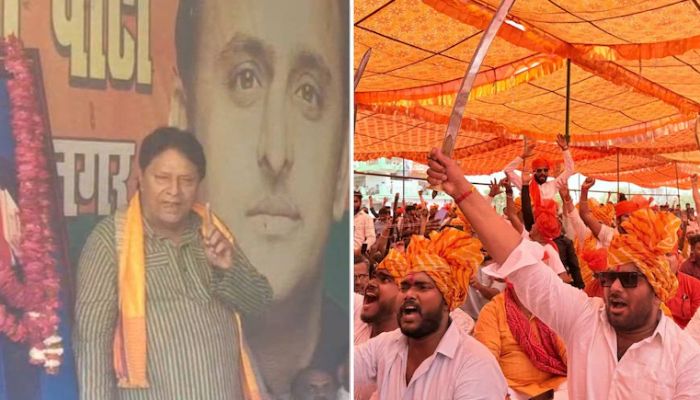
‘They feared me’, ‘killed landlord’, ‘why would I go to jail?’: Left-wing MLA from Bihar boasts of his terror; video goes viral—a testament of Lalu-Rabri’s jungle raj?

A leftist legislator from Bihar has openly shared his story of terror on camera. He confessed to killing a landlord and spoke about the fear surrounding the incident. The MLA detailed these events in an interview, and now, some clips from it have surfaced.

CPI (ML) leader Satyadev Ram recounted his journey, describing how he rose from poverty to wealth. He claimed that a landlord from his village began troubling him, which eventually led to the murder.

Satyadev Ram stated, “I made up my mind to end the landlord’s dominance. I joined this party (CPI-ML) because I saw them fighting. We fought in the village for a year. That landlord was eliminated and finished. After that, I developed political awareness.”

At this point, the journalist interrupted and asked if he had indeed killed the landlord. He responded, “What else? What do you think?” The journalist then questioned whether he had ever been jailed for the crime. The MLA replied, “Why would I go to jail? Why would I stay in jail?”

“This part of the conversation can be heard in the video between the 11th and 15th minute.”

Satyadev Ram then stated, “They didn’t even file a case against me. They were too scared to do so. The police surrounded the village until 9 PM, but I managed to escape in my way. After that, they became even more fearful. This was when my political awareness started growing.” He further mentioned that people used to shut their doors out of fear of him.

He went on to say that he later started fighting against landlords in other villages. He explained that he continued carrying out attacks in several areas. Satyadev Ram emphasized that his goal was to fight against landlords. He also admitted that after committing the murder, he kept moving from place to place.

61-year-old Satyadev Ram is a five-time legislator. He was first elected as an MLA from Mairwa in 1995 and has won from this constituency three times. In 2015 and 2020, he was elected as an MLA from the Darauli Assembly seat in Siwan district on a CPI (ML) ticket. Despite this, he openly admitted on camera that he had killed a person and faced no consequences.

What Satyadev Ram is saying may sound shocking, but it reflects the reality of Bihar in the 1990s. This was the era of Lalu Yadav and Rabri Devi’s jungle raj. It was a time when red flags were forcibly planted on farmland and those who resisted often lost their lives and property.

This period gave rise to many left-wing killers in Bihar. Today, they hold positions of honour. They proudly recount on camera how they murdered a landlord. They even admit that after the killing, they instilled fear in people and never faced the law. Ironically, these very individuals are now the ones making laws.

Massacre in Syria, persecution of Hindus in Bangladesh: How regime change always takes struggling nations from bad to worse

Syria witnessed one of the deadliest outbreaks of violence since its civil war broke out 14 years ago, with over 1,300 people killed in battles between security forces and anti-government organizations as well as a wave of “revenge killings.” The Syrian Observatory for Human Rights, headquartered in Britain, reported that 250 Alawite militants from pro-Bashar al-Assad outfits, 231 members of the government security force and 830 civilians were among those who lost their lives.

The already volatile nation has seen even more unrest since President Bashar al-Assad was forced to leave the country last December as his regime fell after 24 years in power. Rebel forces led by Hayat Tahrir al-Sham (HTS) took over many important cities last year, including the capital, Damascus. Notably, the United States and other Western countries consider HTS, the most powerful group within the rebel coalition, to be a terrorist group. It was associated with Al-Qaeda and ISIS (Islamic State of Iraq and Syria) supremo Abu Bakr al-Baghdadi had despatched its head and interim Syrian president Abu Mohammed al-Julani also known as Ahmed Hussein al-Sharaa to the country.

Syria dared to hope for a better future under the new leadership, but now its dim prospects have been overshadowed by the ongoing crisis. The widespread clashes began on 6th March while the administration blamed “individual actions” and claimed they were retaliating against attacks by Assad’s remaining forces.

Deadly sectarian violence rocks Syria

The Assad dynasty controlled Syria, a country with a large Sunni population, for more than 50 years. Hafez al-Assad established the rule in 1970, but it was abruptly removed last December when his son Bashar al-Assad was made to abscond. Assad family is a member of the Shia Islamic sect classified as the Alawite community who make up roughly 10 to 15% of Syria’s population. They are mostly found around the coasts of Tartus and Latakia.

The minority Alawites, who still support him, held top positions during his rule. While interim President Ahmed al-Sharaa promised to support all Syrian minorities, including Christians and Druze, Alawites and others fear persecution under the hardline Sunni rule. Furthermore, ISIS and HTS along with other Sunni extremist factions have labelled Alawites as heretics and justified murder against them. Inflaming the sectarian rift, Islamist forces inside Syria’s new government see them as the remains of a dictatorship they fought to overthrow.

Deadly confrontations between Syrian government forces and pro-Assad organizations have been reported in the coastal province of Latakia, based on Syria’s state-run SANA news agency. Pro-Assad militias launched an attack on government troops in the Alawite-dominated seaside region of Jableh. Thirteen personnel were killed during the assault on security patrols and checkpoints.

Numerous civilians were killed in the ensuing government crackdown. Armed Sunni fighters, who reportedly targeted and murdered Alawite citizens in retaliation for crimes committed under the Assad administration, joined the government forces. On the morning of 9th March, there were reports of extensive arrests, home raids, and executions of Alawite Syrians on the streets. According to the Syrian Observatory for Human Rights, HTS fighters and affiliated Sunni Muslim gunmen, including foreign fighters, killed about 800 members of the Alawite sect on the 6th and 7th of March. This occurred in the governorates of Tartous and Latakia in Syria’s Alawi heartland.

The observatory’s chief, Rami Abdulrahman, described the mass murders in Jableh, Baniyas and the surrounding areas in Syria’s Alawite heartland amounted to the deadliest carnage in years in the country’s 13-year-old civil war. He added that Alawite minority women and children were among the victims. Western and Arab capitals have stated that a major issue is the Islamist government’s ability to govern inclusively and the startling magnitude of the violence, which included accounts of the execution-style killing of dozens of Alawite males in one village, raises further doubts about this capacity.

“Residents of Alawite villages and towns spoke about killings during which gunmen shot Alawites, the majority of them men, in the streets or at the gates of their homes. Many homes of Alawites were looted and then set on fire in different areas,” unveiled media reports. Details of the horrific massacre disclosed that a teenager was compelled to use a gun to kill his own family members while Alawite women were paraded in the streets nude before being shot.

The scope and character of the executions are evocative of the mass killings committed by the Islamic State throughout its campaign in Syria and Iraq. The witnesses revealed that both Syrian armed groups and foreign fighters, once again displayed their religious extremism as they carried out the HTS-led executions. The violent upheaval was exacerbated by the looting of residences, businesses and places of employment.

Attack on dwindling Christian minorities

On the other hand, under the present Syrian administration, Christians and other minorities have also been subjected to atrocities. A joint statement denouncing “massacres targeting innocent civilians” was recently released by the heads of Syria’s three major Christian churches. “In recent days, Syria has witnessed a dangerous escalation of violence, brutality, and killings, resulting in attacks on innocent civilians, including women and children,” the statement signed by the patriarchs of the Greek Orthodox, Syriac Orthodox and Melkite Greek Catholic Churches stated.

It further conveyed, “The Christian churches, while strongly condemning any act that threatens civil peace, denounce and condemn the massacres targeting innocent civilians, and call for an immediate end to these horrific acts, which stand in stark opposition to all human and moral values.” The statement added, “The churches also call for the swift creation of conditions conducive to achieving national reconciliation among the Syrian people.”

There is a small Christian community in the city of Latakia, which has been severely affected by the persistent violence, even though the majority of Christians in Syria escaped during the civil conflict that broke out in 2011. The Syrian Observer estimated that just about 300,000 Christians are in Syria, a sharp decline from the country’s Christian population at the beginning of the civil war. Thousands of people, including Christians and Alawites, reportedly ran from the areas in search of safety in neighbouring mountains. According to local accounts, there have been targeted murders of Christians in Latakia.

The United States also released an official statement denouncing the violence perpetrated against minority groups in Syria and announced, “The United States condemns the radical Islamist terrorists, including foreign jihadis, that murdered people in western Syria in recent days. The United States stands with Syria’s religious and ethnic minorities, including its Christian, Druze, Alawite, and Kurdish communities, and offers its condolences to the victims and their families. Syria’s interim authorities must hold the perpetrators of these massacres against Syria’s minority communities accountable.” The violence has been addressed by multiple world leaders as well.

Ahmed al-Sharaa vows action but no action on the ground

Meanwhile, de facto leader Ahmed al-Sharaa conveyed that security forces should not permit anyone to “exaggerate in their response because what differentiates us from our enemy is our commitment to our values.” He alleged, “When we give up on our morals, us and our enemy end up on the same side.” His appeal, nevertheless, appears to have no impact. The violence was earlier referred to by Sharaa as “expected challenges.” He further claimed, “Syria is a state of law. The law will take its course on all.”

The interim government in Syria promised to set up an impartial commission to “investigate and ascertain the facts” and provide the president with a report in 30 days. According to a statement released by the Syrian interim presidency, the committee would “investigate the violations committed against civilians and identify those responsible,” as well as “uncover the reasons, circumstances, and conditions that led to these events.”

Additionally, it will “investigate and determine accountability for attacks on public institutions, security forces, and the military.” It further stated that those found guilty would be presented before the judiciary.

Blood of Hindus cover the streets in Bangladesh

The alarming events in Syria are similar to the events that transpired in Bangladesh following the forced exodus of former Prime Minister Sheikh Hasina in August of last year. The anti-quota demonstrations progressed into a coup that deposed the Bangladesh Awami League and ultimately descended into violence against the nation’s minorities, particularly Hindus. Muhammad Yunus’s interim government, in the meantime, has been catering to radicals, purposefully keeping quiet about their activities, freeing convicted terrorists and Islamic hardliners and attempting to discredit assaults on Hindu community by terming them “fake,” “exaggerated,” “politically motivated,” and even accusing India of spreading propaganda over the same.

However, the Office of the United Nations High Commissioner for Human Rights (OHCHR) released a 104-page report outlining crimes committed against vulnerable Hindus in the nation, in addition to reports from Bangladesh and the international media. “Violent mobs engaged in serious acts of revenge violence, including killings, targeting police and Awami League officials, especially from early August onwards. Some Hindus were also subjected to human rights abuses, including the burning of homes and attacks on places of worship, with different underlying motivations,” it pointed out.

The report identified several attacks on Hindu houses, places of worship and businesses in Thakurgaon, Lalmonirhat, Dinajpur, Sylhet, Khulna and Rangpur. The human rights organization also brought attention to the forced resignations of Hindu teachers and headmasters. The Human Rights group pointed out that the administration did not effectively respond to stop non-state actors from abusing human rights (a reference to violent Muslim mobs). The assault on Hindus and indigenous people in the Chittagong Hill Tracts (CHT) was also mentioned in the report.

It has now become a norm to murder Hindus, smash idols of their deities, illegally occupy their properties, slaughter cows to offend them and forcibly convert them to Islam, in Bangladesh with the tacit support of the current regime. The Islamists even asked for jizyah, or taxes paid by non-Muslim people to their Muslim rulers, from Hindus and threatened them over “Durga Puja” celebrations. Likewise, the indigenous Buddhist monks in Chittagong Hill Tracts last year expressed that they would not be performing “Kathin Chibar Dan” (Kathina Robe Offering) because of the circumstances and security concerns.

A similar operation unfolded in Ukraine

Unsurprisingly, the United States, which was responsible for the regime change in Bangladesh, also pushed Ukraine toward an unending war with Russia owing to a similar operation in the country. According to President Donald Trump, 700,000 Ukrainian troops and one million Russian forces have been dead. However, the figure is much higher than any estimates provided by Western intelligence services, Russia or Ukraine. The number of injured and displaced individuals is significantly higher. The property loss is in the billions.

“War in Ukraine risks seeing 90 per cent of the country “freefall into poverty” and extreme vulnerability,” a United Nations report assessed in 2022. Nine million Ukrainians live in poverty as of 2024, a rise of 1.8 million since the beginning of 2022 because of the war, which has resulted in extensive damage and fatalities. Victoria “Toria” Nuland, a former member of the US Foreign Service, who was also active in Bangladesh was responsible for pushing the nation into war with Russia and for toppling a democratically elected government of Viktor Fedorovych Yanukovych in favour of the United States, under the pretext of “freedom.”

Nuland, along with her liberal-interventionist and neocon allies, saw a chance to oppose Russian President Vladimir Putin in Ukraine by encouraging violent protests to overthrow the pro-Russian President Yanukovych and install a new government hostile to Moscow. She got an opportunity on 20th February 2014, when a mysterious sniper who seemed to be operating from a building controlled by the Right Sector shot and killed police officers and protesters, escalating the crisis.

On 21st February, Yanukovych made a last-ditch effort to avoid further unrest by agreeing to a plan guaranteed by the European Union which recognized diminished powers and called for early elections to remove him from office. Nevertheless, that proved insufficient since on 22nd February, anti-Yanukovych groups led by the Right Sector and neo-Nazi militias took over government buildings, forcing him and a number of his employees to flee for their lives. Armed thugs prowling the corridors of power made the final path to “regime change” clear.

The turmoil brought on by the “regime change” caused Ukraine to descend into financial ruin and ultimately engage in a brutal conflict with Russia, a former superpower and a far greater economy.

Conclusion

Regime change operations have never worked out well for the nation, its citizens, or even the rest of the globe. They not only claim numerous lives but also devastate the already fragile economies. Similar events have occurred throughout history, such as the Arab Spring, where regimes were held accountable and leadership changed but left power vacuums throughout the Arab world and in the end, it led to a bitter conflict between religious elites seeking to consolidate their influence and people.

Minority groups are, of course, the first to suffer from such acts. They are the designated targets who, particularly in Muslim countries, must bear the brunt for no fault of their own. Similar incidents occurred in Afghanistan, where the Taliban targeted and destroyed religious minorities along with their holy symbols such as the popular Buddhas of Bamiyan. When such forces seize power, they also jeopardize the nation’s cultural heritage and roots.

Likewise, on the occasion of the Bengali New Year (Pohela Boishakh), which is observed on 14th April of each year, radicals are threatening to slaughter 100 cows in Bangladesh, hurting long-standing customs and traditions to humiliate Hindus. However, in reality, the people in positions of power, those who impose them and the fanatics have benefited from regime changes as the rest, particularly marginalized groups, suffer while a constant doom looms over the unsustainable state of affairs, including the economies of such nations, the absence of safety and security prove disastrous for everyone in the long run.

Government to introduce Immigration and Foreigners Bill 2025 to regulate stay of foreigners in India: Key highlights

In a major attempt to overhaul India’s immigration system, the Modi government is likely to introduce the Immigration and Foreigners Bill in the Lok Sabha on 11th March 2025. This proposed legislation aims to bolster India’s immigration framework by replacing the outdated laws which are no longer sufficient to address contemporary immigration and related security challenges. The Immigration and Foreigners Bill 2025 seeks to create a comprehensive legal structure to regulate the entry, stay and exit of foreigners in India.

The Immigration and Foreigners Bill 2025 repeals and replaces the Foreigners Act, 1946; Passport (Entry into India) Act, 1920; Registration of Foreigners Act, 1939; and Immigration (Carriers’ Liability) Act, 2000. These old laws are being repealed to prevent overlapping with the new legislation.

Besides streamlining immigration procedures, the proposed legislation aims to impose heavy penalties on illegal immigrants. Most importantly, the bill shifts the burden of proving legal status on the immigrant rather than the state. As the Immigration and Foreigners Bill 2025 is set to transform India’s immigration system, here are the key highlights of the proposed legislation.

Grounds for refusal to entry in India, increased powers for Immigration Officers

The bill states that no individual shall be allowed to enter India via air, water or land without a valid passport and other travel documents. Similarly, foreigners would be required to have valid visa and while staying in India, they (foreigners) are exempted under section 33 or intergovernmental agreements.

“No person proceeding from any place outside India shall enter age to enter, India by air, water or land unless he is in possession of a valid passport or other travel document, and in case of a foreigner, also a valid visa, and any foreigner while present in India shall also be required to possess valid passport or other valid travel document and valid visa, unless exempted under section 33 or through inter-governmental agreements,” the bill reads.

The Immigration and Foreigners Bill 2025 further provides that no foreigner would be allowed to enter and stay in India if he is found to be a threat to India’s national security and integrity or jeopardises India’s relations with foreign states, public health, etc. In these cases, the decision of the Immigration Officer will be final and binding.

“Provided that notwithstanding anything contained in this sub-section, no foreigner shall be allowed to enter into or stay in India, if he is found inadmissible to do so on account of the threat to national security, sovereignty and integrity of India, relations with a foreign State or public health or on such other grounds as the Central Government may, specify in this behalf Provided further that the decision of the Immigration Officer in this regard shall be final and binding,” the bill reads.

The bill also states that no one would be allowed to depart from India without having a valid passport and other travel documents and in case of foreigners, the possession of a valid visa would be required.

“Notwithstanding anything contained in section 3 of the Passports Act, 1967, no person shall depart or attempt to depart from India by air, water or land unless he is in possession of a valid passport or other travel document and in case of a foreigner, also a valid visa,” the bill states.

It further mentions that no person would be allowed to leave India if his presence is required by the country’s authorised agencies or on grounds the Central government specifies. In this regard as well, the decision of the Immigration Officer would be final and binding.

“Provided that notwithstanding anything contained in this sub-section, no person shall be allowed to depart or exit from India, if his presence is required in India by any authorised agency or on such grounds as the Central Government may by order, specify in this behalf,” the bill reads.

While there already is a Bureau of Immigration, the new bill provides increased powers and legal backing to the Immigration Officers who may examine the passport or other travel documents and visa of a foreigner during his entry into transit through, stay in movement within India and also require him to furnish such information as may be necessary and appropriate. Moreover, the Immigration Officer may also check a passport or other travel document of any person which has been declared as lost or stolen or considered as damaged or forged or fraudulently obtained or on the direction of the passport issuing authority.

Furthermore, the bill mentions that all the visa and related matters will be dealt with by the Central Government.

Immigration and Foreigners Bill 2025 places the burden of proving legal status on individuals and imposes carrier liability

The bill provides that institutions including universities, hospitals, nursing homes etc hosting foreign nationals like students or patients will be required to report their details to designated registration officers. This would improve the tracking of foreign nationals in India while enhancing accountability.

Moreover, the bill places the onus on individuals to prove their legal status in India, reversing the traditional challenging approach wherein the State had established illegality. This would essentially streamline deportation processes for illegal immigrants like Rohingya and Bangladeshi Muslims.

To prevent the influx of illegal immigrants into India and reinforce border control measures, the bill reportedly says that airlines and other transport carriers will face penalties for bringing illegal immigrants into India.

Stricter penalties for violation of immigration laws

The Immigration and Foreigners Bill 2025 proposes much-needed stricter penalties for violation of laws. The bill states that foreign nationals entering India without valid passports or visas could face up to five years of incarceration and fines up to Rs 5 lakh. For those using forged travel documents, the penalties escalate to a minimum of two years and up to seven years in prison alongside fines ranging from Rs 1 lakh to Rs 10 lakh. These measures would deter illegal immigration and the use of fraudulent means to obtain documents for illegal stay in India as seen in the case of Bangladeshi illegals.

In addition, the bill reportedly includes a provision of three years imprisonment and a Rs 3 lakh fine for overstaying the visa period.

How the Immigration and Foreigners Bill 2025 can help India tackle immigration-related challenges

The bill, if passed, would establish India’s strictest-ever immigration system, reinforcing the Central government’s control over the entry, stay and departure of foreign nationals. Most importantly, the bill would aid the Centre’s efforts to tackle the menace of illegal infiltration of Rohingyas and Bangladeshis from the porous borders it shares with Myanmar, Bangladesh and Nepal as well as expedite their deportation.

India faces multifaceted challenges rooted in its geographical position, porous borders, and socio-political dynamics.

As per the latest data as of 31 December by UNHCR, around 95,600 Rohingyas are living in India who fled after facing persecution in Myanmar. This includes 22,500 refugees and asylum seekers considered stateless by the United Nations High Commissioner for Refugees. The majority of Rohingya Muslims, over 10 lakh, who fled Myanmar reside in Bangladesh, and they are supported by international aid agencies. These stateless refugees pose a security threat to India contrary to the Islamo-leftist cabal’s constant efforts at whitewashing the involvement of the members of this community in criminal activities. Rohingya refugee camps have been strongly suspected to be breeding grounds for radicalization and terror activities. Rohingyas have been arrested in the past for involvement in human trafficking. They have been arrested for involvement in dacoities.

Similarly, the influx of illegal Bangladeshi immigrants into the bordering states of India has been a threat to the country’s national security and demography. One of the biggest obstacles in identifying and deporting Bangladeshi illegal immigrants is proving their nationality. This is because the illegal immigrants who have been staying in India for many years and decades have obtained bogus Aadhar Cards and other documents. These illegal immigrants have integrated into local communities and even received support from Muslim-appeasing political parties. The enhanced penalties and stricter rules in the new Bill, may deter such illegal crossings and punish those caught with forged documents, disrupting the ecosystem of those facilitating the stay of illegal immigrants by providing forged documents in exchange for money or carrying out other illegal activities like smuggling or narcotics and human trafficking.

The harsh penalties for illegal entry and document fraud proposed in the Immigration and Foreigners Bill 2025 aim to dissuade those planning to enter India illegally and procure fake identities as the risk of imprisonment and penalties would outweigh the supposed benefits of illegal immigration. A strict implementation of this bill, if passed, may reduce the illegal infiltration of Bangladeshi Muslims and Rohingyas.

As the bill includes provisions shifting the burden of proving legal status on immigrants and empowering immigration officers, the deportation process would become more streamlined. If the Indian government ramps up enforcement, the challenges including judicial delays and lack of cooperation from origin countries like Myanmar which does not recognise Rohingyas as its citizens, India would be in a better position to pressure origin countries into entering repatriation agreements.

Haryana: CM Saini orders probe after woman who had got jail time for filing false rape cases gets honoured on Women’s day

0

On International Women’s Day, on 8th of march, Rekha Rani Dhiman, an activist from Haryana, received the Indira Gandhi Mahila Shakti Award along with a cash prize of ₹1.50 lakh. However, since then, her controversial past has come to light and Haryana CM Nayab Singh Saini has ordered a probe into the matter. CM Saini has ordered a probe to find out how her name was even recommended for the award.

The Haryana CM has ordered a probe into Jind Administration’s failure to verify Rekha Dhiman’s background before recommending her for the award.

Rekha had apparently filed over 2 dozen false cases of rape. The social media uproar over her award apparently led to the probe being ordered by the CM.

Media coordinator of Haryana CM Saini, Ashok Chhabra, said, “The CM has ordered an inquiry into the matter and strict action would be taken against officials responsible for the oversight.”

Incidentally, police records show that Rekha had been jailed in 2020 for filing a false rape complaint and is currently out on bail. She is known for filing false rape cases frequently, and even spent 33 days in Jind Jail because of her frequent false claims.

Rekha Dhiman had filed rape case against 12 men in Jind district of Haryana, against 26 men in Hisar, and another case against men in Rohtak.

While explaining the reason why her name was forwarded for the reward on Women’s Day, Jind deputy commissioner Mohammad Imran Raza said, “Rekha Rani Dhiman had disclosed her past cases in an affidavit while applying for the award. Since the court has not yet convicted her and the matter is still pending, her name was forwarded to the Haryana women and child development department for consideration.”

Haryana CM Nayab Singh Saini had honoured 50 women on the International Women’s Day, and Rekha Dhiman was one of them.

Mizoram CM Lalduhoma says agents from US and UK are providing arms training to insurgents in Myanmar, previously called for extra-territorial Kuki-Zo unity

On Monday (10th March), the controversial Chief Minister of Mizoram, Lalduhoma, claimed that agents from the United States and the United Kingdom had been providing arms training to insurgent groups in Myanmar.

He stated that the people have been entering Myanmar through Mizoram. Lalduhoma was referring to the case of UK national Daniel Newey, arrested in June last year at the Lengpui airport.

He was found possessing one live ammunition and was booked under the Arms Act of 1959. Newey was later acquitted by a court.

Lalduhoma claimed that some of the agents who have entered Myanmar through Mizoram were involved in the ongoing Russian- Ukraine war.

Lalduhoma also claimed that 2000 foreigners visited Aizawl between June and December 2024 but were not seen on the streets. He hinted that the visitors might be conspiring to interfere in Myanmar’s internal affairs.

Mizoram CM calls for extra-territorial Kuki-Zo unity

In September 2024, Lalduhoma met members of the Chin community during an official visit to the United States. Despite being the chief Minister of a bordering Indian state, he called for the unity of the Zo (Chin-Kuki-Mizo) community spread across Myanmar and Bangladesh based on ethnic and religious lines.

The development comes amid ethnic tension between the Meitei and Kuki communities in neighbouring Manipur. Mizoram Chief Minister Lalduhoma called upon the Zo people to unite based on religious and prevent further division.

I would like to take this opportunity to address the elephant in the room and convey my apprehension that there is a real danger of our religion becoming a source of disunity and division, rather than being one that shepherds the flock and transforms the church into a united, strong and impenetrable fortress, which it should be,” the transcript of his speech read.

He lamented how the ‘Church of North East India’ could not become a reality despite different denominations of Christianity uniting together to form the ‘Church of South India’ and ‘Church of North India.’

While making a heartfelt plea to the Zo community to unite in the name of Jesus Christ, Lalduhoma commended the ‘Chin Relief Committee of Mizoram’ and ‘Myanmar Relief Committee of Mizoram’ for catering to the Kuki-Zo refugees.

He pointed out, “There are several revolutionary groups in the Chin Hills. There even are instances where two or three CDFs exist and operate within the same township. We belong to the same ethnic group and yet, for some reason, cannot work together. Leave aside cooperation, we have even spilled the blood of our brothers and sisters on occasion and this is a shameful, regrettable fact that we as a people have to face and take accountability for.

The Mizoram CM talked about different organisations, formed by them and working in Manipur on cross-purposes. “I am glad to note that steps are being taken towards unity and I am sure I speak for all present today that I eagerly await the outcome of these overtures,” he added.

Lalduhoma stated that the Zo Reunification Organisation (ZORO) is working towards unity and pointed out that the purpose of his US visit was to create a path of unity for the pan-Zo community. He also highlighted about the establishment of a Chin Unity Forum in July 2018.

During his meeting with the Kuki-Zo people, the sitting Mizoram CM made remarks that threatened to undermine the sovereignty of India.

Lalduhoma said, “I want to let everyone here know that the primary reason I accepted the invitation to visit the United States is to seek a path towards unity for all of us. We are one people—brothers and sisters—and we cannot afford to be divided or apart from one another.

“I want us to have the conviction and confidence that one day, through the strength of God, who made us a nation, we will rise together under one leadership to achieve our destiny of nationhood,” he added.

The Mizoram CM lamented that the Chin-Kuki-Mizo people were divided by boundaries and 3 different nations, hoping to transcend the territories in the near future.

“While a country may have borders, a true nation transcends such limitations. We have been unjustly divided, forced to exist under three different governments in three different countries, and this is something we can never accept,” Lalduhoma concluded.

Such remarks are unprecedented for a responsible, elected people’s representative tasked to head a key State in India’s Northeast.

West Bengal: Sheikh Indu vandalises idol of Hindu deity, sets it on fire, police claim accused has ‘mental heath issues’

On Friday (7th March), a Muslim man named Sheikh Indu vandalised the idol of Goddess Shitala and then set it on fire. The incident occurred in Baruipur city in the South 24 Parganas district of West Bengal.

Visuals of charred idols and the damaged Hindu temple could be seen in multiple posts on social media. The locals were able to apprehend the accused, Sheikh Indu, who was involved in the vandalism and arson attack.

West Bengal BJP leader Agnimitra Paul staged a protest outside the Baruipur police station against the desecration and vandalism of the idol of Goddess Shitala.

In the meantime, the ruling Trinamool Congress (TMC) MLA Bibhas Sardar attempted to blame Hindus in order to deflect attention from the crime perpetrated by Sheikh Indu.

Coincidentally, the Baruipur police also posted a tweet on Friday (7th March) claiming that the accused is a ‘person of unsound mind’ with ‘mental health issues.’

“Local people apprehended him and police took custody of the person. A case has been registered and investigation is on. The detained person is an outsider and has mental health issues,” it alleged.

Screengrab of the tweet by the Baruipur police

“The situation is peaceful. Stern legal actions will be initiated against those trying to spread rumours and communal disharmony,” the Baruipur police cautioned.

Interestingly, the West Bengal police made similar claims when it came to light that a Hindu temple was vandalised in Basirhat. They went on to claim that the extremist behind the destruction of the idol of Goddess Kali has ‘mental health issues.’

Preliminary enquiry suggests that the person has mental health issues. The situation is peaceful and under control. Police remains alert and vigilant. Harshest possible action shall be taken against those committing/attempting similar mischief anywhere in the state,” the police concluded.

Gujarat: Muslim mob attacks Hindus near Dahegam’s Moti Masjid for celebrating India’s Champions Trophy finale victory; Arbaaz, Sajid, and others booked

India won the ICC Champions Trophy 2025 final after defeating New Zealand by 4 wickets. Celebrations were taking place all around the nation following this momentous occasion. Similarly, festivities were in full swing at Dahegam, Gandhinagar. However, suddenly a Muslim mob assaulted the people by throwing stones close to the Ugmanovas mosque in the Kasba neighbourhood as Hindu youth participated in a victory procession following India’s landmark triumph.

Several accused have been arrested in connection with the incident and a First Information Report (FIR) has been filed. According to the reports, Hindus were leading a victory march in Dahegam, amid “Bharat Mata Ki Jai” slogans. The Muslims began stone pelting as soon as the procession reached the mosque. Accounts of other vehicles being vandalized have also surfaced during this time. Furthermore, three young Hindu men were hurt during the attack. They were taken to Gandhinagar Hospital right away.

A Hindu named Dhawal Mistry filed a complaint at the Dahegam Police Station after being hurt. The police have filed a case against the accused Mohammed, Arbaaz Khan, Owais, Sajid Hussain, Wasim, Mohammed Taufiq, Sanjay, Mohammed Irfan and Naseer Khan, along with six other unidentified individuals, based on the complaint. OpIndia has a copy of the FIR.

The FIR stated that the complainant joined the bike rally at Vijay Circus on his friend’s bike. The rally arrived at a Muslim town at approximately 11 pm where a group of Muslims were seated close to the mosque. According to the complaint, the sounds coming from the vehicles triggered the extremists and they targeted the victims. They asked, “Why have you come here?” Moreover, the Muslim group also abused the Hindus present there.

Two-three more Muslims arrived at the spot with sticks and attacked the rally. Meanwhile, seven-eight bikes were also vandalized. According to the FIR, the complainant got scared and escaped leaving the bike behind, after this incident. He also endured injuries. Afterwards, he was put inside an atuto and taken to Gandhinagar Civil Hospital by the Hindus there. According to the doctor, the complainant has a fracture in his foot.

The complainant’s brother, Rahul stated in an interview with OpIndia that the former is currently under treatment. He added that he is the only one with his brother in the hospital. He is presently visiting the victim. Additionally, he stated that he will provide further details regarding the instance at a later time. Police Inspector Desai of Dahegam Police Station told OpIndia that the cops arrived on the scene and attempted to control the situation just as they received information about the event.

He added that six people have been charged under sections 189 (2), 191 (2), 191 (3), 352, and 324 (4) of the BNS (Bharatiya Nyaya Sanhita) in addition to the named perpetrators. He added that other teams are currently looking into the matter. A few individuals have also been taken into custody. The case is under investigation.

Maharashtra: Minister Nitesh Rane introduces “Malhar Certification” for jhatka mutton shops run exclusively by Hindus

Nitesh Rane, Minister of Ports Development of Maharashtra, announced a new initiative on 10th March to register all Jhatka mutton businesses in the state under the recently introduced Malhar certificate, with a focus on the fact that they will only be operated by Hindus. The Malhar certification is akin to India’s current halal certification, which is granted for meat processed in accordance with Sharia or Islamic law.

Rane added that Hindus from the Khatik group will be the only ones operating MalharCertification.com, a site for Jhatka meat producers.

“Today we have taken an important step for the Hindu community from Maharashtra. This is being brought for Hindu community, through which Hindus will get access to mutton shops selling Jhatka mutton for Hindus,” Minister Rane remarked. He also advised Hindus to avoid purchasing mutton from stores that lack Malhar certification.

“This Malhar certification should be used more and more and Hindus should not buy mutton from shops without Malhar certification. This is what I appeal to people. Jai Shri Ram,” the minister added.

The website said, “Malhar is a certified platform for Jhatka mutton and chicken vendors. It ensures that goat and sheep meat, sacrificed according to Hindu religious traditions, is fresh, clean, free from saliva contamination, and not mixed with any other animal meat. This meat is available exclusively through Hindu Khatik community vendors. Therefore, we encourage everyone to purchase mutton only from vendors certified by Malhar.” According to the website, their meat is “fresh, clean, free from saliva contamination, and not mixed with any other animal meat.”

OpIndia had explained earlier how the whole idea of Halal certification is discriminatory towards other communities. For a meat product to be halal, the animal must be slaughtered only by a Muslim. In order to achieve economies of scale, the meat industry ends up operating large-scale abattoirs to produce all their meat. They end up using only Muslims at these abattoirs as it has simply become cheaper to produce all their meat together, instead of running separate abattoirs for halal and non-halal meat. In such a scenario, many Hindu communities, especially some Dalits, who were traditionally butchers, miss out on employment opportunities in the sector. Considering the meat industry is worth several Billion dollars, this is a huge sector where only people from one religion are finding jobs because of halal policies.

Most businesses have started serving only halal meat now to save the cost of maintaining 2 supply chains, for halal and non-halal meat. People who may not be comfortable with halal meat, or for people with religions where only jhatka meat is allowed, no longer have any choice in the matter. If they are ordering meat at a restaurant, they get halal only by default.

Pharmaceutical products, personal care products, cosmetics, and even flour, all come with halal certification now. With its ever-growing scope, it is creating the grounds for restricting the job prospects in these sectors to people from only one religion. Further, this parallel system of certification runs without any checks and balances from the government.

Furthermore, halal is not just limited to non-vegetarian goods as it also includes cosmetics, non-meat foods and other fast-moving consumer goods. To summarise, halal imposes a religious belief on non-followers too. Halal certification thus encourages a parallel economy. In a secular country like India, where over 80% of the population is Hindu, and where numerous religious beliefs thrive along with several cultures, the very idea of Halal economy is outrageous.

Rampant Hinduphobia in the US: American broadcast television NBC’s SNL show demonises Lord Ram and ‘Om Namah Shivaay’ mantra in a “comic” satanic skit

Amidst the ongoing attacks on Hindu temples and a general rise in Hinduphobia in the United States, American broadcaster NBC demonised Hindu Gods in a “comic” Satanic cult skit aired on its popular Saturday Night Live (SNL) show.

A snippet from the show mocking satanic cults has been doing the rounds on the internet. Popular American singer Lady Gaga debuted on the show meant to mock satanist rituals but ended up outraging several sections of society, most notably the Hindus for unwarranted references to Hindu Gods and the religious incantation “Om Namah Shivaay”—held sacred by millions of Hindus around the world.

The controversy erupted on March 8 when Lady Gaga made her hosting debut on Saturday Night Live, sparking controversy with a skit titled Friendly’s Birthday Gone Wrong. In the sketch, she staged a mock satanic ritual over a fabricated birthday claim, featuring red-cloaked staff, fake blood, and a heart-ripping scene reminiscent of Indiana Jones.

Meant as a campy satire to promote her new album Mayhem, the skit included a character named ‘Mola Ram’ who tried to scare the protagonist. Subsequently, the skit featured another character chanting “Om Namah Shivaay”.

The skit backfired dramatically, with a section of social media blasting SNL for its brazen Hinduphobia at a time when Hindus and Hindu iconography has come under the attack of racist bigots bent on painting the entire world with the same brush as the potent mix of Khalistanis and Islamists seek to shape American society by their whims and the exclusivist idea of religious absolutism.

The American social media was also up in arms against Lady Gaga and SNL, accusing it of furthering hidden Satanic messaging, drawing on her history of provocative artistry, including the meat dress and the Judas music video.

Attack on BAPS temple in California

Notably, on Saturday (8th March), extremists carried out vandalism at the BAPS Hindu Temple in Chino Hills in California State of the US. The temple walls were defaced with slogans such as ‘F*ck Modi, Modi Murdabad, Hindustan Murdabad.’

BAPS confirmed the incident through a post on the social media platform X and drew attention to the hateful messages that were written on the temple walls.

In the post on X, BAPS stated, “In the face of another Mandir desecration, this time in Chino Hills, CA, the Hindu community stands steadfast against hate. Together with the community in Chino Hills and Southern California, we will never let hate take root. Our common humanity and faith will ensure that peace and compassion prevail.”

Series of attacks on Hindu temples

This is not the first time a Hindu place of worship has been targeted. 

On 3rd August and 16th August 2022, the Shri Tulsi Mandir in Queens, New York, was vandalised. On 30th October 2023, the Hari Om Radha Krishna Mandir in Sacramento was attacked. On 23rd December 2023, the SMVS Shri Swaminarayan Temple in Newark, California, was desecrated.

At the beginning of 2024, there was a series of such incidents. On 1st January, the Shiv Durga Temple in Santa Clara was defaced. Four days later, on 5th January, both the Shree Ashta Lakshmi Temple in Fremont and Vijay’s Sherawali Temple in Hayward were targeted.

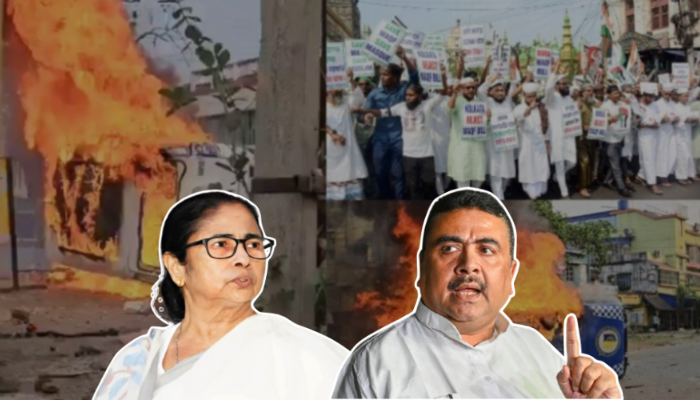
West Bengal: Hindu shops and properties under attack in Muslim-dominated Murshidabad, BJP demands deployment of central forces

On Sunday (9th March), BJP MLA Suvendu Adhikari took to X (formerly Twitter) to inform that shops and properties belonging to the Hindu community came under attack at Patikabari bazar in Nawda block in West Bengal’s Murshidabad district.

Adhikari tweeted, “A couple of hours ago, miscreants have vandalised and set on fire Shops & Properties owned by Hindus at Patikabari Bazar; at Nawda Block of Murshidabad District.”

He requested the urgent intervention of the West Bengal police and the Chief Secretary of the State. The BJP leader called for the deployment of forces to bring the law and order situation under control.

Suvendu Adhikari also sought the deployment of the Border Security Force (BSF) to pacify the situation.

“If you are not able to control the situation, kindly request Hon’ble Bengal Governor for the deployment of BSF personnel so that the law & order Situation is restored and normalcy is reimposed as early as possible,” the BJP MLA emphasised.

BJP spokesperson Amit Malviya also shared the video of the attack on Hindu shops and properties. He blamed supporters of Mamata Banerjee of orchestrating vandalism and arson.

“The law and order situation in West Bengal is spiraling out of control, rapidly resembling the chaos seen in Bangladesh. Just a few hours ago, Mamata Banerjee’s extremist supporters vandalized and set fire to shops and properties owned by Hindus at Patikabari Bazar in Nawda Block, Murshidabad District,” Amit Maviya tweeted.

He further added, “If Bengal Home Minister Mamata Banerjee is incapable of handling the situation, she must ask Chief Minister Mamata Banerjee to requisition central forces immediately to restore normalcy.”

This is not the first time that such an incident has come to light from the Muslim-dominated district of Murshidabad.

Muslims run riot during Kartik Puja in Murshidabad

A state of unrest ensued after a Muslim mob unleashed attacks on Hindu homes on 16th November last year over alleged ‘blasphemy.’ The incident occurred in Beldanga town in the Murshidabad district of West Bengal.

The attack coincided with the Kartik Puja celebration, observed by the Hindu community across the State. The Muslim mob resorted to arson and stone pelting after accusing Hindus of committing ‘blasphemy.’

While speaking to OpIndia, a resident of Baldanga informed us on the condition of anonymity that crude bombs were hurled, and over 20 Hindus were injured.

Official figures, as reported by the media, suggested only 6 injuries. The West Bengal police had claimed that there were no casualties.

The local administration had imposed prohibitory measures under Section 167 of the Bharatiya Nagarik Suraksha Sanhita (BNSS), thereby preventing the assembly of more than 5 people. Internet services were also suspended.