Home Blog Page 4774

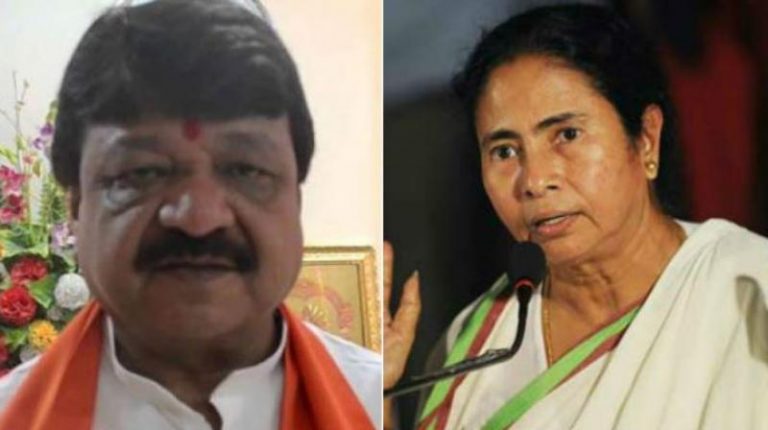
After Mamata Banerjee lies to Matua community about Indian citizenship, BJP’s Kailash Vijayvargiya assures implementation of CAA in the state

On Saturday, BJP leader Kailash Vijayvargiya assured the Matua community in Thakurnagar in South 24 Parganas district of West Bengal of implementation of the Citizenship Amendment Act (CAA). This assurance comes days after West Bengal Chief Minister Mamata Banerjee lied to the Matua community that they do not require citizenship under CAA as ‘they are already citizens of India’.

While addressing the media, BJP’s national general secretary informed, “We do not need the support of the State government. The Centre has the power to implement CAA in West Bengal. It will be implemented, irrespective of the support of the State.” It has been a long-standing demand of the Matua community that they are provided with permanent citizenship.

“Matuas, Nama Shudras have been living in India as refugees, after coming to India from Pakistan and Bangladesh to avoid religious persecution. We will give them citizenship to them, under any circumstances, and none can stop us,” Kailash Vijayvargiya emphasised. He had met Shantanu Thakur, BJP MP from Bongaon and a Matua community leader, during his visit to Thakurnagar. Shantanu added, “We will be looking forward to Union Home Minister Amit Shah making the announcement on implementation of CAA during his visit to Thakurnagar.”

TMC lies and cries foul

TMC leader Sougata Roy claimed that Matuas have already been given permanent citizenship and the right to vote. “The assurance to give them citizenship is akin to saying that they are not citizens,” he alleged. Former TMC MP Mamata Thakur also said that the party will announce a sit-in protest against the decision. “We will not accept citizenship like this,” she said.

Earlier last week, Mamata Banerjee, while addressing a rally in Gopalnagar in Matua-dominated Bongaon in North 24-Parganas district attempted to appease the people from Matua community. She had claimed that the BJP was trying to divide people by promising citizenship under CAA. Claiming that Matua people are already Indian citizens, Banerjee said, “I’m saying all Matua people are Indian citizens. There’s no need for a certificate for it.”

Who are the Matuas?

Matuas are ‘lower-caste’ Hindu immigrants from Bangladesh who have migrated to India, owing to religious persecution. The community was founded by Harichand Thakur (1812-1878) and his son Guruchand Thakur (1846-1937), who lived at Faridpur in Bangladesh. Although their families came to Bengal in 1946, most of their community members entered India ‘illegally’ after 1971.

They hold influence in over 40 constituencies in the State. While they have supported the TMC in the past, the BJP has witnessed a voting shift towards them in the 2019 Lok Sabha polls. The Matua community in West Bengal is awaiting the implementation of CAA, reports suggest. BJP chief JP Nadda had earlier assured that the rules were being framed for implementation of CAA.

Maharashtra: Sharad Pawar’s birthday celebration in Beed goes wild as cake cutting gets violent. Watch video

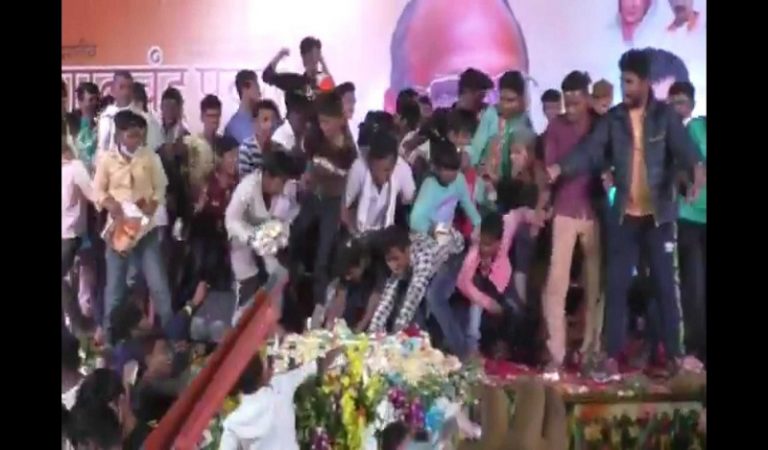
In a bizarre incident, the workers of Nationalist Congress Party (NCP) ran a riot on the stage on Saturday during the celebration of party supremo Sharad Pawar’s birthday in Maharashtra’s Beed.

The NCP workers had organised a birthday celebration of its party chief Sharad Pawar to ring in party supremo’s 80th birthday in Beed. Several party workers took part in the event which also included the cutting of a cake.

However, just after the cake was cut to celebrate the occasion, the NCP workers thronged on to the stage to get their share of the cake

In the video that was captured by one of the spectators, the NCP workers could be seen falling over each other, pushing and punching trying to get hold of the cake. In their hurry to get hold of their share of the cake, the NCP workers even pushed some of their fellow colleagues of the stage.

Pawar, a former Union minister and Maharashtra chief minister, turned 80 on Saturday. Currently, Sharad Pawar-led NCP is part of the Maha Vikas Aghadi coalition government in Maharashtra after it formed the government by joining hands with Shiv Sena and Congress. It was rumoured that he may replace Congress’ Sonia Gandhi as UPA chief. However, the NCP later refuted the reports.

Mahatma Gandhi’s statue vandalised by Khalistani elements in Washington DC during Anti-farm laws protests, organisers brazen it out

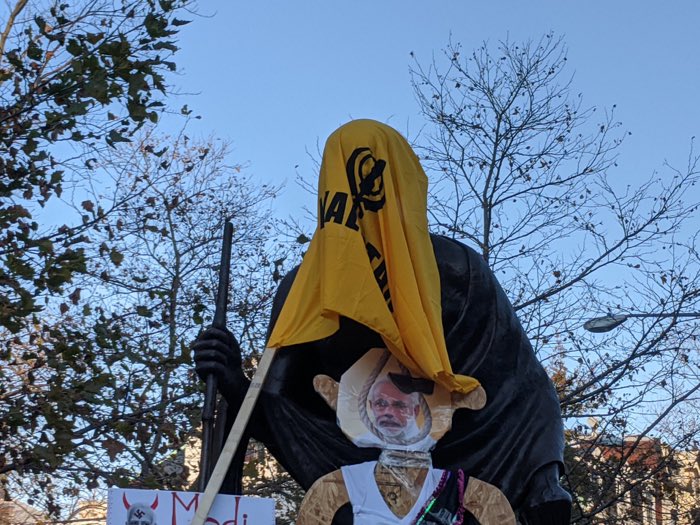
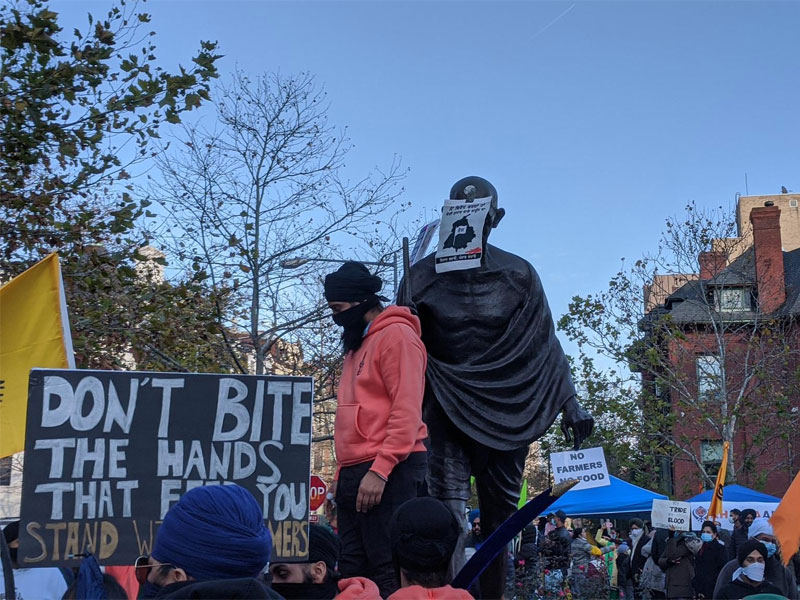
Khalistani elements in the US while protesting against the farm laws in India defaced and vandalised Mahatma Gandhi’s statue in Washington DC. Khalistani flags were also placed on Mahatma Gandhi’s bust by the Khalistanis. The statue is located in front of the Indian Embassy in Washington.

The statue is placed outside the Indian Embassy in Washington DC.

The Embassy officials said, “The Embassy strongly condemns this mischievous act by hooligans masquerading as protesters against the universally respected icon of peace and justice.” The protesters have spray painted the statue and made graffiti on it. The Indian mission has registered a complaint with the local law enforcement agencies. The authorities later covered the figure, and the site was cleaned up.

The statue was unveiled on September 16, 2000, by then-Prime Minister of India, Atal Bihari Vajpayee, during his state visit to the US. Then-President Bill Clinton was present during the unveiling ceremony.

“Why not Him?” says protester

Mansimran Singh, one of the organisers of the protest, said, “This protest is not particularly against the government but in support of the farmers. It is against the current administration there. We see this bill as eradication of our culture.”

When he was asked about defacing Mahatma Gandhi’s statue, he said, “In America, all confederate statues were vandalised and now they have been taken down. So why not him?”

Removal of confederate monuments and memorials in the US is an ongoing process since the 1960s. Protestors have been tearing down public properties which according to them ‘glorify white supremacy’. Majority of these confederate statues and monuments were put up between 1877 to 1964. The detractors allege that they were not put up as memorials but as a means to intimidate African Americans and reaffirming white supremacy.

Defaced statue of Mahatma Gandhi in Washington DC (Image: Businessworld)

Another protester Manmeet Singh said that protests at the Embassy were non-violent and peaceful. When he was asked about the Khalistani flags being spotted at the protests, he said, “The organisers will raise the Khalistan issue on another platform on another day. We want the media to concern on the farmers’ issue. This is not a regional issue.”

Statue Vandalism during George Floyd protests

In June this year, during the George Floyd protests in the US, Mahatma Gandhi’s statue was vandalised by the protesters. An expert was called to repair the statue at that time. The Indian Embassy had then registered cases with the National Park Police and the Metropolitan Police. The incident was also reported to the State Department. Deputy Secretary of State, Stephen Biegun, called the Indian ambassador to talk about the incident. Biegun had apologised for the incident. A month later, he, along with Taranjit Singh Sandhu, the Indian envoy to the United States, had inaugurated the refurbished statue of Mahatma Gandhi.

Farmers’ protests in India

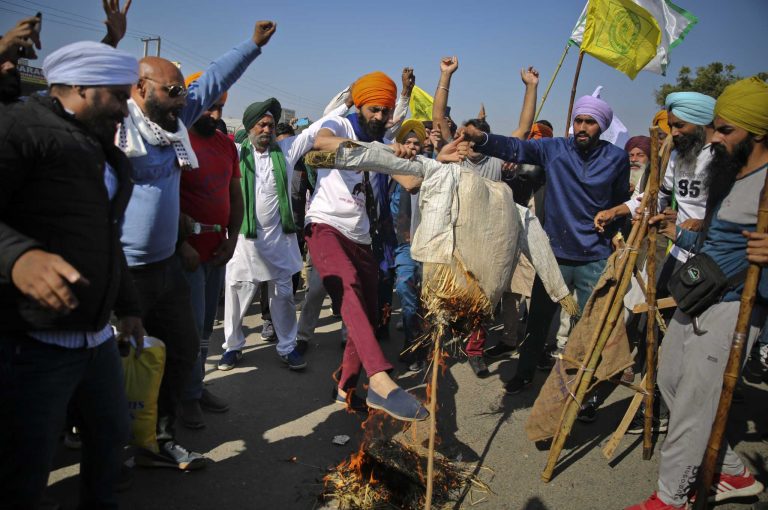
Thousands of farmers, mainly from Punjab and Haryana, are protesting against the recently passed Agriculture laws. They are lodged at the borders of Delhi for three weeks now. There have been reports that the protests are being taken over by Maoists and Khalistani elements. The unions are openly asking for the release of Naxalites and Delhi Riots 2020 accused that has nothing to do with the Agriculture laws. Open threats to PM Modi and derogatory language against Hindus have become a part of the protests.

While the government is ready to take and has tried to alleviate the situation, the farmer unions are not interested in any amendments in the laws and demanding the laws should be repealed. Reports have suggested that while the protests are going on, farmers in several parts of the country are already benefiting from these laws.

‘Farmer protests’ are nothing but manufactured perception to fool the country, protestors constitute less than 1% of real farmers in the country

Even as the left-liberal media is trying hard to project the ‘farmers’ protest in the national capital as some sort of an uprising against the Modi government, it is being estimated that not even 1 per cent of the total farmers in the country are part of these protests indicating that a large of numbers of farmers have no issues with the three farm bills passed by the Modi government.

Ever since farmers from Punjab camped on the roads leading to the national capital to protest against the farm reforms thus causing a massive inconvenience to the public, the ‘liberal-secular’ media ecosystem has been desperate to hail these protestors and depict these so-called protests involving alleged ‘farmers’ as another revolution against the incumbent Modi government.

However, in reality, these ‘farmers’ from Punjab holding the state into ransom by blocking the roads are no representatives of the collective interest of the country’s farmers at all. The alleged farmers from Punjab, who are rejoicing freebies like pizza and foot massages along the Haryana-Delhi border, form a minuscule part of India’s farmers collective.

Interestingly, out of the 15 crore farmer households in the country, the Punjabi farmers who seem to have grievances against the farm reforms forms less than 0.75 per cent of the total farmers in the country. According to Prof Ashok Gulati, there are more than 14.6 crore farmer households in the country and Punjab has less than 11 lakh farmer households, thus making their representation less than 1 per cent.

Even in the case of Punjab farmers, not all farmers from the state are opposed to the farm reforms. It is only a handful of them, anywhere between 20,000 to 80,000 farmers are camping at the four sites – Singhu, Noida, Ghazipur and Tikri. Most of the farmers at the protest site have been allegedly brought by the Arhatiyas or middlemen to protest against the three farm laws, who have been made irrelevant in the new laws.

Not all protestors are farmers

It is also important to note that not all protestors at the protest sites are farmers. The protests that allegedly began as an opposition to the farm laws have now taken the form of political protests. Supporters of political parties, including the Congress, the Shiromani Akali Dal, the Aam Aadmi Party and the far-left, Islamists organisations are also fighting each other to appropriate these protests to further their political agenda.

We had also reported how anti-Indian elements such pro-Khalistan outfits have hijacked the ‘farmer protests’ are using to further their secessionist agenda. Foreign-based Khalistanis and certain entertainers with a shady history have been extremely vocal over the course of these protests.

Most importantly, organisations that have connections with pro-Khalistani outfits are now operating in these protest sites to facilitate the so-called protests against the Modi government. Pro-Khalistan organisations, in order to attract the crowd to these protests, had also come up with the idea of luring the so-called protestors by offering free pizza, foot massages at the protest site so that they could not only retain the already exhausted protestors but also attract new ones.

If one takes into account of all these numbers, one can say that the protests against the Modi government, which is now being depicted as a ‘farmer uprising’ by the left-liberal media are nothing but “manufactured perception” to fool the rest of the country. The protests are neither the manifestations of real grievances of the farmers nor representing the real farmers of the country.

Protests are political in nature, hijacked by Islamists and Khalistanis

The protests are purely political in nature, which is being exposed day-after-day with Khalistani forces successfully hijacking these so-called farmer protests. Just yesterday, we saw how these protests took a dangerous turn after the alleged ‘farmers’ openly expressed their solidarity to left-wing terrorists and Urban Naxals in the name of protesting against the government.

The protestors had demanded the release of terrorist sympathisers and enablers such as Gautam Navlakha, Sudha Bhardwaj, Varvara Rao, Anand Teltumbde, and riot accuses such as Umar Khalid, Sharjeel Imam, Khalid Saifi etc.

The farmers’ unions and organisations that have been leading the so-called ‘farmer’ protests against the centre also lack credibility. Only a handful of farmers association, mostly controlled by far-left leaders, have managed to influence some farmers from Punjab to hit the streets against the Modi government.

One organisation, in particular, Bharatiya Kisan Union have used the opportunity of ‘farmers’ protest to hail Naxalism and demand the release of riots accused and terrorist sympathisers.

Darshan Pal, President of Krantikari Kisan Union, who is coordinating among various organisations participating in the protests, became a farmer just a few years ago. He is also a working committee member of the All India Kisan Sangrash Coordination Committee (AIKSCC). Shockingly, he is also a Maoist leader. Darshan Pal was one of the founders of People’s Democratic Front of India (PDFI). PDFI is a constituent of the Maoist movement, the left-wing terrorism in the country.

Not just that, the farmers and middlemen (Arhatiyas) in Punjab play by different rules of procurement and MSP system than the rest of the country making them some of what distinct than the rest of the country. The farmers in Punjab are not part of the Direct Benefit Transfer system and one-third landowners in the state are absentee landlords, who have rented out their lands to farmers.

It is also reported that the current protests are also allegedly fuelled by these Arhatiyas, who fear of losing their existing hegemony in the procurement process. The three farm laws passed by the Modi government aims to bypass these intermediaries in the procurement process.

Farmers across the country welcome farm laws, writes letter to govt not to withdraw out of pressure

Apart from one or two isolated incidents of protests, mostly symbolic ones carried out by few farmer groups aligned to the opposition parties, no major farmer protests have been taken place in the rest of the country. Interestingly, apart from Punjab and some pockets of Haryana, even farmers cultivating in those states ruled by the non-BJP government have also stayed away from these protests largely.

In fact, most of the farmers have openly come out in the support of the three laws passed by the Modi government that has freed them from the earlier restrictions imposed by the APMC acts passed by respective state governments. Several videos, testimonies in favour of the three farm laws have come up on social media platforms highlighting how the majority of the farmers, if not all, have welcomed the much-needed agro reforms.

Recently, around 1.20 lakh farmers from Haryana had expressed their support to the farm laws and had written a letter to the Union Agriculture and Farmers Welfare Minister Narendra Singh Tomar demanding them not to succumb to the pressure and withdraw the farm laws.

As depicted by the media, the three farm laws that are part of comprehensive agro reforms did not originate with the Modi government. These significant reforms, which is a continuing process and are not end in itself, were initiated by the past governments. Continuing the reform agenda, the Modi government brought three farm laws to ease the procurement system in the country thus enabling the farmers to get higher returns for their produce.

The Modi government has had enough deliberations on these reforms and had conducted about 1.4 lakh training and webinar sessions before introducing the three bills in the parliament. Contrary to the claims of opposition parties that Parliament has hurried the farm laws, the Modi government has reached out to nearly 93 lakh farmers, in the last six months over the agriculture reforms.

Echoing similar observations, Prof Ashok Gulati – one of country’s topmost agricultural economist, had said that enough discussion has taken place on farm laws for the last 17 years and it was time for bringing actual reforms in the agro sector. The professor, who is an Infosys chair on agriculture at the Indian Council for Research on International Economic Relations (ICRIER) had also said that the communication gap has been fully exploited by some political parties and activists to create a fear psychosis among the farmers. 

Despite all the glaring evidence that these protests have nothing to do with farmers or agriculture, the left-liberal media has been trying extremely hard to show otherwise displaying their intellectual dishonesty and lack of professional integrity.

‘Farmer leader’ VM Singh protesting and demanding assurance on the MSP is actually a Congress leader accused in 8 cases, has assets worth crores

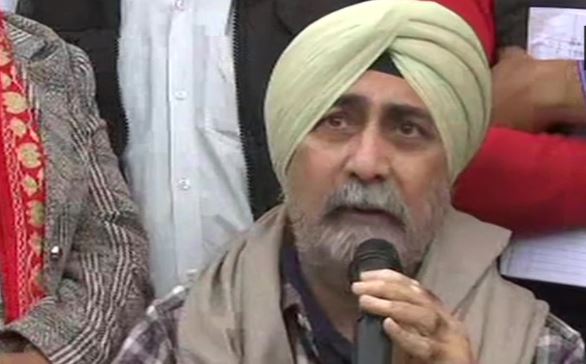
The All India Kisan Sangharsh Coordination Committee chief Sardar VM Singh today demanded that the government must give an assurance on the Minimum Support Price (MSP) on all of their produce. “We want assurance on the MSP. We want a guarantee of the purchase of our produce under it. Farmers will be benefitted if you bring MSP Guarantee Bill”, said Sardar VM Singh while addressing a press conference. Little do people know that VM Singh, who has been one of the prominent faces of the ongoing farmer’s protest in the outskirts of Delhi, is actually a Congress leader.

By now almost everyone has understood that the Modi government’s new farm laws nowhere talks about repealing MSP, a fallacy that the Congress and the leftist liberals have been peddling day and night to mislead farmers. Modi government has, again and again, stressed that they are neither abolishing APMC Mandis not repealing MSPs. So, the question of “assurance on MSP”, a demand which has been put forth by VM Singh, really does not make sense.

VM Singh doubling up as a ‘disgruntled, poor farmer’ is actually a Congress leader whose assets run in crores

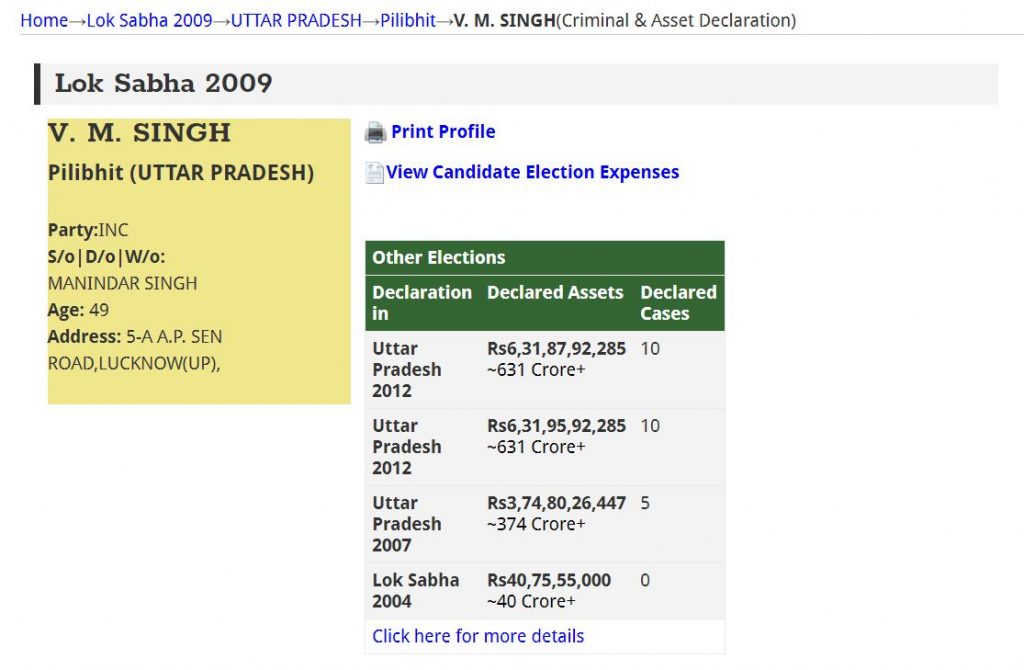
However, the one thing which many might not be knowing is that VM Singh, who has been at the forefront of this ongoing agitation doubling up as a disgruntled, poor ‘farmer’ is actually a Congress leader whose assets run in crores. He was a Lok Sabha Congress candidate from Uttar Pradesh’s Pilibhit district. In 2009 his net worth was close to Rs 631 crores.

Information provided on myneta.info

According to the affidavit submitted by him at Pilibhit District Collectorate in 2009, VM Singh was the richest Lok Sabha candidate then. He had declared of having cash amounting to Rs 15,00,000 and banks deposits worth Rs 26,50,000. Singh declared owning three vehicles worth Rs 14,00,000, two non-agricultural plots of land worth Rs 206,00,00,000 – a 1.5-acre plot in Delhi and 100-acre plot in Bhopal. He also owns agricultural land worth Rs 414,60,00,000. It includes 366-acre plot in Raisen (Madhya Pradesh) worth Rs 36,60,00,000; a 180-acre plot in Delhi worth Rs 270 crore and a 54-acre agricultural plot in Bhopal worth Rs 108 crore. He also has two houses worth Rs 11 crore.

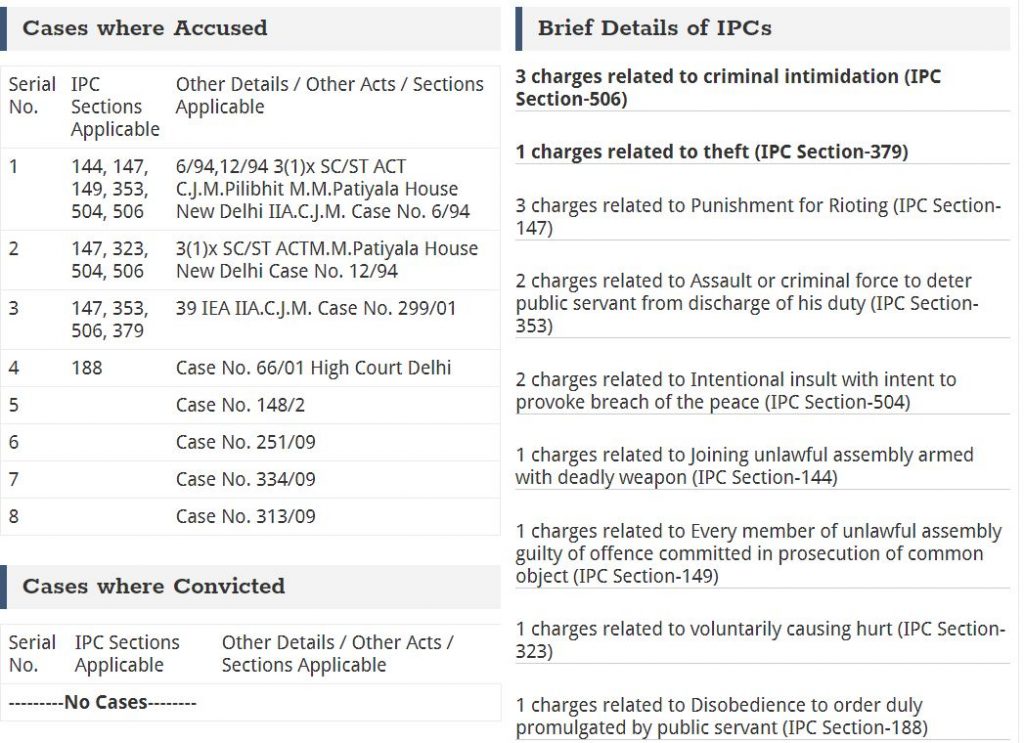
VM Singh faces 8 cases including one under SC/ST Act

Moreover, the Congress leader is accused in as many as 8 cases ranging from criminal intimidation to theft to rioting also including one under the SC/ST Act.

Information provided on myneta.info

Congress lies against the new farmer laws

As the Congress leader VM Singh is busy speaking on behalf of ‘farmers’, it becomes almost imperative to recollect how his party has been blatantly peddling lies against the new farm bills to denounce the Modi government and instigate and mislead ignorant farmers.

The Congress has claimed that they are supporting the agitation against the new farmer laws, because the new laws mean that: Mandis will be abolished, Minimum Support Price (MSP) will be abolished, farmers will have no bargaining power, farmers vulnerable to exploitation by corporates, lakhs of Mandi workers will be unemployed and the debt would rise. However, all the reasons given by the Congress against the new farm laws are outright lies.

Two from Manipur Students Association Delhi arrested by Police for calling Brahmins ‘b*stards’, released on bail

0

The Manipur Students Association Delhi (MSAD) has been opposing the Manipur government’s recent decision to introduce Sanskrit in some schools and colleges describing it as an attempt to ‘impose’ the language. Two executive members of the MSAD were arrested by a combined team of Manipur police and Delhi police on December 9 from Chanakyapuri area in the national capital after they issued a statement calling Brahmins ‘b*stards’.

The two members who were released on bail yesterday were arrested on the charges of disturbing communal harmony. They were brought to Imphal by the police for interrogation. The students have been identified as Singhajit Thokchom, secretary general of the MSAD, and Kenedy Moirangthem, secretary of the MSAD. Kenedy Moirangthem had signed the derogatory statement.

Court grants bail to MSAD members considering their academic career

The Chief Judicial Magistrate (CJM) of Imphal West granted bail to the two MASD members. The CJM took notice of the fact that two were college students studying in the 5th semester of B.Com. and have exams commencing on December 13. The CJM observed that keeping them in custody would amount to ruining their career. The court also noted that the students were first-time offenders and their chances of absconding were negligible.

The court released the two with the condition that they should not threaten, contact or induce any of the prosecution witness. They have directed by the court to be present for interrogation by the police as and when required. They need prior permission of the court for leaving Manipur till the trial is over.

The MSAD called Brahmins ‘b*stards’

The MSAD had registered a strong opposition to the Manipur Education Minister’s announcement regarding introduction of Sanskrit in selected schools and colleges of the state. As we had reported earlier, on November 20, 2020 the association had released a press statement describing the government’s decision as an attempt to impose Sanskrit in Manipur in the interests of a particular community.

In the press statement, the MSAD had said that the ‘RSS-oriented government of Manipur’ was trying to impose Sanskrit as a subject in schools and colleges. “Sanskrit texts are too malicious to be taught to the students of Manipur where not a single word of it is inherited to the mother tongue of the indigenous population. The government exposes its stupidity by trying to impose Sanskrit which is based on hatred, rime, untouchability, sexism, domination, chauvinism, as we know what the upper caste Hindu Brahmins are.” the statement read.

The statement read, “Imposing an alien language upon the indigenous people is completely a sign of colonisation. There are above 30 dialects spoken by the indigenous people of Manipur most of which are about to be extinct lest measures are taken up to continue their existence.” Furthermore, they had called Hindu Brahmins ‘bastards’. It stated, “No doubt that this government is blind enough to not to see such sight but obedient enough to be acceptable to their colonial master, the Indian empire’s upper-caste Hindu Brahmins, the b*stards… The recent announcement by a so-called Education Minister of the puppet regime submissive to the Brahmins, that Sanskrit subject will be introduced in the curriculum of schools and colleges in the colony is highly condemnable.”

The MSAD said that this was an attempt to ‘enslave the people of Manipur academically and linguistically in furthering India’s process of colonialism against Manipur’. The association had later released another statement clarifying that it regretted using the word ‘Bastard’ and others. It said that it was not against any particular community or religion. An Imphal bases group had filed a complaint against the MSAD after the press statement. The police had invoked sections 153A, 504, 505(2) and 34 of the IPC.

Pakistan: Statue of Maharaja Ranjit Singh in Lahore vandalised by a man because Singh had converted a mosque into a horse stable

0

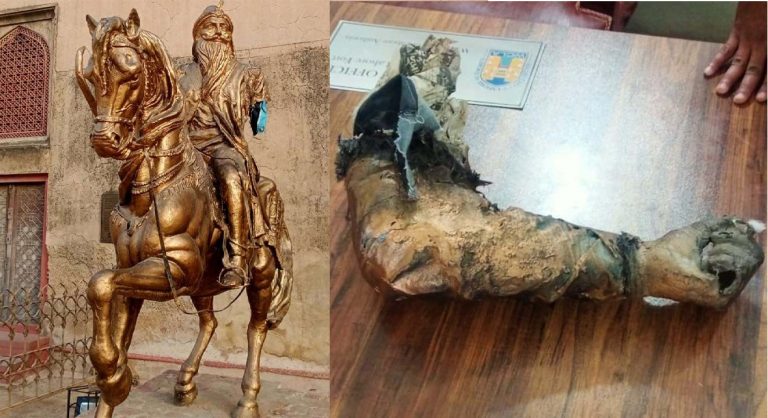
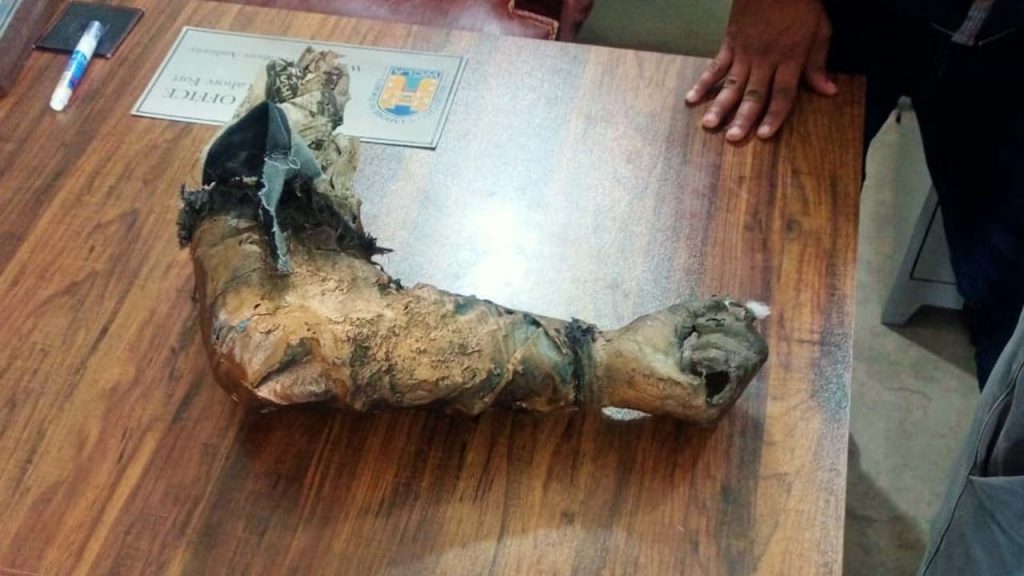
A nine-feet tall statue of Maharaja Ranjit Singh in Lahore in Pakistan was vandalised yesterday. Located outside the Haveli of Rani Jindan Kaur, wife of Maharaja Ranjit Singh, at Lahore Fort, the statue was vandalised by a person identified as Zaheer Ishaq on December 11. Ishaq was caught by a security guard on the spot after he broke the left arm of the statue. The culprit who is said to be a staunch follower of late Maulana Khadim Hussain Rizvi, was reportedly opposed to the placing of the brave Sikh king at Lahore fort because he had converted the Badshahi mosque into a horse stable.

Severed arm of the statue (Source: dnaindia)

Zaheer Ishaq said that Ranjeet Singh had killed several Muslims and harmed the sentiments of Muslim community. That is why he damaged the statue.

The Ranjit Singh statue was attacked earlier too

This is the second time that the statue was attacked. Earlier, the statue was attacked soon after it was unveiled in June 2019. Two men belonging to Tehreek-Labbaik founded by Maulana Khadim Rizvi, had reportedly desecrated the statue in August last year after Indian government abrogated Article 370 applicable to Jammu and Kashmir.

Statue was installed to commemorate Maharaja’s legacy

The bronze statue was unveiled last year on the occasion of 180th death anniversary of the Maharaja who had died in 1839. The statue sculpted by the local artists under the guidance of Fakir Khana Museum, was installed by UK-based group Sarkar Khals Foundation (SKF). It was installed to commemorate the legacy of the Maharaja who ruled over the Sikh empire in the Punjab region in the early half of the 19th century.

A superstar, a murder and four Chief Ministers: Movies and the Dravidian Movement

A feature of Dravidian politics since the 50s is the extraordinary influence that movies and film stars wield. Even though other states have elected movie stars to power, the consistent stream of movie stars that articulate and follow through on political ambitions is a unique feature of Tamil Nadu and their coastal cousins to the North, the Telugus.

This was not so at its inception. In fact, the earlier avatar of the Dravidian movement, the Justice Party, were upper-class social conservatives who looked down upon entertainers and the industry as infra dig.

That same conservatism was reflected in ‘Periyar’ EV Ramasamy’s attitude towards the movie industry people that formed the propaganda arm of the DMK. He frequently called them ‘koothadis’ – a Tamil term that can only be translated into Hindi as ‘nachaniya’.

How did movies and actors become so closely intertwined with the politics of the State? To understand that, we must take a little tour across time and space that begins with Europe of the 30s.

Movies as mass propaganda

The November 1932 German federal election was a disappointment to the Nazi Party, which lost 34 seats, 4% of vote share and could not form a Government on its own. After talks with Gregor Strasser to form a coalition with a breakaway faction of the Nazis failed, Chancellor Strasser made a deal to form a coalition with Adolf Hitler as Chancellor. In end-February, the Reichstag was set fire by arsonists and snap elections were announced within days. The Nazi stormtroopers by now ruled the streets and were able to steal the elections by massive violence against Communists, Centre-Right Conservatives and the Social Democratic Party.

This was an experience that Hitler was determined never to repeat. He and the Nazi Party then hit upon the formula of using the emerging medium of movies as a tool of propaganda. It was at the same time that a brilliant young woman called Leni Riefensthal began to make movies.

The Nazis won the popular vote and formed the Government in March 1933. Within weeks, Hitler passed an act giving himself dictatorial powers and also banned all other parties. 

In August and September, the Nazis began the first of their grand rallies in Nuremberg. Rather than simple party conferences, these were brilliantly choreographed spectacles, modelled on the pomp and pageantry of ancient Rome. Leni had a full reign of affairs and made a movie ‘Der Sieg des Glaubens’ – The Victory of Faith – which showed the party conference and took great pains in highlighting the leaders of the movement as heroic figures.

She followed it up with the classic ‘Triumph des Willens’ which was a record of the 1935 Nuremberg Rally. The intricate choreography and the combination of heroic themes from Wagner and the camera shots turned the Fuhrer Hitler into something of a mythic figure.

Other Powers were quick to take note. Hollywood followed up with high-quality war propaganda films in the 40s. The Soviets also took note. The Soviet propaganda news reels of the Second World War and the post-War eulogizing of Stalin were impressive in their effectiveness.

Tamil Movies as Propaganda

Tamil talkies began to be produced in the 1930s. There were several factors that shaped the industry in its early years – the usage of actors, scripts, themes and directors from the stage industry and the taste of the general public. In order to dodge criticisms of being entertainment of poor virtue, these movies mostly had Puranic themes. A few social movies were made, but due to heavy censorship, political themes were few and far between.

Into this environment, a young man from a Vishwakarma (goldsmith) family, Mayavaram Krishnamurthy Thiyagarajan, stepped in with a movie called Pavalakkodi, in 1934. His singing voice and suave looks made him the first Tamil superstar. Between P.U. Chinnappa, T R Mahalingam and M K Radha, it was MKT or Thyagaraja Bhagavatar as he was known by then, who stood head and shoulders above the rest.

At the same time, N S Krishnan was a comedic genius and the first comic star of Tamil movies. With his wife, T A Mathuram they made a comic pair that worked very successfully. He himself made a few films that were spoofs of ancient Puranic stories and folklore. In one of his movies, Chandrahari, a reversal of the name Harishchandra, he played a king who refused to speak a single word of truth. These films were quite successful and there was a mild element of lampooning Hindu beliefs and an undercurrent of anti-Brahminism in his films.

Towards the beginning of the war, many of the senior artists in the movie industry were influenced by Congress principles and the freedom movement. K B Sundarambal, MS Subbulakshmi were among the leading nationalist stars. They sang about Gandhi ji, Prohibition, homespun khadar, the charka and acted in nationalist themed films that spoke for widow re-marriage, against untouchability and so on. These social themes were the platform for the Congress brand of nationalism and thus drew people into the nationalist cause.

MS Subbulakshmi’s husband ‘Kalki’ Sadasivam was a Congressman and between him, the leading producers K Subramanyam and SS Vasan, the movie business was influenced with a nationalistic fervour as yet unseen elsewhere in India.

Seva Sadanam, Thyaga Bhoomi were blockbusters. Thyaga Bhoomi (1939) had visuals of Gandhi ji spinning the charka and Congress volunteers courting arrest.

The Justice Party had banned a few nationalist movies when it was in power, but once the Congress took power in Madras Presidency in 1937, there was little hindrance from the authorities as long as no direct negative references were made to the Crown or the British. Clearly, the Congress and the nationalist movement were winning at this propaganda game.

The Muckraker

C N Lakshmikanthan was an ex-convict who had completed a 7-year sentence in 1939. He started a magazine called Cine Thoothu (Cine Courier). It had to be shut down on orders for poor quality journalism in the form of unverified rumours. He started Hindu Nesan (Hindu Nationalist), which was in the same mould. His stock-in-trade was gossip about prominent people in society, mostly related to their sex lives. The identity of people was very thinly veiled and put in a way that it would be unmistakable. He made a living by blackmailing people to stop publication of their stories in his magazine.

Lakshmikanthan was an ex-convict with good contacts among the roughnecks of Madras of the day. He just shrugged off the threats and in one instance, himself beat up the thug who had been sent to threaten him!

In 1944, he was stabbed by a group of men in the evening and succumbed to injuries the next day. 

Jail

Both Thyagaraja Bhagavatar and NS Krishnan were among the accused. They were convicted and sentenced to jail on counts of conspiracy to murder. The two appealed in the Privy Council in London, which referred the case back to the Madras High Court. By the time the appeal was heard and acquittal issued, 30 months had passed by and the year was 1947. India got Independence a few months later. AVM Studio’s movie Naam Iruvar came out, which was probably the last nationalist/Congress themed movie for a while.

Dravidian movies

After their release, MKT and NSK’s careers and lives took different trajectories but still continued with themes of loss and difficulties. 

MKT tried producing movies for himself, but he continued with the old Puranic themes. He continued to be avowedly apolitical and refused to renounce or hide his faith in the Gods and in the Hindu religion. He was shunned by the music sabhas and his movies didn’t do well. After his release, he only made 4 films, none of which did well, before his death in 1959.

NSK, however, made a comeback and got roles as a comedian in movies. He home production, Nallathambi of 1949, introduced C N Annadurai as the script writer.

Randor Guy, the Tamil movie historian, recounts in his 1997 book ‘Starlight, Starbright’ that popular opinion held that both the major stars implicated in the case were innocent and had been framed. He also says that when he tried to investigate this in the 1970s, he was politely warned to stay off the story.

The same year that he made his debut in the movies, Annadurai broke away from the parent Dravidar Kazhagam to form the political outfit Dravida Munnetra Kazhagam, which, till date, is the primary electoral and political vehicle of the Dravidian movement. Nallathambi released in February and the DMK was formed in September.

Another young member of the DMK, M Karunanidhi, began his career as a staff scriptwriter in 1946 in Coimbatore’s Jupiter Pictures. His breakout hit Manthirikumari in 1950, also was the breakout movie for a young actor called M G Ramachandran.

Ramachandran, who was a khadar-wearing Congressman, came under the influence of Annadurai and joined the DMK in 1953.

Karunanidhi’s major hit with dialogues, 1952’s Parasakthi, also launched the other Tamil super star of the 60s, Sivaji Ganesan.

Sivaji managed to balance his religious faith with the career-boosting atheism-themed movies for some time. However, his popularity and his refusal to toe the party line made him a target. A smear campaign was run against him when he visited the temple at Tirupati. He broke away from the Dravidian movement then.

Strangely, the Congress in Tamil Nadu never thought much of using the medium of cinema to the same extent that the DMK did.

From 1967 onwards, until the death of Jayalalitha in 2016, for 49 years, the Chief Minister of Tamil Nadu was always someone from the film industry or their proxy.

The impact

The impact of this case was far reaching. The dominance of Dravidian ideology would have taken a much longer time since the popularity of Thyagaraja Bhagavatar was at its peak. His last film before he was jailed – Bhakta Haridas – had the distinction of staying in theatres for three Deepavalis. 

The sudden exit of these two stalwarts and the full co-option of NS Krishnan gave the Dravidian movement it’s springboard into the Tamil movie industry

Hispanic Popular Culture in the Americas

Such cultural mass extinction events have happened twice elsewhere – in the Mexican film industry and the plane crash that claimed the lives of Buddy Holly, Richie Valens and JP Richardson, which slowed down the commercial success of Spanish language rock and roll.

The Mexican film industry went through a very successful period in the 1940s. There was a possibility of the industry going on to dominate the Spanish speaking world, which at that time was close to the English-speaking audience in numbers, though not in revenue. 

In 1953, the star Jorge Negrete died of cirrhosis after a trip to Los Angeles, at the age of 49. His contemporary Pedro Infante died in a plane crash at the age of 40, in 1957. Their successor Javier Solis, died at 35 in 1966.

Between these deaths, the entry of television in the 1950s and lack of funds sent the industry into a long period of decline from the 1960s to 1990s. During the same period, English language films went on to attract the best funds, technology and auteurs and dominate the cultural landscape of the world.

The post-World War II Baby Boomer generation of America was the first that made popular music a cultural commodity that could drive attitudes, trends and viewpoints. Before this generation came of age, in the 1950s, the foundation for the popular music of the next few decades were being laid in rock-and-roll acts. White American artistes took the tunes and chords of black blues and soul music and creating the new popular sound.

A 16-year-old Hispanic artiste – Richie Valens – made a dramatic entry in 1957. His 1958 hit single, ‘La Bamba’ was one of the earliest Spanish-language rock-and-roll numbers that made it to the Billboard charts. An America-wide Spanish-language rock-and-roll market remained still born after Ritchie Valens died in a plane crash in 1959, in which the other stars of the era – Buddy Holly and JP Richardson – also died.

To this day, Spanish language music and Spanish movies continue to play second fiddle to English movies and music acts.  

In the same way, after the removal of the major stars, Tamil movies took a direction that has not changed to this day.


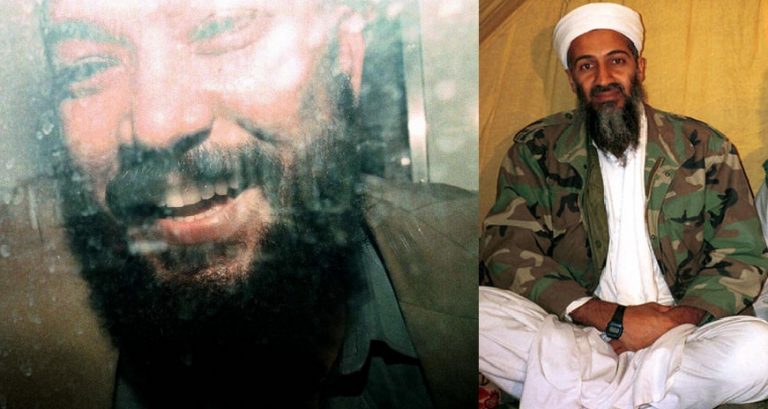
Al-Qaeda terrorist and Osama bin Laden’s former spokesman released from jail in the USA ahead of term due to his obesity

0

In a bizarre decision, a former aide of Osama bin Laden, Adel Abdel Bary (60), has been released ahead of the completion of his jail term by a Manhattan federal judge for being too ‘obese’. The decision was taken fearing that he had a high risk of being infected with Coronavirus while in jail. He has been set free and is now living in the United Kingdom. Bary was Osama bin Laden’s former spokesman.

US District Judge Lewis A. Kalpan ruled, “Defendant’s obesity and somewhat advanced age make COVID-19 significantly more risky to him than to the average person.” His lawyers argued that his ‘continued incarceration’ could aggravate his health conditions. It is important to mention that Adel weighed 230 pounds, with a body mass index of 36. Citing his health conditions (age, girth and asthma), his lawyers sought for his release earlier than the scheduled date.

The prosecutors, conceding his obesity, stated, “The defendant’s obesity is an extraordinary and compelling reason that could justify a reduction of his sentence in light of the current pandemic.” They, however, did not buy the argument that his age made him susceptible to Coronavirus infection. Nevertheless, the Al-Qaeda terrorist was freed on October 9 from prison and released on Wednesday from an Immigration and Customs Enforcement facility.

Adel now lives in a million-dollar apartment

As per reports, Adel was an Al-Qaeda terrorist who bombed two US embassies in Africa in 1998 and killed a total of 224 people, including 12 American nationals. He had spent 21 years in a prison in New Jersey in connection to the terrorist attacks. Adel now lives with his wife Ragaa at an apartment in London, which costs over $1 million. His son is Abdel-Majed Abdel Bary, a former rapper who took to extremism in 2013 and arrested in April 2020 from Almeria.

Aide of Osama bin Laden could not be extradited back to Egypt

Despite public outcry, his extradition to the United Kingdom could not be stopped as he was granted asylum in the country in 1997. He was arrested 2 years later in 1999 and was deported to the US in 2012 to stand trial. Although sentenced to 25 years in prison in 2015, Adel received relief for years spent in jail in Britain. Since he is now at a risk of death due to obesity, the terrorist could not be returned back to Egypt.

“Just serving a sentence doesn’t mean that a person has been rehabilitated, doesn’t mean that their core thinking has changed. This is a person who can still do harm in the world”, lamented Edith Bartley, the sister of a victim of Adel’s terrorist attacks.

Yogi Adityanath effect: UP MLA Vijay Mishra gets his own illegally constructed shopping complex demolished

0

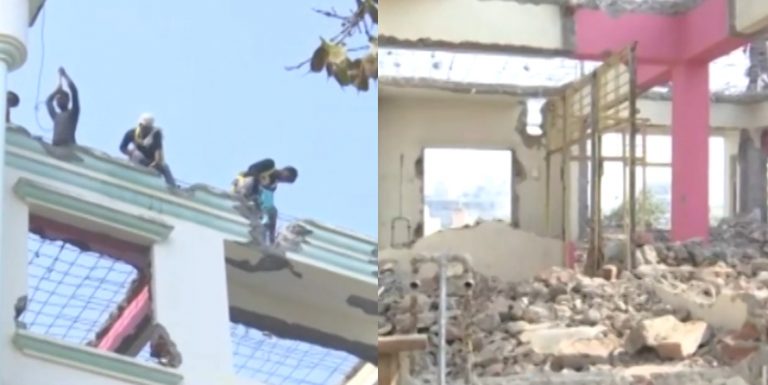
In a surprising move, the family of arrested Uttar Pradesh MLA Vijay Mishra have got their own ‘illegally constructed’ shopping complex in Prayagraj demolished. This move came after the Yogi Adityanath government has been on the offensive to destroy the ecosystem of the tainted MLA Vijay Mishra, who has 73 cases registered against him and has been booked under the Goonda Act and the stringent National Security Act in the past.

Fearing similar fate like that of their three-storey residential building spread in an area of 500 sq ft worth several crores in Allahpur area, which was demolished by the Yogi government last month, Mishra’s family got the top two floors of their shopping complex demolished. The complex has more than twenty shops and showrooms on the lower two floors including the basement, while offices and lodges run on the top two floors.

According to the building plan, the Prayagraj Development Authority had granted permission for the construction of only two storeys in that complex, but Vijay Mishra used his clout and muscle power to illegally construct extra two floors without the approval from authorities. These two top floors were declared illegal by the Prayagraj Development Authority (PDA). Now, probably fearing that the entire structure might be razed by the Yogi government due to the illegal two floors, Mishra’s family has reportedly gone on to themselves demolish the top two illegally constructed floors of the shopping complex.

Tainted MLA Vijay Mishra’s illegal residence razed by Yogi government

Last month, continuing the crackdown against illegal properties owned by the jailed Badohi MLA, a joint team of Prayagraj Development Authority (PDA), district administration and police had razed a three-storey residential building spread in an area of 500 sq ft worth several crores in Allahpur area under George Town police station of Prayagraj. It was alleged that the MLA had illegally occupied Nazul land and action to demolish the illegal structures were taken on a complaint. 

Despite resistence from the wife of jailed MLA, Ram Lali Mishra, MLC from UP along with her daughter Seema Mishra, the demolition drive was carried out under the supervision of Zonal Officer, PDA, Ashwasht Shukla and officer on special duty (enforcement) Alok Pandey. The team backed by heavy police force led by CO and an SDM-rank official, continued the demolition drive for hours and then sealed the entire area.

Wanted UP MLA Vijay Mishra arrested for role in criminal case

The tainted MLA Vijay Mishra of Bhadohi and his son were arrested in August 2020. The four-time MLA, who was elected to the Uttar Pradesh Assembly on a Nishad Party ticket in 2017, was arrested for allegedly grabbing a relative’s house and extorting money from him. They were booked under sections 323 (voluntary causing hurt), 347 (wrongful confinement), 387 (putting a person in fear of death or grievous hurt), 449 (house-trespass) and 506 (criminal intimidation) of the Indian Penal Code on August 4. The father son duo were also charged with raping a Varanasi-based singer.

The MLA, belonging to Nishad Party, currently has 73 cases registered against him and has been booked under the Goonda Act and the stringent National Security Act in the past.

Yogi Adityanath Govt tightening its noose on land-mafia

In its effort to curb against the menace of land mafia in Uttar Pradesh, the Yogi Adityanath government has been tightening its noose on such encroachers. Besides launching an anti-land mafia portal in 2017, where people of the state can file their complaints against any illegal occupation in lands belonging to any private or government institutes and setting up of anti-land mafia task force to check illegal land grabbing in the state, Yogi Govt also identified more than 1.5 lakh people who have encroached upon government land.

It has been carrying out demolition drives on the property acquired illegally by many influential persons in the state including people like Samajwadi Party leader Azam Khan and dreaded gangster-turned-politician Mukhtar Ansari. The UP government had also bulldozed illegal constructions done by gangster Vikas Dubey and influential Islamic preacher Pir Khushal Miyan.