Home Blog Page 51

Who is Mahmoud Khalil, the radical Palestinian activist who instigated Stanford students to walk out when Sundar Pichai addressed them

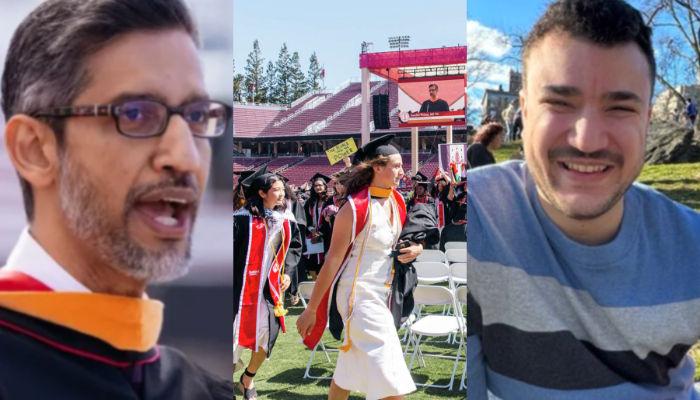
On 14th June (Sunday) Stanford University’s 2026 graduation ceremony was interrupted after a group of students started a protest when Google Chief Executive Officer (CEO) Sundar Pichai was giving his keynote speech as the commencemnt speaker. He entered the stage as approximately 200 students left their seats, blew whistles, chanted slogans as well as waved banners and Palestinian flags.

Image via SFGATE

Many were also spotted donning traditional scarves called keffiyehs which are tied to Hamas. Pichai, an alumnus of the institution, was introduced and the students wearing their graduation hats and gowns began to depart while several could be heard booing as his address proceeded.

The demonstrators denounced the tech giant’s connections to the Israeli government, especially Project Nimbus. It is a $1.2 trillion cloud computing agreement between Google, Amazon and Israel which took place in 2021. The walkout was publicised weeks ago by Stanford Students for Justice in Palestine, accusing that the project promotes the Jewish state’s operations amid the war in Gaza.

It was alleged that under Pichai’s leadership “Google profited from and enabled ICE’s (United States Immigration and Customs Enforcement) kidnappings of our neighbours and the genocide in Gaza by providing cloud computing services and AI software to ICE and IDF (Israel Defense Forces).”

The students contended that “they refuse to glorify the corporations which fuel this violence.” They referred to Google as “evil” and announced that they “will not allow their technology to be used for war and profits.” However, Pichai didn’t bring up the subject and even stayed away from discussing artificial intelligence.

The students had organised their own “People’s Commencement” for the second consecutive year. The main speaker for the latest event was Islamist Palestinian activist Mahmoud Khalil. On the other hand, the Google chief who urged the attendees to “choose optimism” was well-received as the stories he shared were greeted with applause and laughter following the brief disruption.

Mahmoud Khalil: The anti-Israel extremist

Mahmoud Khalil, born in Syria, is an infamous Algerian Palestinian propagandist who grabbed attention when “Intifada” shouting individuals occupied New York’s prominent Columbia University in 2024 to rally against Israel. He emerged as a spokesperson and negotiator during this “Gaza Solidarity Encampment” and larger agitation, reported BBC.

The move intended to press the institution to formally insist on an end to Israel’s campaign in Gaza and to divest from Israel, particularly from businesses whose goods, services or infrastructure had been utilised in the military action there. At the time, Khalil was a graduate student at the Ivy League school. ICE apprehended him on 8th March of last year.

The Trump administration attempted to deport the 30-year-old, and he spent three months in an immigration detention in Louisiana. However, a judge eventually ordered his release on 20th June. President Donald Trump had pledged to crack down on students embroiled in similar conduct.

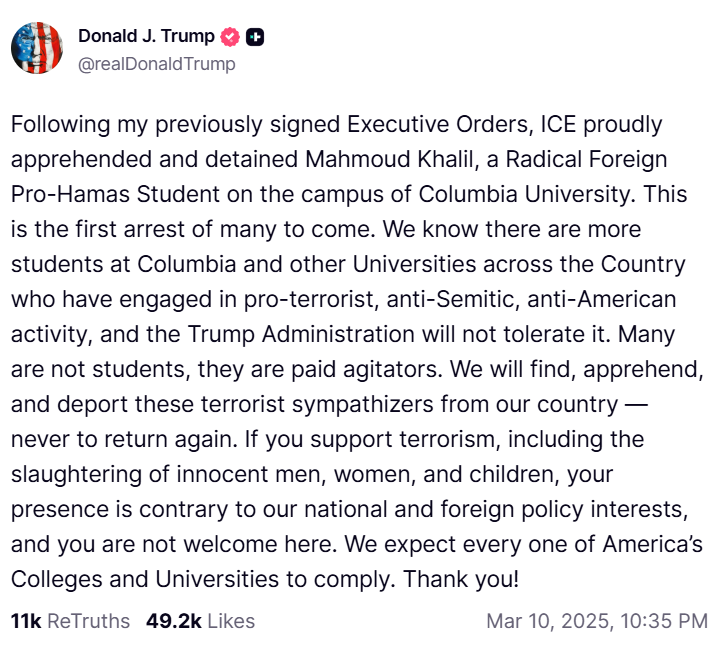
He charged that Khalil and other pro-Palestinian voices endorsed Hamas, which is classified as a terrorist group by Washington. Trump termed him as “a radical foreign pro-Hamas student” who was involved in “pro-terrorist, anti-Semitic, anti-American activity” which would not be tolerated. The action was hailed as “the first of many to come” as the former argued that such persons need to be repatriated.

“Many are not students, they are paid agitators. We will find, apprehend, and deport these terrorist sympathisers from our country — never to return again. If you support terrorism, including the slaughtering of innocent men, women, and children, your presence is contrary to our national and foreign policy interests, and you are not welcome here. We expect every one of America’s Colleges and Universities to comply,” he added.
Khalil worked for the Syrian American non-profit Jusoor after graduating from Lebanese American University with a degree in computer science. His profile on the Society for International Development website disclosed that he oversaw the Syria Chevening Programme for the British Embassy in Beirut, which provided scholarships for study in the United Kingdom. He later left the position. 

After relocating to the US in 2022, Khalil enrolled in Columbia University’s School of International and Public Affairs to obtain a master’s degree. He married an American citizen and had a child with her.

Circulating Hamas literature, failure to provide important information and more: Serious charges against Khalil

Khalil was a mediator between protestors and university management amid the face-off in Columbia University. He has been accused of leading Columbia University Apartheid Divest (Cuad), which wanted a truce in Gaza and the institution to sever its financial links to Israel, among other demands. However, Khalil refuted the allegations and asserted to be acting just as a spokesperson and mediator during the conflict.

The Department of Homeland Security pointed out that Khalil was “leading activities aligned to Hamas” upon his arrest which was part of an effort to carry out Trump’s executive order that forbade antisemitism. He was accused by the White House of planning gatherings where pro-Hamas literature was handed out as his lawyers denied these statements.

Jewish students at the varsity expressed that the protests turned antisemitic and they experienced unease and unsafety on campus. Columbia Jewish Alumni Association likewise stated that Khalil “spent over a year abusing the privileges this country and Columbia gave him.” The university lost $400 million in funding due to “continued inaction in the face of persistent harassment of Jewish students,” per the Trump administration.

Khalil was temporarily suspended from the university during the unrest as police stormed the campus after a building was taken over by the marchers. He insisted, however, that he was merely a negotiator with Columbia officials and he had refrained from joining the encampment out of concern that it might have an impact on his student visa. Interestingly, there is also ambiguity regarding the time he obtained his green card, which provides him with permanent residency.

Immigration agents nabbed Khalil on two charges. Marco Rubio, the secretary of state, declared that his presence in the country could trigger “potentially serious adverse foreign policy consequences” by citing a rare section of the Immigration and Nationality Act. However, US District Judge Michael Farbiarz pronounced that the attempt to detain and deport the Muslim man was unconstitutional.

The Trump administration then mentioned that the action was taken due to his failure to supply details about his 2024 application for authorised permanent residency. Although Khalil was granted bail, White House emphasised that the judge lacked the authority and underscored that they would file an appeal against the decision.

Furthermore, a lawsuit regarding the 7th of October 2023 terror attack unveiled that multiple anti-Israel groups in the US had prior knowledge of the massacre perpetrated by Hamas. It was submitted by 6 relatives of victims held captive by the jihadi outfit against numerous student organisations and Khalil for “aiding and abetting the continuing acts of international terrorism” perpetuated by Hamas.

Mr Donald Trump, the Strait of Hormuz was open and toll-free before you started the war against Iran, so what victory exactly are you celebrating?

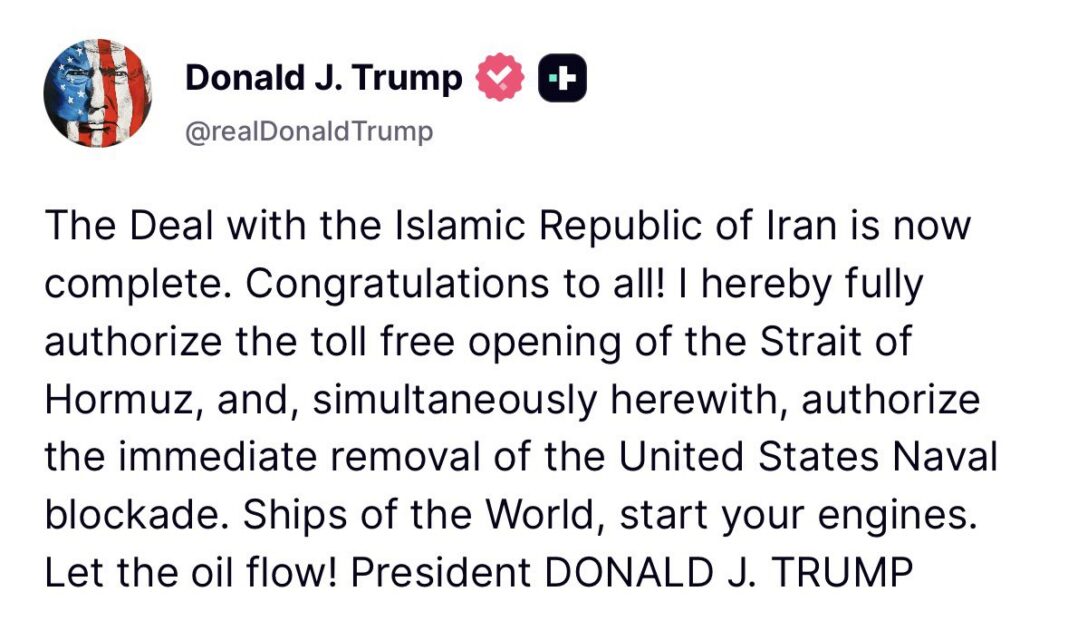
The US government has announced the successful agreement with Iran on a peace deal, with the usual dose of self-praise and bravado by Donald Trump. The White House posted the announcement by Trump, declaring “The deal with the Islamic Republic of Iran is now complete. Congratulations to all”.

His post on Truth Social was the usual style, full of bravado and self-glorification bordering on narcissism that the world is used to by now. 

Trump’s post on Truth Social

“The deal with the Islamic Republic of Iran is now complete. Congratulations to all. I hereby fully authorize the toll-free opening of the Strait of Hormuz, and simultaneously herewith, authorize the immediate removal of the United States Naval blockade. Ships of the world, start your engines. Let the oil flow.”

Trump’s statement reads as if the Strait of Hormuz was closed by some evil powers who were demanding a heavy, impossible toll, and the US President sent his Navy to defeat the evil powers and open the Strait, going to war for the global good like a fairy tale king.

For a person who has observed the developments of the conflict carefully, this alsmost reads like a crass joke. Who is he congratulating? What victory is he so happy about? Because, in his desperation to post anything tha looked like winning, Trump seems to have forgotten an important fact. The Strait was already open, peaceful, functional and toll-free before the war was started by the US and Israeli forces against Iran.

That truth is stark and known, regardless of what Trump posts on his personal social media, ironically named ’Truth Social’. The Strait was open, peaceful, and was handling 25% of the Global oil and LNG trade before Trump started bombing Iran on February 28.

Iran had only closed and mined it ‘in response’ to U.S. and Israeli strikes. The “crisis” that Trump is claiming to have solved is one HE created. 

What was the point of this war?

Before the war endangered commercial shipping in the world’s most energy-focused trade route, tankers moved smoothly through the Strait with no tolls imposed on routine traffic. After the U.S. and Israel started bombing, Iran retaliated by shutting it down, attacking vessels, and the U.S. imposed its own blockade.

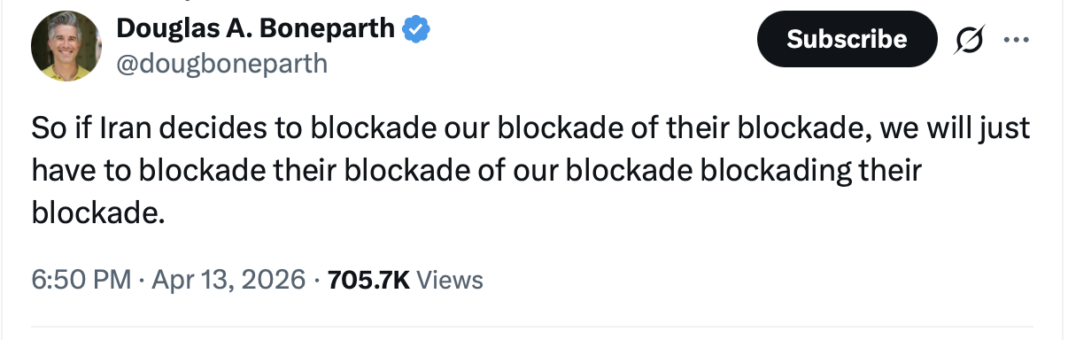
That ‘blockade’ itself was a joke. US was effectively countering an alleged blockade by claiming to be blockading the hell out of the blockade that was never blockaded in the first place before they came to bomb Iran. 

Oil and gas prices spiked, global supplies through the entire route were disrupted through the Gulf to India, Singapore, Thailand, China, Japan and beyond. Now the deal claims to restore pre-war conditions, toll-free access again, after months of disruption.

Trump wants the world to believe that this is some kind of victory that he has scored. But he is not foooling anyone. This is not a win, this is a desperate cleanup for a mess that the US has created.

Who actually won, who benefited the most from the war?

One word: Russia. 

The Russian Federation was the biggest gainer in this war in purely economical and even some strategic terms. The energy supply disruption from the Gulf nations caused Russia to pocket a massive windfall, because Arab oil was blocked in the Strait, and President Putin had a lot of oil to sell. 

The Hormuz closure drove oil prices sharply higher, boosting Moscow’s export revenues by billions of dollars. The US had to waive its own sanctions on Russian oil because they created a supply crisis in the Strait of Hormuz. Some estimates say Russian earnings may have been several tens of billions of dollars. Higher Urals crude prices, combined with temporary US sanctions easing on Russian oil, gave Putin an economic gift that helped sustain operations elsewhere. 

In February, Russia’s discounted Urals crude was selling at $45 per barrel. In mid-March, thanks to the USA, it was selling at $90 per barrel. That’s just the Urals crude; since the Iran war disrupted LNG supplies from the Gulf too, Russia gained additionally from LNG sales. In March 2026 alone, Russia’s oil exports were reported to have surged by $9.3 billion month-on-month.

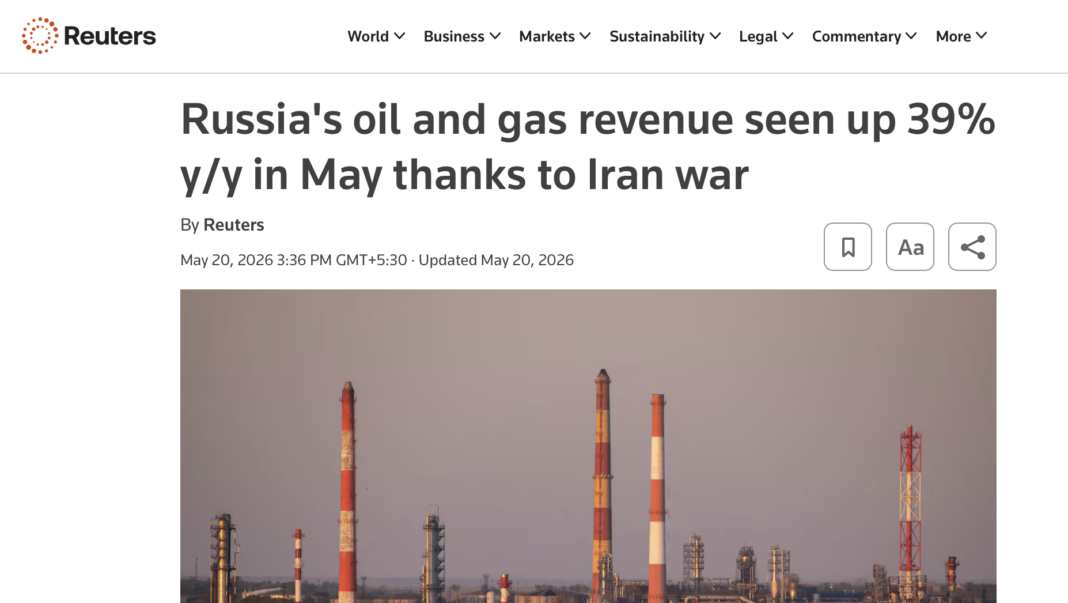
Reuters reported that Russia’s oil and gas revenues were already up by 39% compared to 2025 as of May this year. 

Trump wanted Regime change in Iran, but all he did was replace one Khamenei with another  

The Iranian theocratic regime that the US beats drums about stays intact. Some say it even strengthened in key ways. US strikes killed Supreme Leader Ali Khamenei, but his son Mojtaba Khamenei was declared the successor, and is stated to be even more of a hardliner, and has better ties with the IRGC than his deceased father.

Mojtaba’s succession marked a dynastic-style transition the regime had long avoided, yet it consolidated power around security forces and suppressed opposition. No collapse, no fundamental change happened. Officially, Iran is still ruled by a theocratic regime.

Iran ends up ‘gaining’ as the deal details suggest

The deal that has reportedly been agreed upon between the US and Iran seems to be giving some much-needed breathing space to Iran. Iran’s assets are to be unfrozen, with a potential release of up to $24 billion in credit lines and cash transfers, as per reports by Iranian state media Mehr News. Iran even gets a 60-day window for nuclear talks with potential room for negotiation and a temporary sanction waiver on oil sales. Latest reports say US is going to release $12 billion of Iran’s frozen assets before the final signing of the deal.

Basically, the regime that Trump failed to change will get a revenue flow.

Additionally, the Iranian state media is reporting that the deal includes a $300 billion reconstruction plan sponsored by US and its allies, apart from withdrawal of US forces from the region.

How much the USA lost?

The US seems to have learned nothing at all from the 20-year-old lesson called Afghanistan. Another expensive war on faraway shores that killed their soldiers and destroyed billions of dollars in military assets while their leaders kept thumping chests and claiming victory in outcomes that are basically ‘back to square one’.

The direct military losses are estimated at $25-35 billion, with costs climbing with replenishment.

Military hardware is where the US loss is most serious. Dozens of drones, including MQ-9 Reapers, F-15s, refuelers, ultra-expensive radars like the THAAD systems that will take years to rebuild, along with the damaged bases across the Gulf region, are a reminder of US taxpayer dollars that have been sunk in another pointless war.

US soldiers have lost their lives in the conflict, dozens haven been wounded and and broader economic ripple effects on US, and its allies are yet to reveal their full impact. Apparently, it was all for a deal that largely resets the board to where it was before the fighting started.

The bottom line is, Donald Trump is tauting the de-escalation and falling oil prices as some sort of vindication for his “peace through strength” and “America First” slogans, but the enriched uranium stockpile that Iran reportedly had, remains an issue deferred to future talks. The Iranian regime survived under new management. Russia has earned billions, and America is bearing the bill, in blood, ultra-expensive assets, and a depleted treasury.

The entire thing looks like a crass joke, on the American public and also on the whole world. A pointless, destructive loop that created a problem through escalation, claimed hundreds of innocent civilian lives and caused economic hardships for billions of people around the world through the disruption of critical supply routes.

The Strait that was open and toll-free before is hopefully going to be open and toll-free again, and hopefully, the crude, violent and thoroughly pointless war that the Trump administration imposed on the rest of the world would come to an end soon, with a global bully congratulating itself like a clown. 

Another fact is that similar alleged ‘peace deal’ agreements have been declared before, Israel has objected before, and the talks have collapsed before. Unless an actual deal has been signed and sealed and US forces are back in their own waters, a lot can still happen. Conflicting statements, claims and counterclaims are already flying, and Israel has already objected, again.

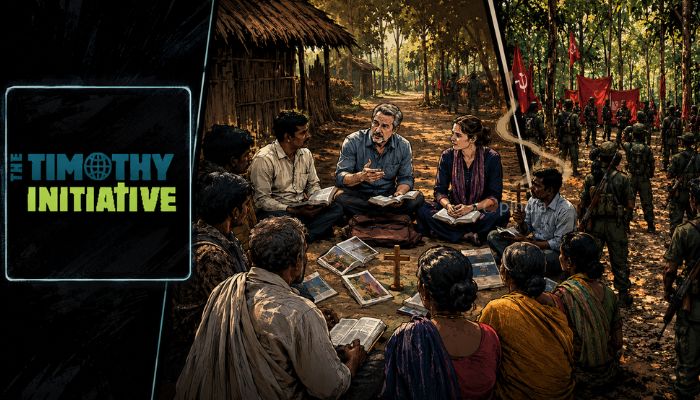
Read exclusive FIR details of USA Christian org ‘The Timothy Initiative’ booked on ED complaint: TTI’s training sermons, brainwashing of poor people led to Left-Wing Extremism

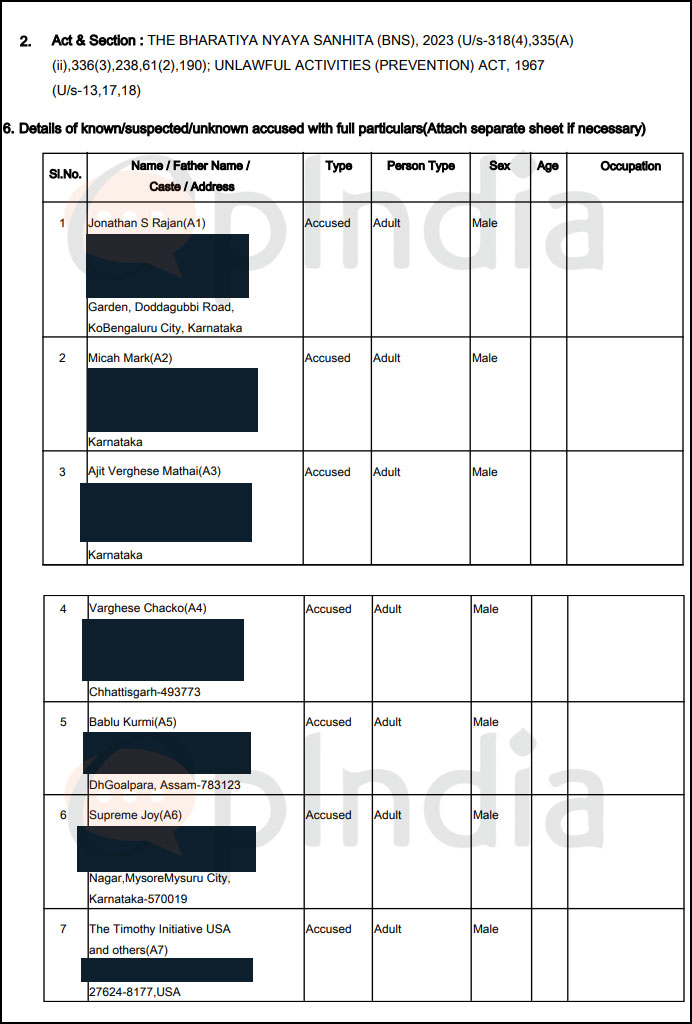
In a major development in the ongoing investigation into the foreign funding network linked to the United States-based evangelical organisation The Timothy Initiative (TTI), Bengaluru Police have registered an FIR in the case. The FIR names six individuals and TTI. The case concerns the routing of foreign funds worth Rs 92.55 crore into India through foreign-issued debit cards. According to the FIR accessed by OpIndia, the ED said in its complaint that TTI’s training sermons and brainwashing of poor people led to Left-Wing Extremism (LWE).

The FIR was registered on 11th June at Kothanur Police Station based on a complaint filed by Assistant Director of the Enforcement Directorate (ED), Sunil Kumar Sinhmar, under Sections 318(4), 335(A)(ii), 336(3), 238, 61(2) and 190 of the Bharatiya Nyaya Sanhita (BNS), and Sections 13, 17 and 18 of the Unlawful Activities (Prevention) Act (UAPA). The complaint was filed through the office of the Bengaluru Police Commissioner.

Source: Bengaluru Police

Notably, search and seizure operations were carried out by the ED on 18th and 19th April 2026 under Section 132 of the Income Tax Act and Section 37 of the Foreign Exchange Management Act (FEMA).

The accused named in the FIR

The accused named in the FIR are Jonathan S Rajan, Micah Mark, Ajit Verghese Mathai, Varghese Chacko, Bablu Kurmi, Supreme Joy and The Timothy Initiative USA and others.

According to the FIR, the accused persons and the US-based evangelical organisation entered into a criminal conspiracy to bring foreign-origin funds into India through debit cards issued by Truist bank in the United States. The FIR stated that these funds were withdrawn from ATMs across India and used for activities linked to TTI’s operations.

Foreign debit cards and the Rs 92.55 crore trail

According to the complainant, based on financial transactions, documents and statements, the process of accessing foreign funds was in violation of the FEMA Act and the Foreign Contribution Regulation Act (FCRA). It further stated that between November 2025 and April 2026, around Rs 92.55 crore, or USD 99,95,240, was used in violation of legal provisions.

Furthermore, the FIR states that between January 2024 and March 2026, around Rs 44 crore was withdrawn using foreign debit cards in several states, including Karnataka, Chhattisgarh and Assam.

Micah Mark intercepted at Bengaluru airport

A key part of the FIR concerns the detention of Micah Mark at Kempegowda International Airport in Bengaluru on 18th April 2026. According to the FIR, when he was intercepted by the ED, he was found to be in possession of 24 foreign debit cards.

During the investigation, the agency found that Micah Mark had travelled abroad several times and brought foreign debit cards into India. According to the FIR, he was the key person handling the main financial operations of TTI in India.

The FIR stated that most of the foreign debit cards were printed in the name of one “Santosh Kumar”. Since the same name appeared on the cards, the cards were internally identified using regional labels such as NE-1, NE-2 and Southern Region-1. It was done to avoid suspicion during LEA and KYC scrutiny.

The FIR says that the foreign debit cards were printed in the name of one “Santosh Kumar”. Since the same name appeared on the cards, the cards were internally identified using regional labels such as NE-1, NE-2 and Southern Region-1. The FIR states that this was done to avoid suspicion during Law Enforcement Agency (LEA) and Know Your Customer (KYC) scrutiny and to conceal original records. Around 1,000 such debit cards had been distributed in India over the past few years.

FIR states digital evidence was destroyed

The complainant pointed towards the destruction of digital evidence by the accused. According to the FIR, following the searches by the ED, the TTI Global portal became unusable for Indian users. It further stated that data maintained in the cloud was erased through remote access to servers maintained by TTI in the US.

During questioning, Micah Mark admitted that his account had been deleted from the backend. The report of the incident and the video recording were provided to the police by the complainant.

Suspicious withdrawals in LWE-affected areas

One of the most concerning aspects of the investigation was the suspicious cash transactions that took place in Left-Wing Extremism-affected areas, including the Dhamtari and Bastar regions of Chhattisgarh, using these foreign debit cards. Around Rs 6.34 crore was withdrawn in such regions. The FIR further stated that the debit cards were used in a planned manner to withdraw large amounts of cash, indicating the involvement of an organised network.

The FIR said that the emergence of a cash-based economy in Naxalite-affected areas poses a serious threat to India’s security and economic integrity and facilitates the illegal transfer of money for unlawful activities. It stated that around Rs 3.2 crore was withdrawn through 3,200 transactions of Rs 10,000 each.

The FIR specifically mentioned that this amount was withdrawn using two debit cards from a single AU Small Finance Bank ATM at Vijay Plaza on Bastar Road in Dhamtari, Chhattisgarh. It stated that the withdrawals were made under the supervision of field-level worker Varghese Chacko.

UAPA invoked over movement of foreign funds to Naxal-affected areas

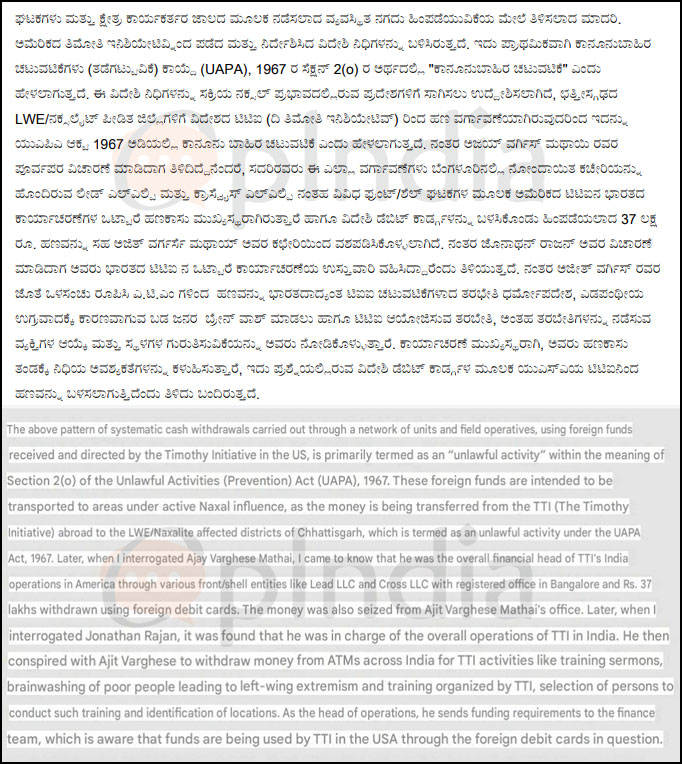
The FIR stated that the pattern of systematic cash withdrawals through units and field workers in LWE/Naxalite-affected districts of Chhattisgarh involved foreign funds received from and directed by The Timothy Initiative of America.

It further stated that this is prima facie an “unlawful activity” within the meaning of Section 2(o) of the Unlawful Activities (Prevention) Act, 1967. The FIR added that the foreign funds were intended to be carried into areas under active Naxal influence.

Because of this, the FIR said that the transfer of money from the foreign-based TTI to LWE/Naxalite-affected districts of Chhattisgarh attracts provisions of the UAPA.

Role attributed to Ajit Verghese Mathai and Jonathan S Rajan

According to the FIR, Ajit Verghese Mathai was the overall finance head of TTI’s India operations. It stated that the transfers were routed through various front or shell entities registered in Bengaluru. Furthermore, Rs 37 lakh in cash, which was withdrawn using foreign debit cards, was seized from Mathai’s office.

The FIR also stated that Jonathan S Rajan was in charge of the overall operations of TTI in India. It records that he, along with Ajit Verghese Mathai, conspired to withdraw money from ATMs for TTI activities across India.

The FIR pointed out that the money was used for activities including training, religious preaching, and brainwashing poor people in a manner leading to Left-Wing Extremism. It also stated that Jonathan Rajan looked after the selection of persons conducting such training and the identification of places where such programmes were to be conducted.

Source: Bengaluru Police

Field-level workers and TTI expenditure

The FIR added that Varghese Chacko, Supreme Joy and Bablu Kurmi were field-level workers who, in conspiracy with others, withdrew money from several ATMs using foreign debit cards and used it for TTI purposes.

The FIR further stated that evidence revealed TTI had spent more than Rs 95 crore in India. It cited a screenshot from quickbook.com, described as the accounting software used by TTI, and stated that Micah Mark was questioned about expenditure bills collected by various field coordinators during the previous six months. According to the FIR, he stated that these were paid by TTI between November 2025 and April 2026.

Background of the case

The FIR against TTI is the latest development in a wider probe into the foreign-funded evangelical network that has been under the scanner of the Enforcement Directorate. OpIndia has done a series of reports on TTI over the past few months. During our investigation, we revealed how TTI built its India network, how foreign churches supported its activities and how funds from abroad were brought into India despite the organisation not having FCRA approval, which was the core of the ED’s investigation in the first place.

As reported earlier in this series, TTI began as “Project India” in 2009 and was later rebranded as TTI in 2009. Its founder, David Nelms, had first come to India in 1992, and the organisation later developed a structured church-planting model focused on India and other countries.

TTI’s model was built around creating layers of local religious workers, described in its own ecosystem through terms such as Pauls, Timothys and Tituses. The model projected low-cost house churches, with each unit requiring only a few hundred dollars to plant.

OpIndia’s investigation revealed how TTI’s India-focused work was not a standalone activity. It was connected with a wider ecosystem of foreign churches and Christian networks, mostly from the US and Canada. Names that surfaced during our investigation included Kensington Church, Mission Grove Church, Northwest Baptist Church, Wooddale Church, Rise City Church, Mission Hills Church, First Presbyterian Church of Hanford, Springbrook Community Church, the Baptist General Conference of Canada, Liberty Church Network, All Access International, Saltbox Church and Woodside Bible Church.

Several of these foreign churches openly described their work in India or with TTI in terms of church planting, pastor training, field visits and funding targets. Kensington Church was linked to thousands of house churches in northern India, along with India visits, field engagement, children’s homes and medical camps. Mission Grove Church spoke of thousands of churches in northern India and Nepal, and fundraising linked to church planting in India and Bangladesh. Wooddale Church was linked to TTI training trips across India, Nepal and Bangladesh, along with references to thousands of leaders and churches.

Furthermore, it was found that TTI’s own training and operational material showed how the organisation trained local workers to enter Hindu-dominated villages, approach Hindus, avoid suspicion, use local social structures and identify caste leaders for outreach. The organisation’s model was not limited to preaching from outside. It depended on local field-level workers, layered leadership, village-level access and a structured expansion plan.

What started with FCRA and FEMA violations has now moved into the realm of national security.

Rise of ‘real’ Christianity: At pro-Trump, conservative event, MAGA women volunteer to give up their right to vote – why it is not surprising

There is a strange, deeply Christian and extremely reggressive trend that is taking shape in the United States of America – Christian women are rallying to give up their right to vote, because in the Christian society, the headship of the household is accorded to the man and the man alone. While the trend has been palpable for some time now, the latest conversation was sparked after several women volunteered to give up their voting rights in the hopes for a far more Christian society at the Turning Point USA (TPUSA) Women’s Leadership Summit recently held in San Antonio, Texas, led by Erika Kirk, the widow of Charlie Kirk.

The Republican Party, which aligns itself with conservative Christian values and exercises influence through the Christian Right, has increasingly made space for reggressive ideas which align with its voter base – women given up their right to vote being one of them.

A CBC report gives remarkable insight into the growing echo among the Christian society. Savanna Stone is a wildly popular Christian conservative influencer with almost half a million followers on Instagram and personifies the “trad wife” schtick. CBC quotes Stone propagating against women’s voting rights and advocating for a one-house-one-vote formula. She claims that women tend to vote for more ‘liberal’ candidates and therefore, they should give up their voting rights for a more conservative and Christian America. She also says that women should vote exactly how their husbands vote.

One would be tempted to dismiss Stone’s views as those of an influencer trying to chase eyeballs, but she wasn’t the only woman to hold such opinions.

CBC quoted several women who advocated for the exact same thing. They quoted a stay-at-home mom, Brooke Foxworthy, saying “If my husband is the head of the household, I am the neck, and we work very cohesively together,” she said. “If he was voting on behalf of our household, I would be fine with that.” She said she’d even be comfortable if it meant her daughter lost her right to vote, as well. “I also know she’s going to marry a biblical man, and that they would also be in line,” when it comes to political values, she said.

Another woman quoted by CBC said, “I feel like with my mindset, I would want to put my vote in,” said the 19-year-old nursing student from San Diego, Calif. “But … I think getting rid of that would actually help women more.”

“My perspective as a Christian woman is that my husband and I are one flesh,” Alexus DeGraaf told CBC. “I vote the same way he does, so honestly, I would be okay with giving up my right to vote, because I know that he would represent me well.”

Not a new campaign – When Pete Hegseth endorsed stripping women of voting rights

In 2025, Pete Hegseth, the largely unstable Defence Secretary in the Trump Administration retweeted an interview of Christian nationalist Doug Wilson. Wilson is Hegseth’s personal pastor and extremely influential in the Republican Party. In the video retweeted and endorsed by Hegseth, church members discussed why they believe women shouldn’t be allowed to vote.

Founded by Wilson, the Christ Church and its members firmly believe that women should not have the right to vote. Politico in a 2025 article quoted Jared Longshore, a minister of Wilson’s church, as saying he is “very grateful for what he’s (Donald Trump) doing. … I’m certainly grateful for what he did with Supreme Court justices. … I know Pete has done things” related to women in combat roles.

“Scripture calls the husband the head and then the woman the body. When you hear that the husband has a hierarchy in the home, we should think in the same way that we think about the relationship between our heads and our bodies”, Longshore was quoted as saying.

Longshore said repealing the 19th Amendment is “not something I’m pressing for, but when asked would I support that, I said yes, I would. … from the beginning of our nation up until the time of the suffrage movement, we had one vote per household and I think that would be a good thing.”

Interestingly, Hegseth only responded through a spokesperson saying that he was a proud member of the Church and supports and appreciates many of Longshore’s writings – tacitly supporting Longshore’s position on women’s right to vote.

The Biblical position on women

While modern propaganda paints Christianity as a cool, choir-singing faith, the truth is far from pretty. Christianity paints women as inferior, with a central tenet being the submission of women to male headship. Christianity was heavily influenced by the Greco-Roman worldview which considered women in inferior position and secondary to men. For example, Aristotle viewed women as ‘infertile males’, which is a bastardisation, essentially, of the ideal form of humanity.

There are several Biblical verses that reaffirm the belief that women are inferior being and must submit to the will and headship of the husband.

Corinthians 11:3–9 for example says, “The head of every man is Christ, the head of the woman is man… neither was man created for woman, but woman for man.” Timothy 2:11–15 says, “I do not permit a woman to teach or assume authority over a man; she must be quiet. For Adam was formed first, then Eve.” Ephesians 5:22–24 says, “Wives, submit yourselves to your own husbands as you do to the Lord. For the husband is the head of the wife.” 

The Biblical position is simple – women are to be excluded from priesthood, political participation, employment and active paritipation in any field that would potentially come in the way of, even slightly, of her traditional role of bearing children and catering to household duties.

Online push-back – a fractured America

MAGA women voters rallying to give up their voting rights has met with rather muted pushback on the internet. While several Americans called out the regressive stance taken by MAGA women and the Republican party, otherwise vocal political influencers have maintained studious silence.

Democrat Sara McGee posted on X, urging MAGA women to just go ahead and give up their own voting rights if they so fervently believe that Christian values exclude women from participating in the democratic process.

Other on X also opposed the assertions by MAGA women.

It is significant that Republican women have been silent through the controversy with Democrats speaking up, turning the TPUSA event to call out the mysogyny in the MAGA fold.

Not a fringe opinion

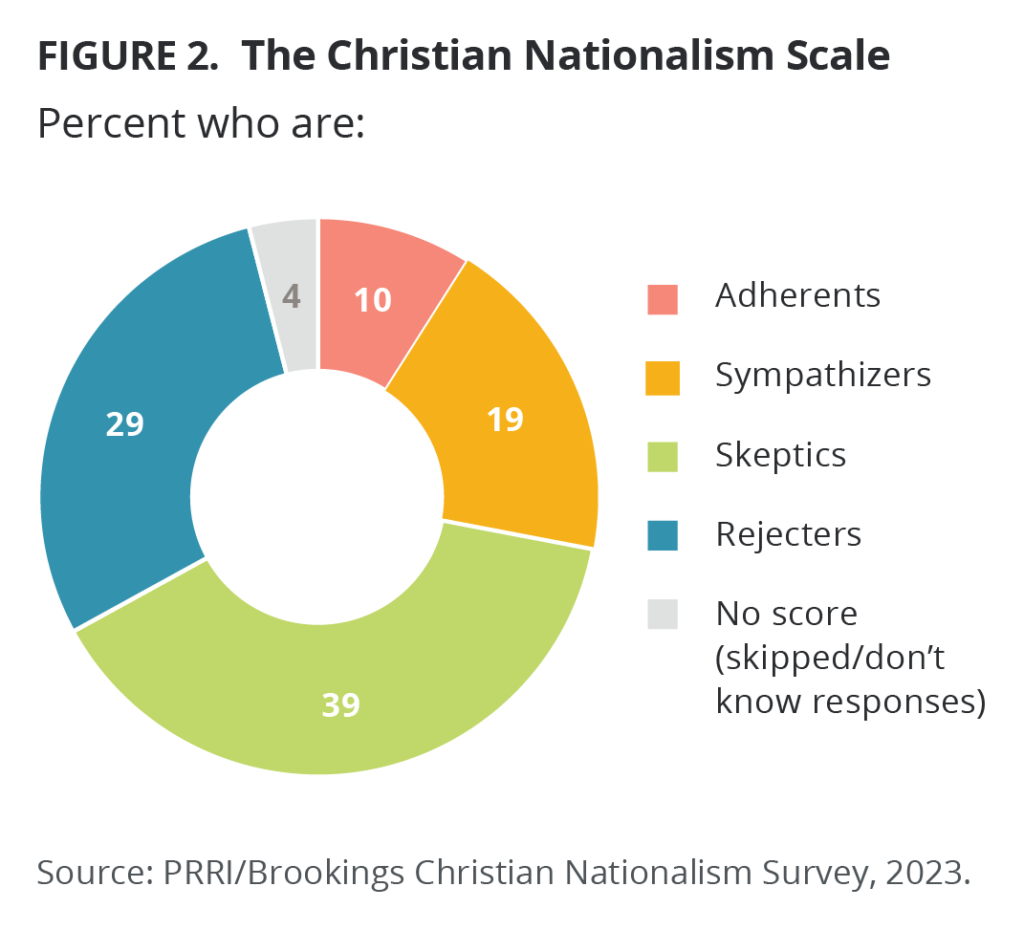
Given the traditional position, it is not surprising that Christian Nationalists would be rallying to strip women off their voting rights and numbers show that this opinion may not be completely ‘fringe’ either. According to a research conducted by the Public Religion Research Centre, an overwhelming number of Americans either firmy believed in or were sympathetic to Christian conservative values.

White Nationalism and belief in Christian Conservative values (source: PRRI)

In 2024, a whopping 29% believed in Christian Nationalism (either adherants or sympathetic).

According to PRRI, “Partisanship is closely linked to Christian nationalist views. Most Republicans qualify as either Christian nationalism sympathizers (33%) or adherents (21%), while at least three-quarters of both independents (46% skeptics and 29% rejecters) and Democrats (36% skeptics and 47% rejecters) lean toward rejecting Christian nationalism. Republicans (21%) are about four times as likely as Democrats (5%) or independents (6%) to be adherents of Christian nationalism”. It therefore shows that while 29% believe in Christian/White Nationalism overall, 54% of Republicans hold such views.

Rebel TMC MP faction merges with Nationalist Citizens Party of India: What is this Howrah-headquartered obscure party that has suddenly become 5th largest party in Lok Sabha

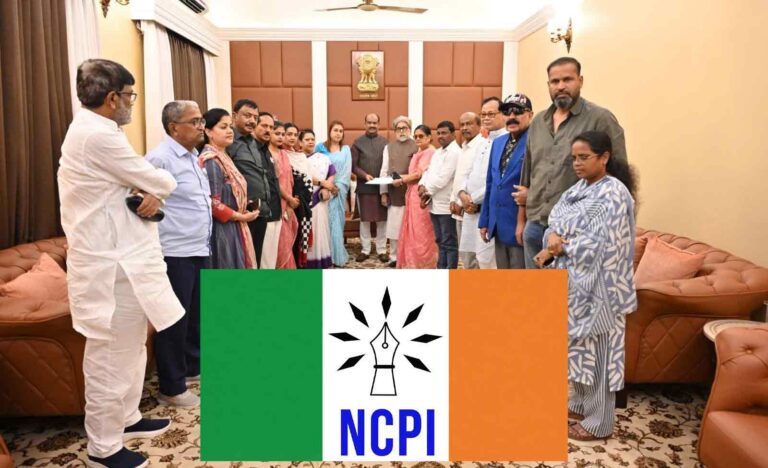
In a dramatic political development that has caught many by surprise, a significant faction of rebel Trinamool Congress (TMC) MPs, comprising around 20 members, over two-thirds of the party’s Lok Sabha strength, has announced its decision to merge with the Nationalist Citizens Party of India (NCPI). The rebels, including veteran leaders like Sudip Bandyopadhyay, Kakoli Ghosh Dastidar, and others such as Satabdi Roy, Saayoni Ghosh, and Arup Chakraborty, met Lok Sabha Speaker Om Birla and submitted necessary letters seeking recognition as members of the NCPI for separate seating arrangements in Parliament.

The rebel faction, now members of NCPI, has also announced that they will join the NDA. While it was expected that the rebel faction would merge with an existing party, the choice of the party has surprised people. Almost no one knew about the existence of such a political party before Sunday afternoon, when the rebel TMC leaders mentioned its name. It is being said that the party has bases in Tripura and Meghalaya, but those bases are also extremely small.

The development has sparked widespread curiosity and amusement, and as per a report by Anandabazar Patrika, several political leaders from Tripura said that they have never heard about the party. With 19 or 20 MPs, the Nationalist Citizens Party of India has suddenly become the 5th largest party in the Lok Sabha, behind DMK, which moves to 4th from 5th place.

The Nationalist Citizens Party of India is a very obscure Registered Unrecognised Political Party, which had no media presence before 14th June. It is not recognised party by the Election Commission, and therefore it does not have an allotted symbol.

The Nationalist Citizens Party of India is one of India’s many obscure Registered Unrecognised Political Parties (RUPPs). Registered with the Election Commission of India in 2022-23, the party had remained virtually unknown to the public and even to seasoned political observers until this sudden spotlight.

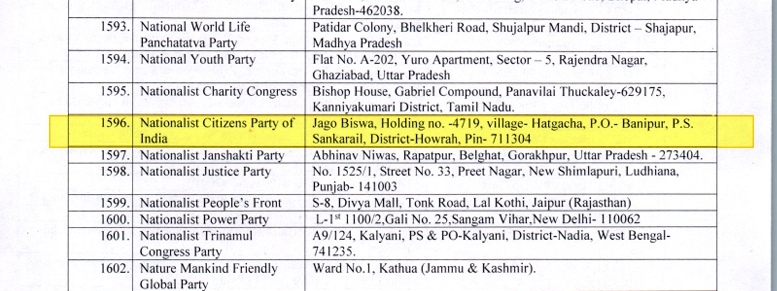
As per ECI documents, its headquarters is located at Jago Biswa, Holding No. 4719, Village Hatgacha, Post Office Banipur, Police Station Sankrail, District Howrah, Pin Code 711304 in West Bengal. Therefore, the party is based in Howrah in West Bengal, not Tripura as being reported by many.

However, despite its West Bengal base, the party showed some political activity only in Tripura, where it contested two seats in the 2023 Assembly elections under the symbol of a pen nib with seven rays. Both candidates performed poorly, with negligible vote shares, reflecting the party’s minimal electoral footprint. Jahangir Ali contested from Kailashahar constituency and secured 286 votes, while Barjeda Tripura from Chawmanu polled just 536 votes. This means the whole party received 822 votes in the elections.

Notably, in election results, ECI used the abbreviation NCPN for the party, not NCPI. The election commission uses its own system for shortening party names, and sometimes it does not match the normal abbreviation. This is mainly done if the abbreviation is already allotted to another party. For example, Aam Aadmi Party has been given the code AAAP by ECI, because AAP was already allotted to Awami Aamjan Party. Therefore, it is likely that the NCPI code is also already allotted to some other unknown party.

Details about the party’s origins, founders, and pre-existing leadership remain remarkably sparse. No prominent national or state-level figures are publicly associated with it in available records or media reports. It functions as a low-profile entity with a modest Facebook presence, where the latest post was posted in 2023. As per its Facebook page, it has a flag with vertical green, white and saffron stripes, with the symbol of pen nib with seven rays in the centre. Apart from some photographs and election posters from 2023 Tripura elections, the Facebook page does not have any other major content.

As per the election posters of the party, its president is Shewly Kundu, vice president is Uttiyo Kundu, and organisational secretary is Shantanu Dey.

The rebels’ choice to merge with this obscure party, rather than forming an entirely new one or joining an established major player like the BJP directly, is rooted in both legal strategy and political pragmatism. According to the law, legislators face disqualification if they voluntarily give up membership of their political party or vote against party directives. However, an exception is provided in cases of the merger of political parties. If not less than two-thirds of the members of the legislative party concerned agree to a merger with another political party, such members are protected from disqualification. This means rebel MPs or MLAs can’t form a new party, but the group can join an existing party.

By merging their group, which comfortably crosses the two-thirds threshold, with the existing registered party NCPI instead of individual defections or forming a new party, the rebels have ensured that it will be a legitimate party merger rather than defection.

Moreover, aligning with a virtually leaderless and obscure outfit like the NCPI allows the TMC rebels to effectively take over the party wholesale. Unlike joining the BJP or another established NDA constituent, where they would have had to operate under senior leaders and established hierarchies, the rebels can now steer the NCPI in their preferred direction.

As the party already has its registered office in West Bengal, it becomes easy for the rebel faction to quickly turn it into a major political party. They can open a bigger party office in West Bengal and may eventually stake a claim to the “Trinamool” name and symbol, leveraging their numerical majority from the original TMC. This effectively transforms the NCPI into its own vehicle, preserving autonomy and avoiding subordination to any external leadership while still extending support to the NDA under Prime Minister Narendra Modi’s guidance.

While NCPI has become the 5th largest party in Lok Sabha, more importantly, it has become the second largest party in the lower house in NDA, surpassing TDP with 16 MPs. However, the development is not expected to end in Lok Sabha. The revolt in TMC started in Kolkata, with over 60 MLAs opposing the party’s choice for the leader of the opposition. The rebel group is backing expelled MLA Ritabrata Banerjee for the post.

With the MPs merging with NCPI, it will be a natural choice for the rebel MLAs also to merge with the party. If that happens, TMC will turn into a very weak party in the state with less than 20 MLAs. In contrast, the BJP-led NDA government, which already has comfortable majority, will become much stronger with a new ally with over 60 MLAs.

Female judicial officer loses ₹52 lakh after Tinder ‘relationship’, complaint filed through maid: Delhi court denies bail to honey-trap accused, asks actual victim to submit details

A Delhi court recently denied bail to an accused in a honey-trapping and cyber fraud case involving Haryana Additional District and Sessions Judge. Additional Sessions Judge (ASJ) Saurabh Partap Singh Laler, of Karkardooma Court, dismissed the bail plea of Deepak Vats, who is accused of duping the judicial officer of ₹52 lakh. OpIndia accessed judgment in the case.

The ASJ noted that the facts of the case bore a pattern of a honey trap, while making sharp observations regarding the conduct of the accused, the complainant, and the investigation carried out by the Delhi Police Special Cell. “…the pattern of financial transactions correlating so precisely and immediately with the WhatsApp communications is consistent with the hypothesis of a honey trap,” ASJ Laler observed in the order dated June 9, 2026, expressing “profound anguish at the state of the record in the present proceedings”.

“The modus operandi is distressingly familiar: initial contact through a dating application, rapid and intensive emotional escalation, the development of deep personal intimacy, and then the progressive extraction of money, often presented as investments, gifts, or shared ventures. The present matter bears all the hallmarks of this pattern,” the ASJ added.

The Court expressed disappointment over the fact that the judicial official got the complaint filed in the name of her domestic help, instead of coming forward and presenting complete facts before the court. “A judicial officer, a person who is herself entrusted with the solemn duty of dispensing justice, of upholding truth before the law, and of expecting others who appear before her to present the complete facts, has chosen to approach this court obliquely, through her maid’s name, rather than coming forward herself,” the ASJ said.

The court acknowledged that the victim, being a judicial officer, might have felt profound embarrassment on finding out that she had been honey-trapped. However, the court said that by filing the complaint in an incomplete and misleading manner complicated the proceedings.

“The vulnerability of a person in that situation invites understanding, not condemnation. However, the officer’s personal discomfort cannot be permitted to compromise the integrity of a criminal investigation. A complaint filed in an incomplete or misleading manner, designed to protect the victim’s identity at the cost of obscuring the facts, creates exactly the kind of evidentiary confusion that is now before this court,” the court said.

The court expressed displeasure over the partially concealed information, including WhatsApp communication and chats, submitted by both the judicial officer and the accused before the court. The court also questioned the conduct of the investigating officer (IO), sub-inspector Ajit Dadarwal of Delhi Police, and stated that an officer investigating a cyber fraud of over ₹52 lakh involving a judicial officer was expected to display the highest standards of diligence, impartiality and thoroughness.

The court said that IO Dadarwal failed to obtain the Tinder chat history of either party, the complete WhatsApp chat history from the accused’s device, and ignored a court direction to verify an alleged meeting between the victim and the accused at Drishtti Dreamscapes, Saket. The court asked the judicial officer to provide complete details of the case. “The victim, being a judicial officer, is better placed than most to understand that the path to justice requires candour,” the court said.

How the case came up before the court

The judge, who is the victim in this case, and the accused had met through a dating app called Tinder. Judicial officer, a member of the Haryana superior judicial service, is presently posted as an Additional District and Sessions Judge, fast track special court for trying offences under the Protection of Children from Sexual Offences (POCSO) Act at Narnaul.

The two developed a relationship, and the judge transferred a total amount of around ₹52 lakh into the bank accounts of the accused. According to the prosecution, the accused made the victim transfer the amount to him by promising high returns. However, the promise was never fulfilled, leading to the filing of a complaint. Notably, the judicial officer did not file the complaint herself but instead got a complaint registered in the name of her house help, Diksha Devi.

An e-FIR was registered under sections 308 (extortion), 318(4) cheating, 319 (cheating by personation) and 340 (using a forged document or electronic record as genuine) of the BNS against Deepak Vats on the complaint of the judicial officer’s maid Diksha Devi.

The ASJ highlighted how even educated individuals, including government officials, have been falling victim to cases of cyber fraud. “This Court has, during the course of proceedings in numerous cyber fraud matters over the year, encountered a regrettable pattern in which individuals, including senior civil servants, professionals, and business persons of standing, have been ensnared in digital arrest, investment fraud or romantic honey traps,” the judge said.

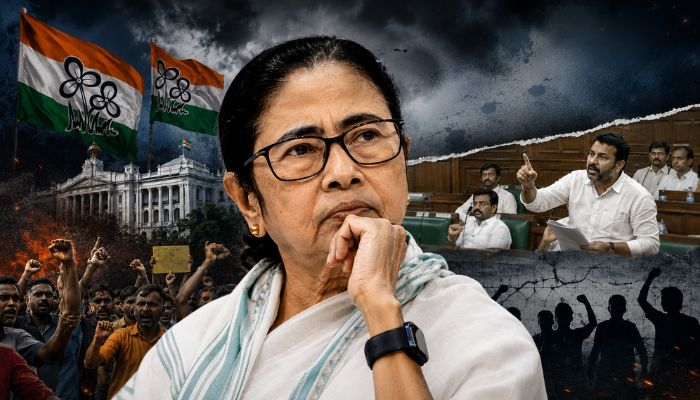
Will TMC cease to exist: Not just MLAs and MPs, read how the public is rebelling and standing upto Mamata’s syndicates

The Trinamool Congress (TMC), which ruled West Bengal for 15 years under the leadership of Mamata Banerjee, is currently facing the biggest political crisis in its history. Since its formation in 1998, the party has survived numerous political battles, defections and electoral challenges. However, the situation unfolding today appears very different. Following its defeat in the 2026 West Bengal Assembly elections, the party has been hit by rebellion at multiple levels, from Parliament to the Assembly and even within its organisational structure.

What began as dissatisfaction after the election results has now developed into a full-fledged internal revolt. Rebel MPs are openly challenging the authority of the party leadership, Rajya Sabha members are resigning one after another, dissident Lok Sabha MPs are trying to create a separate parliamentary faction, and a large group of MLAs has already installed its own Leader of the Opposition in the Assembly. At the same time, at the grassroots level, people who once feared local TMC syndicates are increasingly speaking out against them.

Cracks deepen as senior Rajya Sabha MPs quit 

One of the most visible signs of the crisis has been the resignation of senior TMC leaders from the Rajya Sabha.

The latest blow came on Thursday, 11th June, when Rajya Sabha MP Prakash Chik Barik resigned from both the Upper House and the party. Barik, who had previously served as a minister in Mamata Banerjee’s government, submitted his resignation to Vice-President C.P. Radhakrishnan and announced that he would no longer remain associated with the party.

Barik’s resignation became particularly significant because he did not merely leave Parliament; he also publicly distanced himself from the TMC leadership and signalled support for the new BJP government in West Bengal.

“People have given a clear mandate. People have favoured the BJP over the Trinamool. Our party’s result was not even good in northern Bengal. I have resigned in view of the people’s mandate. I have not spoken to Mamata Banerjee as of now. But I have resigned from both the Rajya Sabha and the party organisation. I will work as per CM Suvendu Adhikari’s instructions in the future. I will work for development,” Barik said after resigning.

His departure came just days after two other prominent TMC Rajya Sabha MPs, Sukhendu Sekhar Roy and Sushmita Dev, also resigned from the Upper House and left the party.

With these three resignations, the TMC’s strength in the Rajya Sabha is set to decline from 13 members to 10. Political observers believe the number could fall further, as speculation continues about more MPs preparing to leave.

The resignations have not only reduced the party’s strength in Parliament but have also created the perception that confidence in the leadership is weakening among senior leaders.

Lok Sabha rebels move to create the “Real TMC”  

While resignations have weakened the party in the Rajya Sabha, the crisis in the Lok Sabha has become even more dramatic.

A group of rebel MPs has openly challenged Mamata Banerjee’s leadership and claimed that they represent the “real TMC” in Parliament.

The rebellion is being led by senior MP Kakoli Ghosh Dastidar, who resigned from party posts earlier and emerged as the face of the dissident camp. According to rebel leaders, as many as 19 Lok Sabha MPs have already joined their effort.

The dissident faction has announced plans to approach Lok Sabha Speaker Om Birla and seek recognition as the genuine TMC parliamentary group.

Rebel MP Jagadish Chandra Barma Basunia confirmed the move publicly.

“We have submitted the letter. On Monday, we will go to the Speaker and stake our claim to form the real TMC parliamentary group. We will ask the Speaker to give recognition to our claim,” he said.

According to the rebel camp, signatures of 19 MPs have already been collected in support of the initiative. The list includes the names: Kakoli Ghosh Dastidar

  1. Kakoli Ghosh Dastidar
  2. Satabdi Roy
  3. Rachna Banerjee
  4. Saayoni Ghosh
  5. Yusuf Pathan
  6. Mala Roy
  7. June Malia
  8. Deepak Adhikari 
  9. Bapi Haldar
  10. Dr Sharmila Sarkar
  11. Prasun Bandyopadhyay
  12. Jagadish Barma Basunia
  13. Asit Kumar Mal
  14. Arup Chakraborty
  15. Khalilur Rahaman
  16. Abu Taher Khan
  17. Mitali Bag
  18. Kalipada Soren 
  19. Partha Bhowmick

The Mamata Banerjee camp has strongly rejected the move. Senior MP Mahua Moitra argued that the rebels have misunderstood the anti-defection law.

“Traitor TMC lawmakers don’t know the law. Constitution 91st Amendment 2003 removed the provision for a split/separate bloc. The number of MPs is irrelevant – 2/3 of the original political party has to merge with another party. All 19 traitors need to resign & contest on BJP ticket,” she wrote on social media.

Despite these legal questions, the rebellion has exposed the depth of dissatisfaction within the parliamentary wing. For the first time since the party’s formation, a large group of sitting MPs is openly questioning the authority of the leadership.

Assembly revolt leaves party leadership isolated 

If the rebellion in Parliament has embarrassed the party, the developments in the West Bengal Assembly have arguably caused even greater damage.

The controversy began after Mamata Banerjee lost the Bhabanipur seat in the Assembly elections. With the party moving into opposition, the post of Leader of the Opposition became crucial.

The party leadership selected veteran leader Sobhandeb Chattopadhyay for the position. However, a large section of TMC MLAs refused to accept the decision.

Soon, a group of 60 MLAs rallied behind expelled MLA Ritabrata Banerjee and submitted a letter to Speaker Rathindra Bose demanding that he be recognised as Leader of the Opposition instead.

The letter carried the signatures of 59 MLAs, demonstrating that the rebel camp had the support of a substantial majority of the party’s legislators.

The dissidents argued that they represented the true voice of the legislative party and that the leadership’s decision had been imposed without proper consultation.

The dispute became even more serious when allegations emerged that signatures supporting Sobhandeb Chattopadhyay had been used without the consent of some MLAs.

Ritabrata Banerjee and Sandipan Saha lodged complaints regarding theirregularities. The Assembly Secretariat subsequently registered a police case and the CID launched an investigation. Some legislators reportedly told investigators that they had not signed the document submitted in support of Chattopadhyay. With nearly 60 of the party’s 80 MLAs supporting the rebel faction, the balance of power inside the Assembly shifted dramatically.

The rebels eventually succeeded in installing Ritabrata Banerjee as Leader of the Opposition, a major setback for the official party leadership.

The crisis became so severe that the TMC leadership dissolved all organisational committees in West Bengal and announced a comprehensive review of the party structure.

In a statement, the party said all committees and frontal organisations stood dissolved with immediate effect and that the organisational framework would be rebuilt after a detailed assessment.

Kalyan Banerjee’s public ultimatum to Mamata Banerjee

As if the resignations and rebellions were not enough, the party was shaken by an extraordinary public attack from one of its most senior MPs.

On Thursday, 11th June, veteran TMC leader and lawyer Kalyan Banerjee launched a scathing criticism of party general secretary Abhishek Banerjee. The dispute began over legal representation in a case involving Abhishek Banerjee. Kalyan Banerjee claimed that another lawyer had been appointed without consulting him, despite his involvement in the matter.

“I don’t like this arrogant attitude. One must respect the seniors. How can he humiliate me? He should understand that the party is facing problems because of him. But he goes and disrespects everyone. This is not tolerable,” Kalyan Banerjee said. He then directly appealed to Mamata Banerjee and effectively asked her to choose between him and her nephew.

“I will urge Didi: if you will remain dependent on Abhishek Banerjee, then stick with him—leave me. But if you part ways with Abhishek Banerjee, then I am with you,” he said.

The remarks were unprecedented because they reflected frustration not merely with party strategy but with the internal power structure itself.

Grassroots resistance against the TMC syndicate system 

While political battles continue within the party, a different kind of rebellion is taking place on the ground.

Across several parts of West Bengal, people are increasingly challenging the syndicate system that flourished under TMC rule.

In Sonarpur, South 24 Parganas, an autorickshaw union office that once operated under the TMC-affiliated INTTUC has switched allegiance to the BJP-backed Bharatiya Mazdoor Sangh.

Local drivers say they are relieved that they no longer have to pay monthly collections demanded by TMC-linked leaders. The change has become symbolic of a larger shift occurring across the state.

Abhishek Banerjee was attacked on 30th May by a mob in Sonarpur, which pelted him with eggs, shoes and stones – in what was seen as a reflection of the large-scale anger against the TMC in general, and Abhishek in particular.

Residents who once remained silent out of fear are now openly discussing extortion, land grabbing and intimidation.

In Kamrabad, residents say construction work on encroached government land stopped after the election results. “We don’t know how the government land was occupied, but no one protested out of fear. Since May 4, construction has stopped,” resident Bapi Haldar said.

In Ghashiyara, Rupali Mondol returned home after spending nearly a year away following an dispute with local TMC leaders.

She claims her vegetable shop was destroyed after she failed to pay money demanded by local political figures.

“So they ransacked my shop. I lodged a complaint with the police and the National Commission for Women, but nothing happened,” she said. Now, with several influential local leaders reportedly absconding or facing investigations, many residents feel emboldened to speak out.

Similar developments are being witnessed in Kolkata’s Beleghata area, where illegal construction networks linked to local political strongmen have come under scrutiny. Several buildings face demolition proceedings, and multiple influential figures have been arrested.

Residents who previously avoided filing complaints now say they are approaching authorities with allegations regarding land grabbing and illegal construction.

The same trend can be seen in Jamalpur in Purba Bardhaman district, where villagers have begun speaking openly about illegal sand mining operations and misuse of government resources.

“Every day, 150 to 200 trucks carried out sand. No one protested out of fear,” said resident Gopal Adak. “Now, that fear is gone,” added another villager, Nimai Majhi.

A bigger question: Will TMC cease to exist?

All these developments paint a troubling picture for the survival of Trinamool Congress.

The party is battling resignations in Parliament, rebellion in the Assembly, internal disagreements among senior leaders and growing public resentment at the grassroots level. What makes the situation particularly serious is that these challenges are emerging simultaneously.

The resignations of Rajya Sabha MPs have weakened the party nationally. The attempt by dissident Lok Sabha MPs to create a separate faction has exposed deep divisions in the parliamentary wing. The successful rebellion by MLAs has undermined the authority of the leadership in the Assembly. And on the ground, the weakening of local syndicate networks has encouraged ordinary citizens to raise complaints that many were previously afraid to voice.

For a party that once appeared politically invincible in West Bengal, the current crisis represents perhaps the greatest challenge in its 28-year history. Whether Mamata Banerjee can reunite the organisation and restore discipline remains uncertain. What is clear, however, is that the Trinamool Congress is no longer facing isolated acts of dissent. It is confronting a widespread challenge to its authority from within the party and from the public alike.

Ambubachi Mela: The period when Goddess Kamakhya menstruates, worship is suspended for three days; Read how the festival reveals the mysteries of creation, feminine energy, and spiritual practice

India’s religious traditions are not limited to worship or faith, but also embody a profound philosophy of nature, life, feminine power, and creation. Many of the festivals celebrated in the country underscore the relationship between humans and nature. One such festival is the Ambubachi Mela, held annually at the Maa Kamakhya Temple in Guwahati, Assam.

Ambubachi Mela stands because of the rituals and religious beliefs associated with it. It is said that the festival marks the menstruation phase of Goddess Kamakhya. This is her annual menstruation phase during which the doors of the Khamakhya Temple are closed for a few days.

The festival is said to be the largest religious gathering in Northeast India, attracting millions of devotees, saints, tantric practitioners, and tourists from India and abroad. During this time, the entire region becomes a centre of devotion, meditation, mystery, and spiritual energy.

What is Ambubachi Mela, what does it represent?

The Ambubachi Mela is an annual religious event associated with the worship of Shakti, the feminine energy. During the festival, Goddess Kamakhya is given a break and usual worship at the temple is suspended.

The tradition is considered a symbol of respect for the female body and the process of creation. While different cultures view the menstrual cycle differently, this tradition honours it as a source of creative power and life. The word Ambubachi is also associated with water, fertility, and creation.

This is the reason that this festival holds not only religious but also cultural and philosophical significance. This time is also considered extremely important for those involved in Tantra Sadhana. It is believed that this period holds special significance for spiritual practice and mantra siddhis, which is why a large number of practitioners arrive here.

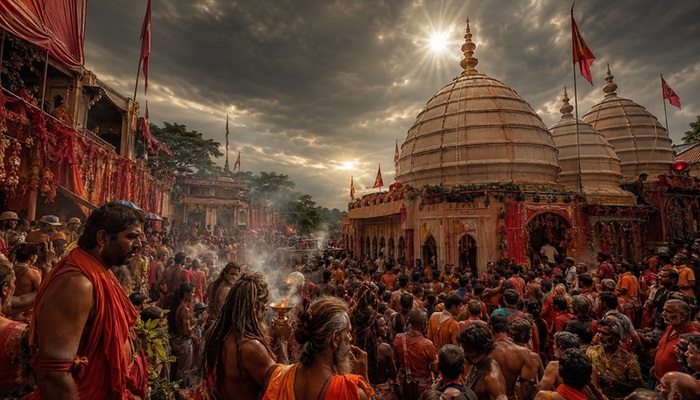
The Ambubachi fair at the Kamakhya temple attracts lakhs of devotees every year. (Photo courtesy: ChatGPT)

Ambubachi Mela 2026: When will it start, and what will be the schedule?

This year, the Ambubachi Mela will begin on 22nd June at night. The doors of the temple’s sanctum sanctorum will be closed at approximately 9:08 pm on that day. The sanctum sanctorum will then remain completely closed for the next three days, 23rd June, 24th June, and 25th June. During this time, no devotees will be permitted to have a direct darshan of the goddess.

Usual religious activities are also restricted within the temple complex. The four-day event will conclude on the morning of 26th June with special rituals and purification ceremonies. After this, Darshan will be reopened for devotees. The annual visitor count during this period is in the millions.

In past years, the administration and temple committee made special arrangements for the large number of devotees arriving. This time too, extensive preparations are underway for security, sanitation, drinking water, medical care, and the movement of devotees.

Pravritti and Nivritti: The Two Spiritual Stages of the Mela

The entire Ambubachi Mela process is completed in two major phases: Pravritti and Nivritti. The Pravritti phase marks the beginning of the goddess’s menstrual period. During this time, the temple doors are closed, and the goddess is given rest. Pujas, aartis, and regular religious activities are not performed during these days.

This is followed by the Nivriti phase. This is considered the end of the Goddess’s resting period and the time when she is re-energised to appear. The temple is opened after special purification and Vedic rituals. This is the time when the largest number of devotees arrive for darshan, and a special religious atmosphere prevails within the temple complex.

The message of Mother Earth’s rest and feminine power

The significance of the Ambubachi Fair is not limited to religious beliefs. It conveys a profound natural and cultural message. According to popular belief, just as a woman rests during menstruation, the earth also rests during this period.

This time is also commonly associated with the arrival of the monsoons and the renewed fertility of the land. Because of this belief, even today, many families postpone farming, tilling, or other auspicious tasks during these times. This is not out of fear, but rather out of respect for nature and an understanding of the creative process.

This belief suggests that the earth is not just a resource but a life-giving force that needs periodic rest and respect.

Angodak, Angvastra and special traditions associated with the fair

An important hallmark of the Ambubachi Mela is the special offerings made here. According to tradition, special cloths are placed in the sanctum sanctorum before the temple is closed. After the doors open, devotees are offered Angodak and Angavastra. Angodak refers to holy water, while Angavastra refers to a small piece of red cloth.

Devotees take it with them, considering it a symbol of the goddess’s grace and power. During these days, the temple complex also sees a special gathering of saints and sages from across the country, as well as those associated with the Tantric tradition, further enhancing the spiritual nature of the fair.

Maa Kamakhya Temple: Where no idol is worshipped, but a symbol of Shakti

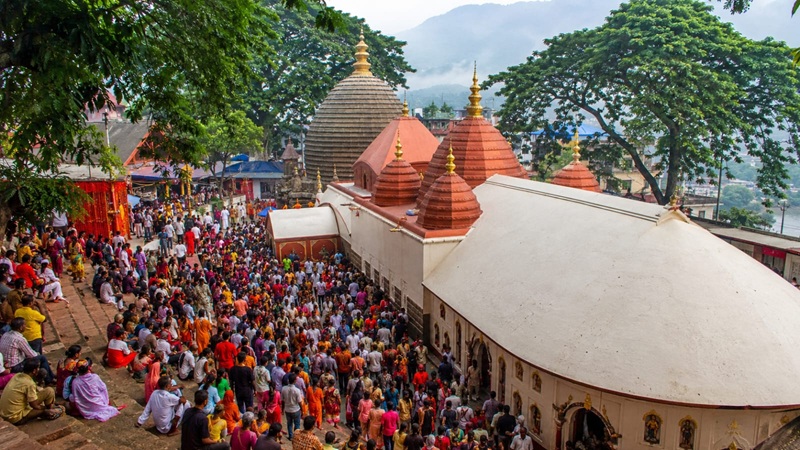
The soul of the Ambubachi Mela is the Maa Kamakhya Temple. Located on the Nilachal Hill in Guwahati, Assam, this temple is considered one of India’s most prominent Shaktipeeths. According to Hindu religious beliefs, Shaktipeeths were established in areas where various body parts of Goddess Sati fell when Lord Vishnu dismembered her corpse with Sudarshana Chakra. Kamakhya Temple was established on the place where the goddess’s vagina is believed to have fallen.

For this reason, this temple is considered a vital centre of power, creation, and goddess worship. The most unique feature of the temple is that it lacks a traditional idol of the goddess. A natural rock form, always moistened by a stream of water, is worshipped within the sanctum sanctorum. This unique feature distinguishes this temple from other Shaktipeeths.

Surrounding the main temple are numerous temples dedicated to various manifestations of the Goddess and Lord Shiva, transforming the entire Nilachal region into a vast spiritual complex. This is why the Ambubachi Mela is considered not just a religious festival but a vibrant celebration of faith, women’s power, nature, creation, and the Indian spiritual tradition.

(This article is a translation of the original article published on OpIndia Hindi.)

Did you know it’s illegal to die in some places? 7 bizarre laws from around the world and the surprising reasons behind them

0

Laws across the world are formed and shaped to cater to the requirements of the societies in which they exist. While some laws, such as those relating to crimes like theft or murder, usually exist universally, there may be laws or local rules to address a peculiar problem. While such rules or laws may make perfect sense to the local people, outsiders, unaware of the social, historical or cultural context of such laws, may find them absurd.

Here are seven rules and laws from across the world that may look unusual and common-sense-defying to others, but are followed by the people of the countries where they exist.

The chewing gum ban in Singapore

The harmless sticky candy once became a menace across Singapore after miscreants started sticking it in places like the sensors of subway doors, inside lock cylinders, mailboxes, inside keyholes, on lift buttons and on elevator buttons. This resulted in added maintenance and cleaning costs. In 1987, the Mass Rapid Transit (MRT) local railway system, which was Singapore’s largest public project, started running. But the chewing gum menace reached the MRT as well. Miscreants started pasting chewing gum on the door sensors of MRT trains, which prevented doors from functioning properly and caused disruption to train services.

The Singaporean government at the time was committed to making Singapore a global trading hub and was paying particular attention to cleanliness and public hygiene. The government came up with a legal solution to the problem and passed a law in 1992 banning the import, sale and distribution of chewing gum. As per the law, chewing gum is not illegal in the country, but selling, importing or distributing chewing gum is.

Therefore, a person travelling to Singapore can bring a small amount of chewing gum into the country for personal use, but it is illegal to spit the gum in an inappropriate place. In 2004, the Singapore government made an exception under the law for therapeutic, dental, and nicotine chewing gum, which can be bought from a doctor or registered pharmacist.

Dying is Illegal in these parts of the world

As absurd as it may sound, there are places in the world where dying is prohibited. Death is generally a dreaded and unwelcome phenomenon everywhere, but some regions have gone to the extent of making rules to stop death from visiting them. There is not one, two or three, but as many as six countries having places that have rules against dying.

Longyearbyen, Norway: Longyearbyen is located on the archipelago of Svalbard in extreme cold temperatures and permafrost conditions (permanently frozen ground), which prevent the dead bodies from decomposing. To prevent the risk of diseases or infections spreading, the governor of Svalbard made a policy decision to ban dying in the city. As per the policy, people who have died or are suffering from terminal diseases have to fly to mainland Norway for burial or treatment. However, if one dies in the town, it is possible to cremate them there, but it requires a license and lots of paperwork that could take months.

It was proved in 1998 that the fear of the spread of infections from dead bodies was not unfounded when scientists unearthed the bodies of seven men buried in the ice 80 years ago. All seven people had died after the Spanish flu in the big pandemic of 1918. Surprisingly, the scientists were able to extract live samples of the virus from all seven dead bodies. This confirmed that deadly diseases could survive in dead bodies buried in permafrost.

Lanjaron, Spain: The mayor of Lanjaron, Jose Rubio, imposed a ban on dying in the town in 1999. The reason behind the ban was that the local cemetery had reached its capacity limit.

Le Lavandou, Sarpourenx and Cugnaux, France: A similar ban was imposed in three towns of Le Lavandou, Sarpourenx and Cugnaux in southern France. In 2000, the Mayor of Le Lavandou outlawed death due to a lack of space for burials in the local cemetery. The towns of Sarpourenx and Cugnaux also followed suit in 2007 and 2008, respectively, for similar reasons.

Sellia, Italy: The mayor of the medieval village of Sellia in Italy passed a decree in 2015 that officially made it illegal to get sick or die in the village as a measure to save its ageing population. Mayor Davide Zicchinella signed a decree stating that residents were forbidden from getting sick, and they should put their health first. The extreme measure was adopted after the village’s population dropped to 537 in 2015 from 1300 in 1960. Besides, 60% of the surviving population was over 65.

Biritiba Mirim, Brazil: In 2005, the mayor of Biritiba Mirim town in Brazil filed a public bill, making it illegal for the residents to die in the town as the local cemetery was full. The bill did not provide any punishments, but the Mayor aimed to target relatives of people who die with fines and even jail, if necessary, to get more space for tombstones.

Itsukushima, Japan: The Itsukushima town, also known as Miyajima, of Japan, is considered a sacred place as it houses several shrines and temples. To maintain the sanctity of the place, a ban on childbirth and death was imposed in the late 19th century. There are no cemeteries or hospitals on the island.

Not voting is criminal in Australia

While voting is considered a right of the citizens in several democracies, Australia went a step ahead and made not voting a crime punishable. In other words, voting is not just a right in Australia but a legal obligation, whose violation can attract a monetary penalty of as much as A$20 ($13; £10) and can also be prosecuted. This was done by way of an amendment in the Electoral Act in 1924.

As a result of the law, the country is among the countries with the highest voter turnouts. Even though it may sound punitive, the law has popular support. A variety of measures have been adopted by the authorities to facilitate people in casting their votes. For example, the elections in the country are held on Saturdays, when most of the people are not working. Besides, employers are required to provide workers paid leave on election day to ensure that people have enough time to go vote.

Government approves children’s names in these countries

Several countries across the world have some rules and regulations relating to the naming of children. While some have approval systems for children’s names, others have laws that allow rejection of certain names. In some countries, there is a ban on certain specified names. Here are some of the countries that regulate how children are named.

Iceland: The European country has a National Register of Persons established under the National Name Act (1971, amended 2019). As per the law, the names of children must conform to Icelandic grammatical traditions under legislative mandate.

New Zealand: In this country, certain names which are offensive, embarrassing, or unreasonably long are explicitly prohibited under the Births, Deaths, Marriages and Relationships Registration Act 1995.

Denmark: In Denmark, the Personal Names Act (Navneloven, 2003) puts restrictions on name choices to approximately 7,000 approved names under formal legislation.

Germany: Germany’s Civil Status Act (Personenstandsgesetz) and name approval regulations under the Standesamt constitute binding statutory law requiring official approval. Names of children in Germany must be approved by the office of vital statistics in the area (the Standesamt) where the baby is born. The name must indicate the child’s gender, and the name cannot be one used traditionally as a surname.

Finland: All Finnish citizens and residents are required to have at least one and at most four first names as per the Names Act of 1985. Those not having a first name are obligated to adopt one when they are entered into the Finnish national population database. Besides, the law requires the parents of newborn children to name their children and inform the population registry within two months of their birth.

In this aspect, India gives absolute freedom to parents to name their children in whatever way they like. A law putting restrictions on children’s names would sound absolutely absurd and unimaginable to Indians, who name their children after Gods, places, good qualities and even fruits and sweets.

Ban on feeding pigeons

Growing populations of pigeons in any area can be a real problem, and Venice has found a solution for that. The city council of the floating town of Italy passed a municipal regulation prohibiting feeding pigeons to stop their populations from rising rapidly. Initially, the ban was effective in areas with historical monuments, but in 2008, it was extended to the entire city. Until the ban, feeding pigeons at St. Mark’s Square used to be a classic tourist activity.

The reason behind the ban was that pigeon droppings damaged the marble of monuments and caused cleanliness and public health challenges. The regulation is enforced by the local authorities, and its violation attracts hefty fines.

A similar ban was imposed in Mumbai, Maharashtra, by the Brihanmumbai Municipal Corporation (BMC) following a High Court order. The decision led to the shutdown of the century-old Dadar Kabutarkhana, which was a prominent pigeon feeding site in Mumbai. The Bombay High Court had flagged serious risks to public health and sanitation in its order.

No high heels when in Greece

For travellers who love wearing and posing in high heels with attractive monuments or ancient archaeological sites in the background, Greece, with all its architectural grandeur, is not the place to go. One might wonder what high heels have to do with the historical sites of Greece. Well, the answer lies in a local regulation that imposes a ban on wearing high heels at historical sites.

In 2009, the Greek government issued a public directive prohibiting visitors from visiting historical sites wearing footwear that can damage the ancient marble. The ban was imposed after experts stated that footwear with sharp and narrow heels, such as stilettos, can damage the floors of historical sites, which cannot be restored easily. The rule prescribed hefty fines of up to €900 for visitors who flouted the rule.

No camouflage clothing for civilians in these nations

While wearing clothes with camouflage prints is perfectly normal in most parts of the world, certain countries in the Caribbean region, Africa, Asia and the Middle East expressly ban wearing camouflage prints for civilians. There are over two dozen countries, most of which are conflict-ridden, across the world that impose such restrictions. Countries like Antigua and Barbuda, Barbados, Bahamas, Dominica, Grenada, Saudi Arabia, Ghana, Nigeria, and the Philippines have formal laws that impose a ban on camouflage clothing for civilians.

Wearing camouflage clothing is illegal for civilians in these nations, as the cloth pattern is reserved exclusively for military and law enforcement. Violating these laws can result in the confiscation of the items, heavy fines, or even arrest.

Twelve years of Modi government: A personal reflection on his leadership and working style

There is rightful elucidation of multiple facets of Prime Minister Modi’s personal and governance style, and a significant amount has been said about how he has gone about systematically transforming the country. Books, articles, speeches, policy analyses, and countless commentaries have examined his leadership from every conceivable angle.

I wanted to add my own two bits to this vast volume of work, not by looking at it from an analytical point of view, but rather through a personal lens.

I met Prime Minister Modi (then Chief Minister Modi) in 2013, when I left my corporate career to pivot to public service. I remember being ushered into his room. It was a room that seemed almost dark, and in that quiet space, CM Modi was working intently. There was no coterie of attendants, no flurry of activity, no multitudes of issues being processed in parallel. There was just pure focus.

That image has stayed with me.

Over the years, having worked in the Government of India, I have had the privilege of seeing and hearing about numerous meetings chaired by the Prime Minister. One perception that quickly became evident to me is that many people view him as intensely target-driven, a leader singularly focused on numbers, outcomes, milestones, and the relentless pursuit of transformational change.

There is truth in that perception, but I believe there is a more nuanced reality.

Drawing from my corporate career, a typical review meeting tends to focus on a straightforward question: What was the target, and what was achieved against it? If the achievement exceeds the target, appreciation follows. If it falls short, explanations are sought and shortcomings examined.

Prime Minister Modi’s approach, in my experience, is different.

What struck me during my earliest interactions and observations was that he seemed less interested in whether a target was achieved and more interested in understanding the thinking behind the target itself.

Why was the target set at that particular level?

What assumptions informed it?

What constraints did the team believe existed?

And now that actual results are available, which of those assumptions have proven right and which have proven wrong?

The conversation, therefore, is not merely about performance. It is about thought process.

When a team exceeds expectations, the question is not simply, “Well done.” It is often, “Why did you think this was the limit?” When a team underperforms, the inquiry is not immediately about accountability. It is about understanding whether hidden constraints, flawed assumptions, or limited ambition shaped the original objective.

In that sense, the review process becomes less about numbers and more about human development.

The Prime Minister appears deeply interested in elevating the quality of thinking. He pushes people to examine the mental models through which they view challenges. He encourages teams to question self-imposed limitations. He seeks to understand whether individuals are underachieving because they have unconsciously accepted constraints that no longer exist, or whether they are succeeding because they have challenged conventional assumptions.

This distinction may appear subtle, but it is profound.

Targets matter. Outcomes matter. Results matter.

But the larger objective seems to be the development of people capable of thinking at a higher level, solving bigger problems, and continuously expanding the boundaries of what they believe is possible.

Twelve years into the Modi government, much will continue to be written about economic reforms, infrastructure creation, digital transformation, foreign policy, welfare delivery, manufacturing, and governance. Those debates will rightly continue.

My own enduring takeaway is simpler.

The most valuable lesson I have observed is not merely how to drive performance. It is how to build people who can drive performance.

There is much to learn from Prime Minister Modi about running a country. There is equally much to learn about running an organization. And perhaps most importantly, there is much to learn about running oneself.