

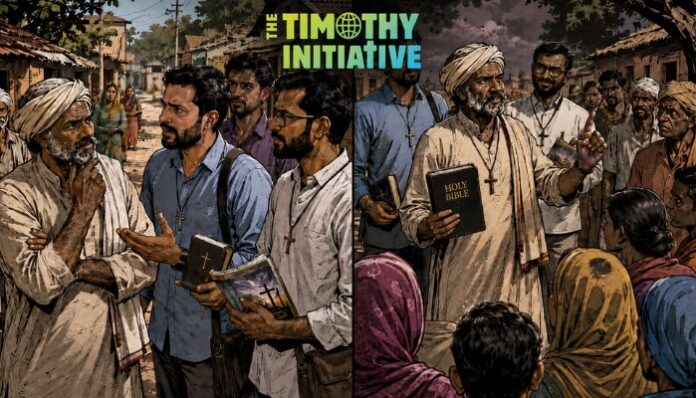
The Timothy Initiative, TTI, which came under the scanner for funding missionary activities using funds brought illicitly into India, has repeatedly presented itself as a “global church planting organisation”. It has clearly stated that its aim is to multiply churches “around the world”, and India is its top target. TTI has published several books or manuals that guide church planters on how to approach Hindus and other communities, how to enter villages while avoiding resistance, and more.
OpIndia accessed 10 books or manuals that shed light on the processes it uses to convert Hindus and members of other communities to Christianity. In the previous report of this series, OpIndia detailed how TTI’s Book 10 trains missionaries to enter Hindu villages, avoid suspicion, use softer methods instead of overt preaching, and even “pray for protection” because Hindu villages are described as being under “evil spirits, or a Hindu god that watches over them”.
During our research, we came across a strategy in which TTI has asked church planters to use leaders from different castes to lure people towards Christianity. In Book 1, where TTI has listed its core values, it says that it wants to reach “everyone”, including “large and small tribes, castes, urban cities, remote villages, rich, poor, everyone”.
While this line may appear broad on the surface, when such statements are read alongside the strategies explained in Book 10, it becomes clear that caste is not merely acknowledged as a social reality. It is being used by TTI as a practical tool for conversions among Hindus.
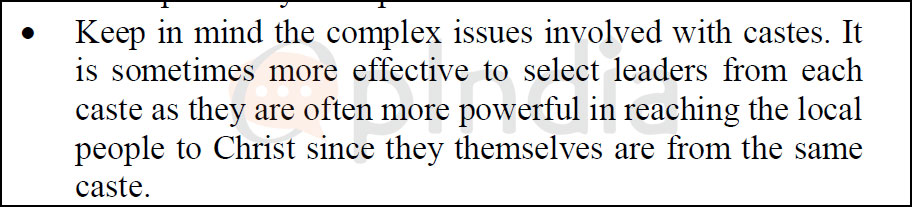
The manual tells missionaries to “keep in mind the complex issues involved with castes” and says it is “sometimes more effective to select leaders from each caste” because such individuals are “more powerful in reaching the local people to Christ since they themselves are from the same caste.”
This is an important aspect of the module, as it shows that caste is not being discussed as a “social problem” or an injustice to be addressed. It is being presented as a strategic pathway to make missionary work more effective.
How TTI brings caste into missionary planning
In the chapter titled “World Religions & Cults” in Book 10, as mentioned in the previous report, there is a specific portion that deals with Hinduism. After laying out what it claims are common beliefs of Hindus and giving methods to challenge doctrines such as karma and reincarnation, the book moves to field level guidance.
It says it is essential for missionaries to understand Hindu villages as spiritually hostile spaces. They should pray before entering them, avoid methods that attract suspicion, and rely on softer forms of outreach. Among these guidelines is one that deals with caste.
The exact wording of the guideline matters here. It says, “Keep in mind the complex issues involved with castes. It is sometimes more effective to select leaders from each caste as they are often more powerful in reaching the local people to Christ since they themselves are from the same caste.”
There is no theological discussion here. It is a direct operational suggestion. TTI is telling church planters that caste identity can make conversion work easier if local caste linked leaders are used as intermediaries. In simple terms, it suggests that if such leaders are converted, they can influence others from their own caste group.
Caste not as a social issue but as a conversion strategy
For missionaries following this model, caste is no longer a social issue but a conversion aid. A social reform discussion would normally focus on inequality, dignity, rights, justice, exclusion, or upliftment. TTI does not go into these aspects of the caste system, which are often highlighted on global platforms.
Instead, it focuses on effectiveness. The concern here is not caste injustice. The concern is conversion efficiency.
The social structure of Hindu society has long been discussed because of the way the caste system is projected worldwide. However, it appears that missionaries have moved beyond discussing caste merely as a social issue. In this manual, caste is viewed from the point of view of missionary penetration.
Who can influence whom, who can access whom, and who can persuade whom becomes the real question. The caste linked leader is not presented as a reformer or a representative of community welfare. He is presented as someone “more powerful” in reaching local people “to Christ”.
In plain terms, the book turns caste familiarity into a missionary asset.
Why this matters in the Indian context
In India, caste is not an abstract category. It is deeply tied to social identity, local credibility, and community behaviour. Any group that studies caste not in order to reform it but in order to use it for religious persuasion is doing something far more sinister than just preaching. TTI’s own language indicates precisely what its intentions are. It does not say, for example, that missionaries should transcend caste or reject caste consciousness. It says they should use caste linked local leadership because it works better.
TTI’s strategy appears to be well structured to counter resistance from locals. In many cases, local leaders are the ones who oppose conversions. If TTI’s strategy is followed, and these caste identity linked leaders get converted to Christianity, they can directly influence those who believe in them.
This is why the issue cannot be dismissed as routine evangelism. The book is showing missionaries how to work inside a Hindu social structure while reducing friction and increasing the likelihood of conversion.
From broad outreach language to targeted caste based conversions
There is a larger pattern in TTI’s methodology that differs from general evangelism. TTI has changed the way missionaries work and lure Hindus. This progression matters. At the ideological level, caste is part of the population to be reached. At the field level, caste becomes a practical mechanism to push conversions in Hindu communities.
It is evident that TTI is not only studying Hindus’ way of living but strategically using their own social norms against them. Caste has long been presented as a social issue by missionaries and international scholars.
However, with this changed strategy, it becomes much easier for church planters to convert Hindus. It has been seen in many cases that even after conversion, many ex-Hindus do not leave their caste identity. There have been demands for giving caste-based benefits to converted Christians from those communities.
There is a possibility that organisations like TTI are behind those who are pushing for bringing a law that allows caste linked benefits for former SC/ST individuals who have converted to Christianity. If that happens, conversion will become even easier.
In the upcoming reports, OpIndia will trace the presence of TTI in India and how it connects to other church groups.


