Home Blog Page 5134

Pakistan: Elderly man accused of blasphemy killed inside courtroom, killer says he was ordered by the prophet to kill

In a brutal incident, an elderly man belonging to the minority Islamic sect of Ahmadiyyas, who was facing a trial for ‘blasphemy’, was shot dead in front of the judge in a local court situated in a high-security zone in Pakistan’s Peshawar city on Wednesday.

According to the reports, Tahir Ahmad Naseem, who was arrested on the charges of blasphemy two years ago, died on the spot in the court of Additional Session Judge Shaukatullah Khan after being shot at. The man on trial was facing charges for ‘insulting’ the Muslim Prophet Muhammad.

A lawyer, who witnessed the incident, said that a case had been registered against the deceased under blasphemy laws. The accused was brought to court from Peshawar Central Jail. In Pakistan, the offences under blasphemy laws attract a maximum punishment, including the death sentence.

“During the hearing of the case, the complainant said that the accused was an Ahmadi and asked him to recite the Kalima-e-Tayyaba,” the lawyer said, adding that the complainant then fired at the elderly man and killed him.

Reportedly, the court is situated in a high-security zone in the cantonment area next to the provincial assembly building, the Peshawar High Court, chief minister’s secretariat and Governor House. It is not clear how the armed attacker managed to get into the court despite the court is situated in such a highly secured area.

Murdered man was US citizen

The deceased man Tahir Ahmed was a US citizen. The USA’s Bureau of South and Central Asian Affairs has condemned the murder and has asked Pakistan to take urgent steps to prevent such incidents.

Muhammad ordered me to kill him, says accused

The police arrested the killer, identified as Khalid Khan. The killer reportedly confessed to the police that he had been ordered to carry out the killing by Muhammad because the accused had belonged to the Ahmadiyya faith.

According to Pakistan police, an FIR was registered against the deceased in 2018. The complainant had stated that the deceased belonged to the Ahmadi community and “befriended him on Facebook” and in subsequent conversations, claimed that he was the “fourteenth Mujaddid”.

“He then invited me to have a discussion with him at a mall in the city where he started talking about his belief,” the complainant had said in the FIR.

The deceased elder man was charged under Section 153-A (promoting enmity between different groups), section 295-A (deliberate and malicious acts intended to outrage religious feelings of any class by insulting its religion or religious beliefs), Section 295-B (defiling etc. of the Holy Quran), Section 295-C (use of derogatory remarks against Prophet Muhammad PBUH) and Section 298 (uttering words etc., with deliberate intent to wound religious feelings) of the Pakistan Penal Code.

Pakistan’s controversial and stringent blasphemy laws are often misused to settle personal scores.

Who are Ahmadiyyas?

Ahmadiyya Community is a sect of Islam that is often persecuted in Islamic countries because other sects of Muslims believe that the community is not “Muslim enough”. The Islamic sect has around 4 million members, who have faced continuous persecution for decades in Pakistan.

In 1974, Pakistan’s Parliament had declared the Ahmadi community as non-Muslims. They were banned over the issue of its founder, Ghulam Ahmad, calling himself as a prophet. In orthodox Islam, there can be no prophets after Muhammad. A decade later, they were banned from calling themselves Muslims.

They are banned from preaching and from travelling to Saudi Arabia for pilgrimage. In Pakistan, around 10 million out of the 220 million population are non-Muslims.

Interestingly, Ahmadiyyas, who are now persecuted by Islamists in Pakistan, were at the forefront of the creation of Pakistan. An Ahmadiyya Unit fought against India in Kashmir in 1947-48. One of the foremost advocates for Pakistan was Muhammad Zafrulla Khan who was an Ahmadiyya. The Lahore Resolution of 1940 was authored by Khan himself. 
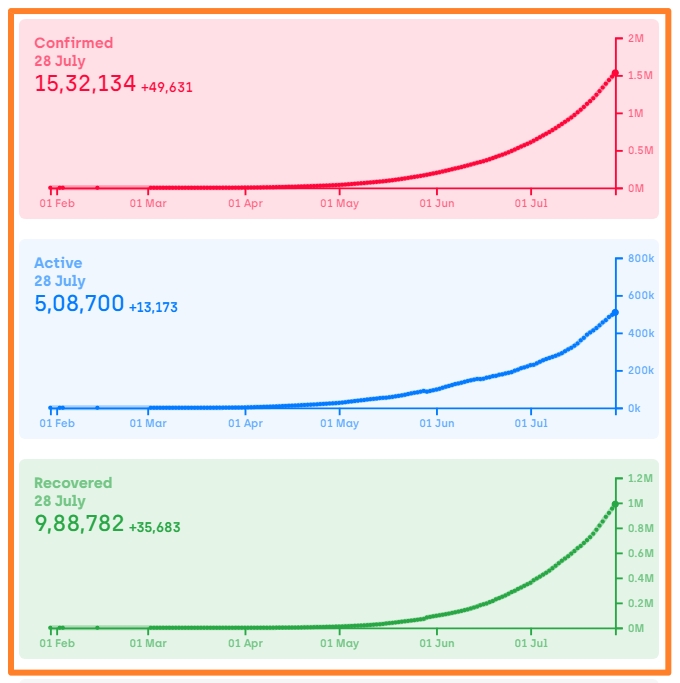
Number of recovered coronavirus patients crosses 1 million in India out of over 1.5 million total cases

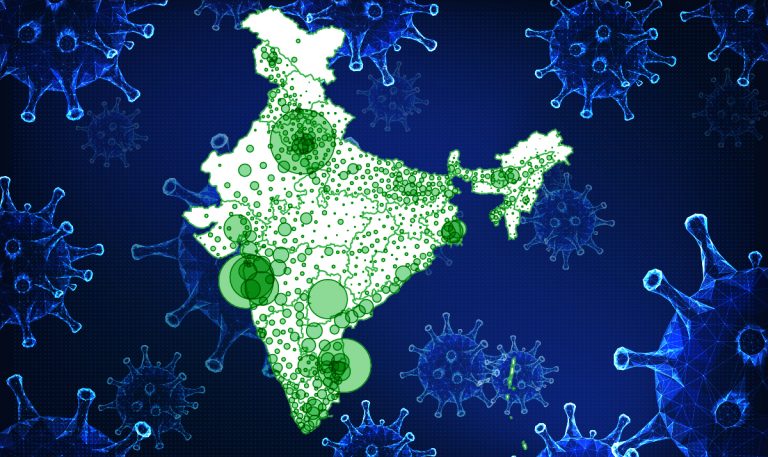
As the Union Government further relaxed the lockdown that has been imposed to contain the spread of Coronavirus with the Unlock 3.0 guidelines, the number of people who have recovered from COVID-19 crossed one million or ten lakh today. More than 15 lakh people have been infected with the Chinese virus in the country so far. With 10 lakh recoveries, the number of active cases in the country is more than 5 lakh, while around 35,000 people have succumbed to the disease, according to Coronavirus tracking website covid19india.org.

Maharashtra remains the worst affected state with more than 4 lakh cases, out which 1.46 lakh are active cases, and 2.40 lakh recoveries. Tamil Nadu is in the second spot with 2.34 lakh total cases, which include 57 thousand active cases and 1.73 lakh recoveries. City-state Delhi has the third highest cases at 1.33 lakh, but the number of active cases in Delhi is only 10 thousand, showing a marked improvement in the state where almost 1.19 lakh people have recovered from the Coronavirus infection.

Andhra Pradesh and Karnataka are the other states with more than 1 lakh total cases. Chandigarh, Meghalaya, Sikkim, Mizoram and Andaman & Nicobar Islands occupy bottom of the list with less than 1 thousand total cases.

While most states reflect the national trend in active cases to recovered case ratio, some states like Andhra Pradesh, Karnataka and Jharkhand are showing the opposite trend with more active cases compared to recovered. The southern state of Kerala also has almost equal numbers of active and recovered cases.

While Delhi leads in recovery rate with almost 90%, other states showing more than 70% recovery rate are Haryana (79%), Assam (76%), Telangana (74%), Tamil Nadu (74%), Gujarat (73%) and Rajasthan (71%). Arunachal Pradesh (46%), Andhra Pradesh (46%), Jharkhand (41%), Nagaland (39%), Karnataka (38%), Sikkim (33%) and Meghalaya (25%) are the states with recovery rates below 50%.

First Coronavirus case was detected in India on 30 January, and 2 more cases were detected after a few days. More cases started to be detected from March, and it reached 2500 by the end of that month. Number of new cases per day has been rising steadily in the last four months. With around one thousand cases per day in April, the number ranged from 30,000 to almost 50,000 per day in the month of July.

Union govt issues guidelines for Unlock 3.0- Gymnasiums, Yoga classes allowed to open from August 5, schools to remain shut

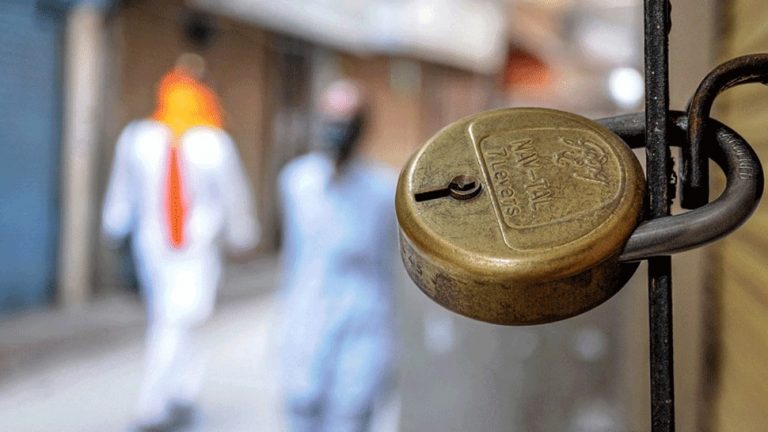
The Ministry of Home Affairs has issued a fresh set of guidelines for Unlock 3.0 as a part of the phased reopening of the county which is under partial lockdown in view of the coronavirus pandemic. Under the new guidelines, night curfew has been removed from across the country while the gymnasiums, yoga classes have been allowed to reopen from August 5.

Yoga institutes and gymnasiums will be allowed to open from August 5, 2020. In this regard, Standard Operating Procedure (SOP) will be issued by the Ministry of Health & Family Welfare (MoHFW) for ensuring social distancing and to contain the spread of COVID-19.

In addition, the government has also allowed Independence Day functions but with a caveat that social distancing and other health protocols, e.g., wearing of masks etc. are followed. Regarding the celebrations of Independence Day, instructions issued by MHA on 21.07.2020 shall be followed, the new guidelines say.

The MHA’s Unlock 3.0 order also states that there shall be no restrictions on inter-state and intra-state movement of persons and goods. No separate permission or approval or e-permit will be required for this. Although restrictions will be there in containment zones, where only essential services are allowed.

School, colleges, Metro Rail, Cinema Halls, theatres to remain closed

The union government, after having deep consultation with states and union territories, has decided that schools, colleges and coaching institutions will remain closed till August 31, 2020.

All Cinema halls, swimming pools, entertainment parks, theatres, bars, auditoriums, assembly halls and similar places outside the containment zones will also remain closed and social/ political/ sports/ entertainment/ academic/ cultural/ religious functions and other large congregations continue to remain banned. The operation of Metro Rail is also not allowed in the 3rd phase of the reopening of the economy.

Restrictions in containment zones

The MHA guidelines on Unlock 3.0 says that lockdown will be strictly implemented in containment zones. Respective state and union territory govts will carefully mark the containment zones as per union health ministry guidelines. Within the containment zones, only essential services will be permitted, everything else will remain shut.

Outside the containment zones, most activities are allowed, apart from those ordered to be closed by the MHA. But the individual states and union territories may decide to restrict additional activities.

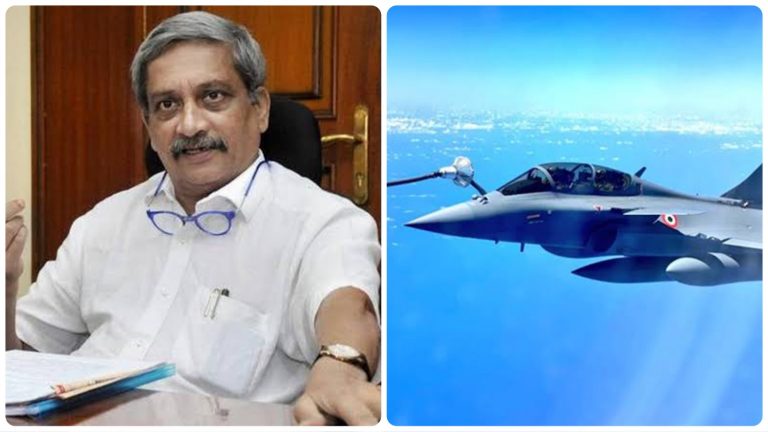
As Rafale fighter jets touch down in Ambala, the nation remembers Manohar Parrikar for inking the momentous defence deal

The wait for the ‘game-changing’ next generation of fighter jets is over as the first batch of five Rafale fighter jets landed at the Ambala airbase on Wednesday, two days after they flew out of France for India. 

Excitement ran high among netizens as social media was awash with images and videos of Rafale fighter jets entering the Indian airspace and their landing at the airbase. 

However, while social media users celebrated the homecoming of the new aircraft, many users, along with several prominent BJP leaders, also remembered the former Defence Minister Manohar Parrikar, for his instrumental role in fortifying India’s Air Forces with the procurement of Rafale fighter jets. 

Goa chief minister Dr Pramod Sawant quoted a tweet posted by the former Defence Minister Manohar Parrikar about the signing of the Rafale Deal with his French counterpart.

Union Minister Smriti Irani also posted a tweet remembering the former Goa chief minister. “Remembering Bhai today,” Irani tweeted while quoting Parrikar’s tweet announcing the historic deal.

Siddharth Shirole, BJP MLA from Shivajinagar in Pune, also quoted the old tweet by Manohar Parrikar on the monumental occasion of the delivery of Rafale fighter jets. 

In addition to politicians, other social media users also joined in to reminisce about Manohar Parrikar and his invaluable contribution towards securing the French-built jets.

Manohar Parrikar signed the momentous Rafale Deal

It was under Manohar Parrikar as the Defence Minister of India that the country signed the historic deal of procuring 36 next-generation Rafale fighter jets to bolster the Indian Air Force’s airpower and aerial supremacy in the Southeast Asia region. On Septemeber 23, 2016, a Memorandum of Understanding(MoU) was signed between then Defence Minister Manohar Parrikar and his French counterpart for the acquisition of 36 Rafale fighter aircraft, which would serve to improve India’s defence and strike capabilities.

However, unfortunately, Manohar Parrikar is not alive to witness the homecoming of fighter aircraft that he signed the deal for. The former defence minister was ailing from pancreatic cancer and died on March 17, 2019, at his residence in Panaji.

Rahul Gandhi used visit to ailing Manohar Parrikar to cast allegations of corruption in Rafale deal against PM Modi

It is pertinent to note that former Congress president Rahul Gandhi had based his entire 2019 General election campaign on the alleged corruption in the Rafale deal. Gandhi had tried to hurl the charges of corruption against PM Modi, in a desperate bid to show the Modi government as corrupt and thereby cast a dent in its legitimacy and popularity among the masses.

In fact, Rahul Gandhi stooped so low that a customary visit by him to check on the health of ailing of Manohar Parrikar was used to score political brownie points with regards to the Rafale deal. Following his visit, Gandhi claimed that the former Defence Minister told him that he had nothing to do with the Rafale deal. Parrikar, who was suffering from the last stage of cancer, shot back at Rahul Gandhi, saying that he was misusing the five minutes that Gandhi spent with him on.

In a letter addressed to Rahul Gandhi, Parrikar wrote, “I feel let down that you have used this visit for your petty political gains. In the 5 minutes you spent with me, neither did you mention anything about Rafale, now did we discuss anything related to it.”

It is also worth noting that the Supreme Court of India rejected the baseless allegations levelled by Rahul Gandhi and the Congress party and declared that no irregularities or corruption have been found in the case.

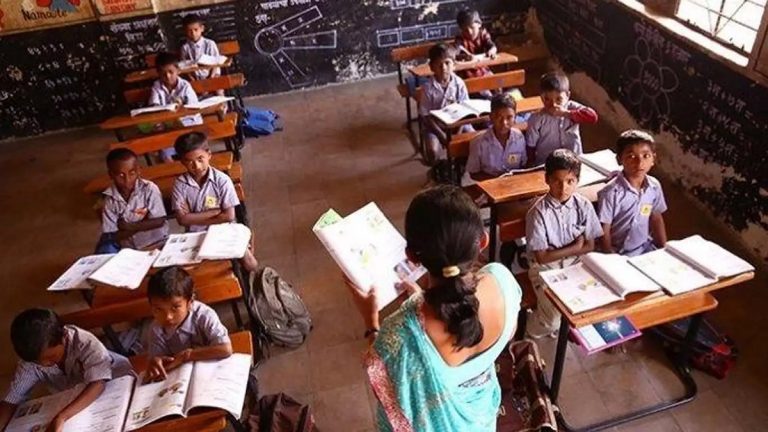
New National Education Policy 2020 unveiled by Modi government, reforms aim to make India a ‘global knowledge superpower’

On Wednesday, the much-awaited National Education Policy (NEP) was announced by HRD Minister Ramesh Nishank and I&B Minister Prakash Javadekar after the Union Cabinet approved the new policy earlier in the day. The policy aims at making “India a global knowledge superpower”.

Minister Prakash Javadekar said that the cabinet under Prime Minister Narendra Modi has approved a New Education Policy for the 21st century, adding “It is important as for 34 years there were no changes in the education policy.” 

The NEP will replace the existing National Policy on Education 1986, which was later modified in 1992. The NEP includes the extension of the Right to Education Act 2009 to cover children between the age group of 3 to 18 years. The new policy also seeks to reduce the content load in the school education curriculum.

Announcing new reform measures, Higher Education Secretary Amit Khare said the major reforms in the cabinet-approved National Education Policy 2020 include a target to have 50% gross enrollment ratio by 2035 along with a provision for multiple entry or exit. The New Education Policy (NEP) also aims to increase the budgetary funding to education.

Under the National Education Policy (NEP), the system of affiliated colleges will be phased out over the next 15 years, the Minister of Education announced. The government also announced that the single-stream higher education institutions will be phased out over time, and all will move towards becoming multidisciplinary.

According to the new National Education Policy, the higher educational institutions will be allowed graded autonomy in academic, administrative and financial matters based on the accreditation status and there will only be a single regulator for higher education instead of different bodies like UGC and AICTE. Legal and Medical education will continue to have dedicated regulators.

“The undergraduate degree will be of either three or four-year duration, with multiple exit options within this period, with appropriate certifications, e.g., a certificate after completing one year in a discipline or field including vocational and professional areas, or a diploma after two years of study, or a Bachelor’s degree after a three-year programme,” announced Higher Education Secretary Amit Khare. The four-year course will be for a Bachelor’s degree and research.

“The present complex nomenclature of HEIs in the country such as ‘deemed to be university’, ‘affiliating university’, ‘affiliating technical university’, ‘unitary university’ shall be replaced simply by ‘university’,” said HRD Ministry officials.

New system of education

The Modi government unveiled a new 10+2 system, which will be divided into 5+3+3+4 format. The NEP changes the school education system to 5+3+3+4 format. This means the first five years of the school will comprise of the foundation stage including three years of pre-primary school and classes 1 and class 2. The next three years will be divided into a preparatory stage from classes 3 to 5. Later three years of middle stage (classes 6 to 8), and four years of secondary stage (classes 9 to 12).

The schools will not have any rigid formation of streams of arts, commerce, science, students can take up whichever courses they want.

In school education, the Modi government has announced major reforms through its NEP, which includes Universalisation of Early Childhood Care Education or ECCE and National Mission on Foundational Literacy and Numeracy. The government has said the new policy suggests a reduction of the school curriculum to core subjects with a vocational integration from Class 6 onwards.

According to the new policy, the focus of school reforms will be to develop a scientific temper in students from a young age. The curriculum would integrate 21st-century skills and mathematical thinking. The policy also mandates increasing access for disadvantaged groups, according to the Union government.

Further, the New Education Policy (NEP) also states that the report card will comprise assessment of the students by both teachers and fellow students. There will be an AI-based assessment of students each year. Measures will be taken to prepare the teachers for the assessment reforms by 2023, announced the government.

The board exams will test the students’ knowledge and it’s applications and not just rote learning, announced the Ministry of Education.

Multi-lingual system of education

The NEP will aim to make mother tongue or regional language as the medium of instruction till class 5 in schools. The new policy is also expected to focus on a multi-lingual education system which means, the teachers will teach not only in English but also in regional Indian languages. MHRD already runs programmes to teach students regional languages spoken in other states.

The government also said that technology will be now part of education planning, teaching, learning, assessment, teacher, school, and student training. The e-content will also be made available in regional languages, starting with eight major languages – Kannada, Odia, Bengali among others to join the e-courses available in Hindi and English.

Single common entrance exam for all colleges

The common Entrance exam for all higher education institutes to be held by NTA. The exam will be optional and not mandatory, announced HRD Ministry.

The government has also decided to discontinue MPhil courses. To pursue research, MPhil will not be allowed and all the courses at undergraduate, postgraduate and PhD level will be interdisciplinary. The 4-year programme may also lead to a degree ‘with Research’ if the student completes a rigorous research project.

The government has decided to set up model public universities for holistic and multidisciplinary education, at par with IITs, IIMs, etc., called MERUs (Multidisciplinary Education and Research Universities). Higher education institutions shall move away from high-stakes examinations towards continuous and comprehensive evaluation.

High performing Indian universities will be encouraged to set up campuses in other countries. Selected universities like those from among the top 100 universities in the world will be facilitated to operate in India.

Further, the gvernment announced that a legislative framework facilitating such entry will be put in place, and such universities will be given special dispensation regarding regulatory, governance, and content norms on par with other autonomous institutions of India.

Impetus on vocational education

The New Education Policy also gives importance to the Vocational education of the students. The new policy integrates vocational education into all school and higher education institutions in a phased manner over the next decade. By 2025, at least 50% of learners through the school and higher education system shall have exposure to vocational education.

The B.Voc. degrees introduced in 2013 will continue to exist, but vocational courses will also be available to students enrolled in all other Bachelor’s degree programmes, including the 4-year multidisciplinary Bachelor’s programmes, the government announced.

‘Lok Vidya’, important vocational knowledge developed in India, will be made accessible to students. The HRD ministry, which will be renamed as Education Ministry, would constitute a National Committee for the Integration of Vocational Education (NCIVE).

The policy also mentions creating institutions such as the National Research Foundation (NRF) and a Higher Education Commission of India (HECI).

Earlier, a panel led by former Indian Space Research Organisation (ISRO) chief K Kasturirangan was constituted, which had submitted the draft of the new National Education Policy to the Union HRD minister. The draft was later put to public consultation to seek feedback from various stakeholders and over two lakh suggestions were received by the HRD Ministry about the same.

The existing NEP was framed in 1986 and revised in 1992. The New education policy was part of the BJP’s manifesto ahead of the 2014 general election. Reportedly, the drafting experts also considered the report of a panel headed by former cabinet secretary TSR Subramanian and formed by the HRD Ministry when it was being headed by Union Minister Smriti Irani.

The implementation of this Policy will be led by various bodies including Education Ministry, CABE, Union and State Governments, education-related Ministries, State Departments of Education, Boards, NTA, the regulatory bodies of school and higher education, NCERT, SCERTs, schools, and HEIs.

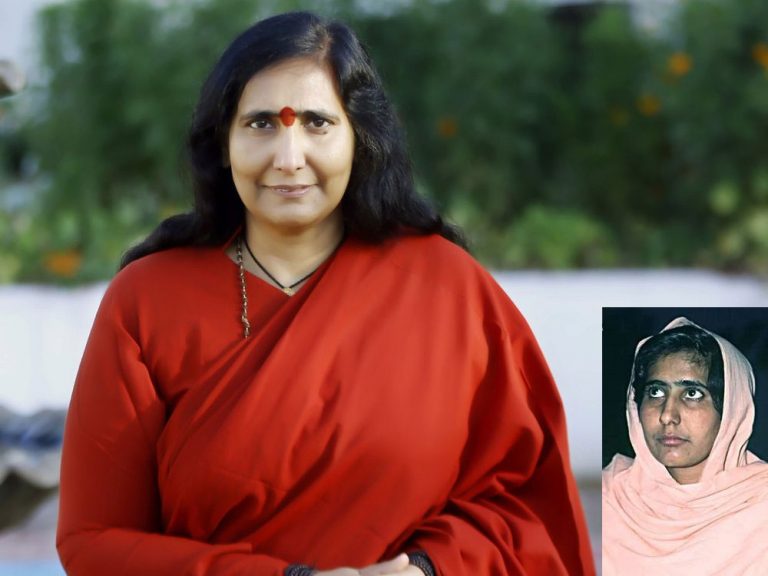
‘Haan hum Hindu hain, Hindustan Hamara hain’: Watch Sadhvi Ritambhara’s speech during Ram Janmabhoomi Movement

The Ram Janmabhoomi movement of the early 90s was a period of a massive nation-wide mobilisation of Hindus to make them aware of the centuries of wrong committed against the community, first by the onslaught of Islamic invaders, who had forcefully converted, tortured and killed them by the millions, and subsequently in the hands of successive ‘secular’ governments who had operated on the premise that secularism means keeping Hindus as the second-class citizens in their own county.

The fact that Hindus were even deprived of worshipping their gods at the Ram Janmabhoomi, one of the most sacred sites of the faith, was a symbol of the centuries of injustice and oppression faced by the community. The Ram Janmabhoomi movement was about reclaiming that place and righting that wrong.

The call for Hindus to gather at Ayodhya for the massive rally called by VHP and BJP was gathering pace. Many Hindu leaders were working day and night with Karsevaks to reach out to the masses. The speeches of Sahvi Ritambhara during that time were testimony to the scale and the popularity of the movement.

Video of Sadhvi Ritambhara’s speech in Delhi during Rath Yatra

In her speech, in Delhi, she recited a poem that called Karsewaks to move forward and join hands to build the Ram Mandir. During that period, her role as an orator in the Rath Yatra made her a popular choice for political campaigns for BJP. As it can be heard in the video, she showed concern towards those who have ‘allergy’ with the word Hindu. She asked them why there was so much hate for the Hindus when their forefathers were Hindu once.

Who is Sadhvi Ritambhara?

Sadhvi Ritambhara is one of the most prominent names of Ram Janbhoomi movement. She joined Sangh Parivar as a member of Rashtriya Sevika Samiti that is the women’s wing of RSS. She had worked extensively with Vishwa Hindu Parishad during Advani’s Rath Yatra to build a sentiment among Ram Bhakts in favour of the temple in Ayodhya. She was present at the Ram Janm Bhoomi when the disputed structure was torn down. Three days after the demolition, she was arrested on grounds of inciting communal tension.

During the Ram Mandir movement, Sadhvi Ritambhara’s speeches were very popular, and cassette tapes of her speeches were played at temples and public places, which helped in mobilising public support for the movement. She was one of the three key women leaders of the movement, the other two being Uma Bharati and Vijayaraje Scindia

Sadhvi Ritambhara is also the founder-chairwoman of Durga Vahini, the women’s wing of the Vishva Hindu Parishad. The purpose of the Durga Vahini is to encourage more women to participate in prayer meetings and in cultural activities. The aim of the organization is to establish Hindu solidarity by helping Hindu families during the time of hardship and by providing social services.

The land dispute case of Ayodhya

Mughals built a disputed structure after destroying a temple on the disputed land in Ayodhya. Ram Bhakts believe that the land on which disputed structure was built, is the land where Shri Ram was born thousands of years ago. A case filed in court by Hindu groups that resulted in the division of property in three equal parts by Allahabad court in 2010. A review petition was filed in Supreme Court against the judgment. On 9th November 2019, after hundreds of years of struggle, the Supreme Court ruled in favour of Ram Lalla Virajman and gave the disputed land to Hindu groups. The court also ordered the government of India to form a trust that will undertake the construction of “Bhavya Ram Mandir.”

On 5th August 2020, PM Narendra Modi will visit Ayodhya for Bhoomi Pujan and will place a 22.6 KG pure silver brick in the foundation of the temple.

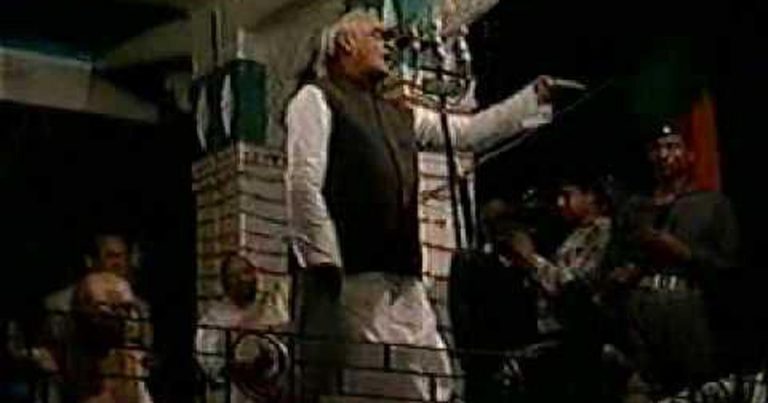
There are sharp stones in Ayodhya, the ground needs to be levelled: Vajpayee’s famous speech a day before the demolition of the disputed structure

While a large number of people made an invaluable contribution towards the Ram Janmabhoomi movement that led to the demolition of the controversial structure in Ayodhya, one of the most monumental roles was played by none other than former Prime Minister Atal Bihari Vajpayee who had motivated thousands of Hindus to become aware of their civilisational heritage and claim their rights.

On December 5, 1992, as the Ram Janmabhoomi movement was reaching a crescendo, Atal Bihari Vajpayee made a fiery speech while addressing a gathering of Karsevaks at Jhandewalan Park in Aminabad, Lucknow. During the speech, Vajpayee emphasised the importance of carrying out Karseva in Ayodhya, asserting that providing Karseva did not violate the Supreme Court’s judgment. This was a time when the ‘secular liberal’ forces were predicting doom and trying to mobilise government forces to stop the mega rally at Ayodhya scheduled on December 6.

Ground needs to be levelled, some arrangements have to be made

Referring to the site of Ram Janmabhoomi, where the VHP and BJP proposed to build a Ram temple, Vajpayee said, “Sharp-edged boulders are present at the site. Nobody can sit there. The ground needs to be levelled. It has to be made fit for sitting. Some construction work can take place there as arrangements for a Yagnya has to be done.”

The Supreme Court had then stated that no construction can take place at the site. But Vajpayee’s speech had asserted that the SC had banned construction, it has not stopped Hindus from doing Bhajan and organising Keertans in Ayodhya. He also stated that Keertans need gathering and some arrangements are needed to be made for Hindus from all over the country who are gathering at Ayodhya during winter.

On the next day, that is December 6, 1992, though Atal Bihari Vajpayee was not present at the gathering in Ayodhya, a large contingent of Karsevaks had stormed the Ram Janmabhoomi premises in Ayodhya and razed the disputed structure. A legion of Hindu activists and VHP supporters scaled the domes of the controversial structure wielding hammers, stones, rods and other tools and had brought the structure down within hours.

Atal Bihari Vajpayee’s clarification on his speech

Years later, the former PM Atal Bihari Vajpayee issued a clarification of his speech made a day before the demolition of the disputed structure. Speaking to Outlook magazine, Vajpayee said that his speech was made in a lighter vein and with a certain context. “Mera Ayodhya andolan mein zyaada role nahin tha (I did not have much of a role in the Ayodhya movement),” he said, adding that he had not mentioned the masjid once and there was nothing in the speech that could be questioned by the courts.

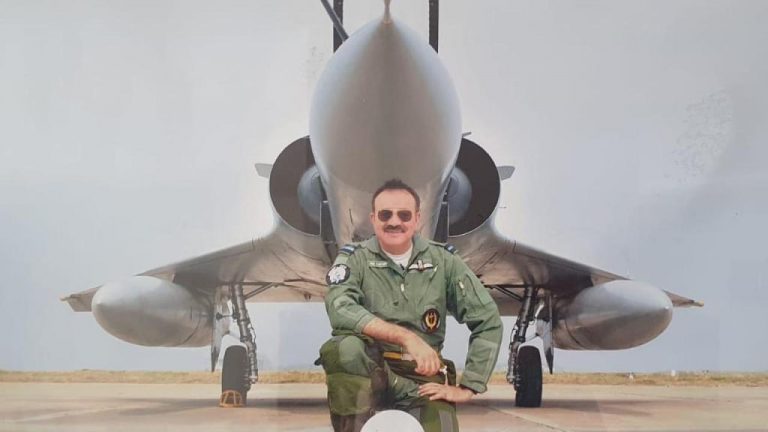
Meet Air Commodore Hilal Ahmad Rather, the IAF officer responsible for delivery of India-specific Rafale jets

Air Commodore Hilal Ahmad Rather, India’s Air Attache in France, has become an instant hero across the country ever since five Rafale jets of the Indian Airforce took off from the Dassault Aviation’s Bordeaux-Merignac facility on Monday.

The Indian Air Force officer who is a native of Anantnag in Kashmir has played a key role in ensuring the delivery of Rafale jets to the country. Rather, son of a retired DSP has spent the last few years arming the combat aircraft to suit Indian conditions. He is credited with helping the project management team to fit the Rafale aircraft with 13 Indian specifications weapons.

Air Commodore Rather, who is also India’s Air Attache in France, has been forefront at the readying the Rafale jets ahead of its induction into the Indian Air Force. The 52-year-old also supervised refuelling training of a team of 152 IAF technicians and 27 fighter pilots with French tanks on Tuesday.

A fighter combat leader and a qualified flying instructor, Rather joined India Air Force as a flight lieutenant in 1993 and went on to become wing commander in 2004, group captain in 2016 and air commodore in 2019.

The officer from Kashmir has commanded Mirage-2000 Squadron and a front line Air Force base in Gwalior. His immense experience in flying jets like MIG 21, Mirage-2000 and Kiran helped him to coordinate with the French project management team in Bordeaux over 35 advanced functions of the Rafale jet.

Air Commodore Hilal Ahmad Rather has an impeccable record of 3,000 accident-free flying hours on different fighter platforms of the Indian Air Force.

Rather, who is an alumnus of Sainik School, has earned a Sword of Honour – the highest award to a cadet during his training at the National Defence Academy.

Rather is also graduate from defence services staff college (DSSC). He also graduated from air war college (USA) with distinction. Air Commodore Hilal is the recipient of Vayu Sena Medal and Vishisht Seva medal.

Reportedly, Hilal’s father was a senior police officer in the Jammu and Kashmir police, when he got commissioned into the IAF in 1988. The family often had faced threats. Rather had to rent out a two-room flat in Nagrota in Jammu two days before his marriage in 1993 for safety reasons.

Along with Rather, Indian ambassador to France Jawed Ashraf was also crucial in ensuring delivery of Rafale jets to India. The five combat jets, which took off from France, have now landed at Ambala Air Force station on Wednesday.

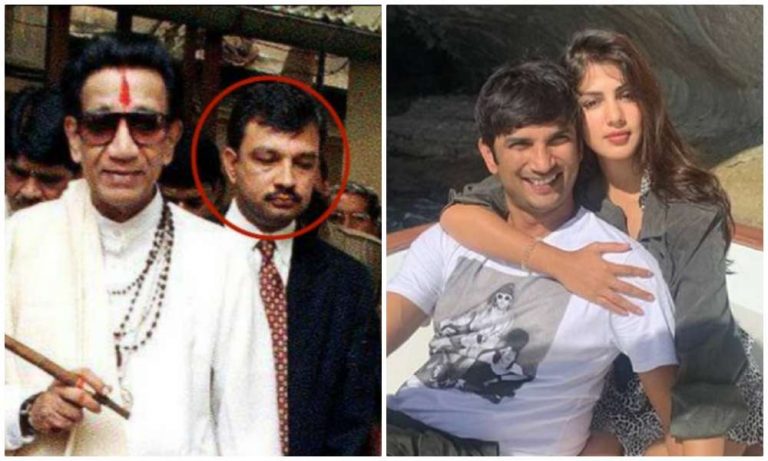
Sushant Singh Rajput case: Rhea Chakraborty hires big shot lawyer Satish Maneshinde who represented Sanjay Dutt in 1993 Mumbai blast case

Bollywood entertainer Rhea Chakraborty has hired one of the most expensive lawyers of the country, Satish Maneshinde, to defend her in the case filed by Sushant Singh Rajput’s father accusing her of abetment to suicide. Earlier, Maneshinde had defended film actors like Salman Khan in the 1998 blackbuck poaching case and Sanjay Dutt in 1993 Mumbai blast case.

She has moved the Supreme Court to transfer the investigation from Patna to Mumbai.

Who is Satish Maneshinde

Satish Maneshinde started his career as a Junior of Senior counsel Ram Jethmalani, where he practiced civil and criminal law. He defended Bollywood actor Sanjay Dutt in 1993 Mumbai Blasts case. He was a part of the legal team defending Sanjay Dutt which included Farhana Shah and Karan Singh, grandson of Delhi-based senior lawyer Rajendra Singh. Dutt was convicted in 2006-2007 by a special court under the Arms Act for possession of AK-56 rifle and a 9 mm pistol. He was sentenced to six years which was later upheld by the Supreme Court but the sentence was reduced to five years.

Maneshinde is also appointed as the special public prosecutor in the Palghar lynching case where two Sadhus were lynched by a mob. Viral videos of the incident showed the police standing as mute spectator while the mob lynched the two sadhus.

On 14th June 2020, 34-year-old actor Sushant Singh Rajput was found dead in his apartment. While initially it was suggested that he committed suicide, later reports emerged which cast aspersions on the cause of death. On Tuesday, KK Singh, Sushant’s father filed an FIR in Patna alleging that Rhea, his girlfriend, abetted his suicide. The FIR states that she took Rs 15 crores, laptops, jewellery and left Sushant, driving him over the edge. Her so-called suspicious involvement with veteran filmmaker Mahesh Bhatt and the alleged influence he commands over her has also fuelled speculations about the whole affair.

“Swagatam”: PM Modi welcomes the five Rafale jets which landed at Ambala Air Force station

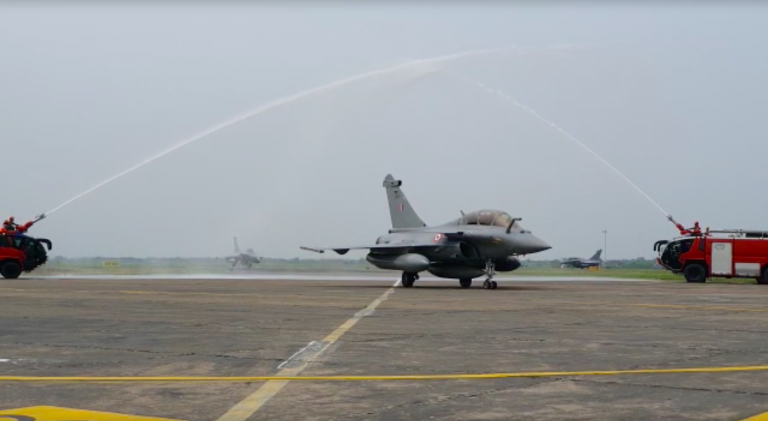
The first batch of five Rafale fighter aircraft has landed at the IAF Air Force Station in Ambala on Wednesday.  

According to the reports, Chief of Air Staff Air Chief Marshal RKS Bhadauria welcomed the Rafale fleet at Ambala. The five fighter aircraft, which were flown by Indian Air Force (IAF) pilots, landed at Ambala Air Force station after covering a distance of 7,000 km with air-to-air refuelling and a single stop in the United Arab Emirates.

Prime Minister Narendra Modi welcomed the fighter jets with a tweet in Sanskrit, which said that they have been dedicated to the security of the nation. The PM also posted a video of the jets landing at the air force ground.

“The Birds have landed safely in Ambala. The touch down of Rafale combat aircrafts in India marks the beginning of a new era in our Military History. These multirole aircrafts will revolutionise the capabilities of the @IAF_MCC,” tweeted Defence Minister Rajnath Singh.

As soon as the Rafale jets landed, the new fighter jets were given a water salute given at Indian Air Force airbase in Ambala, Haryana.

The aircraft will be officially inducted into the IAF in the second half of August.

Earlier, Defence Minister Rajnath Singh had tweeted about five Rafale fighter jets entering the Indian air space, which was escorted by two Sukhoi-30 MKIs as they entered the Indian air space. 

The Indian Navy warship INS Kolkata (D63), which is deployed in the Arabian Sea had earlier established contact with the Rafale jets and had welcomed the five Rafale jets.

The five Rafale jets are to be inducted into the Indian Air Force at the Ambala later in August. They had left the Dassault Aviation’s Bordeaux-Merignac facility on Monday, July 27.