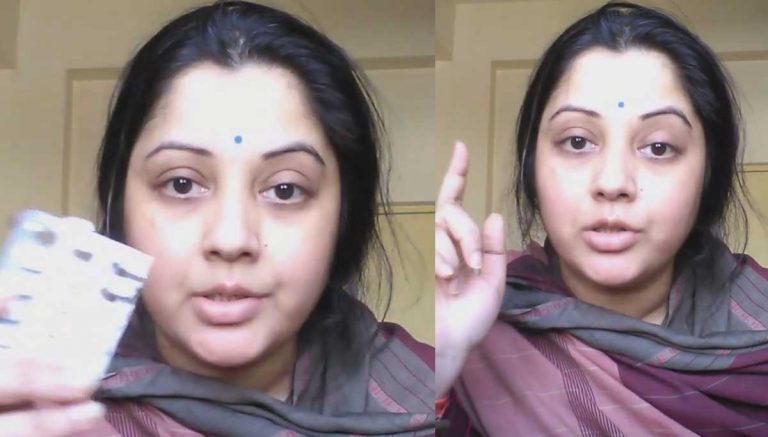
Tamil actress Vijayalakshmi on Sunday evening attempted suicide after uploading a video on her Facebook page. She is currently undergoing treatment at a Chennai hospital. In her video, she alleged harassment from NTK (Naam Tamilar Katchi) party and Hari Nadar (Panankattu Padai) and accused them of humiliation and torture.
In her video, she said that NTK politician Seeman and his partymen were allegedly humiliating her regularly on social media. She had said in her video that she has taken a few tablets to bring down her blood pressure and that she will fall unconscious and die soon. She said that Seeman would torture her because she was born in Karnataka.
“As a woman I have put up with it to my highest capabilities, I won’t be able to handle the pressure anymore. I am from the Pillai community, the same community LTTE leader Prabhakaran is part of. Prabhakaran is the only reason Seeman is who he is today, but now he has been harassing me on social media continuously. You slut shamed me to make me feel the pain and it is up to me to decide on what to do after facing such insults from you. I request my fans to not let Seeman away from this case, he should never get an anticipatory bail. My death should be a big eye opener to everyone. I don’t want to be a slave to anybody.” she said in her video.
Former filmmaker Seeman is a vocal supporter of Sri Lankan Tamil people and the Liberation Tigers of Tamil Eelam and is a devout follower of LTTE founder Prabhakaran.
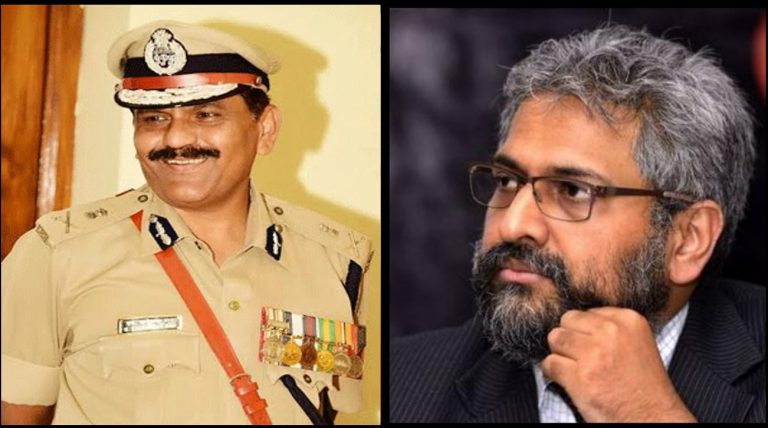
Founding Editor at The Wire, Siddharth Varadarajan, has hit out at former interim-director of CBI M Nageswara Rao after the latter spoke out against what he calls “Project Abarahamosation of Hindu Civilisation”. American citizen Varadarajan took great offence at the IPS officer for exercising his freedom of expression as guaranteed by the Indian Constitution.
Unbelievable communal paranoia from a senior, serving police officer who was put in charge of the CBI when Modi ousted Alok Verma. Verma was also ‘committed’, no doubt, but Modi-Shah’s ‘New India’ demands showy allegiance to RSS and its anti-Muslim claptrap. https://t.co/NVMC03rlUA
In the tweet in question, Nageswara Rao highlighted the fact that there is an organised attempt underway to relegate the Hindu Civilisation to the dustbins of history. According to him, there is a deliberate attempt to deny Hindus knowledge of their history and vilify Hinduism as a collection of superstitions.
Nageswara Rao also says that the education system has been Abrahamised and so have been the media and entertainment industry. He said an attempt has been made to shame Hindus about their identity and consequently, if the glue of Hinduism ceases to exist, then Hindu society withers away.
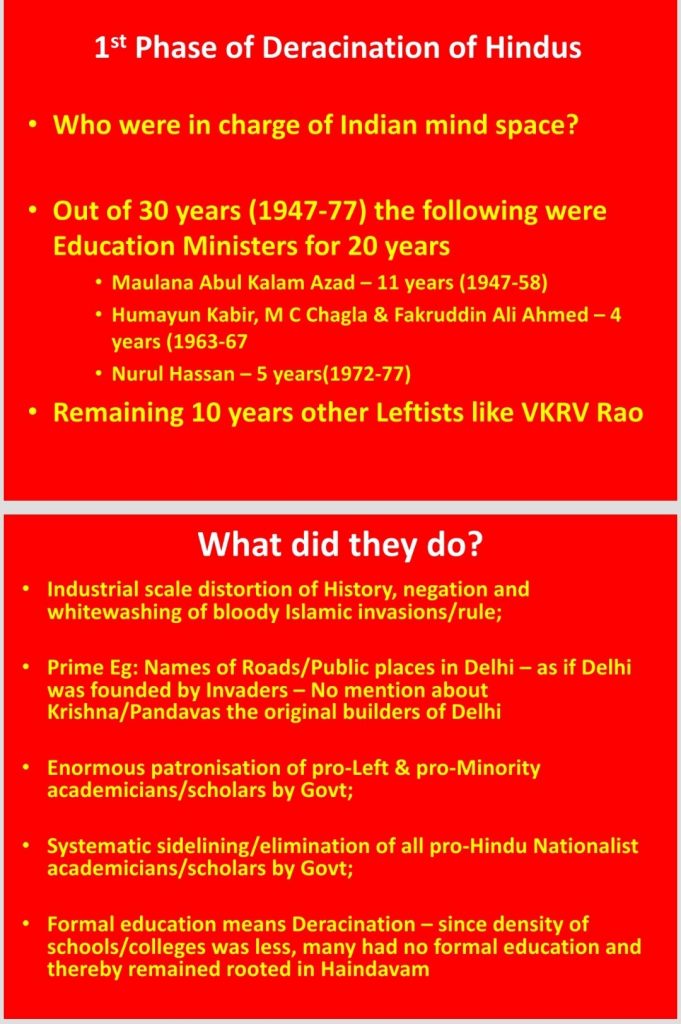
Furthermore, the IPS officer attached four photos to his tweet which highlights the phases in which subversive elements attempted to undermine Hindu society. In the first phase, the attached picture says that the Ministry of Education was under the hands of people such as Maulana Abul Kalam Azad, Humayun Kabir and Nurul Hassan and leftists.
1st ohase of deracination of Hindus according to M Nageswara Rao
During this phase, there was the distortion of history at an industrial scale and an attempt to whitewash the crimes of the genocidal Muslim invaders. Leftist and pro-minority academicians and scholars were patronised by the government while their Hindu Nationalist counterparts were deliberately sidelined.
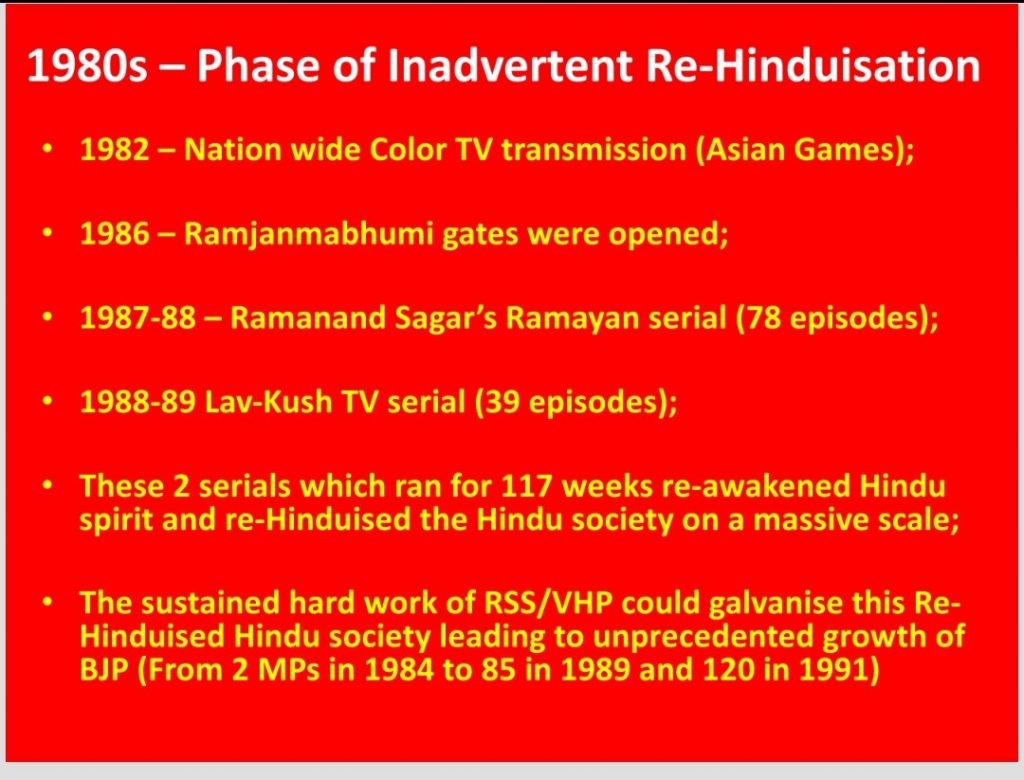
Nageswara Rao calls the 1980s the phase of ‘inadvertent re-Hinduisation’. During this phase, the Ram Janmabhoomi gates were opened and the appearance of television shows such as Ramanand’s Ramayan and Lav-Kush ‘re-Hinduised’ Hindu society on a massive scale. Furthermore, “the sustained hard work of RSS/VHP” aided in the same.
Image Source: M Nageswara Rao/Twitter
Nageswara Rao says the second phase of the deracination of Hindus began from 1990s after “Anti-Hindus understood the process of re-Hinduisation in 1980s”. The Anti-Hindus, he says, “started an intensive and extensive de-Hinduisation of every aspect of education and public institution.”
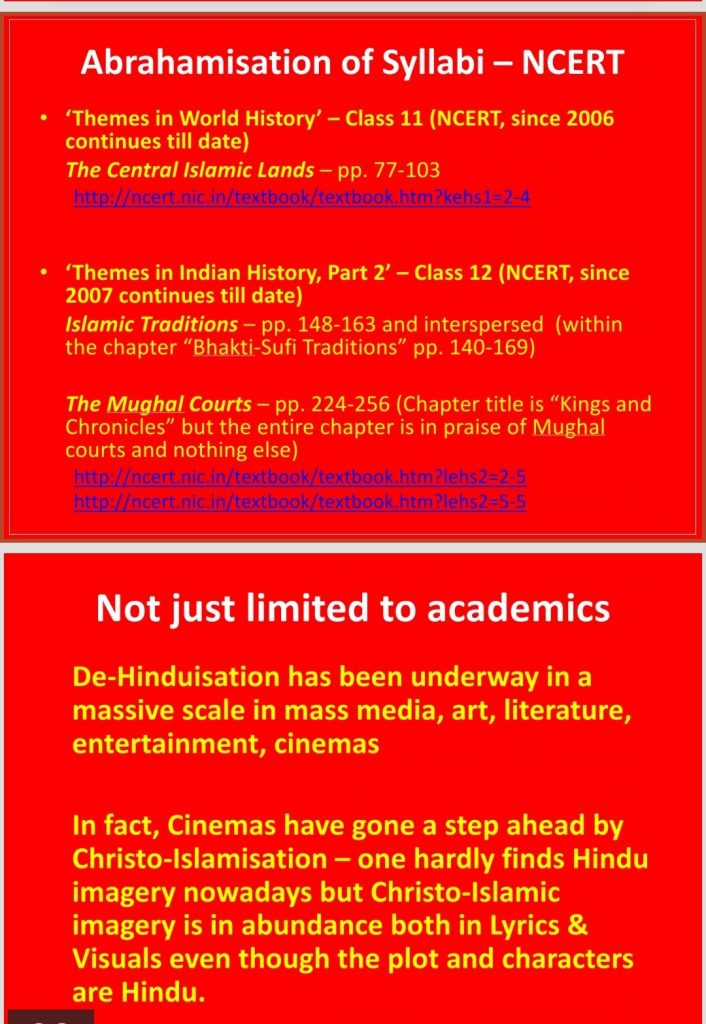
The IPS officer says that de-Hinduisation is underway at a massive scale in mass media, art, literature, entertainment and cinemas. He said, “In fact, Cinemas have gone a step ahead by Christo-Islamisation- one hardly finds Hindu imagery nowadays but Christo-Islamic imagery is in abundance both in lyrics & visuals even though the plot and characters are Hindu.”
Second phase of deracination of Hindus according to Nageswara Rao
While people may disagree with individual components of the officer’s reasoning, hardly anyone will disagree with the fact that there is a concerted attempt underway to undermine Hinduism. Similarly, it is widely recognised that Indian history has been distorted and the crimes of the Islamic invaders have been deliberately whitewashed. Even ‘secular liberal’ intellectuals bemoan the fact that history was distorted due to politics which they blame for the rise of Hindutva in the country.
The abundance of anti-Hindu propaganda on platforms such as Netflix and even Bollywood movies, something we have reported on extensively, is testament to the accuracy of the assertions made by Nageswara Rao. In addition to this, the manner in which the mainstream media covered the anti-Hindu Deli Riots and the frequency with which it spreads fake news to undermine Hinduism further proves his assertions as well.
The hysterics of Varadarajan, no doubt, was exacerbated by Rao’s usage of the term ‘Christo-Islamisation’. The term refers to the alliance between the two monotheistic religions to undermine the Hindu Civilisation. It is known that such an alliance exists. For instance, after the CAA was passed by the Indian Parliament, Christian organisations and priests opposed the Act for the persecuted minorities of three neighbouring Islamic countries even though it had the provision for Christians from Pakistan, Bangladesh and Afghanistan.
The protests against the CAA was the biggest demonstration of the alliance between Christian and Muslim fundamentalists. Furthermore, it is also known that Christian missionary organisations from abroad fund missionaries to convert Hindus in India and Islamic organisations radicalisation of Muslim youth in the country. Thus, there was hardly anything extraordinarily controversial about what Nageshwar Rao said.
Yet, Siddharth Varadarajan and certain other ’eminent citizens’ of the country descended upon the high ranking official and ascribed personal motives to his comments. The objective, quite clearly, is to paint as a ‘conspiracy theory’ the obvious threat to the Hindu Civilisation. Thus, in order to keep Hindus oblivious to the threat to their way of life, it is of paramount importance to paint such observations a consequence of ‘communal bigotry’.
Ironically, with his frenzied proclamations, Siddharth Varadarajan only further proved Nageswara Rao correct in his statements. Amusingly enough, it was only today that The Wire published an article where it was claimed that Muslims have a greater claim over India than the Hindu community. Thus, quite clearly, the founding-editor of The Wire is greatly bothered only because the nefarious designs of his ilk have been found out.
In a shocking interview with the Triggernometry, rape survivor Dr. Ella Hill has revealed that at least half a million Non-Muslim (Kaffir) girls have been raped by grooming gangs, operated by Muslim men in the United Kingdom, in the past 40 years. The interview was conducted by two comedians, Konstantin Kisin and Francis Foster.
Recounting her tale of horror from 20 years ago, Hill informed that she was targeted as a teenager by her Pakistani Muslim boyfriend. She said that the relationship soon turned into a ‘controlling, obsessive, and religiously charged’ one. She reminisced about being taken to different flats around Rotherham, Sheffield, and Bradford and subsequently raped, tortured, and strangled. “You know (I) was covered in bruises that lasted over a year.” Her Pakistani boyfriend also threatened to kill her and her parents if she confided in them, the harrowing tale of brutality. As such, she was coerced into silence.
When she tried to run away from her perpetrator, he stalked her and then barged into her house. The Pakistani man tried to execute an ‘honour killing’ along with his friends but Hill survived to tell the story. She was hospitalised for a week and had suffered multiple fractures and lacerations. Her only way out from the Pakistani grooming gang was to change her name, shift somewhere else, and start life afresh. “At that point, the police told my parents to move me away and change my name which is what they did.. and that’s how I got out of it,” Hill narrated.
Interview of Dr. Ella Hill
Modus Operandi of the grooming gangs
Dr Ella Hill defines the activities of the grooming gangs as ‘racially and religiously aggravated rape’, perpetrated by a group or network. She revealed that the grooming gangs primarily target underage girls but also victimise young and old women. “Well, it’s all over the UK. There are a lot of different towns that have been named as being involved. There’s Burnley, Blackburn, (and even) Oxford. Really, there are very few major cities that haven’t had some sort of grooming gang scandal.”
She then reiterated that there have been half a million victims of grooming gangs in the UK alone in the last 40 years. “And it’s predominantly white victims and the perpetrators are predominantly Asian Muslim,” Hill emphasised. On being asked as to why the issue has not been raised to the status of a ‘national scandal’, she stated that there have been multiple reports about crimes committed by the Muslim grooming gangs and that it was indeed a national scandal.
The medical practitioner informed that the National Crime Agency in the UK have been investigating historic cases related to grooming gangs for the past 15 years. She highlighted, “I think maybe about 20-25 perpetrators have been brought to justice in Rotherham and over 1000 under investigation by the National Crime Agency in Operation Stovewood in the South.”
Grooming gang crimes motivated by racial prejudice
Shedding pretentious nuances surrounding discussions related to race and religion, Dr. Elisa Hill emphasised, “A lot of it has to do with race and religion. A lot of people don’t like talking about it or they don’t like to hear about it.” She reiterated that crimes committed by the grooming gangs are motivated by religious and racial prejudice against the victim.
She narrated, “When I was being beaten, I was called a white slag, white whore and white cunt (sic).” Dr. Hill pointed out that her white skin was always on the mind of her Muslim perpetrator. She revealed that grooming gangs viewed white girls as ‘easy meat’ because they sing, dance, drink alcohol – things considered ‘immoral’ and ‘worthy of punishment (rape and beating in this case).’
Violation of Islamic teachings meant ‘punishment’
Dr. Hill informed that her Muslim perpetrator viewed anything contrary to Islamic teachings as worthy of ‘punishment.’ She said, “There are a lot of narratives within these grooming gangs which make hatred of white people a justification for what they are doing.” The medical practitioner highlighted how the grooming gangs use ‘scriptures’ to justify rape after a young girl hits her period. She said that the perpetrators rely on ‘vying’, a type of molestation that is devoid of vaginal penetration, to abuse minor girls if they are yet to have their period.
“It (My torture) was linked to his idea of what a good Muslim was and a bad non-Muslim was or a good believer and a bad unbeliever. ” Without mincing any words, she said that even though she was a devout Christian, yet, her Muslim perpetrator believed that she asked to be raped as she wasn’t ‘fully covered’ from her head to toe. She further revealed that non-adherence to Islamic rules and customs gave them a licence to use, throw, and abuse non-Muslim women. “If white girls look a Muslim man in the eyes that means they are asking to have sex with them,” Dr. Hill unearthed the distorted mindset behind the idea of grooming gangs.
Grooming gangs bolstered by police inaction
On being asked if she approached the police, Dr. Hill conceded, “I went to the police 5 times. But, they said that they can do nothing about it. Those were their exact words.” She said that as a teenager, she was unsure whether it was rape, even though her perpetrators said that they were going to gang-rape her. “I did not understand what the law was.. as he was my boyfriend.. but the police should have understood.
The interviewers then asked her about the indifferent behaviour of the police towards her. She said, “At that time, there was a culture of inaction. The same was found in a police review. Plus, it’s your words vs theirs.” Highlighting the dismal condition of the justice system, she said that most of the time, there is no evidence to prove sexual crimes due to a lack of eyewitnesses. In spite of documentary evidence of scars and fractures in her medical notes, the police refused to act.
Despite recent internal police investigating hailed it as a case of negligence on the part of the law enforcement authorities, the said officers could not be prosecuted or traced due to ‘missing notes’. This left the hosts shell-shocked about the cruel injustice meted out to the victim.
19,000 children sexually abused in England in 2019
According to the official figures, it is being estimated that nearly 19,000 minors in England were sexually groomed in England in the last year. Reportedly, the local authorities in England have identified around 18,700 suspected victims in 2018-19, up from 3,300 five years ago. The latest figures showed a sharp increase in the number of child grooming victims over the last five years. The highest rates of child grooming victims in Britain were reported in areas including Birmingham, Lancashire, and Bradford. Speaking to the media, Sarah Champion, the Labour MP for Rotherham, which has been targeted by child grooming gangs, said that figures show this type of exploitation ‘remains one of the largest forms of child abuse in the country’.
Cyberabad police have arrested Mohammed Ismail, a 50-year-old godman and his associate for cheating people. He was allegedly cheating the public claiming that he can cure coronavirus disease. Ismail was arrested on Saturday, the police charged them with cheating and relevant sections of the Epidemic Act.
He was “curing” the patients at his house in Marthanda Nagar in Hafizpet. On learning about his practices, police took suo-moto cognizance of the matter and arrested Ismail and his associates. Inspector S Venkatesh of Miyapur Police Station said that two victims had come forward to give their statements against the duo.
He was famous for curing seasonal fevers using his special prayers and was active from the last four years. When Covid-19 pandemic started to spread its roots in the country, he started claiming to provide treatment for the same. He also made his preaching available on WhatsApp groups.
Depending on the financial situation of the families, he was charging anywhere between Rs.5,000 to Rs.50,000 for the ‘treatment’. Recently, he took Rs.40,000 from a patient on the pretext of curing the deadly disease. He claimed that he has extraordinary powers to cure such diseases.
Police have requested the public to approach a doctor if they have Covid-19 symptoms instead of falling for such godman.
The Hindu spin to the whole narrative
One thing that did not change about this arrest is that almost every MSM house tried to give it a Hindu spin by calling him Corona Baba or Fake Baba instead of a Fakir or Maulvi which would have been the right term considering his religion. This is not the first time media has tried to frame Hinduism for spreading superstitions wrongly.
In May 2020, a newspaper used an image of a Saffron-clad Hindu priest while reporting about Moulvi Aslam who raped a woman and called him a Tantrik. In April 2018, Times of India carried an article in which they claimed that a Tantrik named “Warsi” was jailed for ten years for rape and extortion. In the same month, News18 reported that police arrested a Tantrik “Sajid” for raping a minor. Jagran called a Sufi godman “Tantrik Sufi Baba” who raped a woman. In 2017, India Today called a Christian pastor “Kerala Priest” while reporting that he demanded girls wearing jeans and t-shirts should drown in the sea.
Well, the year 2020 has changed a lot of things. The world is not the same old place anymore as the Chinese pandemic has altered most of the aspects of our lives. Nevertheless, there are certain things that have managed to save their essence in its pristine form. Shiv Sena leader Priyanka Chaturvedi’s lack of Mathematical comprehension is one of them.
Priyanka Chaturvedi, who was once infamous for her sycophancy towards Gandhi-scion Rahul Gandhi, later deserted the sinking ship called Congress to join Shiv Sena. The ‘secular party’ Shiv Sena elevated her by making a Rajya Sabha member recently. However, despite all this, the Rajya Sabha member from Shiv Sena has not lost her touch in spreading fake news on social media, just like her old days.
Days after former Congress President Rahul Gandhi, who was once Priyanka Chaturvedi’s numero uno, had taken to social media to attack the Modi government over the issue of special Shramik trains and accused the government of earning huge profits from running these trains that were meant to ferry migrant labourers back to their home states amidst the Coronavirus pandemic.
Armed with fake news, Rahul Gandhi had shared a Hindi news report to make misleading claims against the Modi government over the issue of deriving profits from running special trains. Rahul Gandhi had stated that the Indian Railways had received a profit of Rs 428 crores by ferrying stranded migrant workers home during the coronavirus lockdown.
Priyanka Chaturvedi makes false claims on Shramik trains
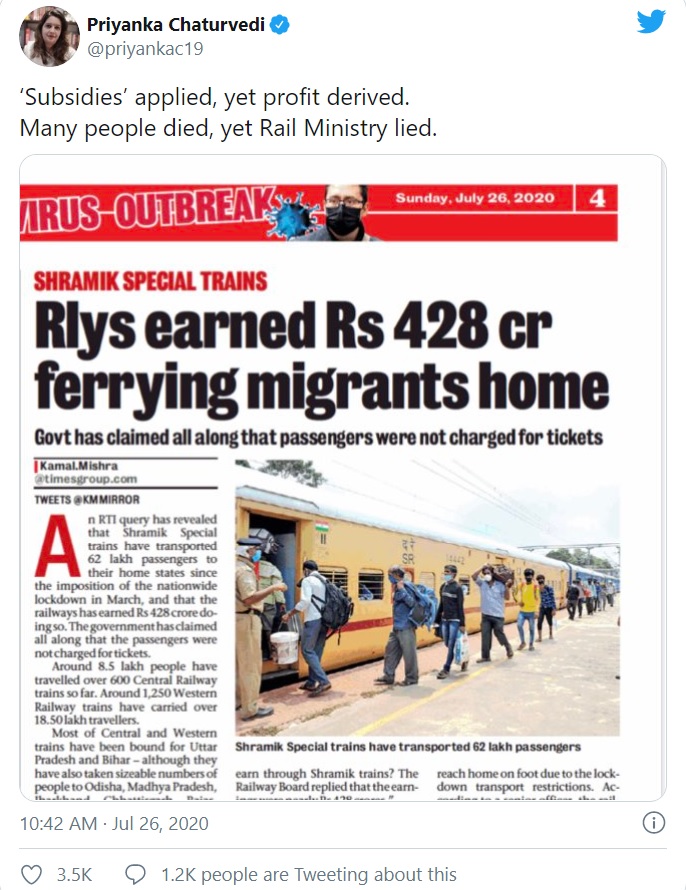
Priyanka Chaturvedi perhaps inspired by her former political boss Rahul Gandhi, made a similar claim on Twitter on Sunday, where she said that the Railway Ministry had lied about the losses incurred on running the special Shramik trains.
“Subsidies’ applied, yet profit derived. Many people died, yet Rail Ministry lied,” tweeted Priyanka Chaturvedi hinting at Modi government incurring huge profits at the cost of migrants by running the special trains.
Image Source: Priyanka Chaturvedi
Citing a Mumbai Mirror news report, Priyanka Chaturvedi made a similar claim as her former master Rahul Gandhi, to assert that Modi government had made profits from Shramik trains by ferrying migrants workers back to their native states.
The report shared by Priyanka Chaturvedi claimed that the Railways had received revenue of Rs 428 crores by ferrying stranded migrant workers home during the coronavirus lockdown. The report also added that the Indian Railways had ferried nearly 62 lakh migrant workers home since May 1, generating revenue of Rs 428 crore.
Fact check
Just like Rahul Gandhi, Priyanka Chaturvedi too perhaps failed to comprehend the difference between the ‘revenue earned’ and ‘profit’. Contrary to the claims of Priyanka Chaturvedi that the Indian Railways earned huge profits by running special Shramik trains, the Railways has spent Rs 2,142 crore on running Shramik Special trains but earned a ‘revenue’ of just Rs 429 crore and did not incur any ‘profit’.
In fact, the Modi government had incurred a loss of nearly Rs 1,700 crores after it ran Shramik trains to ferry back the stranded migrant labours from various parts of the country.
According to the official data, the Railways have incurred a loss of nearly Rs 1,700 crores after it ran Shramik trains to ferry back the stranded migrant labours from various parts of the country.
According to the information received through an RTI application, the Railways has only earned Rs 428 crore till June 29 and ran 4,615 Shramik trains.
The national transporter shared information regarding its expenditure, which shows that it spent Rs 3,400 per passenger the Shramik Special trains, which amounts to Rs 2,142 crore for around 63 lakh migrant workers transported in total. The Railways managed to recover only 15 per cent of the cost of operations from states and the rest 85 per cent was borne by the ministry.
May be Priyanka Chaturvedi, who is now an elected representative of the Parliament, must enrich her Mathematics skills at least now, and learn the difference between revenue and profit/loss.
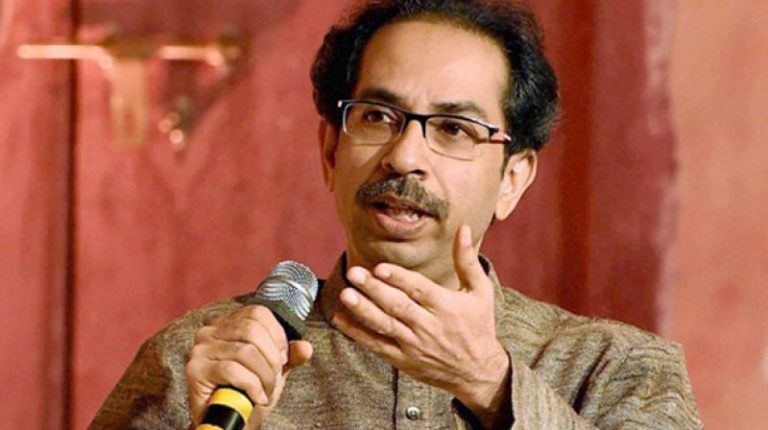
Uddhav Thackeray, Chief Minister of Maharashtra, has said that the ground-breaking ceremony for Shri Ram Temple construction in Ayodhya should be conducted using video conference amid Covid-19 pandemic. He said that he is ready to go to Ayodhya in Uttar Pradesh for the ceremony but will it not be possible for the administration to stop lakhs of “Ram Bhakts” from going there.
Shri Ram Janmabhoomi Teertha Kshetra Trust invited Prime Minister Narendra Modi for the “Bhoomi Poojan” ceremony. They gave 3rd and 5th August as possible dates for the auspicious ceremony. PMO approved 5th August to be the date for the event. Thackeray, who has been invited for Bhoomi Poojan to represent Shiv Sena, has expressed concerns over the event.
PTI reported that Thackeray said in an interview published in the Shiv Sena mouthpiece ‘Saamana‘ on Sunday, “The ground-breaking ceremony can be held through video-conference. This is an event of joy, and lakhs of people would be interested in attending the ceremony. Will we allow the spread of coronavirus?” He added that Shri Ram Temple has a background of struggle.
He suggested for Bhoomi Poojan via video link and said, “This is not an ordinary temple. Today, we are fighting the coronavirus pandemic, and religious gatherings are prohibited. I can go to Ayodhya for the ceremony, but what about lakhs of Ram bhakts. Will you stop them? You can do e-bhoomi poojan through video-conference.”
Thackeray said that when he last time visited Ayodhya, he was not allowed to perform ‘aarti’ at the Saryu river. Covid-19 pandemic just started to spread its roots in India at that time. He said, “Before that, I had seen huge crowds on the river banks. Ram Mandir is a matter of faith. How can you stop people from going there?”
Thackeray assumed office as the Chief Minister of the state under Sena-led Maha Vikas Aghadi (MVA) government with the support of NCP and Congress on 28th November 2019. He visited Ayodhya in March on completion of 100 days in office.
Legacy of Balasaheb undone
Though Balasaheb was not present at the site, Shiv Sena played a vital role in bringing down the disputed Babri Masjid. The Shiv Sena founder never shied away from praising the demolition. In 2018, while attacking PM Modi, Shiv Sena claimed that it was Balasaheb who took the responsibility of the demolition. They blamed BJP for not fulfilling the promise of Ram Mandir. In the editorial, they said that PM Modi does not speak a word about the Temple, which was one of the primary election promises.
In a statement on Babri demolition, Balasaheb had said, “I am glad that I have breathed life into the Hindus. Since the time of the Muslim invasion, nine centuries back, Hindus had lost their souls. The need to get their spine back, I did just that. That Rath even if it is power-driven appeals to the Hindu.”
This is the same Shiv Sena that played a crucial role in Ram Mandir movement, and now they have joined hands with likes of Congress and NCP for the post of Chief Minister. Uddhav Thackray, son of Balasaheb, has become a part of the crowd that is opposing Bhoomi Poojan directly or indirectly.
Attempts to stop Bhoomi Poojan
The opposition parties, Muslim groups and leftists groups are miffed with the Supreme Court judgement that favoured Ram Lala Virajman and Hindu groups. Since Shri Ram Janmabhoomi Teertha Kshetra Trust announced that Bhoomi Poojan is going to happen in August and the temple will be constructed in the next 3.5 years, these groups are trying to cause trouble at every step.
Congress supporter Saket Gokhle had submitted a petition in Allahabad high court asking for a stay on Bhoomi Poojan, which was rejected. NCP leader Sharad Pawar has pointed fingers at the government saying while the country is fighting with coronavirus some people are planning to build temples. AAP leader Syed Asad Abbas got so rattled by the news of Bhoomi Poojan that he hurled sexist abuses at BJP spokesperson Nupur Sharma during a debate. NCP even said that Pandit Nehru did not attend Bhoomi Poojan of Somnath temple but forgot to mention then-President Rajendra Prasad attended the function saying no one can stop him from following his faith.
From denying the existence of Ram Mandir at Ayodhya to calling the Ram Janmabhoomi a ‘disputed site’, the ‘liberal-secular’ establishment has time and again attempted not only to slander Hindu belief system but also deny Hindus their rights.
With only days remaining for the historic groundbreaking ceremony of the Ram Mandir at Ayodhya, the ‘liberal-secular’ establishment has yet again tried playing their dirty tricks by referring to the holy site of Ram Mandir as a ‘disputed site’. Even after years of a relentless campaign to stall the court case and keep Hindus away from their claim at the Ram Janmabhoomi site, the secular establishment is still trying to weave new narratives.
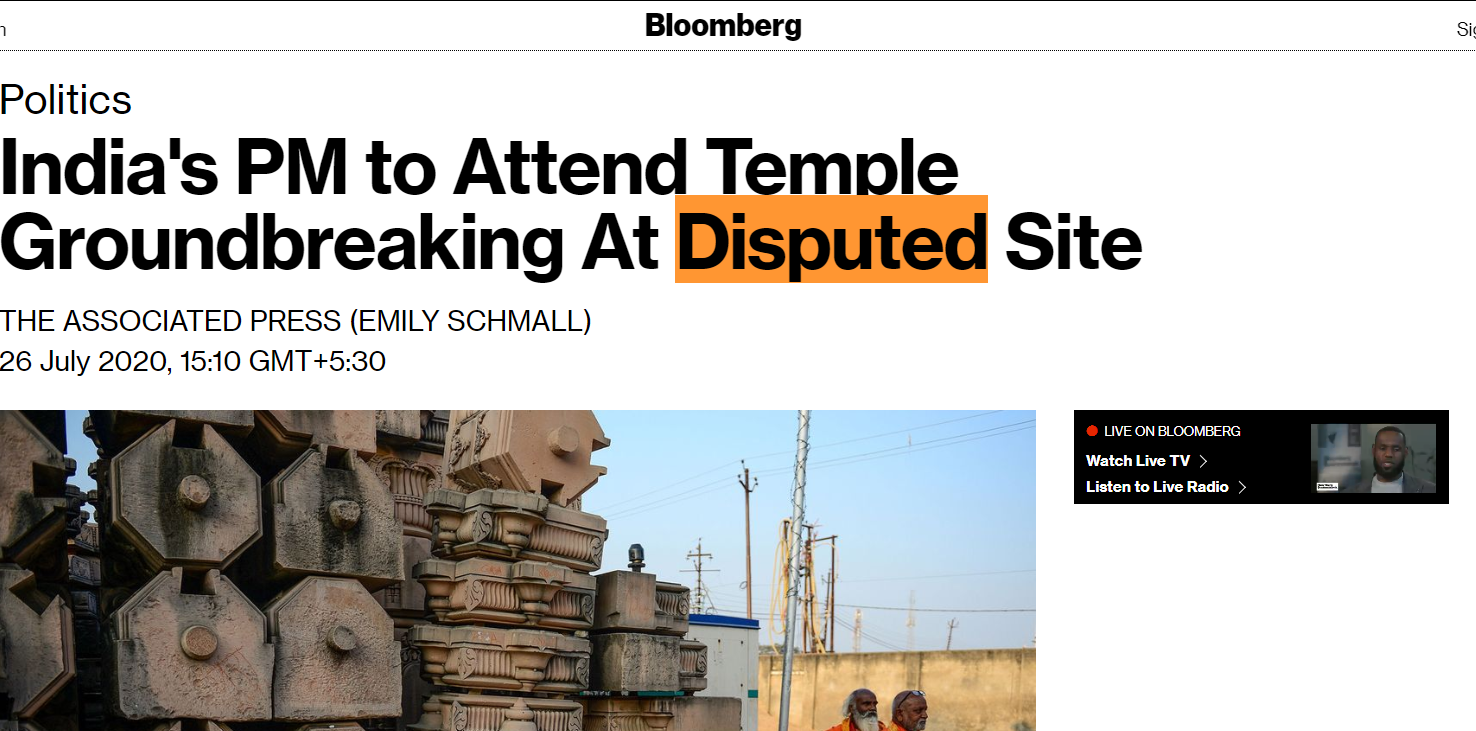
Continuing such propaganda, the Bloomberg media network on Sunday not only expressed its disappointment over the Bhoomi Pujan event at the Ram Janmabhoomi site in Ayodhya but also referred to it as a ‘disputed’ site.
In its report, the Bloomberg went on to make ridiculous claims saying that the Indian Prime Minister Narendra Modi would attend a groundbreaking ceremony next month for the construction of the Ram Mandir, which according to Bloomberg is being built on a ‘disputed site in northern India where a 16th-century mosque was torn down by Hindu hard-liners in 1992’.
“A century-long dispute over the site was resolved last year following the BJP’s landslide election victory. In November, the Supreme Court ruled in favour of the temple trust, saying that Muslim petitions would be given five acres at an alternative site,” read the report insinuating that the Supreme Court ruled in favour of Hindus only after BJP’s election victory in 2019 general elections.
The Bloomberg’s narrative to refer the holy site of Ram Janmabhoomi as a ‘disputed site’, despite the fact that the country’s highest court has already delivered a judgement in the Ram Janmabhoomi-Babri Masjid dispute, is nothing but sheer intellectual dishonesty.
On November 9, 2019, in a historic judgement ending a dispute spanning centuries, the Supreme Court of India had handed over the disputed Ram Janmabhoomi-Babri masjid land to the Hindu parties, making way for Hindu devotees to have a grand Ram Mandir at the birthplace of Lord Ram.
The five-judge bench of the Supreme Court, delivering a unanimous judgement in the Ram Janmabhoomi case, had ordered the Union government to provide five acres of land at an alternate site at a prominent location in Ayodhya to the Sunni Waqf Board to rebuild the Babri Masjid which was demolished in 1992.
Most importantly, the Supreme Court had mentioned that there is adequate material in ASI report to conclude that the disputed Babri Masjid was not constructed on vacant land, but there was already a structure underlying the disputed structure. The underlying structure was not an Islamic structure, the Supreme Court had said.
Despite the country’s highest judiciary delivering a 929-page unanimous judgment in favour of the construction of Ram Mandir at Ayodhya, the ‘liberal-secular’ establishment does not respect the Supreme Court’s judgement but rather indulges in such false narratives to incite Hindus ahead of the historic event, for which the indigenous faiths of the country have waited over five centuries.
While the site was legally disputed when the case was going on, after the apex court delivered the verdict, the dispute no longer exists. The land now belongs to the Hindu litigants, and the Muslim side has no right on it. Moreover, no Muslim side has filed any petition against the Supreme Court verdict, therefore, the site is no longer disputed, it belongs to the Ram Mandir now.
Perhaps, the media networks like Bloomberg, who often laments over deteriorating rule of law and democratic values in the country post-Modi-phenomenon, should at least have some respect India’s independent judiciary if not for country’s indigenous faiths and culture.
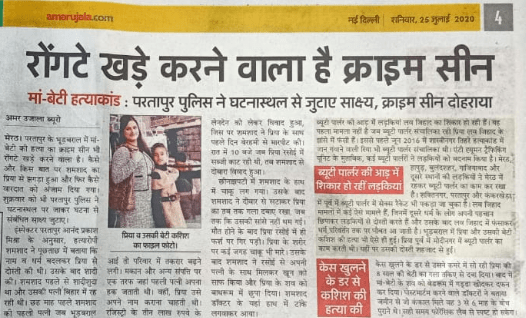
Love Jihad is gruesome to the unimaginable levels. Who would have thought that Shamshad would cheat on Priya after becoming her lover? Who would have known that he would not show mercy to the 11-year-old innocent child who called him daddy? Who would have thought that Priya and Kashish will die together? Nobody would have imagined that the person they were living with will bury them in the same house in an 8-feet deep pit. Did they think Shamshad will pour twenty packets of salt over their dead bodies to dry them out?
There are countless questions troubling everyone who has learned about the brutality Priya and her daughter Kashish faced. The story of the mummified and broken skeletons has caused a shockwave across the nation. Everyone is showing this case with a new angle. Every day someone comes forward with new updates in this case. However, many things are hidden behind the curtains. Today, we are trying to uncover the gruesome details of the case and give you a clearer perspective about the case.
Chanchal’s version of the story of Priya and 11-year-old Kashish
Priya, a divorcee, was living alone away from her family after getting separated from her husband, Rajiv. She often got worried about the future of her 2-year-old daughter. However, being a strong woman, she was trying to stand on her feet so that she can take responsibility for herself and her daughter without caring what the society says about her. She would have never imagined that Shamshad, who operates a fake account by the name Amit Gurjar, will contact her on Facebook.
In the year 2012-13, she came in contact with Shamshad alias Amit Gurjar on Facebook. They started talking regularly and slowly bonded with time. One day, Shamshad called Priya to meet him in Meerut, and they allegedly got married. Priya started to believe that her life has taken an unexpected but beautiful turn. While she kept on believing that her lover, then the husband is from the Gurjar community, the reality was different.
Priya is not alive to tell the true story. We do not have to share her pain. However, there is one person who can narrate what she went through. This person supported Priya and her daughter at every moment of their lives, and even now, when they are not between us, she is trying to get justice for them.
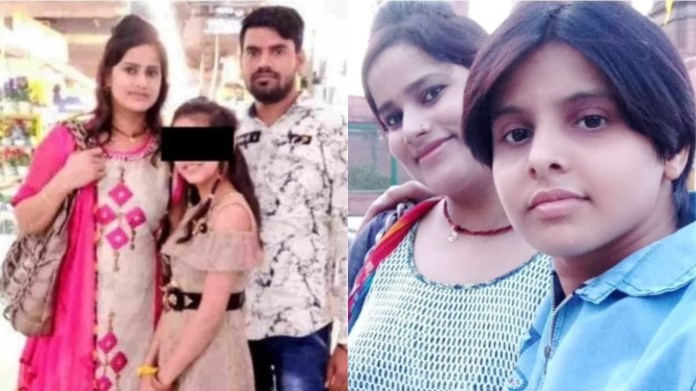
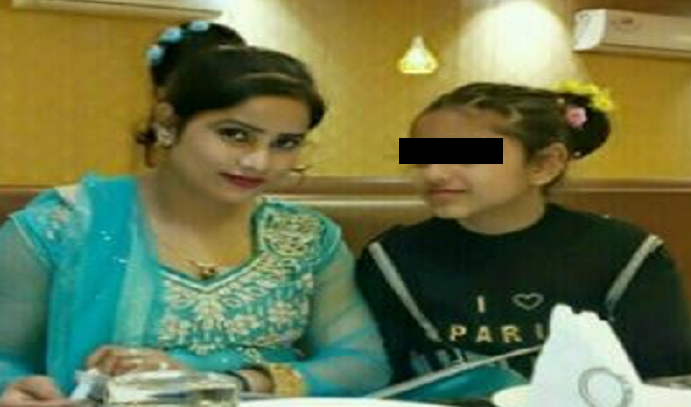
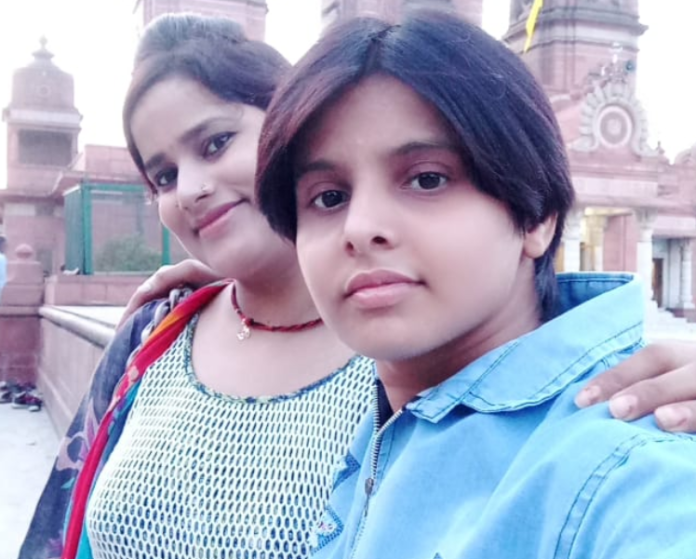
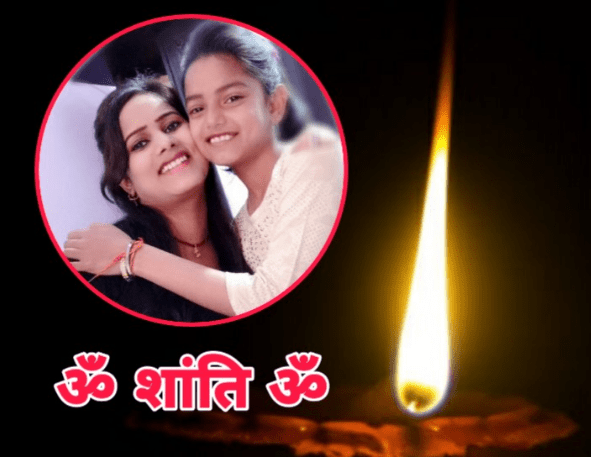
Priya and Kashish
That person is Priya’s friend Chanchal Choudhary. Priya shared every detail of her life with Chanchal till the last moment. She was aware of Shamshad’s behaviour and knew that the person with whom her friend was living is capable of doing anything. Chanchal is the one who fought with society to get justice for her friend Priya. She made sure that her killer gets arrested, but even though there was ample evidence against Shamshad, the path to justice was not easy.
Priya’s friend Chanchal
Chanchal is a 26-year-old woman who lives with her family. If society sees police circling a house every now and then, they will make stories. No one asked the real story behind so many visits by police. The attitude of the society, the weak-kneed attitude of the administration and snail-like speed of the justice system almost broke her many times during the struggle.
When the media started to report Chanchal’s struggle, we tried to contact her. Chanchal’s narration of the story dug out countless skeletons that were more than enough to make anyone’s stomach churn. Priya’s story is one of those that are capable of breaking the myth that there is nothing like Love Jihad in this country.
OpIndia’s conversation with Chanchal
When we contacted Chanchal, we had a list of questions, just like any media house. However, while talking to her, we realized that it would be better if we let her decide what and how to tell. When she heard Priya’s name, she got quiet for a while and then started narrating the story.
She told that Priya got divorced in 2012 and moved to her house in Modinagar as a tenant. After a while, Chanchal and Priya became good friends. Priya used to work in a parlour and leave Kashish with Chanchal whenever she leaves for work. Chanchal and her family used to take care of Kashish during the day, and Kashish will get back to her mother in the evening. Kashish won everyone’s heart in a jiffy, and the bond between Chanchal and Kashish got stronger with time.
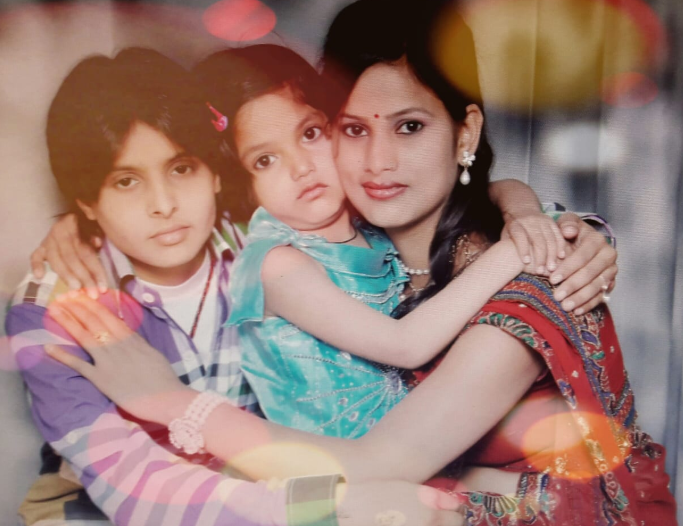
Photograph of Chanchal, Priya and Kashish when they used to live in Chanchal’s house as tenants in Modinagar
Chanchal said that Priya loved her daughter a lot and often got worried about her future. Around that time in 2012, Shamshad contacted her on Facebook via a fake ID using the name Amit Gurjar. He created a web of lies to lure Priya. He gained her confidence and started to share his dreams for the future with her. Priya believed him and slowly fell in love with him. He even promised her that he would buy a shop for her so that she can open her own parlour and made her leave the job.
Chanchal said that Priya used to tell her everything. From her first meeting with Shamshad as Amit to when she came to know the reality, Chanchal was aware of everything. She said that everything was fine in the beginning. He used to take them shopping and to eat at restaurants. In 2015, Shamshad and Priya got married in a temple and they started living together based on the fake marriage. Shamshad’s identity was a secret for a while after marriage.
Slowly after the marriage, it got harder for Shamdhad to maintain his fake identity. Priya came to know that the person living with her is not Amit, but his real name is Shamshad. She told Chanchal about it and narrated how he is abusing her every day.
The news shocked Chanchal as well, but there was nothing both friends could do. Chanchal tried to talk to Shamshad and requested him to stop abusing her friend. Every time Shamdhad started to cry and apologized for his behaviour. He used to tell Priya that his family has only wronged him and he wants to do something good for her.
Why Priya lived with Shamshad after learning the truth?
The reason Priya decided to continue her relationship with Shamshad was the fear of society. She was afraid how society will react if, after a divorce, she gets separated from a man again. She was scared for the future of her daughter. She was afraid that people would make her daughter’s life miserable. She always thought that no one would accept her daughter. According to Chanchal, Shamshad shifted homes several times after the marriage. Priya’s friends tried to tell her that people like Shamdhad are not loyal in relationships, but she wanted a father’s name for her daughter.
While there was a lot of struggle going on in their lives, Priya bought her house in Kashiram at an affordable price. Shamshad and Priya lived there together. During their stay in Kashiram, his true radical face became more prominent, and his attitude changed towards Priya. When Priya used to go out for work, he used to tell her, “Women who work outside are prostitutes.” He started to question Kashish’s clothes and wanted to stop her schooling. He would say to Priya, “What kind of clothes you buy for her? Dress her properly and teach her Urdu.”
Chanchal said that Priya told her many times that Shamshad was pressurizing them to convert to Islam. He used to force them to go to Jamaat. Priya always ignored his arguments saying, “Kashish’s name is already Islamic. There is no need to convert, and after all, you can call me anything out of love at home.”
Shamshad used to force Priya to go to Jamaat and follow Islam
Perhaps Priya thought that she would be able to save her identity, her name and her religion. But it was not possible for her. She forgot the fact that living and facing all those things in the hand of the person who betrayed her was a big mistake.
As long as Priya stayed in Kashiram, she had a temple at home. She sent Kashish to the school of her choice. However, her life was changed drastically the day she shifted to Shamshad’s house in Bhud Bharal of Meerut. The only thing that did not change was Chanchal’s support. She was with Priya at every step.
Chanchal said that they had a huge house, but Shamshad did not let her have a temple. Priya used to burn incense sticks, and Shamshad used to get irritated by the smoke. Priya had deep regard for Sai baba, and she loved her religion and God. He used to beat her and force her to stop worshipping, but she did not give up her religion. When she left Kashiram, she sadly asked Chanchal to take her temple. She said, ”Chanchal, take my temple to your house. I cannot see them getting disrespected. He will disrespect my God. I cannot tolerate that and will fight with him.”
Chanchal said, ”I was not able to bring the temple to my house due to lockdown. It is still in the house at Kashiram. Shamshad refused to give space for the temple in his house.” According to Chanchal, Shamshad used to bring men at home, and when Priya objected, he fought with her over it.
Priya started to get more suspicious of Shamsham in her last days. As soon as she comes across any documents related to her, she would immediately forward them to Chanchal. After the fight, she used to tell Shamshad that if anything happens to her, Chanchal will take care of her daughter. She will not leave you.
Chanchal gets emotional while talking about her friend. She can’t forget the time they spent together. While talking about a one and half-year-old quarrel between Priya and Shamshad, she said, “Things got really tense at that time. We also filed a complaint against him at the police station. But he managed to take her back home. I don’t know if it was my fault that I let her go or it was her fault that she believed him again. But if they were careful at that time, Priya would have been alive.”
Chanchal believes that if Priya’s family would have been there for her at that time, the situation will be different. At many occasions, Priya felt alone and broken without any support. She used to think that she cannot bother her friend every time she fought with him. However, though she skipped telling Chanchal about the fights, she got a gist of it almost every time.
Chanchal said, “Shamshad took full advantage of the lockdown. He tried to create differences between Priya and me. He tried to accuse me and turn Priya against me. He tried to stop her from meeting me. Still, she kept contact with me as she trusted me. Shamshad once called me to meet after a fight. I refused to go saying that he called me a bad person. Why would I meet him? He said that Priya has left went to Kashish’s school angrily. Please come quickly. He came to pick me. When we reached the school, Priya had already left. I did not tell Priya that I was with Shamshad. Otherwise, she would have thought that I am under his influence. Later, Priya called me from her neighbour’s house and told me about the fight. She told that Shamshad twister her arm and tried to strangulate her throat.”
28 March 2020 to 30 March 2020 – mother-daughter’s murder and Chanchal’s suspicions
According to Chanchal, it is not clear if it happened after planning or all of a sudden. But Priya started to complain her about the fights before lockdown. Priya left with her daughter several times, but Shamshad brought her back every time after apologizing. The fights, however, kept on happening. On 28th March, Priya’s phone got switched off. As Chanchal was in constant touch with her, she tried calling her several times. When no one answered, she thought her number is in the blacklist.
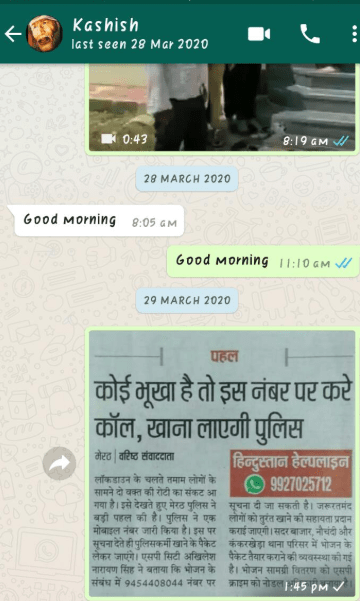
Last conversation between Priya and Chanchal. After that, Priya’s phone was switched off on 28th March
In the last call, Priya had told Chanchal that Shamshad brings a lot of men to the house. They stay in the house. He also refused to believe that corona is spreading. It was getting hard for her to track who all are coming to her house. She told Shamshad that they live alone at the house, and it is not right for so many men to come here. He fought with Priya and said, “It is my house. I can bring anyone with me.” When Chanchal learned about this, she said she would talk to Shamshad. However, the next day Priya’s phone was found switched off.
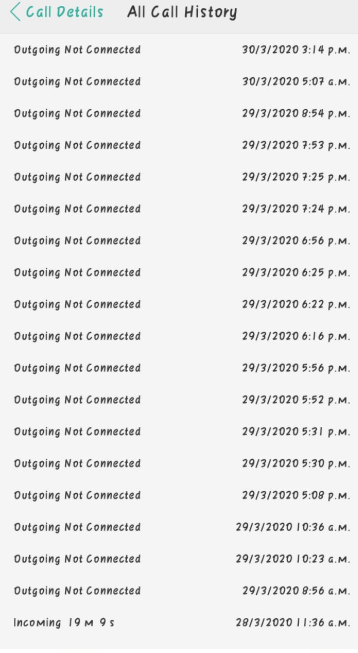
In the last conversation, they talked for 19 minutes and 9 seconds
She tried to call Shamshad. He picked up the call and said he is out for some work and will call once he is back. She kept trying Priya’s phone during that time, but it remained switched off. She called Shamshad again in the evening. Shamshad said that Priya is very angry and does not want to talk to anyone. After trying everything, she finally called Priya’s neighbours on 29th or 30th March. Priya had given her those numbers to use in case of any emergency.
Chanchal and Priya
When she called one of the neighbours, they told her that both Priya and Shamshad are not at home. She got more suspicious. She requested the neighbours to go to her house, and she talked to Shamshad on neighbour’s phone. Shamshad did not expect Chanchal will have neighbours’ number.
He got nervous and said, “she ran away with all the money after stabbing him.” To which Chanchal asked how he can stay calm after Priya stabbed her and ran away with the money. He started hurling abuses and said, “It is your trick. I understand everything. You are the reason behind all this. I will tell everyone.” Chanchal, after hearing a fake story from Shamshad, understood that either he had sold them or killed them.
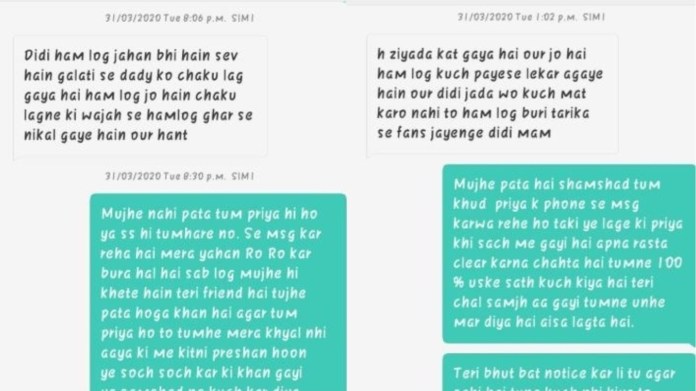
Screenshot of the messages
Chanchal said that Shamshad tried to be clever and sent a vague message on 31st March from Priya’s phone. The message was from Kashish, and it read, “Didi, we are safe wherever we are. We left the house after the accidentally stabbing daddy. We took the money. Please do not do anything; otherwise, we will be great trouble.”
He tried to build a scenario where Chanchal stop blaming him and avoid calling Priya. Chanchal kept on saying that Priya is her friend and she will call her even if she is in the last corner of the earth.
Chanchal’s visit at Pakharpur police station on 15th April
Days were passing by, and Chanchal did not get any information about Priya. Finally, on 15th April she went to Pakharpur police station to file a complaint. However, the police gave a clean chit to the accused Shamshad. Later on, when she raised her voice against the police’s irresponsible behaviour, police visited Chanchal’s house and tried to persuade her and her family not to pursue the matter. The neighbours started to question why the police came. Chanchal had to answer every single one of them, but that did not stop her from visiting police stations so that they take some action in the case.
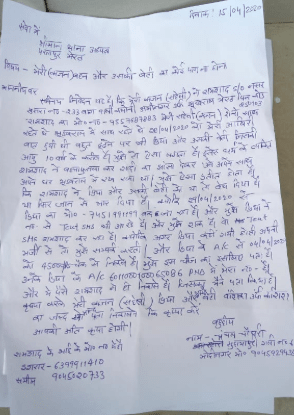
Complaint filed by Chanchal on 15th April
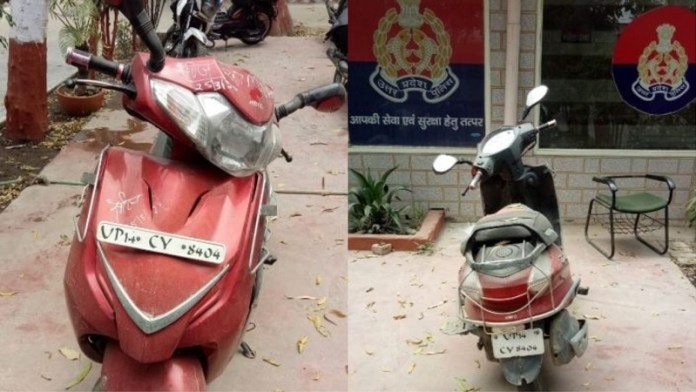
During one visit to the police station, she noticed Priya’s scooty. She told them that the scooty belonged to Priya. But despite the evidence, police did not take any action. However, they started asking her if she is okay to visit Bihar for investigation. Chanchal said that she will help the police in every possible way and will visit Bihar as well.
Priya’s scooty outside police station
Shamshad was worried as Chanchal was actively trying to get justice for her friend. He started to threaten her and said that he would tell people that she is a prostitute. Chanchal did not back off. Chanchal called several Hindu organizations to get help in Priya’s case. Some groups visited the police station with her, but it did not help.
Chanchal’s DP on Whatsapp in memories of Priya and her Daughter
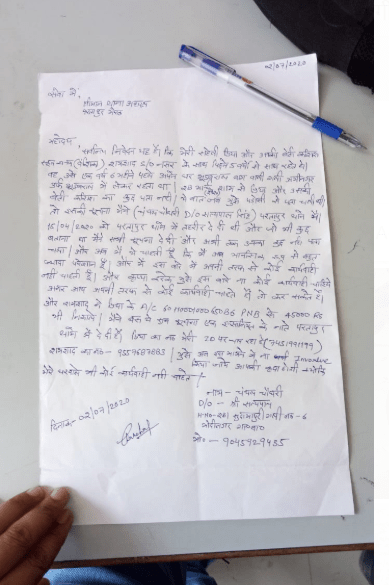
Finally, on 2nd July, she signed a letter in which she said that she does not want to pursue any further in this case as it is causing mental stress. She did not have any hope left for her friend. She can only pray for getting justice for Priya.
On 12th July, she talked to Manish Lohia of RSS. There was again the light of hope in the case. What followed after that is now clear in front of everyone. Chanchal cannot stop thinking about how Shamshad can be so cruel to someone who lived with him for over five years. She loved him, took care of him, made sure he gets good food, and even then he killed her and her daughter. She feels helpless thinking about the last moments of Priya in which she might have looked at her daughter in vain and maybe thought about Chanchal as well.
While talking to OpIndia, Chanchal expressed her gratitude towards Manish and said it is because of him that the world knows what Shamshad did to Priya and Kashish. Chanchal thanked Manish so many times during the conversation that OpIndia tried to learn his views on the incident.
Chanchal and manish Lohia
Manish’s coversation with OpIndia
In a conversation with OpIndia, Manish said that he is actively working to spread awareness against Love Jihad since 2007. He is associated with Dharma Jagran Samanvay, a wing of RSS. He was previously associated with Vishwa Hindu Parishad and Bajrang Dal. When he came to know about the case, he contacted Chanchal on 12th July.
He said that Chanchal was very angry with the previous false assurances and refused to talk. He then assured her that she is her sister, and he will do everything in his power to help her. After this, she explained the case and said she was duped before in the name of help. Within two days of conversation with Chanchal, Manish contacted higher officials to discuss the matter. A new case was registered on 14th July. SSP informed him that CO Bhupendra would look into the matter.
Manish continuously kept contact with the CO. He requested him to put everything on surveillance. He also asked him to find out where Priya’s phone was last used and when it was switched off. The administration had to work faster in the case due to continuous pressure from the organizations. Police arrested Shamshad, but a few days later he was released after interrogation.
ग्रेजुएट चंचल। इसी बहादुर छात्रा ने मेरठ के डबल मर्डर को सॉल्व कराया। साढ़े 3 महीने तक पुलिस से जूझती रही की मेरी दोस्त लापता है। केस वापस लेने का दवाब बना। आखिर अपनी सहेली प्रिया व उसकी बेटी के कातिल शमशाद को जेल पहुंचाया। #Meerut#Uppic.twitter.com/lJ493KGyZv
— Sachin Gupta | सचिन गुप्ता (@sachingupta787) July 22, 2020
When the organization contacted police for the update, they told Manish that further inquiry would be based on the statements of Chanchal. Manish helped Chanchal in organizing all the evidence. When the officers felt that it is not possible to delay the case further, they picked Shamshad again and questioned him strictly. Shamshad broke down and revealed the truth.
When Manish was asked for his views in the case, he said that based on evidence it is clear that Shamshad was regularly pressuring Priya to go to the mosque, recite Islamic prayers and read Quran and followed strict Islamic customs.
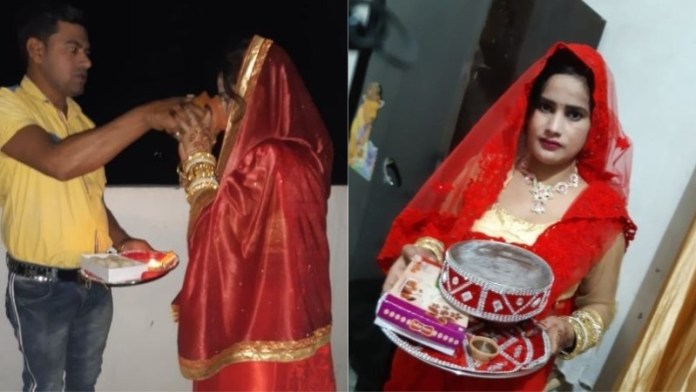
He said that it is also clear that he was at his good behaviour only when he wanted to have physical relations with her; otherwise, he used to fight every day. He said that Shamshad framed a vulnerable girl who was living alone with her daughter after the divorce. He projected himself as someone from the Gurjar community and married her. He went to temple with her and even let her keep fast on Karwachauth. However, when Priya came to know about his reality, he started to force her to convert to Islam. He said that Shamshad did not show mercy to the innocent child who used to call him daddy. He may have abused her too.
Shamshad used to visit temple and asked Priya to keep Karwachauth fast for him
According to Manish, it is a clear case of Love Jihad. It was a pre-planned drama to convert Priya. If Islam is so pure, Shamshad would not have hidden his identity. He kept a name that belonged to a community that dominates the area.
In his words, the conclusion is,
“It is my endeavour that more such cases come into the light so that girls become aware of men with such a mindset. If they feel that after leaving such a person where they will go, or they will get alone, they have to keep in mind that while living with such men, their life will be in danger. No one hides their identity for love. They hide their identity for religion. When the situation gets messed up, the girl thinks that where will she go? In today’s time, we talk about women’s freedom, but these people pressurize them to wear a burqa. We only want that Priya and her daughter get justice, and Shamshad gets death penalty for his actions.
Updates on mother-daughter murder case so far
So far, police have arrested Shamshad in the case. They are looking for his brother-in-law and his wife, among others. It is alleged that his brother-in-law was with him on 28th March at the time of the incident. They murdered the mother-daughter duo, and on 29th morning, Shamshad dug up an 8-feet deep pit in the bedroom to dump the two bodies. He sprinkled 20 packets of salt on both of them to ensure they get mummified quickly. He plastered the floor again so that no one gets suspicious.
What happened on the night of 28th March: According to some media reports, Priya tried a lot save herself. She not only scratched Shamshad with nails but also attacked him using a knife from the kitchen. When Shamshad’s wrist got cut with the knife, he got angry and strangled Priya. She could not breathe and died on the spot. Then Shamshad murdered Kashish in the bedroom by suffocating her using a pillow. The incident took place around midnight on 28-29 March.
Shamshad’s confession: When police started the investigation, Shamshad did not tell anything at first. But later when he asked for how long he had to stay in the police station, the inspector replied he could leave once they find mother and daughter. Then Shamshad told the police that he had killed them and they are buried in his bedroom.
The police did not believe him at first, but when he kept repeating it, the police decided to visit his house at around 4 AM. They dug up the said location in the bedroom and recovered two skeletons in pieces. A video of the recovery was also released by the police in which the police can be seen recovering the skeletons.
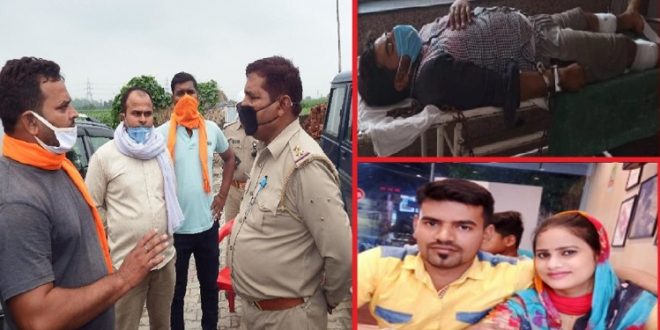
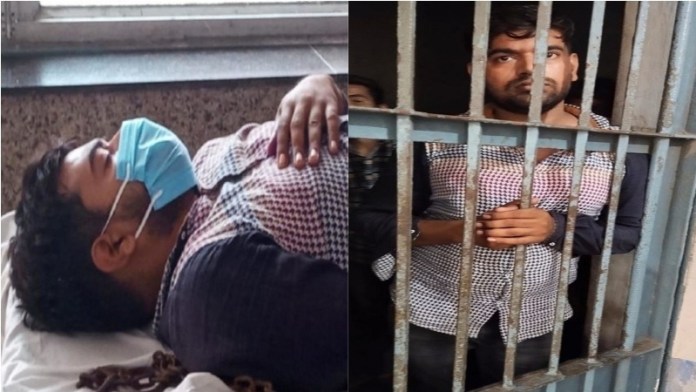
How he skipped police custody and arrested again: Reports suggest that Shamshad escaped from police custody on Wednesday. The police later arrested him after an encounter. He was shot in his both legs. The police admitted him in the district hospital where he was treated for the injuries.
What led to the murder: During the investigations, a lot of angles are emerging in the matter. It is alleged that Shamshad was already married and his wife’s name was Afsana. He had three kids with her. She came to Meerut some time ago to claim the Shamshad’s property in Bhud Bharal, but Priya wanted the said property on her name for a safe future.
They both used to fight a lot, and there was a fight between them on that night as well. The argument was over a transaction of Rs.3 lakh, and it escalated at around 10 PM. Priya was cutting vegetables when Shamshad tried to attack her. After his hand got injured by the knife, he strangled her. When she died due to suffocation, he stabbed her dead body several times before throwing it in the bathroom. Then he went to a doctor to get stitches.
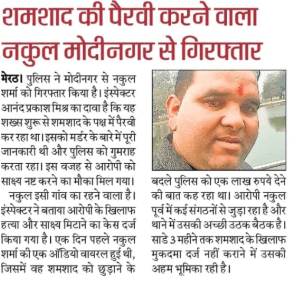
The arrest of Nakul Sharma, who saved Shamshad: Police also arrested a man named Nakul Sharma along with Shamshad. He was caught because of a video of Nakul going viral. He was heard saying that he will pay 1 lakh to save Shamshad. Reports suggest that Nakul was helping Shamshad in misleading police. He also helped him in erasing all the evidence. He was arrested after his name appeared during the investigation.
Plan to kill Chanchal: During the investigation, police found that Shamshad planned to kill Chanchal too. Two men were helping him in the planning. Police did not take any strict action on her complaint and used abusive language while talking to her. Instead of finding Priya, they blamed Chanchal and pointed fingers on her character.
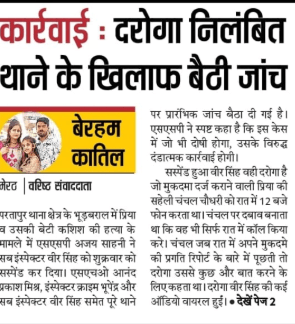
Action against officers for inaction: SHO, inspector and sub-inspector are under investigation for inaction in the case. Inspector Veer Singh was suspended on Friday. SSP made it clear that anyone who is found guilty will face strict action. Shamshad may be booked under NSA in future based on the investigation.
The inspector who used to call Chanchal late night around 12 AM has been suspended. Instead of talking about the case, he tried to have a personal conversation with her. Audio of Inspector Veer Singh has also gone viral over social media.
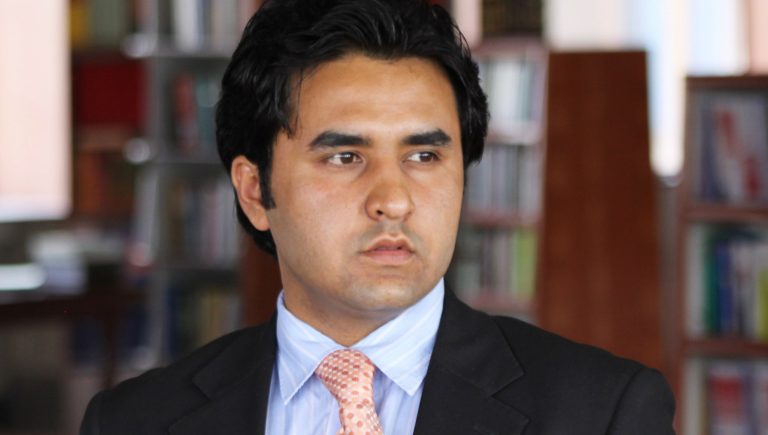
Khushnood Nabizada served as the chief of staff to Ministry of Urban Development and Housing, Government of Afghanistan from May 29, 2016, to June 02, 2019. Khushnood is known for his fearless and straightforward views on a number of topics relating to modern-day Afghanistan, be it Talibanisation, inefficiencies and corruption in the Afghan government, the involvement of Pakistan in Afghan politics or evolving India-Afganistan relations.
This is an exclusive interview with a rising star of Afghanistan – Khushnood Nabizada, political expert, journalist and owner as well as founding editor of The Khaama Press News Agency, the largest online news service of Afghanistan.
The questions asked by the interviewer are in italics, followed by the answers by Khushnood Nabizada.
Yours has been a story of living under the scourge of the Taliban from a very young age. You were only in class 5th when Taliban occupied your home province of Baghlan and you had to immigrate to Pakistan, only to return to your country in 2003. Today you occupy a pre-eminent position in journalistic and political circles in the country. How do you see your own personal journey vis-a-vis that of your country over these past two decades?
My life story and journey have been quite different than many of my family members, friends, and colleagues. My family fled to Pakistan as refugees when the Taliban took power …I was only 16 when I returned back to the country after the fall of the Taliban and as the eldest son of a poor and homeless family, I had to work beside my father in order to feed a large family with 10 members. In addition to attending school, I used to teach English language and computer programs in a local institute and was earning only USD 40.00 per month. I had only night times to study, prepare for classes and do my assignments. I was very grateful to the almighty God who had given me excessive energy and passion to work hard.
Parallel with studies, and work, I was working on my personal capacity building in the areas of calligraphy, graphics, design, web development and leadership. In 2009, I established a web development firm together with one of my university friends and started to make some money for life. I loved journalism and had a dream in my mind to establish my own news agency through which I can serve my country and provide awareness to the society which needed to learn about democracy, globalization, pluralism and diversity. I managed to establish Khaama Press in October 2010 with the help of one of my colleagues, named Ahmadshah Ghanizada, who is now living in Canada. Ahmadshah is a founding member of Khaama Press and he is truly one of the reasons that KP succeeded to become a well-known and popular newswire service in the country. In 2015, I joint the government as an advisor to the Minister of Urban Development and Housing of Afghanistan and in 2016 I was promoted as the ‘Chief of Staff’ for the ministry which is a very key position in the Afghanistan governmental system.
During the time I was at the Ministry of Urban Development and Housing, I played an important role in fighting against corruption, reforming the organization and capacity building of the employees. I have travelled to many countries including Canada, UK, Belgium, Norway, Sweden, Netherlands, Germany, China, Russia and India. The more I travelled, the better I understood how I could work to be of help to my home country which burns in terror, poverty and extremism.
I have been a close observer of the evolving geopolitics of Afghanistan and have been interested in its history as well. The country has dramatically changed over the past century, from the days of the Great Game between Russia and the UK, the creation of the Republic of Afghanistan in 1973, the Saur Revolution, the Soviet war efforts in Afghanistan against Mujahideen insurgents, the collapse of the Najibullah government in 1992, the Taliban years, the NATO invasion of Afghanistan and the country today. All these ties into various competing forces and players in the country.
Thomas J. Barfield wrote an interesting piece, published in Iranian Studies in 2004, on the question of the legitimacy of authority and government in a multi-ethnic country such as Afghanistan, with its tribal heritage, and how that has led to difficulties in establishing national order. What are your thoughts on this?
Afghanistan’s conflict has historical roots and therefore it has always been a battleground for the different super-power countries.
Afghanistan has been the battleground for many decades due to its strategic geographical location and as well as being a multi-ethnic country failed to become a ‘one nation’ and end its internal conflicts. There are different mentalities and serious disagreements between major ethnic groups in Afghanistan. Afghans have zero-tolerance against each other when it comes to tribal and ethnic issues. The reason behind this is the historical injustice and inequality that exists in the country from over 200 years back. An illustrative example is the anger and disappointment of many Pashtuns including President Ghani about Abdul Rashid Dostum promotion to Marshal. In addition to large gatherings that opposed this promotion neither the palace officially announced Dostum’s new rank and nor President Ghani participated in his ceremony. Afghans cannot end the war and stand on their own feet until they do not become ‘one-nation’ or use a different model of governance such as India to distribute power based on different states/provinces.
Speaking of multiple stakeholders and players in the region, geopolitically several international entities have a lot to gain or lose from the developments in Afghanistan, be it Pakistan, Iran, India, USA, Russia and other countries. How do you see this complex interplay of forces affecting Afghanistan today?
A weak administration paves the way for the interference of foreign countries in the internal affairs of a country. The Afghanistan government failed to manage the game well in order to gain maximum advantages for the country. The nearly 2 decades presence of the international community in Afghanistan could be counted as a great opportunity for a war-torn country like Afghanistan, but unfortunately, the programs and aids were not managed the way Afghanistan could receive the utmost benefits. Now, Afghanistan has been used as a battlefield by the regional countries for their proxy wars. Iran, Pakistan, India, Saudi Arabia, Russia and U.S.A fight their wars in Afghanistan territory with almost zero harm to their own states.
You have commented on the continued involvement of the ISI in the internal workings of the politics of Afghanistan. What are the ways in which this continues to happen, how is it adversely affecting the country and how can this be minimised?
Pakistan is one of the key players in the region that sees a war-torn and destroyed Afghanistan in its favour. Pakistan has been supporting the insurgency for long years. Al Qaeda and the Taliban have had their safe havens in Pakistan for years. They were supported financially and politically both by Pakistan and its close alley Saudi Arabia. ISI, of course, has been behind the game as the main player. If the Afghanistan intelligence service is supported for further capacity building and is equipped with all the necessary and new technology and devices, in addition the key ISI-backed individuals who are within the system structure must be identified and sidelined in order to limit ISI’s access to secrets and critical information.
You have been a critic of the inefficiencies and corruption of the government in Afghanistan in the past. You spoke of how democracy failed in 2014 due to the ‘mismanagement of the government, corruption and systematic election frauds’. The question of the legitimacy of the government with an extremely low turnout (with 1.8 million Afghans have gone out to vote) remains. You have also in the past commented on how international funds and finances meant for the development of Afghanistan have been mismanaged. How do you think this broader question of corruption, misrule and inefficiency can be handled?
During the past 19 years, over 100 billion US dollars were raised for Afghanistan development and rehabilitation, but unfortunately, you can see no tangible projects that have been implemented to represent this large amount of funds that were allocated for Afghanistan. Parts of these funds are said to be taken back as administration costs and hiring foreign TAs. Other large portions were spent in non-infrastructural projects that were not very beneficial for the national economy and some were spent by President Karzai to keep tribal elders and the opposition pleased. As a result of administration incompetencies and corruption, Afghanistan lost a critical opportunity that cannot be undone. Since 2014, the international community has reduced its aid to Afghanistan which has negatively affected the country’s economy. Economical activities and development projects have become very limited as a result of increasing violence and flee of investors.
Being an Indian, I am most interested in the position of, and prospects for, Indo-Afghanistan ties. Afghanistan and India were both part of the Non-Aligned Movement. They have both been close to the Soviet Union in the past. Today, they face an increasingly aggressive China and an intrusive Pakistani intelligence. In the face of the looming US pullout, how do you think the Indo-Afghanistan ties stand and can be developed so as to present political leverage in the region against hostile forces? How important a role can and must Russia play to facilitate this?
India and Afghanistan have a relationship based on mutual interests and respect which is a two-state relation. Also, we have common values that strengthen our relationship. India’s diversity can be a good example of inspiration for Afghanistan to build our future on the values and differences that are parts of the history and identity of each ethnic and minority community. India is a multi-ethnic state, its model of governance and administration is more likely very suitable for Afghanistan.
In the new era, India has been a great ally and friend to Afghanistan, contributing around 3 billion USD to Afghanistan’s development funds, mainly invested in the community development and infrastructural projects.
India has also been very generous in contributing to Afghanistan’s education sector. It has so far provided around 40,000 scholarships for the Afghan students to study in the Indian universities.
The USA and Taliban recently signed a peace treaty. However, hours later hostility was seen on the ground and the supposed cessation of hostility was not quite ubiquitous. How do you see this moving forward, especially considering the power vacuum that may be developed once the USA leaves? How important is the element of decentralisation and of empowerment of local governments in this?
The peace process has to be understood as a process, not as a project, and it should be built on the concepts of peacemaking, peacekeeping, and peacebuilding. All these three aspects of the peace process are equally important.
At the same time, we have to know that the Afghanistan peace process is multidimensional and there are many players and factors that have influential powers on the process. I want to make it clear that from an Afghan point of view there is a difference between the US-Taliban deal and reaching a sustainable peace in Afghanistan. The country is still suffering from the deadlock of the last presidential election. Yet the members and structure of the high peace reconciliation council are not officially formed and any disagreement between the president and the chairman of the high peace reconciliation council over their share in the government will highly affect the peace process. And we have the experience of a National Unity Government (NUG) in which both sides could not agree on a single agenda over the last six years and of course, the concerns for their future collaboration is always there.
Leading sustainable peace is very challenging. Some factors and elements need to be taken into consideration. There are both regional and international influences, and the partners’ corporations are essential. Afghanistan needs a more active foreign policy to get engaged at all levels because Afghanistan’s insecurity is also a threat to the world. The peace process needs the support of both national and international players.
We must also not forget that the peace deal with Taliban does not mean the end of extremism in Afghanistan. There are several terrorist groups that are actively operating and have created a safe haven in the country. Also, Taliban is not only one group, there are different divisions and levels that operate under the name of the Taliban. Therefore when talking in reference to the peace in Afghanistan, we need to be very careful and analyze all these facts and aspects. There are many questions and concerns that still need to be addressed. The civil society, media and local institutions should be included and have their voice in the peace process.
At the same time, the country needs a national dialogue to create a platform where every group, including minorities, women and youth can share their concerns and views. It is essential that all the Afghans come together and hold a dialogue on their differences and shared values. The majority and minority concept is no longer appropriate, and everyone deserves to be treated the same in front of the law and see their images and identities reflected as citizens of the country in the power structure.
We cannot end the four decades of war and conflicts without creating an inclusive narrative of peace by all its meanings and aspects. What happens with religious communities and minority rights and freedom, and what about the women’s rights or freedom of speech? Personally, for me, as a journalist, freedom of expression, and the values of freedom of speech must become strengthened day by day. The young generation has their views and ideas that have to be included in decisions that are going to be made for the future of the country. Our today’s democracy is a significant achievement, even if it is weak and fragile. We must seek possibilities and ways forward to a better tomorrow!
Afghanistan has historically been a culturally diverse nation, with Muslim, Hindu, Christian, Sikh and Buddhist elements. There have been myriad communities and tribes, cultures and sects that have lived together. However, today we have seen unsettling developments in the last two decades, with the Talibanisation of Afghanistan, be it with the infamous explosion of the Bamian Buddha or the persecution of minorities such as Hindus and Sikhs. What are strategic and decisive steps, according to you, that can be taken to correct this worrying trend?
I would like to highlight our rich history and culture are results of the contributions made by all Afghans and every ethnic group has played their roles in building the country and our civilization is built on the values and contribution of all community divisions. Denying this fact is our weakness, and the major problems and conflicts we have today are because some groups such as religious minorities are excluded from the political structure. Indeed, Afghanistan is a country of minorities, there is no majority, but certain ethnic groups claim to be the sole owners of the land, which is not a true mentality and that is a real cause of these deep and long-run conflicts.
Unfortunately, the religious minorities have suffered throughout the history, but there is no other way than to accept and respect the religious diversity for a peaceful country.
In order to put an end to the internal ongoing- conflicts in Afghanistan, a strong and fair administration is required to first accept equal rights for all the ethnicities, respect diversity and proceed based on the values of pluralism to accept every ethnic and religious group. It will help the country for nation building- ‘one nation’ ideology.
Soft power has a major role to play in today’s political scene, be it through sports, science, movies, literature and fine arts or market entities. India recently signed 5 pacts to help develop educational infrastructure in Afghan provinces, the Afghan cricket team has been in the limelight lately, and Bollywood has had a rosy relationship with the Afghan masses. How do you see the Indo-Afghanistan ties being strengthened going forward, using the element of soft power?
Very crucial, as you have mentioned soft power like literature and art, which I believe should be used as a social objective to foster peace and democratic values.
Afghanistan is a country of diversity, and the values of differences should be accepted and respected as the country’s rich culture and history. Also, the country needs an active and inclusive cultural policy that cultural activity fosters peace and dialogues between the nations.
Cultural programs will further strengthen the friendly relationship between both countries. India and Afghanistan can enter into a bilateral agreement wherein India assists Afghans in the areas of cinema, music, movies, sports and fine arts.
Afghan women make up just around 36% of the national workforce. Women’s empowerment is crucial for the transformational economic growth of the country. We may have come to some distance from the dark days of Taliban rule but women’s empowerment has been an area where Afghanistan needs more work, particularly in terms of providing economic opportunities, education and skills. What are your thoughts on this?
Compared to the Taliban and Mujahideen’s time, the women’s role and representation have dramatically changed and they are now at the front-end. Afghan women now have access to health and education as their basic rights, which they did not have in the past. However, the presence of women in the system has been more symbolic just to indicate their presence for the donor community and they were not in the decision-making levels. Women who make 50% of the community population can play key roles in the developments, health, education, peace and prosperity of their countries.
Afghan women must be given further opportunities to make ways in the decision making levels and are given executive positions in the government, so the changes they cause must be felt and seen. Their leadership skills and potential capabilities should be seen as an asset for the development of the country.
Coronavirus has presented a unique challenge for Afghanistan, as it has for the world. Covid-19 is spreading rapidly in Afghanistan, and with no vaccine and scant medical resources, people are turning to remedies such as using opium in the hopes of beating the pandemic. Afghanistan has recorded more than 34,000 confirmed cases and over 1,000 deaths in a population of nearly 39 million, though, with only 7 testing facilities in the entire nation, the real figures may be much higher. The tragedy is the effect of conflict on the preparedness of the Afghan government. People in conflict zones have precarious housing and work situations, with destroyed infrastructure like roads and hospitals and heightened demands on the health-care system. How do you see the way forward for Afghanistan during this period of crisis?
The COVID-19 pandemic has been a disaster for all the nations, but it affected Afghanistan more economically. Afghanistan is a landlocked state with no direct route to the water. During the pandemic time, Afghanistan neighbours closed borders for a while and mainly the shortage of food items in the Afghan market caused the rapidly increasing of the prices that overall resulted in the poverty increase. The municipalities, however, arranged a program to distribute bread for the poor families, but unfortunately, this move was not successful and did not help the people in need.
The Afghanistan government has confirmed over 34,000 cases with over 1,000 deaths, however the actual figure can be way higher than what is announced. The number of testing facilities are very limited and the awareness about the C19 is very low in the rural areas. However, the mortality arising out of Covid-19 is said to be much lower than any other country, which is apparently because of the lifestyle and the foods used.
The Covid-19 has affected the Afghanistan education sector to a larger scale. Other countries in the world managed to set up online classes in order to minimise its impact and the students could still pursue their education, however this option did not work for Afghanistan due to the absence of internet services in most parts of the country and also lack of the required technological devices including smartphones, tablets and computers. Only a small portion of the population in the capital Kabul could have access to online classes during the pandemic time.
A large portion of the Afghan population have lost their jobs during the pandemic as a result of which crimes have increased to a large scale. Dozens of Afghan citizens are killed everyday and every week by the robbers.
If this pandemic doesn’t end sometime soon, Afghanistan’s security situation will get worse, the health and education sectors will suffer too much.
It is July 26, which is Kargil Vijay Diwas. Who is celebrating? The whole country for sure. But did you know that it wasn’t always like that? In fact, the UPA government ignored Kargil Vijay Diwas during its entire first term in power. It is not difficult to guess why.
Article by HT
You might have noticed a strange new tradition among liberals nowadays. Saying kind words about Atalji followed by insults thrown at PM Modi.
While I am thrilled that liberals have grown to respect Atalji so much, we cannot forget how liberals treated him when he was Prime Minister.
While you have probably heard of the time when Sonia ji called Narendra Modi “maut ka saudagar,” here is something you may not have heard. And it makes for an interesting and somewhat ironic story.
Article by Tribune India
In Sep 1999, shortly after the Kargil War, Sonia Gandhi addressed a campaign rally at Ujjain in Madhya Pradesh where she allegedly called Atalji a “gaddar.”
The embarrassed Congress issued various clarifications, such as saying that Sonia Gandhi had never explicitly named Vajpayee in her remarks. I do not know how convincing that is. In 1999, the BJP did not buy the excuses either. One of the BJP general secretaries demanded that Sonia ji should issue a public apology.
The name of that General Secretary? Narendra Modi.
The fact is that the Nehru dynasty could never reconcile itself to a non-Gandhi ruling over India. It could be Vajpayee, it could be Modi. It could even be P V Narasimha Rao, a lifelong Congressman. The formidable PVNR did not rule while being under the thumb of the Nehru dynasty. In Congress, it is the family which is the party.
There is a reason why Congress ecosystem gives credit to Dr. Singh for the 1991 reforms and not to P V Narasimha Rao. And who can forget how PVNR was humiliated even in death? Who can forget how the body of a former Prime Minister of India was not let inside the Congress HQ?
Today the Congress Party loves Vajpayee because he is no more. And because the liberal ecosystem benefited from his deep generosity. You will see Congress leaders sharing how Atalji restored Nehru’s portrait after he became External Affairs Minister in the Janata Government.
Atalji had a big heart. We already knew that. Do the Congress leaders tell you about the incredible pettiness with which they had Veer Savarkar’s plaque removed from Andaman Cellular Jail as soon as UPA came to power?
We should be grateful that Atal ji lived a long life and survived well into the Modi years. When he passed away, he received a farewell that fitted his stature. Otherwise, who knows what kind of indignity the UPA would have inflicted on him had he passed away during their rule?
Incidentally, the Congress has just launched centenary celebrations for P V Narasimha Rao. They spurned his dead body 16 years ago. Today they have come with folded hands, begging for a share in his legacy. Good to know.
We are going to keep reminding them though: how the Congress treated Vajpayee, Rao and the heroes of Kargil. Sab yaad hai. Sab yaad rakha jayega.