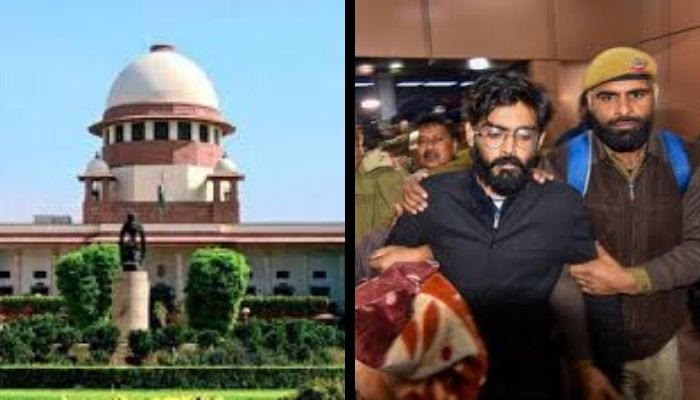
On Tuesday, the Solicitor General of India (SG) Tushar Mehta had reportedly sought more time during the hearing of a petition filed by radical Islamist and sedition-accused Sharjeel Imam before the Supreme Court of India. Imam had moved the apex court seeking the amalgamation of all FIRs filed against him in different states of India.
The petition came up before a 3-Judge Bench comprising of Justices Ashok Bhushan, Sanjay Kishan Kaul, and MR Shah. Tushar Mehta informed that a reply would be filed, regarding the petition, on Wednesday. Counsel appearing for the accused, Siddhartha Dave, reportedly cited the case of Arnab Goswami and the Aligarh Muslim University case to club all FIRs filed against Imam into one single case. Disagreeing to the prayer, the Solicitor General said that Imam’s case was different from the ones he had mentioned.
He added that all other States, including NCT of Delhi, where cases have been filed against the accused needed to be made a party in the said case. Solicitor General Mehta also stated that the apex court should issues notices to the States of Uttar Pradesh, Assam, Manipur, and Arunachal Pradesh, all the states that have cases pending against Imam and emphasised that merely issuing notice to the NCT of Delhi won’t be enough.
Threats by Sharjeel Imam to ‘cut off’ Assam
Earlier, a series of videos had gone viral on social media in which Sharjeel Imam, the chief co-ordinator of Shaheen Bagh protest and a The Wire columnist was seen instigating Muslims of the country to break India by cutting of North-east from the rest of the country. While speaking to Muslim mobs, he said, “Our aim is to cut Assam and North-east India from rest of India”.
Arrested for Sedition
In January this year, Sharjeel Imam was arrested by the Police from Bihar’s Jehanabad. Sedition charges were filed against him in multiple states for his remarks urging Muslims to cut off North East India from the rest of the country by blocking the Chicken’s neck. The arrest was made by the Delhi Police Crime Branch after he was absconding for four days. A manhunt was launched after the video of his seditious speech went viral on social media.
Several states like Uttar Pradesh, Manipur, Assam, Arunachal Pradesh had filed FIRs against him under charges of sedition and other offences for his secessionist statements.
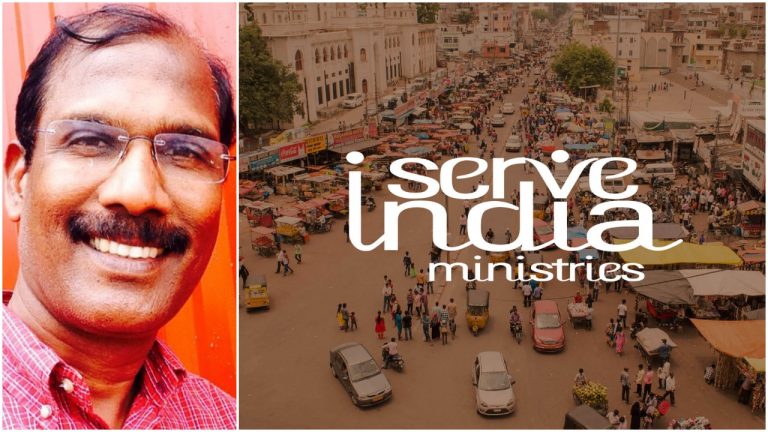
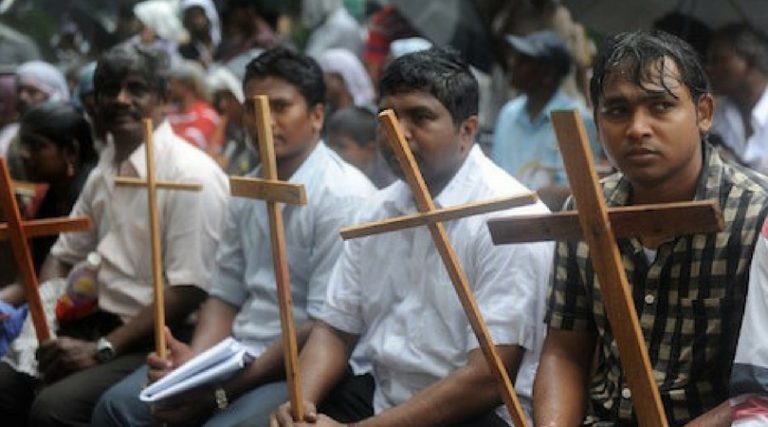
According to the reports, Legal Rights Protection Forum (LRPF) has flagged a web of illegal activities of Christian organisation ‘Serve India Ministries’, including nefarious activities of illegal conversions of poor Hindus using deceit, hate speech, enticements and FCRA violations. Ebenezer Samuel is the head of Serve India Ministries and it is based in Coimbatore, Tamil Nadu.
This comes just weeks after a complaint was filed against Christian organisation ‘Gospel for Tribals Social Service Society’ for indulging in illegal conversions, hate speech against Hindus and FCRA fraud.
In a complaint letter to MHA, the LRPF has accused Ebenezer Samuel, the head of Serve India Ministries and his NGO of being inimical to communal harmony, a multi-religious, multi-ethnic society of India. The evangelist Samuel is also accused of indulging in large scale conversions using inducements, allurements, magic remedies, the threat of incurring divine displeasure.
Meet Mr. Ebnezer Samuel, Chief Functionary, Serve India Ministries (FCRA: 75850282), Coimbatore,TN.
Filed complaint with Union Home Affairs for violating FCRA Rules, Hate Speech against Hindus and Christian Conversions targeting Hindu Children, Women & innocent Tribal people. pic.twitter.com/jYcnZk0HGZ
— Legal Rights Protection Forum (@lawinforce) May 25, 2020
Financial irregularities including FCRA violations
In its complaint to the MHA, the LRPF has stated that the organisation has filed different tax returns in India and USA, raising suspicion regarding its expenditure. According to the LRPF, this is a deliberate attempt by the Serve India Ministries to hide the evangelist activities, church planting and conversion activities carried out by them.
For example, the NGO has claimed tax exemption in its USA IRS Tax Return Form 990 of 2007, citing activities like church planting, spreading of Gospel, child sponsorship programs, training, educational programs, etc. The Christian NGO has also filed similar tax returns in its 2018 USA tax returns and has mentioned similar reasons as its programme accomplishments.
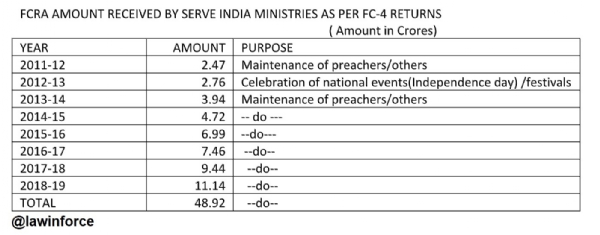
The LRPF documents revealed that the NGO has filed no FCRA returns in India since 2010-11, however, it has been filing tax returns in the USA from the year 2007 onwards. Interestingly, the NGO has also received an amount of Rs 2.76 crores in 2012-13 towards the celebration of National Festivals.
Further, the documents showed that for the last 4 years the NGO was investing substantial part of FCRA proceeds in fixed deposits and deriving interest from the same. To attract prospective donors, Serve India Ministries has produced 8 videos in a DVD and a book with 30 stories from India – “Journey Through India: A 30 Day Spiritual Adventure”. These were distributed for free abroad but not available to India, says the LRPF letter.
Image Source:: Organiser
Hate speech and Church planting
In a speech delivered, the evangelist Ebenezer Samuel openly confesses of being involved in planting churches among the Hindus, Muslims, Buddhists and various other religious groups.
Similarly, in various other evangelical speeches, Ebenezer Samuel has made numerous references to church planting in Hindu villages. He has also bragged about how successful he has been in converting Hindus into Christianity.
As per the Organiser report, in a video, Ebenezer was introduced as “80 % of India is Hindu and only 3.2 % are Christians. However, one man is determined to change that statistic forever”. The NGO spread propaganda to Hindus regarding miracle cures with the power of Jesus. And the gullible Hindus, especially in rural areas who are suffering from health, family or financial problems fall into Ebenezer Samuel’s trap.
Shockingly, the Hindus are referred to as being in “Bondage of Satan for Millenniums”, “Unsaved People”, “Unreached People”. The NGO also pushes narratives such as Hindu gods are “dead gods”, “far way gods”, who are constantly referred to as ‘cruel, revengeful, constantly looking out to pour out their wrath’ on their followers.
“Whenever a Hindu faces a problem, he has to figure out which of the 33 million gods he or she worships has become angry and then do Pooja to appease that angry Hindu god. Hindus are oppressed by their own Gods!” reads NGO’s anti-Hindu agenda as per the report.
According to the complainant, the above anti-Hindu narrative is a clear offence under section 508 of IPC which covers “Act caused by inducing person to believe that he will be rendered an object of the Divine displeasure”.
NGO uses young children to illegal conversions
The LRPF complaint further accused the NGO of committing violations by employing minor children to push for illegal conversions. Under the garb of conducting after school free tuitions, children are forced to go through Christian prayers, Gospel preaching, praying for Jesus etc., the NGO has carried out projects such as “Stepping Stones” and “The Egg Project”.
Reportedly, the “Stepping Stones” has four steps – Education, Hygiene, Prayer, Bible Stories and Gospel. This programme is one of the most important contributors of funds to the NGO from abroad.
The Christian NGO solicits funds from their prospective donors in the USA and elsewhere by marketing these programmes. In most of the speeches of Ebenezer Samuel and the videos of the NGO, reportedly, there are constant references to this method of converting Hindus.
The NGO, to attract young children, provides eggs for free. The NGO even have a special programme to convert to Christianity families of farmers who have committed suicide.
Through another programme, Vacation Bible School, the NGO tries to prey on non-Christian children to convert them to Christianity. According to the NGO, they are conducting VBS for 20,000 children each year with the explicit purpose of exposing such children to Christianity.
In videos and speeches of the NGO, Ebenezer Samuel has shared numerous testimonies of children “Accepting Jesus” and has claimed that their parents are doing well following their conversion to Christianity.
NGO has committed various illegal activities
In addition to illegal conversion, FCRA violations, the NGO – Serve India Ministries is also accused of many other illegal activities. According to LRPF, the NGO is using Dalits in the country as a bait for their conversion activities. In almost all the speeches of the NGO Serve India Ministries, there are references to “Dalits” and “atrocities on Dalits” by other caste Hindus. The NGO also repeatedly claims the government of India as being anti-Christian and pro-Hindu.
The NGO has also continued to conduct its conversion activities even in states that have passed the Freedom of Religion Act, which bans such illegal conversions. However, Ebenezer Samuel has been on record to confess that he has been doing evangelism, church planting and conversion in such states.
Further, the NGO is also accused of violation of Visa norms as many of its foreign preachers arrive in India on tourist Visas and indulge in conversion activities.
Given such illegal activities and FCRA violations of Serve India Ministries, the LRPF has requested to Home Ministry to immediately freeze all FCRA revenues and also the designated bank account. The complainant has also demanded a detailed enquiry into the evangelism, illegal conversion, miracle healing activities of the NGO.
The LRPF has also demanded an enquiry into the assets of Serve India Ministries and personal assets of Ebenezer Samuel.
A similar complaint against another NGO by the LRPF
The Legal Rights Protection Forum (LRPF) had also filed a similar complaint against Christian organisation ‘Gospel for Tribals Social Service Society’ headed by Bishop Jacob Marineni recently for violating the Foreign Contribution Regulation Act (FCRA) and also for indulging in religious conversions through allurement among tribals in Telangana.
The complaint was filed with the Ministry of Home Affairs against the organisation for actively involved in religious conversions of innocent Janjatis (tribals) in agency areas of Khammam District in Telangana.
An investigation carried out by the LRPF has found that the Christian organisation has violated the FCRA by establishing a poultry farm using foreign funds. The accused Evangelical organisation’s preachers have also been allegedly involved in communal speeches against Hindus and Hindu customs at several international platforms.
The onset of the coronavirus outbreak in the country has reportedly spelt doom for many Non-Governmental Organisations (NGOs) as they are witnessing a steady plunge in their already dwindling donations, ss per a report in The Hindu Businessline. While a calamity, especially of the magnitude of coronavirus would have generally garnered outsize monetary contributions for the NGOs, however, the benefits of donating to PM CARES Fund has driven a huge chunk of contributions away from these non-profit organisations.
PM CARES favoured over traditional NGOs
The report states that the NGOs in India are struggling under the long economic shadow of coronavirus. They are facing stiff headwinds from the PM CARES Fund whose inherent advantages are providing donators with enough motives to side with it. Almost all big donations for meeting the emergency have gone to the PM CARES Fund, partly because of its wide publicity and largely because of the 100 per cent tax exemptions allowed for the donations. Those donating to the NGOs stand eligible only for 50 per cent of tax deduction. This has been a powerful reason for many, small and big donators, to contribute solely to the PM CARES Fund.
The launch of the PM CARES Fund has posed a serious challenge to the existing NGOs. The NGOs believe that the ace business magnates in the country would be more inclined to donate towards the PM CARES Fund, considering the appeal made by the Prime Minister and the extensive publicity of the PM CARES Fund. In such a scenario, the NGOs fear that the business leaders would increase their share of donations towards the Prime Minister’s Fund and cut back on the contributions made to the NGOs.
The Bisinessline report also states that the contributions received by the NGOs as a part of CSR activities of organisations have also drastically reduced after the government amended the CSR guidelines, allowing the organisations to treat their donations to PM CARES Fund as a part of their mandatory 2 per cent CSR contribution under the Companies Act. Funds worth Rs 7000 crore which would have otherwise gone to NGOs have been donated to the PM CARES Fund as CSR contribution.
Crackdown on foreign funding
Ever since the Modi government came into power in 2014, there has been a focused attempt to turn off the foreign aid tap to the NGOs owing to the dubious source of the funding and their underlying agenda for pumping money into the country to achieve political goals.
The Narendra Modi government, soon after coming to power, began a process of scrutinizing foreign-funded NGOs in the country. The government has followed a meticulous process when it comes to FCRA rules compliance. A report by CBI in 2015, had revealed that there are more than 31 lakh NGOs operating in the country which received their funds either from the government or from abroad, only a paltry 10% had filed their balance sheet.
Since coming to power in 2014, the Modi government has come down hard against the shady NGOs who have been receiving illicit foreign funding to carry out their nefarious designs in India. Under the Modi government, nearly 18,000 NGOs which were found to be violating the various clauses of the Foreign Contribution (Regulation) Act were stripped of their permission to receive foreign funding.
An analysis of the FCRA data indicates that as on 1st April 2017 the total amount brought forward by the FCRA-NGOs as unspent money from past foreign ‘donations’ is a whopping Rs. 15,907 Crores, more than 50% of which is lying with about 2% of the FCRA-NGOs. As a result of the clampdown by the Modi government against the NGOs, a staggering 40 per cent decline was witnessed in funding from foreign sources in the year 2017-2018 from the levels of external funding recorded in 2014.
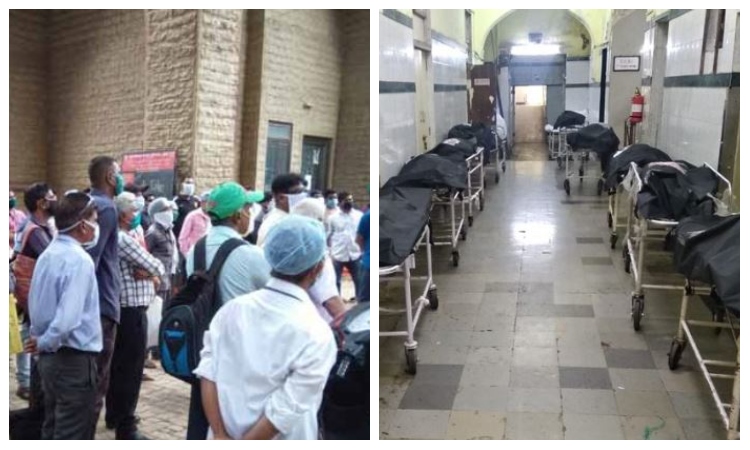
Hundreds of nurses and contractual health workers have gone on a strike in Mumbai’s state-run King Edward Memorial Hospital. The paramedics and doctors have been protesting outside the hospital in masks and protective gears.
As per reports, the protest broke out after a contractual employee working in the Covid-19 ward died on Sunday night. According to reports, he was reportedly unwell and wanted leave, which he was allegedly denied. He was not provided with any sort of facility or help from the administration. His subsequent death has sparked a huge protest outside the state-run hospital.
Protesting employees have demanded that his family should be compensated with a job and financial aid.
#Breaking | Contractual health workers go on strike in Mumbai’s KEM Hospital. Health workers protest shoddy infrastructure in hospitals.
Allegations made by protesting employees of the state-run KEM hospital in Mumbai
The protesting contractual workers have alleged that their supervisor has been making extremely derogatory and mean comments and has been threatening to sack them if they do not turn up to work or work according to the liking of the superiors.
The protesting staff have also highlighted the apathy of the state-run KEM hospital by sharing disturbing images of body bags on stretchers lying unattended in the corridors of the hospital.
BJP MLA Nitesh Rane took to Twitter to share one such image where dead bodies are seen lying in a corridor. He captioned his tweet as: “This is KEM hospital Mumbai!”
Corona infected corpse seen lying with patients undergoing treatment in KEM hospital
The KEM hospital is a dedicated coronavirus facility in Mumbai. Earlier in the month, Nitesh Rane had shared few videos from the same hospital showing dead bodies of coronavirus patients lying in unattended along with those undergoing treatment.
The video shared on May 11 showed at least three bodies wrapped in blue polythene lying next to patients undergoing treatment.
KEM hospital today at 7 am ! I think the @mybmc wants us to get used to seeing dead bodies around us while taking treatment bcz they just don’t want to improve! Feel bad for the health workers too who hv to work in such conditions!! Is there any hope ? pic.twitter.com/E1VsmAveou
Similar images had also emerged from Sion Hospital in Mumbai, which throws light on the apathy of the state-run hospitals in Maharashtra. Political leader, like BJP’s Nitesh Rane and Congress’ Milind Deora, had tweeted about this incident and expressed shock at the state-run hospital’s blatant lapse in managing the coronavirus crisis.
Earlier, a similar incident was reported from the Cooper hospital where a patient was allegedly left unattended and had to spend the night with two corpses around him.
Maharashtra remains the worst-hit state with the total number of coronavirus cases crossing 52,000-mark with 31,000 in Mumbai alone.
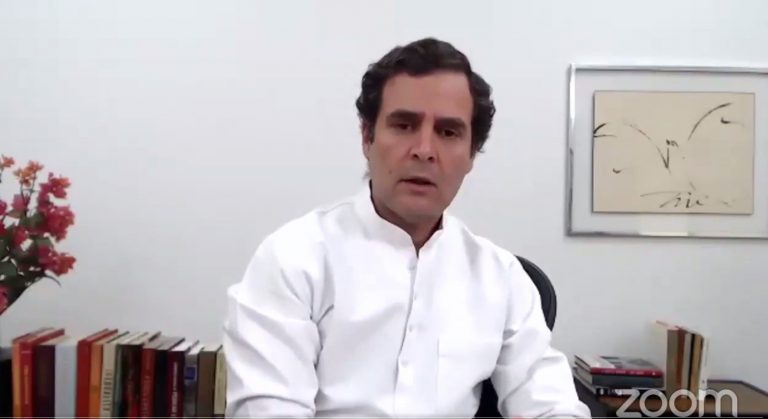
Former Congress president Rahul Gandhi addresses a press conference through Zoom video conferencing today, where again he made contradictory statements on the coronavirus lockdown. While the Gandhi scion termed the lockdown as a failure in controlling the spread of Coronavirus, he criticised the govt for gradually lifting the lockdown.
Rahul Gandhi claimed that the nationwide lockdown was supposed to eradicate the Coronavirus infection in the country, but that didn’t happen. It seems he completely misunderstood the purpose of the lockdown. The lockdown was not supposed to end the infection completely, it was supposed to slow the growth of the disease, and that has been achieved to a large extent. Nobody claimed that emergence of new cases will stop due to the lockdown, as that is not possible with such a highly contagious virus like the Wuhan Coronavirus.
It's pretty clear that aim & purpose of our lockdown has failed. What India is facing now is the result of a failed lockdown. What we, in the Congress party & a lot of others, want to understand is what is the Govt’s view going forward: Shri @RahulGandhi#RahulGandhiVoiceOfIndia
It may be remembered that when the Coronavirus had started to grow in March, the statistical models developed by many experts had predicted millions of cases in India by the month of May. This analysis published by The Print on 23rd March had predicted more than 9 lakh positive cases and more than31000 deaths by May 31.
Ramanan Laxminarayan of Center for Disease Dynamics, Economics and Policy (CDDEP) in the USA, who is had studied Economist but was projected as a health expert doctor by a section of India media, had projected even worse numbers. In an interview with controversial journalist Barkha Dutt, he had claimed that India will see 300 to 500 million cases by July, and 1-2 million deaths. The CDDEP had predicted that India will have 250 million cases by April-May if Lockdown was total failure, and 120 million cases, or 12 crore, if lockdown was successful.
Currently we have around 1.45 lakh cases, no doubt a high number, but this number is much lower than what the mathematical models had predicted two months ago. Therefore, it is completely wrong to claim that lockdown has failed. If Lockdown was not implemented, we would have seen much more cases than we had seen today.
We are now 60 days into lockdown and we’re the only country where the virus is exponentially rising and we’re removing the lockdown: Shri @RahulGandhi#RahulGandhiVoiceOfIndia
While Rahul Gandhi claimed that lockdown had failed to achieve its desired purpose, he also criticised the govt for relaxing it. He said that we are the only country where the virus is exponentially rising and we are removing the lockdown. Earlier too he had spoken against lockdown. In mid-April, he had said that lockdown can’t defeat coronavirus, but now he is criticising the Modi government for lifting lockdown. This is a complete change in position in just one month.
While it is true that new cases emerging every day, it is wrong to claiming it is growing exponentially like Rahul Gandhi said. If the Coronavirus was growing exponentially in India, we would have seen millions of cases as predicted by the experts using statistical models.
It is also important to note that lockdown was successful in containing the coronavirus almost completely in the majority of states, it was growing only in few states. The recent rise in cases in other cases are due to migrants returning from those high coronavirus states to their native states. As these migrants are kept in quarantine, even if the numbers are rising, they don’t pose a risk of community transmission, and that’s why the lockdown can be lifted in those states.
The YSRCP MP Raghu Ramkrishna Raju made an explosive admission on a debate on Times Now where he admitted that the Christian missionaries in Andhra Pradesh are using money to carry out widespread religious conversions in the state.
Raju asserted that the religious conversions in Andhra Pradesh were not a recent phenomenon after Jagan Mohan Reddy assumed the office of Chief Minister but that they continued to happen extensively across the state even before he became the chief minister. He also defended the rampant religious conversions in the state by claiming that such proselytisation was prevalent across the country and was not limited to Andhra Pradesh alone.
“Conversions are happening at many places in the country. It is the money power of the Christian missionaries that they are pumping in money from abroad to carry out their proselytising activities and strengthening their religion. This is happening throughout the country, what are we supposed to do?” said Raju while adding, “India is a secular country and we cannot stop what is happening.”
Raju further said, “In the night these folks(Christian missionaries) go about colonies and areas and preach their religion to the residents in a bid to get them converted. We cannot stop them. It is happening everywhere.” However, the MP added that the Andhra Pradesh state government is not supporting these conversions.
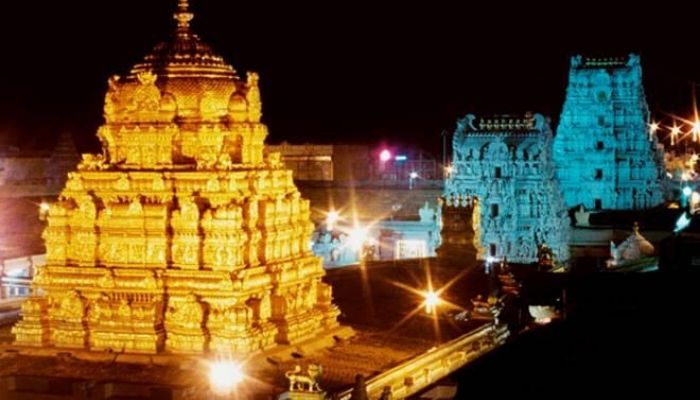
The debate was concerning the recent proposal put forth by the Tirumala Tirupati Devasthanams(TTD) that manages India’s richest temple Tirumala in Chittoor district of Andhra Pradesh, to auction as many as 50 immovable properties of the temple located in different states, creating a furore across the country and triggering protests from opposition parties and Hindu groups.
Andhra Government accused of encouraging conversion to Christianity
Last year, a damning report published in the Sunday Guardian held that the Jagan Mohan Reddy government in Andhra Pradesh was anti-Hindu and provided freebies to people to convert into Christianity. Experts raised their concerns regarding the spree of freebies doled out to the Christian communities by the YS Jagan Mohan Reddy-led Andhra Pradesh government. The freebies were not only causing a loss of public money, but these appeasement schemes are also aimed at encouraging ordinary Andhra citizens to convert, reported Sunday Guardian.
According to the report, the rampant conversion drives in Andhra Pradesh had become a serious issue in the state, which may even take a violent turn if not stopped. The opposition parties in Andhra Pradesh right-wing activists have been accusing YS Jagan Reddy, a Christian that ever since he became the Chief Minister of Andhra, he has spent a huge amount on the Christian community services, with an eye on encouraging conversion activities.
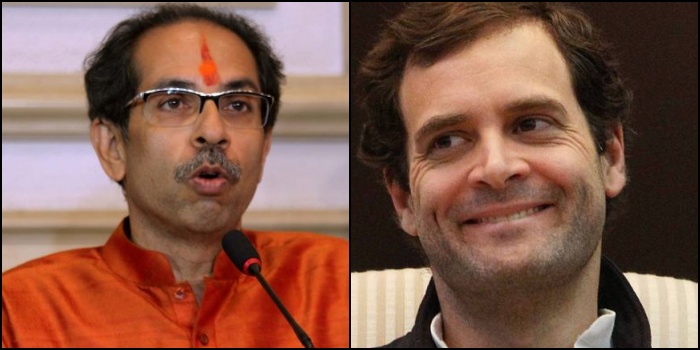
Maharashtra has spiralled into a Coronavirus hotspot state rather quickly with the number of positive cases crossing the 52,000 mark. The state now contributes over a third of the Coronavirus cases in the entire country, with Mumbai being most severely affected. While Chief Minister Uddhav Thackeray has drawn sharp criticism for his handling of the Coronavirus pandemic, Rahul Gandhi, during a press interaction today distanced Congress from the mess being created in the alliance government ruled state.
Maharashtra, which is currently being ruled by an alliance government of Congress, NCP and Shiv Sena, with a Shiv Sena chief minister has now squarely been abandoned by the Congress. Today, during a press conference held by Rahul Gandhi, he was asked about the Coronavirus pandemic and its spread in Maharashtra.
Responding to the question, Rahul Gandhi said that since Maharashtra is most connected and owing to the nature of the state, the spread of the virus in the state was inevitable. However, shielding Congress from sharing any of the governance blame, Rahul Gandhi also said that Congress is not in a decision making role in Maharashtra.
Rahul Gandhi said that there is a difference between running the government and supporting the government in the state. He said that Congress can be considered to be in a decision making role in states like Punjab and Rajasthan, but not in Maharashtra.
While distancing himself from the mess in Maharashtra, Rahul Gandhi also tried to shield his ally, Shiv Sena, by saying that the central government must extend every possible help to the state of Maharashtra in fighting the Coronavirus pandemic. He also said that Maharashtra is fighting a difficult battle, as are many other states, and there should be full support to the state and its people.
Effectively, what Rahul Gandhi seems to have done is put the entire onus of the mess on Shiv Sena and distance his own party, Congress, from the misgovernance the state has seen so far. This claim rings hollow considering Congress has several important ministries in Maharashtra including Education, energy, public works, revenue etc. For Rahul Gandhi to say that Congress is not a key decision maker in Maharashtra is a shoddy attempt of shielding his party from partaking in the misgovernance that has marred the state during the pandemic.
Either way, the undercurrent of Congress trying to distance itself from Maharashtra governance has been rather clear even before Rahul Gandhi spoke up.
Only recently, Sanjay Nirupam had tweeting exposing the abysmal condition of hospitals in Maharashtra amidst the Coronavirus crisis. Nirupam tweeted, “After Sion hospital, this is Rajawadi hospital of Ghatkopar where dead body is lying for hours in an open patient ward.#BMC officials incharge particularly the dean of the hospital must be sacked immediately for this inhuman act”. He followed his tweet up with the hashtag “shameful”.
After Sion hospital, this is Rajawadi hospital of Ghatkopar where deadbody is lying for hours in an open patient ward.#BMC officials incharge particularly the dean of the hospital must be sacked immediately for this inhuman act.#Shamefull#COVID19pic.twitter.com/N5HicGt07w
Then, Prithviraj Chavan, veteran Congress leader had recently remarked that the Maharashtra government is one which is not run by the Maha Vikas Aghadi but one run only by Shiv Sena.
It is apparent that the Congress party, headed by Sonia and Rahul Gandhi are all set to pin the blame of the COVID-19 mess in Maharashtra squarely on Uddhav Thackeray, who had compromised not only politically but also ideologically in his greed for the Chief Minister’s chair while forming an alliance with Congress and NCP.
On Monday, the Government of Andhra Pradesh had reportedly stayed the decision to auction the properties owned by Tirupati Tirumala temple, following vehement opposition from the Hindu community. The State Government had asked Tirupati Tirumala Devasthanam (TTD) to reconsider their decision in light of the sentiments of the devotees. Chief Secretary Praveen Prakash has issued the order on behalf of the Andhra Pradesh government.
Jagan Mohan Reddy-led-Andhra government had said that until a final consensus is reached on the matter, the decision to auction the property will be halted. Moreover, the Executive Director of TTD has been directed to take action and make the government aware of the development through a report.
The Government has also asked senior saints to communicate with the devotees of the temple on how TTD can use temple properties for the propagation of religion, the building of temples, and other religious activities.
Andhra Pradesh government order: Prohibition on auction of property
The current political dispensation of the YSR Congress had tried to pass on the blame to the previous government. The Government argued that the board of the trustees, which decided to auction 50 properties of the temple, was constituted by the erstwhile government of Chandrababu Naidu.
The ‘Rationale’ behind the Auction
Reportedly, the properties that TTD wanted to auction were in fact donated by the devotees to the temple. The Tirupati Tirumala Temple Trust, however, decided to sell them, claiming that they were ‘non-usable’. The said properties are located in Andhra Pradesh, Tamil Nadu, and Rishikesh. The Trust had argued that since the properties were located away from the temple, it was ‘difficult’ to manage them. Several properties had also been encroached upon by miscreants.
Several such lands are being used for agriculture and there are many houses, which are far from the temple. The temple management said that it was incompetent to take care of these properties. Both the BJP and TDP opposed the YRS Congress government against the recent decision.
Objection to the decision of TTD
Rajya Sabha MP and RSS worker, Professor Rakesh Sinha, objected to the decision by writing a letter to the Tirupati Tirumala Devasthanam Board. He informed that in 2016, Chandrababu Naidu’s government took this decision. He wrote in a letter to the chairman of the trust that the Board should seek the help of devotees to manage the properties that are away from the temple. Sinha emphasised that the sentiments of devotees are attached to these temple properties.
Thanks to #TTD Chairman @yvsubbareddymp Garu for accepteing d demand to defer d process to sell Balaji Tirupati’s some properties & bring d matter in TTD Board to reexamine & review. It is an honour of religious sentiments of lmillions of devotees as well as democratic tradition. https://t.co/6dut1CHyqm
Telugu actor turned politician Pawan Kalyan had earlier urged devotees and his party leaders to attend the hunger strike against the decision of the Andhra Pradesh Government to sell Tirupati temple property.
I request all Lord Balaji Devotees , Janasainiks, Veermahilas and JSP Leaders to participate in this hunger protest against the sale of TTD lands by AP Govt. pic.twitter.com/zuLsUDLw4p
BJP MP from South Bengaluru, Tejasvi Surya, had urged Hindus to vehemently oppose the contentious move by the Andhra Pradesh government. Condemning the decision as ‘highly deplorable’, he asked the State BJP and actor Pawan Kalyan to fight against this issue until the Government reversed its stand.
AP Govt’s decision to sell assets of Tirupati Devasthanam is highly deplorable. We must oppose this tooth & nail.
I request Sri @PawanKalyan Garu & BJP in AP to fight this issue until the govt reverses it’s stand.
In the longterm, we must get temples out of state control.
It should be mentioned that this is not the first time that Tirupati is selling the properties of the Tirumala temple. Between 1974 and 2016, 129 such properties which were sold for auction.
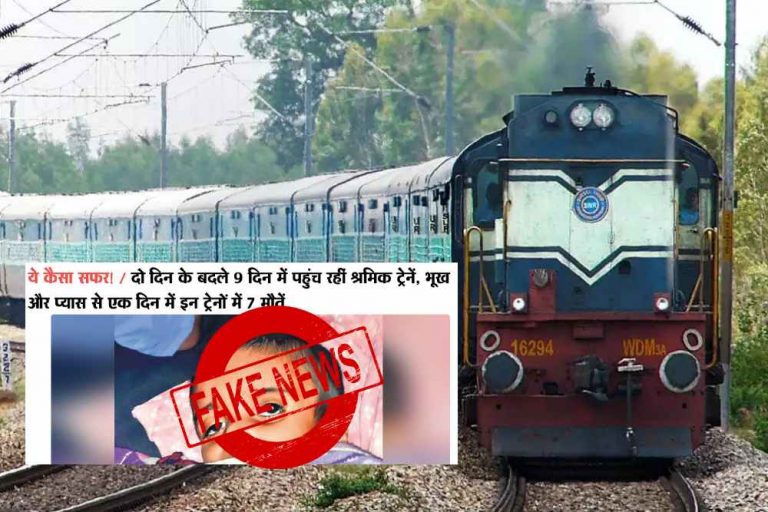
The Indian Railways today called out the Dainik Bhaskar report which claimed that Shramik Express trains run by the Railways were were delayed by a week because of which as many as seven people lost their lives. In its report, Bhaskar had claimed that the bus which left for Siwan from Surat on 16th May reached its destination on 25th May and amid all this, many people lost their lives due to the heat, lack of water and food.
The report is filled with errors and half-truths. The 2 trains from Surat reached Siwan on 25th in two days time instead as reported 9 days. The Child was ill & returning from Delhi after treatment. The cause of death can’t be determined without post mortem. https://t.co/YhfM7Cvlxx
— Spokesperson Railways (@SpokespersonIR) May 26, 2020
The Indian Railways said that the trains which reached Siwan on 25th May had departed Surat on 23rd May and reached within 2 days and not 9 days as reported by Bhaskar. In fact, sources in the Railways ministry confirmed with OpIndia that no Shramik Express train departed from Surat for Siwan on 16th. “Train no. 09339 departed from Surat at 0530 hours on 23rd May and arrived at Siwan on 25th May at 0220 hours. Train no. 09439 departed from Surat at 2300 hours on 2rd May and arrived at Siwan on 1655 hours.
Dainik Bhaskar report mentions about one Anwar who had boarded the Shramik Express from Mumbai’s Bandra on 21st May to Katihar. The report states that Anwar bought Sattu for Rs 10 and when he got off the train to buy water, he died. Sources in the railways ministry say that he had fallen unconscious between platform 7 and 8 under water pipeline at Barauni railway station. Doctor from state medical team examined him and declared him dead. The cause of death is still under investigation. Similarly, further details are awaited on demise of Nasir Khan who passed away on the Palghar-Danapur Shramik Express.
Moreover, the report talks about death of a 4 year old Mohammad Irshad who passed away while boarding the train from Muzaffarpur to Betiya. The Railways clarified that the child was ill and was returning from Delhi after treatment. The cause of his death will be known only after postmortem is carried out.
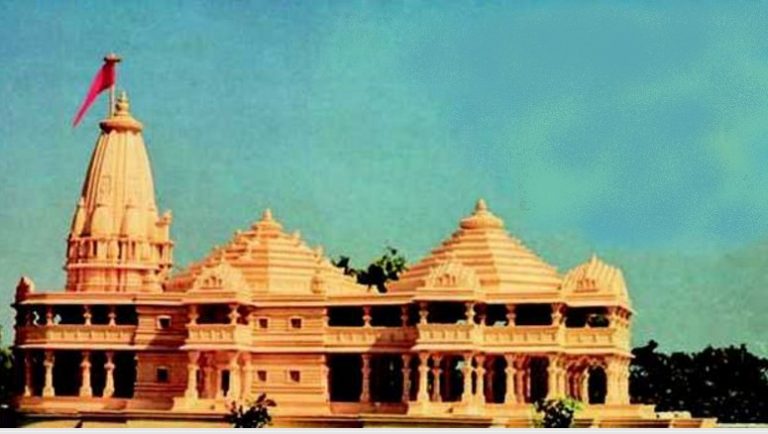
Mahant Nritya Gopal Das, the Chairman of Shri Ram Janmabhoomi Theertha Kshetra Trust, on Monday visited Ram Lalla, the infant Lord Ram, as he is worshipped at his birthplace Ayodhya, after 28 years and performed pooja at the holy site in Ayodhya. He took stock of the situation for the construction of Ram temple at Ayodhya after the initial levelling work was completed.
According to the reports, Mahant Nritya Gopal Das, after visiting the Ram Lalla on Monday, later visited the temple site and inspected the levelling work going on there. “The temple work has already started and this is a land of purity and devotion,” he said.
Speaking to the media, Mahant Nritya Gopal Das said that he came to offer prayers after twenty-eight years because the Ram temple dream was turning into reality. The Mahant said that he did not visit the temple after the demolition as he could not bear to see Lord Ram living in the open.
Excavation during construction finds old Hindu structures
During the excavation carried out for the construction works for the temple in the Ram Janmabhoomi in Ayodhya, the remains of Hindu stone sculptures, including a Shivling, broken-idols of Hindu deities, and carved pillars of Indic design were found near the site on Wednesday.
According to Shri Ram Janmabhoomi Teerth Kshetra, as the work for levelling of land and removal of the gangway in Shri Ramjanmabhumi Complex was resumed on last Wednesday after the coronavirus lockdown, the workers at the site unearthed the remains of pillars adorned with old Hindu carvings, likely of a temple during the excavation.
The objects included various archaeological artefacts and stone pillars with carvings of flowers, Kalash, Aamalak, etc, said Shri Ram Janmabhoomi Teerth Kshetra trust. During the excavation, a 5-feet Shivaling, 7 carved pillars of Black touchstone, 6 carved pillars of red sandstone and broken idols of Hindu gods were also found. The trust said that the work is still continuing at a slow pace due to the restrictions.
Shri Ram Janmabhoomi Trust receives Rs 4.6 Crore in donations
Despite a nationwide coronavirus lockdown, Shri Ram Janmabhoomi Theertha Kshetra Trust, which is responsible for the construction of Ram temple in Ayodhya, has received Rs 4.60 crore as donations from devotees across the country, for the construction of Ram Mandir.
Acharya Satyendra Das, the chief priest of the Ram temple, said, “We are confident that there will be no shortage of money for the temple. People are donating huge sums of money for the project and we will make sure that the temple that is built is unmatched in magnificence and grandeur.”
The trust, in March, had declared its bank accounts to enable people to make donations through e-banking.