Home Blog Page 5491

Enforcement directorate discovers trust associated which Tablighi Jamaat, transactions worth crores of Rupees under scanner

0

In an important development into the investigations against Tablighi Jamaat, the Enforcement Directorate has found out the alleged trust which is known to be funding the orthodox Islamic religious sect. The name of the Trust is ‘Kashif ul Uloom’. The man associated with the trust and their bank account has also been discovered. Now ED is looking into the financial transactions of the trust. As per reports, some ninety lakh rupees have been sent abroad through that bank account.

The probe agency was investigating the case under the Money Laundering Act. The Agency had sought information from the Income Tax Department and other government institutions about the trust associated with the Jamaat. But couldn’t trace the funding trust.

As per reports, the name of the trust is Kashif-ul-Uloom and the Bank account associated with the trust is in Nizamuddin’s Bank of India. The ED will issue a notice to the Bank of India seeking information about the Trust’s bank account.

During the investigation, the names of many common people have been revealed. One of them is Nizami who has the business of perfume and hotel. Apart from that, a person named Abbas Afghani is also suspected and allegedly said to be in hawala business. ED expects that much important information will come out of this inquiry.

Also, the documents sent by Delhi police are being translated from Urdu to Hindi, which can reveal more important facts after translation. As per reports, the activities of money laundering aren’t connected to Maulana directly but as the investigation is progressing the ED is screening the Mulana and his close ones.

The inquiries conducted over the bank documents and other documents related to trust and Tablighi jamaat can play an important role in tightening the clutches.

According to the Crime Branch of Delhi Police, which is investigating the finances of Tablighi Jamaat, its chief Maulana Saad has been receiving money in the tunes of millions from anti-national forces. They have also asserted that the money received by Tablighi Jamaat is being made under the guise of donation for religious education. The role of accused Maulana Saad’s acolyte, Javed, is also under scanner as the police have accused him of transferring millions of rupees every day to Markaz’s account in batches from different bank accounts to escape scrutiny.

Cases filed against Maulana Saad

Maulana Saad was booked under The Epidemics Act 1897 for allowing religious congregation in the month of March despite repeated warnings from the centre and the state government. He disregarded the guidelines issued by the government in the light of the Wuhan coronavirus epidemic which is spreading rapidly.

In addition, the Delhi police have also charged Tablighi Jamaat Chief Maulana Saad Kandhalvi for culpable homicide not amounting to murder. The charges of culpable homicide under Section 304 of the Indian Penal Code was added to the FIR that was already lodged against the religious leader on March 31.

Furthermore, the Enforcement Directorate has registered a money laundering case against the Tablighi Jamaat Chief Maulana Saad Kandhalvi and nine others on Thursday under the Prevention of Money Laundering Act (PMLA) based on predicate offence that is registered by Delhi police.

IMCT chief writes strongly-worded letter to the West Bengal Chief Secretary complaining of non-cooperation in Coronavirus inspection

On Saturday, the leader of the Inter-Ministerial Central Team (IMCT) in West Bengal wrote a letter to the Chief Secretary of the State government, complaining about inadequate security and non-cooperation.

The letter began by reminding the State Government of the order issued by the Ministry of Home Affairs (MHA) on April 19 wherein it categorically stated that the Mamata Banerjee-led-West Bengal Government would provide logistical support and cooperation during a visit to local areas, procurement of documents and records as requested by IMCT.

The team leader further complained that four letters had been written to the State Government since April 20 but no response had been received for the same. IMCT alleged that in gross violation of the MHA order, the Chief Secretary of the government had made media statements refusing to allow senior officials to accompany the team, under the pretext of “not wasting their time.”

The leader of the team further revealed that while a presentation was made by the State Health Department on 10 aspects sought by IMCT, the hard copy of the presentation was not provided to the team. IMCT has also rebuked the Chief Secretary and made it clear that the stand of the government must be highlighted through written communication and not media statements.

IMCT complains about non-cooperation

On Tuesday, the Ministry of Home Affairs has said in a statement that the Inter-Ministerial Central Teams (IMCT) appointed by the Centre to make an on-spot assessment of Coronavirus situation has received support, with the exception of West Bengal, from local administration and State Governments in Rajasthan, Madhya Pradesh, and Maharashtra.

The MHA stated that the IMCT which visited Kolkata and Jalpaiguri were being stopped from visiting the designated areas. They were reportedly also barred from interacting with the local health workers. The Central Government has also written a letter to the State asking for the enforcement of April 19 order besides facilitating the assessment team in doing their job.

Mamata Banerjee stays defiant

On April 20, the West Bengal Chief Minister Mamata Banerjee questioned the formation of IMCT constituted by the Central Government for quick redressal of coronavirus crisis in states, claiming that it is ‘not consistent with the spirit of federalism’. The Central government constituted 6 IMCT to make an on-spot assessment of the coronavirus situation and issue necessary directions to state authorities for its redressal.

The IMCT would also submit its report to the central government in the larger interest of the general public. These teams would visit West Bengal, Rajasthan, Madhya Pradesh, Maharashtra, and Rajasthan to ensure that lockdown is implemented there. Earlier, she had said she would not allow usage of PPE kits sent by the Centre as they were yellow in colour.

Here is why it is necessary to call out the Muslim community after the Tablighi Jamaat fiasco

India was dealing with the Coronavirus pandemic rather well. In fact, there was a point when Western Media was tacitly hoping that more people would die in India just so they could feed their white-supremacist ego and claim that the unwashed masses couldn’t possibly deal with a pandemic better than the “civilised” world.

Enter Tablighi Jamaat.

The cases spiked and spiked how. As per the Home Ministry, over 4000 cases in India are either members of the Tablighi Jamaat or those who came in contact with the Tablighi Jamaat. The fact that the Jamaat is responsible for an overwhelming number of cases is not the point of contention here. Frankly, a contagion could get anyone, any gathering, any religion, caste, creed or gender. It is the willful and shameless conduct of the Tablighi Jamaat that made them the focal point of the discussion that the Minority Commission is now miffed about.

After the Tablighi Jamaat event undermined India’s fight against Coronavirus, the criticism not only of the Tablighi Jamaat but the Muslim community, on the whole, has seen an unprecedented upswing. Rightly so, perhaps. But the criticism itself has not sat well with the Minority Commission of India or politicians who have based their political careers on mollycoddling the Muslim community.

The Union Government set up the National Commission for Minorities (NCM) under the National Commission for Minorities Act, 1992. Initially five religious communities, viz., Muslims, Christians, Sikhs, Buddhists and Zoroastrians (Parsis) were notified as minority communities by the Union Government. Further, vide notification dated 27th January 2014, Jains were also notified as another minority community.

The Minority Commission Joint Secretary has written to Press Information Bureau (PIB) to ensure that through them, the message is given to the country that the entire Muslim community cannot be held responsible for the actions of Tablighi Jamaat.

“While such action by the Jamaat attendees is highly condemnable and merits suitable action by the authorities, it may be appreciated that these persons do not represent the entire Muslim community and holding the whole Muslim community responsible for actions of the Tablighi Jamaat attendees is wrong and uncalled for,” Richards said in the letter.

The Muslim community members are complying with the lockdown directives as rest of the citizens, the letter said.

The commission feels that there is an urgent need to present the correct picture in the media that the members of the Muslim community should not be linked to, and held responsible for the outcome of the actions of the Tablighi Jamaat attendees, the NCM joint secretary said.

“I request you to take necessary steps to ensure that this message is adequately conveyed in the country through all mediums of the media immediately,” the letter to the government’s principal spokesperson said.

Firstly, the basic premise of a ‘minority commission’ is rather Abrahamic. The assumption that Hindus would somehow oppress minorities is a notion that stems from the conduct of Abrahamic faiths and their conduct when they become the majority in any part of the world. One only needs to look towards younger, unruly neighbouring Islamic nations if one wants proof. Or better yet, one can simply read the history of the now Union Territory of Kashmir, and unless one has intellectual blindfolds on, the truth would be apparent.

Secondly, even if we submit to the notion that minorities need a body to protect their right, a minority that is well over 24% of the world population and in India, well over 15% amounting to almost 11% of the world population of Muslims, protection of rights being suspiciously blended with shielding them is a problem that is less spoken of.

One might notice that I mention Muslims and not Parsis or even Jains because, frankly, the Minority Commission has hardly ever spoken for other minorities. Not too long ago, there was a case where a sick Sikh man was thrashed brutally for refusing to convert to Islam. This happened in Punjab, there Sikhs are supposed to be the majority community. The Minority Commission, that should have spoken up for the Sikh man was conspicuously silent. Not a word of condemnation was offered because that would defeat the tacit function of the Minority Commission.

Not that the Muslim community is ever shy on reasons to call themselves the victims, with the Coronavirus pandemic, the syndrome has taken epic proportions (yes, it could get worse. The joke is on you if you thought it couldn’t).

Having said that, I understand where the Minority Commission is coming from because the trope is age-old and almost seems like a broken record now. “The Muslims Community, on the whole, cannot be held responsible for the action of a few”. It is a trope we have heard all too often. After every transgression, terror attack, riot, total disregard for public safety, laws, decorum, decency, murder etc, we hear the trope that the Muslim community, on the whole, cannot be held responsible. And that is not untrue, altogether. It is true that a large portion of the Muslim population is staying home, adhering to the lockdown (in the case of Coronavirus) or even refrain from subscribing to radical views. But there are two aspects to this that need to be discussed before following that trope, repeatedly, for every crime that is routinely committed by the Muslim community.

Taking the current scenario as an example, it is obvious that not all Muslims of India are out on the streets, spitting on Kaffirs and beating medical and police personnel up. However, it is also worthy to note that there is a large section belonging to a specific community that is indeed indulging in such delinquent behaviour. It is true that Tablighi Jamaat hid their travel history. It is true that Tablighi Jamaat members defied lockdown orders. It is true that Tablighi Jamaat members are misbehaving with medical personnel while in quarantine. It is true that they were hiding in Mosques across the country aided by Mullahs and Imams. It is true that Muslims have defied lockdown rules every Friday for Jummah Namaaz. It is true that Muslims have pelted stones at healthcare officials and police personnel throughout the country. It is true that these elements belong to the Muslim community and their conduct stems from their deep-seated faith in their religion.

In such a scenario, when the delinquents undermining the fight against a pandemic, where at huge personal cost, over a billion people are staying home, making sacrifices, belong to the same community and their delinquency stems from either their religion or the herd mentality that comes from their religion, it is only fair that the community as a whole is questioned. To question the community, the operative analysis to be done is whether the delinquents were acting because of their personal motivations or community and/or religious motivations. It is abundantly clear that the motivations were religious and/or community loyalty. They pelted stones because they did not want the police to quarantine the local Mullah. They defied lockdown because their religion mandates community Namaz. They hid in Mosques, not homes. They were sheltered by Imams. And when the entire community is involved in the perpetuation of a crime affecting the entire country, the assumption that “all Muslims should not be questioned” is a mollycoddling technique that is employed time and again to shield the Muslim community from being held accountable for their actions.

For a moment, to understand the gravity of the situation, let us flip the situation. What if Temples across the country were hiding Hindus who had attended a religious gathering and were infecting people by the hundreds? What if Hindus were spitting on Muslims and in some cases, deliberately trying to infect people who don’t follow Hinduism? Would the argument be the same? Would Hindus, as a community, not be blamed? Would the community participation in hiding the criminals not be a subject of discussion?

It would, because no other community gets a free pass and an honorary lifetime membership of the victimhood community like Muslims. What ebbs the community to continue to indulge in this behaviour is the embarrassing bigotry of soft expectations that the Liberal word seems to have from the Muslim community. ‘Secularism’ in its modern glory demands that a long rope is given to Muslims in particular and thus, even a Muslim being a normal human being and not killing Kafirs is seen as an act that must be rewarded and hailed for its heroism. This, coupled with the street veto that Muslims enjoy makes it almost impossible to be remotely honest.

The famous punchline for any sort of violence that the Muslim community indulges in is that “they were provoked”. Overnight, good Muslims seem to turn into the very ‘radicals’ against whom the ‘good Muslims’ are supposed to be a shield. When Charlie Hebdo happened, the party line was that freedom of speech has limits and that nobody should be offended to point that they lose their minds and resort to violence. When the recent Delhi riots happened, the defence was that their mythical oppression under big-bad Modi led to them slaughtering Ankit Sharma and dumping him in a drain. When the first bout of riots happened in November, during the anti-CAA protests, the defence was that they are scared about them being othered and their citizenship being revoked, a lie spread by the very Islamists and their enablers who were rioting on the streets.

Every act of violence by the Muslim community is protected by the same argument – ‘they were provoked’. And this argument is craftily used to ensure that the fear of provoking the Muslim community burns fresh and bright in the hearts of the Kafir.

Christopher Hitchens, may peace be upon him, defined this phenomenon rather brilliantly. In an essay headlined, ‘God-Fearing people, Why are we so scared of offending Muslims?’, Hitchens writes:

Islamic belief, however simply or modestly it may be stated, is an extreme position to begin with. No human being can possibly claim to know that there is a God at all, or that there are, or were, any other gods to be repudiated. And when these ontological claims have collided, as they must, with their logical limits, it is even further beyond the cognitive capacity of any person to claim without embarrassment that the lord of creation spoke his ultimate words to an unlettered merchant in seventh-century Arabia. Those who utter such fantastic braggings, however many times a day they do so, can by definition have no idea what they are talking about. (I hasten to add that those who boast of knowing about Moses parting the Red Sea, or about a virgin with a huge tummy, are in exactly the same position.) Finally, it turns out to be impossible to determine whether jihad means more alms-giving or yet more zealous massacre of, say, Shiite Muslims.

Why, then, should we be commanded to “respect” those who insist that they alone know something that is both unknowable and unfalsifiable? Something, furthermore, that can turn in an instant into a license for murder and rape? As one who has occasionally challenged Islamic propaganda in public and been told that I have thereby “insulted 1.5 billion Muslims,” I can say what I suspect—which is that there is an unmistakable note of menace behind that claim. No, I do not think for a moment that Mohammed took a “night journey” to Jerusalem on a winged horse. And I do not care if 10 billion people intone the contrary. Nor should I have to. But the plain fact is that the believable threat of violence undergirds the Muslim demand for “respect.”

He further writes:

It is often said that resistance to jihadism only increases the recruitment to it. For all I know, this commonplace observation could be true. But, if so, it must cut both ways. How about reminding the Islamists that, by their mad policy in Kashmir and elsewhere, they have made deadly enemies of a billion Indian Hindus? Is there no danger that the massacre of Iraqi and Lebanese Christians, or the threatened murder of all Jews, will cause an equal and opposite response? Most important of all, what will be said and done by those of us who take no side in filthy religious wars? The enemies of intolerance cannot be tolerant, or neutral, without inviting their own suicide. And the advocates and apologists of bigotry and censorship and suicide-assassination cannot be permitted to take shelter any longer under the umbrella of a pluralism that they openly seek to destroy.

Thus, the Tablighi Jamaat members are shielded today by saying that not all Muslims can be branded because of the action of a few, because we cannot offend Muslims. After endangering an entire country and infecting thousands, they are hailed as heroes because reportedly, some of them have decided to donate plasma in order to help other Coronavirus positive patients. They are shielded by demonising those who question. By calling them bigots, saffron terrorists, Hindu extremists etc.

And then the minority commission steps in the formalise the diktat – thou shalt not criticise. Thou shalt not question. The governments are instructed to ensure that the outlandishly special community has a supply of fruits while they observe Ramzan while no such concern is expressed by pretty much anyone when Hindus were observing Navratri fasts. A man is booked under sedition laws because he did not accept delivery from an individual who was scratching himself and not wearing a mask, simply, because he happened to be a Muslim.

Tablighi Jamaat is turned into “single source event” or even, “special operation” because the cardinal rule – Thou shalt not offend Muslims.

There comes a time in the journey of every country, where the truth, as apparent as it is, becomes the subject of debate. The truth is then demonised, hated, shunned, discredited. Those who dare are branded. This phenomenon is not incompatible with the global trajectory. One recalls how women were branded witches and those who claimed that the earth is spherical were called lunatics or worse, blasphemes. India stands at the precipice today and I daresay, while it has known the truth, in its heart of hearts for long, the ‘witches’ were banished for even whispering the truth lest it offends the heretics.

This phenomenon seems to be amplified by every individual in power, entrusted with the responsibility of treating citizens equally. While the Hindu community gets even more miffed with every passing “single source” incident, even the constant demonisation of the Hindus for expressing their angst has failed to uphold the mythical values of ‘secularism’, as we see more and more people refusing to even buy groceries from Muslims.

In my mind, there are only two possible solutions to an impossible conundrum.

Firstly, the Omertà of silence has to be broken. The world cannot tip-toe around the Muslim community and mollycoddle them at every given transgression simply because offending them seems to be a far costlier option that ends with invariable bloodshed or demonisation. And secondly, like one of the greatest Muslims to walk the pious land of Bharat, Dr Avul Pakir Jainulabdeen Abdul Kalam, pious Muslims need to up their Kaffir quotient and rely on coexistence, science and modernity far more than dogmatic beliefs that push them into ghettos. The Omerta that is in place to ensure that Muslims don’t get offended is also a disservice to those Muslims who do not subscribe to these views or behaviour. In fact, I would go as far as to say that the Minority Commission, by shielding the behaviour of a large section of Muslims, is complicit in the branding of decent Muslims because they are seen working for the benefit of the delinquents.

Not all Muslims are bad. Not all Muslims defy the basic principles of humanity. But the Community must stand scrutiny when an entire nation’s sacrifices are being flushed down the toilet because one community refuses to assimilate and submit to the laws of the land.


Coronavirus: UP CM Yogi Adityanath bans public gatherings in the state till June 30

0

The office of Chief Minister of Uttar Pradesh quoting the chief minister declared on Friday that no public gatherings will be allowed to take place till June 30. The office of Yogi Adityanath announced, “The chief minister has directed officers that no public gathering be allowed till June 30. Further decision will be taken depending on the situation.”

He also directed the officials to keep a check over fake reporting. CM Yogi Adityanath held a meeting with 11 committees of the state over the COVID-19 situation.

The country is already observing a lockdown till May 3 because of the severe health crisis due to coronavirus pandemic.

The CM Office declared that “order will be reviewed depending on the current situation” amid the speculations of the extension of lockdown. UP has a total of 1621 coronavirus cases so far.

Prime Minister Modi will also be holding a meet with the Chief Minister of states on Monday.

The countrywide lockdown that started from March 25 has been extended till May 3. On 25 April 2020, there are 24,506 cases with a surge of 1054 cases in 24 hours. 5063 people have been recovered while 775 have died due to Wuhan coronavirus.

Here is the list of clarifications issued by the Home Ministry regarding the relaxation to open shops selling non-essential items

The Ministry of Home Affairs issued several clarifications regarding the notification that was issued last night allowing shops of non-essential items to open in the country from Saturday. As the notification was in legal language, it had created confusion about which shops are allowed and which are not, which prompted the ministry to issue a series of clarifications.

Rural vs Urban, Standalone vs Market Complex shops

The first clarification states that shops can resume the functions in rural as well as urban areas. According to the guidelines, the shops in urban areas can open only if they are standalone or present in residential complexes. Thus all standalone shops/neighbourhood shops and shops in residential complexes are now allowed to open in urban areas.

In rural areas, all shops, both standalone shops and shops inside market complexes can open, but shopping malls will remain close.

Shops in single and multi-brand malls would not be allowed to open anywhere.

Only 50% staff allowed in shops

Although shops of non-essential items have been allowed to open, they can’t operate in full capacity. The shop-owners should work with 50% strength of its workers. Moreover, wearing of masks and observing social distancing has been made mandatory for the staff working in the shops.

No Alcohol, tobacco, gutka, No e-commerce in non-essential items

Further, the MHA has clarified that the sale of liquor and other items continues to be prohibited as specified in the National Directive for COVID-19 management. Meanwhile, the MHA has not changed its stance after it issued a statement on April 15 regarding the sale of tobacco, wine and gutka. Substances like gutka, tobacco and alcohol have been banned, according to the guidelines.

The Union Home Ministry, which is supervising and monitoring the countrywide shutdown, also said that “sale by E-commerce companies will continue to be permitted for essential goods only.”

Several states had already announced that they would not allow the sale of alcohol until April 30, 2020. However, that deadline will extend till May 3. Some states had earlier allowed the sale of alcohol in the states, but after MHA had clarified that liquor shops can’t open, they were closed.

The MHA also clarified that E-Commerce companies will be permitted to sale essential items only. Even though brick and mortar shops for non-essential shops have been allowed, the same has not been allowed for e-Commerce companies.

No Salons, No Restaurants

Bad news for those waiting for a haircut for over a month now, as another clarification issued by the MHA stated that all restaurants, salons and barber shops will remain closed during the lockdown period. The ministry clarified that the relaxation has been granted to only those shops which sale items, but these establishments provide services, do not sale products.

No exemptions in hotspots, containment zones

As specified in the consolidated revised guidelines, these shops will not be permitted to open in areas, whether rural or urban, which are declared as containment zones by respective States and union territories.

Even though the union government has allowed to open shops selling non-essential items, shops in several states are yet to open as the respective state governments will have to issue directives regarding the same. It is expected that the states will issue directives on Monday, after the scheduled meeting of the PM with CMs through video conferencing on Monday morning.

The month-long Coronavirus Lockdown has crippled the economy, and it is expected that opening of the shops will bring a huge relieve to traders and consumers.

Netizen starts drive to collect funds for family of driver lynched in Palghar along with Sadhus, Raveena Tandon appeals for help

0

The brutal lynching of Swami Kalpvriksha Giri, Sushil Giri and their driver in Palghar, Maharashtra has shocked the nation out of its wits. To help the family of the driver Nilesh Telwade, a fundraising campaign has been launched. Now Bollywood actress Raveena Tandon has supported the campaign to extend help to the family of deceased Palghar lynching victim Nilesh Telwade and appealed all to contribute to the campaign.

Uploading a video of the deceased driver Nilesh Telwade’s mother, brother, wife and both daughters and sharing the link of a website where one can donate, Raveena Tandon tweeted: “A fundraiser for the 29 yr old driver who was lynched along with Hindu sadhus. He leaves behind two little girls, please do your bit and help this family.”

The fundraising has been launched by social activist Ritu Rathaur with a goal to raise Rs 30 lakh. According to the fundraising website, the campaign has already collected Rs 27.40 lakh for the driver’s family.

Twentynine-year-old Nilesh, a driver by profession, was lynched along with two sadhus by a mob of over 200 people in Maharashtra”s Palghar last week. Nilesh Telwade’s untimely death has left his family including his wife and two little daughters in a helpless condition.

Palghar Sadhus lynched

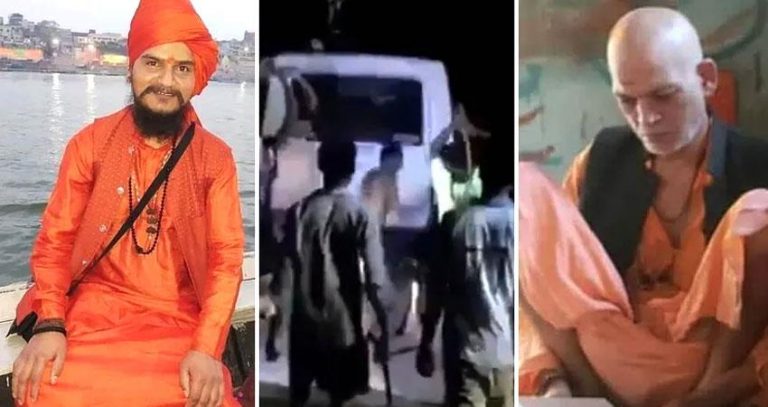
The blood-curdling incident happened on 16th April 2020 in Palghar, Maharashtra. Two Sadhus, 70-year-old Kalpavrishka Giri Maharaj and 35-year-old Sushil Giri Maharaj along with their driver 30-year-old Nilesh Telgade associated with the Juna Akhara and were on their way from Mumbai to Gujarat to give Samadhi to another Sadhu.

Owing to the rumours child abduction and organ harvesting when the Maruti Eeco, the Two Sadhus were travelling in drove past Gadchinchle around 8 pm on April 16, the men of Gadchinchle, Divshi, Dabhadi, Talavli and Rudana were ready, with torchlights and bamboo sticks. The Eeco was stopped barely 1 km from Gadchinchle, at a lockdown barricade manned by guards from Dadra-Nagar Haveli, and turned back. It was then the wild and frenzied crowd of over more than 100 people attacked them. The villagers deemed them as thieves and started attacking them. The police claim that their team which had rushed to the spot to rescue the 70-year-old man also came under the attack of the violent mob.

Horrifying visuals of the Palghar lynching incident where a mob of over 100 people killed two Sadhus and their driver even as the Police stood there as mute spectators, just letting the barbaric act unfold, had gone viral on the social media.

People of the Sadhu community say that this village is tribals dominated and most of them are Christians while some are Muslims. Some even say that the police, out of fear of the tribals, handed over the Sadhus to the mob which later beat up those Sadhus to death with sticks. Reportedly, when the tribals of a particular religion started beating up the Sadhus, the police did not intervene.

TMC MP Nusrat Jahan defends her TikTok dances as an ‘entertainer’, labels who question her silence over protests for food in her constituency as trolls

0

While many politicians, including Prime Minister Narendra Modi, have buckled down in their efforts to stop the spread of coronavirus outbreak in the country, some politicians like the Trinamool Congress leader Nusrat Jahan are busy ‘entertaining’ people with their dance moves.

Following the crippling nationwide lockdown that hobbled economic activities and deprived the daily wage labours of food and jobs, many politicians presided over the task of distributing food to the needy in their respective constituent assemblies. However, the Basirhat MP Nusrat Jahan did not consider it worth going through the rigamarole of distributing food and items of daily necessities to those in need in her constituency. Instead, the actor-turned-politician was occupied with uploading her dancing videos on the popular video-sharing app TikTok.

@nusratchirps

#Savage #savagechallenge #fyp let’s do it @mimichakraborty86 @srabantigintu my #savagegirls

♬ Savage – Megan Thee Stallion

In fact, when social media users called her out for her apathy towards the sufferings of the people of in her constituency, she brazened it out on Twitter by sharing another video and saying, ‘An Artist always entertains’ while terming those who questioned her misplaced priorities amidst calamity as ‘trolls’.

Earlier, the people of a village in Nusrat’s constituency, Basirhat, staged a protest for the paucity of food during the nationwide lockdown. There is simmering discontent in the region as locals have protested against the lack of or irregularities in ration distribution. Recently, there occurred a pitched battle between people and the police in the Baduria district of Basirhat. The residents of the village have alleged irregularities in the distribution of relief. Several policemen sustained injuries in the clashes, including the officer in charge of Baduria police station.

However, the MP of Basirhat, Nusrat Jahan, had no concerns for the tribulations faced by the members of the constituency that elected her to the parliament. Instead, Nusrat brazenly defended herself, sharing another video while exhibiting a blithe indifference to the starving people in her constituency.

TMC government in West Bengal accused of mishandling the coronavirus outbreak

The Mamata Banerjee-led TMC government in West Bengal is accused of bungling the coronavirus measures in the state. Tensions have run high between West Bengal chief minister Mamata Banerjee and governor Jagdeep Dhankhar after angry exchanges over issues like curfew protocols, coordination on relief measures and the visit of a central team to check for coronavirus measures.

Fearing that the extent of coronavirus outbreak in the state is underreported, the inter-ministerial central team(IMCT) had sought the methodology from the West Bengal Audit Committee that they used in ascertaining the number of coronavirus deaths in the state.

Kashmir police stop handing over bodies of slain terrorists to their families to avoid mass gathering at funerals, four burials took place in Central Kashmir

0

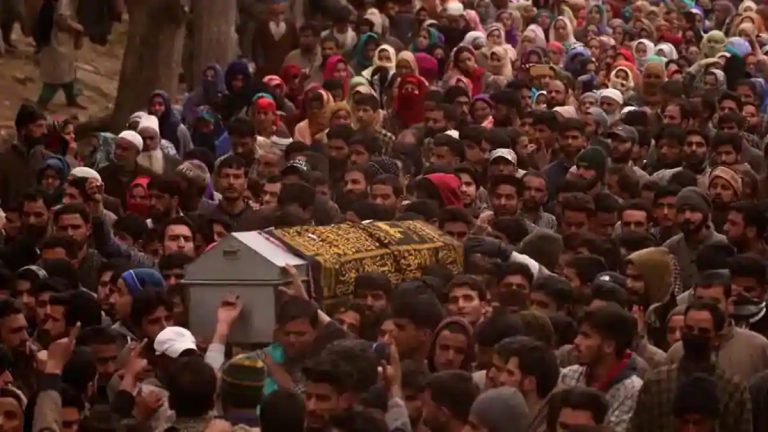
The Jammu and Kashmir police have decided not to hand over the bodies of slain terrorists to their families to contain the spread of Wuhan Coronavirus during their funeral processions. Instead, the authorities will bury the body of the terrorists killed in encounter in the graveyards managed by the government in the presence of the family members.

Jammu and Kashmir police have started burying such bodies of slain terrorists at different designated graveyards in remote areas of central Kashmir and not in their native villages to avoid public gathering.

As per reports, the burials will be conducted by local authorities in the presence of Magistrate. A senior officer of Jammu and Kashmir police said, “Every effort is being made to conduct burials in a respectful manner, in the presence of their families and in full compliance with religious requirements. DNA samples are also being maintained to ensure transparency.”

The officer further said, “There is no legal obligation to hand over bodies of terrorists killed in combat to their families. Recall that even the body of Mohammad Afzal Guru, the Parliament House attacker, was buried in Tihar Jail after his hanging.”

According to reports, four terrorists who belonged to Al-Qaeda’s Kashmir region affiliate- Ansar Ghazwa’tul Hind, were buried in a graveyard managed by the government on April 22. The families of Bashrat Shah and Wakeel Ahmad Dar, both residents of the District of Pulwama and Tariq Ahmad Bhat of the Shopian district had attended the burial. The family members of the slain jihadist Uzair Ahmad Bhat from the district of Baramulla in North Kashmir could not attend the burial.

Sajad Ahmad, a Hizbul Mujahideen terrorist and a native of Shopian and Sartaj Ahmad from Kulgam were killed in an intense firefight near Keran earlier this month were also buried in the South-Kashmir graveyard with three unidentified terrorists who are believed to be Pakistani nationals.

People gathering in slain terrorists burial rites

Earlier this month, hundreds gathered in the burial rites of slain Jaish-e-Mohammad terrorist Sajjad Nawab Dar in Sopore, defying the lockdown norms that also led to an increase in coronavirus cases in the valley. The Burial rites of Hizbul Mujahideen’s Mohammed Ashraf Malik in Kulgam’s Arwani also encountered a huge gathering. That was the first since the nullification of article 370 in the Jammu and Kashmir that raised fears about jihadis reappearing.

The phenomenon took place in 2015 when hundreds gathered in Kashmir in the rites of Lashkar-e-Taiba jihadist Abdul Rehman, also known as Abu Qasim. Jammu and Kashmir have registered a case against the people who had attended the burial of Dar on April 8.

Although the official reason for not handing over bodies of terrorists is cited as Coronavirus, it is being suggested that another reason for this move is to ‘pro-jihad’ gatherings. Due to large gatherings of anti-India crowd at funerals of terrorists, it was being demanded for a long time that bodies of the slain terrorists should not be handed over to their families.

Kerala: Free food kits meant for distribution among poor found in Left party offices, Congress and BJP stage protests

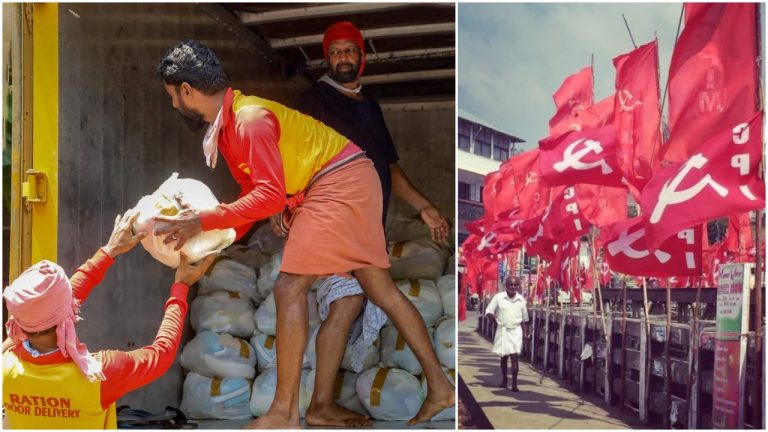
In a massive embarrassment to the Communist Party of India (Marxist), hundreds of food kit (PDS) meant for distribution among ration cardholders was found at their party offices in various places in Kerala, reports the Hindu.

Reportedly, the authorities in Kerala have unearthed free food kits meant for distribution among ration card holders from various Left party offices. It is alleged that public distribution system shop owners had stocked the kits in the offices.

On Wednesday, activists of the Bharatiya Janata Party (BJP) and the Congress staged a protest in front of a local committee office of the Community Party of India (Marxist) at Madappally, near Changanassery, accusing a ration shop dealer of diverting the kits to the party office.

Following this, a police team rushed to the spot and directed the shop owner to shift the consignment to a safe location.

Similar incident at Vaikom

On Thursday, a similar incident was also reported at Vaikom after a team of police and Civil Supplies officials raided an office of the Communist Party of India. The authorities were shocked to find at least nearly 200 PDS kits at the party office.

The initial investigations have suggested that the kits had been delivered to a PDS shop nearby from the Taluk Supply Office. In both cases, the dealers had taken the kits to the party offices on the pretext of space constraint at the shops.

The District Supply Officer said notices have been served on the ration shop dealers seeking an explanation.

‘Conditions violated’

The preliminary investigation suggested that both dealers had violated the condition of keeping these kits, meant for distribution later, at neutral and safe locations. An official said action will be taken based on their response.

The episode has resulted in a political controversy in Kottayam with leaders of Opposition parties accusing the Left parties of attempting to regulate the distribution of food materials from the government as per their priorities.

Hindu Sadhus were killed for political reasons, Christian missionaries supported by left, NCP behind Palghar lynching, finds report: Read details

Days after the blood-curdling lynching of two Sadhus, 70-year-old Kalpavrishka Giri Maharaj and 35-year-old Sushil Giri Maharaj along with their driver 30-year-old Nilesh Telgade in Palgarh in Maharashtra by a frenzied mob, more details are emerging regarding the real intention behind the killing of Hindu Sadhus.

An investigative report by Zee News suggests that the killing of the Sadhus was intentional and it was done due to political reasons.

The mob-lynching of Sadhus was intentional

A report by Zee News Editor-in-chief Sudhir Chaudhary has published accounts of the eyewitness of the gruesome incident which ascertains the truth behind the whole incident.

The Zee News team spoke to Sarpanch, Chitra Chaudhary, of Garh-Chinchle village of Dahanu area, an eyewitness of the gruesome incident. Chaudhary was the first one to reach the spot where two sadhus along with their driver were brutally lynched to death in front of the police by the Christian-converted mob on that day.

“Around 8:30 pm, we came to know that a vehicle has been stopped at the check post where she reached in 15 minutes to see that the sadhus sitting inside the car,” Chitra Chaudhary said to Zee News. She added that the two Sadhus greeted her from inside the car and said that she had also asked them who were they and where did they want to go.

Chaudhary said that as she was talking to the Sadhus, a mob gathered there and punctured the tires of the car and overturned it. Chitra said that she tried hard to convince the frenzied mob until the police arrived, but could not control them much as people were angry at her. She said she somehow managed to calm them down for two-three hours.

As the police reached the spot at 11 PM, two of the three people surrounded by the crowd managed to sit in the police car, but when the elderly monk came out of the forest post holding the hand of one policeman, the crowd went berserk and started beating him.  

Chaudhary said she was hurt as she tried to stop the mob. She had to leave the spot to save her own life. She added that after reaching home, she saw images of dead bodies of the monks and their driver.

Sadhus were killed for political reasons

The Garh-Chinchle village sarpanch has claimed that the three men were killed due to political reasons. 

According to Zee News, illegal liquor has been one of the reasons for the lynching of the Hindus Sadhus. The Gadchinchale village, where the heinous incident occurred, falls in a tribal region where most political parties have used liquor as a tool to mobilise popular support. Social workers, individuals and seers, opposing this are treated as enemies by those who have massive influence in the region.

Rampant conversions of tribals by Christian missionaries supported by left, NCP

Reportedly, Zee News spoke to many social organisations which have been working here for long in the region. According to these organisations, Palghar has been one of the tribal areas which have been impacted with rampant conversions. The Palghar region has become a battleground for political and religious supremacy with active support from Chrisitan missionaries.

The Christian missionaries enjoy massive support from the Left-wing groups and are involved in the conversion of tribals in the region. These Christian groups face stiff resistance from the Hindu religious outfit. In recent years, Palghar and the surrounding areas have become a big flashpoint between the Christian missionaries and the Hindu outfits over religious conversion. 

Besides, these missionaries have full support from political parties like Sharad Pawar-led NCP, one of the coalition partners in the incumbent Maha Vikas Aghadi government in Maharashtra. Addition to that, one Kashinath Chaudhary, who is the district panchayat member of NCP, was also among the mob which killed the two men. He has been accused of instigating the mob.

Further, a video has also resurfaced showing several local leaders and activists of NCP, as well as CPM, was in the crowd during the alleged mob lynching of the three men. Chitra Chaudhary had also said that the mob was energised after seeing local NCP leader Kashinath Choudhari at the spot. She said that the mob began chanting ‘Dada aala, Dada aala’ (big brother is here) on seeing the Palghar Zila Parishad member and NCP leader, who can also be seen in the videos of the incident.

Kashinath Choudhari has agreed that he was present at the time of the crime, but he said that he tried to calm down down mob, but he failed.

All these new evidence raises the suspicion that the two Hindu seers – Kalpavriksha Giri Maharaj, Sushil Giri Maharaj – might have been killed for political reasons.

Child theft bogey

There have been rumours of child theft in these tribal areas for a while now. A certain section of media has been propagating the same rumour to link it to the killing of the sadhus. However, interestingly, in her testimony to Zee News, the Sarpanch claimed that mob got suddenly infuriated after seeing the elderly monk with policemen and went berserk after that.

The sudden mood swing of the mob hints that the real motive was to kill the sadhus by labelling them as thieves and that too in front of several policemen.

Interestingly this tribal belt in Maharashtra, including Palghar, is also known for worshipping demon king Ravana and organising events glorifying him. This has also led to several incidents of clashes between the pro-tribal groups and the right-wing organisations.  

Palghar Mob Lynching incident

On 16th April 2020, two Sadhus associated with the Juna Akhara, 70-year-old Kalpavrishka Giri Maharaj, and 35-year-old Sushil Giri Maharaj along with their driver 30-year-old Nilesh Telgadewere were on their way from Mumbai to Gujarat to give Samadhi to another Sadhu. At Gadakchinchale village, a wild and frenzied crowd of over more than 100 people attacked them. The villagers deemed them as thieves and started attacking them. The police claim that their team which had rushed to the spot to rescue the 70-year-old man also came under the attack of the violent mob.

But later videos emerged which completely debunked the claim of police, as it was seen that the sadhus were in the custody of the police, but the police personnel handed them over to the mob. The mob then proceeded them to beat them to death in front of the policemen.

Arrests made in the case

The authorities on Sunday filed an FIR against the villagers and 110 people including 9 juveniles have been arrested so far. 101 have been sent to judicial custody till April 30 while the juveniles have been sent to the juvenile shelter home.

Maharashtra Home Minister Anil Deshmukh had released the list of 101 adults arrested in connection with the case. The home minister said that they were arrested within eight hours of the incident.