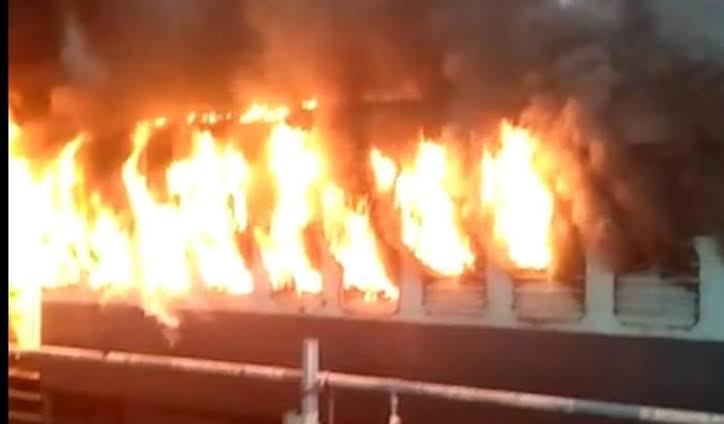
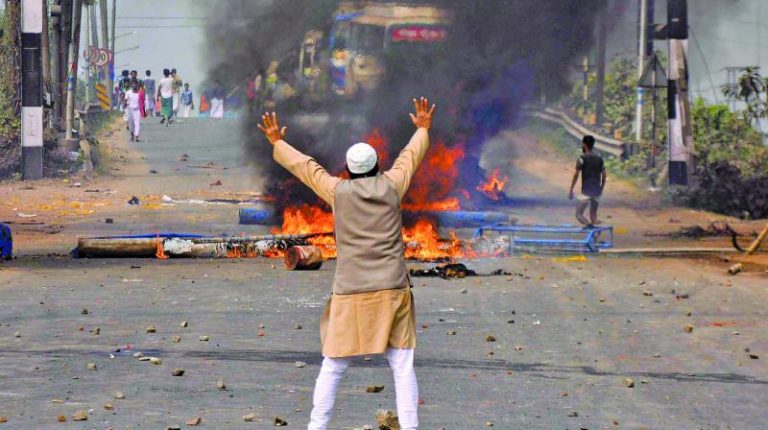
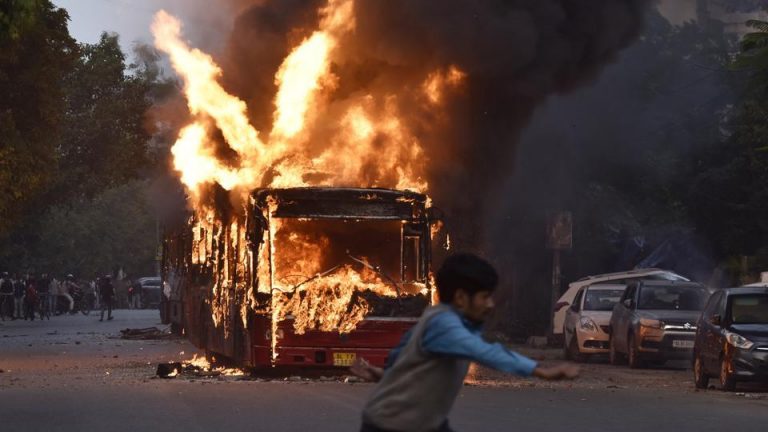
The state of West Bengal witnessed unprecedented violence as protestors torched several trains, railway stations and tracks, and dozens of buses on Saturday amid spiralling violence in West Bengal during the agitation against the legislation of the Citizenship Amendment Bill.
Taking cognisance of the worsening law and order situation, the governor of the state, Jagdeep Dhankar had made a request to the Chief Minister Mamata Banerjee to be briefed and updated on the latest situation in the state.
However, it appears that the Mamata Banerjee thought it is was not important to notify the governor on the latest developments. The governor today took to Twitter to slam the Mamata Banerjee government for not briefing him on the current situation in the state.
.@MamataOfficial. Am stunned that in spite of request made neither Chief Secretary nor Director General of Police have come to brief and update me on the current painful situation in the State. This is surely not acceptable given the enormity of situation.
“I am stunned that in spite of request made neither Chief Secretary nor Director General of Police has come to brief and update me on the current painful situation in the State. This is surely not acceptable given the enormity of the situation,” Dhankar tweeted.
The state of West Bengal witnessed widespread violence and a total collapse of law and order as Muslim mobs protesting against the CAA and implementation of NRC in the state went on a rampage. Inciting the violence further, CM Mamata Banerjee has declared that she would not allow CAB and NRC to be implemented in the state. Far from informing the governor of the state, Mamata Banerjee also spearheaded the anti-CAB march today in the capital city of Kolkata.
In a stunning disregard of law and order, Mamata today said that the central government stopped railway services in West Bengal just because a few trains were burnt down. “Just because a few trains were set on fire, the Centre has stopped railway services in most parts of Bengal,” Mamata said in a rally in Kolkata.
The Citizenship Amendment Bill aims to give Citizenship to the persecuted minorities like Hindus, Buddhists, Jains, Parsis and Christians from the neighbouring Islamic nations of Pakistan, Bangladesh and Afghanistan. The Bill has been passed in both Lok Sabha and Rajya Sabha and also got the assent of the President. However, it has seen widespread opposition from “secular” parties like the TMC, Congress and others.
The Citizenship Amendment Bill after being passed in the Lok Sabha and Rajya Sabha got the President’s assent and has now become a law. The Act (CAA) seeks to provide citizenship to the persecuted minorities of neighbouring Islamic countries like Pakistan, Bangladesh and Afghanistan. The opposition to this Act has come from very specific quarters. It perhaps seems ‘widespread’ because the news is everywhere on Social Media and rightly so. However, while the bill has received widespread support, it becomes essential to analyse where the violent opposition (anti-CAA protests) to it has emanated from, why, and most importantly, who might be instigating it.
One of the first violent ‘protests’ that we heard of was from the state of West Bengal. Violent Muslim mobs ran amuck ransacking and vandalising property. Running riots and damaging public property. The videos are several, but the message is the same – even a perceived injustice against the majority Muslims of Pakistan is going to strike a chord with Islamists in India. I saw ‘perceived’ because, in actual terms, there has been absolutely no injustice meted out to them by India as far as the Citizenship Amendment Act is concerned. This Act doesn’t concern Indian Muslims and it certainly has no power to ‘discriminate’ against Muslims who are a majority in Islamic nations.
Then, we saw violent protests at several Universities. Students protesting for a cause is perhaps the most powerful image and the purpose is multifold – while it generally gives the impression of ‘organic protests’ taking place, any action by the law enforcement against violent ‘students’ is met with criticism. The violent protests were mainly limited to Aligarh Muslim University and Jamia Millia Islamia University. There was stone-pelting, some news of petrol bombs being hurled by the ‘students’, and sloganeering that would put the stone-pelters of Kashmir to shame. We heard slogans of ‘Hinduon se Azaadi’ and posters of “Khilafat 2.0”.
Soon, a dangerous narrative was being spun with several elements inciting violence, lying to make rioting “students” appear as victims of police brutality and calls for more colleges to join in.
One had to wonder, how is this well-oiled machinery coordinating? How are all of them saying the same thing at the same time so effectively and efficiently? Who is spearheading the campaign to co-ordinate, incite violence, spread misinformation, and who are the hidden hands that are helping these “students” when they eventually run into trouble with law enforcement? It is evident that these “students” who are running riot aren’t really scared about how they would get out of trouble should the police arrest them.
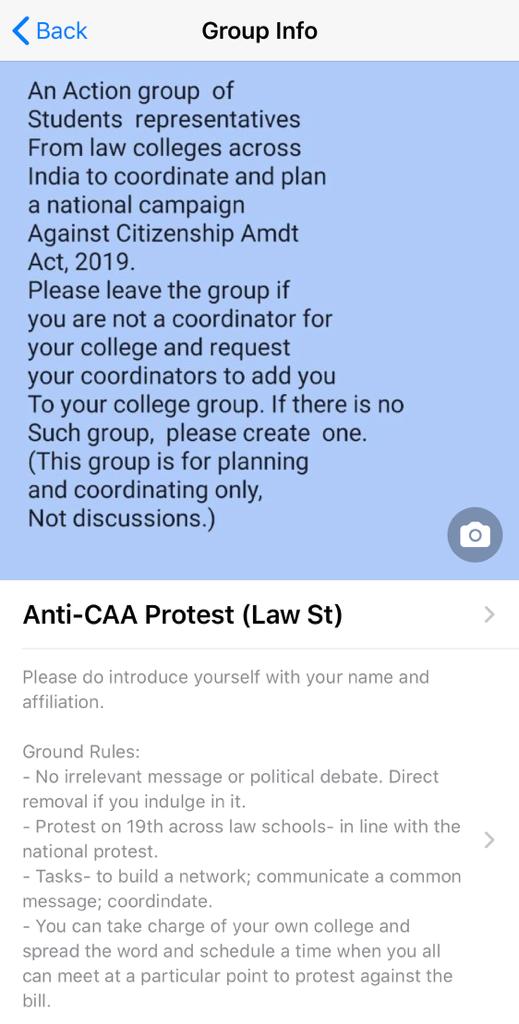
The Whatsapp group for Anti-CAA protests
While speaking to several students and trying to find the answers to these questions, I was sworn to secrecy and added to a Whatsapp group that was called “Anti-CAA Protest (Law St)”. The Display Picture of the group clearly states that this group was for coordination and planning of protests against CAA in Law Universities. Specifically mentioned was that this group was made for coordination and not ‘debate or discussion’.
WhatsApp group name
The Admins of the Anti-CAA protest Whatsapp group
Once I was added to the Whatsapp group, the messages were severely anti-CAA and even bordering on some messages sounding completely Leftist. I proceeded to check the admins of the Whatsapp group.
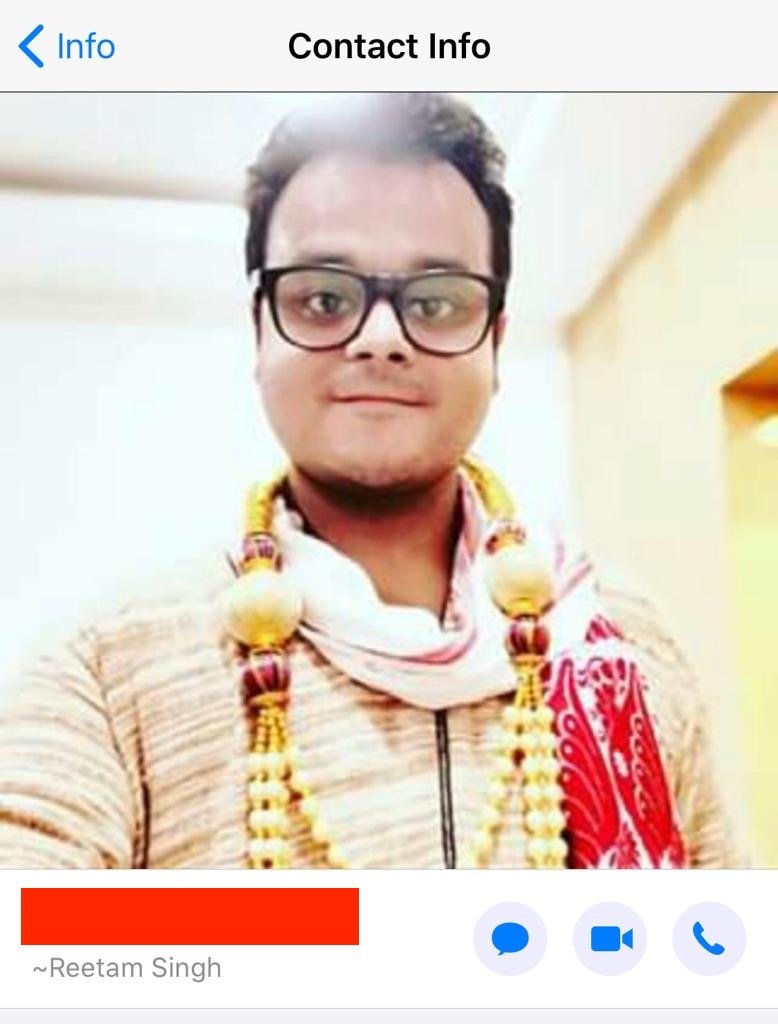
The first admin that I noticed was one Reetam Singh. On Whatsapp, this is Reetam’s profile information.
Reetam Singh
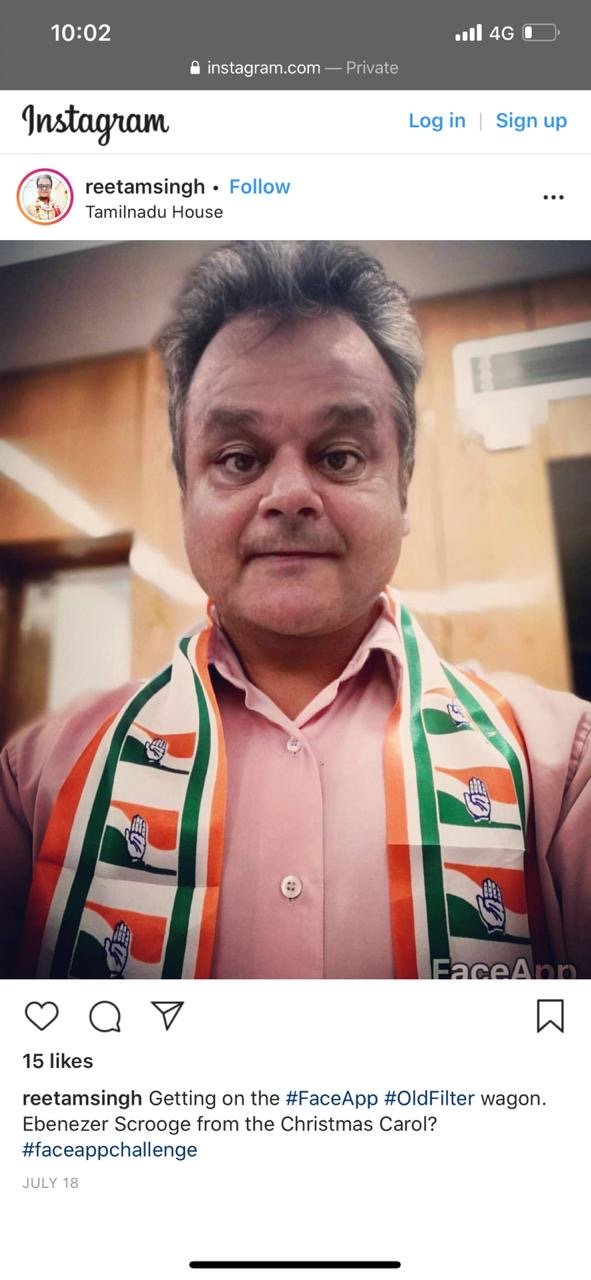
When searched on Instagram, this is what it threw up. With the same profile picture, there was one post where Reetam was wearing a Congress scarf.
Reetam Singh Instagram account
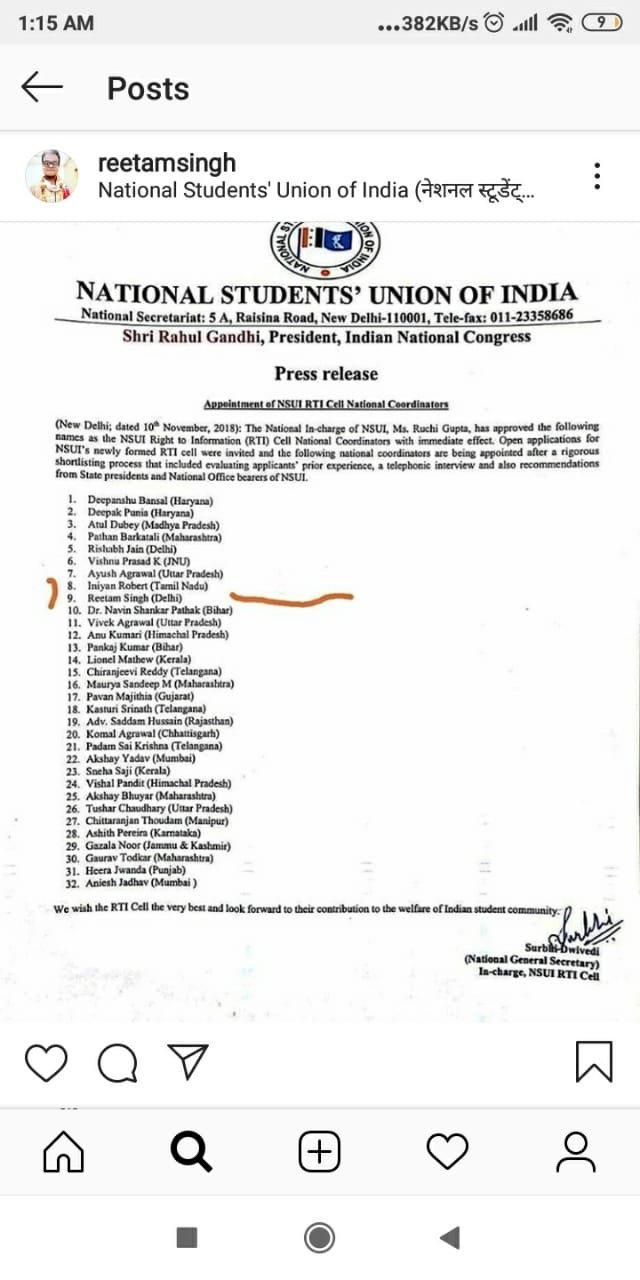
Another post on Instagram proves Reetam Singh’s Congress association. It turns out, Reetam Singh is the NSUI National RTI Cell Coordinator. NSUI is the National Students Union of India which is a Congress Students arm.
Reetam Singh Instagram post
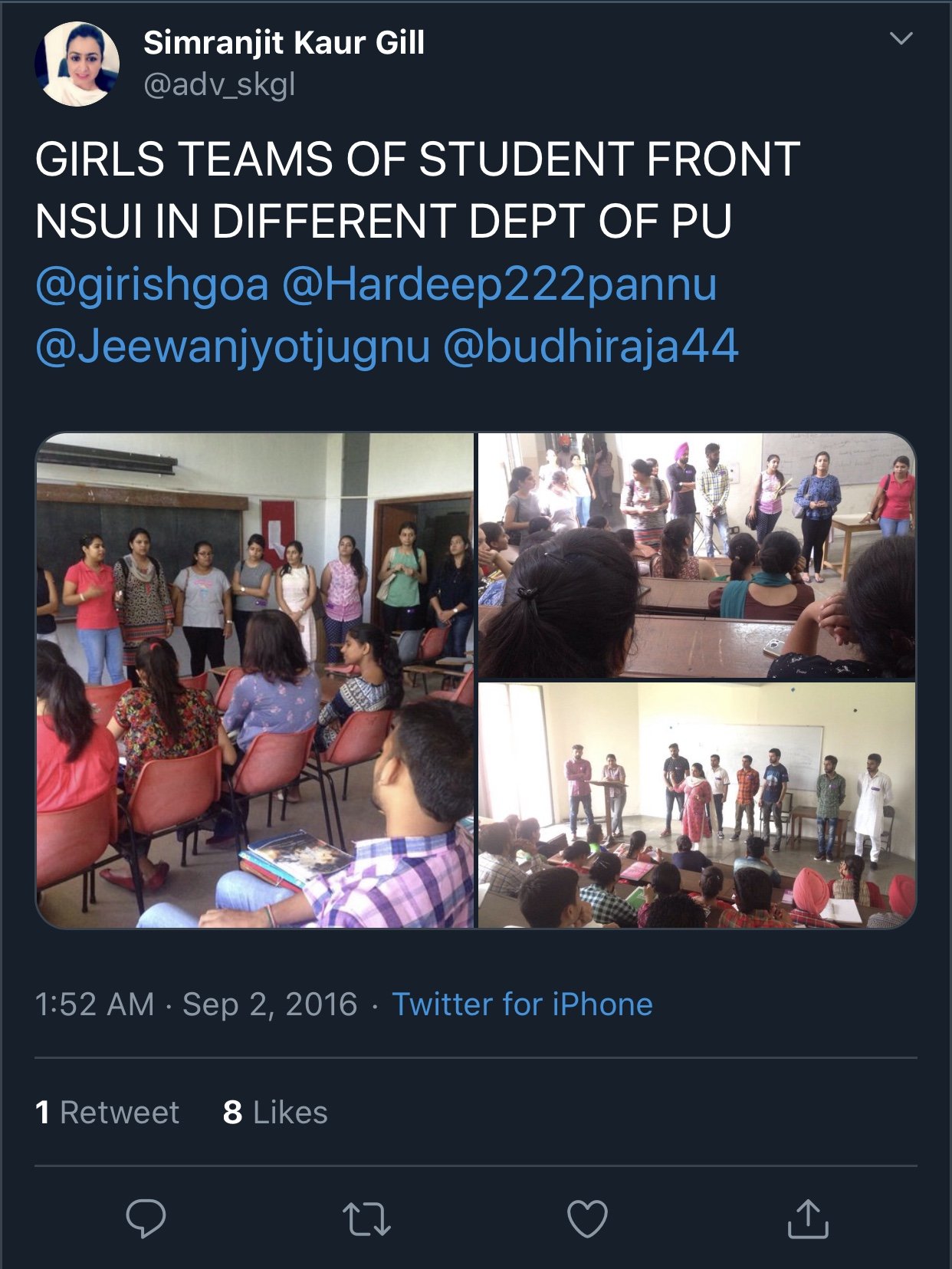
Another admin was one Simranjit. When searched, we found one Simranjit who clearly had Congress affiliations.
Simranjit Twitter account
Further, another admin of the Whatsapp group was one of the people who spearheaded the Aarey Metro protests. The other admins were also affiliated to NSUI.
The confirmation of Congress affiliation
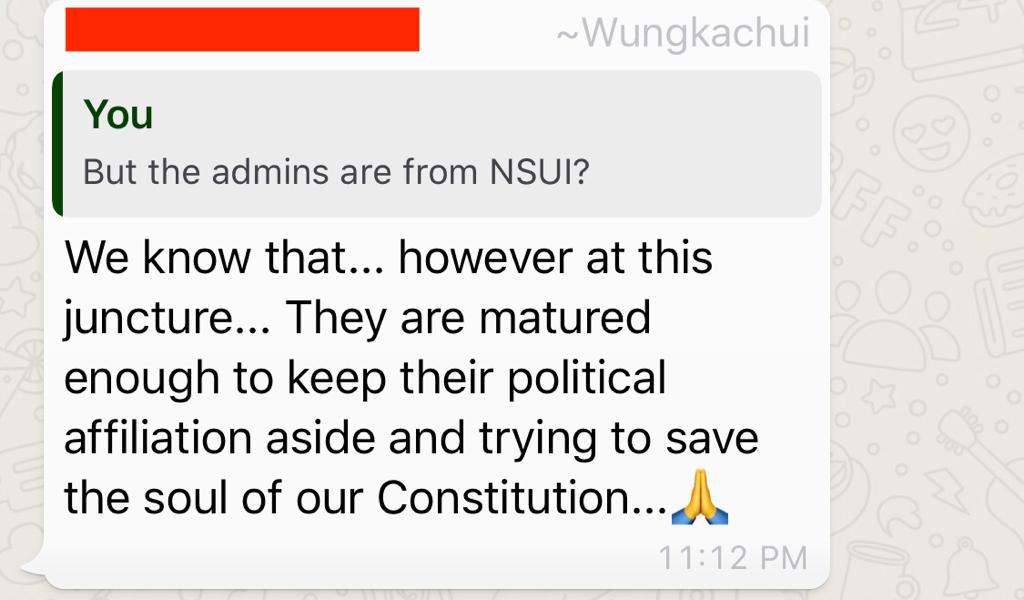
Finding their links merely with their names was not enough for confirmation that this group coordinating protests against CAA was spearheaded by Congress and NSUI representatives. To get a confirmation, I tried to prod whether the admins of this group were, in fact, NSUI representatives.
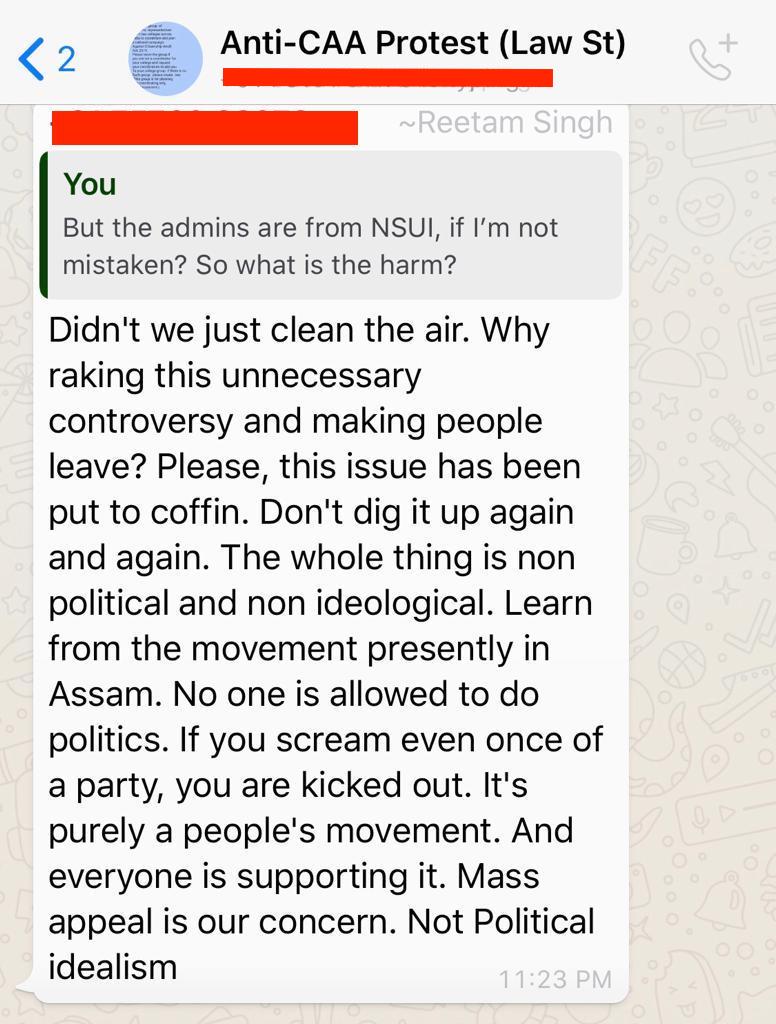
Screenshot from WhatsApp chatScreenshot from WhatsApp chat
From the chat, it is evident that the participants knew that the admins of the group were NSUI representatives. In fact, one response to my query was from Reetam Singh himself who on his Instagram had confirmed that he is NSUI functionary.
Reetam Singh’s message revealed a sinister plot. He asked people to “learn from the protests in Assam” and rudely asked that NSUI affiliation not be brought up. The Assam protests were very different from the reasons for protests by the rest of the Congress functionaries and Islamists. While the later is protesting against the exclusion of Pakistani, Bangladeshi etc Muslims in CAB, Assam is protesting not against the exclusion of Muslims but the fact that they want Clause 6 of the Assam Accord implemented. In essence, the protests in Assam actually fuels the need for NRC since Assam wants no immigrants to be settled in their state. That Congress is confounding the two points to dangerous propaganda that is being peddled.
Reetam Singh also reveals that the aim is “mass appeal”. Perhaps the reason that I was shouted down by several people and asked to not bring up NSUI connection, was that while the coordination of the protest is clearly being spearheaded by Congress, they would want to conceal that information to make it appear indigenous protest.
The aim – spearheaded by Congress but projected as organic
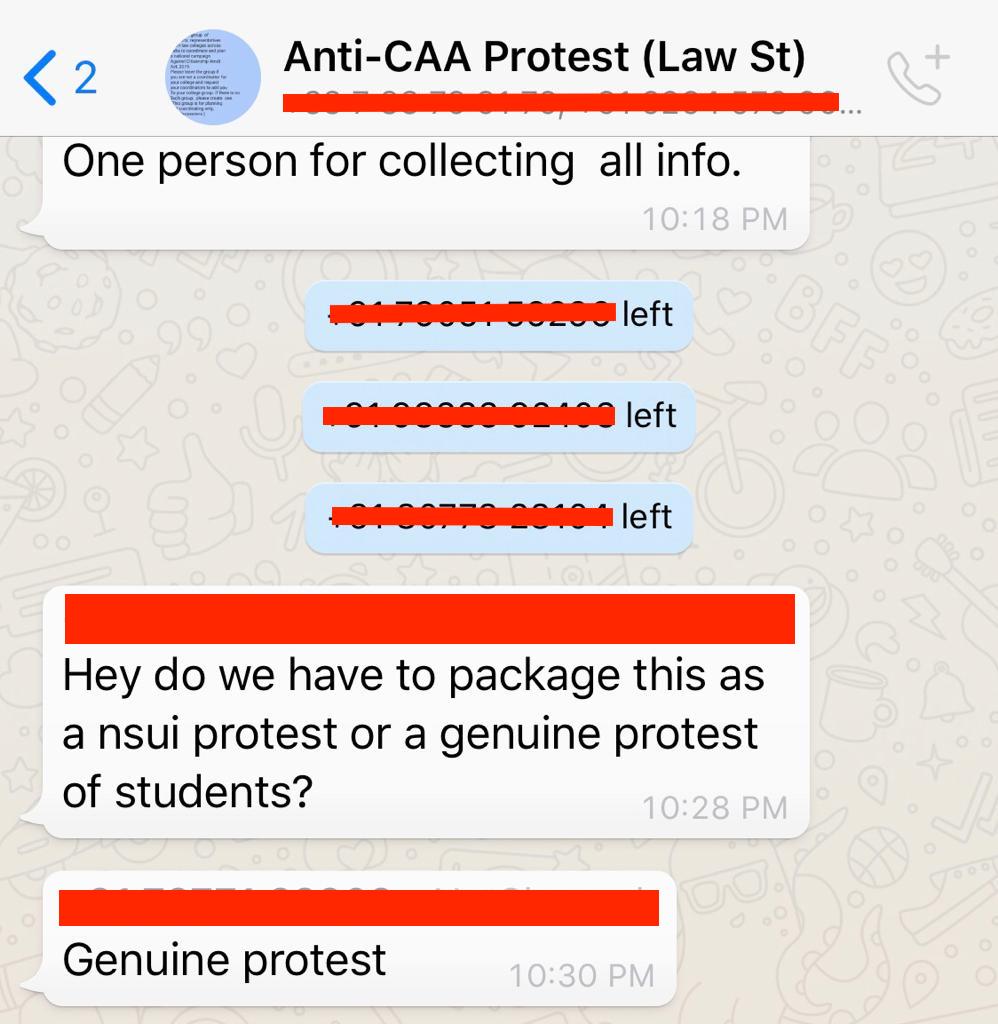
To confirm that the plan was to project these protests as organic protests and hide the clear NSUI affiliation, I asked my source in the WhatsApp group to ask if the protests were supposed to presented as an NSUI protest or an organic one.
As soon as the question was asked, the obvious answer that was presented was that these were supposed to be packaged as genuine protests.
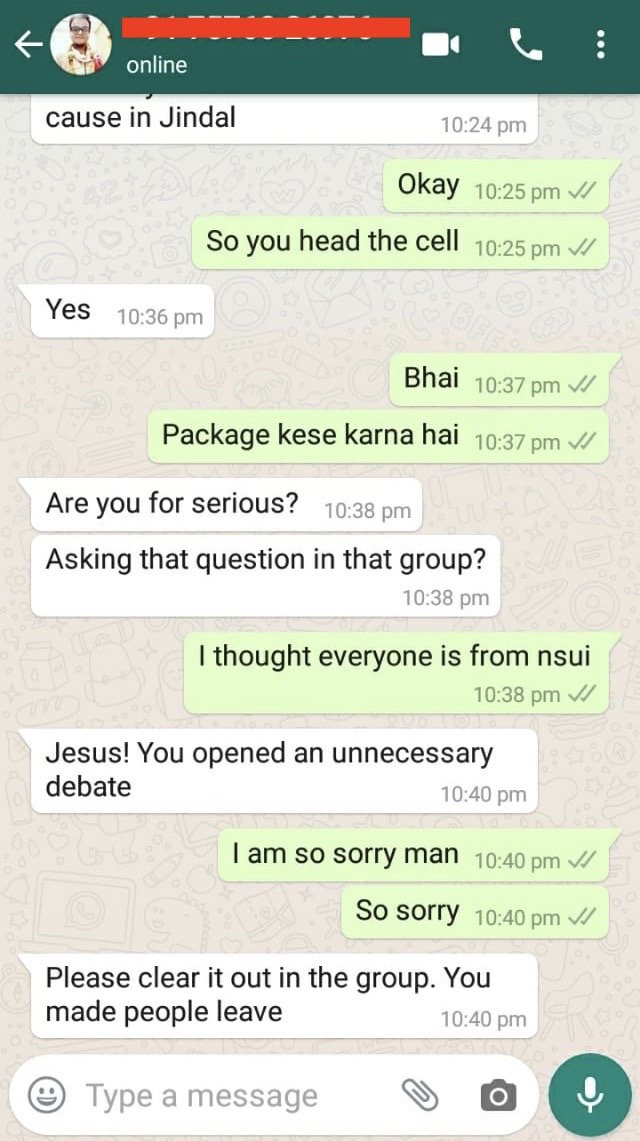
In fact, the source who asked the question later got threatened by NSUI functionary Reetam Singh. He was immediately asked to clarify in the group and asked not to raise the NSUI connection in the group again.
A screenshot sent by an individual who was threatened
The group was essentially made to ensure that protests break out on the 19th of December across Law Universities and the protests appear as though these were organic ones without any political involvement. However, with this group and messages, it is evident that protests are being planned and coordinated by Congress.
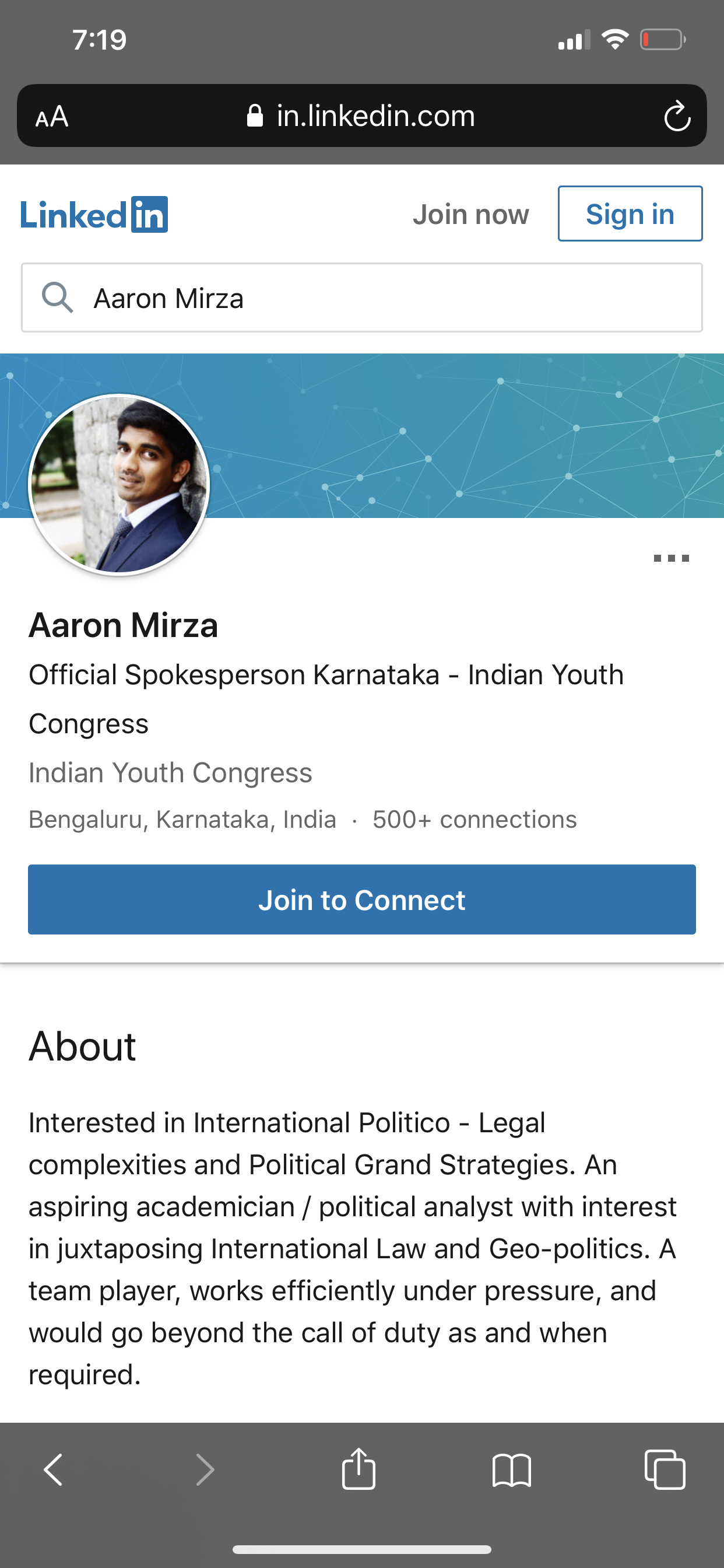
Aaron Mirza, Karnataka Youth Congress spokesperson was also part of the group.
Aaron Mirza’s LinkedIn Profile
The plan by NSUI
Reetam Singh, the NSUI representative charted out the entire plan of the protests that are being planned on 19th December.
The following message was sent by him on WhatsApp (screenshot of it with the reporter).
Why are we against CAA
It is against the ideals of Article 13,14 and 15
It is inconsistent with NRC administered by Supreme Court making it redundant.
It violates reasonable classification by using one and one criteria that is religion only when we talk in terms of Art 14. It uses only religion when reasonable classification and intelligible differentia uses more than one clauses to make a differentiation. Eg making reservations for women is justified as they have economic as well as differentiation based on sex. Here in CAA, it is religion and religion only. That too of certain countries based on religion. Not on humanitarian ground.
That it violates India’s commitment to the International Declaration of Human Rights. And it’s various commitments to UN and international declaration {can provide further inputs if required}
It opens the door for further religion-based differentiation laws beyond the scope of Art 25 to 30.
It gives blanket citizenship to Hindu illegal migrants while Muslim migrants will be persecuted as illegals.
2.5 Crore Hindu Bangladeshis have now declared they would seek India’s citizenship { check news piece from Assomiya Pratidin whereby they have declared the intention in Bangladesh through various organisations}
It is inconsistent with the Indian Citizenship Act, 1955 Article 3 of the Act
It is inconsistent with fundamental rights available to foreigners hence violative of Art 13. Freedom of religion is guaranteed to foreigners. Hence we see missionaries in India from abroad.
It gives land rights, economic rights, voting rights to illegal Hindu Bangladeshis. Who form 5 lakh of the 12 lakh illegals identified under NRC in Assam
Why it bothers Northeast? You have estimated over 50 lakh illegal migrants in Northeast. Assam officially some say 12 lakh, initial NRC was 19 lakh. Some of them used figures as 50 lakh in Assam only. I am using a conservative estimate. Now, these people will get blanket immunity to settle here. They are not settling in Ladakh or Rajasthan or Tamil Nadu. But Northeast due to proximity and availability of vacant forest land. While in Bengal we already face a high density of population. So they won’t go there. The whole burden of resettlement comes to Northeast. Hence the aggressive protest.
Then he charts out the plan. In his messages, wrote:
The first thing we could do in our capacity is to write letters to Chief Justice of Local High Courts to invoke their conscience.
The main matter of the letter:
Invoke Constitutional conscience and explain to them how as Guardian of Constitution at the state level they should protect the Constitutional Sanctity.
Force Police to register FIR against all individuals involved in hate-mongering especially Politicians who with full impunity of state go on to make hate speeches without consequences.
Take immediate action on issues of absolute National importance at the earliest without time delay. The State Counsels abuse processes of law to take 8 weeks time to 4 weeks time for instructions when they should just give 1 week of time so that cases occur in an expedited processes
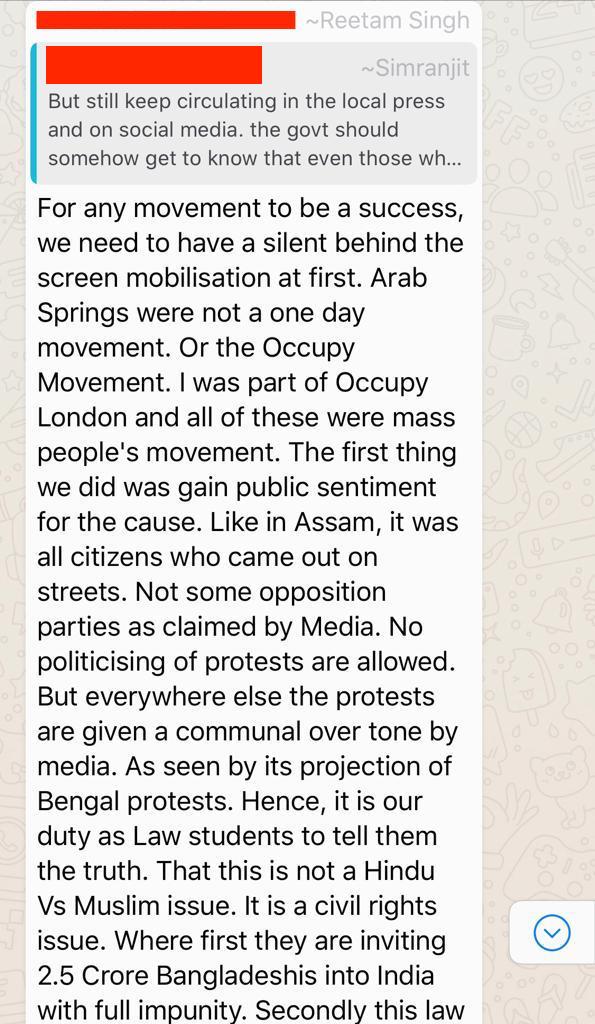
First thing first, you need to mobilise your faculty teachers to take a stand. They need to write letters to their Chancellors and then to Justices of Supreme Court. That would be the 1st job. Second, we need to draft a letter. And send it to Chief Justice of India. Next is a ceremonial reading of Preamble together. We all law students have to read the Preamble together in chorus and post videos here. So that we can post it out to media. Contact your professors. See to it if they can ask faculty members to write a common letter of protest invoking conscience of the Judiciary. This is today’s plan of action.
Further, what is even more dangerous is that the NSUI is now comparing the protests against CAA to the Arab Spring. He even says that he was a part of the ‘Occupy London’ movement. Then he says that the West Bengal protests were “wrongly” projected as Muslim protests (which is incorrect). Further, he says that the movement needs to be projected as a non-partisan movement to gain public faith. Of course, the fact that he is from Congress is a fact that has been pushed under the rug.
Screenshot from WhatsApp chat
Threats, intimidation, incitement of violence
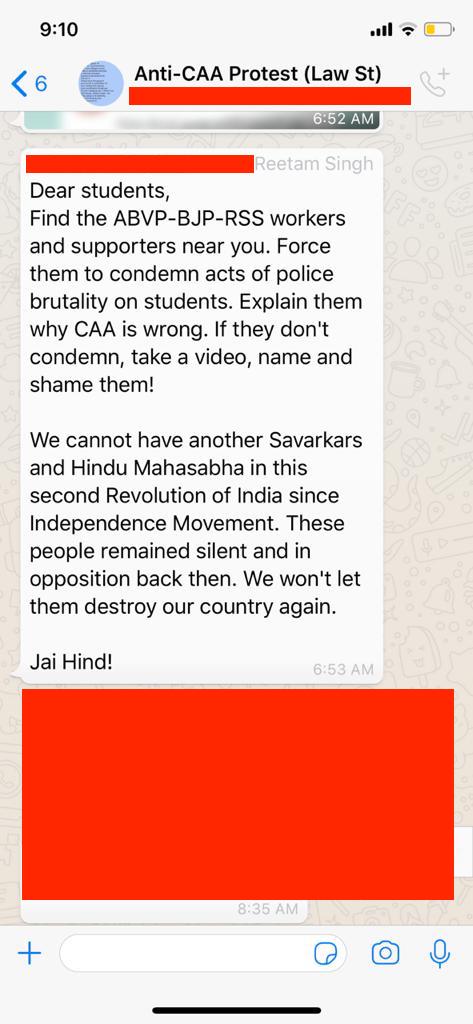
One of the most dangerous parts of the plan was a tacit incitement of violence against those who support the Citizenship Amendment Act.
WhatsApp screenshot
The message above was sent by NSUI Reetam Singh who is the admin of this group. The message clearly calls for “confronting” people from BJP, RSS and ABVP. In fact, by the conversation that I was a witness to, it is evident that anybody who does not agree with their agenda automatically is abused, threatened and called names.
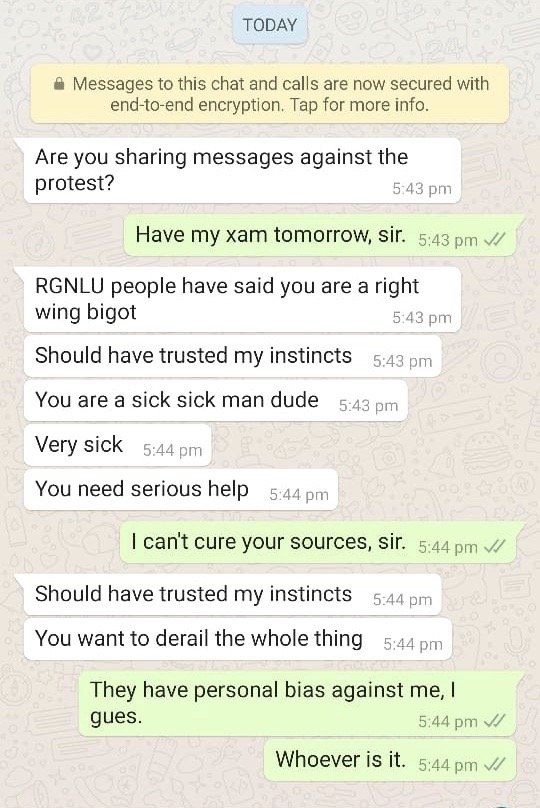
An individual who was threatened by NSUI representatives shared the conversation with me.
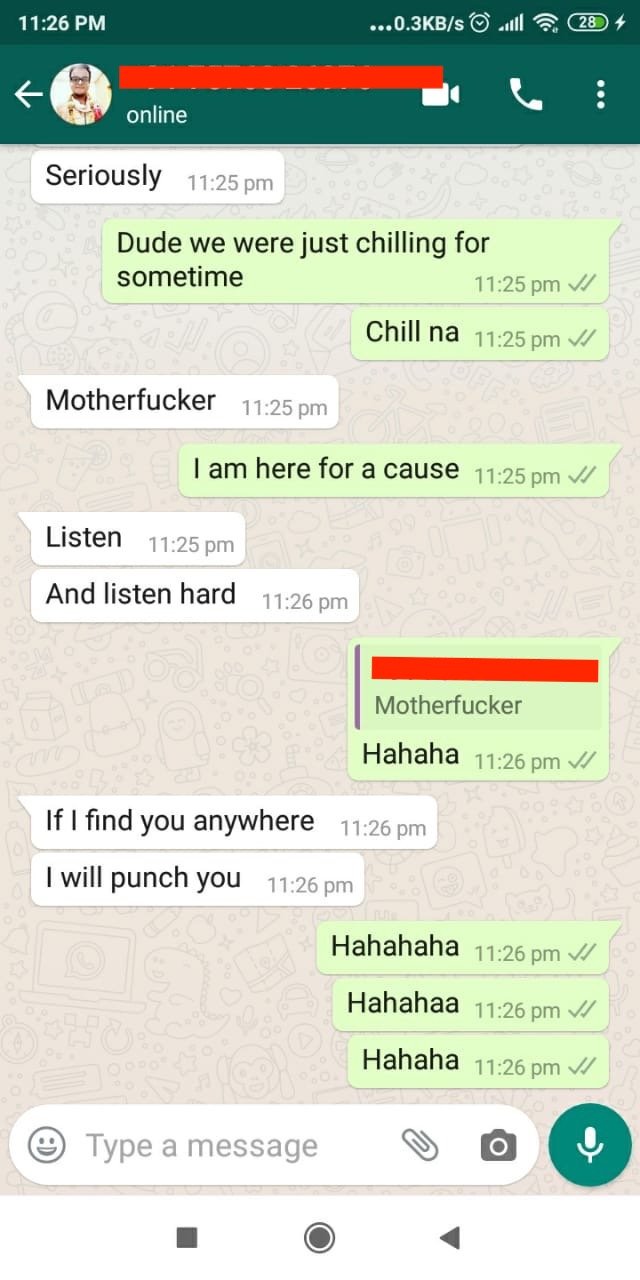
A screenshot sent by an individual who was threatened by NSUI
The person who is being threatened here by NSUI representatives is someone who expressed his support for CAA. He was called a “right-wing bigot” and is being told that he wants to derail the entire thing (December 19th protests).
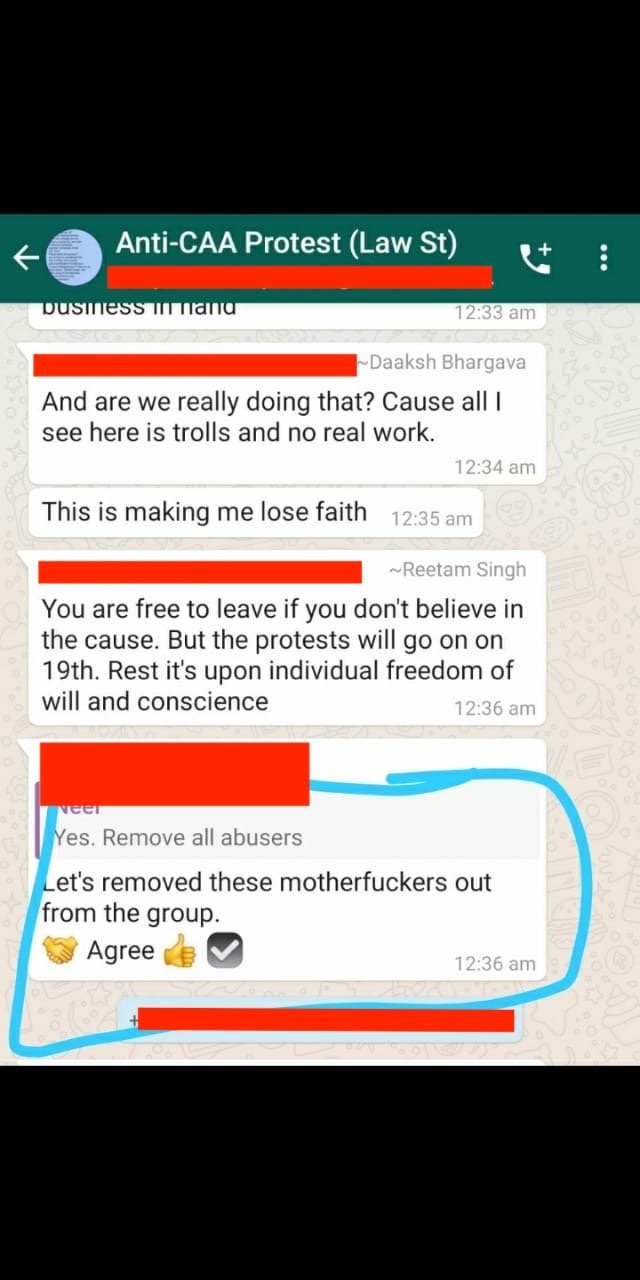
Further, Reetam threatened several others too who did not agree with what the group was spreading about CAA.
Abuses by NSUI people
And more threats by NSUI functionary Reetam Singh.
Threats issued against people who support CAA
While they are trying to project the December 19th protests and their protest in general against CAA as an organic protest, every dissenting voice was threatened by NSUI goons and made to keep quiet in the process. They were also immediately kicked out of the WhatsApp group and specific instructions to not hold any discussion was issued.
All protests planned through the same people?
A tweet surfaced on Twitter that said that Law students from all major law schools of India were rallying against CAA.
Rule of Law v/s Law of Rulers?❌
What to choose?
Law Students from major law schools have a special message for the Nation.
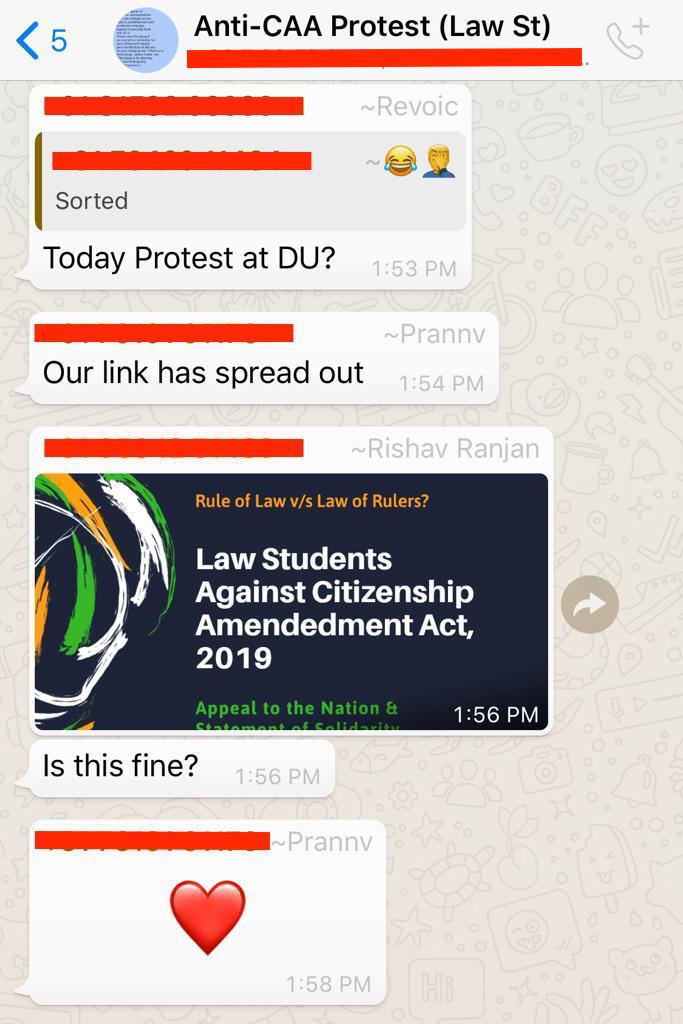
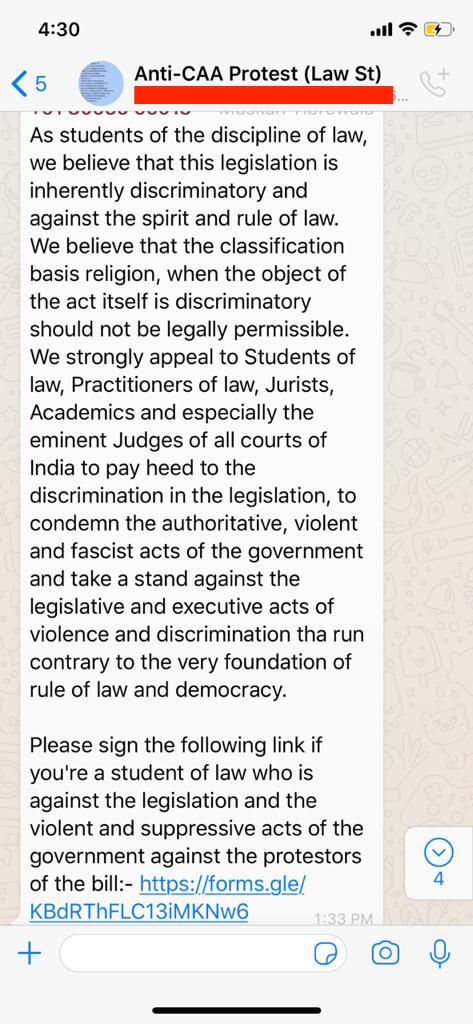
Rishav Ranjan is also one of the admins of the WhatsApp group where these protests are being planned. In fact, this poster, the ‘solidarily statement’ and the Google form were formulated on that group itself in which the admins are from NSUI, Congress.
Rajiv Ranjan confirming banner in the group
Incidentally, it must be mentioned that Rishav Ranjan is from Yogendra Yadav’s Swarajya Abhiyaan and was also the lawyer against the Aarey Metro shed.
Screenshot from WhatsApp group
In the message above, it can be seen that the form and the solidarity statement was formulated in this group itself.
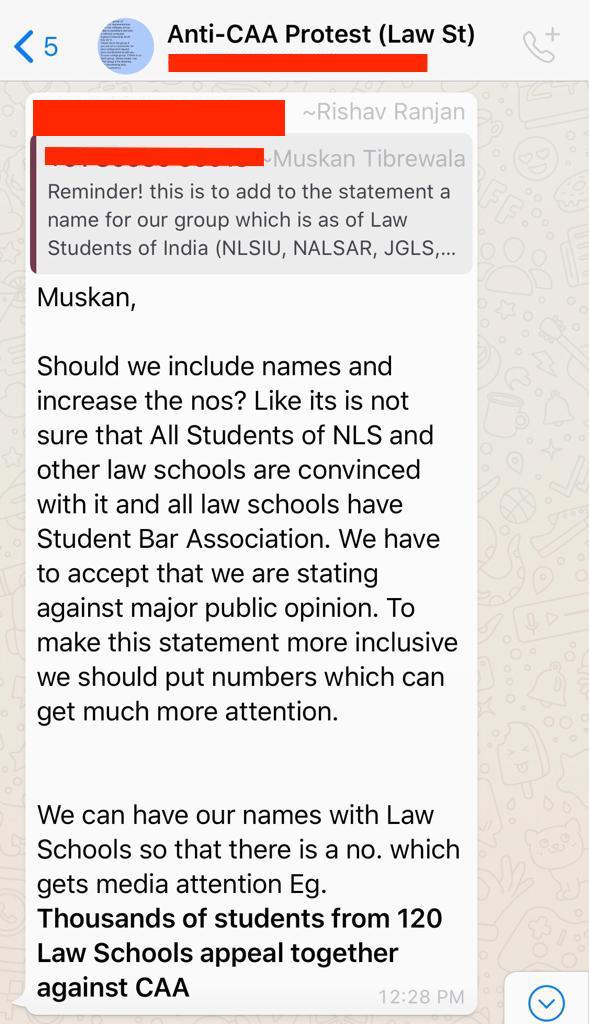
Once the statement was formulated, it was time to set the narrative.
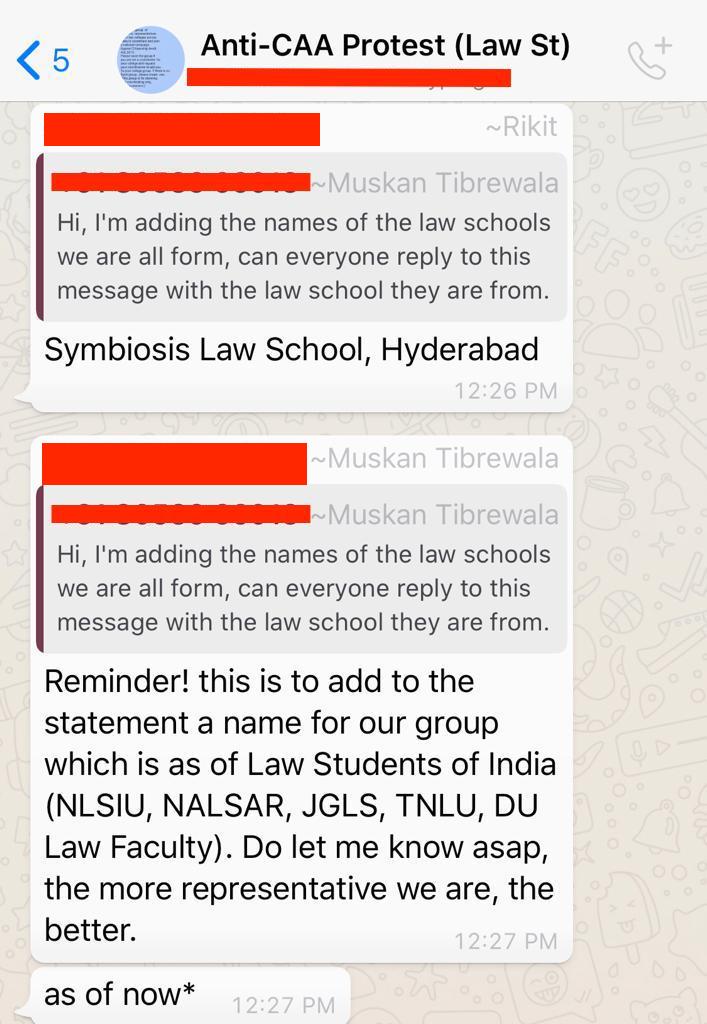
Screenshot from WhatsApp chat
The truth is that they do not have “thousands” of people from law schools. In fact, scores of people left once it was revealed that the admins of the group were from NSUI and disgusted with the propaganda that was being spread. However, as Ranjan admits, this was about how the narrative needed to be set and hence, the line that thousands of students from law schools all over the country were protesting against CAA was adopted.
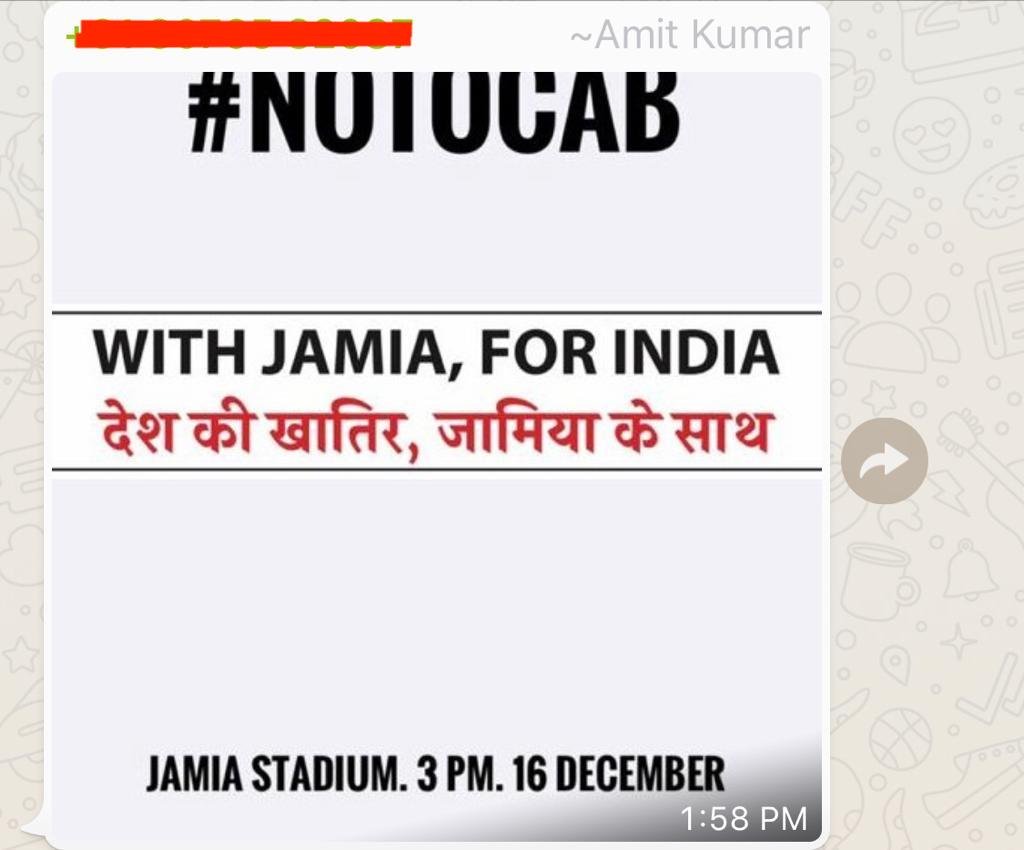
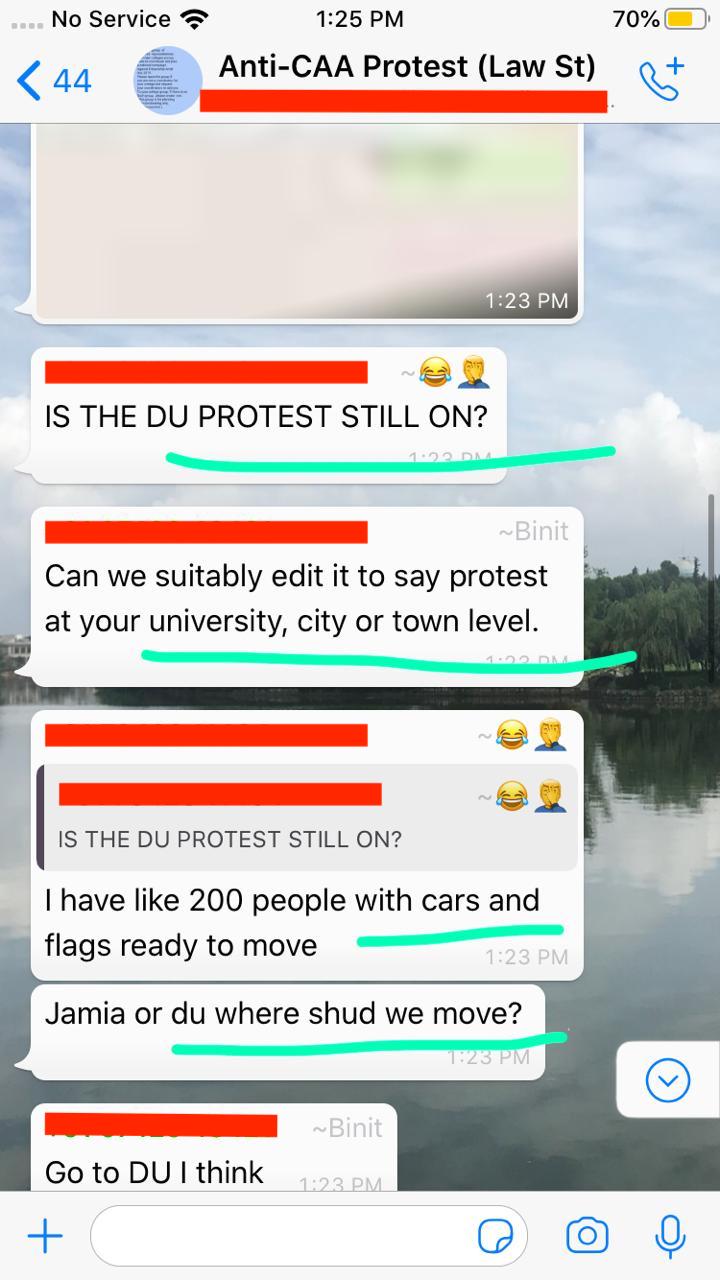
Following are the protests the group is thinking about. This and much more.
Screenshot from WhatsApp chatScreenshot from WhatsApp groupScreenshot from WhatsApp group
There are several other protests, not just in law schools, that are being coordinated and spearheaded from such WhatsApp groups that are headed by NSUI, Congress functionaries.
Who are the people behind the scenes helping Anti-CAA protests
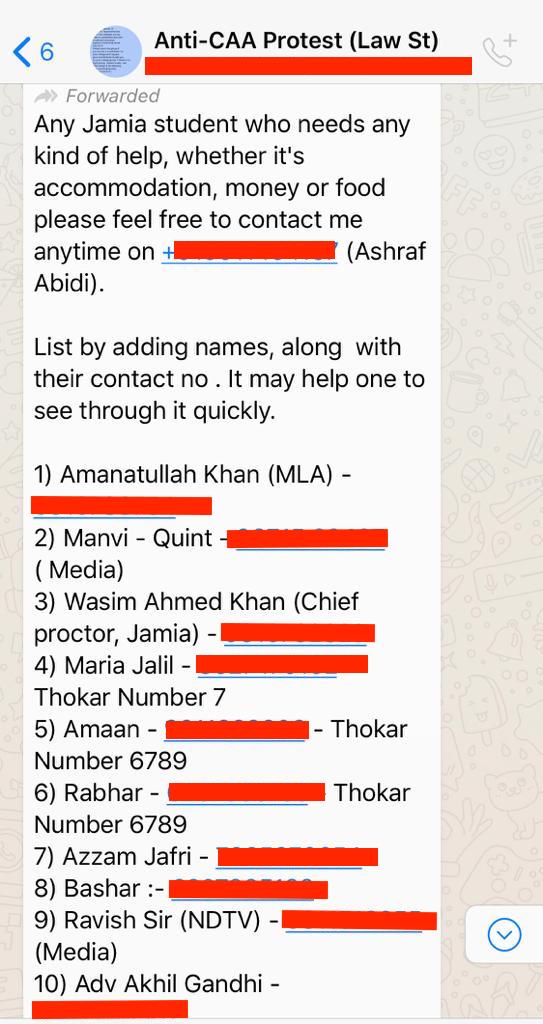
After the Jamia protests that turned violent with students pelting stones and the police taking action against the goons, the WhatsApp group immediately buzzed with some numbers that Jamia students and other students can contact if they fall into trouble while holding violent protests.
People to be contacted by goons if they fall into trouble
Two interesting names that cropped up, who were willing to offer help to goons screaming ‘Hinduon se azaadi’ were AAP leader Amanatullah Khan, NDTV journalist Ravish Kumar and another The Quint journalist Manvi. That these journalists and the AAP leader were directly involved in aiding the Jamia rioters, makes it obvious that these protests might be coordinated by the Left, Islamists, Congress and with the active help of such elements.
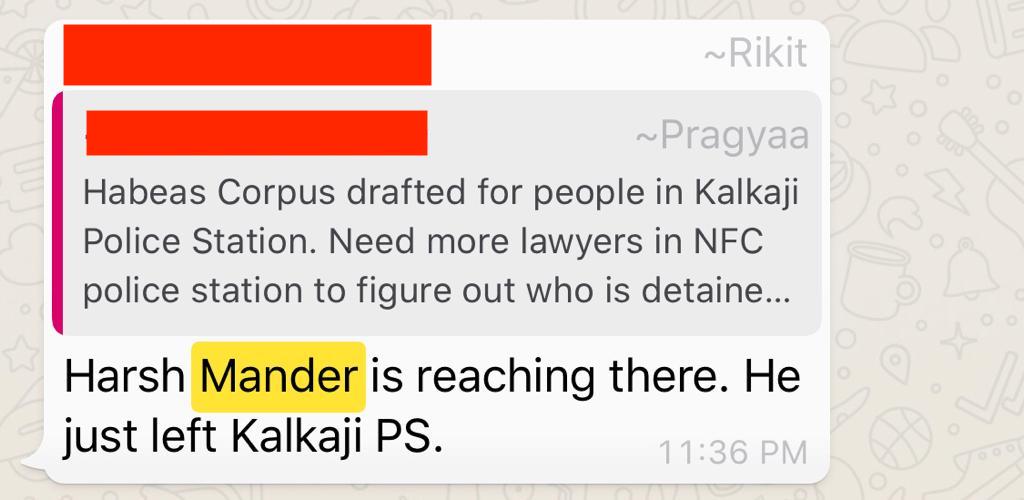
Another element that came across was information that Harsh Mander, member of Sonia Gandhi’s planning commission who had drafted the anti-Hindu communal violence bill had reached the police station at midnight to ensure that the Jamia rioters were saved.
People to be contacted by goons if they fall into trouble
Other dangerous messages about Anti-CAA protests
There were several other messages that came to the fore from sources that have not yet been verified personally. These messages pertained to Islamists coordinating to launch attacks and protests targeted at police personnel and Hindus of India. Some of these were shared on social media and have gone viral since then.
Peaceful Students of Jamia ? Or religiously motivated individuals with nefarious agenda?
These Chats are fm a WA Protest Grp whr they r planning attacking Police with Bats, Hockey Sticks & whatever they can grab
From these messages, it is evident that the coordination is focussed at inciting needless violence for the sake of violence.
Anti-CAA protests: Conclusion
The group that I was a part of was clearly coordinating protests on 19th December across law colleges of India. It was also evident that scores of people left the group when the clearly partisan agenda was revealed. In fact, at a point of time, the NSUI goons started bad-mouthing veteran lawyer Harish Salve and calling him a stooge, at that point of time, several had quit the group. This group was specifically made for coordinating protests in law colleges. One can only imagine how many more groups are being spearheaded by Congress and NSUI coordinating attacks and protests in other places and universities.
Evidently, the protests are not organic. They are clearly coordinated by Congress while trying their best to ensure that the Congress, NSUI connect does not get revealed so these protests can then be used by Congress politically to say that the “Nation is against CAA and Modi”. A sinister plan seems to be afoot to promote anarchy and bloodshed. What remains to be seen is how law enforcement tackles the situation.
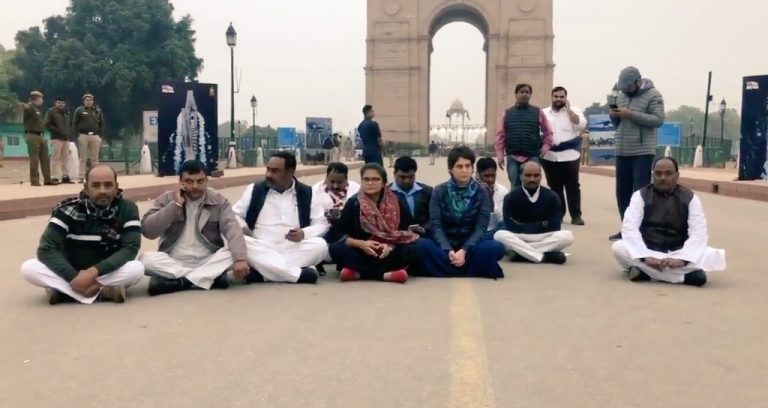
Rumours were making rounds that Rahul Gandhi may again have gone abroad, perhaps to recuperate from the ‘Bharat Bachao Rally’ he addressed on Saturday because of his conspicuous absence from the two-hour ‘symbolic’ protest at New Delhi’s India Gate organised by his sister and Congress General Secretary Priyanka Gandhi Vadra.
Priyanka, however, was joined by other Congress leaders like Jagdish Tytler who was accused of leading mobs during the 1984 Anti-Sikh riots.
Delhi: Jagdish Tytler arrives for Congress’ symbolic protest near India Gate over police action during students’ protests in Jamia Millia Islamia (Delhi) & Aligarh Muslim University. pic.twitter.com/Micwuab2Kj
Earlier it was reported by Congress-friendly journalist Pallavi Ghosh that all Congress leaders will join Priyanka in her protests, but her sibling senior MP Rahul Gandhi and mother, Congress President Sonia Gandhi were both missing from the protests.
@priyankagandhi and all cong leaders will sit on dharna at india gate for 2 hours
In November, Congress had planned 35 press conferences between November 1 and November 8 against the economic policies and decisions of PM Narendra Modi-led government at the Centre. The protest was incidentally planned by Rahul Gandhi. However, Rahul Gandhi decided to skip the protest event that he himself planned and instead visited mysterious ‘meditation’ camps. These ‘protests’ were eventually postponed to December and now it seems they will not take place.
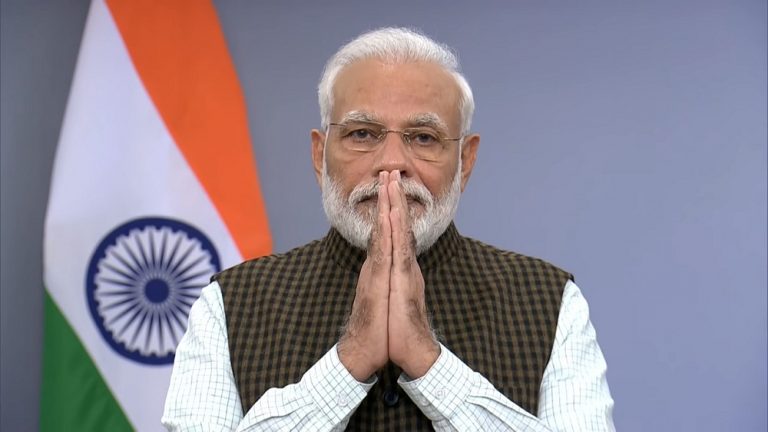
Prime Minister Narendra Modi appealed for peace and harmony in wake of the violence perpetrated by Muslim mobs across the country after the passage of the Citizenship Amendment Act. He requested everyone to refrain from any sort of rumour-mongering and falsehoods. The statement comes a day after the Police entered Jamia Milia Islamia University to flush out violent ‘protesters’.
This is the time to maintain peace, unity and brotherhood. It is my appeal to everyone to stay away from any sort of rumour mongering and falsehoods.
The Prime Minister assured the citizens of the country that no Indian citizen had anything to fear from the Citizenship Amendment Act. He said, “I want to unequivocally assure my fellow Indians that CAA does not affect any citizen of India of any religion. No Indian has anything to worry regarding this Act. This Act is only for those who have faced years of persecution outside and have no other place to go except India.”
PM Modi also said that vested interests were at work to create instability in the country. He stated, “The need of the hour is for all of us to work together for the development of India and the empowerment of every Indian, especially the poor, downtrodden and marginalised. We cannot allow vested interest groups to divide us and create disturbance.”
The Prime Minister also said that it was deeply distressing to see violent protests and that damaging public property and disturbance of normal life has never been a part of our ethos as a country.
Violent protests on the Citizenship Amendment Act are unfortunate and deeply distressing.
Debate, discussion and dissent are essential parts of democracy but, never has damage to public property and disturbance of normal life been a part of our ethos.
Violent protests were witnessed across the country following the passage of the law in the Upper House of the Parliament. From Delhi to West Bengal and Assam, violence gripped the country. Buses have been torched, trains have been burnt and massive loss has been caused to public property.
The Jamia ‘protestors’ continued to unleash the violence as two news reporters from the news agency ANI were today assaulted by the hoodlums protesting against the legislation of the Citizenship Amendment Bill 2019 outside the Gate no. 1 of the Jamia Millia Islamia University.
#WATCH Delhi: ANI Reporter Ujjwal Roy and Cameraperson Sarabjeet Singh who were assaulted while covering protests near Jamia Milia Islamia University Gate-1, are undergoing treatment at Holy Family hospital pic.twitter.com/mzPggwYwuB
ANI reporter Ujjwal Roy and Cameraperson Sarabjeet Singh were injured as the mob of ‘protestors’ outside the University Gate-1 assaulted the two scribes gathered there to cover the protests. They were taken to the Holy Family hospital where they are currently being tended.
Delhi: An ANI reporter and cameraperson have been assaulted outside Holy Family Hospital, in Okhla. More details awaited. pic.twitter.com/R3kpdu3KpY
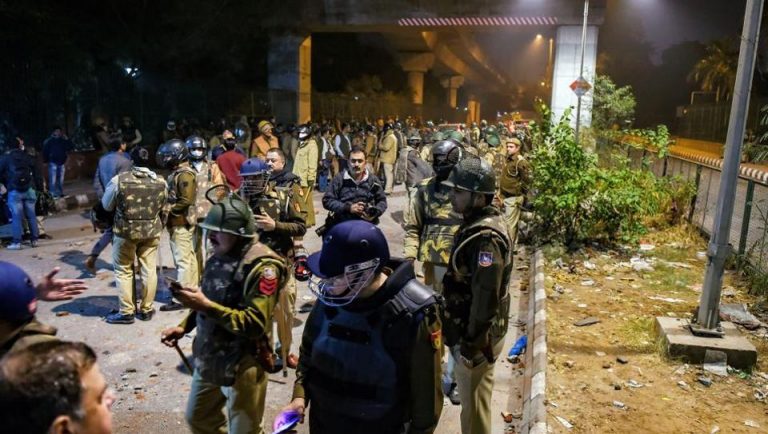
Last evening, the Delhi Police entered the Jamia Millia Islamia University to quell the bouts of violent acts accompanying the protest against the Citizenship Amendment Act. Public property was destroyed as the enraged mobsters indulged in blatant acts of vandalism and arson. Hundreds of ‘protesters’ were paraded out of the University with their hands in the air. The Police said that they had nabbed some outsiders who were indulging in violence.
Many sympathisers of the Jamia ‘protestors’ came out to defend the protest as a peaceful demonstration that was cruelly suppressed by the Delhi Police with brute force. However, the latest attack on the scribes who were out there to report the developments of the protest indicates that the violence was a distinctive feature of the protest that was carried out yesterday and the protest was by no means ‘peaceful’.
Home Minister Amit Shah announced at a rally in Pakur, Jharkhand that the Bhavya ‘sky-high’ Ram Mandir in Ayodhya will be constructed within the next four months. The announcement came after the Supreme Court paved the way for the Temple in a landmark verdict on 9 November.
Union Home Minister & BJP President Amit Shah in Pakur, Jharkhand: Supreme Court has given its verdict. Now, within 4 months a sky-high temple of Lord Ram will be built in Ayodhya. pic.twitter.com/l9VhF2s7Cs
On the 12th of December, a five-member bench of the Supreme Court headed by Chief Justice Bobde had dismissed all review petitions filed against the verdict. A 5-judge bench, headed by the then CJI Gogoi, had in a unanimous verdict on November 9 decreed the entire 2.77 acres disputed land in favour of deity ‘Ram Lalla Virajman’ and also directed the Centre to allot a five-acre plot to Sunni Waqf Board for building a mosque in Ayodhya.
Amit Shah was addressing the rally as part of the BJP’s campaign in Jharkhand for the ongoing Assembly Elections where it currently is in power. Targetting the Congress party, he said that senior Congress leader Kapil had on purpose delayed proceedings in the Court. He said, “Kapil Sibal used to say, ‘Don’t hear the case now, hear it later!’ Kyun Bhai? Aapke pet me kyu dard ho raha hai?“(What problem do you have?)
#Breaking | Union Home Minister @AmitShah sets the ‘mandir deadline’.
‘Ram Temple will be constructed in the next 4 months’, says Amit Shah while addressing a public rally in Jharkhand.
During his address, he also raised the matter of forcible religious conversions in the state. He said that the government led by Chief Minister Raghubar Das had successfully implemented the Anti-Conversion Act.
As the National Capital of the country was yesterday racked with violent protestors indulging in acts of vandalism in several parts of the city, particularly Jamia Millia Islamia University, several AAP supporters extended their support to the protesting students following Delhi Police’s corrective action against the hoodlums.
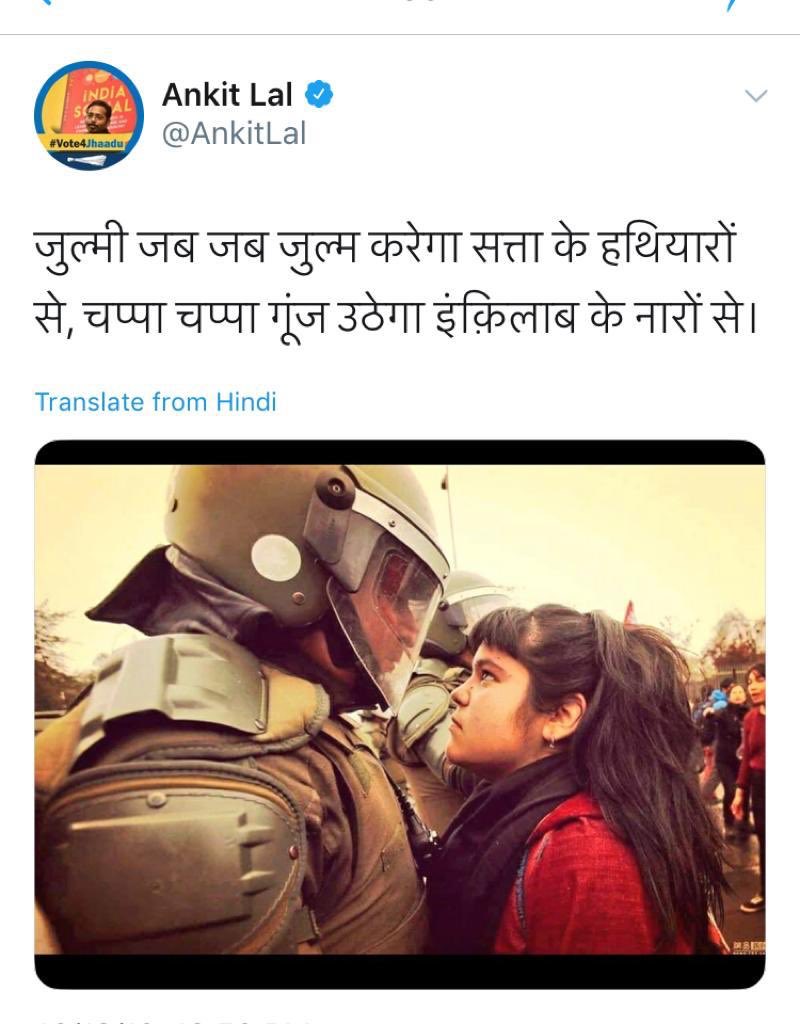
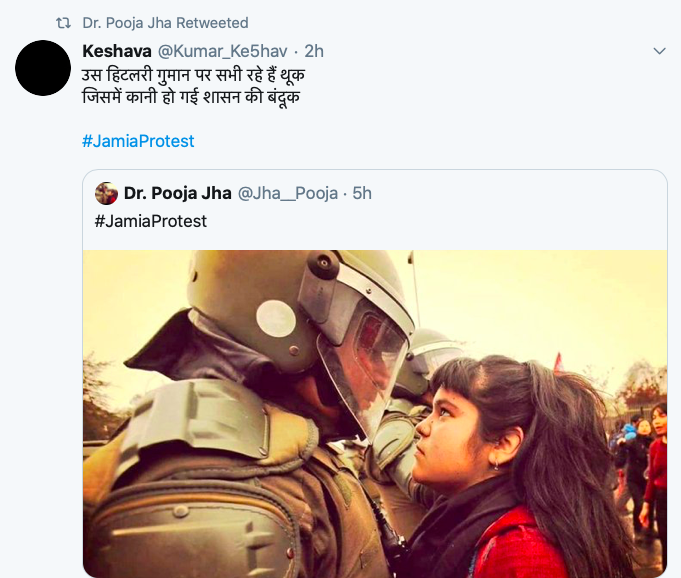
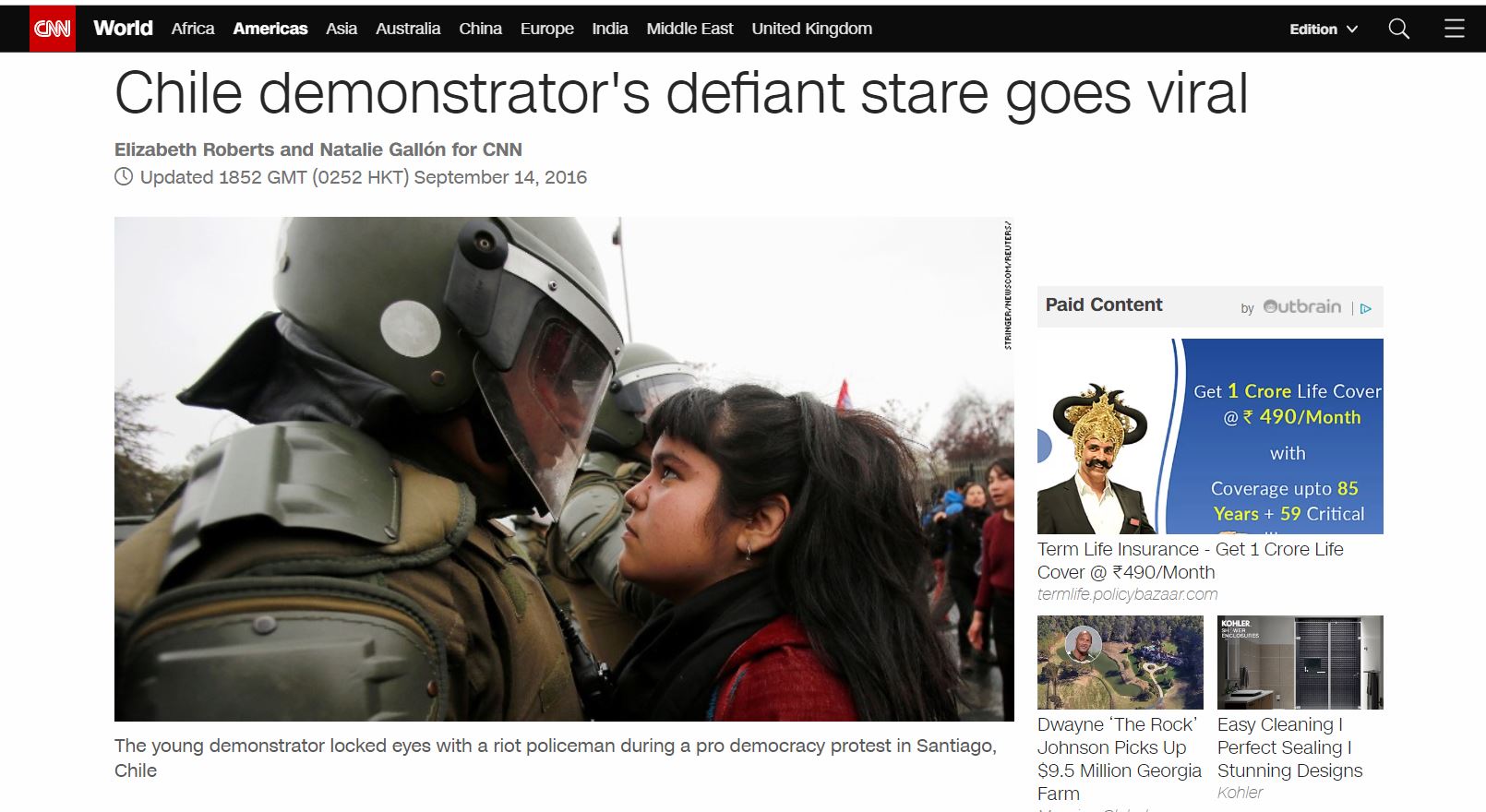
Many AAP supporters and sympathisers on Twitter encouraged violence protests and riots by passing off a famous image from the Chile protests in 2016 on the 43 anniversary of the Pinochet coup as the Jamia Millia Islamia protests.
The Social Media and IT Strategist of the Aam Aadmi Party, Ankit Lal shared the image inciting protests against the government.
Another person, Dr Pooja Jha shared the image of the girl staring into the eyes of the police officer with the caption #JamiaProtest. In fact, Pooja has also changed her display picture with the Chile protest picture to extend her support to the Jamia Millia protestors.
Via Twitter
When another AAP supporter pointed out that the image belongs to 2016 and is from Chile, Pooja shamelessly brazened it out claiming that it is a symbolic image of protest.
The AAP supporters on Twitter are using the image to make people believe that the incident of the girl staring resolutely at the police officer pertains to the Jamia Millia protests in Delhi. However, the image of a girl staring defiantly at a police officer belongs to the Chile protests that erupted in 2016.
The image which was shared by tens and thousands of people on Social Media website had come to symbolise Chile protests 2016.
However, so far-removed were AAP supporters from the reality that they generously shared the image from 2016 believing that it belonged to the recently held Jamia Millia protests in Delhi.
The Delhi Police yesterday entered the Jamia Millia Islamia University premises to flush out the hoodlums who had indulged in vandalism and acts of arson under the pretext of carrying out a peaceful protest against the legislation of the Citizenship Amendment Bill 2019. Buses were torched, public property damaged and stones were pelted at policemen.
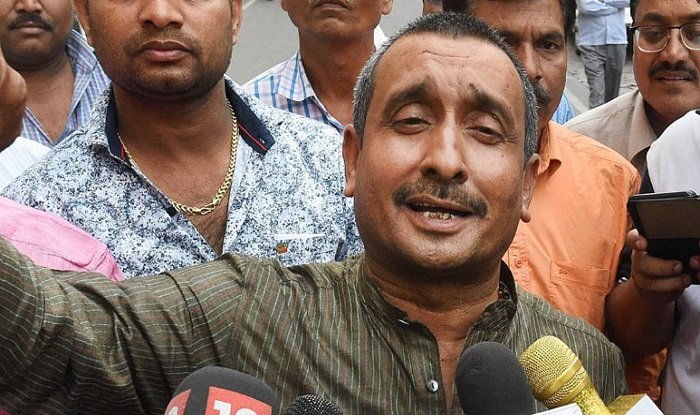
The arguments on the sentencing will be held on 19th December, 2019. Another accused Shashi Singh has been acquitted. Earlier this year, he was sacked from the BJP. The decision to sack the rape accused MLA comes after mounting pressure on the party after an accident killed kin of the Unnao rape victim and injured the victim and her lawyer.
Former BJP MLA Kuldeep Singh Sengar was the prime accused in the 2017 high profile rape case. The case pertains to an alleged rape committed by Sengar and his plot to silence the victim and intimidate her relatives by framing them in police cases based on flippant charges.
In August this year, the victim of the Unnao rape case was travelling to Rae Bareli with her two aunts, and her lawyer Mahendra Singh when their vehicle was hit by a truck, rendering them critically injured. The vehicle collided with a truck going in the opposite direction towards Lalganj in UP. The victim survived the near-fatal accident.
Two of her aunts were killed in the accident while her lawyer also sustained serious injuries. The woman’s family has filed a complaint alleging “conspiracy” behind the car crash.
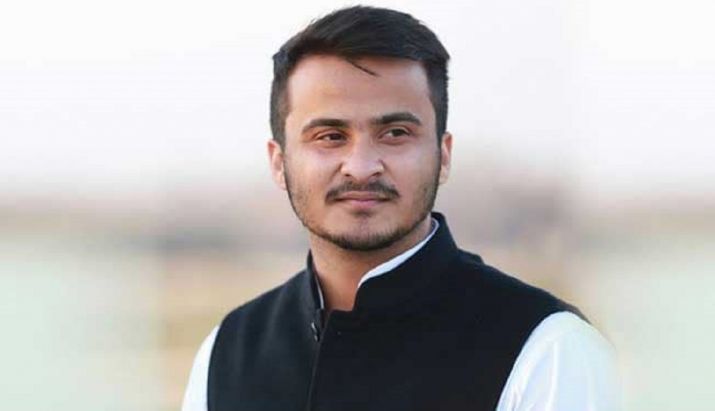
The Allahabad High Court has disqualified senior Samajwadi Party leader Azam Khan’s son and Suar MLA Abdullah Azam Khan from the Uttar Pradesh Legislative Assembly in connection with a fake affidavit. He is no longer an elected representative of the State.
Allahabad High Court disqualifies Abdullah Azam Khan from the membership of the State Legislative Assembly in connection with fake affidavit. He was the MLA from Suar of Rampur. He is the son of senior Samajwadi Party (SP) leader Azam Khan. (file pic) pic.twitter.com/tuDKV48OIN
On December 16 the court ruled that Abdullah Azam had produced fake documents about his age during the 2017 assembly elections and was underage at the time of elections. Senior Samajwadi Party leader Azam Khan and his son Abdulla Azam had landed in trouble after the Uttar Pradesh police filed a case of forgery against them. The police filed a case against the father-son duo following the directive by a Rampur court.
The case pertains to Abdulla Azam allegedly submitting a fake affidavit during the 2017 UP Assembly elections, in order to conceal his true age. The election was won by Abdulla from the Suar seat in Rampur.
Soon after the election, former BSP minister Kazim Ali Khan who is also known as Naved Mia, filed a case against Azam Khan and Abdullah, alleging their attempt to submit fake documents to prove that Abdulla was aged above 25 years. 25 is the minimum age required to contest either assembly or Lok Sabha elections. Abdulla’s father Azam Khan was dragged into this matter by the BSP leader by alleging that the latter too was involved in the forgery.
Last evening, the Delhi Police entered the Jamia Millia Islamia University to quell the bouts of violent acts accompanying the protest against the Citizenship Amendment Act. Public property was destroyed as the enraged mobsters indulged in blatant acts of vandalism and arson. Hundreds of ‘protesters’ were paraded out of the University with their hands in the air. The Police said that they had nabbed some outsiders who were indulging in violence.
Even as the police valiantly discharged their duty to uphold law and order in the National Capital, some of the mischief mongers on Social Media websites were busy fanning falsehoods and stoking rumours about the police crackdown. One such unverified speculation floated by these miscreants that snowballed into a widespread rumour was related to a death of JMI student Shakir Kota.
Scores of Twitter users instantly lapped up the rumour and started tweeting about the student’s death in order to further incite the protests and assert that the Delhi Police has been an enabler of a fascist regime.
My friend is stuck in Jamia, has sent me some videos.
According to him It’s emergency in Jamia, one JMI student named Shakir Kota ( Department not known for now) has been killed.
However, these assertions were merely falsehoods to push a motivated agenda against the law enforcement agencies and thereby pressurising the government into revoking the Citizenship Amendment Bill 2019. Pro-AAP blog Janta Ka Reporter also reported unverified news that there are reports that three students have died in the clashes.
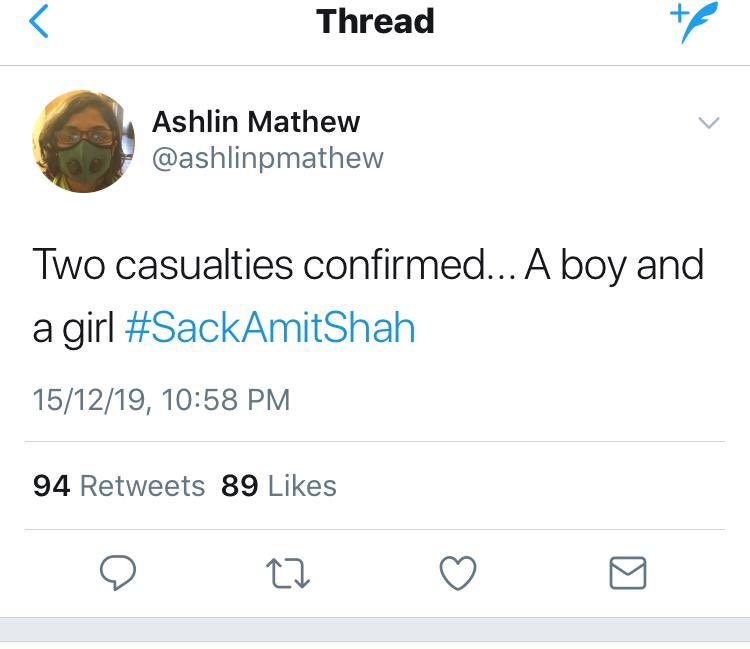
Amongst those involve in rumour mongering were one Ashlin Mathew, editor with Congress mouthpiece National Herald.
Editor at National Herald
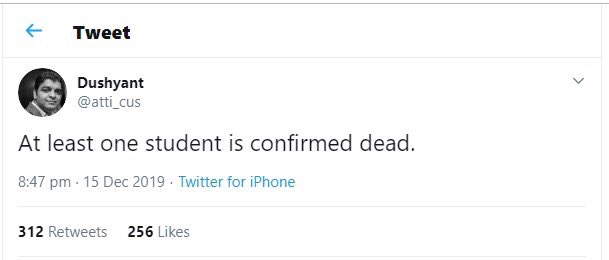
Delhi-based lawyer Dushyant Arora also tweeted how at least one student is confirmed dead. He has now quietly deleted the tweet without offering any explanation for the fake news.
Before long, the propaganda was busted as the news started to trickle in that no protestors were killed in the police action. Shakir, which many Twitter users were claiming had died is still alive. However, despite news reports denying deaths of demonstrators, the rumours about the deaths of protestors continued to be propagated unabatedly.
Today, the Vice-Chancellor of the Jamia Millia Islamia, Najma Akthar had to come out and brief the media over the ongoing rumours of deaths of two students of the University.
Vice Chancellor of Jamia Millia Islamia, Najma Akhtar: There has been a strong rumour that two students died, we deny this totally, none of our students died. About 200 people were injured of which many were our students pic.twitter.com/3uGAAVJuri
Denying the rumours about deaths of two JMI students, Akthar said that none of their students died due to the police action. She also mentioned that about 200 students got injured because of the police crackdown adding that many of those 200 injured students did not belong to the university.