Home Blog Page 703

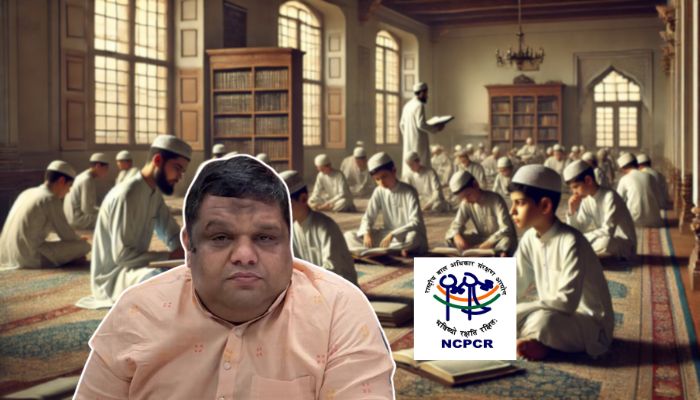
NCPCR recommendations on madarsa education: Remove non-Muslim students, introduce formal education, stop state funding and more

The National Commission for Protection of Child Rights (NCPCR) recently released a set of recommendations in connection with the madarsa education system in India. The main focus of the report is to ensure that all children, including those who attend madarsas, receive a formal and quality education as per the Right to Education Act, 2009. Notably, the NCPCR has raised concerns multiple times over the exclusion of madarsa students from the formal education system. Such exclusions often lead to educational deprivation and violations of their rights.

The Right to Education Act and madarsa exemptions

The Right to Education Act (RTE) was introduced under Article 21A of the Constitution of India in 2009. As per the RTE Act, every child between the ages of 6 and 14 has the right to free and compulsory education. However, in 2012, the Government of India introduced an amendment to the Act that exempted minority institutions, such as madarsas, from its provisions.

The idea behind introducing these exemptions was that such institutes provide religious education. According to Articles 29 and 30 of the Constitution of India, minorities have the right to conserve their culture, language, and scripts. In short, the amendment was introduced to safeguard the rights of minority communities under these Articles. However, because of the amendment, the children studying in these institutes became vulnerable and were denied access to formal schooling.

The RTE Act makes it mandatory to provide each student with essential facilities such as textbooks, libraries, and mid-day meals, as well as an age-appropriate and child-friendly curriculum. However, the exemptions provided to religious institutions under the 2012 amendment to the RTE Act deprived the students of these facilities.

The NCPCR conducted nine years of research to examine the impact of the exemptions introduced in 2012 on the education of children from minority communities. The commission held consultations with stakeholders, including children, teachers, and community leaders. In 2021, the NCPCR published a report based on the study, revealing widespread issues in the madarsa system. The commission found that children who attend madarsas were often deprived of formal education and basic entitlements, including a safe learning environment, proper infrastructure, and high-quality teachers.

The report by NCPCR highlighted that many madarsas, especially those operating outside formal government oversight, often do not adhere to basic safety standards and child protection policies. The commission found several cases of child rights violations, including physical punishment, child labour, and inadequate living conditions. The NCPCR noted that these violations have a severe impact on the well-being and future prospects of the children attending these institutions.

Speaking to ANI on reports on madarsa, NCPCR chief Priyank Kanoongo said, “Commission has released its final report after studying this issue for 9 years. We have found that around 1.25 crore children are deprived of their basic education rights. They are being tutored in such a way that they would work according to the motives of certain people, this is wrong. The people who have captured these Madrasas are those who used to say that they wanted to preach Islam across India during India-Pakistan partition. There are Madrasa boards in 7-8 states and we have asked to shut the Madrasa boards because they filed to serve the purpose…donations are being raised for Madrasas. This funding should be stopped and Madrasa Board must be disbanded and the Hindu children who are studying in these Madrasas must be enrolled in Schools.”

NCPCR’s findings

The NCPCR found that the states and UTs have been reluctant to conduct the mapping of madarsa. It is crucial for the state to fulfil its constitutional duty, as per the RTE Act, 2009, and ensure that all children receive formal and quality education. If the state fails to do so, it constitutes a violation of children’s fundamental rights, as it is the state’s responsibility to safeguard their access to formal education that meets the standards set forth by the Constitution and the RTE Act, 2009.

The commission pointed out that since independence and the adoption of the Constitution, state governments have failed to provide formal fundamental education to all children, leaving those from certain communities deprived of this critical right. This failure, the commission said, could be attributed either to the oversight of those responsible or their intention to appease specific sections of society for personal advantage. Interestingly, despite Muslims having served as education ministers for 20 years, only 5.5% of students come from the Muslim community, according to the AISHE report of 2019-20.

The commission noted, “On the other hand, Scheduled Caste students constitute 14.7%, and Scheduled Tribe students constitute 5.6% of the total enrolment, while 37% of students belong to Other Backward Classes. The SC/ST communities have not had the privilege of many education ministers from their own communities. Despite the opportunity of benefiting from reservation under different categories, the representation of the Muslim population in higher education remains low. This can be attributed to the fact that no parallel system of education was ever established for SC/ST communities, whereas children from Muslim communities are being drawn towards madarsas. Both Dr. B.R. Ambedkar and Mahatma Jyotirao Phule were strong advocates for education, particularly for marginalised communities, viewing it as a tool for social upliftment and empowerment. Following their leaders’ ideals, people from these communities recognised the importance of education and pursued formal schooling. This shows that leaders lead the way for society. The SC/ST community embraced education, but the representatives of the Muslim community did not carry forward the teachings of their religion and instead kept children away from their fundamental right to serve their own selfish purposes.”

The commission also pointed out an instance where Maulana Abul Kalam Azad, the first education minister of independent India, delivered a speech in Deoband in 1950. In his speech, he described the academic importance and greatness of Darul Uloom. The commission noted that this idea does not align with the promises made by the Constitution of India.

The report stated, “The first education minister of independent India, Maulana Abul Kalam Azad, was a founding member of the Anjuman-i-Ulama-i-Bangala in 1913, which would later become the Jamiat Ulema-e-Bangala branch of the Jamiat Ulema-e-Hind in 1921. He visited Deoband in A.H. 1370 (1950-1951). Maulana Azad delivered a speech in which, after mentioning the peculiarities of the ideal of life at the Darul Uloom, its academic importance, and his longstanding relations with it, the idea doesn’t seem to match what was promised by the Constitution of India to the children. Before the 86th Amendment in 2002, Article 45 read: ‘The State shall endeavour to provide, within a period of ten years from the commencement of this Constitution, for free and compulsory education for all children until they complete the age of fourteen years.'”

NCPCR’s Key Recommendations

Withdrawal of non-Muslim children from madarsas

All non-Muslim children attending madarsas without explicit parental consent should be removed and enrolled in formal schools as per the RTE Act, 2009.

The NCPCR’s recommendation read, “Making a child profess a religion different from their birth religion shall amount to a violation of Section 75 of the Juvenile Justice Act, 2015 (JJ Act 2015). Not only are children’s fundamental rights being infringed, but the Juvenile Justice Act, 2015, is also being disregarded. This is sometimes done by institutions that function on State funds. Any provision excluding children from the benefits of the right to education is against the spirit of the Constitutional principles with which the Constitution was adopted by the people for themselves.

It further states, “Article 29(2) of the Constitution states that no citizen shall be denied admission into any educational institution maintained by the State or receiving State aid on grounds of religion, race, caste, language, or any of them. Article 28(3) further states that no person attending an educational institution recognised by the State or receiving aid from State funds shall be required to take part in any religious instruction or attend religious worship conducted in such institutions or premises unless the person, or in the case of a minor, their guardian, has given consent. However, in most cases, States/UTs have failed to provide evidence of parental consent for non-Muslim children attending madarsas imparting Islamic education.”

The NCPCR accordingly recommended, “Therefore, it is recommended that all non-Muslim children be withdrawn from madarsa and enrolled in schools to receive fundamental education as per the RTE Act, 2009.”

Ensure formal education for all children

NCPCR noted that states should ensure that all Muslim children attending madarsa are also enrolled in formal schools and receive education according to the RTE Act’s prescribed time and curriculum.

NCPCR’s recommendation read, “The report reiterates that formal education for all children is a fundamental right, and hence every child is entitled to quality education as per the RTE Act, 2009. States are obligated to provide such schooling, where children up to class 5 attend school for 4 hours and children from classes 6 to 8 attend school for 6 hours. Failure to fulfil this duty is not only against the welfare of the children but also contradicts our constitutional ethos and principles. During the creation of this report, it was observed that both religious and fundamental education can be provided concurrently but not within the same institution.”

The child rights body recommended, “Therefore, States should ensure that all children from the Muslim community attending madarsas, whether recognised or unrecognised, are enrolled in formal schools and receive education as per the prescribed time and curriculum under the RTE Act, 2009.”

Cease State funding for non-compliant madarsas

NCPCR urged that state funding should be stopped for madarsa that do not comply with the RTE Act, and madarsa boards that fail to meet educational standards should be closed down or restructured.

NCPCR’s recommendation read, “State funds should not be spent on any instruction outside the RTE Act, 2009, as this would violate the rights of children. The responsibility of providing religious education lies with the concerned community, for which adequate provisions are made under the Constitution. Without indulging in any form of appeasement, the State should recognise its responsibility as enshrined by the Constitution and the RTE Act, 2009, and allocate resources to ensure children receive formal, quality education. Failing to do so results in a violation of fundamental rights at an institutional level. Moreover, merelyconstituting a board or obtaining a UDISE Code does not indicate that madarsa are complying with the provisions of the RTE Act, 2009. Article 30(2) of the Constitution states that the State shall not, in granting aid to educational institutions, discriminate against any institution based on minority status, whether by religion or language.”

The report added, “Therefore, there is no discrimination against minority groups. However, any funding provided to an institution under the guise of education that hinders the implementation of the RTE Act, 2009, is unconstitutional. Consequently, it is recommended that State funding to madarsa and madarsa boards be stopped across all States/UTs and that madarsa boards be discontinued and closed down (in the case of Uttar Pradesh, subject to the judgment of the Hon’ble Supreme Court on SLP (Civil) No. 008541 of 2024).”

No State funding for religious instruction

In its recommendations on madarsa, NCPCR noted that State funds should not be used for religious instruction, which is the responsibility of the respective community. The State should focus on providing formal education as per constitutional and legal mandates.

NCPCR’s recommendation read, “The misuse of the MoU signed between NIOS and Jamiat Ulema-e-Hind (JUH) has also brought attention to the role of NIOS in the matter. Despite knowing that it is a constitutional obligation of the State to provide free and compulsory elementary education to all children, NIOS signed an MoU with JUH while being aware that these children were not attending formal education in schools up to class VIII. The MoU contributed to keeping these children out of school. Therefore, the Ministry of Education (MoE) may initiate action to examine the role of NIOS in this regard.”
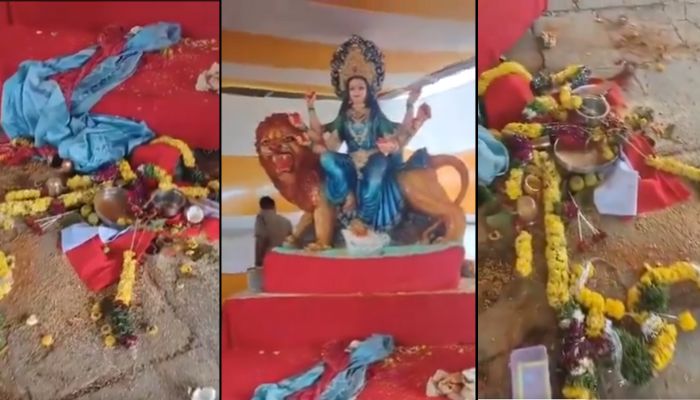
Idol of Goddess Durga desecrated in Hyderabad: While police arrests a ‘vagabond looking for food’, here are the questions that are left unanswered

0

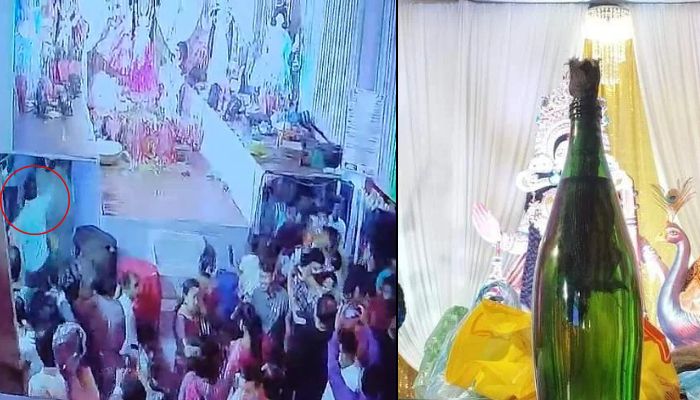
On Thursday (10th October), the idol of Goddess Durga was found vandalised at the Nampally Exhibition Grounds in Hyderabad city of Telangana. 

According to reports, the attack on the Hindu Puja mandap occurred during the Devi Sharan Navaratri celebrations in the city. On learning about the incident, cops from Begum Bazar police station reached the scene and conducted an inspection.

A video surfaced on social media, showcasing the extent of damage caused to the puja mandap.

From the video, which has not been disputed, it seems the extent of the damage was not limited to the Mandap itself, but also the Murti of Goddess Durga. In the video, it is visible that the arm of the Murti has been broken by the criminal who vandalised the Mandap.

According to a Telugu Hindustan Times report, the miscreant first disconnected the electricity lines and then destroyed CCTVs. Following that, they damaged the barricades, and the arm of the idol of the Hindu deity. The attackers also threw away Puja paraphernalia.

Investigating the matter, the Hyderabad police issued a statement to the media. DCP, Central Zone Akshahsh Yadav says, “In the morning around 6:00 am we got a call that the Durga Mata idol which has been kept in the exhibition ground, the right hand has been damaged and the ‘prasad’ and other items kept at the feet of the idol were scattered. Immediately the team reached the spot in the morning and looked for the evidence, we checked CCTV footage and around 8:15 pm we caught one accused. The name of the accused is Krishnaiah Goud…He is a vagabond…He came to this pandal in the morning since he was feeling hungry and while searching for food he disturbed the Prasadam and in that, the idol got damaged. This incident happened because there was negligence on the part of the organizers…We have booked a case against the organizers…”

The police have arrested one Krishnaiah Goud for the vandalism and booked the organisers for the lapse in security measures.

While the police arrested the accused, the statement by the police raises more questions than it answers.

The police have claimed that Krishnaiah Goud was hungry and looking for food. It was in the process of looking for food that the idol was desecrated and the mandap vandalised.

The images that have emerged from the Mandap and the information reported by Hindustan Times, however, raise questions.

The first and foremost question is if Krishnaiah Goud was a ‘vagabond’ (homeless and jobless), hungry and looking for food, how did the Murti itself get desecrated in the process of looking for food? If one were to guess the typical behaviour of a hungry homeless person looking for food, one would imagine that he would break into the pandal, take the Prasad and either leave with it or eat that Prasad.

What would make a homeless hungry person looking for food reach out to the Murti and break an arm of the Murti?

Further, if the person was hungry and looking for food, why was the Prasad clearly scattered in the Mandap instead of either consumed or taken along with the vandal?

The police statement also does not explain how the “vagabond”, which is essentially a homeless person, disconnects the electric lines and the CCTV before looking for food.

One would assume that the version of the police, where they say the vandal was merely a homeless person looking for food, is what they have learnt in the course of the investigation after the accused was arrested. In the absence of an explanation from the police, it could be assumed that this was the reason the accused himself gave the police after his arrest by the police.

The statement from the police, however, does not debunk any of the assertions made in the Hindustan Times report. While the police certainly say there is no “communal angle”, they fail to explain why in the process of looting food, the vandal desecrated the idol of Goddess Durga. It is rather obvious that it was a deliberate act and the arm of the idol did not simply break by accident while looking for food which was kept in the form of Prasad on the floor, much lower than the Murti itself. From the video, one can conclude that the vandal would have to specifically make an effort to reach the arm of the Deity to break it.

While there appears no indication to believe yet that the police arrested the wrong person, the statement by the police leads to more questions than it answers. Given the significance of the festival and the grave crime of desecrating the faith of the Hindus, these questions deserve answers from the Hyderabad police.

Deep State, Wokeism, ‘Cultural Marxists’ are threats to all cultural traditions: RSS Chief Mohan Bhagwat

0

Rashtriya Swayamsevak Sangh chief Mohan Bhagwat on Saturday emphasised the threats posed by “Deep State,” “Wokeism” and “Cultural Marxists” to cultural traditions stating that destruction of values and traditions is a part of the modus operandi of this group.

Addressing the annual Vijayadashami programme held at Nagpur, the RSS Chief highlighted that the first step of such groups is to capture the institutions of the society.

“Words like ‘Deep State’, ‘Wokeism’, ‘Cultural Marxist’ are in discussion these days. In fact, they are the declared enemies of all cultural traditions. Complete destruction of values, traditions and whatever is considered virtuous and auspicious is a part of the modus operandi of this group. The first step of this modus operandi is to bring the mind-shaping systems and institutions of the society under one’s influence – for example, the education system and educational institutions, media, intellectual discourse, etc., and to destroy the thoughts, values and belief of the society through them,” Bhagwat said.

“In a society living together, an identity-based group is motivated to separate on the basis of its actual or artificially created specialty, demand, need or a problem. A feeling of victimhood is created in them. By fanning discontent, that element is pulled apart from the rest of the society, and made aggressive against the system. Direct conflicts are created by finding fault lines in the society. An atmosphere of anarchy and fear is created by intensifying distrust and hatred towards the system, laws, governance, administration etc. This makes it easy to establish one’s dominance over that country,” the RSS leader said.

The RSS Chief also called for unity among Hindus citing the example of Bangladesh where he said that for the first time, Hindus united and came out on roads for their protection. He noted that till this radical nature of committing atrocities out of anger prevails – not only Hindus, but all minorities will be in danger.

“What happened in our neighbouring Bangladesh? It might have some immediate reasons but those who are concerned will discuss it. But, due to that chaos, the tradition of committing atrocities against Hindus was repeated there. For the first time, Hindus united and came on roads for their protection. But, by the time this radical nature of committing atrocities out of anger is there – not only Hindus, but all minorities will be in danger. They need help from the Hindus from the entire world. It’s their need that the government of India help them… Being weak is a crime. If we are weak, we are inviting atrocity. Wherever we are, we need to be united and empowered,” Mohan Bhagwat said.

Bhagwat further mentioned that in Bangladesh, such discussions are going on that they have a threat from India and hence they have to side with Pakistan since they have a nuclear weapon to stop India.

“We all know which countries are pushing such discussions, and narrations, we don’t need to take their name. Their wish is to create such conditions in India as well. Such industries are being run to stop India,” Bhagwat said.

He also emphasized that India is progressing in the fields of technology and education.

“Society’s understanding is also gradually improving. As a result, we observe that the elections in Jammu and Kashmir were conducted peacefully. This also reflects the growing stature of India on the global stage. Our philosophy of “Vasudev Kutumbkam” (the world is one family) is being widely accepted. Our yoga is becoming a global trend. The world is also embracing our perspective on environmental conservation,” he said.

(This news report is published from a syndicated feed. Except for the headline, the content has not been written or edited by OpIndia staff)

Bangladesh: Mohammed and his aides attack Durga Puja mandap with petrol bomb, stab devotees with knife on being stopped

Amid the ongoing Islamist onslaught on the minority Hindu community, a petrol bomb was hurled at a Durga Puja mandap in the Tanti Bazar neighbourhood in Dhaka city of Bangladesh.

In visuals that have surfaced on social media, a man was seen attacking the Durga Puja pandal with a bomb. The accused was seen standing in a queue and hurling the explosive towards the idol of the Hindu deity.

According to reports, a minor fire broke out at the pandal, but no one was injured. The Hindu devotees present at the scene tried to stop the attacker but he stabbed them. A total of 5 people (4 volunteers and 1 visitor) were injured in the knife attack.

The victims included Deepta Dey, Jhantu Dhar, Khokon Dhar, Sagar Ghosh and Mohammed Ramiz Uddin. They are currently undergoing treatment at Sir Salimullah Medical College Mitford Hospital.

The police have recovered the explosive, which was used in the targeted attack. A total of two accused were identified and arrested by the police. They include Mohammed Hridoy and Mohammed Jibon.

The duo was taken into custody and is now interrogated by law enforcement authorities. A separate robbery attempt was made at the Puja Mandap. The police have recovered a gold chain from the accused, identified as one Akash.

Tantibazar Puja Celebration Committee General Secretary, Bijoy Shah, confirmed the development and clarified the petrol bomb attack at the Durga Puja mandap and robbery were separate incidents.

The Durga Puja pandal in Tanti Bazar is now being guarded by Hindu devotees and law enforcement authorities. The Puja committee has demanded strong action against the accused.

It has accused the police of downplaying the petrol bomb attack by equating it with the robbery incident. The three accused are from different parts of Bangladesh. It remains unknown whether the trio was recruited by any secret organisation.

While Congress leaders blame EVMs for Haryana defeat, state OBC leader Ajay Yadav blames mismanagement and poor coordination for the debacle

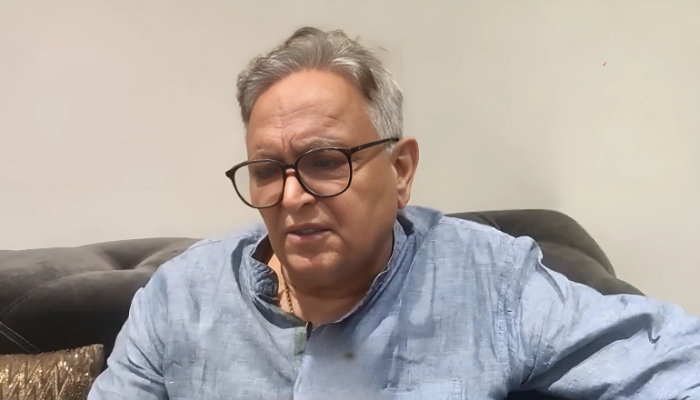
On Thursday, 11th October, former Haryana Minister and Congress’s Other Backward Class (OBC) chairman Ajay Yadav blamed mismanagement and poor coordination among the national and state leadership for the debacle in Haryana elections. Yadav accused National General Secretary KC Venugopal of being unreachable during the elections. Yadav’s statement came at a time when Congress was blaming EVMs for the Haryana election defeat. Though Yadav echoed the sentiment to some extent during an interview with news agency ANI, he primarily blamed the party leadership for the loss.

Ajay Yadav suggested that the party should introspect over the failure in the Ahirwal belt in Haryana, where 10 out of 11 seats went to the Bharatiya Janata Party (BJP). He said, “Ahirwal has no representation in the Congress Working Committee, the party’s central election committee, the All India Congress Committee, or the Haryana Pradesh Congress Committee. The party has appointed me as OBC national chairman, which is of no use as it is toothless. We lost the election because there was no coordination between the state and national leadership.”

In a post on X, Yadav wrote, “The party should introspect on its failure in southern Haryana, especially Gurugram, Rewari, Mahendragarh, and Faridabad, where it won just one seat. Ahirwal has no representation in the CWC, CEC, AICC general secretaries, or even in the HPCC. The AICC OBC chairmanship is an eyewash and toothless.”

In another post on X, he criticised the Congress for its inability to control the narrative, as there were reports of infighting within Haryana Congress for the Chief Minister post before securing the mandate from the people.

Elaborating on his post while speaking to ANI, he said, “When elections are held, winning is the primary goal, and if tussles for the CM post emerge in the media at that time, it is not a good sign for the party. First, secure the mandate, and after that, decide who will become the CM. This decision cannot be made by any one person; it is made by the MLAs. So I believe there are many issues.”

He also accused the party of not assigning a new state in-charge when Deepak Babaria was hospitalised. Yadav said, “When the party’s state in-charge Deepak Babaria was hospitalised, why was his duty not assigned to another leader? The party’s state chief, Udai Bhan, was contesting himself, so he failed to take proper feedback and help the candidates in finalising the strategy.”

Interestingly, Ajay Yadav alleged that senior party leaders from the All India Congress Committee (AICC) had asked him to make arrangements for Congress leader Rahul Gandhi’s roadshow in his area. However, Gandhi never visited. Yadav also pointed out that Kumari Selja did not visit Rewari due to the unavailability of a helicopter. He said, “We finalised Kumari Selja’s programme in Rewari, but she expressed an unwillingness to attend due to the unavailability of a helicopter.”

Furthermore, Yadav noted that a statement by Mamman Khan, the sitting MLA from Ferozpur Jhirka, also worked against the party. He said, “Our sitting MLA from Ferozepur Jhirka, Mamman Khan, won by a huge margin because the majority of voters were Muslim there, but his controversial remarks contributed to our defeat. The campaign was led by individuals, and other leaders were missing. We lost due to polarisation and poor election management.”

Ajay Yadav is not the only Congress leader blaming the party leadership for the Haryana election defeat. Senior Congress leader and Rohtak MLA Bharat Bhushan Batra said that poor management and overconfidence among party leaders and workers led to the loss. He said, “In the last week of the campaign, huge polarisation of SCs and OBCs was observed, and that worked in favour of the BJP. We need to reconsider where we went wrong.”

However, he refuted allegations made by former Assandh MLA Shamsher Singh Gogi that Congress lost due to infighting and an over-reliance on former Chief Minister Bhupinder Singh Hooda. He added that Gogi often makes biased remarks against Hooda whenever he has the opportunity.

An unnamed senior leader was quoted by the Hindustan Times saying that party leaders were inactive during the elections, which led to the defeat. He said, “Our top leaders Bhupinder Singh Hooda, Kumari Selja, Ajay Yadav, and Randeep Surjewala did not share the stage even once. In two rallies, Hooda and Selja were present, but other leaders were missing. The BJP succeeded in convincing people that all was not well within Haryana Congress, and the assembly results reflect that.”

Congress blamed EVMs for Haryana defeat

After the defeat in assembly election in Haryana, the Congress party again started to blame Electronic Voting Machines (EVMs). However, they brought some changes to the allegation. In a bizarre accusation, the party claimed that EVMs with different levels of battery charge gave different results. Refuting their accusations, the Election Commission explained that while fully charged batteries are inserted in EVMs before the polls, the charge level continues to come down with the use of the machines in mock poll, actual voting and counting. The same accusations were echoed by Yadav in statement to ANI.

With inputs from ANI

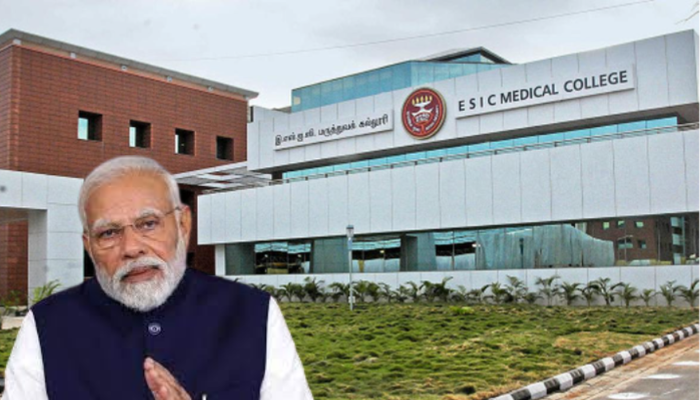
Centre announces the establishment of 10 new ESIC medical colleges, an extension of Atal Bima Beemit Vyakti Kalyan Yojna till June 2026

The Modi government is set to establish 10 new ESIC medical colleges and extend the unemployment allowance scheme for ESI Corporation members until June 2026. These decisions align with the Prime Minister’s Independence Day (2024) promise to add 75,000 medical seats in the next five years.

Ludhiana in Punjab, Basaidarapur in Delhi, Jaipur in Rajasthan, Noida and Varanasi in Uttar Pradesh, Ranchi in Jharkhand, Indore in Madhya Pradesh, Guwahati-Beltola in Assam, Naroda-Bapunagar in Gujarat and Andheri in Maharashtra have been selected for the new facilities, according to the Labour and Employment Ministry Dr Mansukh Mandaviya.

During an ESI Corporation meeting, Mansukh Mandaviya made several significant announcements aimed at enhancing the facilities and medical capabilities of ESIC.

Launched in 2018, the Atal Beemit Vyakti Kalyan Yojna offers unemployment benefits to ESIC-insured people seeking new jobs. The program will now run from 1st July to 30th June 2026, for an additional two years. ESIC beneficiaries would receive unrestricted medical care in hospitals affiliated with the Ayushman Bharat Pradhan Mantri Jan Aarogya Yojana (AB-PMJAY), with no financial cap in undeveloped regions of the nation.

“To provide relief to insured persons, who have been rendered unemployed, a scheme namely “Atal Beemit Vyakti Kalyan Yojna” was introduced in ESIC on a pilot basis for two years w.e.f. 01.07.2018. The scheme was intended to provide support in the form of an Unemployment Allowance during the period when an insured person searches for a new engagement for earnings. After completion of two years since its inception, the scheme was extended for another year from 01.07.2020 to 30.06.2021. It was further extended up to 30.06.2022 and then up to 30.06.2024. Further, this scheme has been extended for a further two years with effect from 01.07.2024 to 30.06.2026,” the official website read.

100 bedded ESI Hospital at Guntur, Andhra Pradesh, 1 Doctor Dispensary at Fatehpur, Uttar Pradesh, DCBO at Pratapgarh, Uttar Pradesh, 350 bedded ESI Hospital, Pune, Maharashtra, ESI Dispensary and Branch Office, Dhubri, Assam, 100 bedded ESI Hospital at Muzaffarpur, Bihar and DCBO at Auraiya, Uttar Pradesh have also been approved by the administration. “Further, construction of 717 new staff quarters at ESIC residential colony, Sector-56, Noida, Uttar Pradesh has also been approved,” the statement added.

Assam: Abdul and other madrassa students desecrate idol of Goddess Durga, police arrest accused

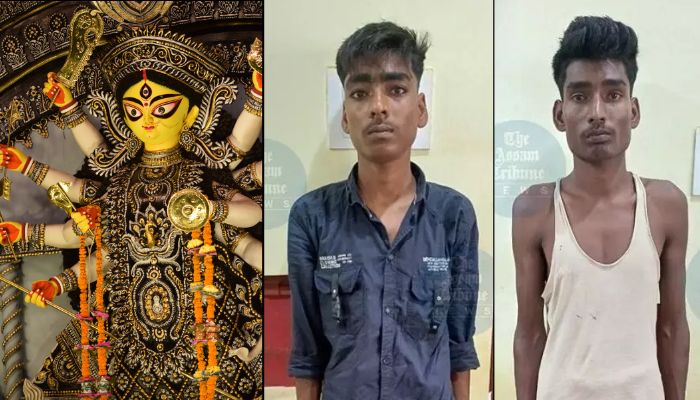
On Wednesday (9th October) night, the idol of Goddess Durga was desecrated by three radical Muslims in Manasangan village in Karimganj district of Assam.

According to reports, the accused were identified as Abdul Ahad, Sahabul Ahmed and a minor. They are said to be students of the local madrassa.

The trio attacked the procession of the Bagargool Sarbajanin Durga Puja committee while they were en route to the pandal.

The committee members were carrying the idol of Goddess Durga when Abdul and his accomplices threw leftover, cooked rice at it and defiled the Hindu deity.

This sparked communal tension in the Manasangan village. On learning about the matter, Karimganj DC Pradip Kumar Dwivedi and SP Partha Pratim Das reached the spot and de-escalated the situation.

A new idol was arranged for by the Karimganj district administration on the demand of the Hindu devotees associated with the Puja committee.

Madrassa students arrested in connection to Karimganj idol desecration

The police swung into action and arrested Abdul Ahad and Sahabul Ahmed. The duo was produced before a judicial court and remanded in custody.

The minor accused was sent to juvenile court. Efforts are underway to prevent further incidents of desecration of Durga Puja idols and pandals.

BJP MLA from Karimganj, Kamalakhya Dey Purkayastha, also visited Manasangan village to take cognisance of the situation. He handed over ₹10,000 to the Bagargool Sarbajanin Durga Puja committee.

200-year-old Hindu temple set on fire in Karimganj

In September last year, a 200-year-old Hindu temple was set ablaze by unidentified miscreants in Barman Basti village in Ratabari in Karimganj district of Assam.

As per reports, a group of criminals set fire to the ancient Shiv-Narayan Mandir in the wee hours of the night. The area falls under the jurisdiction of the Ratabari police.

After the news of the incident spread, the locals rushed to the temple. They demanded strict action against those involved in the temple’s destruction. During the initial investigation, three gallons of fuel were recovered by the police.

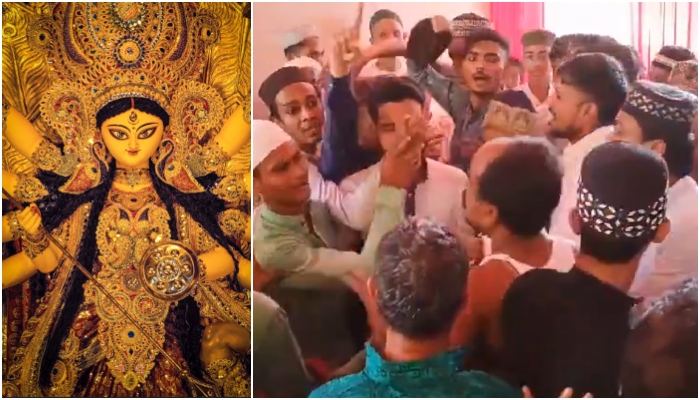
Kolkata: Muslim mob storms into Durga Puja pandal and threatens to vandalize Maa Durga idol, abuses Hindu women, complaint filed by organisers

On Friday, 11th October, amid the Durga Puja festival, the Puja Pandal of New Bengal Sporting Club at Garden Reach area of Kolkata was stormed by a Muslim mob who threatened the Puja organizers to stop the Hindu rituals. The Muslim mob consisting of around 50-60 members also threatened that they would vandalize Maa Durga idol if the celebrations weren’t stopped.

The organizers of the Hindu religious event, New Bengal Sporting Club at Garden Reach area of Kolkata, wrote a complaint to the Police demanding FIR in the case. The complaint letter was shared by BJP leader, LoP West Bengal Suvendu Adhikari on X. He also shared a video showing a large number of Muslim youths creating a ruckus inside the pandal.

“What is this C P Kolkata Shri Manoj Kumar Verma (IPS)? How did the goons garner the ability to storm into a Durga Puja Pandal under the Jurisdiction of the Kolkata Police and threaten to vandalize the idol of Maa Durga if the rituals aren’t stopped?” he pondered.

“The Office Bearers and Members of the New Bengal Sporting Club have also provided video footage of the incident. How can you allow this to happen? I believe you will take the strictest action possible against the culprits and make them realize that it is Kolkata, not Dhaka,” he added.

The organizers in the complaint mentioned that the incident happened on 11th October at around 1 pm. “About 50-60 Muslims came to our puja pandal and interrupted rituals. They threatened to disrupt the pandal and said that they would also break Maa Durga’s idol if the puja rituals were not stopped,” the complaint read.

It also added that the Muslim mob used abusive language for Hindu women and threatened them for following Hindu rituals. The video of the said incident is making rounds on social media in which some individuals wearing Islamic caps can be seen creating chaos in the pandal. The letter added that they have submitted the video of the incident at the Garden Reach Police Station.

The organizers have demanded FIR in the case.

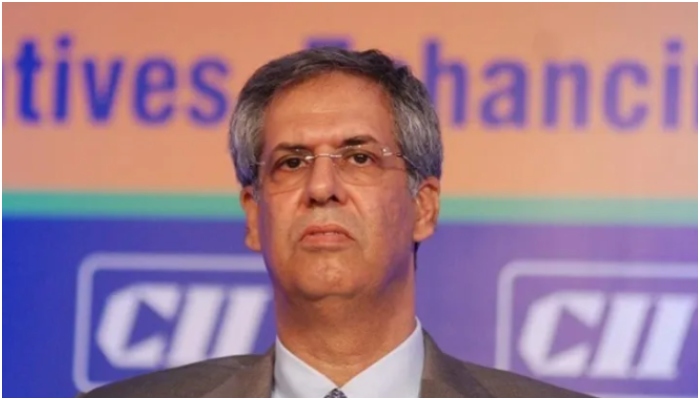
Here’s who Noel Tata is, the newly chosen chairman of Tata Trusts after the death of Ratan Tata

0

On Friday, 11th October, Noel Tata, the chairman of Tata Trent and vice chairman of Tata Steel, was chosen as the new chairman of Tata Trusts. This is after Ratan Tata, the previous chairman of the Tata conglomerate’s philanthropy arm, died on the night of October 9th, 2024, at the age of 86, due to old age complications.

Tata Trust is the fundamental body that oversees the operations of all 14 Tata Trusts and holds the majority of shares in Tata Sons, the Tata Group holding company. The two main trusts are Sir Dorabji Tata Trust and the Sir Ratan Tata Trust, which together own nearly 52% of the company. Other trusts together own another 14% of Tata Sons, taking the total holding to 66%.

The position of chief of Tata Trusts fell vacant after the demise of Ratan Tata, and his half-brother Noel Tata was seen as the frontrunner for the position. As per expectations, he has been selected as the new head of the trust. As per reports, many ‘old timers’ wanted him to lead the venture. His appointment to the post continues the tradition of Parsis hearing the trust.

After the announcement, he said that he is deeply honoured and humbled by the responsibility that has been cast on him by his fellow Trustees.

Noel Tata was born in December 1957 and is Ratan Tata’s half-brother. He graduated from Sussex University (UK) and finished the International Executive Programme (IEP) at INSEAD.

He is an Irish citizen and currently heads Tata group companies Trent and Voltas. He has transformed Trent into the biggest fashion chain in the country. He is married to Aloo Mistry, and their three children, Leah, Maya, and Neville Tata, are all actively involved in the Tata group business. Leah Tata works as a Vice President at the Indian Hotels Company while Maya Tata is linked with Tata Capital. Neville Tata on the other hand is a member of Trent’s leadership team at Star Bazaar.

Noel’s mother Simone Tata, the second wife of Ratan Tata’s father Naval Tata, was born in Switzerland and is known to have started the fashion brand Lakme here.

Noel Tata’s most notable position prior to this new assignment was as Managing Director of Tata International Ltd, the group’s trade and distribution arm. Between 2010 and 2021, the company’s revenue increased from $500 million to more than $3 billion, demonstrating its capacity to drive growth in a highly competitive sector.

As Managing Director of Trent Ltd, Tata’s retail arm, he led the company’s expansion from a single store in 1998 to over 700 outlets in a variety of forms. Noel Tata now serves as the chairman of Trent, Tata International Limited, Voltas, and Tata Investment Corporation. He is also the vice chairman of Tata Steel and Titan Company Limited.

He is also a trustee on the boards of Sir Ratan Tata Trust and Sir Dorabji Tata Trust, which together own more than 50% of Tata Sons. These two trusts are the administrative wings, and they can both assign persons to Tata Trust. 67-year-old Noel Tata has been associated with the Tata Group for the last 4 decades. With this appointment, Noel Tata becomes the sixth chairman of the Sir Ratan Tata Trust and the eleventh chairman of the Sir Dorabji Tata Trust.

Noel Tata was once considered a candidate for the presidency of Tata Sons, but the keys were handed over to Cyrus Mistry, Noel’s brother-in-law. At that time, he was deemed not experienced enough for the position. Following Mistry’s controversial exit, N Chandrasekaran, the then-CEO of Tata Consultancy Services (TCS), was appointed chairman of Tata Sons.

Ratan Tata, the name associated with one of India’s most famous industrial conglomerates, the Tata Group, has left an indelible influence on the worlds of business and society. His leadership, charity, and imaginative thinking have revolutionized not only the corporation but also the Indian and global corporate landscapes. His death on 9th October has created a huge void in the industrial space provoking each Indian to remember his ideals, his greatness, and his determination towards the nation’s overall development. 

While Tata Trusts owns 66% of Tata Sons, it does not have direct control over the holding company or the group companies. But the trust appoints a third of the directors to Tata Sons who have veto power over board decisions. While Tata Sons is not compelled to seek directions from the trusts, it is an understanding that there is consulting between the two arms on major decisions. As a result, the Tata Trust and its head have considerable say in the group, although indirectly.

Tata Sons is a major Indian conglomerate of nearly 100 companies operating in several sectors including automobiles, aviation, beverages, chemicals, consumer products, energy, engineering, finance and insurance, information systems, materials, retail, services, semiconductor, steel, tourism etc.

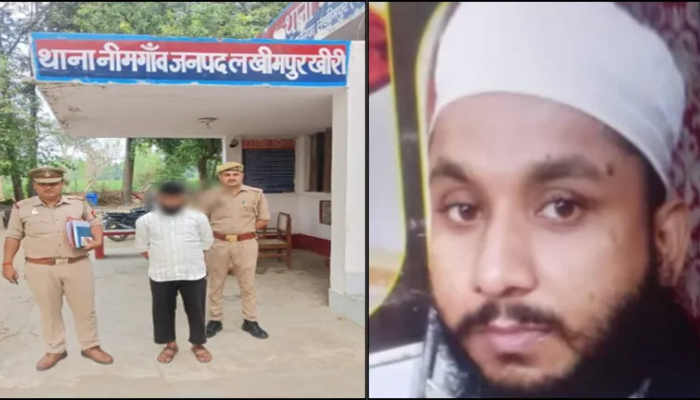
Uttar Pradesh: Maulana Masood arrested for molesting, blackmailing minor Hindu girls using their photos with the help of his girlfriend, accomplice Masood Khan booked

0

A Maulana (Muslim cleric) from Lakhimpur Kheri in Uttar Pradesh used to blackmail Hindu girls using their photographs which were sent to him by his girlfriend. The families of the victims have filed a First Information Report (FIR) against him and he has been arrested by the authorities. According to media reports, the accused has been identified as Maulana Masood Khan.

The matter pertains to the Neemgaon police station area of ​​Lakhimpur Kheri. He is a resident of Achaniya village and also runs a shop. His lover Priyanka who teaches in a convent school provided him with the images of her female students and he began to threaten them. The institution is managed by a man named Masood Khan.

On 25th May when a girl reached the cleric’s shop in order to get her phone recharged, he caught hold of her hand. He took the device and tampered with it. Afterwards, he followed her and engaged in appropriate behaviour with her. He molested her again on 24th September and threatened that he would take obscene pictures of her and share them on social media. He even threatened her via WhatsApp messages. Her brother then lodged an FIR against him. Afterwards, the cops examined the perpetrator’s mobile and discovered dozens of photos as well as lewd videos of Hindu girls, many of whom attended the school where Priyanka was employed.

In a separate matter, a girl from a village in the police station area studies in a coaching institute located in the area with her two friends. According to her family members, all three are friends with Priyanka who sent their photos and videos to the offender and he misused them. The authorities have submitted a case under sections 79 and 351 (2) of the Bharatiya Nyaya Sanhita (BNS), on the complaint of their families.

He has also been charged with converting a Hindu girl. Two cases have been launched against him. His lover and the other Masood Khan have also been named as accused and the police are searching for them. Neemgaon police station officer Sunita Kushwaha told OpIndia that both of them will also be arrested soon and further investigation into the matter is underway. The girls are minor and they are also looking into the matter from this angle.