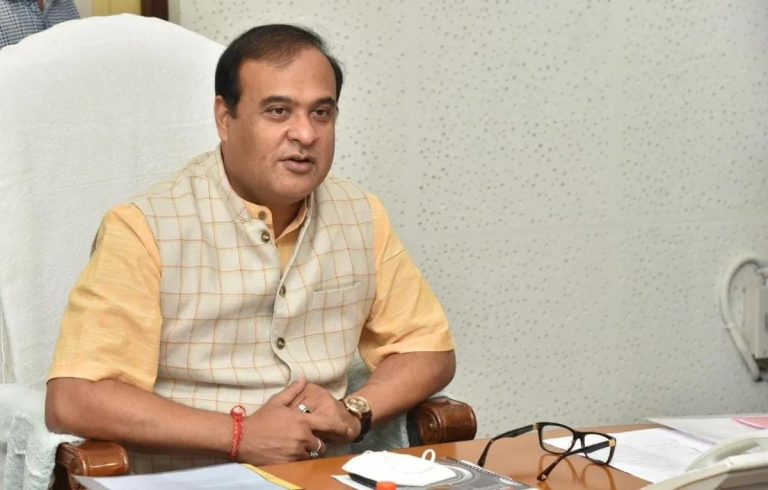
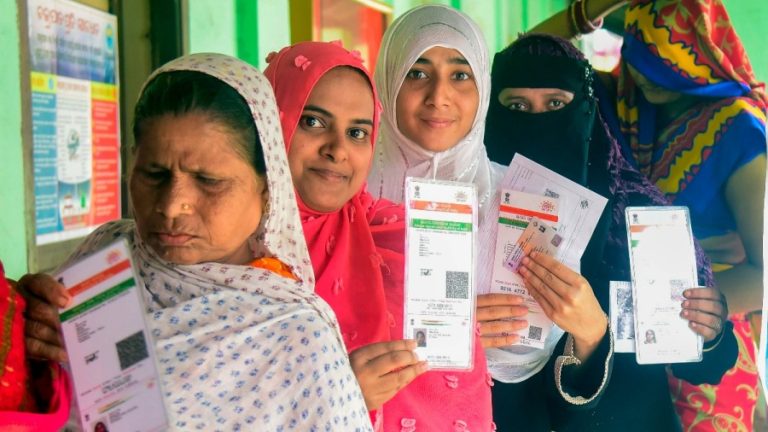
In a significant development, Assam Chief Minister Himanta Biswa Sarma has issued new directives for the implementation of the Citizenship (Amendment) Act (CAA). Notably, cases against Hindu Bengalis under the Foreigners Tribunal have been dropped, as many of them claim to be citizens who entered before 1971 and therefore do not wish to apply under the new law.
During a press conference, Sarma mentioned that most Hindu Bengalis prefer to prove their citizenship status in court rather than applying under the CAA. According to a home department order, Hindus, Sikhs, Christians, Parsis, Jains, and Buddhists from Afghanistan, Pakistan, or Bangladesh who entered India on or before December 31, 2014, are eligible to apply for citizenship. Consequently, the border police may not forward their cases to the Foreigners Tribunal.
The central government will determine their citizenship based on the facts and circumstances of each case, and a separate register will be maintained for these cases. However, this provision does not apply to those who entered India from these countries after December 31, 2014, regardless of their faith.
Sarma stated, “So far, only two people have applied. Anyone who arrived in India before 2015 under the CAA has the first right to apply for citizenship. If they do not apply, we will lodge a case for them. This is a statutory instruction. We will deport those who came after 2015. Out of five applications, three individuals were not present at the hearing, and only two have applied under the CAA.”
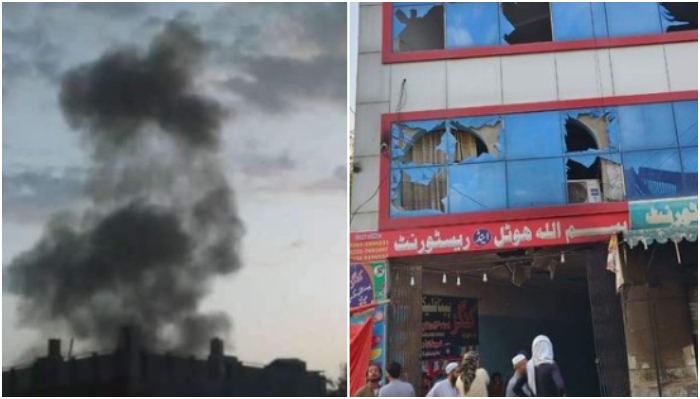
On July 15, 2024, a coordinated and devastating attack rocked the Bannu cantonment in Khyber Pakhtunkhwa, Pakistan. The attack featured a few suicide bombers and heavy firing, resulting in numerous casualties. The Jaish Fursan-e-Muhammad, a faction of the Tehrik-i-Taliban Pakistan (TTP) led by Hafiz Gul Bahadur, has claimed responsibility for this incident.
The attack commenced early in the morning when the assailants attempted to break through the cantonment’s security walls with an explosive-laden vehicle. The attackers, armed with sophisticated weapons and wearing suicide vests, began their attack by detonating a car at a checkpoint. The big explosion caused panic, allowing the remaining attackers to move forward.
Jaish Fursan-e-Muhammad, has claimed responsibility for ongoing suicide attack on Bannu Cantonment; attack initiated by a bomber who detonated his explosive laden vehicle at main entrance, other bombers infiltrated premises. pic.twitter.com/UYZ2rkMk7D
Eyewitnesses reported hearing several loud explosions, followed by intense firing. The assailants took advantage of the initial confusion and engaged in a heated shootout with security officers stationed at the cantonment. Despite the Pakistani Army’s efforts to stop the attackers, the incident is said to have resulted in significant damage and casualties.
Two suicide bombers of Jaish Al Fursan Muhammad group have attacked Kohati Gate, #Bannu Cant with VBIED followed by heavy firing. Bannu Cant is 80 Kms from #Afghanistan border. The attack shows the reach of Pashtun groups and their adamancy to liberate Khyber from #Pakistan. pic.twitter.com/KXDX9AeTKJ
According to initial reports, at least 12 Pakistani soldiers have been killed and several more are injured. However, a report by News 24 Digital states that around 8 Civilians in the cantonment’s proximity are also said to have lost their lives, the precise number of deaths is yet unknown. The Pakistani Army responded swiftly, deploying a gunship aircraft to give aerial support and engage the attackers from above.
As the firefight raged, the military imposed a lockdown in the region, restricting internet and phone services to prevent the assailants from coordinating additional attacks or fleeing. The current operation aimed to secure the region and safeguard the safety of both military troops and civilians.
BANNU ATTACK
3 TTP militants have been killed after the militants from the Jeesh Fursan Muhammad group, affiliated with the TTP's Hafiz Gul Bahadur group, launched a daring attack on Bannu Cantt early this morning, starting with a massive blast likely caused by a… pic.twitter.com/wyhxr0tXVr
Jaish Fursan-e-Muhammad, an affiliate of the TTP’s Hafiz Gul Bahadur group, has claimed responsibility for the attack. As per the reports, this faction has been recognized for its militant activity in the region, frequently targeting security forces and government buildings. The statement underscores the group’s continued conflict with the Pakistani military.
The attack on Bannu Cantonment underlines Pakistan’s ongoing security concerns, notably in the volatile Khyber Pakhtunkhwa area. Political leaders and international observers are said to have condemned the act, urging intensified efforts to combat terrorism and maintain regional stability.
As per several social media updates, 3 attackers have been killed and around 60 people have been reported as injured. The story is developing. Details will be updated once obtained and confirmed.
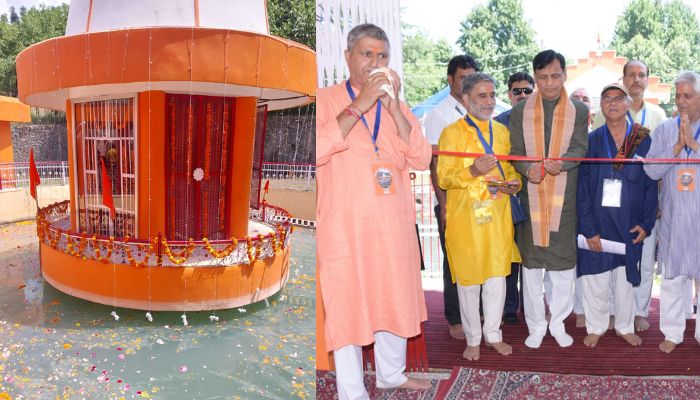
On Sunday (14th July), the ancient Hindu temple dedicated to Goddess Uma Bhagwati was reopened after a long gap of 34 years. The temple is located at Brari Aangan in the Shangus area in South Kashmir’s Anantnag district. Union Minister of State for Home Affairs Nityanand Rai was present during the ceremony to reopen the temple.
#JammuAndKashmir: Uma Bhagwati temple reopened for devotees in south Kashmir's Anantnag after 34 years.
Union Minister of State for Home Affairs Nityanand Rai threw open the temple for devotees at Brari Aangan in Shangus area of Anantnag. pic.twitter.com/yVXPUGe8e9
— All India Radio News (@airnewsalerts) July 15, 2024
After the outbreak of terrorism in the Kashmir valley in the late 1980s, the temple was vandalised. The inauguration ceremony was held after the completion of restoration work at the Mandir.
Devotees in large numbers, especially Kashmiri Pandits, were present on the occasion to pay obeisance to Goddess Uma Bhagwati and seek darshan of the deity. The ceremony was attended by a large number of devotees who came from different parts of the Union territory.
During the ceremony, an idol of Goddess Uma Bhagwati was placed in the sanctum sanctorum amid the chanting of religious hymns. The idol was brought from Rajasthan.
— ????? ???? ?????? (Sunil Rajanaka) (@Sunilraina10) July 14, 2024
It is so heart-warming to see that the ancient temple of Goddess Uma Bhagwati in Brariangan of my home district, Anantnag in Kashmir, has been restored and is thrown open for devotees today, on July 14. I have so many fond memories of going to the temple with the whole clan and… pic.twitter.com/dzdfYO2bri
Addressing the gathering of devotees, MoS Home Affairs, Nityanand Rai expressed confidence that a large number of devotees shall visit the temple after its re-opening.
He said that the government’s commitment towards a developed Jammu & Kashmir and the UT’s own syncretic culture shall go a long way to develop J&K into a prosperous and peaceful region.
During his address, he reiterated the Modi government’s zero-tolerance policy towards terrorism. Rai said, “This is PM Modi’s India. Either you (terrorists) will go to hell, or you will be buried 7 feet below the ground. Choose yourself what you accept. You either go to India’s jail or dedicate your life to a good cause. India is now living with a zero-tolerance policy towards terrorism.”
At the ceremony, Minister Rai was accompanied by Anantnag Deputy Commissioner Syeed Fakhrudin Hamid, Senior Superintendent of Police G V Sandeep Chakravarthy, and officers from the district administration. Functionaries of Uma Bhagwati Asthapan Trust were also present at the event.
The deputy commissioner assured that the administration would provide all support to the devotees to facilitate their visit to the shrine.
It is pertinent to note that the Uma Bhagwati Mandir at Brariangan is an ancient temple. Before terrorism in Kashmir, devotees used to come in large numbers from different parts of the erstwhile state to pay obeisance to the goddess and seek darshan of the deity.
The Mandir is located amidst five springs. These five springs include Brahma Kund, Vishnu Kund, Rudhra Kund, and Shiv Shakti Kund.
On the 13th of July 2024, Congress secured two major victories in Uttarakhand Assembly by-polls – one from the Manglaur seat and the other, from Badrinath. The party and the media celebrated almost immediately. It was touted as a defeat for the BJP and a victory for the politics of Rahul Gandhi. The Manglaur seat, however, presents unique insights into the voting pattern of different communities, especially the Muslim community.
Manglaur city, according to the 2011 census data, is one with almost 90% Muslim population. The Assembly constituency, however, is reported to have at least over 45% Muslim electorate, coupled with an almost 20% SC electorate. According to India Today, the Manglaur Assembly Constituency has a 52,000-strong Muslim voter base, while it has a Dalit voter base of 18,000, Jat (14,000), and Gujjar (8,000).
The Manglaur seat became vacant after BSP MLA Sarwat Karim Ansari died in October last year. With a history dating back to the early 10th century, Manglaur was named after Mangal Singh of the Chauhan clan who built a fort there. Today, it is a predominantly Muslim town.
In the 2024 by-election, the victorious candidate was Congress’ Qazi Mohammad Nizamuddin with 37.91% votes. Second, was BJP’s Kartar Singh Bhadana 37.4% votes. Third was BSP candidate Obedur Rehman with 23.4% votes.
Manglaur being a Muslim-dominated constituency, the fact that Qazi Mohammad Nizammudin won is no surprise, however, a slightly deeper look into the numbers reveals interesting insights into community voting patterns.
Manglaur has never voted for a non-Muslim candidate
Since 2022, Muslim candidates – either from the Congress or the BSP have ruled the electoral politics of the constituency.
The winning Congress candidate in the 2024 by-poll was a BSP candidate in 2002. In 2002, Qazi Mohammad Nizamuddin won with an almost 40% vote share in Manglaur. In second place was a Congress Muslim candidate – Sarwat Karim Ansari – with a 27.5% vote share.
In the 2007 Assembly Elections, the results were not too different.
Qazi Mohammad Nizamuddin won as a BSP candidate with an almost 37% vote share defeating Congress’ Muslim candidate who came third with a 27% vote share. Second was an RLD candidate, Chaudhry Kulveer Singh, with a 32% vote share.
In 2012, Qazi Mohammad Nizamuddin switched from BSP to Congress and ended up coming second with a 33.07% vote share. BSP’s Ansari won with a 34.3% vote share. The difference was far more marginal than in the previous years.
In 2017, INC’s Qazi Mohammad Nizamuddin won again with a 38.58% vote share, defeating BSP’s Ansari with a 35.29% vote share.
In 2022, the sequence changed against with BSP’s Ansari winning and Congress’ Qazi Mohammad Nizamuddin coming second.
In the 2024 elections, while Congress’ Qazi Mohammad Nizamuddin won with 37.91%, something shifted massively.
In the 2024 by-elections, BJP fielded Kartar Singh Bhadana – a Hind candidate – who ended up getting a whopping 37.4% vote share – losing only marginally from Congress’ Qazi Mohammad Nizamuddin.
Essentially, Manglaur as an Assembly Constituency has always seen a Muslim candidate winning since the formation of the state of Uttarakhand in 2000 switching between Qazi Mohammad Nizamuddin and Sarwat Karim Ansari.
Victory for Congress’ Qazi Mohammad Nizamuddin, but massive strides for BJP
Historical data proves that the Muslim-dominated constituency has always ensured that a Muslim candidate wins in the Assembly polls, however, in the 2024 by-election, a massive shift was observed.
The BJP fielded a Hindu candidate Kartar Singh Bhadana, who lost to Qazi Mohammad Nizamuddin only by 422 votes.
The Muslim candidate fielded by BSP Obedur Rehman got 23.37% votes – which indicates a 13.8% fall in vote share for BSP. BJP’s vote share, on the other hand, went up by 16.04%. It would certainly seem on the face of it that the entirety of the BSP vote share shifted to BJP.
While the BSP electoral in Manglaur was voting for Muslim candidates fielded by the party, this time, it would appear that a large chunk of the Hindu electorate shifted to BJP and consolidated behind it. This electoral would include SCs, Jats, and Gujjars.
This appears to be only the second time that a Hindu candidate was able to get a substantial vote share in the Manglaur Assembly seat. The first time a Hindu candidate got a substantial vote share in the Assembly Constituency was in 2007 when RLD’s Chaudhry Kulveer Singh came second with a 32.01% vote share. The vote share of Singh was also substantially lower than the BJP candidate in 2024 – who got 37.4% vote share. In 2007, the Hindu candidate of RLD lost by 3393 votes, while in 2024, the Hindu candidate of BJP lost merely by a 422 votes margin.
This indicates a massive shift in the Manglaur Assembly Constituency where it is evident that this scale of Hindu consolidation has perhaps happened for the first time in the Assembly Constituency which has only elected Muslim candidates owing to the seat being dominated by Muslims.
BJP fielded a Muslim candidate only once in 2012 – who got only 2061 votes
Since the inception of Uttarakhand, the BJP has fielded a Muslim candidate from the Manglaur constituency only once. In the 2012 Assembly Elections, BJP fielded Kaleem as its candidate.
In the 2012 Assembly Elections, where BJP fielded a Muslim candidate, the candidate garnered only 2,061 votes. To put things in perspective, Sarwat Karim Ansari of BSP got 24,706 (and won) while Qazi Mohammad Nizamuddin from Congress came second with 24,008 votes. The Hindu candidate fielded by RLD, Gaurac Chaudhury came third with 19,354 votes.
While a Hindu candidate by RLD was in the fray, the Constituency failed to see the kind of consolidation in 2012 that it has seen in 2024, with the BJP fielding a Hindu candidate.
What does Manglaur tell us about community voting patterns?
First and foremost, from the voting pattern, it becomes imperative that we address the eternal grouse of “liberals” that Muslims don’t find adequate representation in electoral politics. Manglaur makes it more than evident that when the Muslim population of a constituency breaches the 40% mark, the winning candidate from that constituency is almost always a Muslim. This underscores the evident voting pattern of the Muslim community that they consolidate to vote for a Muslim candidate almost without exception. When the Muslim community shows that pattern of voting, as an axiomatic reality, the “liberals” and the Muslims, who often whine about representation and the fact that the Hindu majority does not necessarily vote for Muslim candidates, cannot grudge the Hindu population their choice of candidate either. If the Muslims vote as a bloc for Muslim candidates, Hindus can certainly vote as a bloc for Hindu candidates and parties that are not necessarily pandering to the Muslim veto are free to field Hindu candidates almost exclusively.
Beyond this, however, what is the fate of the Muslim candidate when a party like the BJP fields one – a demand that the “liberals” often make? In 2012, when BJP actually fielded a Muslim candidate, the candidate managed to get only 2061 votes. This only goes to show that the Muslim electorate not only wants a Muslim candidate, but the Muslim candidate should also be from a party which they believe is going to pander to them unequivocally. If a party carries even the perception of not being anti-Hindu and unequivocally pro-Muslim appeasement, their Muslim candidates are also going to lose miserably.
When this is the electoral mentality of the Muslim community, the community itself and their allies – the Left – should stop expecting the BJP to field Muslim candidates.
The pattern also holds lessons for BJP – of course. The difference in their 2012 performance and 2024 performance is clearly indicative of the fact that any kind of ‘social considerations’ from within the Hindu community reaps electoral benefits, while pandering to the Muslim community electorally is almost surely not going to bring them success. The BJP fielded a Muslim candidate in 2012 with the intention of making inroads into the Muslim dominated constituency and hoping to get a piece of the Muslim electorate pie. The result of fielding that Muslim candidate is rather apparent – it got no Muslim votes and the Hindu electoral did not trust the BJP either. It is only when they fielded a Hindu candidate did the constituency see an unprecedented consolidation of the Hindu vote in favour of BJP.
Local journalists tell us that the threat of demographic change weighs heavily on the Hindus of Manglaur and therefore, the consolidation in these by-elections favoured the BJP. Further, BJP also managed to get its caste equations right this time by fielding Kartar Singh Bhadana. Manglaur borders Uttar Pradesh and therefore, a candidate from Haryana appealed to the Hindus of Manglaur. The caste equation, coupled with the awareness among the population about the shifting demographic change, helped BJP clinch the consolidation which resulted in the party losing by only 422 seats.
It is evident from the results of Manglaur that Hindu consolidation coupled with getting community considerations right is the only electoral way ahead for the BJP – one which may be a potent answer to Muslim consolidation – as seen in Lok Sabha elections repeatedly.
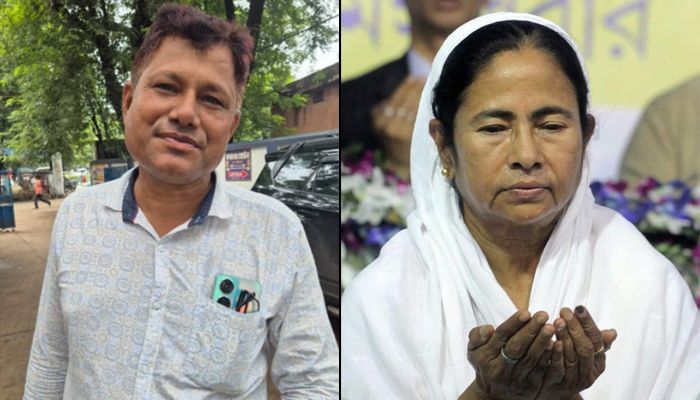
On Thursday (11th July), a Trinamool Congress leader named Mohammed Yunus courted controversy after he accused Hindus of usurping top positions in the party and leaving dirty work for the Muslims.
The incident took place in Sainthia city in Birbhum district of West Bengal. In a video that has now gone viral on social media, Yunus was heard saying, “Where can the minorities (Muslims) do? Where can the minorities go?” “
“The majority (Hindus) have taken all top positions in the party. We need to poke them in the eyes and show them that we exist,” the TMC Minority Morcha leader brazened out.
TMC's Chopra MLA pushes for Sharia Law, Kolkata Mayor Firhad Hakim hints at conversions, and now Sainthia's TMC Minority Morcha Leader openly attacks majority community leaders.
He boasts about minorities making bombs and voting for TMC, questioning why majority leaders get… pic.twitter.com/QQPEsyLWYI
“You guys are not able to win in your own booths. In such circumstances, what responsibility will you take to lead the party? They (Hindus) are at the helm of all core committees. We need to think about it,” Mohammed Yunus stated.
He lamented, “We (Muslims) will do all the (dirty) work, starting from making bombs…This is not right.” Amid the controversy, the Trinamool Congress is mulling supsending the Minority Morcha leader from the party.
While speaking about the matter, BJP leader Dhruba Saha remarked, “They are (finally) admitting that they make bombs, capture booths and murder democratic right of the people to ensure TMC’s victory.”
Firhad Hakim gives open call to convert people to Islam
Earlier, this month, the Mayor of Kolkata Firhad Hakim stirred the hornet’s nest for deriding non-Muslims as ‘unfortunate’ and openly calling for their religious conversion to Islam.
During his address at the All India Quran competition, Hakim claimed, “Those who were not born into Islam were born with misfortune. If we can give them Dawat (call for proselytism) and bring Iman (Faith) in them, then, we will make Allah happy.”
“We need to spread Islam among non-Muslims. If we can bring someone on the path of Islam, then, we will prove to be a true Muslims by ensuring the spread of Faith,” he brazened out.
Firhad Hakim further emphasised, “We showcase strength when thousands of people sit like this wearing skull caps. It shows unity and gives an assurance that none can subdue us.”
“Since we are born into Islam, Prophet and Allah made a clear path for us to Jannat. If we don’t commit any sins, we will directly go to Jaant,” the Kolkata Mayor was heard saying.
TMC MLA justifies Taliban-style public flogging of woman in ‘Muslim Rashtra’
On 30th June, TMC MLA Hamidul Rehman justified the Taliban-style flogging of a woman in full public glare in Chopra in Uttar Dinajpur district of West Bengal.
Rehman alleged, “The woman was doing unsocial work in the absence of her husband. A meeting was held by the villagers over her activities and a collective decision was made.”
Hamidul Rehman went on to claim that Chopra, where the incident took place, constituted ‘Muslim Rashtra’. He was heard saying, “In our Muslim rashtra, there are certain rules of conduct and punishment.”
“But it had become little extreme this time. That is why we are now reprimanding the villagers.” the TMC MLA concluded.
The Karnataka State Road Transport Corporation (KSRTC) is planning to propose a hike in the bus fare by up to 20%. This comes after Congress’s populist Shakti scheme under the “five guarantee” schemes, which offers free bus travel for women in Karnataka, resulted in an enormous loss of Rs 295 crore for the KSRTC over the last three months.
The KSRTC Chairman SR Srinivas underlined the necessity of raising ticket rates to keep the department running. “A board meeting on Friday decided to increase bus ticket prices and bring this to the chief minister’s attention. Bus services are essential. If a bus driver doesn’t show up, a village may lose its bus service for the day. We’ve incurred a loss of Rs 295 crore in the last three months due to the Shakti scheme, Srinivas said adding that if ticket prices are not hiked, the KSRTC will not survive,” Srinivas said. It must be noted here that KSRTC is otherwise a profit-making body, however, the burden of the Shakti scheme has pushed it towards enduring Rs 295 crore losses.
Similarly, Raju Kage, Chairman of North Western Karnataka Road Transport Corporation (NWKRTC), ascribed the Corporation’s losses to the Shakti scheme. “We haven’t increased bus fares in the last 10 years. The department is at a loss, but we’re still managing,” Kage said.
Increasing bus fares is a measure to recuperate some of the lost revenue, but it disproportionately affects those who do not benefit from the free travel scheme and would be unfair to them.
Congress’s five-guarantee scheme drying out Karnataka’s treasury
Freebies function like a communist dream of Utopia, initially, everything appears perfectly fine, but soon, soon reality hits. Initially, the Congress-friendly media and the extended ecosystem showered praises on the state government for its populist “five guarantees”. The ecosystem claimed that the implementation of these freebie-squandering schemes would somehow strike a balance with the state’s economic health and public welfare, however, the reality is far from the tall claims made.
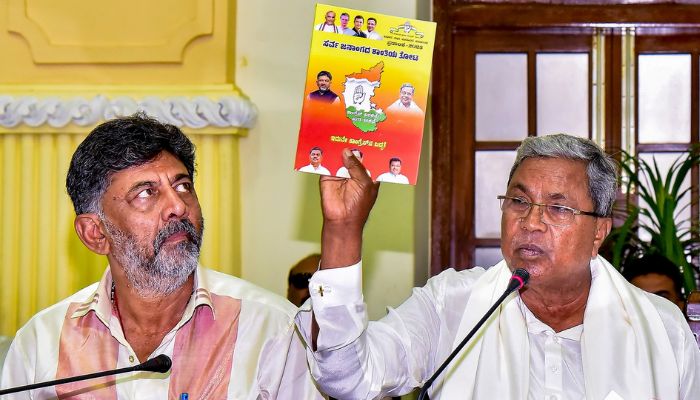
Last week, Karnataka Chief Minister Siddaramaiah’s financial advisor, Basavraj Rayareddy lamented that the state lacks funds for development projects due to guarantee schemes.
“Many MLAs are demanding funds for development works in their constituencies, however, there is no money with the government. We are spending approximately Rs 65,000 crore on guarantee schemes. Since I am the financial advisor, I somehow managed to get the grant for a lake development project. People want development. But believe me, there is no money. Since I am the financial advisor, I managed to get funds for the lake development project here,” Rayareddy said adding that it has become practically impossible for state MLAs to acquire funding for projects in their constituencies.
State government increasing prices and taxes to sustain freebies
The Congress government has introduced five key guarantee schemes aimed at providing various benefits to the residents. While announcing such schemes political parties claim to alleviate the financial burden on the people, however, these are largely vote-attracting measures.
Notably, Congress’s five guarantee schemes in Karnataka include Gruha Jyothi, as per this, all households receive 200 units of free power; under Gruha Lakshmi, the woman head of every family receives Rs 2,000 monthly assistance; under Anna Bhagya, cash is given to each member of a BPL household instead of an additional 5 kg of rice; under YuvaNidhi, unemployed graduate youth receive Rs 3,000 per month; under Shakti scheme, women are given free travel on public buses. To fund these schemes, CM Siddaramaiah allocated approximately Rs 52,000 crore in February this year, however, the amount apparently, did not prove sufficient to sustain the distribution of freebies.
While the state government allocated 20% of the budget towards providing freebies, in February this year, the CM Siddaramaiah-led government set aside 40% of the Rs.1,20,373 crore meant for welfare programmes. While CM Siddaramaiah claimed that the five guarantees will have a positive economic impact, the impact is more negative than positive.
The state government has had to resort to significant tax hikes, placing an additional financial burden on the people of Karnataka and potentially affecting economic growth.
Since its launch in June last year, the Karnataka Congress government has significantly increased various taxes to sustain its five guarantee schemes and last year, increased the excise duty on Indian Made Foreign Liquor (IMFL) by 20% and on beer from 175% to 185%. The government had also revised guidance values for all immovable properties by 15-20%, increasing the property tax burden on residents.
In February of this year, the Karnataka government increased Stamp Duty costs by 200% to 500% on any documents that do not require registration. Some concerns that increased stamp duty could negatively impact residential and commercial real estate activity in Bengaluru.
There have been proposals to tax fees for the collection of solid waste from houses in Bengaluru, as well as revisions to mining licence fees.
In June this year, the Congress government in Karnataka announced a Rs 3 surge in petrol prices bringing the cost per litre in Bengaluru to Rs 102.84, up from the previous rate of Rs 99.84. Similarly, the price of diesel was increased by Rs 3.02, raising the cost per litre from Rs 85.93 to Rs 88.95.
Besides, petrol and diesel, the state government also announced that it will hike water tariffs saying that “it has become imperative to increase the water tariff as the water board is not able to pay the electricity bill.”
Other than this, the Karnataka Milk Federation (KMF) increased milk prices by Rs 2 last month. After this, a 550 ml packet of Nandini’s toned milk (blue) would cost Rs 24, while a 1,050 ml packet would cost Rs 44. Reports say that this hike was the second in less than a year as in July 2023, the KMF increased rates by Rs 3 per litre.
The desperation of the Congress government is also seen in its alleged diversion of the funds meant for SC/ST communities to implement the five guarantee schemes. It has been alleged that the Congress government diverted around 37% of the funds allocated under the Karnataka Scheduled Castes Sub-Plan and Tribal-Sub-Plan (SCSP-TSP) for the implementation of its guarantee schemes.
Governments often promote welfare schemes and freebies as a means to garner public support, but these initiatives frequently come at a hidden cost. As discussed above, the Congress government’s implementation of five guarantee schemes in Karnataka has led to significant tax hikes to fund these programs. While the people of Karnataka might receive free services or financial aid on the surface, the reality is that the cost is often passed back to them through increased taxes and levies elsewhere. This approach appears to be a form of financial sleight of hand, where the government claims to offer “freebies” while simultaneously placing a heavier tax burden on the populace. Such measures strain household finances and potentially stifle economic growth, as increased taxes can reduce disposable income and consumer spending.
While these schemes claim to provide immediate relief and support to many families, the long-term economic implications and sustainability of such measures remain a concern. These freebies deplete the public treasury, forcing state governments to raise taxes to replenish it. Ultimately, the larger burden is always on the people.
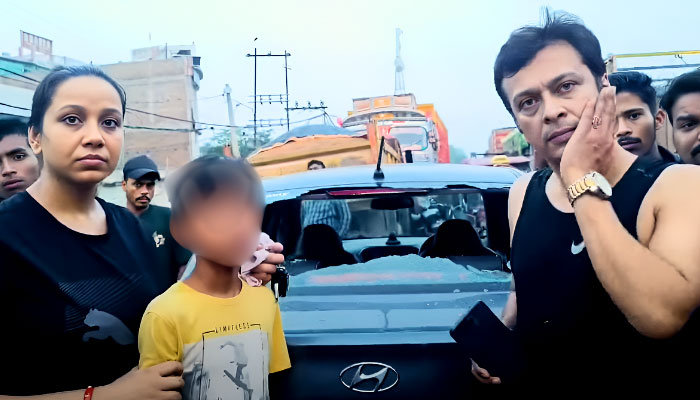
On 14th July, a Hindu family was attacked during a Muharram procession near Sardarganj Chowk in Dalsinghsarai, Bihar. While the media claimed the incident took place after a clash between the two groups, the family asserted that the attack was deliberate.
According to the police, two groups of Islamists created a ruckus while playing Tajia. The mob broke the glass panes of several vehicles. The situation escalated further when Amitesh Kumar, a resident of Basoli, Madhubani, was driving through Nawada Sardarganj Chowk with his wife Sadhna Kumari and their son. Amitesh stated that some Islamists from the Muharram procession attacked his car with a sword. The glass of the car got shattered injuring the minor son.
In a statement, the family described the attack as unprovoked. Amitesh insisted on the fact that they were not in the path of the procession, yet the mob attacked them. He said, “I was driving slowly, on the side, not obstructing the procession. Suddenly, they pulled out swords and attacked our car from all sides. My son, who was in the back seat, got injured.” Amitesh pointed out that he identified some of the attendees of the procession. He and his wife said, “They attacked us without any reason. I was driving slowly on the side, the procession was there, and some of their members, whom I recognised, attacked us. We recognised them very well. When they are caught, it will be understood why they attacked.”
As the mob got unruly around Sardarganj Chowk, the passersby and other drivers fled the scene. Deputy Superintendent of Police (DSP) Vivek Kumar Sharma said in a statement that the altercation between the two local groups started over carrying soil. The car of Amitesh Kumar got caught in the crossfire. DSP Sharma said that an FIR has been registered in the matter and CCTV footage is being reviewed to identify the culprits. He assured that strict action would be taken against the accused.
Though an investigation into the matter has been initiated by the police on the complaint of Amitesh Kumar, he said in a statement that despite repeated calls for assistance, no immediate help arrived from the authorities. He expressed his frustration and said, “We called the administration several times, but no one came. It feels like a major mishap could have happened, and there’s no accountability.”
Provocative slogans raised during Muharram procession in Amethi outside police station
On 14th July, a mob of Islamists reportedly raised slogans of “Hindustan mein rehna hai, Ya Hussain kehna hai” (If you want to live in India, you have to say ‘Ya Hussain’) outside Musafirkhana Police Station in Amethi. The incident happened during the Muharram procession. A video of the incident has gone viral on social media. Police have filed an FIR in the matter and some of the suspects have been detained.
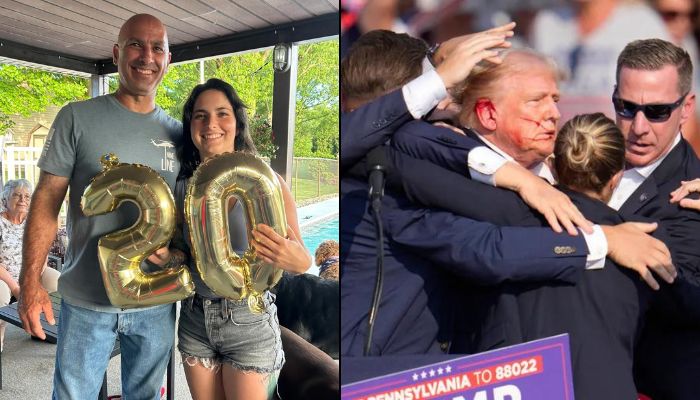
On Saturday (13th July, local time), a 20-year-old man named Thomas James Crooks carried out an assassination attempt on former US President Donald Trump during an election rally in Pennsylvania. The attack left one spectator killed and two others injured.
The deceased has now been identified as 50-year-old Corey Comperatore. A former fire chief in Buffalo Township and a vocal supporter of Trump, Corey jumped in front of his daughter and wife to shield them from the assassin’s bullets.
While speaking about the incident on Sunday (14th July, local time), Pennsylvania Governor Josh Shapiro remarked, “We lost a fellow Pennsylvanian last night: Corey Comperatore…Corey was a girl dad. Corey was a firefighter. Corey went to church every Sunday.”
NEW: Pennsylvania Gov. Josh Shapiro shares new details about spectator killed during Trump rally. pic.twitter.com/39jQ2LQyLj
“Corey loved his community. And most especially, Corey loved his family. Corey died a hero. He dove on his family to protect them last night at this rally…Corey was the very best of us. May his memory be a blessing,” Shapiro emphasised.
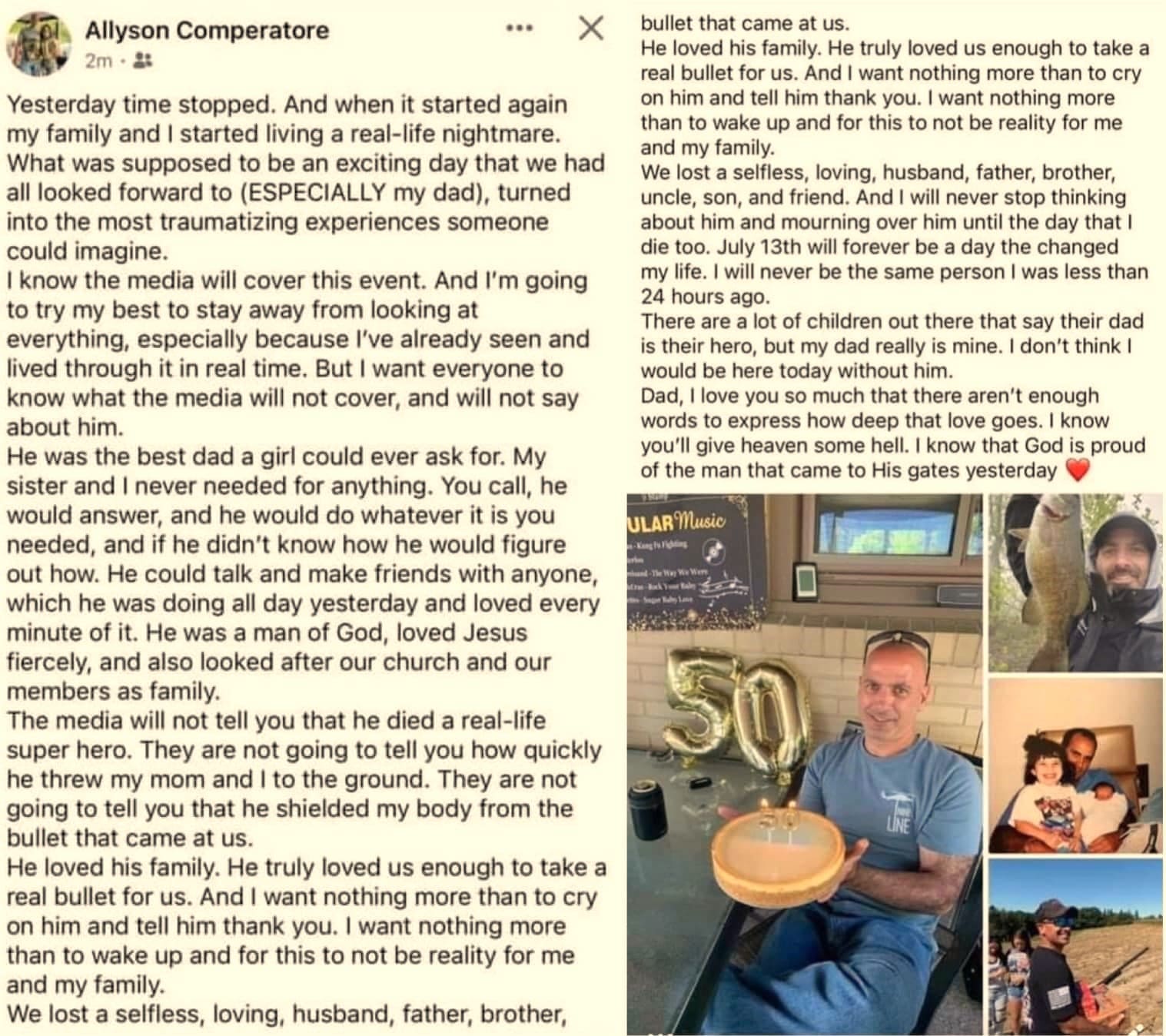
Allyson, the daughter of Corey Comperatore, detailed the heroics of her father when faced with imminent threats to their lives.
“The media will not tell you that he died a real-life super hero. They are not going to tell you how quickly he threw my mom and I to the ground. They are not going to tell you that he shielded my body from the bullet that came at us. He loved his family. He truly loved us enough to take a real bullet for us. And I want nothing more than to cry on him and tell him thank you,” she said in a heartfelt Facebook post.
Screengrab of the Facebook post of Allyson Comperatore
Allyson thanked her deceased father for his selflessness and for being the “best dad a girl could ask for”. She concluded, “Dad, I love you so much that there aren’t enough words to express how deep that love goes. I know you’ll give heaven some hell. I know that God is proud of the man that came to His gates yesterday.”
Hours before his death, Corey Comperatore had posted about going to the Trump rally held in Pennsylvania.
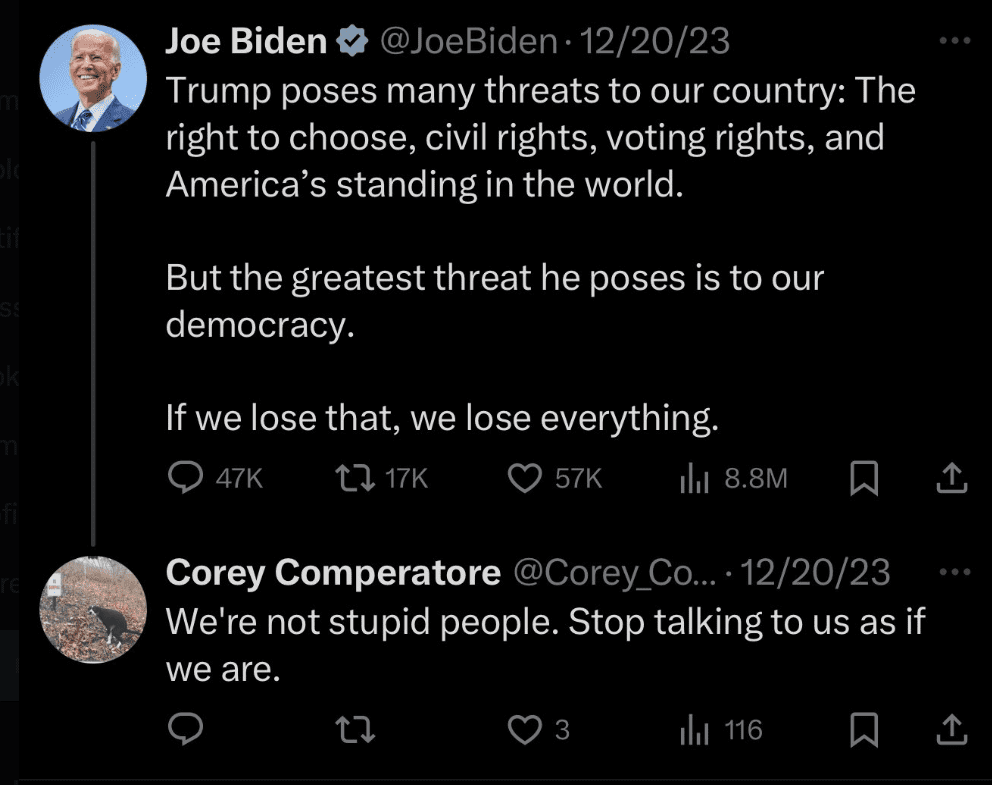
The deceased was a vocal critic of Joe Biden and his fearmongering tactics against Donald Trump.
In December last year, the incumbent US President had tweeted, “Trump poses many threats to our country: The right to choose, civil rights, voting rights, and America’s standing in the world. But the greatest threat he poses is to our democracy. If we lose that, we lose everything.
Corey Comperatore did not mince words before lambasting Joe Biden and said, “We are not stupid people. Stop talking to us as if we are.”
Screengrab of the tweet by Corey Comperatore
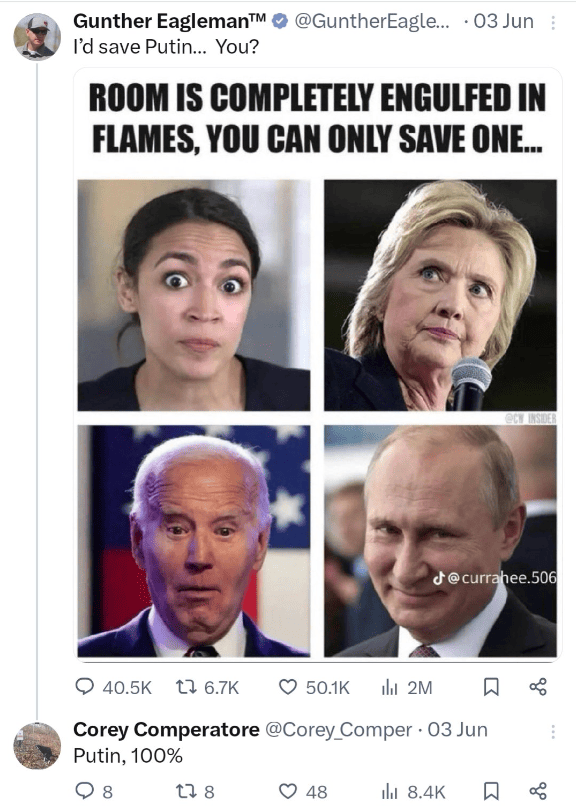
The former fire chief had also made it clear, in one of his tweets, that he would rather save Russian PM Vladimir Putin instead of Democrats.
Screengrab of the tweet by Corey Comperatore
The pro-Trump supporter was politically incorrect. He often took potshots at the Democratic Party’s delusional gender politics and appeasement of pro-Hamas cheerleaders in the United States.
I pass that everyday. The one slide a week ago said, "F*ck Hamas and the camel they rode in on". The guy that owns it is great!
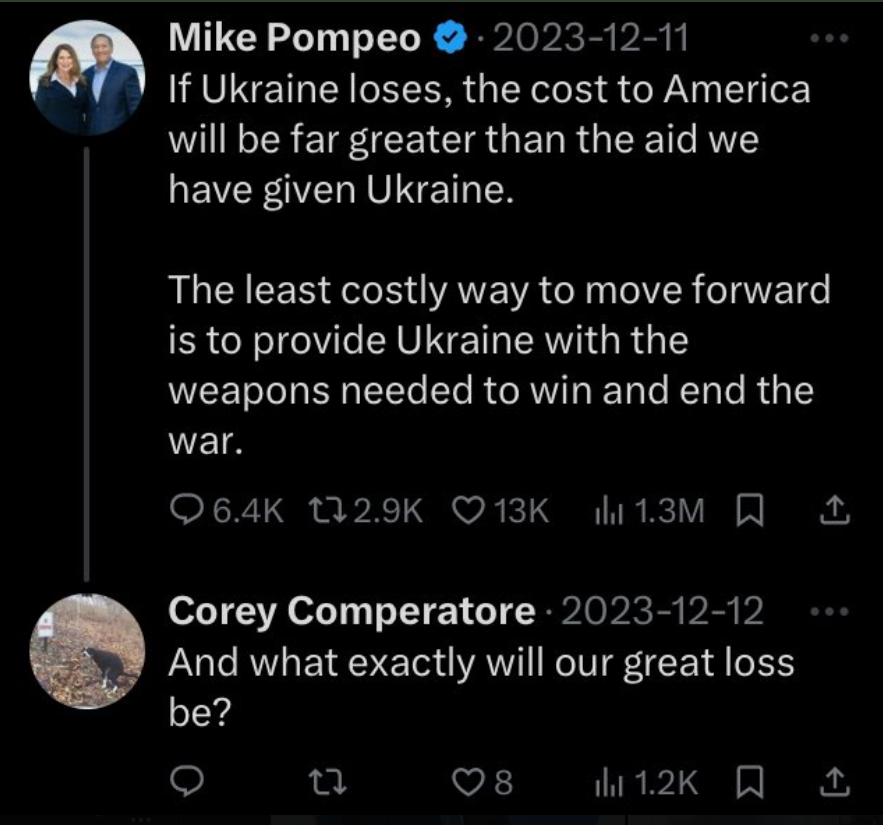
As evident from his tweets, Corey Comperatore was against the United States providing military aid to Ukraine to fight Russia.
In 2023, former United States Secretary of state Mike Pompeo claimed that America would lose if Ukraine lost the war to Russia. “The least costly way to move forward is to provide Ukraine with the weapons needed to win and end the war,” he had claimed.
A true American at heart, Corey Comperatore had questioned the stance of the Republican and inquired, “And what exactly will our great loss?”
Screengrab of the tweet by Corey Comperatore
“Send the illegal immigrants to Ukraine and let them fight for freedom. Let’s see how bad they really want it,” he had tweeted in May last year.
Corey Comperatore was murdered during yesterday’s assassination attempt of President Donald J. Trump.
Corey, was one of us. His name must never be forgotten. Rest in peace, brother. pic.twitter.com/9vB0V541Pi
— Joseph D. McBride, Esq. (@McBrideLawNYC) July 14, 2024
In his memory, the Volunteer Fire Department in Buffalo Township put the fire fighting gear of Corey Comperatore on full public display.
The Volunteer Fire Department in Buffalo Township, Pennsylvania is Displaying the Gear of their Former Fire Chief, Corey Comperatore who was Killed at yesterday’s Trump Campaign Rally in Butler County while Shielding his Daughters from Bullets fired by the Shooter, during the… pic.twitter.com/GAyRtXmB4w
On 14th July, a mob of Islamists reportedly raised slogans of “Hindustan mein rehna hai Ya Hussain kehna hai” which means (If) you want to live in India, you have to say ‘Ya Hussain’ outside Musafirkhana Police Station in Amethi. The incident happened during the Muharram procession. A video of the incident has gone viral on social media. Police have filed an FIR in the matter and some of the suspects have been detained.
वीडियो अमेठी का बताया जा रहा है। कांग्रेस अमेठी जीत गई है और अब वहां नारे सुनाई दे रहे हैं कि "हिंदुस्तान में रहना है तो या हुसैन कहना है।" pic.twitter.com/IgzzWryIXu
In a statement, Superintendent of Police Anoop Kumar Singh said, “A video has been brought to over notice via social media under Musafirkhana Police Station. Persons appearing in the video have been detained for questioning. An FIR has been registered in the matter. Investigation is underway. Appropriate action will be taken in the matter.”
#amethipolice थानाक्षेत्र मुसाफिरखाना से संबन्धित सोशल मीडिया पर वायरल वीडियो की जांच के क्रम में वीडियो में दिख रहे व्यक्तियों को हिरासत में लेकर पूछताछ व सुसंगत धाराओं में अभियोग पंजीकृत कर अन्य विधिक कार्यवाही के संबन्ध में #SP_अमेठी द्वारा दी गई बाइट । pic.twitter.com/JK8tOIQhGd
Speaking on the matter, the head priest of Swami Paramhans Ashram Sagara Babuganj, Mauni Ji Maharaj, said that raising such slogans in front of the police station creates an atmosphere of fear in the region. “I demand immediate action in the matter from Chief Minister Yogi Adtiyanath and the district administration so that the evil intentions of such elements can be stopped,” he added.
#अमेठी:-मुसाफिरखाना कोतवाली के विवादित नारा लगाए जाने का मामला,अभय चैतन्य मौनी महाराज ने बताई बड़ी साजिश, जिला प्रशासन और मुख्यमंत्री योगी आदित्यनाथ से की कार्यवाही की मांग #amethipic.twitter.com/VwgGCYekbQ
Targeting the Islamists, he said, “The roots of such elements extend to Pakistan. These people intend to cause communal violence in India and destroy the ‘Ganga-Jamuni’ culture. Hence, immediate action should be taken.” Mouni Maharaj added there could be a political conspiracy behind such acts and anti-social elements who are under political protection want to create conflict between Hindus and Muslims.
On Sunday (14th July 2024), India woke up with shocking news and images coming out of the United States of America where an assassination was attempted on the Former US President and Republican Presidential nominee, Donald Trump. The assailant, now identified as 20-year-old Thomas Matthew Crooks, fired a multiple bullets from a nearby rooftop, killing one spectator.
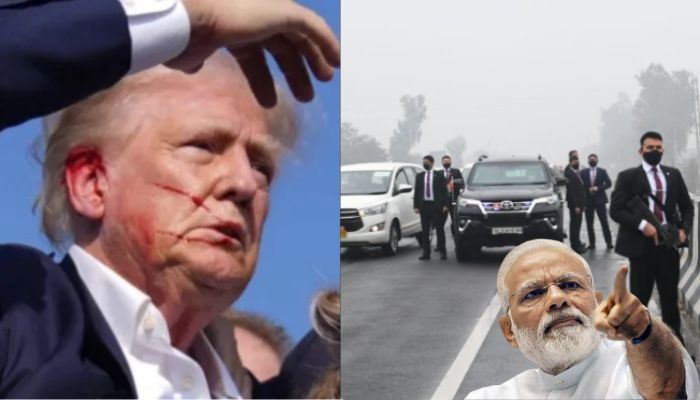
One bullet pierced the upper right ear of Donald Trump, missing his skull by millimeters. Moments after the attack, a bleeding Trump raised a fist shouting, ‘Fight, fight, fight’ as he was rushed out by Secret Service personnel in a protective security cover.
While the attack garnered outright condemnation from Republicans, Democrats, and leaders around the world, the legacy media in the United States attempted to downplay the assassination attempt, displaying their inherent bias and abject contempt for the life of the Former US President, whom they portray as their enemy.
The US Intelligence and probing agencies are currently finding out the motive behind the assassination attempt. However, several Republicans, political pundits, social media users, and Independent observers have argued that this appears not to be an isolated lone-wolf attack, but rather a culmination of feverishly high-pitched rhetoric against Donald Trump which has led to this unfortunate assassination attempt at his life.
Notably, Donald Trump’s potential running mate, JD Vance, has blamed incumbent US President Joe Biden’s campaign for the shooting at Trump’s campaign rally in Butler, Pennsylvania.
In a post on X, Vance stated, “Today is not just some isolated incident. The central premise of the Biden campaign is that President Donald Trump is an authoritarian fascist who must be stopped at all costs. That rhetoric led directly to President Trump’s attempted assassination.”
Today is not just some isolated incident.
The central premise of the Biden campaign is that President Donald Trump is an authoritarian fascist who must be stopped at all costs.
That rhetoric led directly to President Trump's attempted assassination.
Republican leaders including Vivek Ramaswamy stressed that the vile attacks by Democratic leadership against Donald Trump led to the unhinged hate campaign against Trump, eventually resulting in an assassination attempt. According to their assertion, Democrats and the US deep state attempted to stop Donald Trump at all costs for which they sued him, prosecuted him, and tried to take him off the ballot, which has now resulted in an attempt on his life.
First they sued him. Then they prosecuted him. Then they tried to take him off the ballot. The only thing more tragic than what just happened is that, if we’re being honest, it wasn’t totally a shock. Biden’s inevitable ritual condemnation of political violence today (when it…
Republicans and several observers argue that with their vile campaign against Trump, Democrats brainwashed and radicalised a segment of their voter base against Trump. By labeling him as an “enemy” or “threat” to the nation, which needed to be eliminated, they painted a target on Trump’s back.
Former Congresswoman, Tulsi Gabbard pointed this out and asked, “The assassination attempt on President Trump is a logical consequence of repeatedly comparing him to Adolf Hitler. After all, if Trump truly was another Hitler, wouldn’t it be their moral duty to assassinate him?”
The assassination attempt on President Trump is a logical consequence of repeatedly comparing him to Adolf Hitler. After all, if Trump truly was another Hitler, wouldn’t it be their moral duty to assassinate him?
Strikingly, several videos have surfaced on social media in which apparent supporters of Democrats could be seen cheering the assassination attempt, exposing the impact of dehumanising political rhetoric.
MASHUP
Deranged Leftists celebrating the ass*ssin*tion attempt on President Trump.
Meanwhile, Republicans and X users have shared several clips and old posts in which Democrats apparently called for “violence”, and physical harm to the Republican nominee and Former US President, Donald Trump. Their call-for-action-laden remarks seemingly made Trump a potential target to be neutralised for upholding the constitution, democratic principles, and values for which the US stands for.
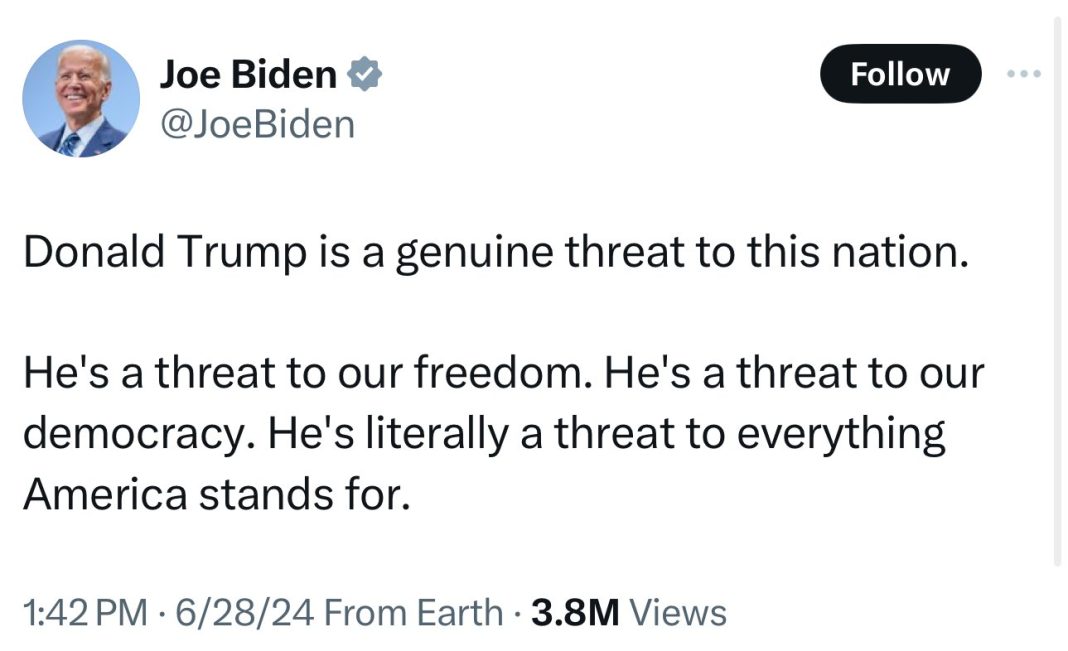
“Most importantly, and I mean this from the bottom of my heart, Trump is a threat to this nation,” Biden had said days before the assassination attempt on Donald Trump unfolded. On multiple occasions, over the course of a decade, Joe Biden has publicly expressed his desire to take his opponent behind the gym and beat the s**t out of him.
90 seconds of Democrats shamelessly promoting violence against President Trump.
In a short compilation video shared by Libs of Tiktok, several Democratic leaders including Former US House Speaker Nancy Pelosi, supportive ecosystem, media, and people from ‘intelligentsia’ could be heard instigating people to “hit the road” against “dictator” Donald Trump, create “unrest”, “uprising”, or baying for physical harm on their political rivals whom they label as “enemies of the state”, including grabbing them by their neck, punching them in the face, putting a “bullet in Donald Trump’s head”.
Here’s 2 and a half minutes straight of Democrats explicitly calling for political violence.
— Tommy Robinson ?? (@TRobinsonNewEra) July 14, 2024
Over the years, many Trump haters and Democrat supporters have staged his killing by stabbing, beheading, and blowing up the White House. Earlier, the Secret Service had initiated a probe against Missouri State Senator Maria Chappelle-Nadal who hoped that President Donald Trump would be assassinated.
Incidentally, apart from Democratic leadership, several prominent celebrities had also chipped in stroking shrill rhetoric against Trump and calling for violence or killing Former US President Trump.
CNN journalist brazenly asked to see in writing that “protests are supposed to be polite and peaceful”, an apparent attempt to whitewash violence against political rivals. “When was the last time an actor assassinated a President”, Hollywood actor Johnny Depp, a Trump hater, in 2017 had voiced for Trump’s assassination when the latter was in the office in the White House. Popular rapper Snoop Dog had once staged an act of killing a clown of Donald Trump.
In 2017, comedian Kathy Griffin posed with a gory dummy, carefully made to resemble the severed head of then-US President Trump.
Uncanny similarities and striking parallels between Biden’s veil campaign and what cabal wishes for in India: Tactics of de-humanising and painting a target on political rivals
The shrill rhetoric and dehumanising tactics glaringly visible in the hate campaign against Donald Trump find uncanny similarities and parallels with what the leftist and Islamist ecosystem has been running against Prime Minister Narendra Modi. Akin to Democrats and its ecosystem’s hate campaign against Trump, the Congress, and its Islamo-leftist cabal have left no stone unturned in dehumanising PM Modi, painting him as an enemy of humankind, particularly minorities, Indian democracy, and a fascist dictator, etc that has to be eliminated. This includes “calling for action”, and street protests, which have the innate propensity to turn violent and baying for physical harm, death threats, threats of Indira Gandhi-kind of assassination, etc directed against PM Modi.
Over the years, Rahul Gandhi and his cabal’s campaign against PM Modi has taken a confrontational, darker turn with shrill rhetoric and machismo posturing taking over competitive and responsible subject matter-based opposition. This includes increased propensity, tolerance, and condoning calls for street violence, summary trial, and justice as well as calling/condoning for direct physical harm and “killing”/assassination of PM Modi.
The opposition has been adamantly portraying PM Modi as a threat to “democracy”, the “idea of India”, and “minorities” one which needed to be stopped at all costs including warranting a civil war-kind of chaos, uprising to dethrone the dictator and making him receive his due Justice.
In their hate campaign against Modi portraying him as a fascist dictator, “genocide enabler” and a “Dehuman” and so-called opposition to his policies and ideology, Congress and I.N.D.I. alliance leaders have peddled extremist rhetoric against PM Modi and shown abject contempt for his life. More so, just like Democratic leadership and their prominent celebrity supporters, Congress and I.N.D.I. alliance leaders have made remarks baying for PM Modi’s blood and voicing for his assassination.
In the garb of acting against their imagined ‘danger’ which PM Modi possesses, they have attempted to instigate and brainwash a large voter base to “hit the road” against “dictator” Modi, choke prominent and strategic places including Chicken’s neck, directing street violence, arson. On multiple occassions, especially days before the announcement of the Lok Sabha 2024 election results, they attempted to instigate people against democracy, and the legitimacy of PM Modi whom they portray as an evil dictator and ready to do whatever it takes to avoid his re-run.
In a direct threat, Senior Congress leader and former Union minister Subodh Kant Sahai in June 2022 had prophesied a Hitler-kind death to PM Modi. The Congress and its cabal have also ridiculed PM Modi’s security breach but also downplayed the risk and projected it as a ‘political gimmick’.
Notably, when a shoe/slipper was thrown at PM Modi’s cavalcade in Varanasi, Rahul Gandhi instead of highlighting security concerns, mocked PM Modi saying that nobody is scared of him now, indirectly encouraging the public do more of such acts. Earlier, when PM Modi’s security convoy was halted for hours at a bridge in Punjab, the Congress party had attempted to downplay it, trying to brush it as a “political gimmick”.
More than a decade earlier, in 2013, when Narendra Modi was the BJP’s Prime Ministerial candidate, around six bombs exploded during his rally in Patna, displaying the grave threat to his life.
Apart from the US which has seen around 15 instances of high-level political assassination attempts, with many being successful even, India has lost two Prime Ministers and several Chief Ministers to assassinations which underscores the need to tone down the shrill rhetoric against political opponents and encouragement of physical violence. Political violence and murders are the fastest way to anarchy because when a political leader, especially a nation head gets assassinated, or even attacked, the public at large gets convinced that there is no law and order in the country, that anyone can be killed and there will be no consequences.