Home Blog Page 120

The curious case of ‘Dhurandhar’: Here is why India’s highest grossing film film triggered a never-before-seen liberal meltdown

Two consequences after watching the movie, Dhurandhar, have become de jure—posting about or reviewing it, and making or sharing memes about it. I choose the former.

As of this writing, the movie has grossed over a thousand crore rupees in the domestic market, making it the highest-grossing Hindi movie ever. The concluding part was released on the 18th of March. Set primarily in the criminal gang-infested locality of Lyari in the Pakistan town of Karachi, the movie follows the lives of gangsters, politicians, and policemen as they play a cat-and-mouse game of doing each other in.

Among the gangsters is a plant, inserted by a character modelled after Ajit Doval, India’s National Security Advisor. The movie is punctuated with real-life episodes, like the Kandahar hijacking of 1999, the 26/11 terror attacks on Mumbai, and bookended by an actual police encounter that took place in Karachi.

Dhurandhar is a taut, entertaining, fast-paced thriller that feels shorter than its 3.5-hour length. The sequel is a shade under four hours. It is backed by music that blends into and burnishes the movie, with at least two songs attaining chartbuster status, including one by Bahranian rapper, Flipperachi. It is an entertainer, well-made. That is its first sin.

A movie should, first and foremost, entertain. Dhurandhar is a movie that unfolds like a good thriller, succeeds in entertaining, and succeeds spectacularly. Dhurandhar is a commercial blockbuster. It is mass market entertainment. It sates the appetite of the guilty cinegoer who seeks escape from the drudgery of real life and its quotidian frustrations in larger-than-life characters, picturesque getaways, and the vicarious pleasure of seeing justice being served. Having long given up on wrongs being righted in real life, the moviegoer settles for a measure of recompense on celluloid.

And that is its second sin, and an unforgivable one at that.

A ‘Pyaasa’ is a masterpiece as a lament of the primacy of commercialism over art. ‘Kaagaz ke Phool’ is cinematic perfection in its portrayal of the ephemeral nature of fame and the subtleties of relationships. A movie, like almost all art, is also an exercise in messaging. For the sake of argument, call it propaganda. When done well, propaganda informs and elevates, while also entertaining. Where matters get muddled is when one side of the ideological spectrum claims exclusivity over propaganda, denying the other side’s legitimacy to create it.

A ‘Pathaan’ that depicts a rogue agent from R&AW, India’s external intelligence agency, as the antagonist; a ‘Main Hoon Naa’ painting an Indian Army officer as a terrorist, and an implacably hostile neighbour, Pakistan, as a peacenik, is supposed to be evaluated as entertainment, never as propaganda. A ‘Rang De Basanti’, that subverts themes and characters from India’s Independence struggle to score ideological and political points while also advocating, even justifying, and not subtly either, political assassinations as a legitimate response by the citizenry, is meant to be judged and accepted as a spectacular exercise in the melding of high-brow art and mass-market commercialism.

If we, the people, call out such movies as subversive and partisan propaganda, it is distressing evidence of our cultural illiteracy and further evidence of our descent into intolerance. If this is meant to be good for the goose, what about the gander?

An Indian Airlines flight was hijacked and taken to Kandahar in 1999. The hijackers had Pakistan connections. Pakistan also funded, trained, and armed terrorists who then proceeded to perpetrate the terror attacks of Mumbai 26/11 in 2008. Recordings of satellite phone communications between the terrorists and their handler in Karachi are also in the public domain. India chose not to retaliate, despite the armed forces declaring their capability and readiness to do so. All of this is an uncontested fact.

Rahman Baloch ‘Dacait’ was a notorious gangster in Karachi, based out of its Lyari township. He was killed in an encounter with the Lyari Task Force, headed by policeman Aslam Chaudhary, in 2009. This is also a documented fact.

Movies are often based on fact, embellished with fiction. ‘Deewar’, Yash Chopra’s grimy thriller, was loosely based on or inspired by the Mumbai don, Haji Mastan’s life. Dayavan, the 1988 Hindi remake of the Tamil movie Nayakan, was inspired by Mumbai gangster Varadarajan Mudaliar. Countless movies are based on, inspired by, or set in actual historical events. So, where is the problem? What explains the meltdown that self-proclaimed intellectuals and washed-out liberals had on Dhurandhar’s release, which degenerated into rabid bile-spewing invective once it became a blockbuster? One such person ran the movie down as a “tough sit”, “clunky”, “pushing a dangerous narrative”. It was not entirely out of character, though, as the same person’s website had called The Kashmir Files “defensive and dishonest”.

Where is the problem? There are two, actually.

Liberal propaganda requires absolute monopoly, an uncontested space, and the complete silencing of dissent. Given its contradictions and intellectually incoherent underpinnings, liberal propaganda—call it alt-leftism, wokeism—needs the nourishment of totalitarianism to survive. Where none exists, it manufactures one, using censorship, legal bludgeons, ostracisation, lies, propaganda, and sometimes, even physical elimination of dissent. This much is also uncontestable, as seen over the decades in Soviet bloc countries, and lately in American universities and media, devastatingly documented in books as “The Coddling of the American Mind”, “The Cancelling of the American Mind”, “The Parasitic Mind”, and many others. The mere expression of a reasonable and uncontroversial opinion, if it runs counter to liberal dogma, is enough for a person to be tarred, labelled, and cancelled. This deliberately public and extreme censorship serves as a grim warning to others to stay in the herd and to not colour outside the line. Acts of retributive intolerance are cloaked in exculpatory language and words like ‘creating a safe environment’.

Most will be unfamiliar with the so-called Great Purge of the early 1970s, when broadcaster CBS cancelled most of its highly rated and popular rural-themed shows, replacing them with ‘edgier’ content, ostensibly to attract new sponsors. These ‘rural-themed’ shows often highlighted family values and stressed the importance of honesty. With these inconvenient shows out of the way, the space was cleared for liberal propaganda to get a clear, uncontested run that has lasted for over half a century, to the point where depicting a happy, unbroken family with a heterosexual couple is stigmatised as an expression of ‘privilege’.

A 1985 movie, Durga, had not only the heroine, Hema Malini, citing Indira Gandhi, Nehru family dynast and Prime Minister, as an exemplar of sacrifice, but also had a long clip of her last speech in Odisha, played verbatim. That was obviously not propaganda in the liberal dictionary. Doordarshan, India’s state-owned and controlled broadcaster, making a movie on Jawaharlal Nehru’s culinary habits was high art, not sickeningly sycophantic pandering. Farah Khan’s Main Hoon Naa, depicting a former officer of the Indian Army as a terrorist was entertainment.

Shahrukh Khan starrer Pathan’s antagonist as a R&AW agent and the protagonist is, of course, not propaganda. Having the heroine, playing the role of an ISI agent, gyrate to Shahrukh Khan “like a concrete mixer whose main bearing has conked out.” It is dubbed artistic liberty. Sriram Raghavan’s Ikkis preaching to audiences that it was war, and not Pakistan, that killed Param Vir Chakra First Lt. Arun Khetarpal, is cinematic acme, and most certainly not an insult to the braves who lay down their lives for the sake of their country.

Vivek Agnihotri’s The Kashmir Files was not only well-made but commercially successful, grossing several hundred crores. It was unremitting in its gaze on the pogrom that was inflicted on the Hindu Kashmiri Pandit community, resulting in their final exodus in 1990. Every single act of violence and brutality depicted in the movie was based on facts. But it was a difficult watch.

Dhurandhar is not The Kashmir Files. It is an entertainer, extraordinarily well executed, mounted on a grand canvas, unapologetic about its ambition to be the ultimate masala entertainer. It’s the kind of movie that people discussed, talked about, recommended to their friends, families, and extended social circle. It’s the movie that people watched a second, a third time. In other words, Dhurandhar packaged messaging in a spectacularly entertaining container.

Dhurandhar informed. It entertained. And it made money. In the cloistered world of liberal echo chambers, the first was an inconvenience. The second was an accidence. The third was unpardonable. Nationalist entertainment that succeeds on both artistic and commercial dimensions is unacceptable in the liberal world.

Dhurandhar 2 is 3 hours, 55 minutes long. Advance bookings are already through the roof. Some theaters are even arranging to screen the first movie for those who want to experience the closest to a binge watch, an eight-hour masala entertainment fest. ‘Alpha’, the latest in Yash Raj Film’s so-called ‘spyverse’ has already been postponed for fear of commercial failure and artistic ridicule should it go head-to-head against Dhurandhar 2. The liberals’ knives are not so much out, for they were never sheathed; they are being sharpened. The attacks on the movie will expectedly be novel and new, while also being trite and cliched at the same time.

Few people like unvarnished truths. But putrid dishonesty can also be unpalatable. Dhurandhar may not be without faults. But the cabal of intellectuals running it down needed to do a better job. A little honesty wouldn’t have hurt, either.

Disclaimer: Views expressed are personal. Despite the presence of the em-dash, not a single word of this review has been written with the help of any LLM.
Amid war and sanctions, how India navigated a tricky terrain in the Middle East to secure energy, trade, and strategic interests

Famed American historian and philosopher Will Durant (1885 – 1981) had once said, “India was the motherland of our race,… she was the mother of our philosophy; mother, through the Arabs, of much of our mathematics; mother, through the Buddha, of the ideals embodied in Christianity;… Mother India is in many ways the mother of us all.”

The luminary, who was best known for his 11-volume work – ‘The Story of Civilization’ – was echoing a kindred spirit that has been found in Maha Upanishad Chapter 6, Verse 72:

“अयं निजः परो वेति गणना लघुचेतसाम्।

उदारचरितानां तु वसुधैव कुटुम्बकम्॥“

(ayaṃ nijaḥ paro veti gaṇanā laghucetasām।
udāracaritānāṃ tu vasudhaiva kuṭumbakam॥)

It translates to –

“This is mine, that is his, say the small minded,
The wise believe that the entire world is a family.”

As Middle East continues to be engulfed in flames, courtesy a joint operative by Israel and US on Iran, India’s well-deliberated stance of keeping herself equidistant from both the axes is stark testimony to the above spirit. It was possibly not coincidental that just before Operation Epic Fury commenced on February 28, 2026 with a joint Israel-US strike on Iranian military and nuclear infrastructure, PM Modi rounded up a strategically timed Israel State tour. While the visit (25th – 26th February) drew tepid outrage from Indian Opposition, all the while receiving a rapturous welcome from the Knesset, Bharat possibly drew a distinct line of support to the Israel-US coalition, just as the war was to erupt.

India’s well-crafted balanced positioning

India has maintained a balanced stance in this war, avoiding any direct entanglement in hostilities. This has had pleasantly surprising consequences, in particular, the stellar “diplomatic win” of having India-bound vessels getting to pass through the Strait of Hormuz. As many other nations reel from a maritime logistics breakdown, India has secured 4 ships already, with more in the offing.  

As the Indian PM outlined the challenges in his Lok Sabha speech on 23/03, he also detailed how India has managed to weather the turmoil so effectively, courtesy a slew of measures undertaken around energy security over past decade. Some immediate reasons are as under:

  • India has a Strategic Petroleum Reserve of over 53 Lakh metric tonnes, with more capacity under development to notch that past 65 Lakh metric tonnes.
  • Energy imports have been diversified from 27 to 41 countries gradually.
  • Ethanol blending has notched up from 1 – 1.5% about a decade back, to ~ 20% currently.
  • Initiatives like railway electrification, metro expansion, electric mobility are reducing dependency on fossil fuels.

In the all party meet that was convened subsequently on 25/03, Opposition parties expressed a “sense of solidarity” with Government, all the while as LOP Rahul Gandhi and TMC chose to skip the same!

Why India chose to stay neutral

Turning back to the question of why India chose to maintain the well-crafted neutral stance it took in the conflict, let us do some soul searching. As it turns out, this might go down in history as one of the most sagacious political and diplomatic stance undertaken by India in recent times!

Balanced diplomacy – Israel and Iran form crucial elements in the regional connectivity of India via the Middle East to other nations to the West. In the event that Iranian regime survives, it will be heavily sanctioned and surrounded by hostile neighbours, many of whom it attacked during the course of the conflict. It makes little sense to trade with such a State, nor would it get any geopolitical advantage by siding with a nation that could fall any day. On the contrary, India harbours a strong trade, defence, and geopolitical connection with Israel and the Gulf States. If the Iranian regime falls, India will gain a lot from a revamped Iranian system that can trade freely once mainstreamed back into the international system. In short, it is a win-win scenario for India to side with Israel, whatever fate befalls Iran.

The other covert benefit, albeit a political one, that India can garner by siding with Israel is to popularise the sentiment that India should be doing to Pakistan what Israel did to Iran. BJP gets a clear benefit in raising that up, more so as many crucial States head to the polls this year. That is perfect diplomacy and politics rolling into one!

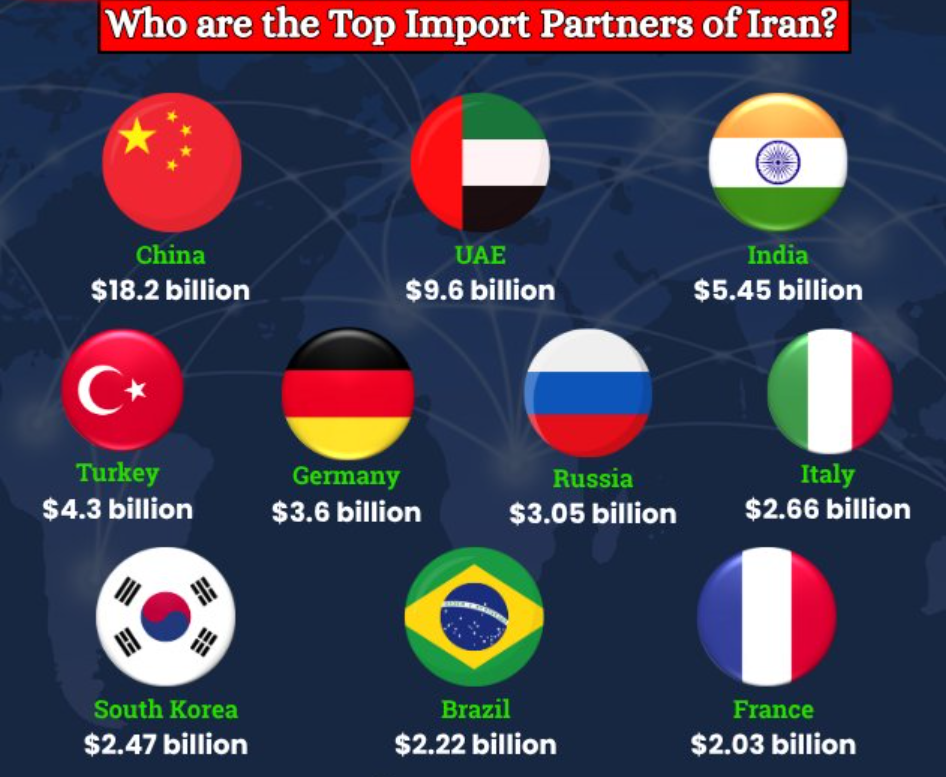
Declining trade interests with Iran – Materially, India has little to lose in Iran as the two economies have decoupled substantially over the last few years under Washington’s sanctions. From a peak in 2018-19 of USD 17.03 BN, India-Iran bilateral trade contracted sharply by around 87% to around USD 2.3 BN in 2024. This was largely driven by the reimposition of US sanctions in 2019. India has maintained a trade surplus here. In fact, India happens to be the 3rd largest import partner for Iran.

(Source: tradeimex.in)

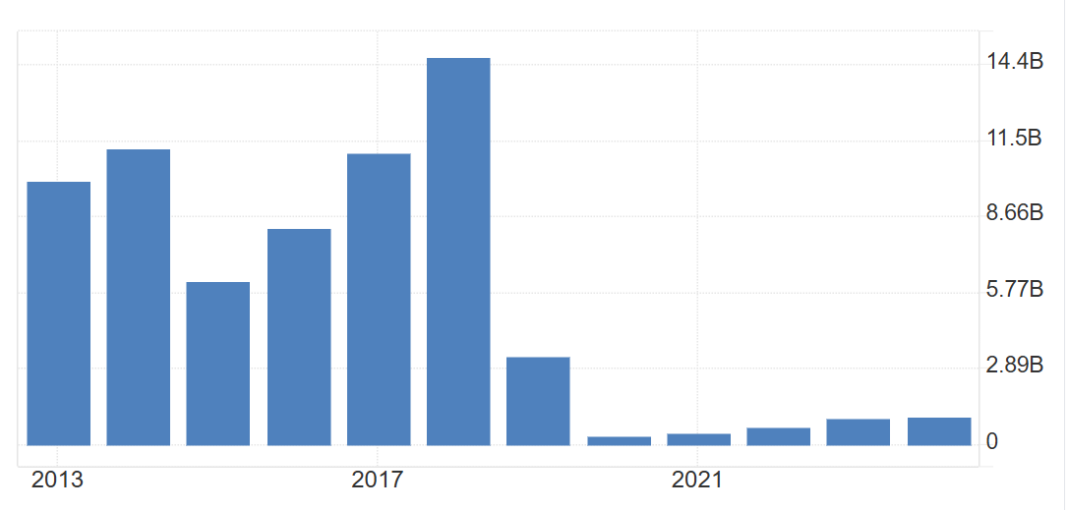
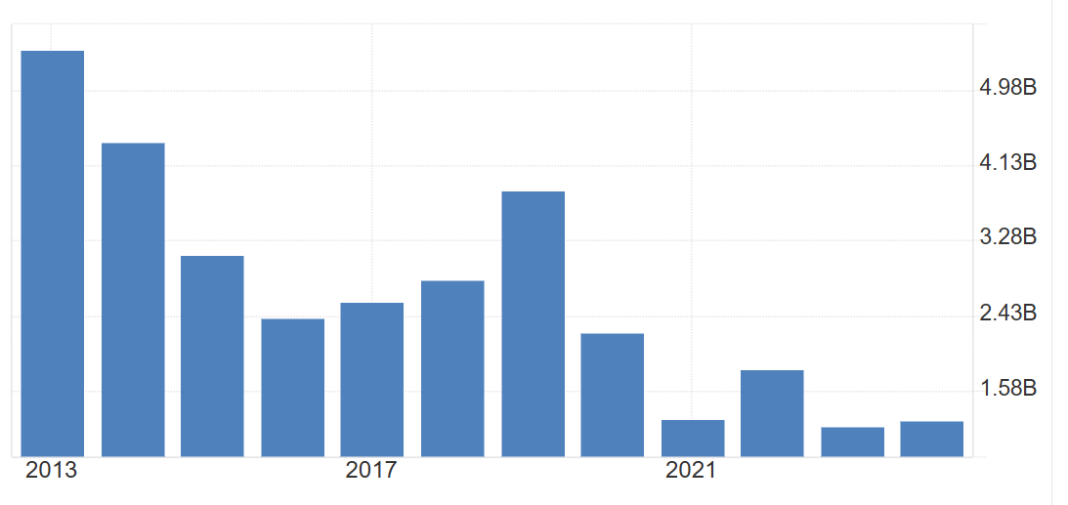
In 2024, Indian imports from Iran were roughly USD 1.06 BN, while exports touched USD 1.25 BN. Organic chemicals, edible fruits, and petroleum products were the prime imports, whereas rice, tea, coffee, and pharmaceuticals were the principal exports.

India’s imports from Iran (2024)

India’s exports to Iran (2024)

(Source: https://tradingeconomics.com/)

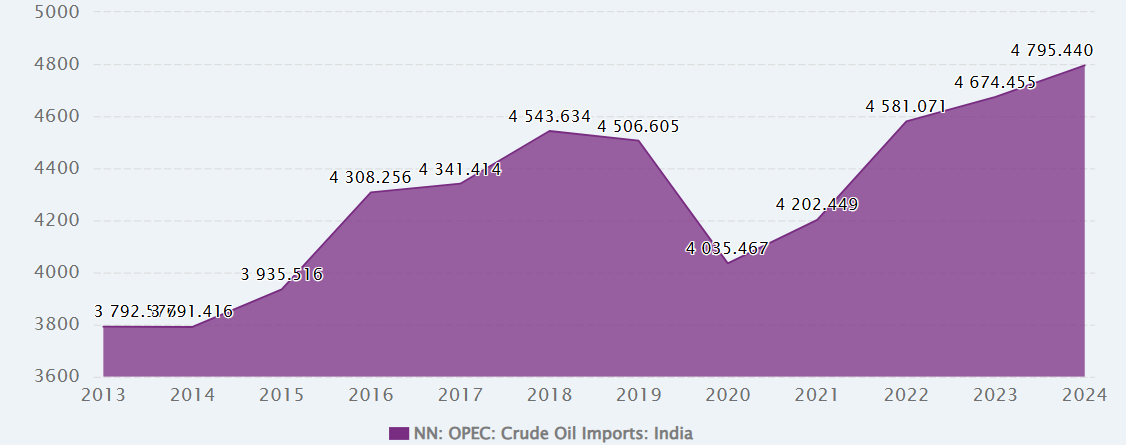
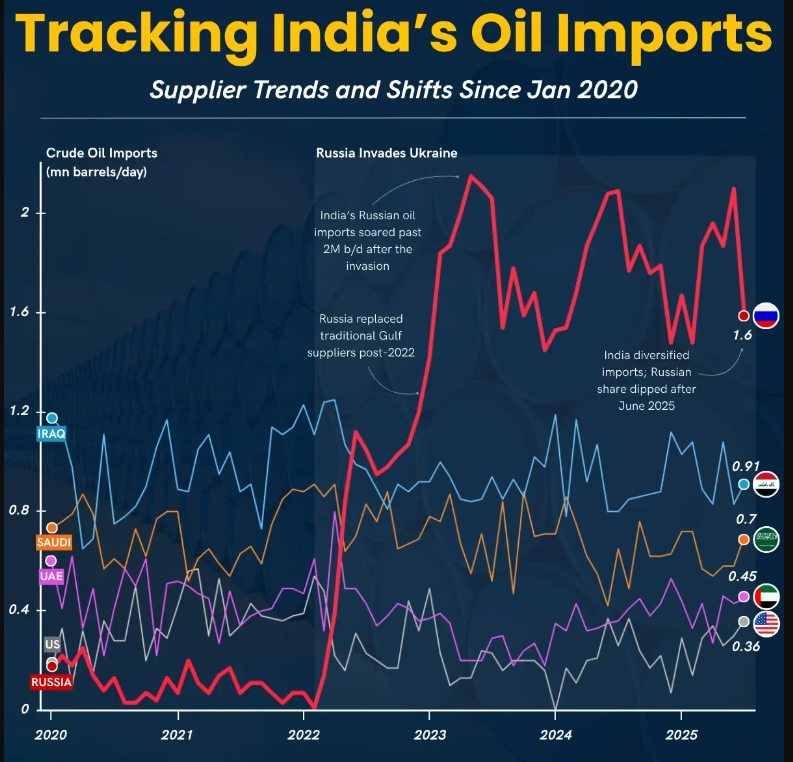
Energy diversification – As the world’s third-largest oil consumer, which depends on imports for over 88% of its crude oil requirement, India has done well to calibrate its energy exposure according to changing geopolitics. During 2016-17 (post 2015 nuclear deal), imports of Iranian oil soared to 27.1 Million Tonnes. Due to the reimposition of sanctions, India has completely stopped buying Iranian oil since May 2019. At that stage, non-compliance would have exposed Indian oil companies to US secondary sanctions. Presently, India has close to nil imports from Iran, with countries like Russia, Iraq, and Saudi Arabia assuming centre stage.

(Source: https://www.ceicdata.com/en/indicator/india/crude-oil-imports)

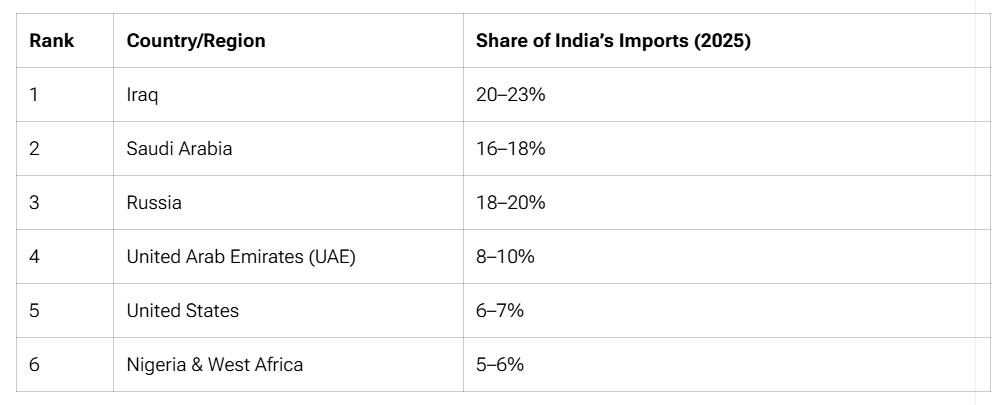
The astute political and economic pragmatism is illustrated further in the evolving mix of importing nations since 2020.

(Source: https://www.voronoiapp.com/geopolitics/Tracking-Indias-Oil-Imports–6162)

The diminished reliance on Iran for oil imports, which stands as a stellar example of India’s political sagacity, could enable the nation to take a balanced stance in the ongoing conflict. In fact, while the recent disruptions in the Strait of Hormuz have rattled multiple nations, courtesy the criticality of dependence on the Strait for oil imports, India’s diversification strategy has led to around 70% of crude imports coming from routes outside the Strait, as against 55% earlier.

It is worthwhile to note in this context that while India’s daily crude oil consumption is about 55 lakh barrels, through its diversification strategy, the volumes secured currently exceed what would normally have arrived through the Strait of Hormuz during this period.  

Focus on the safety of the Indian diaspora – The Middle East is home to around 90 Lakh Indian expatriates. Their safety and continued flow of remittances to India for the diaspora, to support their families and other requirements, have been priorities for the Indian Government. Of the aforementioned number, 9,000 – 10,000 reside in Iran. Balancing the safety of Indians spread across Middle East nations warrants a non-aligned approach, which India has successfully adopted.

Strategic relationship with Israel – The Indian and Israeli PMs have had a long-standing bonhomie, which the latter referred to in his speech at the Knesset, during PM Modi’s State visit, as “I would almost venture to say, more than a friend, a brother”.  He was candid to mention, “In a world where anti-Semitism is rising, India stands out.” In a world that is increasingly getting shaped by heightened protectionism and an evolving play of technological prowess, it is only but natural for India to deepen its long-standing relations on world stage.

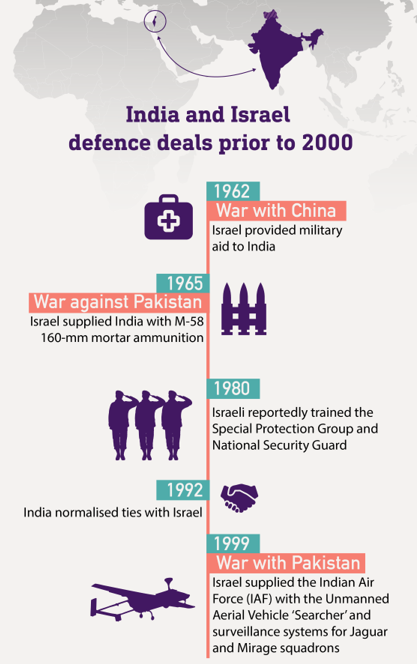
Both regions have consistently blamed a rising “Islamic terrorism” as a threat to global peace. The overtly pro-Israel policy, though, has been a detour from the erstwhile Government’s stand. That dates back to 1947, when India opposed the UN’s plan to partition Palestine. In fact, in 1988, India became one of the first non-Arab states to recognise Palestine. With the end of the Cold War and a leaning towards the Soviet Union despite being non-aligned, India’s stance slowly changed, with diplomatic relations being initiated with Israel in 1992. Since then, the Indo-Israel ties have gone from strength to strength.

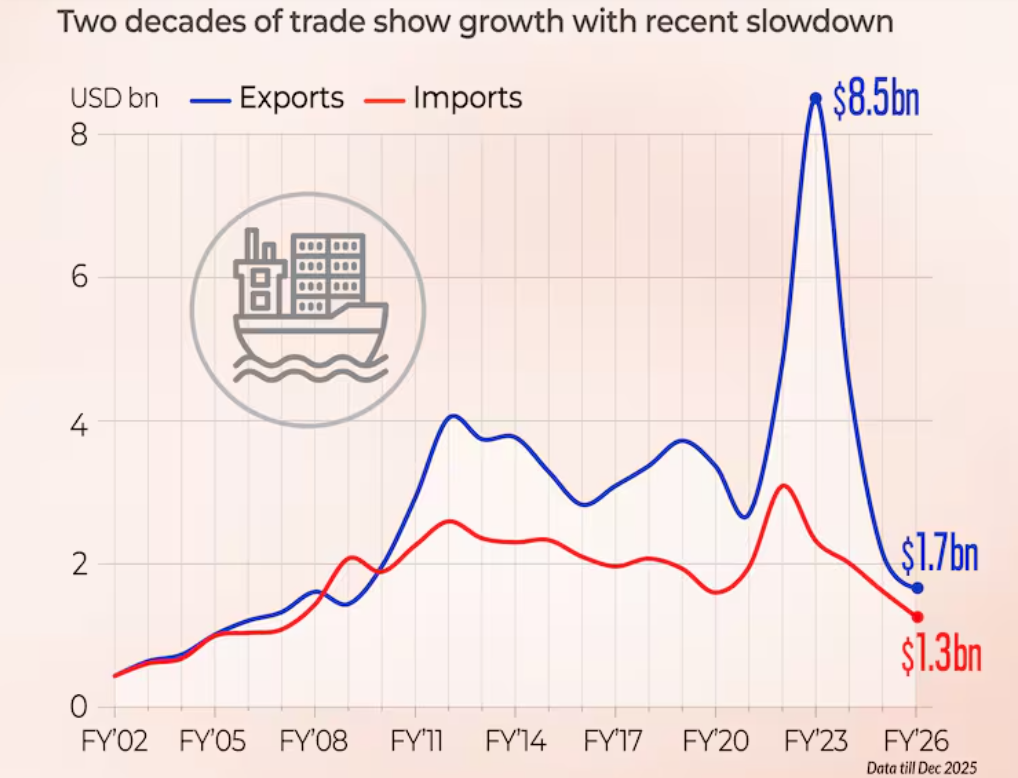
Key defence partner in Israel – Under the present regime, India became Israel’s largest weapons buyer. Trade between the two nations has ballooned from USD 200 MN in 1992 to more than USD 6 BN in 2024. India is Israel’s second-largest Asian trading partner after China in goods, primarily in petroleum, chemicals, and diamonds. The Bilateral Investment Treaty (BIT) that was signed last September, has given a further fillip to bilateral trade.

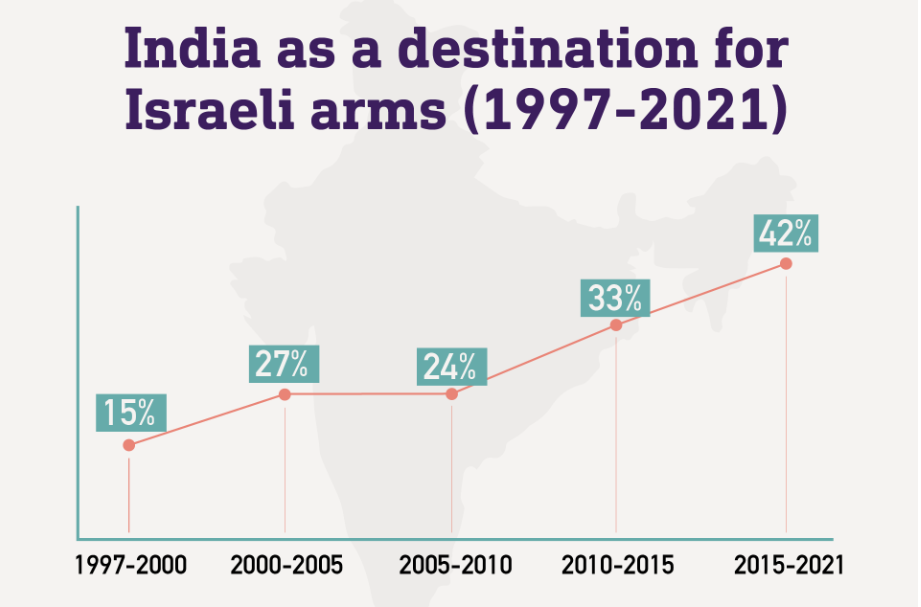
India’s defence deals with Israel date back long – to 1962 – when Israel provided military aid to India in its war against China. In 1999, during India’s war with Pakistan, Israel supplied IAF with the Unmanned Aerial Vehicle ‘Searcher’ and surveillance systems for Jaguar and Mirage squadrons. The defence ties with Israel have notched up since, and since 2014, around 42.1% of all arms exports from Israel have landed in India, with Azerbaijan, Vietnam, and US making up the other major customers.

Increasing trade interests with Israel – As regards trade, India’s partnership with Israel is not limited to defence. Exports are, however, concentrated across a few key sectors, like gems and jewellery, especially cut and polished diamonds, which are sent to Israel’s large diamond trading hubs. Apart from this, petroleum products, organic chemicals, plastics, and engineering goods also form a major portion of the exports. In very recent years, there has been a sharp drop in Indian exports to Israel – PM Modi’s visit can supposedly perk up the exports again, courtesy strategic deals and tie-ups across areas.

Statecraft at its finest

Chanakya, in his seminal treatise on statecraft, ‘Arthashastra’, talks of ‘Mandala theory’ – which in essence is a framework to model foreign policy based on ‘circle of states’. He mentioned the immediate neighbour as an enemy (Ari), the state beyond them is a friend (Mitra), and so on. Present-day Central Gov’s foreign policy is well aligned to such ancient wisdom of Bharat, as we find India navigating the tricky neo-political contours of the Middle East so very well during the present conflict. Pragmatic realism (Realpolitik) is a key tenet of Arthashastra, and despite complex relations with Gulf nations, India has prioritised national interest over ideological sentimentality in its bonhomie with Israel, as also staying cautious to not infuriate Iran.

‘When it rains, look for rainbows’ – goes an old adage. Under the trying circumstances of a volatile Middle East, India’s sagacious diplomacy ensured it not only weathered the rains, but also upped its relations across the Middle East. Government’s guiding beacon ‘Sabka Sath’, for once, transcended national borders – onto international terrain. With Bharat’s indelible mark written all over!

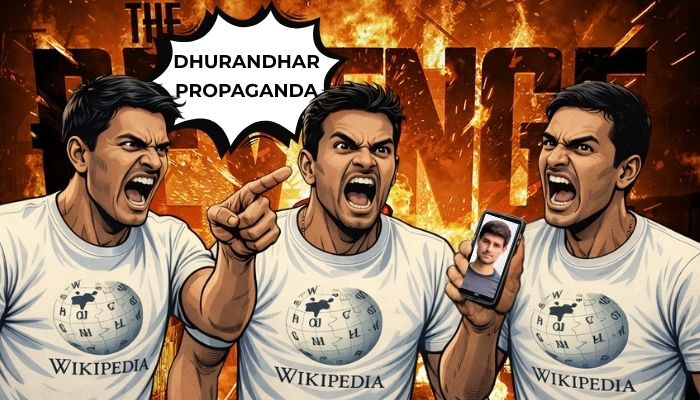
Who is pushing the ‘propaganda’ tag against Dhurandar on Wikipedia? How an anti-Hindu Wikipedia ‘Editor’ booked in Manipur for inciting violence cited fake news peddler Dhruv Rathee to tarnish the movie

0

The so-called encyclopedia, Wikipedia, is actively shaping the narrative around Hindi film Dhurandhar and Dhurandhar: The Revenge by pushing the claim that it is a “propaganda” movie. Discussions on the talk pages of Ranveer Singh starrer films reveal a pattern where certain editors have consistently attempted to insert politically loaded descriptions into the Wikipedia articles on the films, while others have pushed back, accusing them of selective sourcing, cherry-picking, and pushing a one-sided narrative. Propagandist YouTuber Dhruv Rathee has been used as a “source” for calling the film “propaganda”, which raises serious questions about the methodology Wikipedia editors have been using. The pages are currently locked for editing.

How Wikipedia editors pushed the narrative of the film being ‘propaganda’

The attempt to label ‘Dhurandhar: The Revenge’ as a propaganda film was not a settled conclusion between the editors. It was a contested claim that several Wikipedia editors openly pushed back against. Discussions on the talk page reveal there was clear resistance to the forced narrative insertion. [Archive link 1] [Archive link 2]

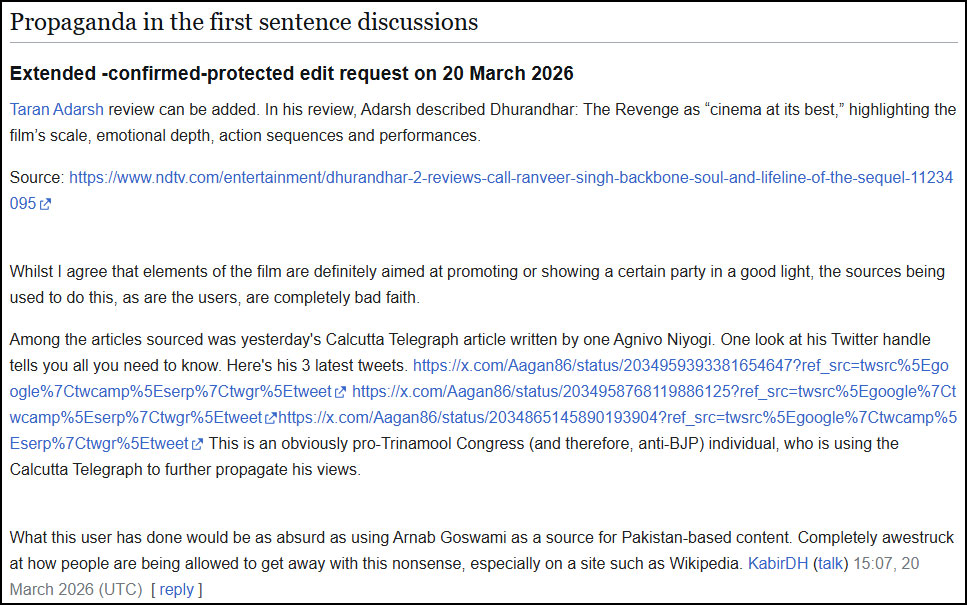
One of the editors, “KabirDH”, explicitly flagged bias and bad-faith sourcing. He stated, “Whilst I agree that elements of the film are definitely aimed at promoting or showing a certain party in a good light, the sources being used to do this, as are the users, are completely bad faith.” He further questioned the credibility of the sources that were being relied upon. He added, “This is an obviously pro-Trinamool Congress (and therefore, anti-BJP) individual, who is using the Calcutta Telegraph to further propagate his views.”

Source: Wikipedia

The concern was not limited to bias. There was also a violation of Wikipedia’s own rules. KabirDH warned, “It would be a brazen violation of WP:NPOV, WP:DUE, and WP:OR to use that single source for a broad, sweeping, genre classification with a wikilink to ‘propaganda film’ in the lead sentence.”

Source: Wikipedia

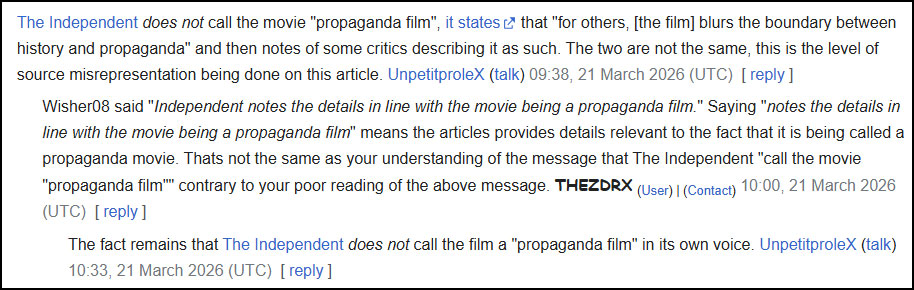
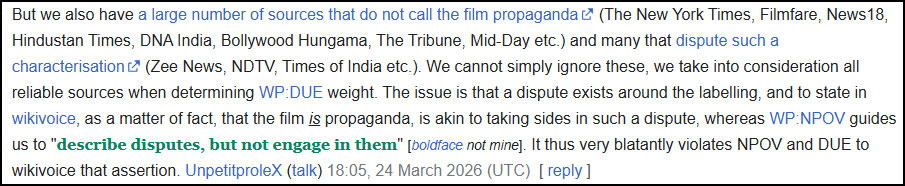
Another editor, UnpetitproleX, rejected the claim that reliable sources had conclusively labelled the film as propaganda. He noted, “The fact remains that The Independent does not call the film a ‘propaganda film’ in its own voice.” Emphasising balance, he added, “But we also have a large number of sources that do not call the film propaganda… We cannot simply ignore these, we take into consideration all reliable sources when determining WP:DUE weight.”

Source: Wikipedia

Highlighting the existence of an active dispute, UnpetitproleX further stated, “The issue is that a dispute exists around the labelling, and to state in wikivoice, as a matter of fact, that the film is propaganda, is akin to taking sides in such a dispute, whereas WP:NPOV guides us to ‘describe disputes, but not engage in them’.”

Source: Wikipedia

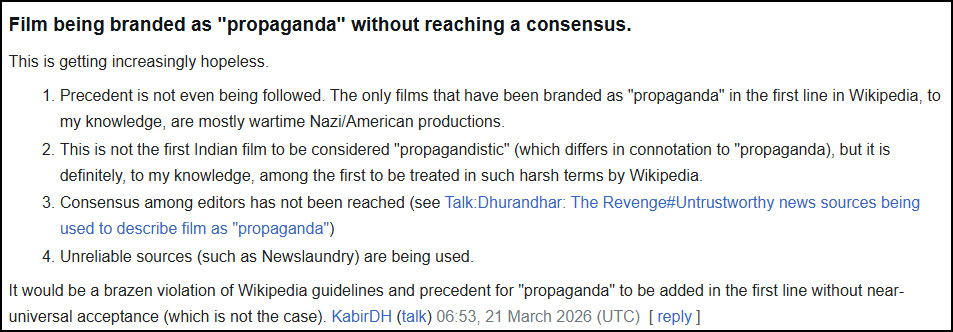
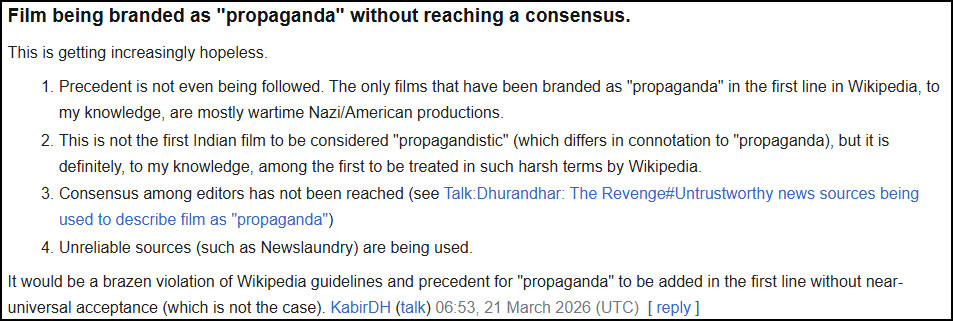
Frustration over the repeated attempts to insert the label was evident. KabirDH remarked, “Film being branded as ‘propaganda’ without reaching a consensus. This is getting increasingly hopeless.” He reiterated the lack of agreement, noting, “Consensus among editors has not been reached… It would be a brazen violation of Wikipedia guidelines and precedent for ‘propaganda’ to be added in the first line without near-universal acceptance (which is not the case).”

Source: Wikipedia

Even the reliability of certain sources was questioned. Editor ARandomName123 pointed out, “Grand Pinnacle Tribune is AI written, which is unreliable per WP:RSLLM.”

Source: Wikipedia

Taken together, the discussion shows that the “propaganda” label was not an established fact, but a disputed characterisation, resisted by multiple editors citing bias, source misrepresentation, and violation of Wikipedia’s neutrality norms.

Similar narrative pushed on first Dhurandhar article, editor Kautilya3 at the centre of controversy

A similar pattern was seen in the first part of the film as well. The archived talk page of the first film, Dhurandhar, shows that the attempt to brand the film as propaganda began much earlier, and the controversial editor Kautilya3 played a crucial role in pushing this narrative. [Archive Link 1] [Archive Link 2]

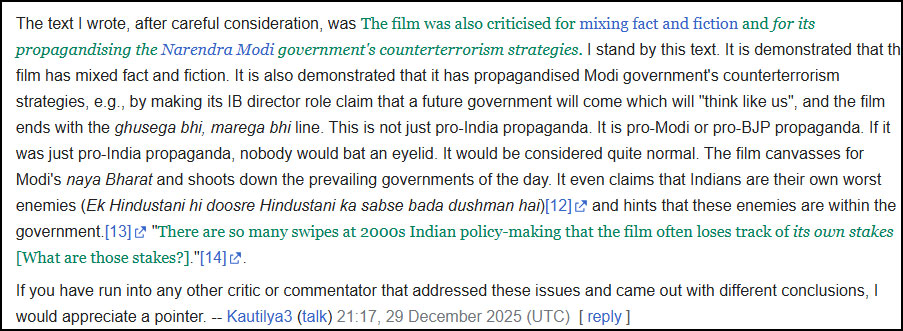
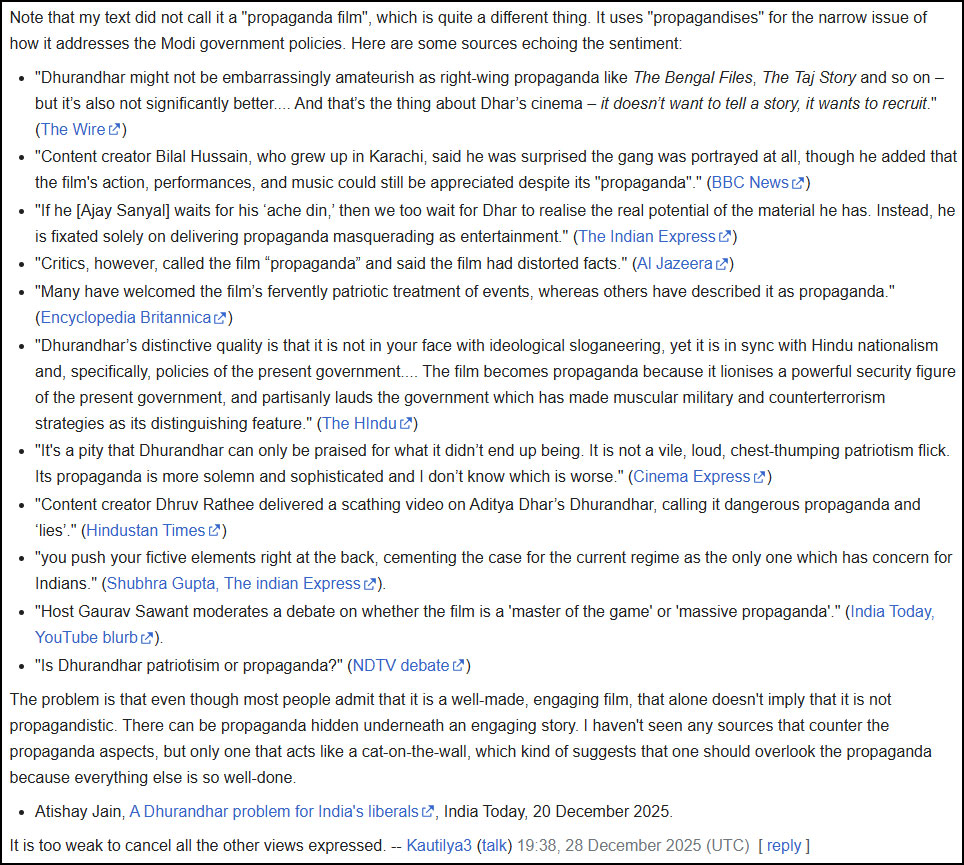
On the talk page of the first film, Kautilya3 went beyond merely citing critics and instead advanced his own interpretation of the film’s messaging. In one of the most striking interventions, he wrote, “It is also demonstrated that it has propagandised Modi government’s counterterrorism strategies.”

Source: Wikipedia

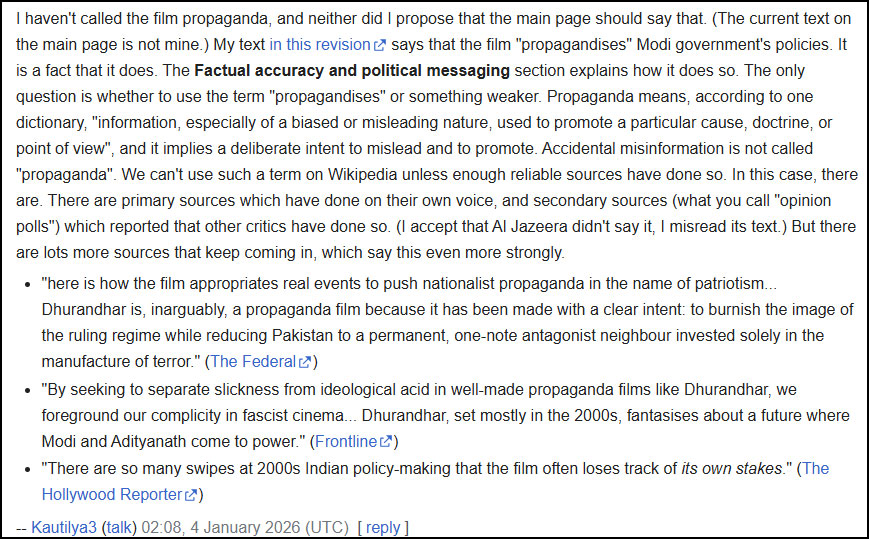
This was not presented as an attributed opinion, but as a conclusion drawn from his own reading of the film and selected sources. He further elaborated his position, attempting to justify the use of the term “propaganda” by stating, “Propaganda means… ‘information, especially of a biased or misleading nature, used to promote a particular cause…’… In this case, there are [sources].”

Source: Wikipedia

In another comment, he made his intent even clearer, asserting, “My text… says that the film ‘propagandises’ Modi government’s policies. It is a fact that it does.”

Source: Wikipedia

Such statements reveal a clear shift from reporting criticism to asserting ideological interpretation as fact, something that multiple editors immediately challenged.

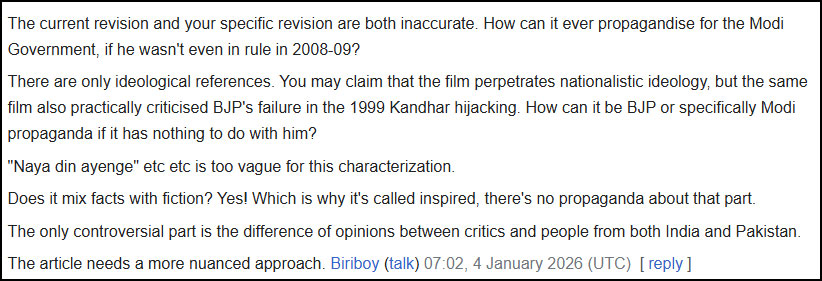
Other contributors pointed out glaring inconsistencies in this framing. One editor directly questioned the timeline argument, stating, “How can it ever propagandise for the Modi Government, if he wasn’t even in rule in 2008–09?”

Source: Wikipedia

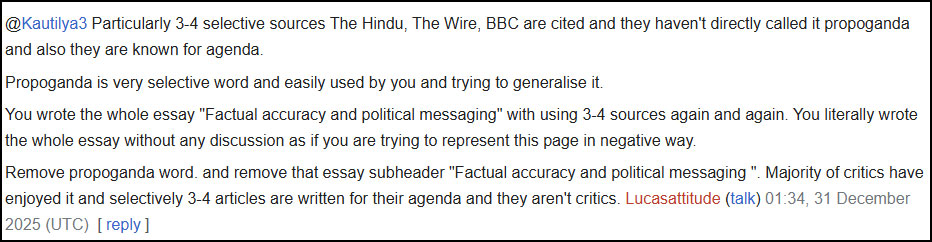
Another editor highlighted the imbalance in sourcing and narrative construction, arguing, “Particularly 3-4 selective sources… are cited… You literally wrote the whole essay without any discussion as if you are trying to represent this page in negative way.”

Source: Wikipedia

There were also repeated objections to the creation of an entire section titled “Factual accuracy and political messaging”, which many editors felt was disproportionately built around a narrow set of critical viewpoints. One editor explicitly demanded, “Remove propoganda word. and remove that essay subheader ‘Factual accuracy and political messaging’.” The resistance was not limited to content alone, but extended to editorial behaviour. Kautilya3 was accused of repeatedly reverting edits and pushing his version of the narrative despite objections. One editor remarked, “He single handedly wrote everything without any discussions and not letting others to do anything at page.”

Another accused him of selectively weighting sources to push a particular viewpoint, stating that he was “cherry-picking sources and peddling propaganda by unfair weighting.”

Despite these objections, Kautilya3 consistently defended his approach by invoking Wikipedia policies, particularly those related to reliable sources and neutrality. In one response, he stated, “Wikipedia discussions proceed based on WP:V and WP:NPOV, not personal views.”

However, other editors argued that this very framework was being used selectively, allowing certain viewpoints to dominate while dismissing others as unreliable or irrelevant.

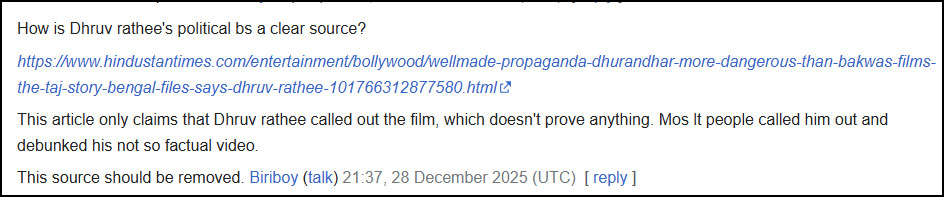
The discussion also exposed how controversial opinions were being elevated through indirect sourcing. References to Dhruv Rathee’s criticism once again surfaced, with editors questioning why his views were being given importance. One editor asked, “How is Dhruv rathee’s political bs a clear source?”

Source: Wikipedia

Another added, “You have cited Dhruv Rathee opinions on Dhurandhar 😂😂😂 wow”

Source: Wikipedia

Interestingly, Kautilya3 called Dhruv Rathee a “notable source”.

Source: Wikipedia

Yet, as seen in the sequel’s discussion as well, once such opinions were reported by media outlets, they were defended as valid under Wikipedia’s sourcing rules.

What becomes evident from the first film’s talk page is that the attempt to frame Dhurandhar as propaganda was not a spontaneous reflection of consensus, but the result of sustained editorial push, selective interpretation, and repeated reliance on a narrow band of sources.

The same arguments, the same resistance, and the same patterns of conflict would later reappear in the discussions around the sequel, indicating a continuing effort to shape the narrative in a particular direction.

Notably, UK-based Wikipedia editor Kautilya3, whose name is Uday Reddy, was booked by Manipur police in 2024 for promoting enmity between communities in Manipur and propagating anti-Meitei hatred.

OpIndia’s dossier on Wikipedia bias and how Dhurandhar fits the pattern

OpIndia’s dossier on Wikipedia had already flagged how the so-called encyclopedia is not merely documenting information but actively shaping narratives through a network of editors, selective sourcing, and policy driven gatekeeping. The dossier highlighted how a small group of entrenched editors often dominate pages, rely on a narrow ecosystem of “acceptable” publications, and use Wikipedia’s internal rules to push specific ideological framings while sidelining others.

The developments around Dhurandhar and Dhurandhar: The Revenge fit perfectly into the pattern described in that dossier. As seen in the talk page discussions, the push to label the film as “propaganda” did not emerge from broad consensus but from repeated attempts by certain editors to elevate a limited set of critical opinions into a defining narrative.

The resistance from other editors, who pointed out “Picking few selective articles and generalising the statements is something looking very fishy” and “3-4 opinions from certain newspapers will not generalise the whole film,” directly mirrors the concerns raised in OpIndia’s findings.

The dossier had specifically noted how Wikipedia’s dependence on a fixed pool of “reliable sources” allows particular narratives to gain disproportionate visibility. This mechanism is clearly visible in the Dhurandhar discussions, where criticism amplified by a handful of publications, including commentary linked to Dhruv Rathee, was repeatedly pushed into the article, while broader reception and opposing views were dismissed or downplayed.

Another key observation from the OpIndia dossier was the role of dominant editors in shaping page content. In the case of Dhurandhar, multiple contributors accused editor Kautilya3 of doing exactly that, with one editor stating, “he single-handedly wrote everything without any discussions and not letting others to do anything at page,” while another raised concerns about “cherry-picking sources and peddling propaganda by unfair weighting.”

This aligns with OpIndia’s broader finding that Wikipedia’s openness often masks a reality where a handful of persistent editors, well versed in policy language, are able to control narratives far more effectively than casual contributors.

The dossier had also underlined how indirect sourcing is used to introduce controversial viewpoints. The reliance on Dhruv Rathee’s criticism is a textbook example of this process. As seen in the talk page itself, editors questioned this approach, asking, “How is Dhruv rathee’s political bs a clear source?” and asserting that “A YouTuber’s opinions is not reliable by any means.” Yet the argument that such views become valid once covered by certain publications allowed them to remain part of the discussion.

In this sense, the Dhurandhar case does not stand alone, it reinforces the systemic issues already identified by OpIndia. It shows how Wikipedia’s editorial structure, far from being a neutral mechanism, can be used to amplify specific narratives under the cover of policy compliance.

A so-called encyclopedia or a platform for ideological narrative building

The Dhurandhar discussions, when viewed alongside OpIndia’s dossier, raise a larger question about Wikipedia’s credibility as a neutral knowledge platform. What is presented as a collaborative, open-source encyclopedia increasingly appears to function as a curated space where narratives are negotiated, filtered, and, at times, pushed in particular directions.

The repeated attempts to brand Dhurandhar as propaganda, despite clear disagreement among editors and lack of unanimity in sources, show how narratives can be constructed through persistence and procedural leverage. When an editor states, “It is also demonstrated that it has propagandised Modi government’s counterterrorism strategies” and insists “It is a fact that it does,” the line between reporting and interpretation begins to blur.

At the same time, opposing voices are constrained within the framework of Wikipedia’s rules, often dismissed as “original research” or “personal opinion,” even when they are pointing out inconsistencies or broader context. This creates a situation where neutrality is not an inherent outcome, but something that can be shaped by those who are most adept at navigating the system.

The dossier had warned that Wikipedia’s reliance on a limited set of publications as “reliable sources” effectively creates an ideological filter. The Dhurandhar case shows how that filter operates in practice. Once a narrative gains traction within that ecosystem, whether through opinion pieces, selective reviews, or amplified commentary, it can be elevated into the article as a significant viewpoint, regardless of how contested it may be outside that circle.

This raises serious concerns about the platform’s role in shaping public perception. When widely read pages begin to reflect narrow or contested interpretations as prominent narratives, the impact goes beyond Wikipedia itself. It influences how subjects are understood, discussed, and even judged by a broader audience.

In that sense, the question is no longer whether Wikipedia has bias, but how that bias operates. The answer, as both the dossier and the Dhurandhar discussions suggest, lies in the intersection of editorial dominance, selective sourcing, and policy driven validation.

While Wikipedia continues to position itself as a neutral repository of knowledge, there is enough evidence against it. Still, it is being used as a primary source of information by search engine giant Google to show summaries about topics, including Hindi film Dhurandhar.

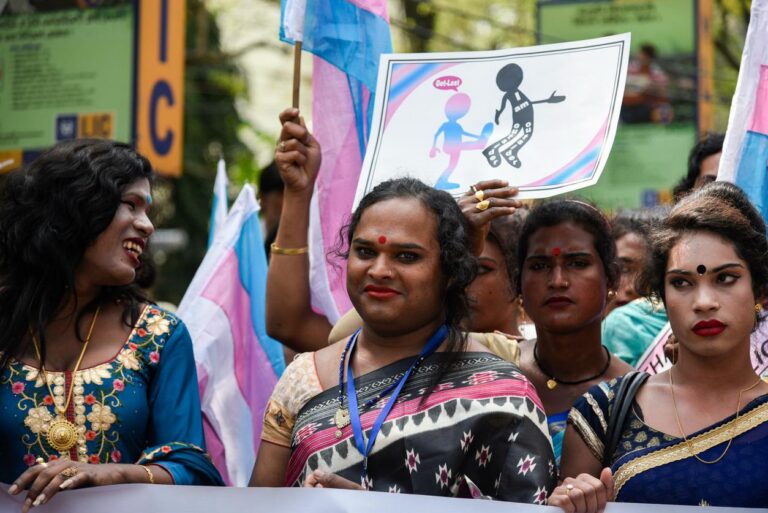
India says NO to woke nonsense: Transgender Bill 2026 sets boundaries straight — definition of ‘transgender’ does not include the pronoun gang. Read details

In a significant legislative move, the Modi government has passed the Transgender Persons (Protection of Rights) Amendment Bill, 2026, marking a decisive shift in how India approaches gender identity under law. The government has framed the Bill as an effort to ensure that protections reach those who face discrimination due to biological realities, while also bringing long-needed administrative clarity.  

The legislation, which also introduces graded punishments based on the severity of harm, has been positioned as part of a broader commitment to bring marginalised communities into the mainstream while safeguarding their rights.  

At a time when much of the world is struggling with ever-expanding and often confusing definitions of gender identity, India has chosen a different path, one that has firmly, legally, and decisively said no to woke nonsense that has afflicted much of the Western world.

With the introduction of the Transgender Persons (Protection of Rights) Amendment Bill, 2026, the Modi government has done something few governments are willing to do; it has drawn a clear line. In one fell swoop, it has put an end to the scourge of identity politics that is rapidly taking root in Indian society.

The Transgender Bill 2026 is not just a legal amendment. It is a course correction, and a pre-emptive one at that.

The earlier Transgender Persons Act of 2019 recognised a “right to self-perceived gender identity.” On paper, that sounded progressive. In practice, it opened the door to ambiguity, confusion, and administrative chaos. When identity becomes entirely subjective, law loses its ability to function.

The 2026 Amendment fixes that. Put simply, the Bill has ended the monopoly of the pronoun gang, a group that believed it was entitled to identify itself with the gender of its choosing without having to comply with the scientific definition of gender.

From “anything goes” to a clear definition

The biggest change in the Bill is simple but significant: it defines who a transgender person is in clear, workable terms.

Instead of leaving it open-ended, the law now limits the category to those who can be identified through socio-cultural or biological realities. This includes traditional transgender communities like hijra, kinner, aravani and jogta, as well as individuals with congenital variations in sex characteristics. It also includes victims of coercion or forced identity imposition.

At the same time, the Bill makes one thing unambiguously clear: this law is not meant to cover every self-declared identity or fluid category

That clarity is deliberate.

Why didthe government tighten the definition?

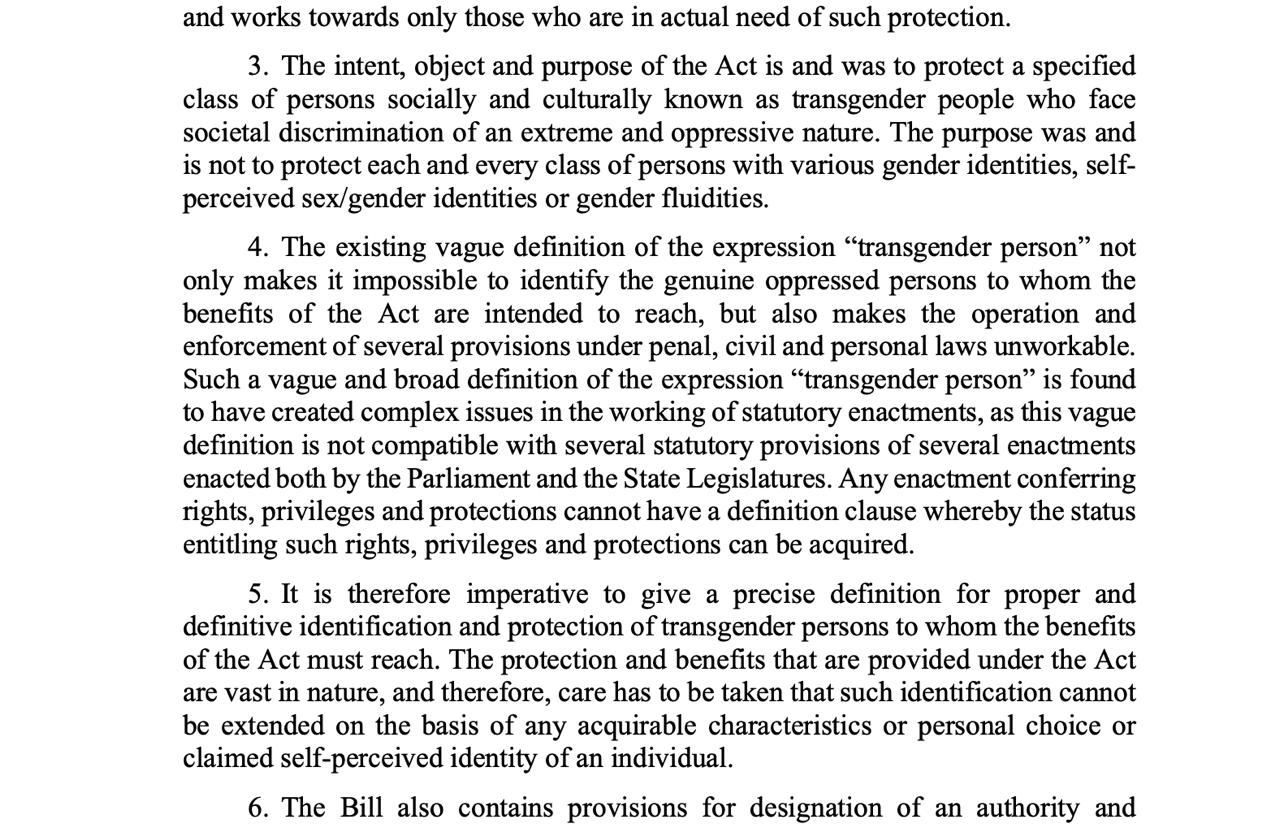
The reasoning behind this move is spelt out in the Bill itself. The government notes that the earlier “vague and broad definition” made it difficult to identify who actually needed protection and made the implementation of laws complicated.

More importantly, it states that the law was always meant to protect a specific class of people who face real, structural discrimination, not an ever-expanding universe of identity claims.

This is a crucial distinction.

Welfare laws are not abstract moral statements; they are tools for targeted support. If the definition becomes too broad, the benefits meant for the most vulnerable get diluted. That is exactly what the government is trying to prevent.

The most important line in the Bill that ends the pronoun gang’s stranglehold over identity politics

Perhaps the most telling part of the Amendment lies in its Statement of Objects and Reasons: “It is therefore imperative to give a precise definition… such identification cannot be extended based on any acquirable characteristics or personal choice or claimed self-perceived identity of an individual.”

This is the heart of the reform. It has effectively ended the loophole that the pronoun gang exploited to further identity politics and fuel confusion in policy and enforcement.

In one sentence, the government has drawn a boundary between personal identity and legal identity. You may identify however you wish, but when it comes to law, benefits, and state recognition, there must be clear and verifiable criteria.

What went wrong earlier

The earlier framework, built around self-perception, created a situation where the category of “transgender” could expand endlessly. That may work in theory, but in practice, it creates serious problems.

How do you administer welfare schemes? How do you issue official documents? How do you enforce laws where identity itself is fluid and unverifiable?

The Bill itself acknowledges that such vagueness made several laws difficult to implement and created conflicts across legal systems.

More importantly, it opened the door for misuse and dilution. When a category meant for a historically marginalised group becomes too broad, those who genuinely need support often end up losing out. The Amendment is an attempt to fix exactly that.

The world has already seen where this leads

If anyone believes these concerns are hypothetical, global developments tell a different story.

Take the case of J. K. Rowling. In the UK, she has repeatedly raised concerns about laws and policies that prioritise self-declared gender identity over biological reality. Under Scotland’s controversial hate crime law, even referring to a biological male as male risked being treated as a legal offence. Rowling openly challenged this, pointing out how such frameworks distort crime data, weaken women’s protections, and create absurd legal contradictions. 

Her criticism wasn’t abstract; it was grounded in real consequences. Cases emerged where biological males identifying as women were placed in female spaces, including prisons, raising serious safety concerns.

Similarly, global sports bodies have been forced to confront the limits of identity-based frameworks. In March 2023, World Athletics banned transgender women who had undergone male puberty from competing in female categories at international events. The decision, as stated by its president Sebastian Coe, was driven by a simple principle: fairness.

The organisation made it clear that allowing athletes with male physiological advantages to compete in women’s categories would undermine the integrity of female sport. Even after testosterone suppression, scientific assessments showed a retained performance advantage. The conclusion was unavoidable: fair competition requires clear biological boundaries.

This was not an isolated move. World Aquatics had earlier imposed similar restrictions, with an overwhelming majority of member federations supporting the decision.

In other words, institutions across the world are slowly realising what happens when policy runs ahead of reality.

India chooses clarity before crisis

What makes India’s move significant is that it comes before such crises fully unfold domestically.

Instead of waiting for legal contradictions, policy breakdowns, or institutional conflicts, the government has acted preemptively. By tightening definitions now, it aims to prevent exactly the kind of confusion and conflict seen elsewhere.

This is not reactionary but anticipatory governance.

Stronger protection where it actually matters

While critics frame the Bill as restrictive, it actually strengthens protections in meaningful ways.

The amended law introduces strict punishments for forced mutilation, coercion into adopting a transgender identity, trafficking, and exploitation. In severe cases, especially involving children, penalties can extend to life imprisonment.

This shifts the focus from abstract identity debates to real-world harms where the law is most needed.

No more “just say it and become it” in law

Another major change is the recognition process itself. The earlier system leaned heavily on self-declaration. The new framework introduces verification, including the involvement of authorities and expert input where necessary.

This brings transgender identification in line with how the Indian state handles other legally significant categories, through documentation and verification, not just personal claims. Now, those who wish to identify themselves as any other gender other than their biological one will have to undergo verification, possibly in the form of medical tests or something along those lines, and get certified by competent authorities to get recognised as one.

Again, this is not about denial. It is about making the law workable and ensuring the system is not gamed by a few bad-faith actors.

Impact on schools and institutions

The implications of this Bill extend beyond courts and legal systems. It could reshape how schools and institutions approach gender identity.

In recent years, fluid identity concepts have increasingly entered educational spaces, often without a clear legal framework. Policies, counselling approaches, and curriculum discussions have sometimes reflected these trends.

The new law introduces a clear boundary. By defining what the state recognises, it ensures that institutional policies, especially in publicly governed spaces, are anchored in legal clarity, not shifting ideological trends. Discussion may continue, but policy must now align with law.

A necessary correction

The Transgender Bill 2026 is not about rolling back rights. It is about making the law clear, enforceable, and fair.

The 2019 Act laid the foundation. But it left too many grey areas. The 2026 Amendment closes those gaps. It ensures that protections reach those who truly need them, prevents misuse, and restores clarity to a complex area of law.

At its core, this Bill is about one simple idea that law cannot function without clear definitions. Around the world, institutions are grappling with the consequences of ignoring this principle. India, instead, has chosen to act early.

It has chosen clarity over confusion, structure over ambiguity, and governance over abstraction. That may not satisfy ideological purists. But it is how functioning legal systems are built.

And in that sense, the Transgender Bill 2026 is not just a reform; it is a statement that defines India’s stand on identity politics. And perhaps a direction for the world to follow.

Dangerous for those who force religious conversion: Union government tables FCRA Amendment bill in Parliament, read about key changes for NGOs

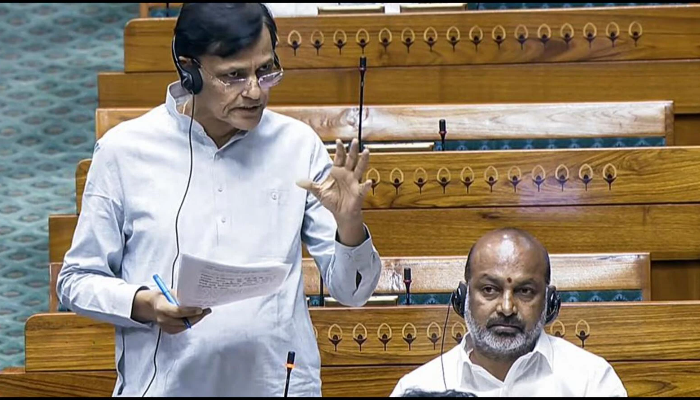
On 25th March (Wednesday), a bill to modify the Foreign Contribution Regulation Act (FCRA) was presented to the Lok Sabha by the Modi government. Union Minister of State for Home Nityanand Rai introduced the bill and expressed that it intends to improve transparency and guarantee appropriate use of funds acquired from overseas. He also responded to the opposition’s accusations that it is “dangerous” and countered that it is “indeed dangerous” for people who exploit the money to push for religious conversion and their own benefit.

He warned, “The Modi government will not tolerate any misutilisation of foreign funding and will take strong action against such elements.” A non-governmental organisation (NGO) must register under the FCRA to obtain financial assistance from abroad. The 2010 parent act lacked a statutory structure to handle the assets generated from the resources and merely had a clause to regulate the flow.

Who is the “key functionary”

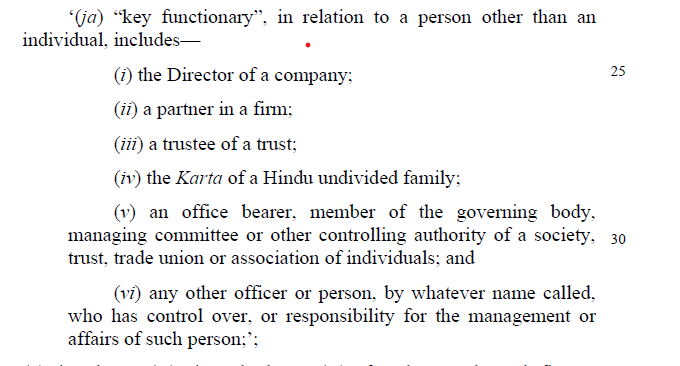
The bill has broadened the definition of “key functionary” within an NGO to encompass not only an office bearer or director but also directors, partners, trustees and the karta (head) of a Hindu Undivided Family alongside office-bearers or members of the governing body or managing committee of a society, trust, trade union, or association as well as any individual who possesses control over or is accountable for the operations or affairs of such an organisation.

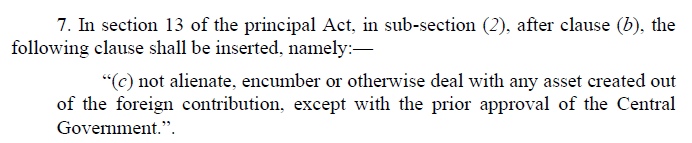
NGOs have to procure the center’s prior consent before alienating, encumbering or otherwise dealing with any asset derived from the foreign contribution.

Additionally, unless they can demonstrate a lack of information or due diligence, the amendment would hold significant staff members accountable for violations under the FCRA.

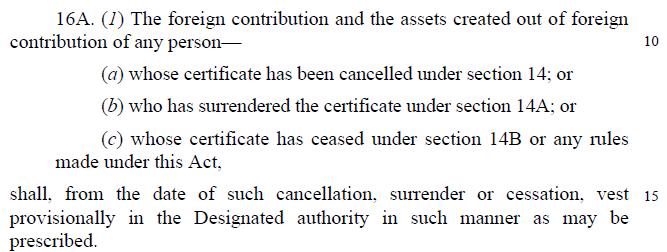
The certificate will be considered to have expired upon the conclusion of its validity period if the renewal application has not been submitted, denied by the central government, or not renewed prior to expiration under the new provisions. “No person whose certificate has ceased to exist shall either receive or utilise the foreign contribution unless the certificate is renewed,” the bill added.

The role of “Designated Authority”

The bill’s comprehensive, time-bound system to deal directly with assets gained out of outside donations in situations where an association’s FCRA registration has been suspended, terminated, surrendered, or otherwise ceased is one of its main features. A “Designated Authority” has been appointed to assume control of the same, keep track of records and inventories, safeguard their condition and secure their legitimate usage or disposal.

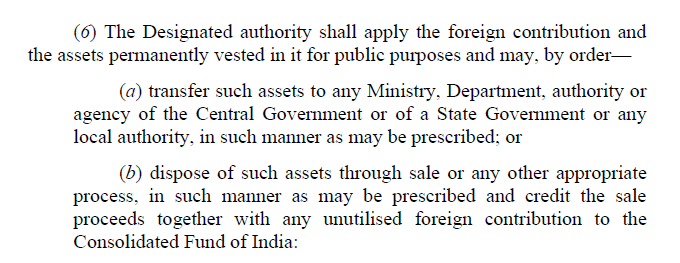
It can employ permanently vested assets for public purposes, such as moving them to any ministry, department, authority or agency of the central government or a state government or any local entity or even sell them with the proceeds put into to the “Consolidated Fund of India” along with any left-over aide from beyond borders.

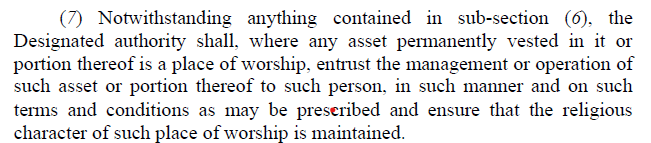
When an asset or its portion that is permanently vested in the “Designated Authority” is a place of worship, then its religious character must be preserved by entrusting the management or functioning to a chosen individual in such a manner along with the terms and conditions that might be established. Its decisions can only be contested in court.

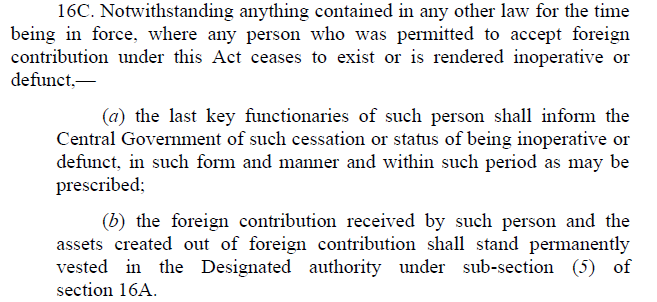
If a person who was allowed to accept foreign aide no longer exists or is pronounced inoperative or defunct, the remaining key functionaries are mandated to tell the central government in the format, manner and time frame that could be specified. The “Designated Authority” will retain permanent ownership of their funds and derived assets.

“The Designated authority and the Administrator, for the purposes of discharging their functions under the act shall have all the powers of a Civil Court under the Code of Civil Procedure, 1908, while trying a suit, in respect of summoning and enforcing the attendance of any person, examining them on oath, requiring the discovery and production of documents, receiving evidence on affidavits, issuing commissions and such other matters as may be prescribed,” the bill outlined. A 90-day period has been granted to approach the District Judge’s Court against the order.

Jail term for the offenders

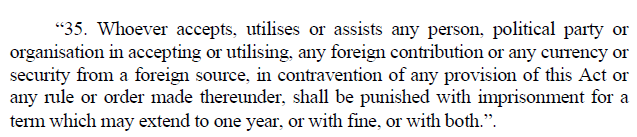
The bill suggested rationalising penalties and lowered the maximum sentence for FCRA violations from previous 5 years to 1 year, a fine or both for anyone who infringes any clause or regulation by accepting or helping an individual, political party or group to take any contribution, currency or security from a foreign source.

Section 43 of the parent act is also altered, requiring any law enforcement agency or state government to obtain prior clearance from the centre before beginning an inquiry into allegations pertaining to the FCRA.

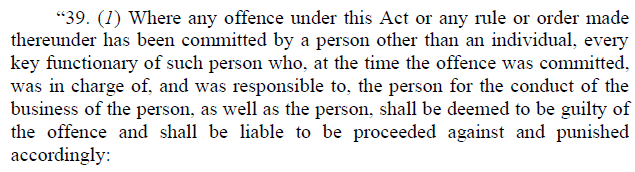
If any breach under this act, any rule or order made thereunder is committed by an entity other than an individual, their every key functionary who was in command and responsible for the conduct of the business at the time shall be considered culpable and is going to be subjected to prosecution and punishment accordingly.

The objective of the move

“The Foreign Contribution (Regulation) Act, 2010 regulates the acceptance and utilisation of foreign contribution and foreign hospitality to ensure that such inflows do not adversely affect national interest, public order or national security. The Act came into force on 1st May 2011 and has been amended in the years 2016, 2018 and 2020. At present, approximately 16,000 associations are registered under the Act and receive around ₹22,000 crore annually,” the official document mentioned.

However, a number of operational and legal deficiencies had been discovered especially with regard to the handling of foreign contributions and the assets they elicit in situations when registration is cancelled, turned in or otherwise stopped. “Further, multiplicity of investigations, inconsistency in penalties, absence of timelines for utilisation, lack of express provision for cessation of registration and ambiguity regarding treatment of assets during suspension have resulted in implementation challenges,” it highlighted.

Hence, the fresh bill aims to establish a comprehensive framework for the vesting, supervision, management, and disposal of foreign contributions and assets, including provisional and permanent vesting, as well as to regulate dealing with assets during suspension of registration, cessation of certificate upon expiration, non-renewal or refusal of renewal.

Moreover, the goal is to develop a definite “timelines for receipt and utilisation under prior permission, to provide for cessation of certificate, to regulate handling of assets during suspension, to rationalise penalties and to require prior approval of the central government for initiation of investigation.”

Bangladesh PM’s Genocide Day statement calling Pakistan’s 1971 Operation Searchlight a “pre-planned massacre” signals reversal of Yunus govt’s policy of rewriting history: Read how

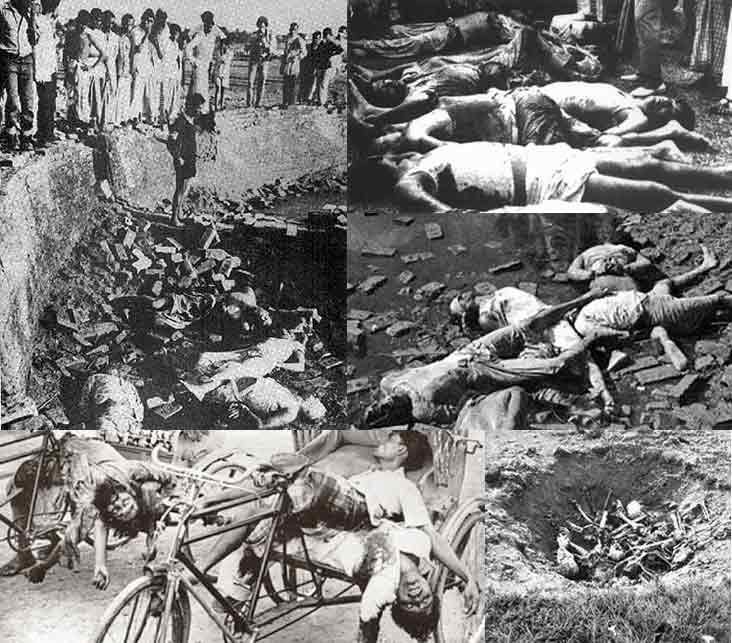
On the occasion of Genocide Day on 25 March 2026, Bangladesh’s Prime Minister Tarique Rahman issued a very strongly worded statement condemning the atrocities of the Pakistani forces during the liberation war. Describing 25 March 1971 as “one of the most disgraceful and brutal days” in the nation’s history, he condemned Pakistan’s Operation Searchlight as a “pre-planned massacre” – a night of indiscriminate slaughter that claimed the lives of teachers, intellectuals, students and ordinary civilians at Dhaka University, Pilkhana and Rajarbagh Police Lines.

The PM wrote in the statement, “In the history of freedom-loving Bangladesh, 25 March 1971 remains one of the most disgraceful and brutal days. On that dark night, the Pakistani occupation forces carried out one of the most heinous genocides in history against the unarmed people of Bangladesh in the name of ‘Operation Searchlight”. They indiscriminately opened fire on teachers, intellectuals and innocent civilians at various places, including Dhaka University, Pilkhana and Rajarbāgh Police Lines, killing many people.”

He further stated, “The genocide of 25 March was a pre-planned massacre. Why this organised killing spree could not be resisted remains a matter of historical research regarding the visible role of the political leadership of that time. However, on the night of 25 March, the 8th East Bengal Regiment in Chattogram formally initiated armed resistance against the genocide by declaring ‘We Revolt’. Through this resistance to genocide, the long nine-month armed Liberation War began.”

Rahman added, “To convey the value and significance of independence to the present and future generations, it is essential to know about the genocide of 25 March as well. Let us all strive to honour the sacrifices of the martyrs by establishing in the state and society the spirit of the great Liberation War – equality, human dignity and social justice.”

Rahman’s statement was not just a routine remembrance of an annual event. For the first time since the fall of Sheikh Hasina’s government in August 2024, a Bangladeshi leader has refused to forget the horrors inflicted by the Pakistani military during the Liberation War. In doing so, he has signalled a reversal of the stand taken by the interim administration led by Muhammad Yunus, an administration whose actions, whether by design or negligence, have amounted to a systematic erasure of Pakistan’s atrocities and the very memory of 1971 from history.⁠

Under Yunus, Bangladesh appeared determined to “move on” from the genocide without demanding accountability. In December 2024, Yunus urged Pakistan’s Prime Minister Shehbaz Sharif to “settle the issues” of 1971 “once and for all”, a clear stand down from the stated Bangladeshi policy of insisting on a formal apology from Pakistan for the mass killings and rapes that claimed three million lives and violated hundreds of thousands of women.

Hasina’s Awami League government had made the demand for Pakistan’s official remorse the precondition for normalised ties. Yunus, by contrast, prioritised improving diplomatic ties, even as Pakistani officials continued to deny the genocide. The interim government’s eagerness to rehabilitate relations with Islamabad, while lifting the ban on Jamaat-e-Islami, the party whose collaborators had aided the Pakistani forces in 1971, spoke volumes.

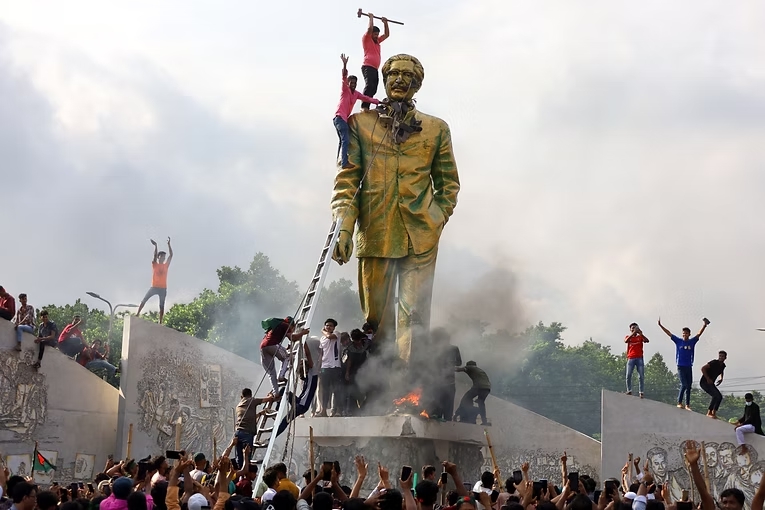
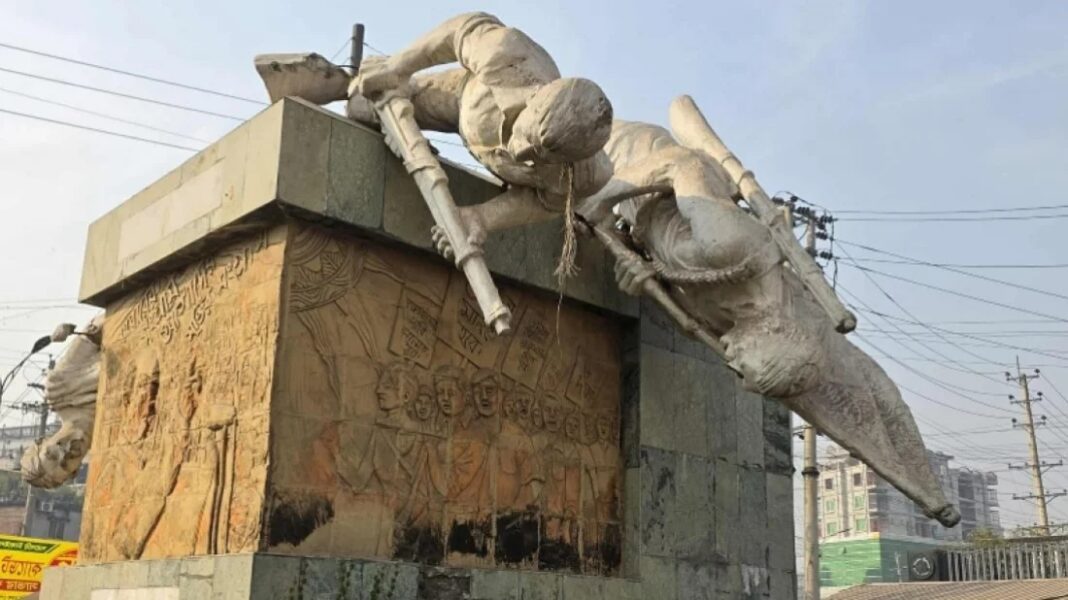
Nowhere was this erasure more evident than in the physical assault on the nation’s collective memory. During and immediately after the July-August 2024 student protests that toppled Hasina govt, mobs unleashed a wave of destruction on Liberation War memorials. According to reports, nearly 1,500 sculptures, murals and monuments dedicated the the independence of Bangladesh were vandalised, torched or uprooted across 59 districts. Statues of Bangabandhu Sheikh Mujibur Rahman, the founding father, were toppled; murals depicting the genocide and the nine-month struggle were defaced.

Dhanmondi 32, the historic home of Bangabandhu and a shrine to the liberation struggle, was stormed, torched and finally razed by bulldozers under the watch of student groups aligned with the new order. The Liberation War Museum in Agargaon was set ablaze.

The vandalism continued after the interim govt was installed after the fall of the Hasina govt. Bangabandhu Sheikh Mujibur Rehman’s house, burned and vandalised in August 2024, was again set ablaze in February 2025. Such acts often took place the tacit approval or outright inaction of the authorities. The Yunus administration did little to stop the carnage. Indeed, in some cases it appeared to endorse it. A Liberation War memorial mancha in Lalmonirhat was demolished on the explicit instructions of the interim government in March 2025.

These were not isolated acts, they were targeted strikes against symbols of the very war that birthed Bangladesh. The interim authorities blamed “provocative remarks” from the exiled Hasina, but the pattern was unmistakable: the physical remnants of 1971 were being systematically dismantled.⁠

In a clear attempt to remove the Pakistani atrocities from history, the National Curriculum and Textbook Board quietly rewrote school history books in January 2025. The new texts declared that Ziaur Rahman, founder of the Bangladesh Nationalist Party and grandfather of the current Prime Minister, had proclaimed independence in March 1971, not Sheikh Mujibur Rahman.

Mujib’s title of “Father of the Nation” was excised. References to India’s decisive military role in securing victory were curtailed in the books.

By failing to protect memorials, by rewriting textbooks to diminish the Awami League’s central role, and by courting Pakistan without insisting on an apology, the interim regime effectively signalled that the genocide of 1971 could be consigned to the footnotes of history. The collaborators of Pakistan army, those who once wore the uniforms of Razakars and Al-Badr, were quietly rehabilitated while the martyrs’ monuments were demolished.

Therefore, Tarique Rahman’s statement on Genocide Day marks more than a ceremonial formality. It is a political path correction. By naming Operation Searchlight for what it was, a “heinous genocide”, and by calling on Bangladeshis to “honour the sacrifices of the martyrs by establishing in the state and society the spirit of the great Liberation War”, he has begun the work of restoring what was being methodically erased.

No refund if tickets cancelled before 8 hours or less, boarding station change and more: Read about the new Railway rules of 2026

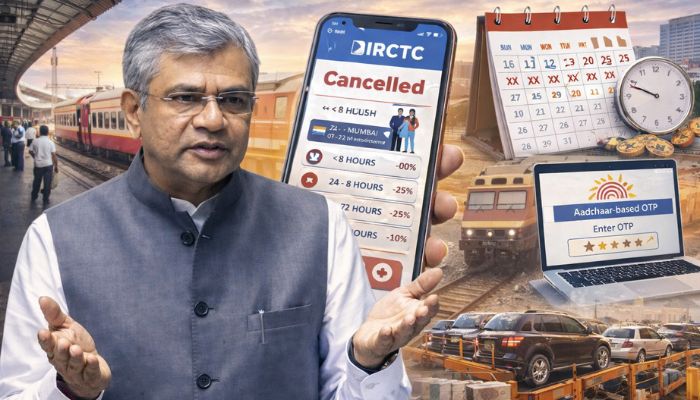
Railway Minister Ashwini Vaishnaw, on Tuesday, 24th March, announced a fresh set of reforms aimed at improving the overall functioning of Indian Railways. Speaking at a press conference, the minister said that five new reforms have been approved as part of the government’s broader plan to modernise the railway system and make it more efficient and passenger-friendly.

He said these reforms are part of the ongoing “Reform Express” initiative. “Around five key reforms will soon be introduced as part of a broader plan to modernise the railway network and enhance passenger services,” Vaishnaw said. These reforms have now increased the total reforms to nine, as part of the overall plan to be introduced in the year 2026.

Big changes in ticket cancellation rules 

One of the most important changes that have been introduced by the Railways is related to ticket cancellations, particularly in the case of confirmed tickets that have been booked through the IRCTC. The Railways have now tightened rules to reduce last-minute cancellations and improve seat availability for genuine passengers.

The minister explained that misuse of Tatkal tickets and ticket black marketing has been a major issue. “Ticket black marketing and misuse of the Tatkal system had been a major concern,” he said. To fix this, the Railways has introduced better technology to detect bots and fake bookings, along with Aadhaar-based OTP verification. Nearly 3 crore fake accounts have already been removed from the system.

The new cancellation policy changes include:

  • More than 72 hours before departure: Passengers are eligible for a maximum refund, with only a fixed cancellation fee deducted per person.
  • Between 72 and 24 hours before departure: A standard penalty applies, with around 25% of the ticket fare deducted, subject to minimum charges.
  • Between 24 and 8 hours before departure: This falls under late cancellation, where 50% of the fare is deducted, along with applicable minimum charges.
  • Less than 8 hours before departure: The cancellation window is considered closed, and no refund is provided.
  • After departure: Tickets are treated as non-refundable, and no refund can be claimed.

Vaishnaw said these changes are aimed at making the system fairer. “These changes are aimed at removing incentives for last-minute speculative bookings and ensuring tickets are available to genuine passengers,” he added.

How the new rules differ from the old system

The major difference in the new rules is the extension of time windows. In the old rules, if a passenger cancelled the ticket within 4 hours of departure, he or she was not entitled to a refund. In the new rules, this time window has been extended to 8 hours.

At the same time, the full refund window has been extended from 48 hours to 72 hours before departure. This means passengers will benefit if they plan well in advance, but last-minute cancellations will be discouraged.

The reservation charts will now be prepared earlier, between 9 and 18 hours before departure, instead of just 4 hours earlier. This will give waitlisted passengers more clarity and time to make alternative travel plans.

More flexibility for passengers

In another major relief, passengers will now be able to upgrade their travel class up to 30 minutes before the train departs. In the old rules, this was possible only before the reservation chart was prepared.

Also, there is a new rule for passengers to change their boarding station digitally 30 minutes before the start of the train from its original station. This means if a person misses their original station for boarding the train, they can select their new station and board the train without losing their seat.

Additionally, counter tickets can be cancelled from any railway station. This means there is no need to be present at the original station for the cancellation of tickets. Also, for e-tickets, there is no need to fill out a Ticket Deposit Receipt (TDR) for a refund. The refund is done automatically.

Other key reforms

Apart from these changes for passengers, there have been several changes for cargo and infrastructure, too.

One of the changes is related to salt transport. The minister said that India generates 35 million tonnes of salt annually. However, only a part of this is transported via railway. The new plan aims to increase the share of railway for long-distance salt transport.

Another major reform is in automobile transportation. Currently, a large portion of vehicles is transported by road. The Railways now plans to improve wagon design and remove operational challenges so that more vehicles can be moved through rail, which is more efficient and cost-effective.

Focus on better construction quality 

The Railways have also introduced several changes to improve the quality of construction projects. The eligibility criteria for contractors have been made stricter to ensure that only experienced companies handle large projects.

The government has also fixed bid security at 2% of the project value to avoid non-serious bidders. Strict rules have been introduced to prevent corruption and unfair practices. Contractors will now have to complete at least 60% of the work themselves, instead of outsourcing most of it.

To avoid unrealistic bidding, companies that quote prices significantly lower than the estimated cost will have to provide additional guarantees. These steps are aimed at ensuring better quality work and timely completion of projects.

Why these changes were needed 

The Railways said it was necessary to bring these changes to fix the issues within the current system. For a while now, issues such as ticket hoarding, black marketing, and cancellation of tickets at the last minute have been a nuisance to genuine passengers.

On the other hand, delays in projects and the inefficient movement of cargo have been slowing down the growth of the railway network. With this new change, the government is trying to make the Indian Railways a more transparent and efficient platform. Overall, this will make the travel experience much better and reliable. 

CAPF Bill 2026 explained: How the government plans to streamline forces, address stagnation, and retain strategic IPS oversight

Having served over three decades in the Indian Police Service, I have witnessed India’s internal security challenges from the frontlines, from leading anti-Naxal operations in Odisha’s dense forests and remote Maoist-affected districts as IG (Operations) to commanding operational sectors along our sensitive international borders as Additional DG in the Border Security Force. These roles have repeatedly underscored one undeniable truth: India’s internal security architecture thrives not on isolated forces but on seamless synergy between the Indian Police Service (IPS) and the Central Armed Police Forces (CAPFs).

The proposed Central Armed Police Forces (General Administration) Bill, 2026, set to be introduced in Parliament, is not merely an administrative reform; it is a forward-looking legislative step that codifies this proven partnership, ensures operational effectiveness, and addresses long-standing cadre concerns in a balanced manner.

India’s internal security landscape is uniquely complex. Insurgency in the Northeast and Left Wing Extremism (LWE) pockets, cross-border terrorism, porous borders, and emerging hybrid threats demand a unified command structure. The CAPFs (CRPF, BSF, ITBP, CISF, and SSB) form the steel frame of this grid, handling everything from counter-insurgency in LWE areas and anti-terror operations in Jammu & Kashmir to border management in high-altitude and difficult terrains.

Throughout my career, I have seen IPS officers deputed to CAPFs bring exactly what these forces need: strategic vision drawn from diverse state-level policing experience, intelligence integration, community-centric approaches, and the ability to bridge Centre-State coordination gaps that no single cadre can replicate alone.

At the IG (Operations) level in Odisha, I have personally led and supervised many anti-Naxal operations. In these challenging theatres, IPS officers, including many of my juniors and even seniors, have consistently led operations from the front, demonstrating extraordinary courage and operational acumen.

A shining example of what visionary IPS leadership can achieve is the Greyhounds, the elite anti-Naxal commando force that, under sustained IPS guidance and command, transformed into the most virulent and effective fighting unit against Naxalism in the country. Raised with a sharp focus on rigorous jungle warfare training, intelligence-driven operations, and relentless pursuit tactics, the Greyhounds delivered decisive results that significantly weakened the Maoist ecosystem in its core areas.

This iconic model has since become a global role model for jungle warfare forces, directly inspiring the COBRA battalions of the CRPF, which were designed and shaped by an experienced ex-Greyhounds IPS officer. The success of such specialised units underscores how IPS officers bring not just leadership but also innovative doctrines, operational strategies, and the ability to forge highly motivated, battle-hardened forces tailored to asymmetric threats.

I personally coordinated large-scale anti-Naxal operations where BSF battalions operated shoulder-to-shoulder with state police. IPS leadership at senior levels ensured real-time intelligence sharing, joint planning, and unified command, turning potential silos into a cohesive fighting machine. Similarly, in the BSF, as Additional DG, I experienced firsthand how IPS officers at the helm facilitated seamless integration with state police in border states, prevented duplication of efforts, and brought policy-level standardisation that enhanced operational outcomes.

Whether it was modernising training methodologies, adopting technology-driven intelligence-based operations, or improving human resource management, IPS deputation has consistently professionalised and modernised the CAPFs.

The CAPF (General Administration) Bill, 2026, finally gives statutory backing to this time-tested model. It unifies service rules across all five major CAPFs under one legal umbrella, replacing fragmented executive orders with transparent provisions on recruitment, promotions, cadre reviews, service conditions, disciplinary procedures, welfare measures, and grievance redressal.

Crucially, it earmarks a substantial proportion of higher command positions for IPS officers on deputation: 50% of Inspector General posts, at least 67% of Additional Director General posts, and 100% of Special DG and DG posts. This is not about “dominance” but about preserving the institutional mechanism that Sardar Patel envisioned — a unified national security framework where All India Services act as the vital bridge between Centre and States.

Critics, including some CAPF veterans, have raised concerns about career stagnation and the impact of IPS deputation on promotional avenues for cadre officers. However, the Bill is not a zero-sum game. It simultaneously creates hundreds of additional senior posts for CAPF cadre officers, implements transparent promotion policies, fixed tenures, and stronger grievance mechanisms. It also paves the way for Organised Group ‘A’ Status benefits while retaining IPS expertise, where it delivers strategic value, exactly the balanced framework India needs.

My own experience reinforces this. In BSF operations, IPS officers at DIG level and IG level brought fresh perspectives from state policing that strengthened community outreach and intelligence-led actions in border areas. Extending such integration to mid-career levels, as the Bill enables, will only deepen mutual understanding between state police and CAPFs, particularly vital in LWE and insurgency theatres where joint operations are the norm, not the exception.

Let us also remember the human cost. IPS officers have consistently led from the front, with many making the ultimate sacrifice. Names like Hemant Karkare, Ashok Kamte, Vijay Salaskar, and countless others in CAPF-led operations stand as testaments to this shared commitment. Their legacy demands leadership that transcends cadre boundaries.

The growth of CAPFs into world-class forces, from expanded manpower to cutting-edge capabilities, has been inseparable from IPS vision and mentorship. As India confronts evolving hybrid threats, the need for adaptive, coordinated, and professional leadership has never been greater. The CAPF Bill 2026 delivers precisely that: statutory clarity, career justice for cadre officers, and the retention of a leadership model that has delivered results for decades.

In my decades of service across state operations and central forces, I have seen no better formula for internal security than this unique IPS-CAPF partnership. The Bill is a mature, statesmanlike response that strengthens both organizational efficiency and national resolve. It deserves wholehearted support from all stakeholders committed to a safer, more secure India.

From piggybacking on Congress, Left and TMC to supporting radical Islamic parties: How decades of appeasement and demographic shift in West Bengal are changing voting patterns of Muslims

The West Bengal Vidhan Sabha election is just a month away. The ruling Mamata Banerjee-led Trinamool Congress government is in a state of crisis. It is not just due to the formidable resistance put forth by the Opposition BJP but also the emergence of ‘Muslim parties’ in the State, steadily chipping away at her core vote bank.

As per estimates [pdf], the Muslim population in West Bengal in 1951 was 19.46%. And their go-to party in the State had been the Indian National Congress. Due to its early appeasement politics and the farce of being ‘secular’, Congress held onto the Muslim vote bank for a long time, and they still do it to some extent.

The paradigm shift came in Bengal in the late 1970s, with the Communist Party of India (Marxist) arriving at the power corridors of the State. Over the next 3 decades, the Left party gained significant support from Muslims for fulfilling their demands while posing as ‘atheists’ and opponents of Hindu nationalism.

But nothing could have prepared the CPIM for what was to come – The rise of ‘Banglar Meye‘ Mamata Banerjee (who holds a master’s degree in Islamic history). She took Muslim appeasement to new heights and doubled down on exclusionist policies to benefit one community.

As the Muslim population grew to an estimated 30-33% of the population in West Bengal (2025), we saw increased cases of religious violence, riots, and targeted attacks with active complicity of the State. A bolstered community, which saw preferential treatment for over 7 decades, is now looking to grab more power and privilege with both hands.

This change in communal attitude has seen the mushrooming of ‘Muslim parties’ in Bengal, with a characteristic religious identity and even more radical outlook. We saw the rise of the Indian Secular Front (ISF) ahead of the 2021 Vidhan Sabha election, the growing presence of All India Majlis-e-Ittehadul Muslimeen (AIMIM) and the emergence of the Aam Janata Unnayan Party (AJUP).

Muslims of West Bengal, who were once piggybacking on ‘secular’ mainstream parties, are now increasingly siding with open and brazenly communal Islamic parties in the State. This trend highlights how a change in demographics, increasing street veto and access to power can drive identity politics in a State.

Appeasement politics in West Bengal

Following the partition of India under the supervision of the Congress, Muslims who remained behind found solace in the politics of the party. While the Hindu marriage law was codified, the Congress stayed away from touching the Muhammedan law.

The grand old party also used the Waqf Board to appoint loyalists and appease influential Muslim clerics. Not to forget, Congress increased funding for madrasas, opposed uniformity in the civil code and gave disproportionate seats to Muslim candidates.

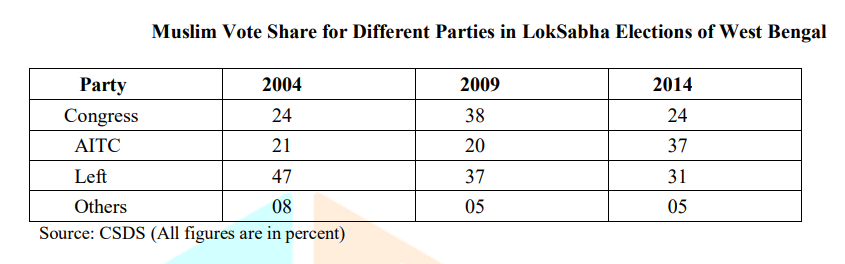
“Election results of 1952 show that a large number of Bengali Muslims did support the Congress. Candidates with Congress ticket won in most constituencies having large number of Muslims,” writes Tawseef Ahmad Malik in ‘Electoral Preferences of Muslims in West Bengal: An Analysis of Lok Sabha Elections’

However, by the late 1970s, Muslims began distancing themselves from Congress and accepting the Left Front as their new ‘messiah’. The Communist Party of India (Marxist) won in areas with high Muslim concentrations that were previously Congress strongholds.

“The political victory of the Left Front in 1977 and 1982, and various programmes undertaken by them for the minorities, made it a suitable alternative to the Congress,” notes Tawseef Ahmad Malik.

Redistribution of surplus lands in the garb of ‘land reforms’ by the Left helped Muslims extensively. As such, the community looked up to CPIM as the ‘protector’ of their political and economic interests.

In 1989, the West Bengal government issued a circular and recommended the deletion of discussions about the medieval period because it was “too controversial.”

The circular explicitly read “Muslim rule should never attract any criticism. Destruction of temples by Muslim rulers and invaders should not be mentioned.”

It maintained its pro-Muslim image by forcing critics of radical Islam, such as Bangladeshi poet Taslima Nasreen, out of West Bengal.

CPIM also doctored the Other Backward Classes quota to illegally include Muslims – a move that was struck down by the Calcutta High Court in May 2024.

The party declared 66 classes as OBCs between 1994 and 2009. About 12 of the classes belonged to the Muslim community. The CPIM government issued 7 executive orders between 5th March and 10th September 2010 to declare 42 new classes as OBCs. 41 of them belonged to the Muslim community.

These new groups thus became eligible for reservation and representation in jobs provided by the West Bengal government. To further appease their Muslim vote bank, the CPIM additionally announced a 10% reservation for Muslims in government jobs in February 2010.

Muslim vote share in West Bengal across 3 Lok Sabha elections

The shift of Muslim voters in West Bengal from the Left Front (CPIM) to the Trinamool Congress (TMC) was a gradual process that accelerated significantly between 2006 and 2011.

Mamata Banerjee capitalised on the Nandigram movement, where the Left had taken over land belonging to Muslim farmers for industrialisation.

After coming to power, the TMC government declared 35 new classes as OBCs. As expected, 34 of those classes belonged to the Muslim community.

In February 2012, Mamata Banerjee made Urdu the second language in areas of the State where Urdu speakers were equal to or more than 10% of the population.

She also introduced a scheme of honorarium for Muslim clerics and muezzins, which is called ‘Imam Bhata’.

Over the years, the TMC government has failed to provide security to Hindus during religious festivals, postponed the Visarjan of Durga Puja to make way for Muharram, demonised Jai Shri Ram, opposed NRC, CAA, the Waqf Amendment Act and even the Special Intensive Revision of electoral rolls in the State.

Mamata Banerjee has downplayed Islamic terror attacks in India, increased funding for madrasas, given scholarships exclusively to Muslims and more. As such, the Muslim vote bank had been her greatest support in electoral politics.

In May 2019, the West Bengal CM had described Muslims as ‘milk-providing cows’. She had infamously said, “Je goru dudh dei, tar lathio khete hoi” (If a cow gives milk, one has to be prepared for its kicks also)”

The rise of radical Islamic parties

Since 2021, West Bengal has been witnessing a new trend. It appears as if Mamata’s open favouritism, preferential treatment and brazen appeasement have fallen short to placate the radical ideas of the Muslim community. As such, there is a growing interest in new and emerging parties whose ideology is ‘political Islam.’

You may recall the case of ‘Indian Secular Front’, which was established in 2021.

The party was founded by an Islamic hate preacher named Abbas Siddiqui, who prayed to Allah to kill 50 crore Indians with the Coronavirus. ISF managed to clinch the Bhangar Vidhan Sabha seat.

At that time, AIMIM of Asaduddin Owaisi contested independently and cut through some of the Muslim vote bank of Mamata Banerjee.

Ahead of the 2026 Vidhan Sabha election, a radical Trinamool Congress MLA named Humayun Kabir threatened to lay the foundation of the controversial ‘Babri Masjid’ in Muslim-dominated Murshidabad.

Kabir, who conceded to making hate speeches against Hindus at the behest of Mamata Banerjee, even floated his own party named Aam Janata Unnayan Party (AJUP).

Since he had weaponised the polarising issue of rebuilding Babri, Kabir has received extensive support from local Muslims. AJUP now hopes to capitalise on this growing Islamist ideology to make inroads in West Bengal politics.

Unlike the past, where Muslims had to choose one mainstream party or another, they now have an option to side with ISF, AJUP and AIMIM.
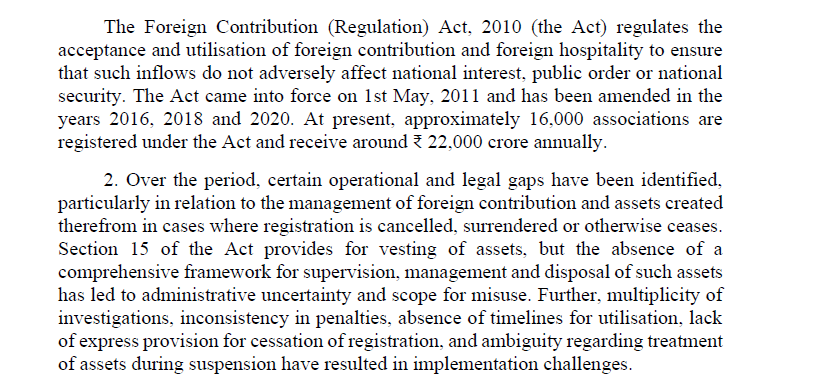
It gives out a clear message – Muslims are now looking forward to political parties who are ‘for the Muslims, by the Muslims and of the Muslims.’

Years of appeasement, followed by rapid population growth and demographic shift, have made it clear to them that they can grab more political power in West Bengal in the coming years.
As such, all parties that Muslims piggybacked on all these years are now appearing as the ones who did ‘injustice’ to them.

Interestingly, this is what Asaduddin Owaisi claimed on Sunday (22nd March) while announcing AIMIM’s pre-poll alliance with AJUP.

Chances of electoral success

The West Bengal Vidhan Sabha has a total of 294 seats. The Muslim vote bank is likely to play a decisive role in 85 Muslim-majority seats. These constituencies are in the districts of Murshidabad (66%), Malda (51%), North Dinajpur (50%), Birbhum (37%), and South 24 Parganas (35%).

If we include areas with 25-30% Muslim votes, the number of seats can reach 110-120. In the 2021 elections, the TMC won 75 of these 85 Muslim-majority seats (out of a total of 213).

However, with the emergence of the AJUP-AIMIM alliance, the TMC’s vote bank is clearly at risk. If the alliance performs strongly in even 40-50 seats, the TMC could lose 50-70 seats.

‘Thank you, India’ to ‘Thank you, Kashmiris’: How Iran buckled on Kashmir to appease anti-India voices after seeking donations from Indians

From “Thank you, India” to “Thank you, Kashmiris”, the embassy of war-torn Iran in India has demonstrated diplomatic sloppiness, hypocrisy, and a lack of courage to unapologetically acknowledge the sovereignty of a country it calls ‘friend’. Amidst the war between the joint front of Israel and the US against Iran, the country has received immense financial and moral support from Indians, particularly, Kashmiri Shia Muslims. The Iranian embassy in India recently expressed gratitude to India for this support in times of crisis, only to cave into insignificant backlash from Pakistanis and their Indian echo chamber online.

On 22nd March, Iran in India, quoted an X post that shared visuals of Indian Kashmiris donating cash, jewellery, utensils, artefacts, and other valuables for the war-hit Iran. In the post, the Iranian embassy wrote, “With hearts full of gratitude, we sincerely thank the kind people of Kashmir for standing with the people of Iran through their humanitarian support and heartfelt solidarity; this kindness will never be forgotten. Thank you, India: Iran in India.”

Iran in India’s now-deleted X post

The Iranian embassy’s heartfelt gratitude towards India attracted mainstream media coverage, highlighting the strong relations between the two nations in the midst of testing times.

Within hours, however, several Pakistanis and pro-Pakistan elements on the Indian side of the border erupted in outrage with their usual “Kashmir is not India” whining.

Thanking India was diplomatically, factually and logically correct, yet, instead of standing its ground, the Iranian embassy in India, soon caved in and deleted the “Thank you, India” post and has since published on separate, narrowed thanks specifically to “the kind people of Kashmir”, in a deliberate extrication of any reference that acknowledges Kashmir as part of India.

Screenshot of the Iranian embassy’s said post after deletion

While one agrees with the Mullah regime in Iran or not is a separate debate, it is indisputable that they have given a tough time and handed significant embarrassment to the US-Israel front by now succumbing so far; however, this same courage seems to be missing in their representatives in India.

The Iranian mission in India’s deletion of the post expressing gratitude to India, and treatment of Kashmir as a standalone entity, due to Islamist pressure, is a blatant disrespect to India’s sovereignty and ‘friendship’ between the two nations.

India has not forgotten that slain Iranian Supreme Leader Ayatollah Syed Ali Khamenei used to echo Pakistan’s narrative on Kashmir. However, the Islamic Republic’s embassy is accredited to the Republic of India in New Delhi.

Jammu and Kashmir, being an integral part of India, under the Indian Constitution and law, is the established, incontestable geopolitical reality. Like that of any other country, the Iranian embassy in India is expected to respect this reality. By caving to external pressure, that too from Pakistan, which has illegally occupied parts of India’s Jammu and Kashmir and retroactively ‘correcting’ its own grateful words, is essentially an endorsement of Pakistan’s illegitimate claim and fantasy over India’s right and reality. The Iranian mission in New Delhi needs to answer whether it has decided to take sides against the host nation.

The Iranian embassy’s hypocrisy is amusing. They had no qualms about setting up an Indian bank account, publicising a QR code, and actively soliciting donations from Indian citizens, including Kashmiris. They were also perfectly fine with accepting Indian goodwill, rupees, and gold when it suited them; however, the moment acknowledging India’s territorial integrity and sovereignty became politically inconvenient on social media, they folded.

Iranian embassy officials need to understand that they cannot pocket the aid and then pretend the donor’s country does not fully include the region from where the aid and the goodwill came. This is not just hypocrisy; this is a textbook case of diplomatic cowardice that perhaps the Indian government should consider calling out.

Driven by religious ‘Ummah’ sentiments, Indian Muslims, not just Kashmiris, have been pouring in their personal savings into Iran’s coffers as an expression of solidarity. The Iranian mission succumbing to online backlash from anti-India elements and erasing India from its gratitude towards the Indian people is a disrespect towards the very people opening their purses and hearts for a war-hit Iran.

The quiet deletion of the ‘Thank you, India’ post and subsequent careful omission of the host country’s name while acknowledging donations and support from Indian Kashmiris is not realpolitik but a disgraceful display of shabby and unprofessional conduct of the Iranian mission.

India has been one of the few countries that has consistently maintained good bilateral and strategic relations with Iran despite sanctions. Jammu and Kashmir, being an inalienable part of India, is non-negotiable, India’s red line. If Iranian officials in India succumb to online pressure over Kashmir, particularly from India’s hostile neighbour, Pakistan, they are only showing that they are willing to trade their diplomatic spine for the appeasement of anti-India elements.