Bollywood actress Dia Mirza has found herself at the centre of a controversy after the Brihanmumbai Municipal Corporation (BMC) deleted her anti-firecracker video from its social media accounts following objections from BJP Mumbai president Ameet Satam.
The actress had appeared in a civic awareness campaign urging Mumbaikars not to burst firecrackers during Diwali. However, Satam questioned why the BMC needed to enlist Mirza to tell people how to celebrate a festival deeply rooted in Indian traditions.
“We don’t need lessons on how to celebrate #Diwali from @deespeak. Our traditions are deeply rooted in our culture,” Satam wrote on X.
The BMC subsequently removed the video without offering an official explanation. Interestingly, similar appeals featuring Madhuri Dixit, Ajinkya Rahane and Marathi actress Nishigandha Wad continued to remain online.
After her video was removed, Mumbai Mayor Rity Tawde slammed the actor, saying that she shouldn’t teach Hindus how to celebrate Diwali. Twade also accused her of running a selective agenda and siding with divisive forces.
VIDEO | Mumbai: Mayor Ritu Tawde, on the controversy over actor Dia Mirza’s pollution-free Diwali video, says, "Dia Mirza shouldn’t teach us how to celebrate Diwali. She may continue working on her selective agenda. Dia Mirza has always sided with divisive forces. She had trolled PM Modi too. She has always been anti-Hindutva."
(Full video available on PTI Videos – https://t.co/bIyFWTfmBd)
Mirza has since defended her participation, saying the video was recorded in the interest of public awareness and that air pollution is a public health concern.
But this controversy has brought back an uncomfortable question about the actress’s much-publicised performative environmental activism. Over the years, Mirza has repeatedly used her celebrity status to advocate sustainable living, lecture people about plastic consumption and offer explanations for environmental degradation. But she has often been found not following them herself.
Here is a look at the controversies surrounding Dia Mirza’s environmental activism.
1. When Dia Mirza’s five-year-old son schooled a coconut delivery worker on plastic pollution
In June 2026, Mirza appeared on Soha Ali Khan’s podcast and narrated an incident involving her five-year-old son, Avyaan, and a coconut water delivery worker.
According to the actress, the worker had arrived with coconuts packed in plastic bags and plastic straws. Her son objected to the packaging and instructed the delivery worker to take the plastic back, as it was not allowed in their house.
Mirza appeared to take pride in her son’s environmental awareness and his willingness to stand up against plastic consumption.
However, the anecdote exposed a rather peculiar approach to environmental activism.
A delivery worker is hardly responsible for deciding how a business packages its products. He is merely delivering an order. If Mirza has an issue with plastic packaging, the logical response would be to address the supplier or find an alternative arrangement rather than turn an interaction with a delivery worker into a lesson on environmental consciousness.
The actress appeared to celebrate her child’s intervention without considering the position of the person standing at her doorstep and doing his job.
Environmental awareness is important. But so is understanding the economic realities of people who cannot dictate the packaging practices of the businesses they work with.
2. When Dia Mirza declared that patriarchy causes climate change
Earlier in June 2026, Mirza triggered another controversy during her appearance on Soha Ali Khan’s podcast.
Discussing climate change, she made an extraordinary assertion that men had driven the climate crisis and were responsible for the resulting chaos.
“It is the men in this world. It is the men who have driven climate change, and they are totally responsible for the chaos,” she said.
She also declared that patriarchy was the cause of climate change.
The actress subsequently clarified that she was referring to patriarchal systems of domination, extraction and consumption, rather than blaming every individual man.
However, the original remarks raised questions about the tendency to turn complicated environmental challenges into ideological arguments.
Climate change is driven by several interconnected factors, including fossil fuel consumption, industrialisation, deforestation, corporate emissions and government policies. Reducing this enormous challenge to patriarchy is hardly an adequate explanation.
For someone who frequently speaks about environmental awareness, a more substantive discussion about practical solutions would arguably have been more useful.
3. The environmental footprint of celebrity lifestyles
Mirza has built a public identity around sustainable living and reducing environmental damage. She has frequently advocated limiting plastic consumption and adopting environmentally responsible practices.
But celebrity activism also raises a question that is rarely addressed with sufficient seriousness: what is the environmental footprint of the lifestyles enjoyed by the very celebrities who lecture ordinary people?
Mirza has often seen in luxury automobiles, and there is a video of Mirza driving a motorcycle doing the rounds on the internet.
Environmental responsibility cannot be measured only by the number of awareness videos a celebrity records or the number of campaigns she endorses. It must also involve consistency in everyday consumption.
4. From environmental campaigns to a Diwali lecture: The latest controversy
The latest episode began after the Bombay High Court pulled up the BMC over rising air pollution and its failure to effectively regulate firecracker use.
The court suggested that celebrities should participate in public awareness campaigns without charging fees. Acting on the observations, the BMC approached several prominent personalities, including Mirza, Madhuri Dixit and Ajinkya Rahane.
Mirza’s video urged citizens to avoid bursting firecrackers and contributing to noise pollution.
Satam objected to her inclusion, saying Indians did not need celebrities to teach them how to celebrate their festivals.
Shiv Sena spokesperson Shaina NC also questioned the message, emphasising Diwali’s cultural significance. Union Minister Ramdas Athawale, meanwhile, said that while excessive pollution was a concern, people also had a constitutional right to celebrate their festivals.
Mirza responded that her message was about public health and a healthier celebration, not an attempt to undermine Diwali.
The BMC eventually deleted her video, although it has not explained why similar videos featuring other celebrities remain online.
5. The larger question about celebrity activism
There is nothing wrong with Dia Mirza advocating cleaner air, reduced plastic consumption or sustainable living. These are legitimate concerns, and celebrities can certainly use their popularity to promote public awareness.
But public awareness should not become public sermonising.
Indians do not need to be treated as though they are incapable of understanding their traditions or making decisions about their celebrations. Nor should people working ordinary jobs become convenient examples in stories about a celebrity family’s environmental consciousness.
The same environmental standards that celebrities expect ordinary citizens to follow must also apply to them. Advocacy becomes more credible when it is accompanied by humility, consistency and an understanding of ground realities.
The BMC’s decision to delete Mirza’s video may have settled the immediate controversy, but it has reopened a much larger debate about celebrity activism, cultural sensitivity and the tendency of Bollywood personalities to assume the role of moral instructors.
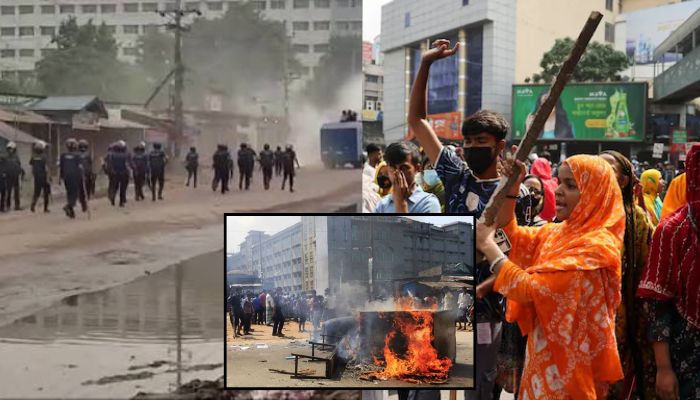
Demonstrators in Bangladesh blocked highways and clashed with police as protests in the ready-made garment (RMG) sector entered their third consecutive day on Monday, 2nd November. Demanding a substantial increase in their minimum wages, workers took to the streets across major industrial hubs, forcing several factories to suspend operations amid rising security concerns and fears of violent attacks.
protesters were prominently reported in Gazipur’s Konabari and Chandra areas near Dhaka, home to a massive concentration of garment manufacturing units. Fearing vandalism and arson, numerous factory owners proactively declared holidays, bringing production to a halt across key manufacturing belts.
Despite the government forming a new wage board on Sunday, 1st November, workers continued their agitation, insisting on a minimum monthly wage of Tk 30,000.
Bangladesh announces six-member wage board to review garment workers’ pay and urges employees to return to work, but protests demanding higher wages continue across major industrial areas, disrupting transport and factory operations https://t.co/2mv4R8x2gg
The violence and disruption were not confined to Monday alone; tensions had already flared over the weekend. On Sunday, 1st November, readymade garment workers staged protests across various areas of Savar and Gazipur on the outskirts of Dhaka, pressing their primary demand for a minimum monthly wage increase to Tk 30,000.
Local media reports indicated that at least 80 factories across these two districts declared holidays on Sunday to protect their facilities. While the situation appeared relatively normal on Sunday morning, it began to deteriorate rapidly in Savar by midday.
Dozens of garment workers in Bangladesh clashed with police in the capital Dhaka as they protested against low pay and the rising cost of living.
The textile industry is the backbone of the country’s economy. https://t.co/9rXDQ6mSx4
More than 50 factories shut in Savar, police deployed
Police were heavily deployed at key transit points and outside factory gates to maintain law and order. Mohammad Mominul Islam Bhuiyan, superintendent of police of Ashulia Industrial Police-1, confirmed the extent of the disruption while speaking to Prothom Alo, “More than 50 factories in Savar declared holidays.” According to witnesses and officials from Ashulia Industrial Police-1, most factories had opened as normal in the morning. However, workers at Al-Muslim Apparels in Nishchintapur, alongside units belonging to the New Age Group and Trouser Line Ltd, stopped work and remained inside their workplaces, signalling growing internal solidarity with the movement.
The protests quickly turned destructive in several locations. In Gazipur’s Kaliakair upazila, a warehouse storing garment factory waste fabric and a pickup van were set on fire in the Chandra Palli Bidyut on Sunday. At least 30 garment factories in the immediate vicinity declared holidays as a direct consequence of the violence.
Warehouse and pickup van torched in Gazipur
According to a report by Prothom Alo, a warehouse of a readymade garment industry was set on fire in the Chandra Palli Bidyut area of Kaliakair upazila in Gazipur on Sunday. Earlier that morning, workers from several factories, including Korni Knit Composite and Knit Asia in Ratanpur, Kaliakair, refrained from starting their shifts. After marking their attendance inside their factories, they gathered on the highway near Shafipur Bazar to demonstrate, prompting neighbouring units to shut down for safety.
Shortly after, when a warehouse storing waste fabric belonging to Tropical Garments was set ablaze, a unit from the Kaliakair Fire Service attempted to respond but was actively obstructed by demonstrators.
To prevent further collapse of public order, five platoons of the Border Guard Bangladesh (BGB) were deployed to support police forces in controlling the situation. Meanwhile, in Dhaka, workers from several parts of Mirpur blocked a key arterial road, forcing the closure of local metro station gates as police rushed to secure the capital’s transport infrastructure.
Why are garment factory workers protesting?
At the centre of the ongoing unrest is the demand for a substantial increase in the minimum monthly wage for garment workers. The existing minimum wage stands at Tk 12,500, while workers are demanding that it be raised to Tk 30,000, more than double the present amount.
Workers argue that the current pay structure is completely inadequate to cover essential household expenses like food, housing, transport, and healthcare. Their demand has also gained momentum following the Bangladesh government’s recent announcement of a new pay scale for government employees, which is expected to substantially increase government salaries and benefits. Workers are now seeking a comparable revision in their own wages.
Factory owners, however, have voiced strong reservations about meeting such a steep pay raise. Manufacturers point to severe operational headwinds, citing a decline in international export orders, stagnant pricing from global buyers, and soaring costs for imported raw materials. They maintain that these combined financial pressures make a jump to BDT 30,000 virtually impossible without risking widespread factory.
Outstanding salaries and other workplace grievances
Apart from the minimum wage demand, the protesters have raised several other workplace grievances. These include the payment of outstanding salaries and dues, reinstatement of dismissed employees and an end to the practice of blacklisting workers who participate in labour movements. Workers have also complained that the actual take-home salaries in some factories do not adequately reflect the statutory minimum wage.
The current minimum wage of Tk 12,500 was established in December 2023. Under provisions in the Bangladesh Labour Act, sectoral wages are scheduled to be reviewed every three years to adjust for inflation, meaning the garment sector’s formal wage structure is technically due for its next legal review in December 2026. However, escalating inflation has forced workers to demand immediate relief rather than waiting for the standard statutory schedule.
As the unrest intensified, the situation took on a distinct political dimension. Law enforcement agencies alleged that leaders from ousted Prime Minister Sheikh Hasina’s Awami League, which was banned by the Muhammad Yunus-led interim government, had joined the protests in Dhaka and Gazipur. Affiliated groups like the Sramik League and Chhatra League were also accused of taking part in the workers’ demonstrations.
PM Tarique Rahman holds meeting amid unrest
Amid the escalating protests and clashes, Bangladesh Prime Minister Tarique Rahman held a meeting on Sunday, 1st November, with Home Affairs Minister Salahuddin Ahmed, Labour and Employment Minister Ariful Haque Choudhury and other relevant officials. The meeting took place in the Cabinet Division conference room at the Secretariat in the evening to review the deteriorating situation in the country’s garment industry.
The meeting came as protests, road blockades and incidents of arson were reported in Mirpur, Kaliakair, Savar and Ashulia. Around 300 factories in these areas had declared holidays amid the unrest, while production and transportation were affected.
Following the meeting, the government directed law enforcement agencies and other concerned authorities to take steps to protect garment workers, factories and public property while ensuring that industrial production and export activities continued without disruption. Concurrently, the administration appealed directly to factory owners to keep their units open and work out solutions with labour representatives through constructive dialogue.
Factory closures and supply Chain strains threaten Garment industry
With the latest protests, Bangladesh’s export engine faces severe economic fallout. The garment sector forms the backbone of the national economy, employing roughly four million workers, generating over 80% of Bangladesh’s export revenue, and contributing around 10% of total GDP.
Bangladesh serves as the world’s second-largest garment exporter after China. Representatives from both the BGMEA and the Bangladesh Knitwear Manufacturers and Exporters Association (BKMEA) have warned that extended unrest could force widespread, indefinite closures. Labour and Employment Minister Choudhury similarly cautioned that ongoing operational delays risk causing missed export deadlines and delayed payments from international buyers, placing immense pressure on both factory owners and daily wage earners.
Compounding these sector-wide troubles are major structural closures within top-tier manufacturing groups. Pacific Jeans Limited, the flagship unit of Pacific Group, one of Bangladesh’s premier readymade garment manufacturers and a leading denim supplier to the US and EU, is set to shut down permanently after its building was declared structurally unsafe on Saturday, 31st October, putting approximately 5,500 jobs at risk.
Violent protests rage as garment factories shut down in Bangladesh 🇧🇩
Latest being 5,500 jobs lost as Pacific Jeans, leading denim suppliers to US and EU, closes partially.
By cheering the US-backed regime change in 2024, Bangladesh burned itself for decades to come.
Everything America touches — Iraq, Libya, Syria, Ukraine — turn to ash. https://t.co/RyOSewqSnC
The major closure of Pacific Jeans Limited occurs alongside broader systemic strains across the entire supply chain. In a move that poses severe risks to the national economy, the Bangladesh Textile Mills Association (BTMA) announced an indefinite operational shutdown of textile mills across the country from 1st February.
BTMA President Showkat Aziz Russell announced during a press conference at the association’s office in Dhaka on 22nd January this year, emphasising that the decision was based on necessity and was not intended as a threat. The association cited crippling financial losses and government inaction in safeguarding domestic yarn producers as the primary drivers behind the shutdown, pointing to a challenging period ahead for Bangladesh’s primary export sector.
Hindu religiosity, particularly in legal contexts, has long been portrayed as an antithesis of constitutional secularism and religious tolerance. When courts cite Sharia while deciding criminal cases, such references are met by self-appointed defenders of secularism either with silence or anfractuous justifications. However, when courts refer to Hindu scriptures while sentencing Muslim men involved in cow slaughter and beef sale, it is painted as a departure from statutory discretion and a pivot toward enforcement of a theological code.
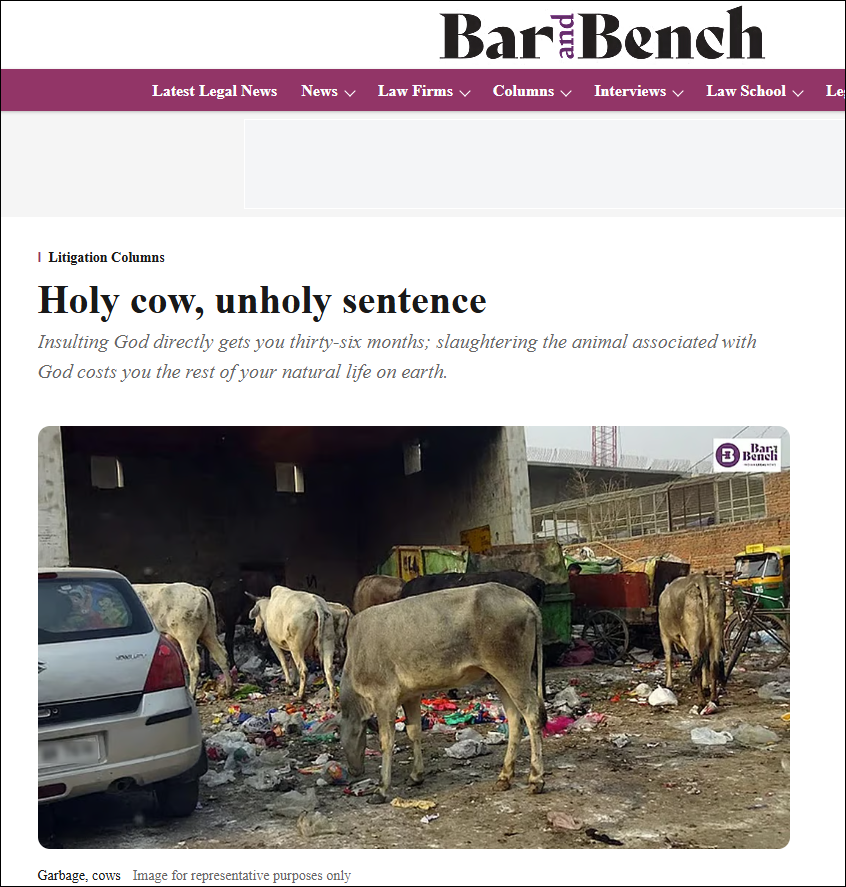
On 30th October 2026, legal reporting portal Bar and Bench published an article headlined, “Holy cow, unholy sentence”.
Source: Bar and Bench
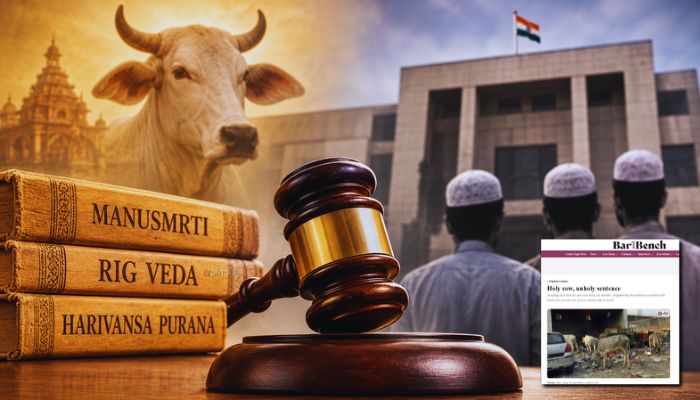
The article, authored by Ritwik Choudhary, lamented the fact that an additional sessions court at Kalol in Gandhinagar district of Gujarat recently cited Manusmriti, Rig Ved, and Harivamsa Purana, while awarding life imprisonment sentences to three Muslim convicts, Wasim, Mohammad Rafiq and Ashfaq, in a 2024 cow slaughter case “based on the recovery of 277 kilograms of beef, seized during a raid on a village house in Jamla.”
“Drawing directly from the Rigveda, the Manusmriti and the Harivamsa Purana, the court noted that the cow houses 33 crore deities; that the sun and moon dwell within its eyes; that Brahma, Vishnu and Mahesh inhabit its horns; and that the four legs of the bovine represent the four Vedas. Then came the judicial diagnosis: if those who slaughter cows are not handed life sentences, “Gau Mata will become extinct from the earth.”,” the Bar and Bench article reads.
Besides the shallowness of the arguments put forth by the Bar and Bench author, the article’s claim that India has “over 300 million head of cattle” is inaccurate.
The 2019 census puts the total bovine population, which includes buffalo, Mithun, and yak, at 302.79 million; however, the cattle population is recorded at 192.49 million.
The Gujarat Animal Preservation Act grant absolute protection to cows from slaughter given their religious significance and economic utility; there are provisions for conditional slaughter of buffaloes.
Instead of questioning why the three Muslim men indulged in the slaughter and sale of cow meat despite laws in place against such acts, the Bar and Bench Article suggested that if three men slaughter a few cows, they will not go extinct.
It further suggested that it is not deliberate slaughter but “ingestion of municipal single-use plastic, starvation in decrepit, State-funded gaushalas and road accidents” that pose a risk to cattle. While these issues are real, it is juvenile to expect the court to address these issues during the hearing of a case involving slaughter of cows and sale of cow meat. This is a part of the liberal playbook, which presents other factors about an issue bigger than the one at hand, to deviate from the root cause and to gaslight Hindus.
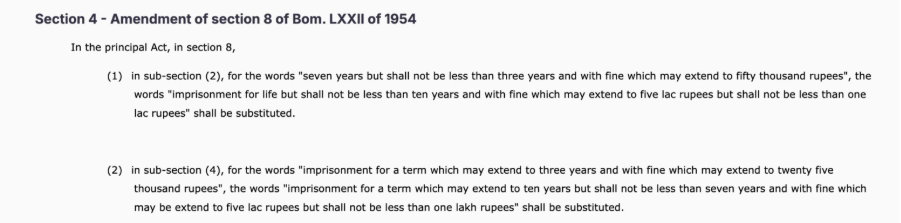
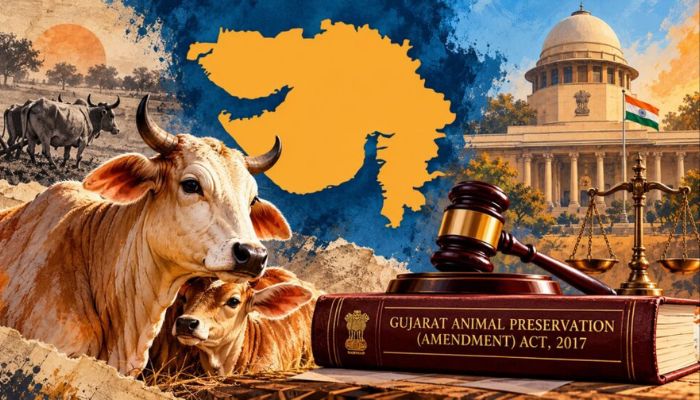
The article highlighted the amended Section 8(2) of the Gujarat Animal Preservation (Amendment) Act, 2017 Section 8(2) which states that imprisonment for cow slaughter “shall not be less than ten years but which may extend to imprisonment for life.”
Subtly questioning the Kalol Sessions Court judge Brijeshkumari Rameshwarsinh Rajput’s intellect and integrity, the Bar and Bench article suggested that the judge did not appropriately assess aggravating and mitigating circumstances, criminal antecedents, age, socioeconomic background, and the role played by the accused while deciding their punishment.
The Bar and Bench article claimed that the Gujarat court disregarded the defence’s plea that the accused Muslim men were young (one was nineteen), that they were the sole breadwinners of impoverished families and that they had no prior convictions, based on “a collection of Sanskrit verses and an imaginary ecological apocalypse.”
Throughout the article, the author conveniently downplays the crime the three men have been convicted for. Long paragraphs on the judge’s reference to Hindu scriptures, but only a “recovery of 277 kg beef” mention about why they have been awarded life imprisonment?
Author Ritwik Choudhary conveniently ignored the distinction between the statutory minimum and the statutory maximum.
Even though the author identifies that Section 8(2) of the Gujarat Animal Preservation Act provides for imprisonment ranging from ten years to life, he suggests that imposing life imprisonment, particularly by disregarding the defence’s pleading that the convicts are sole breadwinners and poor, is an inherently disproportionate exercise of judicial discretion.
The range of punishment, be it minimum or maximum, does not become automatically appropriate because the prosecution has established guilt. In the Kalol case, the court did mention that “cow would go extinct” if cow slaughterers are not punished, this apprehension alone did not drive the court to award sentence to the accused to life in prison.
When a law prohibits cow slaughter, the public of the state understands such a law exists, and what consequences will follow if they violate the law, and yet they slaughter cows, attempt to carry out an illegal organised cow meat trade; is it alarming that the court awarded maximum punishment? No! Statutory maximum is not decorative, nor does it exist to demonstrate mere on-paper strictness of the law.
Recovery of 277 kg of beef alone drove a Gujarat Sessions Court judge to sentence three men to life imprisonment?
Contrary to the framing by the Bar and Bench, the basis of the conviction of Wasim Qureshi, Mohammad Rafiq Qureshi and Ashfaq Behlime was not only the recovery of 277 kg of beef.
In fact, this ‘recovery’ framing is vague and downplays the seriousness of the acts the convicts were accused of. Bar and Bench‘s framing of the Kalol case suggests that three men were found possessing cow meat whose origin and legal status are disputed.
In reality, the court’s observations were devoid of any ambiguity about the role of the accused persons. The Bar and Bench article skips mentioning an important detail that two persons were acquitted by the same scripture-citing judge. The acquittal of two accused persons is in contrast with the Bar and Bench’s suggestion that the Gujarat court enforced theological code or demonstrated ideological biases.
It is, thus, pertinent to know what the police found and what the court said.
On 22nd August 2024, the Kalol police in Gandhinagar raided a house in Dhankani Vas, located in Jamla village, and apprehended individuals allegedly involved in cow slaughter. The police recovered 277 kilograms of meat from the premises. Laboratory testing subsequently confirmed that the meat was cow meat.
The police also seized weapons allegedly used for cattle slaughter, vehicles and other items worth a total of ₹3.61 lakh.
Subsequently, a case was registered against five accused at the Kalol Taluka police station under Sections 325 and 54 of the Bharatiya Nyaya Sanhita, the Gujarat Police Act, the Gujarat Animal Preservation Act and provisions of the central government’s Prevention of Cruelty to Animals Act. The accused were arrested. A separate case was later registered against a sixth accused. The accused were released on bail at different times between September and December 2024.
According to the police chargesheet, Lalabhai Senma, a resident of Jamla, and his son, Vitthal Senma, allegedly purchased weak cows and buffaloes that had stopped producing milk from surrounding areas at low prices. They would then call the other accused, who allegedly slaughtered the animals and sold the meat.
Lalabhai Senma, Wasim Qureshi, Mohammad Rafiq Qureshi and Ashfaq Behlime were apprehended at the scene, while the remaining two accused, Ghulam Moin Qureshi and Vitthal Senma, were arrested subsequently.
Later, Ghulam Moin Qureshi and Vitthal Senma were acquitted due to insufficient evidence.
In its judgment, the court quoted a shloka from Mahabharat’s Anushasan Parv, stating that the cow is regarded as the mother of the world and is beneficial to human life and society.
The court cited the Manusmriti, stating, “According to Hindu religious scriptures, the cow is not merely an animal but is regarded as a pillar of dharma. According to the Vedas and religious texts, when drops of divine nectar fell upon the Earth from Brahma’s mouth during his penance, Kamadhenu emerged from these divine drops. She is regarded as the mother of all cattle on Earth.”
The court also cited the Rigveda, stating that the cow is described as ‘Aghanya’, meaning one that must never be killed or slaughtered.
While pronouncing the sentence, the court stated: “Despite being aware of the consequences, the accused mercilessly slaughtered a cow regarded as a mother and attempted to sell approximately 277 kilograms of beef obtained from it. If those who cruelly slaughter cows are not punished as prescribed by law, Gau Mata will gradually become extinct from the Earth. Therefore, it is necessary to award the accused the maximum punishment permitted under the law.”
Scriptural reference is contextual, not legal reasoning
While the Bar and Bench article downplayed the aggravating factor, the court noted that the accused persons were aware of the fact that cow slaughter was illegal in Gujarat and also that cows hold religious significance for Hindus, and yet they slaughtered cows, obtained beef and sold it.
Contrary to the Bar and Bench article’s insinuation that “discretion collapsed entirely”, courts in Gujarat do differentiate punishments based on the seriousness of the offence.
Even if we go by just ‘recovery of XYZ kg of beef ‘framing, an Ahmedabad court awarded eight years for about 12 kg of cow meat in July 2026. In the Kalol cow slaughter case, the accused slaughtered cows, planned to sell their meat, and 277 kg worth Rs 55,000 was seized. Clearly, commercial, organised trade designs were the primary reason for the judge choosing the upper end of the imprisonment range under the relevant law.
The Kalol Sessions Court’s references to Hindu scriptures only highlight the religious significance of cows; the court did not utilise them for legal reasoning behind the life sentence for the accused. If courts begin to rely on Hindu scriptures like the Vedas and Manusmriti for operative reasoning while deciding punishment for cow slaughter, the convicts will have to be executed.
Bar and Bench’s ‘penal exchange rate’ contention is both illogical and misleading
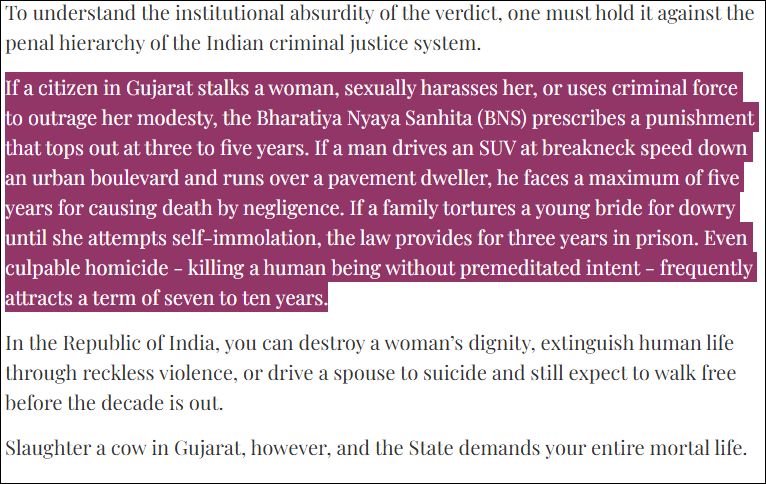
In pursuit of painting the Gujarat court and Judge B. R. Rajput as enforcing religious code instead of legal reasoning, author Ritwik Choudhary compared the life sentence for cow slaughter with punishments for stalking, sexual harassment, outraging the modesty of a woman, negligent driving and cruelty to a wife. The Bar and Bench article implied that somehow the law, the courts, and the judges are considering the killing of a cow more serious than violations of a woman’s dignity and human life.
Source: Bar and Bench
“In the Republic of India, you can destroy a woman’s dignity, extinguish human life through reckless violence, or drive a spouse to suicide and still expect to walk free before the decade is out. Slaughter a cow in Gujarat, however, and the State demands your entire mortal life,” the article reads.
While this argument is rhetorically appealing, it is legally unsound.
Various offences have different statutory elements, circumstances, and legislative objectives.
The Bhartiya Nyaya Sanhita does not mandate a single universal punishment for all offences relating to women. Different offences, be it assault, sexual harassment, voyeurism, rape, aggravated rape, or gang rape, etc., have different punishments prescribed.
Comparing the maximum punishment for one form of crimes against women with the maximum punishment for a separate statutory offence does not automatically establish a hierarchy of human and animal worth. Does making punishment for outraging the modesty of women require strengthening the relevant law, or does it require reduction of punishment under a cow slaughter law?
The Bar and Bench article further highlights an SUV driver running over a pavement dweller and argues that the offender faces a maximum of five years in prison. The article, however, skips mentioning the fact that even in such cases there is a distinction between negligence (covered in BNS Section 106(1)) and a deliberate act (BNS Section 106(2).
Taking the punishment for one category of negligent conduct and using it to establish the argument that the law values cattle more than human life is irrational.
Furthermore, the article draws a comparison between cow slaughter law and dowry-related cruelty. Relying on Section 85 of the BNS, the article claims that a family can torment a young bride until she attemptsself-immolation and still suffer only three years in prison. The article, however, ends up conflating the legally distinct cruelty, attempted suicide, abetment to suicide and dowry death offences.
The article misleadingly suggests that the three-year maximum punishment for one offence is the statutory maximum for all the dowry-related offences against women.
It further claims that beating a stray dog to death, mutilating a horse or poisoning a cat may attract only a fine of Rs 50 for a first offence under Section 11 of the Prevention of Cruelty to Animals Act, 1960; cow slaughter in Gujarat can lead to life imprisonment.
This comparison between the Prevention of Cruelty to Animals Act and the Gujarat Animal Preservation Act is carefully crafted to make the life imprisonment provision of Gujarat’s cow slaughter law appear irrational and inhuman.
However, laws don’t price human lives against animals. Statutes are meant to set penalties based on the harm to a protected interest and the extent of deterrence the legislature wants.
Under BNS Section 178, counterfeiting Indian currency carries a life-term ceiling; does that mean the law considers banknotes more valuable than human beings?
The Bar and Bench article also referred to the State of Gujarat v. Mirzapur Moti Kureshi Kassab Jamat case.
Notably, in the 2005 State of Gujarat v. Mirzapur Moti Kureshi Kassab Jamat case, a seven-judge Supreme Court bench ruled that the Bombay Animal Preservation (Gujarat Amendment) Act, 1994, which imposed a complete ban on the slaughter of cows and bulls, was constitutionally valid, noting its economic usefulness.
There is an interesting contradiction in Choudhary’s article. On one hand, it argues that the Supreme Court justified the cow slaughter ban based on agrarian and ecological grounds, not religious significance or sacredness. On the other hand, it benchmarks the same judgment against BNS Section 299, which concerns the offence of outraging religious sentiments.
If the Act is an economics-driven measure, isn’t Section 299 a wrong comparator? If it is indeed a sentiment-driven law, then doesn’tif defeat Choudhary’s Mirzapur argument?
Also, Section 299 has a high mens rea threshold, and it safeguards all religions equally; it is not some Talibanic blasphemy law against “insulting God”. Cow slaughter is prosecuted under varying state agricultural or animal-related statutes, not essentially as religious insult.
Equating American or British animal cruelty laws with cow slaughter law is wrong
The Bar and Bench piece also equates the Gujarat Animal Preservation Act with the UK’s five-year jail sentence ceiling and America’s seven-year ceiling under the PACT Act. However, these are cruelty-to-animals statutes penalising suffering inflicted on an animal.
The Gujarat Act, on the contrary, is a preservation and prohibition statute which essentially bans a category of killing even when it may be painless and the animal, cow specifically, is owned. The comparison doesn’t hold.
Courts citing Manusmriti represent the theological zeal of judges; citing the Quran doesn’t?
The Bar and Bench article argues that citing Manusmriti while deciding criminal cases dissolves the constitutional wall separating Church and State.
“When a criminal court begins citing the Manusmriti to calibrate the deprivation of fundamental liberty under Article 21, the constitutional wall separating Church and State does not just crack; it dissolves. The Supreme Court established long ago in SR Bommai that secularism is the basic structure of the Constitution. A citizen cannot have their prison term dictated by a magistrate’s theological veneration of an animal, regardless of how deeply held those religious beliefs may be in private life,” the article reads.
There is no constitutional obligation on Central or state governments to follow the American model of separation of powers. India has its own moral and legal understanding of secularism.
In fact, the SR Bommai case actually endorses the accommodative model of principled engagement with all faiths. It does not hold that any single ritual performed by a government or constitutional official establishes theocracy. The problem would have been only when there was systemic favouritism, and the governments or those holding constitutional offices were using state machinery to propagate their religion or suppress others.
There have been many cases wherein courts have cited Sharia law while deciding cases. In 2023, the Madras High Court cited Sharia to annul a Muslim marriage
In 2025, Kerala HC turned to Sharia in a case about a blind beggar threatening his wife with polygamy and cited the Quran in the judgment. Did that mean the judges were driven by some theological zeal and their personal beliefs were governing their judicial decisions? If yes, then why are no questions raised about such cases? Why does only the citing of Hindu scriptures attract ‘constitutional scrutiny’ in the media?
Bottom line: Many cases have seen courts phrase deterrence in sweeping terms. Claiming that the judge BR Rajput’s “Gau Mata will become extinct” remark is mythical zoological forecast governed his decision to sentence Kalol case convicts to life in prison is a dishonest assessment. The stray cattle menace and failing gaushalas issue requires serious administrative attention; however, to imply that the cow slaughter law is irrational or that imposing the statutory maximum is excessive is wrong.
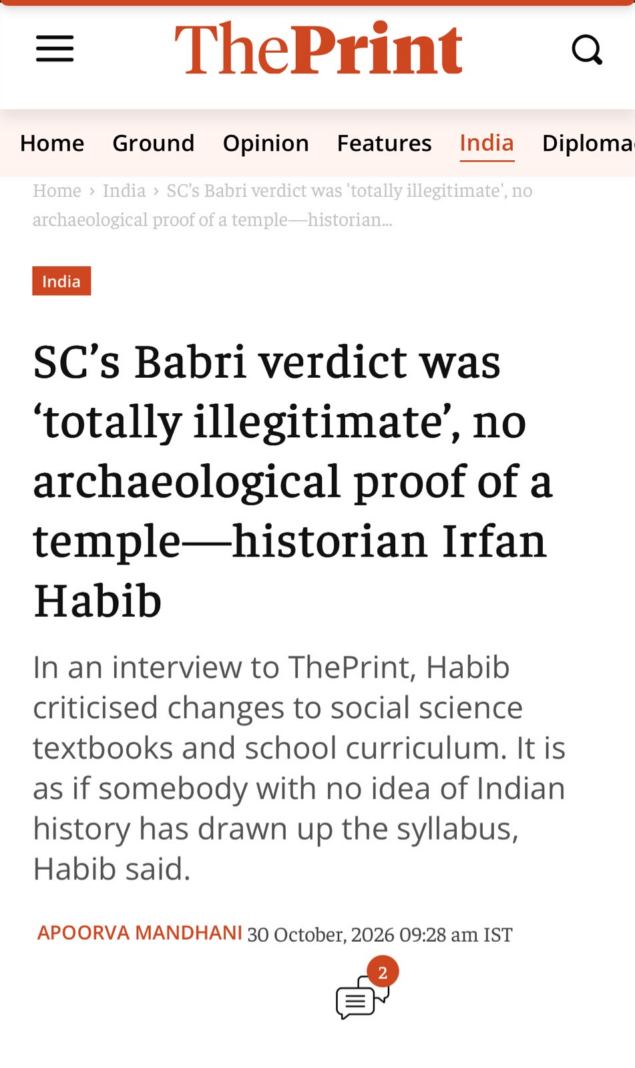
In another attempt by leftists to distort the history of the sacred Ram Mandir in Ayodhya, Shekhar Gupta’s ThePrint platformed Marxist historian Irfan Habib and published an interview with him on Friday, 30th October. The Marxist historian claimed that the Supreme Court’s 2019 Ram Janmabhoomi–Babri Masjid verdict was “totally illegitimate”.
During the interview, Irfan Habib claimed that the Supreme Court’s 2019 Ram Janmabhoomi–Babri Masjid verdict was “totally illegitimate” and questioned the archaeological evidence presented in support of the temple that existed at the disputed site.
Speaking to ThePrint in Aligarh, the 95-year-old historian claimed, “It is illegitimate because there is no proof that there was a temple there. They assumed, but archaeologically, there was no proof… The evidence for Babri Masjid being a temple is very slight.”
Supreme Court’s Babri Masjid verdict was “totally illegitimate” from a historian’s point of view, says historian Irfan Habib in a conversation with @dksingh73 and @MandhaniApoorva. https://t.co/OvJ1iQLEET
Habib further alleged that the Archaeological Survey of India (ASI) had selectively interpreted the findings from the excavation. He claimed that bricks associated with Muslim construction were discarded while stones were presented as parts of Hindu idols. “You first destroy a mosque, and then you start digging. So when a brick comes out of Muslim construction, you throw it away. But when a stone comes out, you say it is a part of an idol,” he said.
He also questioned whether the archaeological findings could establish that a temple had existed at the exact location. According to him, stones recovered from the site could have been brought from elsewhere and reused in the construction of the mosque. He claimed that no archaeologist of repute had supported the conclusion that a temple stood beneath the Babri Masjid.
This latest commentary is a continuation of his long-standing strategy to derail historical truth. Habib’s position on the Ayodhya dispute was discussed by a veteran journalist, Arvind Singh, in his book, “India’s Rogue Historians – How They Fought Against Hindus at Ayodhya & Lost.”
The book describes how, even before the ASI excavation began, Habib had written an article in Hindustan Times arguing that the archaeological team should not dig deeper than two metres.
Irfan Habib wrote an article in HT before the excavation started. He argued that the ASI should not go deeper than 2 metres because the dispute pertains to medieval India and any depth more than that would yield material culture of the ancient India and a brick of the Kushan period could be used as a evidence of a Hindu structure. The Muslim side took the cue and pleaded with the HC to prescribe a 2-metre depth limit to the ASI. The court asked the ASI to reply. The agency argued that limiting the depth would be against the principles of archaeology. It would be an incomplete and meaningless exercise. A couple of months before, Habib had admitted of a structure beneath the earth but called it ‘a residential quarter for marginalised sections.’ All his roguery has been unmasked in my book India’s Rogue Historians. Here is the link.
https://t.co/585kmhXZ2i
According to the account in the book, Habib argued that the dispute concerned medieval India and that digging beyond two metres could take the excavation into much older historical layers. He suggested that the ASI might then discover remains from ancient India, including bricks from the Kushan period. Such discoveries, he feared, could be presented as evidence of an earlier Hindu structure at the site.
The Muslim side even adopted Habib’s argument and asked the High Court to restrict the ASI’s excavation to two metres. The court then asked the ASI to respond.
The ASI opposed the demand, arguing that imposing an arbitrary depth limit would violate established archaeological principles and make the excavation incomplete and meaningless. Archaeologists need to examine the layers of earth to understand the history of a site. Restricting the excavation in advance could prevent archaeologists from examining important evidence lying beneath the surface.
The book also points out that, a couple of months before the excavation, Habib had admitted the existence of a structure beneath the ground but described it as a “residential quarter for marginalised sections”.
Constant subversion of Archaeological evidence
This is not the first time Habib has openly backed the Muslim side in the Ayodhya dispute and questioned the archaeological findings that supported the existence of a temple beneath the demolished Babri Masjid.
In August 2003, Habib accused the ASI of tampering with the evidence to suit its own conclusions and claimed the findings from the site suggest that the structure below the demolished Babri Masjid could well have been a mosque and not a temple. The leftist historian claimed that the presence of animal bones was decisive evidence against the existence of a temple.
“Bone fragments with cut marks are a sure sign of animals being eaten at the site and therefore rule out a temple existing at the site at that time,” he argued.
Similarly, he alleged, glazed ware, often called Muslim glazed ware, also constitutes an equally definite piece of evidence which militates against the temple theory, as this was not used in temples.
These arguments were part of the objections raised by the Marxist historian Habib. However, the ASI’s findings were subsequently examined during the legal proceedings in the Ayodhya dispute. The Allahabad High Court’s 2010 judgment discussed the archaeological evidence, including the remains of a large structure beneath the demolished mosque. The Supreme Court later considered the evidence and other material before delivering its November 2019 verdict.
Attacks on Prime Minister Modi and school curricula
Apart from the Ram Mandir, the leftist historian made another outrageous claim in the same interview. Habib used the interview to target Prime Minister Narendra Modi and defend former Prime Minister Jawaharlal Nehru, and claimed, “Nehru is one of the most important minds and what people like the present Prime Minister say about him is useless. It’s hardly worth any attention. What has he done in history?”
Habib also criticised the changes being made to social science textbooks and the school curriculum. Referring to the recent changes in NCERT textbooks, he accused the present government of rewriting history and claimed that India was now going ahead of Pakistan in falsifying historical accounts. The leftist historian claimed, “Unfortunately, that is present in India. Earlier, Pakistan glorified it. But now we are practically outpacing Pakistan by falsification.”
He also accused the current government of rewriting history. “The syllabus drawn up in the name of the Government of India and the Ministry of Education is atrocious. As if somebody who has drawn it has no idea of Indian history, no idea of the origins of the caste system,” Habib added.
Irfan Habib admitted Aurangzeb demolished temples in Varanasi and Mathura
These statements add to the long list of controversial statements about Hindu temples and Mughal rulers in the past. In January 2024, an old video of the Marxist historian from May 2022 went viral on social media. In the video, he admitted that Mughal emperor Aurangzeb had demolished temples in Varanasi and Mathura to build mosques.
The video had surfaced days after the discovery of a Shivling-like structure inside the Gyanvapi complex in Varanasi. Habib acknowledged the demolition of temples but questioned whether the government could act against structures that had existed since the 17th century.
“It is correct that Aurangzeb demolished the temple, but it is not specified that it was Lord Shiva’s temple. It became a Shiv Temple after they found a Shivling. Aurangzeb demolished this temple in Varanasi. Another temple was demolished in Mathura. There’s no two ways about it,” he said.
He then questioned the demand for the restoration of the temples, asking, “Can the government demolish something that was built in 1670? It is against India’s Monument Protection Act.”
Habib has constantly targeted Hindu organisations and the administration. In an interview with NewsClick, he remarked that Mughals would not disappear from history just because the Sangh wished so. In another interview with The Quint in May 2022, Habib had also acknowledged the destruction of temples by Aurangzeb but questioned whether the discovery of old temple stones should lead to the demolition of existing mosques.
Habib has also repeatedly made controversial remarks against the RSS and the BJP government. In January 2020, a legal notice was sent to him over his remarks at Aligarh Muslim University, where he claimed that the RSS had been formed to attack Muslims. He had also targeted Hindutva ideologue Veer Savarkar, accusing him of being responsible for India’s Partition and claiming that there was circumstantial evidence linking him to Mahatma Gandhi’s assassination. He had also referred to Prime Minister Modi as ‘Jahil’.
Ideological roots: Whitewashing separatism and demanding class history
Notably, Irfan Habib is the son of Marxist historian Mohammad Habib of Aligarh Muslim University. Mohammad Habib had turned to Marxism after the Anglo-Soviet Pact of 1941, when previously banned communist literature entered India. He was among the early influential converts and was the first to propound the notion in his 1927 work Sultan Mahmud of Ghazni that Muslim rulers of medieval India razed temples purely out of avarice and greed, denying any religious motivation behind the destruction.
Mohammad Habib maintained a close friendship with the Nehrus and was a protégé of Motilal Nehru. His theories regarding Mahmud were directly echoed in Jawaharlal Nehru’s The Discovery of India (1945), where Mahmud was painted as a warrior interested in culture who broke temples merely for building materials. After independence, Nehru relied heavily on Marxist historians to justify his pro-Muslim policies, providing them the blueprint to push class as the primary organising principle.
In his 1947 presidential address to the Indian History Congress, Mohammad Habib called upon historians to use their pens to fashion a society based on class, asserting that past historical works suffered from “bourgeois” biases and urging scholars to lead India to the “shrine of her newfound, classless God.” Through such ideological frameworks, Marxist historians sought to whitewash the violent history of Islamic rule and smooth over fault lines, laying the groundwork for decades of historical distortion.
Conclusion
The publication of Irfan Habib’s latest interview by ThePrint underscores a persistent effort by leftist platforms to amplify discredited ideological narratives under the guise of historical commentary. By providing an uncritical platform to a Marxist historian whose career has been defined by selective archaeology, political activism, and explicit legal manoeuvring to block pre-excavation truths at Ayodhya, ThePrint effectively enables the revival of claims already settled by exhaustive archaeological evidence and the highest court of the land.
Promoting Habib’s assertion that the Supreme Court’s 2019 verdict was “illegitimate” ignores both the extensive findings of the Archaeological Survey of India (ASI) and Habib’s own long history of attempting to pre-empt and restrict scientific excavation.
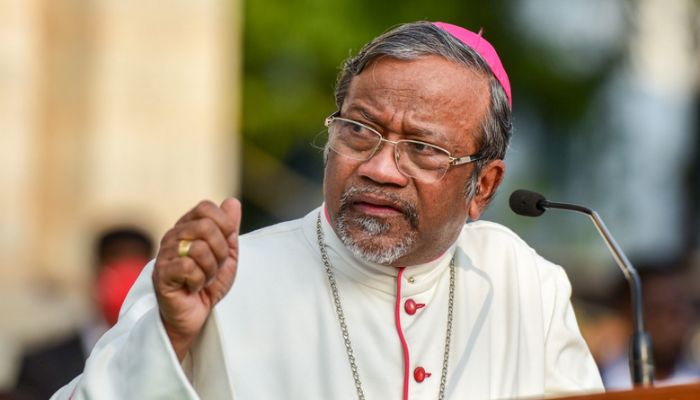
On 30th October 2026, Archbishop of Bangalore, Peter Machado, urged the Congress government in Karnataka to fulfil its promise of repealing the state’s anti-conversion law. During a media interaction in Bengaluru, Peter Machado said that a meeting of minority communities, Dalit communities, and farmer communities was called to press their demands pertaining to the repeal of the anti-conversion law in the state.
A day prior to the meeting, the Karnataka United Christian Forum for Human Rights issued a statement identifying three priority areas requiring government intervention, including religious freedom, protection against communal hostility and fulfilment of electoral promises.
c He said that it has been around three years since the Congress Party formed government in the state and that it also has numbers in the State Assembly to repeal the law.
“Today we have called a press conference of the minority communities, the Dalit communities, the farmer communities, especially those that have been experiencing certain difficulties with the laws of the State. First of all, we Christians have come strongly asking the government to repeal the anti-conversion law that was passed in 2022. “…it was passed by the previous government, and this government, which was trying to get into power that time, they have put it in the manifesto that if they came to power, they would withdraw immediately the anti-conversion law as such…” Machado said.
Bengaluru, Karnataka: Archbishop of Bangalore Peter Machado says, "Today we have called a press conference of the minority communities, the Dalit communities, the farmer communities, especially those that have been experiencing certain difficulties with the laws of the State. First of all, we Christians have come strongly asking the government to repeal the anti-conversion law that was passed in 2022. And it was passed by the previous government, and this government which was trying to get into power that time, they have put it in the manifesto that if they came to power, they would withdraw immediately the anti-conversion law as such…"
In addition to the anti-conversion law, Peter Machado also said that the Congress government had made promises to different communities, including the Muslim community, regarding the anti-cow slaughter bills. He alleged that “it doesn’t look to be very good on their part because Muslims and farmers are suffering because of it.”
He then claimed that ageing cattle needed to be taken care of and “if they cannot go to cowsheds…,” insinuating that slaughterhouses were the only other destination. “In some places, the government has done it. It’s okay,” he added.
In September this year, Machado took a Christian delegation to visit Congress President Mallikarjun Kharge at his Bengaluru home, where Kharge’s son and Karnataka home minister, Priyank Kharge, was also present. The delegation sought the abolition of the state’s anti-conversion law and a special 1% reservation for the community.
Peter Machado’s public expression of discontent over the anti-conversion law and anti-cow slaughter law even though these laws only target illegal practices, has sparked outrage.
Who is Archbishop Peter Machado?
Born in 1954 in Karnataka’s Uttara Kannada, Peter Machado became an ordained priest on 8th December 1978 for the Diocese of Karwar.
In February 2006, Pope Benedict XVI appointed Machado the Bishop of Belgaum and ordained him bishop in March 2006.
After serving there for around 12 years, Peter Machado was appointed the Archbishop of Bangalore in March 2018 by Pope Francis.
Archbishop Peter Machado is also President of the Karnataka Regional Catholic Bishops Council and of the All-Karnataka United Forum for Christian Human Rights.
Last year, Machado was elected Vice-President of the Conference of Catholic Bishops of India (CCBI) and chairs its Commission for Laity.
Machado has consistently been pushing the ‘Christians under attack’ bogey through his speeches, petitions in courts, and engagements with political parties.
In June 2022, the Supreme Court admitted a plea, which alleged that attacks on Christian priests and Churches have increased in the country. The petition was filed by the National Solidarity Forum, the Evangelical Fellowship of India and Archbishop of Bangalore Diocese, Peter Machado.
The petition claimed that about 40-50 attacks, on average, were taking place on Christian institutions each month, alleging that 57 such attacks took place in May 2022 alone.
In January 2020, the Bangalore Archbishop Peter Machado had appealed to Prime Minister Narendra Modi to ‘reconsider’ his decision on the Citizenship Amendment Act (CAA). Machado’s opposition to the CAA came even though minorities in the Islamic or Muslim-majority countries of Pakistan, Afghanistan, and Bangladesh faced persecution due to their religious identity, and there’s no way Muslims would be persecuted by Muslims in an Islamic country for being Muslims.
In June 2020, the former judge of the Bombay High Court, Michael F Saldanha, had accused Machado of colluding and covering up murders allegedly committed by Bishop of Mysore KA William. He had accused Peter Machado and Bishop K A William of ‘criminally misappropriating’ ₹49.5 crores collected for Coorg Disaster Relief work in 2018.
Accusing Machado of misappropriation, ex-Judge Michael F Saldanha wrote, “Perhaps Archbishop Peter Machado can tell us how many night shelters for homeless persons he has constructed because this was one of his appeals made more than a year back at the time of the concert. If it is there in writing in the annexure, then he is certainly accountable.”
In 2020, the Karnataka Catholic Christian Association (AKCCA) accused him of being involved in a multi-million-dollar scam. Pope Francis appointed Machado, a vocal critic of the Citizenship Amendment Act (CAA), as the Metropolitan Archbishop of Bangalore.
In August of that year, the AKCCA demanded a probe by the Enforcement Directorate (ED) into the financial misappropriation of Asha Charitable Trust, which is owned by the archdiocese. At a press conference in Bangalore, the group accused the Trust of siphoning off ₹3 billion ($42 million).
“It is a scam worth three billion, and it needs investigation, AKCCA leader Raphael Raj informed the media. Raj stated that even though the archdiocese collected funds from foreign donors, it was not used as promised.
Raj added that the annual audit report highlighted financial irregularities, but the archdiocese ignored it and did not act against the ‘guilty’.
In 2021, Peter Machado was at the forefront of opposing the anti-conversion law in the State of Karnataka. Machado had handed over a memorandum to the Karnataka Chief Minister, saying the proposed anti-conversion law was unwarranted and would lead to ‘unnecessary communal issues’ and ‘unrest’ in Karnataka.
In March 2024, Machado had urged PM Modi to ‘rein in’ his party (BJP) leaders, “who fail to rise above petty politics and hate speeches.”
This came after a parent of a student filed a complaint in February that year at the Mangaluru South police station against a teacher from St. Gerosa Catholic Girls School in Mangaluru for allegedly making derogatory remarks against the Hindu religion, Lord Ram and PM Narendra Modi.
The accused teacher named Prabha was reported to have used curse words against Lord Sri Ram and the Prime Minister while teaching students of class 7 while teaching the chapter ‘Work is worship’ on 8th February.
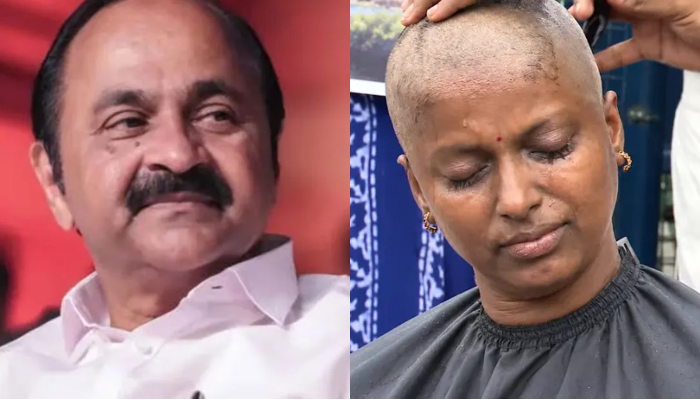
After the incident, parents, Hindu organisations, and BJP MLA from Dakshin Kannada, Vedavyas Kamath, staged a protest demanding strict action against the accused teacher for making insulting and derogatory remarks about the Hindu religion and trying to convert students to Christianity. Instead of condemning the Christian teacher, Peter Machado vilified BJP leaders for backing Hindu victims.
BJP government enacted an anti-conversion law in Karnataka
The previous Bharatiya Janata Party (BJP) government passed the Karnataka Protection of Right to Freedom of Religion Act, 2022. Conversion from one faith to another through “use or practice of misrepresentation, force, undue influence, coercion, allurement or by any fraudulent means or by any of these means or by promise of marriage” is forbidden by law.
Forced conversion is punishable by three to five years in prison and a fine of Rs 25,000.
Karnataka Prevention of Slaughter and Preservation of Cow Bill 2020
The Karnataka Prevention of Slaughter and Preservation of Cow Bill 2020, passed by the state’s previous BJP government, took effect in February 2021. According to the Act, slaughtering any cattle, except buffaloes over the age of 13, is a serious offence punishable by up to seven years in prison.
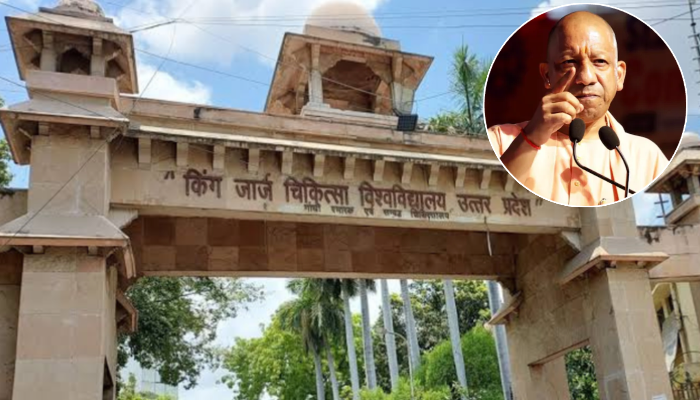
The Yogi Adityanath government in Uttar Pradesh on Friday (October 30, 2026) directed the Registrar of King George’s Medical University (KGMU), Lucknow, to take strict departmental action against university personnel found complicit in Love Jihad, forced religious conversion, and other related activities at the university. The directive follows findings enclosed in a Special Task Force (STF) inquiry report. The University is required to submit an action taken report to the government.
The STF report dated October 25, 2026, was compiled following an investigation into allegations of religious conversion, love jihad, mental harassment, and sexual exploitation of female Hindu students and staff on campus. The investigation was initiated by the UP STF based on a complaint filed by Shri Shivam Srivastava, President of the UP Youth Association, requesting an inquiry into reports of religious conversion and Love Jihad that took place in the K.G.M.U. campus.
Findings of the STF Inquiry
Below are the details of department-wise findings noted in the STF Inquiry Report prepared by Inquiry Officer Pramod Kumar Shukla, Deputy Superintendent of Police, STF, Lucknow. The report notes findings on the activities relating to religious conversion and mental and physical harassment of Hindu students and employees, the conduct of certain faculty members and employees, incidents and complaints reported across different KGMU departments, and action taken by concerned authorities on the complaints.
Pathology Department
The report cites two major cases filed in December 2025 at the Chowk and Kaiserbagh police stations by resident doctor Dr Devarti Mitra and nursing staff Maviya from KGMU, Lucknow, under various provisions of the BNS and the U.P. Prohibition of Unlawful Conversion of Religion Act, 2021 against resident doctors in the Pathology Department, Dr Rameez (Rameezuddin) Malik and Mohd. Adil, respectively. Dr Rameez Malik was arrested in January 2026 and was found guilty by KGMU’s internal Vishakha Committee.
The inquiry found collusion among the Muslim faculty of the Pathology Department, shielding of Muslim staff, harassment of Hindu junior doctors/nursing personnel, and specific faculty members in relation to the above-mentioned two cases. “If any female employee raises her voice in protest against the same, full effort is made by the departmental faculty to suppress the matter by threatening to ruin her career, declare her mentally deranged, or terminate her from service,” the finding stated.
According to the report, resident doctor Dr Rameezuddin trapped Dr Devarti Mitra, who was his junior resident doctor, in a relationship and mentally and physically exploited her. He forced her to convert to Islam and perform a Nikah with him. Dr Devarti Mitra later came to know that Rameezuddin had already married Dr Mansi Saxena, his batchmate at Sarojini Naidu Medical College (SNMC), Agra, in February 2025. Dr Mansi Saxena told Dr Devarti Mitra that Rameezuddin had trapped several Hindu girls and planned to convert and marry them.
Screenshot from the STF inquiry report
After learning the truth about Rameezuddin, Dr Devarti became distressed and attempted suicide by consuming a large number of antidepressants and fell unconscious. After recovering, she filed the case against Rameezuddin. During the inquiry, names of several other Hindu female doctors emerged who had been similarly trapped by Rameezuddin. His victims included Dr Kritika Pandey and Dr Muskaan, both resident doctors at KGMU Lucknow, and another unidentified Hindu female doctor who graduated from SNMC Agra.
Faculty complicity and suppressionof complaints
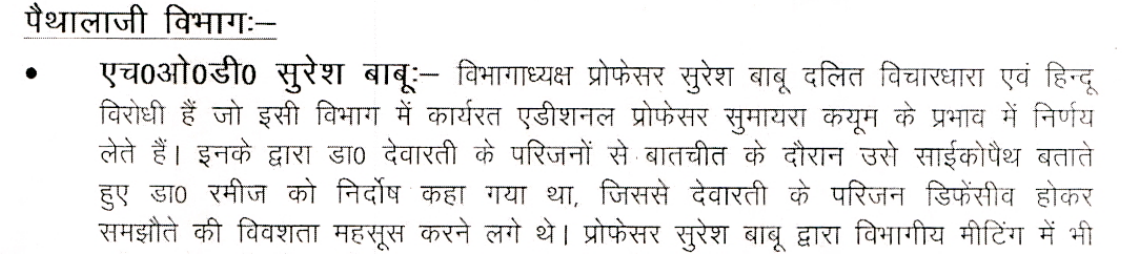
The inquiry revealed that the Head of the Pathology Department, Suresh Babu, along with Additional Professor Sumaiya Qaiyum, shielded Rameezuddin and indulged in character assassination of Dr Devarti Mitra. After she filed the case against Rameezuddin, HOD Suresh Babu declared Rameezuddin innocent and termed Dr Devarti Mitra a psychopath. He pressured the family of Dr Devarti Mitra to agree to a compromise.
The report states that HOD Suresh Babu follows Dalit ideology and is known to be anti-Hindu. He is also said to be deeply influenced by Additional Professor Sumaiya Qaiyum and to take decisions under her influence. “It is often also said that Prof. Suresh Babu is anti-Hindu to the extent that even in his phone, he first saves category and then name. It is also said that after taking charge, he had got the list of residents of each batch prepared category-wise,” the report noted.
Screenshot from the STF inquiry report
The inquiry findings regarding Professor Sumaiya Qaiyum also highlight alarming details with respect to her discriminatory conduct towards Hindu students. Professor Sumaiya Qaiyum is a native of Kashmir and is married to Khaliq-ur-Rahman, a Professor in the Pathology Department of SGPGI, Lucknow. They are both graduates from Aligarh Muslim University and are known for having a hardcore Islamic ideology. Professor Sumaiya Qaiyum is entrusted with sanctioning leave for resident doctors.
The inquiry revealed that she discriminates against Hindu resident doctors in sanctioning leave and shows leniency towards Muslim resident doctors. “…it was found that the 2023 batch resident, Dr Sabina, was granted leave without replacement despite posting in the Trauma Lab in an irregular manner, whereas the resident, Dr Harshit Jain, appointed in her place, was subjected to harassment,” the inquiry report said.
The report cites an instance when resident Dr Harshit Jain requested leave for Chhat Puja and to take part in the last rites of his grandfather; Professor Sumaiya Qaiyum harassed him and made a derogatory remark saying, “Will you himself light your grandfather’s funeral pyre?” On the other hand, she easily granted permission to Muslim resident doctors to participate in Namaz, weddings, or any other personal work. Professor Sumaiya Qaiyum is said to have dismissed Dr Devarti Mitra’s case as a “small incident” and advised her batchmate residents not to blow it out of proportion. She also threatened resident doctors who supported Dr Devarti Mitra.
Screenshot from the STF inquiry report
Another member of the Pathology Department, Dr Wahid Ali, is also found to have given preferential treatment to Muslim students and provided them separate seating and praying space inside the Biochemistry Lab of the Pathology Department. Dr. Wahid Ali, who holds an M.Sc., PhD, is the in-charge of the Biochemistry Lab.
According to the STF report, he provided exclusive space for Muslim students to gather, offer namaz, and hold meetings in an HPLC Lab inside the Biochemistry Lab. He follows hardline Islamic ideology and discriminates against Hindu resident doctors. The report states that Dr Wahid Ali harassed Dr Harshit Jain by making him do double duty and giving him negative feedback about him. He also supported Rameezuddin against Dr Devarti Mitra.
Gandhi Ward
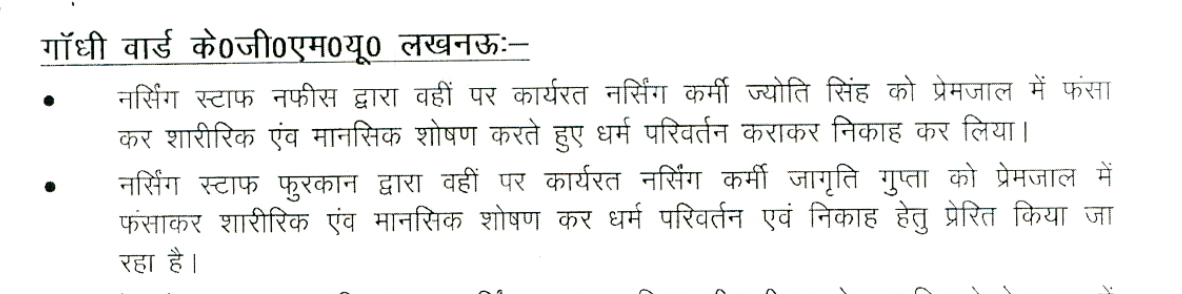
The STF Inquiry Report cites three incidents where Hindu female employees were trapped and mentally and physically exploited by Muslim staff members. In one incident, nursing staff Nafees trapped nursing employee Jyoti Singh. physically and mentally exploited her, converted her to Islam, and performed Nikah with her.
Screenshot from the STF inquiry report
In another case, nursing staff Furkan is accused of trapping nursing employee Jagriti Gupta, physically and mentally exploiting her, and coercing her to marry him after converting to Islam. The third incident involves resident doctor Adil, who targeted multiple women and exploited them. Adil lured nursing staff members Maviya, Meenakshi Pandey, and others into relationships and physically exploited them on the pretext of marriage. A case was filed against Adil by Maviya at Police Station Kaiserbagh, and an oral complaint was made by Meenakshi Pandey against him regarding the exploitation.
Microbiology Department
The report highlighted a similar pattern of harassment of Hindu employees in the Microbiology Department of the university. As per the inquiry report, a 25-year-old Hindu computer operator, Jyoti Rao, was teased and stalked by 50-year-old employee Shafaat Ali Khan, who also forced her to convert and perform Nikah with him.
Jyoti Rao’s oral and written complaints against Shafaat Ali Khan to the Head of the Department remained unaddressed. Instead, she faced retaliatory action and was terminated from her service, after which she went into depression.
Radiology Department
The report notes inquiry findings relating to the Radiology Department of the varsity involving resident Dr Rizwan. As per the report, Dr Rizwan has been forcing resident Dr Avanjala Singh and Dr Ishita to convert to Islam and subjecting them to blackmail. When the victims made oral complaints regarding the same to the department, they were suppressed and given threats of ruining their careers and failing them in examinations.
Islamic Medicos: A network of Muslim students
The report exposes an organised group of Muslim students from SNMC Agra and KGMU, which includes Dr Rameezuddin, Dr Rizwan Malik, Dr Adnan Ansari, Dr Sam Anees, and several others from the 2021/2022 batch. The members of the group maintain close ties, engage with Hindu female residents, and promote hardline Islamic ideology, supported by Prof. Sumaiya Qaiyum.
The report names a book titled Islamic Medicos published at SNMC, Agra, containing details of Muslim medical students of the 2012 to 2016 batches who are part of the group. Apart from the book, a similar magazine is also published at SNMC, Agra. According to the inquiry findings, new Muslim students taking admission to the college are organised and trained by these “Islamic Medicos”.
Dr Rameezuddin had introduced Dr Mansi, Dr Devarti, Dr Kritika Pandey, Dr Muskaan, and several other female Hindu students to the network. The report notes that when Rameezuddin introduced Dr Sam Anees to Devarti, he said that Anees, a resident of Saharanpur, had raped 19 Hindu women.
Screenshot from the STF inquiry report
Many members of the Islamic group, including Mohd. Kaif (SNMC 2021 batch), Mohd. Ehsaan, Aman Malik, Shadan Shameem, Mohd. Ayaan (all KGMU 2021 batch) and Mohd. Zaheer, Mohd. Aman and Shabir Khan (all KGMU 2022 batch) had close relations with Hindu female resident doctors, whom they had been grooming to be assimilated into Islamic ideology.
Administrative nexus within the university
The report uncovers an administrative nexus at KGMU that created a conducive environment for the harassment and exploitation of Hindu female students. The report states that most of the incidents of religious conversion happened at KGMU between 2006 and 2012. This period fell within the tenure of Dr Abbas Ali Mehdi as the H.O.D. of the Medicine Department.
The report also names S.A. Abbas, who worked as a clerk in various departments of KGMU and retired around 3 years ago. Abbas is said to have close ties to Dr Mehdi, who got all his work done through him. After retirement, Abbas was appointed as a P.S. to Dr Mehdi, who had taken VRS and currently owns Era Medical College.
The report states that the names of the members of committees formed to examine religious conversion complaints and other issues involving Muslim students are suggested by Dr Mehdi to the V.C. through Abbas. Notably, most Muslim doctors from the KGMU have invested their money in Era Medical College.
According to the report, since the retirement of Abbas, Professor Usman Kausar, a Nephrologist in the Medicine Department, has been leading the Muslim faculty and resident doctors at the KGMU. Having strong oratory skills, he is often entrusted with defending Muslim students and employees in cases involving them.
Screenshot from the STF inquiry report
Professor Kausar runs a private clinic named Diabetes Health, but does not write prescriptions himself in the clinic and keeps a compounder/assistant named Rizwan for the job. It is mentioned in the report that Dr Kausar’s brother-in-law, Dr Haider Abbas, who supports his ideology, is also appointed in the Medicine Department.
Furthermore, the report states that Assistant Professor Dr Ahmad and Assistant Professor Dr Kaleem in the Biochemistry Department play a key role in motivating and supporting Muslim students.
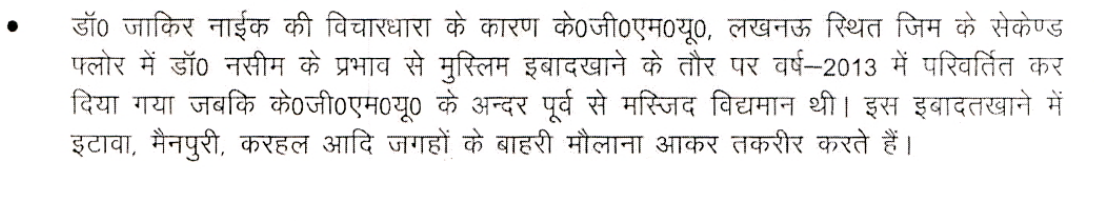
Another name in this series that is mentioned in the inquiry report is Dr Naseem Khan, currently in the Physiology Department of Integral University, Lucknow, and formerly worked in the Dental Department of KGMU Lucknow. As per the report, Dr Naseem Khan propagated the hardliner ideology of fugitive radical Islamic preacher Zakir Naik among Muslim students at KGMU.
Screenshot from the STF inquiry report
Citing unverified sources, the report states that Dr Naseem Khan is married to Dr Khalida Naseem, who resigned from Integral University following action against Dr Shaheen in connection with the 2025 Delhi Red Fort Blast Case. Before joining Integral University, Dr Khalida Naseem worked as an eye surgeon at KGMU. The inquiry revealed that under the influence of Zakir Naik’s ideology, the second floor of the gym at KGMU was converted into a Muslim Ibadatkhana (prayer room) in 2013 on the direction of Dr Naseem Khan, while a mosque already existed inside the university. The Muslim Ibadatkhana was frequently visited by Muslim clerics from places like Etawah, Mainpuri, and Karkhal who delivered religious speeches.
A wider network of Islamic radicalism
The renowned medical university has emerged as a den of Islamic radicalism and harassment and victimisation of Hindu female doctors. Rameezuddin has been named as a main accused in the sexual exploitation and religious conversion activities targeting Hindu female students on the campus. The investigation into the case filed against him disclosed that he was part of a major conversion network where a reward of ₹15 lakh was introduced for converting medical professionals (doctors) and ₹5 lakh for others.
The investigation also revealed Malik’s association with Dr Shaheen Saeed, who was apprehended in connection with the Delhi blast case. According to media reports, he encountered her at a medical conference. Afterwards, he became very influenced by her ideology and accepted his ties with her during the interrogation. Information recovered from his electronic devices revealed that Rameezuddin was in contact with multiple Hindu women, whom he had been enticing and forcing to embrace Islam. Photos of around 50 women were also found on his devices.
India has recorded “one of the fastest poverty declines” in the world between 2011 and 2023, according to the World Bank’s latest report. In its report [pdf] titled India Poverty and Equity Brief: October 2026, the World Bank highlights that the country has made remarkable progress in reducing poverty across both monetary and non-monetary dimensions.
Over this decade-long span, extreme poverty in the country fell drastically by 24.5%. As the World Bank noted in its note, “Over the past decade, India has made remarkable progress in reducing poverty across both monetary and non-monetary dimensions, recording one of the fastest poverty declines in the world.”
This massive social transformation was largely driven by robust consumption growth, rising employment, particularly among women entering the workforce, and expanded social welfare programs like food subsidies. However, the report also cautions that poverty is becoming increasingly concentrated geographically, with roughly 57% of India’s poor population living in a contiguous belt stretching from Uttar Pradesh to West Bengal.
How the World Bank estimates poverty
The World Bank uses three international poverty thresholds to measure poverty, based on daily income or consumption levels adjusted for purchasing power parity (PPP). The latest estimates use 2021 PPP values and three poverty lines: $3 per day, $4.20 per day and $8.30 per day.
The $3 daily threshold represents extreme poverty, while the $4.20 threshold is used for the lower middle-income poverty line. The $8.30 threshold represents the upper middle-income poverty line. These measures help track poverty across different income levels and allow comparisons between countries.
The estimates in the latest report are based on India’s three most recent Household Consumption Expenditure Surveys, conducted in 2011-12, 2022-23 and 2023-24. The report also uses other data to assess non-monetary poverty and living conditions.
Alongside monetary metrics, the report evaluates non-monetary deprivations, noting that Oxford Poverty and Human Development Initiative’s (OPHI) Multidimensional Poverty Index (MPI) fell sharply by 37.4% between 2005 and 2021, while the World Bank’s own MPI measure stood at 15.5% in 2022–23.
Nevertheless, the report also adds a note of caution that these household surveys may not fully capture the consumption patterns of wealthier households, meaning they are likely to understate top-end inequality.
Expected decline and future projections
The World Bank report projects that poverty will continue to decline across the country, though at a more gradual pace. The poverty rate measured at the $4.20 per day line is expected to fall further from 14.2% in 2026 down to 12.1% by 2028.
Future reductions in national poverty will heavily rely on generating productive employment opportunities, particularly in the states spanning from Uttar Pradesh to West Bengal. The lower middle-income poverty rate also declined significantly, falling by 41.6% over the same period. This represents an estimated 496 million people moving above the $4.20-a-day poverty line.
The World Bank said this progress was mainly driven by strong growth in consumption, an increase in employment, particularly among women, and wider access to social welfare support, including food subsidies. The World Bank also clarified that these are indicative projections based on microsimulation models. They may be revised as fresh labour market and economic data become available.
The graphs show declining poverty and Consumption inequality
The World Bank report also includes two graphs to explain how poverty and consumption inequality have changed over the years.
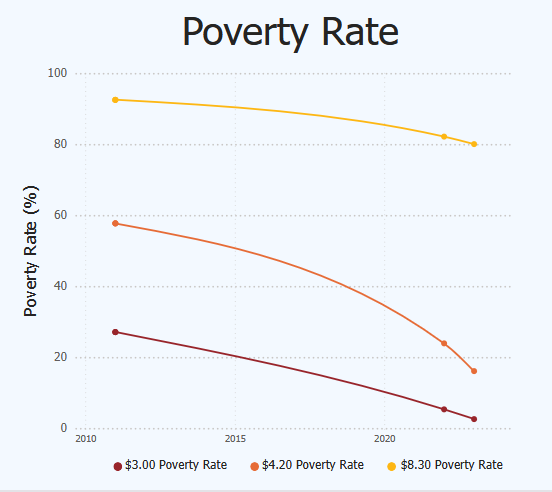
The first graph shows the downward trend in poverty rates across the three international poverty lines between 2011 and 2023. At the extreme poverty threshold of $3 per day, the rate dropped sharply from 27.1% to 2.6%. At the lower middle-income threshold of $4.20 per day, it declined from 57.7% to 16.1%, lifting an estimated 496 million people out of poverty.
Graph via World Bank report
At the upper middle-income threshold of $8.30 per day, the poverty rate also came down, from 92.5% in 2011 to 80% in 2023. However, the figures show that a large share of India’s population still lives below this higher income threshold.
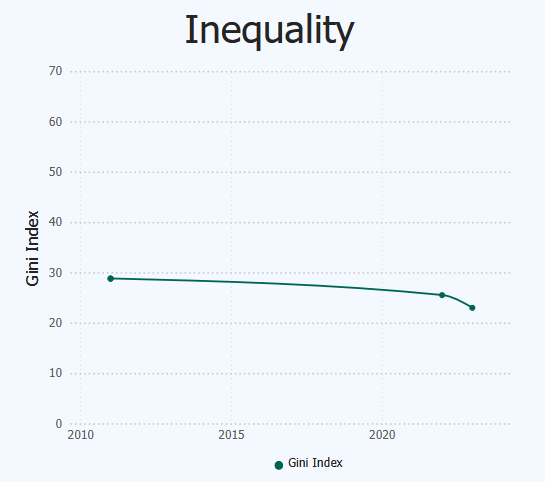
The second graph tracks consumption inequality using the Gini index. The index measures how equally or unequally consumption is distributed across a population. It ranges from 0 to 100, with a higher figure indicating greater inequality.
India’s Gini index fell from 28.8 in 2011-12 to 25.5 in 2022-23 and further to 23.0 in 2023. This indicates a decline in measured consumption inequality over the period.
Graph via World Bank report
While this consumption-based index reflects a slight compression in measured inequality, the broader report points out that wage disparities remain wide, with the top 10% of workers earning roughly 13 times more than the bottom 10% in 2023.
Poverty remains higher in Rural areas and among children
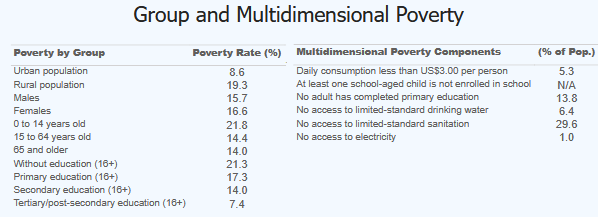
The report shows that poverty levels differ across regions and population groups. At the $4.20-a-day lower middle-income poverty line, the poverty rate in rural areas stood at 19.3%, compared with 8.6% in urban areas. This shows that rural households continue to face greater economic challenges, even though rural India has recorded significant improvements over the years.
The poverty rate was also slightly higher among women, at 16.6%, compared with 15.7% among men. The World Bank noted that poverty is becoming increasingly concentrated in certain parts of the country. Around 57% of India’s poor population lives in a continuous geographical belt stretching from Uttar Pradesh to West Bengal.
The report also pointed out that households with lower levels of education, fewer assets, limited access to stable jobs and more dependent family members are more likely to remain poor.
Employment growth has played an important role in reducing poverty. Between 2017 and 2023, the number of employed people increased by around 134 million, nearly twice the growth of the working-age population. A large part of this increase came from rural women joining paid work and adding to the number of earning members in households.
However, the report also noted that youth unemployment increased from 14.6% to 15.9% between Q1 FY2026 and Q1 FY2027, particularly among rural young women. Real earnings also remained largely unchanged, with much of the employment growth coming from relatively low-productivity work.
The report also examines India’s multidimensional poverty rate
Apart from income, the World Bank also measures poverty through access to basic facilities such as education, drinking water, sanitation and electricity. This is known as multidimensional poverty because it looks at different difficulties people face in their daily lives.
According to the report, India’s multidimensional poverty rate, measured using the World Bank’s Multidimensional Poverty Measure, stood at 15.5% in 2022-23. The report also cited figures from the Oxford Poverty and Human Development Initiative (OPHI), which show that multidimensional poverty declined from 53.8% in 2005-06 to 16.4% in 2019-21.
Children remain more vulnerable to multidimensional poverty than other age groups. The rate stood at 21.8% among children aged 0 to 14, compared with 14.4% among people aged 15 to 64 and 14% among those aged 65 and above.
Education also makes a difference. Among people aged 16 and above, the poverty rate was 21.3% for those without education, 17.3% for those with primary education, 14% for those with secondary education and 7.4% for those with post-secondary or tertiary education.
The report also highlighted gaps in access to basic facilities. Around 29.6% of the population lacked access to limited-standard sanitation, while 13.8% lived in households where no adult had completed primary education.
The Indian National Congress-led I.N.D.I. Alliance has announced the “Chalo Dilli” march at Ramlila Maidan on 1st November to protest alleged irregularities in electoral rolls and demand the resignation of Chief Election Commissioner (CEC) Gyanesh Kumar.
Kerala Chief Minister VD Satheesan is also going to participate in the opposition program, informing that he would join it to purportedly “stand with lakhs of citizens in defence of democracy, the Constitution, and the right to vote.” He added, “This is not just a protest. It is a firm declaration that we will not remain silent when democracy is under threat.”
#ChaloDilli ✊
India is calling.
Tomorrow, I will be at Ramlila Maidan in New Delhi to stand with lakhs of citizens in defence of democracy, the Constitution, and the right to vote.
This is not just a protest. It is a firm declaration that we will not remain silent when democracy is under threat.
Chalo Dilli. November 1. Ramlila Maidan.
@RahulGandhi @priyankagandhi @kharge @INCIndia @INCKerala
#VDSatheesan #INDIABloc
While Satheesan is planning to attend the gathering to “save democracy,” people in his own state are being slapped with cases for raising legitimate demands. The matter is related to the consistent demonstration of Lower Primary School Teachers (LPST) rank holders in Thiruvananthapuram. They are yet to obtain formal appointment orders despite passing the Kerala Public Service Commission (PSC) screening procedure and appearing on the May 2025 rank list.
Their protest has already entered its 117th day, while the associated hunger strike is on its 5th day. However, instead of addressing their grievances, a case has been registered against 8 identified individuals and 50 others for holding an agitation near the Secretariat’s main gate. S Valarmathi, secretary of the All Kerala LPST Rank Holders Association, has been named as the first accused.
On 26th October, she had tonsured her head and pronounced an indefinite fast after Satheesan addressed the issue in the assembly, not to resolve their complaints but to make a political dig. He remarked that those who had not even bothered to take notice of people protesting outside the Secretariat for the past five years were going around with photographs of a shaved head.
Valarmathi had asked the government about measures it had implemented. “We will not back down from our demand to reduce the student-teacher ratio in classrooms,” she maintained and highlighted the hypocrisy by adding that those who are currently making such comments had supported the protests by Public Service Commission (PSC) rank holders when they were in the opposition.
The candidates had already warned they would organise a hunger strike and remove their hair if the government did not make a favourable decision. However, their appeals fell on deaf ears, after which they stepped up their efforts.
Their principal demands are to guarantee immediate and legal appointments for individuals on the PSC rank list, revise the critical student-teacher ratio to 1:25 from 1:30, postpone fresh notifications until everyone on the existing list is inducted and transfer aided school recruitments to the PSC to prevent any corruption-based procedures.
Congress government remains indifferent as protests continue
Valarmathi’s symbolic act of sacrifice came amid continuous accusations that the government had shown nothing but gross neglect towards them. She recently called out Indian Union Muslim League (IUML) leader N Samsudheen, who is serving as the Minister for General Education and Minority Welfare of Kerala. She outlined that he insisted there is a “financial crisis and is not willing to reduce the student-teacher ratio,” emphasising that the objective is to protect teachers and their jobs.
She asserted to have the details “on the number of existing vacancies, but the minister told the assembly that the data was still being collected. If that is the case, what exactly has the government studied about our issue? Who conducted the study, and who were the members of the committee? The government must release those records.”
All Kerala Lower Primary School Teacher (LPST) Rank Holders’ Association secretary Valarmathi S says, "The Minister keeps repeating that the government is facing a financial crisis and is not willing to reduce the student-teacher ratio. We are demanding a reduction to protect teachers and their jobs. We have the data on the number of existing vacancies, but the Minister told the Assembly that the data was still being collected. If that is the case, what exactly has the government studied about our issue? Who conducted the study, and who were the members of the committee? The government must release those records.
You asked for 45 days only to mislead us. We are protesting because we want justice. Those sitting here have worked hard, cleared the examinations and secured places on the rank list. Please do not keep repeating false claims.
The government had promised to reduce the HSA student-teacher ratio to 1:40. How were you able to make that reduction? You are not even clearly stating how many divisions have been lost. Everything is being kept under wraps, and the only response we get is that any decision would create a financial burden.
The government must first appoint candidates from the existing rank lists. After that, it can go ahead with appointments through other routes. The current system gives the impression that jobs can be secured by paying money. That system must change.
We have no other option. It was only after our protest had entered its 13th day that the government said our demands would be considered sympathetically. But what action has it taken since then? There is no need to invite us for further discussions. We need a decision, not more assurances. We will continue our protest, even if it takes a death for the government to finally make a decision."
Valarmathi lashed out, “You asked for 45 days only to mislead us. We are protesting because we want justice. Those sitting here have worked hard, cleared the examinations and secured places on the rank list. Please do not keep repeating false claims.”
She pointed out that the government had promised to change the student-teacher ratio to 1:40 and questioned how it had arrived at that figure, pointing out, “You are not even clearly stating how many divisions have been lost. Everything is being kept under wraps, and the only response we get is that any decision would create a financial burden.”
Valarmathi underlined that the government must first hire people from the existing rank lists before proceeding with admissions via other means. “The current system gives the impression that jobs can be secured by paying money. That system must change,” she pressed.
“We have no other option. It was only after our protest had entered its 13th day that the government said our demands would be considered sympathetically. But what action has it taken since then? There is no need to invite us for further discussions. We need a decision, not more assurances. We will continue our protest, even if it takes a death for the government to finally make a decision,” she declared.
Valarmathi earlier charged that Samsudheen’s plea for 45 days to settle the dispute was a ruse to put an end to the strike. She suspected that bribes might have been distributed to officials, including the chief minister. However, she was determined that they would be chosen on their credentials earned through education. The protesters also revealed that they could seek to meet Satheesan again and vowed to embark on a hunger strike until death if they are denied justice.
No support from Abhijit Dipke to Prakash Raj: The deafening silence of self-proclaimed champions of people’s rights
The demonstrators indicated that they have effectively been left to fend for themselves, with no support for their crucial fight, recounting, “We were running from one minister to another till some days ago. The same leaders who expressed solidarity with us when in opposition are now avoiding or ignoring us,” reported The New Indian Express.
Additionally, it was unveiled that the United Democratic Front (UDF) government headed by Congress had verbally agreed to grant four requests: lowering the student-teacher ratio to 1:25, putting off the new notification, extending the rank-list period, and bringing head teacher vacancies under the purview of the PSC. However, the protesters found out that no action had been taken.
The centre of the problem revolves around the loss of teaching positions when school divisions are consolidated to cater to the 1:30 student-teacher ratio. Valarmathi stated, “The teachers who are flushed out in this exercise are accommodated in retirement vacancies, depriving us of a chance to be appointed. There were around 600 such division-fall adjustments made last year.”
She added that the ratio can be modified to fit the state’s needs, similar to high schools. According to those on the rank list, they delivered thorough reports on open positions and reform recommendations to the government, but with no success.
The protesters also noted that they do not receive any help and have to pool their own money to sustain the agitation. They conveyed that some PSC coaching facilities used to offer them food, but at present they either prepare kanji by the roadside or make other local arrangements to feed themselves.
Interestingly, they also noticed the conspicuous absence of andolanjeevis or career agitators, recognising that their movement has received little attention because it is rooted in a genuine cause and has no agenda or affiliations with any party or outfit.
“No one noticed us till now. We wonder where the activists – like Ranjini Haridas – are. Where are the rappers? Where are the likes of Tovino Thomas, Vineeth Sreenivasan, Ashiq Abu and Reema Kallingal? Where were the writers and intellectuals? The systemic rot linked to PSC placements is out there for everyone to see, right,” the attendees enquired.
They also shared, “Many among us even tagged Abhijit Dipke of CJP (Cockroach Janta Party) in our protest pictures. We also commented on their social media posts, drawing their attention to our agitation. Even when actor Prakash Raj visited Manaveeyam Veedhi, we requested him to visit our protest venue. But no one even bothered.”
The account sheds light on the selective nature of those who claim to champion people’s causes, especially those concerning the country’s youth and students, but are conveniently silent when the subject does not serve their political interests. Furthermore, neither the former chief minister and Leader of the Opposition, Pinarayi Vijayan, nor officials at the Secretariat met Valarmathi despite her exhausting attempt.
Conclusion
Rahul Gandhi, Satheesan and the Congress leadership have regularly urged the young people to become a part of their political campaigns. The Gandhi scion even launched “Chhatron Ki Goonj” (Voice of Students), supposedly to flag concerns over shortcomings in the Indian education system.
However, it appears that the opposition and its ecosystem are deeply concerned about their future only when the state is governed by the Bharatiya Janata Party (BJP). This duplicity has surfaced time and again and was also equally evident in Jharkhand, where protests against the I.N.D.I. bloc government were similarly ignored.
The challenges faced by the youth, it seems, deserve focus only depending on the region and the political ideology, and when the rhetoric is put to the test, it tells a different story. The protesters in Kerala even ate grass to underline their desperate conditions, as many women left their families and homes to struggle for their valid demands, only to see their pleas go unanswered.
This is the reality of the Indian opposition’s activism, which pretends to “save democracy,” but where equality is determined by political preferences rather than treated as a basic tenet. Borrowing from William Shakespeare’s famous line, it would hardly be an exaggeration to say, “Hypocrisy, thy name is the Indian opposition.”
In a major development, a Sessions Court in Gandhinagar convicted 3 men in a 2024 cow slaughter case and sentenced them to life imprisonment. They were identified as Wasim, Mohammad, and Asfaq. A fine of ₹3 lakh was imposed on each of the accused.
While pronouncing the verdict, the court cited the Vedas and sacred scriptures and observed that the cow is like a mother to the universe and its protection is an act rooted in duty and compassion. The court pointed out that if stringent punishments are not imposed to set a precedent in society, the cow could become extinct in India.
While sharing the news on X (formerly Twitter), Minister of State Harsh Sanghavi wrote, “This verdict under the Gujarat Animal Preservation Act sends a clear message that the law will never spare anyone who commits cow slaughter in Gujarat. The protection of Gau Mata is Gujarat’s steadfast resolve.”
3 ગૌહત્યારાઓને આજીવન કેદ!
ગાંધીનગર જિલ્લાના જામળા ગામમાં 277 કિલો ગૌમાંસ સાથે રંગેહાથ ઝડપાયેલા ત્રણેય આરોપીઓને કલોલ સેશન્સ અદાલતે આજીવન કારાવાસ અને પ્રત્યેકને ₹3 લાખના દંડની સજા ફટકારી છે.
ગુજરાત પશુ સંરક્ષણ અધિનિયમ હેઠળનો આ ચુકાદો સ્પષ્ટ સંદેશ છે ગુજરાતમાં ગૌહત્યા કરનારને કાયદો ક્યારેય નહીં છોડે. ગૌમાતાની રક્ષા એ ગુજરાતનો અડગ સંકલ્પ છે.
સચોટ તપાસ અને મજબૂત પુરાવા રજૂ કરનાર ગાંધીનગર પોલીસ તથા સરકારી પક્ષને અભિનંદન.
#ગૌરક્ષા #GujaratPolice
The court sentenced the 3 men under Sections 325 (cruelty to animals) and 54 (abettor present when offense committed) of the Bharatiya Nyaya Sanhita, Section 119 of the Gujarat Police Act, Sections 5, 6(A), 6(B), 8(2), and 8(4) of the Gujarat Animal Preservation Act, 2017, Section 11(1)(l) of the Prevention of Cruelty to Animals Act, 1960, and Section 177 of the Motor Vehicles Act.
Courts in Gujarat have previously awarded life sentences to several convicts in cow slaughter cases as well. The basis for these rulings is a statutory amendment enacted by the Gujarat government in 2017. Because courts function strictly under statutory provisions, they cannot award stringent punishments such as life imprisonment without an explicit legal provision.
Gujarat: The only State that allows life imprisonment for cow slaughter
While cow slaughter is banned and regulated by legislation across several Indian states, Gujarat is the only state where the provision exists for punishment with life imprisonment. This provision was introduced in 2017.
In April 2017, the Gujarat government introduced the Gujarat Animal Preservation (Amendment) Bill, amending the original Gujarat Animal Preservation Act of 1954. Before that, several amendments had been enacted over the years, starting in 2011.
Under the Vijay Rupani administration in 2017, the newly amended Animal Preservation Act introduced life imprisonment for cow slaughter.
Even prior to this amendment, cow slaughter and the sale, storage, and transport of beef were already prohibited in Gujarat; however, the penalties were comparatively lighter.
Under the previous statutory framework, cow slaughter carried a prison sentence of three to seven years and a fine of up to ₹50,000. In effect, if an individual was caught, tried, and convicted of cow slaughter, the maximum sentence possible was seven years, with a minimum of three years, and the fine was capped at ₹50,000.
Similarly, the sale, storage, or transport of beef and beef-related products earlier attracted imprisonment of up to three years and a fine of up to ₹25,000. Additionally, authorities impounded any vehicle used to transport such items.
However, under the prior rules, it could not be released until a court order was issued or six months had passed, whichever was earlier. This allowed vehicles to be released either on court orders or upon the completion of six months.
In 2017, the Gujarat government made all these provisions considerably more stringent.
The government enhanced the punishment for cow slaughter from a maximum of seven years to life imprisonment, while the minimum sentence was raised from three years to 10 years. The fine was revised to a minimum of ₹1 lakh and a maximum of ₹5 lakh.
The 2017 amendments by the Gujarat government
Similarly, the penalty for selling, storing, and transporting beef was enhanced from up to three years to a minimum of seven years and a maximum of ten years, with fines ranging from ₹1 lakh to ₹5 lakh.
Furthermore, the earlier provision that allowed impounded vehicles to be released after six months was amended, providing that seized vehicles remain permanently confiscated by the government and cannot be released.
Animal Preservation Act: History and Evolution
The Animal Preservation Act was originally enacted in 1948 for the post-independence Bombay State. Since Gujarat had not yet been separated from Maharashtra at that time, Bombay’s statutes applied across the territory of present-day Gujarat.
In 1954, a new act was introduced and implemented. At that time, there was no total ban on cow slaughter, but regulations required official statutory permission before any bovine animals (cows, buffaloes, calves, bullocks) could be slaughtered.
Specific conditions governed these slaughter permits. Permission could not be granted for any bovine that was useful for agriculture, necessary for breeding, or classified as a milch animal. Permits were granted only for animals outside these categories.
The law also contained a religious exemption: animals over 15 years of age could be cleared for slaughter on religious grounds without requiring verification of their ongoing utility for agriculture or breeding.
Gujarat enacted a blanket cow slaughter ban in 1961
After Gujarat was formed in 1960, the statute remained in force alongside many other existing laws. The following year, in 1961, the Gujarat government enacted an amendment that enforced a total ban on the slaughter of cows.
The Gujarat Legislative Assembly inserted a section into the 1954 Bombay Act providing that no certificate or permission could be issued for the slaughter of a cow under any circumstances. Furthermore, cow slaughter was banned even for religious occasions.
The new clause specified that authorities could process slaughter permits for religious occasions only if the animal was not a cow.
The 1979 Amendment
In 1979, the Gujarat government amended the Animal Preservation Act again, expanding the protected category to include calves. It also prohibited the slaughter of bulls and bullocks below 16 years of age, meaning slaughter permits could only be issued for bulls aged 16 and above.
A parallel rule applied to permits for religious occasions: while cows and calves could not be slaughtered under any religious pretext, the age floor for bulls was set at 15 years, permitting the slaughter of bulls over 15 on religious grounds.
Bulls protected in 1994, Supreme court upheld the law in 2005
In 1994, the state government introduced another amendment extending the blanket ban to bulls and bullocks as well. The rationale provided was that these animals are vital for farming and rural transport. Their dung serves as agricultural manure and fuel for biogas, making them central to the agrarian economy.
This amendment was subsequently challenged in court, particularly the prohibition on slaughtering bulls and bullocks. The Gujarat High Court initially held that older, unproductive animals could be permitted for slaughter, ruling that a total ban infringed upon the fundamental right of butchers and traders to practice their trade. The Gujarat government challenged this ruling before the Supreme Court.
In 2005, a seven-judge Constitution Bench of the Supreme Court upheld the 1994 amendment. The apex court ruled that the protection of bovine progeny is in the public interest and that restrictions imposed under Article 19(6) of the Constitution were valid. The court also upheld the prohibition on slaughter for religious occasions, observing that bovine slaughter is not an essential religious practice and therefore does not violate religious freedoms.
The court noted that the law did not impose a total ban on the meat trade as a whole, but rather protected specific cattle categories on rational grounds.
2011: Curbs on sale, storage, and transport of Beef
Until 2011, there was no dedicated statutory framework prohibiting the sale, storage, or transport of beef. That regulatory gap was addressed when the government enacted provisions completely banning the sale, storage, and transport of beef, making them cognizable offenses. Rules were also introduced prohibiting the night-time transport of bovine animals even for agricultural or authorized purposes.
In 2011, the Gujarat government also enhanced penalties. Since 1954, violations of the act had carried a maximum sentence of only one year. In 2011, the sentence for slaughtering bovine animals was raised to between three and seven years, and the penalty for selling, storing, or transporting beef was set at one to three years.
Finally, the 2017 amendment introduced life imprisonment for cow slaughter and up to 10 years’ imprisonment for beef-related offenses. This 2017 statutory regime remains in force today, providing the legal basis on which courts award life terms in cow slaughter cases.
Previous cases and verdicts
In November 2025, the Amreli Sessions Court sentenced three convicts, Kasim, Sattar, and Akram to life imprisonment in a cow slaughter case. The court noted that despite knowing the cow is regarded as sacred in Hinduism, the three committed slaughter and hurt the religious sentiments of the community.
The case originated in November 2023, when Amreli City Police raided Kasim’s residence, recovered beef, and arrested the accused. During sentencing, the court noted that adopting a lenient approach would send the wrong signal to society and fail to deter criminal mindsets.
In September 2024, an individual named Afzal Habib from Devgadh Baria was awarded a seven-year sentence for selling beef.
In September 2022, police acting on specific intelligence raided the premises of Afzal Habib Mirza and Hussain Ghanchi, apprehending both red-handed while running a beef trade. Police recovered nine live bovines, approximately 50 kg of beef, and other animals. Law enforcement seized the live animals and meat contraband, arresting the accused before securing a conviction in 2024.
In August 2024, a court in Amreli sentenced a man named Asif to 10 years’ imprisonment after he was caught with 50 kg of beef. Acting on a tip-off, police raided Asif’s residence and recovered 50 kg of beef along with butchering tools.
During the trial, the court observed that the accused was fully aware of the religious significance of cows to Hinduism, yet proceeded with the slaughter, hurting religious sentiments.
The court convicted Asif under IPC Sections 295 and 429, Section 8 of the Gujarat Animal Preservation Act (for violations of Sections 5(1)(c) and 6(b)), and Section 119 of the Gujarat Police Act. He was awarded two years’ imprisonment and a ₹2,000 fine under IPC 295; three years’ imprisonment and a ₹3,000 fine under IPC 429; ten years’ imprisonment and a ₹2 lakh fine under the Gujarat Animal Preservation Act; and two months’ imprisonment under Section 119 of the GPA.
In February 2026, a Godhra court sentenced a father and son, Mehboob and Farhan, to 10 years’ imprisonment each for trafficking beef.
The court noted that despite the explicit statutory prohibition against cow slaughter in Gujarat, the duo procured and transported a large consignment of beef with the intention of retailing it from their residence. The court stated that handing down sentences in line with the 2017 amendments serves the core objective of the legislation, deters such offenses across society, and enforces strict legal accountability against perpetrators.
In what could go down as the biggest cryptocurrency heist in history, hackers have siphoned off approximately $6.3 billion from Binance, the world’s largest cryptocurrency exchange, in an extraordinarily coordinated cyberattack that has sent shockwaves through the global financial technology industry.
The scale of the theft is staggering. Billions of dollars worth of digital assets were moved out of Binance-controlled wallets spread across ten different blockchain networks, with most of the transactions executed within just 20 minutes.
But what makes the incident even more alarming is the suspected involvement of North Korea. Two leading blockchain intelligence companies have independently pointed towards TraderTraitor, an elite hacking unit linked to Pyongyang’s cyber operations and associated with the notorious Lazarus Group.
If the allegations are confirmed, the attack would add another massive cryptocurrency theft to North Korea’s growing list of cyber operations targeting financial institutions and digital asset platforms.
The United States has repeatedly accused North Korean hackers of stealing cryptocurrency to generate funds for the sanctioned regime. The Binance incident could represent the most audacious operation yet attributed to these hackers.
How hackers pulled off the $6.3 billion Binance heist
According to blockchain investigation firm TRM Labs, the attacker moved approximately $6.36 billion worth of cryptocurrency from Binance wallets across ten blockchain networks on October 29, 2026.
The transactions involved Bitcoin, Ethereum, XRP, Tron, Solana and several other digital assets.
What stands out is the speed at which the operation was executed. Rather than gradually siphoning off funds over several days, the attackers moved the bulk of the cryptocurrency within approximately 20 minutes.
TRM Labs described the incident as the largest cryptocurrency theft on record, approximately four times the size of the $1.5 billion Bybit hack in February 2025.
Binance subsequently acknowledged the security incident, describing it as a complex attack. The exchange began coordinating with blockchain intelligence companies, law enforcement agencies and cryptocurrency issuers to trace the stolen assets and prevent further movement.
The incident has also raised questions about how attackers managed to gain access to the exchange’s wallet infrastructure and execute transactions on such a massive scale.
Cryptocurrency exchanges maintain digital wallets to facilitate customer deposits, withdrawals and other transactions. Some wallets remain connected to the internet, allowing exchanges to process transactions quickly. However, these systems also present potential security vulnerabilities if access controls or transaction-authorisation mechanisms are compromised.
The exact method through which the attackers gained access remains subject to investigation.
North Korea’s TraderTraitor suspected of orchestrating the attack
The biggest development in the investigation is the suspected involvement of TraderTraitor, a North Korean hacking group associated with the Lazarus Group.
US-based blockchain investigation company TRM Labs has expressed “high confidence” that TraderTraitor was responsible for the attack.
“TRM attributes the attack to TraderTraitor, North Korea’s elite hacking unit, based on robust on- and off-chain intelligence. We make this judgment with high confidence,” the company said.
TRM added that several characteristics of the Binance incident resembled earlier cryptocurrency thefts attributed to North Korean hackers, particularly the February 2025 Bybit attack.
Chainalysis, another prominent blockchain intelligence company, has also pointed towards the same group.
Jonathan Levin, co-founder of Chainalysis, wrote on X that the $6.4 billion Binance attack was likely carried out by a North Korean group identified as TraderTraitor because of its links to previous hacking operations.
DPRK, or the Democratic People’s Republic of Korea, is the official name of North Korea.
The suspected involvement of the group is significant because North Korea has developed a notorious reputation for using cyber operations to target cryptocurrency exchanges, financial institutions and technology companies.
From the Sony Pictures hack to billion-dollar cryptocurrency thefts
TraderTraitor is associated with the wider Lazarus Group, one of the most notorious cyber-espionage and hacking organisations linked to North Korea.
The group came into international focus following the 2014 cyberattack on Sony Pictures Entertainment. North Korean hackers were accused of infiltrating the company’s systems, stealing confidential information and disrupting its operations after Sony produced The Interview, a comedy film depicting a fictional assassination plot against North Korean leader Kim Jong Un.
Over the years, North Korean-linked hackers have increasingly turned their attention towards cryptocurrency platforms, where successful attacks can yield enormous financial returns.
The February 2025 Bybit hack was one of the most prominent examples. The FBI attributed the theft of approximately $1.5 billion in cryptocurrency from the Dubai-based exchange to North Korean hackers associated with TraderTraitor.
That attack had been considered the biggest cryptocurrency heist in history until the latest Binance incident.
TRM Labs has specifically highlighted similarities between the two operations, strengthening its assessment that the same North Korean-linked hacking network could be involved.
The pattern is particularly concerning because cryptocurrency theft offers North Korea a potential route to acquire funds outside conventional financial systems, which are heavily restricted by international sanctions.
Binance moves to freeze billions in stolen cryptocurrency
Following the discovery of the attack, Binance launched efforts to track the stolen funds and prevent hackers from converting them into other assets or moving them beyond the reach of investigators.
The exchange said it was working with blockchain partners to freeze approximately $3 billion in affected cryptocurrency.
Its response involved coordination with law enforcement agencies, cryptocurrency issuers, blockchain intelligence companies and other industry participants.
Binance said in a statement that it had begun recovering affected assets for users and would continue working with its partners to trace, freeze and recover additional funds.
The exchange also said it had reserved more than $6.34 billion in company funds to cover the incident. Of this amount, approximately $5 billion was held in the same token assets that were affected by the attack.
However, freezing cryptocurrency does not automatically mean that the money has been returned to its rightful owners. It merely prevents the affected assets from being transferred or used, depending on the intervention available to the relevant issuer or platform.
The attackers also attempted to move some of the stolen funds through different cryptocurrencies and trading platforms, complicating recovery efforts.
Bitcoin and cryptocurrency markets react to the massive hack
News of the Binance heist sent jitters through cryptocurrency markets, with investors concerned about the security of digital assets held on centralised exchanges.
Bitcoin fell approximately 4% to $77,465 following reports of the attack. Ethereum also registered a decline of around 6%, while several other major cryptocurrencies came under pressure.
BNB, the native cryptocurrency associated with Binance, fell approximately 1%.
The reaction highlighted how a security incident involving one major exchange can affect sentiment across the wider cryptocurrency ecosystem.
The incident also raises uncomfortable questions about the security of platforms that collectively hold billions of dollars worth of customer assets. Even the world’s largest cryptocurrency exchange is not immune to sophisticated cyberattacks.
Unlike conventional banking transactions, cryptocurrency transfers are generally irreversible once confirmed on a blockchain. Recovering stolen assets therefore depends heavily on tracking transactions, identifying wallets and coordinating with issuers or other entities capable of freezing funds.
If TRM Labs and Chainalysis are correct about the identity of the suspected attackers, the Binance incident would mark another major chapter in North Korea’s campaign of cryptocurrency thefts.
Investigators are now working to establish the full extent of the breach, identify the attackers and recover the affected assets. But one thing is already clear: the theft of $6.3 billion has exposed the enormous financial stakes involved in cryptocurrency security and the growing capabilities of state-linked cybercriminal networks.