

Home Blog Page 32

Swara Bhasker drags Roop Kanwar case into Jauhar debate after calling it ‘cowardly’: A false equivalence to erase the brutality of Islamic invasions of India

0

Swara Bhasker appears determined to win an argument against Jauhar by changing the argument itself. Days after describing the portrayal of jauhar in Padmaavat as “cowardice”, Bhasker has now doubled down on her attack on Jauhar by drawing a false equivalence and invoking the tragic 1987 Roop Kanwar case.

In a post responding to critics, she accused those defending the historical context of Jauhar of “chamka-o-ing” their politics and described the practice as “the most gruesome, brutal, painful and grotesque culture sanctioned; society celebrated violence that can happen to a woman.”

The problem is that nobody in this debate is arguing that women in the 21st century should burn themselves alive.

That is a straw man Swara has created to deflect criticism for her remarks on Jauhar at a recent event, where she referred to the act of committing Jauhar as “cowardly” without explaining the context in which the women were forced to make that decision.

The question being raised is considerably more straightforward: why is it intellectually honest to condemn Jauhar without acknowledging the circumstances in which Rajput women historically believed it to be preferable to capture following defeat against invading Islamic armies?

What did the Islamic armies do that Hindu women chose an immensely painful death over living under them?

And that is precisely where Bhasker’s invocation of Roop Kanwar falls apart.

Roop Kanwar was a tragedy. But it was not jauhar.

Roop Kanwar was an 18-year-old woman who died on her husband’s funeral pyre in Deorala, Rajasthan, on September 4, 1987. The incident triggered national outrage and eventually led to the enactment of the Commission of Sati (Prevention) Act, 1987, which specifically sought to prevent sati and its glorification.

There is no need to sanitise what happened to Kanwar. If she was coerced, as accounts and subsequent reporting alleged, then she was the victim of a horrific crime. The fact that people allegedly participated in, facilitated or glorified her death makes the episode even more disturbing.

But what does that have to do with Jauhar?

Very little. And Swara’s ad hominem attack against her critics proves it. It had nothing to do with Jauhar and everything to do with how she could get back at her critics. But as usual, she has, once again, failed.

Nevertheless, Sati and Jauhar are not interchangeable terms. Conflating the two is plain dishonesty.

Sati traditionally referred to the immolation of a widow on her deceased husband’s funeral pyre. Jauhar, in the Rajput historical context, referred to collective self-immolation by women when a fort was facing imminent defeat and capture, particularly in circumstances where the women feared a lifetime of enslavement, sexual violence or forced concubinage after the fall of the fort.

The historical circumstances surrounding both practices can certainly be debated. But pretending that they were the same phenomenon simply because both involved fire is not serious historical analysis.

Bhasker has taken a modern criminal case involving the death of a young widow and placed it beside medieval accounts of women facing the consequences of a defeated fortress.

That is not contextualisation.

It is conflation.

Nobody is asking women today to commit Jauhar

This is perhaps the most important point Bhasker seems unwilling to engage with.

The people criticising her remarks are not campaigning for the revival of Jauhar. They are not asking modern Indian women to kill themselves rather than survive sexual violence. They are not suggesting that a rape survivor has lost her dignity or her right to live.

In fact, the opposite is obvious.

A woman subjected to sexual violence today has every right to live, recover, seek justice and rebuild her life. There is no legitimate argument for suggesting otherwise. In fact, comparing what Rajput women went through and equating them with rape survivors itself deserves closer scrutiny and criticism, for judging a historical atrocity from a modern prism.

But that modern moral principle does not magically erase the historical context in which Jauhar occurred.

The controversy began because Bhasker passed a judgment on women living under radically different circumstances. While speaking about the Padmaavat sequence, she said that if she were a rape survivor, she might feel like a “coward” for not having killed herself to preserve her honour. Her remarks have since been clarified by her, with Bhasker insisting that she did not call Rani Padmavati or the women who performed jauhar “cowards” and that her words had been misrepresented.

That clarification, however, does not resolve the underlying historical question.

The movie didn’t glorify Jauhar. It paid tribute to hundreds, if not thousands, of Hindu women and their determination to endure a painful death rather than be reduced to sexual slaves, concubines of Islamic invaders.

The issue is not whether suicide should be encouraged today.

The issue is why women in a particular historical setting believed death, and that too a painful one undertaken through Jauhar, was preferable to capture.

Those are two entirely different questions.

The uncomfortable historical context Bhasker avoids

Across the history of Islamic conquest, the capture of women was a grim reality. Be it India, Iran, or Afghanistan, the invading Muslim armies treated women of the losing kingdom as war booty. Non-Muslim women were subjected to unspeakable atrocities. They were enlisted in harems, trafficked off to the Middle East in perpetual sexual slavery.

The Islamic conquests were extraordinarily brutal, and defeated populations often faced a fate that is difficult for modern audiences to comprehend. It is precisely this uncomfortable historical context that Swara Bhasker appears to strip away when she reduces Jauhar to an act of “cowardice”.

That context is important.

If women in a besieged Rajput fort believed that defeat would expose them to capture and sexual exploitation, then their decision to enter the fire cannot honestly be analysed as though they were sitting in a modern room with access to a police station, a court, a women’s shelter and a constitutional guarantee of bodily autonomy.

Their world was not ours. It was their agency to choose death, and in the form of Jauhar, to escape a lifetime of atrocities under an Islamic invader.

And that distinction is precisely what Bhasker’s argument fails to confront.

And this is where Roop Kanwar becomes a convenient distraction

The Roop Kanwar case is horrifying precisely because it demonstrates what happens when a society turns a woman’s death into an instrument of custom, coercion, prestige and even economic or political interest.

There is absolutely nothing to defend in such a crime.

But using Kanwar to settle the jauhar debate is like using a modern murder case to explain why soldiers historically chose to die rather than surrender during a war.

The fact that both involve death does not make the circumstances identical.

Kanwar’s case happened in independent India in 1987, under a modern legal system. Indeed, the law specifically criminalised the commission and glorification of sati.

Jauhar belongs to a radically different historical context: siege warfare, Islamic atrocities on a predominantly Hindu India, and the anticipated consequences of military defeat.

The distinction is fundamental.

And yet Bhasker uses the 1987 case to suggest that those defending the historical context of jauhar are somehow defending violence against women.

They are not.

They are saying that historical actors deserve to be understood within their historical circumstances before they are judged through the assumptions of the present.

That is not glorification of Jauhar. It is respecting and acknowledging the circumstances that led to it. It is context.

The double standard in the debate

There is another question Bhasker’s intervention raises.

Why is there such reluctance to discuss the Islamic barbarity that created the conditions in which jauhar became imaginable?

When Padmaavat depicts the women of Chittor choosing death as the fort falls, the conversation frequently becomes an indictment of the women, their society and their concept of honour.

But what about the military conquest by invading Islamic armies that forced women to commit Jauhar? Swara conveniently remains silent on it because the context adds meaning to the sacrifices made by those women and renders her argument weak.

One can disagree with the film’s artistic treatment.

But calling the women who made such a choice “cowardly”, or then issuing a convoluted clarification saying the words weren’t meant for the women but what she would have felt if she had committed the same act, or creating the impression that their decision can be evaluated without examining the circumstances surrounding it, is something else altogether.

It strips the act of its historical meaning and context.

That is particularly important when dealing with practices as horrific and complicated as sati and jauhar.

Modern India has rightly outlawed sati. It has rightly criminalised its glorification. No woman should ever be coerced into such an act.

But acknowledging that does not require pretending that jauhar and sati were identical. Nor does it require pretending that medieval women made decisions in circumstances remotely comparable to those available to women today.

Swara is free to criticise Padmaavat. But she is not free to criticise choices made by women 600 to 700 years ago in the face of a lifetime of sexual slavery and torture, after stripping away the context in which those choices were made. Any assessment of history to determine what forced Hindu women to commit Jauhar would instantly attract cries of ‘Islamophobia’ by the same set of people who are passionately criticising Jauhar and insulting those who committed it.

She is free to argue that modern cinema should be careful not to romanticise self-immolation.

But if she wants to enter a debate about history, she cannot selectively remove historical circumstances and context around it.

The tragedy of Roop Kanwar should be remembered as a warning against coercion and the glorification of a woman’s death.

The women who performed jauhar should be understood in the context of the Islamic brutality of the times, the treatment of women as war booty, and the mass conversion violence that followed after the conquest.

These two truths can coexist.

What cannot withstand scrutiny is the attempt to use one tragedy to erase the context of another.

And that is ultimately what makes Bhasker’s latest intervention so disingenuous: she argues against a position nobody is actually taking, while avoiding the historical question her critics are raising.
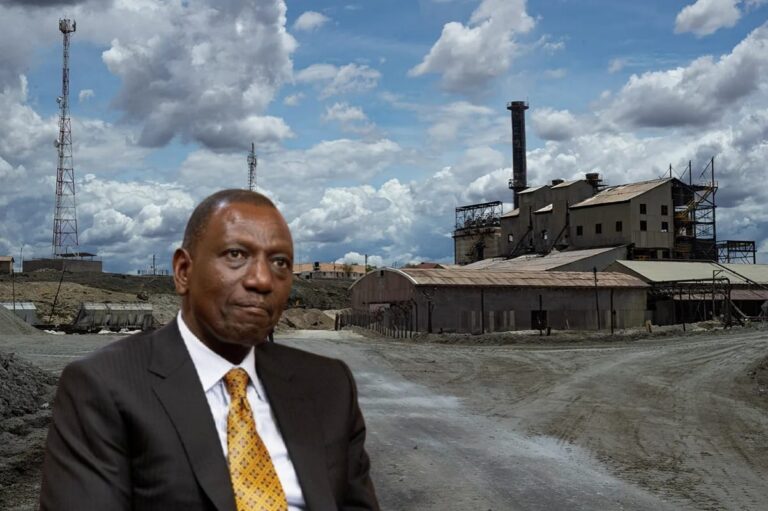

Why does Kenya want Tata Chemicals gone? Inside the escalating row over a 100-year-old soda ash business

0

Kenyan President William Ruto has effectively told Tata Chemicals that its long innings in Kenya is over.

During a visit to Kajiado County on Thursday, Ruto said he had ordered the Indian company to stop its operations in the country, accusing it of failing to deliver meaningful benefits to Kenya despite having operated around Lake Magadi for decades.

And Ruto was not exactly subtle about his frustration.

“That TATA company … had that contract for 100 years. They have not built anything in Kajiado, they have not built any factory in Kajiado,” he said, questioning whether Kenya should remain dependent on foreign companies to exploit its natural resources.

“Are we slaves to other people?” Ruto asked.

The remarks mark a dramatic escalation in what had initially appeared to be a regulatory dispute between Nairobi and Tata Chemicals. The Kenyan government had already suspended mining operations at Tata Chemicals Magadi in July. Ruto is now talking about replacing the Indian company altogether.

So, what exactly has gone wrong?

The dispute is not simply about Tata leaving Kenya

At the heart of the controversy is Tata Chemicals Magadi Limited (TCML), which operates the Magadi soda ash business in Kajiado County.

Tata Chemicals acquired the Magadi operation in 2005. But the business itself dates back much further: commercial operations at Lake Magadi began in 1911.

The facility extracts trona, a naturally occurring mineral found around Lake Magadi, and processes it into soda ash, or sodium carbonate.

That may sound like an obscure industrial chemical, but soda ash is hardly insignificant. It is used extensively in glass manufacturing, detergents, chemicals and water treatment.

Tata Chemicals says its Kenyan operation exports more than 350,000 tonnes of soda ash every year to markets in Southeast Asia, India, the Middle East and Africa.

This is therefore not a case of a small foreign company quietly running an inconsequential facility in Kenya.

It is an established industrial operation with a century-long history.

And that is precisely where the Kenyan government’s frustration appears to begin.

Kenya wants value addition, not just minerals leaving the country

Ruto’s criticism goes beyond the immediate question of whether Tata Chemicals complied with individual regulations.

His central complaint is about value addition.

In simple terms, Kenya does not want to merely extract a natural resource, process it to some extent and export it. Nairobi wants more of the economic activity associated with that resource to happen inside Kenya.

That means factories, jobs, skills, local suppliers and downstream industries.

Ruto specifically said Kenya would bring in two companies to replace Tata’s operations—one to establish a large glass manufacturing business in Kajiado and another to manufacture chemicals locally.

That reveals the broader economic thinking behind the confrontation.

Kenya has soda ash. Soda ash is an important raw material for glass. So why, Nairobi appears to be asking, should Kenya stop at producing and exporting soda ash instead of building a domestic glass industry around it?

The government wants to move further up the value chain.

And it believes Tata’s decades-long presence has not delivered enough of that transformation.

Then came the July crackdown

The immediate trigger for the current crisis came on July 28.

Kenya’s Mining Cabinet Secretary Hassan Joho ordered Tata Chemicals Magadi to suspend all mining operations.

The government cited a long list of unresolved issues.

These included questions surrounding royalty reconciliation and payments, export reporting, mineral beneficiation and value addition, community development agreements, employment and skills transfer for Kenyan citizens, procurement from local suppliers and environmental compliance.

In other words, Nairobi’s complaint was not limited to one alleged violation.

The government raised questions across almost the entire chain connecting Tata’s mining operation to the Kenyan economy: what the company pays, what it exports, how much it processes locally, what it gives back to the community, whom it employs, whom it buys from and how it complies with environmental rules.

The suspension also disrupted soda ash exports from the facility.

The Kenyan government maintained that it had been engaging with Tata Chemicals for years over its statutory obligations and demanded documentation demonstrating compliance and addressing outstanding liabilities.

Tata Chemicals, however, disputes that characterisation.

Tata says: We are compliant

Tata Chemicals has taken a notably conciliatory position publicly.

The company says its Kenyan subsidiary submitted the information, reports and documentation requested by Kenya’s Ministry of Mining, Blue Economy and Maritime Affairs.

It maintains that it is compliant with the applicable regulatory requirements and is waiting for the Kenyan government to review its submissions.

The company has also said it respects the authority of the Kenyan government and remains committed to resolving the outstanding issues through legal and regulatory channels.

So there are effectively two competing narratives.

Kenya says: A foreign company has operated around a valuable natural resource for decades without generating enough local industrial development and has outstanding regulatory and statutory issues.

Tata says: It has provided the information demanded by the government, complied with applicable regulations and remains willing to engage with Nairobi to resolve the dispute.

The disagreement is now moving beyond a regulatory spat into a much larger question over who gets to control and benefit from Kenya’s natural resources.

But has Tata really contributed nothing?

This is where the Kenyan president’s claim becomes contested.

Tata Chemicals strongly rejects the suggestion that its presence has failed to benefit Kenya.

According to the company, around 500 employees and their families, along with contractors, suppliers, transporters and local businesses, depend directly or indirectly on the economic activity generated by its operations.

The company has also said around 30,000 people in the Magadi community directly benefit from its support for water, healthcare, education, infrastructure and community development.

That does not necessarily settle the government’s argument about value addition.

A company can provide employment, community services and export revenues while a government can simultaneously argue that it should be doing substantially more to build downstream industries.

That appears to be the fundamental fault line.

Kenya is not merely asking whether Tata has generated some economic activity.

It is asking whether the economic model surrounding Lake Magadi is ambitious enough for Kenya.

There is also a legal battle in the background

The confrontation has already spilled into Kenya’s courts.

Tata Chemicals challenged the July suspension, but Kenya’s High Court declined to lift it. The government argued that Tata had been given earlier notices concerning its obligations and also contended that the company did not have a current mining licence because its application was still being processed.

A Kenya Gazette notice recorded Tata Chemicals Magadi’s application for a mining licence covering approximately 63.5 square kilometres in Kajiado County for soda ash.

There is also a separate history of friction between Tata and Kajiado County.

In 2025, Kenya’s Court of Appeal ruled in Tata Chemicals’ favour in a dispute involving land rates demanded by the county government, holding that the demand was arbitrary and illegal and that the company was not obliged to pay the claimed arrears in the absence of an open and accountable mechanism for determining the rates.

The present dispute, however, is considerably broader.

What happens now?

Ruto has moved the goalposts.

This is no longer simply a case of “fix the compliance issues and restart operations.”

The Kenyan president has publicly spoken about bringing in two new companies to replace Tata Chemicals and creating glass and chemical manufacturing capacity in Kajiado.

For Tata, that could turn a regulatory dispute into a major commercial and legal confrontation.

For Kenya, it is an attempt to rewrite the economics of one of its oldest mineral industries.

But there is an obvious complication: replacing an established industrial operator is easier said than done.

Tata says hundreds of employees and a wider ecosystem of contractors, suppliers, transporters and local businesses depend on Magadi. The company also says tens of thousands of people benefit from its community programmes.

At the same time, some Magadi residents have welcomed the suspension and raised their own concerns about employment, community participation and the benefits flowing to local people.

That leaves Kenya facing a difficult balancing act.

If Tata is indeed failing to deliver the level of local value addition Nairobi expects, then demanding more from a multinational company is hardly unusual. But if Kenya wants to replace an established operator with companies that will build glass and chemical manufacturing capacity, it will have to demonstrate that the promised industrialisation is more than political rhetoric.

For now, Tata Chemicals says it is waiting for the Kenyan government’s review of its submissions and remains committed to resolving the dispute through legal and regulatory channels.

Ruto, meanwhile, appears to have already reached a much more dramatic conclusion.

The question is no longer simply what Tata Chemicals owes Kenya.

It is whether Kenya believes it can get a better economic deal from someone else.

Estonia’s €70 million ammunition scandal: How a Ukraine arms deal involving an Indian-owned company ended with the Defence Minister’s resignation

0

Estonia, one of Europe’s most vocal supporters of Ukraine, is now grappling with an embarrassing question: how did a government end up paying tens of millions of euros upfront for artillery ammunition to companies that had never previously sold a single artillery shell?

The fallout has already reached the top.

Estonian Defence Minister Hanno Pevkur announced his resignation on September 2, saying he was accepting political responsibility for problems in the country’s defence sector. His resignation came after the National Audit Office raised serious concerns about defence spending and procurement, including the functioning of the Estonian Centre for Defence Investments (ECDI), the agency responsible for military procurement.

At the heart of the controversy is a 2024 procurement agreement for artillery ammunition intended for Ukraine. Estonia ultimately paid about €70 million in advance, with the money coming through the EU’s European Peace Facility (EPF). The intended supplier was Datasel S.R.L., an Italy-registered company acquired by India’s Neco Defence Munitions in March 2024. According to reports, neither the companies nor their relevant operations had a previous record of selling artillery shells.

What followed was a procurement nightmare involving delayed deliveries, disputed quality, terminated contracts, arbitration, and now a ministerial resignation.

The €70 million ammunition deal

The story begins in 2024, when Estonia was attempting to secure artillery ammunition for Ukraine at a time when Kyiv was desperately seeking more shells for its war against Russia.

The Estonian Centre for Defence Investments signed multiple contracts with Datasel. The first agreement in August 2024 was accompanied by an advance payment of approximately €15 million. A further €10 million was reportedly paid in October. Additional contracts followed, eventually taking the advance payments to roughly €70 million.

The urgency was understandable. Ukraine’s artillery ammunition requirements were enormous, while European countries were under pressure to increase military assistance.

But urgency appears to have come with a price: risk.

Estonian officials acknowledged that the procurement involved greater-than-usual risks because of the need to get ammunition to Ukraine quickly.

The companies involved, however, had never previously sold artillery shells.

That is the detail that has turned an ordinary procurement dispute into a political scandal.

Where did the €70 million go?

The simple answer is: it has not simply vanished, but a huge chunk of the money is stuck in a legal dispute.

Estonia says ammunition deliveries were delayed and that inspections subsequently found problems with the material supplied.

The Estonian side terminated the contracts and took the matter to arbitration. Estonian media have reported that between €60 million and €70 million in advance payments are caught up in the dispute. Tallinn is also working with the European Commission on how the money can be recovered.

The National Audit Office has warned of an even more uncomfortable possibility: Estonia could ultimately have to cover around €70 million from its own state budget if the money cannot be recovered.

In other words, money intended to facilitate military support for Ukraine could end up becoming a liability for Estonia itself.

And that is where the political embarrassment becomes much larger than a delayed arms shipment.

The ammunition itself is disputed

Estonia’s version is that the material supplied did not meet the required standards.

Estonia’s current Defence Ministry leadership has described shipments as incomplete or unsuitable. According to ERR, an artillery round requires components including a fuse, propellant charge and primer; Estonian officials said the shipment they rejected lacked essential components.

But Datasel has rejected Estonia’s account.

In a statement reported by Euractiv, the company described itself as the victim of the dispute. Datasel said it had supplied and invoiced approximately €58 million worth of material against about €59 million in advance payments and disputed the claim that quality problems had been established by the relevant inspections.

The company also blamed delays in approvals, authorisations and documentation involving multiple countries and regulatory authorities. It said Estonia later refused to accept some material that was ready for delivery or already in production before terminating the contracts.

Therefore, calling this a proven “€70 million fraud” would go beyond what has been established.

The facts currently point to a deeply troubled procurement contract, a substantial amount of money tied up in litigation/arbitration and competing claims over deliveries and quality.

The legal dispute remains unresolved.

Why is an Indian company involved?

This is where the controversy has acquired an Indian angle.

Datasel S.R.L. is registered in Italy but was acquired by Neco Defence Munitions, an Indian company, in March 2024. Estonia subsequently contracted Datasel to supply artillery ammunition.

The important caveat is that the controversy does not establish that Neco Defence Munitions committed fraud.

Nor does the resignation of Estonia’s defence minister amount to a finding of criminal wrongdoing by the Indian-owned company.

Datasel has expressly rejected Estonia’s allegations and maintains that the contract was disrupted by factors including regulatory approvals and Estonia’s refusal to accept certain material. The dispute is now being fought through arbitration.

So the striking question is not simply, “How did an Indian company scam Estonia?”

It is more accurately:

Why did Estonia choose a supplier with no established track record of selling artillery shells for a wartime procurement worth tens of millions of euros, and why were such large sums paid upfront?

That is the procurement question now hanging over Tallinn.

The minister says: I did not negotiate the contract

Pevkur has attempted to distinguish between political responsibility and operational responsibility.

He said the defence minister does not personally negotiate individual procurement contracts or scrutinise every piece of ammunition being purchased.

But that defence did not prevent him from accepting political responsibility.

“A leader must have the courage to take responsibility,” Pevkur said while announcing his resignation. He argued that although the minister does not conduct individual contract negotiations, the National Audit Office’s findings concerning the defence forces and ECDI raised a question of political responsibility.

Pevkur had served as defence minister since July 2022.

He also maintained that Estonia had made the right strategic choices in strengthening its defence capabilities and argued that continued support for Ukraine remained vital to Estonia’s own security.

But politically, the argument was difficult to sustain.

The National Audit Office had already raised concerns about Estonia’s defence-sector financial management and procurement. A criminal investigation into issues surrounding defence-sector finances has also been opened following the audit findings. (euronews)

The ammunition controversy therefore arrived at precisely the wrong time.

Why was Estonia using EU money?

There is another important layer to the story.

The ammunition procurement was linked to the European Peace Facility, the EU mechanism used to support military assistance and strengthen the defence capabilities of partner countries, including Ukraine.

The EU has increasingly channelled the extraordinary revenues generated from immobilised Russian sovereign assets towards Ukraine. In July 2024, the European Commission announced that €1.4 billion of the first €1.5 billion tranche of such revenues would go through the European Peace Facility for military equipment, including artillery ammunition. (Enlargement and Eastern Neighbourhood)

So this was not simply Estonia spending €70 million of its own money on a failed procurement.

The transaction was part of a much broader European effort to get weapons and ammunition to Ukraine.

That makes the procurement failure particularly awkward.

The EU was attempting to use Russian-linked windfall revenues to help Ukraine defend itself against Russia. Instead, a substantial amount of the money involved in one procurement has become entangled in a dispute between a European government and an Indian-owned ammunition company.

The bigger problem: wartime urgency versus procurement safeguards

The episode exposes a dilemma that goes well beyond Estonia.

Ukraine needs ammunition immediately. European governments want to replenish their own stocks while simultaneously supplying Kyiv. Defence manufacturers are under pressure to increase production. And governments have to make procurement decisions much faster than they ordinarily would.

But defence procurement is precisely where haste can become expensive.

Estonia appears to have accepted greater procurement risk because of the urgency surrounding Ukraine’s ammunition requirements. The question now is whether the safeguards were strong enough to prevent that risk from turning into a potential €70 million liability.

The fact that the supplier had no established track record in selling artillery shells makes the question even more uncomfortable.

A government can take a calculated risk on an untested supplier.

But when the bet involves tens of millions of euros in advance payments—and the product is ammunition required for an active war—the consequences of getting that calculation wrong are considerably greater.

What happens now?

Pevkur’s resignation does not resolve the dispute.

Estonia is pursuing arbitration and seeking to recover the money. The European Commission is also in contact with Tallinn over the fate of the funds. Commission spokesman Christian Wigand said there are safeguards and recovery procedures designed to ensure EU taxpayers’ money is properly spent, while declining to give details about the ongoing discussions.

The criminal investigation and the National Audit Office’s findings will also keep the spotlight on Estonia’s defence procurement system.

For Estonia, the episode is an uncomfortable lesson in the risks of wartime procurement.

For the European Union, it raises questions about how quickly billions in support can be deployed without compromising financial safeguards.

For Ukraine, it highlights the practical problem behind Europe’s promises of ammunition: getting shells from a government ledger to an artillery unit is considerably more complicated than announcing another aid package.

And for India, the controversy has drawn attention to an Indian-owned defence manufacturer, but it is important not to confuse an unresolved contractual dispute with a proven fraud case.

The most damaging fact for Estonia is already beyond dispute: around €70 million was paid upfront in an ammunition procurement that subsequently unravelled, and the country’s defence minister has now stepped down, taking political responsibility for the wider failures in the defence sector.

The ammunition may still become part of a legal accounting between Estonia and Datasel.

But politically, the bill has already arrived.

Double deflation, base year, GVA and others: Demystifying India’s 7.8% GDP growth

Beating global economic uncertainties due to ongoing geopolitical issues, India’s Gross Domestic Product (GDP) grew by 7.8% in the first quarter (April to June) of the financial year 2026-27. PM Modi called the exemplary growth a herculean feat, saying that “the collective strength of our people ensured India delivered such growth despite oil price shocks and supply chain issues in the midst of global uncertainties.”

However, the 7.8% figure also became the subject of intense political and economic debate. Usual suspects, including critics and opposition leaders, questioned the credibility of these numbers, pointing to downward revisions in previous data and certain statistical anomalies—like how manufacturing inflation seemed to fall while everyone knows costs are rising.

To put an end to the confusion, the Ministry of Statistics and Programme Implementation (MoSPI) released a detailed set of Frequently Asked Questions (FAQs) explaining the complex mathematics behind the numbers. If you have been reading the news and feeling lost in a sea of financial jargon like “double deflation,” “base year revision,” and “implicit deflators,” this article is for you. We will break down exactly what the government said, explain the technical terms in plain Indian English, and unravel why the 7.8% GDP growth is calculated the way it is.

What the numbers say

According to the government estimates, real GDP, or GDP at Constant Prices, is estimated at ₹81.36 lakh crore in Q1 FY 2026-27.  It recorded 7.8% rise, compared with 6.9% growth in Q1 FY 2025-26. On the other hand, nominal GDP, or GDP at Current Prices, is estimated at ₹88.27 lakh crore, registering 10.3% rise, compared with 8.1% last year.

Real Gross Value Added (GVA) for the same period has been estimated at ₹73.82 lakh crore, recording 8.2% growth. The Nominal GVA is estimated at ₹80.53 lakh crore, recording 11.5% growth.

In the first quarter of FY 2026-27, manufacturing recorded 9.2% growth in terms of GVA, supported by strong output across key segments. Capital goods production also increased by 15.2%. The secondary sector expanded by 8.6% in Q1 2026-27, compared with 6.1% in the corresponding quarter of the previous year. The tertiary sector grew by 10.0% in Q1 2026-27, up from 8.0% in Q1 2025-26. Within the sector, financial, real estate, IT and professional services recorded 12.1% growth.

The new estimates also revised the real GDP growth for the previous 3 years. Accordingly, the GDP grew by 7.3% in 2023-24, by 7.2% in 2024-25, and by 7.7% in the FY 2025-26. Each of these numbers represent upward revision by 0.1%. The annual revised estimates reflect the use of new price and production indices with base year 2022-23. This includes the Output Producer Price Index (PPI) and Banking Services Price Index (BkSPI). Updated administrative data from different sources were also incorporated, the govt said.

Understanding the Basics: A Guide to Economic Terms

Before diving into the controversies and the government’s defence, we must first understand the basic building blocks of economic measurement.

What is GDP?

Gross Domestic Product (GDP) is simply the total monetary value of all the finished goods and services produced within India’s borders in a specific time period, like a quarter of a year. Imagine India as one giant factory. Everything this factory produces, from the cars manufactured in Chennai to the IT services delivered from Bengaluru, and the wheat grown in Punjab to tea grown in Assam, everything adds up to form the GDP.

What is GVA

While GDP measures the final value paid by the consumer (which includes taxes), GVA (Gross Value Added) looks at the economy from the producer’s side. GVA is the value of output minus the value of intermediate consumption, which is the raw materials used to make the product.

For example, if a baker buys flour, sugar, and butter for ₹50 and sells a cake for ₹150, the GVA is ₹100. It measures the actual “value added” by the baker’s physical and intellectual effort.

Nominal vs. Real GDP

This is where many people get confused, and it sits at the heart of the recent debate.

  • Nominal GDP calculates the value of goods and services using current prices, the prices at the exact time they were produced.
  • Real GDP calculates the value of goods and services using the prices of a fixed base year. This removes the illusion of growth caused merely by rising prices, which is inflation.

For example, a farmer sells 100 apples in 2025 at ₹10 each. The revenue is ₹1,000. In 2026, he sells the exact same 100 apples, but because of inflation, the price is now ₹15. His revenue is ₹1,500. A nominal calculation says the business grew by 50%. But a real calculation, using 2025 as the fixed base year price, says he still only sold 100 apples, so the GDP will remain ₹1,000. Therefore, the real growth will be 0%. Real GDP reflects the actual increase in physical production, which is a truer measure of a country’s economic health.

What is a Base Year

A base year is a reference point used to compare economic performance over time. Because the economy constantly evolves—new industries emerge, consumer habits change, and old technologies die—the base year must be updated periodically so that the yardstick remains relevant. India recently updated its GDP base year from 2011-12 to 2022-23.

What is a Deflator

A deflator is the mathematical tool used to strip out the effect of inflation from Nominal GDP to arrive at Real GDP. It essentially “deflates” the inflated current prices back to the base year’s reality.

The controversy of the revised base year and past GDP figures

The Allegation: Was last year’s GDP “shrunk” on purpose?

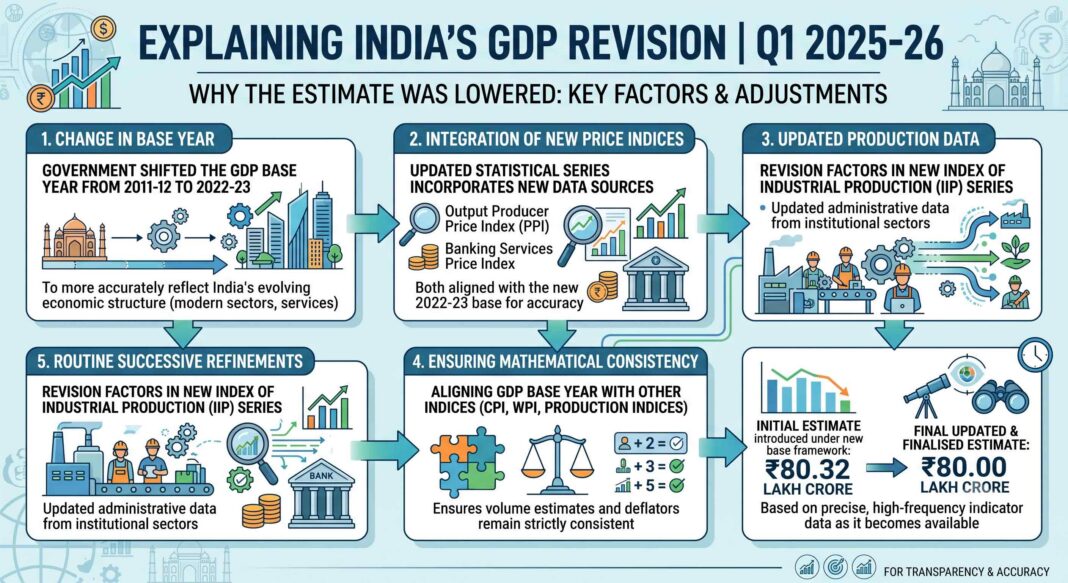
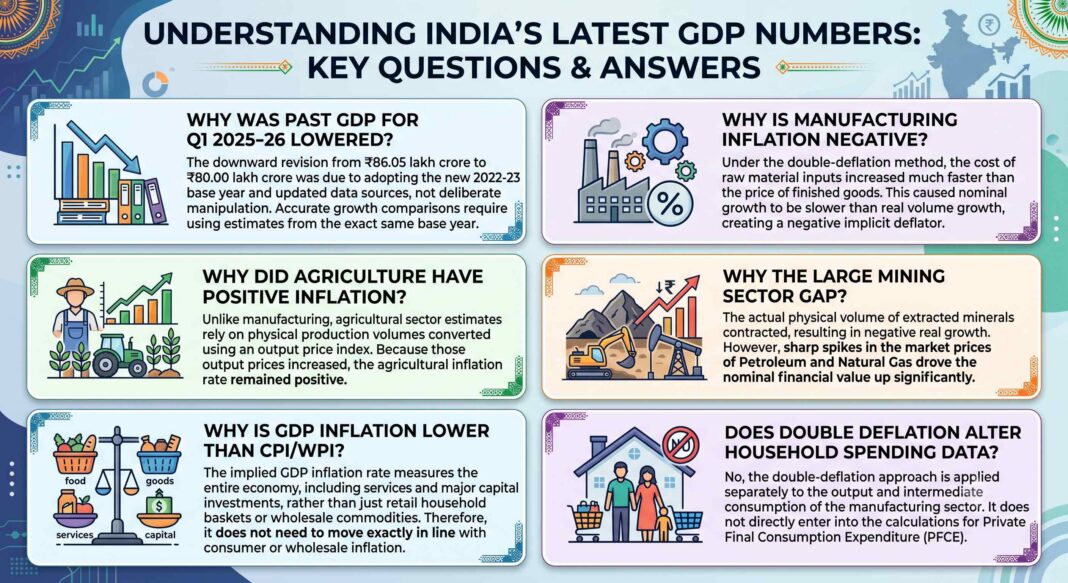
One of the loudest criticisms raised by the opposition was regarding a downward revision of last year’s GDP numbers. Initially, the GDP for the first quarter of last year (2025-26) was reported as ₹86.05 lakh crore under the old 2011-12 base year. However, in the recent reports, this baseline figure was shown as ₹80.00 lakh crore.

Critics, including a former finance secretary, argued that the government purposely shrank last year’s GDP figure by ₹6 lakh crore so that the current year’s figure of ₹88.27 lakh crore would look like a massive jump, thereby ‘artificially manufacturing’ a 7.8% growth narrative.

The Congress also picked up the claim to attack the government. In a post on X, the party alleged that the Modi government had “fudged GDP figures” and claimed that, without the alleged manipulation, real GDP growth would have been only 2.6%.

But this comparison is misleading because the 2.6% figure being circulated is not an alternative calculation of India’s real GDP growth. It comes from comparing figures from two different GDP series.

The government’s clarification: Comparing apples to apples

The Centre issued FAQs amid opposition’s questions over 7.8% GDP growth, emphatically denying the allegation of manipulating numbers. The Ministry of Statistics & Programme Implementation explained that this revision was not a deliberate manipulation but a necessary mathematical adjustment resulting from the shift to the new 2022-23 base year.

When the base year changes, the baseline prices used to value the entire economy change. Furthermore, the new calculation series incorporated vastly improved data sources, such as the new Output Producer Price Index (PPI) and the Banking Services Price Index. Because of this updated methodology, the actual measured size of the economy in Q1 2025-26 under the new framework was recalculated to ₹80.32 lakh crore, which was later finalised to ₹80.00 lakh crore as more accurate indicator data rolled in.

The government stressed that one simply cannot compare ₹86.05 lakh crore calculated with 2011 prices and old methodologies against ₹88.27 lakh crore calculated with 2022 prices and new methodologies. To measure true growth, 2025-26 figures must be recalculated using the new methods so that it can be properly compared with the 2026-27 numbers. When compared fairly under the exact same methodological umbrella, the real GDP growth stands robustly at 7.8%.

The Puzzle of the Manufacturing Sector

How Can Inflation be Negative When Prices are Rising?

Perhaps the most complex point of debate was the manufacturing sector. In the latest numbers, the manufacturing sector recorded a negative inflation rate in its GVA implicit deflator of “-1.5%”.

To the average person, this sounds absurd. If the cost of raw materials like steel, plastic, and energy is going up, and the price of finished goods like cars, appliances, and clothes is also going up, how can the government claim that manufacturing inflation is negative? Critics quickly pointed to this as proof that the data was flawed.

What is “Double Deflation”?

To answer this, the government explained a concept called “Double Deflation”. It sounds intimidating, but let us break it down.

In the past, statisticians would calculate the inflation of the final output and simply assume that the raw materials experienced the exact same rate of inflation. As a result, they used a single deflator. However, in reality, input prices and output prices often move at completely different speeds.

Double deflation is a more advanced, highly accurate method recommended globally by the International Monetary Fund (IMF). Under this method, output (finished goods) and inputs (raw materials) are deflated separately using their respective price indexes.

Here is exactly how the “-1.5%” deflator happened:

During the April-June 2026 quarter, the prices of inputs (what factories buy) rose much faster than the prices of outputs (what factories sell). Imagine a scenario where the cost of raw cotton shoots up by 15%, but a textile factory can only increase the price of a finished shirt by 5% because of market conditions.

Because the input costs rose so aggressively, the nominal GVA (the unadjusted profit margin, essentially) grew slower—at 7.7%—than the real GVA (the physical volume of value added), which grew at 9.2%.  The resulting difference between nominal and real GVA growth produced a negative implicit GVA deflator of 1.5%.  Mathematically, when Real Growth outpaces Nominal Growth, the formula gives a negative deflator.

Thus, a -1.5% deflator does not mean manufacturing prices dropped; it merely reflects the harsh reality that input prices squeezed the producers far more than output prices rose. The government noted that this trend was heavily seen in sectors like basic metals, rubber, plastics, and textiles.

Importantly, a negative GVA deflator does not mechanically imply lower real growth. It also does not imply that manufacturing output prices declined. It reflects the relative movement of output and input prices in the double-deflation framework. Real GVA growth depends on the relative movements in real output and real intermediate consumption.

Reconciling the 2.5% Implied GDP Inflation Rate with CPI and WPI

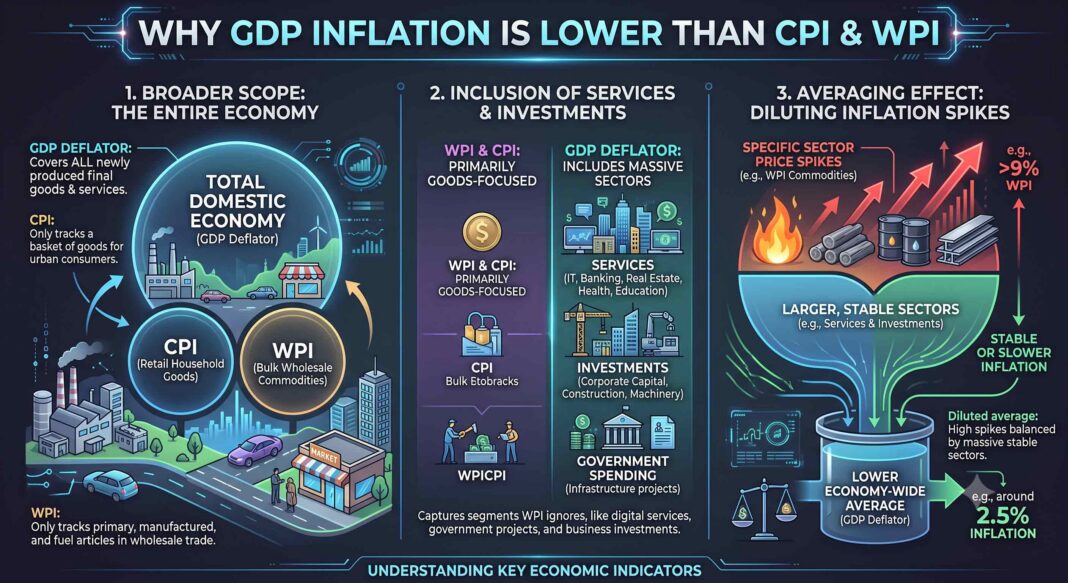
When the government announced an implied GDP inflation rate, called the GDP deflator, of just 2.5%, many observers were left scratching their heads. How could this be accurate when everyday retail inflation measured by the Consumer Price Index (CPI) was at 3.9%, and wholesale inflation measured by the Wholesale Price Index (WPI) had crossed a massive 9%?

To understand this, we must look at exactly what these three inflation metrics measure, as they cover entirely different parts of the economy.

Understanding CPI, WPI and GDP Deflator

  • Consumer Price Index (CPI): This is the inflation everyone feels every day. It tracks a very specific “basket” of items that common households buy, such as food, clothing, housing, and transport. If the price of vegetables or retail milk spikes, the CPI goes up.
  • Wholesale Price Index (WPI): This tracks the prices that businesses and factories pay for bulk goods and raw materials before they reach the retail consumer. It is heavily influenced by global commodity prices, fuel, and manufactured goods. Importantly, WPI completely ignores the “services” sector like IT, banking, and education.
  • Implied GDP Inflation Rate (GDP Deflator): This is the ultimate, all-encompassing measure of inflation for the entire country. Unlike CPI or WPI, it does not just look at household groceries or factory raw materials. The government clarified that the GDP deflator covers the broader economy, which includes personal consumption, corporate investments, government spending like building infrastructure, exports, and the massive services sector.

Why the numbers do not need to match

Because the GDP deflator covers a much wider footprint of the economy, including massive areas completely untouched by CPI and WPI, the government has explicitly stated that the implied GDP inflation rate “need not move in line with either CPI or WPI”.

For instance, while WPI was pushed over 9% due to a sharp rise in specific raw materials such as crude petroleum and metal ores, these industrial inputs only make up a fraction of the total economy. At the same time, large segments of the economy, like broad services, long-term capital investments, and government expenditure, may not have experienced that same severe price jump.

When the average inflation across the entire GDP pie is calculated, the severe spikes in wholesale goods are diluted by the relative stability in other sectors, resulting in the broader 2.5% implied GDP inflation rate.

In simple terms: The 2.5% figure is a blended average for the whole country’s total output, while the 3.9% CPI is specific to the household shopping basket, and the 9% WPI is specific to factory inputs. Because they are measuring three entirely different things, it is mathematically normal for the numbers to be different.

Why double deflation doesn’t affect household budget

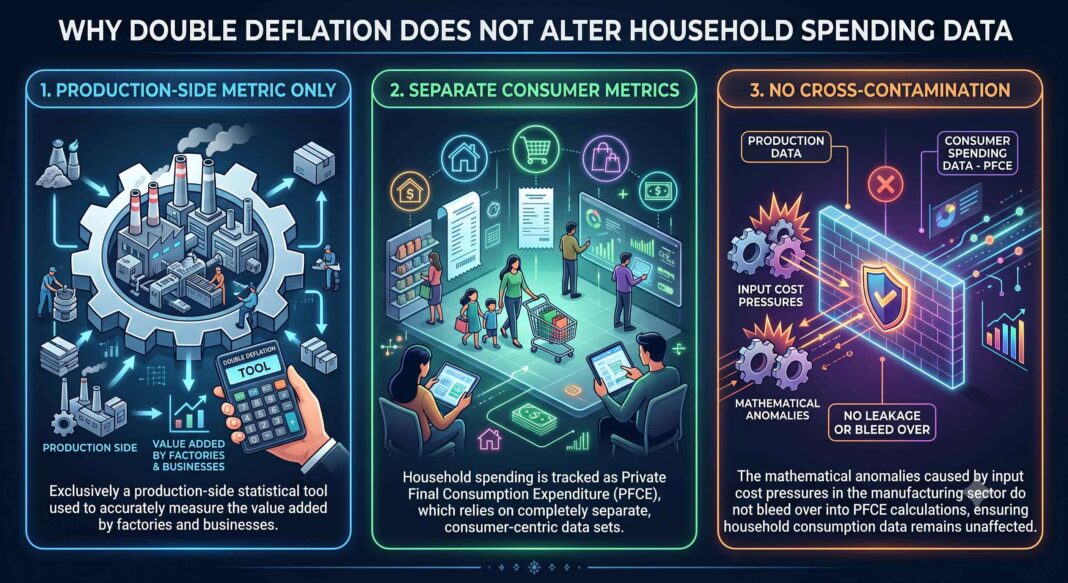
The adoption of the “double deflation” method caused some critics to worry if it artificially altered household consumption figures, known technically as Private Final Consumption Expenditure (PFCE). If factory math is changing, does that mean the government is changing how they calculate our spending?

The government has firmly stated: No. Double deflation is strictly a production-side tool used exclusively to calculate industry GVA. It applies to factories and businesses to accurately measure the value they add. When the government calculates how much households are spending (PFCE), they use completely different, consumer-centric data sets. As PFCE is a measure of final demand (expenditure on goods and services for final use), it has no intermediate consumption to subtract, like in case of industries. Therefore, the mathematical anomalies seen in the manufacturing sector’s inputs and outputs have zero artificial impact on how household consumption is recorded and presented in the final GDP figures.

At the quarterly level, PFCE is estimated at a detailed item/item-group level. For various goods such as food and manufactured products, constant-price estimates are compiled first using appropriate volume indicators, and current-price estimates are subsequently derived using relevant Consumer Price Indices. For several services items under PFCE, such as education, health, restaurants and accommodation services, current-price estimates are compiled using relevant output indicators and the corresponding constant-price estimates are derived using appropriate price indices.

Therefore, double deflation is relevant to the estimation of production-side GVA and is not a method used directly for estimating PFCE.

Why agriculture and mining showed different trends

Another question after the GDP numbers were announced was: if manufacturing showed a negative deflator, why did other sectors behave differently?

The positive inflation in agriculture

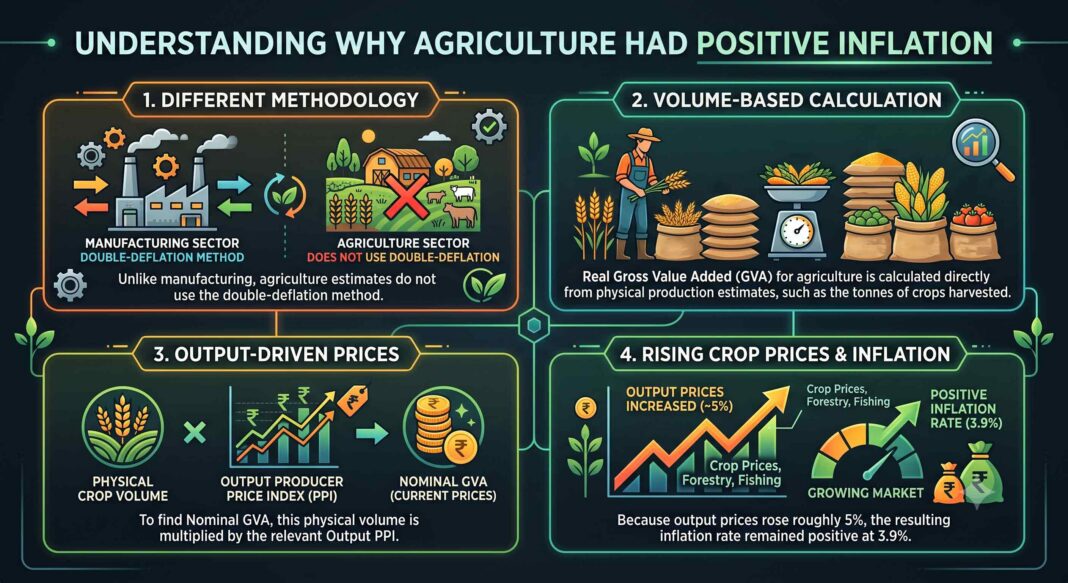
For the agricultural sector, the GVA implicit deflator showed a positive inflation rate of 3.9%. The government explained in its detailed FAQ releases that agriculture is calculated using a completely different methodology than manufacturing.

Agricultural Real GVA is first calculated based on physical production estimates, how many tonnes of wheat, rice, pulses etc., were actually harvested. Once the physical volume is known, it is multiplied by the relevant Producer Price Index (PPI) to get the current Nominal GVA. In Q1 2026-27, the output PPI for agriculture, forestry, and fishing rose by roughly 5%. Because agricultural nominal GVA is tied directly to these final output prices, its implied inflation stayed in positive territory at 3.9%.

Gap between nominal GVA and real GVA estimates of mining sector

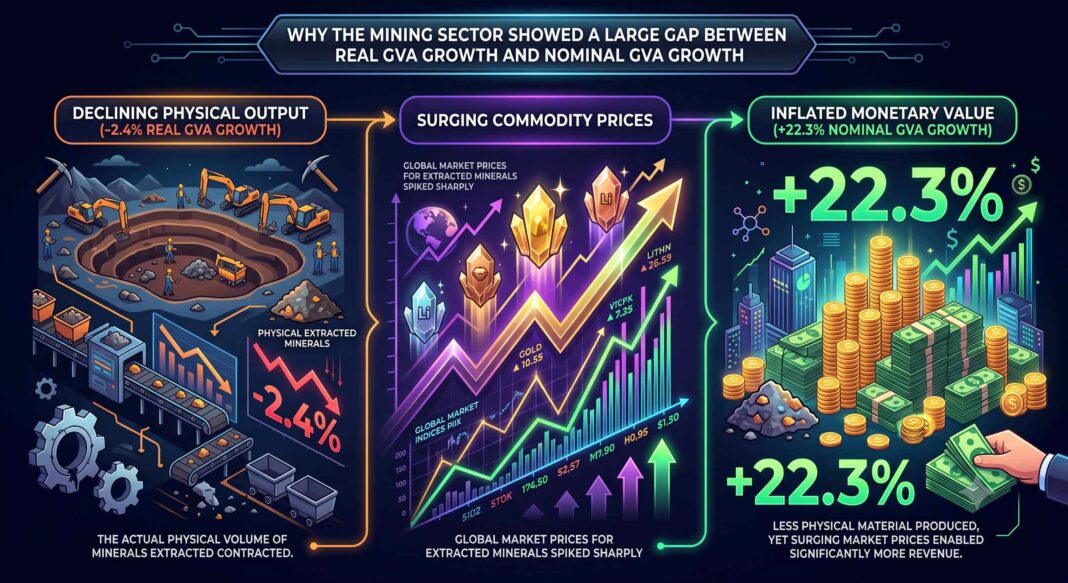
Critics also pointed out discrepancies in the mining sector, citing a large gap between nominal and real estimates. But the government has clarified that this is the result of high Inflation based on PPI in the sector.

The nominal estimates are derived by applying the relevant Producer Price Indices (PPI) to the corresponding real estimates for different mineral groups. The PPI data for Q1 2026-27 indicate significant price increases in the Mining & Quarrying sector. In particular, prices of Crude Petroleum and Natural Gas increased by 69.5% in April, 72.2% in May and 33.7% in June, while Mining of Metal Ores recorded inflation of 27.6%, 25.2% and 23.5%, respectively. The nominal GVA growth of the Mining & Quarrying sector accordingly stood at 22.3% in Q1 2026-27.

On the other hand, the real GVA growth for Mining & Quarrying was -2.4% during Q1 2026-27. This perfectly aligns with the high-frequency Index of Industrial Production (IIP) data, which showed negative growth in April (-3.8%) and May (-1.4%), dragging down the overall quarterly average despite a slight recovery (1.6%) in June. The data was consistent across different government tracking tools, leaving no room for statistical discrepancy.

Therefore, the substantial difference between real and nominal GVA growth is primarily a result of the strong increase in mineral prices, particularly crude petroleum and natural gas and metal ores. In simple terms, the difference is the result of a sharp increase in prices and a slight decrease in production volume.

Conclusion: Trusting the process

The debate surrounding the 7.8% GDP growth rate for Q1 2026-27 is a perfect example of how complex economics can become tangled with political narratives. To a layperson, seeing past data revised downward or seeing a negative inflation figure for a sector where costs are rising can understandably look highly suspicious.

However, as the detailed FAQs issued by the Ministry of Statistics and Programme Implementation illustrate, these numbers are not the result of random manipulation or a desire to artificially inflate current growth. They are the outcome of adopting more rigorous, globally accepted statistical standards. Updating the base year to 2022-23 and implementing the double deflation method brings India’s statistical tracking in line with recommendations from international bodies like the IMF.

While it may require a bit of patience to look past the dense jargon, understanding these concepts is vital for every citizen. The revision of past data was an apples-to-apples normalisation process, not a deliberate downgrade. The peculiar manufacturing numbers merely showed that businesses faced severe input cost pressures that outpaced their ability to raise final prices.

Ultimately, robust methodologies ensure that policymakers, businesses, and everyday citizens have the truest possible picture of the Indian economy. The extensive breakdown provided by the government confirms that the 7.8% real GDP growth is built on solid, transparent statistical foundations.

Konda Surekha vs Revanth Reddy: How a row over her daughter’s remarks escalated into a Cabinet crisis

On 3rd September (Thursday), Konda Surekha, who was serving as the Forest and Environment as well as Endowments minister in the Telangana government, has been dropped by Chief Minister A Revanth Reddy, ending a weeks-long disciplinary row. Governor Shiv Pratap Shukla has been requested to approve the recommendation to remove her from the state cabinet.

The action was proposed by the Telangana Pradesh Congress Committee (TPCC) disciplinary committee. The dispute was sparked by comments made against Revanth Reddy and his family by Konda Sushmitha Patel, Surekha’s daughter. Now, the decision has revealed escalating tensions within the party in the state. Interestingly, there is already a political tussle between Revanth Reddy and Surekha.

“Discipline is paramount within the Congress party as the party’s prestige hinges on discipline of its rank and file. Disciplinary action must be taken so that the party comes to power again,” mentioned Lok Sabha MP and disciplinary committee chairman Mallu Ravi.

The controversy rocks Telangana Congress

The conflict began in August, when Sushmitha made heated remarks about Revanth Reddy at a public function. The Parkal Assembly constituency is at the heart of the issue. Revanth Reddy publicly supported current MLA Revuri Prakash Reddy during a recent event there and asked voters to support him once more in the upcoming election.

However, Sushmitha questioned, “Who is Revanth to decide my ticket?” She dared Prakash Reddy to step down and run against her in a by-election. She also declared that she is going to run from the constituency as an independent candidate if she is denied a ticket by the party.

Moreover, she accused Revanth Reddy of favouring his family members in commercial operations. He was confronted for selling prime land for substantially less than its value to a shell firm connected to his brother. Afterwards, several Telangana Congress leaders demanded action against Sushmitha and Surekha in response to her remarks, which triggered a significant backlash inside the party.

The controversy soon intensified, moving from the state Congress unit to the central leadership. Surekha’s failure to openly disassociate herself from her daughter’s comments further increased the political pressure. However, she insisted that the latter’s opinions were personal and she shouldn’t be held accountable for them.

“Expecting another person to take political responsibility or demanding an explanation for someone’s opinions merely due to family relations is improper,” she submitted as an explanation before the TPCC Disciplinary Committee.

In addition to defending her political record, Surekha cited her and her husband Konda Murali’s social and political status, emphasising that they are members of two backward communities that together make up a sizable portion of Telangana’s population.

Surekha insisted that she had not been charged with corruption and pressed the party to let her stay in the cabinet. She even asserted that she was being targeted by some members of Congress and the demand for her expulsion from the cabinet was the result of a conspiracy.

A series of political meetings

On the other hand, more than 20 Congress MLAs and MLCs, as well as a few ministers, sought strict punishment against Surekha and Sushmitha. Hence, Surekha hurried to Bengaluru to meet Indian National Congress President Mallikarjun Kharge and argued that she was being unfairly singled out during the meeting. She insisted that she had not personally spoken anything negative about Revanth Reddy or the party.

According to sources, Kharge clarified that unilateral statements about running from a specific constituency and public criticism of the chief minister were against party discipline. He brought up the fact that the party’s central leadership chose the candidates for the election. She also met with the Telangana in-charge Meenakshi Natarajan to clarify her stand.

Surekha’s refusal to resign in the face of mounting scrutiny worsened the situation. She reportedly told the senior leaders to take disciplinary action against her, challenging that Revanth Reddy should also endure the same consequences.

On 2nd September, she rushed to Delhi and met with Kharge again as the party’s top brass discussed her future. Senior Congress officials, including All India Congress Committee (AICC) general secretary and Lok Sabha MP KC Venugopal, Revanth Reddy, Telangana deputy chief minister Bhatti Vikramarka, TPCC chief B Mahesh Kumar Goud and other state leaders deliberated concerning the disciplinary matter.

Revanth Reddy also met with KC Venugopal in the national capital and demanded strict measures against Surekha. However, some others pointed to her political influence and popularity among some of the state’s backward communities and advised the high command to proceed with caution.

The TPCC disciplinary committee eventually stated that Surekha should be ousted from the cabinet, and Revanth Reddy took action.

Surekha denies sacking, Sushmitha curses Revanth Reddy

“I have not received this as of now. No signature, no letter pad, only white paper. I think it’s not correct. I was not given any intimation. I replied to the show-cause notice also and clarified my point. Nobody contacted me from the party,” Surekha contended while talking to CNN-News18, after the development. “Letterhead is not signed. This is not correct,” she insisted, ed raising doubts on the validity of the communication.

“They first had to contact me and take my version. They have removed me without taking my version. After getting official confirmation, I will decide the further course of action,” she conveyed. “I have no sorrow over losing my ministerial post. We have the support of the people. Nobody can do anything to us. A ministerial post is only an ornament for us. Losing it does not cause us any loss. Ministers and MLAs are not happy. What happened to me today will happen to you tomorrow. Nothing is getting done in this government,” she shared with the reporters.

“My statement was personal and not against any party. I just spoke against one person in my personal capacity,” Sushmitha also stressed in a conversation with the media house. She expressed, “Injustice is done to my mother. I am deeply hurt that she has been treated like this.” Sushmitha announced that she would always stand by Surekha, remarking, “My mother will not be silenced. I curse Revanth Reddy,” daring him to contest from her seat.

Meanwhile, senior Congressman G Chinna Reddy’s appointment as vice-chairman of the Telangana Planning Board was also revoked by the government due to comments about Wanaparthy MLA T Megha Reddy. He stated that the latter was handed a party ticket after being lured with money.

Furthermore, Revanth Reddy appointed Gadwal Vijayalakshmi as vice-chair of the Telangana Planning Board, Nerella Sharada as chair of the Telangana State Commission for Women and former Rajya Sabha MP G Sudha Rani as chair of the Kakatiya Urban Development Authority as part of an overhaul of important positions.

All eyes on ‘Naughty Boy’: ISRO to launch GSLV EOS-5 Earth observation satellite

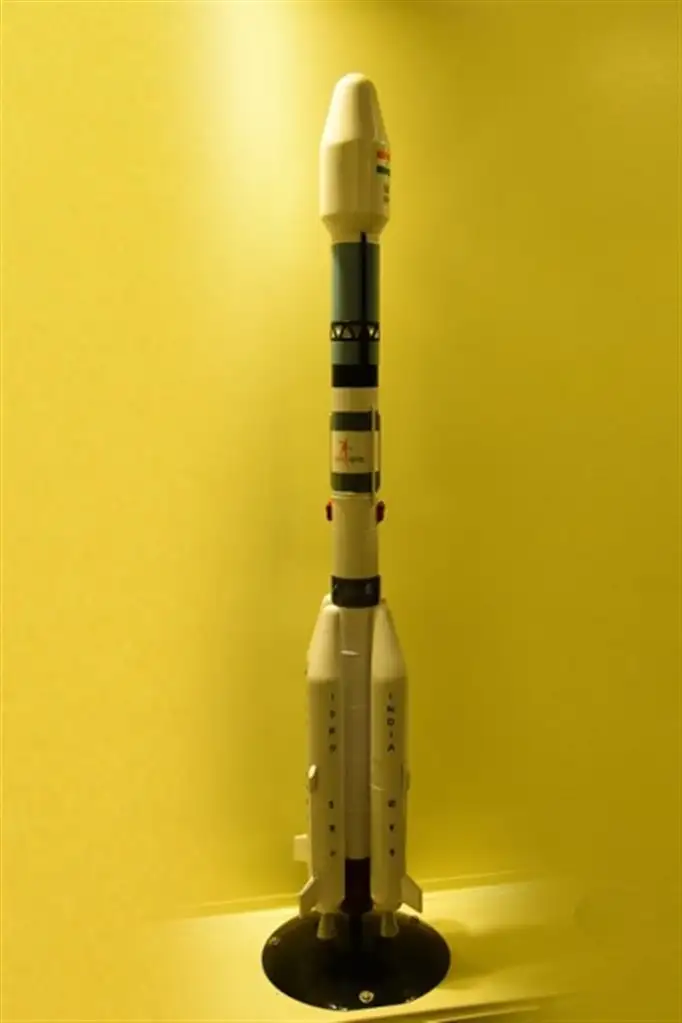
At 2:55 am on 4th September 2026, when most of India will be asleep, the Indian Space Research Organisation (ISRO) will attempt the launch of the ‘Naughty Boy’ Geosynchronous Satellite Launch Vehicle, or GSLV-F17, from the Second Launchpad at Sriharikota to deploy EOS-5, India’s first Earth Observation Satellite to operate from geosynchronous orbit, 36,000 kilometres above India. ISRO is looking forward to achieving a turnaround after recent PSLV setbacks.

ISRO relying on ‘Naughty Boy’ GSLV to PSLV setbacks into GSLV comeback

The recent months have not been very positive for ISRO, as the Polar Satellite Launch Vehicle (PSLV) suffered consecutive failures in 2025 and 2026, prompting the government to ground the launcher and initiate an investigation. The PSLV shockers were even more unsettling given that this workhorse has been not only India’s but the world’s one of the most reliable rockets.

Since the reliable one has disappointed lately, the ISRO has pinned its hopes for a spectacular comeback on ‘Naughty Boy’, the GSLV.

Notably, GSLV is a three-stage launch vehicle, having most of its components, like the Vikas engine and booster motors, imported from PSLV technology. ISRO developed three staged GSLV with four boosters to send satellites to Geosynchronous Transfer Orbits (GTO) and Low Earth Orbit (LEO), which PSLV could not.

The GSLV has earned this moniker due to its mixed operational record. Out of the initial 18 GSLV flights, six failed to achieve full mission success.

The ‘Naughty Boy’ GSLV remains India’s pride despite its initial tantrums, given the struggle ISRO did to indigenously develop the cryogenic engine. What drove ISRO to develop the GSLV was its efforts to master cryogenic propulsion.

In the 1990s, India sought cryogenic technology from Russia; however, the United States strongly objected to the transfer, citing ‘missile proliferation’ fears.

What further created hurdles for India’s manoeuvers to access this technology were international restrictions. This drove ISRO to pursue indigenous development.

It took years, numerous failures, setbacks, redesigns, and repeated testing to achieve mastery over technologies functioning at temperatures as low as minus 250 degrees Celsius, where liquid hydrogen and liquid oxygen transform into powerful rocket propellants.

After years of try-fail-repeat, ISRO finally achieved success. The first launch of GSLV was on 18th April 2001, and the last GSLV launch took place on 12th August 2021, which was unsuccessful.

During this time, fourteen launches were made, including the MK-I and MK-II series. Of these, eight were successful, two were partially successful, and four were failures. From 2014, GSLV marked six consecutive successful launches.

GSLV-F17-EOS-05 Mission

According to ISRO, GSLV-F17 is the 19th flight of India’s GSLV. The GSLV-F17 vehicle will place the EOS-05 satellite into a Sub-Geosynchronous Transfer Orbit (Sub- GTO). The launch will take place from the Second Launch Pad (SLP) at Satish Dhawan Space Centre, SHAR.

Unlike conventional Earth Observation Satellites (EOS) that orbit at lower altitudes, passing over regions periodically, the EOS-05 satellite will achieve a fixed position relative to the Earth’s rotation. The ISRO says that maintaining a fixed position will enable continuous monitoring of the Indian subcontinent and surrounding areas.

This EOS-05 satellite will provide the ISRO with near real-time images at 30-minute intervals, along with the capability to revisit priority targets every five minutes, particularly for rapid observation tasks.

The GSLV-F17 flight sequence goes as follows: S139 ignition, then 4L40Hs ignition, encapsulated assembly, GS2 ignition /GS1 separation, IS 1/2 M separation, OPLF separation, EOS-05 S/C separation, GS2 separation /CUS ignition, and CUS burnout.

All infographics via ISRO’s relevant mission brochure.

As per ISRO, the high-frequency imaging capability will aid applications in disaster management, agricultural monitoring, environmental assessment, as well as strategic surveillance. It will be even more useful during evolving emergencies when agencies would need fresh data for faster decision-making.

This mission acts as a replacement for a similar spacecraft lost in August 2021 when the GSLV-F10 cryogenic upper stage failed to deliver as intended during the EOS-03 launch attempt.

If a successful deployment is achieved, India will join an elite club of nations operating geostationary Earth imaging satellites.

Pakistani intruder Nazir Sadhir arrested along Jammu border by BSF: All you need to know about recent incursions and drone activities

0

The Border Security Force (BSF) on Thursday (3rd September) arrested a Pakistani intruder along the International Border (IB) in the Kanachak sector of Jammu. As per reports, the intruder, identified as Nazir Sadhir, was nabbed by troops of the 44 Battalion of the BSF in the morning in the forward area of Border Outpost (BOP) Sohan. The stretch of the India-Pakistan border is considered sensitive and highly vulnerable to infiltration and smuggling activities.

Nazir, a resident of Luni village in Pakistan’s Sialkot district, was taken into BSF custody after the arrest. He is being interrogated by the BSF to determine the purpose of his intrusion into Indian territory. The BSF is trying to ascertain whether he entered this side of the border accidentally or if he was surveying the area for terrorist infiltration.

The Deputy Inspector General (DIG) of the sector arrived at the spot to take stock of the situation. An investigation is underway into the case.

Recent incidents of Pakistani intrusion

A series of similar infiltrations along the India-Pakistan border have come to light have reportedly come to light in recent months. In March this year, an Indian security personnel caught an elderly Pakistani national opposite BOP Bhaller in Ramgarh sector in Samba district. Interrogation revealed that he had crossed over the border inadvertently, and his repatriation process was initiated.

But another Pakistani intruder who approached the LoC on Republic Day this year was not an accidental case. The intruder, identified as Mohd Arif (61) from Lahore, aggressively ran towards the fence near Chak Majra village in Ramgarh sector, despite repeated warnings. As a result, he was neutralised by the Indian security forces.

Two separate incidents of Pakistani intrusion were also reported during the first half of the year. One of the Pakistani intruders was shot dead by the BSF in the Arnia sector while he was approaching the fence. The other intruder was arrested by the forces in the Ramgarh sector.

Pakistani drones dropping weapons and narcotics in Indian territory

Indian security forces have intensified surveillance after spotting many Pakistani drones hovering over Indian areas along the Line of Control. Last month, the Indian Army launched a search operation after the movement of Pakistani drones was sighted in different areas of Jammu and Kashmir, including Poonch, Udhampur, Kathua, and Rajouri districts.

Over the past few months, Indian security forces have caught Pakistani drones smuggling arms, ammunition, and narcotics inside Indian territory along the LoC. In July this year, a major anti-terror operation by the Delhi Police Cell led to the exposure of two Islamic terror modules linked to Pakistani gangster Shahzad Bhatti. One of the terror modules was smuggling weapons into India through Pakistani drones. The police arrested six jihadis who were planning a terror attack in Delhi.

In November 2025, the Delhi Police’s Crime Branch busted an ISI-linked international arms smuggling racket. The gang was also smuggling high-end foreign firearms and ammunition, including the Turkish-made PX-5.7 Pistol and Chinese-made PX-3 Pistol, to India using drones from Pakistan.

The use of drones by the Islamic Republic of Pakistan to smuggle weapons and narcotics into India is not new. In 2019, the then Punjab Chief Minister, Captain Amarinder Singh, had flagged Pakistani activities along the border. He has urged Home Minister Amit Shah to take action to thwart Pakistan’s nefarious plans.

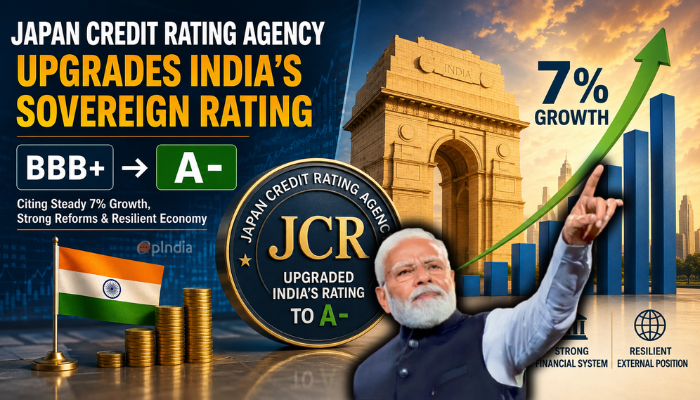
Japan Credit Rating Agency upgrades India’s sovereign rating to A- from BBB+, citing 7% growth: Know what it means

“Doomsayers were doomed, and India bloomed”. Prime Minister Narendra Modi said this recently as he praised India’s real GDP growth rate in the first quarter reaching 7.8%. While detractors of the Modi government engaged in casting aspersions on the GDP growth rate, the Japan Credit Rating Agency (JCR) relied on the sustained 7% growth to upgrade India’s sovereign rating from BBB+ to A- with a stable outlook.

The JCR had assigned India BBB+ since 2007. The A- is the highest rating any major international sovereign ratings agency has currently assigned to India, and the first A- category rating from an international sovereign rating agency in over 35 years. The last time India received an A rating was in 1988 by Moody’s, which assigned A2. However, Moody’s withdrew its rating in 1990-1991 due to the infamous balance-of-payments crisis.

Japan Credit Rating Agency cites steady 7% GDP growth to upgrade India’s sovereign rating from BBB+ to A-

In a press release dated 2nd September, the Japan Credit Rating Agency explained the rationale behind the upgradation.

It said that India has managed to maintain a high growth rate of 7%, strengthening the economy’s foundations, including digital public infrastructure and the Goods and Services Tax (GST) regime, enhanced quality of government spending, a healthier financial system, and an impressively resilient external position contrary to the state of affairs in the past.

“The Indian economy has maintained a high growth rate of around 7%, supported by robust private consumption and public investment. The government of India has steadily implemented policies conducive to productivity growth and economic development, including the development of digital public infrastructure and the implementation of the goods and services tax (GST), strengthening the country’s economic foundations as compared to the past,” the JCR said.

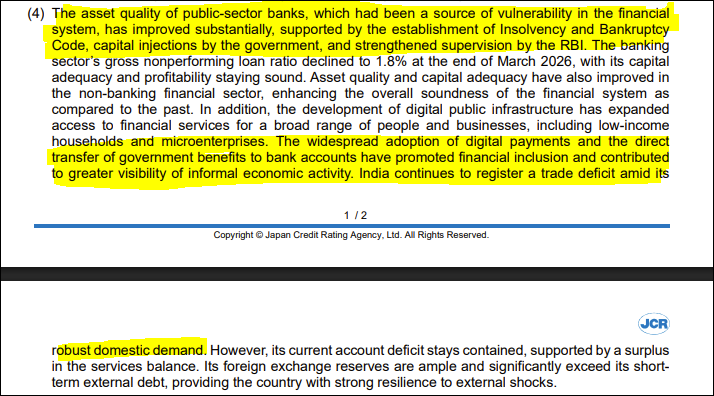
The Agency also noted that India’s banking sector’s nonperforming loan ratio has declined to below 2%, aided by the establishment of the Insolvency and Bankruptcy Code and the Reserve Bank of India’s (RBI) “strengthened financial supervision and macroprudential policies.”

It further pointed out that the financial foundation of the non-banking financial sector has also been bolstered, significantly contributing to the improvement in the soundness of the financial system in recent years.

In view of India’s strong economic growth, economic policies that reinforced the foundations for growth, as well as the improved health of the financial system, the JCR said that they have upgraded India’s Foreign Currency and Local Currency Long-term Issuer Ratings to “A-”.

“Considering India’s solid economic growth, the effectiveness of economic policies that strengthen the foundations for growth, and the improved soundness of the financial system, JCR has upgraded the Republic of India’s Foreign Currency and Local Currency Long-term Issuer Ratings by one notch to “A-”. JCR has also raised the country ceiling by one notch to “A,” the JCR stated.

Source: JCR press release

Highlighting India’s 1.4 billion population and GDP of USD 3.9 trillion, the Japan Credit Rating Agency said that India grew 7.7% in real terms in FY26 and 7.8% in the first quarter of FY27 and expected India to grow at a rate above 6% in FY27.

Inflation increased amidst unfavourable weather and West Asia war, but within RBI’s target: JCR highlights structural challenges

The JCR noted that while inflation has surged since early 2026, with an increase in food prices due to adverse weather conditions and higher energy prices resulting from the West Asia war, it has remained within the RBI’s target range

“Inflation has been rising since the beginning of 2026, reflecting higher food prices caused by unfavourable weather conditions and higher energy prices amid escalating tensions in the Middle East. Nevertheless, the inflation rate has remained within the RBI’s target range,” it said.

The JCR also pointed out certain “structural challenges” that keep fiscal deficits persistently high. These challenges, as per JCR, are:

  • complex intergovernmental fiscal relations;
  • fiscal transfer arrangements aimed at reducing disparities among states; and
  • fiscal management that is susceptible to electoral cycles.

The agency, however, noted that in recent years, the Indian government has curbed expenditures on subsidies and placed greater emphasis on capital expenditure, especially infrastructure investment.

“In recent years, however, the government has restrained growth in current expenditures including subsidies while placing greater emphasis on capital expenditure, particularly infrastructure investment, that helps raise the economy’s potential growth rate,” it said.

Meanwhile, the Modi government has also reduced the fiscal deficit from 4.7% of GDP in the previous fiscal year to 4.4% while maintaining capital expenditure at a high level. The central government debt-to-GDP ratio stood at 56.1% at the end of FY2026 and is expected to decline gradually.

However, the agency says that the general government debt, including that of state governments, and the associated interest burdens remain high.

Asset quality of public-sector banks improved “substantially”

The Japan Credit Rating Agency study further indicates that the establishment of the Insolvency and Bankruptcy Code, capital injections by the government, and strengthened supervision by the RBI have resulted in the substantial improvement in the asset quality of public-sector banks.

It further noted that the Indian banking sector’s gross nonperforming loan ratio declined to 1.8% at the end of March 2026, with its capital adequacy and profitability staying sound.

“Asset quality and capital adequacy have also improved in the non-banking financial sector, enhancing the overall soundness of the financial system as compared to the past. In addition, the development of digital public infrastructure has expanded access to financial services for a broad range of people and businesses, including low-income households and microenterprises,” the JCR stated.

The JCR lauded the Modi government for the massive adoption of digital payments and the direct transfer of government benefits to bank accounts of beneficiaries. This rapid adoption of the digital payments system for disbursal of government benefits directly not only promoted financial inclusion but also caused increased visibility of informal economic activity.

“India continues to register a trade deficit amid its robust domestic demand. However, its current account deficit stays contained, supported by a surplus in the services balance. Its foreign exchange reserves are ample and significantly exceed its short-term external debt, providing the country with strong resilience to external shocks,” the JCR concluded.

Source: JCR press release

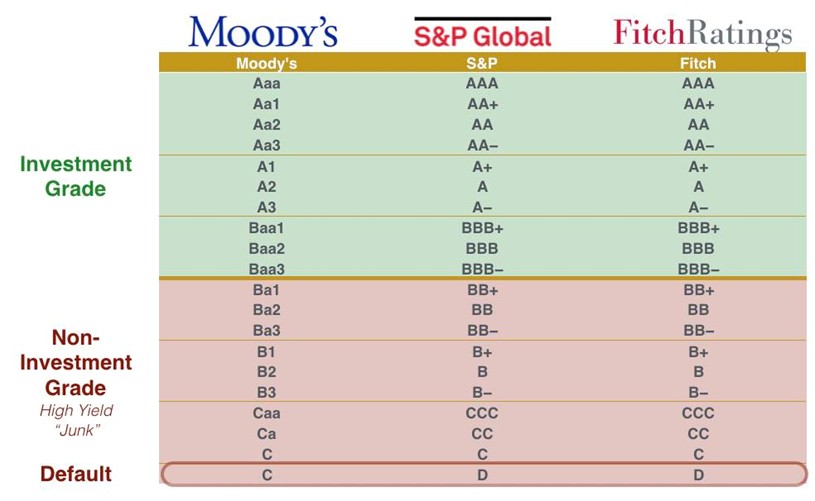
AAA, A, A-, BBB, BB: What sovereign credit ratings are and what they mean in practice?

A sovereign credit rating is an independent research-based opinion of a national government’s ability and willingness to meet its debt obligations on and in full. Various rating agencies assess growth, financial balances and debt burden, external finances, including reserves, current account position, the financial system, institutions and policy credibility, alongside political and economic stability.

These ratings use letter grades such as:

  • AAA / AA, which means very high credit quality.
  • A, including A-, which means high credit quality, indicating high certainty of fulfilling obligations.
  • BBB, including BBB+, which indicates adequate capacity, though more vulnerable to unfavourable economic conditions.
  • BB and below indicate speculative or non-investment grade.
  • C signifies an extremely high risk of default pertaining to the payment of financial commitments.
  • D reflects that the security is either in default or is highly likely to default in the near future.

Here the “+” and “-” modifiers indicate relative standing within a category. A one-notch pivot from BBB+ to A- moves from the top of the BBB (adequate capacity) band into the A (high credit quality) band.

Source: ETF Trends

In the context of the JCR’s upgradation of India’s rating, it has essentially upgraded India from the adequate capacity category BBB+ to the high credit quality band A-.

It is, however, notable that these ratings are opinions, not any automatic market event. A higher sovereign rating, though, can over time bring down the risk premium on government and corporate debt, particularly for entities whose ratings are capped by the sovereign or country ceiling.

Given India borrows massively domestically, the direct impact on the Centre’s rupee debt of such ratings is very limited, although the bigger channel is external commercial borrowing by companies alongside the overall cost of capital.

An A- rating might improve investor access for some, as in many cases funds and insurers have mandates that consider A- rated paper more positively than BBB.

JCR is more optimistic than S&P, Fitch and Moody’s

If we compare the ratings by the “Big Three”: Fitch Ratings, S&P Global Ratings, and Moody’s Ratings, the Japan Credit Rating Agency’s rating stands higher. S&P rated India BBB- in August 2025; Fitch Ratings has also placed India in the BBB band, while Moody’s has put India at Baa3, equivalent to BBB.

India on a positive trajectory: Government of India welcomes JCR ratings

Notably, over the past year, India had previously received sovereign rating upgrades from major international rating agencies. Morningstar DBRS upgraded India’s sovereign rating in May 2025, followed by S&P Global Ratings in August 2025 and Rating and Investment Information, Inc. (R&I) and Japan in September 2026.

In a press release issued on 2nd September, the Ministry of Finance said, “The Government of India welcomes the decision of Japan Credit Rating Agency (JCR) to upgrade India’s Long-Term Foreign Currency and Local Currency Issuer Ratings by one notch from ‘BBB+’ to ‘A-’, while maintaining the Stable Outlook. JCR has also raised India’s country ceiling by one notch to ‘A’.”

Meanwhile, Union Minister of Commerce and Industry, Piyush Goyal, wrote on X: “Data Doesn’t Lie! Japan Credit Rating Agency (JCR) has upgraded India’s sovereign rating to A- from BBB+, citing steady ~7% growth, strong digital public infrastructure & GST, and a healthier banking sector. Global institutions are giving India’s growth story the stamp of approval it deserves.”

Pakistan raises $3 billion in Eurobonds: How Islamabad is selling another loan as an economic triumph

0

Pakistan is celebrating a fresh US$3 billion borrowing from international investors as a landmark economic achievement.

The country’s Finance Ministry has described the transaction as its largest-ever international bond issuance in a single transaction, highlighting nearly $6 billion in investor orders as evidence of renewed confidence in Pakistan’s economy and its return to global capital markets.

But beneath the celebratory language is a rather simple reality:

Pakistan has borrowed another $3 billion.

It has not earned $3 billion. It has not received $3 billion in foreign direct investment. And it certainly has not received a $3 billion grant.

International investors have lent money to the Pakistani government, and Islamabad has promised to pay them interest and return the principal.

That distinction is particularly important given Pakistan’s existing financial position and its long-running struggle to manage external debt repayments.

What exactly has Pakistan done?

Pakistan has issued two dollar-denominated Eurobonds.

The first is worth $1.75 billion, with a maturity of five-and-a-half years and a 7.50% coupon.

The second is worth $1.25 billion, with a maturity of 10 years and a 7.90% coupon.

Together, they raise $3 billion for Pakistan. The transaction attracted nearly $6 billion in orders, meaning investors indicated demand for almost twice the amount the government eventually sold.

The Finance Ministry has called it a “landmark” transaction and said the strong order book demonstrates renewed investor confidence in Pakistan.

There is certainly a positive element here for Islamabad: international investors were willing to buy Pakistani sovereign debt in substantial quantities.

But the fundamental nature of the transaction does not change.

Pakistan went to the international market and borrowed money.

Why is Pakistan presenting it as a major economic victory?

Because access to international capital markets matters greatly for a country that has experienced repeated external financing crises.

Pakistan has spent years depending on multilateral institutions, bilateral partners and commercial lenders to meet its external financing requirements.

Its successful return to the Eurobond market therefore gives Islamabad another source of foreign currency.

It also allows Pakistan to spread some of its repayment obligations over longer periods and establish a more regular presence in international debt markets.

Finance Minister Muhammad Aurangzeb has described the latest issuance as “external validation” following sovereign credit-rating upgrades and has pointed to the diversified international investor base as evidence of renewed confidence.

That is a legitimate argument.

But there is a crucial difference between being able to borrow and being financially strong.

An investor agreeing to lend Pakistan money does not mean the investor has gifted Pakistan money.

The investor expects a return.

What does the $6 billion order book actually mean?

This is perhaps the most important number in Pakistan’s official narrative.

The government says the $3 billion issue attracted nearly $6 billion in orders.

That means investors were prepared to buy almost $6 billion worth of Pakistani bonds at the offered terms.

It is a positive indication of demand.

But Pakistan did not receive $6 billion.

It received $3 billion.

The remaining orders simply demonstrate that demand exceeded the amount Islamabad wanted to raise.

The distinction matters because a large order book does not transform debt into investment income.

If a bank receives applications for ₹20 lakh in loans but lends only ₹10 lakh, the applicant’s interest does not mean the borrower has received ₹20 lakh.

Similarly, Pakistan has received $3 billion.

The other $3 billion was demand, not money.

Why is this still a loan?

Because Pakistan has an obligation to pay it back.

The $1.75 billion bond carries a 7.50% coupon, which works out to approximately $131.25 million in annual coupon payments.

The $1.25 billion bond at 7.90% represents another approximately $98.75 million annually.

Together, the two bonds therefore imply roughly $230 million in annual coupon payments, assuming the stated coupon rates and a full year of payments.

And those payments are only the interest.

When the bonds mature, Pakistan must also return the original $3 billion principal.

So the transaction can be described as a successful capital-market operation.

It can be described as renewed access to international financing.

But it cannot accurately be described as Pakistan suddenly becoming $3 billion richer.

Pakistan has acquired $3 billion today in exchange for future financial obligations.

Is borrowing necessarily bad?

No. Because not all loans are bad. But when it comes to Pakistan, the borrowing is often seen as bad because of its inability to service loans on time. In essence, the nature of the transaction and whether the transaction is sensible is what makes the loan good or bad.

Sovereign borrowing is a normal part of government finance. Countries borrow to fund infrastructure, cover fiscal deficits, refinance existing debt and manage the timing of their liabilities.

Pakistan says that is precisely what it is trying to do.

The Finance Ministry says its broader debt-management strategy involves diversifying sources of financing, extending maturities, reducing refinancing and rollover risks and potentially replacing shorter-term and more expensive obligations with longer-term financing.

Finance Minister Aurangzeb has similarly said Pakistan is looking at instruments such as Sukuk and Panda Bonds to repay short-term, expensive debt and reduce rollover risks.

There is nothing inherently irrational about that strategy.

If Pakistan can replace a loan that is due shortly with financing that does not mature for five or 10 years, it can reduce immediate pressure on its foreign-exchange reserves.

But there is a critical distinction:

Debt management is not debt elimination.

Extending the maturity of a liability does not make that liability disappear.

Pakistan’s existing debt burden puts the $3 billion in perspective

The latest borrowing becomes more significant when viewed alongside Pakistan’s existing external debt.

Pakistan’s own January 2026 Debt Policy Statement put its external debt at approximately $91.4 billion at the end of September 2025. It also reported external loan disbursements of $12.1 billion during FY2025.

More importantly, Pakistan’s debt servicing, including principal repayments and interest, amounted to $13.3 billion during FY2025 and another $2.8 billion during the first quarter of FY2026.

That is the context in which another $3 billion of external borrowing needs to be viewed.

The question is not merely whether Pakistan can raise money today.

The more difficult question is:

Will Pakistan have enough foreign currency when these obligations become due?

The IMF’s assessment also illustrates the scale of Pakistan’s obligations. Its 2026 review projects Pakistan’s external debt service at about $14.8 billion in FY2025-26, before declining in the following fiscal year.

For a country that has repeatedly struggled to maintain adequate foreign-exchange buffers, these obligations matter enormously.

The UAE episode showed the problem very clearly

Perhaps the clearest recent example came earlier this year when Pakistan faced the repayment of approximately $3.5 billion owed to the United Arab Emirates.

The UAE facility had been repeatedly rolled over since 2018. But in March 2026, Islamabad failed to secure another rollover, the first such failure in seven years.

Pakistan subsequently moved to repay the facility.

Reuters reported that the repayment, combined with a $1.3 billion Eurobond repayment and other coupon obligations, placed significant pressure on Pakistan’s foreign-exchange reserves.

Pakistan eventually repaid approximately $3.45 billion in UAE deposits, according to the State Bank of Pakistan.

The episode is revealing because it demonstrates precisely why Pakistan’s ability to access external financing is so important.

For years, Islamabad has depended not only on receiving new loans but also on creditors agreeing to roll over existing loans and deposits.

When that accommodation is withdrawn, Pakistan has to find actual dollars to repay the creditor.

And that can put considerable pressure on its reserves.

The new $3 billion adds another future obligation

This is where Islamabad’s celebration of the latest borrowing needs to be treated cautiously.

The Eurobond may help Pakistan manage its immediate financing needs. It may allow Islamabad to refinance some expensive or short-term liabilities and push repayments further into the future.

But the new bonds also create another $3 billion principal obligation, along with substantial interest payments.

In other words, Pakistan has gained breathing room, but breathing room is not the same as becoming debt-free.

If Islamabad uses the money to improve its debt structure and simultaneously strengthens exports, tax revenues, foreign-exchange earnings and economic productivity, the borrowing could ultimately contribute to greater financial stability.

But if Pakistan repeatedly borrows new money to repay old money, it risks entering a cycle of:

borrow → repay → borrow again → refinance → repeat.

That is why the real test of Pakistan’s economic recovery is not whether it can successfully sell another bond.

It is whether it can eventually reach a position where it doesn’t need to keep borrowing simply to manage its existing obligations.

And then came the Finance Ministry’s embarrassing faux pas

There was also an ironic communications blunder surrounding the announcement.

Pakistan’s Finance Ministry appears to have briefly posted a draft version of its Eurobond announcement on X, rather than the final public version.

The draft still carried prominent legal warnings that it was “NOT FOR RELEASE, PUBLICATION OR DISTRIBUTION” in or into the United States, Australia, Canada or Japan.

It also contained lengthy legal language concerning the US Securities Act of 1933, UK financial regulations and restrictions on the distribution of the material to certain categories of investors.

Such disclaimers are not unusual in international bond transactions. They are designed to ensure that securities-related communications comply with the laws of different jurisdictions.

The faux pas was that the draft containing those restrictions apparently ended up being posted publicly by the very ministry responsible for the transaction.

There was an almost perfect irony to it.

The Finance Ministry was celebrating Pakistan’s return to sophisticated international capital markets while apparently uploading a document that explicitly said it was not meant to be publicly distributed.

The post was subsequently replaced, but the subsequent tweet included the same draft.

So, is this a victory for Pakistan?

It depends on what exactly is being described as the victory.

If the claim is that Pakistan has successfully regained access to international bond markets, there is substance to it.

If the claim is that nearly $6 billion in demand shows investors are prepared to take exposure to Pakistan again, that is also significant.

But if the transaction is being portrayed as though Pakistan has received $3 billion of wealth, that is not what happened.

The country has raised $3 billion in debt.

And given Pakistan’s existing external obligations, the more important question is not how successfully Islamabad can raise another loan today.

It is how successfully it can repay that loan tomorrow.

Pakistan’s latest Eurobond is therefore best understood as a capital-market success and a debt-management exercise, rather than an economic windfall.

The government has demonstrated that it can persuade global investors to lend it $3 billion.

The harder challenge remains unchanged: building an economy capable of generating enough dollars to repay the billions it already owes, and the additional $3 billion it has just borrowed.

After cars for MLAs, ₹100 crore for Waqf Board, free tuition for Muslim girls, Tamil Nadu CM Vijay announces ₹1,200 crore new Secretariat plan

On 3rd September 2026, the Tamil Nadu Chief Minister Joseph Vijay announced plans to establish a new Secretariat complex for ₹1,200 crore in Chennai.

The planned new Secretariat will comprise all state government departments in one complex built on 20 lakh square feet of land area. In addition, the state government will set up a Tamil Nadu Olympic City and a Motor Sports City in Chennai.

CM Vijay announced that the new Secretariat complex will be a state-of-the-art, futuristic, modern complex and will comprise offices of all government departments in a single campus, ditching the existing fragmented framework.

“The new project, estimated at ₹1,200 crore, will span 20 lakh square feet in Chennai, integrating all government departments into a modern, accessible, and eco-friendly facility while preserving the heritage of the existing Fort St. George. The government has control only over a small portion of the 107-acre Fort St. George campus, as the rest is managed by the Defence and the Archaeological Survey of India,” he said.

Explaining the rationale behind the decision, CM Vijay said that over the last 40 years, the number of government departments, staff, and administrative responsibilities have significantly increased. This has led to overcrowding in the current, ageing infrastructure.

“It is not possible to expand by undertaking further construction at Fort St George, which was built in the 17th century. A modern and integrated Secretariat complex will be established so that all departments can function from a single campus. To ensure efficient, world-class administration for the coming century, it is necessary to consolidate all government departments into one modern, accessible, and eco-friendly complex,” CM Vijay said.

The new complex will have fire safety systems, accessibility features for individuals with disabilities, and will be constructed in accordance with green building standards. Speaking about the amenities, the Tamil Nadu Chief Minister said the new Secretariat complex will have ample parking, conference halls, public service centres, and modern facilities for government staff.

In addition, the current Secretariat building, Fort St George, will also be preserved.

“The historically significant Fort St George will be preserved without altering its heritage character,” CM Vijay added.

The coterie that went berserk over the Central Vista Project goes silent over Vijay’s Rs 1,200 crore new Secretariat plan

In 2021, the BJP-led Central government announced the Central Vista Project, which involves the redevelopment of the area known as Central Vista Avenue, the area between Rashtrapati Bhavan and India Gate, where all the important buildings related to the Union government are located.

Back then, the Congress party and the entire anti-BJP coterie were outraged over the Central Vista Project and rose in opposition, alleging that the project was a ‘criminal wastage’ of money. Now that the Congress party is in alliance with the ruling Tamilaga Vettri Kazhagam (TVK), they are not calling CM Vijay’s new Secretariat plans a ‘criminal wastage’ of public money.

Tamil Nadu is under debt of ₹13.18 lakh crore, yet CM Vijay is prioritising appeasement and personal convenience?

The opposition All India Anna Dravida Munnetra Kazhagam (AIADMK) slammed the Vijay government’s move, accusing it of prioritising personal convenience and publicity over public welfare despite claims of an empty treasury.

The TVK government has been facing accusations of squandering state funds on freebies and Muslim appeasement-driven schemes even as the state’s financial health is deteriorating.

Recently, the TVK government announced that the state government will cover the full undergraduate tuition fees for Muslim female students admitted under the government quota in government, government-aided, and self-financing colleges. For this, the government allocated ₹20 crore.

Minister A M Shahjahan also announced the expansion of the Tamil Nadu Waqf Board scholarship for Muslim girls, from Classes 1-8 to Classes 9-10 at ₹2,000 per year. The scheme is expected to benefit 41,384 Muslim schoolgirls for Rs 8.28 crore.

An announcement was also made about a ‘minorities’ women’s college in Chennai through the Waqf Board, with an initial grant of ₹2.45 crore.

Moreover, the Vijay government has also announced a ₹100 crore interest-free revolving fund for loans to develop income-generating assets like marriage halls, commercial complexes, etc. on Muslim and Christian properties.

The state government will also construct a new headquarters for the Tamil Nadu Waqf Board at an estimated cost of ₹40 crore. The administrative grant for the state Waqf Board will also be raised to ₹5 crore.

In late August 2026, CM Joseph Vijay announced three free LPG cylinders a year for every family with an annual income below ₹2.5 lakh, under the Annapoorni Super Six scheme. While the scheme is likely to benefit 1.30 lakh families, it will cost the state exchequer over ₹4,000 crore annually.

CM Vijay has also burdened the state exchequer with fulfilment of his expensive poll promise of 8 grams (one sovereign) of gold to babies born in government hospitals. The Thaimaman Thanga Mothiram scheme will be run with an annual allocation of ₹756 crore for roughly 4.42 lakh rings. 

On one hand, CM Vijay has announced ₹1,200 crore new Secretariat complex construction plan, on the other, he pulled the plugs from the second airport project in Chennai.

CM Vijay cancelled the Parandur greenfield airport project that was advanced under the previous DMK government even as land acquisition was already underway, to fulfil his poll promise to protesting farmers.

By cancelling the Parandur airport project, which advanced to the stage of land acquisition after years of planning and clearances, CM Vijay essentially pushed Chennai’s second-airport project back to the initial site-selection phase.

On 19th August, CM Vijay announced that all 234 MLAs in Tamil Nadu will be provided cars for constituency travel and public service work. The MLAs will also receive a monthly allowance of Rs 75,000 for the driver’s salary, fuel and vehicle maintenance.

In addition, the government will also provide each MLA with Rs 25,000 a month to appoint an assistant and bear their salary expenses. 

Going by the math of report numbers, a monthly vehicle allowance of Rs 75,000 means Rs 9 lakh per MLA annually, amounting to a recurring expenditure of Rs 21.06 crore each year for the 234 members of the state assembly. The Rs 25,000 monthly assistant grant adds another Rs 3 lakh per MLA, or Rs 7.02 crore annually.

These two allowances alone would create an annual commitment of Rs 28.08 crore, and in a five-year assembly tenure, it will cost the state exchequer Rs 140.4 crore. The amount will go significantly higher with the purchase of 234 utility vehicles.

Notably, Tamil Nadu Electricity Minister CTR Nirmal Kumar released a white paper on the condition of the state’s electricity board, revealing an outstanding debt of Rs 2.47 lakh crore. Despite this huge debt burden, the TVK government said that there will be no electricity tariff hike and that the electricity scheme for farmers would continue.

As per the White Paper released by the TVK government itself, the total debt of Tamil Nadu has reached ₹13.18 lakh crore, including ₹10 lakh crore in direct state borrowings and ₹3.18 lakh crore in public sector undertaking (PSU) liabilities. The per capita burden has also risen, with every Tamil Nadu resident effectively carrying a debt share of nearly ₹1.29 lakh.

Despite these alarming figures, the Vijay government is prioritising freebies, Muslim appeasement and now a new Secretariat complex.