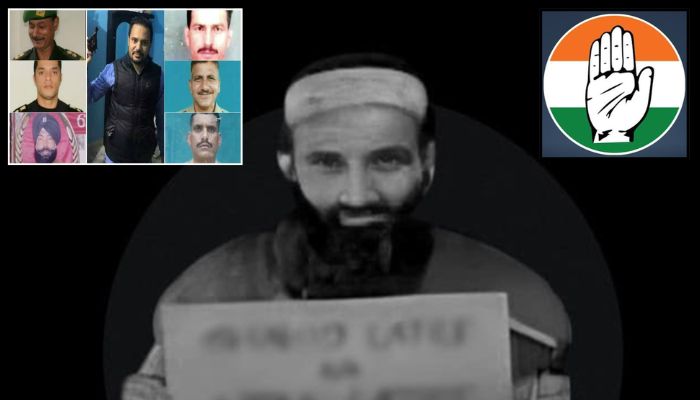
In another shocking example of the extent of its appeasement politics, the UPA government, led by then Prime Minister Manmohan Singh, released 25 Pakistani terrorists from Indian jails in 2010 as part of what was described as a “goodwill gesture” towards Pakistan. The group included terrorists linked to terror organisations such as Lashkar-e-Taiba (LeT), Hizbul Mujahideen (HM) and Jaish-e-Mohammed (JeM). The detainees were released on the advice of the Union Home Ministry and were later deported to Pakistan through the Wagah border.
God help our country! Shame! Pak terrorists freed in goodwill gesture – http://tinyurl.com/327q4qk
The decision came shortly before Manmohan Singh’s planned visit to Jammu and Kashmir in June 2010.
The terrorists had been detained under Section 19(1) of the Jammu and Kashmir Public Safety Act. Some had been shifted to prisons outside Jammu and Kashmir because of security concerns. Reports at the time said the detainees had also been given consular access before their release. The 25 Pakistani prisoners were eventually handed over to Pakistani authorities.
Among those released from different prisons were Noor Mohammad, Abdul Rashid, Nazir Mohammad, Mohammad Shafi, Rahim Din, Mohammad Sharief Malik, Karamat Hussain and Suhail Ahmad Kataria. Others were lodged in prisons including Agra, Naini, Varanasi, Tihar, Jodhpur and Sangrur.
Shahid Latif: The ‘goodwill gesture’ that came back to haunt India
One of the most controversial names in that list was Shahid Latif, a Jaish-e-Mohammed terrorist who had spent 11 years in an Indian prison. Latif had been arrested in Jammu and Kashmir in 1994 after infiltrating the Valley a year earlier. He was later deported to Pakistan following his release in 2010.
Latif was among the 25 militants released on 28th May, 2010. The release was part of the UPA government’s effort to their version of improving relations with Pakistan, a nation that carried out multiple terror attacks on India before 2010. After returning to Pakistan, Latif rejoined Jaish-e-Mohammed and eventually became an important figure in the organisation’s Sialkot network.
The consequences became particularly significant after the Pathankot terror attack in January 2016. Intelligence and investigation agencies identified Latif as the chief handler of the JeM terrorists who carried out the attack. The National Investigation Agency’s case records describe the Pathankot assault as an attack by heavily armed terrorists suspected to be from Pakistan and linked to the Pakistan-based JeM.
Pathankot attack: Seven security personnel killed
On 2nd January, 2016, heavily armed terrorists attacked the Indian Air Force station in Pathankot, Punjab. The attackers had infiltrated from Pakistan and targeted a strategically important military installation.
The security forces launched a major operation to contain the terrorists and protect the sensitive areas of the airbase. The Indian Air Force, Army, National Security Guard and other security agencies took part in the operation. The terrorists identified as Nasir Hussain, Hafiz Abu Bakar, Umar Farooq, and Abdul Qayum were neutralised after a prolonged counter-terror operation. The Ministry of Defence said the security forces prevented the attackers from reaching the technical area where aircraft, weapons and fuel storage facilities were located.
According to the Union Home Ministry, seven security personnel and one civilian were killed in the attack, while 37 security personnel and another civilian were injured. All the terrorists involved were eventually neutralised.
Investigators later linked Shahid Latif to the attack and identified him as the mastermind who helped coordinate the fidayeen squad. He arranged logistics including weapons, clothes, medicines and other supplies for the attackers. He was also described as being close to JeM chief Masood Azhar.
Shahid Latif killed in Pakistan in 2023
Nearly seven years after the Pathankot attack, Shahid Latif was himself killed in Pakistan. On 11th October, 2023, unidentified gunmen shot Latif and his brother near the Noor Madina mosque in Daska, in Pakistan’s Sialkot district.
According to officials, three motorcycle-borne attackers opened fire after Latif came out of the mosque following pre-dawn prayers. Latif was killed along with his brother. No group immediately claimed responsibility for the attack. Pakistani authorities described the incident as a targeted killing.
Latif had been designated a terrorist under India’s Unlawful Activities (Prevention) Act and was considered one of India’s most wanted terrorists. Indian officials said he had become a key JeM commander after being deported to Pakistan in 2010.
Vajpayee government had refused to release Latif during the IC-814 hijacking.
Shahid Latif’s release had previously been sought by Jaish-e-Mohammed terrorists during the 1999 hijacking of Indian Airlines flight IC-814.
The hijackers had demanded the release of several terrorists, including JeM founder Masood Azhar. The then Atal Bihari Vajpayee government released Azhar, Mushtaq Ahmed Zargar and Omar Sheikh in exchange for 154 passengers held hostage in Kandahar. However, Latif and several other names on the terrorists’ demand list were not released at that time.
Latif was instead kept in Indian custody and was later moved to Varanasi jail following the IC-814 hijacking and the 2001 Parliament attack, with concerns that his associates could try to free him from J&K. Yet, years later, the UPA government released him along with 24 other Pakistani militants as part of its outreach to Pakistan.
The decision by the UPA government to release these 25 detainees in 2010 without securing the release of a single Indian prisoner from Pakistani custody clearly reflects a strategy centred on appeasement politics in the name of a “goodwill gesture”.
US President Donald Trump randomly lays claim to distant lands and islands on Truth Social quite often. However, on 6th September, Donald Trump made an extraterrestrial claim when he published an image of the Moon overlaid with the text “THE MOON IS OURS” and a US flag.
In the same flurry of posts, Trump earlier posted mock-up images of a proposed “next-generation US Space Force service dress uniform in space grey, appearing to be inspired by Starship Troopers film uniforms and “modernized for the guardians of the space domain”.
These, however, are just social media posts at this point in time, although they are an indication of the Trump administration’s future extraterrestrial ambitions.
When Donald Trump created the Space Force in 2019 during his first term as US President, he made it clear that he would treat space as a domain for American primacy and dominance. In his second term, President Trump signed an executive order in December 2025, directing a crewed lunar landing by 2028, initial elements of a permanent lunar outpost by 2030, and deployment of nuclear reactors on the lunar surface.
These plans are in line with Trump’s broader “America First” space policy asserting commercial development, resource utilisation, and competition with China. In fact, when Trump has to justify his adventures, he conveniently says, “If not us, China will do it”.
What international law says
While Donald Trump’s idea of the US taking over the Moon sounds rhetorically amusing, it is legally impossible. Under the 1967 Outer Space Treaty, signed after the United Nations General Assembly discussions, to which the US is a signatory, alongside all major spacefaring countries, the Moon and other celestial bodies are not subject to national appropriation by any means.
“Outer space, including the Moon and other celestial bodies, is not subject to national appropriation by claim of sovereignty, by means of use or occupation, or by any other means,” Article II of the OST states.
Article III of the UN agreement states that all exploration and use of outer space, including the Moon and other celestial bodies, will be in line with international law, for maintaining international peace.
“States Parties to the Treaty shall carry on activities in the exploration and use of outer space, including the Moon and other celestial bodies, in accordance with international law, including the Charter of the United Nations, in the interest of maintaining international peace and security and promoting international co-operation and understanding,” it states.
Are Trump’s territorial and extraterrestrial claims about projecting strength ahead of midterm elections?
For any troubled, if not failed, political leader in power, promising territorial claims, reversing perceived historical wrongs, and exceptionalism are the greatest means to project strength. President Donald Trump’s second term in office has been all about wars he never stopped, wars he promised to secure and end but failed, and laying claims over strategically significant islands and countries, and now even the Moon.
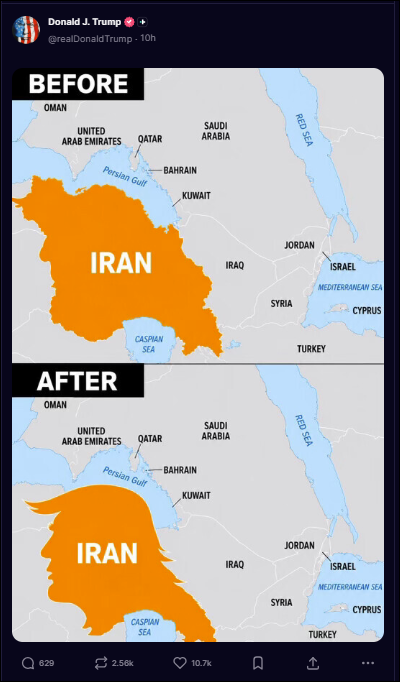
On 6th September, Trump published an image on Truth Social that included an Iran map resembling Trump’s silhouette, indicating his victory over Iran and Tehran’s subjugation. Trump’s various posts have indicated his aspirations to take over Kharg Island and the Strait of Hormuz.
In recent months, Trump has both offered and threatened a US takeover of the strategically significant Arctic territory of Greenland. Trump has claimed that the US may seize control of the autonomous Danish territory if Denmark will not agree to a deal. This one-sided takeover bid comes even as neither Greenland nor Denmark has shown any interest in handing over their territory and autonomy to the US.
Not only Greenland, but Trump has also been pushing for a US takeover of neighbouring Canada over supposed unfavourable policy decisions by Ottawa. Trump repeatedly and insultingly calls the Canadian Prime Minister Mark Carney “Governor” and Canada the 51st state of the US. Trump’s interest in merging Canada into the US is growing stronger even as neither the Canadian government nor the citizens are in favour of joining the US. Trump even claimed earlier that the US was “seriously considering” naming Lake Ontario “Lake America.”
Donald Trump has also been eyeing the Panama Canal. Months after returning to power, Trump warned of reasserting US control over the canal as he accused Panama of levying “exorbitant charges” to utilise the passage and coddling China. Trump had declared, “China is operating the Panama Canal, and we didn’t give it to China — we gave it to Panama — and we’re taking it back.”
Trump has also laid claim to Micronesia and the Marshall Islands. In a social media post, he shared an image labelling these sovereign Pacific island nations under “U.S. Territories.”
Donald has consistently been making ridiculous but bold territorial claims embellished with appealing visual spectacle, and portraying US activity or prospects of US presence as exclusive leadership.
Trump campaigned on tall promises of ending the Russia-Ukraine war. However, after over a year and a half into his second term, the war is raging on into its fifth year, with all mediation efforts by Trump falling flat.
In February 2026, the US joined Israel to launch an offensive against Iran in West Asia, while Trump initially described it as a short and decisive action to ‘liberate Iran’ and destroy its nuclear program; the conflict has dragged on for over six months. Trump’s Iran campaign has turned out to be a grinding conflict of strikes, counterstrikes, economic disruptions, and fragile, rather farcical ceasefires.
Neither the US has been able to overthrow the Mullah regime nor fully dismantle Iran’s nuclear and missile programs. Despite inflicting severe economic blows, Tehran continues to project strength, has allies by its side, and pushes back against the US offensive, showing no signs of defeat.
While the US wanted to cripple Iran economically, Washington itself has spent over $37.5 billion in direct military costs. The Iran war has inflicted way higher economic costs on Americans. Trump is facing global and domestic criticism for his unplanned offensive against Iran and its global implications, particularly on energy supplies.
Amidst all the criticism and dwindling popularity, Trump needs something to project strength and convey to the American people that he is somehow going to make America ‘great’ and ‘invincible’ not only on this planet but even on the Moon.
Cases of illegal religious conversion are increasing in parts of West Bengal. Recent incidents involving Christian religious activities have drawn protests from residents. The issue has gained fresh attention after an incident in Hingalganj in North 24 Parganas, where residents confronted a foreign national visiting the Sundarbans over allegations of religious conversion.
According to reports, the Argentine national had been staying in the Hingalganj Assembly constituency area for several months. Local sources confirmed that he had learnt Bengali and had established links with several house churches in the area. Residents accused him of approaching local people and attempting to persuade them to embrace Christianity. The allegations were widely circulated on social media and subsequently became the subject of local controversy.
News coming in from North 24 Parganas district of #WestBengal.
A Christian Missionary from #Argentina has been living in #Hingalganj Assembly Constituency area for months and converting Hindus.
The man has learnt Bengali language and built several house church in the area. He… pic.twitter.com/AE44NFKxGG
The matter escalated when villagers questioned the foreign national about his religious activities and his presence in the area. Locals sought answers about whether he was involved in conversion activities and whether he possessed the required permissions for his work.
Around the same time, police in Hingalganj questioned three people, including two foreign nationals, after receiving information about an alleged conversion-related gathering in Sandelerbil village panchayat. Police and local sources said people from different countries had gathered at a house and were accused by villagers of trying to persuade tribal residents and people belonging to other faiths to change their religion.
Some villagers also revealed that people from Kolkata, as well as Australia, Germany, Bangladesh, and Argentina, regularly visited the house. Residents said that economically weaker people living near the Sundarbans were being offered money or other inducements. Police, however, are still examining the identities of those involved, their purpose of visiting the area and whether there was any basis for the allegations.
The issue therefore remains under investigation, but the incident has clearly highlighted the growing cases of organised religious activities in the region.
Hasnabad coaching centre sparks fresh protest
A similar controversy surfaced this month in Hasnabad village of North 24 Parganas district, where a Christian-run free coaching centre for children became the centre of a local protest.
According to those protesting, children were being provided free tuition at the centre, but religious material related to Jesus and the Bible was also being used. Members of the Hindu Jagran Manch and local residents arrived at the centre and demanded that the activities be stopped.
News coming in from North 24 Parganas district of #WestBengal.
In #Hasnabad, Christian Missionaries opened a free coaching centre for small children.
In the coaching centre, small children were taught about Jesus and Bible along with other subjects.
One protester, identified as Suparna Bera, said they had come to protest because they believed the centre was being used for religious activities. Pointing towards the walls, she said, “There are no pictures of great personalities or Hindu deities on these walls. Why should this be done? Jesus’ pictures are painted all over the walls. Go inside and see for yourself.”
When asked about their demand, she said, “We demand that this be shut down immediately. Why should this continue? This must be stopped.”
Bera further claimed that the activities at the location had been continuing for around 20 years. She said locals had been aware of the matter earlier but had not come together to protest. “We knew everything, we understood everything, but no one was by our side back then. Now our Hindu community has awakened, and we also want to carry out this protest,” she said.
A person associated with the centre gave a different explanation. When asked why children were being taught there, the person said, “We just teach free tuition to these children. For the children’s study… we set this up to teach them.”
Asked why the centre had been stopped, the person said villagers and members of the local groups had arrived and objected to the activities. The person also indicated that the centre would not continue religious activities if local residents opposed them.
Another protester said that the area was Hindu-majority and claimed that children were being brought to the centre and exposed to Christian teachings. The protester said that pictures of Jesus could be seen on the walls and that references to Jesus were also present in notebooks and books.
Sonamukhi conversion led to another protest
Another incident has been reported from Sonamukhi in Bankura district, where a group of locals confronted people during a Christian religious programme.
According to videos and reports circulating online, the programme was described as an attempt to convert local residents and tribal people under the guise of a healing or prayer programme. Members of a local group reached the spot and questioned the organisers about the material being distributed there.
During the confrontation, one man repeatedly asked, “Hey, give us the books! You’re taking the Bible here!” He then questioned another person, asking, “What is in his hand? What is in his hand? Show it!”
The protesters also asked what was being taught at the gathering and whether the books contained the Bible. One organiser tried to defend the gathering, saying that the material was meant for prayer. The exchange became heated, with people in the gathering repeatedly saying, “God is formless! God is formless!”
Bengali woman catches Christian evangelist red-handed and confronts her
The controversy over conversion activities also surfaced in Jalpaiguri in July, when a Bengali woman confronted a Christian missionary during an argument over religion.
📍Jalpaiguri, West Bengal
A Bengali Hindu woman confronted and slapped a Christian missionary during an alleged attempt to convert Hindus.
This is what one vote can achieve, people feel empowered to stand up for their beliefs and resist what they perceive as unlawful or… pic.twitter.com/QZTzzl4oLi
In a video of the confrontation, the woman questioned the missionary about Sanatan Dharma and challenged the idea that it had a single founder. “Who is the father of Sanatan? Does Sanatan have a father? Sanatan is never a person! Sanatan is a religion!” she said during the exchange.
The confrontation reflected the increasingly aggressive nature of some local disputes over religious preaching and conversion. Such incidents have become flashpoints, with residents questioning missionaries over their conversion activities.
Locals finally push back as conversion cases rise
Taken together, the recent incidents in Hingalganj, Hasnabad, Sonamukhi and Jalpaiguri show how locals are increasingly speaking out against attempts to convert people in their communities. Instead of remaining silent, locals have begun questioning religious activities taking place in their neighbourhoods, confronting those involved and demanding answers about what is being taught or offered to residents. In some cases, these objections have led to heated confrontations and the disruption of religious gatherings held in the name of healing and education.
For the locals raising these objections, the issue is not simply about religion but about the illegal conversion which is happening within their own communities. They say they do not want economically weaker families or children to be approached with religious teachings, money or other inducements in the name of education, charity or prayer. Their protests show a growing willingness among residents to come forward themselves and question activities they believe could affect the religious character of their communities.
The recent protests also show that locals are no longer willing to ignore activities that they suspect may be linked to religious conversion. Whether it is questioning foreign nationals in Hingalganj, protesting outside a coaching centre in Hasnabad or confronting people during a prayer gathering in Sonamukhi, residents have increasingly chosen to raise their voices and demand action. At the same time, the cases of forced or induced conversion must be established through proper investigation and evidence.
Amid the West Asia conflict and the prolonged Russia-Ukraine war, India has once again emerged as a major energy supplier to Europe. In the month of August 2026, Indian refineries supplied over 60 per cent of the diesel or gasoil that passed through the Bab-el-Mandeb Strait towards Europe. India is keeping diesel flowing to Europe as Russian exports declined to significant lows.
Three-fifths of diesel supplies to Europe came from India
Reports say that more than 2,00,000 barrels per day (bpd) of diesel and gasoil were moved on the route across the Red Sea chokepoint on vessels bound for Europe in the month of August this year. Of this volume, around three-fifths comprised Indian supplies. This signifies a major role India has grown to play in Europe’s refined fuel market.
The Indian diesel supplies to Europe surged amidst a sharp fall in Russia’s exports. Russia’s seaborne diesel exports averaged merely 150,000 bpd in the first 25 days of August 2026, going down from 610,000 bpd year-on-year and 81% below the five-year seasonal average.
Meanwhile, US seaborne diesel exports to Europe from outside the region were recorded at 520,000 bpd in August, which is around half of those imports, up from a quarter last year; however, they slumped sharply from a first-half peak of 540,000 bpd to 350,000 bpd in the second half.
Notably, India is the world’s fourth-largest refiner, with 258.1 million tonnes per annum capacity, and exported around 61.5 million tonnes of petroleum products in FY 2025-26. However, a Vortexa analysis indicates that India’s crude and condensate imports have dropped to 3.8 million bpd in August from about 4.8 million bpd a year earlier.
How Russia’s loss became India’s gain in European fuel market
While Europe’s eastern diesel supply route through Bab-el-Mandeb, the southern entrance to the Red Sea, linking the Suez Canal and Mediterranean, has recovered after earlier disruptions, it continues to face difficulties.
Russia, which once was a major diesel supplier to Europe, has witnessed exports decline sharply due to Ukrainian drone strikes on refineries and export infrastructure. Reports say that the Perm Oil Refinery has halted operations after a Ukrainian drone attack caused significant damage to technological units 21st August.
Ukraine has been targeting Russia’s energy infrastructure to cripple its economy and undermine war efforts by cutting financial income. Perm is now operating at 28 per cent capacity, with no diesel cargoes from Tuapse since a strike in May this year.
India’s complex and export-oriented refineries, particularly the Jamnagar refinery of Reliance, have spare capacity and can refine a wide range of crudes, then supply products to the highest-paying markets.
Indian-processed diesel flowing through Bab-el-Mandeb is significant because the West Asia crisis has rerouted or constrained traditional Gulf supplies, making the Red Sea corridor more crucial for some east-to-west product movements, although this remains a risky affair.
Amid media reports and queries by employee associations at the Indian Space Research Organisation (ISRO) over ISRO undergoing privatisation, the space agency has issued an extensive clarification on 6th September. ISRO addressed all the queries about the importance of ISRO in the future after the opening of the space sector to private players. ISRO called the claims that attempts are underway to privatise ISRO or reduce its role “completely baseless and incorrect”.
“ISRO will never be privatised”: ISRO dismisses privatisation claims
In a statement issued on Sunday, ISRO said, “ISRO’s Next Chapter: Leading India’s National Space Ecosystem. There has been considerable reporting in parts of the media around the future role of ISRO, including speculations and misinformation that there is an attempt to privatise ISRO or reduce its role. These assertions are completely baseless and incorrect. We wish to categorically state that ISRO will neither be privatised nor will its importance be diminished.”
The premier space agency stated that it will remain India’s “principal institution for advanced space research and technology development, national and strategic missions, space science and exploration, and critical and frontier space capabilities.”
Participation of private sector in space will not reduce ISRO’s role
Addressing how the entry of private players in the space sector will impact ISRO and its role in the future, ISRO said that Participation of the private sector in space is not about reducing ISRO’s role. It said that the entry of private players will enable ISRO to focus even more strongly on the next generation of India’s space programme, while industry scales mature technologies and capabilities.
“What is changing is not the importance of ISRO, but the scale and structure of India’s space ecosystem,” ISRO said.
Contrary to the narrative created by several media reports, there is no tussle between ISRO and private players looking forward to entering India’s space sector.
“The space-sector reforms initiated since 2020 and institutionalised through the Indian Space Policy 2023, along with progressive liberalisation of FDI policy, aim to create a larger, stronger and globally competitive Indian space ecosystem,” ISRO said.
ISRO further stated that participation of industries, start-ups and academia is not about diminishing ISRO’s importance but about complementing and multiplying ISRO’s capabilities.
“Industry, start-ups and academia are being enabled to participate across the space value chain, complementing and multiplying ISRO’s capabilities. The reforms should therefore be seen as ecosystem expansion and capability multiplication, not privatisation,” it said.
ISRO-led national space ecosystem: Mature tech transfer does not mean ISRO is withdrawing from that domain
Speaking about multiple mature technology transfers to private players and the misinterpretation that it amounts to ISRO’s withdrawal from that domain, ISRO said that this interpretation is devoid of factual merit.
“As India’s industrial and technological capabilities have grown, mature and scalable activities can increasingly be undertaken by Indian industry. ISRO has already transferred around multiple technologies to industry. Transferring a mature technology does not mean ISRO is withdrawing from that domain,” it said.
Clarification regarding media reports on concerns relating to Space Sector Reforms and the role of ISRO
ISRO’s Next Chapter: Leading India’s National Space Ecosystem There has been considerable reporting in parts of the media around the future role of ISRO including speculations…
Contrary to the ‘withdrawal’ narrative, these tech transfers “enable large-scale production, commercialisation, innovation and access to global markets while allowing ISRO’s scientific and technical manpower to concentrate on advanced research, next-generation technologies and complex national missions.”
“The transition is therefore towards an “ISRO-led national space ecosystem,” ISRO declared.
ISRO to focus on frontier R&D, advanced tech, human spaceflight and development of strategic national capabilities
Contrary to the ‘ISRO to lose its significance’ bogey, ISRO indicated that its role is going to become even more crucial and diverse in the coming times as the space agency will bolster its role in frontier R&D, advanced technologies, human spaceflight, next-generation launch systems, deep-space and planetary missions.
“ISRO’s role will progressively strengthen in areas where its scientific expertise matters most: frontier R&D, advanced technologies, human spaceflight, next-generation launch systems, deep-space and planetary missions and strategic national capabilities,” it said.
ISRO will continue developing cutting-edge technologies, including advanced payloads for communication, navigation and Earth observation, sensors, propulsion systems and other critical technologies.
It further emphasised that mature and routinely manufactured systems can increasingly be scaled through industry. ISRO further stated that production of mature launch vehicles, routine satellites and other established systems “can increasingly be undertaken by industry or PSUs through appropriate competitive processes.”
“This allows ISRO to devote more resources and scientific manpower to the next generation of technologies and missions, while the wider ecosystem provides the investment, manufacturing capacity and scale required by an expanding national space programme,” it added.
ISRO opens up on the “Next Frontier: Space Station, Moon and Planetary Exploration”
ISRO said that the transition of India’s space sector with the entry of private players is particularly significant in view of the Space Vision 2047.
“India’s ambitions include establishing the Bharatiya Antariksh Station by 2035, undertaking an Indian crewed mission to the Moon by 2040, developing next-generation and reusable launch systems, pursuing sustained lunar and planetary exploration, and establishing India as a major global space power,” it said.
The ISRO asserted that these are technologically demanding missions that require ISRO to focus on advanced research and capabilities that cannot be substituted by commercial activity.
“The objective is therefore to enable industry to scale mature capabilities while ISRO pushes India towards the next technological frontier. The new institutional architecture gives each part of the space ecosystem a distinct role,” it said.
ISRO remains at the core organisation while Department of Space provides overall policy direction
ISRO stated that the Department of Space provides overall policy direction and ISRO remains the core organisation for advanced R&D, technology development and national missions.
“IN-SPACe facilitates and authorises the participation of non-government entities, while NSIL undertakes commercialisation and industry-led utilisation of mature capabilities. Industry and start-ups contribute investment, innovation, manufacturing capacity and market access,” it said.
Regarding the ownership and control of critical national space infrastructure and strategic capabilities, ISRO said that these “will continue to remain with the Government.”
It added that private participation in operations and services will be enabled where appropriate and will remain subject to national-security, safety and other regulatory requirements.
ISRO further clarified that strategic and nationally critical capabilities “will continue to be governed by security, safety, quality and national-interest considerations.”
Highlighting how private participation in the space sector post 2020 reforms is increasing and thriving, ISRO said, “From only a handful of Indian space start-ups in 2020, India today has more than 450, working across launch vehicles, satellites, propulsion, ground systems, Earth observation, communications and space applications.”
Indian space economy aspiration to grow from $8.4 billion to $44 billion by 2033 requires private participation: ISRO
ISRO also emphasised that while the Indian space economy is currently estimated at around $8.4 billion, India aims to increase its share of the global space market to $44 billion by 2033.
For this, government resources and ISRO’s manpower alone are insufficient. “It requires private capital, industrial capacity, entrepreneurship and global market access. A stronger Indian space industry can augment ISRO’s capabilities, strengthen domestic supply chains, attract talent and investment, increase production and competitiveness, and enable India to capture a larger share of the global space economy,” ISRO clarified.
The Next Frontier: Space Station, Moon and Planetary Exploration This transition is particularly important in the context of Space Vision 2047. India’s ambitions include establishing the Bharatiya Antariksh Station by 2035, undertaking an Indian crewed mission to the Moon by…
ISRO scientists sought clarity over ‘privatisation’
The ISRO clarification comes amidst media reports, speculations and misinformation by the detractors of the Modi government as well as a written query by nine employee bodies representing staff across major ISRO centres to ISRO Chairman and Department of Space Secretary V Narayanan.
In a five-page representation, dated 4th September, employee associations from centres including the Vikram Sarabhai Space Centre (VSSC), Satish Dhawan Space Centre (SDSC), UR Rao Satellite Centre (URSC), Liquid Propulsion Systems Centre (LPSC), Space Applications Centre (SAC), National Remote Sensing Centre (NRSC) and ISRO Propulsion Complex (IPRC) sought clarification on ISRO’s future role amidst ‘privatisation’ claims.
How India’s space sector was opened for private players
While the idea was taken into consideration before also, the Modi government’s push to bring private companies into the space sector began explicitly in 2020 as part of the broader economic reforms announced during the Covid-19 pandemic.
In May 2020, the fourth tranche of the Atmanirbhar Bharat package was announced by Finance Minister Nirmala Sitharaman. The minister said that the government wanted private companies to become partners in India’s space journey.
“The Indian Space Research Organisation has brought a lot of laurels to the country. However, the private sector is also doing a lot of work in the arena now. We want the Indian Private sector to be a co-traveller in India’s space sector journey,” Sitharaman said.
The government announced that private companies would be allowed to use ISRO facilities and other relevant assets to improve their capabilities. The government’s intent was never to fully privatise ISRO but to make better use of India’s existing space infrastructure and allow startups and private companies to develop their own capabilities under ISRO’s guidance.
For private participation, IN-SPACe was created as a regulatory and facilitation mechanism, while NewSpace India Limited (NSIL) has a commercial role in taking ISRO-developed technologies and systems to industry.
The Indian Space Policy 2023 subsequently allowed private companies a wider role across the space value chain, including the development and operation of space systems.
During the infamous Shaheen Bagh sit-in protest back in 2020, Islamo-leftists decided to bring forward women and children to protest against the Citizenship Amendment Act. Five years later, the Cockroach Janta Party-led ‘student protest’ in New Delhi saw a massive presence of ideologically driven youngsters, hurling abuses against Hinduism, Brahmins, Prime Minister Narendra Modi and continuing the degeneracy since then. One such Hinduphobic CJP supporter is Nishu Azad.
‘Tum Talwar uthao, hum kalam uthayenge’: Nishu Azad, the Ambedkarite CJP ‘cockroach’ who didn’t know the full forms of NEET and CBSE
Nishu Azad is a 15-year-old Dalit student and social media ‘activist’ from Uttar Pradesh’s Ghaziabad, who identifies as an ‘Ambedkarite’ and atheist. Azad gained prominence during the CJP protests in July this year.
The self-declared ‘Ambedkarite’ Nishu Azad was actively involved in the CJP protest. She gave various interviews to the media.
Nishu Azad would deliver aggressive speeches, confront critical media questions with expectedly juvenile arguments, read ‘Tum Talwar uthao, hum kalam uthayenge’ type poems, but fail to even tell the full form of NEET (National Eligibility cum Entrance Test), the very examination that triggered the CJP agitation. She would boast to be a CBSE (Central Board of Secondary Education) student and not know CBSE’s full form.
Meet 15 yo CJP Sherni Nishu "Azad"
Even Days: "Tum Mandir Banao, Hum School Jaenge"
Tum Talwar Pakdo, Hum Kalam Pakdenge"
Odd Days: Full form of NEET "NASA Eligible Karke Kuch hai.."
CBSE Fullform Don't know.
"Fault of system that CBSE Fullform is not taught"
To escape the embarrassment, Azad blamed the education system, which somehow has been so careless that it failed to teach Nishu Azad these basic full forms.
In June this year, Nishu Azad was seen hurling abuses at PM Modi and inviting people to a 13th-day funeral feast for PM Modi’s death. Now she has issued a ‘clarification’ that she did not say ‘Modi ke Terhavi ka khana’ on her own but read from a board. The video, however, shows her reading the highly insensitive poster quite gleefully.
Nishu Azad is the daughter of an Ambedkarite ‘activist’ Sanjay Azad, who has been in the news over his allegations against an influencer, Swatantra Bhardwaj, that the latter assaulted him during the CJP protests at Jantar Mantar. Bhardwaj, however, denies deliberately hitting Sanjay Azad’s head.
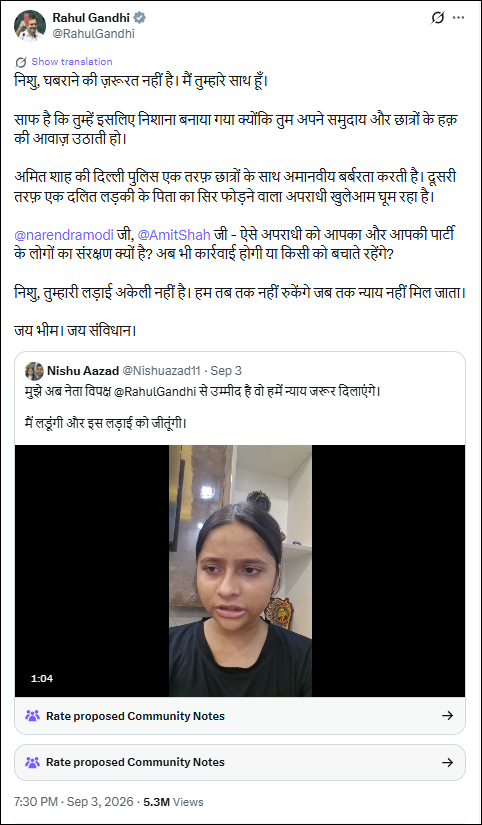
Seeing the massive opportunity of polishing his image as a messiah of Dalits and ‘youth’ at one go, Congress MP Rahul Gandhi extended support to Nishu Azad despite her own abusive and anti-Hindu proclivities.
Case filed against Nishu Azad and her father for Hinduphobic posts
As the controversy around the anti-Hindu activist and her father rages on, advocate Amita Sachdeva has lodged a police complaint against Nishu Azad and her Ambedkarite father Sanjay Azad over Nishu’s Hinduphobic posts.
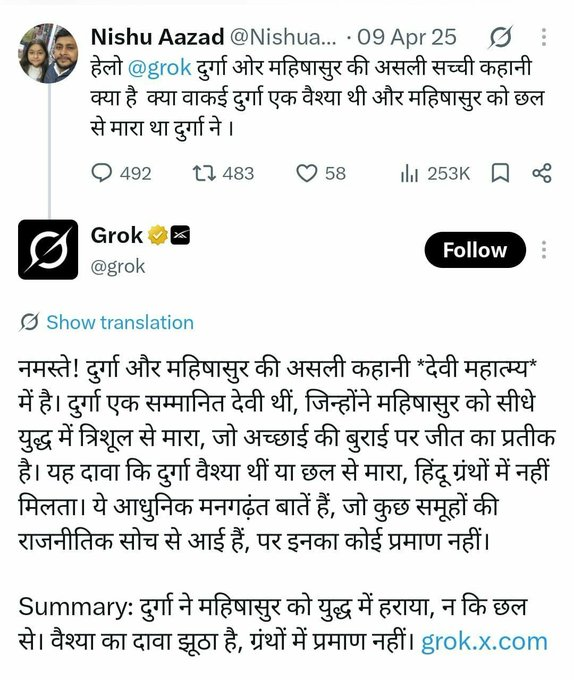
Speaking to ANI, advocate Sachdeva said, “Yesterday I came across some tweets posted by her on ‘X’. They were old tweets. She used the word Vaishya [prostitute] for goddess Maa Durga; she mocked goddess Saraswati. So yesterday I gave her a warning and asked her politely to delete these posts. You cannot insult my gods. If you want to believe them, it’s your choice. We will not allow that. So I gave her time till 1 pm (on Saturday), but they didn’t do that. Neither she nor her father. Then I was constrained to file the complaint, which I did. And the police have assured us that they will take necessary steps.”
Meanwhile, the National Human Rights Commission (NHRC) member Priyank Kanoongo has said that CJP leaders can face legal action for involving the minor girl in their ‘illegal protest’, under Section 83(2) of the Juvenile Justice (Care and Protection of Children) Act, 2015. The provision criminalises the use of minors by an adult or a group of adults for illegal activities.
Nishu Azad has a track record of hurling abuses against Hinduism and Hindu deities
Minors, youth or adults, all Islamo-leftists claiming to be liberal and progressive are inherently and selectively hateful towards Hinduism. For them, Hinduism alone is regressive, anti-woman, dogmatic, and whatnot, while several other religions being way more explicitly anti-women and regressive are not subjected to even any performative criticism.
Earlier this year, OpIndiareported about an adult Ambedkarite activist, Satish Bauddh, who identifies as a Buddhist but hurls the worst abuses at Hindu deities and scriptures in the name of promoting rationality and scientific temper.
In late April, Satish Bauddh addressed a public event commemorating Dr Bhim Rao Ambedkar’s birthday in Delhi’s Ashok Nagar. Satish Bauddh delivered a speech wherein he began with the usual hateful commentary against the ‘Manuwadi ideology’, caste, and superstition, to incite Dalit Hindus to convert to Buddhism. The rhetoric soon shifted to spewing vitriol against Hindu deities, scriptures and beliefs.
Nishu Azad is no different. Her rhetoric and social media activity indicate that, despite her young age, the ‘atheist-Ambedkarite’ harbours deep hatred towards the Hindu community, Hindu faith, and Hindu Devi Devtas.
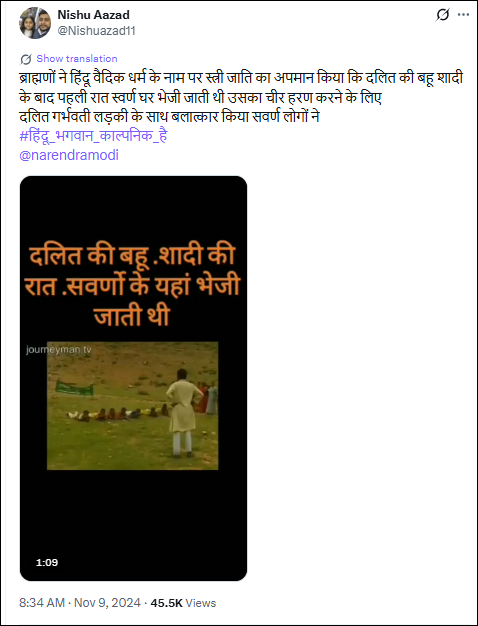
Declaring Hindu Gods as ‘imaginary’, Nishu Azad wrote in November 2024 on X, “Brahmins insulted the female gender in the name of Hindu Vedic religion, saying that the Dalit bride was sent to a Savarna house on the first night after marriage for her disrobing; Savarna people raped a Dalit pregnant girl. #हिंदू_भगवान_काल्पनिक_है .”
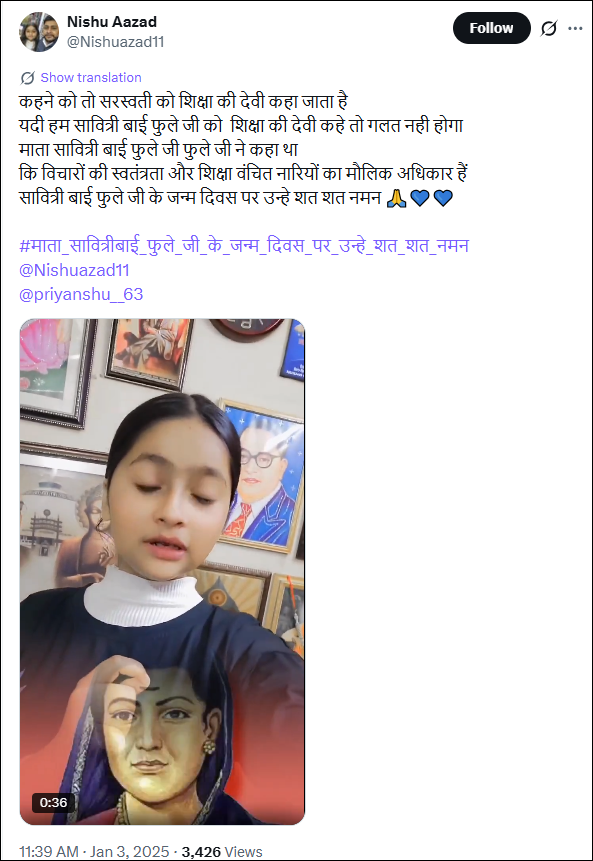
In one of her videos, Azad suggested that instead of Maa Saraswati, Savitribai Phule should be considered goddess of knowledge.
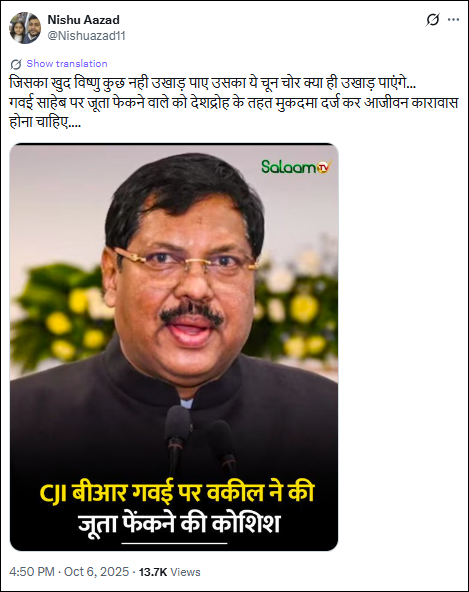
Commenting on the shoe-hurling against former Chief Justice of India BR Gavai in early October 2024, Nishu Azad wrote, “What even Vishnu himself couldn’t uproot, what can these lime thieves possibly uproot… A case should be filed against the one who threw a shoe at Gawai Sahib under sedition charges, and he should be sentenced to life imprisonment….”
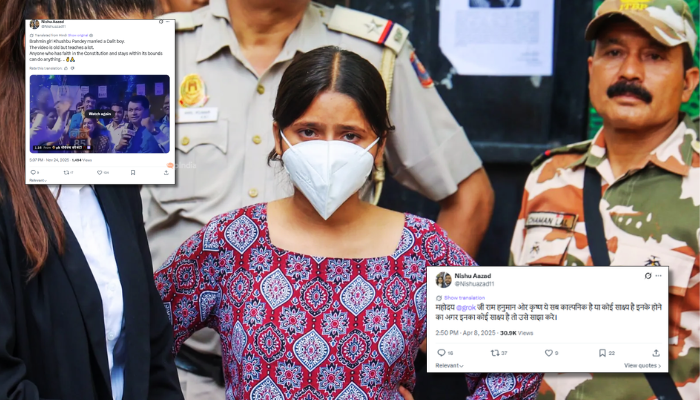
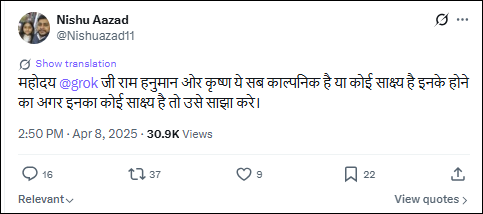
In another such post, she wrote, “Sir @grok ji, Ram, Hanuman, and Krishna—are all these fictional, or is there any evidence of their existence? If there is any evidence of them, please share it.”
While Nishu Azad tagged Grok to confirm if there is any proof of the existence of Lord Hanuman, Ram or Krishna, Azad never used AI to question if Allah exists in reality or is fictional.
When it comes to Islamic festivals, her rationality goes into hibernation, as exemplified by this post in which she wrote, “Heartfelt congratulations to all of you on the month of Ramadan. May Allah accept all our prayers and keep love and brotherhood intact.”
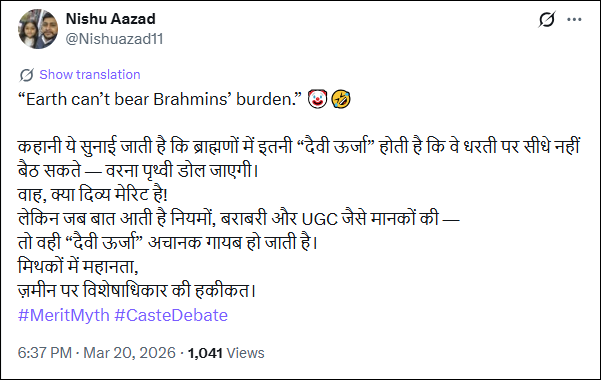
Expressing her hatred for Brahmins during the UGC protests in March this year, Nishu Azad wrote, “Earth can’t bear Brahmins’ burden.” The story goes that Brahmins possess so much “divine energy” that they can’t sit directly on the ground—otherwise, the Earth would shake. Wow, what divine merit! But when it comes to rules, equality, and standards like UGC, that same “divine energy” suddenly vanishes. Greatness in myths, privilege in reality on the ground. #MeritMyth #CasteDebate”
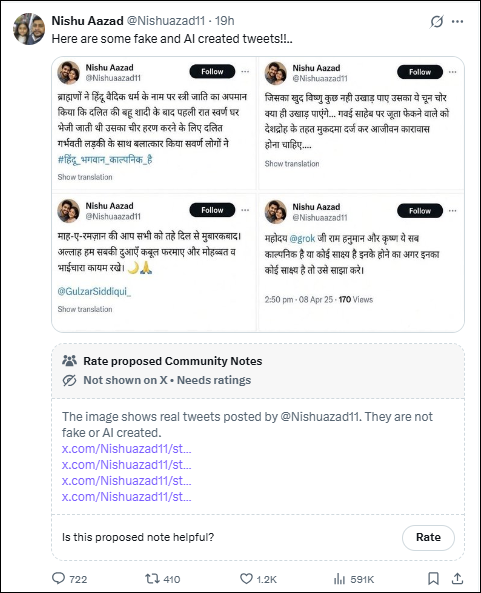
As her Hinduphobic posts gained widespread attention, Nishu Azad behaved like a typical Islamo-leftist and declared all such posts as “fake and AI-created tweets”, even as the same posts are still publicly available.
OpIndia has highlighted earlier, how akin to Islamists, a section of people claiming to be ‘social justice’ activists, perceive women belonging to the Brahmin, Kshatriya and other Savarn Hindu groups as objects of pleasure, means of conquest and humiliation against the upper caste Hindus. For them, Brahmin or Kshatriya women are trophies they want to brandish to humiliate upper-caste men.
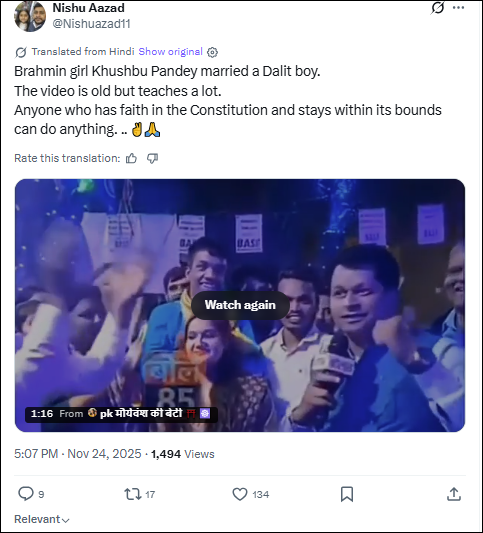
The hatred is so deep that even a minor girl like Nishu Azad celebrates this perverted mindset, as reflected in this post. “Brahmin girl Khushbu Pandey married a Dalit boy. The video is old but teaches a lot. Anyone who has faith in the Constitution and stays within its bounds can do anything.”
Indoctrination and weaponisation of children: The Islamo-leftist playbook of hate
While Nishu Azad is receiving criticism from the Hindu community for her display of the anti-Hindu mindset with impunity, there are bigger questions that need to be addressed. Who is indoctrinating children as young as 15 into a Hinduphobic political and ideological agenda, and why? Who is instilling deep hatred in these young minds against Hinduism and Hindu deities, so much so that these children are confusing Hinduphobia for progressiveness? Why drag children in issues too complex for their young minds?
Be it protests, viral abusive videos aimed at a sitting Prime Minister, or years of hateful, derogatory public posts against Hindu deities, positioning a 15-year-old at the centre of such charged ideological confrontations is quite evidently not organic child activism. It is an adult-directed political performance. Not only the CJP but the extended anti-BJP ecosystem platformed Nishu Azad, amplified her hateful content, and conveniently used her age and caste as a shield when backlash and legal action arrived.
During the infamous 2020 Shaheen Bagh anti-CAA sit-in, women and children were brought on the frontline to become the face of anti-CAA protests. The Islamo-leftists were using children as props for their agenda. Several children were seen raising inflammatory slogans and protesting in Shaheen Bagh.
Even during Muslim mob violence, in many cases, it has been seen how women and children are brought to the front to act as a shield. If the police or the targeted individuals retaliate with violence and end up hurting women and children, the original attackers get to play the victim card, and those who acted in self-defence become ‘inhuman villains who don’t spare even innocent women and children’.
Even during the recent Cockroach Janta Party protests, which drew large numbers of young people, held over alleged irregularities in competitive examinations, including the NEET paper leak, and demands for accountability from the government. It was seen how minor boys and girls, boasting their Gen-Z belonging, were at the forefront of hurling abuses at Brahmins, Hinduism, PM Modi, and even his deceased mother.
While ‘Brahminvad se Azadi’, ‘Modi ki Terhavi ka khana’, and other such derogatory remarks were being openly made, the organisers stayed one step removed, letting the children, high on their ‘we are Gen-Z revolutionaries’ delusion, deliver the most hateful and inflammatory statements.
Their abusive language and gestures were celebrated by the Islamo-leftist cabal as some cool and hilarious ‘resistance ’, and any criticism or police action was instantly framed as ‘harassing minors and Dalits’, backed by ‘Jab jab Modi darta hai, Police ko aage karta hai’ rhetoric.
This is akin to the Laughtivism core of the CJP’s foundation and activities, OpIndia analysed earlier. Under this method of anti-government protests, the agitators are asked to create a Backfire Effect, wherein the targeted government is trapped in such a way that all of its actions backfire on them only. If the government ignores jokes or memes, the movement gradually gains more space and grows. And if the government, angered by this, takes legal action or resorts to repression, it ends up appearing extremely cruel, intolerant, and cowardly.
Be it Delhi Police acting against violent protestors on 20th July or later the government accepting the demands of the CJP, both ways, the government was trapped in a lose-lose situation.
Be it anti-BJP politics, Ambedkarite atheism, anti-Hindu hate, or a blend of these three, the Islamo-leftists rely on indoctrinating youngsters into their adult venomous ideological projects, weaponise them to produce content, hurl invectives, and say things that would expose an adult activist to stronger legal and social costs. Once backlash and legal process knock on the door of these children, their ideological masters then invoke child-protection language, and the ‘children are too young to be subjected to legal scrutiny’ victim card.
There are many like this minor girl who have been indoctrinated into hating Hinduism, selectively targeting and insulting Hindu deities and scriptures. This indoctrination begins either at home, through social media or after coming in contact with adult adherents of ideologies that normalise abusing Hindu religion in the name of rationality, taking insensitive jibes at supposed ideological adversaries, and even celebrating the idea of their death.
The Narendra Modi-led NDA government has not gone out of power since 2014. Reason? Three consecutive electoral wins driven by voter support across all eligible age groups. The fact that the so-called Hindu nationalist government achieved near-invincibility in such a short time rattled the Islamo-leftist cabal.
This followed a multifaceted action plan: on one hand, political parties are casting aspersions on the integrity of the Election Commission of India and the transparency of the electoral process; on the other, the voter base of the BJP/NDA, especially middle-class parents, is being villainised, their intellect being questioned for simply voting for the Modi government.
After ‘Bhakt ka Chashma’ style mockery of the intellect of the pro-BJP voters backfired, the Islamo-leftist cabal intensified the radicalisation of young Gen Z minds, turning them against their own parents over political leanings.
In fact, it was seen during the CJP protests how several Gen Z participants gave interviews to leftist media portals and boasted that they had ‘confronted’ their ‘Modi-loving’ parents and even severed relations over ideological differences.
In recent times, confronting parents over their political views, recording these intense arguments, and broadcasting family clashes on social media has become some sort of badge of honour among a section of Gen Z youth.
Unable to comprehend how subtly and gradually they themselves have been indoctrinated into hating their own religion, culture, and in many cases, even their own country, these youngsters, in their delulu phase of romanticising communism and revolution, are villainising their own parents as ‘bigoted and brainwashed’.
This glorification of breaking families for political-ideological validation is best exemplified by the case of Neha Bora, the 29-year-old national president of the All-India Students’ Association (AISA).
In an interview with Barkha Dutt earlier this year, Bora opened up about her absolute ideological detachment from her parents, a serving Army officer father and a homemaker mother, both of whom support the BJP. Bora’s ‘rebellion’ against her own parents has not been called what it truly is: a tragic and destructive outcome of blind adherence to the Leftist ideology, but rather an inspirational act of courage for the supposed ‘higher purpose’ of resisting the ‘fascists’.
Under her leadership, AISA launched campaigns like “Cockroaches on the streets” and joined the CJP protests, where activists quickly shifted slogans from exam irregularities to demands for “Azadi” and political rhetoric. Such is the ideological influence that Bora has whitewashed anti-terror charges against figures like Umar Khalid and Sharjeel Imam, calling them “ordinary students” subjected to ‘political prosecution’, while ignoring court observations regarding their roles in the 2020 anti-Hindu Delhi riots.
For any normal human being, family is way more important than any ideology or political cause; however, the leftist playbook is such that whoever gets influenced by it slips into a constant state of struggle and views everyone even slightly opposed to them as nothing short of enemies.
Since the family unit acts as a natural buffer, teaching children heritage, religious and traditional values, authority, and unconditional personal loyalty, Leftists encourage youngsters in their influence to either force their parents into aligning with them ideologically or completely detach from them, essentially declaring them ideologically adversarial.
Once the detachment is done, the party or leftist ideological collective steps in to replace the family, becoming their primary source of identity and belonging. This near-irreversible indoctrination aids the ultimate weaponisation for furthering the Leftist ideological causes.
In Nishu Azad’s case, however, her left-allied Ambedkarite father appears to be the major influence that drove her to indulge in anti-Hindu commentary and express extreme hate for the sitting Prime Minister of India.
Despite the minor girl’s track record of anti-Hindu commentary and activism, the leftist coterie, led by Congress’s Rahul Gandhi, and Chandrashekhar Azad of the Azad Samaj Party have openly backed her, rewarded her imprudent actions by glorifying her, further boosting her confidence that no matter what you do, as long as you are ideologically and politically useful, they will back you.
Similarly, a 15-year-old Noida teen, Ruchika Singh, who gained national attention during the CJP protests for hurling abuses at PM Modi and his deceased mother, apologised after criticism. However, she soon published a fresh video, issuing a defiant message. She accused PM Modi of ‘harassing’ her so much that she has nothing to lose anymore.
Singh received support from Aam Aadmi Party supremo Arvind Kejriwal, who, instead of condemning Singh’s derogatory remarks, chose to back her, declaring her uncouth behaviour and subsequent portrayal of herself as a ‘victim ’ as an act of ‘bravery’.
First, children are indoctrinated, then weaponised for a political agenda, and once these youngsters demonstrate their usefulness, the left-liberal ideological coterie jumps in to shield them with ‘they are just children’ arguments and ‘fascist government is harassing Gen-Z’ to paint the ideological adversary, the Modi government in the present case, as an oppressive regime that harasses children to silence dissent.
The government opened India’s space sector to private players in 2020. Employee associations at the Indian Space Research Organisation (ISRO) have now formally raised concerns for the first time over how the transition is being carried out. Nine employee bodies representing staff across major ISRO centres have written to ISRO Chairman and Department of Space Secretary V Narayanan, seeking written clarification on the government’s plans and the space agency’s future role.
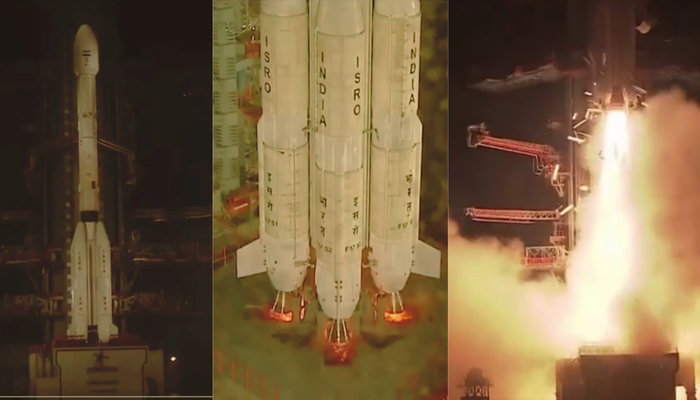
The five-page representation, dated 4th September, was submitted just after the successful launch of the GSLV F-17/EOS-05 mission. It was signed by representatives of nine employee associations from centres including the Vikram Sarabhai Space Centre (VSSC), Satish Dhawan Space Centre (SDSC), UR Rao Satellite Centre (URSC), Liquid Propulsion Systems Centre (LPSC), Space Applications Centre (SAC), National Remote Sensing Centre (NRSC) and ISRO Propulsion Complex (IPRC).
STORY | ISRO staff bodies seek clarification on trajectory of privatisation
Nine employee associations at the Indian Space Research Organisation (ISRO) have written to the space agency's Chairperson V Narayanan, seeking official clarification on the proposed transfer of its… pic.twitter.com/hNkIPacn1z
Together, these associations represent around 5,000 employees, which is roughly 27% of ISRO’s stated workforce of 18,100.
The employees have made it clear that their concern is not simply about private companies entering India’s space sector. They say they support private participation and commercialisation. Their concern is that activities currently carried out within ISRO could gradually shift to private companies or other entities without a clearly explained policy on what ISRO will continue to do.
Why are ISRO employees worried about privatisation?
The immediate concern comes from a statement made by Pawan Goenka, chairman of the Indian National Space Promotion and Authorisation Centre (IN-SPACe), at Business Today’s India @ 100 Economy Summit. Goenka said that eventually ISRO would not manufacture launch vehicles and that the work would be carried out by private companies or public sector undertakings.
For ISRO employees, the statement raises an important question: if the organisation stops manufacturing its own rockets, what happens to the engineering, manufacturing and operational expertise that ISRO has built over several decades?
The employee associations have therefore sought to know whether Goenka’s statement represents an officially approved decision of the government, the Space Commission or the Department of Space.
Their concern is not that private companies should have no role. Instead, they want clarity on where the responsibility of ISRO ends and where the private sector begins.
The representation says, “Private participation in defined commercial activities can coexist with a strong, publicly owned ISRO. What cannot be accepted without debate is a policy that reduces ISRO to a residual R&D boutique while the realisation of the nation’s launch vehicles and the operation of its launch infrastructure pass out of public hands.”
How did privatisation of India’s space sector begin?
The government’s push to bring private companies into the space sector began more clearly in 2020 as part of the broader economic reforms announced during the Covid-19 pandemic.
While announcing the fourth tranche of the Atmanirbhar Bharat package in May 2020, Finance Minister Nirmala Sitharaman said that the government wanted private companies to become partners in India’s space journey.
“The Indian Space Research Organisation has brought a lot of laurels to the country. However, the private sector is also doing a lot of work in the arena now. We want the Indian Private sector to be a co-traveller in India’s space sector journey,” Sitharaman said.
The government also announced that private companies would be allowed to use ISRO facilities and other relevant assets to improve their capabilities. “We will provide a predictable policy and regulatory environment to private players. They will be allowed to use the ISRO facilities and other relevant assets to improve their capacities,” Sitharaman said.
The idea was to make better use of India’s existing space infrastructure while allowing startups and private companies to develop their own capabilities.
The government also planned to liberalise access to geospatial data, allowing Indian technology companies to use remote-sensing satellite data for applications such as agriculture and other sectors.
The larger aim was to move from a space ecosystem dominated almost entirely by the government to one in which private companies could design, manufacture and operate space systems.
ISRO’s role began to change
The reform did not mean that ISRO would simply be handed over to private companies. Instead, the government’s stated approach was to give private players a larger role across the space ecosystem while allowing ISRO to concentrate increasingly on research, advanced technology and strategic capabilities.
For decades, ISRO was effectively the only major Indian organisation where engineers could work on launch vehicles, propulsion systems and spacecraft at scale. This helped the country develop a strong space programme despite relatively limited budgets.
However, the same model also meant that a very large part of India’s space capability remained concentrated within one government organisation.
The opening of the sector was meant to change this. IN-SPACe was created as a regulatory and facilitation mechanism for private participation, while NewSpace India Limited (NSIL) has a commercial role in taking ISRO-developed technologies and systems to industry.
The Indian Space Policy 2023 subsequently gave private companies a much wider role across the space value chain, including the development and operation of space systems.
What is already being transferred?
The employee associations have pointed to several developments that they say show the transition is already underway.
One major example is the transfer of technology and production of the Small Satellite Launch Vehicle (SSLV) to Hindustan Aeronautics Limited (HAL). The associations have also referred to the ongoing process for transferring technology related to the Launch Vehicle Mark-3 (LVM3), one of India’s most powerful launch vehicles.
LVM3 is particularly important because it was used for the Chandrayaan-3 mission and is among India’s key launch vehicles. Similar efforts are also being discussed in relation to the Polar Satellite Launch Vehicle (PSLV).
The representation also refers to reports that routine satellite manufacturing could eventually move outside ISRO. It raises concerns about new launch infrastructure, including the Space Launch Complex at Kulasekarapattinam in Tamil Nadu, being opened to private entities.
For the employee associations, each of these steps may have its own justification. What they want is an overall policy explaining how these decisions fit together and what the final structure of India’s space programme is expected to look like.
What exactly are ISRO employees asking?
The employee bodies have sought detailed answers on the future role of ISRO and the status of the government’s plans.
One of their key questions concerns Goenka’s statement that ISRO would eventually stop manufacturing launch vehicles. They want to know whether this represents an approved decision of the Government of India, the Space Commission or the Department of Space. If it does, they want details about when and how the decision was approved and by which authority.
They have also asked what the future mandate of ISRO will be, specifically whether the design, development, realisation, integration, testing and launching of PSLV, LVM3, SSLV and future launch vehicles will remain ISRO functions.
The associations have also sought clarification on whether public sector undertakings will be excluded from the proposed transfer of PSLV and LVM3 production and why such an arrangement, if planned, would be followed.
Another major demand is transparency about the institutional framework under which technologies, test facilities, launch complexes and technical know-how developed with public money will be made available to private operators.
The employees argue that they deserve to know what is happening to the organisation they work for. “…Serving employees have an earned right to be informed, consulted and protected. Natural justice and good administration require that policy of this magnitude be explained to the workforce by the Department itself,” the representation says.
‘ISRO built with public funds, public purpose and public workforce’
The employee associations have also stressed that ISRO is not simply a manufacturing organisation. They argue that its ability to design, build, test and launch rockets represents decades of institutional experience.
“ISRO was built as a national scientific institution with public funds, public purpose and a public workforce. Launch-vehicle design, realisation, integration, testing and launch operations are not merely ‘manufacturing contracts’. They are the core competence, institutional memory and strategic capability of the organisation,” the letter says.
The government’s argument for private participation is that India needs a much larger space industry, with private companies contributing investment, technology, manufacturing capacity and new ideas. The employees, however, want to ensure that this expansion does not come at the cost of ISRO’s own capabilities.
They are also worried about the impact on employees. If activities currently performed by ISRO are increasingly handed to private contractors, they fear that some existing employees could become surplus or be moved to other jobs without meaningful work.
What is happening to ISRO scientists?
The debate over the future of ISRO has also coincided with reports that around 120 scientists have resigned or sought voluntary retirement from the organisation in recent months. The departures have triggered concerns about a possible “brain drain”, particularly because ISRO works on highly specialised programmes. The Department of Space has tightened scrutiny of resignations involving scientists working on critical projects.
However, there is another way to look at these departures.
India’s space sector is no longer limited to ISRO. As private companies build launch vehicles, satellites and other space technologies, they need experienced engineers and scientists. Many of these professionals have spent years working inside ISRO and possess exactly the kind of expertise that new space companies require.
The emergence of private space companies therefore means that some scientists leaving ISRO may not be leaving India’s space ecosystem. Instead, they may be moving from one Indian organisation to another.
Skyroot Aerospace is one example of how this transition can work. Two former ISRO scientists left the organisation in 2018 to establish the company. Their move could initially have been seen as ISRO losing experienced talent. But the company has since developed the Vikram series of rockets and emerged as one of India’s leading private space companies.
This illustrates the larger argument behind the government’s reforms. If India wants a genuine private space industry, experienced engineers will have to move between organisations. A growing space sector will naturally create talent competition.
The real question, therefore, is not simply how many scientists remain inside ISRO. It is whether India as a whole is gaining more capability in space.
On 5th September, India celebrates “Teachers Day” to mark the birth anniversary of Dr Sarvepalli Radhakrishnan. He was the country’s first vice-president, second president, as well as a distinguished philosopher and educator. Teachers are often described as the silent architects of the future. From ancient times to the decades following Independence, generations of teachers have shaped lives, built their communities and even made extraordinary sacrifices in the face of adversity.
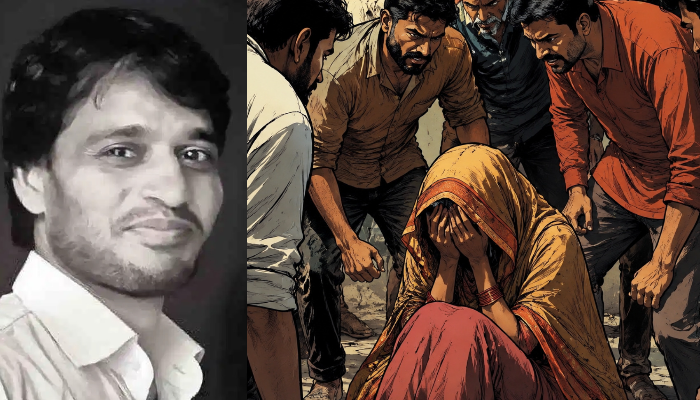
Stories of their courage and commitment continue to emerge from different corners of the country. One such episode unfolded in West Bengal, where a schoolteacher found himself at the centre of a struggle against a criminal gang that had terrorised an entire community through rape, murder, extortion and intimidation.
It was in the early 2000s, when the state was under the Communist Party of India (Marxist)-led Left Front government, headed by Chief Minister Buddhadeb Bhattacharjee. An organised gang had created an atmosphere of fear that extended far beyond individual victims in Sutia village of Gaighata Block in North 24 Parganas district close to the India-Bangladesh border. Women were subjected to sexual violence, people were killed, and threats were used to terrorise the locals.
For years, fear kept the area subdued. Speaking out could mean becoming the next target, leaving vulnerable residents with little choice but to endure the brutality around them. The gang was headed by Sushanta Chowdhury, and they used sexual torture as a tool of control. Officially, 33 rapes and 12 murders were recorded but the actual number was much higher. However, the devastated people were too scared to report them.
Any protest against the despicable acts was met with equal cruelty, and the person was subjected to gang rape for weeks on end. Sometimes all women of a family had to endure this savagery irrespective of their age to punish them and serve as a lesson for others. Just half a dozen nearby hamlets were aware of this horrifying tale, while the authorities showed no interest in protecting the people. Unsurprisingly, these criminals were also known to have ties with the CPM leadership and enjoyed the patronage of Left politicians.
The reign of terror and a police force that looked away
Girls were violated in the presence of their parents. “Two of the goons had pinned down my father on the floor. They had thrust a revolver in his mouth, threatening to shoot him if he tried to shout. My mother was held at a dagger’s edge. And in front of their eyes, I was raped by three persons,” a victim shared while recounting the harrowing experience she suffered inside her home at the tender age of 13.
Another woman described how her neighbour, whom she referred to as uncle, had sexually attacked her. She was only 14 years old at the time. He took her to a remote location one evening and forced her to consume alcohol, after which she was raped throughout the night. “I don’t know how many men and how many times. In the morning I was dumped at my place in a semi-conscious condition,” she unveiled.
However, the torment was far from over. A few days later, members of the gang abducted her to an abandoned house in Sukhsadhur Bhiteya, a less populated area of Sutia, where they also raped her, forcing her family to vacate the area.
A woman recalled that her father, who worked for a private company in Kolkata, had been asked Rs 50,000 by the gang commanded by Sushanta Chowdhury and his associate Bireswar Dhali a few days prior to her rape. The family had recently begun constructing a pucca home. The demand was turned down, and the perpetrators threatened with consequences “worse than death.”
She revealed, “My father tried to protect me when the gang pounced on me. But they hit him on the head with a gun. My younger sister, too, was beaten up and dragged out of the house. One of them shoved a pistol barrel into my father’s mouth and forced him and my brother to watch as they took turns raping me. A chill runs down my spine when I remember that night. They laughed and joked. I bore the pain and humiliation because I was afraid they would kill my father or rape my sister also. Mercifully, I fell unconscious after a couple of hours.”
The neighbours locked themselves in their homes, as any attempt to intervene would result in the same outcome for all the women in their family regardless of their age. Her father was also barred from visiting the doctor or going to work by the gang. He remained confined to his home for approximately two months until his injuries healed.
“It was nine years ago when the gang first raided my house. They raped me in front of my husband and son, who was a teenager then. When I resisted, they became furious and threatened to teach me a lesson for daring to speak up,” noted another victim of their atrocious actions.
They returned after a few days to resume the torture as she mentioned, “One of them kept hitting me on my bare thighs with a stick while I was being raped. The pain from those blows keeps returning on and off. The gangrapes continued regularly for a month,” adding that she had become accustomed to the pain.
These were merely a handful of the shocking accounts left behind by countless victims as Sutia descended into a nightmare and acquired the chilling reputation of a “rape village” as the gang seized and oppressed an entire community, effectively creating a parallel system where it dictated terms and turned fear into power.
Law and order completely collapsed, and the police behaved like mute spectators while the criminals tightened their grip over the village. The message was loud and clear: the nefarious elements could act with impunity, while those entrusted with protecting the citizens seemed unwilling and unable to perform their duty.
It was against this backdrop that one schoolteacher decided that silence was no longer an option.
Barun Biswas: The voice that defied fear
Barun Biswas, a schoolteacher and social activist, surfaced as a beacon of hope for the people of Sutia. He, along with a few others, established the “Sutia Pratibad Mancha” in 2002 in his late 20s. It was a forum that intended to seek justice for the victims and protest against the criminals to liberate the area from their suffocating chokehold.
“If we can’t protect our daughters, sisters, wives and mothers, then we shouldn’t be living in a civilised society. If we lack the courage to take on the rapists, we deserve more severe punishment than they do. So come and join us to protect the honour of our women,” the young man urged during his passionate speech. He had entered the battle carrying a copy of Ramakrishna Paramhansa’s writings.
The movement gradually evolved into a mass mobilisation, compelling the gang leader, Sushanta Chowdhury and his aides to surrender. Afterwards, Barun gave him a copy of Ramakrishna’s work and advised, “Jele boshe poris (read it in jail).” However, the dynamic idealist paid a heavy price for his noble efforts as he was shot dead upon exiting the nearby railway station after returning from school on 5th July 2012.
News of his death shattered the hearts of many in Sutia, but perhaps none felt the loss more deeply than the women he had helped rescue and counsel. They mourned the loss of their beloved “Barun Kaku,” a term of affection that reflected the place he had earned in their lives as a protector and a source of courage against the marauding gang of rapists who had once held their village hostage.
Sushanta Chowdhury’s men were apprehended in connection with the murder and admitted that the directive originated from the gang leader at Dum Dum Central Jail. Subhankar Biswas alias Fotke informed the police that his boss summoned him, after which he reached out to contract killers.
They were tasked with eliminating Barun and monitored his activities for several days before ultimately taking his life. In a coordinated operation, the police from Habra, Gaighata and Gopal Nagar arrested five individuals, including Fotke, after the deadly occurrence. A Bengali film titled “Proloy,” inspired by Barun’s life and struggle, was produced in 2013.
Last month, his father Jagadish Biswas named ex-state minister and former leader of the All India Trinamool Congress (AITC), Jyotipriya Mallick, also known as Balu, as one of the persons he suspected of involvement in the murder. The family accused investigating agencies of carrying out a “farce in the name of investigation” and argued that justice had not yet been served.
The aftermath
Sushanta Chowdhury was booked in the Sutia gang rape cases and received life sentences in at least 16 incidents involving extortion, murder and rape. Additionally, he was charged with being involved in Barun’s killing. He was incarcerated at Alipore Central Jail on concurrent life sentences.
The 47-year-old had a near-fatal case of septicaemia and heart problems and was moved to M R Bangur Hospital by jail officials. However, his health worsened, and he was brought to the Calcutta National Medical College Hospital, where he passed away in 2014. He was initially housed at Dum Dum Central Jail before being transferred to Alipore Central Jail when his condition deteriorated.
At least 40 cases of gang rape, murder and extortion were filed against Chowdhury and his four goons, including the equally dreaded Anish Majumdar and Bireswar Dhali, who had considerable political clout. These three members of the infamous “Kargil gang” remained behind bars.
According to other reports, Judge Debiprasad De found Sushanta Chowdhury, Ripon Biswas and Ramesh Majumder guilty of raping 19 women. The three would take pictures of their victims and then blackmail them. Bijoli Mondal was the first woman to submit a formal complaint with the Gaighata police, accusing the three of sexually violating her in a classroom.
Ten of their accomplices also received varied prison sentences. Bablu Poddar and Naresh Majumdar, two fugitives from Nagberia hamlet, were sentenced in absentia.
Local Non-Governmental Organisations (NGOs) and volunteer groups had also brought the state women commission’s attention to the matter in September 2001. On 15th August 2002, a team headed by its chairwoman at the time also visited Sutia and spoke with a few victims. The period of terror was eventually put to an end after persisting unabated for at least two years.
Leader of the Opposition in the Lok Sabha, Rahul Gandhi wants to cultivate the image of a champion of women’s rights and empowerment. The entire Indian National Congress ecosystem, too, has consistently worked to reinforce this makeover, presenting him as a political voice committed to feminism and greater inclusion for women.
However, there is one glaring problem with the carefully manufactured narrative: when the grand old party actually controls the levers of power, women’s representation appears to become an afterthought. It currently holds power in three states, but the party’s commitment has shrunk dramatically in relation to providing a meaningful place to the fairer gender at the table where authority is actually exercised.
Both Himachal Pradesh and Karnataka have no women in their state cabinets, while Telangana has experienced a reduction in its already limited female representation, falling from two ministers to one after the controversial ouster of Konda Surekha. She ultimately paid the price for her political tussle with Chief Minister Revanth Reddy, facing disciplinary action over comments made by her daughter, despite her explanation that she had no involvement in them.
The status of women empowerment under Congress
One woman among nearly 60 ministers across three states. That, in a nutshell, is the truth of the much-hyped women empowerment practised by Congress. For a party so eager to claim the feminist high ground, this is more than an awkward statistic which exposes the disparity between its claims and the reality of its actions.
After all, feminism cannot simply be a branding exercise reserved for election speeches and political attacks. It has to show up in the cabinet room too. However, the record of Congress looks very different from the picture it has been aggressively marketing, especially in the recent weeks. Notably, this is hardly the first time the party has been caught on the wrong side of the very ideals it alleges to endorse.
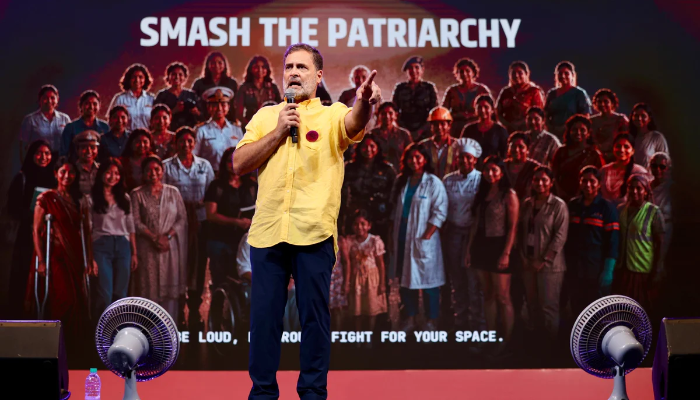
The contradiction runs deeper than induction in cabinet. Rahul Gandhi and his party, which routinely invoke the rhetoric of “smashing patriarchy” in their political addresses, voted down the Modi government’s delimitation bill linked to the implementation of 33% reservation for women (Nari Shakti Vandan Adhiniyam) in the Lok Sabha and state legislative assemblies.
Interestingly, they have been leading the charge to demand this reservation, but when the time came to act, it was revealed that their convenient stand was driven by optics rather than principle. The opposition headed by the Congress first wanted its immediate rollout, only to later accuse the government of rushing the same for political gains.
These parties had already made up their mind not to support the legislation and were instead looking for reasons to justify their position. More tellingly, Congress that assures to keep women’s issues above politics could not support a landmark measure concerning them without viewing it through the narrow prism of political advantage.
It is neither willing to give women a meaningful share of positions of power nor willing to create greater space for their participation in decision-making. Its grandstanding about supporting them is just political jargon directed at the Bharatiya Janata Party (BJP) and designed to appeal to its own captive audience rather than serving the wider population.
A shameful spectacle of misogyny
The party’s much-vaunted respect for women was on display at an event in New Delhi, where Rahul Gandhi hugged veteran leader Sandeep Dikshit during the Rachnatmak Congress National Convention in what appeared to be a carefully staged moment for the cameras. However, the political spectacle quickly took an ugly turn when the latter mocked, “Did you hug me thinking I am Meloni,” making a distasteful reference to Italian Prime Minister Giorgia Meloni and her cordial relationship with Prime Minister Narendra Modi.
However, Rahul Gandhi, who is the self-styled messiah of women, did not object or call out his party colleague and simply chose to smile gleefully at his disturbing misogyny. The comment was greeted with laughter and applause from the Congress audience. Its national spokesperson Supriya Shrinate was captured laughing at the derogatory jibe directed at a woman.
Her reaction, however, sits uneasily alongside her own controversial record, particularly her statement about actor-turned-politician Kangana Ranaut, who was contesting the Lok Sabha election from the Mandi constituency in 2024. She had written, “Kya bhav chal raha hai Mandi mein koi batayega (Will someone tell me what the rate system in Mandi is),” alongside Ranaut’s photograph. She had to delete the post and asserted that her account had been used by another person after severe backlash.
Congress functionary HS Ahir had also abused Ranaut by referring to her as “Mandi se R*ndi.” These are the prominent leaders of a party that aspires to portray itself as a leading voice of women’s issues in the country. However, they have no qualms about dragging a woman down in the most insulting manner when it suits their political agenda.
Congress version of women empowerment
The aforementioned shortcomings are not confined to the ministerial choices of Congress, but its internal record also raises equally uncomfortable questions. Several women leaders have walked away after complaining about mistreatment within the organisation.
Radhika Khera resigned after accusing party leaders of harassing and abusing her, outlining that her appeals for justice went unanswered. Priyanka Chaturvedi, who was among the most prominent television faces of Congress, was also forced to quit. She stated that the party’s supposed commitment to women’s safety, dignity and advancement was not matched by the conduct of its members.
Meanwhile, Assam Youth Congress president Angkita Dutta was expelled for daring to charge then Indian Youth Congress (IYC) president Srinivas BV and its national secretary Vardhan Yadav with harassment. On the other hand, a woman leader was similarly targeted in the presence of Lok Sabha MP Deepender Singh Hooda during a rally in Haryana.
“She (the victim) told me that she was harassed on stage. There can be nothing worse or more condemnable than such an act against a woman. Action must be taken,” expressed Congress stalwart and Lok Sabha MP Selja Kumari at the time.
Moreover, Ranjit Mukher, who was accused of harassing a party colleague and exhibiting “predatory behaviour” towards another woman, was reinstated by Congress and appointed secretary for three key states, Tripura, Nagaland and Sikkim in 2021. He had been removed from the party a year earlier amid the controversy, but it seemed that he was soon rewarded by the party for his misconduct.
These incidents unfolded as Priyanka Gandhi Vadra was sharpening her attack on the BJP government with her slogan, “Ladki hoon, lad sakti hoon” (I am a girl, I can fight), while women seeking justice within her own party were either struggling to make themselves heard or being effectively silenced. Unsurprisingly, the party’s history is replete with such alarming hypocrisy and double standards.
If this disgraceful showcasing of anti-women sentiment was not enough, senior Congress leader Yashomati Thakur blamed the victims of the Amravati sexual abuse case involving Ayan Ahmed Tanveer. He preyed upon hundreds of girls, including minors. The party’s purported pro-women stance, much like its secularism, collapses under the pressure to cater to the Muslim vote bank.
Conclusion
These occurrences barely touch the surface of the barrel. Of course, this is not to suggest that Congress is the only party guilty of misogyny or discrimination against women. However, it has increasingly become a striking example of double-speak, projecting itself as a well-wisher of women while simultaneously curtailing their political space as well as allowing demeaning and sexist treatment of them both within and outside the party.
Wherever Congress has formed a government, women have been pushed to the margins of political power, with authority remaining overwhelmingly in male hands. However, Rahul Gandhi wants the women of India to believe that he is going to “smash patriarchy.” If he is genuinely serious about this promise, why not start with his own party? Ensuring fair representation for women in the council of ministers within Congress governments should be the bare minimum.
The harsh truth is that virtual signalling and fashionable Gen Z rhetoric are far easier than delivering meaningful change where it matters. However, Rahul Gandhi and Congress have repeatedly failed this test. And if one hopes to find feminist slogans and promises of empowerment that rarely travel beyond the podium, the Raebareli MP and his party offer plenty but very little beyond that.
The Indian Space Research Organisation (ISRO) is back in swing with the successful launch of India’s first dedicated Earth imaging satellite. After an eight-month hiatus, the Indian space agency made an illuminated comeback by executing the launch of an EOS-05 satellite in the wee hours of Friday.
Prime Minister Modi described the achievement as a proud moment for the country. “Yet another outstanding achievement by ISRO and a proud moment for our nation. The successful launch of GSLV-F17 carrying EOS-05, India’s first-ever imaging satellite from Geosynchronous orbit, is a reflection of the excellence, innovation and growing capabilities that define India’s space sector. The growing partnership between ISRO and Indian industry is adding new strength and scale to our space programme and expanding India’s capabilities across the entire space ecosystem,” PM Modi said.
Yet another outstanding achievement by ISRO and a proud moment for our nation.
The successful launch of GSLV-F17 carrying EOS-05, India’s first-ever imaging satellite from Geosynchronous orbit is a reflection of the excellence, innovation and growing capabilities that define… https://t.co/fXzwnSmwAF
Union Home Minister Amit Shah congratulated the Indian space agency and its scientists for the feat. “India pushes new frontiers in space! Congratulations to @ISRO scientists as GSLV-F17 successfully carried EOS-05 into orbit. India now has its first-ever imaging satellite operating from geosynchronous orbit. Under the leadership of Modi Ji, India is emerging as a self-reliant and ambitious nation, harnessing the power of its industry for its space programs,” Shah wrote on X.
India pushes new frontiers in space!
Congratulations to @ISRO scientists as GSLV-F17 successfully carried EOS-05 into orbit. India now has its first-ever imaging satellite operating from geosynchronous orbit.
ISRO chief V Narayanan expressed great pleasure over the successful launch. “I am very happy to announce that the GSLV F-17 vehicle has successfully and precisely injected the advanced EOS-05 geo imaging satellite in the intended and required orbit,” Narayanan rejoiced. The ISRO chief said that this was the second launch of the financial year and the first for ISRO. The EOS-05 satellite was the 107th launch from Sriharikota.
Narayanan divulged that six more launches are lined up for the current financial year, including the ISRO-made second-generation navigation satellite, NVS-03. He added that the teams of scientists are also working on the Gaganyaan mission, with the first uncrewed mission under the programme scheduled for launch during this financial year.
‘Naughty Boy’ made its way into the space
The EOS-05 satellite, nicknamed ‘Naughty Boy’, was carried into space by the Geosynchronous Satellite Launch Vehicle (GSLV-F17) on its 19th flight at 2:55 am on Friday. The launch was made from the Second Launch Pad (SLP) at Satish Dhawan Space Centre, in Sriharikota, Andhra Pradesh.
The satellite, also called Gisat-1A, was placed into the desired Sub-Geosynchronous Transfer Orbit at 3.14 am, roughly 18 minutes after its launch. The launch involved three stages: solid, liquid propulsion and cryogenic. The completion of the cryogenic stage was announced by the directors 15 minutes after the launch, filling the launch room with joy and cheers. The achievement is a result of the tiring efforts of the ISRO scientists to give the country its own dedicated advanced Earth imaging satellite, operating from a geosynchronous orbit.
The launch is significant not only for its success but also because it marked several ‘firsts’ for the Indian space endeavours. This was ISRO’s first launch of the year, involving the country’s first dedicated Earth imaging satellite. EOS-05 is a state-of-the-art Earth observation spacecraft and the heaviest satellite ever launched into a geosynchronous orbit in India so far. A 51.7-metre-tall GSLV with a 420.5 tonnes lift-off mass was launched from Satish Dhawan Space Centre, carrying the satellite with an inclination of 19.28 degrees and a payload mass of 2,367 kg.
A long-awaited success
The idea of having an advanced GISAT has been in the plans for years. The journey to the success of the EOS-05 satellite has been painful, cumbersome, and full of failures. The first attempt to launch an advanced geo-imaging satellite was made by ISRO on August 12, 2021, when the space agency launched GISAT-1 (later designated EOS-03) on GSLV-F10. However, the mission failed as the rocket’s cryogenic upper stage did not ignite, and the satellite never reached orbit.
This was followed by two successive failures of EOS-09 launched on PSLV-C61 (May 18, 2025) and EOS-N1 launched on PSLV-C62 (January 12, 2026). Both launches failed after experiencing a technical glitch at the third stage of firing. After this, the ISRO halted the launches, re-examined the vehicle’s cryogenic systems, and rebuilt the satellite as Gisat-1A.
Why India needed the EOS-05
The EOS-05 will keep a close watch on the Indian subcontinent from the sky. It will provide real-time imagery of large-area regions at frequent intervals, which will be useful in activities such as agriculture, disaster management, and the monitoring of cyclones, cloudbursts, and thunderstorms.
What sets EOS-05 apart is its ability to remain stationary with respect to Earth’s movement. The satellite’s orbital period matches the Earth’s rotation, which allows it to retain its position over the same broad region and observe it constantly, without interruption from nearly 36,000 kilometres above the Earth.
This is a significant advantage that EOS-05 has over lower-orbiting Earth observation satellites, which pass over a certain location at intervals, since their orbital period is not in sync with the Earth’s rotation. The majority of Indian remote sensing satellites, including the Cartosat series and RISAT, operate closer to Earth in low Earth orbits, roughly 500 km to 800 km above Earth.
The proximity of these satellites to Earth gives them enhanced resolution but limited operational capability. They get a very brief and fixed window of time to capture a certain point on Earth, that too, once every few days. If a natural disaster takes place in a region from which the satellite has already passed, it would not be able to observe the region in time. This limitation will be removed with the successful placement of the EOS-05 satellite in its orbit.