Home Blog Page 41

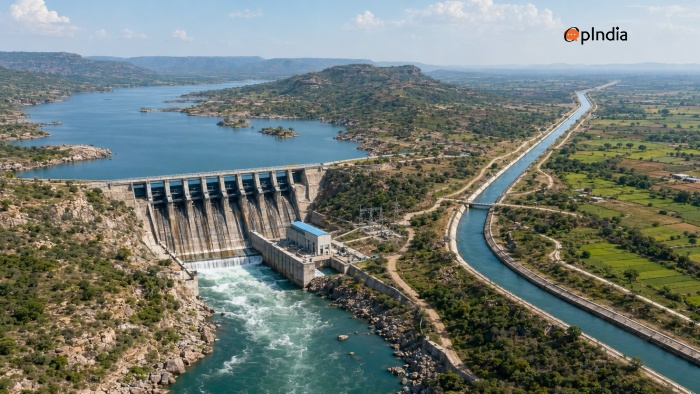
Linking India’s rivers Part II: Why Bundelkhand needs the Ken-Betwa Link Project the most

The second part of the River Linking series shifts the focus from the national river-interlinking vision to ground reality: the chronically drought-prone region of Bundelkhand, spanning thirteen districts across Uttar Pradesh and Madhya Pradesh. For decades, Bundelkhand has been defined by acute water scarcity, dried-up borewells, repeated crop failures, and widespread distress migration. The crisis is not a lack of seasonal rainfall, but the absence of long-term water storage infrastructure in its hard-rock terrain.

Part 2 examines the Ken-Betwa Link Project (KBLP), the pioneer model and first flagship initiative launched under India’s National Perspective Plan for river interlinking. The core objective of KBLP is to transfer excess monsoon water from the surplus Ken River basin in Madhya Pradesh to the water-deficit Betwa River basin via the major Daudhan Dam and a 221-kilometre canal network.

The report highlights the transformative scale of the Ken-Betwa project. Once fully operational, it will provide clean drinking water to over 62 lakh people across dry districts like Banda, Mahoba, Jhansi, Lalitpur, Tikamgarh, Panna, and Chhatarpur. Furthermore, the project aims to bring more than 10.6 lakh hectares of land under year-round irrigation, boosting agricultural yields and ending the painful cycle of rural migration that forces farmers to leave their homelands for basic livelihoods.

Beyond drinking water and agricultural security, KBLP acts as a multi-purpose economic booster for the region. The infrastructure includes power generation facilities designed to produce 103 megawatts of hydropower and 27 megawatts of solar power, laying the foundation for local industrial growth and regional employment.

The analysis also details how the project successfully overcame decades of complex inter-state political hurdles between Uttar Pradesh and Madhya Pradesh, setting a historic precedent for cooperative federalism. Addressing ecological concerns, the report explains how integrated landscape management plans were created to preserve the ecosystem around the Panna Tiger Reserve. Ultimately, Part 2 discusses how the Ken-Betwa Link Project is not just a civil engineering feat, but a lifeline that offers Bundelkhand a permanent escape from ecological distress and economic stagnation.

The full article is available on Chapter One Mag.

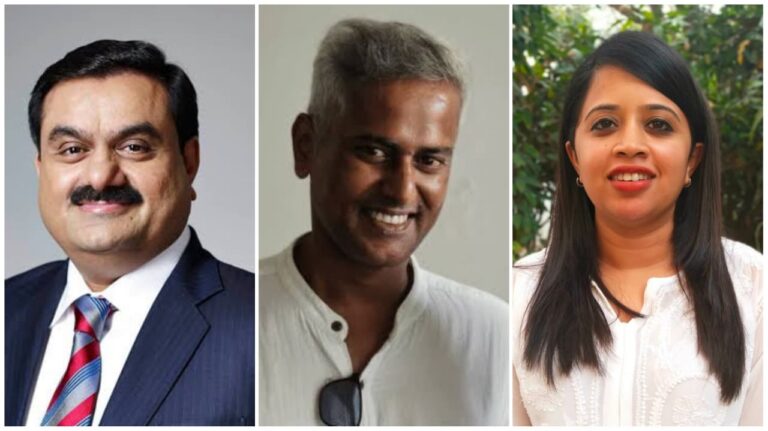
Gujarat Police seizes Ravi Nair’s electronic devices after HC upholds FIR over LIC’s Adani investment report, Dhanya Rajendran fumes

The Gujarat High Court has refused to quash the FIR against propagandist Ravi Nair over an October 2025 Washington Post article alleging that the Government of India and Life Insurance Corporation of India (LIC) had indicated plans for around $3.9 billion in investment in Adani Group companies.

Nair had sought quashing of the proceedings, arguing, among other things, that APSEZ had already initiated defamation proceedings over similar allegations. The High Court rejected his plea, allowing the investigation to continue.

The Gujarat Police, accompanied by Delhi Police, shortly visited Nair’s house following the verdict to seize his electronic devices after court approval for the ongoing investigation.

The case stems from a complaint by Adani Ports and Special Economic Zone Ltd (APSEZ), which alleges that false and fabricated information and documents were used in the report and related social media posts.

Dhanya Rajendran’s meltdown

Rajendran reacted sharply after Gujarat Police, accompanied by Delhi Police, visited Nair’s residence. She claimed on X that police took two of Nair’s phones, his son’s laptop and the laptop and iPad of a colleague who happened to be present, and alleged that officers refused to provide hash values for the devices.

The important detail in her own account was that the police had a judicial magistrate’s order authorising the seizure.

Rajendran then alleged that the complaint was filed over a tweet rather than directly against The Washington Post “to keep Washington Post out of the FIR”. In another post, she said Adani lawyers and the state had argued that the LIC story may have been fabricated and that the court consequently allowed devices to be seized if needed.

Questions about forensic procedure or the seizure of devices belonging to non-accused persons can legitimately be raised. But they are different from claiming that the investigation itself is illegitimate.

What the APSEZ complaint actually alleges

The complaint was filed by APSEZ deputy general manager Dushyant Joshi, who said he was authorised by a November 5, 2025 board resolution to represent the company before police and courts. He said APSEZ had first approached the Gandhinagar Superintendent of Police on November 20, after which a preliminary inquiry was conducted and the matter was transferred to the Ahmedabad City Crime Branch.

According to the complaint, the October 24 Washington Post article claimed that the Government of India and LIC had indicated plans for around $3.9 billion of public-fund investment in Adani companies. It allegedly relied on documents containing details such as conditions, bond ratings and internal approvals.

APSEZ alleged that Nair posted about the claim on X at 3:43 pm the same day. LIC rejected the report on October 25, saying its investments were made with integrity and due diligence. Later that day, according to the complaint, Nair questioned LIC’s denial and posted screenshots purportedly showing portions of documents, accusing LIC of misleading the public.

APSEZ then wrote to LIC seeking verification of the documents. The complaint says LIC responded on October 28 that it had neither received nor issued such documents and had received no government information or instruction to invest in Adani Group companies. APSEZ said it submitted LIC’s response and relevant stock-exchange disclosures to investigators.

LIC rejected the central claim

LIC’s own public statements are central to the dispute. On October 25, 2025, it rejected the Washington Post report and said its investments were made independently under Board-approved policies and after due diligence. On October 28, it reiterated that it had neither issued nor received the documents cited in the report and had received no government instruction to invest in Adani Group companies.

APSEZ’s complaint consequently alleges something more specific than merely inaccurate reporting. It says the documents and information used by Nair were “false and fabricated from the beginning”, that fabricated documents were presented as genuine, and that the posts caused financial losses and fear among potential investors. It further alleges that Nair used the material for personal financial gain and to damage the companies’ reputation.

These remain allegations, not findings of guilt. But they explain why investigators are examining the provenance of the documents rather than simply scrutinising Nair’s political views.

The FIR invokes BNS Sections 318(4), 336(2), 336(4) and 340(2), concerning cheating, forgery, forgery intended to harm reputation, and using a forged document or electronic record as genuine.

Ravi Nair was already convicted in another Adani defamation case

On February 10, 2026, a Judicial Magistrate First Class court in Mansa, Gandhinagar, convicted Nair in a separate criminal defamation case filed by Adani Enterprises Ltd. The court sentenced him to one year of simple imprisonment and fined him ₹5,000 over tweets and online articles published between October 2020 and July 2021.

After a full trial, the court rejected Nair’s defence of fair criticism and public interest, holding that the publications contained categorical allegations of corruption, manipulation and political patronage and crossed the line into criminal defamation. It also rejected his argument that references to the “Adani Group” did not concern Adani Enterprises.

The magistrate declined probation, observing that journalists must understand the consequences of serious allegations disseminated widely through social media. The sentence was subsequently suspended for one month and Nair was granted bail to pursue an appeal.

The conviction does not establish that every allegation made against Nair is true. But it is an important part of the context missing from Rajendran’s portrayal of him as simply a journalist being persecuted by a powerful corporate group.

Nair also challenged the Crime Branch proceedings before the Supreme Court. The court did not declare the investigation illegal or rule that the reporting was truthful; in March 2026, it directed him to pursue the appropriate remedy before the Gujarat High Court.

The central issue is therefore not whether Nair is a journalist or a propagandist. It is whether the allegations in the report were properly sourced and verified, whether the documents were genuine, and whether investigators followed due process while collecting evidence.

Rajendran is entitled to question the seizure of devices and raise concerns about journalistic material and forensic safeguards. But presenting a judicially authorised investigation as though it were simply an arbitrary attack on a journalist strips away the legal context.

The facts are more complicated: Nair is facing an investigation over allegations that fabricated documents were used to support a major claim about LIC and Adani, and he has already been convicted in a separate Adani criminal defamation case. While Rajendran tries to portray the seizure of Nair’s electronic devices as an “attack on journalists”, his own record suggests it could well be another case of defamation against the Adani Group.

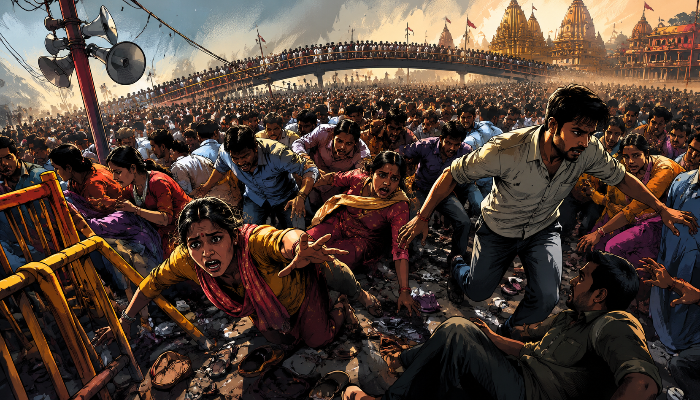
Bihar’s Ashok Dham stampede: How rumours and panic turn massive gatherings into deadly tragedies

On 17th August, thousands of Hindus arrived at Ashokdham Temple, also known as Shri Indradamneshwar Mahadev Mandir, to offer prayers and perform Jal Abhishek to Lord Shiva on the third Monday of the auspicious Shravan or Sawan month in the Lakhisarai district of Bihar. What began as a morning of faith and devotion soon descended into chaos as heartbreaking scenes of wails and cries resonated throughout the place.

According to preliminary accounts, at least 50,000 devotees had gathered at the site when a rumour triggered panic among the crowd, turning the peaceful religious assembly into a matter of life and death. At least 7 persons were killed while more than a dozen others were injured and taken to hospital. Several of them are in critical condition. All the victims are reportedly women, and the toll is feared to rise as rescue and medical operations were started by the administration and authorities.

Prime Minister Narendra Modi announced an ex-gratia of Rs 2 lakh from PMNRF (Prime Minister’s National Relief Fund) for the next of kin of each deceased and Rs 50,000 for every wounded individual. The tragedy was the result of a rumour that a live electric wire had fallen on people after a pole collapsed, but it was actually a cable wire.

The more troubling aspect is that it is far from an isolated incident and adds to the long and painful list of lives lost at large gatherings, religious or otherwise, where a moment of panic sparked by a rumour or misinformation unleashes a deadly chain of reaction. Such unverified developments provoke trepidation and push already anxious crowds into sudden and uncontrollable movements.

Over the years, many major stampedes in India have been linked to mass hysteria instigated by rumours or misinformation. These instances highlight times when the collective human mind fell prey to the menace, turning special occasions into scenes of extraordinary grief. The recent incident is yet another agonising reminder of how swiftly dread can permeate a bustling area, leading to severe outcomes, just as several similar episodes serve as grim examples of the same.

Mahakaleshwar Temple

A few hours after the upheaval in Lakhisarai, a situation close to a stampede surfaced on the occasion of Nag Panchami near the Mahakaleshwar Temple as people poured into the holy city of Ujjain, Madhya Pradesh. A rumour had erupted regarding leakage of electric current adjacent to a transformer inside the barricaded section. Afterwards, barricades were broken as panic spread among the devotees near the Harsiddhi square.

Some people needed medical attention because they fell and sustained injuries, while those who fainted were also taken to the hospital. The situation was brought under control once the Collector and Superintendent of Police reached at the spot. Additionally, there were reports of chaos outside Neelkanth Square, the Bada Ganesh Temple and the path from Kark Raj Parking to the Harsiddhi entrance.

The temple, which is a part of the Mahakaleshwar Jyotirlinga complex, opens for only 24 hours on Nag Panchami, which prompted the massive influx of devotees. According to Mahakal temple administrator Pratham Kaushik, there hasn’t been any chaos or such instances there.

He outlined, “Till 12 noon today, more than 6 lakh devotees had darshan of Bhagwan Nag Chandreshwar, and more than 2 lakh devotees had darshan of Lord Shri Mahakaleshwar. All devotees have been provided with every possible facility by the temple administration. Darshan continues at the temple.”

Mansa Devi Temple

A rumour about an electric current claimed at least 6 lives and 35 others were wounded at Mansa Devi Temple of Haridwar in July of last year. The sacred Shravan month had prompted a surge in crowds as thousands of visitors flocked to the renowned destination, which attracts a high number of devotees, particularly on weekends and festivals.

A rumour tied to the snapping of a power line incited a desperate rush to flee, which resulted in the stampede. “We found through photos and videos that someone spread the rumour of an electric wire breaking; while looking at the injured or the dead, we did not get any such indication. We will investigate who spread the rumour that caused the stampede, and a magisterial inquiry will be set up to investigate cameras and other means. The death of 6 people has been confirmed,” District Magistrate Mayur Dixit had stated at the time.

Uttarakhand Power Corporation Limited (UPCL), the state power distribution utility, examined all of the electrical panels and power lines at Mansa Devi before releasing a statement affirming that “no leakage of electric current in any of their assets” could have produced the mishap.

“During the inspection conducted by our personnel at the temple premises, the leakage of electric current was found to be zero. Also, the Low-Tension lines carrying power there are completely insulated with no bare conductors in use. We also found no incident of anyone suffering an electric shock or getting electrocuted,” its then managing director Anil Kumar expressed while talking to The Times of India.

Gandhi Maidan of Patna

In October 2014, a stampede in Bihar killed at least 32 individuals, including 27 women, when rumours spread that an electrical wire had fallen on people during a religious program. According to the authorities, thousands of people were headed to their homes from the popular Dussehra celebrations when the horrific incident happened in Gandhi Maidan of Patna. Furthermore, 15 people had to be hospitalised after being hurt in the flurry.

Ratangarh Mata Temple

A similar incident happened on the last day of the Navratri festival near the famous Ratangarh Mata Temple in the Datia district of Madhya Pradesh during October 2013. The temple is situated on the banks of the Sindh River. 115 lives were lost, and 100 more were injured after a rumour circulated alleging that the bridge over the river was about to collapse. Police also began to use force to control the massive 5,00,000 frenzied mob. The fake information set off alarm as the terrified devotees succumbed to the deadly crush while many jumped into the water to save themselves.

Chamunda Devi Temple

A stampede left at least 168 people dead and over 100 injured at a temple in Jodhpur, Rajasthan in September 2008. The disaster took place on the first day of Navratri at the Chamunda Devi Temple, located within the hilltop Mehrangarh fort complex. Almost 25,000 devotees had assembled there on the religious occasion. The incident was widely asserted to have been brought on by unfounded bomb-related rumours. However, the authorities had refuted these reports.

It is important to remember that bomb blasts and terror assaults were often witnessed during that period under the United Progressive Alliance government, which was helmed by the Indian National Congress, exacerbating the stress and worries of the masses.

Naina Devi Temple

A month earlier, 162 people, mostly women and children, were killed and 47 others were wounded due to a stampede at Naina Devi Temple in the Bilaspur district of Himachal Pradesh that year. There were over 25,000 devotees for the Sawan Navratri. The chaos was ignited by rumours of a significant landslide, and some accounts indicated that stones had fallen from a retaining wall, which subsequently fuelled the panic. The long history of landslides at the temple also added to the fear.

The pilgrims were following a 2.5-mile track en route to the site perched on a hill when a portion of the iron railings on one side of the road broke, sparking a stampede. The people believed that it was a landslide, and the panic drove them to rush down to escape the potential catastrophe, crushing those who were underneath. Several people also perished as sections of the railings collapsed due to the intense human pressure.

Madras relief centre

A stampede for food coupons at an aid shelter took at least 40 deaths, predominantly women and over 50 others were hurt. The incident happened in Madras (Chennai) in December 2005. Approximately 3,000 flood victims had gathered in a small alleyway that led to a government school. People waited in a queue for hours out of concern about shortages even before the relief shelter was opened.

“Suddenly it started raining heavily, and there was a mad scramble to get in. The lock on the main door had snapped. The women at the front were crushed first. At least 11 policemen who tried to control the crowd were among those injured,” a witness mentioned. According to some reports, it was the result of a rumour about the last day for food coupons, while others pointed to a sudden downpour owing to which people scrambled for cover.

Stampede for free saris

In April 2004, 21 women were killed in a stampede during an event on the birthday of the late former governor Lalji Tandon. 10,000 women and children from low-income families had reached a public park to receive free commodities. However, a rumour erupted that there were no more saris available for distribution, which resulted in the havoc. A witness recounted, “Suddenly, a large number of women jostled with one another to reach the distribution point and collect the birthday gift.”

Conclusion

Of course, mismanagement, overcrowding, inadequate facilities and poor preparedness often play a major role in these stampedes. However, rumour-mongering has also emerged as a significant and often overlooked trigger that can be anticipated, countered and, to a large extent, prevented. Hence, the government needs to address it firmly alongside the other contributing factors. Otherwise, the country will continue to mourn such tragedies time and again.

From Newtonian physics to fluid dynamics: What science says about deadly stampedes, and why it is not about wild irrational crowd panic

The recent observations by the Allahabad High Court regarding crowd management in historic pilgrimage centres like Mathura and Vrindavan highlight a much-needed shift in how India handles massive public gatherings. The court noted a critical administrative failure: local authorities often reduce crowd management to mere traffic control. The court recommended treating crowd behaviour as a formal scientific discipline and establishing a Centre of Excellence for Crowd Science.

This judicial intervention aligns with what physicists and crowd scientists have argued for decades: fatal crowd disasters are rarely the result of wild, irrational panic. Instead of being unpredictable psychological events, these tragedies are structural failures dictated by the unforgiving laws of Newtonian physics, fluid dynamics, and particle physics.

The article outlines several scientific theories that explain the mechanics of these deadly incidents:

Media reports frequently blame fatalities on “stampedes,” a term that unfairly shifts the blame onto victims by implying a crazed public blindly trampled over one another. However, true trampling deaths are exceedingly rare. Scientists assert that most incidents are actually “crowd crushes.” Extreme human density transforms a gathering into a dangerous physical system. The primary cause of death is compressive asphyxia—where the chest cannot expand to breathe due to immense pressure—rather than panic-driven trampling. People do not die because they panic; they panic because they are already being crushed.

The real trigger for a disaster is local density, measured in persons per square metre, rather than the overall crowd size. At one to two persons per square metre, individuals move freely. However, at four persons per square metre, involuntary body contact begins. When the density reaches six to seven persons per square metre, the crowd completely loses its individual agency and starts behaving like a continuous medium.

Based on empirical studies, such as Dirk Helbing’s extensive analysis of the 2006 Hajj disaster in Mina, scientists observed that crowd behaviour undergoes critical transitions as density increases. Beyond a specific threshold, physical forces are transmitted continuously from body to body. The mass of people physically moves like a fluid, rendering standard policing completely ineffective.

Ultimately, preventing deadly crowd disasters requires acknowledging these scientific realities rather than relying solely on basic law-and-order tactics.


You can read the full article in Chapter 1 Magazine.

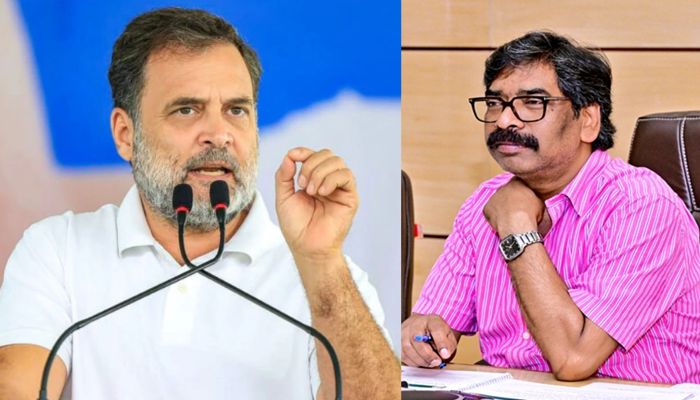
Rahul Gandhi asks Hemant Soren to meet protesting students: Why his appeal exposes Congress-backed JMM govt’s brutal crackdown on protesters

Rahul Gandhi asking Jharkhand Chief Minister Hemant Soren to meet the protesting students has put the spotlight back on the JMM-Congress government’s handling of the agitation. The appeal from a Congress leader to his political ally is significant because students have been protesting for weeks over irregularities in recruitment examinations, while the situation on the ground has continued to worsen.

Instead of opening a serious dialogue with the students, the government’s response has increasingly been marked by heavy police deployment, barricades, water cannons and lathi-charge. Police have also said pellet guns are being kept ready for use in an emergency. At a time when students are demanding answers on recruitment exams, Rahul Gandhi’s intervention can be seen as an indirect admission that the state government has failed to handle the matter properly.

Students march towards Vidhan Sabha amid heavy police presence

On 10th August, thousands of students took out a “Vidhan Sabha Gherao” march towards the Jharkhand Assembly in Ranchi. Their main demand is action on irregularities in various recruitment examinations, including those linked to JPSC and JSSC.

The police prepared for a large gathering by deploying a substantial force in Ranchi. Ranchi City SP Paras Rana said that peaceful protesters would not face any inconvenience. At the same time, he warned that anyone resorting to violence would face legal action.

The controversy grew after a video showing police personnel carrying guns went viral. Rana clarified that the weapon shown in the video was a paintball gun, which fires soft, coloured balls to mark and identify troublemakers. However, he also made it clear that pellet guns were being carried by police personnel for use in emergencies.

Pellet guns are 12-bore pump-action shotguns that fire cartridges containing pellets. They are classified as less-lethal or non-lethal crowd-control equipment and are part of the standard equipment used by specialised riot-control units.

The fact that police are keeping such weapons ready during a student protest has raised serious questions about the manner in which the government is dealing with the agitation.

Rahul Gandhi’s appeal puts Hemant Soren under pressure

Against this backdrop, Rahul Gandhi’s request that Hemant Soren meet the protesting students becomes important. If the government had been effectively engaging with the students and addressing their concerns, such an intervention from a Congress leader would hardly have been necessary.

The appeal also comes after reports of police action against protesters and restrictions around the agitation. Students who have been demanding reforms and clarity over recruitment examinations are now facing a situation where the focus has shifted from their demands to police action.

For a government led by JMM and supported by Congress, the responsibility should have been to sit with the students, hear their complaints and give clear answers on the recruitment process. Instead, the use of force and the reported restrictions have created the impression of a government trying to control the protest rather than resolve the problem.

This is why Rahul Gandhi’s intervention is politically significant. His request to Hemant Soren to meet the students effectively highlights the failure of the state government to bring the situation under control through dialogue.

Devendra Nath Mahato is in critical condition

The situation has become even more serious with the hunger strike led by Devendra Nath Mahato. On the 15th day of his fast, his condition was described as extremely critical. Mahato suffered chest injuries after Jharkhand Police stopped him from participating in a Tiranga Yatra.

The central question now is why Hemant Soren has not met Mahato or the protesting students despite the seriousness of the situation.

Mahato has continued his fast while demanding attention to the concerns of the protesters. His deteriorating condition makes the government’s silence even more difficult to ignore. When a protester reaches such a critical stage during a hunger strike, meeting him and listening to his demands should be among the first steps taken by the administration.

Instead, the continuing distance between the government and the protesters has added to the sense of anger among students.

Sonam Wangchuk’s hunger strike

The response of the BJP leadership during the CJP protest in Delhi provides a clear political comparison. When climate activist Sonam Wangchuk was on hunger strike, BJP president JP Nadda met him, repeatedly urged him to end his fast and offered him his first sip from a cup to help him break the hunger strike.

The contrast is difficult to miss. In Delhi, a senior BJP leader personally met a hunger-striking protester and appealed to him to end his fast. In Jharkhand, Devendra Nath Mahato has continued fasting for 15 days; his condition has become critical, and yet Hemant Soren has not met him or the protesting students.

This difference has raised questions over whether political leaders apply the same standards when dealing with protests in states ruled by their own allies.

Different standards over police action?

The Jharkhand episode also brings back the controversy surrounding the CJP protests in Delhi. During the “Chalo Sansad” march on July 20, the Delhi Police used lathi-charge and other crowd-control measures after the protest turned violent.

At that time, Congress, Samajwadi Party and other INDIA bloc parties, along with their supporters, strongly criticised the Delhi Police. Claims were also made that pellet guns had been used against peaceful protesters. CJP spokesperson Saurav Das had claimed that Delhi Police used pellet guns and shared a video showing marks on a protester’s body.

The Delhi Police, however, denied these claims and said it neither possessed nor used pellet guns during the protest. It called the claims false and misleading and asked people not to circulate unverified information.

The situation in Jharkhand presents a different picture. Here, the Ranchi Police has openly said that pellet guns are being carried for emergencies. Police have also used lathis and water cannons during the student agitation.

The question, therefore, is not simply about whether pellet guns were actually fired. It is also about the very different political reactions to police action in BJP-ruled Delhi and Congress-supported Jharkhand.

Questions over press freedom in Ranchi

The concerns have also extended beyond the protesters. On 9th August, an OpIndia reporter was removed by Jharkhand Police after questioning Hemant Soren about JPSC reforms. The journalist was also stopped from approaching the stage where the Chief Minister was seated during an event near the protest site.

Journalist Aman Chopra has also been booked in connection with his coverage of the student protests. He was detained and questioned by police and has said that he was restricted from covering the ongoing agitation in Ranchi.

These developments have added another layer to the controversy. During the Delhi protests, journalists were present on the ground despite political disagreements over the coverage. Some reporters were even called “Godi media” and heckled by protesters, but Delhi Police did not book media persons in connection with the CJP agitation.

The Jharkhand government now faces questions not only about its handling of students but also about the space being given to journalists covering the protests.

The larger question is, why not talk to the students?

The central issue is simple. Students have been protesting for weeks over recruitment examinations and demanding reforms. Their agitation has now reached a stage where a hunger striker is in critical condition, police are carrying crowd-control weapons and journalists covering the protests are facing restrictions.

In such a situation, dialogue should have been the first response.

Rahul Gandhi’s appeal to Hemant Soren to meet the students has therefore come at a crucial time. Rather than solving the political problem for the JMM-Congress government, the appeal highlights how badly the situation has been handled.

The contrast with JP Nadda’s meeting with Sonam Wangchuk makes the issue even sharper. When a protester is fasting, the priority should be to meet him, hear his concerns and find a solution, not wait until the situation turns into a larger confrontation.

For the JMM-Congress government in Jharkhand, the immediate challenge is to move away from police action and towards meaningful talks. Students demanding answers on recruitment exams need a government willing to listen. Rahul Gandhi’s intervention suggests that even within the alliance, there is now recognition that Hemant Soren needs to engage with the protesters directly.

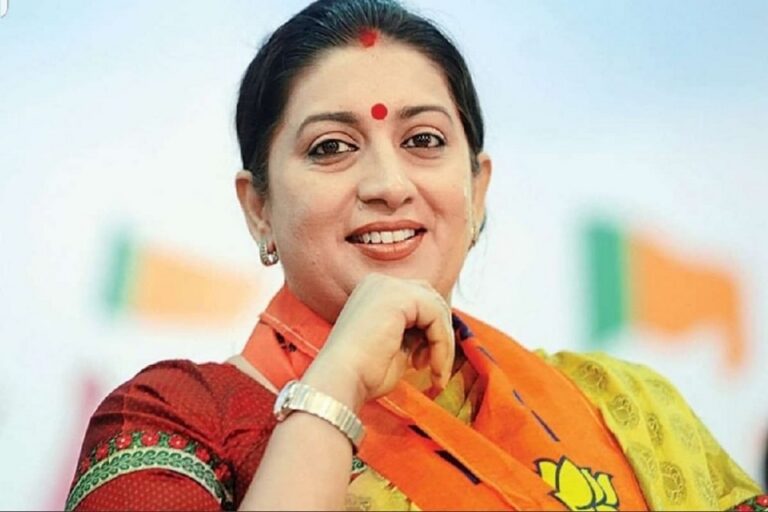
Smriti Irani’s big comeback in BJP 3.0: Why the party has brought its ‘giant killer’ back ahead of UP polls

On Monday, August 17, the Bharatiya Janata Party unveiled its new national team under party president Nitin Nabin. Among the most significant appointments was that of Irani, who has been brought back into the BJP’s national organisation as one of its eight national general secretaries. The new team also includes several experienced political operators, signalling a significant organisational reset as the BJP prepares for a fresh electoral cycle.

Irani’s return is particularly significant because she is not merely another former minister being accommodated in the party organisation. She is one of the BJP’s most recognisable political campaigners, a former Union Cabinet minister and, above all, the politician who once delivered one of the most politically humiliating defeats to the Gandhi family.

And there is a reason her return is attracting attention in Uttar Pradesh.

The Amethi factor

Smriti Irani’s political association with Uttar Pradesh began with a defeat.

In 2014, she took on Rahul Gandhi in Amethi, then one of the Congress party’s most formidable strongholds. She lost, but instead of treating the constituency as a one-election contest, Irani continued to cultivate her presence there.

She returned repeatedly, interacted with local workers and maintained a political presence in the constituency. That persistence eventually produced one of the defining upsets of the 2019 Lok Sabha election.

Rahul Gandhi had represented Amethi since 2004. The constituency had long been associated with the Gandhi family and was widely regarded as one of Congress’ safest political territories.

Then came Smriti Irani.

In 2019, Irani polled 4,68,514 votes, defeating Rahul Gandhi, who secured 4,13,394 votes, by 55,120 votes.

The significance of that victory went far beyond the 55,120-vote margin. Irani had defeated the sitting Congress president in a constituency that had been synonymous with the Gandhi family for decades.

The victory transformed her political stature almost overnight.

She was no longer merely the BJP’s high-profile television personality-turned-politician. She had become the BJP’s quintessential “giant killer”, a leader capable of taking on the Congress’ most prominent political family on its home turf.

From Amethi to the Union Cabinet

Irani’s rise after 2014 was equally remarkable.

She served in several important Union portfolios, including Human Resource Development, Textiles and Women and Child Development. By the second Modi government, she had become one of the most prominent women in the Union Cabinet.

Her political trajectory was unusual even by Indian political standards: from television’s hugely popular Tulsi Virani to a BJP organisational leader, Lok Sabha MP and Union Cabinet minister.

But the 2024 Lok Sabha election changed the equation.

Irani lost Amethi to Congress candidate Kishori Lal Sharma, a long-time Gandhi family loyalist. Sharma secured 5,39,228 votes, while Irani polled 3,72,032, defeating her by 1,67,196 votes.

The defeat was a major reversal.

The politician who had once wrested Amethi from Rahul Gandhi had now lost the same constituency to a Congress candidate closely associated with the Gandhi family.

After the defeat, Irani receded from the national political spotlight. She was no longer in the Union Cabinet and was not part of the BJP’s central organisational structure.

But that did not mean she had abandoned politics.

The politician who did not really leave Uttar Pradesh

This is perhaps the most important part of the BJP’s latest decision.

While Irani was less visible nationally after 2024, her political connection with Amethi and Uttar Pradesh did not simply disappear.

Even after losing the Lok Sabha election, she continued to remain associated with developments in Amethi. On Monday itself, just as her return to the BJP’s national team was announced, Irani shared an update concerning the redevelopment of Gauriganj railway station in Amethi, presenting it as part of the Modi government’s development agenda.

That matters because the BJP’s organisational politics is not built exclusively around elected office.

A leader can lose an election and still retain political value if he or she has a strong network of workers, familiarity with local political structures and the ability to communicate the party’s message to voters.

Irani possesses all three.

Her political career in Uttar Pradesh was built on precisely this model: contest, lose, remain present, build, return and eventually win.

That history makes her particularly relevant as the BJP prepares for another battle in Uttar Pradesh.

Why Uttar Pradesh matters so much

The timing of Irani’s elevation is difficult to separate from the political importance of Uttar Pradesh.

The state sends 80 MPs to the Lok Sabha and remains one of the central pillars of national electoral politics. The 2024 Lok Sabha election, however, exposed vulnerabilities in the BJP’s Uttar Pradesh organisation.

The BJP won 33 seats in the state, while the broader NDA tally stood at 36. The opposition INDI bloc won 43 seats.

The next major test will be the Uttar Pradesh Assembly election, expected in 2027.

For the BJP, rebuilding its organisation in the state is therefore not simply about winning another election. It is about restoring the political momentum that helped the party dominate Uttar Pradesh in the 2014 and 2019 Lok Sabha elections and the 2017 and 2022 Assembly elections.

This is where Irani’s political profile becomes useful.

She knows the state’s political landscape. She has personally fought one of its most high-profile electoral battles. She has spent years interacting with party workers and voters in Amethi. And unlike purely organisational functionaries, she can also campaign aggressively on the public stage.

Why bring Smriti Irani back now?

There are several possible reasons behind the BJP’s decision.

First, she brings electoral credibility.

Irani has already demonstrated that she can turn a seemingly impossible contest into a victory. The 2019 Amethi election remains one of the clearest examples of a BJP challenger successfully dismantling a Congress bastion. That experience can be valuable in a state where the BJP will have to fight intensely for every constituency.

Second, she brings grassroots experience.

Irani’s political story in Amethi was not built around parachuting into the constituency during election season. Her 2019 victory followed years of political engagement after her 2014 defeat.

That ability to remain connected to a constituency even after losing an election is particularly important for a party seeking to strengthen its booth-level organisation.

Third, she remains an exceptionally effective communicator.

The BJP’s organisational apparatus needs people who can work behind the scenes, but it also needs leaders who can take the party’s message directly to voters.

Irani belongs to the latter category.

She is a combative speaker, an experienced campaigner and a politician who has spent years operating at the intersection of television, electoral politics and government.

The women voter equation

There is another reason Irani’s elevation makes political sense.

Women voters have become increasingly important to the BJP’s electoral strategy. Welfare programmes such as Ujjwala, Swachh Bharat and Jal Jeevan Mission, along with various direct-benefit schemes, have helped the party establish a significant connect with women beneficiaries.

Irani’s profile fits naturally into that political narrative.

She is a former president of the BJP Mahila Morcha, a former Union minister for Women and Child Development and one of the party’s most recognisable female leaders.

Her return therefore gives the BJP another high-profile woman leader who can communicate directly with female voters while also operating as a broader political campaigner.

The BJP’s new national team itself places considerable emphasis on representation, with 10 women finding positions in the restructured national organisation.

A different kind of organisational general secretary

Irani’s appointment is also interesting because of what she is not.

She is not primarily known as a backroom organisational strategist in the mould of leaders who spend their careers building party structures away from the spotlight.

Her strength is different.

She is a mass-facing political leader.

The BJP has simultaneously brought several experienced organisational hands into prominent positions. Leaders such as Sunil Bansal, Vinod Tawde and Satish Poonia bring extensive experience of managing party structures and electoral campaigns.

Irani adds something different to that combination: visibility, political aggression and name recognition.

That combination could become particularly useful in Uttar Pradesh, where the BJP will have to contend with the Congress’ attempts to rebuild its organisation and the broader opposition alliance.

The Rahul Gandhi factor

There is also an unmistakable political symbolism in bringing Irani back.

Rahul Gandhi remains one of the Congress’ principal national faces. And Smriti Irani is the BJP leader who famously defeated him in Amethi in 2019.

The Congress subsequently reclaimed Amethi in 2024, but the memory of the 2019 contest remains politically potent.

The BJP can therefore deploy Irani not merely as another campaigner but as a living reminder of the party’s ability to challenge the Congress leadership on its own ground.

That symbolism could become particularly useful if the BJP’s political contest with Congress intensifies in Uttar Pradesh.

Her television comeback made her visible again, but politics remained the bigger story

Interestingly, Irani’s public profile began rising again before Monday’s organisational appointment.

In 2025, she returned to television as Tulsi Virani in the reboot of Kyunki Saas Bhi Kabhi Bahu Thi, reprising the role that had made her a household name.

But Irani herself made it clear at the time that the television comeback did not represent a retirement from politics. In an interview discussing her return to television, she said that politics would always remain part of her life.

A year later, the BJP has now demonstrated exactly what that meant.

The television comeback may have brought Tulsi Virani back into Indian living rooms.

The BJP’s latest decision brings Smriti Irani back into the political war room.

BJP 3.0’s message from Uttar Pradesh

The larger message from the reshuffle is that the BJP appears to be preparing well in advance for the battles ahead.

The party has not simply brought back one former minister. It has assembled a national team combining experienced political leaders, organisational strategists, regional faces and high-visibility campaigners. The official announcement includes 13 national vice-presidents, eight national general secretaries and 16 national secretaries.

Within that architecture, Smriti Irani has a very specific political utility.

She knows what it means to fight Congress in Uttar Pradesh.

She knows what it means to lose there.

She knows what it means to keep working after losing.

And, most importantly, she knows what it means to defeat a Gandhi in Amethi.

Her 2024 defeat may have temporarily pushed her out of the BJP’s central spotlight. But it did not erase the political capital she accumulated over the previous decade.

Now, with the BJP preparing for the next Uttar Pradesh battle, that political capital is being put back to work.

Smriti Irani’s return is therefore not simply a comeback.

It is a message.

The BJP has decided that the woman who once broke the Gandhi family’s hold over Amethi still has a role to play in rebuilding the party’s political machine in Uttar Pradesh.

Whether that translates into electoral gains in 2027 will depend on the BJP’s broader organisation, alliances, candidate selection and voter sentiment.

But one thing is already clear: Smriti Irani is back where the BJP believes she can make the most difference, in the political fight.

The former Union minister’s elevation as BJP national general secretary is more than an organisational reshuffle. With Uttar Pradesh heading towards a crucial Assembly election, the party appears keen to bring back a leader whose political identity is deeply intertwined with the state, and whose biggest electoral achievement came from defeating Rahul Gandhi in his family’s traditional bastion of Amethi.

For Smriti Irani, the political comeback has now come full circle.

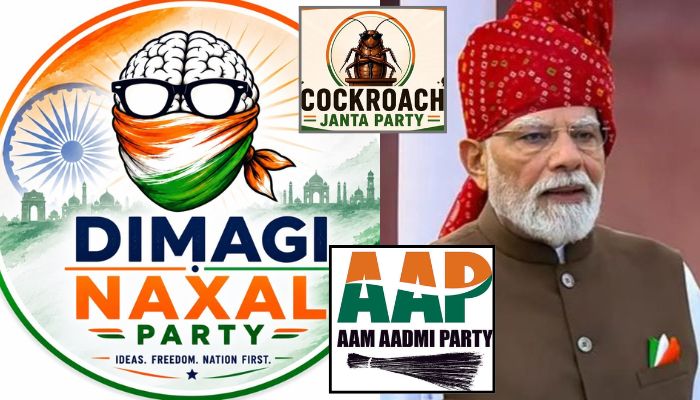
Is ‘Dimagi Naxal Party’ another front of AAP-linked Cockroach Janta Party? Here is what we found

It has now become a trend to create a party out of random remarks. The left-liberal ecosystem appears to have taken Prime Minister Narendra Modi’s latest remark so personally that, within a day, another satirical political outfit appeared online. A page named “Dimagi Naxal Party” (@dimaginaxalpartyy) has emerged after PM Modi used the term “dimaagi Naxals” in his Independence Day speech. The page presents itself as a satirical political party. 

The immediate trigger was PM Modi’s Independence Day address from the Red Fort on Saturday, 15th August. While speaking about Left-Wing Extremism, Modi said that armed Naxalism had been weakened but that its ideological influence still remained a concern. He warned against what he called “dimagi Naxals” and said such people needed to be identified and isolated. “LWE extremism destroyed the future of lakhs of youths. Naxal violence and ideology snatched the children of so many mothers,” Modi said, adding that Naxal violence had controlled large parts of the country for decades and had “ruled by the gun.”

Soon after the speech, the phrase became a subject of political debate and online reactions. Within this atmosphere, the Dimagi Naxal Party appeared on Instagram. Like many internet-born political pages, the outfit seems to have turned a political phrase into a brand, using the same words that were used by the Prime Minister and presenting them as the identity of a satirical movement. The page has not publicly established itself as a registered political party, and its founders have so far remained away from the public spotlight.

From “Cockroach” remark to Cockroach Janta Party

The method is not entirely new. The AAP-linked Cockroach Janta Party (CJP) was created in almost the same manner. The CJP emerged after a controversy over remarks made by Chief Justice of India Surya Kant during a courtroom hearing. His comments about unemployed people entering professions such as law, journalism and activism triggered a major social-media debate. The CJI later clarified that he was referring to people who posed as professionals despite having bogus degrees, rather than legitimate lawyers, journalists or activists.

The controversy was picked up by Abhijeet Dipke, who posted on social media asking, “What if all the cockroaches come together?” The post quickly gained traction, following which Dipke created a website and launched the satirical Cockroach Janta Party on May 16, 2026. The CJP described itself as a “political party for the people the system forgot to count” and the “voice of the lazy and unemployed”. Its tongue-in-cheek eligibility criteria included being “unemployed”, “lazy”, “chronically online” and having the “ability to rant professionally”.

What began as an online joke soon moved beyond memes. Dipke returned to India and the organisation became associated with protests in Delhi over alleged examination irregularities and demands concerning the education system. The group also appointed public-facing spokespersons, including investigative journalist Saurav Das, political researcher and filmmaker Vijeta Dahiya, and Ashutosh Ranka.

Is Dimagi Naxal Party another CJP front?

The Dimagi Naxal Party, however, has not revealed the faces of its founder or co-founder. Yet, its social-media activity provides some clues about the political and ideological ecosystem with which it appears to be engaging.

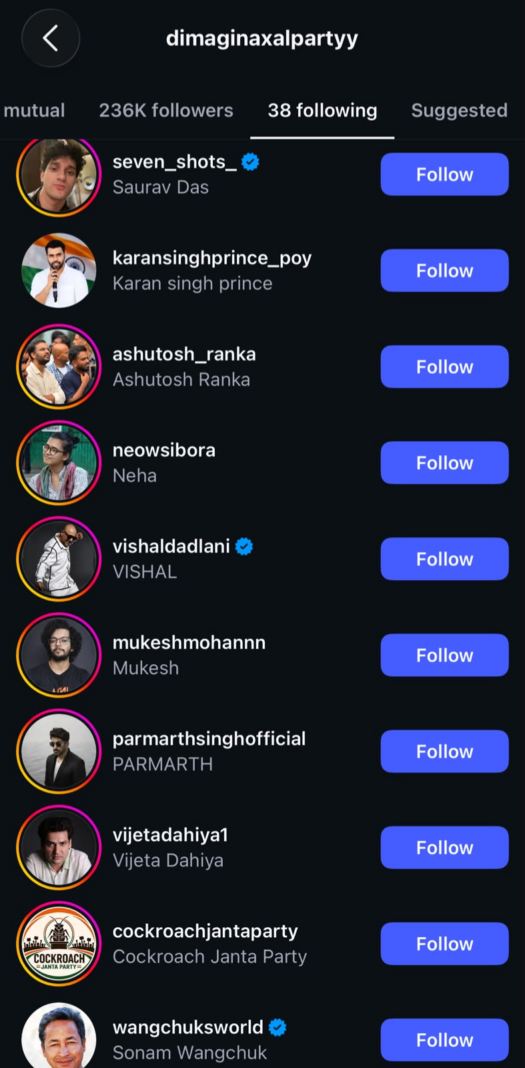
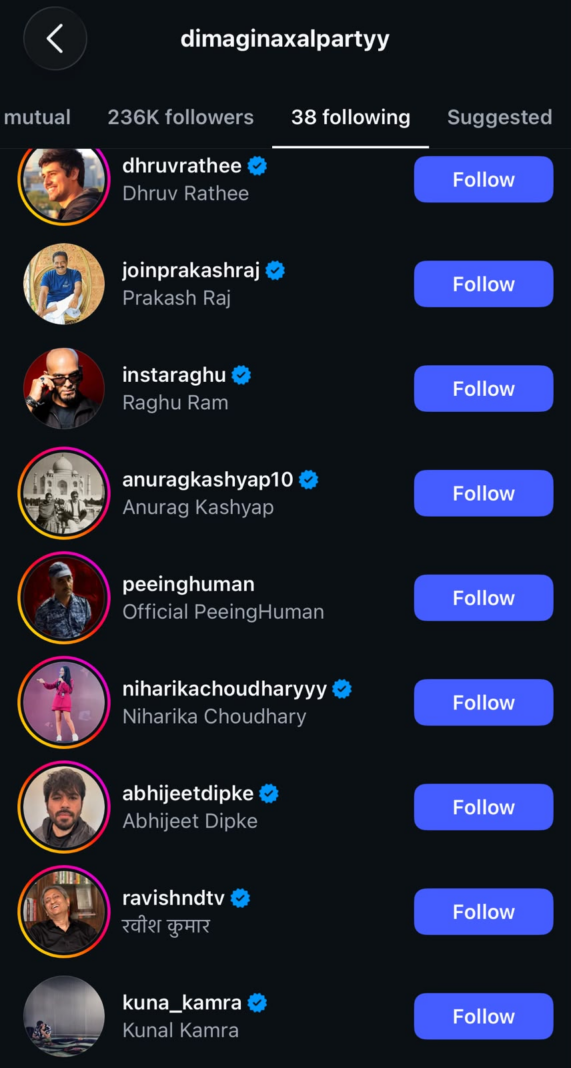
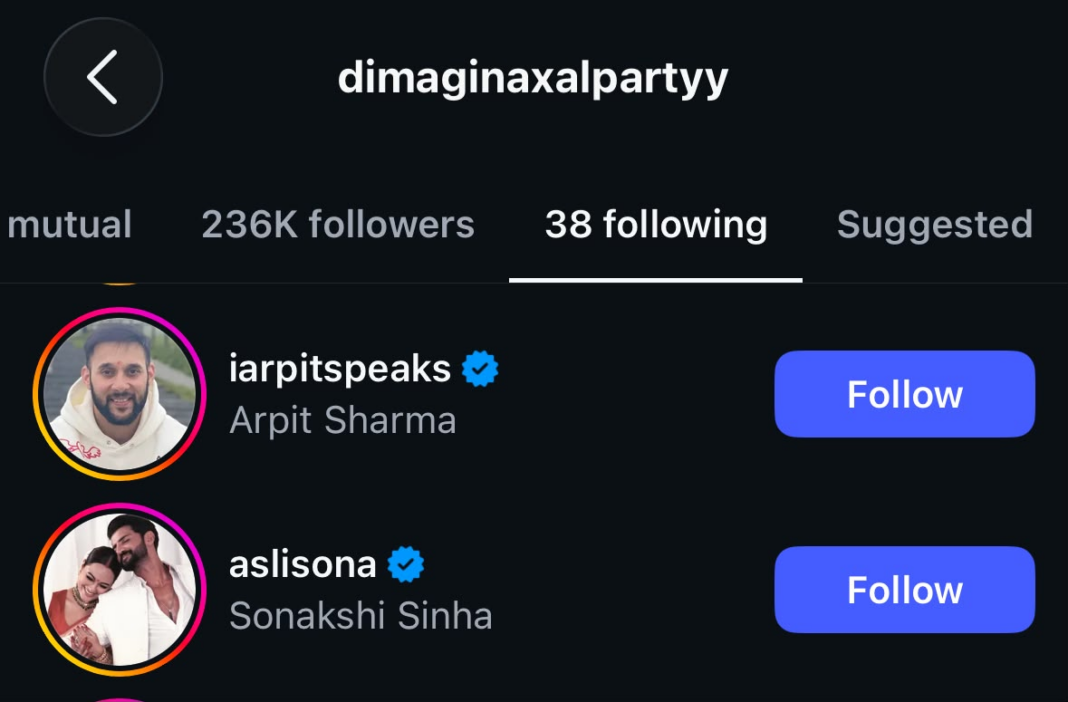
The Instagram account is currently following 38 pages and individuals. Among them are the Cockroach Janta Party, its founder Abhijeet Dipke, CJP chief spokesperson Saurav Das, spokesperson Ashutosh Ranka, former spokesperson Vijeta Dahiya, and Arpit Sharma, who has been identified in social-media discussions as the son of an AAP leader. The presence of several CJP-linked individuals in the following list is notable because it creates a visible overlap between the two internet-born political outfits.

Furthermore, the party follows various individuals who were openly making objectionable remarks during the CJP-backed Jantar Mantar protests or actively extending support to the movement. The account follows YouTuber Dhruv Rathee, who openly backed the CJP demonstration. 

It follows Bollywood actress Sonakshi Sinha, who rarely commented on political issues in the past year, but posted a video looking noticeably thrilled right after Dharmendra Pradhan’s resignation. Stand-up comedian Kunal Kamra is also present on the following list; Kamra was seen making controversial jokes about Lord Ram and Goddess Sita during the CJP gathering at Jantar Mantar. 

South Indian actor and propagandist Prakash Raj is another notable account followed by the DNP. He is the same actor who faced backlash for mocking the Chandrayaan-3 mission, and whose name also surfaced during the controversies involving Dharmasthala. Additionally, left-liberal student activist and president of the communist student outfit AISA, Neha Bora, is followed by the party.

Taken together, the following list gives the impression that the Dimagi Naxal Party is drawing from a similar political-social media ecosystem as the CJP. Whether that makes it an actual “front” of CJP is not established, but the overlap is certainly significant enough to raise questions about the relationship between the two outfits.

Bhagat Singh post and Vijeta Dahiya connection

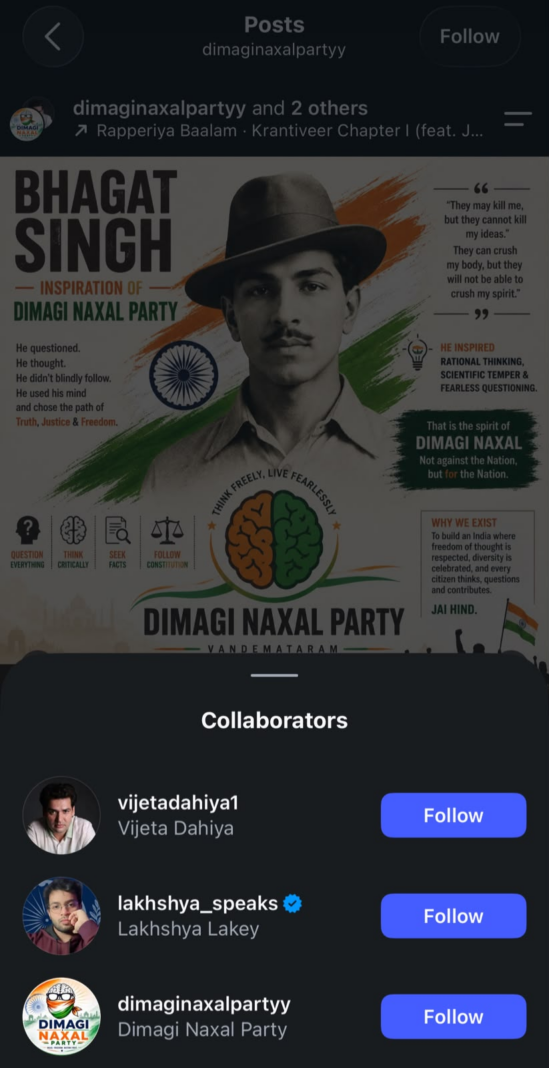
The page has also attempted to establish an ideological identity. On Instagram and X, it shared a post featuring freedom fighter Bhagat Singh with the words, “Bhagat Singh Inspiration of party.” The accompanying caption said: “We are Followers of Bhagat Singh… If THEY try to suspend our accounts or label us Anti-Nationals.. Just know- They are disrespecting Bhagat Singh.”

Interestingly, the post was published in collaboration with former CJP spokesperson Vijeta Dahiya. Dahiya is a political researcher, author, poet, filmmaker and content creator. He studied at Delhi Technological University and has directed Haryanvi films including Dararein and Opri Parai. He has also authored Power of Universe and To Hell With That Job. His public profile is particularly associated with his work as a researcher and scriptwriter for YouTuber Dhruv Rathee. Multiple profiles and interviews identify Dahiya as part of Rathee’s research and writing team.

Dahiya’s association with the CJP itself was short-lived. He was appointed one of its spokespersons in June, alongside Saurav Das and Ashutosh Ranka. However, on 21st July, CJP removed him after a video circulated showing him eating a burger during the period of the organisation’s protest. Dahiya later said he had been “made a scapegoat” in the controversy.

The fact that the anonymous Dimagi Naxal Party collaborated with Dahiya while also following almost the entire visible CJP leadership has added another layer to speculation surrounding the page.

Following the CJP playbook

The broader pattern is difficult to miss. CJP began with a viral remark, converted the controversy into a political identity and then attracted a network of activists, influencers, political commentators and protesters. The Dimagi Naxal Party appears to be following a similar route: take a political phrase, turn it into a satirical party name, build an online identity and connect it with personalities already active in anti-government or protest politics.

The CJP itself became closely associated with the protests in Delhi over alleged examination irregularities and the demand for political accountability. The group’s Jantar Mantar mobilisation brought together social-media personalities and activists, while its digital campaign expanded rapidly. The Indian Express reported that Dahiya was brought into the CJP team through his connection with Dhruv Rathee, while Dipke already knew other members of the core group.

The AAP connection behind CJP

A closer look underlines the direct connection between AAP and CJP. The party was launched by Abhijeet Dipke, an active political operator who served directly within the Aam Aadmi Party‘s social media core. In a past social media post, Dipke claimed, “The cockroaches have awakened!” portraying the movement as a spontaneous youth uprising. However, this raises serious concerns, as opposition networks have repeatedly tried to ignite Gen-Z-led street protests in India targeting the central government, mimicking political upheavals seen in neighboring nations. CJP’s website claims to represent “a political party for the people the system forgot to count” and calls itself the “voice of the lazy and unemployed,” declaring, “They tried to step on us. We came back.”

At first glance, the Cockroach Janta Party might look like just another meme page born out of social media outrage. But examining its founder’s political affiliations and manifesto reveals that the satire serves as a calculated vehicle for anti-BJP and anti-institutional narratives. The party capitalised on the CJI’s court remarks where he mentioned “jobless” youth entering professions like law or activism as “parasites.” The CJP platform welcomed anyone who was “lazy,” “chronically online,” and ready to “rant professionally.”

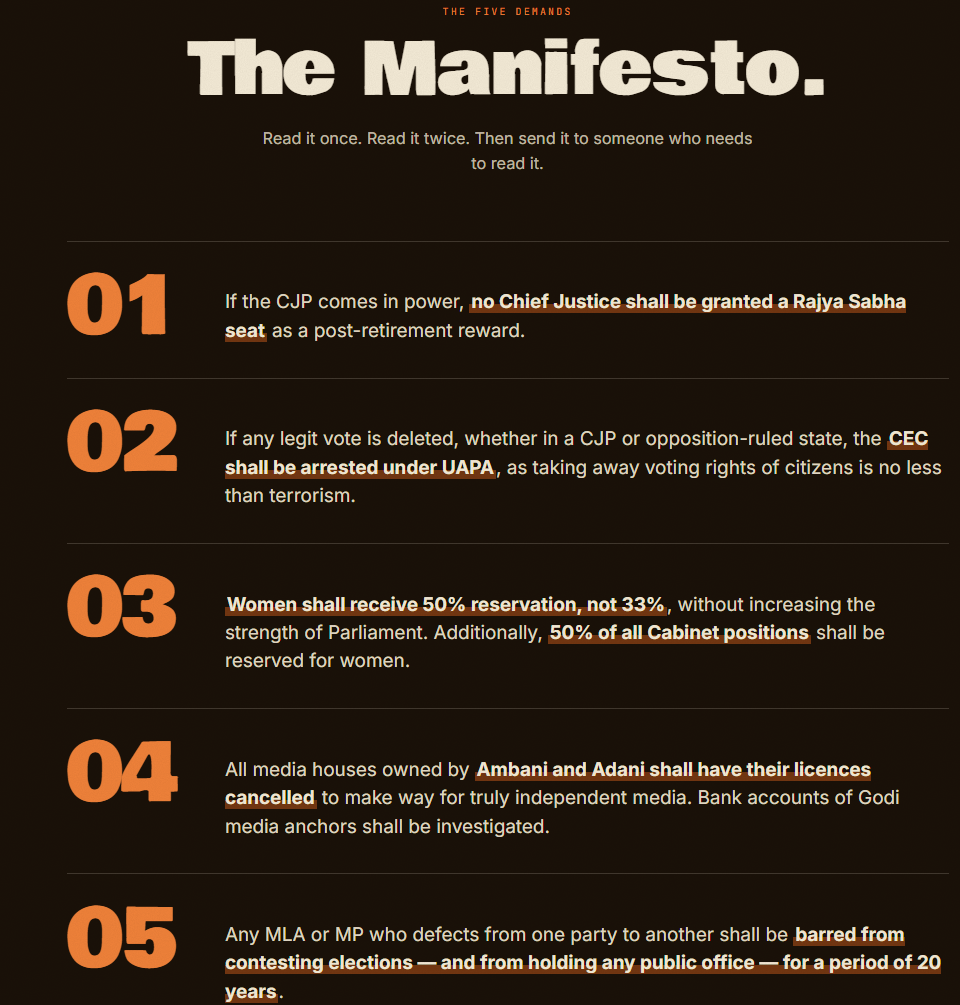
However, its actual manifesto lays bare its political agenda: demanding that no retired CJI be given a Rajya Sabha seat, calling for the arrest of the Chief Election Commissioner under UAPA if any legitimate vote is deleted, and attacking the Special Intensive Revision (SIR) exercise. 

The manifesto also demands 50% reservation for women in Parliament without expanding seat counts, a direct challenge to the planned delimitation exercise, and calls for cancelling the broadcast licenses of major media houses while investigating “Godi media” anchors. Beneath the comedic surface, the entire setup systematically advances opposition talking points targeting the judiciary, Election Commission, media, and corporate sector.

Abhijeet Dipke is far from an independent or neutral web user who stumbled into politics. Reports from the 2020 Delhi Assembly elections explicitly identified the Pune native as a key strategist behind AAP’s social media overhaul, working directly under AAP IT media head Ankit Lal. 

He specialised in simplifying political propaganda for first-time voters using memes, pop-culture clips, and parody videos to promote “Brand Kejriwal” while attacking opponents. Reports from AAP’s election war room confirmed that Dipke was in charge of national social media coordination, managing trending hashtags like #DelhiWithKejriwal and monitoring rival handles.

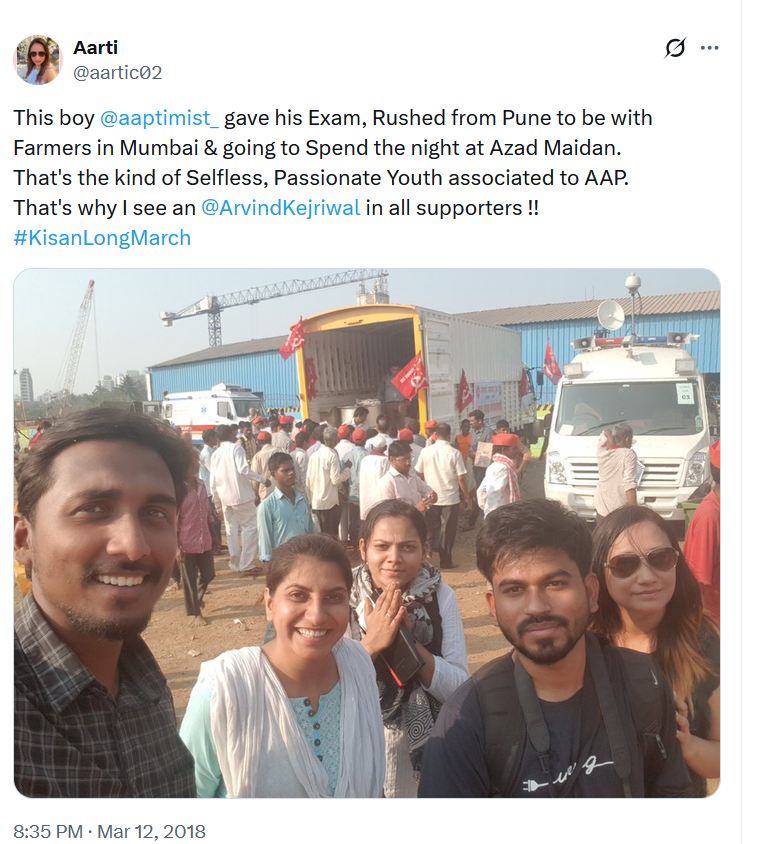
Despite Dipke claiming on news channels that his association with AAP was limited strictly to 2020-2023, digital evidence proves otherwise. Resurfaced posts from 2018 show key AAP social media member Aarti Chadha tagging Dipke’s old handle (@aaptimist_) and praising him as a dedicated youth worker representing “an Arvind Kejriwal in all supporters.” 

Furthermore, as far back as June 2017, AAP member Hasan Safin publicly promoted Dipke as the “AAP Maharashtra SM in-charge.” These clear records completely debunk his claims of being an independent youth icon, proving that both CJP and the newly created Dimagi Naxal Party function as coordinated extensions of AAP’s political network.

The overlap between the two online outfits is striking. The anonymous Dimagi Naxal Party follows CJP’s founder, its leadership, its former spokesperson and several personalities associated with its protest ecosystem. Until the founders of the new page reveal themselves, the strongest available clue about its political orientation remains its own digital footprint, and that footprint points unmistakably towards the same ecosystem that helped turn the Cockroach Janta Party from a viral joke into a political pressure group.

Malvika Sharma asked about beef in Kerala: How the state’s Islamised media ecosystem normalises provocations against Hindus and mocks their faith

There is something deeply revealing about the question asked to actor Malvika Sharma during her first interaction with the Kerala media. She had travelled to the state to promote Khalifa, her Malayalam debut. Yet, barely minutes into the interaction, a reporter asked her: “Did you like beef?”

Malvika, visibly taken aback, replied that she was a vegetarian and therefore had not tried it. The exchange subsequently went viral. And the obvious question is: why was beef the question that a reporter thought was worth asking an actress who had come to Kerala to promote a film?

The question matters because it fits into a wider cultural pattern in Kerala: beef is not merely treated as food by sections of the political-media ecosystem; it is presented as a badge of secularism, progressivism and opposition to Hindu nationalism. The Malvika episode therefore looks less like an innocent food question and more like an attempt to normalise beef consumption as a cultural marker while putting a Hindu celebrity on the spot.

That is the real problem. The issue is not what another person chooses to eat. The issue is the deliberate cultural signalling involved in making beef the first question posed to a Maharashtra-born actress during a promotional interaction in Kerala, and then hoping her response could garner eyeballs and normalise the consumption of beef among Hindus.

When beef becomes an ideological performance

Modern digital media has discovered a simple formula: identify a cultural fault line, push a celebrity towards it, record the reaction and allow social media to do the rest. In Kerala, beef has long been weaponised in precisely this manner. It is portrayed not merely as cuisine but as a statement: eat beef, therefore you are progressive; object to it, therefore you are a “Sanghi”.

Perhaps the reporter wanted engagement. Perhaps the question was deliberately provocative. Either way, the outcome is the same: Hindu religious sentiment is converted into entertainment while beef consumption is presented as something that a Hindu celebrity ought to be asked to publicly account for.

Now reverse the question. Suppose a journalist had asked a celebrity in a public interaction whether he had eaten pork. Would the same people who are now silent have treated it as a harmless food question? Or would the familiar ecosystem of Left commentators, activists and social-media outrage merchants have descended upon the journalist, accusing him of communalism, bigotry and dehumanising Muslims?

The fact that there has been no comparable outrage over the Malvika episode tells us much about the selective standards of India’s self-styled secular ecosystem. When a Muslim’s religious sensitivities are perceived to have been touched, the outrage machinery can be immediate and ferocious. When the target is a Hindu, the same ecosystem often discovers the virtues of humour, free speech and “local culture”.

That is not principled secularism. It is a hierarchy of sensitivities in which Hindus are expected to keep their religious beliefs sacrosanct only in private, while public expressions of those beliefs are treated as obstacles to progressive politics.

Kerala’s media space is increasingly an ideological battlefield

There is a broader cultural phenomenon here that deserves discussion. Kerala’s media space is not ideologically neutral. Like the state’s politics, its media ecosystem contains strong ideological currents, including organisations and commentators influenced by Islamist politics. It would be intellectually dishonest to pretend that these currents have no influence on the way religion, identity and Hindu customs are discussed.

Beef has increasingly acquired a meaning far beyond food. It has become a political symbol used to mock Hindu reverence for the cow and to signal opposition to the BJP, the RSS and Hindutva. Beef-parotta is routinely presented in sections of the discourse as a badge of Kerala’s secular credentials, while Hindus who object to cow slaughter are caricatured as communal or backward.

This is precisely how cultural normalisation works. Repetition turns provocation into ordinary conversation. A Hindu’s discomfort is first mocked, then dismissed, then portrayed as proof of his alleged intolerance. Eventually, the very act of objecting to the mockery becomes the offence.

And the Malvika Sharma episode fits neatly into that pattern.

Kerala’s deeper problem with religious extremism

This discussion cannot be divorced from Kerala’s history of religious extremism. It is the same state where a Congress leader had slaughtered a cow to protest against the government’s notification to restrict the sale of cattle in the markets for slaughter purposes.

The most haunting example is Professor T.J. Joseph.

In 2010, Joseph, then a professor at Newman College in Thodupuzha, became the target of a brutal attack after a question he prepared for a college examination was interpreted by radical elements as insulting the Prophet Muhammad. On July 4, 2010, a group attacked him and chopped off his right hand. The subsequent investigation and prosecution established the involvement of members of the now-banned Popular Front of India (PFI).

The case was not merely an assault on one individual. It represented an attempt to enforce a religious verdict through violence.

In 2023, a Special NIA Court convicted six people in the second phase of the trial. Three—Sajil, M.K. Nasar and K.A. Najeeb—were sentenced to life imprisonment, while three others received three-year prison terms. The court described the violence as a terrorist act and said it amounted to an attempt to establish a parallel religious judicial system.

That is an important distinction.

Religious extremism is not merely about someone holding conservative beliefs. It becomes a grave threat when individuals believe their religious interpretation gives them the authority to punish another citizen outside the constitutional and legal system.

Joseph’s story is especially powerful because the physical attack was only one part of his suffering.

His English-language memoir, A Thousand Cuts: An Innocent Question and Deadly Answers, documents the consequences of the controversy and the isolation he experienced afterwards. Penguin describes the book as an account of a man who survived the attack but was subsequently deprived of his livelihood and isolated by his own community.

His wife Salomi eventually died by suicide in 2014, after years of financial, emotional and social turmoil surrounding the controversy.

Joseph’s own conclusion is perhaps more important than any political interpretation imposed upon his story: religious fundamentalism itself is the problem.

That lesson should not be selectively applied.

The T.J. Joseph case shows where unchecked religious extremism can lead

If Kerala’s media is genuinely committed to pluralism, it must confront religious extremism wherever it originates. The T.J. Joseph case remains one of the most disturbing reminders of what unchecked religious fanaticism can produce.

The Kerala media slanders a Hindu activist defending himself against political killings as extremist while contextualising violence perpetrated by Islamists belonging to banned PFI and other such organisations.

The ideological label should follow the conduct, not the religion of the perpetrator.

This is where the media’s vocabulary becomes important.

There is a growing tendency in ideological discourse to describe violence against Hindu nationalist activists primarily through the vocabulary of “political rivalry”, “clashes”, “local disputes” or “hooliganism”. Yet when the ideological motivation is Islamic extremism, sanitising the description serves nobody.

A media ecosystem that selectively applies these standards is not protecting society from extremism. It is protecting an ideological narrative from scrutiny.

Malvika Sharma was asked a question. The silence that followed is the bigger story

The most revealing part of the Malvika Sharma episode is not merely that the question was asked. It is the silence afterwards.

If a journalist had asked a celebrity whether he had consumed pork, the Left ecosystem would almost certainly have discovered its outrage vocabulary. The journalist would be branded communal, hateful, Islamophobic and worse. Social-media campaigns would follow. Think-piece after think-piece would explain why such a question was “dehumanising”.

But ask a Hindu-origin actress about beef within minutes of meeting her for a film promotion, and there is silence.

That silence exposes the double standard.

The same ecosystem that lectures Hindus about tolerance rarely asks why Hindus alone are expected to tolerate repeated provocations to their faith. A Hindu is expected to laugh when his religious symbols are mocked, remain silent when his festivals are stripped of their religious character, and demonstrate his liberal credentials by showing indifference to practices that offend his beliefs.

Meanwhile, religious boundaries asserted by other communities are often treated as matters requiring accommodation.

Consider the recent Nilavilakku controversy. IUML MLA Fathima Thahiliya was criticised after lighting a traditional lamp at a restaurant inauguration, while Samastha’s Central Mushawara said Muslims should refrain from participating in practices associated with other faiths and described such participation as religiously problematic.

That episode is revealing for another reason. Religious communities are entitled to preserve their doctrinal boundaries. But if one community’s religious boundaries are treated as legitimate while the majority’s religious sentiments are routinely subjected to ridicule, the result is not harmony. It is asymmetry.

This is why the Malvika Sharma episode cannot be dismissed as merely a silly question. It is symptomatic of a culture in which provoking Hindu sentiment has become a form of ideological performance.

The objective is not necessarily to make every Malayali eat beef. It is to make beef consumption culturally unremarkable, politically fashionable and, eventually, a weapon with which to taunt Hindus who refuse to treat the cow as merely another animal.

That is the larger ideological project.

And the Left’s silence is part of the story.

India’s secularism cannot survive if it demands that only Hindus constantly prove their liberal credentials by surrendering their religious sensitivities. A civilisation in which one community is repeatedly told to accommodate while its own beliefs are mocked is not becoming more tolerant. It is merely teaching one side that its sentiments do not matter.

The Malvika Sharma episode should therefore be remembered not because a reporter asked an awkward question, but because it exposes the cultural climate in which such a question could be considered normal, amusing or newsworthy in the first place.

Kerala’s media has every right to question politicians, actors and public figures. It has every right to challenge religious beliefs. But if it wants to claim the moral high ground of journalism, it must abandon the habit of treating Hindu sentiment as uniquely disposable.

Professor T.J. Joseph’s story reminds us of the end of religious intolerance: when accusations of blasphemy become a justification for physical violence. The Malvika episode is obviously nowhere near that level. But between violent extremism and a harmless joke lies a vast cultural territory where religious contempt can be normalised, one provocation at a time.

That is precisely why such incidents deserve scrutiny.

When a Hindu’s faith is repeatedly made into a punchline, the problem is not that Hindus have suddenly become too sensitive. The problem is that a section of India’s ideological establishment has become far too comfortable with attacking the very idea that Hindus are entitled to take their own faith seriously.

And instead of calling out dangerous Islamist extremism for what it is, the state’s media ecosystem has repeatedly cosseted and legitimised Islamists. This indulgence has only emboldened them to continue their increasingly depraved provocations, gradually creating a culture in which mocking and denigrating Hindus and their religious beliefs is treated as acceptable.

That is not pluralism. It is selective contempt dressed up as progressivism.

Linking rivers of India: Why it matters

Every year during the monsoon season, two contrasting realities emerge across India. While states like Assam, Bihar, and Eastern Uttar Pradesh face devastating floods that submerge farmland and cause structural losses worth thousands of crores, regions like Bundelkhand, Marathwada, and Western Rajasthan suffer from acute drought and severe water shortages. This recurring paradox reveals a fundamental truth about India’s geography: the nation does not suffer from an absolute shortage of water; the real crisis lies in water management.

In the first part of this series, author Shravan Shukla breaks down why the Interlinking of Rivers (ILR) project is essential for India’s long-term water management goals. Overseen by the National Water Development Agency (NWDA), this massive infrastructure vision encompasses 30 inter-basin river links, divided into 14 Himalayan and 16 Peninsular components designed to balance the country’s water distribution.

The core philosophy of this mega-project is simple yet revolutionary. During the 100 to 120 days of the monsoon, billions of litres of surplus freshwater flow unchecked into the sea or unleash destructive floods. By constructing a national water grid of canals, reservoirs, and dams, this excess water can be captured and diverted to thirsty, drought-prone regions that crave every single drop for drinking and farming.

The report highlights that river interlinking is far more than an agricultural proposal; it is the bedrock of India’s future food, energy, and economic security. With India’s population expected to reach nearly 1.7 billion by 2050, securing water resources is a national imperative. Global models like China’s South-North Water Transfer Project and the California State Water Project in the United States have already proven that large-scale inter-basin water transfers can eliminate national-level water crises.

Beyond controlling annual floods and mitigating droughts, a fully realised national water grid offers multi-dimensional benefits. It promises to bring millions of hectares under reliable irrigation, generate thousands of megawatts of clean hydroelectricity, boost inland navigation, and help resolve decades-old interstate water disputes. Part 1 establishes why connecting India’s major river systems is the most crucial infrastructure goal of the 21st century.

The full article is available on Chapter One Mag.

UPI still climbing, The Wire still faking: Notorious fake news peddler claims decline in UPI use, data shows healthy growth

Habitual fake news peddler The Wire is back with another piece of fake news. This time, they have claimed that Indians have started to switch to cash from UPI after the parliament passed a bill allowing the centre to impose a Merchant Discount Rate (MDR) on some Unified Payments Interface (UPI) transactions. The Wire claimed, “data shows that these transactions have been slowing in the last five years, with cash flow increasing in the same period.”

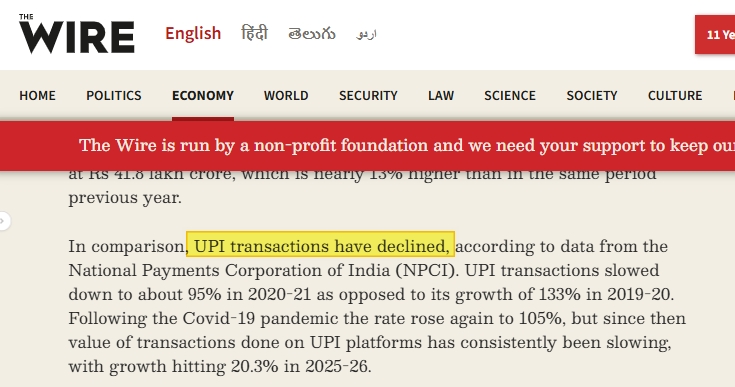
The Wire report further claims, “UPI transactions have declined, according to data from the National Payments Corporation of India (NPCI).” However, contrary to the claim, UPI transactions have not declined in the country. While the data shows that the rate of annual growth of UPI has been coming down, Wire changed that to a fall in UPI transactions.

Screenshot of the Wire report

The article by The Wire, published on 16 August 2026 and based on a The Hindu analysis from the previous day, asserts that UPI transactions have slowed while cash usage is increasing, linking this to the recent passage of the Taxation and Other Laws (Amendment) Bill, 2026, which enables the government to permit a Merchant Discount Rate (MDR) on certain UPI and RuPay transactions. The article implies a behavioural shift away from UPI “since” the announcement.

The reality of the fee

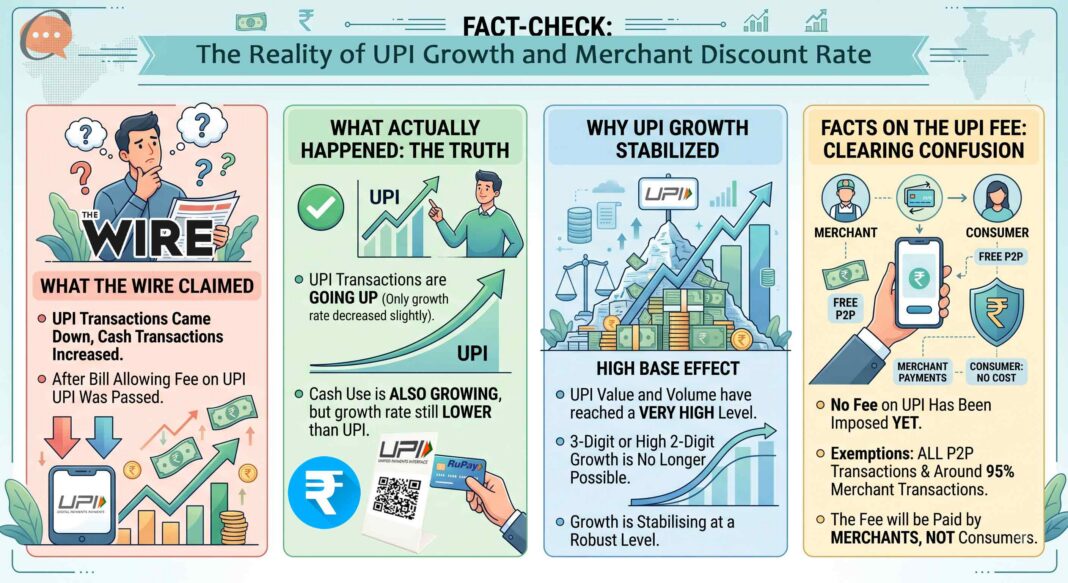
The entire claim made by left-wing propaganda portal The Wire is baseless, because no MDR on UPI has been imposed yet. The Bill is only an enabling provision that amends Section 10A of the Payment and Settlement Systems Act, 2007. It removes the earlier statutory bar and allows the government, through future notification, to specify modes that may attract charges. The actual decision on whether to introduce MDR, on which transactions, at what rate and from when rests with the UPI and Services Steering Committee headed by the National Payments Corporation of India (NPCI). Nothing has changed on the ground for users or the vast majority of merchants.

Essentially, the bill itself does not levy any tax on digital payments; it merely removes a legal prohibition on levying such tax. This means that if the government decides to tax certain digital transactions in future, it can do so through a notification.

Moreover, the government has clarified repeatedly that even if the MDR is implemented, consumers will not face any charges. All person-to-person (P2P) transactions will remain free. Any MDR, if and when introduced, will apply only to a limited set of merchant transactions above a certain threshold, at a nominal rate far lower than existing MDRs for debit or credit cards. Only the merchants will have to pay the MDR when it is implemented, not the consumers.

Moreover, the government has clarified that the vast majority of merchant transactions will continue to remain free of charge. Industry estimates circulating around a possible ₹2,000 threshold for larger merchants indicate that only around 4-5% of person-to-merchant volume would be affected, meaning well over 95% of transactions by volume would stay untouched. Everyday payments for groceries, local transport, small purchases and transfers would be unaffected. The claim that people have already stopped using UPI because of a fee that has not been levied is therefore meaningless.

Payment Council of India (PCI), a trade body representing non-banking payment players, has also clarified that consumers will not be charged for making UPI payments. The council also clarified that small merchants and kirana stores will continue to accept UPI payments without paying any Merchant Discount Rate (MDR). It said protecting small businesses remains central to UPI’s inclusive growth model.

PCI further added that even if merchant service charges become applicable for certain large merchants in the future, such arrangements would be commercial agreements between merchants and payment service providers. They would not result in consumers being charged for making UPI payments. Merchant service charges are common across digital payment ecosystems worldwide and typically remain separate from consumer payment charges.

As per the latest data, 63% of UPI transaction volume is person‑to‑merchant (P2M) transactions, reflecting UPI’s extensive use for high‑frequency, low‑value retail payments. In contrast, person‑to‑person (P2P) transactions dominate transaction value, contributing 71%, indicating their use for higher‑ticket transfers between individuals. This contrast underscores UPI’s dual role as a mass retail payments platform and a trusted channel for larger‑value fund transfers.

86% of person‑to‑merchant transactions are valued below ₹500, highlighting UPI’s deep integration into routine retail and day-to-day commerce. People routinely use UPI to pay for a cup of tea or a pack of chips. Therefore, majority of merchant payments will not have any MDR if and when it is implemented, and P2P transactions will be completely exempt, regardless of the value.

Bill passed on 6 August, UPI data up to 9 August

An interesting fact is that The Hindu report uses UPI transaction data upto 9th August. On the other hand, the amendment to the Payment and Settlement Systems Act, 2007 was passed on 6th August. Therefore, if The Wire is to be believed, in just 3 days, Indians switched to cash from UPI after the bill was passed in Parliament.

What the data shows

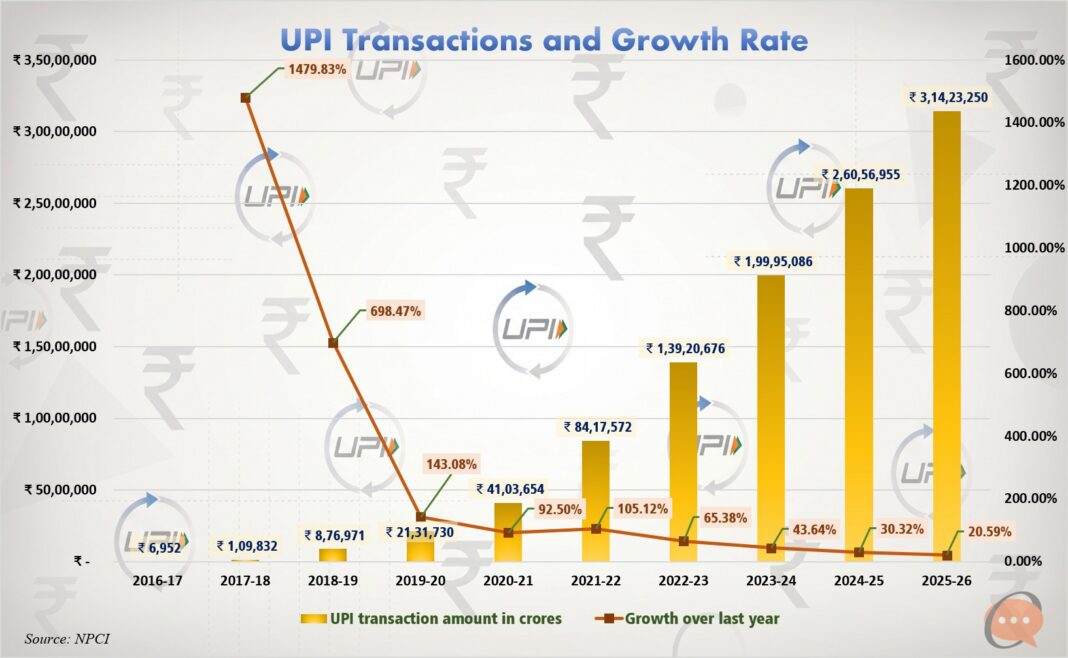
The Wire claimed that the UPI transactions have declined, but the underlying data actually shows continued expansion of UPI, not a reduction in usage. The Hindu report, the basis of the Wire report, itself notes that the value of UPI transactions grew 133% in 2019-20, 95% in 2020-21 and 105% in 2021-22 before moderating to 20.3% in 2025-26 and further to 18.7% in 2026-27 so far (April-August). It further states that the growth rate of cash usage has also gone up in recent periods—from around 4% in 2023-24 to 6.5% in 2024-25, 12% in 2025-26 and nearly 13% as of 31 July 2026 (reaching ₹41.8 lakh crore).

However, UPI’s growth rate remains higher than that of cash, while absolute volumes and values keep rising. In July 2026 alone, UPI processed a record 23.66 billion transactions worth about ₹29.88 lakh crore, up roughly 22% in volume and 19% in value year-on-year. April-July 2026 volume growth stood at 23.5%. Full-year FY 2025-26 saw 24,162 crore transactions worth ₹314 lakh crore, with volume growth of 30% and value growth of about 20.6%.

Calling a still-healthy 18-20% growth “decline in UPI usage” is completely misleading. Of course, the growth rate is coming down every year, and that is expected. In the initial years, the UPI usage was low, and that’s why the growth rate was enormous, but such high rates can’t be sustained in the long term. Ten years ago, the UPI transaction value in 2026-17 was ₹6,952 crore, and in the last FY it was ₹314 lakh crore.

When the annual use is already enormous, percentage growth naturally moderates even as absolute numbers climb sharply. Early triple-digit rates reflected a low base after the launch of UPI in 2016. Sustaining three-digit or even high two-digit growth forever is mathematically impossible once the system processes tens of billions of transactions every month and accounts for the bulk of India’s digital payments. Growth is stabilising at a robust level consistent with a mature, high-penetration platform in a growing economy.

Along with UPI, the value of cash transactions is also increasing, and that is expected. Cash is not going away, govt is not planning it, at least not yet. The fact that usage of both cash and UPI is increasing at a healthy rate indicates a growing economy, where people are transacting more.

Both cash holdings and UPI volumes can rise simultaneously when nominal economic activity expands, prices adjust, and people hold more liquidity for precautionary or everyday reasons while also making more digital payments. This is not evidence of substitution away from UPI to cash; it is evidence of a larger overall payments pie.

It is also notable that The Hindu’s 18.7% figure for August 2026 is also potentially misleading. The month is not yet over, and full-month data cannot yet exist. Therefore, any comparison based on partial August figures (Upto 9th August) cannot be treated as definitive for the entire period. Year-to-date trends through July already showed solid double-digit growth.

The UPI Growth Story

Since its launch in 2016-17, the Unified Payments Interface (UPI) has transformed India’s digital economy into one of the most inclusive and dynamic payment ecosystems in the world. What began as a bold experiment in real-time, interoperable payments has now become a global benchmark, processing billions of transactions every month and reaching deep into the fabric of everyday life. Today, UPI has grown into the world’s largest real-time payment system.

UPI’s trajectory from its introduction underscores why high early growth rates were never going to persist indefinitely. NPCI launched the system on 11 April 2016 with 21 member banks as a real-time, interoperable platform for inter-bank transfers using a simple mobile interface. Adoption was modest at first. Demonetisation later that year provided an early push, followed by the rollout of BHIM and progressive integration by major apps and banks. From just a few crore transactions and negligible value in the initial years, volumes exploded. Annual transactions rose from around 2 crore in FY 2016-17 to over 24,162 crore in FY 2025-26, an almost 12,000-fold increase, while value climbed more than 4,000-fold to ₹314 lakh crore.

By 2025-26, the platform was handling average daily volumes of around 66 crore transactions. Banks live on UPI now exceed 700. This explosive phase was powered by network effects, zero-MDR policy from 2020, QR code proliferation and deep smartphone and internet penetration. Once a system reaches this scale and becomes the default for everyday retail payments, growth rates settle into the tens or low twenties while absolute usage keeps expanding with the economy. That is precisely the phase India is in now.

The Wire’s headline and narrative invert this reality. A modest deceleration in the rate of growth is presented as people using UPI less, a fee that has not been imposed is treated as the cause, and the simultaneous rise in cash, itself slower than UPI’s growth, is cast as a switch. The data from NPCI and RBI show UPI still expanding robustly, cash rising alongside a growing economy, and no behavioural retreat from digital payments triggered by an enabling Bill. The report therefore peddles an inaccurate and alarmist interpretation rather than a careful reading of the numbers.

It is notable that the fake news by Wire on UPI comes when the Indian payments system is going global. The system is already operational in several countries, including the UAE, Singapore, France, Qatar and others. The next decade of UPI is poised to drive even greater transformation in India’s digital payments landscape. Therefore, it is typical of anti-India portal The Wire to create negativity around the UPI system.

UPI is a national achievement built by Indians, for Indians. The Government has repeatedly said that it will continue to promote and fund the system in future.

The Wire and fake news

The Wire has a well-documented record of publishing sensational claims that later collapse under scrutiny, forcing it to delete stories and issue apologies. Two of the most prominent examples illustrate this pattern clearly. In January 2022, the portal ran a multi-part “investigation” claiming the existence of a sophisticated, secretive app called Tek Fog, allegedly used by operatives linked to the BJP to manipulate social media trends, amplify propaganda, hijack WhatsApp accounts and systematically harass journalists and critics. The reports presented technical screenshots, supposed whistleblower accounts and complex diagrams as proof. Independent examination, including detailed fact-checks by OpIndia, showed the claims were based on fabricated or unverifiable material, no such app existed, and the technical evidence did not hold up.

The Meta-Instagram episode that followed later the same year proved even more damaging. In October 2022, The Wire published reports asserting that Meta had granted BJP IT cell head Amit Malviya special privileges under its XCheck programme, allowing him to get Instagram and Facebook posts removed “with no questions asked.” The stories relied on purported internal emails, screenshots and technical claims. Meta and several people quoted by The Wire publicly stated that the documents and emails published by the portal were fabricated. After an “internal review” following the exposure on social media, The Wire formally retracted the articles, claimed it had been “subjected to deception” by a member of its own investigation team, deleted the reports, and issued a public apology to readers for failing basic editorial standards on technical verification.

When the portal’s later Meta coverage unravelled, The Wire also quietly removed the Tek Fog series from public view, citing an internal review because one of the key authors was also involved in the Meta stories.

These were not minor errors or differences of interpretation. In both cases the core claims were false, the supporting material did not withstand independent scrutiny, and the portal was compelled to erase the stories and apologise. The pattern of publishing high-impact, politically charged narratives on the basis of shaky or fabricated technical evidence, only to retract when exposed, continues to undermine The Wire’s credibility whenever it makes similar sweeping claims.