Home Blog Page 42

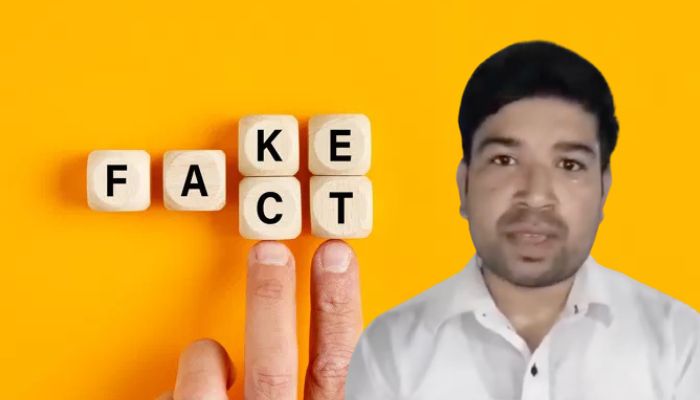
Dalit Rapido driver suspended for 100 years after he created a ruckus over ‘caste slurs’ by passengers: How he made up a story to get famous, falsely accusing Dalit passengers

On the 15th of August, a video surfaced in which a Rapido taxi driver was seen screaming at and abusing his passengers, claiming that they had hurled casteist abuse in their conversation about their own senior. The passengers were railway employees who were allegedly talking about their superior. The video from Lucknow was first posted by Piyush Rai, who claims to be a journalist. He wrote, “A Dalit cab driver, Ankit Kumar (30), confronted four Indian Railways employees in Lucknow after they allegedly repeatedly used casteist slurs while referring to a senior officer from his community. He later asked all four employees to deboard the cab midway”.

On the same day, Piyush Rai posted another video where the cab driver was seen narrating the incident. He starts his video with ‘Jai Bhim’. In the video, the Rapido driver claims that he has no religious, cultural or caste-based sentiments against the passengers he threw out of his cab. He claimed he was not even aware of the passengers’ caste. However, he claims that the passengers were specifically targeting one caste in their conversation. Ankit Kumar says that, because he hails from the same caste, he asked the passengers several times to refrain from targeting that community; however, they did not heed his request. In his video, he further claims that Rapido suspended him for 100 years without asking him for his version.

The incident drew widespread reactions, with the usual Ambedkarite trope being spewed on the internet. The selective framing of the incident was used by many to abuse Hindus and Hinduism, and also by many Muslims to demand a “Muslim Atrocity Bill”, claiming that Dalits could file SC/ST cases when they face abuse; however, Muslims do not have similar laws to “protect them”.

Congress functionaries also commented on the issue, outraged.

The truth, however, was very different from what Piyush Rai was projecting. After these two videos, Rai did not publish any other information which revealed the truth about the case, making it a classic case of spreading motivated misinformation.

What the truth of the case was: Dalit passengers open up, reveal how Rapido driver Ankit Kumar lied

Hours after Piyush Rai posted Ankit Kumar’s video, journalist Brajbhushan Markandey posted a long interview with the passengers, in which they revealed that they were themselves Dalit and that the Rapido driver had lied blatantly.

He wrote, “Wanted to implement the SC/ST Act! The claim turned out to be the opposite! The victims’ side is shocking! They were four railway employees who booked a Rapido! The Dalit Rapido driver stopped the vehicle and shouted loudly in an aggressive tone! These four people are repeatedly seen shouting while calling them Manuvadi, and it is being observed that they have used caste-related words! The crowd gathers, and then what happens… The special thing is that three of these four people were from Scheduled Castes and Scheduled Tribes, and one person was from Backwards Classes! These railway employees, with their great sense of judgment, stopped a big commotion while a major accident could have happened! If such reactions and the misuse of SC/ST will continue without any reason, where will society go? The four experienced individuals who were present in the discussion themselves had requested to come on our channel so that the truth could be told to society!”

The passengers said that they themselves belonged to the Dalit community and denied having used casteist slurs in their conversation. They also said that Ankit Kumar randomly stopped the cab and started picking a fight with them. He started the video with the casteist slur, and it was at that moment they understood that he aimed to ensure that the passengers were trapped in an SC/ST Atrocities case by making the video viral.

Interestingly, in the original video posted by Piyush Rai, one passenger is also heard saying that he himself is a Dalit; however, Rai did not highlight that aspect of the video.

One passenger in the interview also revealed that Ankit Kumar was calling others on the phone to reach the spot, potentially to incite unrest. “We would have been in serious danger if people were of that mentality and had been influenced by Ankit Kumar”, the passenger said.

3 out of 4 passengers were Dalits

Journalist Brajbhushan Markandey, in his opening remarks, made an interesting observation. That the way the video by Ankit Kumar was framed, and how it was presented on the internet, gave the impression that the passengers probably belonged to general castes and were using casteist slurs against Dalits. Ankit, however, was unaware that 3 of the 4 passengers he threw out of his taxi were Dalit themselves.

How the incident unfolded – what the passengers said

The incident is from the 10th of August. According to one of the passengers, who is a Dalit, the 4 of them were discussing the merits of taking an Ola/Uber ride rather than owning a car. The conversation was about how taxis for hire are far more convenient, since one does not have to pay road tax, tolls, or car servicing costs. Even if one has to travel a bit far, taxis are far more convenient.

The passenger says that they then started discussing how the Railways has now started giving leave to its employees, which was not the case earlier. During that conversation, the group discussed how leave becomes difficult when they receive an insensitive “Triple-C”.

It is this statement that was misunderstood, deliberately or otherwise, by Ankit Kumar, the Rapido driver. He believed that “Triple-C” was a casteist reference, when in reality, Triple-C is a post in the Railways equivalent to an HR manager.

The passenger alleges that after this conversation, Ankit stopped the car and started becoming aggressive. He switched on his camera and started recording the incident.

He also revealed that Ankit started calling people, threatening to commit violence.

Another passenger confirmed the incident and said that right after stopping the car, Ankit Kumar first called someone on the phone, asking them to come to the location.

In another shocking revelation, the second passenger said that when Ankit switched his camera on, he first pointed it towards him. When he did so and started accusing them of using caste slurs, the passenger told him that he was from the SC community as well. At that point, he turned the camera towards a different passenger.

This reveals that the driver actually knew that the group he was accusing had members who were Dalits, and yet proceeded to accuse them of using anti-Dalit slurs.

“The moment he started recording, he started by using the slur (that we had not used). That very moment I knew that he was trying to stir trouble”, the passenger said. “While I understood, those sitting at the back did not understand his motives. They had also done night duty, so were taken aback by the aggression. He kept abusing”, he added.

A third passenger said during the interview that he aimed to get famous, since he has his own YouTube channel.

The fourth passenger said that when Ankit started accusing them, he told him that they also believe in Dr Ambedkar since they were Dalits; however, Ankit did not heed and kept accusing them.

“He created a lynching type of situation”

The passenger says that even when Ankit Kumar was screaming and becoming aggressive with them, they had told him that they too belonged to the SC and ST communities; however, the Rapido driver did not bother listening.

Further, the passenger claims that the crowd that had gathered there was also trying to stop Ankit, saying that he had no right to create a ruckus based on some private conversation among passengers.

“We were very scared. We were lucky that the crowd over there had good people; otherwise, Ankit had created a lynching sort of situation”, the passenger said.

“Differences are disappearing, but such incidents will increase the caste divide”, says passenger

One of the passengers, who is himself a Dalit, said that society was becoming far more egalitarian. Discriminatory practices are disappearing; however, such incidents would only deepen the caste divide.

“We were Dalits. But if we belonged to General Caste, I can’t even imagine what the driver would have done to us”, the passenger said. “Even though we belong to the SC/ST community, we got scared by his aggression. He just imagined the insult and forced it on us”, he added.

Another passenger insinuated that Ankit was trained in creating such a scene to go viral. “He first said that he was a lone Dalit fighting against 4 Manuvaadis. Then he started saying that he was tolerating our supposed caste abuse quietly for a long time. Then changed his statement to claim that he kept requesting us not to use the caste slur, but we did not listen. Then he started telling us about the SC/ST Act. Such people need to understand and stop trying to play the victim. We work in a profession where all castes work as equals. Such elements should not try to create strife”, he said.

Worrying trend of Ambedkarite activism

This incident underlines a worrying trend in modern politics – the rise of dangerous Ambedkarite activism which has crossed over from assertion of identity pride to aggressive posturing and the active persecution of non-Dalits, in some frenzied vengeance over real, as well as imaginary and exaggerated historical grievances.

There have been several cases where those chanting ‘Jai Bhim’ have falsely accused non-Dalits of indulging in casteist behaviour, inciting hate and, on several occasions, violence.

In April 2026, an Instagram influencer was assaulted by Ambedkarite goons simply because he questioned the degrees of Dr Ambedkar. In April, a video from Amravati, Maharashtra, went viral on social media, where a group of Ambedkarite activists (Bhim Tola) were seen beating up an influencer identified as Dev. His mistake was that he had questioned the claims of 32 degrees earned by Dr BR Ambedkar in one of his videos, which has now been deleted. The assault video had a background song, making it hard to understand what the activists were saying and what Dev said in reply. However, he was seen folding his hands and apologising. By the end of the video, police were seen standing while Ambedkarites continued to intimidate Dev. Later, Dev was forced to publish a video apologising to the followers of Dr Ambedkar if he had hurt their feelings. In truth, according to a PIB press release from 2024, Dr BR Ambedkar had five degrees and two honorary degrees, making the total seven. There is no official source that can support the claim of 32 degrees.

In April 2025, in the Shirur area of Maharashtra’s Pune district, a youth was attacked over a social media post on Dr Bhimrao Ambedkar. The incident unfolded near Nakshatra Building in the evening when a 24-year-old Vaibhav Santosh Bhosale, a resident of Pawar Mala, was attacked by the accused Roshan Devre and three others. A case has been registered against the four accused at the Shirur Police Station on the victim Vaibhav Bhosale’s complaint. The police said the accused created a fake social media account in the complainant’s name and posted objectionable content against Dr Ambedkar on the Bhimsena Maharashtra Group. Under the pretext of resolving the dispute they created, the accused called Vaibhav to meet them; however, the accused assaulted the complainant.

Another troubling incident from February 2026 was when journalist Ruchi Tiwari was assaulted in the DU Campus.

In the North Campus of Delhi University, a pro-UGC protest took a disturbing turn on 13th February 2026. A journalist, Ruchi Tiwari, associated with the YouTube channel ‘Breaking Opinion’, was mercilessly assaulted by caste activists, including Leftist elements. The incident took place at the Arts Faculty when the Brahmin woman had gone to cover the protests by SC-ST-OBC activists.

The protest was organised by left-wing student groups like the Students’ Federation of India (SFI), All India Students’ Association (AISA), and the newly formed All India Forum for Equity. The protestors demanded the implementation of the University Grants Commission (2026) “Promotion of Equity in Higher Educational Institutions” regulations, stayed by the Supreme Court. The caste discrimination-related guidelines have caused significant outrage over the 2026 regulation, which ruled out the general castes as victims of caste-based violence by restricting the category of victims to SCs, STs, and OBCs.

Amidst the tensions among student groups in Delhi University, YouTuber Ruchi Tiwari had arrived on campus to cover the pro-UGC protests. However, she was soon surrounded and cornered by a pro-UGC mob comprising 50-100 men and women. It has been alleged that upon learning her surname “Tiwari”, a common Brahmin identifier, several among the mob shouted phrases like “Yeh Brahmin hai, isko pakdo” (She is a Brahmin, catch her). A man can be heard saying in a video, “mar isko pata chalega” (beat her, she will learn a lesson). Another voice was saying repeatedly ‘Koi bol na dena yahan pe, kaat ke phenk denge” (Don’t say a word here, or else we’ll cut and throw you). Someone said the protests were peaceful when she appeared.

These three cases are merely indicative of the malaise that has overtaken Ambedkarite activism, where the assault, vilification, and persecution of non-Dalits, merely for a difference of opinion and, more often than not, merely for their non-Dalit identity, has become a feature rather than a bug. The incident of Ankit Kumar falsely accusing the passengers of hurling caste abuse and the media blindly following that narrative is the natural result of such dangerous activism.
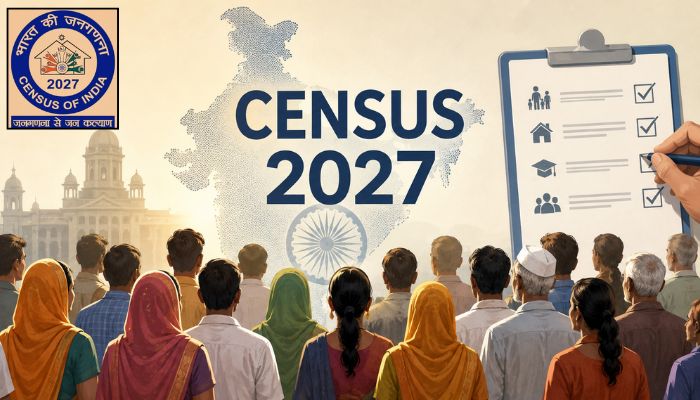
Left-liberals who believed that the National Population Register was ‘dead’ have bad news: The Census 2027 is bringing it back

The Registrar General of India (RGI) on Friday, 14th August, notified the 40-question questionnaire that will be used during the population enumeration phase of Census 2027. The questionnaire marks a major change from the 2011 Census, most notably because it will ask every respondent to provide their “caste”. This will be the first time since Independence that caste, beyond the existing enumeration of Scheduled Castes (SCs) and Scheduled Tribes (STs), will be recorded across the population. The notification was issued by the Ministry of Home Affairs under the Census Act and authorises census officials to collect information through the Household Schedule.

The new Census will also collect several categories of information that were not part of the 2011 questionnaire. While the 2011 Census had 29 questions, the new schedule has 40. Among the new or expanded fields are spouse’s name, nationality, father’s and mother’s particulars, digital literacy, permanent residential address, place of Covid-19 vaccination, number of bank accounts, and the availability of mobile number, Aadhaar, voter ID, passport and driving licence details.

What are the 40 questions in Census 2027?

The notification, issued by the Ministry of Home Affairs (MHA) under the Census Act, authorises census officers to collect information through the household schedule from every person residing in their assigned areas. According to the notification, officials will gather 40 categories of information from residents. These include basic demographic details such as name, age, sex, marital status, spouse’s name, nationality, religion, caste, and parental information.

The questionnaire will seek information on education and skills, including literacy and digital literacy status, attendance in educational institutions, and the highest level of education attained. Language-related information, including mother tongue and other known languages, will also be recorded.

Respondents will be asked whether they worked during the previous year, their occupation, industry or service sector, class of worker, and whether they are seeking employment. Information on travel to the workplace will also be collected.

The notification further provides for the collection of migration-related data, including place of birth, previous place of residence, reasons for migration, and duration of stay at the current location since migration. Permanent residential address details will also be recorded.

For women who are currently married, widowed, divorced, or separated, census officials will collect information on the number of children surviving, children ever born alive, and, in some cases, births during the previous year.

The final section moves into areas that were largely absent from the 2011 Census. Respondents will be asked about the place where they received their Covid-19 vaccination and the total number of bank accounts they hold. The questionnaire will also seek their mobile number, Aadhaar number, voter ID number and passport number, where applicable, as well as whether they have a driving licence. The identification details are conditional: for example, the form asks for a passport number if the respondent is an Indian passport holder and asks for mobile and Aadhaar numbers “if available.”

The 40 questions included in this year’s census questionnaire are:

  1. Name of the person
  2. Relationship to head
  3. Sex
  4. Date of Birth and Age (in completed years)
  5. Current Marital Status
  6. Age at Marriage (in completed years)
  7. Spouse Name
  8. Nationality as declared
  9. Religion
  10. Scheduled Caste (SC)/ Scheduled Tribe (ST)/ Caste
  11. Father’s Particulars
  12. Mother’s Particulars
  13. Disability
  14. Mother Tongue and other languages known
  15. Literacy and digital literacy status
  16. Status of attendance in educational institution
  17. Highest educational level attained and Stream/Discipline
  18. Worked at any time during the last year
  19. Category of economic activity
  20. Occupation
  21. Nature of industry, trade or service
  22. Class of worker
  23. Non-economic activity (for marginal, semi-marginal and non-worker)
  24. Seeking or available for work (for marginal, semi-marginal and non-worker)
  25. Travel to place of work
  26. Birth place
  27. Place of last residence
  28. Reason for migration
  29. Duration of stay in this village/town since last migration
  30. Permanent Residential Address
  31. Number of children surviving at present (for currently married, widowed, divorced and separated women only)
  32. Number of children ever born alive (for currently married, widowed, divorced and separated women only)
  33. Number of children born alive during last one year (for currently married women only)
  34. Place of Covid-19 Vaccination
  35. Total number of Bank Accounts
  36. Mobile Number (if available)
  37. Aadhaar Number (if available)
  38. Voter ID Number (if available)
  39. Passport Number (if Indian Passport holder)
  40. Availability of Driving License

The Overlap with the National Population Register (NPR)

Several of these questions were also featured in the rehearsal form of the National Population Register (NPR) in 2019. The NPR, which was initially proposed to be conducted alongside the first phase of the Census, was temporarily halted due to Covid-19. Left-liberal groups and Muslim organisations across the country had assumed that it was ‘dead’. They claimed that the data gathered through the NPR exercise could subsequently be used by the central government to prepare a countrywide National Register of Citizens (NRC).

This overlap of questions in Census 2027 comes as bad news for those who celebrated the stalling of the NPR after organising protests in multiple parts of the country, including the anti-Hindu Delhi riots.

The Modi government has brought back the same questions in Census 2027 that were previously criticised by left-liberals and opposition parties, aiming to appease their vote bank. 

During the anti-CAA agitation, West Bengal witnessed extensive violence across Murshidabad, Howrah, Malda, and North 24 Parganas, where rioters set fire to 17 buses, five empty trains, police vehicles, and fire engines, while also vandalising rail stations and blocking major highways.

Similar unrest escalated in the national capital starting in mid-December 2019, leading up to the anti-Hindu Delhi riots in February 2020. Protesters at Shaheen Bagh instituted prolonged blockades, demanding that the NPR exercise be cancelled in Delhi. Violence subsequently broke out in Jafrabad, Seelampur, Gokulpuri, Bhajanpura, and Chand Bagh, resulting in 37 deaths, including an Intelligence Bureau constable and a police head constable, alongside widespread property damage. Despite these agitations, the crucial data parameters have now been incorporated into the main census process.

Tracing lineage and the connection to Citizenship

Specific details such as relationship to the head of household, father’s particulars, mother’s particulars, duration of stay, and permanent residential address closely mirror the draft requirements of NPR 2020. 

These questions carry political sensitivity because of their direct link to establishing parental lineage and long-term residency. If a Bangladeshi Muslim illegally enters India, they can potentially acquire local identity documentation like an Aadhaar card, PAN card, birth certificate, or passport over time. 

However, such individuals cannot retrospectively insert their name or their father’s name into the 1971 Indian voter list. This core verification requirement is precisely why the NPR faced opposition, to establish genuine lineage, an individual must demonstrate their parent’s presence in historical electoral rolls or official registers.

Why does the issue have a citizenship angle?

The controversy over the NPR largely comes from its connection with the legal framework for preparing a National Register of Indian Citizens. Section 14A of the Citizenship Act, 1955 provides that the Central Government may compulsorily register citizens and maintain a National Register of Indian Citizens. It also states that the Registrar General can function as the National Registration Authority.

This legal connection is the reason critics have historically worried that information collected through the NPR could eventually become relevant to an NRC exercise. At the same time, it is important to distinguish the legal possibility from an actual government decision. The presence of similar questions in a Census questionnaire does not by itself establish that an NRC is being conducted or that Census data will automatically be converted into an NRC.

The concerns became especially strong after the Citizenship Amendment Act was passed in December 2019 and then Union Home Minister Amit Shah spoke in Parliament about a nationwide NRC. The experience of Assam further intensified the debate, as the Assam NRC exercise required applicants to establish their eligibility for inclusion and resulted in a large number of people being left out, while questions remained over the treatment and status of those excluded.

The political significance of the questionnaire is therefore likely to extend beyond the simple counting of India’s population. The inclusion of caste could provide the country with its first broad official caste data since Independence, while the addition of information on education, employment, migration, digital literacy, banking and identity documents will create a much wider picture of Indian society.

With the inclusion of parent particulars and identity parameters in Census 2027, the structural framework for resident verification remains active within the central administrative apparatus.

When will Census 2027 take place?

Census 2027 is being conducted in two phases. The first is the Housing and House Listing Operations (HLO), followed by Population Enumeration. The HLO phase is being conducted during 2026, while the main population enumeration is scheduled for February 2027. For Ladakh and the snow-bound areas of Jammu and Kashmir, Himachal Pradesh and Uttarakhand, the population enumeration will take place earlier, in September 2026.

For these snow-bound areas, the government has notified September 1-30 for enumeration, followed by a revisional round from October 1-5. Self-enumeration will be available before the house-to-house exercise. The reference date for these areas is midnight of October 1, 2026, while for the rest of the country it is midnight of March 1, 2027.

The Census is also significant because it is India’s first fully digital Census, with self-enumeration being offered as an additional facility. The last Census was conducted in 2011.

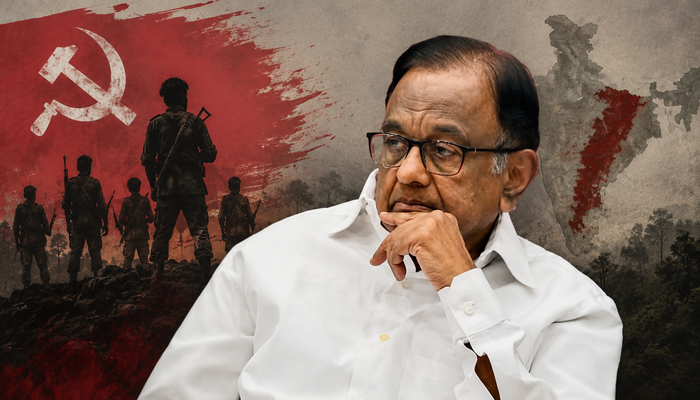
From opposing Indian nuclear weapons to peddling ‘saffron terrorism’ narrative: How P Chidambaram’s confession of being a ‘Dimagi Naxal’ doesn’t surprise anyone

Prime Minister Modi’s reference to “Dimagi Naxals” in his Independence Day address has triggered many Naxal sympathisers, including senior Congress leader P Chidambaram. In response to the PM’s remarks, the former Union Home Minister posted a message on X on Sunday (16th August) identifying as a proud “Dimagi Naxal”. “I am proud to be a dimagi naxal !” Chidambaram wrote.

In his address, PM Modi distinguished a “Dimagi Naxal” from armed Naxals, who operated and spread violence and terror in multiple districts across different states, including Jharkhand, Odisha, Chhattisgarh, and Maharashtra. The Prime Minister used the term to refer to the people sitting in power corridors and still pushing the Naxal ideology that aims to overthrow the Indian state and the democratically elected government. PM Modi cautioned the country against such “Dimagi Naxals” who want to influence the young minds and use them to impose their delusion of a utopian ‘proletariat rule’ on people while making them bear its cost.

While the fact that a former Union Home Minister identifies and openly associates himself with the Naxal ideology is disturbing, it is not at all surprising. Chidambaram’s admission comes as no surprise because back in 2010, when he was the Union Home Minister, he offered to hold talks with armed Naxals without requiring them to lay down arms. An old video shows Chidambaram speaking at Jawaharlal Nehru University in Delhi, expressing the government’s willingness to engage in dialogue with the Naxals, without having them compromise their ideology.

In the video, he clearly stated that the government would not even ask the Naxals to lay down arms, as it was aware that they believed in armed struggle. “We’re ready for talks; we’re not asking you to lay down arms. We know you won’t do that because you believe in armed struggle,” Chidambaram said in the video. His remarks were welcomed with huge applause by the audience present at the varsity, which has been a stronghold of leftist and other extremist ideologies. Coincidentally, the comments came a month after the Dantewada Maoist attack, where 76 CRPF policemen were killed.

Chidambaram headed the Union Home Ministry at a time when Naxalism was at its peak in the country. But he and his government not only failed to counter the threat, but they also failed to see the problem for what it was and come up with a lasting solution for it. The Congress government was notoriously soft on Naxals and terrorists. During the Congress rule, while on one hand armed Naxals attacked and wounded the Indian state, on the other hand the ‘Dimagi Naxals’ existing within the system, who protected and patronised them, made sure that the government engaged with the Naxals on their terms.

Chidambaram’s act of acting soft and pleading with the Naxals to engage in a dialogue with the government aligns with his admission of being a “Dimagi Naxal”. A close examination of his stance on issues like national security and terrorism, and his aversion to policies aimed at development, reveals a similarity with the anti-state and anti-development ideology of Naxalism.

The peddling of a false narrative of Hindu terror

Chidambaram took offence on behalf of all Dimagi Naxals and expressed solidarity with them by identifying as one of them. His statement clearly arose from his massive empathy for the Naxals, irrespective of the fact that they engaged in armed rebellion against the democratic state of India for decades and killed thousands of Indian security personnel and civilians. The empathy is not just misplaced but dangerous in light of the fact that it is coming from a person who headed the Union Home Ministry, which is responsible for overseeing national security.

Interestingly, the merciful Chidambaram, whose heart bleeds for the Naxals, did not hesitate to target the entire Hindu community with the false and made-up narrative of Hindu terror. This was a striking contrast to Congress’s stance that terrorism has no religion. Chidambaram was among the Congress leaders who coined the term ‘saffron terror’ and peddled a white lie, defaming the majority community, to monkey-balance and appease their vote bank.

In 2010, while he was the Union Home Minister, he cautioned the law enforcement authorities regarding the “recently uncovered phenomenon of saffron terror”. His successor and fellow Congress leader, Home Minister Sushilkumar Shinde, along with Congress leader Digvijaya Singh, also peddled the lie of Hindu terrorism.

The entire Congress ecosystem exerted all its might to establish the lie of Hindu terror as a fact by falsely implicating Sadhvi Pragya Singh Thakur, Lt. Colonel Shrikant Prasad Purohit (who was serving at the time) and other Hindus in the 2008 Malegaon blast case. The case was a desperate attempt by the Congress government to weave the narrative of “Hindu terror” and “saffron terror”. However, the case, after 17 years of legal scrutiny, fell flat in the court of law for the simple reason that there was no truth in it.

Chidambaram opposed digitalisation of payments

Despite being a seasoned politician and a successful lawyer, Chidambaram ridiculed and opposed the Modi government’s push for a cashless economy and digitalisation of payments, knowing well that this would reduce corruption and bring transparency. He also slammed the Modi government for demonetisation, calling it a “scam”. What is to noted is that his opposition to these policies was not a result of his short-sightedness but a consequence of his Naxal-influenced anti-progress and anti-development mentality.

Research has shown how demonetisation hit at the backbone of terrorism, including left-wing terrorism, as it directly impacted the funding that fueled the menace. Terror funding generally happens in cash form, which is physically moved across borders or funnelled through unregulated underground banking systems. It remains one of the primary methods for financing both organisational activities and terrorist operations. The funds are mostly stored in the form of large denomination currency notes like ₹500 and ₹1000 banknotes, which make it easier to store large amounts of money in smaller stacks of notes. Demonetisation discontinued the use of ₹500 and ₹1000 banknotes, which rendered the terror funding moving in cash form as good as nothing.

Similarly, digitalisation of payments also proved to be a successful policy decision in combination with government programs like Digital India and Jan Dhan Yojana, along with rising smartphone penetration, cheaper data plans and near-universal household electrification.

Chidambaram was against India acquiring nuclear capability

The former Union Home Minister vehemently opposed the development of nuclear capabilities by India. Speaking in Parliament, Chidambaram argued that by developing nuclear weapons contrasts with “moral authority” that India has acquired globallly. In his speech delivered on 27 May 1998 in Parliament, he objected to the then Vajpayee government’s plan to use the nuclear capabilities aquired by India after the successful Pokhran II test for developing nuclear weapons.

Neglecting India’s need to acquire military might to become capable safeguarding itself against any possible military aggression, Chidambaram was more focused in maintaining some delusional moral supriority. A politician like Chidambaram arguing against enhancing the military might of a country with hostile neighbours is clearly symptomatic of a Dimagi Naxal.

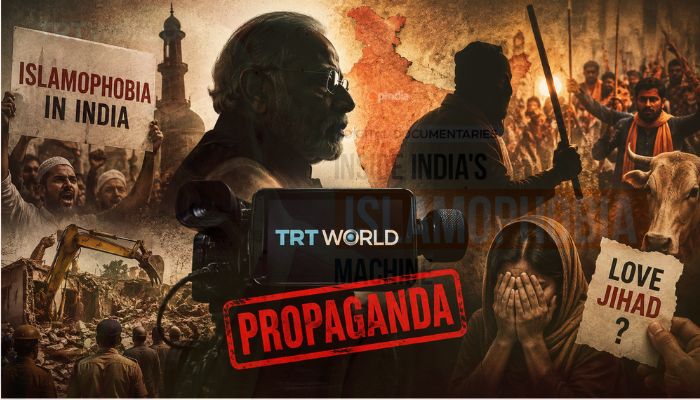
‘Anti-Muslim hate machinery’: TRT World publishes propaganda documentary vilifying India, Hindus and peddling ‘Islamophobia’ propaganda

Ever since the BJP came into power at the Centre in 2014, Indian and foreign Islamo-leftist media have consistently been churning out propaganda articles and documentaries to further their one-sided ‘Indian Muslims are being persecuted by Hindutva fascists’, ‘Islamophobia on a rise in India’ bogey. The latest piece of propaganda against India has been rolled out by Turkish state-owned media outlet TRT World. TRT World published a 21-minute 6-second-long documentary on 10th August 2026, with the title, “Inside the machinery of anti-Muslim hate in Narendra Modi’s India”.

TRT World peddles the Muslim victimhood bogey based on half-truths and propaganda, and makes no mention of Muslim crimes against Hindus

The TRT documentary shows cherry-picked personal stories of alleged mob violence, demolitions of illegal encroachments, and alleged police actions, and relies on villainisation of Gau Rakshaks, as ‘proof’ of a continuous ‘anti-Muslim hate machinery’ under Prime Minister Narendra Modi.

The Turkish state media, however, made not even a passing mention of how Muslim neighbours of a Hindu man named Tarun Kumar in Delhi’s Uttam Nagar brutally killed him over a mere Holi colour-filled balloon falling over one of the Muslim ladies.

Be it Hindu festivals of Ram Navami, Hanuman Jayanti, Holi, Diwali, Durga Visarjan or celebration of a major cricket match victory, recent years have witnessed how Muslims look for triggers, store stones and petrol bombs to attack Hindu processions, and as seen in the 2025 Sambhal violence case, pelt stones at police officials in a pre-planned fashion.

However, the Turkish state-owned propaganda outlet has no interest in cases wherein innocent Hindus have been killed by Muslims over real or imaginary excuses.

The TRT World documentary attacking India shows ‘cow-vigilantes’ as violent groups with the backing of BJP governments, out on the streets only to harass and kill Muslims, even as Gau Rakshaks catch and report cow smugglers or slaughterers regardless of their religious identity.

Unsurprisingly, TRT raises no questions over significant involvement of Muslims in cow smuggling and slaughter despite there being prohibitions on cow slaughter by law in some states, and broader Hindu religious sentiments.

The propaganda documentary further insinuates that Muslim men are being targeted by ‘Hindu extremists’ and the ‘Hindutva regime’ helmed by PM Modi, in alleged cases of love jihad.

Here again, the TRT World documentary presents one-sided victimhood propaganda. The film does not even properly address what grooming or rape jihad is, which is colloquially called ‘love jihad’. It wrongly articulates the Hindu community’s criticism of love jihad as criticism and intolerance of all interfaith marriages.

There is a well-documented pattern of Muslim men deliberately faking their identity as Hindu, approaching Hindu girls, from school-going minors to women working in top corporate offices, feigning love, gaining trust, establishing sexual relations, only to later blackmail, brainwash, and coerce them into converting to Islam.

OpIndia, and to now a noticeable extent even mainstream media, has covered thousands of incidents involving Love Jihad, and yet somehow the Islamo-leftist cabal is still peddling the denialist propaganda that love jihad is ‘BJP’s conspiracy theory’.

From Kerala, Uttar Pradesh, Rajasthan’s Beawar, Bhilwara and Ajmer, to the United Kingdom’s Rotherham and Telford, the disgusting Muslim pattern of weaponising rape to humiliate Kafirs, insult their faith, and secure conversion to Islam is not unique to India. Yet, TRT World turns a blind eye to the naked truth, because the Islamist-inflicted misery of be it Hindu Kafirs of India or Christian Kafirs of the UK is unimportant, immaterial or perhaps a source of glee.

The Islamo-leftist media cabal’s selective amplification of real or fake Muslim victimhood and their deliberate downplaying and trivialisation of Muslim victimisation of Hindus is not surprising.

Remember how the global Islamo-leftist media coterie outraged and extensively covered the Bulli Bai case, even as there was no real selling or exploitation of Muslim women? This Islamo-leftist cabal continues to highlight this case to vilify Hindus, while they conveniently dismiss real cases of love jihad and online sexual objectification of Hindu women as sex slaves of Muslim men as non-issues.

The documentary further amplifies the Indian Islamo-leftist peddled lies that somehow the BJP governments are deliberately demolishing houses and shops belonging to Muslims, conveniently withholding the facts that in most cases Muslims encroached government lands, land belonging to Hindus, and built illegal mazars, Jhuggis, etc.

The TRT World documentary makes no mention of how Waqf Boards over the years arbitrarily laid claims over entire villages, government offices, houses, and land patches belonging to Hindus, and other non-Muslim communities.

Turkish state broadcaster’s Muslim victimhood documentary relies on Islamo-leftists Sanjay Hegde and Asif Mujtaba over the 2020 anti-Hindu Delhi Riots

The propaganda documentary published by the Turkish state-owned media features advocate Sanjay Hegde, who claims that in all the episodes of ‘organised violence’ against Muslims, the BJP governments, be it in states or the Centre, as well as the police administration, essentially protect ‘Hindu perpetrators’.

Hegde’s remarks suggested that in all cases involving communal tensions between Hindus and Muslims, it is essentially Hindus only who are at fault, or trigger violence. This insinuation apparently stems from the Islamo-leftist cabal’s demonstrated pattern of blaming Hindus for Muslim mob violence against them.

If Hindus celebrate a cricket match victory on the road and happen to pass by a mosque in a ‘Muslim area’, they deserve to be attacked with rods, stones and sharp objects by Muslims, for having somehow ‘offended’ them.

If Hindus take out their religious procession and the loud music of devotional songs falls on the ears of Muslims, or Hindus put up religious flags, it is justified for Muslims to hurl stones at Hindus.

If a movie (Chhava) shows how an Islamic fanatic Mughal tyrant tortured Hindu warrior king Chhatrapati Sambhaji Maharaj, and yet failed to coerce him into converting to Islam, it is ‘natural’ for Muslims to do violence against Hindus, destroy their and public property, while leftists and Muslim-appeasing politicians would blame the film’s makers and actors for making the film.

OpIndia has consistently documented senior Supreme Court advocate Sanjay Hegde’s anti-Hindu moorings over the years. Hegde is a notorious Islamist sympathiser, who wants India to welcome more and more Rohingya and Bangladeshi Muslim infiltrators despite reports of their involvement in various criminal activities against Indian citizens. Hegde’s Hinduphobia is also widely known and criticised.

The TRT World documentary also features Islamist Aasif Mujtaba, describing him as a ‘social activist’. Mujtaba claimed that “justice s utopian” for Muslims in India.

He claimed that be it the 2020 Delhi Riots, the 2013 Muzaffarnagar riots, or the 2002 Gujarat pogrom, and several other riots, were all ‘anti-Muslim riots’ and that Muslims have yet not received justice.

Neither Aasif Mujtaba informed (expectedly), nor TRT World cared to highlight the complete truth of the 2002 Gujarat Riots, and both conveniently painted it as an anti-Muslim pogrom even as it was Muslims who began the communal violence.

Riots broke out in Gujarat in 2002 after a Muslim mob set fire to 2 coaches of Sabarmati Express near the Godhra railway station, burning 59 Hindu pilgrims alive. A total of 31 Islamists were found guilty of committing the heinous crime.

11 of them were handed the death penalty by a special fast-track court on March 1, 2011. Their names include Abdul Razzak Kurkur, Ismail Suleja, Jabbir Binyamin Behra, Ramzani Binyamin Behra, Mehboob Hassan, Siraj Bala, Irfan Kalandar, Irfan Patadia, Hassan Lalu, Mehboob Chanda, & Salim Zarda. Their death penalty was later commuted to a life sentence in October 2017.

TRT World platformed Aasif Mujtaba to peddle his one-sided version portraying the 2020 anti-Hindu Delhi Riots as a pre-planned anti-Muslim violence, even as it was Muslims, including the recently convicted and sentenced to jail, former Aam Aadmi Party councillor Tahir Hussain, who orchestrated Muslim mob violence and brutally killed a Hindu Intelligence Bureau (IB) officer, Ankit Sharma and dumped the dead body in a drain.

Mujtaba made no mention of how a mob comprising his co-religionists brutally lynched Head Constable Ratan Lal of Delhi Police while he was trying to perform his duty on the main Wazirabad Road, Chand Bagh, during the violent riot.

A mob attacked police officers stationed in Maujpur, Delhi’s North-East area, on February 24, 2020. Ratan Lal died from a bullet wound, according to the autopsy report.

A voiceover in the film amplifies the Islamo-leftist narrative on the Citizenship Amendment Act (CAA), describing the legislation brought to fast-track citizenship of Hindu, Sikh, Christian, and other non-Muslim minorities from neighbouring Islamic or Islamic majority countries of Pakistan, Afghanistan, and Bangladesh, as “discriminatory”.

While TRT World describes the CAA as the ‘trigger’ for the Delhi Riots, it did not care to understand or inform its viewers why Muslims from the neighbouring countries were not included in the CAA.

Pakistan’s persecuted Shias and Ahmadiyas identify as Muslims; thus, their persecution is the Islamic Republic’s law and order issue. Meanwhile, Rohingyas persecuted in Myanmar come to India via Bangladesh; they enter India for material benefits and no longer remain a persecuted group; thus, they are excluded from the CAA, not due to any anti-Muslim agenda or hatred.

Notably, Aasif Mujtaba is the founder of Miles2Smiles Foundation, the organisation that had set up a learning centre at a Rohingya camp at Nuh in Haryana. The organisation had raised funds for the construction work for the Rohingya Refugees at Nuh in Haryana and had also built housing units, he claimed on Twitter in January this year. It is worth noting that Nuh belongs to Mewat in Haryana, the region that is notoriously known as “Mini Pakistan“, where tales of abduction, rapes and forced conversions of Hindus have been routinely reported. 

An IIT Delhi graduate, Mujtaba has been propagating hate against Hindus and spreading fake news to project the usual “muslims in danger in India” narrative. In December 2022, the so-called activist and social worker, Aasif Mujtaba, said that Jamia University was not created to become a centre of excellence but for “Muslims to learn to resist.”

In their pursuit of portraying a Hindu majority India under a supposedly ‘pro-Hindu’ government as a dystopia for Muslims, TRT World did not even mention the fact that Aasif Mujtaba was named by Delhi Riots accused jihadi Sharjeel Imam as a co-conspirator.

The TRT World documentary also features unsuspecting Hindu rights activists from Vishwa Hindu Parishad, and a few Gau Rakshaks. Their utility in the film, however, is not to present a balanced view of the situation, but to portray their grievances and their pushback against Islamist intransigence as blatantly ‘Islamophobic’.

However, expecting balanced reporting from the Turkish state broadcaster is like expecting an Islamic terrorist to believe in secularism. TRT World itself has repeatedly peddled anti-India and anti-Hindu propaganda over the years.

It is quite audacious for the Turkish state broadcaster to attempt to tarnish India’s image as a bigoted and Islamophobic ‘majoritarian state’, given it conveniently overlooks Turkey’s own persecution of Kurds, secularists, and Gülenists.

The TRT World documentary on ‘anti-Muslim hate in India’ is yet another Islamist media propaganda that relies on selective framing, half-truths, lies and blatant neglect of the Islamist crimes against Hindus.

What is disturbing but not surprising is that the majority of the comments under the film on YouTube are by Indian Muslims, with a common statement being, “as an Indian Muslim, it is true”. Apparently, despite enjoying freedoms of all sorts, equal treatment and opportunities, even reservations in some states, a significant section still prefers not only to be used by ‘secular’ parties as their votebank even if they ridicule their intellect, but also to have an international image of ‘perennial victims’.

Reliance joins forces with Rolls-Royce to build indigenous Advanced Medium Combat Aircraft engine: What does it mean for India

Reliance Industries and British aerospace major Rolls-Royce have announced plans to work together on developing a sovereign combat aircraft engine for India’s Advanced Medium Combat Aircraft (AMCA) programme. The partnership is aimed at giving India greater control over one of the most critical technologies needed for its planned fifth-generation fighter jet. The two companies said on Friday, 14th August, that they intend to explore the design, development, manufacturing and delivery of an indigenous combat engine for the AMCA. As part of the proposed collaboration, Reliance and Rolls-Royce will also explore setting up a dedicated Aerospace Gas Turbine Complex in India.

The proposed facility is expected to become a centre for advanced power and propulsion technology. It would aim to develop capabilities across the complete engine lifecycle, including design, development, manufacturing, testing, production and long-term maintenance and support.

However, the announcement is currently a strategic intent to explore the partnership, and not a final joint venture agreement or commercial engine contract. The companies have not yet disclosed details such as the investment, ownership structure or timeline for establishing the proposed complex.

What will the Reliance-Rolls-Royce partnership do?

The proposed partnership brings together two different strengths. Rolls-Royce will contribute its long-standing expertise in aircraft engines and advanced propulsion technology, while Reliance will bring its manufacturing capabilities, technology, scale and project execution experience.

The central objective is to develop the AMCA’s combat engine in India rather than depending entirely on foreign suppliers for the fighter’s propulsion system.

According to the companies, the proposed Aerospace Gas Turbine Complex would create an end-to-end capability within the country. This means that India could potentially develop expertise not just in assembling an engine but across its entire lifecycle, from design and development to manufacturing, testing, production and maintenance.

The companies also said that the partnership could eventually go beyond the AMCA programme. The proposed facility could support wider cooperation in defence, civil aerospace and new power and propulsion technologies.

This could make the project broader than a single fighter-engine programme, with the potential to create an ecosystem for advanced aerospace engineering and manufacturing in India.

Why is the AMCA engine important?

The AMCA is India’s planned indigenous fifth-generation stealth fighter aircraft. The programme is aimed at developing a more advanced combat aircraft for the Indian Air Force, with a focus on technologies associated with modern fighter jets.

One of the biggest challenges in India’s fighter aircraft programmes has been the development of a powerful indigenous engine. India has historically relied heavily on foreign manufacturers for fighter aircraft engines. Developing a domestic high-thrust powerplant has therefore remained an important part of the country’s push for greater defence self-reliance.

The Reliance-Rolls-Royce proposal is significant in this context because it seeks to combine international engine expertise with manufacturing and industrial capabilities available in India.

If the proposed complex is eventually established and the engine programme moves forward, it could help India build expertise in areas that go beyond simply producing aircraft. A domestic engine capability could give the country greater control over the design, production, testing and long-term support of fighter engines.

The project also fits into the government’s wider Atmanirbhar Bharat push, which seeks to reduce dependence on imports in strategically important areas, particularly defence.

What Anant Ambani said

Reliance Industries Executive Director Anant Ambani said the partnership was aimed at developing capabilities that are important for India’s strategic autonomy. “India’s strategic autonomy requires sovereign capability in critical technologies,” Ambani said.

He said the partnership would combine Rolls-Royce’s expertise in advanced propulsion with Reliance‘s capabilities in technology, manufacturing, scale and execution.

“Our intent with Rolls-Royce is to combine their world-leading expertise in advanced propulsion with Reliance’s technology, manufacturing, scale and execution capabilities to build an indigenous aero-engine ecosystem in India,” he said.

Ambani added that the objective was not just to create a capability for one programme but to develop an enduring national capability in advanced propulsion.

“Together, we aim to build an enduring national capability that can make India self-reliant and, over time, globally competitive in advanced propulsion technologies,” he said. He described the initiative as Reliance’s contribution to Prime Minister Narendra Modi’s vision of an “Atmanirbhar Viksit Bharat”.

Rolls-Royce calls it a major milestone

Rolls-Royce CEO Tufan Erginbilgiç also welcomed the proposed partnership, saying it would combine the British company’s experience in advanced engineering with Reliance’s industrial capabilities in India. “I welcome the opportunity to join forces with Reliance Industries, bringing together our century-long heritage in advanced engineering and proven engine expertise with their homegrown leadership in Indian industry,” Erginbilgiç said.

He said the proposed collaboration could help create a stronger aerospace ecosystem in the country. “Together, with our existing partnerships and capabilities in India, this marks a major milestone towards building a robust, self-reliant aerospace ecosystem in the country,” he said.

The companies said their existing capabilities and partnerships in India could also support the development of the proposed Aerospace Gas Turbine Complex.

What does it mean for India?

For India, the biggest potential benefit of the proposal is the possibility of developing a domestic ecosystem for fighter-engine technology. Aircraft engines are among the most technically demanding components of a modern fighter jet, requiring advanced engineering, manufacturing, testing and maintenance capabilities.

India’s dependence on overseas engine suppliers has been a long-standing challenge for its defence aviation ambitions. An indigenous engine programme could therefore strengthen the country’s strategic autonomy by reducing dependence on foreign sources for a critical component of military aircraft.

The proposed complex could also help build a specialised industrial base around aerospace propulsion. If the project develops as planned, it could bring together design engineers, manufacturers, testing facilities and maintenance capabilities under a broader domestic ecosystem.

Another possible benefit is the development of expertise that could be used for future aircraft and propulsion programmes. The companies have already indicated that their cooperation could eventually extend beyond the AMCA engine to other defence and civil aerospace projects.

The project could also support India’s ambition to become a larger player in the global aerospace manufacturing sector. Reliance brings the ability to operate at large industrial scale, while Rolls-Royce brings decades of experience in aircraft-engine technology. Combining these capabilities could potentially create opportunities for both domestic production and future exports.

However, the partnership is still at an early stage. The two companies have announced their strategic intent and plans to explore the Aerospace Gas Turbine Complex, but important details such as investment, ownership, production timelines and the final structure of the project have not been announced.

The government had also earmarked ₹15 billion (around $157 million) in May for the AMCA programme, as part of efforts to accelerate the development of India’s next-generation fighter aircraft.

Ultimately, the success of the Reliance-Rolls-Royce initiative will depend on whether the proposed plans translate into an actual engine development and manufacturing programme. For now, the announcement represents an important step towards bringing global aero-engine expertise together with India’s growing private-sector defence manufacturing capabilities.

If realised, the Aerospace Gas Turbine Complex could give India something it has long sought in military aviation: a stronger domestic capability to design, build, test and support advanced combat aircraft engines. That would make the AMCA programme not just an effort to build an indigenous fighter, but also an opportunity to develop a wider Indian ecosystem for advanced aerospace propulsion.

What is ‘Saptadhara’ framework, announced by PM Modi on Independence Day

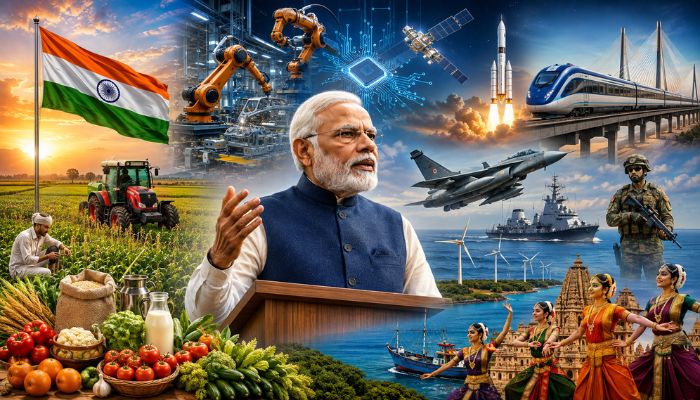
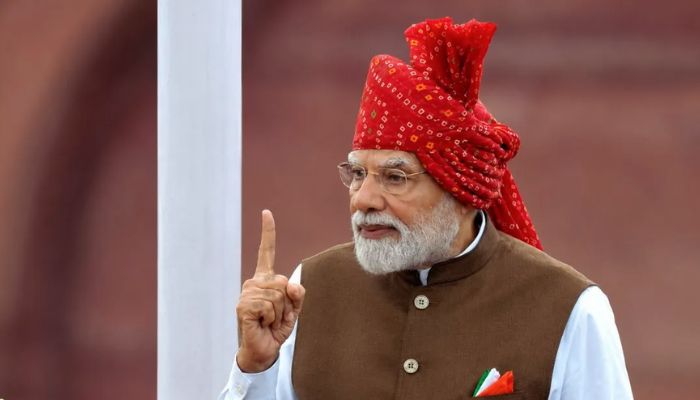
Prime Minister Narendra Modi on Saturday, 15th August, announced a seven-point development framework, called ‘Saptadhara’, during his Independence Day address from the Red Fort. The framework focuses on seven key areas that the government believes can help India move faster towards the goal of becoming a developed nation, or Viksit Bharat, by 2047.

Drawing a comparison with the ancient reference to ‘Sapta Sindhu’, or the seven rivers, Modi said India now needs a new set of streams of strength to take the country forward. The seven areas identified under Saptadhara are –

  • Manufacturing Power
  • Agriculture and Food Processing
  • Technology and Innovation
  • Gati Shakti
  • Defence Power
  • Green Economy and Blue Economy and
  • India’s Soft Power.

Modi said the coming five to seven years would be especially important for the country. “The work that was not done in the past five to seven decades has to be completed in the coming five to seven years,” he said, while stressing that the energy and capabilities of India’s youth would be used for nation-building.

Manufacturing to lead the seven streams

Manufacturing has been placed at the centre of the Saptadhara framework. Modi said India must build a complete manufacturing chain within the country, covering everything from components and design to finished products.

“From design to manufacturing, India will have to become a trusted centre of the global supply chain,” he said.

He called on manufacturers, entrepreneurs and MSMEs to compete with the world on cost, quality and scale. He also said Indian factories should focus on user-friendly products, attractive packaging and zero-defect precision manufacturing.

“Our zero-defect precision manufacturing should become our identity,” Modi said, adding that quality should become a major part of India’s global brand value. “Our mantra should be quality, quality, quality,” he said.

Agriculture, food processing and global markets

The second focus area is agriculture and food production. Modi said India should move beyond traditional farming and connect its agricultural products with international markets.

He highlighted the potential of Indian spices, milk, traditional foods and other farm products to become global brands. He also spoke about chemical-free farming and said products meeting global standards could find greater demand overseas.

Modi also referred to the government’s efforts to protect farmers from changes in global fertiliser prices. He said a bag of urea costing around ₹3,000 in the international market is being provided to Indian farmers for ₹300, while DAP, which he said costs around ₹5,000 globally, is being provided for ₹1,350.

Technology and innovation to make India a global hub

Technology and innovation form the third stream of Saptadhara. Modi said India must not remain only a market for new technologies but should become a place where new ideas and technologies are developed.

He pointed to areas such as AI, quantum technology, space, robotics and data centres as important opportunities. He also referred to India’s experience with UPI and digital public infrastructure.

“We have demonstrated our strength,” Modi said, stressing that India should take its digital public technologies to different parts of the world and aim to lead in next-generation communication technology.

He also called for Made in India education to reach people across the world.

Gati Shakti to improve speed and connectivity

The fourth stream is Gati Shakti, with the focus on faster and better connectivity. Modi said India needs high-speed rail, modern highways, inland waterways, airports and a strong multi-modal logistics network.

He said the country should move beyond simply loading and unloading goods at ports and work towards port-led development and growth. Better connectivity, he said, will help people, goods and services move more quickly and support economic expansion.

Aatmanirbhar Defence and new technologies

Defence is the fifth stream, with a strong focus on Aatmanirbhar Defence. Modi said India cannot remain dependent on other countries when nations around the world are increasingly trying to secure their own strategic resources and supplies.

“India cannot remain a market for the world. We have to be self-reliant in the field of defence,” he said.

He called for the development of new-generation defence technologies and said India should aim to become a global defence supplier. Areas such as counter-drone systems, hypersonic defence technologies and cyber security were specifically highlighted.

Green and Blue Economy

The sixth stream brings together the Green Economy and Blue Economy. Modi said India has the opportunity to expand green hydrogen, renewable energy, energy storage, green mobility and green manufacturing on a global scale.

“When the world talks about global warming, we keep looking for ways. We are giving solutions to problems,” he said, highlighting India’s potential to contribute to the global green movement.

The Blue Economy, meanwhile, includes opportunities linked to India’s long coastline. Modi mentioned fisheries, coastal tourism and ocean technology as areas that can create new opportunities and green jobs.

Soft power to expand India’s global reach

The seventh stream is India’s Soft Power, covering culture, tourism, creative industries, healthcare traditions and sports.

Modi highlighted the global reach of Yoga, Ayurveda and India’s holistic healthcare traditions. He also pointed to handicrafts, films, VFX, animation, gaming and digital content as areas where India can build a stronger global presence.

He referred to the World Audiovisual and Entertainment Summit (WAVES) and said India’s creative sector can become a global power.

Tourism is another major part of this vision. Modi said India has more than 100 national parks but still has significant room to attract more foreign tourists. He also highlighted sports tourism and the growing concert economy, saying India has an opportunity to attract artists and young people from across the world.

‘Reform Express’ for Viksit Bharat

Along with the seven streams, Modi called for changes in India’s work culture, thinking and pace of implementation. He described the push as a “Reform Express”, saying traditional systems, goals and ways of working would need to change.

The Prime Minister said the seven streams should not be viewed separately but as part of a holistic approach. He expressed confidence in India’s youth, women, farmers and workers and said their energy would be central to achieving the ambition of Viksit Bharat@2047.

Free online coaching, civil defence, nuclear energy, Saptadhara, and more: Major announcements made by PM Modi during Independence Day speech

Addressing the nation from the ramparts of the Red Fort on India’s 80th Independence Day, Prime Minister Narendra Modi announced various initiatives, targets, and reforms, with a focus on a “Viksit Bharat” by 2047. In his 13th consecutive Independence Day speech on 15th August, PM Modi announced several youth-centric initiatives.

Prime Minister Modi emphasised that to achieve the vision of a Viksit Bharat by 2047, India must become Atmanirbhar Bharat, focus on technological capability, energy security, youth empowerment, and national resilience.

Free online coaching for competitive exams

The Prime Minister highlighted that coaching classes have become a heavy burden on poor and middle-class families. He noted that parents remain concerned that if they do not send their children to coaching centres, their kids will fall behind.

“The competition surrounding coaching classes has become a huge burden for middle-class families. Every parent feels that if they do not send their child to a coaching centre, they are somehow falling behind or do not belong to a respectable family,” he said.

To remove this financial burden, PM Modi announced that his government will provide free online coaching classes for competitive exams. He emphasised leveraging digital public infrastructure and talented teachers to build a full network so that youth can stay with families without having to compromise with their studies, avoid financial strain, and save thousands of crores spent on coaching.

“Keeping the concerns of poor and middle-class families in mind, we want to help save them the thousands of crores of rupees they spend on coaching. Our young people should be able to stay close to their families, receive their care, and avoid placing an additional financial burden on them. Therefore, we have decided to provide free online coaching for various competitive examinations for our youth. We have digital public infrastructure, and we have highly talented teachers and educators. By bringing these resources together, we will provide free coaching to the country’s young people and build an entire network for this purpose,” PM Modi stated.

Civil Defence Reform

Delivering his 13th consecutive Independence Day speech, PM Modi called for a stronger, modern, and vibrant network of Civil Defence.

Noting the changed nature of warfare with wars no longer remaining limited to borders, PM Modi announced that a stronger network of Civil Defence will be established to familiarise citizens with emergency systems and protocols.

“My dear fellow citizens, making India secure is the collective responsibility of all of us. Whether the challenge arises from within our borders or from beyond them, India is fully prepared for every situation. Today, the nature of warfare is transforming. There is no longer any guarantee that a war will only be fought along border frontiers… Today from the ramparts of the Red Fort, I announce that in the coming days, we will establish a modern and vibrant network of Civil Defence. We will familiarise citizens with advanced emergency systems and protocols,” PM Modi said.

5 to 8 semiconductor plants coming up: PM Modi stresses Atmanirbharta in chips

PM Modi noted that chips are indispensable for electronics, medical equipment, transport systems, etc., and without them this modern world would come to a standstill.

The Prime Minister highlighted that India has pivoted toward self-reliance, with three major semiconductor plants established and production already begun.

He announced that in the coming 7-8 years, five to eight additional semiconductor plants are set to commence operations very soon.

“… Becoming an ‘Atmanirbhar Bharat’ is crucial. That is why, over the past few years, our conviction has been that India should no longer live in dependence on other nations; we must become self-reliant… We must enhance our own capacities and safeguard our interests ourselves. With this resolve, we are moving forward firmly towards an ‘Atmanirbhar Bharat.’ Every Indian is connecting with initiatives like ‘Make in India,’ ‘Swadeshi’, and ‘Vocal for Local’,” PM Modi said.

“In today’s digital world and technological landscape, we understand the immense importance of chips. Whether it is electronic goods, medical equipment, or transportation systems, chips are indispensable; without them, the world would come to a standstill. India has moved towards self-reliance in this sector; three major semiconductor plants have already been established, and I have been informed that production from these facilities has already begun for export. In the coming 7-8 years, five to eight additional semiconductor plants are set to commence operations very soon…” he added.

‘Energy security is the demand of the time’: PM Modi announces ambitious nuclear energy target

PM Modi informed the nation that efforts are being taken in the direction of producing 100 GW of nuclear energy by 2047. He also said that India is progressing towards commissioning five new nuclear reactors.

The Prime Minister boasted that India has achieved mastery in Fast Breeder Nuclear Technology this year, marking a major milestone and a giant leap towards self-reliance in nuclear fuel.

“… Nuclear energy is a major means of energy security. We have paved the way towards a new goal by passing the ‘Shanti Act’ in Parliament. By 2047, we are moving forward with the target of 100 GW of nuclear power. We aim to commission five new nuclear reactors within this decade alone. This year, India achieved a significant milestone by mastering fast breeder nuclear technology, marking a major stride toward self-reliance in nuclear fuel,” PM Modi said in his Independence Day speech from the ramparts of the Red Fort.

Notably, the Sustainable Harnessing and Advancement of Nuclear Energy for Transforming India (SHANTI) Act, 2025 replaces two key legislations: the Atomic Energy Act of 1962 and the Civil Liability for Nuclear Damage Act, 2010.  It allows private players to participate alongside public sector entities, while making it explicitly clear that highly sensitive materials and strategic controls will continue to remain exclusively with the government.

PM Modi also spoke about the expansion of piped gas and solar energy infrastructure, stating that piped gas coverage had surged from 70 cities before 2014 to 700 cities. He added that the number of households receiving piped gas has grown from around 22 lakhs to 1.75 crore. India’s solar energy capacity had risen from 2 GW in 2014 to 160 GW.

AI-skilling: PM Modi wants Indian youth to lead the global AI sector

In his 80th Independence Day speech, Prime Minister Modi has announced an initiative to provide artificial intelligence (AI) skilling courses to 1 crore young people.

“Today, there are over 250,000 registered startups. We recently hosted an AI Impact Summit; the reach of AI is expanding rapidly. From the ramparts of the Red Fort, I wish to make an announcement to the nation’s youth: we have resolved to train 10 million (one crore) young people in AI skills over the coming year, empowering them to take the lead in the world of AI. Before 2014, the bio-economy sector was valued at only ₹60,000 crore… The industry that stood at ₹60,000 crore before 2014 has now surged to ₹20 lakh crore,” PM Modi announced.

Saptadhara: PM Modi announces unique seven streams of strength for a Viksit Bharat

The Prime Minister gave seven clarion calls that are paramount for achieving the ambition of a Viksit Bharat by 2047. PM Modi announced a seven-point ‘Saptadhara’ reform framework to expedite India’s ambitious journey towards becoming a Viksit Bharat by 2047.

PM Modi called for significant changes in manufacturing, agriculture, technology, infrastructure, defence, the green and blue economy, and soft power to bolster India’s global influence.

“Today, I would also like to recall that era when the nation knew, understood, and heard of India’s prowess in the form of the ‘Sapta Sindhu’. Now, to build a Viksit Bharat, we need a new current. Today, from the ramparts of the Red Fort, I invoke the ‘Sapta Dhara’ of strength before the nation,” PM Modi said.

“In the coming 5 to 7 years, what could not be achieved in the last 5 to 7 decades, through the prowess and power of this Sapta Dhara, we will give the nation new heights, new momentum, and the capability to surpass new goals. Alongside this, the power and potential of our youth will be fully harnessed and integrated into nation-building…” he added.

Following are the seven streams of the ‘Saptadhara’:

  • Manufacturing Power: Build complete domestic end-to-end value chains, from design to components, focusing on zero-defect quality, cost, and global scale.
  • Agriculture and Food Processing: Create integrated farm-to-export supply chains for millets, spices, and fruits while transitioning to chemical-free farming.
  • Technology and Innovation: Evolve from a tech market into a global innovation hub leading in AI, Quantum, Space, Robotics, DPI, and Made-in-India 6G.
  • Gati Shakti: Establish high-speed, seamless multimodal logistics connecting cities, highways, rail, airports, and modern industrial sea ports.
  • Defence Shakti: Achieve complete strategic self-reliance by pioneering and exporting next-gen defence technologies like drones, counter-drone systems, and hypersonics.
  • Green and Blue Economy: Scale sustainable growth through Green Hydrogen, renewables, and energy storage alongside full utilization of ocean, coastal, and marine potential.
  • India’s Soft Power: Globalize Indian culture, Yoga, Ayurveda, and tourism while establishing global leadership in gaming, VFX, animation, and the creative economy.

During this Independence Day speech, PM Modi also highlighted several achievements, particularly, Defence production surging four times, Khadi village industries by five times, mobile phone production by 33 times, digital transactions increasing by 100 times, in addition to a massive acceleration in basic amenities. PM Modi also boasted that his government has lifted 25 crore people out of poverty.

Economist vs Economist: The British media house opposes UCC and backs Muslim Personal Law in India, while defending secular law in the UK

The mainstream media, particularly in the West, has never held a uniform position when it comes to matters concerning India or Hindus. The coverage often swings between sympathy and scepticism, praise and criticism, depending only on the issue and the preferred narrative. Hence, expecting complete honesty, impartiality or objectivity from such institutions is unrealistic, but they are at least expected to maintain the appearance of neutrality even when their agendas have been evident.

However, that facade appears to be fading fast. On 12th August (Wednesday), The Economist, which seemed to believe it was perfectly within its remit to sermonise India, effectively ventured into the internal matter of the country on the subject of the Uniform Civil Code (UCC). The tone carried an unmistakable whiff of colonialism, as though New Delhi were still expected to listen politely from the other end of the table.

Unfortunately for them, the calendar has moved on along with the nation. However, the episode became even more revealing with the British publication’s 2016 article. In a classic example of preach what you never practice, it was far less accommodating when discussing the existence of Sharia courts in the United Kingdom and argued firmly against the creation of a parallel legal system alongside the established judicial framework. However, such opinions tend to perform a backflip when the country is India.

When equality is framed as oppression

The piece, titled “Should Every Indian Follow the Same Rules,” paints a dramatic picture around the UCC, starting with the remarks of a man named Ahmed who insisted that one cannot truly be a Muslim without following Sharia law, before ominously declaring, “This is what awaits much of India,” implying that the government is stripping the minority citizens of their religious identity.

The Economist lists Assam, Gujarat and Madhya Pradesh, adding that other states could soon follow suit. If West Bengal also decided to pass this law, it warned, nearly “30 million more Muslims will face Ahmed’s dilemma.” Of course, the Bharatiya Janata Party, the “Hindu nationalist outfit’ that has already become a favourite target of these media houses, is declared the culprit, since all these states and the country are run by its governments.

The piece reads, “The BJP presents the new codes as a matter of universal human rights, in particular women’s rights. But look more closely and what is actually going on is a process of imposing on religious minorities the laws and customs that Hindus already follow.”

It mourns the loss of privileges that were extended to Muslims after the partition, under the guise of calming the apprehensions of the minority community, which are on the verge of being rescinded, resulting in them being treated similarly to their fellow citizens. This outcry is quite representative of the phrase, “When you are accustomed to privilege, equality feels like oppression.”

“The universal codes extend to Muslim daughters the same equal inheritance rights that Hindu daughters won in 2005. They criminalise polygamy for Muslim men. Talk to Muslim women in Uttarakhan,d and many are pleased to see such fixes,” it states, adding, “That makes it easy to dismiss critics as conservative cranks,” because The Economi, st which allegedly believes in the values of liberalism and human rights, cannot afford to support equality, gender justice, or rights of women and children if it hampers the propaganda.

Reality is ignored to defend discrimination

“But the reality is that the codes are not an instrument of women’s liberation, or indeed liberalism of any kind. One of the Uttarakhand code’s provisions, for instance, requires all couples to register a live-in relationship with the state within 30 days or risk a prison sentence. State and party officials insist that the aim is to protect women from exploitative men by bringing informal liaisons out of the shadows,” the column argues, conveniently overlooking the necessity of addressing the growing menace of love jihad and grooming jihad in India and even the United Kingdom. Nevertheless, the agenda takes precedence over all else.

Afterwards, the piece began to extol the virtues of Muslim personal law, asserting, “Under its dictates, women can generally escape toxic marriages faster than Hindu wives can. And they are also protected by mehr, a payment that a husband-to-be must make at the time of marriage to ensure his wife’s financial independence.”

If this is indeed the case, should not Muslim women be contesting the law rather than celebrating it, as the column itself indicated? Obviously, triple talaq, polygamy, child marriages and other notorious practices that deeply affect women in the Muslim community are left out of the column.

It subsequently begins to criticise Hindu law for being rife with injustices, frequently excluding widows, wives, and mothers from inheriting ancestral property. The Economist, in its disdain for Hinduism and the saffron party, neglects to acknowledge the existence of the Succession Act. This is not to imply that there are no legitimate issues, but at least there are provisions in the legal system aimed at protecting the rights of Hindu women.

Stoking tensions and fear

The Economist then seeks to downplay the reality of changing demographics due to the influx of illegal Bangladeshi Muslims and Rohingyas, who have taken possession of public land unlawfully and even attempt to coerce local girls into marriage with them. This is an even more pressing concern for a place like Uttarakhand, which is of great religious significance to the Hindu community. The scenes that transpired in Haldwani in 2024 act as a notable cautionary tale.

Furthermore, the grave and abhorrent practice of halala is reduced to merely “an archaic Muslim divorce custom” by the platform, which soon jumps onto its all-time favourite bandwagon of charging the BJP with trying to turn India into a “Hindu nation” with Uttarakhand serving as its testing site.

It then shifts to alarmist rhetoric, stoking fears over West Bengal and its sizeable Muslim population, which does “vibrant and violent politics,” suggesting that the state could become another battleground if it too moves towards implementing the UCC.

When The Economist opposed special laws in Britain

A few years back, the challenge of special laws was not merely about complying or coming to an understanding with the Muslim community, as pointed out by The Economist on 12th November 2016, in its column, “Muslim family law is a conundrum for those who make the laws of the land.”

It underscored the risks presented to a nation founded on a secular democratic framework and countered the assertions made by proponents of Sharia councils, arguing, “Critics retort that the Sharia councils are already beginning to resemble a parallel legal system. If they are now regulated and licensed by the government (with the implication that some of them are doing a decent job), that problem will merely worsen.”

The media outlet took a proactive stance on the sanctity of British law, mentioning, “If any change was made, it should be firmer insistence that the (secular) law of the land was supreme.” However, it is unwilling to extend that same principle to India.

The media house is far more comfortable with Indian laws being shaped around the personal regulations of the very community whose parallel legal mechanisms it had questioned in Britain. The hypocrisy does not end there and only continues to expose itself in increasingly glaring and grotesque form.

In India, The Economist wants Muslims to avoid the courtroom and address issues with the Muslim community,y but the same was presented as a concern in relation to Britain as it conveyed, “Whatever policymakers laid down, ultra-zealous Muslim groups might in any case try forming their own semi-secret tribunals. Given that Jewish religious courts known as Beth Din already have some standing in British case law, there was a risk of a proliferation of religious tribunals challenging the authority of secular justice.”

What is good for the goose apparently is not good for the gander. The publication, which has become a mouthpiece for Muslim personal law in India, wrote, “Any legitimisation of sharia councils will lead to the set-up of tribunals for Hindu, Sikh, and perhaps even other Christian denominations. Differing laws will mean inequality of legal rights and obligations, with some rights being better than others and plain discrimination based simply based on religious identity.”

It clearly signifies that British law should be considered the highest authority, with no religious law able to override it, but Muslim personal law should be accommodated and permitted to thrive in India even at the expense of rights, equality and justice.

The article delved into fearmongering and referenced a prediction made by Rowan Williams in 2008, who was the archbishop of Canterbury at the time. He stated that it was “almost inevitable” for certain forms of sharia law to be enforced in the UK, and The Economist declared the statement to be “quite accurate.”

Conclusion

At the risk of sounding repetitive, the doublespeak and dual standards of Western media towards India are simply too glaring to ignore. When Indian laws are imposed, Muslim or minority rights are displayed as being under threat. However, religious or personal laws are expected to take a back seat to the sanctity and supremacy of British law.

The hypocrisy is not specific to any matter, but it runs through their broader approach and becomes visible time and again in the attempts to attack India or Hindus. This is how it has been for years, and being called out would not change anything. They have no love lost for India, but the BJP government at the centre adds further fuel to the anti-India sentiment already simmering beneath the surface, and The Economist’s recent hit job is another example of the same familiar pattern.

From Shaheen Bagh to Palestine: Who is Zoya Hasan, the JNU professor whose Independence Day lecture was cancelled at a Delhi school

On the eve of Independence Day, Sardar Patel Vidyalaya in Delhi cancelled the appearance of Zoya Hasan as chief guest for its flag-hoisting and scholarship award ceremony. She had been invited to address students on “pluralism.” But the school subsequently cancelled her invitation after protesters allegedly belonging to VHP raised concerns against her presence.

Delhi Police confirmed the school informed them of the threat and that officers were deployed only for protection; the decision to cancel was the school’s. The programme proceeded with another speaker. 

While the episode might have disappointed Ms Hasan, the far-left The Wire appeared considerably more agitated by it. It rushed to wrap the incident in emotive language, branding the protesters “goons” and casting Hasan as the supposed victim of an assault on pluralism.

Source: The Wire

But even its own report could not sustain that sweeping narrative without caveats: after citing sources who claimed that 10-15 VHP members had gathered outside the school, The Wire acknowledged that the VHP itself had not confirmed their presence and that some teachers said they had not seen any such persons outside their campus.

However, this was never merely about one cancelled lecture. It was about whether a school should hand an Independence Day platform before children to a figure whose entire public career has been defined by sharp, polarising and partisan political interventions disguised as neutral academic scholarship.

Who Is Zoya Hasan, really?

Hasan is Professor Emerita at Jawaharlal Nehru University, former Dean of the School of Social Sciences. That institutional perch gave her influence. She has used it consistently as an ideological campaigner, not a detached academic. 

Her books focus on the Congress and the rise of the BJP. Congress After Indira examines the party in detail. Ideology and Organization in Indian Politics frames the transformation of Indian politics as the replacement of an earlier secularism by “Hindutva nationalism.”

She occupied a prominent place in the liberal-left intellectual ecosystem that thrived under the UPA. She served on bodies such as the National Commission for Minorities, the National Integration Council, CABE and the National Book Trust. In 2010 she publicly urged the UPA-II government toward more “inclusive” policies. This is the classic Delhi establishment circuit: universities, minority commissions, textbook committees and commentary platforms overlapping to shape discourse in one direction.

Anti-CAA activist, not observer

Hasan’s most consequential recent role has been her opposition to the Citizenship Amendment Act. The law offers an expedited path to citizenship for persecuted non-Muslim minorities from Pakistan, Bangladesh and Afghanistan. Hasan did not merely critique it from an ivory tower. She co-authored co-authored When People Protest: Mobilising for Equal Citizenship in India, a work that glorified the anti-CAA movement, its mobilisation strategies, and its demands for equal citizenship.

Zoya Hasan also portrayed the anti-CAA protests in strongly celebratory terms, particularly highlighting the role of Muslim women at Shaheen Bagh. She described them as being “in the vanguard” and the “life and soul” of resistance to the CAA, while arguing that their mobilisation represented a major assertion of citizenship, democratic rights and public participation. Hasan has also characterised the protests as a significant moment of democratic renewal, presenting the movement not merely as opposition to a law but as a broader struggle over the idea of citizenship and the Indian state. 

Her writings treat the protests as democratic mobilisation for equal citizenship while casting the law itself as an assault on constitutional values. It is nothing but a part of the Left’s sustained campaign against CAA that lent academic legitimacy to prolonged street protests. When such a figure is invited to lecture schoolchildren on “why pluralism matters,” the invitation is not neutral. It is an endorsement of a specific, divisive ideology with a twisted political reading of citizenship and nationhood.

The Ambedkar cartoon episode

In 2012, while serving on the National Monitoring Committee linked to NCERT political science textbooks, Hasan defended a controversial cartoon depicting B.R. Ambedkar seated on a snail (representing the slow constitution-making process) with Nehru holding a whip behind him. The cartoon triggered parliamentary uproar for disparaging the chairman of the Drafting Committee. Advisers Yogendra Yadav and Suhas Palshikar resigned after the government ordered its withdrawal. 

Hasan took the opposite position. She criticised the campaign for removal and argued that the review process had failed to grasp the “complexities.” For those who found the image offensive in a school textbook, her defence of it is revealing. The same academic associated with that controversy was later presented to schoolchildren as an authority on India’s civic values.

From CAA to Palestine: Consistent polarisation

Hasan’s interventions extend beyond domestic contests. In November 2024, Gurugram University cancelled a discussion she was scheduled to deliver titled “Palestinian Struggle for Equal Rights: India and Global Response.” The university called the topic controversial; Hasan denounced the decision as “censorship.” The pattern is consistent: she selects India’s and the world’s most charged issues, frames them in the language of rights and justice while targeting the Modi government and Hindu nationalism, then cries foul when institutions decline the controversy. 

She has written critically of the VHP, Bajrang Dal and other Sangh-linked organisations, linking them to vigilantism and communal violence. Her public commentary routinely portrays BJP politics through the lens of majoritarianism, intolerance and suppression of dissent. This is not the record of a neutral commentator on pluralism. It is the record of an ideological actor who has repeatedly placed herself at the centre of India’s most divisive debates.

The school platform question

The VHP and others who objected to her invitation were not inventing a problem. They were responding to a clear record: an outspoken critic of the Modi government, active anti-CAA campaigner, defender of a textbook cartoon many found insulting to Ambedkar, and vocal pro-Palestine voice, being given the Independence Day stage before schoolchildren to speak on “pluralism.” 

Peaceful protest against that choice is democratic pushback, not “goon” behaviour. A school’s first duty is the safety of its students; security concerns justified the cancellation. The deeper failure lies with the school for selecting such a polarising figure in the first place. An Independence Day ceremony is a civic occasion, where nationalist voices should be encouraged and platformed. It should not be turned into an event where dubious individuals who use their academic credentials to attempt ideological indoctrination are feted.

Hasan has every right to her views and to advocate them. Institutions that claim to value pluralism and the careful formation of young minds have a corresponding responsibility not to present ideological campaigners as neutral authorities. The episode at Sardar Patel Vidyalaya simply forced that question into the open. It was one more round in the long contest over who gets to define nationalism, pluralism and India’s constitutional identity, and whether schools should serve as platforms for one side of that contest.

Meet Cambridge academic Farah Ahmed: Former Hizb-ut-Tahrir member who called Western secular education ‘a threat to Islam’

The University of Cambridge, already grappling with the embarrassing plagiarism row involving Jason Arday, who became the institution’s youngest Black professor before resigning, has found itself in another controversy. This time, the spotlight has fallen on a female academic who was a member of the proscribed Sunni Islamist group Hizb-ut-Tahrir, which dreams of creating a caliphate governed by Islamic law.

Dr Farah Ahmed, an assistant research professor at Cambridge’s Faculty of Education, who also recruited Arday, was appointed in 202,4 and she is currently in charge of both teaching undergraduates and conducting postgraduate research. However, she has held quite extremist views, strongly critical of liberal and secular values, notably both before and since her tenure at the premier institution.

Ahmed has been on a crusade against the “western education” which she determines as a “threat” to her community. She has openly denounced democracy and integration, and to further illustrate her perilous ideology, she rebuked British schools for teaching against child marriage and polygamy.

Ahmed wrote that “gaining literacy and numeracy and other disciplinary skills demonstrated through qualifications” is diametrically opposite to the Islamic conception of education after she entered Cambridge, despite her extensive history of racist, radical and separatist beliefs.

British curriculum is a threat to Islam; democracy and secularism are bad

The initial layer of the controversy erupted when Ahmed articulated her opinions in a chapter of a Hizb ut-Tahrir pamphlet titled “Education and Identity” in 2002. “The Western Education System and the British National Curriculum” was republished in 2017 and acquired by The Spectator, in which she objected to the national curriculum’s religion studies components for emphasising “religious tolerance” because it would “further aid distancing the Muslim child from the concept of Islam being the only reference point.”

According to her, a “systematic indoctrination” of Muslim youngsters was underway to “build model British citizens” and “integrate all individuals into the fabric of secular society and develop them as personalities who uphold the values adopted by the society around them.”

She contended that the Muslim aqeedah (faith) directly opposes this system of secular capitalism. Hence, it would not be appropriate for the demands of Muslim pupils. “Attempts to integrate Muslim children” into British society were regarded by her as an attempt “to produce new generations that reject Islam.” She encouraged, “If society is built on kufr (infidel system), it is our duty to tackle this challenge as a community to protect our young from its corruption.”

Ahmed also raised her radical voice against the anti-child marriage position of British schools and hit out at them for teaching that “polygamy or marriage under the age of 16 is outdated and discriminatory towards women.” She was also furious with them for telling children that “democracy is the only way that laws should be created” because she considered it a “corrupt tradition” where if “decision makers decide to make bombing Iraq or homosexuality legal, as they currently have, there is nothing anyone can do about it.”

Of course, religious tolerance, a source of distress for every jihadi, was next on her list of targets as she complained that it is promoted in religious education and protested that “Islam is taught as a religion like any other, putting its value on the same level as Christianity, Buddhism, Judaism, Hinduism, Sikhism and the like.”

No English fairytales, William Shakespeare or science for Muslim students

Ahmed unsurprisingly disapproved of academic study as well, referring to English as “one of the most damaging subjects” a school can teach. Her bigotry even extended to fairy tales, which she insisted were a manifestation of “secular and immoral beliefs that contradict” the perspective of her religion. Similarly, historical classics were not exempt,mpt as she insisted upon the “obvious dangers” posed by Shakespeare, including in “Romeo and Juliet,” which promotes disobedience to parents and premarital relationships.

Macbeth was also singled out for contesting the notions of fate and destiny. Predictably, Western education was characterised as “a threat to our beliefs and values” and democracy as a “corrupt tradition” by Ahmed.

Science, too, appeared to be a matter of concern for her, due to the “teaching of evolution, Muslim children will be exposed to ideas that contradict Islam.” She outlined another horror of gender-segregation enthusiasts, suggesting that boys and girls might need to work together in any subject.

“As Muslim parents, we try to protect our children from the rubbish that Western society encourages, but interaction with non-Muslim children in the playground, which is full of the competitiveness and individualism that Western culture encourages, erodes and moulds their personalities away from Islam,” Ahmed appealed, remarking, “Western culture is playground culture.”

“Any topic or subject that emanates from a culture or viewpoint of life that differs from the Islamic aqeedah should not be taught at any level. Subjects such as foreign history, foreign languages and foreign literature should be taught only at the higher level of education with the view of refuting their ideas and exposing their falsehood,” Ahmed argued.

She even collaborated on a chapter with Dr Nazreen Nawaz, the women’s spokesperson for Hizb-ut-Tahrir, explaining in great detail how the educational system will function under their “caliphate” and the global Islamic superstate which is their ultimate objective.

Ahmed claimed to have left the extremist group in 2010 but has never truly parted ways with its ideology, something that remains very evident in her work to this day.

Islamic Shakhsiyah Foundation: Ahmed’s contentious war on “secular-liberal” education system

Ahmed established the Islamic Shakhsiyah Foundation (ISF) in 2002 as an educational charity and non-profit organisation “to provide a complete holistic education for Muslim children aged 3-14 years. It aims to deliver Islam-centred child development, teacher training and curriculum design. It operates day care schools in the United Kingdom.

Interestingly, Ahmed first gained notoriety in 2009 after she was revealed to be operating two private elementary schools while receiving over £100,000 in public funds. However, their curriculum closely mirrored the separatist, anti-democratic stance of Hizb-ut-Tahrir, and at least 3 of the 4 trustees were the group’s members or activists, including the wife of its chief at the time.

The story sparked a political controversy, but no action was taken while she cried Muslim persecution; she evasively declined to respond to enquiries about Hizb ut-Tahrir. She has remained a trustee of the body that oversees the two schools in Slough and Haringey, which continue to receive government support (£382,000 last year).

More importantly, Ahmed’s Islamist worldview appears to lie at the heart of her initiative, as reflected in a curriculum that repeatedly presents itself as an alternative or rather a direct counter, to the anti-Islamic values of the Western education system. She has consistently emphasised this in her research papers.

“Rethinking contemporary schooling in Muslim contexts: An Islamic conceptual framework for reconstructing K-12 education,” which she co-authored with Safaruk Chowdhury last year, stated that teachers and students in Islamic schools live and learn in a modern and secular framework, ranging from the curriculum and textbooks to grading systems and daily schedules, which is built on the same.

The paper stressed that they desire to see, understand and live in the world through a traditional Islamic worldview and hence, the aim is to map out these secular influences and build a practical framework that aligns school life with Islamic values. To put it simply, the values of liberalism and secularism are fundamentally at odds with Islam, as pointed out by the authors.

“Authority, autonomy and selfhood in Islamic education – Theorising Shakhsiyah Islamiyah as a dialogical Muslim-self”, which was published in 2021, Ahmed discussed the “philosophical tensions between secular-liberalism and Islam.” It used the term “liberal dilemma” to assert inconsistency between the liberal ideals of equality and autonomy and the Western principles of pluralism, specifically the presence of faith-based education in secular-liberal cultures.

“This dilemma refers to the challenges liberals face from cultural and communitarian groups who do not prioritise liberal values, particularly the value of personal autonomy,” it added. Ahmed charged that classical liberalism is a product of Christianity as well as colonial heritage and bore resemblance to the “UK government narrative of Fundamental British Values as a means of assimilating non-liberal values and cultures, which has been extensively problematised as seriously damaging to Muslim educational experiences” in the state schools.

The entire paper served as a commentary on the fundamental incompatibility of the Western education system, which is rooted in values of liberalism and autonomy, with the Islamic perspective.

In the 2012 paper, “Tarbiyah for shakhsiyah (educating for identity): seeking out culturally coherent pedagogy for Muslim children in Britain,” Ahmed posited that second-generation Muslims residing in the West have turned to Islam as a form of revolt against “assimilation.”

Its goal was to present a “Quran-centred worldview” to “revive classical Islamic education and synthesise it with modern pedagogy as a defence against the dominant secular culture.” This paper followed a similar pattern by involving interviews with Muslim women involved with ISF, depicting it as a credible alternative to the progressive secular education system in Britain.

“Pedagogy as Dialogue between Cultures: Exploring Halaqah: An Islamic dialogic pedagogy that acts as a vehicle for developing Muslim children’s shakhsiyah (personhood, autonomy, identity) in a pluralist society” which came out in 2018, dedicated a whole chapter to the tensions between secular liberalism and Islam.

The paper clearly indicated that residing in a Western society poses difficulties for Muslims, primarily due to the direct conflict between values like secularism, liberalism and Islamic beliefs.

Hence, Ahmed showcased the ISF curriculum as a supportive option for Muslim students, unlike the British version that is steeped in Western principles.

A conference to challenge the “objectivity of science”

Ahmed is also the director of Camtree, the Cambridge Teacher Research Exchange’s Islamic Educator Learning Community (IELC). It is a centre where she is a member of the governing body and a research fellow at Cambridge University’s Hughes Hall. Her ongoing campaign against science seems to have persisted without interruption, remaining unaffected by the passage of time or any changes in her situation.

IELC, Camtree and Cambridge University organised a conference on Islam, science and education in the summer of 2023. Its purpose was “to develop critical consciousness in both educators and learners to consider challenges to a positivist approach that sees science as objective knowledge and to recognise the role of science as part of a wider modernist and colonial project.” Ahmed was among the organisers.

The project wanted to “seek to develop educator confidence to approach the teaching of science through an ethical orientation that supports scientific research from within an Islamic worldview and to acknowledge that there are multiple ways of doing this” alongside assisting “educators to draw on the Islamic intellectual tradition and scholarly adab to begin to navigate the teaching of Science in Muslim contexts.”

Conclusion

Ahmed’s comprehensive body of work focuses on emphasising the rifts between secularism, liberalism and Islam, depicting the former as an affront to the beliefs of the Muslim community. Her language might have evolved to be more diplomatic or carefully articulated over time, but the core message remains largely unchanged.

Her ideology seems to take precedence over all other considerations. At its heart is a worldview in which Islamic identity demands its superior space within the West, today through ISF and possibly with the prospect of much more tomorrow. She has placed Britishness and her religious identity on opposite sides of the same divide, creating a dichotomy that implies Muslims cannot be expected to embrace the values embedded in the British curriculum.