Home Blog Page 46

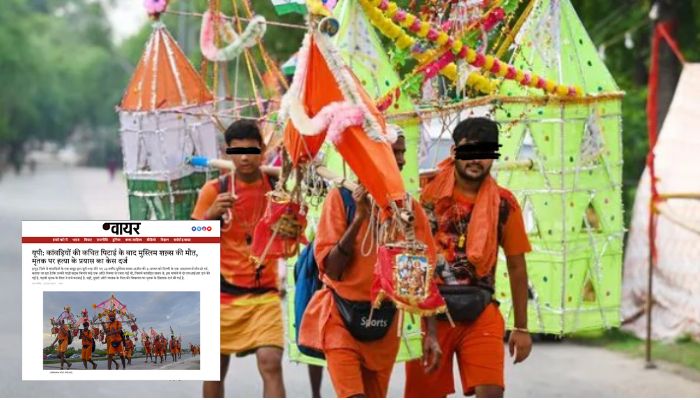
Mini truck driver Mohd Azeem dies due to injuries during assault after accident with Mohd Farman’s auto rickshaw ferrying Kanwariyas; The Wire pins sole blame on Kanwariyas

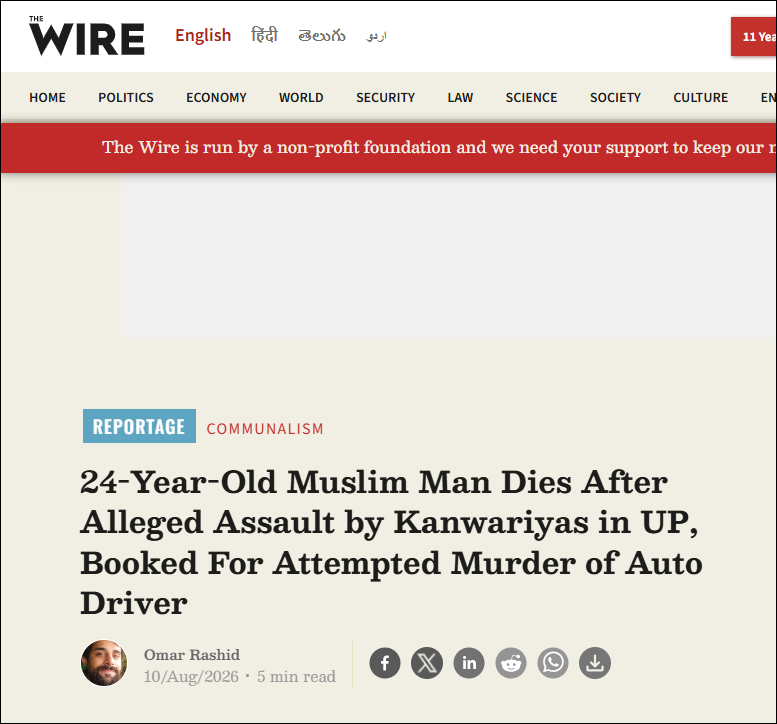
Islamo-leftist propaganda rag The Wire has a penchant for villainising Hindus and giving communal spin to almost every incident wherein the victim happens to be a Muslim. The left-liberal cabal vilifying Kanwariyas has become an annual ritual. On 10th August, The Wire published a report with a carefully crafted headline, “24-Year-Old Muslim Man Dies After Alleged Assault by Kanwariyas in UP, Booked For Attempted Murder of Auto Driver.” It claimed that a Muslim mini-truck driver Mohammad Azeem (24) died at a hospital due to injuries caused during an attack on 31st July by Kanwariyas in Uttar Pradesh’s Hapur.

Road accident, assault, counter-complaints and The Wire’s selective emphasis on Kanwariyas

The Wire played the shrewd game of selective emphasis on Kanwariyas in the headline even as the dispute began after a road accident in which Mohammad Azeem’s mini-truck collided with a parked autorickshaw belonging to one Mohammad Farhan (19). Farhan’s auto rickshaw was booked by four Kanwariyas, Ankit, Lokesh, Manish, and Shivam.

The collision occurred near the Shiva Dhaba under the Garhmukteshwar Police Station precinct. The Wire report claimed that after the accident, Kanwariyas dragged Azeem and brutally assaulted him, leaving him severely injured.

The Wire report says that Mohammad Azeem was rushed to a hospital in Meerut and later transferred to Delhi. Azeem, who went into a coma, succumbed to his injuries at a Delhi hospital on 4th August without ever regaining consciousness.

The Islamo-leftist rag’s reporter Omar Rashid deliberately did not lay equal emphasis on the alleged involvement of Mohammad Farhan in thrashing Mohammad Azeem.

Notably, the police have reportedly made no arrests but have confirmed that deceased Mohammad Azeem’s father, Intezar, has filed a complaint against Mohammad Farhan and the four Kanwariyas. In his complaint, the deceased person’s father named Farhan, the four Kanwariyas, and two unknowns. All residents of Bajheda Khurd village.

Intezar alleged that after the collision of Azeem’s mini-truck and Farhan’s parked auto rickshaw occupied by the Kanwariyas, Farman and the passengers dragged Azeem out and assaulted him.

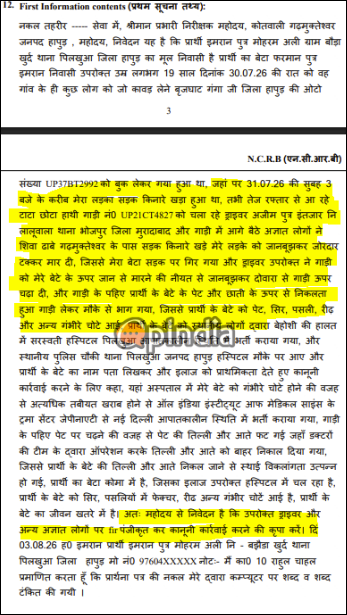
Mohammad Farman was also critically injured and under treatment at AIIMS Trauma. In a counter-complaint, Farman’s father Imran accused Mohammad Azeem of deliberately running over his mini-truck with the intention to kill him. Azeem was not alone in his Tata mini-truck.

“Mohammad Azeem deliberately rammed Farman, who was standing roadside, knocked him down, and then intentionally drove over him a second time with wheels over abdomen and chest, with intent to kill, and fled. Farman suffered severe injuries, including those on the head, ribs, spine, and abdomen. His spleen and intestines ruptured and were surgically removed, causing permanent disability,” Imran’s complaint reads.

The FIR says that Farman is in a coma at AIIMS Trauma Centre / JPNA Trauma, New Delhi, after initial treatment at Saraswati Hospital, Pilkhuwa. Local police noted details and prioritised treatment.

The Garhmukteshwar Police Station SHO has said that because Mohammad Azeem is dead, the police are processing closure of the FIR against him.

In both the Hindi report and its English equivalent, The Wire placed selective emphasis on Kanwariyas, portraying them as the main assailants, even as the FIR names Farman as the primary accused alongside the four Kanwariyas in the complaint lodged by Azeem’s father, Intezar.

While in its report copy, The Wire subordinated Farman and placed Kanwariyas in the spotlight as the actors who killed the ‘sole breadwinner of a poor Muslim family’, they withheld any mention of Farman in the headline.

Despite it being a case of a road collision that turned into a serious assault between two vehicle parties, and not a one-sided ‘Kanwariyas killed Muslim man’ incident. With its sinister headline, The Wire not only made Azeem’s death about Muslim victimhood but also furthered the lies that Hindu Kanwariyas are by default violent and out to target Muslims.

Even if it is assumed that Kanwariyas joined Farman in assaulting Azeem, it would be a crime. However, The Wire effortlessly and without any factual basis communalised the incident despite there being no reported religious motivations demonstrated by either party in attacking each other.

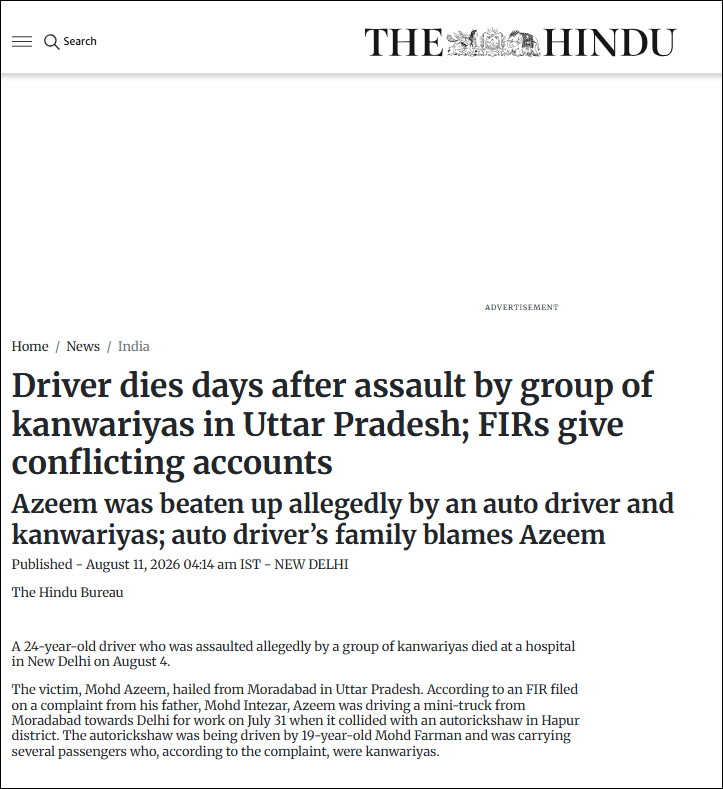
The Wire, however, was not the only Hinduphobic portal to push this communal ‘Kanwariyas killed Muslim man’ bogey. The Hindu also reported the matter with a similar “Driver dies days after assault by group of kanwariyas in Uttar Pradesh; FIRs give conflicting accounts” headline.

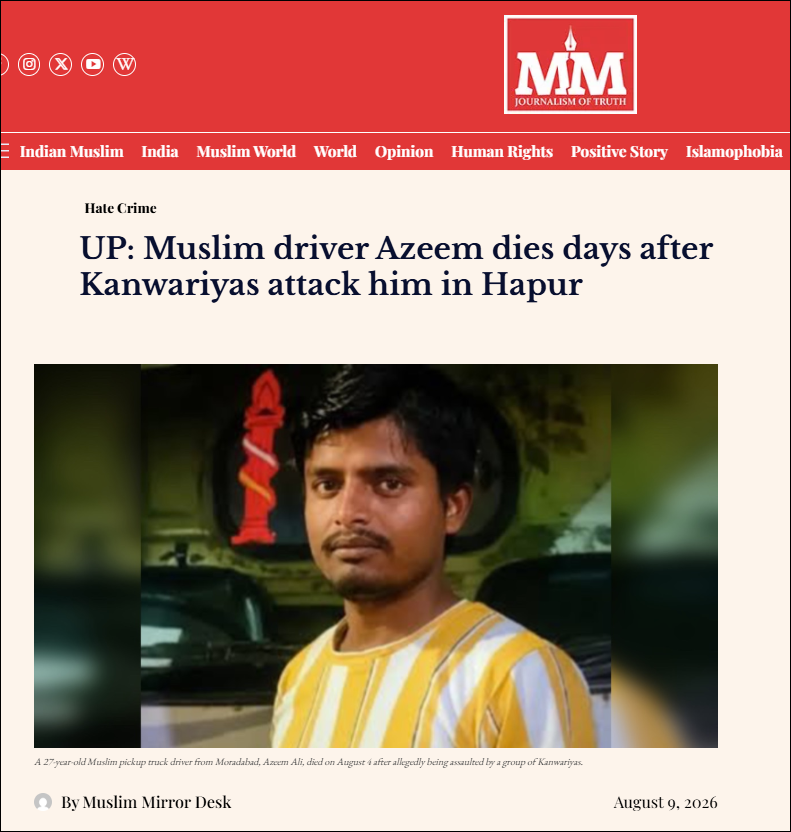
Similarly, Muslim Mirror, another Islamist rag notorious for peddling fake Muslim victimhood and spreading hatred against Hindus, reported the incident in question with a headline, “UP: Muslim driver Azeem dies days after Kanwariyas attack him in Hapur.”

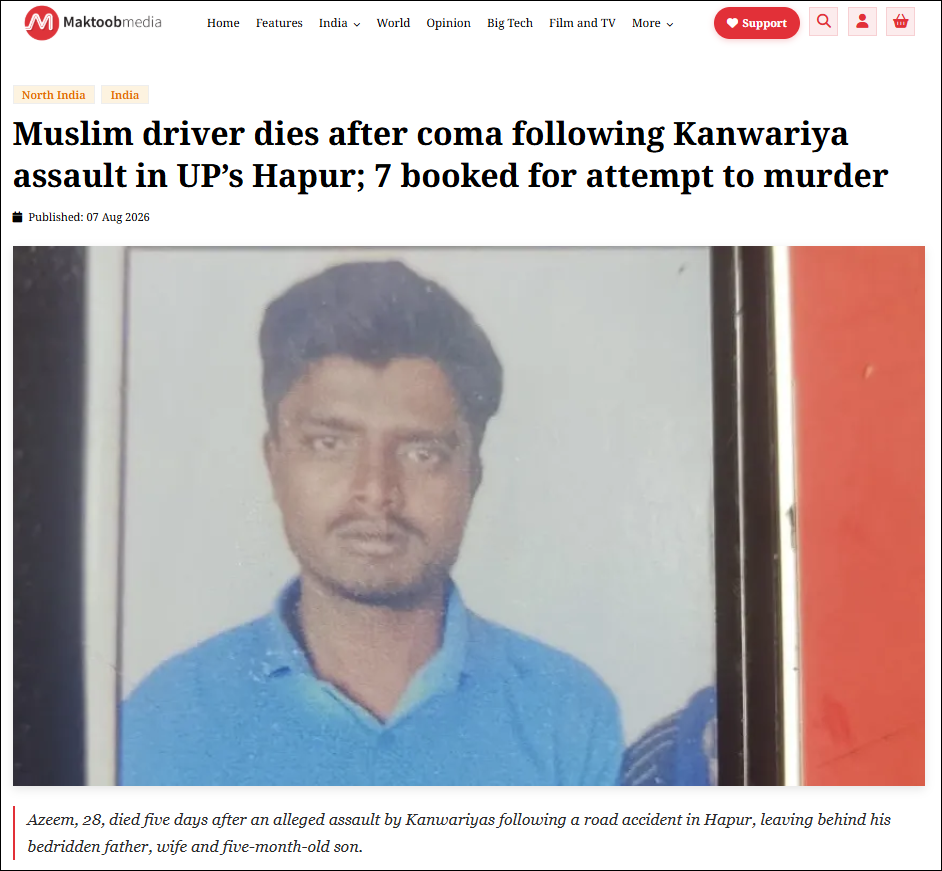
Another Islamist propaganda outlet, Maktoob Media, also blamed Kanwariyas alone for Azeem’s death and published the headline, “Muslim driver dies after coma following Kanwariya assault in UP’s Hapur; 7 booked for attempt to murder.”

The Wire and other Islamo-leftist portals are selectively giving a communal colour to the incident and downplaying Mohammad Farman’s alleged role in the incident even as the police are still investigating the matter. Apparently, for the Islamo-leftist media, a Muslim deceased and mention of Hindu Kanwariyas alone is enough to concoct a ‘Kanwariyas killing Muslims’ bogey.

The same Islamo-leftist cabal either downplays the religious identity of Muslims when Muslim mobs pelt stones at Kanwar Yatra processions out of sheer hatred towards Hindus, somehow blames Hindus only for their misery, or skips reporting such incidents altogether.

The Wire’s selective framing villainising Kanwariyas as anti-Muslim appears to be a part of a broader pattern to vilify Kanwariyas and, by extension, Hindus to further the ‘Muslim minorities under threat’ bogey. Recently, an Islamist Maulana Sajid Rashidi had called Kanwariyas ‘terrorists’.

How global tech giants are flagging child abuse material and helping to catch criminals

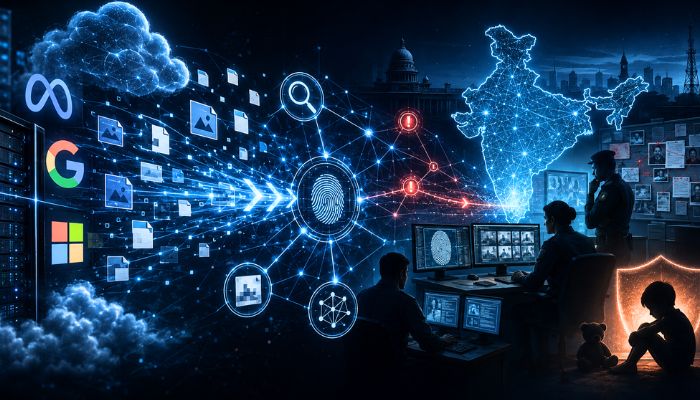
A child in Aizawl had never approached the police, nor had the family. Yet digital signals generated by technology platforms eventually became part of a CBI investigation that helped identify and rescue the child. The case illustrates an international detection infrastructure through which material appearing online can be recognised, reported and routed to Indian law-enforcement agencies.

Internationally, such material is commonly called CSAM, or child sexual abuse material. In India, the Supreme Court has endorsed the term CSEAM, child sexual exploitation and abuse material, rejecting “child pornography” as terminology that can trivialise the seriousness of abuse. India has formally received NCMEC CyberTipline reports since an NCRB-NCMEC agreement in 2019. In 2025, NCMEC associated about 1.93 million CyberTipline reports with India. These are reports, not 1.93 million victims, offenders or criminal cases.

Technology companies broadly detect such material in three ways: recognising previously identified content, flagging potentially new material, and analysing suspicious account or network behaviour. Known material can be detected using hashes, effectively mathematical fingerprints. Microsoft’s PhotoDNA, for example, allows participating services to match images against fingerprints of previously identified material without identifying the person depicted or reconstructing the original image.

Previously unseen material requires a different approach. Google says artificial intelligence can flag images displaying characteristics similar to confirmed CSAM, after which trained personnel review them. Meta also uses AI and machine learning alongside matching technologies and behavioural signals. Human review remains important because platform enforcement and criminal proof are not the same. Microsoft reported that 15.08% of accounts it actioned in 2025 were subsequently reinstated following appeals and further review.

The scale of repeat circulation further complicates the numbers. Meta found that more than 90% of child exploitative material in one 2020 sample was identical or visually similar to previously reported material. NCMEC says imagery involving one child victim circulated for around two decades and appeared more than 1.4 million times in submissions. A single victim’s material can therefore generate enormous numbers of detections.

Ultimately, technology can identify a signal, but it cannot establish who created or uploaded material, who controlled an account, where the abuse occurred or whether a child remains at risk. Those questions require investigation, device examination, digital forensics and evidence capable of standing in court.

Read the full article on Chapter One Magazine.

British national booked in Pune under Maharashtra’s anti-conversion law, made misleading claims about Hindu deities while promoting ‘devotion to Jesus’

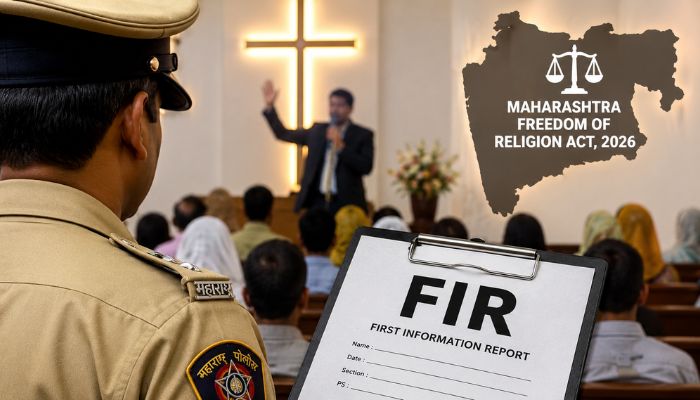
Pune Police have registered an FIR against a UK-based Overseas Citizen of India (OCI) cardholder for attempting to induce people to embrace Christianity during a religious gathering, in one of the first cases registered under Maharashtra’s new Freedom of Religion Act.

The accused, a resident of Manchester, has been booked under relevant provisions of the Immigration and Foreigners Act, 2025, and the newly enacted Maharashtra Freedom of Religion Act, 2026, a Pune Police official said on Monday, 10th August.

The case was registered at Khadak police station after the accused attended a religious programme at a Marathi church in Guruwar Peth and addressed devotees.

According to the preliminary investigation, the accused used terms associated with Hindu religious traditions, including “kirtan”, “Sant” and “Mauli”, while speaking at the gathering. Police alleged that he spoke about following the path of devotion to Jesus and made statements that created misconceptions about Hindu temples and deities.

Police said the statements were made with the intention of misleading people and inducing them to embrace Christianity.

UK national made claims that illnesses could be cured by invoking the name of Jesus

According to the police, the accused made claims that illnesses could be cured and rainfall could occur by invoking the name of Jesus. Investigators have said that such statements were intended to attract Hindus and people belonging to other faiths towards Christianity.

A Khadak police station official said that OCI cardholders are permitted to attend prayer meetings and participate in religious functions. However, they cannot preach, conduct kirtans or deliver religious discourses without obtaining the requisite permission.

“We have booked the person and further probe is on,” the officer said.

First FIR under Maharashtra’s new Freedom of Religion Act

The UK national’s case comes days after Pune Police registered the first FIR under the Maharashtra Freedom of Religion Act, 2026.

The first case was registered on 5th August against a 22-year-old man from Uttar Pradesh who was accused of asking a minor girl, with whom he was in a relationship, to convert from her religion. The case was also registered under the Protection of Children from Sexual Offences (POCSO) Act because the girl is a minor.

According to police, the accused and the girl were from the same village in Uttar Pradesh and had later moved to Karnataka and then Pune. The accused was booked under Sections 3 and 9(2) of the new law and was arrested before being remanded to judicial custody.

Section 3 prohibits conversion, attempted conversion, or aiding and abetting conversion through means including coercion, fraud, allurement, misrepresentation, force, threat or undue influence. Section 9(2) provides for imprisonment of up to seven years and a fine of up to Rs 5 lakh when an offence under Section 3 involves a minor.

What is Maharashtra’s Freedom of Religion Act?

The Maharashtra Freedom of Religion Act, 2026, was notified on 31st July and came into force on 1st August.

The legislation defines unlawful conversion to include conversion through allurement, coercion, deceit, force, misrepresentation, threat, undue influence or other fraudulent means. It also includes certain forms of alleged brainwashing through education among the methods that can constitute unlawful conversion.

“Allurement” has been defined broadly and can include money, gifts, material benefits, employment, free education, promises of marriage, a better lifestyle or claims of divine healing.

The law also provides a procedure for people who voluntarily wish to change their religion. A person intending to convert has to submit a declaration to the District Magistrate or designated authority at least 60 days before the proposed conversion. Religious institutions conducting conversion ceremonies are also required to provide prior notice.

The legislation provides enhanced punishment where alleged unlawful conversion involves minors, women, members of Scheduled Castes or Scheduled Tribes and persons of unsound mind.

It also contains provisions relating to marriages conducted for unlawful conversion and provides for assistance and rehabilitation for victims.

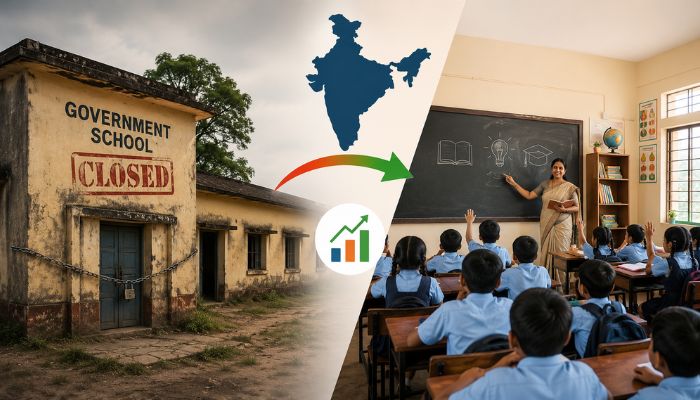
94,000 government schools shut? How Congress weaponised NITI Aayog data to hide the real story

The Congress on Monday, 3rd August, claimed that around 94,000 government schools have been shut down in India over the past decade, and used the figure to attack the Narendra Modi government’s education record. Sharing the claim on X, the party wrote, “Aise Padhega India”, suggesting that the closure of government schools reflects the government’s failure to provide education.

The figure of 94,000 government schools, however, does come from government data cited in a recent NITI Aayog analysis. But presenting it on its own gives only one part of the story. The NITI Aayog report presents a much more nuanced picture of what has happened to India’s school education system between 2014-15 and 2024-25.

The report shows that while the number of government schools has fallen sharply, India has also witnessed a decline in the school-age population, lower overall enrolment, an increase in private schooling and a rise in the number of teachers. Several states have also merged or consolidated schools with very low enrolment in an effort to pool resources and provide better facilities.

In other words, the fall in the number of government schools cannot simply be presented as evidence that the government has stopped focusing on education. The data points towards a larger structural change in the country’s school education system.

Congress highlights school closures, but leaves out the larger picture

The Congress’s social media post focused on the decline in government schools and the impact it could have on children’s access to education. There are legitimate concerns around school closures, particularly in rural, tribal and economically weaker areas where a government school may be the only accessible educational institution for children.

However, the NITI Aayog analysis itself asks a larger question: should the success of school education be measured simply by the number of schools, or by whether children have access to a properly resourced school that can provide quality education?

This distinction is important because not every school closure means that children have been left without a school. In several states, schools with very few students have been merged with larger institutions so that teachers, classrooms, laboratories, libraries, sports facilities and other resources can be used more effectively.

The data also shows that the total number of schools in India has not fallen by 94,000. The decline in the total number of schools is much smaller. The country had around 15.16 lakh schools in 2014-15, compared with around 14.71 lakh in 2024-25, a fall of roughly 45,000. The sharp decline was mainly in government schools, while the number of private unaided schools increased.

Therefore, using the 94,000 figure without explaining the demographic and structural changes behind it presents only part of the picture.

What does the NITI Aayog report actually say?

According to the NITI Aayog analysis, the number of government schools declined from around 11.07 lakh in 2014-15 to 10.13 lakh in 2024-25, an 8% fall. During the same period, the number of private schools increased from around 2.88 lakh to 3.39 lakh, an increase of about 18%.

The decline in government schools happened alongside a fall in the number of children enrolled in schools. Overall school enrolment fell from 26.95 crore in 2014-15 to 24.69 crore in 2024-25, a decline of around 2.26 crore students or nearly 8%.

Government school enrolment also declined. The share of students enrolled in government schools fell from around 54.3% in 2014-15 to 49.25% in 2024-25. At the same time, the share of students in private schools increased from 31.7% to 38.8%.

The shift towards private education is therefore another important part of the story. Parents’ changing preferences, urbanisation and migration, along with demographic changes, have contributed to the changing school landscape.

The NITI Aayog analysis identifies three broad reasons for the fall in overall enrolment: “demographic shifts, particularly falling fertility rates leading to a smaller school-age population”, “the effects of school consolidations” and challenges in retaining students at higher levels of education.

India has fewer children entering school

One of the biggest factors behind the changing education landscape is India’s demographic transition.

India’s fertility rate has fallen significantly over the past few decades. The total fertility rate, which was above three in the early 1990s, has now fallen to around two, below the replacement level of 2.1.

This means that fewer children are entering the school system every year. Rising female literacy, urbanisation, better healthcare, wider access to family planning, delayed marriages and changing family aspirations have all contributed to smaller families.

As the number of school-age children declines, schools with very low enrolment become increasingly common. Some schools that once had more than 100 students may now have only a few dozen, or even fewer.

Running separate schools with very low enrolment can also create another problem. A school may have only one teacher handling multiple classes and several subjects. Such schools may technically provide access to education but may struggle to offer subject-specific teaching, peer learning, sports and other activities.

Why are schools being merged?

The NITI Aayog report points towards “consolidation and rationalisation measures” as one of the reasons for the decline in government schools.

Several states have merged schools with low enrolment into larger institutions. A NITI Aayog project launched in 2017 also focused on merging and reorganising low-enrolment schools in states including Jharkhand, Madhya Pradesh and Odisha.

The National Education Policy, 2020, has also promoted the idea of school complexes and clusters, where schools can share teachers, infrastructure and other resources.

The argument behind consolidation is that a larger, properly equipped school can provide a better educational environment than several extremely small schools with only one or two teachers.

However, this does not mean that every school closure is automatically beneficial. The report also acknowledges the risks involved. If a school is merged with another institution located several kilometres away, children may have to travel longer distances. This can particularly affect young children, girls and students living in remote, tribal or disadvantaged areas.

This is why school consolidation has to balance quality, accessibility and equity.

Teachers increased despite fewer schools

Another important part of the data is the number of teachers.

While the number of schools and students declined, the number of teachers increased from around 90 lakh in 2014-15 to more than one crore in 2024-25. This indicates that the decline in the number of schools has not simply been accompanied by a reduction in the teaching workforce. In fact, teacher availability has improved at the national level.

However, the national average hides significant differences between regions. Some rural schools still have only one teacher and very few students, while some urban schools face overcrowding.

The challenge, therefore, is not simply to increase or decrease the number of schools. It is to ensure that schools have enough qualified teachers and resources while remaining accessible to children.

The bigger problem is keeping children in school

The NITI Aayog analysis also identifies another major challenge: retaining children beyond Class 8.

The secondary level has been described as the “most fragile link” in the schooling cycle. The Gross Enrolment Ratio at the secondary level is 78.7%, compared with more than 90% at the primary and upper-primary levels. At the higher-secondary level, it falls further to 58.4%.

The report points out that nearly four out of every 10 children who enter school do not continue until the higher-secondary stage.

One reason is that the Right to Education (RTE) Act guarantees free and compulsory education only up to the age of 14. After Class 8, families may have to bear more of the cost of education, which can become a major barrier for children from poorer households.

The structure of schools can also create problems. Only around 5% of India’s schools offer continuous education from Classes 1 to 12. Children often have to shift schools after Class 5, Class 8 or Class 10 depending on what is available in their area.

The NITI Aayog report notes that this “fragmentation without any established linkage between schools for transitioning” can make it harder for students to continue their education.

At the same time, there has been progress in some areas. Primary-level dropout has fallen sharply from around 4% in 2014-15 to just 0.3% in 2024-25. At the secondary level, dropout has also declined from 17.86% to 11.5%, although it remains the highest among the major stages of schooling.

So, is the closure of government schools a crisis?

The decline of nearly 94,000 government schools is a real figure and deserves scrutiny, particularly where closures or mergers make it harder for children to reach school. But the data does not show that schools are being shut simply because the government is no longer interested in education.

India is going through a demographic change, with fewer children entering school. At the same time, many families are increasingly choosing private schools. States have also been merging schools with low enrolment to pool teachers and infrastructure.

The bigger question is whether these changes are improving education or creating new barriers.

School consolidation can make sense when it gives children access to better teachers, laboratories, libraries, sports facilities and a stronger peer-learning environment. But it can become harmful if children, particularly girls and those from poor or remote communities, are forced to travel long distances or drop out because the nearest school has been closed.

Ultimately, the success of India’s school education policy cannot be judged only by how many schools exist. It should be measured by whether every child can safely reach a well-equipped school, receive quality teaching and continue education beyond Class 8.

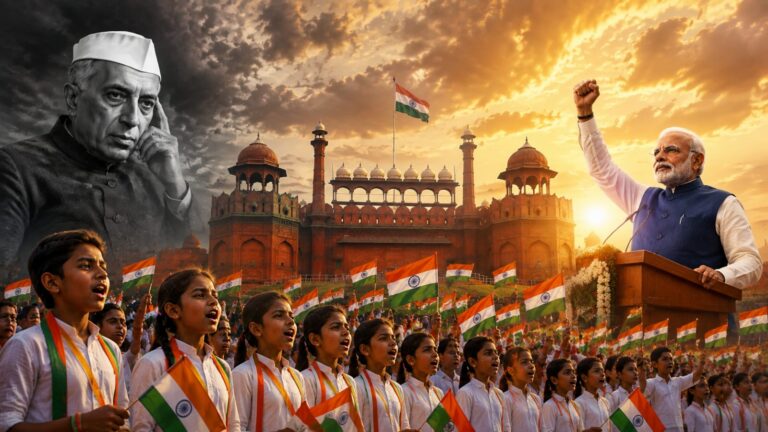
‘Shoot us, but we won’t sing Vande Mataram’: Kerala Congress revives its old opposition to National Song

On one hand, while the country is celebrating the 150th anniversary of this timeless creation and the central Modi government is giving it respect equivalent to the national anthem and encouraging the collective singing of all its verses from the Red Fort to the entire country, on the other hand, the attitude of the Congress party remains the same today as it was during the freedom struggle.

This character of Congress has not changed even after decades. Whenever there is talk of singing Vande Mataram in its entirety or honouring it, Congress and its appeasement-driven allied parties stand in opposition.

The opposition that recently surfaced from Kerala has once again proven the extent to which hatred is filled within Congress leaders regarding the national song Vande Mataram, where its leaders are not hesitating to say that even if they are shot, they will not sing the full Vande Mataram.

The Full ‘Vande Mataram’ will resonate from the Red Fort, but fierce opposition from Congress in Kerala

On the historic occasion of India’s 80th Independence Day (15 August 2026), an unprecedented scene is going to be witnessed.

According to information provided by the Ministry of Defence, for the first time in history, all the verses of the entire Vande Mataram will be sung upon the Prime Minister’s arrival at the ramparts of the Red Fort.

This year, the main theme of the Independence Day celebrations has been kept as ‘150 Years of Vande Mataram’ and ‘Youth Power for Developed India@2047’. Under this, as per the guidelines of the Ministry of Home Affairs protocol and the National Implementation Committee, the collective singing of all 6 verses of the national song is being ensured across the country.

Even on the invitation cards, its complete lyrics have been printed so that all citizens can sing along. But while the entire country is ready to witness this historic moment, the UDF-supported politics of Kerala and Congress leaders have opened a front against it.

Controversy erupted after Kerala Chief Secretary Vishwanath Sinha issued a circular on August 6, giving administrative instructions to sing Vande Mataram completely during Independence Day programs.

As soon as this directive came, panic spread between both the ruling party and the opposition in Kerala. Kerala Health Minister K Muraleedharan explicitly stated that all verses of the national song would not be sung during government programs in the state and only the traditionally sung initial two verses would be performed.

Going even further, senior Congress MP Rajmohan Unnithan made a controversial statement, saying, “We cannot accept the full singing of Vande Mataram in this lifetime. Even if Narendra Modi threatens to shoot us, ‘Vande Mataram’ will not be sung in full.”

He went on to allege that the Governor and Raj Bhavan are indulging in politics to weaken democracy. This entire sequence of events has exposed that for the Congress government and its leaders, the full singing of the national song is not an administrative directive, but an issue against which they are ready to go to any extent to oppose.

Why is there a problem with the final verses?

Opposition to the full singing of Vande Mataram is not new; rather, a long history of appeasement is hidden behind it. In the first two verses of Vande Mataram, the natural beauty of the land of India- Sasya Shyamalam, Malayaja Sheetalam, Sujalam, Sufalam- is venerated, to which no one has an objection.

The problem for opponents begins from the subsequent verses. In the later verses, Bankim Chandra Chattopadhyay depicted Bharat Mata as Durga, Lakshmi, and Saraswati and invoked the motherland as the power of Goddess Durga holding Shashtra in ten hands (Dasha Praharana Dharini).

In Kerala, the stand of Congress, CPI(M), and their political ally Indian Union Muslim League has always been that the latter parts include invocations, symbols, and religious imagery related to Hindu deities.

They have argued that in a secular state, verses containing such religious symbols should not be made part of official national singing. In reality, this opposition is not ideological but purely the mathematics of vote bank and appeasement.

To please Muslim fundamentalists, Congress and its leftist allies always crafted a narrative that the latter lines are against the principle of ‘Monotheism’ (one God).

Under the pressure of this Muslim League and fundamentalist vote bank, the UDF and Congress politics led by VD Satheesan appear subdued even today. CPI(M) and Pinarayi Vijayan also immediately started politics over this and accused the government of bowing down to the Sangh Parivar’s political agenda.

It is the result of this appeasement politics that advocating for pruning and making the country’s national song incomplete is being done openly by Congress even today.

Bankim Chandra’s timeless creation and Vande Mataram’s contribution to the freedom struggle

Vande Mataram is not merely a song; it is the life force of India’s freedom movement and the immortal voice of patriotism that ignited the flame of revolution in the hearts of crores of Indians.

This timeless creation was composed by Bankim Chandra Chattopadhyay on 7 November 1875 and was later included in his famous novel ‘Anandamath’. The time this song was composed was when British rule was expanding its roots in India and Indians were being pressured to sing the British national anthem ‘God Save the Queen’.

Bankim Chandra composed Vande Mataram, proclaiming the sovereignty and power of his motherland as a response to this colonial cultural imposition by British rule. Composed 150 years ago, this song united the entire country in no time.

In 1896, at the Calcutta session of the Indian National Congress, Gurudev Rabindranath Tagore himself set it to tune and sang it for the first time. After this, during the Partition of Bengal (1905), it became the biggest slogan and symbol of Indian resistance against the British.

During the freedom struggle, from heroines like Matangini Hazra to revolutionaries like Bhagat Singh, Rajguru, and Sukhdev, countless revolutionaries chanted Vande Mataram while facing British police batons and kissing the gallows.

This song became a symbol of India’s national unity, pride, and self-respect against colonial slavery. But the same song that inspired lakhs of youth to sacrifice themselves for the freedom of Mother India is being rejected by Congress leaders today.

Nehru and Congress’s hatred: How the National Song was made incomplete

This hateful and compromising character of Congress regarding Vande Mataram is not new, but its roots are hidden in the historical blunders of Jawaharlal Nehru and the then Congress leadership.

In 1937, when provincial elections were held in the country and Congress governments were formed in several states, the Muslim League and Muhammad Ali Jinnah raised strong objections to the singing of Vande Mataram.

In the pursuit of appeasing Jinnah and placating the Muslim League, Jawaharlal Nehru and the Congress leadership made a severe compromise with the national song.

At the 1937 Kolkata session, under the presidency of Nehru, the Congress passed a resolution to accept only the first two verses of Vande Mataram and to remove the remaining verses from official programs.

The logic given was that the later verses mention Hindu deities, which could hurt the sentiments of non-Hindus. This was the biggest beginning of appeasement politics in India’s freedom movement.

Moving forward, when it came to choosing the national anthem in the Constituent Assembly, Jawaharlal Nehru flatly refused to make Vande Mataram the national anthem.

He argued that the tune of Vande Mataram was not such that it could be played on a band or presented internationally as a national anthem. The song that had united the country in the freedom struggle could not get the status of the main national anthem due to this attitude of Nehru and the Congress, and it was cut down and limited to just two lines.

Dr Rajendra Prasad’s vision and Modi government’s Historic initiative

Contrary to this attitude of the Congress, India’s first President, Dr Rajendra Prasad, was the biggest proponent of full honour for Vande Mataram.

On 24 January 1950, the final day of the Constituent Assembly, Dr Rajendra Prasad made a historic statement clearly declaring that while ‘Jana Gana Mana’ would be the National Anthem of India, ‘Vande Mataram’, which played a historic role in the freedom struggle, would also be given equal status and honour as ‘Jana Gana Mana’.

However, subsequent Congress governments put this sentiment and order of Dr Rajendra Prasad on the back burner. For decades, Vande Mataram remained neglected, and controversies continued to be raised regarding its singing.

Years later, the central government led by Prime Minister Narendra Modi resolved to bring Dr Rajendra Prasad’s vision into reality on the ground. On the occasion of the national song completing 150 years, the Modi government decided to organise a special 10-hour discussion in Parliament on its history, significance, and contribution, where Prime Minister Modi himself initiated the debate.

Not only this, the central government brought ‘The Prevention of Insults to National Honour (Amendment) Bill, 2026’ in Parliament, which has been passed by the Rajya Sabha. Through this bill, Vande Mataram has been given legal and constitutional status equal to the national anthem.

Now, insulting Vande Mataram or creating an obstacle in its singing will be considered a serious criminal offence, providing for a jail term of up to 3 years and a fine.

Congress’s hateful attitude being exposed even today

Today, as the country celebrates the 80th anniversary of its independence and 150 years of Vande Mataram, the difference between nationalism and appeasement stands fully exposed.

On one hand, the current Modi government is committed to restoring lost constitutional honour to national symbols, the sacrifices of freedom fighters, and the sacred hymn Vande Mataram; on the other hand, Congress continues on its old path of appeasement.

The statement of the Congress MP in Kerala saying ‘Shoot us, but we will not sing the full Vande Mataram’ is not an accidental remark.

It is an extension of that decades-old mindset of Congress where vote bank politics is placed above national pride and respect for the national song.

The cycle of neglect and truncation towards Vande Mataram that started with Jawaharlal Nehru continues even in the era of Rahul Gandhi and his associates today.

This clearly proves that years passed, decades passed, power equations changed, but the character of Congress did not change. The Congress still harbours hatred for the national song that shook the foundations of the British during the freedom struggle.

While the echoing of the full Vande Mataram from the Red Fort is a symbol of self-respect and national renaissance for 140 crore Indians, the opposition to it by Congress proves that for them, the agenda of appeasement remains greater than the national interest even today.

ISIS Ricin terror plot: Gujarat NIA court rejects bail plea of accused Jihadi Dr Syed Ahmed Mohiuddin

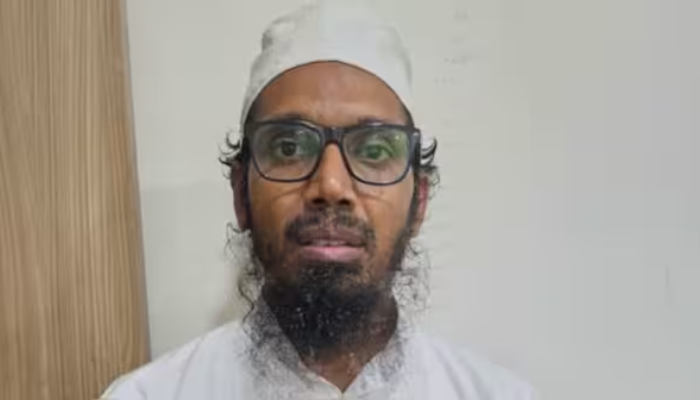
On 10th August, a Special NIA Court in Gujarat’s Ahmedabad rejected the regular bail plea of Dr Syed Ahmed Mohiuddin, the main accused Jihadi in the 2025 ISIS ricin terror plot case.

Appearing for Syed Ahmed Mohiuddin, advocate K.M. Dastoor argued that his client was innocent and had been falsely implicated. The defence said the material on record did not establish his links with any terrorist organisation or show that he intended to harm people. It also argued that Mohiuddin did not know what was inside the bags in which weapons were found and had no knowledge of the process of preparing ricin.

Court finds prima facie material against accused

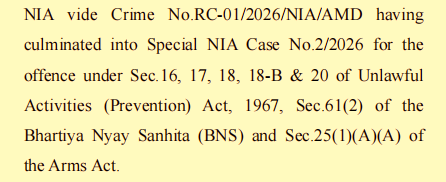
Special Judge (NIA) Hemang R. Rawal said the case involved serious charges under Sections 16, 17, 18, 18-B and 20 of the Unlawful Activities (Prevention) Act (UAPA), Section 61(2) of the Bharatiya Nyaya Sanhita (BNS) and the Arms Act.

The court said the investigation had produced prima facie material against the 2025 ISIS ricin terror plot accused Jihadi Mohiuddin and a chargesheet had been filed in the case.

The court noted that Mohiuddin, who is a doctor, was accused of setting up a laboratory at his Hyderabad home without the required permission. Investigators said ricin was prepared there using castor seeds and chemicals. The court observed that, given his medical background, it could not be said that he was completely unaware of the nature of ricin, a highly toxic biological toxin with the potential to cause mass deaths.

Prosecution says doctor worked with handler

Opposing the bail plea, Special Public Prosecutor M.G. Kapadiya told the court that Mohiuddin was facing a serious prosecution and had travelled towards Mehsana carrying three pistols and 30 live cartridges without a licence. The prosecution said this, along with other evidence, showed his involvement in the wider conspiracy.

The prosecution claimed that Mohiuddin had converted his Hyderabad residence into a clandestine laboratory for extracting ricin from castor beans. His mobile phone, according to the prosecution, contained conversations with a Telegram user identified as Abu Khadija, described as a wanted accused. These conversations included discussions about obtaining acetone, castor seeds and weapons for preparing ricin.

Notably, Ricin is a highly toxic protein which is derived from the castor bean plant, Ricinus communis. Ricin is not a virus or bacterium; rather, it is a lectin toxic to inhibits protein synthesis in cells. Its consumption can lead to organ failure and quick death. Extraction of ricin involves mashing castor beans, removing the oil, and then chemically processing the remaining mash to isolate the Ricin-rich pulp. Although a sophisticated work, this process requires only basic lab equipment, gloves and acetone.

“Per contra, learned Spl. P.P. has submitted that the applicant-accused is facing serious prosecution. The
learned Spl. P.P. has further submitted that the applicant-accused was travelling to Mehsana carrying three pistols and 30 live cartridges without any license and the said act of the applicant-accused itself speaks about his ill intention. The learned Spl. P.P. has further submitted that the applicant-accused converted his residence into a clandestine laboratory to extract Ricin from castor beans using chemicals, intending to carry out mass casualty attacks in Indian cities,” the court order reads.

The prosecution further told the court that Mohiuddin had agreed to assist Abu Khadija in activities being carried out in the name of a religious cause. He had also sought around US$4 lakh to establish business operations. As part of the wider plan, he travelled to Delhi, where he discussed plans, funding and future operational activities.

The prosecution also said Mohiuddin took an oath on Abu Khadija’s instructions, recorded it and sent the video to the handler. He then tried to expand the network by administering similar oaths to Abdul Vajid and Naved Pamidi. According to the prosecution, he also sent photographs and videos showing the preparation of toxic material to Abu Khadija.

Court lists allegations against Mohiuddin

According to the court’s summary of the chargesheet, Mohiuddin came in contact with Abu Khatija through Telegram in 2025 and agreed to assist him. He allegedly sought about US$4 lakh for business operations and travelled to Delhi in August 2025 to meet an associate and discuss plans and funding.

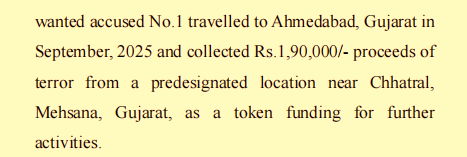
The court also recorded that Mohiuddin travelled to Ahmedabad in September 2025 and collected Rs 1.90 lakh, described as terror proceeds, from a pre-designated location near Chhatral in Mehsana. He later recorded an oath and shared it with his handler, while similar oaths were administered to other individuals as part of efforts to expand the network.

The chargesheet further states that Mohiuddin procured castor seeds, oil-extraction equipment and chemicals such as acetone. The court noted the prosecution’s case that these materials were used to prepare ricin at a laboratory at his Hyderabad residence. The chargesheet describes ricin as a highly toxic biological toxin listed in Schedule-I of the Chemical Weapons Convention.

The court also recorded that Mohiuddin had arranged to receive additional funds and materials and planned to visit Ahmedabad in November 2025, where he received advanced weapons for a terrorist act. Based on these allegations, the court said the accusations were serious and prima facie showed his involvement in the case.

Mohiuddin was aware of the ricin terror plot; he knew that the bags contained weapons

The court rejected the defence argument that the ISIS ricin terror plot accused Syed Ahmed Mohiuddin did not know about the weapons. It pointed to the recovery of three pistols, 30 live cartridges, Indian and US currency and a bottle containing four litres of castor oil. The judge said the material in the chargesheet indicated that Mohiuddin was acting on the instructions of Abu Khadija and that the weapons were obtained for an improper purpose.

The court also said the records indicated a conspiracy involving Mohiuddin, Abu Khadija and other accused persons.

“Thus, the allegations levelled against the applicant-accused seem to be serious in nature, and prima facie reveal the involvement of applicant-accused with the offence in question,” the court stated.

The Special NIA Court further highlighted that since the accused Syed Ahmed Mohiuddin is a doctor, “it cannot be said that he was absolutely unknown to the material prepared by him in the nature of Ricin, a toxic biological toxin, which is having potential of mass killing. Further, the existence of a lab at the residence of the applicant-accused without there being any license/permission from a competent authority, prima facie speaks about the ill intention of the applicant-accused.”

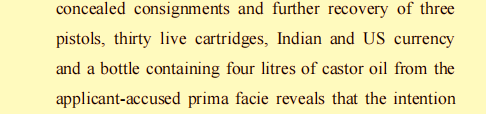
The court also noted that accused ISIS ricin terror plot accused jihadi Mohiuddin had allegedly travelled to different locations including Delhi and Ahmedabad, to meet operatives and collect concealed consignments, and further recovery of three pistols, thirty live cartridges, Indian and US currency and a bottle containing four litres of castor oil from the applicant-accused prima facie “reveals that the intention on the part of the applicant-accused was not holy or for any human cause,” the court noted.

Citing the chargesheet, the Special NIA Court noted that accused Dr Syed Ahmed Mohiuddin was in contact with the wanted main accused and was acting as per his instructions, leading to the preparation of Ricin and further the procurement and holding of weapon pistols. The court, thus, rejected Defence’s claim that Mohiuddin was unaware of the bags and their contents (weapons).

“The recovery of weapon from applicant-accused prima facie 10 reveals that the said weapon was obtained for oblique purpose and therefore, the contention raised by the learned Advocate for the applicant-accused that applicant-accused had no knowledge about the bags and contents thereof, deserves no acceptance at the hands of this Court,” the court said.

“Further, the video recovered from mobile phone of accused No.1 also speaks about the ill intention on the part of applicant-accused and does not reveal that the applicant-accused was moving towards the holy path and doing good to humanity,” the court added.

Considering the seriousness of the accusations and the restrictions imposed by Section 43D(5) of the UAPA, Special Judge Hemang R. Rawal refused to grant bail. The court rejected the application without any order as to costs.

“Considering the aforesaid and rigors of section 43D(5) of the Unlawful Activities ( Prevention) Act, this Court deems it fit not to exercise the discretionary jurisdiction vested with this Court in favour of the applicant-accused, and hence, the present application is hereby rejected with no order as to costs,” the court ordered.

Case background

The case emerged after the Gujarat ATS arrested three men in connection with an Islamic State-Khorasan Province (ISKP)-linked network. Investigators said members of the group had conducted reconnaissance of crowded markets and religious or organisational sites in Ahmedabad, Delhi and Lucknow while gathering information that could be used for a possible terror attack.

Mohiuddin, a doctor from Telangana who studied medicine in China, was arrested with firearms, ammunition and castor oil. Investigators said he was trying to prepare ricin from castor seeds at his Hyderabad residence. The ATS also traced his communication with an Afghan handler linked to ISKP, while the investigation continued into funding, other members and possible links to a wider network.

Melting Arctic ice is opening a window for India, and we need to act soon

For the last twenty years, India’s strategic thinking has been locked on one place, the ‘Indo-Pacific.’ The Quad, and freedom of navigation patrols and the long naval watch on China near the first island chain. That focus made sense, and it was the right call.

But north of everything Delhi has been watching, a second theatre has been quietly opening up, not replacing the Indo-Pacific, just running alongside it.

The Arctic is now warming three to four times faster than the rest of the planet, according to recent assessments from the World Meteorological Organisation and America’s NOAA. A WMO report found the Arctic is set to warm more than three and a half times faster than the global average between 2025 and 2029, while NOAA’s own tracking shows Arctic annual air temperatures have been rising nearly three times faster than the global mean since 1980. And the Northern Sea Route, once the exclusive territory of Soviet icebreakers and polar explorers, is turning into real, usable infrastructure. Ice doesn’t wait for foreign ministries to give it permission before it melts.

The question is no longer whether the Arctic matters to India. It’s whether India will simply watch this new route open from the shore or step in and help build it.

A theatre made by ice, not ideology

The Arctic theatre isn’t being shaped by alliances or ideology. It’s being shaped by physics. Arctic sea routes could cut the distance between Northern Europe and Asia by as much as 40 per cent compared with the traditional path.

And this isn’t just theory. In 2024, Rosatom reported nearly 37.9 million tonnes of cargo moving along the Northern Sea Route, a record. There were also a record 92 transit voyages that pushed transit cargo past 3 million tonnes. Rosatom’s director general said in October 2025 that he expected roughly 20% more cargo the following year.

The real picture is a bit more layered than that headline suggests. When the final 2025 numbers came in, total NSR cargo had actually slipped to about 37 million tonnes, down slightly from the year before. Russian consultancy Gecon called it a second straight year of decline in overall volumes. But the transit segment, the part of the route that competes directly with Suez, carrying goods from China toward Europe, told a different story. It hit a record 103 voyages carrying about 3.2 million tonnes. One container ship, the Istanbul Bridge, even reached the English port of Felixstowe in just 20 days, against the 40-50 days a Suez or Cape route usually takes.

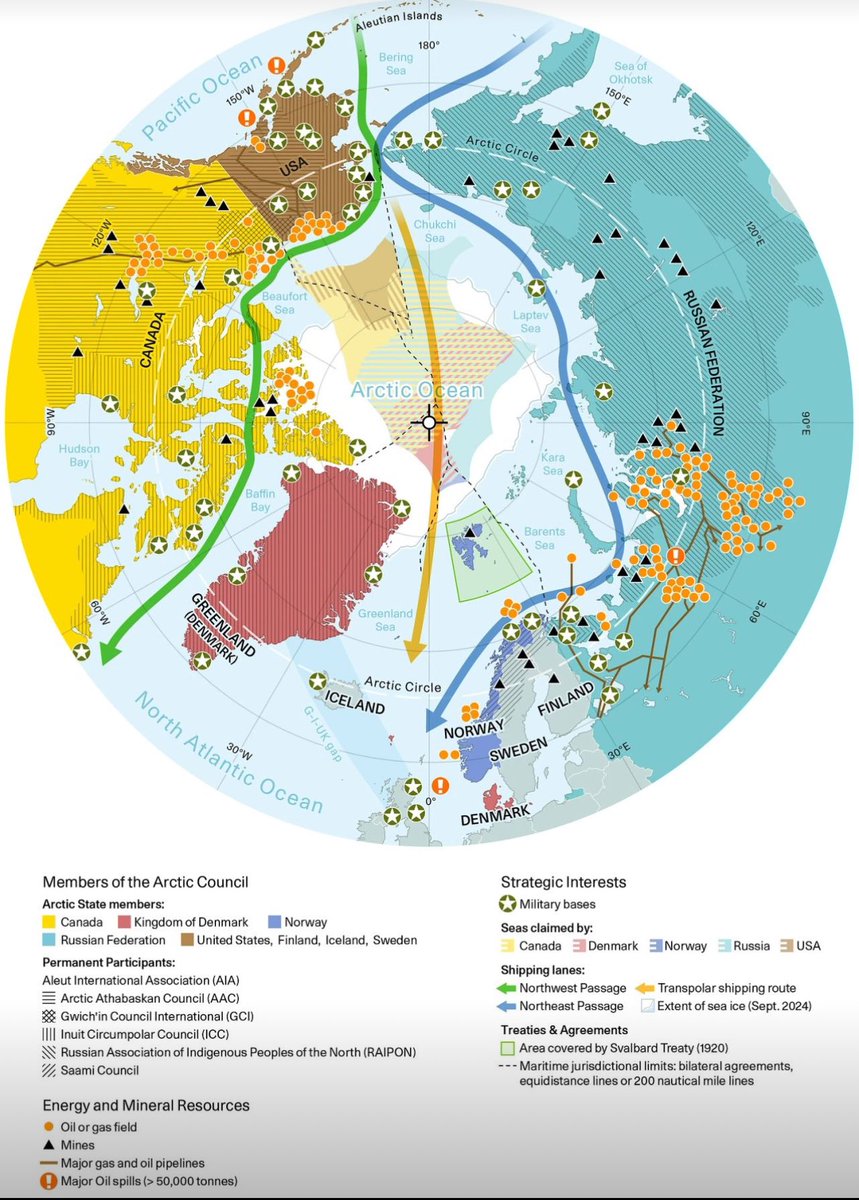
Arctic Circle and NSR, map by Brussels School on Geopolitics, shared by Velina Tchakarova on X

Western shipping majors have mostly stayed away. Maersk, CMA CGM and Hapag-Lloyd have pulled back because of sanctions risk, and even China’s COSCO hasn’t sailed the route since 2022. But the specific lane that matters most to India’s calculations, the one linking Asia to Europe, is the one growing fastest.

The monsoon is written in the ice

Here’s the part of the story no other Indo-Pacific power can tell. Try asking Tokyo, Canberra, or Hanoi how the Arctic affects their monsoon. They’ll look at you blankly. Ask Delhi, and they’ll show you the data, less Arctic ice means unpredictable rains for millions of Indian farmers.

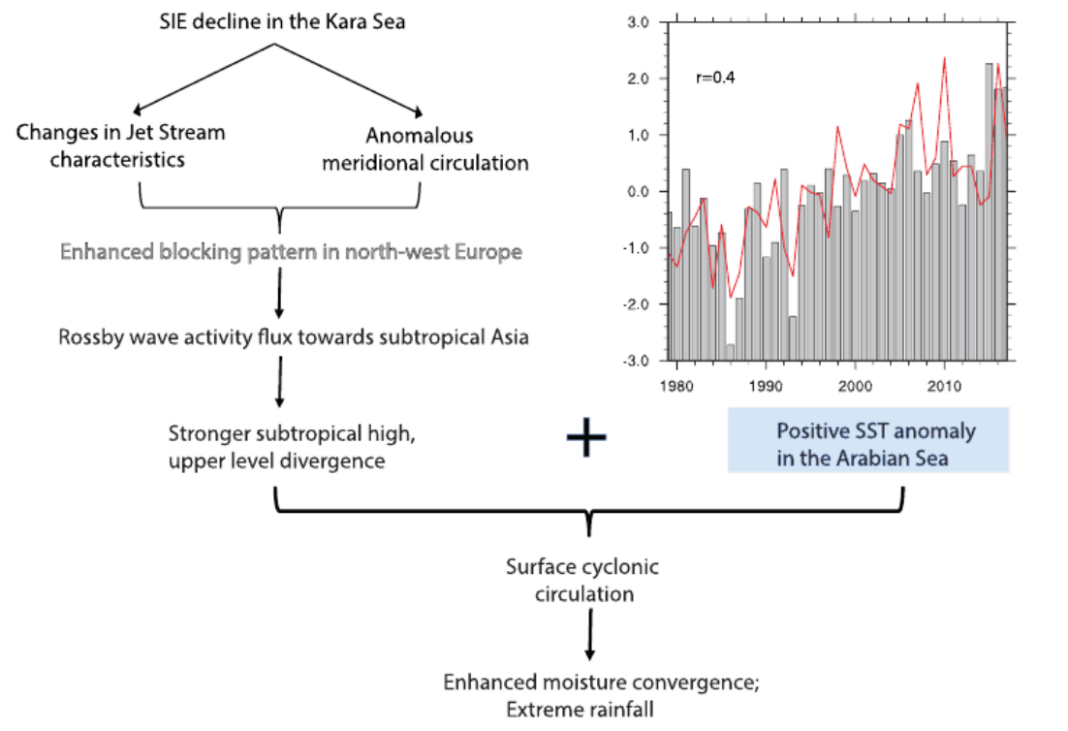
Scientists at India’s National Centre for Polar and Ocean Research, working with South Korea’s polar institute, have traced how shrinking sea ice in the central Arctic and the Barents-Kara Sea is reshaping the Indian monsoon. When sea ice concentration falls in the central Arctic, rainfall drops over western and southern peninsular India but rises over north-western and central India, a redistribution, not simply less rain overall. M. Ravichandran, Secretary at the Ministry of Earth Sciences, has called climate-resilient infrastructure and deeper research into this Arctic-monsoon link a policy priority. 

Schematic of the suggested mechanism between The Arctic Sea Ice Extent (SIE) in Kara Sea and Indian Summer Monsoon Rainfall (ISMR) extremes during September

A monsoon that waters more than a billion people is being rewritten, one melting season at a time, in a sea most Indians will never see. That isn’t a metaphor. It’s a data point. It means India’s Arctic stake isn’t mainly about trade or minerals. At its core, it’s also existential, in a way no ally’s is.

A claim older than China’s

When China called itself a ‘near Arctic state‘ in its first official Arctic white paper in January 2018, it presented the region as a new frontier opening up for Asian powers. India’s claim to a seat at the table is older, by almost a century.

India’s link to the Arctic goes back more than a hundred years. It was one of the original high contracting parties to the Svalbard Treaty, signed in Paris in February 1920. India signed as part of the British Empire’s overseas dominions, alongside Canada, Australia, South Africa and New Zealand. China only joined the same treaty five years later, in 1925.

That’s exactly the reason when Union Minister Jitendra Singh released India’s first Arctic policy, ‘India and the Arctic: Building a Partnership for Sustainable Development,’ in March 2022. He traced India’s Arctic engagement back a century, to that 1920 signature in Paris. It’s a fair reply to anyone who calls India a late entrant just playing catch-up to Beijing. But it shouldn’t be stretched too far. Signing a treaty in 1920 is not the same as owning an icebreaker in 2026. A serious case for India’s Arctic role has to hold both truths at once, the century-old legal claim at the table, and the very real capability gap that still exists today.

Slow and steady: How India got here

Line up the dates, and you’ll see it. India was late to the paperwork, but early to the ground game.

Himadri, India’s Arctic research station in Svalbard, opened in July 2008. Five years later, India became an Arctic Council observer, sitting at the table with China, Japan, South Korea, and Singapore. The formal Arctic Policy didn’t arrive until March 2022, fourteen years after Himadri. But by then, India was already deepening its presence. In December 2023, Delhi launched its first winter science expedition to Himadri, pushing the station toward year-round operations.

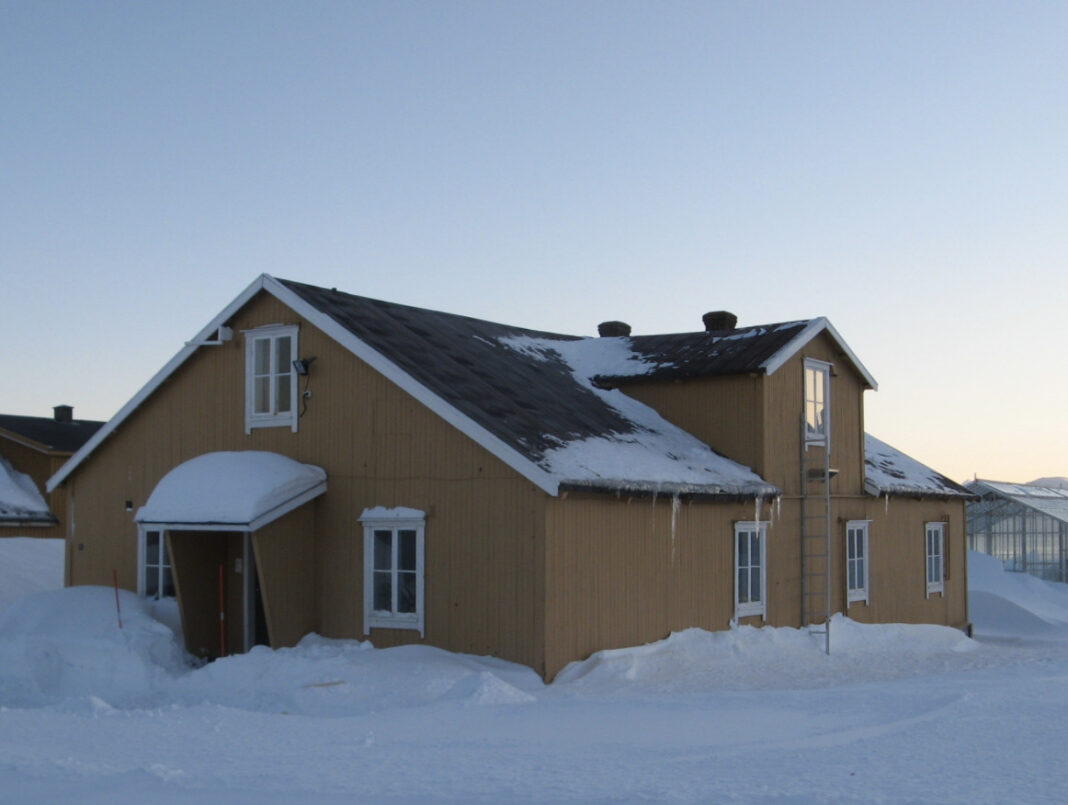
Himadri Station in Svalbard

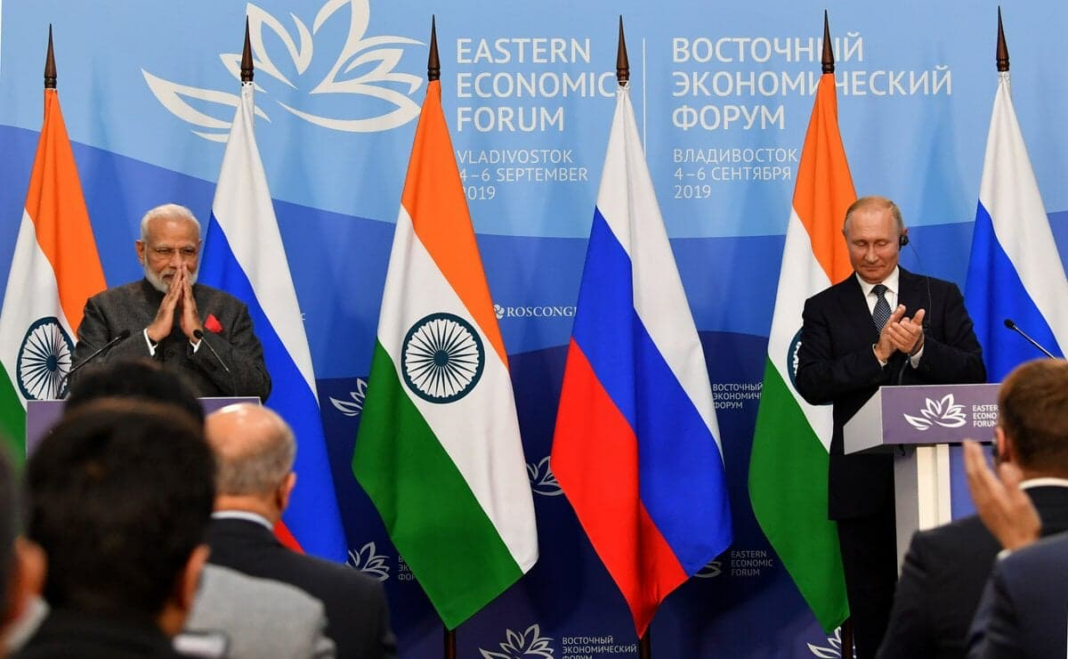
But the Arctic wasn’t the only piece moving. In September 2019, Prime Minister Modi visited Vladivostok for the Eastern Economic Forum, the first Indian Prime Minister to set foot in Russia’s Far East. There, he announced a $1 billion line of credit for development projects in the Russian Arctic and launched India’s ‘Act Far East’ policy. It was a signal, India wasn’t just watching the Arctic from Svalbard. It was building a corridor to reach it. That corridor became the Chennai-Vladivostok Eastern Maritime Corridor, launched in November 2024. A direct sea link between Indian ports and Russia’s Far East, cutting transit times by up to 16 days compared to the traditional route via Suez. In December 2025, during Putin’s visit to New Delhi, India and Russia formalized the connection: the Chennai-Vladivostok corridor would link directly to the Northern Sea Route, creating a continuous maritime axis from the Indian Ocean to the Arctic.

The 20th India-Russia Annual Summit, Vladivostok 2019

The logic is simple. Vladivostok is India’s gateway to the Arctic. From there, Indian ships can access the Northern Sea Route, Russian Arctic ports like Murmansk and Petropavlovsk-Kamchatsky, and the resource-rich Far East. In July 2024, Russia’s Far East and Arctic Development Corporation signed an MoU with the Indian Chamber of International Business in Vladivostok to foster joint investment projects. In December 2025, the two countries committed to intensifying trade and investment cooperation in the Far East and the Arctic zone of the Russian Federation.

In May 2025, Indian representatives joined the seventh BRICS Working Group on Ocean and Polar Science and Technology in Brasília. And in May 2026, at the Third India-Nordic Summit in Oslo, the first Indian Prime Minister’s visit to Norway in 43 years, the Nordic states welcomed deeper Indian involvement in polar research.

Call it what you want. It’s not a sudden pivot. It’s fifteen years of small, deliberate steps. Easy to miss if you’re looking at one year at a time. Hard to explain away once you see the whole line. Himadri in 2008, Vladivostok in 2019, Arctic Policy in 2022, Chennai-Vladivostok corridor in 2024, BRICS polar roadmap in 2025, and Nordic Summit in 2026. India wasn’t waiting for permission. It was building the path, one step at a time.

The Russia opening

Since 2022, the other seven Arctic Council states have frozen Russia out of formal cooperation as the region’s security architecture shifted decisively toward NATO. That left Moscow looking outside the traditional Arctic club for partners, and it found two, China and India.

In December 2025, Russian Foreign Minister Sergei Lavrov said Moscow was building dedicated Arctic working groups with both countries, naming India specifically as a priority partner in developing the Northern Sea Route. That wasn’t just talk. Weeks earlier, in October 2025, Russia had signalled strong interest in India’s inclusion in the Arctic Council as part of a push for deeper NSR cooperation. Then, during President Putin’s state visit to New Delhi in December 2025, India and Russia concluded a formal agreement on training Indian seafarers for polar shipping operations. The two sides also opened talks on jointly constructing four Arctic-class vessels worth roughly $750 million, sitting alongside India’s own $8 billion shipbuilding incentive package already under way.

This is the same structural gap India has already exploited in energy markets since 2022, buying discounted Russian oil while the West looked away. Except this time the asset isn’t a tanker. It’s an entire ocean.

None of this means picking Moscow over Washington or Tokyo. It means strategic autonomy doing what it’s supposed to do, keeping a door open that everyone else’s has shut. The Arctic Institute has pointedly asked why India has not worked more closely with fellow democracies in the Arctic, instead opting for closer cooperation with a regime the other seven Arctic states have largely cut off. That tension is real, and a serious case for India’s Arctic policy has to name it rather than talk around it.

Parliament enters the Ice Age

On 30 July 2026, an Indian parliamentary committee did something no Indian institution had done before. It put the Arctic and Antarctic at the centre of a foreign policy report, not a footnote to science policy. The Standing Committee on External Affairs, chaired by Congress MP Shashi Tharoor, tabled ‘India’s Role and Presence in the Arctic and Antarctic Regions’ in the Lok Sabha during the Monsoon Session. The committee had adopted the report nine days earlier, after hearing from the Ministry of Earth Sciences, the Environment Ministry and the Ministry of External Affairs. Tharoor called the subject ‘rather obscure’ but said the polar regions are far more important than people think.

Its central recommendation consisted of India appointing a ‘polar ambassador’ to pursue polar diplomacy more effectively and push for full member status of the Arctic Council. The committee noted that all Arctic Council states, and most non-Arctic observers including Japan, China, Singapore and South Korea, already have such a position. It went further. It recommended a quadrilateral agreement among India, Japan, Singapore and South Korea, the Council’s four Asian observers, to strengthen Asia’s collective voice, and noted that development of NSR shipments between India and Russia is being actively pursued, alongside India’s Chennai-Vladivostok Eastern Maritime Corridor, operational since November 2024. It also recommended the government buy polar research vessels, citing a shortage of icebreaker ships as a real constraint on India’s polar work.

Perhaps most striking is what it asked India to become, not just a scientific observer of the Arctic, but the voice of the Global South inside its governance.

The Hard truths

A serious case for India’s Arctic role has to start by admitting what it still lacks. India doesn’t yet have a dedicated Arctic class icebreaker of its own. It leases and borrows what it needs, which is exactly why the committee’s call to buy polar research vessels matters. The December 2025 talks with Russia on jointly building four ice-class ships are a real first step toward closing that gap. But they remain talks, not ships already delivered. India also runs just one permanent Arctic station, while China has poured far more into polar infrastructure and icebreaking capacity in the thirteen years since both countries became Arctic Council observers together.

Sovcomflot, Russia’s largest shipping company, Icebreaker.

And there’s the question the Arctic Institute has already asked in public. Why has India built its Arctic strategy so heavily around Russia, instead of coordinating more closely with fellow democracies that are just as close to the Arctic, like Japan or Norway?

The honest answer is strategic autonomy, not sentiment, and partly economics, the same discounted oil logic that has shaped India’s Russia policy since 2022. India has kept open a channel that almost no other major democracy still has. That channel may prove valuable precisely because it’s scarce. But it is also a wager that India can keep close ties with Moscow, Tokyo and Washington all at once, indefinitely, without ever being forced to choose.

What Delhi should do now?

The parliamentary committee has basically handed India a clear to-do list. Five things on it stand out as the most important.

Get the ships built

A proper Arctic capable ship (Polar research vehicle) is the single most practical and fundamental demand on that list. The conversations with Russia about four icebreaker ships have to turn into signed contracts, not stay as talking points. 

Here’s the awkward reality. Russia operates the world’s biggest nuclear icebreaker fleet, and the only nuclear-powered ones anywhere, while India still has none. Back in December 2025, Russian Deputy Prime Minister Denis Manturov confirmed discussions on building four non-nuclear icebreaker ships in India, valued at more than ₹6,000 crore. Rosatom, Russia’s state nuclear corporation, is already looking at Indian shipyards, both public and private, for the work. This isn’t simply about purchasing ships. It’s about joint construction, transferring technology, and training Indian crews for polar operations.

Connect the Arctic to the routes India already runs

Formally tie the Northern Sea Route into the International North-South Transport Corridor and the Chennai-Vladivostok Eastern Maritime Corridor. That way, the whole thing looks like a natural extension of India’s existing connectivity plans rather than a sudden new idea. 

The INSTC already links India, Iran and Russia by sea, rail and road, and it brings cargo from St Petersburg to Mumbai down to about 25 days instead of the usual 40 via Suez. The Chennai-Vladivostok corridor, which started running in November 2024, gives Indian ports a direct east-west line into Russia’s Far East. Add the Northern Sea Route, and you suddenly have a continuous path from the Indian Ocean up through Vladivostok, into the Arctic, and out toward Europe. Rosatom is actively inviting Indian involvement in NSR projects and offering priority access to icebreaker escorts and ports.

In December 2025 India and Russia signed several maritime MoUs that treat the INSTC, the Chennai-Vladivostok corridor and the Northern Sea Route as one connected network. The committee isn’t asking Delhi to invent anything fresh. It’s simply asking it to join up the lines it has already drawn.

Move from buying cargo to owning a share

 Stop limiting yourself to shipping Russian Arctic oil and start taking an equity stake in the projects, the same way ONGC Videsh has done in other places. A pure customer has no real voice while an investor does.

Since 2021 ONGC Videsh has been discussing a minority stake in Russia’s Vostok oil project, which holds an estimated 44 billion barrels of high quality crude, and in the Arctic LNG-2 project on the Gydan peninsula. Gazprom Neft first invited ONGC Videsh into its offshore Arctic work as early as 2017. Even further back, in 2012, ONGC Videsh was already looking at Russian Arctic blocks with ExxonMobil and ENI. India has put about $16 billion into Russian oil and gas overall, but most of that money sits in Siberia and the Far East rather than the Arctic itself.

The committee’s message is straightforward. India needs to shift from buyer to partner. Ownership gives you influence over pricing, production and access. Just buying the oil leaves you dependent on the seller’s terms.

Create a group that doesn’t wait for the Arctic Council’s approval 

The Arctic Council has been largely frozen since 2022, when the other seven members suspended work with Russia after the Ukraine invasion. In that situation the committee’s idea of a quadrilateral with Japan, South Korea and Singapore looks more practical in the short term than waiting for all eight Arctic states to agree on anything. All four countries are Asian observers on the Council. All four run polar research programmes. All four want Arctic access without getting stuck in the Russia-West standoff. Japan already has two icebreakers. South Korea has one. Singapore has none, but it is a major shipping hub. India also has none, yet it already operates Himadri in Svalbard, is expanding its research presence, and currently holds the BRICS chair.

Such a quadrilateral would not replace the Arctic Council. It would simply work around the blockage, concentrating on joint research, shared logistics, and coordinated positions on the Northern Sea Route, data exchange and climate monitoring. The committee is not telling India to walk away from the Council. It is telling Delhi to stop sitting around waiting for the Council to thaw.

Make full use of the BRICS chair while India still holds it  

India has the BRICS presidency through 2026, exactly when Arctic issues and Global South concerns are starting to overlap. That is a concrete, time limited tool, not some vague future chance, and it vanishes the moment the chairship ends. 

In May 2025 the BRICS Working Group on Ocean and Polar Science and Technology held its seventh meeting in Brasília and approved a five-year plan for joint polar research. Russia, Brazil, South Africa and China all have their own Arctic or Antarctic interests. Brazil runs an Antarctic station. South Africa has a Southern Ocean programme. China operates two Arctic stations and an icebreaker fleet. India’s 2026 presidency is the moment to lift polar cooperation from a working-group topic to a summit priority.

India should use the BRICS chair to present itself as the voice of the Global South in Arctic affairs. That means treating the Arctic not only as a resource zone but as a climate zone, one where melting ice in the far north already influences monsoon patterns across the Global South. It means pressing for technology sharing, joint research and fairer access to polar resources. And it means acting now, while the gavel is still in Delhi’s hands. Once the chairship ends, that lever is gone.

Representative Image via AI

Conclusion: Passenger or pilot

None of this means India has to walk away from the Indo-Pacific, or pick Moscow over its other partners. It simply asks Delhi to stop treating the Arctic as a side hobby for scientists, and start seeing it for what the ice has already decided. It is a live strategic theatre, one that carries a monsoon, a shipping lane, and a century-old claim to a seat at the table. The ice isn’t going to wait for any committee to meet again.

The route is opening. The monsoon is already shifting. And for the first time, Delhi has a clear parliamentary mandate to act, not just watch from the sidelines. India’s claim to the Arctic didn’t begin this year. It began in Paris, in February 1920. The only question left is whether, in 2026, India finally starts behaving like it.

Passenger, or one of the pilots? Customer, or partner? The ice is melting.

Dear non-Left, don’t fall for Leftists shaming Newslaundry for sexual harassment at the workplace; they would celebrate your ordeal the first chance they get

There is something deeply amusing about watching the Left-liberal ecosystem discover workplace ethics.

For years, the same ecosystem has positioned itself as the ultimate moral authority on journalism, feminism, institutional accountability, sexual harassment and victims’ rights. It has lectured politicians, actors, journalists and editors about believing women, respecting survivors and dismantling “toxic” workplace cultures.

And then came Newslaundry.

Suddenly, the sermon has become an uncomfortable mirror.

The controversy surrounding Newslaundry and its co-founder Abhinandan Sekhri is not merely another episode in India’s media wars. It raises a much more uncomfortable question: what happens when people who have spent years presenting themselves as custodians of journalistic ethics are forced to confront allegations and testimonies about the culture inside their own newsroom?

The answer, at least for now, is that some of their ideological comrades have discovered accountability.

But here is the problem: do not mistake their outrage at Newslaundry for solidarity with you.

They are not suddenly going to become champions of victims they ordinarily dismiss. They are calling out Newslaundry because defending it has become increasingly difficult.

And there is a difference.

It took a court conviction to make Newslaundry confront its past

The immediate trigger was the Bombay High Court’s recent conviction of former Tehelka editor Tarun Tejpal in the 2013 sexual assault case. The court overturned his earlier acquittal and sentenced him to 10 years’ imprisonment.

That inevitably brought renewed attention to Newslaundry’s relationship with Tejpal and, more importantly, to a 2014 article published by Nirupama Sekhri, sister of Abhinandan Sekhri.

The article, “Letter To Ms Tehelka-Assault-Victim”, directly questioned the woman who accused Tejpal and used deeply condescending language to describe her. It said Nirupama Sekhri did not consider her a victim, except of what she called “bubblegum feminism”, while portraying Tejpal as a victim of public fury.

This was not some anonymous social-media post. It was published by Newslaundry.

The publication later removed the article, saying its values had evolved and the piece no longer reflected its standards.

That is an admission of sorts.

But the question remains: why did it take more than a decade, the #MeToo movement, changing attitudes towards sexual assault and eventually a court conviction to arrive at that conclusion?

More importantly, what else was happening inside the organisation while Newslaundry presented itself as a fearless crusader against institutional wrongdoing?

That is where the story becomes considerably more uncomfortable.

Former employees have raised serious allegations

Former Newslaundry employees have come forward with their own accounts.

Sumedha Mittal publicly raised questions about how complaints of sexual harassment within the newsroom were handled. Priyanka Ishwari alleged that a senior journalist screamed at women editors and threatened one of them during work calls.

Then came Sayantan Ghosh, who said he joined Newslaundry as a trainee journalist in 2016 and described his experience as an “extremely toxic” workplace. He alleged that Abhinandan Sekhri used deeply hurtful and abusive language towards employees.

Ghosh specifically rejected the argument that such behaviour was simply “normal” in journalism. He said he had worked at other newsrooms, including The New Indian Express and The Telegraph, where he recalled being treated respectfully.

He also described an incident after writing a story concerning Section 66A in which, according to his account, the abuse became so severe that he fled Delhi and returned to Kolkata.

Whether every allegation is ultimately established is a matter for evidence and due process.

But one principle should be obvious:

A newsroom that routinely investigates allegations against others cannot demand a different evidentiary standard when allegations concern itself.

These allegations should be investigated, not dismissed because they are politically inconvenient.

And then came the Left’s great awakening

As criticism of Newslaundry intensified, several prominent voices from the same ideological ecosystem began criticising it.

Barkha Dutt warned against journalistic “god complexes”.

Anusha Ravi Sood described abusive language as a longstanding newsroom problem and expressed sympathy for Ghosh.

Rohini Singh described his experience as terrible and scarring.

There is nothing wrong with any of this.

If someone is abused or harassed at work, they deserve sympathy. If a newsroom has a toxic culture, it deserves scrutiny. If a senior journalist allegedly abuses subordinates, that behaviour should be condemned.

The problem is not that these people are criticising Newslaundry.

The problem is that their moral consistency has historically been selective.

The Left-liberal ecosystem does not have a monopoly on feminism, compassion or victimhood. It does not get to decide which victims deserve solidarity.

The skeletons are now tumbling out of the ivory towers

Just as the Newslaundry controversy exposed the gap between the Left-liberal media establishment’s public sermons and its internal realities, another account emerged from another prominent media organisation.

On Monday, August 10, former ThePrint employee Angana Chakrabarti took to X to describe what she alleged was a deeply toxic workplace culture at the organisation under Editor-in-Chief Shekhar Gupta.

Her account must be treated as an allegation and judged on its merits. But the timing is difficult to ignore.

Chakrabarti described ThePrint as “so very, very toxic” and alleged that the newsroom was constantly anxious about what Gupta thought. She claimed employees were discouraged from interacting beyond work, that editors bent themselves to accommodate his preferences and that mentorship and collegiality were lacking.

She further alleged that she was pushed out after being sent to the Northeast under what she described as impossible conditions, and that someone was later hired to monitor “productivity”.

She described a culture in which work was extracted from employees while they were made to feel like “parasites” for asking for anything in return. She also alleged that former colleagues faced threats of salary cuts and that ex-employees were denied letters of recommendation.

Again, these are allegations. They require verification, investigation and a response from the organisation.

But there is a larger story.

When allegations from former employees emerge from multiple institutions that have spent years positioning themselves as moral arbiters of journalism, perhaps the industry should stop treating workplace toxicity as something that only happens in somebody else’s newsroom.

Where was this moral clarity when the victim was ideologically inconvenient?

Think about the broader pattern.

When the victim is politically useful to the Left, she becomes a symbol of resistance.

When the accused is ideologically hostile, every allegation becomes an opportunity for moral grandstanding.

But when the victim belongs to the political camp they dislike, the language changes.

Suddenly, credibility becomes negotiable. Context becomes important. Motives are questioned. We are told that things are “complicated”.

Sandeshkhali was instructive. Women publicly alleged sexual harassment and intimidation by local Trinamool Congress strongmen. There were subsequently competing allegations about political manipulation, including claims that women were pressured to file or withdraw complaints.

The principled position should have been simple: investigate every allegation, protect every complainant, punish every guilty person and do not weaponise victims for political purposes.

Instead, much of the discourse became about which political side the victims belonged to.

That is not feminism.

That is tribalism.

The same contradiction was visible in the treatment of Smriti Irani, who was subjected to vicious political and personal attacks, including misogynistic commentary. During the 2024 election campaign, Kangana Ranaut was also targeted by an objectionable, sexualised social-media post.

The principle should have been straightforward:

Don’t sexualise women because you disagree with them.

Not: Don’t sexualise women unless they are BJP supporters.

The former is feminism. The latter is political convenience.

Arnab Goswami and the selective outrage problem

The 2020 Kunal Kamra–Arnab Goswami episode offers another illustration of selective outrage.

To be clear, this was not a workplace-harassment case. Kamra and Goswami were not colleagues.

But it demonstrated how public humiliation of a journalist could be celebrated when the target was politically disliked.

Kamra confronted and heckled Goswami on an IndiGo flight from Mumbai to Lucknow, filmed the encounter and uploaded it online. IndiGo suspended him from flying for six months, while other airlines also imposed restrictions.

One can debate whether those bans were proportionate. One can debate the aviation regulations. But the basic principle should remain intact:

You do not get to decide that harassment, intimidation or public humiliation is unacceptable only when the target is someone you like.

Arnab’s journalism can be criticised. His editorial choices can be attacked. His political positions can be dismantled.

But cornering someone on an aircraft, where they cannot simply walk away, and turning the encounter into entertainment should not become heroic simply because the target is politically disliked.

That is the hypocrisy.

The outrage against Newslaundry is not necessarily a moral awakening

This is the most important distinction.

There is a temptation among people on the Right and Centre-Right to celebrate when Left-wing journalists turn against one of their own.

Yes, there is something satisfying about watching people who have spent years lecturing everyone else about workplace morality being forced to confront allegations concerning their ideological fellow travellers.

But do not confuse satisfaction with solidarity.

Their outrage against Newslaundry today does not guarantee that the next woman alleging harassment by someone ideologically aligned with the Left will receive the same sympathy.

It does not mean the next BJP worker describing intimidation will become a feminist icon.

And it certainly does not mean ideological double standards have disappeared.

The answer, therefore, is not to oppose criticism of Newslaundry.

It is to demand consistency.

If Newslaundry deserves scrutiny, scrutinise Newslaundry. If former employees have raised concerns, examine them. If complaints were mishandled, hold those responsible accountable. If allegations are false, the accused deserve due process.

The same standard must apply to ThePrint.

If Angana Chakrabarti’s allegations are true, they deserve to be taken seriously. If they are disputed, ThePrint and Shekhar Gupta deserve the opportunity to respond.

The principle cannot be: believe former employees when they accuse people we dislike and dismiss them when they accuse people we like.

That is not justice.

That is factionalism.

The real problem is moral exceptionalism

The deeper disease in Indian journalism is not merely ideological bias. It is moral exceptionalism.

Newsrooms love investigating everyone except themselves.

Journalists demand accountability from politicians while resisting scrutiny of their own institutions. Editors lecture corporations about workplace culture while dismissing complaints from junior employees. Commentators write about sexism while laughing at misogynistic jokes against women they dislike.

Newslaundry’s predicament is therefore bigger than Newslaundry. ThePrint allegations make it bigger still.

The question is whether journalists believe in universal standards or merely standards that can be deployed against their enemies.

If sexual harassment is wrong, it is wrong when the accused is a BJP leader, Congress leader, TMC leader, celebrity, professor, journalist or newsroom founder.

If workplace abuse is unacceptable, it is unacceptable whether the boss is a Modi supporter or Modi critic.

If victim-blaming is reprehensible, it remains reprehensible when the victim votes for the BJP.

And if due process matters, it must matter even when the accused is politically convenient.

Your editorial line is not your character certificate

There is a particularly delicious irony here.

The media ecosystem that lectures Indian society about patriarchy, power structures, toxic masculinity and institutional accountability has spent years portraying itself as the enlightened alternative.

Fine.

Then hold it to that standard.

If a conventional newspaper has a toxic boss, expose it. If a television newsroom abuses junior employees, expose it. If a digital publication does the same, expose it.

But do not give the “progressive” newsroom a presumption of moral superiority simply because its journalists write about feminism or criticise the government.

An organisation does not become feminist because it publishes feminist articles.

A newsroom does not become progressive because its journalists criticise the government.

And a media house does not become ethical because it investigates the ethics of other media houses.

Your editorial line is not your character certificate. Your conduct towards your employees is.

Do not outsource your morality to the Left

So yes, call out Newslaundry.

Call out the 2014 article. Call out victim-blaming. Call out allegations of workplace harassment. Ask difficult questions of Abhinandan Sekhri and Newslaundry.

And now ask ThePrint the same questions. Take Angana Chakrabarti’s allegations seriously enough to demand answers, while recognising that allegations must still be established through evidence and due process.

But do not outsource your moral compass to people whose outrage may follow ideological convenience.

You do not need Barkha Dutt to tell you workplace abuse is wrong.

You do not need Rohini Singh to tell you employees deserve dignity.

You do not need Newslaundry to teach you feminism.

And you certainly do not need the Left to validate the suffering of someone who happens to be politically inconvenient to them.

Stand with victims because they are victims.

Demand accountability because accountability is necessary.

Defend due process because due process is universal.

Condemn misogyny because misogyny is wrong.

Not because the victim belongs to your camp. Not because the accused belongs to the other camp. And not because the controversy gives you another weapon against your political opponents.

That is the difference between principle and propaganda.

Newslaundry is now being forced to confront what happens when an institution that spent years examining everybody else’s moral failures is itself placed under the microscope. ThePrint is facing questions of its own.

The answer should not be another round of ideological warfare.

It should be accountability.

Because the real test of morality is not whether you can condemn your enemy.

The real test is whether you can condemn your own.

The real test is whether you can stand with a victim when she is politically inconvenient. Whether you can condemn misogyny when the target is Smriti Irani or Kangana Ranaut. Whether you can listen to a former Newslaundry employee even when you agree with Newslaundry’s politics. Whether you can listen to a former ThePrint employee even when you admire Shekhar Gupta.

And whether your principles survive the moment your political tribe becomes the accused.

If they don’t, they were never principles.

They were merely weapons.

Yes, Newslaundry should answer. Yes, former employees should be heard. Yes, allegations should be investigated.

But no, you do not need to applaud the Left for finally discovering workplace harassment.

The lesson is not to trust the Left more. It is to trust principles more than tribes.

Do not believe someone because they are Left-wing. Do not disbelieve someone because they are Right-wing. Do not defend an accused person because they are ideologically aligned with you. Do not condemn someone merely because they oppose you.

Never let a political label determine whether harassment is harassment, whether misogyny is misogyny or whether a victim deserves to be heard.

The Left has spent years demanding that the rest of society confront its hypocrisy.

Fair enough. Now the mirror is facing them.

Let them answer.

And if their outrage at Newslaundry is genuine, it should survive beyond this news cycle, beyond ideological convenience and beyond the next politically useful target.

Otherwise, it is not accountability.

It is merely sabki dhulai se pehle apni bhi dhulai, followed by the same old hypocrisy once the headlines move on.


AAP supremo Arvind Kejriwal casts aspersions on the integrity of Supreme Court Collegium: The dissection of the veiled attack on recent judicial appointments

Arvind Kejriwal, former Chief Minister of Delhi and Aam Aadmi Party (AAP) supremo, has launched a direct attack on the integrity of the Indian judiciary. On 9th August, Arvind Kejriwal claimed that judges are in a “tearing hurry” to go to the Supreme Court and insinuated that the Collegium is inducting judges with demonstrated loyalty towards “emperor” Prime Minister Narendra Modi.

Quoting a news report about the Supreme Court Collegium recommending Justice Ashwani Kumar Mishra as the Chief Justice of the Punjab and Haryana High Court, Kejriwal claimed that the appointment of Justice Mishra by “bypassing seniority” makes him “vulnerable to quid pro quo”.

Casting aspersions on the integrity of, apparently, not just Justice Mishra but the entire judiciary, Kejriwal claimed that judges are being elevated to the Supreme Court based on “loyalty to the emperor”. The AAP leader’s remarks framed as ‘questions’ suggested that the Supreme Court Collegium is compromised and filling the apex court with judges ideologically aligned with the Modi government.

“It seems there is a tearing hurry to go to SC. Should judges be allowed SC elevation out of turn, bypassing seniority? That makes him vulnerable to quid pro quo. What is examined before a judge is elevated to SC? Loyalty to the emperor? Should people not know? What face will they show the young gen?” Kejriwal wrote.

Arvind Kejriwal further asserted that opaque elevation of judges should not be allowed, especially in the case of judges who “go out of the way to please the executive”.

“No out of turn, opaque elevation shud be permitted. Esp in such cases who throw law to the wind and go out of their way to please the executive. We should be careful of weaponisation of courts. Integrity of courts is most important for democracy to survive,” Kejriwal added.

Arvind Kejriwal’s statement is not only outrageous but is also replete with factual inaccuracies and hypocrisy.

Has Justice Ashwani Kumar Mishra been elevated to the Supreme Court as Arvind Kejriwal insinuated?

The Aam Aadmi Party leader’s claim that Justice Ashwani Kumar Mishra has been hurriedly elevated to the Supreme Court by bypassing seniority is baseless. The Supreme Court Collegium’s recommendation is for permanent Chief Justice of the Punjab and Haryana High Court, not the elevation to the Supreme Court.

The CJI Surya Kant-headed Supreme Court Collegium made the recommendation to appoint Justice Ashwani Kumar Mishra as the permanent Chief Justice of the Punjab and Haryana High Court on 6th August. Justice Mishra was already serving as the Acting Chief Justice of the Punjab and Haryana High Court. Justice Mishra has not been elevated to the Supreme Court.

Justice Mishra’s parent court was Allahabad, and he was appointed Additional Judge in February 2014 and made permanent in February 2016. Mishra was transferred to the Punjab and Haryana High Court and joined on 21st July 2025. Justice Ashwani Kumar Mishra became the senior-most puisne there (a junior judge or associate justice who sits on a court alongside, but lower in seniority than, a chief justice). Seniority here is based on the date of initial appointment.

After the previous Chief Justice Sheel Nagu was elevated to the Supreme Court, Justice Mishra took over as the Acting Chief Justice in early June 2026 under Article 223.

The Supreme Court Collegium’s permanent Chief Justice recommendation for Justice Mishra followed around two months later. What Arvind Kejriwal dubbed as some sort of alarming ‘weaponisation of judiciary ’ was, in reality, a standard practice for confirming an Acting Chief Justice and there is no question of bypassing seniority within High Court in this case.

Contrary to the allegation Arvind Kejriwal levelled that the Supreme Court is somehow acting at the behest of the ‘emperor’, is also factually incorrect. Firstly, the Supreme Court Collegium is an independent body of senior Supreme Court judges; it has nothing to do with the Executive or the ruling dispensation.

Secondly, Arvind Kejriwal offered not even a shred of evidence indicating that the Supreme Court recommendation for appointing Justice Ashwani Kumar Mishra as Chief Justice of the Punjab and Haryana High Court was “out of turn” in the context of all-India High Court seniority conventions.

From the Nithari Killings case to handling matters pertaining to illegal mining, infrastructure, service law, environment, etc, Justice Mishra’s career exhibits no apparent record of any pro-BJP bias or explicit allegiance to the Modi government or vendetta against the AAP government in Punjab.

Neither has Arvind Kejriwal cited any, nor are there any publicly reported judgements by Justice Ashwani Kumar Mishra involving Kejriwal, AAP or the alleged scams linked to his erstwhile government in Delhi. Thus, Kejriwal’s “throwing law to the wind” or quid pro quo with the executive allegations hold no factual ground and are nothing but a sensationalisation of a routine High Court appointment, for political gains.

Meanwhile, Cockroach Janta Party (CJP) spokesperson Saurav Das, who previously wrote a hit job against former CJI DY Chandrachud, amplified Arvind Kejriwal’s alarmist propaganda.

Much like Arvind Kejriwal, Saurav Das also did not elaborate on how the Supreme Court Collegium’s recommendation for permanent appointment of the Acting CJ of the Punjab and Haryana Court amounted to the weaponisation of the judiciary to meet political ends.

“Scathing comment by an Opposition leader on the state of affairs in the judiciary. Indeed, we should be very alarmed by the manner in which courts are being weaponised to achieve political ends. Our courts should be protected and remain institutions of very high integrity. The Young Gen will ensure this happens. Accountability shall be fixed,” he wrote.

Arvind Kejriwal’s attack was directed at Justice Sheel Nagu? If so, the AAP leader’s allegations are rooted in disdain, not logic

Interestingly, some AAP supporters have claimed that Kejriwal’s post was about Justice Sheel Nagu, who has been recently elevated to the Supreme Court. This interpretation, however, defies timeline, if we go by the post’s content and the quoted material. However, if we go by the Opposition’s record of vilifying judges who ruled against them in specific matters, then it makes sense that Kejriwal’s attack was about Justice Sheel Nagu’s elevation to the Supreme Court.

Arvind Kejriwal directly quoted a Bar and Bench X post, which had a link to its report about the Supreme Court recommendation of Justice Ashwani Kumar Mishra as the Chief Justice of the Punjab and Haryana High Court. If Kejriwal was talking about Justice Sheel Nagu, why would he quote news material about Justice Mishra, and write, “That makes him vulnerable to quid pro quo”, unless Kejriwal was hiding behind ambiguity.

The Supreme Court Collegium meeting was held on 6th August 2026, and the apex court’s statement makes no mention of Justice Sheel Nagu, nor does the Bar and Bench report quoted by Arvind Kejriwal.

Notably, Justice Sheel Nagu served as the Chief Justice of the Punjab and Haryana High Court from July 2024; the Supreme Court Collegium recommended his elevation to the Supreme Court in May 2026. His appointment was notified by the Central government on 1st June 2026, and he assumed office as a Supreme Court judge on 2nd June.

Justice Nagu’s elevation created the vacancy for a permanent CJ to the Punjab & Haryana High Court, leading to Justice Ashwani Kumar becoming the Acting Chief Justice. Naturally, the Acting CJ was recommended to take over as the permanent CJ.

Regarding Justice Sheel Nagu’s elevation to the Supreme Court, Kejriwal’s “out of turn”, “bypassing seniority”, claims, even if directed at Nagu, are simply a political attack on the judiciary as well as the Central government.

While seniority is not completely disregarded, it is not the sole criterion the Supreme Court Collegium relies on while recommending judges for elevation to the apex court. Under the Collegium system, the Supreme Court judges weigh a blend of merit, overall track record, performance, and representative balance of different high courts rather than following a mechanical application of all-India seniority.

The Supreme Court Collegium is not bound to select judges in an unbroken sequence of chronological seniority. Apparently, Justice Sheel Nagu’s extensive tenure and disposal rate in the Madhya Pradesh and Punjab & Haryana High Courts were viewed as impressive in terms of administrative capability and judicial output, and the Collegium might deem him fit to handle the top court’s workload.

Justice Nagu is reported to have written over 499 judgements during his tenure as a Judge at the Madhya Pradesh High Court. Nagu was also a part of the three-judge committee constituted by then CJI Sanjiv Khanna to probe corruption accused Allahabad High Court judge Yashwant Varma.

If seniority alone were a major deciding factor for promotions within the judiciary, the Indian Constitution would not have explicitly permitted the direct elevation of distinguished High Court advocates to the Supreme Court under Article 124(3). The Constitution directs the induction of diverse legal perspectives, bar experience, and specialised expertise even from active practice into the apex court.

However, Arvind Kejriwal appears to be hiding behind seniority, if his post was directed against Justice Sheel Nagu.

Because if departure from seniority criteria when picking Supreme Court judges was Kejriwal’s chagrin, he would have criticised advocate V. Mohana’s elevation to the Supreme Court. Alongside Justice Sheel Nagu, advocate V. Mohana was directly elevated as a Supreme Court judge on 2nd June 2026.

Apparently, Sheel Nagu has been a part of various matters linked to the Aam Aadmi Party. In November 2025, when a row erupted over Panjab University senate elections, the protestors had made it about state versus Centre, ‘RSS Murdabad’ slogans were raised, and AAP was among the key political parties to back the agitation.

At that time, the Punjab and Haryana Court bench led by Justice Sheel Nagu punctured the fear-mongering narrative, and the anti-BJP political parties and non-political elements were peddling regarding the election. The court had ordered the resumption of academic activities and stated that the elections must be held expeditiously, dismissing the need for politically-motivated chaos that was being exploited by AAP and various unions to target the Central government.

In April 2026, a Division Bench of Justice Sheel Nagu and Justice Sanjiv Berry heard the petition filed by former AAP Rajya Sabha MP Rajinder Gupta, who was among the seven AAP MPs who resigned from AAP and joined the BJP.

Following his ‘defection’ to the BJP, the Punjab Pollution Control Board (PPCB) under the AAP government in Punjab had raided the premises of Trident Group’s Dhaula unit. Trident Group’s Chairman Emeritus is Rajinder Gupta. Following the raids, Trident had filed a petition in the High Court alleging political vendetta by the AAP government over his switch to the BJP. Another petition was filed regarding the sudden withdrawal of Gupta’s Punjab Police security cover.

In these matters, the Division Bench of Justice Sheel Nagu and Justice Sanjiv Berry directed PPCB not to take coercive action against Gupta without giving 30 days to rectify deficiencies. It was found that the PPCB failed to demonstrate any environmental threat or presence of any poisonous effluents. Similarly, in the security cover-related plea, the Nagu-led bench directed the state government to ensure the safety of Gupta and his family.

Another matter wherein AAP encountered Justice Sheel Nagu in court was linked to another AAP MP, Sandeep Pathak, who jumped into the BJP. He too had filed a plea seeking interim protection from coercive action. In this case, the Punjab government first said that it had no information regarding the FIRs, and later assured no coercive action would be taken against Pathak without the court’s permission.

Interestingly, now CJP co-convenor Saurav Das who earlier legal investigative reporting had peddled conspiracy theories in connection with these cases and cast aspersions on the integrity of Justice Sheel Nagu. No wonder, many on social media are joking that perhaps Kejriwal’s X post in question was drafted by Saurav Das.

However, despite its purported belief that Justice Sheel Nagu has his loyalty devoted to the ’emperor’, AAP or Arvind Kejriwal have not openly demanded a probe against him nor presented substantial evidence of bias, beyond conspiracy theories. Thus, the “throwing law to the wind” or quid pro quo with the executive allegations, if directed against Nagu, lack serious factual basis.

Clearly, the supposed attack on Justice Sheel Nagu by AAP supremo Arvind Kejriwal is not about judicial integrity but his own disdain for judges who weigh a case’s merit rather than offer blind compliance to AAP.

From saying ‘Supreme Court Collegium functioning smoothly’ to casting aspersions on its integrity: The hypocrisy of AAP and Arvind Kejriwal

It is amusing that Arvind Kejriwal is now casting aspersions on the integrity of the Supreme Court Collegium and claiming that it is acting at the behest of ‘emperor’ Modi to induct his loyalists. Kejriwal and his party AAP had welcomed the Supreme Court verdict that struck down the National Judicial Appointments Commission (NJAC) Act in 2015.

The NJAC Act was brought by the Modi government in 2014 to replace the collegium with a commission comprising the Chief Justice of India, two senior Supreme Court judges, the Union Law Minister, and two eminent persons selected by a panel including the Prime Minister, the Leader of the Opposition, and the CJI.

This framework was enacted with bipartisan legislative support and presidential assent. It was aimed at integrating judicial, executive, and civic perspectives into the appointment process, reflecting a pluralistic approach to constitutional governance. The NJAC Act was a landmark step towards ending the much-controversial and debated monopoly of the Supreme Court Collegium in judicial appointments.

However, the Supreme Court invalidated it in a 4:1 verdict, upholding the collegium on grounds that its primacy was essential to judicial independence, a component of the Constitution’s basic structure.

At that time, the AAP had welcomed the Supreme Court verdict, calling it a positive decision to protect independence of the judiciary. The Aam Aadmi Party had described the verdict as a major blow to the Modi government.

“The AAP is of the firm view that independence of the judiciary and a transparent system for the appointment of judges are of equal importance as both of them are interlinked…But Collegium should ensure greater transparency,” the AAP said in a statement in October 2015.

In December 2022, AAP had opposed a Private Member Bill introduced by MP Shri Bikash Ranjan Bhattacharya on judicial appointments.  The National Judicial Commission Bill, 2022, was equated by the AAP to the NJAC Act struck down already by the apex court.

Back then, then AAP Rajya Sabha MP Raghav Chadha had said that the “Collegium system was functioning smoothly”.

“…Collegium system functioning smoothly, scope for improvement but not for any political interference…I think we are attempting to do a constitutional impossibility. The current collegium system of appointment of judges is functioning smoothly. There could be a scope of improvement, which could be explored after discussions and dialogue with the judiciary.”

Bottomline: The AAP and Arvind Kejriwal are politicising judicial appointments apparently due to their own personal grudges. One can debate whether it was a case of factual inaccuracy in targeting Justice Mishra or a veiled attack on Justice Sheel Nagu; Kejriwal’s attack on the Collegium system was direct and appeared to be aimed at sowing distrust in public against the judiciary by insinuating the Supreme Court Collegium is not independent but being controlled by ‘emperor’ Modi.

From supporting the Supreme Court Collegium to now casting aspersions on its integrity, AAP and Arvind Kejriwal have weaved alarmist narratives around the judiciary to lend credence to their conspiracy theory that the Modi government is somehow taking over the judiciary, although the biggest irony remains that the same Modi government could not get the NJAC Act cleared by the Supreme Court.

Arfa Khanum questions Rahul Gandhi for criticising ‘his own government’ over Jharkhand student protests: How it exposes the Left’s moral bankruptcy

There is something deeply revealing about The Wire ‘journalist’ Arfa Khanum Sherwani’s disappointment with Rahul Gandhi. On Monday, August 10, the journalist took to X to question why the Congress leader had spoken out against the Jharkhand government over the use of force against protesting students.

“What’s the problem with Rahul Gandhi? Apni hi Sarkar ke khilaaf bol rahe hain,” Sherwani wrote, before bringing up the Centre’s response to the July 20 protests in Delhi. She argued that PM Modi had remained silent for over 50 days before allegedly asking Union Education Minister Dharmendra Pradhan to resign and complained that neither Modi, his Home Minister nor the Delhi police commissioner had apologised to students over the July 20 crackdown.

For the unversed, July 20 witnessed a violent confrontation in Delhi, with Delhi Police personnel bearing the brunt of the unrest. So-called student protesters resorted to stone-pelting during their march towards Parliament, injuring several police personnel and breaching barricades, leading to widespread chaos and mayhem. Yet, Ms Sherwani compares it with peaceful protests in Jharkhand because the false equivalence offers her a convenient way to deflect from the uncomfortable reality that the two situations were fundamentally different: one involved violence and stone-pelting against police personnel, while the other involved students protesting against issues concerning examinations and recruitment.

By placing them in the same bracket, she appears less interested in whether the use of force was justified and more interested in who is politically responsible for it.

On the face of it, demanding accountability from governments for excessive use of force against students sounds perfectly reasonable. The problem is what Sherwani’s argument reveals when applied to the Jharkhand episode.

Rahul Gandhi had condemned the use of force against students protesting over irregularities in recruitment examinations in Jharkhand. The protests in Ranchi have been going on amid allegations surrounding examinations conducted by the Jharkhand Public Service Commission and Jharkhand Staff Selection Commission. On August 10, police used water cannons, tear gas and lathicharge as thousands of students and job aspirants marched towards the state Assembly.

And here lies the awkward question for Sherwani: why should the identity of the government responsible for the alleged excesses matter?

Congress is a constituent of the ruling alliance in Jharkhand, led by the Jharkhand Mukti Morcha. It is a junior partner in the state government. Therefore, when students allege that they have been subjected to excessive force while raising concerns about examination irregularities, Rahul Gandhi calling out the state administration should ordinarily be welcomed as an example of political accountability.

Instead, Sherwani appears disappointed that he did so.

That is precisely where the moral argument begins to collapse.

If lathicharge, tear gas or the alleged use of pellet guns against protesters is wrong when the BJP is in power, it cannot suddenly become politically inconvenient when the government in question is backed by the Congress. The principle cannot be “violence against protesters is unacceptable unless condemning it embarrasses an ally”.

The July 20 Delhi protests and the Jharkhand protests are not identical situations. The July 20 demonstration involved stone-pelting and vandalism, and more than 100 police personnel were reported injured.

That makes the distinction between peaceful protesters and violent elements important. But it also makes consistency even more important.

If Sherwani believes the Modi government must answer for police action against protesters, then the JMM-Congress government must answer for police action against students in Ranchi. If she believes the use of force against peaceful protesters deserves condemnation, then that principle must apply irrespective of whether the government in question sits in Delhi or Ranchi.

Instead, her criticism of Rahul Gandhi risks creating the impression that political loyalty comes before the rights of protesting students.

And that is the real problem.

The Left-liberal ecosystem has spent years demanding that governments be held accountable whenever students, farmers, activists or other protesters face police action. Yet the moment accountability threatens a political ally, the language changes. Suddenly, the question becomes: Why is Rahul Gandhi attacking “his own government”?

But why should it be “his own” government at all when the victims are students demanding answers?

Students do not become less deserving of sympathy because their protest embarrasses the Congress party. Nor does a government become immune from scrutiny because its survival depends on an opposition party’s alliance.

Rahul Gandhi’s intervention may have political implications for the JMM-Congress alliance. It may even allow the BJP to attack the Jharkhand government. But if the price of avoiding that political embarrassment is silence over allegations of excessive force against students, then what exactly is the point of all the grandstanding about student rights?

A genuine commitment to civil liberties requires one simple standard: condemn excessive force wherever it occurs, irrespective of who controls the government.

Otherwise, “justice” becomes nothing more than a partisan instrument.

And Sherwani’s reaction to Rahul Gandhi has inadvertently exposed precisely that uncomfortable hypocrisy and shameless moral bankruptcy.