Home Blog Page 47

How to plan your monthly budget that supports loan repayment

0

Taking a loan is not just about getting approval; it is also about ensuring that repayments fit comfortably into your monthly finances. Whether you are managing a personal loan or any other form of credit, understanding how EMIs affect your daily expenses, savings, and future goals is essential. Many borrowers focus only on the installment amount but overlook its impact on their overall cash flow. A well-planned budget helps you balance repayments with essential spending while keeping room for emergencies and unexpected costs, allowing you to manage your borrowing more confidently.

Start with the actual net income

The first step in creating a realistic budget is understanding how much you actually receive each month. Use your net income after deductions, not your gross salary or total cost to the company. Planning with a higher figure can lead to a budget that does not match your actual cash flow.

Salaried employees can check their monthly bank credits to find their net income. Self-employed individuals should calculate their average monthly income after subtracting regular business expenses. Using the correct income figure helps create a repayment plan that is practical and sustainable.

Categorize your fixed and variable outflows

Once you know your net income, list every single expense category. Separate these costs clearly into fixed and variable buckets for better clarity.

Fixed Outflows

● Essential Obligations: These include house rent, existing loan installments, and insurance premiums.

● Regular Commitments: These include essential digital subscriptions and society maintenance fees.

Variable Outflows

● Daily Expenses: These include monthly groceries, utilities, and transport costs.

● Lifestyle Expenses: These include dining out, clothing shopping, and weekend entertainment.

Periodic Outflows

● Annual Costs: These include yearly insurance renewals and seasonal festival expenses.

● Maintenance Costs: These include vehicle servicing charges and medical checkups.

Fixed expenses have predictable amounts, and you can plan them precisely. Variable expenses require close estimation based on your typical monthly usage patterns. You must amortise periodic expenses monthly so they do not create sudden pressure.

Position the loan EMI within the budget

Your monthly installment is a fixed outflow. You must position it as a top-priority item. Pay this obligation before any variable spending happens during the month.

Set up an automated debit for a date shortly after your salary arrives. This ensures the money leaves your account before you spend it on variable categories. This practical structure protects your repayment from getting displaced by regular shopping pressures.

The remaining balance becomes your actual pool for the rest of the month. Your mental model shifts toward spending only after handling your key obligations.

Build buffers for variable and periodic expenses

Budgets often fail because variable and periodic expenses arrive at bad times. A sudden vehicle repair or medical need consumes your available cash flow.

The disciplined approach is to build separate buffers for these specific categories. Set aside a fixed monthly amount for maintenance and irregular costs. When actual costs arrive, draw them directly from this accumulated buffer. This buffer discipline allows your financial plan to function smoothly through difficult months.

Use digital tools during planning

Before taking on any new debt, verify that the instalment fits your budget. Tools such as EMI calculators can help you estimate monthly payments, compare repayment options, and understand the overall cost of borrowing. For example, before applying for a personal loan, you can use online tools to calculate personal loan EMIs based on different loan amounts, interest rates, and repayment tenures.

Leading financial institutions offer digital tools such as EMI calculators that support borrowers in evaluating repayment scenarios before making a borrowing decision. Comparing the projected payment against the money left after meeting fixed costs helps you understand whether the loan fits comfortably within your budget.

Stress-test your monthly budget

A budget that works during normal months may still fail during emergencies. Test your financial plan against realistic stress scenarios before finalizing a commitment. 

● High Utility Bills: Imagine experiencing two months of unexpectedly high variable utility bills.

● One-Time Emergencies: Calculate how a one-time large expense of ₹30,000 impacts your savings.

● Income Disruptions: Plan for a temporary 20% income reduction lasting for three months.

If you are planning a personal loan, you can calculate personal loan repayment scenarios under different conditions to understand how changes in income or expenses may affect your monthly budget. 

Track actual versus planned spending monthly

A budget that stays hidden in a spreadsheet does not help you. You must actively track your actual spending against your planned categories every month.

This tracking habit does not need to be highly complex or time-consuming. A simple monthly review identifies financial drift before it becomes a major problem. This review protects your schedule and highlights opportunities to adjust your habits.

Build room for strategic prepayments

A well-structured budget creates excellent opportunities for occasional loan prepayments. You can direct a workplace bonus or a tax refund toward your principal balance. Avoid absorbing these temporary surpluses into your regular variable entertainment spending. Each extra payment reduces your total interest burden over the remaining tenure.

Adding small extra payments whenever possible can help you reduce your loan burden faster. However, ensure that prepayments do not affect your emergency savings or essential expenses. A balanced approach allows you to lower interest costs while maintaining financial stability.

Conclusion

A monthly budget that supports repayment is not just about restricting your lifestyle. It is about structuring your cash flow to protect essential obligations while maintaining financial flexibility. Whether you are managing a personal loan or another credit commitment, making your instalment payment early in the month, building a buffer, and reviewing spending patterns can make repayment easier. Borrowers who follow these habits create a stronger financial foundation and reduce the chances of repayment stress over time. The discipline required is simple, but its long-term impact on financial stability can be significant.

Congress’ love for protesting students ends where Parliament begins: How Rahul Gandhi and the Opposition mastered the art of ‘shooting and scooting’

There is perhaps no better illustration of the Congress party’s politics than its newfound concern for students.

For weeks, Opposition leaders have been making dramatic speeches about students, examination irregularities, NEET paper leaks and alleged police action against protesters. Rahul Gandhi has demanded answers. Mallikarjun Kharge has demanded answers. Congress MPs have demanded answers. They have demanded the Home Minister’s presence in Parliament, demanded his resignation and repeatedly accused the government of being indifferent to the plight of students.

The rhetoric is loud. The outrage is theatrical.

The concern, however, appears to have a rather convenient expiry date.

Because when Parliament actually gets down to doing something about examination-related malpractice, the same Opposition that claims to be fighting for students suddenly discovers the exit door. Last month, Congress leaders staged a walkout during the passage of the paper leak Bill.

This is the fundamental problem with the Congress’ politics on student issues.

It does not appear to be interested in solving the problem as much as it is interested in owning the protest

Across the country, students are protesting against examination irregularities and administrative failures. What began with demonstrations in Delhi over the NEET paper leak has expanded into protests in other states, including Jharkhand and Kerala, as students and aspirants demand transparency, accountability and fairness in examinations.

These students have every reason to be angry.

For an aspirant, an examination is not merely a date printed on a calendar. It represents months and often years of preparation. Parents spend their savings. Students sacrifice social lives, employment opportunities and precious years of their youth. A paper leak or serious examination irregularity does not merely inconvenience them. It can destroy their plans.

The issue therefore deserves serious politics.

Unfortunately, serious politics is precisely what the Congress appears incapable of offering.

Instead, it has perfected a formula that can be described in four words:

Shooting and scooting.

Make an allegation.

Create a ruckus.

Demand a resignation.

Then run away when the other side starts answering.

On Monday, Union Parliamentary Affairs Minister Kiren Rijiju made the government’s position abundantly clear. He said the government was ready for a comprehensive discussion on the student movement and the issues surrounding the protests. He said Home Minister Amit Shah would make a statement and respond to the debate concerning the police action against protesters.

The government, in other words, put the ball squarely in the Opposition’s court.

The Opposition had been demanding a discussion.

The government said: Fine. Let us discuss it.

One would imagine that this would be precisely what the Opposition wanted.

Apparently not.

Rijiju also warned that the Opposition should not disrupt proceedings, indulge in sloganeering and walk out after the government begins responding.

Why would he have to say that?

Because this is not a hypothetical concern. It is a pattern.

The Congress and its allies have repeatedly demonstrated that they are far more comfortable making allegations than listening to the answers to those allegations.

They want the Prime Minister to answer. They want the Home Minister to answer. They want the Education Minister to answer.

But when those ministers actually stand up to respond, suddenly Parliament becomes an unacceptable place for debate.

This is not parliamentary accountability.

Parliamentary heckling masquerading as accountability

And the Opposition’s conduct over the examination reform legislation exposes the contradiction even more brutally.

Parliament recently passed the Public Examinations (Prevention of Unfair Means) Amendment Bill, 2026. The legislation is aimed at strengthening the framework against examination malpractice and addressing organised unfair means that threaten the credibility of public examinations.

Now, there can certainly be legitimate criticism of the Bill.

The Opposition could have argued that the provisions are inadequate.

It could have demanded stronger safeguards.

It could have proposed amendments.

It could have questioned the government’s implementation record.

It could have voted against the legislation.

That is what a parliamentary Opposition is supposed to do.

Instead, Opposition MPs walked out.

Read that again.

The same Opposition that spends days telling the country that students are suffering because of examination malpractice walked out when Parliament was debating legislation dealing with examination malpractice.

You couldn’t write a more perfect parody of Congress politics if you tried.

Outside Parliament:

“Save the students!”

Inside Parliament when a law addressing examination malpractice is debated:

Walk out.

Outside Parliament:

“Why isn’t the government answering?”

Inside Parliament when the government is ready to answer:

Create a ruckus.

Outside Parliament:

“We want accountability!”

Inside Parliament:

Demand resignation and leave.

This is not concern for students.

This is concern for the next political headline.

And the Congress’ problem is not merely that it walks out. The deeper problem is that it has conditioned itself to view every public grievance primarily through the prism of electoral politics.

Students are useful when they can be converted into an anti-government spectacle. Their grievances become useful when they can be turned into a slogan. Their protests become useful when cameras are present.

But the moment the discussion moves towards legislation, institutional reform, examination architecture, enforcement mechanisms and actual governance, the political glamour disappears.

And so does the Congress.

This is precisely why the Congress’ outrage over the July 20 protest crackdown deserves scrutiny.

If there was excessive force against students, it must be investigated. But their conspicuous silence on the disproportionate force against peaceful students protesting in Jharkhand reveals their concern for students is limited to political convenience. The moment their government or alliance is in the state, Congress suddenly forgets raising issues of student concern and the use of “force” against students.

If police personnel acted unlawfully, they must be held accountable.

If students were mistreated, the government must answer.

There should be no ambiguity about that. But there shouldn’t be any hypocrisy about that as well.

However, there is an equally important question: Why does Congress believe that the only possible response is disruption and resignation demands?

The government has said the Home Minister is ready to make a statement.

Then let him speak.

Let the Opposition speak. Let the evidence be placed on the table. Let the allegations be answered. Let the public decide.

That is how parliamentary democracy is supposed to work.

But that would deprive the Opposition of something far more valuable than an answer: the outrage itself.

Because once the government answers, the political campaign has to confront facts.

And facts are inconvenient for politics built around perpetual outrage.

We have seen this movie before.

Rahul Gandhi and the Opposition have made explosive allegations in Parliament, only to become noticeably less enthusiastic when the government actually begins responding. The “vote chori” episode was another example of this politics of allegation followed by avoidance.

The Opposition wants its allegations to become headlines.

It does not always appear equally interested in allowing the government’s rebuttal to become one.

That is the essence of “shooting and scooting”.

And there is another standard that Congress needs to answer for.

If the party genuinely believes that ministers responsible for examination controversies must resign, then surely that principle cannot change depending on whether the minister belongs to the BJP or Congress.

But when controversies emerge under Congress governments, the vocabulary mysteriously changes.

Suddenly, there must be an inquiry. Suddenly, we must wait for facts. Suddenly, institutional processes must be respected. Suddenly, resignation is not the answer.

But when the same allegation is directed at the Centre, resignation becomes the first and last sentence in the Congress’ press release.

Students deserve consistency.

They deserve politicians who will demand accountability whether the government in question is run by the BJP, Congress or any of its allies.

Because a leaked paper does not ask the student whether the government responsible is saffron, green, red or blue.

A corrupt examination system does not care about the ideology of the ruling party.

An aspirant who loses a year because of an examination scandal does not get that year back because Rahul Gandhi held a press conference.

This is why reducing the student movement to another Congress-versus-BJP political battle is itself an insult to the students.

They are asking for something much more basic.

A fair examination.

A transparent process.

Competent examination agencies.

Accountability for leaks.

Punishment for those who cheat the system.

And assurance that honest students will not be punished for somebody else’s criminality or administrative incompetence.

That requires institutional reform. It requires laws. It requires enforcement. It requires governments to be held accountable.

And, yes, it requires an Opposition that does more than shout.

But that last requirement may be the most difficult one for Congress.

Because Congress has increasingly turned politics into a performance in which the volume of the accusation matters more than the seriousness of the solution.

Look at the larger pattern.

Every social group is turned into a political constituency.

Farmers.

Women.

Minorities.

Backward classes.

Dalits.

Youth.

Students.

Congress presents itself as the protector of whichever group happens to be politically useful at a particular moment.

Before the 2024 elections, Rahul Gandhi’s “Jiski Jitni Aabadi, Uska Utna Haq” slogan was presented as a political revolution for marginalised communities.

Now students are being presented as another constituency whose grievances can be weaponised against the Modi government.

But students are not pawns on a political chessboard. They are not Congress’ next votebank.

And their future cannot be reduced to a press conference outside Parliament.

If Congress really cares about students, it should stop asking them to become props in its political battles and start treating them as citizens whose problems require serious institutional solutions.

If Congress believes the government’s examination reforms are inadequate, attend the Parliament and debate with the Centre.

If it believes the government is wrong, vote against the Bill.

If it believes the Home Minister is responsible, listen to his statement and dismantle his arguments.

If it believes the police used excessive force, produce the evidence and demand accountability.

If it believes examination agencies are failing, propose a better architecture.

And if a Congress-ruled state faces an examination scandal, apply exactly the same standards there.

That would be an Opposition doing its job.

What Congress is doing instead is much easier.

Stand with protesters.

Give fiery speeches.

Demand resignations.

Slogan-shout in Parliament.

Walk out.

Hold another press conference.

Repeat.

It is activism as theatre and opposition as content creation.

The students protesting across India deserve better.

They deserve politicians who will fight for them when the cameras are switched off.

They deserve Parliamentarians who will stay inside the House when the legislation is being debated.

They deserve an Opposition that is prepared to hear answers to the questions it asks.

And most importantly, they deserve a political class that understands one simple truth:

A student’s ruined career cannot be repaired by a hashtag or selective outrage

Congress can continue using students as political ammunition. It can continue demanding resignations before investigations are complete. It can continue walking out when uncomfortable answers begin.

But sooner or later, students themselves will ask the question that Congress desperately wants to avoid:

If you were really fighting for us, why did you walk away when it was time to actually do something for us?

That is a question Rahul Gandhi and the Congress cannot answer by shouting louder.

They will have to stay in the room.

From pellet guns, lathicharge, to media intimidation, everything dubbed wrong during Delhi’s CJP protest becomes ‘normal’ during Jharkhand student protest: The Left-Liberal hypocrisy

Thousands of students are taking a “Vidhan Sabha Gherao” march to the Jharkhand state assembly in Ranchi on 10th August. The students are protesting against irregularities in various recruitment exams. As the student protest intensifies in Jharkhand, the Ranchi Police has said that it will use pellet guns against student protestors in case of “emergency”.

Ranchi City SP Paras Rana told the media that a large police force has been deployed as a precautionary measure and said that the protestors will not face inconvenience. However, if anyone resorts to violence, appropriate legal action will be taken.

“There will be a large number of students. Instructions have been issued to all Ranchi Police personnel that if the protesters conduct themselves peacefully, no inconvenience will be caused to anyone. However, if anyone attempts to resort to violence, appropriate legal action will be taken against them,” he said.

In a response to the question about a viral video wherein police personnel were seen carrying pellet guns as a weapon, SP Rana said that it was not a pellet gun but a paintball gun used to throw colored balls to mark and identify troublemakers. However, the officer said that pellet guns are being carried strictly for use during emergency situations.

“If a pellet gun is being carried, it is strictly for emergency situations. Regarding the viral video—what is being mistaken for a pellet gun is actually a paintball gun; it fires soft, colored balls used to mark and identify troublemakers. It is not a pellet gun,” the officer added.

Notably, pellet guns are 12-bore pump-action shotguns that fire cartridges loaded with pellets. Pellet guns are classified as less-lethal or non-lethal crowd-control equipment. These are a part of the standard equipment of specialised riot-control units.

Interestingly, the reaction of the Left-Liberal cabal to the apathy of the Jharkhand Mukta Morcha and Congress alliance Government towards the weeks-long students’ protest stands in sharp contrast to their fury during the Cockroach Janta Party (CJP) protest in Delhi in July.

Anti-BJP cabal that villainised Delhi Police over rumours of pellet guns use against protestors during CJP protests goes silent during Jharkhand student protest

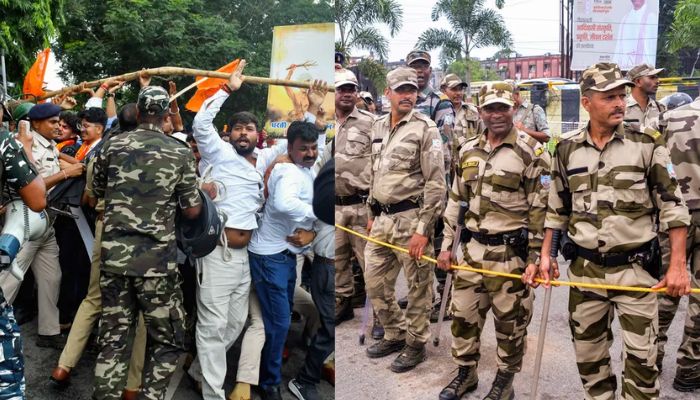
Not too long ago, when the CJP protests turned violent during the ‘Chalo Sansad’ march on 20th July, the Delhi Police was forced to respond with lathicharge and other strict measures.

The Left-Liberal cabal had claimed that the Delhi Police used pellet guns against innocent protesting students, although the march was replete with supporters of anti-BJP political parties.

From Congress, Samajwadi Party and other INDI Alliance parties, to their ideological supporters, all of them vilified the Delhi Police over alleged use of pellet guns when the 20th July protest turned violent.

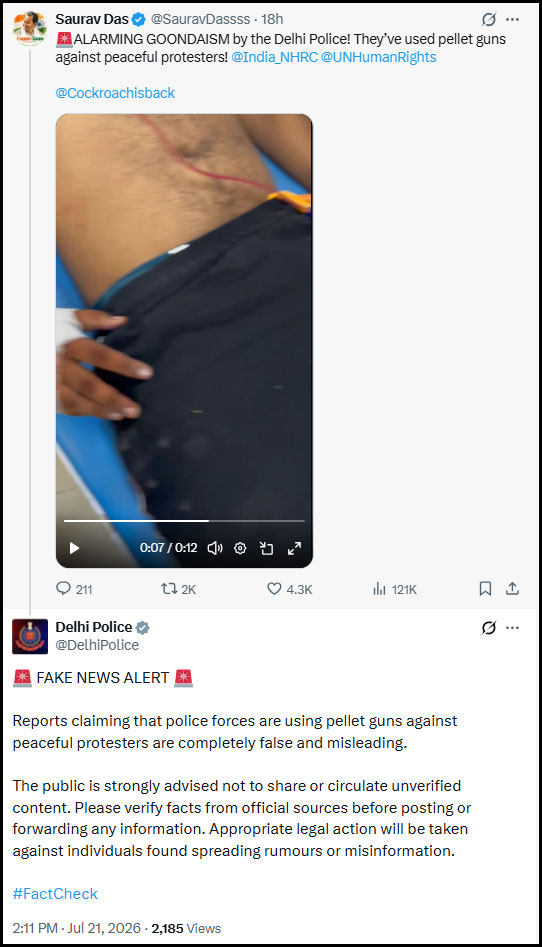
Back then, CJP spokesperson Saurav Das had claimed that Delhi Police had used pellet guns against “peaceful protesters”. He shared a video showing marks on a protester’s body.

The villainization of the Delhi Police continued despite them publicly denying the use of pellet guns on peaceful protesters. The Delhi Police said, “Claims of pellet guns being used against peaceful protesters by Delhi Police on Monday are completely false and misleading. Delhi Police neither possesses pellet guns nor were they used during the ongoing protest. The public is requested not to share or circulate any unverified or misleading information.”

The CJP supporters had even attempted to mob lynch Rapid Action Force (RAF) personnel and circulated their videos and pictures online for identification and later targeting. The anti-BJP cabal framed the police response to CJP protestors pelting stones at police personnel as ‘state repression’ of students, their right to protest, crushing of dissent by brute force and whatnot.

However, the same cabal has gone completely silent over the Ranchi Police’s admission of readiness to use pellet guns on student protests during ‘emergency’ in the Congress-JMM alliance-ruled Jharkhand.

Apparently, pellet guns are bad only when the police use them against protestors in BJP-ruled states. Even the leftist media has no problem with the Ranchi Police carrying pellet guns for ‘emergency’ use. Their maximal response to ‘crackdown on peaceful dissent’ is reserved only for the BJP governments.

While the Delhi Police has denied pellet guns use, the official SOPs and Supreme Court observations allow their use in exceptional circumstances after other softer measures. However, when the police in non-BJP states openly boast readiness to use the same pellet guns to suppress the protests if it turns violent, the same left-liberal ecosystem largely remains silent. Even the Delhi Police had not resorted to strict measures for fun.

The CJP protest continued for over a month, and the police did not forcefully remove even a single ‘cockroach’ from Jantar Mantar; even climate activist Sonam Wangchuk, who was on indefinite hunger strike, was shifted to a hospital only on the court’s order. It was only when the protest turned violent on 20th July that the Delhi Police and RAF acted in accordance with the SOP, and did a lathicharge against violent CJP protestors, essentially in a proportionate emergency.

However, given the political utility of the so-called ‘excesses’ by the Delhi Police during the CJP protest, the Congress-led Opposition has continued protests outside Parliament. It is not letting the House function properly until Home Minister Amit Shah’s statement on the issue. It’s been more than three weeks since the CJP protests were called off, and yet the domestic and foreign Leftist media continues to frame the Delhi Police-CJP episode as ‘brutal suppression of peaceful dissent’. Petitions have been filed in the Supreme Court to seek a ban or stricter SOPs on the use of pellet guns.

Everything wrong during CJP protest became right during Jharkhand student protest: The Liberal hypocrisy

Collectively, the same left-liberal cabal that has stayed quiet on Jharkhand student protests is still devoted to portraying the Delhi Police’s response to CJP’s violent protests as emblematic of fear-driven authoritarian overreach by the BJP-led Central government.

Now, when the JMM-Congress-led administration in Jharkhand has unleashed lathis and water cannons and even expressed readiness to use pellet guns against students protesting against corruption in JPSC and JSSC, all the opposition parties and their media lackeys have turned a blind eye.

This is not only about the use of pellet guns; the liberal cabal has maintained a hypocritical silence over the Jharkhand student protests. Even their limited commentary is performative, just as CJP’s support to Jharkhand student protestors was. Clearly, the anti-BJP ecosystem delivers moral lectures on democracy, dissent, and constitutional rights, etc, only when the BJP leads the ruling dispensation.

Jharkhand Police have put up barbed wire, have lathi-charged students in Ranchi, police personnel are carrying pellet guns, and even intimidated journalists, including Aman Chopra and OpIndia’s Keshav Malan, that too when the students are peacefully protesting while the liberals were accusing the Central government of police action against the CJP mob that indulged in stone pelting.

On 9th August, an OpIndia reporter was removed by Jharkhand Police after questioning CM Hemant Soren about JPSC reforms. The police also stopped him from going near the stage where CM Soren was seated during an event just a few kilometres away from the protest site.

Journalist Aman Chopra has been booked for covering student protests in Jharkhand. He was detained and questioned by the police. Chopra has said that he has been restricted from covering the ongoing protest in Ranchi.

Apparently, democracy and press freedom come under threat, rather collapse in real or in rhetoric, only when the ruling dispensation is helmed by the BJP. In contrast to the police action against journalists in Ranchi, Delhi Police did not book any media person in connection with the CJP protests despite there being a section of leftist reporters on the ground peddling sheer disinformation.

In fact, neutral reporters were labelled ‘Godi media’ and heckled by CJP protestors, and the same degeneracy was celebrated online by leftists. As per the liberal logic, when non-BJP governments use pellet guns, book and intimidate journalists, peaceful students are lathi-charged, and the sitting chief minister dodges accountability, it is all for the ‘greater good’ of maintaining law and order

The human cost of India’s paper leak crisis

Paper leaks have become a recurring national crisis that strikes at the heart of Indian meritocracy, even as protests over the cancelled NEET-UG 2026 examination begin to fade. While medical aspirants have moved on to counselling after the re-test, agitation continues in Jharkhand over recruitment exams and in Punjab over cheating scandals, showing that compromised public tests have become a stubborn affliction.

The human cost falls hardest on middle-class and lower-middle-class families. For them, education is often the single largest investment of a lifetime. Parents sell jewellery, take loans and spend ₹1–3.5 lakh a year on coaching in places such as Kota and Sikar, treating competitive exams as the only reliable path to social mobility. A leak shreds that unwritten contract. Years of dawn-to-dusk study and family sacrifice are rendered worthless when better-connected candidates buy the questions. Affluent families can fall back on foreign education or private-college quotas; ordinary families cannot. Delays, re-tests and extra years of coaching push many into deeper debt, and despair has in some cases led to suicide.

The problem is long-standing. From the cancelled AIPMT of 2015 through SSC, CBSE and state recruitment scandals, organised networks of middlemen, coaching intermediaries and solver gangs have exploited every weak link. Convictions of senior organisers remain rare.

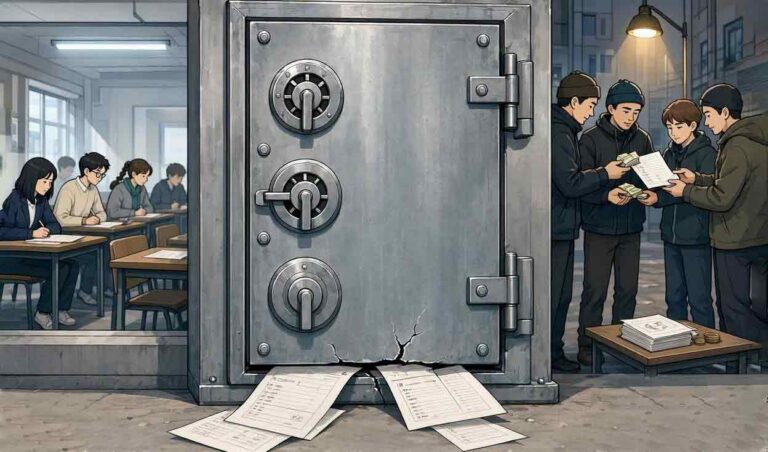
NEET-UG is uniquely vulnerable. More than two million candidates compete for about 1.1 lakh medical seats, many of them low-fee government places that can change a family’s fortunes for a generation. The pen-and-paper model remains a logistical nightmare. Papers travel from setting and translation through printing, packing, long-distance transport and storage in vaults or school strong rooms. NTA’s thin permanent staff and heavy outsourcing fragment accountability. Encrypted apps then spread a leaked paper nationwide in minutes.

The government has responded with the Public Examinations Act 2024, a 2026 amendment that raised penalties and imposed fast-track timelines, the Radhakrishnan Committee’s recommendations for encrypted just-in-time printing and secure centres, and a new Nilekani task force. Lasting reform requires shortening the physical chain of custody, insulating paper-setters from coaching networks, regulating the coaching industry, and expanding affordable medical seats so that a single exam is no longer a life-changing lottery worth the crime. Until then, every leak will continue to cancel not just an examination but years of honest sacrifice.


You can read the full article on Chapter 1 Magazine.

For the left ecosystem, rape now ‘exists on a spectrum’ and rapists need care: Read why this should worry women and children

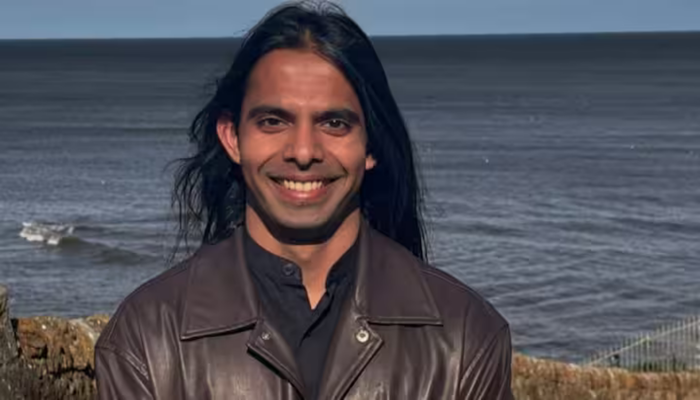
An Indian-origin transgender, non-binary Member of the Scottish Parliament (MSP) for the Edinburgh and Lothians East region, Q Manivannan, is facing huge backlash after he called a heinous crime like rape ” existing on a spectrum”. Manivannan, who was elected to the Scottish Parliament in May, made the controversial remarks about rape during an episode of The Subjective Space, a podcast hosted by Dr Sindhu Rajasekaran. The episode was recorded in February last year, a clip from which went viral, attracting widespread criticism and stirring a debate.

During the podcast, which was titled “On care, grief and words”, Manivannan argued against “demonisation of rape” and advocated for expressing care towards rapists. He began by explaining how, in his opinion, a rapist should not be viewed through a stereotypical lens as “a monster rapist” and that anyone, including a person like himself, was capable of committing rape. He further claimed that such extreme portrayals of rapists take the attention away from the discussion on why such crimes happen.

“I think this idea that the rapist is the ‘big burly man’ is not necessarily unfounded, because that’s the individual I’m most scared of on a day-to-day basis, but it’s also an entity that is misconstrued simply because I think any individual is capable of it: including yourself (podcast host Dr Rajasekaran) and me,” the MSP said.

He claimed that an offence like rape is just a question of “circumstances” that lead a person to such an act. And, therefore, perpetrators of crimes like rape also deserve sufficient care. Manivannan believes that it is the act of rape which should be condemned and not the person who commits it because, according to him, rape exists on a spectrum, and no act on the spectrum is “less or more worse”.

After his insensitive remarks drew widespread criticism, Manivannan defended himself by claiming that his words were taken out of context and misconstrued.

Manivannan’s statement, initially, appears to be a sophisticated observation about a crime like rape. But a closer look unravels the underlying attempt at blurring the lines between traditional categories of a victim and a perpetrator. His statement reflects an insidious effort at interchanging empathy and the burden of proof between the victim and the perpetrator. This is a classic manoeuvre of the subscribers and propagators of the leftist and trans ideologies, aimed at creating a society that runs on the whims of individuals rather than on the foundation of justice and morality.

Their distorted worldview, emerging from their sense of insecurity and victimhood, is focused on eliminating the distinctions between a victim and a perpetrator, a man and a woman, and even a right and a wrong. The worldview prioritises feelings over facts, emotions over biology and subjective opinions over reality. In this worldview, a person with a penis can be a woman, and an individual with a uterus can be a man; a child can be adult enough to be sexualised, and a criminal could be a victim if he/she identifies as one.

The blurring of foundational categories of a society is a classic trait of the identitarian left, of which the trans ideology is a sub-part. The ideology treats all categorical boundaries such as man-woman, adult-child and even victim-perpetrator as an artificial construct imposed by a repressive society. The goal is to break free from all societal moulds and be guided by emotions instead of sanity and reason.

The underlying principle of the ideology is that self-determination trumps observable reality. Manivannan applies the same principle to a crime like rape, where a rapist could be a self-determined victim of his circumstances.

The subscribers of this ideology want to convince the entire society that womanhood is an emotional state and not a biological fact. Its dangerous implications became visible in the West, where biological males identifying as ‘women’ competed with biological females in various sports and won medals. After decades of struggle, women were able to create spaces for themselves in areas traditionally dominated by men. But with the growing influence of trans ideology, these spaces are being threatened by a self-determined class of victims.

With the increasing appeal of these distorted ideologies, one wonders how feasible it is to give birth to and raise children among people who normalise paedophilia and justify sexual crimes against children by blurring the lines between the victim and the perpetrator? The troubling impact of this ideology is that the costs are borne by women and children. Removing basic safeguards that protect privacy and bodily autonomy leaves women and children vulnerable. This is a striking contrast to the ideology’s purported aim of protecting and empowering the weaker and marginalised sections of society.

As Modi govt cracks down on illegal foreign funding through FCRA Amendment Bill, read about 13 organisations whose licences were cancelled

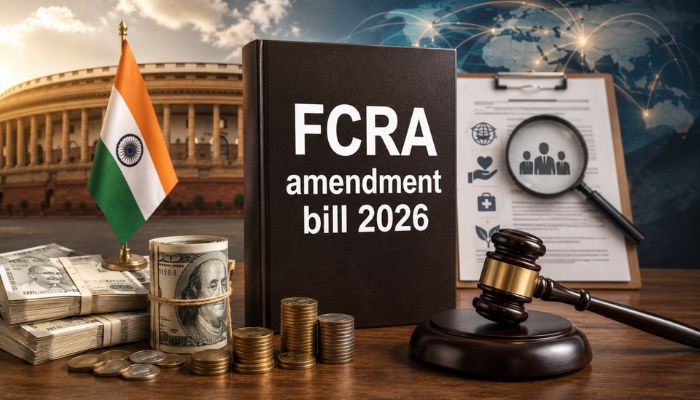
The proposed Foreign Contribution (Regulation) Amendment Bill, 2026, has brought the Foreign Contribution (Regulation) Act, or FCRA, back into focus. The proposed changes aim to strengthen transparency and accountability in the way foreign donations are received and used in India. The need for such a law becomes clearer when cases of misuse of foreign contributions, diversion of funds and activities beyond the declared objectives of organisations come to light.

Foreign funding plays an important role in India. Thousands of organisations receive money from overseas for healthcare, education, disaster relief, scientific research, environmental protection and other social work. Such international cooperation can provide much-needed resources to communities. However, foreign contributions also involve money moving across national borders, making transparency and financial oversight important.

The FCRA is the legal framework that regulates how Indian individuals, associations, NGOs, trusts and other eligible organisations receive and use foreign contributions. It is administered by the Ministry of Home Affairs (MHA). The law does not prohibit foreign donations. Instead, it lays down conditions for receiving, using and reporting such funds.

The proposed FCRA Amendment Bill, 2026, therefore seeks to further strengthen a system that is based on transparency and accountability. While thousands of organisations continue to use foreign contributions for legitimate charitable purposes, investigations into some organisations have raised questions about whether foreign funds were being used for purposes other than those for which they were received.

Why did the Modi government suspend or cancel FCRA licences of 13 organisations?

Over the years, the government has taken action against several organisations after investigations or inspections raised allegations of financial irregularities, misuse of foreign contributions, violation of FCRA rules or activities beyond their declared objectives. The following cases show why the government argues that stronger monitoring of foreign-funded organisations is necessary.

  1. Satat Sampada Pvt Ltd

One of the recent cases concerns Delhi-NCR-based environmental and climate organisation Satat Sampada Pvt Ltd, whose FCRA licence was revoked in January 2026.

The Enforcement Directorate conducted searches at the organisation’s office premises, a business store and two residences in Delhi and Ghaziabad under the provisions of the Foreign Exchange Management Act (FEMA). According to official sources cited in reports, the agency was investigating the end use of foreign exchange received by the organisation from offshore NGOs and other groups.

The funds were received in the name of consultancy charges. Investigators were examining whether the foreign money was ultimately being used to influence government policies. The allegations are significant because foreign contributions are required to be used for the purposes permitted under the law and properly accounted for.

The case also highlights the wider concern around foreign-funded organisations working in sensitive policy areas such as climate, environment and development. The issue is not whether an organisation can work on such subjects, but whether foreign funds received for one purpose are being used transparently and within the limits of Indian law.

2. Advantage India and diversion of funds

Another major case involves Advantage India, a non-profit organisation associated with corporate lobbyist Deepak Talwar. The Central Bureau of Investigation (CBI) filed a chargesheet against Talwar and the organisation for violations of the FCRA.

According to the CBI, Advantage India received around ₹90.72 crore in foreign contributions between 2012 and 2016. The organisation also received donations from defence companies Airbus and MBDA.

The investigation revealed that foreign contributions meant for non-profit activities were diverted towards personal and business activities. One example cited by the investigation was foreign travel expenses of Talwar. The organisation spent ₹30.37 lakh between May 2015 and January 2016 on his foreign travel.

Investigators also said that Advantage India used its fixed deposits as security for overdraft facilities obtained by Wave Impex, a company controlled by Talwar and his family. The money was subsequently used for business operations.

Another allegation concerned medical camps. The organisation reportedly showed bills claiming that medicines worth ₹26.97 crore had been purchased from Aastha Pharma and Hind Pharma. However, the two entities told investigators that they had not dealt with the association.

The CBI also pointed that that Advantage India operated from Talwar’s premises and paid him ₹80 lakh as rent between 2012 and 2015. The agency considered this another instance of foreign contributions being used for personal benefit.

3. Operation Mobilisation India

The Operation Mobilisation (OM) India group of charities also faced allegations involving foreign contributions. The Economic Offences Wing of the Telangana Crime Investigation Department froze 26 bank accounts belonging to seven related charity organisations associated with the group.

The investigation followed a complaint by Albert Lael, a former Chief Finance Officer of OM India’s group of charities. A criminal case was registered against Christian evangelist Joseph D’Souza, his son Josh D’Souza and others.

According to the allegations, the organisations received large amounts of foreign donations for charitable activities. Investigators found that some of the money was placed in fixed deposits and subsequently diverted or misappropriated.

The freezing of the bank accounts was intended to prevent further movement of funds while the investigation continued. The authorities were also examining possible violations of the FCRA.

4. New Hope Foundation

The Home Ministry cancelled the FCRA registrations of two Christian evangelist organisations, New Hope Foundation in Tamil Nadu and Holy Spirit Ministries in Karnataka, over violations of the FCRA.

Both organisations had received foreign funding from Gospel For Asia and related entities. New Hope Foundation received more than ₹42 crore in foreign contributions between 2017-18 and 2019-20, while Holy Spirit Ministries received more than ₹49 crore during the same period.

The case came against the backdrop of earlier action against Gospel For Asia’s Indian arm and affiliates over FCRA violations. The foreign donors associated with the organisations included entities based in the US, Canada, South Africa and Finland.

The case raised questions about how large foreign contributions received by religious and charitable organisations were being utilised and whether the funds remained within the activities declared to the authorities.

5. India Rural Evangelical Fellowship

In August 2025, the Ministry of Home Affairs suspended the FCRA licence of the India Rural Evangelical Fellowship (IREF), an Andhra Pradesh-based church-linked organisation.

According to the allegations cited in the reference material, IREF received around ₹28.6 crore from its US and UK branches between 2019 and 2024. Investigators revealed that money meant for welfare activities was diverted to personal accounts.

The organisation, founded in 1972, described its work as including education, children’s hostels, evangelism and distribution of Christian literature. However, complaints submitted to the MHA coercive religious conversions, misuse of children’s photographs for overseas fundraising and violations involving foreign missionaries.

The allegations also included the use of foreign funding for political mobilisation. The Legal Rights Protection Forum had submitted a complaint to the MHA containing documentary and multimedia material relating to the allegations.

These remain serious allegations, and the action demonstrates why authorities seek to establish whether organisations are using foreign contributions strictly for their declared purposes.

6. Harvest India

The MHA also cancelled the FCRA registration of missionary organisation Harvest India over violations of the FCRA.

The organisation was accused by the Legal Rights Protection Forum of using foreign funds for missionary activities. According to the allegations, Harvest India’s foreign contributions between 2017-18 and 2019-20 amounted to around ₹19.6 crore.

Reports also said that the organisation had a large network of community centres and pastors involved in evangelisation activities. The complaint raised questions about the use of foreign funds for salaries of pastors, church maintenance and other missionary activities.

The organisation’s chief functionary, Suresh Kumar, was also accused of making political and anti-Hindu remarks during a conference in the US. In one speech, he said, “Right now, we are under Hindu rule. Our Prime Minister is a bad guy.”

He also appealed for prayers ahead of an election, saying, “I don’t want this party to come back.”

The allegations against Harvest India therefore involved not only financial questions but also the use of foreign-funded organisational activities for religious and political purposes.

7. Centre for Equity Studies (CES)

The Centre for Equity Studies (CES), associated with human rights activist Harsh Mander, also faced scrutiny following allegations concerning children’s homes run in association with organisations linked to CES.

The National Commission for Protection of Child Rights (NCPCR) inspected two homes, Umeed Aman Home for Boys and Khushi Rainbow Home for Girls, in October 2020.

The NCPCR reportedly found serious irregularities, including allegations of sexual abuse at the boys’ home and failures in reporting such incidents. The Commission observed that the “non-reporting of POCSO offences” could endanger the welfare of children.

The inspection also raised concerns about children being made to participate in anti-Citizenship Amendment Act protests. The Commission further questioned the presence of foreign nationals providing voluntary services at the homes.

The Delhi Police subsequently registered an FIR against CES officials and others over financial irregularities and other violations.

8. Socio Legal Information Centre (SLIC)

The Home Ministry also cancelled the FCRA registration of the Socio Legal Information Centre (SLIC), whose chairperson was former Supreme Court judge Justice Deepak Verma.

SLIC is the parent organisation of the Human Rights Law Network (HRLN), founded by senior advocate Colin Gonsalves. The organisation describes its mission as making the justice system “accessible, efficient, accountable, affordable, and pro poor.”

It works on public interest litigation, legal awareness and investigations into human rights violations.

However, the organisation and its associated network have faced allegations concerning foreign funding and involvement in campaigns on politically sensitive issues. The cancellation of SLIC’s FCRA registration therefore brought attention to the need for organisations engaged in advocacy and litigation to maintain strict compliance with foreign funding rules.

9. CARE India Solutions for Sustainable Development

CARE India, whose legal name is CARE India Solutions for Sustainable Development (CISSD), also came under scrutiny over its foreign funding and activities.

The organisation had received substantial foreign contributions. Its FCRA submissions showed foreign donations of more than ₹157 crore during the financial year mentioned in the reference material, with major donors including CARE organisations abroad, USAID and Amazon Development Centre India.

The organisation was also accused of using its association with government projects while soliciting donations. Its functionary Neera Saggi separately came under scrutiny in connection with the IL&FS financial fraud.

The reference material also alleges that CARE India transferred money to the Evangelical Social Action Forum, which received more than ₹52 lakh from CARE India in 2018-19.

The case raises a broader question: when organisations receive large foreign contributions and work closely with government programmes, their financial dealings need to remain transparent and clearly separated from activities not covered by their declared objectives.

10. Centre for Policy Research

The Centre for Policy Research (CPR), a Delhi-based public policy think tank, had its FCRA licence suspended in 2023 and later cancelled.

The action followed Income Tax Department surveys conducted in September 2022. The government also sought explanations and documents concerning CPR’s foreign contributions.

CPR’s filings showed that it received around ₹10.1 crore between October and December 2022 from foreign sources including the Bill and Melinda Gates Foundation, the University of Pennsylvania, the World Resources Institute and Duke University.

The government non-compliance with FCRA provisions, including concerns over the transfer of foreign contributions to other entities and the use of non-designated accounts.

CPR later challenged the action and said it would consider legal options. Its case illustrates that FCRA compliance also applies to think tanks and research organisations receiving foreign funds, particularly when those funds are used for policy research and public affairs.

11. Oxfam India

Oxfam India is another organisation that faced action over FCRA violations. The MHA recommended a CBI inquiry into the organisation over violations of foreign funding rules.

According to the allegations, Oxfam India continued transferring foreign contributions to other entities even after the 2020 amendment that restricted such transfers.

Authorities also said that Oxfam India planned to route funds through other FCRA-registered organisations or through a for-profit consultancy structure. The government further revealed that Oxfam India transferred funds to CPR through associates and employees in the form of commission. It also received around ₹1.50 crore directly into its FCRA utilisation account rather than the designated FCRA account.

The organisation’s FCRA registration ceased in January 2022 after it failed to obtain renewal.

Another controversy involved a report on Assam’s tea industry. Investigators said that the report relied heavily on volunteer-collected data and did not include sufficient field research or the views of tea garden managements, workers’ unions and the state government. The report was later cited in connection with the US Department of Labor’s list concerning goods produced using child or forced labour.

The case raised concerns over whether foreign-funded advocacy and research could potentially affect India’s economic interests and exports.

12. Legal Initiative for Forest and Environment

The FCRA registration of environmental organisation Legal Initiative for Forest and Environment (LIFE Trust), associated with environmental lawyer Ritwick Dutta, was suspended in March 2023 and cancelled in February 2024.

The CBI that LIFE received foreign funds from US-based environmental law organisation Earthjustice and used them for legal action against coal and other infrastructure projects in India.

According to the investigation, Dutta received ₹41 lakh in foreign contributions from Earthjustice in 2013-14, while a related proprietorship received around ₹22 crore between 2016 and 2021 as professional receipts.

The government said that foreign funds were being used to support litigation intended to delay or stop development projects.

The investigation examined cases involving thermal power and coal projects in Rajasthan, Chhattisgarh and other parts of the country. The government argued that such funding arrangements could affect India’s energy infrastructure and economic interests.

LIFE, however, has described its work as being aimed at environmental democracy and improving access to information, public participation and justice in environmental matters.

13. Environics Trust

The last case is that of Environics Trust, whose FCRA registration was cancelled on 4th March, 2024.

The CBI filed a chargesheet against the organisation and its officials over violations involving foreign-funded transactions. The agency also revealed that the organisation used two forged invoices worth ₹6.50 lakh and ₹4 lakh from a company called MAA Plasto in its FCRA returns.

According to the allegations, the invoices had not been issued by the company, but were shown as expenses in returns filed for foreign fund utilisation.

The organisation was also examined over its activities relating to campaigns against coal mining and coal-fired power projects. Investigators found that foreign contributions were used to support protests against development projects.

The case highlights another important aspect of FCRA compliance: organisations must maintain genuine records and provide accurate accounts of how foreign contributions are spent.

Why the FCRA Amendement is needed

These cases are different from one another. Some involve diversion of money for personal or business purposes, while others concern political, religious, advocacy or environmental activities. The cases show why a regulatory framework for foreign contributions is necessary. Foreign funding can support genuine social work, but it can also create accountability challenges when money is moved across borders and used for purposes that are difficult to monitor.

The FCRA amendement is intended to create a traceable chain between the foreign donor, the recipient organisation and the final use of the money. Organisations receiving foreign contributions are required to register, maintain designated banking arrangements, maintain accounts and submit returns.

The law is therefore not meant to stop legitimate charitable work. Education, healthcare, disaster relief, poverty alleviation, scientific research, environmental conservation and humanitarian activities can continue through foreign funding as long as organisations follow the rules.

The core objectives of the FCRA

At its heart, the FCRA rests on five broad objectives: transparency, accountability, protection of sovereignty, enabling genuine social work and maintaining public confidence.

Transparency means that foreign contributions should be properly recorded and their source and use should be identifiable. Accountability requires organisations to maintain accounts and submit returns so that authorities can examine how the money was utilised.

The sovereignty aspect is equally important. Foreign contributions that could adversely affect India’s sovereignty, security, democratic institutions, electoral processes or public order need to be regulated. This does not mean that every foreign-funded organisation is a threat. It means that the government has a responsibility to ensure that foreign financial influence does not undermine national interests.

At the same time, the purpose of regulation should not be to obstruct genuine international cooperation. Thousands of organisations continue to receive foreign funds for legitimate humanitarian and development work. Stronger oversight can actually help such organisations by improving public confidence in the voluntary sector.

The cases discussed above show why the proposed FCRA Bill, 2026, is being presented as a measure to strengthen transparency and accountability. Foreign contributions can play a valuable role in India’s development, but the money must reach the people and causes for which it was intended.

Ultimately, the need for the FCRA is not based on the existence of foreign funding itself. It is based on the need to ensure that such funding remains transparent, traceable and accountable. A strong regulatory system can protect legitimate NGOs while making it harder for organisations to divert foreign money for personal gain, unauthorised activities or purposes that go beyond their declared objectives.

OpIndia had earlier reported that the proposed FCRA Amendment Bill is not an anti-Christian measure, but is aimed at strengthening transparency and accountability in the use of foreign contributions. 

While the US has raised concerns over the treatment of Christians in India, it is important to note that the United States itself has laws regulating foreign influence and funding. The US enforces the Foreign Agents Registration Act (FARA), which requires certain individuals and organisations representing foreign interests to disclose their relationship with foreign principals and provide information about their activities and funding. The same principle of transparency applies to India’s FCRA framework. 

How did the FCRA come into existence?

OpIndia had also previously reported on the history of the FCRA and argued that the Congress party, which is now criticising the Modi government’s proposed amendments, played an important role in bringing the legislation into existence.

The statutory framework used by governments to monitor, audit, suspend or cancel FCRA registrations was not created by the present government. The regulation of foreign contributions has evolved over several decades through successive laws and amendments.

The Foreign Contribution (Regulation) Act, 1976, was enacted during the Congress-led government headed by then Prime Minister Indira Gandhi. The foundation stone of the FCRA was laid during the height of the Emergency in 1976. The objective was to regulate the inflow and utilisation of foreign funds.


Newslaundry and Abhinandan Sekhri are sick and twisted: For hours after conviction of Tarun Tejpal, their article and tweet shaming his victim was live – why their ‘apology’ is a sham

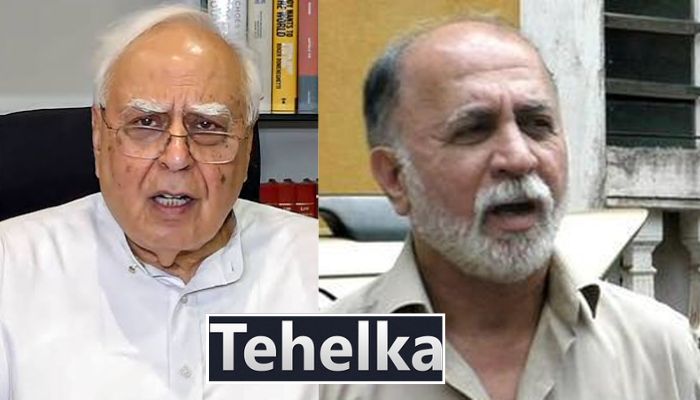
The conviction of former Tehelka editor-in-chief Tarun Tejpal in the 2013 sexual assault case has once again brought back questions about how sections of the media ecosystem treated the survivor when the allegations first surfaced. More than 12 years after the assault, the Bombay High Court at Goa overturned Tejpal’s 2021 acquittal and convicted him in the case, sentencing him to 10 years of rigorous imprisonment.

When Newslaundry and Abhinandan Sekhri came to defence of Tarun Tejpal

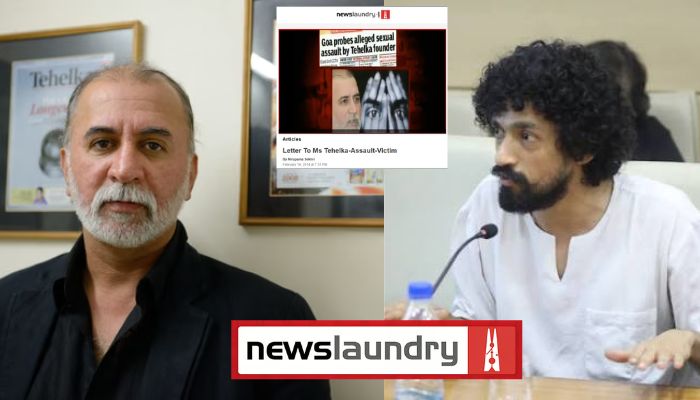
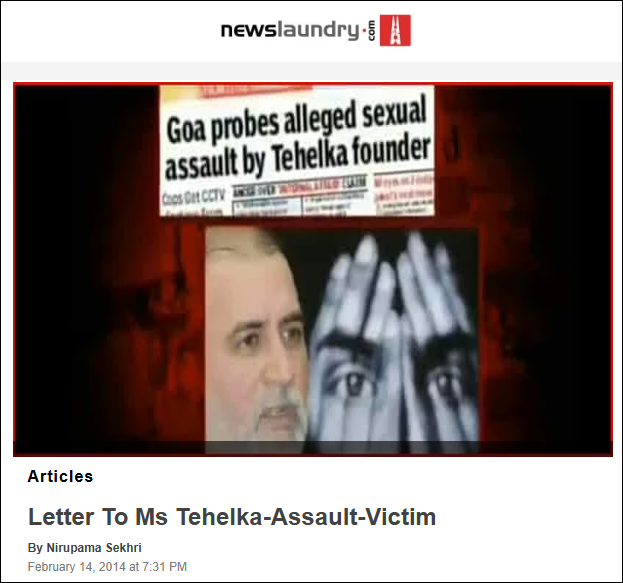
It is in this context that an old piece published by Newslaundry has come under renewed scrutiny. In February 2014, only months after the allegations against Tejpal emerged, Newslaundry published an open letter [archive] by Nirupama Sekhri, the sister of Newslaundry founder Abhinandan Sekhri, addressed to “Ms Tehelka-Assault-Victim”.

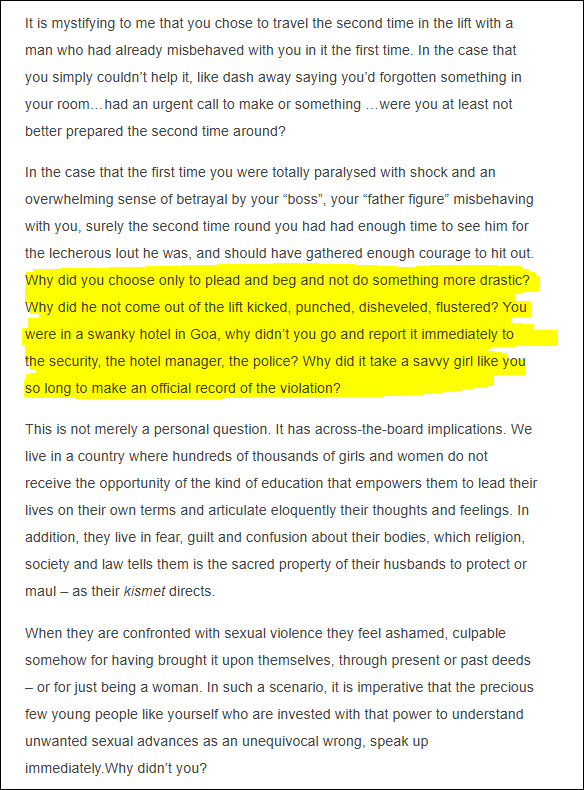
The tone of the letter was not one of sympathy towards the woman who had accused Tejpal. Instead, Sekhri questioned whether she should be considered a victim at all. “To begin with, I would like to establish quite clearly that I do not see you as a victim, unless it is of bubblegum feminism which I will speak in detail of later,” she wrote.

The letter went on to frame the controversy around what it described as “bubblegum feminism” and questioned the survivor’s actions before and after the alleged assault. It asked why she had entered the elevator with Tejpal and questioned the delay in making an official complaint. At one point, the letter said that Tejpal had become “the victim” of the media frenzy surrounding the case.

The questions raised in the piece reflected the kind of “perfect victim” expectations that have repeatedly been criticised in discussions around sexual violence. Why did she go with him? Why did she not immediately report it? Why did she not fight back? Why did she behave in a particular way after the incident? Such questions have long been criticised for shifting attention from the alleged conduct of the accused to the behaviour of the survivor.

Nirupama Sekhri’s letter also described the survivor as “irresponsible” and accused her of damaging Tejpal’s reputation. The piece therefore did not merely raise questions about the case; it placed a substantial part of the burden of explanation on the woman who had made the allegation. The original Newslaundry page itself confirms that the letter was published by Nirupama Sekhri on February 14, 2014.

The controversy did not end there. Abhinandan Sekhri himself amplified the article. In a 2014 post, he shared the link and wrote: “The counter perspective on the Tehelka case. For those asking, yup my sister. Letter to Ms Tehelka assault victim.” He also appeared in a 2014 interview with the former Tehelka editor. This made the issue more than simply an opinion piece written by an individual contributor; Sekhri had publicly associated himself with the article and its framing.

A letter that remained online for 12 years

This article, which resorts to victim-blaming, scarred the rape survivor for 12 years. Newslaundry never bothered to apologise to her.

For twelve long years, this article remained live on Newslaundry, serving as a persistent public record that demeaned the survivor’s experience. Throughout more than a decade of legal proceedings, as the survivor fought a gruelling battle for justice across multiple courtrooms, Newslaundry never reached out or offered a formal apology to her for hosting and promoting content that attacked her integrity.

It was only after the Bombay High Court’s landmark conviction of Tarun Tejpal, and the intense public outcry that followed regarding the media’s past conduct, that Newslaundry finally took action. Following the renewed controversy, Newslaundry removed Nirupama Sekhri’s original article and replaced it with an editor’s clarification. The publication acknowledged that the piece was originally published in 2014 and said it had since “reflected deeply on workplace sexual harassment, consent, trauma, and the responsibility of those in positions of power.”

The clarification further said that, in light of “legal developments, evolving public understanding, the #MeToo movement, and the experiences of countless survivors who have come forward”, Newslaundry no longer believed the piece met the values guiding its journalism. The publication therefore decided to take it down.

Newslaundry also said it was leaving the note at the original URL so that the article’s existence and its removal would remain part of its public record.

But the timing of the decision has itself become a point of criticism. The question being asked is simple: if the article was so clearly inconsistent with the publication’s present-day values, why did it take the conviction of Tejpal and a fresh wave of public criticism for the article to finally disappear?

In fact, the question we must ask is this – at what point was shaming a rape victim culturally acceptable? At what point was it the societal “understanding” that a rape victim should be shamed publicly. Did Newslaundry 12 years ago believe that rape was the fault of the woman? Did Newslaundry 12 years ago believe that rape was acceptable? What “evolving understanding” was required for Newslaundry to understand that victim shaming was, is and will continue to be wrong?

Abhinandan Sekhri’s so called apology

On Saturday, August 8th, Abhinandan Sekhri posted a message on his X account acknowledging the decision to remove the 2014 post:

“I have taken down my 2014 tweet. I don’t think there’s anything to say other than I take full responsibility for the piece that was published. It was wrong and should not have been online for this long on newslaundry, if at all. This is on me and me alone. It took a judgement to take this call, which should not have been the case. I apologise to all the people who support newslaundry and my fantastic team. I’ll try and do better.”

The post was presented as an acknowledgement of responsibility. But in the same sequence, Sekhri also posted another message aimed at critics. “And as for the prime time studio turnips (this is only for you) who made the most of this with your hollow lectures & outpouring of pent up angst for us calling out your hate, bile and venom that you serve as news. We will continue to call you out. Enjoy your weekend. Read a book, play a sport – do better.”

However, any sense of genuine remorse was quickly undercut by a second tweet posted shortly thereafter. Rather than maintaining a tone of solemn accountability, Abhinandan Sekhri shifted into a defensive and combative stance aimed at his media critics, “And as for the prime time studio turnips (this is only for you) who made the most of this with your hollow lectures & outpouring of pent up angst for us calling out your hate, bile and venom that you serve as news. We will continue to call you out. Enjoy your weekend. Read a book, play a sport – do better.”

This casual dismissal highlighted a sharp contrast between the formal words of reflection and the immediate urge to settle scores with rival journalists. By brushing off criticism as mere outrage from “prime time studio turnips,” the gravity of the decade-long victim-blaming was brushed aside in favour of social media bravado.

Was it an apology or forced accountability and social media tokenism

For over 36 hours after the conviction of Tarun Tejpal, the article and Sekhri’s tweet remained available without any modification. Only after the issue gained wider public attention did Newslaundry remove the article and Sekhri delete his old tweet. That timeline has led that the apology was not spontaneous accountability but a response to public backlash.

Calling the response a genuine apology is therefore difficult because the apology did not come when the article was first questioned, nor when the publication’s own understanding of sexual harassment changed after the #MeToo movement. It came after the Bombay High Court overturned Tejpal’s acquittal and the old article suddenly became a major subject of public discussion.

At the very least, the episode raises questions about institutional accountability. An apology is not simply an admission that something was “wrong”. It also requires recognising who was harmed, what exactly was wrong, and why the mistake was allowed to continue for so long.

In this case, the wording of Sekhri’s post focused heavily on taking responsibility for the publication decision and apologising to “all the people who support newslaundry and my fantastic team”. It did not centre the woman who had been targeted by the 2014 article. That omission is significant because the original piece itself had placed the survivor under scrutiny.

The phrase that Newslaundry has “reflected deeply” and that the piece no longer represents its values also invites another question: when did that reflection actually begin? If the publication had already recognised the problems surrounding consent, trauma and workplace power, why was the article allowed to remain online until the present controversy?

The response was social media posturing rather than a meaningful apology, and, at best, tokenism. Whether one agrees with that assessment or not, the chronology is difficult to ignore: Tejpal was convicted, the old article resurfaced, public criticism followed, and only then did Newslaundry remove it and Sekhri delete his old tweet.

The larger issue goes beyond Newslaundry or one old article. The Tejpal case has once again shown how powerful men accused of sexual misconduct can remain at the centre of public sympathy, while the survivor’s behaviour is examined in extraordinary detail. The Bombay High Court’s decision has rejected several of the stereotypes that shaped the earlier trial court approach.

The Tarun Tejpal case

The case dates back to November 2013. Before November 2013, Tarun Tejpal was regarded as one of the most prominent figures in spreading propaganda under the name of journalism. At that time, Tejpal was not an unknown journalist. He was a prominent figure in far-left journalism and the founder-editor of Tehelka. 

In November 2013, a young woman working with Tehelka accused him of sexually assaulting her inside an elevator at the Grand Hyatt in Bambolim, Goa, during the magazine’s THiNK event; the allegations concerned incidents on 7th and 8th November. Tejpal subsequently stepped down as Tehelka’s editor-in-chief, saying he wanted to “recuse” himself from the organisation. He was arrested on 30th November, 2013, and was later released on bail in 2014.

The legal battle then continued for years. The Goa Crime Branch filed a chargesheet, and Tejpal faced charges including rape, sexual harassment, assault with intent to disrobe, wrongful restraint and wrongful confinement. Among the provisions invoked were Section 376(2)(f), dealing with rape by a person in a position of trust or authority, and Section 376(2)(k), dealing with rape by a person in a position of control or dominance.

In May 2021, a Goa sessions court acquitted Tejpal of all charges. The judgment attracted widespread criticism, particularly for its treatment of the survivor’s behaviour. The court examined her conduct, including her reactions and communications after the assault, while assessing whether they matched what it considered “normative behaviour” for a sexual assault survivor. The Bombay High Court later criticised this approach, with the lower court’s reasoning having been described as resembling a “manual for rape victims.”

The Bombay High Court has now reversed that acquittal. The court found Tejpal guilty and sentenced him to 10 years’ rigorous imprisonment. The verdict has once again put the spotlight not only on the legal history of the case but also on the treatment the survivor received in the public discourse surrounding it.

JNUSU, girlfriend Banojyotsana Lahiri and Harsh Mandar lied in the name of Adivasi Divas to glorify Umar Khalid? Why JNU cancelled the event

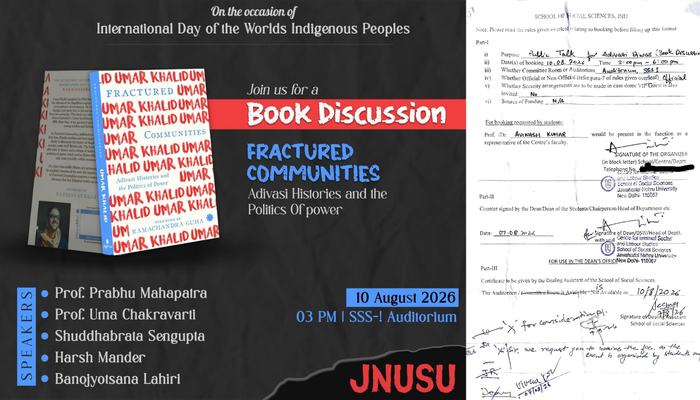
Jawaharlal Nehru University (JNU) on Sunday (9th August) cancelled the booking of its SSS-1 auditorium by the JNU’s Students Union (JNUSU) for a “book discussion” event, organised to discuss a book by Umar Khalid, that was slated to take place on 10th August. According to the notice issued by JNU Joint Registrar MK Pachauri, the booking was cancelled because of non-disclosure of full details of the proposed event in the request form submitted to the university.

“The booking of the auditorium SSS-1 stands cancelled because of non-disclosure of the full facts about the program which is going to take place on 10th August 2026 from 3 pm to 6 pm,” the university administration stated.

The request form shared by the university in a post on X cited “Public Talk for Adivasi Diwas (Book Discussion)” to mark Adivasi Diwas (Tribal Day) as the purpose of the booking. The auditorium was booked by Dr Avinash Kumar of the Centre for International Legal Studies (CISLS).

The proposed discussion was scheduled to take place on August 10 from 3 pm to 6 pm and was to be attended by the likes of Prof. Prabhu Mohapatra, Prof. Uma Chakravarti, Shuddhabrata Sengupta, and Harsh Mander. The permission for the stated event was granted by the Dean, SSS, who later cancelled it a day before the scheduled discussion.

The JNU notice of cancellation of the event did not cite what facts related to the event were not disclosed. However, a poster of the event shared by the university showed that the discussion was on a book titled ‘Fractured Communities: Adivasi Histories and the Politics of Power’. As visible in the poster, the book was a work of Delhi anti-Hindu riots accused Umar Khalid, whose name was printed all over its cover page.

The request for the booking submitted to the university omitted to mention that the proposed discussion was about Khalid’s book. According to India Today, this was the reason that the university cancelled the event.

Essentially, JNUSU along with those like Harsh Mandar and Banojyotsna Lahiri (Umar Khalid’s girlfriend) told the university that they need to hall to conduct a program for Adivadi Divas. They completely ommitted the fact that actually, they wanted to hall to conduct a discussion on Umar Khalid’s book. For context, Umar Khalid is accused under the UAPA and is currently in jail for being the mastermind of the Delhi anti-Hindu riots.

According to an Instagram post by Umar Khalid’s girlfriend Banojyotsana Lahiri, the book was actually Khalid’s PhD thesis published in the form of a book by Juggernaut Books. Lahiri wrote an emotional message celebrating her UAPA-accused boyfriend’s ‘achievement’ and portraying the Delhi anti-Hindu riots conspirator as a victim of state atrocities.

Umar Khalid, a former JNU student leader and co-founder of ‘United Against Hate’, was arrested in September 2020 over the anti-Hindu riots that broke out in north-east Delhi in February that year. The riots erupted during protests against the Citizenship Amendment Act and led to the killing of 53 people and injured more than 700. According to the Delhi Police case, Khalid helped plan the violence, as part of what police call a ‘larger conspiracy,’ carried out through speeches, WhatsApp groups and planned road blockades timed for maximum disruption. The case against Khalid runs under the stringent anti-terror law, the Unlawful Activities (Prevention) Act (UAPA).

Khalid’s had made multiple bail applications before various courts since his arrest. His bail applications have repeatedly been dismissed by the courts, citing a prima facie case against him.

How the Delhi anti-Hindu Riots conspiracy started: A short chronology

Most chargesheets filed in the Delhi anti-Hindu riots case so far have a detailed chronology of events attached to them which starts from the events of December. One has to recall that on the 15th of December, violence broke out in Jamia Millia Islamia. The chargesheet says that some students, ex-students of Jamia and people associated with political parties congregated to protest the CAA and NRC and wanted to march towards the Parliament House and Presidents House. When stopped, they started pelting stones and indulging in violence. 

In the process, busses were burnt, cars were damaged, 2 public persons got injured and 10 police personnel also suffered injuries. 

It is interesting to note that while the violence broke out on the 15th of December, on the 14th of December, Sharjeel Imam had delivered his provocative speech at the very site. He had urged Muslims to protest against CAA and NRC by doing ‘chakka jam’ on the 14th of December. On the 15th of December, protestors tried to block Mathura road and violence ensued. 

Following this, the dispersing crowd retreated inside Jamia and a fresh cycle of violence started. The usual suspects had proceeded to blame the police was trying to enter a college campus and brutalising students, however, the truth was far from it. It was in fact these ‘students’ who had started the violence and the police were merely trying to control the violence. 

The chargesheet mentions that right after the violence of 15th December, Jamia Coordination Committee was coordinating protests and blockages of roads. They had called several leaders to speak to the protesting Muslims as well. The chargesheet mentions Harsh Mandar who had instigated people on the 16th of December (though he has not been named as an accused so far). 

The Shaheen Bagh protest then started, on cue, from the 15th of December. While the Shaheen Bagh protest raged on, on the 17th of December, violent mobs started pelting stones in the Jaffrabad area. 

Thereafter, from the 15th of January, Muslim protestors blocked roads in 7 different areas in the name of protests. Provocative slogans were raised and incalculable inconvenience was caused to commuters. 

Here are the 7 roads that were blocked: 

  1. Seelampur – Opposite Medina Masjid (from the 15th of January) 
  2. Dayalpur – Brijpuri Pulia near Farrukhia Masjid (from the 17th of January) 
  3. Dayalpur – Chand Bagh Majar on Bhajanpura (from 17th of January)
  4. Jyoti Nagar – Kardam Puri Pulia near Ashharfia masjid (from 17th of January) 
  5. Khajuri Khas – A block main road, Shri Ram Colony (from 17th of January)
  6. Bhajanpura – Noor-e-Lahi near petrol pump (from 18th January) 
  7. Shastri Park – Near Wahid Jama Masjid (from 26th of January)

It is pertinent to note that people from the Chand Bagh Mazar protest site had also tried to block the main Wazirabad Road. 

The chargesheet categorically states that the riots were pre-planned and not spontaneous. On the 22nd of January night, woman, children and several Muslims protestors blocked the Jaffrabad metro station after Chandrashekhar Azad’s call for Bharat Bandh. It is pertinent to note that is also said that Pinjra Tod and JCC were instrumental in the instigation and implementation of blockage of Jaffrabad metro station. On the 23rd, there was a counter rally which demanded the opening of the road that had been blocked by anti-CAA crowds. The Muslim side started pelting stones first, as even mentioned in the chargesheets. On the 24th, full-fledged riots began with the first life being claimed being that of constable Ratan Lal after being attacked by a Muslim mob. 

Where does Umar Khalid fit into the chronology of events – Analysing his role 

The first evidence of Umar Khalid’s role in the Delhi Riots came when a speech made by him surfaced. The speech was allegedly made on the 20th of February in Amravati. In the speech, he was clearly heard saying that on the 24th of February, when President Donald Trump visits India, Muslims should ‘show’ the visiting US president that the people of India are fighting against the ruling party of India.

The entire speech was about 17 minutes long where Khalid invoked the false narratives of ‘targeted mob lynching’ against Muslims and then went on to say that when the Muslims did not revolt against the Ayodhya judgement by Supreme Court, the government took it for granted that they can bring any law against Muslims.

Inciting the crowd further, saying the CAA has been brought to harm Muslims, Khalid says that the people should show the government its ‘Aukaad’, and take to the streets to throw it out. He further says that if enough people take to the streets, first the CAA will go, then the NPR and then NRC, eventually the government will also go.

It was 4 days after this speech, on the 24th of February, as Umar Khalid had predicted, that riots broke out. Ankit Sharma was stabbed over 50 times by the mobs of Tahir Hussain. Dilbar Negi’s arms and legs were chopped off and he was burnt alive by Muslims. Amidst chants of Allahu Abkar and Nara e Taqbeer, Hindus were specifically targeted. 

The Left and Islamist cabal found nothing wrong with this speech. They, in fact, called it a peaceful speech and said there was nothing in it that incited violence. They find nothing wrong with the fact that Umar Khalid, only 4 days before riots broke out, had specifically mentioned the date 24th of February and said that on that day, they will “show” how they fight with the government. 

But was Umar Khalid’s role limited to just this speech? 

By insinuating that the speech was the only thing for which Umar Khalid was arrested, is a gross misrepresentation of facts. In several chargesheets, Umar Khalid’s role in the larger conspiracy has been mentioned in details. The Special Cell has 180 days to file a chargesheet against Umar Khalid specifically, however, his role has been hinted in abundance in the other chargesheets and FIRs filed. 

In the chargesheet filed in FIR 114, the role of Umar Khalid in the conspiracy hatched is mentioned clearly. It says that Tahir Hussain was connected to Khalid Saifi of United Against Hate Group and through Saifi, he was also in touch with Umar Khalid. Khalid Saifi, it says, had arranged a meeting between Umar Khalid and Tahir Hussain on the 8th of January at Shaheen Bagh. In that meeting, it was decided to take ‘big action’ so the government gets shaken up on the issue of CAA and NRC and also, ensure that the international community takes notice of that action. 

In the chargesheet, it is also mentioned that Umar Khalid had told Tahir Hussain not to be concerned about the funding for the riots as Popular Front of India (PFI) would provide the funding as well logistic support. It was categorically mentioned that the riots were to take place when President Donald Trump would visit India. 

In the chargesheet, as reported, here is a flowchart of the coordination between Umar Khalid, Pinjra Tod ‘activists’, Khalid Saifi and Tahir Hussain. 

Flow Chart from the Chargesheet 

From everything that is alleged in the chargesheet, it is clear that Umar Khalid was perhaps one of the masterminds who was also constantly in touch with Pinjra Tod activists who are also accused of grave sections. Khalid Saifi of UAH, who is also a close associate of Umar Khalid was coordinating with Tahir Hussain after their initial meeting in Shaheen Bagh on the 8th of January. Further, Tahir Hussain was coordinating with other rioters and instigators. Tahir Hussain has now been convicted in the murder of Ankit Sharma, an IB officer stabbed and tortured to death brutally by a Jihadi mob.

Congress loved rapist Tarun Tejpal: How Kapil Sibal donated 5 lakh to help Tehelka launch its print edition, Sonia Gandhi wanted to shield him

The conviction of former Tehelka editor-in-chief Tarun Tejpal in the 2013 rape case has once again brought attention to his long association with influential figures in politics especially from Congress, journalism and public life. More than 12 years after the assault, the Goa Bench of the Bombay High Court overturned his 2021 acquittal and convicted him in the case. The court sentenced Tejpal to 10 years of rigorous imprisonment and gave him time to surrender. Tejpal has said he will challenge the verdict in the Supreme Court.

The case dates back to November 2013, when a young woman working with Tehelka accused Tejpal of sexually assaulting her inside an elevator at the Grand Hyatt in Bambolim, Goa, during the magazine’s THiNK event; the allegations related to incidents on 7th and 8th November. Tejpal stepped down as Tehelka’s editor-in-chief after the allegations surfaced, saying that he wanted to “recuse” himself from the organisation. He was arrested on 30th November, 2013, and was later released on bail.

The legal battle continued for years. Tejpal faced charges including rape, sexual harassment and assault with intent to disrobe. In May 2021, a Goa sessions court acquitted him of all charges. The judgment was criticised for the way it examined the survivor’s conduct and reactions. The Bombay High Court has now reversed that acquittal and convicted Tejpal. The court’s verdict has again brought the former Tehelka chief’s career and the ecosystem around the magazine under scrutiny.

Kapil Sibal’s Rs 5 lakh donation to propaganda outlet Tehelka

As public scrutiny around Tehelka intensified over the years, political connections backing the far-left media outlet also came under intense scrutiny. One name that has resurfaced in the context of Tehelka is former Union law minister and senior lawyer Kapil Sibal. In November 2013, when the sexual assault case against Tejpal was dominating headlines, Sibal told The Sunday Express that he had donated Rs 5 lakh to Tejpal in 2003, when Tehelka was starting its print edition.

Sibal was responding to questions about his financial connection with Tehelka. According to documents available with the Registrar of Companies, Sibal held 80 shares in Anant Media Private Ltd, the company that published Tehelka, amounting to a 0.04 per cent stake at the time. Sibal, however, said he did not consider himself a stakeholder in the publication, despite holding a stake in Tehelka and paying them to start their print edition.

“I don’t have any stake in Tehelka,” Sibal said.

Explaining the Rs 5 lakh payment, he said: “When Tarun approached me for help in 2003, I was a lawyer at that time… I helped him. I gave a donation of Rs 5 lakh in 2003. I did not apply for shares, nor am I given any share allotment.”

Sibal said the donation was linked to his belief in press freedom. “The donation was my commitment to freedom of speech and freedom of press… After they lost everything following the witch hunt of the BJP-led government for exposing corruption,” he said.

The donation came after Tehelka’s website had carried out its controversial Operation West End sting against then BJP president Bangaru Laxman and the NDA government. The operation brought Tehelka national attention and also triggered a political storm over alleged corruption in defence deals.

The corporate records also showed that Sibal continued to hold 80 shares. His stake was 0.08 per cent until 2010-11 and fell to 0.04 per cent after fresh equity was infused into the company in 2011-12. Sibal also rejected speculation about a family relationship with Tejpal, saying, “The misinformation doing the rounds is both false and motivated. Tarun Tejpal is not my nephew.”

According to the same report, Tejpal and his family members held around 19% in Tehelka, while industrialist and Trinamool Congress Rajya Sabha member K D Singh held around 65% through direct and indirect holdings at the time.

Thus, while Sibal denied having a substantial stake in Tehelka, his own statement confirmed that he had financially supported Tejpal when the magazine was entering the print business.

Tehelka and the controversial Operation West End

Long before the assault case, Tehelka had built its reputation through controversial and defamatory sting operations. It was March 2001. Tehelka, the far-left media organisation, decided to ‘uncover’ corruption within the defence establishments and political circles.  One of its most infamous investigations was Operation West End, launched to expose alleged corruption in defence procurement.

They floated a fake company by the name of ‘West End International’ and set out to sell hand-held thermal cameras/ imagers to the Government of India. ‘Journalists’ Aniruddha Bahal and Mathew Samuel posed as ‘arms dealers’ and tried to secure defence contracts as part of their sting dubbed ‘Operation West End.’ Tehelka’s team employed hidden cameras and audio recording devices to capture conversations with high-ranking officials and politicians involved in defence deals.

The undercover investigation spanned several months. Some prominent politicians, bureaucrats, and army personnel were caught on camera accepting bribes and discussing kickbacks in defence deals. Tehelka was soon in the dock over entrapment charges, the missing ‘authenticity’ in its evidence, and lack of ethics as displayed through its bribing of officials to create sensationalism.

As per reports, Tehelka journalists extended their sting operation, much beyond exposing corruption. Aniruddha Bahal and Mathew Samuel arranged for call girls and even filmed explicit encounters involving three defence officials. The revelation caused an uproar and turned public sentiment against Tehelka, as it raised ethical questions and challenged the moral high ground that the news portal once took. Tehelka was criticised by politicians such as Madhavrao Scindia and Chandra Shekhar.

Reports at the time also alleged that Tehelka journalists used women and liquor during parts of the operation. The methods drew criticism from political leaders and raised questions about whether the magazine had crossed the line between exposing the alleged corruption and creating situations designed to produce sensational footage.

The Major General Ahluwalia defamation case

One of the most serious controversies surrounding Operation West End involved Major General M S Ahluwalia. Tehelka had accused the Army officer of involvement in corruption in defence deals. Ahluwalia denied the allegations and later filed a defamation case against Tehelka and those associated with the report.

The case continued for more than two decades. In July 2023, the Delhi High Court directed Tehelka, Tarun Tejpal and two of its journalists to pay Rs 2 crore in damages to Ahluwalia for the loss of reputation he suffered. The court noted that the officer had lived with “ill fame for more than 23 years” and said that the serious allegations of corruption had damaged his reputation.

The court observed that Ahluwalia’s reputation had suffered because his character was maligned with serious corruption allegations and said that “apology at this stage is not only inadequate but is meaningless.”

The controversy became even more significant because the allegations made by Tehelka about Ahluwalia’s demand for money were disputed. According to reports on the case, Tehelka’s initial claim regarding the alleged demand changed during the proceedings. In an Army court of inquiry, journalist Mathew Samuel also reportedly acknowledged that Ahluwalia had not demanded money or expensive whisky. The Delhi High Court subsequently dismissed Tehelka’s review plea against the damages order.

While Tehelka set out to expose the dark realities of corruption within the Indian defence establishment, it uncovered its own lack of journalistic ethics and integrity in framing Major General MS Ahluwalia. 

Fake sting? Why did Congress shut down inquiry commission: How Sonia Gandhi wanted to shield Tehelka and Tarun Tejpal

After the Tehelka sting operation, a Commission was set up by the Atal Bihar Vajpayee government to inquire not only into the alleged corruption but also the authenticity of the sting operation conducted by Tehelka, headed by Tarun Tejpal. Justice Phukan was appointed to the committee for the continuation of the probe. By February 2013, Tehelka had already refused to participate in the inquiry claiming that they had no resources to continue their participation. Tejpal had claimed that Tehelka had “devoted” two years for the inquiry, and would not participate further. He had also said that all the tapes and evidence had been submitted, with nothing more to add. When asked about Tehelka participating in the financial irregularities part of the investigation, he claimed that Tehelka’s financier could participate if they wanted to, but the portal itself would not.

Interstingly, as soon as the Congress came to power in 2004, Sonia Gandhi who was the then Super PM and Manmohan Singh, who was the paper PM, disbanded the Justice Phukan Commission, inquiring into the authenticity of the sting operation by Tehelka. It was later revealed in a book that Sonia Gandhi had written a long letter to P Chidambaram while the inquiry commission was still working and instructed that the financier of Tehelka, First Global, should not be troubled and be treated “fairly”.

“Justice Phukan meant business and did not allow anyone to delay matters. He took calmly the fact that the Tehelka team decided to walk out of the Commission’s proceedings as soon he announced the tapes were being sent for checking,” writes Jaitly.”… When the Commission was still at work, Sonia Gandhi, as head of the UPA and the National Advisory Council, wrote an official letter to finance minister P Chidambaram, dated 25/27 September 2004 – a copy of which was provided to me by a highly placed source in the Opposition – asking him to ensure that First Global, Tehelka’s financiers, are not meted out ‘unjust or unfair treatment’. “She was, in fact, saying the very same thing I was trying to explain to the Tehelka person asking me a favour for the purpose of entrapment. Here again, irony was visiting…,” the book, written by Samata Party president Jaya Jaitly, claimed.

The Phukan Commission report was handed over to the Vajpayee government, but before it could be tabled in the parliament, Congress was in power. The report had found that George Fernandes, who had resigned as the defence minister after the sting operation, had no role to play in any corruption and gave him a clean chit.

The Congress government did not want to table the report. But under mounting pressure, it decided to table only a 41 page summary of the report which was submitted, finding Fernandes innocent.

Why did the Congress government not want the commission report to be tabled in full and rejected it forthright, and why did they disband the inquiry commission? Because at that time, Kapil Sibal had prematurely declared that the Tehelka tapes were authentic according to forensic reports before the reports were officially opened. However, the forensic analysis actually revealed several cuts and edits, proving that the Tehelka tapes were tampered with. This detail would have been revealed had the commission report been tabled in full – which is why – Congress’ hitman, Kapil Sibal, ensured it wasn’t. In this entire ordeal, Tehelka’s lawyer was none other than Prashant Bhushan.

Essentially, if one is to truly evaluate the facts from the time, it would become rather apparent that Tarun Tejpal, now convicted of rape, was the media henchman of Congress – funded, shielded and goaded by the Congress to tarnish and bring down a BJP government.

Gujarat HC refuses to grant relief to Christian woman who forced ASHA workers to convert: Here is what the court said

The Gujarat High Court recently ruled that while a person has the right to propagate their religion, activities involving force, inducement, fraud or pressure for religious conversion can amount to an offence under the law. The court was hearing a plea filed by a female health worker accused of pressuring ASHA workers working under her to convert to Christianity. The High Court refused to quash the FIR and chargesheet and allowed the case to proceed before the trial court.

What was the case

The case relates to allegations made by an ASHA facilitator and four other ASHA workers against a female health worker working at the Bamanva Primary Health Centre in Anand, Gujarat.

According to the complaint, for around three years, the ASHA workers were asked to stay back after government work and official health-related meetings were over. They were then spoken to about Christianity, encouraged to read the Bible and told that idol worship practised in Hinduism was wrong.

The complaint further said that the woman used to make the ASHA workers watch Christian videos on YouTube on her mobile phone. The videos discussed the return of Jesus Christ, the creation of a new world after the end of the present world, and various teachings of Christianity.

The women said that when Hindu employees refused to watch the videos or listen to such discussions, they were threatened with consequences at work. According to the complaint, they were told that their monthly allowance or salary could be cut and that they could lose their jobs. The complaint said this kept the women under constant mental pressure.

One incident mentioned in the case took place in Vadodara. The women were told that they were being taken there for a government health department meeting. However, after reaching Vadodara, they found that it was a large Christian religious programme.

According to the complaint, the women had been taken there in the name of a government meeting, where plays and speeches were held as part of an attempt to influence them towards Christianity.

Accused woman moved High Court

The accused woman later approached the Gujarat High Court seeking cancellation of the FIR and chargesheet.

Her lawyer told the court that she was a follower of Jehovah’s Witnesses and that spreading the teachings of the Bible was part of her religious belief. The lawyer argued that Article 25 of the Constitution gives every person the fundamental right to profess, practise and propagate their religion.

The defence said there had been no force or inducement to convert anyone. It argued that the woman had only given religious literature to the workers and shown them material available in the public domain. The lawyer also said that the Vadodara programme was voluntary.

The defence further claimed that the complaint was filed because of personal enmity. It also questioned whether the complainant could file a complaint on behalf of the other employees.

Another argument was that the chargesheet had been filed without taking prior permission from the District Magistrate and, therefore, the proceedings should be cancelled.

Police investigation and bank transactions

The government lawyer opposed the petition and told the court about the evidence collected during the investigation.

According to the government, the police found that copies of a Bible titled What the Holy Bible Teaches had been given to the complainant and other women. The accused woman’s mobile phone and laptop have also been sent to the FSL for examination.

The government lawyer said the accused woman was directly connected with an organisation called Jehovah’s Witnesses of India (JWI). The investigation into her links with the organisation and the financial transactions had also revealed transactions involving crores of rupees, the government said.

According to the details placed before the court, more than Rs 10 crore was deposited from a JWI account into the accused woman’s ICICI Bank account. More than Rs 7 crore was later withdrawn from the account.

Similarly, more than Rs 20 crore was deposited into her HDFC Bank account from JWI, of which more than Rs 19 crore was withdrawn.

Police also recovered a large quantity of Christian and Bible-related literature during a search at the accused woman’s house.

The material included Gujarati and Hindi-language Bible books, books on Bible study and Jehovah’s Witnesses, along with pamphlets related to the 2025 Great Convention– Devotion to Jehovah. Police also recovered several books, diaries and notebooks.

What did the Gujarat High Court say?

After hearing both sides, the Gujarat High Court said that Article 25 of the Constitution gives people the right to follow and propagate their religion. However, this right is subject to public order, morality and health.

The court said there is no restriction on voluntarily propagating one’s religion. But when force, fraud, inducement, threats or misuse of authority are involved, such activities do not get protection under the Constitution and can amount to an offence.

Referring to Supreme Court judgments, the High Court also observed that showing one’s own sect as superior while criticising another religion or idol worship goes against the principles of Indian secularism.

The court also rejected the argument that the complainant did not have the authority to file the case. It said that in serious cases involving illegal religious conversion, the meaning of an ‘aggrieved person’ has to be understood broadly. Any aggrieved person or organisation can approach the police to maintain law and order, the court said.

The High Court also rejected the argument regarding prior permission from the District Magistrate. The state government produced documents showing that the Anand District Magistrate had given the required legal approval on March 6, 2026.

The court also noted that although the accused woman did not have direct control over the salaries of the ASHA workers, she was their supervisor. Whether she used her position to influence or pressure the workers will be examined by the trial court.

The High Court said the evidence collected during the investigation prima facie showed that an offence had been made out. Therefore, the FIR and chargesheet could not be cancelled at this stage under the principles laid down in the Bhajan Lal case.

The court dismissed the woman’s petition and directed the trial court to hear the case independently and according to law.