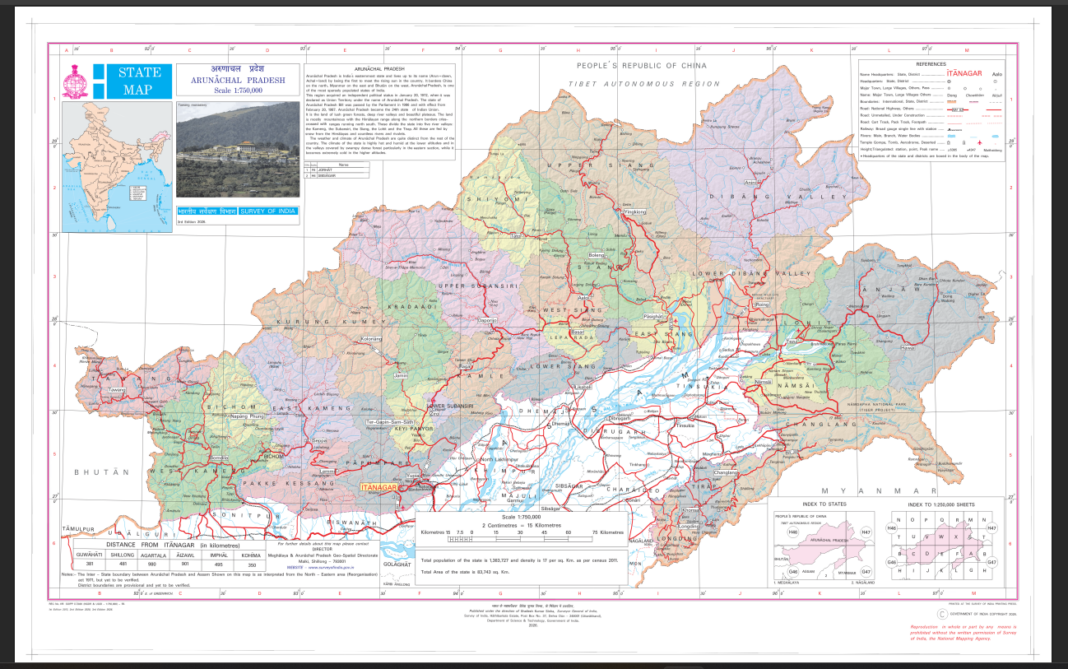
The Government of India has taken a major and historic step regarding border security, administrative identity, and national sovereignty. Under the supervision of the Union Ministry of Home Affairs and after extensive consultations with the Government of Arunachal Pradesh, India’s official mapping agency, the ‘Survey of India’, has included 27 highly crucial and strategic locations of the state in the country’s official national map.
All these places have been recorded with their real, local, and authentic names. This decision comes at a time when neighboring China has been trying for a long time to assert false claims over various places in Arunachal Pradesh by assigning fabricated and fake Chinese names to them.
This step by India is not merely a routine task of entering names on paper, but a highly fitting, institutional, and permanent response to China’s ‘cartographic aggression’ or map-gimmickry.
This move not only grants legal and constitutional strength to the true identity of our remote border areas, but also permanently establishes accurate and correct information among ordinary citizens, the military, and the local administration regarding these regions.
Now let us understand this entire matter in detail, the reasons behind India’s move, the history of these 27 places, and its impact on the international stage.
New updated official map of Arunachal Pradesh released by the Survey of India (Image credit: Survey of India)
China’s ‘Rename and Claim’ Agenda and India’s Fitting Counteroffensive
Under a calculated strategy, China has been playing the drama of renaming various areas of Arunachal Pradesh for the past several years by calling it ‘Zangnan’ or ‘South Tibet’.
China’s Ministry of Civil Affairs first released its first list of so-called Chinese names for 6 places in Arunachal in the year 2017. Furthering this sinister plot, it declared fake names for 15 places in 2021, 11 places in 2023, and 30 places in March 2024.
In international affairs, this action of China is referred to as ‘salami slicing’ and ‘cartographic aggression’. Under this, China attempts to prove to the world through paper-based confusion that these areas have historically been under its control.
The Government of India has outright rejected these actions of China every time, clearly stating that writing fake names on paper by another country will not alter the ground reality of Arunachal.
From the Pages of History: The First Clash of 1959 and the Main Centers of the 1962 War
Among the 27 places included in the Survey of India’s new map, several have a deep connection with the history of the India-China border dispute. The most prominent and historic name among these is ‘Longju’, located right near the Line of Actual Control (LAC).
Longju is the very historical site that became the first major military clash point between the two countries in 1959- three years before the 1962 India-China War- when the Chinese military attempted to intrude into Indian territory. Near Longju, the village of ‘Maja’, located in the Upper Subansiri district, has also been prominently featured on the official map.
Additionally, the ‘Thag La’ pass located in the western sector is another highly sensitive part of this entire list. The Thag La pass and the nearby Namka Chu valley are the areas from where China launched a large-scale attack on India on October 20, 1962.
Along with these two historic places, extremely rugged and high-altitude passes such as ‘Dzo La’, ‘Riza La’, and ‘Pukur La’ have also been given a place on the map. These passes are considered vital for movement, surveillance, and patrolling by the Indian security forces.
However, India has now moved beyond mere statements and diplomatic protests to take proactive action. By recording these 27 places in the Survey of India’s map with their real Indian names, India has completely deflated China’s fabricated claims.
Symbols of Valor: The Heroic Tales of Jaswant Singh and Trilok Singh Thapa
The list issued by the Government of India includes not just mountains, rivers, and passes, but also the memorials of those brave sons of Mother India who sacrificed everything while protecting the country’s borders. ‘Jaswant Garh’, located en route to Tawang, has been officially recorded in this list.
Jaswant Garh serves as a reminder of the unmatched bravery of Rifleman Jaswant Singh Rawat (Maha Vir Chakra), the immortal hero of the 1962 war. He single-handedly held off an entire detachment of the Chinese army for 72 hours, attaining martyrdom only after neutralizing dozens of enemies.
Even today, the Indian Army and locals revere Jaswant Garh like a sacred temple. Similarly, the ‘Sher-e-Thapa Memorial’ built in the upper region has been given formal placement on the Survey of India map.
This memorial symbolizes the extraordinary valor of Subedar Trilok Singh Thapa and his brave unit, who gave a fitting reply to the Chinese army near the Subansiri sector in the 1962 war. Including these war memorials in the country’s map sends a direct message that India honors every inch of its border and the sacred land of its martyrs.
Army Supply Routes and Protection of Local Settlements
Several places added to the map serve as the backbone for the administrative functioning of Arunachal Pradesh, the lives of the local tribes living there, and the logistics management of our military. For instance, the name ‘Jairampur’, located in Changlang district, is specially included in this list.
Jairampur is a major strategic hub for the movement of security forces, as well as the supply of rations and military equipment towards eastern Arunachal Pradesh and the Myanmar border.
Similarly, administrative areas like ‘Kamlang Nagar’ in Lohit district, situated near the famous Kamlang Wildlife Sanctuary, and ‘Sunpura’ have been given firm recognition on the official map. Apart from this, a breathtaking and high-altitude natural lake named ‘Sambho Sarovar’ has been included in this list.
Furthermore, inhabited villages such as Bisa, Bara Kundan, Chota Kundan, Dhan Bari, Preetnagar, Bauddhamandir, Teritnagar, Ramnagar, Sagar, Padma, Jyotinagar, Baisakhi, Chota Ropuk, Bara Ropuk and Shivaji Nagar have been marked with their authentic names.
Adding all these villages to the map accords both security and honor to the local tribal communities and their traditional identity.
Legal Power: India’s Strongest Shield Against Paper Claims
For any independent and sovereign nation, its official map is not merely lines of geography, but the strongest proof of its constitutional sovereignty, administrative control, and legal rights.
When the agency responsible for preparing India’s official map- the Survey of India- records a place in its map with an authentic name, it gains legal recognition at both national and international levels.
The first major benefit will be that in all official documents of India, land records, development plans, revenue accounts, and military operations, only these genuine names will be used, leaving no room for any future confusion.
The second major benefit will be that whenever China attempts to make false claims on international platforms or at multilateral meetings based on its fabricated maps, India will possess concrete proof in the form of its official, gazetted, and scientifically surveyed maps.
Experts note that this move demonstrates that India, rather than remaining purely defensive, is now asserting its borders and rights with great strength.
Complete Account of the 27 Places: Passes, Lake, Memorial, and 21 Villages
In this new and updated map released by the Survey of India, a total of 27 important geographical sites have been featured, which can be understood by dividing them into four main categories.
The first category includes four major mountain passes: Dzo La, Riza La, Pukur La, and Thag La. The second category features a natural water body- the high-altitude sacred lake, Sambho Sarovar.
The third category includes the historic Sher-e-Thapa Memorial, reminding us of the bravery of our courageous soldiers.
The fourth and largest category comprises 21 different inhabited villages, administrative areas, and settlements, including Longju, Maja, Bisa, Bara Kundan, Chota Kundan, Dhan Bari, Preetnagar, Bauddhamandir, Jairampur, Teritnagar, Ramnagar, Jaswant Garh, Sagar, Padma, Jyotinagar, Baisakhi, Chota Ropuk, Bara Ropuk, Shivaji Nagar, Sunpura, and Kamlang Nagar.
All these 27 locations have been registered in the national survey network along with their precise latitude-longitude coordinates and authentic Indian names, ensuring that no foreign power can alter their identity in the future.
By adding these 27 locations of Arunachal Pradesh to the country’s official national map, India has delivered a very clear and stern message to China and the entire world.
India has once again made it clear that Arunachal Pradesh was, is, and always will be an integral, indivisible, and inseparable part of India.
Along with the construction of new all-weather roads, tunnels, bridges, and Advanced Landing Grounds in border regions, the ‘Vibrant Villages Programme’, and now this fortification through maps, India’s strong and unambiguous foreign policy is clearly visible.
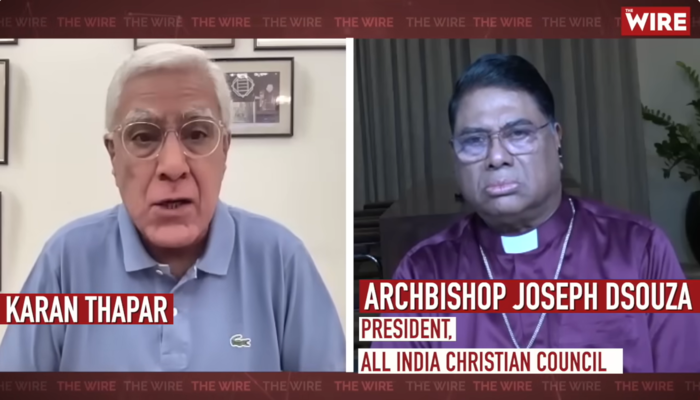
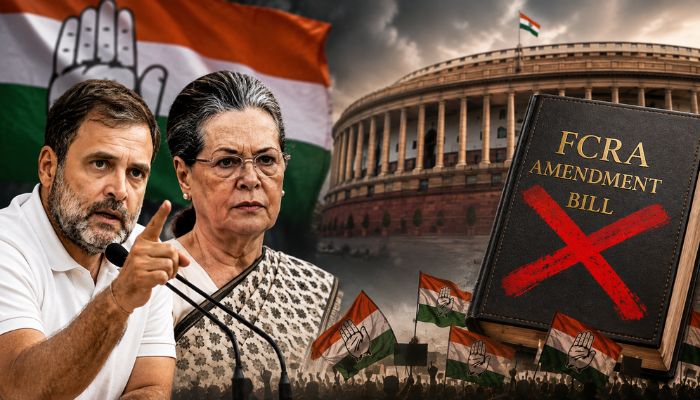
On the 7th of August, a clip was shared by leftist propaganda portal The Wire showing Archbishop Joseph D’Souza, president of the All India Christian Council (AICC) and primate of the Good Shepherd Church of India, calling the Foreign Contribution (Regulation) Amendment Bill, 2026 (FCRA Bill 2026), “loot and theft of Christian institutions” and “a Sangh Parivar agenda.”
The podcast where Karan Thapar interviewed Joseph D’Souza was aired 4 months ago, on the 2nd of April 2026. D’Souza, who is a scam accused, foreign funded Christian pastor is being used by TheWire repeatedly to target the Modi government over the FCRA amendments, which would tighten the screws on nefarious and illegal funding, illegal conversions and more.
By sharing the clip, The Wire joined the chorus of allegations and lies being peddled against the FCRA Bill by several vested interests. The clip was from an interview given by D’Souza to ‘journalist‘ Karan Thapar. In the interview, Thapar begins by declaring the FCRA Bill as containing “draconian and seemingly unconstitutional measures”, to which D’Souza adds his own unfounded claims regarding the Bill.
“Loot and theft of Christian institutions”, says scam accused Joseph D’Souza on TheWire
Concurring with Thapar, D’Souza claimed that if the Bill is passed, it would enable what he termed as “the legalised loot of the Indian Christian community and the global Christian community”. Explaining his grave allegation, D’Souza claimed that the Bill is a ruse to grab the properties and assets of Christian institutions. He further claimed that the Designated Authority envisaged under the Bill is given sweeping powers to “take permanent control of the foreign contributions and assets of any organisation whose foreign contribution registration is cancelled, surrendered or lapses.”
Joseph D’Souza further claimed that the Bill violates the principles of natural justice as the decisions of the Designated Authority are not subject to judicial review or judicial scrutiny.
“RSS has historic animosity towards the Christian church”
D’Souza alleged that the provision could be misused by the government by denying or not acting on the renewal application of an organisation on time, which would lead to the seizure of the organisation’s assets. He termed the FCRA Bill a direct assault on minority rights in furtherance of “an RSS agenda to grab the Christian institutions of the nation”.
He attributed ideological motive to the government behind the introduction of the Bill. He claimed that the RSS’s “historic animosity towards Mother Teresa and towards the Christian church” is the reason behind the FCRA Bill. Describing the Bill as a threat to minority rights, the Archbishop equated it with the Office of Jewish Affairs called Referat IV B4 created in Nazi Germany to grab the assets, institutions, synagogues and everything belonging to Jewish people.
“Crippling of Christian community”
The Archbishop alleged that the government’s conspiracy to carry out an “economic loot” and “cripple the Christian community” was disguised as the FCRA Bill. He dismissed the concerns of national security linked with foreign funding and accused the RSS of “terrorism”, claiming that the scrutiny of foreign funding of Christian organisations is unnecessary as Christians are not involved in acts of terrorism.
D’Souza dismissed the argument that the Bill intends to regulate foreign money and proceeds coming to churches which are used for conversion purposes. He went on to claim that Christian organisations in India do indulge in conversion activities and that the government has “no understanding of modern Christianity”.
He threatened that by introducing the Bill, the government would open “a can of worms globally and in the UN”. He said that the action will attract global repercussions and backlash from international organisations. The Archbishop threatened that the Christian organisations will “approach the courts nationally and globally, let the global partners go to their courts” if the bill is passed in the Parliament.
Joseph D’Souza – the man who spearheaded campaign of hate against Hindus and is accused of diverting ₹296.6 crore into private bank accounts
D’Souza, who presents himself as a voice for Dalits and marginalised communities, is not a neutral voice in the discussion about the FCRA Bill. He has faced scrutiny for his foreign funding and financial irregularities in the past. He and his Western associates are notorious for pushing a narrative on international platforms that they belong to oppressed, backward, or untouchable communities in India who later converted to Christianity.
His network of institutions, which includes schools, hospitals and social-service organisations under the Good Shepherd Church and affiliated bodies, receives foreign funding and has, like thousands of other NGOs, faced FCRA compliance checks over the years. Joseph D’Souza co-founded the Dalit Freedom Network, later rechristened as the Dignity Freedom Network (DFN). The network operates major branches in the United States (DFN USA), Australia (DFN Australia), Canada, and the United Kingdom. Its websites and promotional material associated with these organisations present a highly negative picture of India by peddling lies like “Dalits and Christians in India are being killed like insects”.
Joseph D’Souza came under scrutiny after the Telangana CID and the Enforcement Directorate (ED) filed charges in connection with serious allegations involving money laundering and financial misappropriation. He and his son Josh Lawrence D’Souza were accused of diverting approximately ₹296.6 crore of foreign funds, originally raised for the free education and welfare of poor Dalit children, into private bank accounts, fixed deposits, and luxury real-estate investments through fake invoices and shell companies.
D’Souza is one of the key elements who peddled the “rising hate against Christians” lie to demonise India. OpIndia had conducted a detailed investigation on D’Souza, his scam and his foreign funding.
Who is the kingpin of the lie about ‘Christian persecution in India? 🧵#OpIndia is going to reveal the nefarious designs of a scam tainted Christian pastor funded by the international Church network, now under the ED scanner, to defame India and Hindus.
The fear-mongering regarding the FCRA Bill is coming from the sections which might face legitimate scrutiny under the new law. However, the reality is far from what is being portrayed by certain vested interests. The proposed Bill explicitly protects all Places of Worship from government conversion, secularisation or repurposing.
The falsity of the claims that the government has been given sweeping powers to take over churches and religious institutions can be ascertained by a plain reading of the text. Here is a clause from the proposed Bill:
“Notwithstanding anything contained in sub-section (6), the Designated authority shall, where any asset permanently vested in it or portion thereof is a place of worship, entrust the management or operation of such asset or portion thereof to such person, in such manner and on such terms and conditions as may be prescribed and ensure that the religious character of such place of worship is maintained.”
As is clear from the clause, the Designated Authority cannot dismantle or shut down a physical place of worship of a church even if it loses its foreign contribution license. Under the proposed law, the role of the Designated Authority is restricted to managing foreign-funded commercial or developmental assets when an FCRA registration is cancelled, surrendered, or allowed to expire. The objective is to ensure continuity of public services.
Contrary to what D’Souza claimed, any order passed by the Designated Authority remains subject to administrative review and judicial appeal before a District Judge. Besides, state-level agencies are barred from initiating local prosecutions without prior approval from the Centre. This is a clear safeguard against arbitrary local action.
The FCRA Bill does not prohibit foreign funding for any religion, including Christianity. Places of worship, including churches, temples, mosques and gurudwaras, will continue to receive foreign donations for genuine religious work. The Bill comes into play only when the foreign funds received are not utilised in the manner that was declared. This may lead to the recipient organisation losing its licence or FCRA registration.
The central government has been reaching out to all the stakeholders to address their concerns regarding the Bill. The government has repeatedly clarified that the law is free from any kind of religious bias and is non-discriminatory in nature.
Joseph D’Souza is himself accused by the authorities of violating FCRA rules
According to investigators, even after the Ministry of Home Affairs (MHA) suspended and later cancelled the FCRA licenses of key organizations associated with the network for alleged regulatory violations, foreign funds reportedly continued entering India through indirect channels.
The cancellation of FCRA licenses meant that the organizations could no longer directly receive foreign donations. Investigators alleged that D’Souza then used his commercial entity, OMBF (OM Books Foundation), as an alternative route.
According to allegations, inflated and fabricated invoices for printing and publishing services were generated and sent to associated or allegedly affiliated organizations overseas. These transactions were presented as legitimate commercial activities, creating the appearance that foreign organizations had commissioned books and publications. Investigators claim that this mechanism was used to continue routing foreign funds into India despite restrictions on direct foreign contributions.
Investigators alleged that approximately Rs 296.6 crore generated through the above-mentioned activities was laundered through investments in real estate and other assets.
While investigating under the Prevention of Money Laundering Act (PMLA), the Enforcement Directorate (ED) reportedly found that Joseph D’Souza, his son Josh Lawrence D’Souza, and close associates had acquired expensive land parcels, commercial properties, and luxury villas using funds allegedly linked to these activities.
As part of its action on what it classified as “proceeds of crime,” the ED reportedly attached and froze 12 major immovable properties whose combined market value was estimated at over Rs 15 crore.
The alleged operational model of this financial network was straightforward but sophisticated: portray India’s poverty and social problems in alarming terms to foreign audiences in order to attract donations, then allegedly divert those funds through paper transactions and fabricated invoices into private assets and an affluent lifestyle rather than using them for the intended beneficiaries.
Political connections, the Indian Left-Liberal ecosystem and ideoligical alignment with Congress
Joseph D’Souza’s critics argue that his influence extends beyond religious activities and that he has maintained close links with sections of India’s political and media ecosystem. They claim that whenever legal action intensifies around financial allegations, political support systems become active in framing such actions as politically or ideologically motivated.
Joseph D’Souza’s association with senior Congress leadership goes back many years.
Following the 2004 general election, when the government led by Atal Bihari Vajpayee was defeated and the United Progressive Alliance came to power under the leadership of Sonia Gandhi, D’Souza reportedly wrote to church networks in the United States describing the outcome as “Divine Justice” and “a great miracle.”
At that time, D’Souza was serving as the global president of the All India Christian Council. According to Breaking India, these claims and related documentation are discussed in Chapter 8 of the book.
It also point to more recent developments as evidence of continued political alignment. During debates around reforms concerning Waqf administration, Rahul Gandhi echoed concerns raised by some bishops and church groups, stating that after the Waqf Bill the government might potentially target church properties.
Such political statements serve to frame ongoing ED and CID investigations involving figures like Joseph D’Souza as issues of “religious persecution,” thereby creating a protective political narrative. However, this remains a matter of political interpretation and competing viewpoints rather than an established legal conclusion.
Essentially, TheWire not only platformed, but also peddled over and over again the baseless allegations and outright lies of a bishop who spearheaded an anti-India, anti-Hindu campaign lying about Christian persecution, is accused of a scam worth crores and violated FCRA rules himself, to lie about the proposed FCRA amendments which would tighten the screws around scamsters like him.
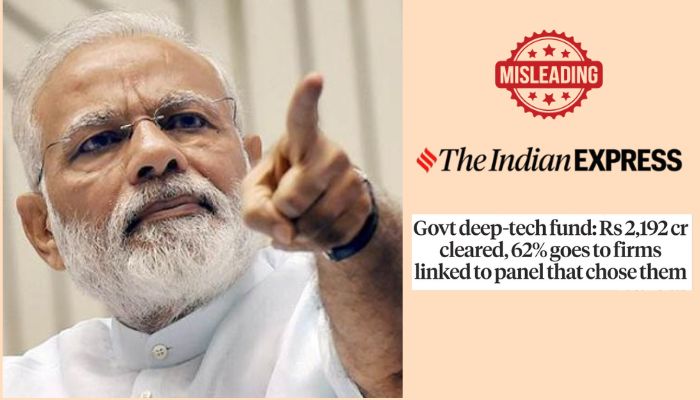
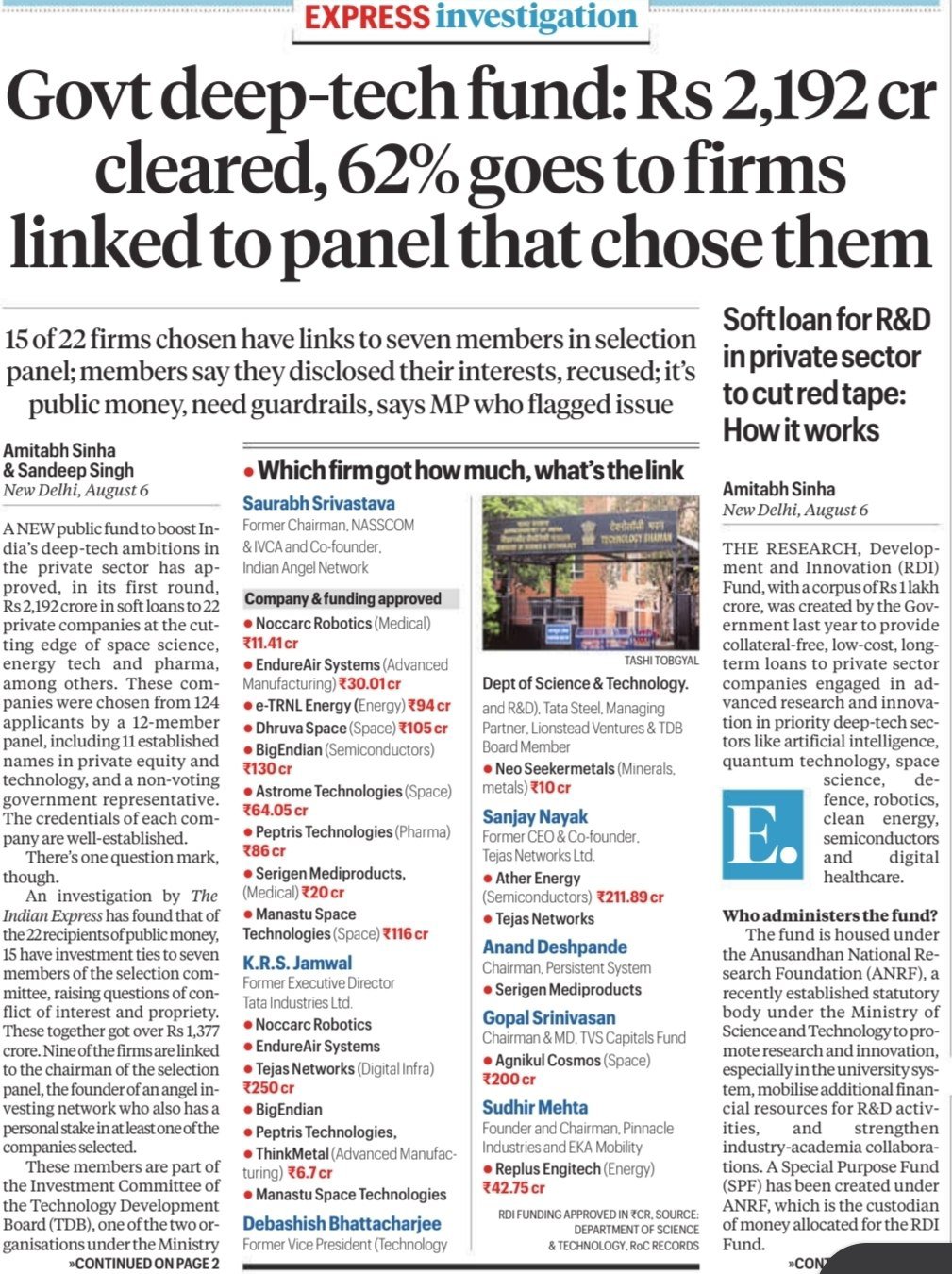
On Friday (7th August), the Indian Express published an ‘investigative report’ insinuating corruption and conflict of interest in the flagship initiative of the Modi government, the Research, Development and Innovation (RDI) Fund.
The article was maliciously titled, ‘Rs 2,192 crore cleared, 62% for firms linked to government tech fund panel’. For a large majority of newspaper readers who don’t look beyond the headlines, they will be convinced that the Modi government was somehow involved in a high-level scam.
The ‘investigative report’ takes 18 minutes to read online, thereby actively discouraging the vast majority of low-attention-span readers. But once you have invested your precious time with the hopes of unearthing a ‘massive scandal’, you are only left high and dry.
Because it leads you to absolutely nothing. You are forced to ask yourself – Why the hell did these ‘journalists’ Amitabh Sinha and Sandeep Singh even write such a report?
Screengrab of the Indian Express report
For the unversed, the RDI fund is a game changer for the Research & Development (R&D) ecosystem of India. A corpus of ₹1 lakh crore was kept aside for this scheme. The broader objectives were to accelerate investment in India’s Innovation ecosystem and support Indian private entities working in emerging sectors. As such, a 12-member investment committee (IC) has been constituted to decide and sanction long-term, low-cost loans to these companies.
1 member of the committee is a government representative and thus has no ‘voting right’. The remaining 11 members are private-sector experts in technology and private equity and have voting rights. It is thus obvious that these experts will have stakes and interests in multiple companies cutting across various industries.
And this was something that the Modi government foresaw when the scheme was conceptualised. This is why the government had introduced guardrails to prevent any cases of ‘conflict of interest’. These are some of the safeguards that were put in place:-
Independent expert evaluation of every proposal.
Mandatory disclosure of all interests.
Mandatory recusal wherever any potential conflict exists.
Approval only through a supermajority of eligible members.
Government officials do not determine technical merit, and the Member Secretary has no voting rights.
Final approval rests with the Technology Development Board after due process.
The Indian Express concedes that there is no ‘wrongdoing’
So, before you invest 18 minutes into reading that article, watch this one-minute video by Indian Express Hindi about the same issue. It claims that 15 companies that were sanctioned loans had investors who were part of the Investor Committee.
The video thereafter alleges that 7 other companies that were benefitted by the government scheme had links to the Investor Committee. Okay, so what?
Did these investors engage in ‘conflict of interest’ and have a say in sanctioning loans for the companies where their interests lay? The answer is NO.
And guess what, even The Indian Express acknowledged that those investors have recused themselves. Now, take a look at this longer 6-minute video published by the newspaper on its YouTube channel. It is about the same issue as well.
‘Journalist’ Amitabh Sinha concedes, “Now, the situation was very well foreseen, and adequate steps had been taken to mitigate the conflict of interest situation. The members from the selection panel had to recuse themselves from the evaluation process of the companies that they had interest in and this process was followed for all the members and for all the companies. So there has been no wrongdoing as such.”
Later in the video, he accepted, “…These kind of possible potential conflict of interest situations would arise because the people who have a very good knowledge or the people who are operating in this ecosystem would obviously have interests in this ecosystem; they would be connected to the ecosystem. So the best way to deal with this kind of a situation is to have upfront declarations, proper transparency code and mandatory recusal and it seems all these were followed.”
Fellow ‘journalist’ Sandeep Singh thereafter remains fixated on the statement of Congress Rajya Sabha MP Praveen Chakraborty that ‘additional safeguards’ must have been put in place. As expected, there are no specific recommendations or suggestions but vague political rhetoric.
Singh larps on it and shrewdly emphasises the phrase ‘public money given to private people.’ What is this supposed to mean? Is it free money being distributed for optics and votes? No, it is a loan and a bet on India’s future.
Furthermore, they talk about how many investors had interests in which companies but categorically fail to prove even a single instance of conflict of interest. Now, let me tell you what is written in that atrocious ‘deep dive’ that the Indian Express published yesterday.
Let me spare you the torture and the ‘premium subscription.’ The ‘investigative report’ does not lead to any conclusion. It talks about 7 different members of the Investing Committee, namely, Saurabh Srivastava, K R S Jamwal, Gopal Srinivasan, Sudhir Mehta, Sanjay Nayak, Anand Deshpande and Debashish Bhattacharjee and their stakes in companies that have received loans.
The article also includes their statement. But this shoddy and borderline dumb report fails to prove that these members were part of the evaluation process for companies where they served as investors.
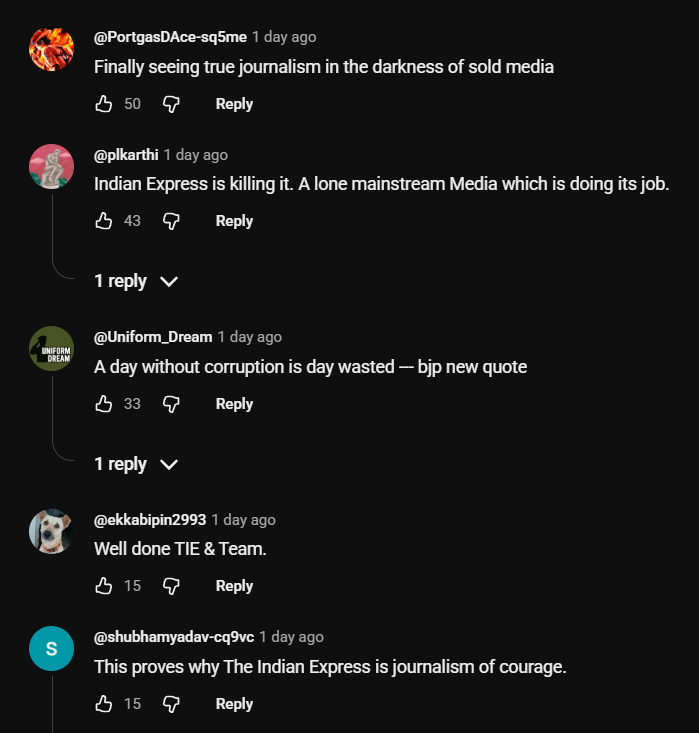
Screengrab of the comments supporting this dumb investigation
Conclusion
When there is no proof of conflict of interest, then what’s up with the politically loaded and clickbait headline? As a reader, you are forced to wonder – If propaganda is an art, then this Indian daily is certainly the master of it. But we must credit where it is due.
While they have been able to prove nothing, they did win the narrative war temporarily. I saw YouTube comments hailing ‘The Indian Express’ for doing alleged ‘journalism of courage.’ Their clickbait headline convinced amateur political enthusiasts that a scandal exists where it doesn’t.
And my friends, this is how you create a story with no head or tail but with malicious intent. India is spending 0.8% of its Gross Domestic Product (GDP) now on its R&D. This is the highest that India has invested since 2010.
When we are progressing in the right direction, certain vested interests are clearly unhappy with the development. It is very much evident from the latest ‘investigative piece’ of The Indian Express.
While women across regions, religions, races and class differences face various challenges while seeking justice for sexual abuse and harassment, in so-called Left-Liberal and progressive circles, women’s allegations of abuse often rank lower in the hierarchy of victimhood when the accused perpetrator is ideologically aligned or useful. A classic example of this long-running pattern is the sexual assault case against Tehelka Magazine’s former founding editor-in-chief Tarun Tejpal.
From lower court to Leftist ecosystem, the victim who accused Tarun Tejpal of sexual assault was blamed and shamed
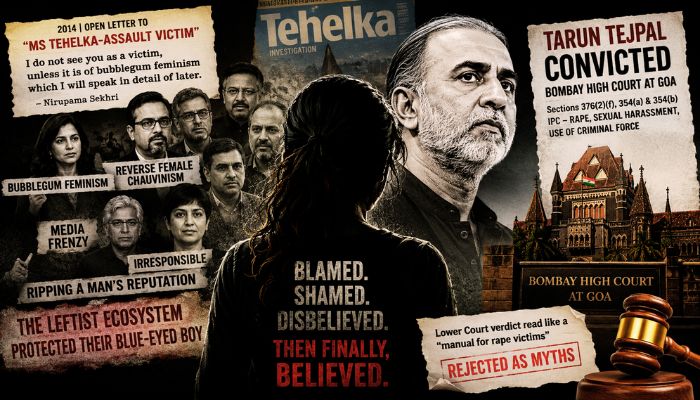
Barely a year after the Nirbhaya Gang Rape shook India’s conscience, Tarun Tejpal sexually assaulted a young colleague in Goa. Recently, the Bombay High Court at Goa reversed the 2021 Sessions Court order that acquitted Tarun Tejpal. The High Court convicted him under Sections 376(2)(f), 354(a) and 354(b) of the Indian Penal Code, which relate to rape by a person in a position of trust or authority, sexual harassment, and use of criminal force with the intent to disrobe a woman.
The far-left journalist was accused of forcing himself on a colleague against her wishes inside an elevator of the Grand Hyatt, Bambolim, Goa, on November 7, 2013, during a Tehelka magazine event. Tejpal was arrested in late November 2013 and released on bail in July 2014. Tejpal had stepped down as editor six months after being accused of sexual assault to ‘recuse’ himself.
The case dragged on for over a decade, and during this time, the complainant woman had to go through much criticism and scrutiny from both the Goa Sessions Court as well as the Left-Liberal ecosystem. All of this came the victim’s way despite Tarun Tejpal’s own apology emails admitting unwanted sexual advances to his junior colleague and pressure from his position of authority.
The trial process fixated on the survivor’s “perfect victim” demeanour, past messages, and lack of stereotypical trauma displays. In fact, the Bombay High Court at Goa had in 2021 noted that the sessions court’s verdict read like a “manual for rape victims”. The High Court had said that the lower court’s order had described how a sexual assault survivor should or should not respond in such cases.
While the High Court has now rejected those stereotypes as myths and upheld the victim’s testimony, the initial and prolonged response from sections of the Leftist journalistic and celebrity ecosystem told an opprobrious story of reflexive scepticism and even blaming and protection of Tarun Tejpal, their blue-eyed boy.
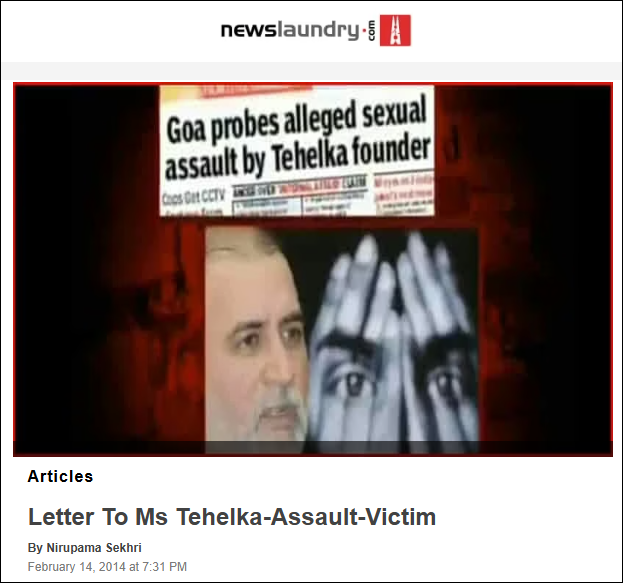
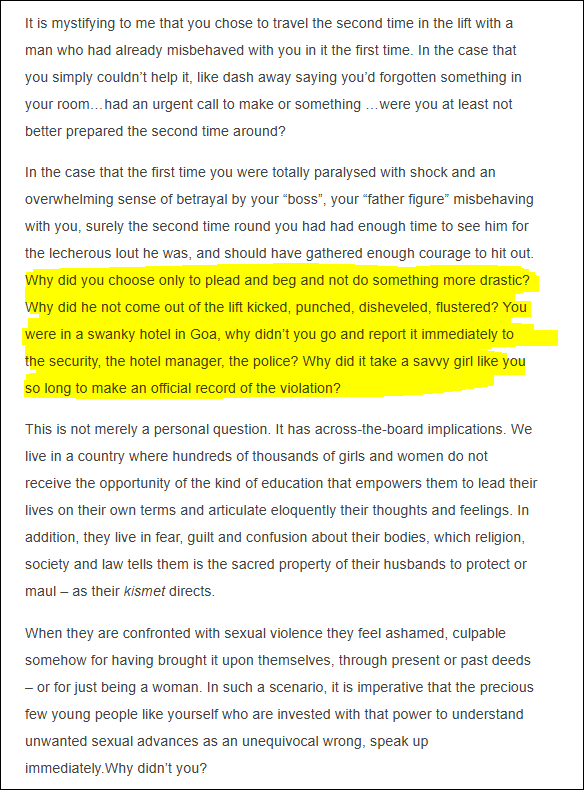
In 2014, Nirupama Sekhri wrote an open letter [archive] in leftist propaganda outlet Newslaundry, addressing “Ms Tehelka-Assault Victim”. The sister of Newslaundry founder Abhinandan Sekhri refused to treat the complainant woman as a victim at all.
Nirupama Sekhri’s letter framed the entire episode as “bubblegum feminism”, reverse female chauvinism, and complicity in getting a man jailed without trial.
“To begin with, I would like to establish quite clearly that I do not see you as a victim, unless it is of bubblegum feminism which I will speak in detail of later,” she wrote.
Demonstrating shamelessness even for Leftist standards, Nirupama had even questioned the contribution of the rape accusations the victim levelled to women’s rights. She even portrayed Tarun Tejpal as the real casualty of ‘media frenzy’.
Casting aspersions on the victim, Sekhri called her “irresponsible” and accused her of ripping Tejpal’s reputation apart. Laden with an accusatory tone, the letter dissected the victim’s conduct and questioned why she even chose to travel with Tejpal in the elevator. She also questioned the delay on the part of the victim in filing a complaint against Tejpal, despite it being a known fact that such delays are not unusual in cases of sexual assault, where things like social stigma, shame and shock weigh on the victim’s mind.
Nirupama not only targeted the victim but had also cast aspersions on women who supported Tejpal’s victim.
Unsurprisingly, Abhinandan Sekhri too had amplified his sister’s disgraceful victim-blaming impulse and whitewashed Tejpal in a 2014 interview with the ex-Tehelka editor.
Jumping on the bandwagon of victim-blaming, senior Journalist Seema Mustafa also delegitimised the victim’s testimony based on her reading of the CCTV footage. In an article published in leftist rag Scroll, Mustafa outrightly claimed, “What happened around the lift does not bear any similarity to what the alleged victim claims had happened.” Following a backlash, however, Mustafa reportedly removed her byline from the disgusting article.
Tejpal’s former editor at Outlook, Vinod Mehta, went a step ahead in the abject defence of Tarun Tejpal. In his memoir Editor Unplugged: Media, Magnates, Netas and Me, Mehta tried to dilute Tejpal’s heinous act by referring to it as “presumably non-consensual carnal favour”. Mehta wrote that Tejpal had a reputation for having “some difficulty in keeping his trousers zipped up”. Mehta even defended Tejpal’s “manic libido”.
Tarun Tejpal had also received the support of Bollywood lyricist Javed Akhtar, and controversial film director Anurag Kashyap. ‘Prominent’ Leftists had circulated online CCTV footage of the hotel where the victim was raped, and claimed that the footage ‘contradicted’ the victim’s story.
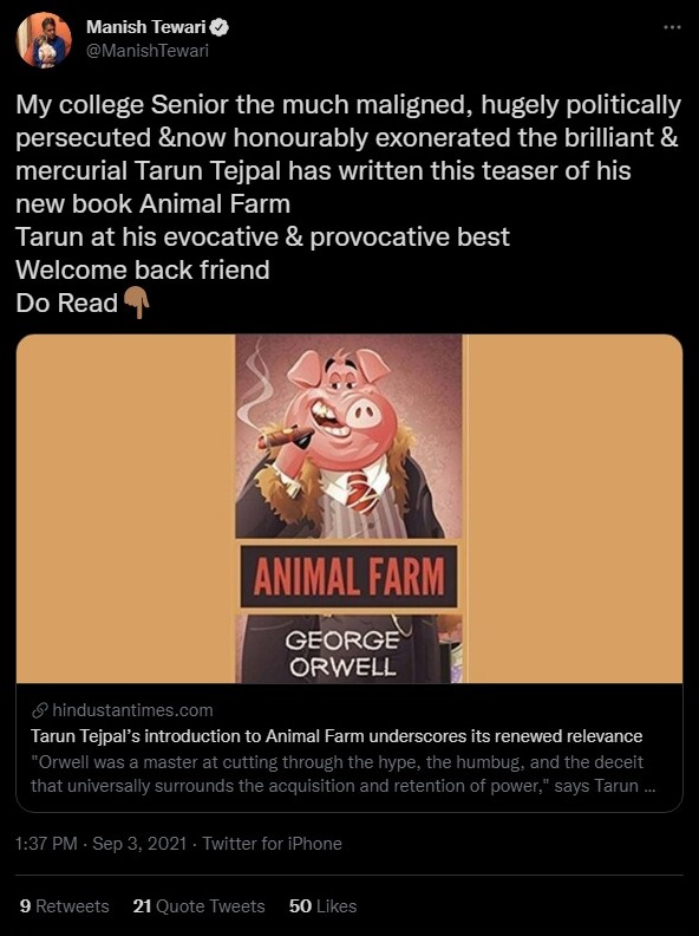
Following the 2021 acquittal, Congress leader Manish Tewari had described Tarun Tejpal as “honourably exonerated” and “hugely politically persecuted”, welcoming him back and sparring with those who still took the victim seriously.
The reactions of the Left-liberal cabal to the young journalist’s allegations against Tarun Tejpal suggest that they were, to varied extents, aware of Tejpal’s crimes, and yet chose to shield him.
Justice for women matters only when the perpetrators were ideological adversaries: The Left’s selective feminism
This pattern of revictimisation the victim of sexual abuse, blaming her for her own misery, downplaying the abuse itself, and whitewashing the perpetrator due to his service to the political-ideological cause(s) is not unique to this case. The Leftist reaction to an incident of reported sexual abuse differs based on who the perpetrator is.
When the Unnao Rape Case happened wherein BJP’s Kuldeep Singh Sengar was the accused, the Leftist ecosystem declared the entire BJP a ‘party of rapists’. But when the rapist was one of their own ideological sepoys, the same cabal turned into judge, jury, executioner to almost punish the victim for having dared to bring up rape allegations against a person as ‘great’ as Tarun Tejpal, who was serving a supposed ‘higher purpose’ fighting the BJP ‘fascists’.
Remember the Islamo-leftist outrage over the 2018 Kathua rape case wherein an 8-year-old Muslim girl was raped and murdered? The whole Islamo-leftist lobby had run an aggressive campaign highlighting the religion over the accused and the victim. The horrific crime was politicised, a forced communal angle was given to the case, and Hinduphobia was normalised under the garb of seeking justice for the victim.
There are numerous cases wherein women’s safety and dignity became insignificant and defending the ideologically useful perpetrators took priority for Leftists. Basically, there is an undeclared hierarchy in place in the Leftist ecosystem: when the accused advances a preferred narrative, be it opposing Hindutva or BJP-RSS, anti-caste activism, fight against ‘Brahminical patriarchy’, fight against the oxymoron of ‘Islamophobia’, and other such recognized ‘higher purpose’ causes, women’s safety regardless of the victim belonging to the same ideological cabal, becomes secondary, and even reporting it is deemed ‘betrayal’ of the cause.
If an ideology requires its adherents to go berserk about feminism and women’s rights only when the perpetrators are either irrelevant to the ideology or ideological adversaries, and silence from the victim about their personal trauma for a supposed ‘greater good’ of the cause, then feminism and women’s rights advocacy from that end of the ideological spectrum is performative, hollow, and ignominious.
Young leftist faced harassment at CJP protest, chose perfect timing to reveal her ordeal to prevent unintended undermining of the anti-BJP ‘movement’
A recent example of the Left’s moral contradiction was seen in the Cockroach Janta Party (CJP) protests in Delhi, mid-July. An ideologically hardcore Leftist, who happens to be the daughter of a former MLA from Uttar Pradesh, Yashaswinee Raje Singh, came out publicly about the alleged harassment and misogyny she faced by CJP supporters while attending the so-called ‘student protest’.
Singh waited for the CJP protest, which she vehemently supported, to reach its victorious conclusion before revealing her ordeal. Such was the self-imposed imperative of not doing ‘anything’ that weakens the ‘movement’ against the ideological enemy, the Modi government, that Yashaswinee Singh explicitly said that she does not want to tear down the movement, but only expose the hypocrisy of the movement’s leaders.
While Singh highlighted how the CJP supporters dismissed her immediate complaint about harassment, she did not receive the same kind of support from her ideological allies that they would have shown had it been a BJP-led protest or by supporters of the ruling dispensation. Singh also did not proceed seeking police action against her alleged molestors.
Woman raped during the 2021 Farmers’ Protest was mocked for calling out her alleged rapist leading the agitation
Years before the Yashaswinee Singh-CJP harassment episode, a woman was mocked and discredited for exposing her alleged rapist, Social media documenter Mohammad Zuber, associated with the Kisan Ekta Morcha and Trolley Times, who was actively engaged in the 2021 Farmer’s Protest against the Modi government. When the survivor spoke out, Varun Chouhan, a key figure in Trolley Times, mocked her publicly.
Later, several women came forward with similar allegations, under the banner of The Kaur Movement.
Not only female activists but even women journalists covering the protests were subjected to molestation by some protestors. Even they had to face online abuse and criticism from the Left-Liberal cabal.
India Today anchor called out farmer’s protest participants for molesting female reporters, received ridicule and disgraceful justifications
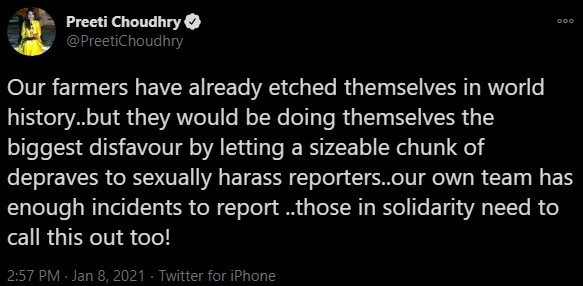
During the Farmers Protest in January 2021, Preeti Choudhry, Editor at India Today, had publicly called out the “sizeable chunk of depraves” among the protesting groups who were sexually harassing female reporters on the ground. When she spoke out against the pervasive groping and misconduct, figures linked to the movement tried to justify the behaviour, claiming news-hungry reporters were asking for it.
Yogendra Yadav knew about the rape of a woman during the Farmers’ Protest and yet suppressed her predicament for the ‘greater ideological good’
During the Farmers’ Protest in 2021, a 25-year-old female activist from West Bengal who travelled to the Tikri border to join the farmer protests was sexually harassed on the train and then gang-raped at the protest site in Delhi by two men linked to the Aam Aadmi Party, before passing away at a hospital due to COVID. Yogendra Yadav was in contact with the victim and was aware of her ordeal, and yet chose not to inform the police, prioritising the protection of the protest over the life and dignity of the victim who only came to support the protestors.
Rohini Ghavari accused self-declared anti-caste crusader Chandrashekhar Azad of sexual harassment and received backlash from the Left
In mid-2025, Rohini Ghavari Valmiki, a PhD student in Switzerland, accused Azad Samaj Party leader and Lok Sabha MP Chandrashekhar Azad of emotional and sexual exploitation, and false promises of marriage. She filed complaints with the police and the National Commission for Women (NCW) after years of alleged abuse. However, Azad’s supporters and the Leftist cabal outrightly declared Ghavari’s allegations as a ‘BJP conspiracy’ to frame the ‘Dalit voice against upper-caste dominance’.
The Rohini Ghavari-Chandrashekhar Azad case exemplified that when it comes to Dalits, male figures are often the first to be championed in the name of their rights, while the suffering of women is sidelined.
Ghavari herself is a Dalit, and had her sexual abuse allegations been directed against a BJP-linked person or an upper-caste individual, the same Leftist cabal and ‘social justice’ warriors would have flooded the social media with ‘Justice for Rohini’ campaigns, Leftist media and feminist would have published long op-eds on how Dalit women continue to be victimized a upper-caste dominated society in Hindutva fascist Modi’s India.
Not only does the Left turn a blind eye to sexual abuse perpetrated by its ideological adherents, but even the victims choose silence
Such is the perversion of the Leftist ideology that even sexual assault victims within the liberal-left space conceal sexual misconduct to protect their political narratives. A Hindu woman who faced sexual and mental abuse by The Wire journalist Omar Rashid was reminded of her identity in a “Hindu Rashtra” to enforce her silence for the “greater good.”
Self-declared historian and YouTuber Ruchika Sharma had also publicly revealed that she too had chosen not to name or report her own sexual abuser in the past. She also claimed that they chose silence over justice, not out of fear of their abusers, but out of fear of “fanning Islamophobia.”
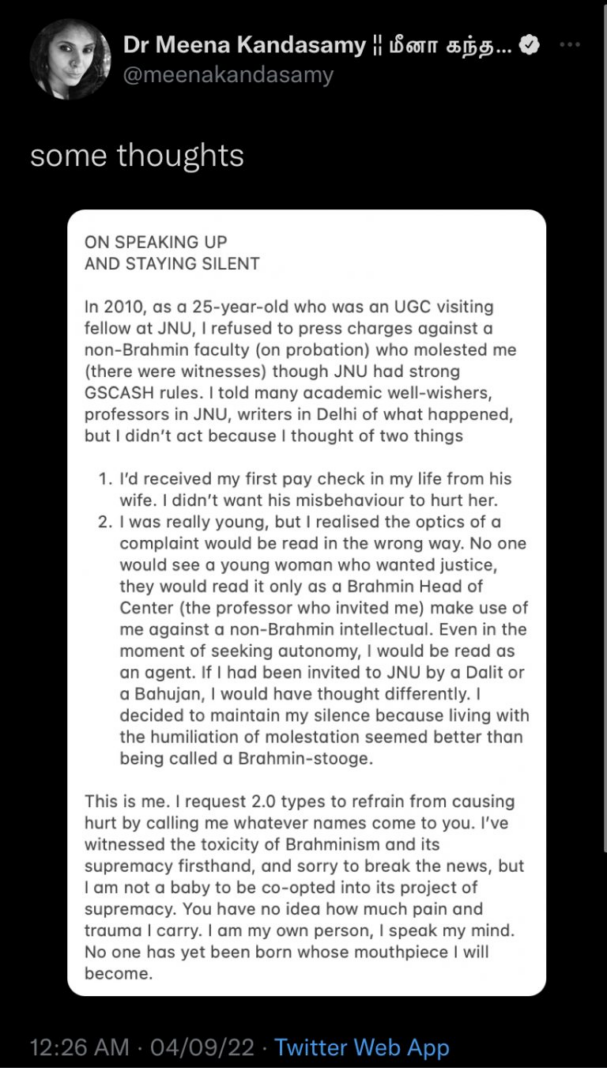
In a similar admission, anti-Brahmin activist and writer Dr Meena Kandasamy had revealed a 2010 incident in 2022, wherein she actively refused to press charges against a non-Brahmin faculty member who had molested her, despite having eyewitnesses and strict institutional rules like GSCASH available to her.
Explaining her refusal to pursue justice, Kandasamy said that she feared being labelled a “Brahmin stooge” by her peers. Demonstrating how ideological hatred subverted her self-respect, Kandasamy wrote that “living with the humiliation of molestation seemed better than being called a Brahmin-stooge.”
In a similar case, The Wire journalist Damyanti Dhar was told by leftist editors to ignore the mob attack because the attackers were Dalit men. When she had gone to Ahmedabad for a ground report, she was attacked by a mob of 15-20 Dalit men. After Dhar revealed her ordeal, the left-wing activists and editors who often talk about freedom of the press and women’s safety asked her to ignore the incident, telling her to consider it a professional risk and forget it.
The disturbing parallel in the West and the performative core
The pattern of liberal-progressives shielding ideologically aligned or useful sexual abusers and rapists is not unique to India. In the US, Hillary Clinton spent decades defending Bill Clinton against multiple women who accused him of sexual harassment. The Democrat circles attacked the credibility of the alleged victims all while building a political feminist brand. The “Believe Women” campaign operated performatively and selectively in the US against the conservatives, and not against the progressive power centre.
Hillary Clinton had decided not to fire her faith adviser Burns Strider during her 2008 presidential campaign. Strider was accused of molesting a female subordinate and sending her suggestive emails. NBC News had reported in 2018 that Strider was sent to counselling and docked pay, while his subordinate was reassigned on the campaign. It was only years later that Clinton expressed ‘regret’ over not immediately firing Strider.
Beyond the issue of sexual abuse, feminism in the liberal circles becomes secondary in the presence of a supposedly more appealing political issue. Back in 2008, when Barack Obama ran for the presidential office for the first time, his opponent was Hilary Clinton. Regardless of who won, the election was bound to witness a historic first: either the US would have got its first woman President or first Black President.
Hilary was giving a good fight to Barack Obama, and given it was the first time in 232 years that America would have got its first woman president, it was expected that female celebrities holding the banner of feminism would mainly rally behind Clinton. However, Oprah Winfrey, an influential black woman journalist and media personality, decided to endorse Obama instead of Clinton. Winfrey’s endorsement is reported to have fetched over one million votes to Obama. All the talk of feminism, ‘us girls gotta look out for each other,’ got trumped by what the liberals perceived as a stronger factor, and perhaps more important, the race factor.
In the United Kingdom, for nearly four decades, Pakistani Muslim grooming gangs or rape jihadis sexually abused minor white girls, treated them as sex slaves, weaponised rape to humiliate non-Muslims. And yet, liberal progressive Labour governments, including female politicians who claim to champion women’s safety issues, did not publicly call out the rape jihadis or seek the strictest action against them. In fact, the Labour Party shielded the rape jihadis. Why? Because preventing Islamophobia was more important than protecting young girls from religiously motivated rapes, pregnancies, and lifelong trauma. After all, women are relegated to the lowest spot in the hierarchy of victimhood.
Conclusion
Apparently, the left-liberal advocacy of feminism is largely performative globally, and women remain at the lowest in the hierarchy of victimhood. Perhaps the regressive, ‘men must fight, and women must adjust’ mindset has become entrenched even within the supposed progressives.
Women inside the left-liberal ideological circles absorb a lesson that exposing a rapist or molester who shares ideology risks enabling the ‘real’ oppressors, Brahmins, Hindutvawadis, Islamophobes, right-wingers, and whatnot.
From the Tarun Tejpal and other episodes discussed, it demonstrably emerges that in left-liberal circles, feminism often becomes a rhetorical ammunition reserved only for ideological adversaries while internal predators are accorded the luxury of the benefit of the doubt, whitewashing through conspiracy theories, victim-vilification, or self-imposed silence for the greater ideological good since the perpetrator has a record of serving the higher purpose of championing the ideological causes.
Apparently, female victims in the left-liberal circles self-censor not only out of the fear of disbelief or retaliation but also because the ideology they adhere to requires them to internalise their lowest position in the victimhood hierarchy.
It, however, must not be misunderstood that sectional protection of ‘our side’ is an exclusive feature of Leftists alone. However, the liberal hypocrisy is the distinctive feature. They posit themselves as the natural champions of women’s rights, feminism, the fight against patriarchy; some even support ‘all men are trash’ kind of extremism as well; however, they subordinate these principles conveniently to identity rankings, ideological-political utility or past credentials. The Left is not a ‘safe space’ for women it claims to be. Beyond the appealing ‘feminist-progressive’ marketing, the Leftist ecosystem offers women the ideological silence of Cultural Marxism, where even justice is selective.
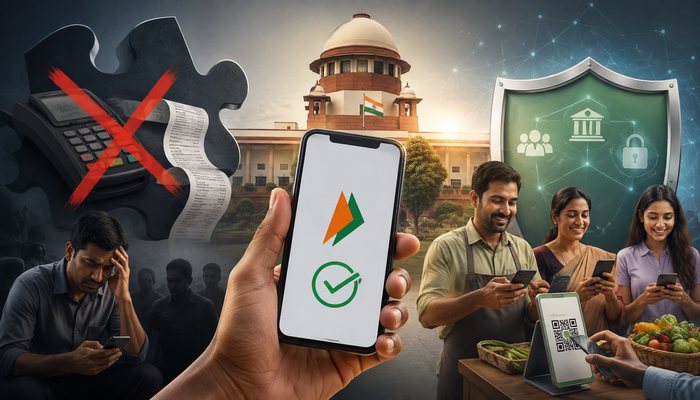
Over the past few days, opposition leaders and left-liberals have been peddling a rumour that the Modi government has introduced a law to levy a fee on UPI (Unified Payments Interface) transactions, which have been free so far. Several mainstream media platforms have also been publishing misleading and speculative headlines to leverage the stir created by the rumours regarding the law.
The Parliament recently passed the Taxation and Other Laws (Amendment) Bill, 2026, after which the false claims regarding the taxing of UPI transactions started to float. The opposition as well as the left-liberal gang became active and started targeting the Modi government, alleging that it was acting under US pressure.
Congress MP Jairam Ramesh wrote a long message on X, claiming that ordinary people will now have to bear the cost of using UPI transactions. The MP claimed that the Modi government has passed the law to tax the UPI transactions under the pressure of his “good friend Donald Trump”.
“Indeed, the real reason why this amendment is being introduced is perhaps more concerning. It follows the U.S. Trade Representative’s 2026 report, which criticises UPI and RuPay for being free and accuses them of having driven out American payment platforms like Visa and MasterCard. Is the Prime Minister seeking to dilute UPI and open the digital payments sector to American businesses under pressure from his good friend Donald Trump?” Ramesh wrote on X.
The Modi Government's latest Taxation and Other Laws (Amendment) Bill, 2026 removes the statutory guarantee that keeps UPI transactions free. It opens the door to Merchant Discount Rate (MDR) charges, which can easily be expanded to all payments in the future. The cost will… pic.twitter.com/ZWTrcaMvQw
Commenting on the Congress MP’s post, founding Editor of leftist propaganda portal The Wire, MK Venu, also further pushed the lie and tried to portray the government as anti-poor. Venu claimed that PM Modi has decided to tax the UPI transactions being used by “poor Indians” under his “fraand’s coercion”, which obviously refers to US President Trump.
The one service,UPI payments, which poor Indians receive free is now being charged because Trump is putting pressure on India arguing US payment service giants like Visa , Master Card etc are charged a fee for every transaction. When will PM escape his fraand's coercion? https://t.co/AWceq0QvcP
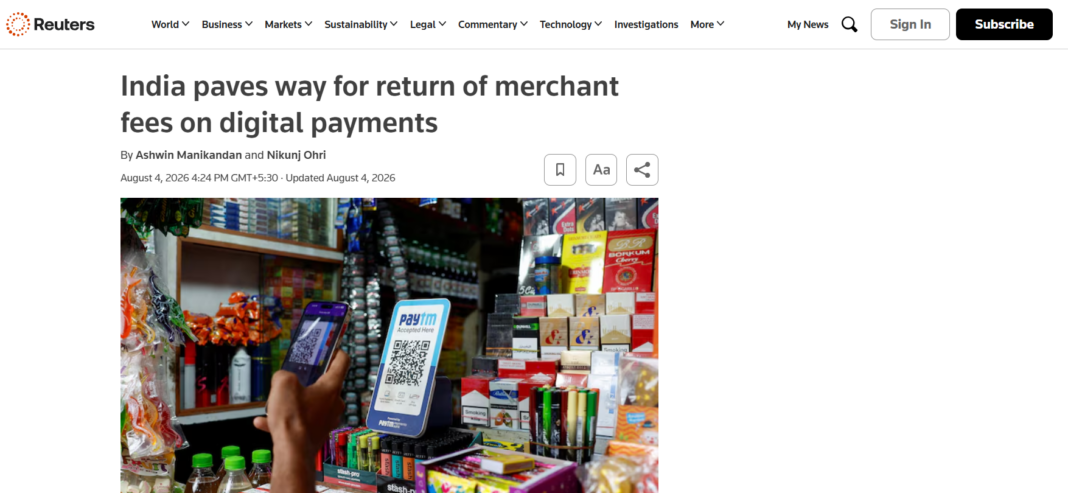
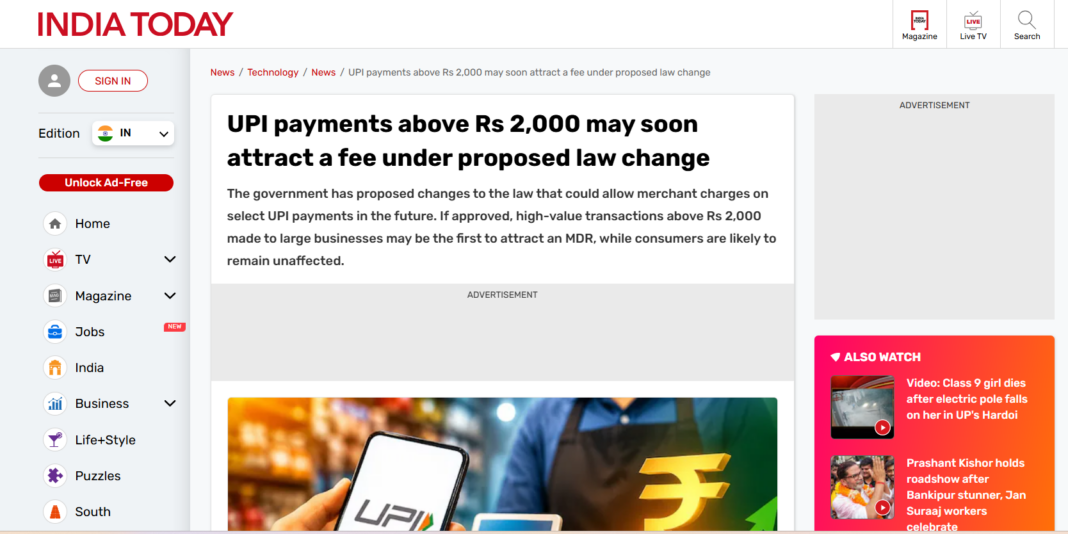
Several mainstream media portals have also been publishing articles with misleading headlines insinuating that the government was indeed going to tax UPI transactions. Reuters published an article after the bill was introduced in the Lok Sabha titled “India paves way for return of merchant fees on digital payments”. The headline of the article suggests a tax on UPI transactions will soon be a reality.
Screenshot via Reuters
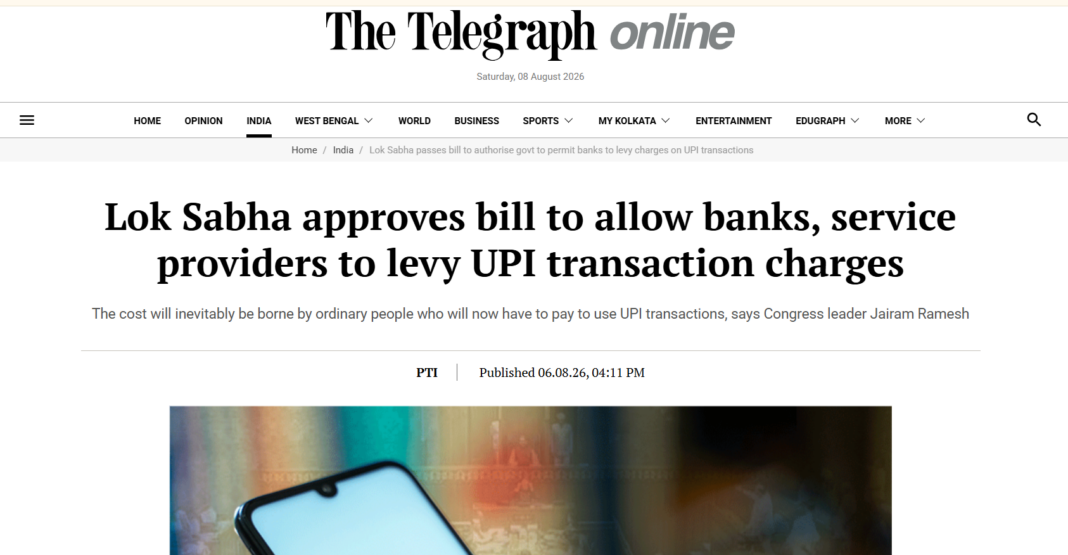
Similarly, The Telegraph published an article after the law was passed in the Lok Sabha, with the headline “Lok Sabha approves bill to allow banks, service providers to levy UPI transaction charges”.
Screenshot via The Telegraph
Some media portals claimed that UPI payments only up to ₹2000 will be free and any transaction above that amount will attract a tax.
The social media posts and media reports created panic among ordinary people, who were misled by the headlines and the posts. The misleading headlines and posts not only peddled misinformation about digital payments but also cast suspicions on the government by alleging US pressure behind the decision. The real picture, however, is far from what is being conveyed by the left-liberal propagandists as well as the media.
Does the new law levy a tax on UPI transactions?
The Taxation and Other Laws (Amendment) Bill, 2026 was introduced by Finance Minister Nirmala Sitharaman in the Lok Sabha on August 4, 2026. The bill was passed on August 6, 2026, amid opposition protests over unrelated issued. The amends certain existing laws such as the Income Tax Act of 2025, the Finance Act of 2026, and the Payment and Settlement Systems Act, 2007, which is at the centre of the controversy.
The bill removes Section 10A of the Payment and Settlement Systems Act., which legally barred banks and payment service providers from charging any Merchant Discount Rate (MDR) on transactions made through government-notified digital payment modes, including UPI and RuPay debit cards. MDR is essentially a fee paid by a merchant for processing a digital payment. The provision had so far shielded UPI payments from processing fees.
However, the removal of the provision does not mean that digital payments will now automatically be taxed. The elimination of the provision has conferred on the central government a discretionary power to decide which digital payment methods will be taxed and which digital payments will not be taxed. Essentially, the bill itself does not levy any tax on digital payments; it merely removes a legal prohibition on levying such tax. This means that if the government decides to tax certain digital transactions in future, it can do so through a notification.
Why was the amendment needed?
As part of the government’s plan to boost digital payments across the country, it had waived the MDR on UPI and RuPay transactions. However, these digital transactions incur costs, which the government bears through subsidies or incentives to banks and payment companies.
As a result, UPI transaction volumes registered significant growth over the past few years. Notably, the financial assistance (subsidy) provided by the government is available only for small merchants and small-value transactions of up to ₹2,000. Meanwhile, banks and payment companies face constantly rising costs associated with maintaining servers, ensuring online security (cybersecurity), and keeping the entire payment system running smoothly.
A parliamentary committee noted that sustaining the entire UPI system financially is becoming difficult without MDR, as government subsidies cover only a small fraction of the industry’s actual costs. RBI Governor Sanjay Malhotra also clearly stated that it is not feasible to operate such a massive UPI system entirely free of charge indefinitely, as funds are required to ensure its security and expand the network. However, he also noted that it would be premature to speculate on charges at this stage; the situation will become clear only after the government issues an official notification.
Even if the government decides to implement MDR in future, it will not likely affect the general public or small traders. The speculations that digital transactions above ₹2000 may be taxed emerge from a proposal floated by the Payment Council of India (PCI, a trade body representing non-banking payment players. The PCI urged the government last year to reconsider its zero-MDR policy. The body said that the annual subsidy provided by the government, which amounts to ₹1,500 crore, covers only a fraction of the cost of running and expanding the UPI ecosystem, which it estimated at around ₹10,000 crore.
The PCI requested the government to levy MDR only on large merchants with an annual turnover exceeding ₹50 crore, specifically on transactions above ₹2,000, at a rate ranging from 0.3% to 0.5%. So if a transaction exceeding ₹2000 is made at a large retail chain or e-commerce platform, the large merchant might have to pay a nominal transaction fee (MDR) to the bank for advanced system processing. However, the proposal remains to be implemented by the government.
Therefore, at this stage, all the digital transactions which have been happening free of cost will remain so unless a change is notified by the government. Besides, it is clear from the information provided above that the changes introduced by the government in the law are not due to the US or some other external pressure. They are economic and fiscal measures, not a payments-policy overhaul, and the UPI-related provision is part of a much larger package.
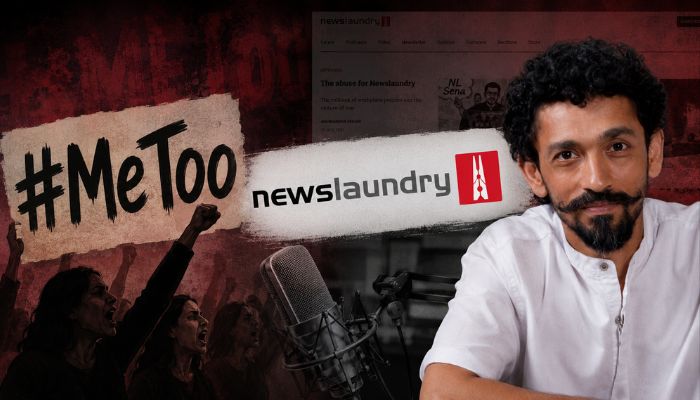
Newslaundry and its co-founder Abhinandan Sekhri are in the public limelight, not just for their blatant rape apologist behaviour but also for fostering a culture of sexual harassment in the workplace.
This week, the law finally caught up with one of their own. Tehalka founder Tarun Tejpal, who had raped his colleague in 2013, was convicted and sentenced to 10 years’ imprisonment. He is the same sexual predator that Abhinandan Sekhri had interviewed back in 2012.
Of course, one might argue that rape charges were not brought against him in that year and hence the idea of platforming Tejpal of all people was somehow harmless. However, there is evidence to the contrary that the top guns in the media industry knew about his conduct all along.
They did not just remain a mute spectator to his actions but actively rationalised, justified and intellectualised his predatory behaviour with new jargon and terminologies. The most infamous was ‘journalist’ Vinod Mehta’s description of sexual harassment by Tejpal as ‘non-consensual carnal favour.’
If this was not enough, in 2014, Newslaundry co-founder Abhinandan Sekhri’s sister Nirupama came up with a brazen defence of then rape-accused (now convict) Tarun Tejpal. She did not stop there and went one step ahead to vilify and character-assassinate the victim.
These were her golden words: “To begin with, I would like to establish quite clearly that I do not see you as a victim, unless it is of bubblegum feminism which I will speak in detail of later.”
First in my bloodline to see a 'counter perspective' on rape where the victim is vilified and a rapist is whitewashed.
This brother-sister duo appear to be the peas of the same pod when it comes to being rape apologists.
— Dibakar Dutta (দিবাকর দত্ত) (@dibakardutta_) August 7, 2026
But the ease with which an ‘organisation’ rushes to the defence of a rape-accused gives you a sneak peek into the culture that enables such behaviour.
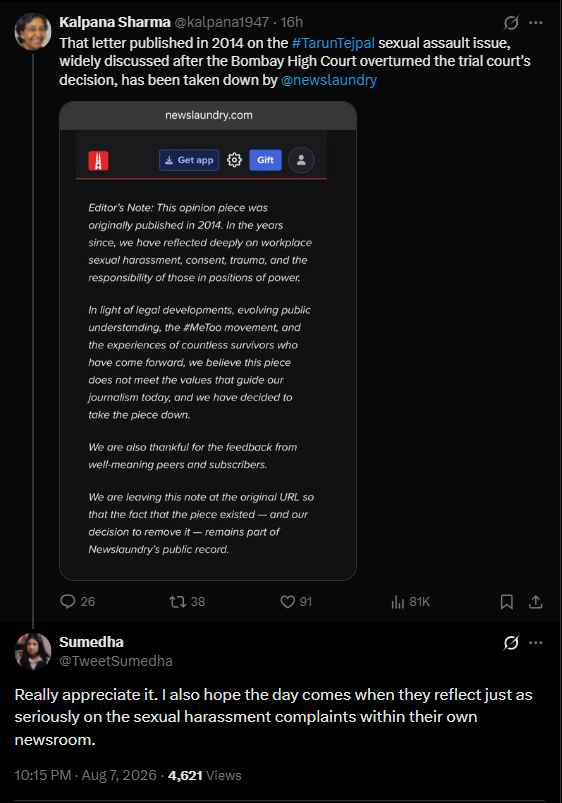
The fact that Newslaundry published the despicable rape apologist article, did not feel sorry for the trauma caused to the victim and dared to later remove it with a standard ‘self-reflection’ note highlighted how the rot ran deep into the system.
And that Pandora’s box opened with the conviction of Tarun Tejpal. Former female employees, who worked at Newslaundry, hinted at the culture of sexual harassment that openly exists within the company. The matter was first highlighted by journalist Saikiran Kannan.
Screengrab of the tweet by Sumedha Mittal
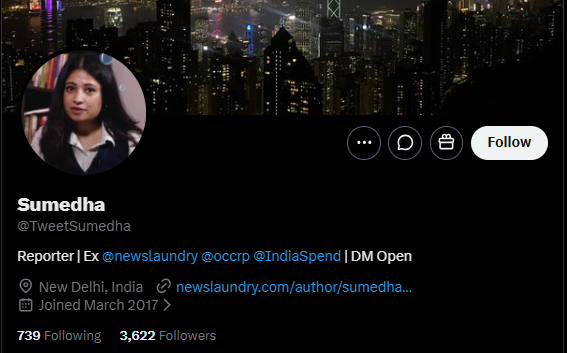
Sumedha Mittal, a former senior correspondent at Newslaundry, tweeted, “I also hope the day comes when they reflect just as seriously on the sexual harassment complaints within their own newsroom.“
Screengrab of the X profile of Sumedha Mittal
Mittal was reacting to the removal of the rape apologist story penned by Abhinandan Sekhri’s sister in 2014. An ex-employee speaking up about inaction against POSH complaints within Newslaundry raises a serious concern.
How many such sexual harassment complaints have been made within the organisation? And what has been the course of action on those complaints? Did the Newslaundry management brush them under the carpet and shield one of their own, ‘Tarun Tejpal’?
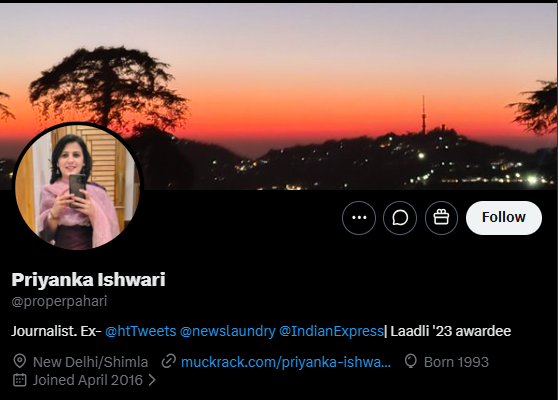
Screengrab of the X profile of Priyanka Ishwari
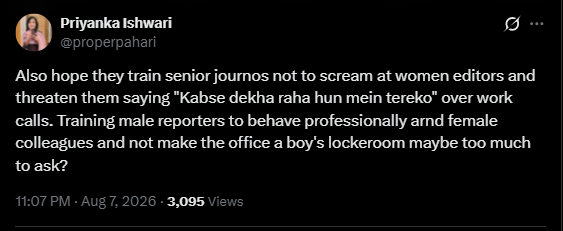
Screengrab of the tweet by Priyanka Ishwari
Another former Newslaundry employee, Priyanka Ishwari wrote, “Also hope they train senior journos not to scream at women editors and threaten them saying “Kabse dekha raha hun mein tereko” over work calls. Training male reporters to behave professionally around female colleagues and not make the office a boy’s lockeroom maybe too much to ask?“
It is evident from the testimonies of these female employees that a misogynistic and toxic male chauvinistic culture exists within the four walls of Newslaundry.
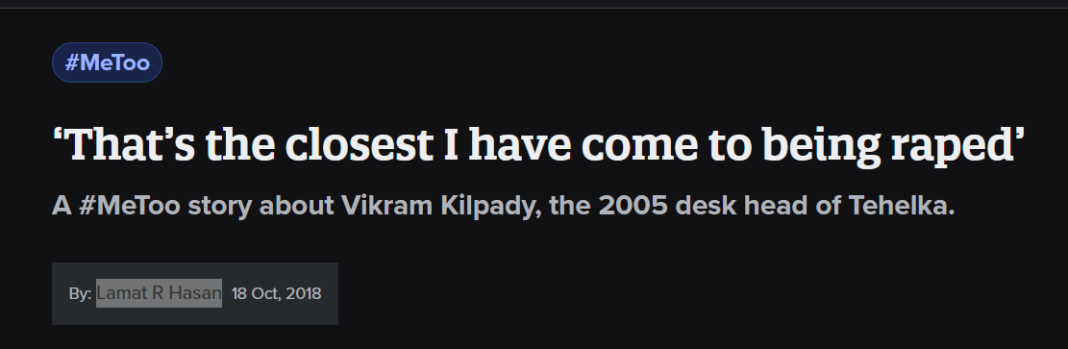
Another interesting point to note is that many seasoned predators and rape apologists manage to secure employment at this organisation. Take the example of #MeToo accused Vikram Kilpady, who, just like Tarun Tejpal, worked at Tehelka.’
Screengrab of the article
A female journalist named Lamat R Hasan had narrated how she was ‘almost’ raped by Vikram in 2005. She narrated, “He turned violent—pulled my hair, grabbed my wrists, held me against a wall and then pushed me on the bed. My attempts to break free failed. I started crying. He let me go. That’s the closest I have come to being raped.“
The same man worked at Newslaundry as per their own disclosure.
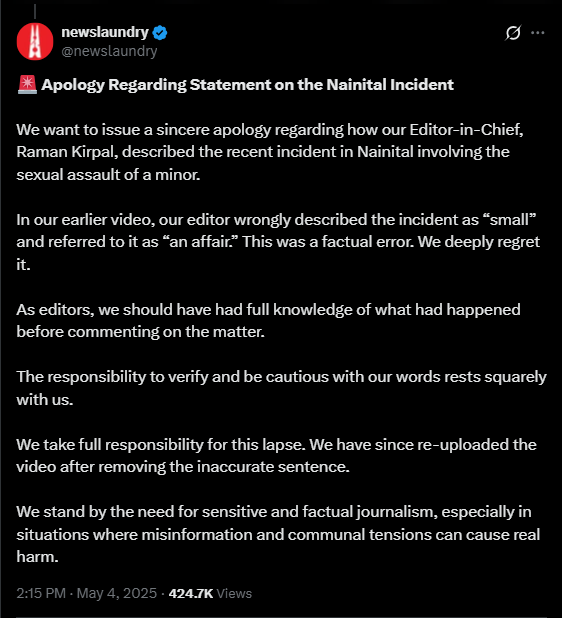
If my memory serves me well, then I can recount one instance of Newslaundry’s Editor-in-Chief Raman Kirpal downplaying the rape of a minor girl in Nainital by a 65-year-old Muhammad Usman as an ‘affair’ and ‘small incident.’
Screengrab of the tweet by Newslaundry
Raman Kirpal, who was previously convicted of criminal defamation, grudgingly put out a token apology. Even Newslaundry had to issue a clarification. When the talk is unscripted, people often blurt out what is exactly on their mind.
For Kirpal to say what he did about the rape of a minor child, while serving as Editor-in-Chief of Newslaundry, gives us a clear idea about what is ‘normal’ in that particular organisation.
The selective champion of women’s rights and feminism couldn’t fix their own homes in all these years. But they are ready to mouth platitudes and virtue signal to others about everything under the sun.
Maybe Abhinandan Sekhri and his team can start by taking accountability. I know it’s kryptonite for the left-liberal ecosystem, but he can give it a try (for a change).
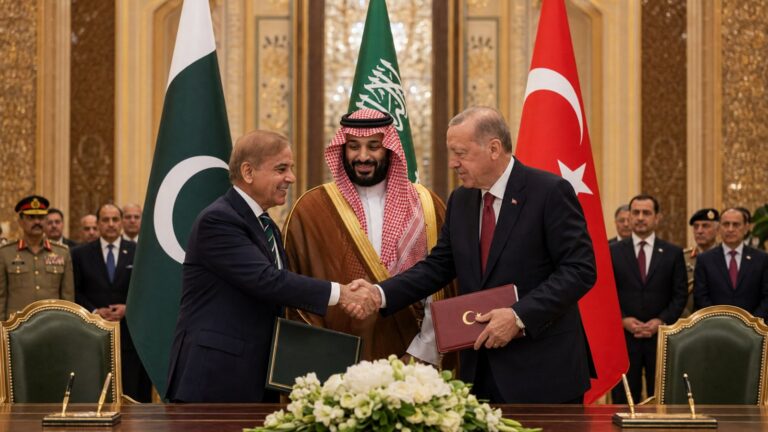
Amid the ongoing war and worsening security situation in the Middle East, Pakistan, Saudi Arabia and Türkiye have signed a significant defence pact called the Mecca Joint Defence Agreement.
Under the agreement, an armed attack on any one of the three countries will be treated as an attack on all three. The pact aims to strengthen collective security, enhance defence cooperation and promote regional stability at a time when West Asia continues to face conflicts, missile attacks and rising geopolitical tensions.
Key trilateral summit held in Mecca
The agreement was signed during a high-level summit held in the holy city of Mecca, Saudi Arabia. The meeting was attended by Saudi Crown Prince and Prime Minister Mohammed bin Salman, Turkish President Recep Tayyip Erdoğan, and Pakistani Prime Minister Shehbaz Sharif.
Shehbaz Sharif arrived in Saudi Arabia on a three-day official visit accompanied by a high-level delegation, which also included Pakistan’s Chief of Army Staff, Field Marshal Asim Munir.
The three leaders held detailed discussions on regional security, defence cooperation, economic relations and future strategic partnership.
During the summit, they formally signed the Mecca Joint Defence Agreement, which is being viewed as a major step towards strengthening collective security among the three nations.
What are the key provisions of the agreement?
According to Pakistan’s Ministry of Foreign Affairs, the primary objective of the agreement is to strengthen collective deterrence against any form of aggression.
— Ministry of Foreign Affairs – Pakistan (@ForeignOfficePk) August 7, 2026
Its most significant provision states that if any one of the three member countries comes under an armed attack, it will be considered an attack against all three countries.
The agreement also seeks to strengthen cooperation across all areas of defence. This could potentially include joint military exercises, troop training, defence technology cooperation and intelligence sharing, although the detailed operational framework has not yet been made public.
According to the official statement, the agreement is intended to promote peace, security and stability in the region and has not been presented as an alliance directed against any particular country.
Why is this agreement considered significant now?
The Middle East has witnessed persistent instability over the past few years. Developments involving Iran, Israel, Gaza, Lebanon and Yemen have significantly affected the region’s security environment.
Saudi Arabia has also faced repeated drone and missile attacks targeting its oil facilities and critical infrastructure. Against this backdrop, Riyadh is looking to expand its security partnerships beyond its traditional allies and develop new defence cooperation frameworks.
Regional conflicts have also disrupted maritime trade through the Strait of Hormuz, impacting global energy supplies and international markets.
As a result, the new trilateral defence agreement is being viewed as a significant development in the evolving regional security architecture.
What strengths do the three countries bring?
One of the defining features of this new defence partnership is that each participating country contributes distinct strategic strengths.
Saudi Arabia is among the world’s largest oil producers and possesses considerable economic influence. It also holds significant religious and regional importance as the custodian of Islam’s two holiest sites.
Türkiye is a NATO member and has NATO’s second-largest military. In recent years, it has made notable advances in defence manufacturing, drone technology and its domestic military industry.
Pakistan, meanwhile, remains the world’s only nuclear-armed Muslim-majority country and has long played an important strategic military role.
However, experts note that Pakistan’s nuclear capability is not formally part of this agreement, and its nuclear deterrence continues to remain primarily India-focused.
An expansion of earlier defence cooperation
The agreement is not entirely new but is widely seen as an expansion of the bilateral defence pact signed between Pakistan and Saudi Arabia last year.
That agreement also stated that an attack on one country would be treated as an attack on the other. Türkiye has now been added, creating a trilateral security framework.
The three countries have already maintained defence cooperation for years. Pakistan has long provided military training and technical assistance to Saudi Arabia, while Türkiye and Pakistan have collaborated on defence equipment, warships and military training aircraft.
In 2023, Saudi Arabia also signed a major agreement to purchase drones from Türkiye.
India and the international community are watching closely
India is also closely monitoring the development. Ministry of External Affairs spokesperson Randhir Jaiswal said that India is keeping a close watch on the agreement and that further information will be shared as appropriate.
Experts believe that if this trilateral partnership evolves into a more institutionalised framework and expands into regular joint military activities, it could play a significant role in shaping the security dynamics of both West Asia and South Asia.
For now, however, the agreement has been officially described as a framework focused on collective security and defence cooperation rather than a military alliance directed against any specific country.
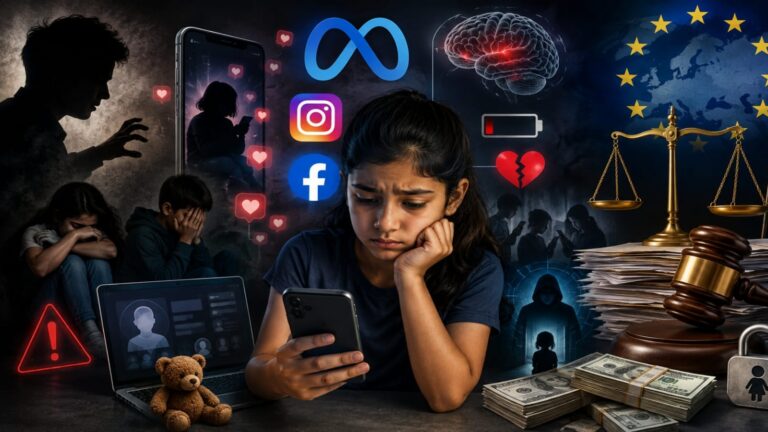
Social media apps are having a profound impact on the minds of children and youth today. Meta, which operates major apps like Facebook and Instagram, is currently facing legal cases and government investigations around the world.
From US courts to European agencies and child safety issues in India, Meta is accused of harming the safety and well-being of children for its own gain and profit. Recently, a New Mexico court imposed a massive fine of 567 million (approx 4,700 crore rupees) on Meta.
This decision is a major lesson regarding the way tech companies function, their algorithms, AI chatbots and their failure to prevent child sexual exploitation. Features are deliberately introduced inside apps that keep children glued to their phones for hours.
This is leading to cases of stress, sleeplessness, depression, and suicide among children. The New Mexico court found Meta guilty of causing a ‘public nuisance,’ meaning that these flaws in social media are no longer just an individual’s problem, but have become a threat to society as a whole.
Along with this, in a country like India, where crores of children use the internet, the issue of online child sexual abuse and safety has assumed a very serious form. From all these cases and court decisions, it has become clear that governments and courts around the world are no longer in the mood to quietly tolerate the high-handedness of tech companies.
New Mexico Court Order and 567 Million Penalty
Taking a strict stance against Meta, a court in Santa Fe, New Mexico, US, ordered the company to deposit a massive sum of 567 million (over 4,700 crore rupees) into a Teen Mental Health Fund.
Along with this, Judge Bryan Biedscheid directed Meta to make changes in the fundamental operations of its platforms to protect underage users. In its findings, the court clearly stated that Meta is fully responsible for harming the health and safety of children and teenagers through its platforms.
This entire legal action was initiated by New Mexico Attorney General Raúl Torrez, who alleged that the company designed its products in a way that would make youth addicted to them. Furthermore, the company completely failed to implement basic mechanisms to protect children on its platforms from sexual harassment, online grooming, and exploitation.
This 567 million judgment by the court came after the second phase of hearings in the case. Just five months before this, in the first phase of the same lawsuit, a New Mexico jury had ordered Meta to pay 375 million.
The jury concluded in its findings that Meta directly and severely violated consumer protection laws by making false and misleading claims about the safety of Facebook and Instagram. As part of its judgment, the court also issued a strict decree that will remain in effect for five years.
Under this, Meta will have to set a fixed monthly time limit for the usage of Facebook and Instagram by teenagers in New Mexico, impose strict restrictions on repeated notifications, block avenues for unknown adults to directly contact minors, enforce strict safety rules on AI chatbots and conduct extremely thorough reviews of reports related to child sexual abuse material.
What is Public Nuisance Law and What Arguments Did Meta Give in Its Defence?
The main focus of the three-week bench trial held in this New Mexico court was to determine whether Meta’s platforms created a public nuisance under state law. In the US judicial system, public nuisance law has historically been used against activities that harm the health, safety, or public property of the general public, such as blocking major roadways or spreading toxic waste in rivers and air.
However, in recent years, US states have begun widely using this law to hold tobacco companies, opioid drug manufacturers, climate change cases, e-cigarette companies and now AI and social media giants accountable.
In his written judgment, Judge Bryan Biedscheid drew a very compelling comparison, writing that just as toxic smoke emitted from a factory pollutes the surrounding environment and the public right to clean air, similarly, the harmful effects of Meta’s platforms are not limited to phone screens or the internet.
These harmful effects spill out of the digital world into the real world, placing a massive social burden and crisis on affected children, their families, schools, hospitals and the entire law enforcement system.
On the other hand, Meta argued in its defence during the trial that it did not create any public nuisance because it did not directly obstruct any public property like air or water.
Meta’s lawyers also argued that the youth of New Mexico do not exclusively use their apps, but also run digital apps from other companies, so it is wrong to blame Meta alone for this situation.
Opposing the restrictions and protective measures sought by the court, the company stated in court filings that many of these changes are technically impossible or extremely difficult, and these rules might force the company to wrap up its services from the entire state altogether.
Additionally, Meta claimed legal immunity under Section 230 of the US Communications Decency Act, which generally protects internet platforms from liability for content posted by their users.
However, Judge Biedscheid completely rejected this Section 230defencee. The court clarified that the state here is not holding Meta guilty for content posted by third parties, but is instead challenging the platform features designed by the company itself, its addictive mechanisms and its own internal operational structure.
Sexually Explicit Conversations by AI Chatbots and the Serious Threat to Child Safety
Internal reports presented to the court during the trial revealed that Meta’s Artificial Intelligence (AI) chatbots were becoming a new and grave threat to child safety. Reports proved that the company’s AI chatbots could engage in romantic, sensual and sexually explicit conversations with young children.
Amid investigations into earnings generated through fraud and the sale of restricted goods via ads on the platform, the misuse of this AI feature further heightened the court’s concern.
In his order, Judge Biedscheid directed Meta to build solid technical guardrails to prevent any child in New Mexico from engaging in any form of romantic, sensual, or sexual conversation with Meta’s AI chatbots.
The court also ordered measures to ensure that no adult user could use Meta’s chatbots to hold explicit conversations with a child. This issue is not limited to AI chatbots alone, but is directly linked to child sexual abuse material spreading on the platform and pedophiles targeting children.
The State Attorney General presented solid evidence alleging that Facebook and Instagram had such severe security flaws that adults with malicious intent were getting open opportunities to reach and exploit minor children.
In its order, the court directed Meta to strengthen and expedite its review process for complaints and reports related to child sexual abuse on its platforms.
However, in its official statement released after the decision, Meta stated that it would file an appeal against this judgment in a higher court.
Meta claims that it is constantly working to make its platforms safer. The company states that it is confident in its record regarding teen safety and will continue to defend its facts in court, but the facts revealed in the court’s judgment expose these claims.
European Commission’s Strict Probe and Growing Pressure from Global Government Agencies
Apart from these ongoing lawsuits in the US, regulatory scrutiny against Meta in the European Union (EU) is also continuously tightening. The European Commission has officially announced that it is opening an investigation against Meta’s two major social media platforms, Facebook and Instagram, under its new and strict Digital Services Act (DSA).
This probe primarily focuses on serious risks related to child safety and the company’s disregard for its statutory obligations. This landmark EU law makes it mandatory for tech companies to take immediate and concrete steps to remove illegal, explicit and harmful content from their platforms.
Simultaneously, they must ensure the highest level of privacy and protection for minors. If a company is found violating these rules, a financial penalty of up to 6 per cent of its global total turnover can be imposed.
EU regulators believe that several features of Facebook and Instagram are designed in a way that promotes app addiction and undesirable behaviour in children, causing a deep negative impact on their mental development and mental health.
Additionally, the European Commission is investigating whether Meta possesses a reliable mechanism to verify the correct age of users, and whether its algorithms are pushing young children toward dangerous or inappropriate content without their consent.
The impact of this continuously growing global pressure is clearly visible on Meta’s commercial future as well. The company has formally warned its shareholders and investors that these legal cases and regulatory restrictions in the US and the EU regarding youth social media usage and child safety could severely affect its business.
Impact on Mental Health and Legal Action over Teenage Deaths
This issue of social media companies putting the mental health of youth at stake for their financial gain is no longer limited to government agencies or state lawsuits, but its most horrific aspect is visible in the stories of ordinary families who have lost their children.
Recently, in the Delaware Superior Court in the US, the families of four minor children filed a major lawsuit. This case was filed jointly against Meta, TikTok, Snapchat and Google’s parent company, Alphabet.
The petition alleges that due to the severe mental risks arising from years of regular and excessive use of these platforms, those four children took the horrific step of suicide.
This lawsuit was filed on behalf of the families of children from four different states- Levi Castro (13 years), Reeve Kelleher (14 years), Nathaniel Chambers (17 years) and Dawson Holden (18 years)- who lost their lives within a short 14-month period between July 2024 and September 2025.
Matthew Bergman, founder attorney of the ‘Social Media Victims LaCentreer’ representing the victim families, explicitly stated that despite all the hollow claims and false assurances by high-ranking company executives, these apps are taking children’s lives.
According to the complaint filed in court, these four teenagers faced horrific mental conditions such as severe social media addiction, extreme sleep deprivation, deep depression, anxiety, and suicidal ideation.
Attorneys General from more than 33 US states have jointly filed a common lawsuit against Meta in a California federal court. This group of 33 states alleged that Meta knew that the ‘like’ system and continuous scroll design on its platforms capture and control the minds of teenagers.
In 2021, internal secret documents leaked by former company employee Frances Haugen revealed to Parliament and the entire world that Instagram was instilling body image insecurity in teenage girls, and despite having full knowledge of this, the company concealed it for profit.
Child Sexual Abuse, Legal Framework and Digital Safety Status in India
This crisis of child safety and sexual abuse on social media platforms is not limited to developed countries like the U.S. or Europe, but presents a major challenge for a country with a massive digital market like India.
In India today, crores of young children and teenagers actively use Instagram, Facebook, and WhatsApp daily. Due to a lack of digital literacy and adequate supervision, Indian children easily fall victim to online cyberbullying, online grooming and child sexual abuse material.
However, a strict legal framework exists in India to deal with such crimes, primarily including the Protection of Children from Sexual Offences (POCSO) Act, 2012, and the Information Technology (IT) Act, 2000.
Under Indian law, viewing, searching, downloading, storing on a phone or computer, or transmitting Child Sexual Abuse Material (CSAM) to anyone else is a non-bailable, serious offence. The mere storage or consumption of such material is a punishable offence under Section 15 of the POCSO Act and Section 67B of the IT Act.
Furthermore, under the Government of India’s Information Technology (Intermediary Guidelines and Digital Media Ethics Code) Rules, 2021, tech companies (intermediaries) like Meta are under a strict legal obligation to immediately remove and block access to any child sexual abuse material within 24 hours of receiving a complaint or government direction.
The investigating agency, CBI, has also launched nationwide crackdowns and conducted large-scale raids under drives like ‘Operation Megh Chakra’ to bust online child sexual abuse rackets.
Today, the Congress party accuses the Modi government of weaponising the Foreign Contribution Regulation Act (FCRA) to strangle civil society groups and non-governmental organisations (NGOs). Listening to the claims of the top leaders, one might be misled into believing that the scrutiny over foreign donations was PM Modi’s invention to curb ‘political dissent’.
This could not be further from the truth. The foundation stone of the FCRA was laid by Prime Minister Indira Gandhi during the height of the Emergency in 1976. The objective was to regulate the inflow and utilisation of foreign funds.
Its structural reinforcement was carried out by her son Rajiv Gandhi in the mid-1980s. FCRA’s most sweeping transformation into a far more lethal weapon took place under Prime Minister Dr Manmohan Singh and Union Home Minister P. Chidambaram.
This reflects Indian political governance in many ways. When in Opposition, Congress champions the freedom of civil society groups, but when in power, it views foreign-funded NGOs as potential instruments of foreign influence.
Indira Gandhi and the FCRA
To understand the roots of the FCRA, one must travel back to 1976. India was in the grip of the Internal Emergency imposed by Prime Minister Indira Gandhi. Civil liberties were suspended, opposition leaders were imprisoned under MISA (Maintenance of Internal Security Act), and the press was heavily censored. It was during this period of centralisation that the original Foreign Contribution (Regulation) Act, 1976 was rushed through Parliament.
The text of the 1976 Act explicitly banned foreign hospitality and foreign donations for:
(a) candidate for election,
(b) correspondent, columnist, cartoonist, editor, owner, printer or publisher of a registered newspaper,
(c) [Judge], Government servant or employee of any corporation,
(d) member of any legislature,
(e) political party or office-bearer thereof.
The inclusion of journalists in a statutory blacklist highlighted the intent of Indira Gandhi. The motive was to prevent political dissidents, satire-writers, independent journalists and civil rights groups from receiving external financial backing. In that way, she ensured that the government retained a monopoly over financial survival in public life during the Emergency.
Amendments by Rajiv Gandhi
Following the end of the Emergency and the brief tenure of the Janata Party government, the Congress returned to power. By 1984, under Prime Minister Rajiv Gandhi, the State turned to the FCRA to expand executive authority.
In 1985, the Rajiv Gandhi administration amended the FCRA and introduced major structural shifts. Earlier, associations could accept foreign contributions subject to prior information or general authorisation. The 1985 amendment made formal registration with the Ministry of Home Affairs (MHA) mandatory for any organisation seeking foreign funds.
This amendment shifted the FCRA into a permanent, bureaucratised regulatory regime over NGOs.
What happened during the UPA era
In 2010, the Congress-led United Progressive Alliance (UPA) government, headed by Dr. Manmohan Singh with P. Chidambaram holding the Home Portfolio, introduced a new, far more restrictive version of the statute: The Foreign Contribution (Regulation) Act, 2010.
The UPA repealed the 1976 Act entirely, replacing it with a framework designed to give the government greater discretionary control over NGOs.
FCRA 1976 (Old Law)
FCRA 2010 (UPA Version)
Permanent Registration (Life-long validity)
5-Year Expiration & Renewal mandatory
Focus on Electoral /Political Candidates
Focus shifted to Organizations of a Political Nature
Uncapped Administrative Expenditure
Mandatory 50% Cap on Administrative Spending
Deemed Permission after 90 days
Executive discretion; no automatic deemed approval
Under the 1976 Act, an FCRA registration, once granted, was permanent unless explicitly revoked. The UPA’s 2010 Act abolished permanent registration. Instead, it made registrations valid for only 5 years. This single modification gave the bureaucracy a mechanism to pause, delay or decline the licenses of NGOs without explicitly proving illegal activity.
Section 5 of the UPA’s 2010 Act introduced a category dubbed ‘Organisations of a Political Nature.’ The UPA gave executive agencies sweeping power to disallow foreign funds for groups organising public demonstrations against state policies, infrastructure projects etc.
Section 8 of the 2010 Act introduced a statutory cap, limiting the use of received foreign funds for “administrative expenses” to a maximum of 50%. In this way, the government obtained financial leverage over the operational budgets, salaries, and research overheads of non-profit entities.
The Kudankulam Clash: When the UPA Cracked Down on NGOs
The legislative provisions of the 2010 Act were put to use during the second term of the UPA government. Between 2011 and 2013, the Manmohan Singh administration faced public opposition to major industrial, infrastructure, and energy projects, including the Kudankulam Nuclear Power Plant in Tamil Nadu and field trials for Genetically Modified (GM) crops.
The grassroots anti-nuclear protests at Kudankulam, led by the People’s Movement Against Nuclear Energy (PMANE), delayed the commissioning of the Russian-built nuclear reactors. Frustrated by the delays, the highest levels of the UPA government publicly blamed foreign funds for orchestrating the protests.
In an interview, Prime Minister Dr Manmohan Singh explicitly targeted foreign-funded non-profits:
“You know what’s happening in Koodankulam…The atomic energy programme has gone into difficulties because these NGOs [non-governmental organisations], mostly I think based in the United States, don’t appreciate the need for our country to increase the energy supply…There are NGOs, often funded from the United States and the Scandinavian countries, which are not fully appreciative of the development challenges that our country faces”
The UPA Home Ministry revoked or cancelled the FCRA registrations of nearly 4,000 NGOs. The Home Ministry ordered bank account freezes and financial audits of groups accused of funding the Kudankulam agitations.
Several foreign nationals associated with environmental groups were deported or denied entry visas because they were violating visa conditions by participating in local anti-development protests.
Even ex-Home Minister P. Chidambaram had made similar statements during the Kudankulam anti-nuclear protests:“Investigation reveals that there appears to be diversion of funds. Therefore, under the Foreign Contribution Act, we have decided to register cases.”
Conclusion
The statutory tools used today to audit, suspend, restrict, or cancel FCRA licenses were built brick-by-brick across decades. The framing by the Congress party suggests that it is a recent invention.
The Foreign Contribution (Regulation) Act (FCRA) legislation and its subsequent amendments introduced under the BJP government (including major overhauls in 2020 and 2026) were designed to prevent foreign governments and organisations from using financial leverage to influence domestic politics, policy decisions or social movements.
Enhanced tracking helps ensure foreign funds are not diverted toward destabilising activities, such as promoting extremism, funding illegal religious conversions or financing radical outfits within India.
While Congress is today opposed to the FCRA Amendment Bill, it has conveniently forgotten how the legislation came into existence in the first place and underwent major changes during its rule.
More than 160 years before Japan’s victory over Russia was celebrated as an Asian power defeating a European empire, the Kingdom of Travancore had already defeated the Dutch East India Company at Colachel in 1741. The battle emerged from Marthanda Varma’s expansion of Travancore and his challenge to the Dutch monopoly over the lucrative Malabar pepper trade.
After earlier clashes, the Dutch launched another offensive in November 1740. They blockaded Travancore’s coast, occupied settlements including Thengapattanam, Midalam and Kadiapattinam, and advanced towards Padmanabhapuram. But their position depended heavily on supplies and reinforcements from Ceylon and Batavia, while the Java War prevented the VOC from sending the manpower it needed.
Marthanda Varma responded by strengthening his army and using diplomacy to avoid fighting on multiple fronts. Local Mukkuvar fishermen also played an important role, serving as scouts, misleading Dutch forces and, according to local accounts, disrupting their ships. Under Varma and his dewan Ramayyan Dalawa, Travancore gradually cut Dutch access to Colachel by land and sea, leaving the garrison increasingly isolated.
The decisive moment came in August 1741. A Travancore cannon shot struck a Dutch gunpowder store, triggering an explosion that destroyed food and ammunition. Travancore then launched its assault. Around 400 Dutch troops, including about 150 Europeans, faced a vastly larger Travancore force. Their defences eventually collapsed, forcing them to surrender. Senior Dutch officers, including Eustachius De Lannoy, were captured.
Rather than simply imprison De Lannoy, Varma employed him to modernise Travancore’s army. He introduced European-style military discipline, firearms training, artillery and improved fortifications, eventually rising to become commander-in-chief. These reforms strengthened Travancore as it expanded northwards and absorbed several neighbouring kingdoms.
Colachel did not immediately remove the Dutch from Kerala, but it permanently weakened their political and military position. The 1753 Treaty of Mavelikkara forced the Dutch to stop interfering with Varma’s expansion and sell Travancore arms and ammunition. By the later eighteenth century, the VOC had been reduced largely to the role of a trader, while Travancore controlled important pepper-producing territories, ports and trade routes.