Home Blog Page 87

As NIA opens its first Hamas terror probe in the Pahalgam attack, the forgotten story of how the Gaza-based terror group funded Islamist networks in India

For years, a section of India’s political and media establishment attempted to portray Hamas as a distant Middle Eastern actor whose activities had little relevance to India’s internal security landscape. Whenever concerns were raised about growing ideological, financial and operational linkages between global Islamist organisations and radical networks in India, such warnings were routinely dismissed as alarmism.

The latest development in the investigation into the Pahalgam terror attack, however, indicates that Indian security agencies are no longer willing to view Hamas merely through the prism of the Israel-Palestine conflict.

In a significant revelation, the National Investigation Agency (NIA), while filing its chargesheet in the Pahalgam terror attack case, stated that further investigation is underway to establish links between Pakistan-backed terror outfits and Hamas. The agency specifically noted that it is probing connections between Lashkar-e-Taiba (LeT), its proxy The Resistance Front (TRF), Jaish-e-Mohammed (JeM), Al Qaeda affiliates, Hamas and other global terrorist organisations.

This is arguably the first time India’s premier anti-terror agency has formally brought Hamas within the ambit of a major terror investigation and signalled its intention to examine possible operational, ideological and financial linkages between the Gaza-based terrorist organisation and Pakistan-backed jihadist networks targeting India.

The development assumes even greater significance because evidence of Hamas-linked radicalisation and funding networks in India is not entirely new. In fact, available literature, intelligence assessments and testimonies of former Islamist operatives suggest that Hamas had already established links with radical organisations operating in India decades ago.

The NIA’s probe may therefore be uncovering not an entirely new phenomenon, but a network whose roots stretch back several decades.

The SIMI-Hamas connection that many forgot

One of the most significant examples of Hamas-linked influence in India emerges from the history of the banned Students Islamic Movement of India (SIMI). 

SIMI was established in 1977 as the student wing of Jamaat-e-Islami-Hind (JIH), itself the Indian counterpart of Jamaat-e-Islami, founded by Islamist ideologue Abul Ala Maududi. Initially created to energise student activism within the broader Islamist movement, SIMI gradually evolved into a far more radical organisation.
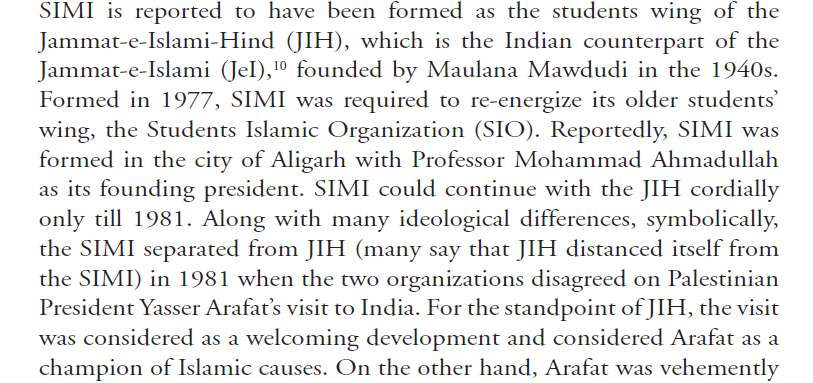
Journal of Defence Studies (The Students Islamic Movement of India: The Story So Far – Anshuman Behera)

According to academic research cited in the Journal of Defence Studies, SIMI increasingly embraced positions that even Jamaat-e-Islami-Hind found difficult to defend. The relationship between the two organisations deteriorated sharply after disagreements over Palestinian leader Yasser Arafat’s visit to India in 1981. While JIH viewed Arafat positively, SIMI activists denounced him as a Western puppet and greeted him with black flags.

This hostility toward Arafat becomes particularly important when viewed through the Hamas lens.

Hamas and Arafat’s Fatah movement were bitter rivals. Hamas rejected the relatively pragmatic Palestinian nationalism represented by Fatah and instead promoted a transnational Islamist project rooted in the ideology of the Muslim Brotherhood. SIMI’s hostility toward Arafat mirrored Hamas’s own ideological orientation and reflected the broader Islamist currents that were influencing radical groups across the world.

The split between SIMI and JIH was not merely organisational. It reflected a deeper ideological shift toward a more militant and transnational vision of political Islam.

Why SIMI’s ideology resembled Hamas

Perhaps the most striking aspect of the SIMI-Hamas relationship was not financial assistance or organisational contact but ideological convergence.

Research on SIMI documented that the organisation openly rejected secularism, democracy and nationalism, describing them as anti-Islamic concepts. It advocated the restoration of the Khalifat or Islamic Caliphate, emphasised the supremacy of the global Muslim Ummah and endorsed armed jihad as a legitimate means of establishing Islamic dominance. 
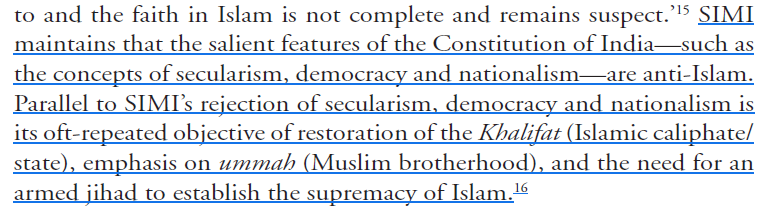
Journal of Defence Studies (The Students Islamic Movement of India: The Story So Far – Anshuman Behera)

The similarities with Hamas are difficult to ignore.

Like Hamas, SIMI viewed religious identity as superior to national identity. Like Hamas, it rejected secular political frameworks. Like Hamas, it regarded the establishment of an Islamic order as a religious obligation. And like Hamas, it viewed armed struggle as an acceptable instrument for achieving ideological objectives.

While Hamas sought to replace Israel with an Islamist state, SIMI increasingly articulated visions of an Islamic political order within India.

This ideological overlap created natural avenues for cooperation, networking and mutual support.

The Hamas founder who addressed a SIMI conference

Evidence of direct interaction between Hamas and SIMI emerged publicly in October 1999.

During the Ikhwan Conference organised by SIMI in Kanpur, which reportedly attracted more than 20,000 participants, speeches were delivered by several Islamist leaders. Among them was Sheikh Ahmed Yassin, the founder of Hamas, who addressed the gathering through a telephonic message. 
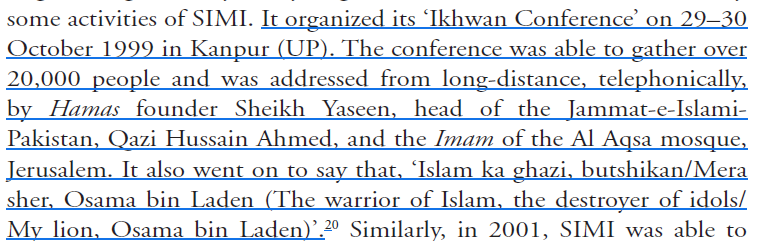
Journal of Defence Studies (The Students Islamic Movement of India: The Story So Far – Anshuman Behera)

The event also featured figures linked to Jamaat-e-Islami Pakistan and other Islamist networks.

The symbolism of the conference was revealing.

This was not an isolated local gathering. It was an event that connected radical Islamist actors across multiple countries through a shared ideological framework. It demonstrated that SIMI was not operating as a purely domestic organisation concerned with local grievances. Instead, it increasingly saw itself as part of a broader global Islamist movement.

The conference became notorious for extremist slogans glorifying Al Qaeda founder Osama bin Laden. It illustrated how global jihadist narratives were being integrated into Indian radical networks years before the emergence of the Islamic State or the global war on terror framework that followed 9/11.

The presence of Hamas founder Sheikh Yassin in such a forum underscores that contacts between Hamas and Indian Islamist networks were neither accidental nor insignificant.

Former SIMI leader revealed Hamas funding

The most explosive aspect of the SIMI-Hamas relationship concerns funding.

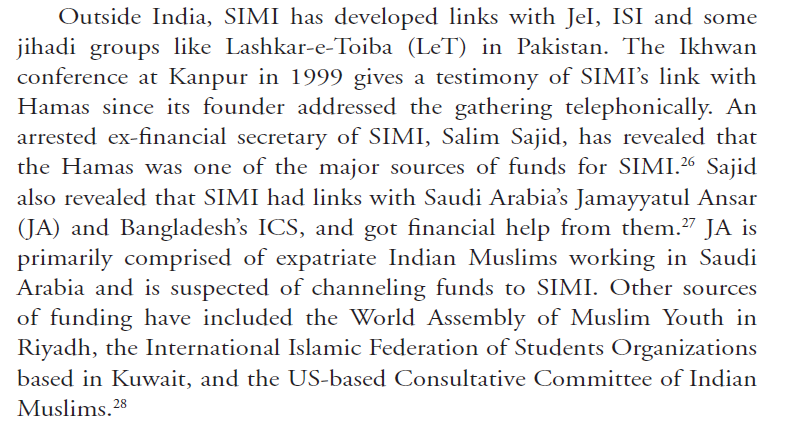
According to disclosures made by Salim Sajid, a former financial secretary of SIMI who later turned against the organisation, Hamas was among the key sources of financial support for SIMI. 
Journal of Defence Studies (The Students Islamic Movement of India: The Story So Far – Anshuman Behera)

His testimony indicated that SIMI was receiving funds from multiple international Islamist entities, including Hamas, Bangladesh-based Islami Chhatra Shibir, Saudi Arabia’s Jamayyatul Ansar and several organisations operating in the Gulf region.

These revelations are especially significant because funding networks often reveal deeper organisational relationships than public ideological statements.

Money is rarely transferred without expectations, influence or strategic objectives.

If Hamas was indeed helping finance SIMI, it would indicate that the Palestinian terror outfit viewed India as a theatre worthy of ideological investment and organisational expansion.

More importantly, such funding would demonstrate that Hamas’s activities extended far beyond the Israel-Palestine conflict and included participation in a wider ecosystem of transnational Islamist mobilisation.

Security agencies had already documented Hamas links

The testimony of former SIMI members was not the only source pointing toward Hamas connections.

Security agency investigations repeatedly identified links between SIMI and various extremist organisations across South Asia and the Middle East, including Hamas. 

These findings reinforced concerns that SIMI was embedded within a broader international network of Islamist organisations sharing ideological goals, training methodologies and funding channels.

The common thread connecting these organisations was not nationality or ethnicity.

It was ideology.

Whether operating in Pakistan, Bangladesh, Saudi Arabia, Palestine or India, these groups subscribed to versions of political Islam that viewed secular democracy as illegitimate, prioritised religious identity above national identity and sought the eventual establishment of Islamic political authority.

This ideological commonality helped create a transnational ecosystem where resources, propaganda, finances and personnel could move across borders.

From SIMI to Indian Mujahideen and beyond

The story becomes even more troubling when one examines what happened after SIMI was banned in 2001.

The organisation did not simply disappear.

Several investigations and intelligence reports suggested that many former SIMI operatives migrated into other radical organisations, including Indian Mujahideen and later networks associated with the Popular Front of India (PFI). 

Security agencies repeatedly warned that SIMI cadres were attempting to reorganise under new names and front organisations.

This pattern is hardly unique.

Terrorist organisations and extremist movements routinely create successor organisations, front groups and proxy entities to evade legal restrictions while preserving ideological continuity.

Lashkar-e-Taiba created charitable fronts. Jaish-e-Mohammed operated through multiple aliases. Islamist networks across the world have repeatedly adopted similar tactics.

The concern for Indian investigators is whether international relationships built during the SIMI era survived these organisational transformations.

If Hamas had relationships with SIMI networks in the past, did those connections vanish after the ban, or did they simply migrate into successor organisations and informal radical ecosystems?

This is precisely the type of question the NIA’s current investigation may now be attempting to answer.

Why the Pahalgam investigation matters

The NIA’s reference to Hamas comes amid growing concerns about cooperation between Pakistan-backed terror groups and global jihadist organisations.

Security officials have reportedly observed increasing interactions between Hamas and Pakistan-based groups such as Lashkar-e-Taiba and Jaish-e-Mohammed. The possibility that tactical methods, propaganda strategies and operational knowledge are being shared between these organisations cannot be dismissed lightly.

The October 7 Hamas attack on Israel demonstrated a level of planning, coordination and psychological warfare that attracted attention from terrorist organisations worldwide.

If elements of those tactics are being studied, adapted or shared among Pakistan-backed groups operating against India, the implications for Indian national security are profound.

The Pahalgam investigation is therefore not merely about identifying individual attackers.

It is about understanding whether a broader architecture of global jihadist cooperation is emerging, one that links Gaza, Pakistan and Kashmir through ideological affinity, operational collaboration and financial networks.

The uncomfortable reality

For years, many commentators attempted to compartmentalise terrorism.

Hamas was treated as a Palestinian issue. Lashkar-e-Taiba was viewed as a Pakistan problem. SIMI was described as a domestic radical organisation. PFI was often portrayed as merely a controversial socio-political movement.

The evidence accumulated over decades suggests a more complicated reality.

Extremist organisations frequently differ in language, geography and immediate political objectives. Yet many remain connected through shared ideological frameworks, common funding channels and overlapping organisational networks.

The history of Hamas’s association with SIMI serves as a reminder that terrorism rarely respects national boundaries. Organisations separated by thousands of kilometres can still collaborate when united by a common ideological vision.

As the NIA expands its probe into possible Hamas linkages in the Pahalgam terror attack, investigators may well uncover relationships that did not emerge overnight but were built over decades through networks that connected radical actors across South Asia and the Middle East.

The significance of the investigation lies precisely here. It is not merely about whether Hamas had a role in one particular attack. It is about determining whether India is confronting an increasingly interconnected ecosystem of Islamist extremism where local terror groups, Pakistan-backed proxies and global jihadist organisations function as different nodes of the same ideological network.

The story of Hamas funding SIMI, the participation of Hamas founder Sheikh Ahmed Yassin in SIMI’s events, the documented financial links exposed by former insiders, and the continuing migration of radical cadres into successor organisations suggest that the questions now being asked by the NIA are long overdue.

What the agency ultimately uncovers could reshape India’s understanding of how global jihadist movements have operated within the country for decades.

Amidst row over illegal mosque in Kawagoe, Pakistan Embassy in Japan urges Pakistanis to follow law: Is Japan witnessing Islamic takeover?

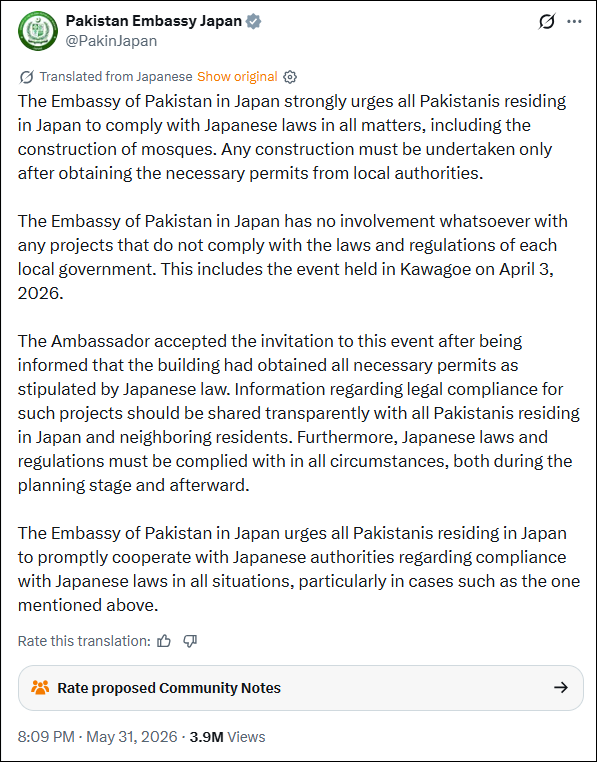
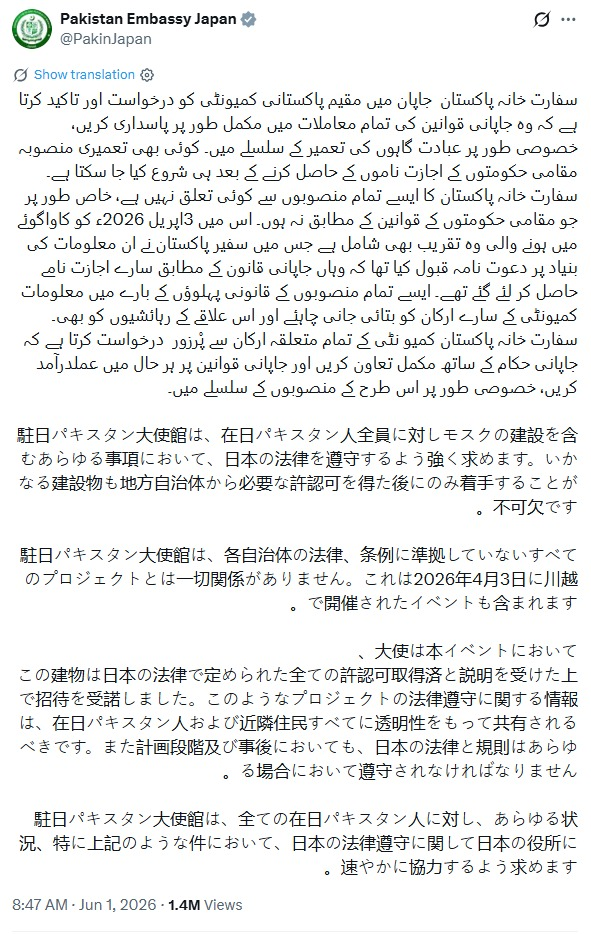
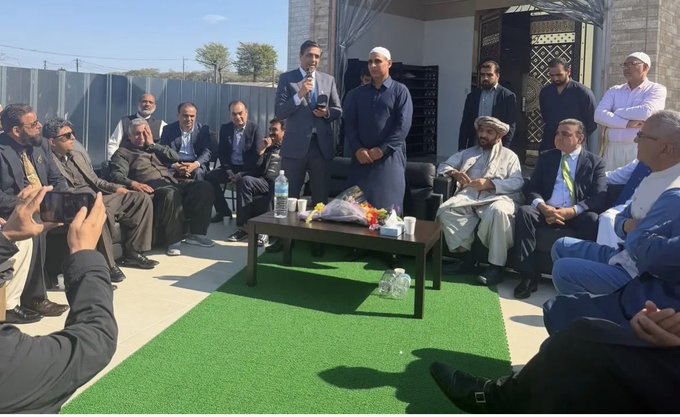
In a major embarrassment for Pakistan, the Pakistan Embassy in Japan issued a statement on the 31st of May 2026, urging Pakistani Muslims in Japan to “abide by” the Japanese laws in all matters, particularly the construction of mosques. The statement came in the backdrop of the Kawagoe illegal mosque construction controversy.

“The Embassy of Pakistan in Japan strongly urges all Pakistanis residing in Japan to comply with Japanese laws in all matters, including the construction of mosques. Any construction must be undertaken only after obtaining the necessary permits from local authorities. The Embassy of Pakistan in Japan has no involvement whatsoever with any projects that do not comply with the laws and regulations of each local government. This includes the event held in Kawagoe on April 3, 2026,” the Pakistani Embassy in Japan said.

Source: X

Addressing the issue of the Pakistani ambassador attending the inauguration event of the Japan Jame Masjid Ramzan in Kawagoe, the Embassy said that the ambassador Abdul Hameed accepted the invitation “after being informed that the building had obtained all necessary permits as stipulated by Japanese law.”

Source: X

“Information regarding legal compliance for such projects should be shared transparently with all Pakistanis residing in Japan and neighbouring residents. Furthermore, Japanese laws and regulations must be complied with in all circumstances, both during the planning stage and afterward,” the Pakistan Embassy in Japan added.

Source: X

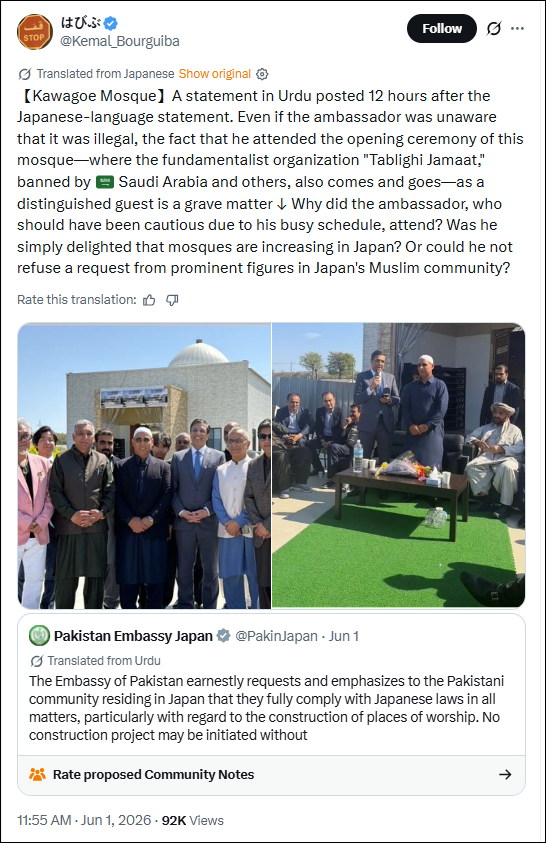
On social media, several Japanese people have expressed anger over the Pakistani official attending the opening ceremony of a mosque with alleged links to the Islamist organisation Tablighi Jamaat.

“A statement in Urdu posted 12 hours after the Japanese-language statement. Even if the ambassador was unaware that it was illegal, the fact that he attended the opening ceremony of this mosque—where the fundamentalist organisation “Tablighi Jamaat,” banned by Saudi Arabia and others, also comes and goes—as a distinguished guest, is a grave matter. Why did the ambassador, who should have been cautious due to his busy schedule, attend? Was he simply delighted that mosques are increasing in Japan? Or could he not refuse a request from prominent figures in Japan’s Muslim community?” one X use wrote.

Source: X

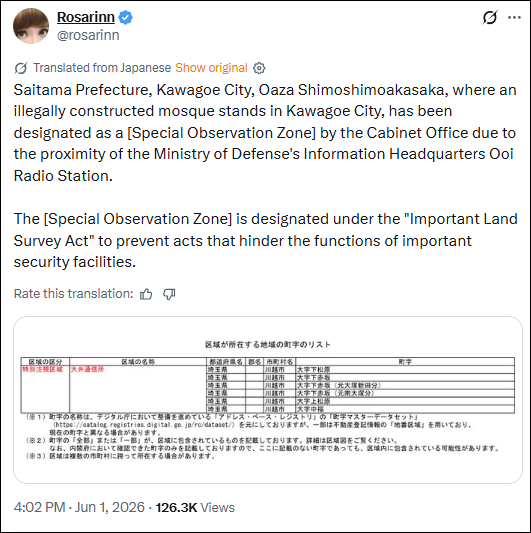
Some have even raised concerns that Pakistan may be backing mosque construction at specific locations in Japan at China’s behest for information gathering, since Japan and China are historical adversaries, although no media reports have indicated this angle so far.

“Saitama Prefecture, Kawagoe City, Oaza Shimoshimoakasaka, where an illegally constructed mosque stands in Kawagoe City, has been designated as a [Special Observation Zone] by the Cabinet Office due to the proximity of the Ministry of Defence’s Information Headquarters Ooi Radio Station. The [Special Observation Zone] is designated under the “Important Land Survey Act” to prevent acts that hinder the functions of important security facilities,” a Japanese X user wrote.

Source: X

The Kawagoe Japan Jame Masjid Ramzan: An illegal mosque and Pakistani Islamist intransigence

Pakistan Embassy in Japan had to issue an embarrassing statement schooling its Muslim nationals to abide by Japanese laws, especially in matters of mosque construction, due to the controversy of the illegal building and opening of the Japan Jame Masjid Ramzan, in Kawagoe City, Saitama Prefecture.

The Saitama Prefecture is a rural Shimo-Akasaka area, an urbanisation-controlled area, having strict building restrictions under the City Planning Act. However, as is the case with Islamists all across the world, local laws mean little to them in matters of Islamic expansion and takeover. The Masjid was illegally constructed on the land owned by a Pakistani-owned company.

Japanese media reports that the real estate registry classified the land in question as “forest land”.

In October 2024, the local residents protested against the nearly completed mosque structure. Since then, the city officials issued multiple stop-work orders; however, the Muslims did not comply and continued the construction work. Initially, the workers reportedly claimed that they could not understand Japanese, apparently to justify their non-compliance.

The land on which the Kawagoe, Japan Jame Masjid Ramzan stands was acquired in March 2025 by a Pakistan-affiliated company. The illegal mosque held its opening ceremony on 3rd April 2026. The event was attended by Pakistani ambassador Abdul Hameed, drawing criticism from the Japanese people for his presence at the opening of an illegal Islamic structure.

Amusingly, in almost all mosque-related disputes anywhere in the world, Muslims claim that the mosque was already there and will stay there till ‘Qayamat’ or Islamic judgment day. This is an Islamist playbook of bolstering and legitimising their claim over land they illegally occupy and erect mosques over.

In the Kawagoe Jame Masjid case, the owners are reported to have submitted a ‘corrective plan’, claiming that the illegal mosque “was always there”. The local Japanese authorities rejected these claims, as prior architecture, let alone a mosque, existed in records.

Many Japanese people have even brought up the old images of the same spot where the illegal mosque stands now, confirming that the Pakistani Muslim owners of the mosque were blatantly lying to justify the illegal encroachment. The delay tactics fell flat as the old images and official records confirm that no prior structure existed at that location.

The authorities have ordered the demolition of the illegal mosque, forcing the Pakistani embassy to distance itself from the incident.

From the Sambhal Jama Masjid in India’s Uttar Pradesh, which originally was a Hindu temple, to the Kawagoe Mosque in Japan, which is built on forest land, this ‘mosque was always there’ exemplifies Islamist intransigence.

The mosque controversy has reignited the debate around the influx of Muslims, demographic shifts, and fears of an Islamist takeover of Japan

A significant section of Muslims believes that it is their religious duty to spread Islam and convert more and more Kafirs or non-Muslims. Earlier, wars and conquests were a means of imposing Islam; in modern times, many travel to distant lands for this purpose, while others further the agenda wherever they live.

Japan is grappling with a serious population decline crisis. In fact, the crisis is accelerating faster than multiple official projections. Japan has one of the world’s lowest fertility rates and oldest populations. This has led to record-low births.

Japan’s Total Fertility Rate (TFR) dwindled to 1:15 in 2024, marking a ninth consecutive year of decline. In 2023, Tokyo’s TFR dipped below 1.0.

According to Japanese media reports citing official data, Japan recorded 705,809 births in 2025, down from around 721,000 in 2024. The number of natural declines and deaths also presents an alarming picture.

Overall, Japan has been below the replacement rate of 2.1 for decades, with its TFR hovering between 1.1 and 1.2.

The crisis has resulted in labour shortages in care, manufacturing, and services, exacerbated by slower economic growth, deflationary pressures, and challenges to funding infrastructure.

There have been reports of rural depopulation, school closures, and even the emergence of “ghost towns” or “dying villages”. These areas mainly include villages vacated by an ageing population and abandoned industrial hubs decimated by sudden economic shifts.

Although very limited success has been achieved, the Japanese government has been running various financial incentive schemes, implementing childcare expansion, enacted work-life reforms to increase Japan’s birth rates. However, cultural factors like later marriages, high child-rearing costs, gender roles, etc, coupled with economic uncertainties, continue to exacerbate the crisis.

Clearly, the demographic crisis of Japan is conducive to Islamist migrants to expand their tentacles. In recent years, due to a worker shortage, Japan has been importing workers from Pakistan, Bangladesh, and Indonesia, who are mainly Muslims. A significant number of Muslims are taking advantage of Japan’s immigration policies and making their way to the country. These Muslims mainly work as technical interns, caregivers, and other such jobs, filling demographic gaps; low birth rates and an ageing population.

There have been reports of Muslim migrant workers indulging in the propagation of Islam, converting Japanese locals, doing interfaith marriages, etc, to spread Islam, deepen their roots, and increase their population.

By the end of 2024, the Japanese media and researchers estimated that the number of foreign Muslims in the country stood at 360,000, while the total number of Muslims was around 420,000, including around 55,000 Japanese converts, marking an increase from 110,000 to 230,000 around 2010-2020. In short, the Muslim population in Japan has surged by four times in just 15 to 20 years. The number of mosques has also increased from 24 in 2001 to more than 164 in 2025.

With an increased presence of Muslims, there have been visible changes in the outlook of localities, culture and society. More mosques, more Muslims, more Islam and more trouble. There have been incidents wherein Muslims would offer namaz on roads, and in other non-permitted areas, in accordance with their usual global practice of exerting religious dominance, telling the local kafirs, ‘we have arrived’.

Though a secular country, Japan has Shinto-Buddhist traditions as its dominant religion, and has cremation as a near-universal practice. There have been incidents of commotion over this since Muslims believe in the burial of their dead, as Islam prohibits cremation. Since the Islamic tradition is not compatible with that of the local Japanese people, and Muslims remain adamant about these issues, concerns have been raised over the failure of Muslims to assimilate and respect local culture.

In May this year, a massive protest erupted over the construction of a mosque in the city of Fujisawa. The city inhabiting 440,000 people, has witnessed a rapid increase in the Muslim population. The mosque in question was being constructed by a Sri Lankan businessman, Mohamed Khaleel, who said that he wants to build a mosque because the Ebina Masjid 20 kilometres away is not sufficient to cater for the surging Muslim population in Fujisawa.

Interestingly, Khaleel and other local Muslims settled on a 980-square-meter site of an abandoned factory on the northern outskirts of Fujisawa in 2021. Operating in mission mode, they established the Fujisawa Masjid NPO, collected funds, bought the land and began obtaining permits for mosque construction.

The modus operandi is concerning. A group of Muslims settled near an abandoned factory in 2021, and quickly raised funds, and by 2025, built a mosque. A significant section of Japanese people is alarmed by how Muslim immigrants are expanding their religious footprint across Japan, in a fashion hinting at a deliberate conspiracy to eventually outnumber non-Muslim locals by both increasing their own population and brainwashing locals into converting to Islam.

This is a pattern of even small Muslim communities quickly prioritising erecting mosques, minarets, giving Islamic calls for Namaz loudly, and using public spaces for Namaz. Muslims have no qualms about violating local laws and bypassing permits to assert religious dominance. This Islamist playbook has been witnessed in Europe as well, wherein this has scaled to large complexes as Muslims exploit the ‘secular’ laws of tolerant nations to further their communal and Islamist agenda.

Not to sound cliché, but demography is destiny. Lebanon was Christian-dominated once, but now, Muslims have become a majority, comprising around 65 to 70% of the population and enjoy dominance, while Christians have become a minority in their own historical homeland. India is also sitting on a similar demographic timebomb, as the Hindu majority faces the danger of being outnumbered by the Muslim ‘minority’.

A 2020 research carried out by Pierre Rostan and Alexandra Rostan estimated a timeline of many European countries turning into Muslim-majority in the coming centuries. Based on the migration scenario, the research estimated that among the High-Growth Muslim population countries, six of them will reach a majority of the Muslim population in the next 200 years. Belgium (in 2175), Bulgaria (in 2160), Cyprus (in 2175), France (in 2165), Sweden (in 2170) and the United Kingdom (in 2195) will all have a Muslim-majority population.

From one mosque emerges a Muslim area, a Muslim area soon becomes a strict no-go zone, streets are blocked, demands for Sharia law implementation come up, in fact, parallel Sharia courts also emerge.  France, the UK, Sweden, the US and many Western countries, along with India in Asia, are grappling with the Islamist expansionist demographic war against Kafirs. Japan is also heading the same way with its suicidal policy of importing Pakistani and Bangladeshi Muslims.

‘Hindu men are incapable, Muslim men are more attractive’: How Arfa Khanum and Nivedita Menon echoed Islamist supremacist tropes to whitewash Love Jihad

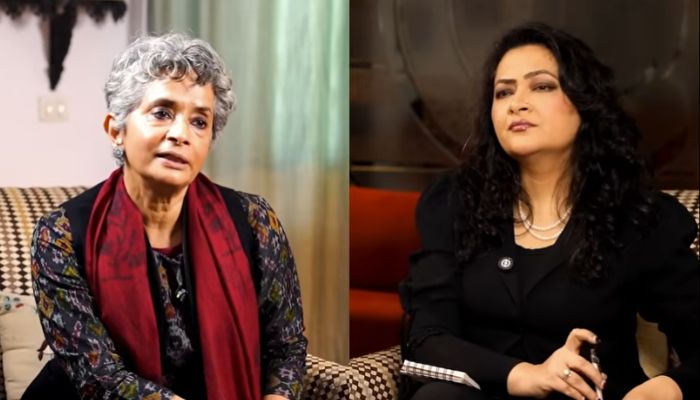
Islamo-leftists portray themselves as progressive, liberal, feminist, rational, and intellectually superior to ‘Hindu nationalist’ right-wingers. They talk about Hindu-Muslim unity, Ganga-Jamuni Tehzeeb, ‘Diwali mein Ali, Ramzan mein Ram’, and whatnot to dramatise the Muslim victimhood bogey. However, there are moments when they expose their real Islamist mindset. A video clip from a podcast by Islamo-leftist rag The Wire’s Arfa Khanum Sherwani and JNU professor Nivedita Menon mocking the Hindu victims of Love Jihad has sparked outrage on social media.

The viral clip is from a podcast Sherwani hosted in February 2026. In this, Nivedita Menon and The Wire’s propagandist not only laugh off the concept of Love Jihad, but also dismiss concerns about a predatory pattern involving Muslim men targeting Hindu women due to religious hatred for Kafirs, as mere Hindu male insecurity.

From emphasising a woman’s free will and agency, the duo pivoted to suggesting that Muslim men somehow possess superior attractiveness or charisma that Hindu women find irresistible. Arfa repeatedly emphasised her question, “Hindu ladkiyon ko Musalman mard hi kyun pasand aate hain?” (“Why do Hindu girls like Muslim men so much?”)

To Arfa’s crude generalisation on Hindu women, Nivedita responds, “Muslim mard honge itne attractive… [laughs] … aur unko apne hi dharm mein woh nahi milta hoga.” (“Muslim men must be so attractive… and they probably can’t find that in their own religion.”)

Nivedita Menon framed the concept of Love Jihad as simply an “expression of helplessness” by Hindu men. Menon suggested that Hindu men feel insecure, implying that Muslim men are somehow more attractive or desirable. The tone, laughter, and mockery show how comfortably an Islamist and a liberal lackey of Islamists communally stereotype Hindu women, declare Hindu men as ‘frustrated’, ‘insecure’ and ‘impotent’ and reduce interfaith relationships into a communal competition wherein women from ‘rival’ religion are trophies, and whoever wins more ‘trophies’ proves his religion superior.

One thing is clear: for Islamists Arfa, who masquerade as liberal-progressive, Hindu women are autonomous agents only when it suits their narratives of Muslim victimhood or Hindu majoritarianism.

When the question is about real, documented pattern of Muslim men feigning love, often pretending to be Hindu, to lure Hindu women, establish sexual relations, use obscene videos to blackmail them, extort money, force Islamic practices like Namaz and Hijab or Burqa, force-feed cow meat, pressure them into converting to Islam and doing Nikah, Love Jihad become ‘conspiracy theory’ and the agency of Hindu women is replaced with victim-blaming and hailing the ‘allure’ of Muslim men.

What an irony that the self-declared ‘secular-progressives’ echo Islamist supremacist tropes like the “virile and dominant Muslims versus the weak Hindus”, and indulge in communal boasting.

What is common between a Dhimmi Kafir, a ‘moderate’ Muslim, and a full-fledged Jihadi? Besides the penchant for romanticising everything Islamic, a trait shared by this trio is their ability to maintain a ‘victim’ outlook despite their parasitic actions.

A group of Islamic terrorists shoot down Hindu men for being Hindu, and the Dhimmis and ‘moderate’ Muslims instinctively announce ‘terrorism has nothing to do with Islam’. A Muslim Jihadi fakes his religious identity to lure a Hindu woman with a clear agenda of sexual abuse and conversion to Islam, and the Dhimmi and moderate duo will somehow portray the Jihadi as the victim.

But here’s the interesting part. The Muslim victimhood is a carefully concocted propaganda, a means for protecting Jihadis, whitewashing their crimes, and vilifying the victim community for calling out Islamist crimes.

When the Kashmiri Pandit exodus happened in the 90s, local Muslims and armed Islamic terrorists used to announce that Hindu men must flee but leave their women behind, to be raped, tortured, and enslaved by them. What has been the Islamo-leftist narrative? It was not an exodus at all; Muslim neighbours in Kashmir regretted what happened; no such ‘leave your women’ calls were given. This is all BJP-RSS-peddled lies to villainise Muslim ‘minorities’.

The same pattern is seen in the context of Love and conversion Jihad. There have been thousands of cases of Love Jihad, both at individual levels and those involving full-fledged Muslim rape gangs like the ones exposed in Rajasthan’s Beawar, Ajmer, and in Uttar Pradesh. From Kerala to Uttar Pradesh, to United Kingdom, there have been cases of Muslims weaponizing rape as a means of conquest of Kafir women, and humiliating non-Muslims and their faith, and yet India is riddled with the many Arfas and Niveditas who draw joy, secular on surface and Islamist from inside, by mocking the Hindu victims of the perverted Islamist ideas like ‘Maal-e-Ghanimat’, which attach religious merits to sexually abusing, humiliating and enslaving non-Muslim women.

While the many Niveditas are useful idiots for Islamists like Arfa Khanum Sherwani, a showpiece Hindu to convey their derisive message that “See, women from your own community are saying that Muslim men are more attractive”.

How are these two ‘feminist-progressives’ any different from Muslim men who run Facebook and Telegram groups calling Hindu women ‘R@nd*’, making edits blending the faith of Hindu women with their religiously-motivated rape fantasies? By dismissing countless cases of exploitation of Hindu women by Muslim men who trapped them either by faking their religious identity or by pretending to be ‘secular’, how are Arfa and Nivedita not different from Muslim men who mockingly boast that Muslim men are more ‘virile’ or ‘sexually potent’ because they eat meat, especially cow meat?

Islamic texts prescribe that Muslim women fully cover their bodies, perform namaz at home, go out only when accompanied by a male Mehram, and men are allowed to take four wives and even lay down the procedure of wife-beating. Many Muslim women are yet to fully get out of the shadow of their male Mehrams, how would they have the freedom and agency to interact with Hindu men, let alone being ‘won over’ by Hindu men. It has been seen how the same Muslim men, who gleefully ‘welcome’ Hindu women to Islam, who marry Muslim men, bay for the blood of Hindu men who they find out to be dating Muslim women.

There may have been occasions when some right-wing leaders flagged concerns about the pattern of love jihad and the modus operandi of rape jihadis. However, portraying such warnings and concerns as ‘shameful admission’ by Hindu hardliner men of their own ‘failure’ to win over women from their own community or Muslim women, shows that even Muslim women like Arfa take delight in the communal scorekeeping of who won more women from the ‘rival’ faith, reducing women to being mere objects of pleasure and means of establishing supremacy of infidels.

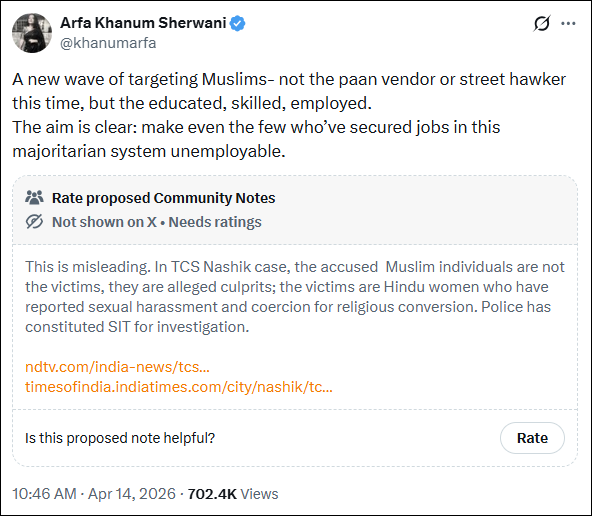
Just a month back, the same Arfa Khanum Sherwani was casting aspersions on the integrity of Hindu women who accused their six Muslim colleagues at a BPO unit of Tata Consultancy Services (TCS) in Nashik, of workplace harassment, constant insulting commentary on Hinduism, sexual abuse, coercion to convert to Islam, offer namaz and eat beef. She claimed that Hindu women who filed a complaint against their Muslim colleagues were lying and created a ‘drama’ out of hate, to ensure that the Muslim men become “unemployable”.

While Nivedita Menon said that ‘love jihad’ is a term concocted by those Hindu men subscribing to the idea of Hindu Rashtra, the term originally came from the Christian church in Kerala because girls were being targeted and brainwashed to join ISIS.

The Islamo-leftists like Arfa Khanum Sherwani and the Muslim-appeasing political parties have long been trivialising the menace of love jihad/rape jihad/grooming jihad as a ‘hoax’, ‘fiction’, and ‘BJP-RSS conspiracy theory’ despite there being ample evidence and thousands of cases across the country. No wonder Arfa and Nivedita dismissed films like The Kerala Story as ‘Islamophobic propaganda’.

There, however, is a difference between the Islamist mind of Arfas and the partially Islamised mind of Niveditas. While the many Niveditas and Sreenivasan Jains (author of ‘Love Jihad and Other Fictions’ trash) deliberately turn their eyes away from the crime, pattern, and most importantly, the Islamic motivations behind Love Jihad and try to secularise such crimes or dismiss them as fake altogether, the Arfas know this reality. They know love jihad is real, they know that a significant section of Muslim men does believe that deceiving Hindu women, sexually abusing them on false pretexts, and weaponising rape as a means to secure their conversion to Islam and contribution to Muslim demographics is Haram, permissible or justified.

Hindu women have been exploited by Islamic jihadi perpetrators from Amravati to Ajmer and Beawar to Bhopal, Kerala to Nashik, through coordinated conspiracies that also offer substantial financial rewards to the perpetrators. And yet, the Hindu-hating Islamo-leftist cabal finds its Niveditas and Arfas to whitewash Islamist crimes, paint victims as villains, and reduce the lived plight of Hindu women to the ‘frustration’ of Hindu men over ‘their’ women choosing ‘superior’ Muslim men.

The same lot that dismisses Love Jihad as a hoax, and a mere outrage term used by ‘frustrated’ Hindu men because many Hindu women chose Muslim partners, cries hoarse over Bhagwa Love Trap, alleging that Hindu men are luring Muslim women with the eventual aim of conversion to Hinduism.

In fact, Nivedita is right, ‘Hindu mardon se nahi hota’. Hindu men can’t fake their religious identity to love-trap Muslim women. Hindu men are just not taught to treat women, be it Hindu or Muslim, as a means of establishing religious supremacy or insulting the Mlecchas. Hindu scriptures do not promise paradise or sex slaves in heaven for Hindu men who used love, deception and sex as means for converting non-Hindu women to Hinduism. Hindus are inherently secular. Had this not been the case, Muslims would not have been thriving in India even after the bloody partition of India on Islamic lines.

Physical strength, attractiveness, and potency are not linked to religion. If these qualities were linked to religion, and as per the discussion between Nivedita and Arfa, Muslims were stronger and more capable than the Indian Armed Forces, comprising Hindus mainly, would not have defeated the Pakistan Army, which essentially runs on the motto of ‘Jihad Fi-Sabilillah’, in four conventional wars. Genes are not Hindu or Muslim.

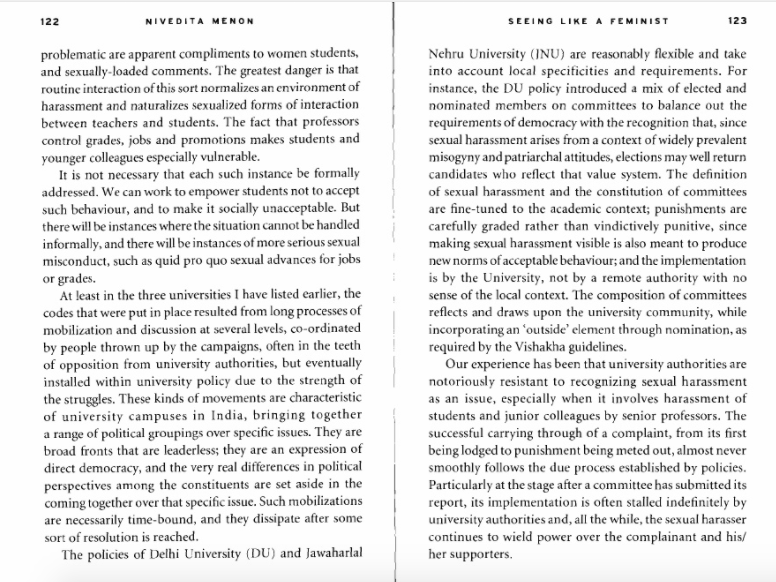
However, nothing better can be expected from a Dhimmi like Nivedita Menon, who believes India is illegally occupying Jammu and Kashmir, praises anti-Hindu Delhi Riots accused mastermind Umar Khalid, and opines that in an academic environment, the definition of sexual harassment would have to be different from other kinds of workplaces.

Nivedita believes that universities are filled with young people in their formative years, and hence, we must think about what it does to them when the teacher regularly passes derogatory comments. You could read her book “Seeing like a Feminist” from where the above quote is taken here. No wonder Nivedita Menon had no qualms about mocking Hindu women who have been victims of love jihad.

What are undersea Internet cables, and why are nations racing to defend them? Explained

In the contemporary era of escalating hybrid warfare and power competition, the concealed arteries of the global internet are under a serious threat. The modern world relies on undersea fibre-optic cables that carry nearly all of the intercontinental data, financial transactions, and communications. However, these internet lifelines lying on the ocean floor now face sabotage risks as the ongoing decade is turning out to be a decade of wars and countries finding unique means to threaten adversaries with economic paralysis and absolute isolation.

“Seabed is battlefield”: Australia, US and UK come together to protect undersea internet cables and energy pipelines

As threats of deliberate sabotage and consequent internet blackouts loom, the United States, United Kingdom, and Australia have announced a new AUKUS initiative to deploy advanced Unmanned Underwater Vehicles or Uncrewed Undersea Vehicles (UUVs) specifically designed to safeguard seabed infrastructure, particularly internet communication cables and energy pipelines.

On 30th May 2026, the UK, US, and Australia announced the initiative to protect undersea cables at a defence minister’s meeting at the Shangri-La Dialogue. The initiative will be a part of AUKUS Pillar II, which focuses on advanced capabilities in areas like AI, undersea robotics, and autonomy. The United Kingdom will contribute around £150 million to the project. As per media reports, these UUVs will feature cutting-edge payloads for safeguarding seabed infrastructure, surveillance, reconnaissance, logistics, and strike capabilities. The project will deliver results next year.

Speaking about what warranted the necessity to launch the AUKUS Pillar II initiative, Australian Defence Minister Richard Marles described undersea internet cables as “the arteries of the modern world” and highlighted how there has been a “historically unprecedented” surge in cuts or attacks on undersea infrastructure in the last 18 months.

Besides AUKUS, 17 nations, Singapore, Brunei, Malaysia, the Philippines, Thailand, Australia, New Zealand, Qatar, Estonia, Finland, France, Italy, Latvia, Lithuania, the Netherlands, Sweden and the United Kingdom have approved the Guiding Principles for Underwater Infrastructure Defence Exchanges (Guide) to protect vital undersea cables.

Russia, which has been embroiled in a war with Ukraine since 2022, has its submarines tracked by the UK, surveying Atlantic communication cables. In recent years, at least two Chinese-flagged vessels have also been involved in disruptions of crucial undersea internet cables in the Baltic Sea.

In October 2023, NewNew Polar Bear, a Hong Kong-registered, Chinese-owned container ship, dragged its anchor for more than 100 miles. This severed both the Balticconnector gas pipeline and the telecom cables connecting Finland to Estonia.

A similar incident was reported in November 2024, wherein a Chinese cargo ship, Yi Peng 3, was tracked to be involved in the near-simultaneous severing of the C-Lion1 cable that connected Finland and Germany, and the C-Lion1 cable, which linked Sweden and Lithuania. In 2026, Iran, which has found reprieve in a fragile ceasefire, has threatened to damage undersea internet cables in the Strait of Hormuz.

Clearly, access to undersea cables is a massive geopolitical leverage, especially for countries like Iran, which are engaged in war, as they can secure concessions from adversaries during negotiations.

As undersea cables hold immense significance for global internet and communications, and are now under threat from wars, let’s understand what exactly these cables are, how they are laid undersea, and why they are vital

Undersea internet cables: The arteries of the modern world

Colloquially called undersea cables, submarine communications cables are fibre-optic lines laid on the seabed to carry the massive amount, nearly 95-99% intercontinental data, voice, and financial traffic. According to various reports and research, there are over 570 active undersea communications cables, while numerous others are planned. The existing undersea cables network spans over 1.5 million kilometres. It is reported that a single modern undersea cable can carry terabits per second, having way more capacity and lower latency than satellites.

These undersea cables underpin global internet and cloud services, international banking and trade, e-commerce, communications, and AI/data centre demands. They are also vital as green energy interconnectors.

In short, without these undersea cables, the modern technology-driven civilisation, with real-time global connectivity, would collapse in affected regions in no time. Though satellites will be the resort in case of undersea cable disruption, they cannot completely compensate because of latency, bandwidth, and coverage limits, particularly for high-volume data.

How undersea cables are laid on the seabed

For the deployment of undersea cables, specialised cable-laying ships, with huge spools holding hundreds of kilometres of cable, are used. The cables are not randomly laid. Such projects undergo proper planning, with routes avoiding fault zones, fishing or anchoring areas, hazards, etc., using detailed seabed maps.

The undersea cables are armoured and buried using ploughs or through remotely-operated vehicles (ROVs). Ploughs are used to create a trench, lay the cable, and then sediment covers it. Since burial is impractical, cables are laid directly on the seabed or the benthic zone.

The cable-laying process begins from the onshore landing stations. The ship used for cable-laying deploys cable gradually while moving. Sometimes, thrusters are used for precision.

Notably, repairing cable disruption is a complex, weather-dependent, expensive and time-consuming task. The repair process often involves grappling the ends, splicing on a ship, and re-laying the cable.

More than 80% of the over 1.3 million kilometres of active submarine fibre optic cables are located in inaccessible deep sea below 1500 m depth, making the repair job even more difficult.

What happens if undersea internet cables are cut

If an undersea cable is cut, fibre strands are severed, disrupting data flow in that segment. Such disruptions cause increased latency, congestion, and slowdowns. Internet blackouts would occur. There would be economic disruptions, affecting finance, business, payments, and services.

Multiple studies show that most of the incidents of damage to undersea cables originate from unintended human activity at sea, such as fishing (38%) and drag anchoring (25%), followed by environmental hazards (14%) like seaquakes or underwater currents.

A 2022 research paper titled “The digital divide in state vulnerability to submarine communications cable failure” studied the impact of undersea cable disruption in affected regions. It cited a case from 2015, wherein the only available submarine cable on the archipelago of the Northern Marianas ruptured. Caused by underwater currents, the rupture disconnected the island from broadband traffic for several days, inflicting significant negatives on the island’s economy and connectivity.

“Cascading effects caused internet, telephone communication, and air traffic to collapse, along with disruptions in the health, tourism, and education sectors. The U.S. overseas territory with 50,000 inhabitants suffered damage amounting to 21 million USD. Small island developing states (SIDS) hardly offer any possibility to operate a cable economically due to their characteristics, such as their remote location, small number of citizens, and below-average GDP, resulting in lower internet usage,” the research paper reads.

One of the first major incidents of undersea cable disruption was reported in 2008, when multiple cables were damaged near the Persian Gulf, particularly in Alexandria, Egypt, and elsewhere. The damage affected millions of lives in West Asia, India, Pakistan, Egypt, etc. There were reports of massive slowdowns and outages, with Egypt losing 80% capacity.

Similar disruptions and aftermaths were reported in the 2022 Tonga incident, wherein the Hunga Tonga-Hunga Ha’apai volcanic eruption caused tsunamis, currents, and debris that severed Tonga’s only international undersea cable. Tonga, a small island nation east of Australia, lost broadband connectivity for weeks, with international repairs taking over five weeks, and domestic repairs taking even longer.

In more recent years, damage to undersea cables has been reported in the Red Sea between 2024 and 2025. Linked to conflict and shipping, damage to undersea cables like AAE-1, EIG, SEACOM, and SMW4 affected traffic between Asia, Europe, the Middle East, and Africa. Although rerouting helped mitigate blanket blackouts, latency issues and disruptions were reported across many countries.

A 2026 National Oceanography Centre (NOC) research found that over 75% faults on island cables happen within 300 kilometres of coastlines. This happens due to both human activity and natural hazards.

While accidental damages caused by human activity or natural disasters remain the major causes of undersea cable disruptions, due to wars, deliberate attacks are moving from being a rarity to a serious threat, jeopardising global connectivity. Besides choosing dialogue over war to resolve disputes, routes diversification, investment in repair fleets, boosting satellite backups, and adhering to international norms are crucial measures to protect global connectivity, since the stakes here are existential.

What is the ‘signature scam’ of the TMC, which has created a political storm in Bengal and caused embarrassment for Mamata Banerjee

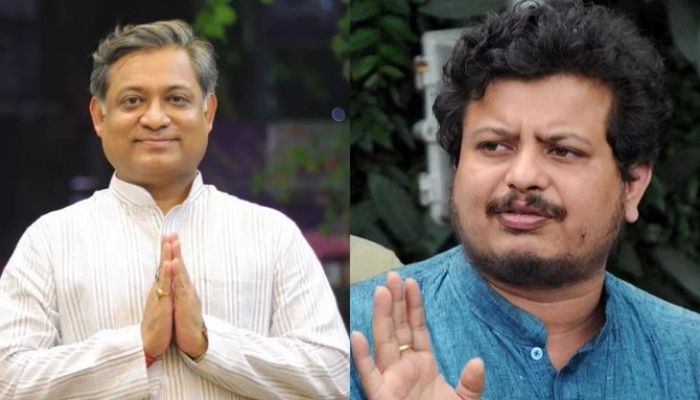
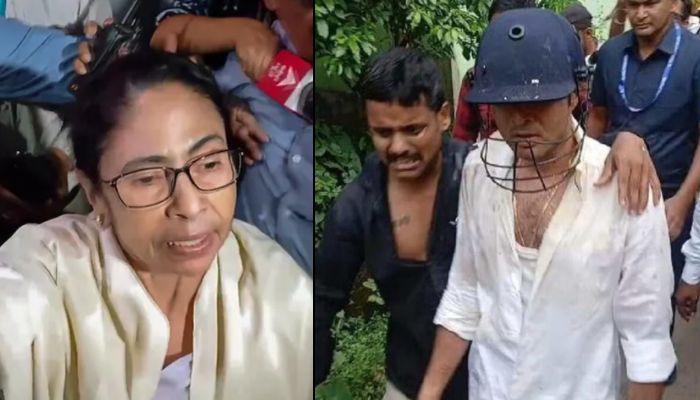
The Trinamool Congress on Monday, 1st June, expelled two of its MLAs, Ritabrata Banerjee and Sandipan Saha, after both leaders raised serious allegations regarding forged signatures in a document submitted to the West Bengal Assembly Speaker’s office. The controversy, now widely referred to as the Bengal “signature scandal”, has triggered a major political storm in the state and intensified tensions between the ruling BJP government and Mamata Banerjee-led TMC.

The party announced the expulsion shortly after West Bengal Chief Minister Suvendu Adhikari publicly referred to complaints made by the two MLAs over forgery of signatures in a letter endorsing Sobhandeb Chattopadhyay as the Leader of Opposition in the Assembly.

A communication issued by TMC vice-president Chandrima Bhattacharya accused the two legislators of “anti-party activities.” The letter claimed that both MLAs repeatedly skipped party meetings and made statements harmful to the interests of the organisation.

“After due consideration of the matter, the competent authority of the AITC has decided to expel you from the primary membership of the party with immediate effect,” the letter stated.

Sandipan Saha targets Abhishek Banerjee

The controversy deepened further after expelled MLA Sandipan Saha directly blamed TMC national general secretary Abhishek Banerjee over the forged signatures.

“Submitting the signatures of those who weren’t there was a huge blunder. Abhishek Banerjee’s name is coming up because he signed the list of MLAs as the General Secretary,” Saha told ANI.

“That list itself had so many mistakes. Questions will definitely fall on Abhishek Banerjee because it was his responsibility and he failed to fulfil it,” he added.

The CID has already issued a notice to Abhishek Banerjee in connection with the case. A CID team visited his Kalighat residence on Saturday and summoned him for questioning. However, Abhishek did not appear before investigators on Monday, citing ill health, and reportedly sought 15 days.

Suvendu Adhikari calls for detailed probe

Soon after the expulsions, Chief Minister Suvendu Adhikari addressed reporters at Nabanna and announced that the signature forgery allegations would be investigated thoroughly by the Criminal Investigation Department (CID).

Adhikari said the complaints regarding forged signatures had come directly from TMC MLAs Ritabrata Banerjee and Sandipan Saha. According to him, an FIR was first registered at Hare Street Police Station on the Speaker’s instructions, after which the matter was handed over to the CID.

“This is not an act of vendetta. The law is very clear on this issue,” Adhikari said.

He claimed that statements of several MLAs had already been recorded during the investigation. “The statements of 13 MLAs have been recorded. Another MLA is out of station, and his statement will be recorded later,” he said.

Adhikari further that multiple signatures shown in the document submitted to the Speaker’s office were not genuine. “Three Trinamool MLAs – Baharul Islam, Arup Roy and Shubhashis Das – have given statements to the CID that the signatures in the document were not theirs,” he claimed.

“The investigating agency can say on whose instructions this was done,” he added.

What is the Bengal signature scandal?

The controversy revolves around a letter submitted to the office of Assembly Speaker Rathindranath Bose on 20th May regarding the appointment of Sobhandeb Chattopadhyay as the Leader of Opposition.

According to the letter, signatures of several TMC MLAs were forged in the document without their consent. The issue became serious after multiple legislators reportedly informed investigators that the signatures shown beside their names did not belong to them.

Investigators are now trying to determine who prepared the document, who approved it and whether signatures were deliberately forged. The CID probe is currently focused on how the letter was prepared and submitted, and whether senior party functionaries were aware of the irregularities.

At the same time, Chief Minister Suvendu Adhikari also raised questions regarding fake beneficiaries under the Lakshmir Bhandar scheme, which was launched during the previous TMC government to provide financial assistance to women.

Adhikari claimed that nearly 30 lakh accounts linked to the scheme were fake and alleged that many men had illegally received benefits meant only for women.

“Around 30 lakh Lakshmir Bhandar accounts are fake. I have asked the DGP to form an SIT to investigate the matter,” Adhikari said.

He further stated that the government was also looking into possible money laundering linked to the fake accounts, since public money had allegedly been transferred illegally.

According to the Chief Minister, investigators had already identified several suspicious accounts in districts like Murshidabad. “The investigators have so far identified around 22 such fake accounts being operated by three people in Murshidabad,” he claimed.

Adhikari said one individual named Mustafizur Rahman and his wife Tuhina operated 15 fake accounts, while another person identified as Tarikur Rahman operated six such accounts.

Suvendu links scandal to “15 years of corruption”

While addressing the media, Suvendu Adhikari also linked the controversy to what he described as a culture of corruption during the Trinamool Congress regime.

“The signature scandal is indicative of the reign of corruption that the Trinamool had engaged in during its 15-year rule,” he said.

The Chief Minister said the government would not interfere in the investigation and that the law would take its own course. “As the chief minister and home minister, I instructed the CID to take over the case. I am not going to interfere in the investigation. That is not my job,” he stated.

Mamata Banerjee accuses BJP of intimidation

Meanwhile, Mamata Banerjee has accused the BJP government of trying to politically target and intimidate TMC MLAs.

The former Chief Minister claimed that several party legislators were threatened over the phone before attending a party meeting. “Four of my elected MLAs complained to me how they were threatened by the cops over the phone before they came for the meeting,” Mamata said.

She also accused the BJP of attempting to weaken the Trinamool Congress by using administrative machinery against opposition leaders.

The controversy has now exposed growing cracks within the TMC at a time when the party is already facing internal dissatisfaction after its poor electoral performance. With the CID investigation intensifying and senior leaders now under scrutiny, the Bengal signature scandal is expected to become one of the biggest political flashpoints in the state in the coming days.

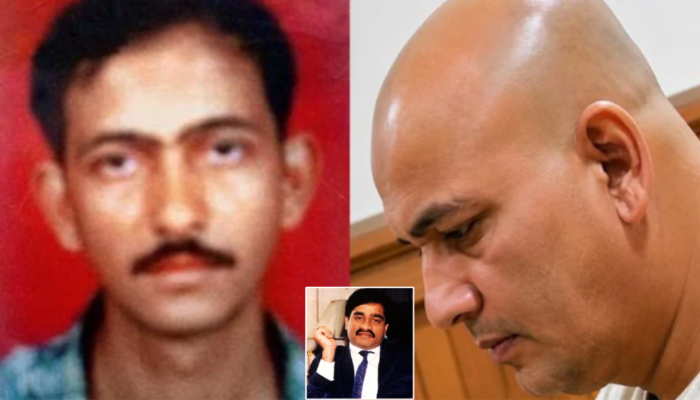
Who is Munna Jhingada: The Dawood aide, Bangkok fugitive and the ISI operative behind a foiled terror conspiracy

On 30th May (Saturday), 8 members of a module connected to the criminal underworld of Mumbai and Inter-Services Intelligence (ISI) of Pakistan have been apprehended by the Delhi Police’s Special Cell. The module mobilised a group of terrorists to assault key regions around the nation, especially Delhi and Mumbai.

Anil Shukla, Commissioner of Police, Special Cell, informed, “Major attacks have been averted with the arrests of these individuals. We have collected evidence, including some pictures, videos, and coordinates of specific government and non-government buildings and security establishments at which these attacks were being planned.”

The police pointed out that the perpetrators were assigned to assault vital installations, security units and security personnel. Their targets included power plants, airports, railroads and nuclear facilities. They intended to execute grenade attacks and shootings. The authorities have confiscated a significant amount of ammunition and weapons.

An operation took place over the course of 17 days, which was jointly carried out by the Delhi Police’s Special Cell from Delhi, Maharashtra and Jharkhand. The arrested people were linked to Shahzad Bhatti, a criminal from Pakistan and Munna Jhingada, a close accomplice of fugitive Dawood Ibrahim, who was imprisoned in Bangkok in 2000 after he was sent there to kill Chhota Rajan on a bogus passport.

The police noted that Bhatti has been operating out of Pakistan for the last 5 years, while Jhingada spent 17 years in prison in Bangkok before he was brought back to the country. According to other reports, the police asserted that Munna Jhingada, Dilawar Khan Shahzad Bhatti and Amir Jatt were the 4 primary handlers of the module and the minds behind the terror conspiracy. They are all based in Pakistan at the moment.

Security agencies revealed that Jhingada has been operating from a Karachi safe house. The location is near a posh hotel and just a few kilometres from an area attributed to Dawood’s apartment in the city. They suspect that Jhingada used digital communication to stay in contact with terrorist recruiters and operatives based in India. He was actively interacting with them via encrypted conversations and video calls.

Evidence that suggested he wanted to arrange and set up a new group of these deadly operatives within the country is under inquiry by agencies. Jhingada was in regular communication with people involved with the nefarious network and exchanged recent pictures of himself with associates.

He originally entered the spotlight after the breakup between Dawood Ibrahim and Chhota Rajan following the 1993 Mumbai riots and serial bombings. After the explosions, Rajan left D-Company and formed his own criminal organisation in Southeast Asia because he disapproved of Dawood’s strong bond with ISI. 

Who is Munna Jhingada

Sayyad Muzzakkir Muddasar Hussain, infamously known as Munna Jhingada, is a prominent aide of Dawood Ibrahim and has long been an associate of his trusted deputy, Chhota Shakeel. He is from the Jogeshwari neighbourhood of Mumbai and is charged with orchestrating major terrorist assaults in India.

Dawood had asked him to reach Pakistan through Nepal in 1997, after which he commenced working for the D-company network. The former regularly utilised Jhingada, a dreaded shooter, to kill his fiercest adversaries since he was incredibly confident in his shooting abilities. He was even told to go after mobster Arun Gawli. He also became one of Chhota Shakeel’s most dependable actors.

Jhingada killed a significant Akhil Bharatiya Sena leader allegedly tied to Arun Gawli in October 1997. He was captured with a small arsenal, which put an end to his murderous rampage. However, he was able to secure bail and departed for Pakistan in 1999. Jhingada has been staying and running terror modules in Karachi, as those allied with the D-company and ISI fled him there in 2019. He has a lot of critical information on Dawood and the ISI.

Jhingada was a second-year Bachelor of Arts student at a Jogeshwari (East) college when he first embraced the criminal world on 12th February 1990. He witnessed a fight involving his friends over an eve-teasing incident and then fatally stabbed a man named Wazir. He gained bail in November 1991 after turning himself in to the police.

Jhingada was pulled into violence again after briefly going back to work in his father’s plumbing company. Nazir, Wazir’s brother, and his friends attacked him on 31st March 1994 for revenge. He attacked Nazir during the face-off and surrendered at the Meghwadi police station.

Jhingada was booked for many crimes between 1990 and 1995, including murder and attempted murder. He escaped to his hometown in the Gonda district of Uttar Pradesh after Nishar Ahmed’s murder in August 1995. He practised with country-made firearms for about six months before starting as a sharpshooter for Chhota Shakeel’s gang in Mumbai.

His arrest on 24th March 1996 marked a crucial turning point. Jhingada met Ismail Malabari, Chhota Shakeel’s confidant, while incarcerated at Arthur Road Jail, who introduced him to their network and helped in obtaining his bail. Jhingada executed multiple contract killings for the cartel between 1994 and 1999. He was accused of killing Sunil Jain, a hawala operator who was suspected of managing money connected to rival criminal Chhota Rajan and fostering links with a well-known Mumbai encounter specialist. Pakistan’s intelligence agency also became aware of his rising proximity to Shakeel.

Dawood Ibrahim and Chhota Rajan gang war

The gang war between Dawood Ibrahim and his erstwhile subordinate Chhota Rajan is directly related to Jhingada’s criminal past. His reputation soared after the unsuccessful attempt on Rajan’s life in Bangkok in 2000. He and other gang members went to Thailand to eliminate him on Shakeel’s orders after the killing of Dilshad Mirza Beg, an Indian-born Nepali politician and Dawood’s primary coordinator in the landlocked nation. The contract value of the operation stood at Rs 4 crore.

However, Rajan survived with wounds while his trusted companion Rohit Verma died. The former was compelled into hiding for almost two years following the attack, which greatly intensified the violent dispute between the warring underworld groups. Afterwards, Jhingada was apprehended by Thai authorities and awarded a 10-year prison sentence for the murder of Rohit Verma.

He was housed in a high-security prison in Bangkok. New Delhi argued that Jhingada was from Mumbai, integral to the Dawood-Shakeel gang and deserved to be extradited to India due to the criminal offences that have been lodged against him after completion of his sentence. He had been accused of more than 70 serious violations, including gang warfare, extortion and murder.

On the other hand, Islamabad argued that he was Mohammad Salim, the name on his fictitious passport and a Pakistani citizen. Indian agencies had presented DNA proof and documentation about his family. Birth certificates, criminal case files and fingerprint evidence were submitted by the Mumbai Crime Branch. Police officials believed that forensic tests carried out in Thailand matched Jhingada’s fingerprints with those given by Indian authorities.

The submission prevailed in the Bangkok lower court, which acknowledged the assertion in 2018. Mumbai Police produced a new dossier in 2019 with information about Jhingada’s criminal background, fingerprints, 6 non-bailable warrants issued by Mumbai courts and an Interpol Red Corner Notice after he contested the verdict before a higher court.

Pakistani officials endorsed Jhingada’s claim by presenting a Pakistani passport and paperwork related to the birth and education of his children. Additionally, he declined to take a DNA test. The case was overturned after a protracted diplomatic battle and legal proceeding at the Bangkok appeals court on 16th September 2019. He was handed over to Pakistan as their claim was accepted, which hampered India’s efforts to drag him back for trial.

His name also grabbed headlines when Uttar Pradesh Anti-Terrorism Squad (ATS) exposed an espionage network working on behalf of Pakistan’s ISI in 2023. He had sent money to Sayyed Armaan, his maternal uncle, to bring in individuals and promote anti-Indian activities.

Armaan and his friend Mohammad Raees were arrested after they gathered photographs and private information about Indian military locations in Uttar Pradesh and shared them with ISI handlers. Jhingada transferred money to Raees via another accused, Mohammad Salman Siddique, who was also caught while he was declared a wanted accused in the case.

The ISI-linked terror module

The module was busted earlier last month. The Special Cell captured 23-year-old Mirzapur native Vijay alias “Shooter” from Pune and Nitish Paswan from Sahibganj in Jharkhand. Their affiliation to Bhatti’s syndicate, which functions out of Pakistan and Dubai, came to light during interrogations.

Shukla stated, “Vijay was in regular contact with members of Bhatti’s network and performed several criminal and terror activities in Delhi, Punjab, Haryana, Rajasthan and Uttar Pradesh. He was also tasked with undertaking these acts in various parts of the country and executing attacks in Delhi NCR (National Capital Region).”

27-year-olds Taoqeer Rizwan Ahmed Sheikh and Arbaz Khan, associated with ISI handlers Yahwar Khan and Jhingada, were taken into custody from Mumbai on 27th May after further questioning and technical surveillance. They were recruited by Huzaifa, who is evading capture. He was acting on behalf of Khan, Jhingada and Bhatti.

The top cop mentioned, “Scrutinising their social media accounts, we found that they had been in touch with the handlers via Instagram and WhatsApp groups, and had already formed a team for carrying out major attacks in Delhi, Mumbai, Punjab and Chandigarh.” Rizwan and Arbaz Khan’s interrogation disclosed that another faction from Punjab was scheduled to travel to Delhi and launch strikes at their command.

Ludhiana residents, 23-year-old Manjeet Singh, along with Gagandeep Singh and Harvinder Singh, both 28 years old, were caught by the police on the Mehrauli-Badarpur route in Delhi.

4 hand grenades, 2 Glock handguns with 24 rounds, 2 stolen two-wheelers and a cell phone with incriminating conversations with handlers in Pakistan and Dubai have been obtained. Pistols and cartridges were manufactured in the Islamic Republic, and grenades were also produced in an ordnance plant there.

The senior official unveiled, “From them, we recovered four hand grenades, two Glock pistols, and 25 live cartridges. We also received other incriminating evidence, laying down the details of locations at which they were planning to attack.”

After examining these men, the authorities uncovered that they were related to Ang Kami Lama, a 66-year-old arrested Nepali national who came into contact with Jhingada while incarcerated in Bangkok. The police highlighted, “He had been serving time in prison for the illegal sale and transportation of drugs from 2001 to 2018.”

According to the cops, Jhingada, who is believed to be based in Pakistan at the moment, sent Lama to Delhi to handle the attack’s financing and logistics. “Preliminary investigation reveals the weapons were dropped by drones,” he outlined. The part played by other Nepali-origin nodes tied to the module and other Nepali citizens is under probe.

Senior police officers conveyed that the New Delhi Range (NDR) team of the special cell received details that handlers of Bhatti’s ISI network in Pakistan and Dubai were preparing terror hits in Delhi, Mumbai, Punjab and Chandigarh while tracking some cadres of his ring.

Moreover, the agencies came across discussions in which the terrorists sought funding to conduct attacks in India. Chats were recovered in which appeals for money totalling lakhs of rupees were addressed. They are also looking into the allegations that weapons and hand grenades were provided through international channels, including their movement in the Gurdaspur district of Punjab.

The operation might have been an element of a larger initiative to revitalise the moribund underworld ring in Mumbai and other regions of the nation. Officials are examining whether the network was trying to expand its arms by enrolling the youth. A possible untoward occurrence has been prevented, but further searches in the matter are transpiring, and raids are taking place in Mumbai and other places to nab other accused.

Uttar Pradesh: Aligarh police book Qasim, Nasir, Salman, their mother Parveen and others for assaulting Dalit couple over ₹500, hurling casteist slurs and issuing death threats, read exclusive details

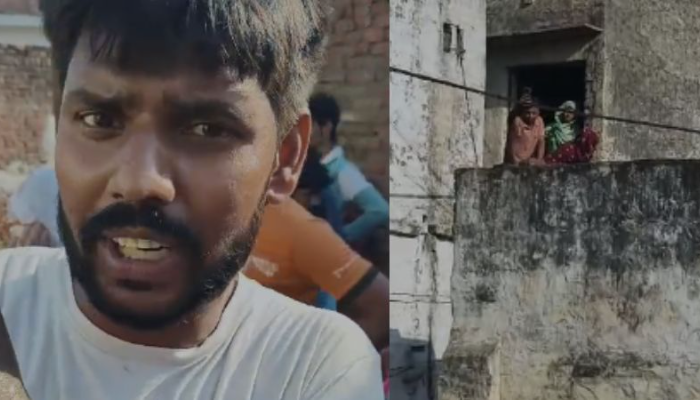
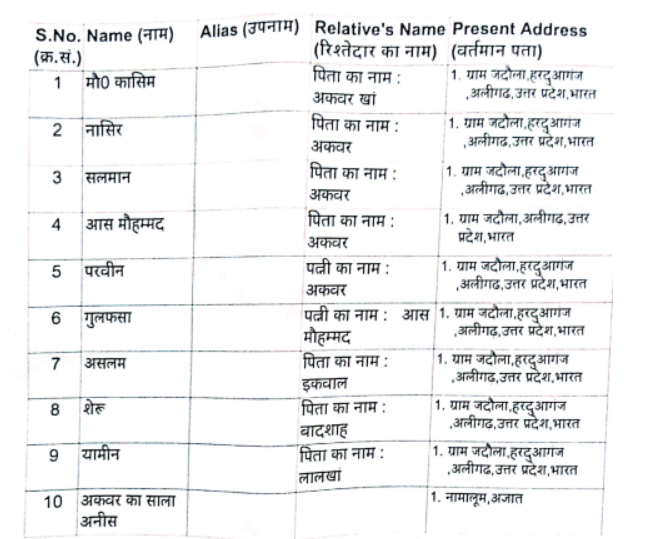
A Dalit youth, Lavkush, was brutally thrashed by a Muslim family living nearby because he could not pay ₹500 for the construction of a paved lane in the Aligarh district of Uttar Pradesh. He disclosed that his wife, Prabha, was attacked inside their home with sticks, kicks and punches. Her clothes were also torn in the brutal assault. He tried to protect her but was subjected to a severe beating by the assailants. 10 perpetrators are identified in the First Information Report (FIR), including Akbar Khan’s four sons, Mohammad Qasim, Nasir, Salman and Aas Mohammad, as well as his wife Parveen.

The matter pertained to Jadaula village, which falls under the jurisdiction of the Harduaganj police station. The young man also went to the police station to narrate his ordeal, but there was a delay in registering the FIR, which was only filed after the Vishva Hindu Parishad (VHP) became involved.

The accused have been booked under several sections, including the Scheduled Castes and the Scheduled Tribes Prevention of Atrocities (SC/ST) Act, rioting and the molestation of a woman, among others. Afterwards, the opposing side lodged a counter FIR against Lavkush, his sibling Deepak, Prabha, alongside 11 named and 15 to 20 anonymous persons, levelling multiple allegations such as assault and criminal intimidation. OpIndia has copies of the 2 FIRs, and we also spoke to Lavkush.

Lavkush recounts the attack

Lavkush, who lives in the aforementioned hamlet, works as a daily-wage labourer to provide for his family and earns ₹700 each day. He has 2 sons: a 4-year-old and a 5- to 6-month-old. Prabha stays at home to look after their children. The Dalit man revealed that his elder son has recently been diagnosed with typhoid, which has prevented him from working for the past 10 days, deteriorating the family’s economic condition due to the loss of income.

Uprooted paved lane and then demanded money for reconstruction

Lavkush stated that the village Pradhan (chief) had initiated the construction of a road. As a result, the paved pathway’s level became lower than the road. This led to flooding in the area with drainage water, causing inconvenience for the residents. A Muslim family then completely removed the pathway, further worsening the situation.

Thus, the locals decided to pool their money to restore the pathway. Each household was required to contribute ₹500. Lavkush was similarly asked to pay the amount. However, he requested them to postpone for a few days, citing his son’s illness. This triggered an intense argument between Prabha and Parveen.

Prabha assaulted inside her home

Lavkush recounted that Parveen forcefully entered their residence and started demanding money at 8:00 am on 27th May. However, Prabha detailed their challenging financial circumstances and her son’s health issues, but Parveen responded, “Well, your son isn’t dead yet, is he? Why doesn’t he just die?” The gravely insensitive comments angered the former, prompting a heated face-off between the two women. However, Parveen called for her sons during this confrontation.

Her sons and daughters-in-law jointly targeted Prabha. She was struck with sticks and rods, kicked and punched, and violently thrown to the ground. Her clothes were torn in the process. Lavkush intervened to protect her and was attacked with sticks. Neighbours, alerted by the screams and commotion, rushed to the scene and rescued the couple. “You ba*ta*d Chamars, you got away this time, but if we catch you again, we will either kill you or drive you out of the village,” the culprits threatened as they departed.

Bricks and stones hurled by Muslims from their rooftop

The Muslim side continued to harass the Dalit victims. On 30th May, bricks and stones were launched from their rooftop. Parveen, her sons and their wives coordinated an attack with bricks and stones aimed at Luvkush’s home. OpIndia has a video of the incident, which features them assembling bricks and pelting stones.

Meanwhile, Luvkush and Deepak suffered injuries during this assault. Their hands and heads were sore. The footage shows a visibly distressed Luvkush trying to protect himself while the Muslims locked their house from the inside. On the other hand, the villagers who were in their close proximity merely observed the event as it transpired. The police reached the location after they were informed, but failed to take any action.

Lavkush files FIR against 10 Muslim individuals

Lavkush went to the Harduaganj police station to file a complaint, but the police were reluctant. He then contacted VHP, which provided assistance at the police station and ensured that the FIR was recorded. The Hindu outfit conveyed that Lavkush is a member of the Jatav community and was assaulted by Muslims.

The police have filed an FIR in accordance with the relevant sections against Mohammad Qasim, Nasir, Salman, Aas Mohammad, Parveen, Akbar Khan’s brother-in-law Anees, Aas Mohammad’s spouse Gulfasa, Aslam (the son of Iqbal), Sheru (the son of Badshah) and Yameen (the son of Lalkhan).

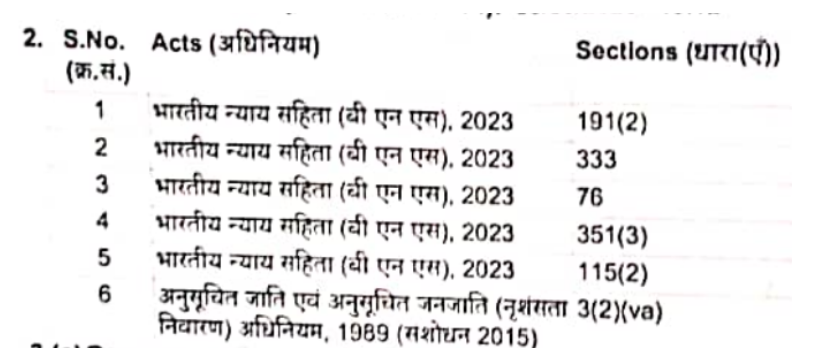
Section 3(2)(va) of the Scheduled Castes and Scheduled Tribes (SC/ST) Act and sections 191(2), 333, 76, 351(3), and 115(2) of the Bharatiya Nyaya Sanhita (BNS) have been invoked against them. These charges consist of committing offences motivated by caste, trespassing and assault, attacking with the purpose of disrobing a woman, criminal intimidation, and willfully causing injury.

Muslims side also lodges FIR

Shortly after Luvkush’s FIR, the Muslims also arrived at the Harduaganj police station to file their complaint, and the police swiftly launched an FIR. It claimed that their neighbour Luvkush and his brother Deepak had attacked them with sticks and clubs. They had also thrown bricks and stones at their house.

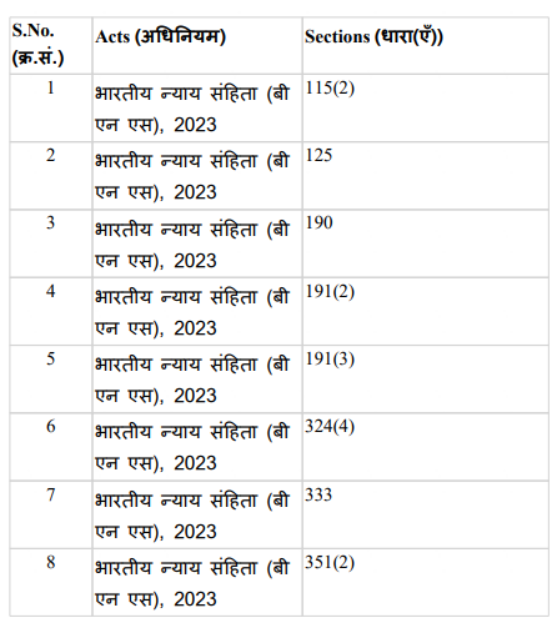
The police have booked Luvkush, Prabha, Deepak and his Kranti, Sherpal, Guddu, Sonu, Pirmukhi, Devendra and Rajkumar, along with 15-20 unidentified people. They have been charged under sections 115(2), 125, 190, 191(2), 191(3), 324(4), 333 and 351(2) of the BNS for intentionally causing injury, rioting, damage to property and trespassing into a house, as well as assault.

Read the original report in Hindi here.

Rajasthan: Hindu man from Udaipur accuses Adil and Safin of brainwashing his wife for religious conversion, taking her away with 9-year-old daughter in Mumbai; read what FIR says

On 24th May, a Hindu man registered a complaint at Sukher police station in Udaipur stating that his wife, who works at a senior post in the State Bank of India in Mumbai, was brainwashed by two Muslim men, identified as Adil and Safin Goldal, and pushed towards converting to Islam. He accused the duo of taking away his wife with their 9-year-old daughter. Both Adil and Safin also worked at the same bank.

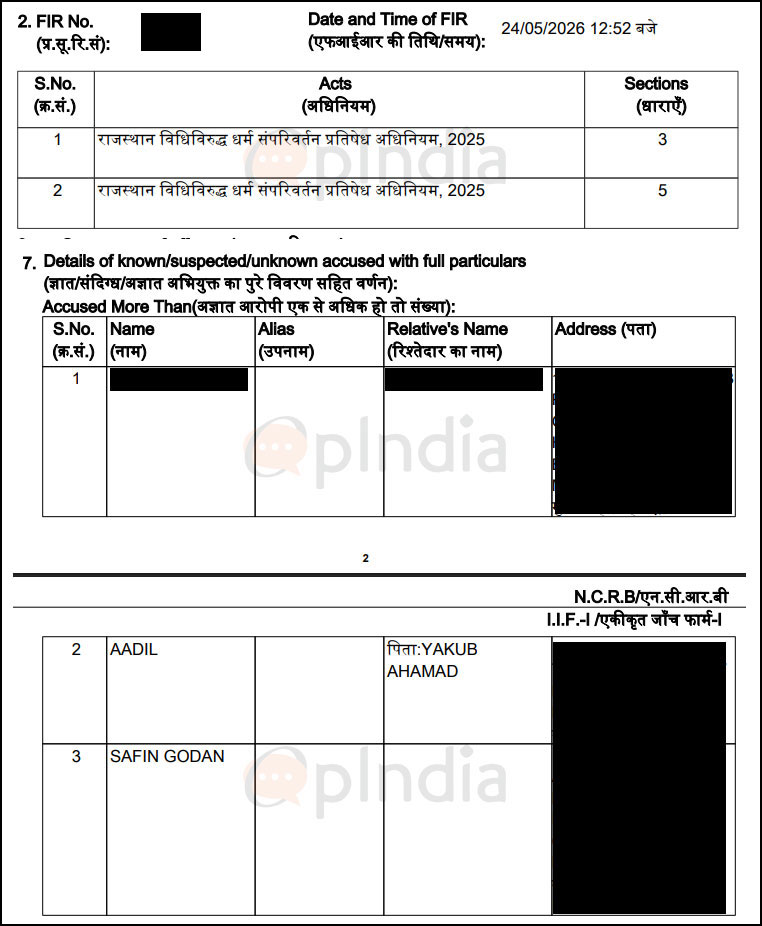
Based on his complaint, an FIR has been registered under Sections 3 and 5 of the Rajasthan Prohibition of Unlawful Religious Conversion Act, 2025 against Adil, Safin and the complainant’s wife. A team from Sukher police station has reached Mumbai to investigate the matter. OpIndia accessed copy of the FIR.

Source: Rajasthan Police

The complainant, identified as Vikas (name changed), said in his complaint that his wife Sakshi (name changed) and the two accused, Mohammad Adil and Safin Goldal, were part of a conspiracy that started in Mumbai and later affected his family in Udaipur. He said that his wife left the house with his daughter and took away a gold chain and around Rs 5 lakh in cash on 18th April.

According to Vikas, he and Sakshi got married in Udaipur on 20th November 2013 as per Hindu customs. Their daughter was born on 21st October 2017. Vikas stated that he and Sakshi worked in Mumbai, while their parents lived in Udaipur. They frequently travelled between the two cities.

Adil and Safin threaten victim

According to the complaint filed by Vikas, the family was in Udaipur in March 2026 when he received a call from Safin Goldal. Vikas stated that Safin threatened him and told him to send Sakshi back to Mumbai immediately. Vikas added that Safin warned him that he would not be able to return to Mumbai and would be killed if he did.

Furthermore, Safin reportedly told Vikas that while he had saved his wife from Adil, he would not be able to save her from him. Vikas said Safin claimed that Sakshi would do whatever he told her to do and would soon convert to Islam along with her daughter.

The complainant further added that he later received a call from a woman who identified herself as Neha Sharma. According to him, she asked him to send Sakshi to Mumbai quickly and warned that Sakshi could lose her job if he did not do so. Vikas stated that Neha was known to Safin and was aware of the matter.

Allegations against wife

In his complaint, Vikas stated that when he confronted Sakshi about the calls and threats, she supported Safin and became angry at him. She reportedly told him that Safin was calling him on her instructions. She added that she would marry him, convert along with their daughter, and keep the child with her.

Vikas further added that she told him that if he wanted their daughter, he would have to pay a heavy price. He said Sakshi had earlier demanded money from him on several occasions and threatened that she would kill herself if he approached the police. She showed him two books in Urdu, saying that she would destroy him and leave for Mumbai with Safin.

Vikas stated that he informed both families about the matter. After the families intervened, she assured them that she would not take any such step and would stay in Udaipur with their daughter so that the child’s education could continue. She also said that she would seek a transfer from Mumbai to Udaipur. Vikas then returned to Mumbai for work.

Wife allegedly left with daughter, jewellery and cash

The complainant stated that he was scheduled to return to Udaipur from Mumbai on 18th April 2026. According to him, after Sakshi came to know about his travel plan, she left the house at around 5.45 am with their daughter and went with Safin Goldal.

Vikas stated that Sakshi also took a gold chain and around Rs 5 lakh that had been kept at home for construction related expenses after breaking open a lock. His parents later informed him that Sakshi and the child were missing from the house.

He claimed that Sakshi later sent him a message saying that she was going to their Mumbai home with their daughter. However, when Vikas checked at their Borivali residence, he was told that neither Sakshi nor the child had reached there. Vikas said this led him to suspect that Safin had taken both of them somewhere else.

Earlier allegations involving Mohammad Adil

In the FIR, Vikas also made allegations regarding an earlier incident from 2022. He alleged that Mohammad Adil, who worked as a contractual employee in the same bank as Sakshi, had brainwashed her and pushed her towards religious conversion.

According to Vikas, Sakshi started adopting Muslim customs and practices, including wearing hijab, after coming under Adil’s influence. He also accused Adil of taking around Rs 2.59 lakh from the joint account and Sakshi’s salary account by misleading her.

Vikas further alleged that Adil had physical relations with Sakshi and got her pregnant. He claimed that on 11th May 2022, Adil allegedly posed as Vikas and got Sakshi’s abortion done at a hospital. The complainant claimed that he and Sakshi had not shared physical relations for about a year before the pregnancy.

Vikas said that due to the seriousness of the situation and keeping the child’s welfare in mind, he brought his wife and daughter to Udaipur. He stated that Sakshi later assured him that such an incident would not happen again. However, he alleged that Adil had threatened him at the time as well, saying that Sakshi would not be able to escape their influence. In his complaint, Vikas also expressed fear that some serious harm could be caused to the child.

Accusations of involvement of Muslim religious organisation

Vikas raised suspicion in his complaint that Adil and Safin worked for a Muslim religious organisation whose aim was to trap Hindu women, convert them and sexually exploit them. The police are reportedly investigating that angle as well.

We have changed the name of the victim and his wife for privacy purposes.

The Red Horrors: Remembering the 1990 Bantala case in West Bengal, when CPI(M) goons brutally gang-raped 3 female medical officers

36 years have passed since the horrific Bantala rape and murder case shook West Bengal, yet the brutality of that night remains one of the darkest chapters in the state’s history. On 30th May 1990, three women health officials and their driver were returning to Kolkata after completing a vaccination programme in Gosaba when they were attacked by local CPI(M) goons in Bantala, then a CPI(M) stronghold on the outskirts of Kolkata. What followed was an unimaginable act of brutality that continues to haunt Bengal’s collective memory even today.

The victims were Anita Dewan, Deputy District Extension Media Officer; Uma Ghosh, a senior official in the West Bengal Health Department; Renu Ghosh, associated with UNICEF and WHO programmes; and their driver Avni Naiya. Around 6:30 pm, their car was intercepted near a CPM party office in Bantala. Sensing danger, the driver did not stop and tried to escape. However, the speeding vehicle overturned while attempting to flee. Within moments, a larger mob gathered around the vehicle.

The horror of Bantala

The attackers dragged the women government officers out of the car and set the vehicle on fire. Driver Avni Naiya tried to protect the women, but the mob brutally assaulted him. Reports later revealed that his genitals were crushed and his body bore 43 injury marks. He succumbed to his injuries on 4th June 1990 at SSKM Hospital.

The three women officers were dragged into nearby paddy fields where they were gang-raped by the CPI(M) members. Anita Dewan died due to the brutal assault, while Uma Ghosh and Renu Ghosh survived with severe injuries. Reports from that time described shocking levels of brutality. During Anita Dewan’s post-mortem examination, the doctor fainted after discovering a one-foot-long metallic torch inserted into her private parts.

Police arrived nearly five hours later. The victims were shifted to the National Medical College in Kolkata, where doctors initially believed all three women had died before realising that two of them were still alive.

Following the incident in which the rapists were linked to the CPM, the then West Bengal Health Minister Prasanta Sur attempted to defend the culprits and said that the villagers had mistaken the women officers for child kidnappers and traffickers. Furthermore, the then Chief Minister Jyoti Basu said, “Such things keep happening!”

Later, the ex-Director of the Asian Development Bank (ADB), D Bandhopadhyay had claimed that Anita Dewan was the main target in the infamous Bantala gangrape case as she had collected evidence of misappropriation of funds by the CPM-led panchayats. Bandopadhyay said that in villages, CPM-led panchayats were misusing funds for rural development sent by UNICEF.

He added that Anita Dewan learned about this misappropriation of funds and when she collected necessary evidence from Gosaba, the communist goons attacked her when she was on her way back to Kolkata. He added that the goons torched the car in which all the evidence was also burnt to ashes.

Following the investigation into the case, six culprits in this infamous 1990 case were awarded life imprisonment. 

1990: A dark year for women in West Bengal

The Bantala case was not an isolated incident. 1990 can be considered as one of the darkest years for women’s safety in West Bengal under the CPI(M) regime.

Just days after the Bantala incident, between 6th and 8th June 1990, another horrifying case emerged from Singur police station in Hooghly district, where three policemen allegedly raped a young girl inside the police station itself. When local residents protested against the crime, police reportedly opened fire, killing one protester.

Then, on 18th July 1990, another brutal incident took place near Birati railway station in North 24 Parganas. A gang of smugglers and hooch operators attacked nearby shanties and gang-raped several women, many of whom were refugees from Bangladesh. In both Bantala and Birati rape case, local police stations, despite being located nearby, failed to act in time.

These incidents created a widespread perception that crimes against women were being ignored, downplayed or politically shielded during that period.

CPI(M) locals goons involvement

Over the years, allegations surfaced that CPI(M)-linked local goons were involved in the Bantala attack. Though courts mainly treated the case as a criminal matter, political allegations surrounding the role of local CPI(M) elements continued to dominate public discussions.

Former Asian Development Bank official D Bandopadhyay later claimed that Anita Dewan had been specifically targeted because she had gathered evidence regarding misuse of UNICEF rural development funds by CPM-controlled panchayats in Gosaba. According to these claims, the attackers destroyed the car to burn all documentary evidence collected by Dewan.

While some aspects of these claims remain debated and were never fully established in court, the allegations significantly shaped public perception of the case.

Senior CPI(M) leaders downplayed the heinous crime

One of the reasons the Bantala case remains politically sensitive even today is because of the statements made by senior CPI(M) leaders after the incident.

Then West Bengal Health Minister Prasanta Sur attempted to defend the incident by claiming that villagers had mistaken the women officers for child kidnappers and traffickers. The explanation was heavily criticised at the time as an attempt to dilute the seriousness of the crime.

Even more controversial was the statement attributed to then Chief Minister Jyoti Basu, who said, “E shob toh hoeyi thakey (Such things keep happening).” The remark triggered outrage across political and civil society circles, with critics accusing the Left government of showing shocking insensitivity toward rape victims.

For many in Bengal, these statements became symbols of how the administration tried to minimise or politically manage horrific crimes instead of ensuring accountability.

Convictions, but lingering questions

Following investigation and legal proceedings, six accused persons were sentenced to life imprisonment in connection with the case in 2003. The punishments never fully answered larger questions regarding political patronage, delayed police response and the atmosphere of fear prevailing at the time.

The Bantala case also exposed the dangers faced by frontline women workers who travelled to remote parts of the state for public health programmes. Anita Dewan, Uma Ghosh and Renu Ghosh were not political activists or public figures. They were health officials working to improve vaccination coverage in rural Bengal. 

From Bantala to RG Kar: Has anything changed?

More than three decades later, West Bengal still struggles with the same questions around women’s safety and political accountability.

After the CPI(M) regime ended, hopes were raised that the situation would improve under the Trinamool Congress (TMC) government. However, more incidents under the TMC era prove that the situation has not changed at all.

The 2024 RG Kar Medical College rape and murder case once again brought national attention to women’s safety in Bengal. The brutal rape and murder of a young doctor inside a government hospital triggered massive protests across the country and raised serious concerns about administrative failure, political influence and institutional silence.

The memory of Bantala returned during the RG Kar protests. The names and governments may have changed, but the anger over women’s safety, delayed justice, and political defensiveness continues to remain painfully familiar in West Bengal even after 36 years.

Mamata Banerjee claims her nephew Abhishek could have died after being hit by eggs: Read how the TMC supremo downplayed the murders of BJP workers in 2021 post-poll violence case as ‘small-time incident’

On Saturday (30th May), Trinamool Congress MP Abhishek Banerjee was egged and heckled by angry locals in Sonarpur in the South 24 Parganas district of West Bengal. The nephew of Mamata Banerjee, who had threatened BJP workers with post-poll violence before the election result, was seen wearing a helmet to brave incoming eggs from the public.

Trinamool Congress supremo, who built her career on street drama and political theatrics, created a hullabaloo at the Belle Vue Hospital in Kolkata after the facility refused to admit Abhishek Banerjee. As a matter of fact, doctors had ruled out any serious sign of physical injury. They informed that the TMC leader was fully conscious, oriented and had only minor bruises on his chest.

Mamata Banerjee and TMC attempted to capitalise on the incident by first dubbing the angry locals as ‘BJP-backed miscreants’ and claiming that ‘rulers became killers.’

Thereafter, the TMC supremo made an outrageous remark that Abhishek Banerjee could have been killed by eggs if he did not wear a helmet. “One local guy gave a helmet to him or else he would have been spot dead.” She also peddled conspiracy theories about the BJP government in Bengal not allowing a private hospital to admit her nephew with no serious injuries.

What Mamata Banerjee said about 2021 post-poll violence

While Mamata Banerjee is busy portraying this stray case of outburst of public resentment against her corrupt nephew as a ‘big incident’, the TMC supremo had, in fact, downplayed the 2021 post-poll violence in Bengal as ‘choto choto ghotona.’

For the unversed, more than a dozen BJP workers were killed, women were raped, and thousands had to suffer exodus at the hands of Trinamool Congress goons following the 2021 Vidhan Sabha election.

But these atrocities and the outbreak of targeted political violence against rival party workers appeared trivial to Mamata Banerjee.  She suggested that those were ‘small-time incidents’ that supposedly occurred everywhere after elections.

In April 2023, she had claimed, “Koyekta choto choto ghotona ghote chilo election er por, samanno ghote thake sob jaigai (Some small-time incidents took place after elections. These happen all the time at other places).” 

She also lamented how the Centre sent several fact-finding teams to the State, which had supposedly led to the ‘arrest’ of several TMC workers in false cases. “If something happens in Bengal, then, it does not mean that the government is responsible,” Mamata Banerjee refused to showcase accountability.

 “Some incidents happened small-small (after elections) but the Centre sent all the teams (from Delhi). They arrested all of our boys and girls through agencies such as CBI, ED and Commissions,” Mamata Banerjee brazened out.

Back in 2021, she attempted to rationalise the post-poll violence by TMC goons as retribution for alleged torture by BJP and Central Armed Police Forces (CAPFs).

 “Bengal is a peace-loving place. During the elections, there has been some heat and dust and calm. The BJP did a lot of torture, also the CAPF,” she had said while making a token appeal for ‘calm’.