Home Blog Page 1277

National Editor of LiveMint who won an award for Financial journalism makes bizarre excuse for MSP, comparing it to MRP of products sold by Kirana stores: How he is wrong

Farmers’ protests and demands for the legalisation of the Minimum Support Price (MSP) have transformed everyone into an ‘expert’ on the issue. Sumant Banerji, the National Editor of LiveMint, came up with a bizarre justification to argue in favour of MSP legalisation. On February 22nd, Banerji took to X to compare the Minimum Support Price to the Maximum Retail Price (MRP) of products sold in general stores.

“Imagine having a job where your entire salary is variable pay & nothing is fixed. So from one month to the next, it varies even as your expenses–rent/EMI, ration, tuition fees, fuel, electricity/gas bill–stays the same. How would you manage? That’s #Farmers without #MSP,” Banerji wrote as if the expenses of others miraculously go down every month.

In continuation, he wrote, “Now for all the lovely people equating farmers with every entrepreneur on the street–these entrepreneurs will die if the price of the stuff they sell varies as wildly as crops A doctor chooses to see a patient because he knows the fees he is going to get Same for a lawyer/CA.”

As if this absurdity was enough, Sumant Banerji argued that a Kirana shop owner stays in the business only because he is ‘guaranteed’ an MRP on the all goods he sells in the shop. “A Kirana store owner is in business only coz he is guaranteed an MRP on every item he sells in the shop. Same for a car dealer or a hardware store owner. A cab/rickshaw driver knows the base minimum fare for any journey & won’t go if the customer doesn’t agree to pay beforehand,” Banerji added.

The ’award-winning’ journalist, however, conveniently ignored the difference between the MSP and MRP. Firstly, it is important to understand what MSP is and how it is computed. The Minimum Support Price is the guaranteed price at which central and state governments, as well as their agencies, purchase food grains from farmers.

The Central Government sets the minimum support price using a formula that takes into account production costs and sets the price at one-and-a-half times these expenses. This method considers both explicit costs (A2), which include expenses for items such as seeds, fertiliser, pesticides, fuel, irrigation, hired labour, and leased-in land and the estimated value of unpaid labour performed by family members (Family Labour or simply FL). Notably, the government decides MSP for 22 mandated crops based on recommendations from the Commission for Agricultural Costs and Prices (CACP), state governments, and relevant Central Ministries /Departments.

Now, coming to Maximum Retail Price, The Maximum Retail Price (MRP) is a type of price regulation used to regulate the price at which consumer goods are permitted to be sold. The MRP is the maximum price that can be charged for a specific product, and it is usually stated on the product packaging or label.

Unlike MSP, the MRP is not decided by the government. It is decided by the manufacturers to safeguard consumers from overpaying for products by ensuring that it is not sold at a higher price than the MRP. While the government is bound to procure the mandate crops at MSP, in the case of MRP, the retailers often sell items at prices lower than the MRP by undercutting their margin and offering discount.

Also, the Kirana shop owner would get an MRP on a product only if it is sold. On the other hand, the farmers are demanding MSP as a legal right meaning that the government will be bound to purchase the crops farmers want to sell regardless of its demand. The customers have no legal obligation to buy the products from a Kirana store.

Comparing these two ‘Maximum’ and ‘Minimum’ scenarios ideally does not make sense, but when has it mattered to the likes of Banerji to make sense? Banerji’s argument suggests that he wants MSP to become like MRP, then which also means inflated costs, thus requiring one to completely forget the economic growth. Amusingly, the Ramnath Goenka Award-winning journalist thinks that the central government ‘commits’ to buying every good in a shop with public money.

LiveMint’s Sumant Banerji also brought doctors and lawyers to emphasise to his bizarre argument. “Now you tell a doctor to operate first & then offer him 50% of his fees, or a lawyer to fight a case & ask him to settle for 30% less or give the cab driver Rs 50 less than the price he bargained for before the start of the trip…& see how they react,” he wrote.

While doctors may have minimum fees for attending patients and as said in this case, operating the patient, they are not guaranteed patients. Similarly, nobody guarantees a certain number of clients to a lawyer, or passengers to a cab driver. Doctors, lawyers and people in other professions bear the risk of not getting any clients. Moreover, contrary to what Banerji is claiming, clients can and do ask for discounts, and many times they get such discounts. Many lawyers charge less from poor people, even take such cases without any charge sometimes, and their fee is never fixed.

Unlike doctors and lawyers, in addition to MSPs on mandated crops, farmers also get various subsidies such as seed subsidies, fertiliser subsidies, irrigation subsidies, electricity subsidies, agricultural equipment subsidies, and agricultural infrastructure subsidies, among others. Furthermore, if farmers receive a higher price than the MSP, they also have the option to sell their produce in the open market.

Even consumers’ perspective, they have the option of not availing of the services of doctors, or lawyers or purchasing goods from a particular Kirana shop owner if they find it expensive. They can either negotiate/bargain or go for some other available options. However, if MSP is legalised as demanded by farmer protestors, the government will have no option but to procure the crops at MSP even if it is not in demand in the consumer market.

One of the most essential points why it is absurd to compare doctors, lawyers, and even shop owners to farmers is that, unlike farmers, they are forced to pay income taxes. Interestingly, agricultural revenue is exempt from taxes. The Central Government cannot levy or charge a tax on agricultural income because Section 10(1) of the Income Tax Act exempts agricultural revenue from the computation of total income for any person.

It is also interesting to note that Sumant Banerji did not mention professions which do not essentially offer a salaried job such as vegetable vendors, fast food ‘Thelas’, rickshaw-pullers or cobblers. Even if they work under uncertain circumstances with no fixed income or MSP or even MRP for argument’s sake, yet they are not subjected to any special treatment or subsidies from either the Central or State governments.

Anyone advocating for MSP law must understand that enacting MSP legislation would impose a massive fiscal burden on the government, there would be a risk of undervaluation of crops with low yields, an increase in food inflation, market distortionary and economically unsustainable practices, and India would face WTO opposition as well as trade disputes with importing countries.

Notably, the MSP has increased substantially since the Modi government took power in 2014. Earlier this month, Union Minister Arjun Munda informed the Lok Sabha that the procurement of foodgrains has increased from 761.40 lakh metric tonnes in 2014-15 to 1062.69 lakh metric tonnes in 2022-23, benefitting more than 1.6 crore farmers. The expenditure incurred (at MSP values) on procurement of foodgrains increased from 1.06 lakh crores to 2.28 lakh crores, during the same period.

Vedic Fire Temple in Azerbaijan: Civilisational heritage and the unceasing continuity of Vedic culture even outside Bharat

The existence of a fire temple called Aateshgah at Surakhani, Azerbaijan, speaks significantly of the civilisational heritage and unceasing continuity of Vedic culture of fire worship even outside Bharat. The genesis of this Vedic culture goes back to the time of the migration of Vedic people from the Indus Valley. Contrary to the subjective claims of colonial scholarship that promoted the Aryan migration theory from Central Asia to Bharat, the trifurcation of migrating Vedic people took place from the Indus Valley in three different directions.

They migrated to the east till Sadanira in Bihar, to the north to Azerbaijan, known in antiquity as Airyana Vaejo, and to the Middle East establishing the Hittite culture. These migrations took place around 2000-1880 BCE when the Indus culture and topography were impacted by natural calamities. As substantiated in the book, The Vedic Entities and Identities (The Oriental Institute Vadodara 2012), the Indus Culture was an integral part of the Vedic Culture. They carried with them the most advanced Vedic culture which found no equivalent anywhere then. The migration of Vedic people northward coursed through Afghanistan, Iran, and then to Armenia and Azerbaijan.

This migration from the Indus Valley on a significant scale also accompanied the Vedic culture, philosophy, metaphysics, knowledge, rich rituals and worldview. The migratory progress it made in the Central Asian region left remarkable cultural footprints that built in the process foundations of several systems of culture, knowledge, rituals, and customs. The cultural treasures that it handed over had an incredible receptivity from the regions the Vedic people covered. The Vedic worldview of inclusivity, universal well-being, mutual respect, the spirit of inquiry and integration. Most importantly the concepts of the world as one family (Vasudhaiva Kutumbakam) and the dharmic consciousness contributed to the formation of civilisations. Therefore, it is not a matter of surprise to find the existence of Vedic myths, such as dragon killing, cultural practices, and the relics of the monuments that embody the memory of a rich Vedic past in Azerbaijan. 

Baku is the capital city of Azerbaijan. It is located on the Caspian Sea shore in the west. Close to Baku, around forty kilometers northeast, there are sacred sites namely Yanerdag and Surakhani easily accessible by road. In Yanerdag, on a hilltop, a sacred fire is burning from a very remote antiquity whose ancestry is difficult to determine but is considered to be a Zoroastrian sacred pilgrimage where relics having strong Avestan cultural connections were unearthed during archaeological excavations.

At the bottom of the hill, a fire burns continuously extending over a length of about fifteen meters. The archaeological remains found near the site present the images and motifs of the Zoroastrian fire and sun worship. The sun disc and Afrinagan pot used by Zoroastrians are carved on the stone slab confirming the Zorastrian past as the region has seen Persian rule in remote antiquity. The main reason for the Avestan people to arrive at Yanerdag and Surakhani was their search for sacred fire because of Angraminyu’s constant defilement of the sacred land created by Ahura Mazda. Angraminyu in Avestan literature is a destructive evil spirit and an antithesis to virtues and goodness Ahura Mazda stands for. The migration northward in search of undefiled space culminated in Azerbaijan which is Airyana Vaejo in Avestan literature. 

The fire temple at Surakhani is called Jvalaji temple. The temple today is more of a fortress. At the center, there exists the sanctum sanctorum. There is a fire altar with a stone structure and typically a yajnavedi where the fire burns constantly. The fortress-like structure having inner and outer courtyards is located on a plateau.

The inscriptions found there embody compositions in Sanskrit, Gurmukhi, and Farsi. The Sanskrit inscription presents salutations to Lord Ganesh and Shiva and venerates the holy fire Javalaji. The Persian inscription also refers to fire. It was once a very significant center of Hindu and Zoroastrian pilgrimage. The Hindu hermits, traders, and devotees used to visit this place quite frequently and perform their puja. This is established through the Hindu motifs and symbols found on the fortress walls.

Inscription in Sanskrit and Gurumukhi
Inscription in Gurumukhi

Archaeological discoveries consolidate the Vedic connection with fire worship tradition. The Hindu priests used to visit this place until the end of the 19th century and over a century there seems no footfall of Hindus to this sacred site. The same is also true of the Zoroastrians who have stopped visiting the place. However, the offerings of pomegranate to the fire remain vaguely present in the folk memory of the locals there. The locals are of the opinion that the offerings given to the fire were largely pomegranate juice and branches. The concepts of fire god and offerings to the fire are essentially an integral part of the Vedic and Zoroastrian cultural and ritual practices.

Their continuity in Azerbaijan indicates the depth and extensiveness of Vedic culture and the certitude of migration from the Indus Valley to the north contrary to the colonial version of the Aryan Invasion. Dr. I N Aliev, an archaeologist who works in the Department of Archaeology, Baku, has done extensive excavations at Surakhani and confirms the discovery of the relics having shared Hindu and Avestan ancestry. Dr. Aliev also believes that his forefathers came from Bharat. This affirmation also opens up the scope of ancient Bharat’s deep connection with Azerbaijan and the region therein. There stands a centuries-old caravanserai in Baku built with Indian patronage.

A great deal of research is, therefore, required to be done to unearth the buried truths and assets of Vedic culture and its antiquity, historicity, and continuity both in Armenia and Azerbaijan. The development of a contradicting theological culture with rigid monotheism in Azerbaijan has unsettled the story of Vedic and Zoroastrian cultural continuity but time has come to recognise the Vedic heritage of Bharat and its outreach. The mood of the country today is to reach the root to form an enduring identity decoupled from colonial determinisms. The presence of Vedic cultural practices or relics of those monuments of Vedic cultural significance outside Bharat presents an opportunity to map the cultural extendedness of the Indus and Saraswati civilisation. 

{the article has been co-authored by Dr. Chandan K. Panda – an Assistant Professor in the Department of English at Rajiv Gandhi University (A Central University), Itanagar.}

‘ISIS bride’ Shamima Begum who travelled to Syria and joined the terror outfit loses appeal against removal of her UK citizenship

0

Shamima Begum, who left Britain to join Islamic State, has lost an appeal against the UK government’s decision to remove her British citizenship. The east London schoolgirl travelled to Syria nine years ago in 2015 at the tender age of 15. Soon after she was discovered in a camp for Syrian refugees in February 2019, her citizenship was revoked due to national security concerns.

The 24-year-old lost a challenge at the Special Immigration Appeals Commission (SIAC) in February of last year following a string of court fights, but her attorneys appealed the decision to the Court of Appeal in October. One of the appeal judges who decided the matter, Dame Sue Carr, mentioned that they agreed with the commission’s ruling about Shamima Begum’s citizenship and that her appeal was dismissed. The legal squad representing her had filed a complaint with the court to reverse the decision. However on 23rd February, all three of the appeal judges rendered a ruling against her.

Her appeal was dismissed by the panel unanimously, according to Dame Sue Carr, the head of the court of appeals. The justice stated, “It could be argued that the decision in Miss Begum’s case was harsh. It could also be argued that Miss Begum is the author of her misfortune. But it is not for this court to agree or disagree with either point of view. Our only task is to assess whether the deprivation decision was unlawful. We have concluded it was not and the appeal is dismissed.”

Appearing with Lord Justice Bean and Lady Justice Whipple, Baroness Carr declared that any debate over the ramifications of the unanimous ruling which might involve a potential Supreme Court appeal will be postponed for a period of seven days.

Samantha Knights KC asserted to the court during the October appeal hearing that the Government had neglected to take into account the legal obligations owed to Shamima Begum as a possible victim of human trafficking or as a result of “state failures” in her case. However, national security was cited by the Home Office’s Sir James Eadie KC as the “key feature” of the case. “The fact that someone is radicalised, and may have been manipulated, is not inconsistent with the assessment that they pose a national security risk,” he stressed.

Baroness Carr noted, “We are not persuaded that there was any obligation on the Secretary of State to take into account the possibility that there might be a duty to investigate the circumstances of Ms Begum’s trafficking, alternatively, to consider whether any such investigation as might be required would be enhanced by her presence in this country,” in the 42-page public judgment.

She added, “In our judgment, SIAC was entitled to find, as the specialist tribunal established by Parliament, that the issue of whether and to what extent Ms Begum’s travel to Syria had been voluntary was within the expertise of the intelligence agencies advising the Secretary of State. Ms Begum may well have been influenced and manipulated by others but still have made a calculated decision to travel to Syria and align with ISIL (Islamic State of Iraq and the Levant).”

Shamima Begum’s counsel presented five arguments, contending that SIAC erred in dismissing her allegation that former home secretary Sajid Javid faulted in denying her citizenship in 2019. However, the judges invalidated her claims in every instance and highlighted that in cases involving national security, an equality responsibility in the public sector did not apply.

Furthermore, they found that Sajid Javid had taken into account Shamima Begum’s legal team’s argument that she was a victim of child trafficking and that he had the right to rule on whether or not she constituted a threat to the United Kingdom’s national security. The court also ruled that the former minister was not obliged to ponder about whether she would essentially become a stateless person because there was no possibility that she would go back to Bangladesh, the country of her parents’ origin.

Shamima Begum is in a refugee camp in northern Syria. Her legal team is likely to appeal the latest judgement. “As long as she is still there, this doesn’t end,” emphasised one of her lawyers, Gareth Peirce.

“Want Mathura, Kashi issue to be solved out of court”: Ajmer Sharif Dargah Dewan

0

Weeks after the Varanasi district court allowed the Hindu side to offer prayers in the southern cellar of Gyanvapi mosque, Syed vodcast , Dewan and Sajjada Nasheen of the Ajmer Sharif Dargah said that the Mathura and Kashi temple disputes should be settled out of court.

“Mathura and Kashi’s issue is sub judice before the court, so one cannot comment on this. We want this issue to be solved outside the court. This will be the best thing for both sides (Hindu-Muslim), and with this, there will be peace between both sides,” Abedin said, speaking to ANI on Friday.

The Dewan of Ajmer Sharif Dargah reasoned that if the court gave any judgement, one side would lose and this would lead to bitterness between both sides. “Otherwise, if the court gives any judgement on this, then that judgement will be in favour of any one side, only leading to bitterness on the other side, Why do so?” Abedin said.

Abedin also stressed that religion and politics cannot be made separate from one another, as it was argued by noted British writer Desmond Shawe in 1957, he said. “All kings had a spiritual head. He used to make decisions consulting the spiritual head. Today a new trend has started on mixing up religion and politics. Gorakhpur Press is famous countrywide.

In the 1957 edition of Sri Kalyan, on pages 771-772, Desmond Shawe says that if politics is made devoid of religion, and vice-versa, both cannot exist in isolation,” he said. Earlier in February, the Allahabad High Court completed the hearing and reserved its order in an appeal moved by the Anjuman Intezamia Masajid Committee challenging the Varanasi District Court order that allowed the Hindu side to offer prayers in the southern cellar of Gyanvapi mosque.

On January 31, the Varanasi district court allowed the Hindu side to offer prayers in the southern cellar of Gyanvapi mosque. The court directed the Varanasi district magistrate to make arrangements within seven days for ‘puja’ to be performed by the Hindu side and a pujari (priest) nominated by Shri Kashi Vishwanath Temple Trust. After the order of the court, “puja” and “aarti” were performed in the early hours on Thursday.

(This news report is published from a syndicated feed. Except for the headline, the content has not been written or edited by OpIndia staff)

How Modi Hacks EVMs, Part 3: From exceeding target and destroying 1,60,000 kgs of drugs in 60 days to AYUSH, COVID vaccines and more

In the run-up to the celebrations of the 75th year of Independence, Prime Minister Narendra Modi set a unique target for the Home Ministry – destroy 75,000 kgs of drugs in 60 days! As with many aspects of this government, the ministry exceeded this target and burnt 1,60,000 kgs of drugs in that 60-day window! 

Speaking on this topic in the Lok Sabha, Home Minister Amit Shah laid out in detail the policy of the Modi government in dealing with the drug menace and provided statistics on how 62,60,000 kgs of drugs were destroyed in the 2014-2022 period (2023 saw another 10,00,000 kgs of drugs destroyed). Now, can you imagine all the serious health problems that have been prevented because of this seizure and destruction of the drugs? The drugs are valued at nearly 1 lakh crore rupees, so can you imagine the scale of the burden that was never put on the youth of this country because of this nearly 200% increase in seizures (compared to the UPA)?

While we are on the topic of prevention, I recollect the jabs the elite crowd used to make (or still make) on the Ayurvedic way of life that the AYUSH (Ayurveda, Yoga and Naturopathy, Unani, Siddha, and Homoeopathy) ministry propagates, again often forgetting that it is very difficult to quantify what is prevented because of following this lifestyle. When Yoga is picked up by the entire world, it is not because it is a fashion to do so, but because Yoga prevents many a health problem (physical and mental) that cannot be quantified! 

We cannot speak of prevention and not bring up the topic of vaccines, especially the COVID-19 vaccines. Developing and deploying our own COVID vaccines, especially Covishield and Covaxin, is perhaps one of our biggest success stories in history. India conducted the world’s largest and fastest vaccination drive (200 crore doses in 18 months) and more importantly, everything was digital! The development and deployment of the CoWIN app was sought after by other countries too. We had discussed in detail, back then, how India mastered this process despite one of the most uncooperative opposition parties and the media. 

This, ofcourse, doesn’t mean people will not get sick. Often, people living in towns and villages or even in tier-2 cities had to travel very far to get treatment for their health problems. The proximity to a good healthcare facility gets resolved if we have more medical colleges (and therefore hospitals) and more qualified doctors graduate every year. Up until the year 2014, we had only 387 medical colleges in the entire country. Today, that number is at 706 – out of which 157 of them are government colleges/hospitals. The medical seats under MBBS increased from a mere 50,000 in 2014 to more than 1 lakh in 2023! This means that crores of people now can go to a good hospital closer to their homes than spending a lot of time and money to travel to larger cities. 

The Madhya Pradesh government even started to impart MBBS in Hindi. I am sure that very soon MBBS will be imparted in many regional languages too. Controversial editor Shekhar Gupta published an article in The Print in which the author thundered on and on about how medical education must remain elitist and be imparted in English only. This one article is enough to tell you how the elite are worried about losing out their bastions, one by one! Anyways, we digress. 

While visiting these hospitals, crores of people in our country do not have to spend money if they are eligible for the Ayushman Bharat health cards. So far, nearly 30 crore people have been given the Ayushman Bharat cards which make them eligible to get free treatment for up to 5 lakhs rupees. So far, Ayushman Bharat has successfully catered to 6.2 crore hospital admissions worth more than Rs. 79,157 crores! Let the number sink in – 6.2 crore hospital admissions worth nearly 80,000 crores

Even the medication you will have to take post this hospitalization has been made really affordable through the generic Jan Aushadi stores. Though these stores existed before 2014 too, their number was too small and the probability is very high that you did not even know these existed. Today, we have a whopping 10,000 such stores across India. 

Through the program Heal in India, India even increased focus on what is termed as Medical Tourism – inviting foreigners to come to India to make best use of the very affordable medical facilities in India, as compared to many Western countries. This has already brought in billions of dollars of revenue to lakhs of people reliant on the medical industry in India. 

Now, think about everything we just wrote. The equal focus on prevention (drug busts, AYUSH ministry, Yoga, Vaccines, POSHAN abhiyans) and on cure (more than 100% increase in number of medical colleges and doctors; more AIIMS across the country; free treatment upto 5 lakh rupees; affordable medicines closer to your home) has benefitted crores of families in our country. This brings us to our core argument – many of these beneficiaries will willing go to the polling booth and press the Lotus button on the EVM, come election day. While the opposition will be busy screaming that the EVM was hacked, the Prime Minister skilfully shows us how he hacks them! 

In the first two articles of the series “Decoding how PM Modi Hacks EVMs” we were speaking about how he was creating wealth through entrepreneurship and employment. In this third article of the series, we discussed about how he created wealth through health and therefore found another way to hack EVMs! 

Delhi HC dismisses TMC leader Mahua Moitra’s plea to restrain ED from allegedly leaking information about FEMA case against her to media

0

The Delhi High Court on Friday dismissed Trinamool Congress leader Mahua Moitra’s plea to restrain the Enforcement Directorate from allegedly leaking any confidential, unverified information to media related to the ongoing FEMA probe against her.

The bench of Justice Subramonium Prasad dismissed the petition. Justice Subramonium Prasad on Thursday heard the matter and inquired from the counsel for Mahua Moitra as to what is so prejudicial in the press reports.

Advocate Siddhant Kumar, who appeared for ANI, contended before the High Court that the reporting concerning a public figure regarding acts committed as a public official. It is the right of the press to report on the conduct of public officials such as Mahua Moitra who is also seeking to contest the next general election.

During the hearing, ED told the court it had not leaked any information to the media. How the information about her being summoned came to the press, we are not aware, said the ED counsel.

Mahua Moitra had moved Delhi High Court sought direction to restrain ED and 19 media houses from leaking, broadcasting and disseminating any “confidential or unverified information” in relation to ED’s investigation against her regarding proceedings under FEMA.

The plea alleged that ED has wilfully and maliciously leaked the details of the FEMA summons, as well as the response submitted by the Petitioner to the 14 February Summons and sensitive details of allegations being investigated against the Petitioner. It appears that ED intends to subject the Petitioner to a media trial by leaking sensitive particulars, including salacious allegations, allegedly stemming from their ongoing investigation and thereby, not only prejudice the investigation into the matter but also tarnish the Petitioner’s reputation in the public eye.

Instead of undertaking a fair, transparent and ethical investigation into the alleged violations of the FEMA by the Petitioner, it appears that ED is pursuing efforts to vilify the Petitioner in the public eye by deliberately and consistently drip-feeding members of the media with every single detail of the investigation being conducted by ED against the Petitioner, plea read.


(This news report is published from a syndicated feed. Except for the headline, the content has not been written or edited by OpIndia staff)

Vadodara: Muslim mob pelt stones on Hindus for seeking action against a Muslim Instagram user over comments hurting religious feelings of a Hindu businessman

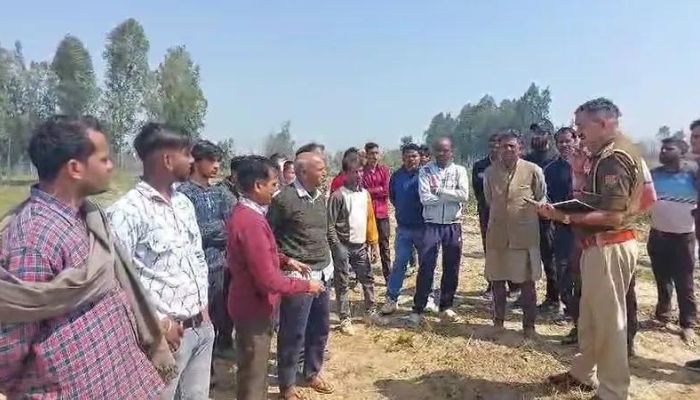
On Friday, February 22, an incident of stone pelting was reported in Gujarat’s Vadodara. A Muslim mob of 100 to 200 allegedly attacked a group of Hindu youths who went to file a complaint at the Navapura Police Station against a Muslim youth for making abusive and hateful remarks against a Hindu businessman during his Instagram Live. The Navapura Police arrested the Muslim youth as well as 10 involved in the stone pelting incident after it filed 2 FIRs in the case.

In what transpired, Jatin Patel, who runs a mobile accessories shop went live on Instagram on 21st February at 7.23 pm and greeted his customers with Jai Shri Ram. He often goes live to announce the offers for his customers. While Patel was announcing the offers, a person with an Instagram ID, sahid-patel-7070, took to the comment section to pass some offensive remarks against the Hindu religion.

Offended by his remark, which Patel saw as an assault on his religious beliefs, he attempted to extract some information about the Instagram user. After some research, he learned that the person in question was Sahid Patel, residing in the Gujarat Housing Board Society, opposite the Mahalakshmi Society in the Padra area of the city. When Patel contacted him, instead of showing remorse, Sahid started threatening him over the call.

Jatin Patel then, along with some Hindu Sangathan activists, approached the Navapura Police Station to lodge a complaint against the Instagram user.

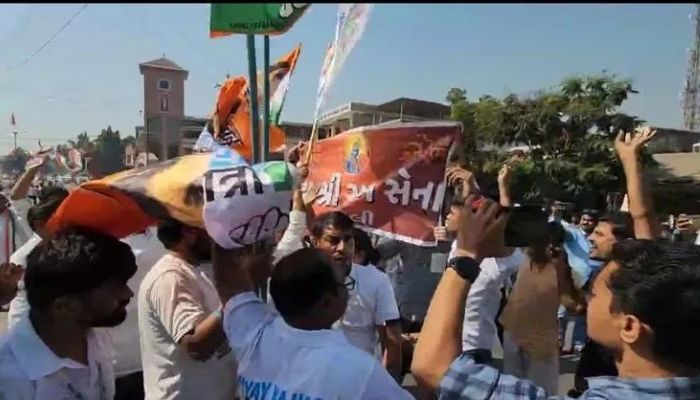
When other members of some Hindu outfits learnt about the issue they too gathered at the Navapura Police station. They demanded strict action against the youth who insulted and threatened the businessman. Chanting Jai Shri Ram slogans, they insisted that Sahid Patel should be brought to the police station, or they would not leave the place. 

When these people were standing outside the police station, suddenly a Muslim mob of 100-150 rushed towards them from Khatkiwad and started pelting stones and glass bottles at the Hindus.

A Hindu youth was hurt in this stone-pelting incident, and two or three other people also sustained minor injuries. The Hindus started running here and there to save themselves from the volley of stones being showed upon them. This resulted in a stampede-like situation and the police had to resort to lathi charge to disperse the crowd. The injured were rushed to the nearby hospital.

The police later filed two FIRs based on the complaint of the victims. The first was filed against the Instagram user and the second against the Muslim mob that indulged in stone pelting outside the Navapura PS. The FIR against the Muslim mob was filed under sections 143, 147, 149 and 337 of the IPC and section 135 of the Gujarat Police Act. Copies of both the FIRs are available with OpIndia.

To delve into the case further, OpIndia spoke to one of Jatin Patel’s friends, who said that they had gathered at the police station and were demonstrating peacefully by chanting Jai Shri Ram chants and Hanuman Chalisa when a mob suddenly rushed from behind a nearby mosque and launched an attack on them. The mob pelted large stones and glass bottles at the Hindus, he said. He also expressed apprehension that the assault was orchestrated.

The Hindu man went on to say that there was a strong indication that the attack was pre-planned otherwise how was it possible that there were so many people present there that too with such a large supply of stones and glass bottles? “There is no construction going on in the vicinity, then from where did the mob manage to procure such large quantities of stones, bricks and metal blocks,” he wondered.

Not a single stone pelted from the Hindu side

A Hindu youth who was present at the scene has refuted claims made by several media outlets, who to defend the Islamist mob, claimed that stones were thrown from both sides. The youth confirmed that the Hindus did not even throw a single stone at the Muslim mob. In fact, the Muslim mob showered stones and glass bottles on the Hindus which resulted in a stampede. Eventually, the cops had to lathi charge to bring the situation under control.

Accused arrested, investigation underway

DCP
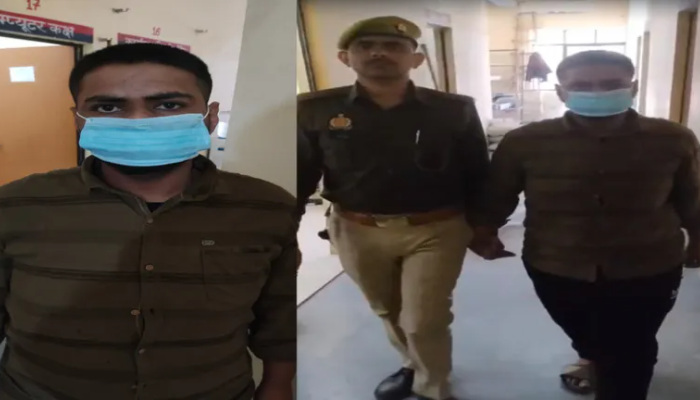
Vadodara DCP Abhay Soni told Opindia that the youth who commented on the matter on Instagram has been arrested, while 10 have been arrested in the stone pelting case. According to Divya Bhaskar’s report, the arrested accused have been identified as Moin, Mohammad Saqlen, Md. Sahib, Wali Mohammad, Buxar Ali, Hasan Khan, Hussain Khan and Sahid Patel.

Regarding the allegations of pre-planned conspiracy, he said that the police are currently investigating in that direction as well and further action will be taken after the investigation.

‘Forced to watch porn, have threesome in the name of Holy Trinity’: Former nuns reveal sexual abuse by Catholic priest close to Vatican

On Wednesday (21st February), two former nuns revealed how a Slovenbia-based Catholic priest named Marko Rupnik sexually abused them three decades ago in the garb of ‘spiritual growth.’

The victims, identified as Gloria Branciani and Mirjam Kovac, were members of the Ignatius of Loyola community. The duo held a press conference in Rome on Wednesday and informed the media that Rupnik forced them to watch pornography and have a threesome in the early 1990s.

“He took me to pornographic theatres to help me ‘grow spiritually’…He said that I would not grow spiritually if I did not meet his sexual needs. We had another nun have sex with us because he said it was like the Trinity”, narrated Gloria Branciani.

“(Rupnik) was always protected by everyone, and everything that you could accuse him of was either minimized or denied…” she added.

“We hope that our testimony – and for this reason we’re exposing ourselves like this, because we feel protected and supported – will stimulate a greater transparency and a consciousness by everyone, and also maybe the pope who wasn’t really aware of the facts that occurred,” Gloria Branciani further emphasised.

It must be mentioned that the victim left the Slovene community in 1993 and had even informed senior Vatican officials at that time. She said that no action was taken against Rupnik and that her accusations were dismissed.

During the press conference, former nun Mirjam Kovac said, “We were all young girls, full of ideals. But these very ideals, together with our training in obedience, were exploited for abuses of various kinds: of conscience, of power, spiritual, psychic, physical and often sexual.”

Who is Marko Rupnik

Marko Rupnik is a famous mosaic artist and a priest at a religious community in Slovenia. He has been accused of sexually abusing at least 20 women in the past 30 years.

He was temporarily excommunicated by the Church after he absolved a woman of having a sexual relationship with him. Rupnik was reinstated two weeks later after he ‘repented’ for his actions. It was only in June 2023 that he was expelled from the Jesuit order, the same one as that of Pope Francis.

Anne Barrett Doyle of ‘Bishop Accountability’, who documents church crimes, described Marko Rupnik as a “powerful cleric who was protected at the highest levels of the Church and the Vatican.” She added, “The Rupnik case shows that little has changed.”

Rupnik, however, continues to serve as a ‘priest’ in a diocese in Koper city of Slovenia. His mosaic art can be found in the Catholic shrine in Lourdes (France), the cathedral in Aparecida (Brazil), and the Redemptoris Mater chapel of the Apostolic Palace (Vatican).

Delhi LG VK Saxena writes to CM Arvind Kejriwal asking to table 5 CAG reports in assembly, says reports pending since August 2023

Delhi Lieutenant Governor, VK Saxena, has written a letter to Chief Minister Arvind Kejriwal and urged him to table the five Comptroller and Auditor-General of India (CAG) reports pertaining to the state finances of the Delhi government in the Assembly.

“My Secretariat is in receipt of copies of communication from the Controller of Accounts, PAO, GNCTD addressed to the Secretary to the Hon’ble Finance Minister, GNCTD, pursuant to a letter by Principal Accountant General Audit, Delhi, requesting for 05 C&AG Reports and 01 GNCTD Accounts report to be cleared by the Finance Minister and sent to me for causing them to be laid before the Legislative Assembly,” read the letter sent to the Chief Minister.

LG Saxena underscored the legal obligations outlined in Section 48 of the GNCTD Act, 1991, which stipulates that CAG reports pertaining to the capital’s accounts must be submitted to the Lieutenant Governor for presentation before the Legislative Assembly.

Furthermore, he drew attention to Article 151 of the Constitution of India, which mandates the Lieutenant Governor to facilitate the presentation of CAG reports before the Legislature.

“In this context, your attention is drawn to the fact that 05 reports of C&AG pertaining to State Finances as under, have been pending for consideration of the Hon’ble Minister of Finance, since August 2023,” the letter read.

“You will appreciate that the reports of the Comptroller and Auditor General of India are constitutionally-mandated independent and impartial assessments of the performance of the Government and in many ways are a guidance document for governments to assess their financial performance, the gains obtained through revenue and help the Government invoke corrective measures where necessary,” it said.

“It is an obligation of the Government of the day to share with the people, through the House, an objective account of its performance revenue and expenditure of public funds,” the letter added.

“Since the Budget Session of the Assembly is in currency, you may advise the Hon’ble Finance Minister to expeditiously process these important reports, so that the same can be laid before the House within this session,” the letter stated further.

(This news report is published from a syndicated feed. Except for the headline, the content has not been written or edited by OpIndia staff)

MEA urges Indian nationals in Russia to stay away from Russia-Ukraine conflict amid reports of Indians being forced to fight for Russia

The Indian government has urged the citizens not to get involved in the Russia-Ukraine conflict after reports surfaced that Indian nationals who got support positions with the Russian Army were forced to fight alongside Russian forces.

The External Affairs Ministry issued a statement on Friday (23rd February)  stating that “a few” Indians had joined up for support jobs with the Russian Army and that the Indian embassy in Moscow has “regularly taken up this matter with the relevant Russian authorities for their early discharge”.

“We urge all Indian nationals to exercise due caution and stay away from this conflict,” said Randhir Jaiswal, spokeswoman for the External Affairs Ministry, in a statement that made no direct mention of Ukraine. According to the government, the statement was released in response to media inquiries about “Indians caught in conflict in Russia”.

According to reports, numerous Indians who had signed up as “security helpers” for the Russian military were compelled to fight alongside Russian troops along the Ukrainian border. Indian citizens have also been stranded at many locations along the Russia-Ukraine border, including Mariupol, Kharkiv, and Rostov-on-Dov.

It has been reported that some Indian people were even killed.

Reportedly, the Indian government has also asked Russia to release Indians employed as support staff in the Russian military.

Earlier, there were claims that the Russian military had recruited up to 200 Nepalese troops. Nepal’s foreign ministry admitted in December that six Nepalese citizens serving in the Russian Army were killed in the conflict with Ukraine.

The Nepalese government has requested Russia not to recruit Nepalese citizens to its military and to return those who are currently serving.

The war that began with Russia’s invasion of Ukraine in February 2022 will begin its second year on Saturday. Since the start of the fighting, the UN Human Rights Monitoring Mission in Ukraine has recorded 30,457 civilian casualties.