The entire nation is captivated by the celebrations and happiness that accompany the festive season. The Hindu community is presently engaged in the vibrant and enthusiastic observance of the auspicious Navratri from 22nd September to 2nd October.
However, how the liberal-Islamist alliance can permit the Hindus to celebrate peacefully? They have not strayed from their long-standing practice of targeting Hindus, particularly during significant occasionswith the intention of tainting the same. Hence, as anticipated, they persist in their vicious attempts to disrupt the joyful ambiance.
According to these elements, each community possesses the right to observe their sacred events per their preferences but the same privilege is not granted to the Hindu community as once again evidenced by the recent outrage. It is not that they need any justification to act outrageously over matters related to Hindus or Sanatan Dharma, but this time, the Muslim extremists and their apologists have been incited by the concerns expressed regarding the presence of Muslim males in garba programs across the country.
Importantly, Muslims target and do not even want to allow Hindus to organize Garba functions near their religious sites, however, it is conveniently painted as problematic when Hindus wish to celebrate their special days in a manner of their choosing.
How the fresh row started
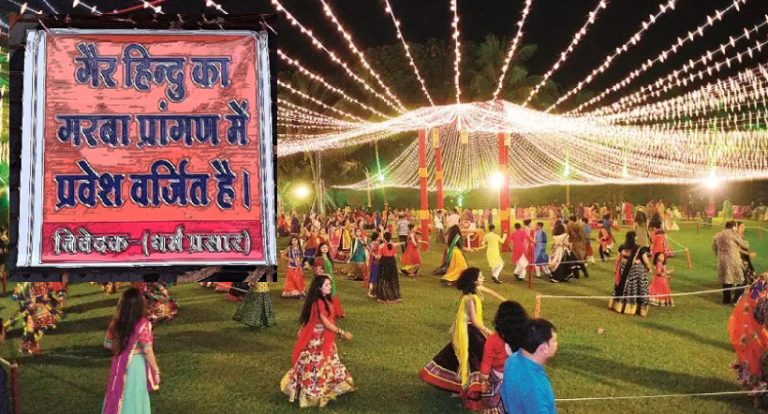
The Vishva Hindu Parishad (VHP) recently declared that only Hindus will be allowed to attend garba programs during Navratri and those who wish to participate must provide their Aadhaar cards, apply a “tilak” to their foreheads and carry out Hindu religious rites. VHP defended the actions by maintaining that they were necessary to stop “love jihad,” which causes troubles every year amid the holy celebrations.
VHP national spokesperson Shriraj Nair voiced, “Garba is not merely a dance but a form of worship to please the goddess. They (apparent reference to Muslims) do not believe in idol worship. Only those having faith in the rituals must be allowed to participate.” According to him, the outfit had sent out advisories instructing garba organisers to verify Aadhaar cards of attendees at entry points, apply “tilak” to them and make sure they conduct puja before to admittance.
He added, “VHP and Bajrang Dal workers will monitor the events. Garba is a form of worship, not entertainment. Those who do not have faith in the goddess should not be part of it.”
According to VHP Vidarbha general secretary Prashant Titre, participants would also be sprayed with “gau mutra,” or cow urine, while volunteers from the Bajrang Dal would supervise garba pandals to make sure the rules were followed. Navin Jain, the convenor of the VHP’s Vidarbha Pran conveyed that non-Hindus should be excluded from garba events which he described as sacred worship as opposed to a dance or cultural program.
“Organisers should check the Aadhaar card of entrants to ensure only Hindus are allowed and a ’tilak’ be put on the forehead of men. Every participant should be asked to bow before the picture of the goddess at the entrance,” he stressed. Additionally, Jain urged that smoking and drinking of any kind be banned from these gatherings.
He mentioned, “People who do not have faith in goddess Durga should not attend such programmes. They go there with a certain mindset, which causes trouble for our sisters and hurts our religious sentiments. In the last few years, it has been seen that Hindu girls have been targeted for love jihad, prompting us to appeal to garba organisers to not allow such people.”
Many Bharatiya Janata Party leaders endorsed the decision, emphasizing that Hindus should have the freedom to organize their events as they wish, provided they secure permission from the relevant authorities. Predictably, the Congress-led I.N.D.I. Alliance, considering its voter base, opposed this in the name of secularism and attacked Vishva Hindu Parishad as well as Rashtriya Swayamsevak Sangh.
Why Muslims want to attend a Mushrik event and go against the teachings on Islam
According to Islam, a mushrik is a polytheist who engages in shirk (idolatry) by identifying partners with God. The Quran explicitly prohibits worshipping idols, deities or anyone else in addition to or instead of Allah. It is considered blasphemy and the greatest sin in the religion. A rational mind might question why the devoted adherents of this faith would choose to oppose the teachings of their sacred text by participating in an event that is fundamentally contrary to their preachings.
It cannot truly be the case that they believe in pluralism, respect other faiths and therefore wish to partake in such celebrations, as evidenced repeatedly by their actions, including stone pelting at religious Hindu processions, disrespecting and vandalizing idols of deities as well as asserting that exposure to Holi colours, performing yoga and even raising “Bharat Mata ki jai” slogan contradicts their beliefs.
This community which is characterized by a profound aversion to idolatry and believes that even calling their own country “Mata” infringes upon their religious convictions wish to attend events that are exclusively focused on the veneration of the nine forms of Goddess Durga?
Moreover, it is not that Muslims participate in the Garba events alongside their families. It is primarily the males who seek access to these programs without any females or children from their community.
This fact should already suffice for anyone to raise an eyebrow at anyone who mention their desire to take part in the cultural or religious diversity of India. Why is this courtesy granted solely to Muslim men and not to women? Are they not, after all, a part of the broader Indian society and deserving of the opportunity to experience the diversity of the country in which they reside?
Notably, all of this is labeled as religious freedom when it pertains to the second largest majority in the country, yet it transforms into intolerance and hatred when Hindus attempt to exercise their rights.
Fake names, problematic actions and more: What Islamists do in Garba events
Certainly, not every Muslim participates in or desires to attend the garba events, however, there exists a history of radical elements within the community exploiting the same as a platform to advance their malicious agendas. “Love jihad” which is frequently misrepresented as a conspiracy theory by Hindu “right wing” groups, by Islamists and their supporters, despite mounting proof indicates a rise during these events.
Guajara, known as the home of garba, once faced considerable challenges from this menace, especially during these events. Non-Hindus used to enter Garba celebrations pretending to be Hindus, tricked girls into believing them, took advantage of their vulnerability and ultimately wrecked their lives.
The same had been exacerbated by non-Hindu Garba classes as well which have been abused in the past to take exploit Hindu girls. These acts of desecration, which range from selling Chaniya Choli to erecting stalls at the Garba grounds and allowing non-Hindus to enter while concealing their identities ruined the glorious celebrations.
However, the Bharatiya Janata Party government, the Hindu community and the active vigiliance of Hindu outfits came together to tackle the problem and effectively brought the situation under control there. Nonetheless, the such threats are far from over.
These allowances given to Islamists have resulted in various troubles for the Hindu community. A married Hindu woman failed to come home from a Garba celebration during the 2024 Navratri in Deesa Taluka of Banaskantha, Gujarat after which a police complaint was filed a young Muslim guy was accused by her spouse of enticing her to accompany him.
Likewise, Munna Abbas Banjara, Mumtaz alias Aftab Banjara, Shahrukh Banjara, Saif Ali Banjara and Ajmal Banjara gang raped a 16-year-old girl during Navratri, last year.
A woman retruning from a Garba event was reportedly harassed by Muslim youngsters near Jama Masjid in Alirajpur of Madhya Pradesh, the same year. Feroz, a Muslim youth, pretended to be Hindu a few days later in order to attend a garba ceremony in Ujjain. He into the pandal with condoms and pretended to be Rahul. Fortunately, he was apprehended by the members of Hindu Jagran Manch. It does not require much effort to understand his motives for bringing the contraceptive at the sacred event.
Five Muslim boys were caught by the police when they infiltrated the Garba pandal in the Guna district under dubious circumstances. During October 2023, Fareed Shah tried to lure a Hindu girl into Garba pandal at Hyderabad’s Begumpet Hockey Stadium by masquerading as Ashish. However, Bajrang Dal activists stopped him.
Eight Muslim men were arrested by Indore police in October 2022 for attempting to enter garba venues while hiding their identities. A Muslim was nabbed for making offensive comments about Hindu women during in Garba pandal in Palsikar colony in another incident that occurred in the same year.
Shahrukh, Zubair, and Samir, stabbed a young man called Madhusudan Modi with a knife at a dandiya celebration in Bikaner, Rajasthan in 2022. Girls who had come to play Garba were being harassed by these people.
Rathod Amin Gulab Nabi, Nizami Moin Nurmahammad, Ganchi Amanbhai Firozbhai and Chauhan Mahamadnuman Mahamadhanif attacked six Hindu students on the same day for playing Islamic songs during a Garba event at BK Patel Arts & Commerce College of Savli in Vadodara. The four accused used stones and iron belts to attack the Hindu pupils.
Some young Muslims broke into the Garba event in Rajasthan’s Jaipur on 30th September 2022. However, the arrival of the Bajrang Dal and VHP activists caused them to flee. Seven Muslim youngsterswere taken into custody by the police from Indore’s Garba pandal of Pandharinath that same year. According to reports, they were filming Hindu girls. They even lied about their names and posed as Hindus when they were confronted by Bajrang Dal activists.
Conclusion
The instances discussed above represent only a fraction of the larger issue but they are adequate to highlight the significant concern. The guidelines set by Hindu organizations are not a result of a prejudiced or anti-Muslim mindset as depicted by the liberal community and opposition parties but rather arise from a legitimate concern rooted in actual events that have rendered garba events a primary target for Muslim extremists to assault Hindus, especially women.
If they are so adamant about the principles of secularism, then why do they not request the organization of such events within the premises of mosques, madrasas or other religious structures of Muslims? They do not, and they never will, because they are aware that religious tolerance and secularism are a one-way street in India and Hindus are forced to bear the burden of it, even compromising their faith to uphold a constructed narrative.
Any such audacity directed towards the Muslim community will not only result in them being labeled as non-secular which is the utmost affront to liberals but will also wreak havoc on the streets with “Sar tan se juda” slogans resonating throughout.