Home Blog Page 2360

International toolkit gets activated to support Amritpal Singh, social media campaign sees a spike after Mo Dhaliwal sought Rihanna’s help

On March 21, hours after pro-Khalistan toolkit fame Mo Dhaliwal called upon singer and actress Rihanna to speak up for Punjab, the international toolkit got activated on social media platforms. OpIndia scrolled through Twitter, Instagram and Facebook to look for possible signs of a well-organised campaign supporting fugitive pro-Khalistan separatist leader Amritpal Singh. We noticed the hashtag #WeStandWithAmritpalSingh trending on Twitter, which is the main platform that is being used. Here is what we have found so far.

trending topic from India. Source: Twitter

The reach on Twitter

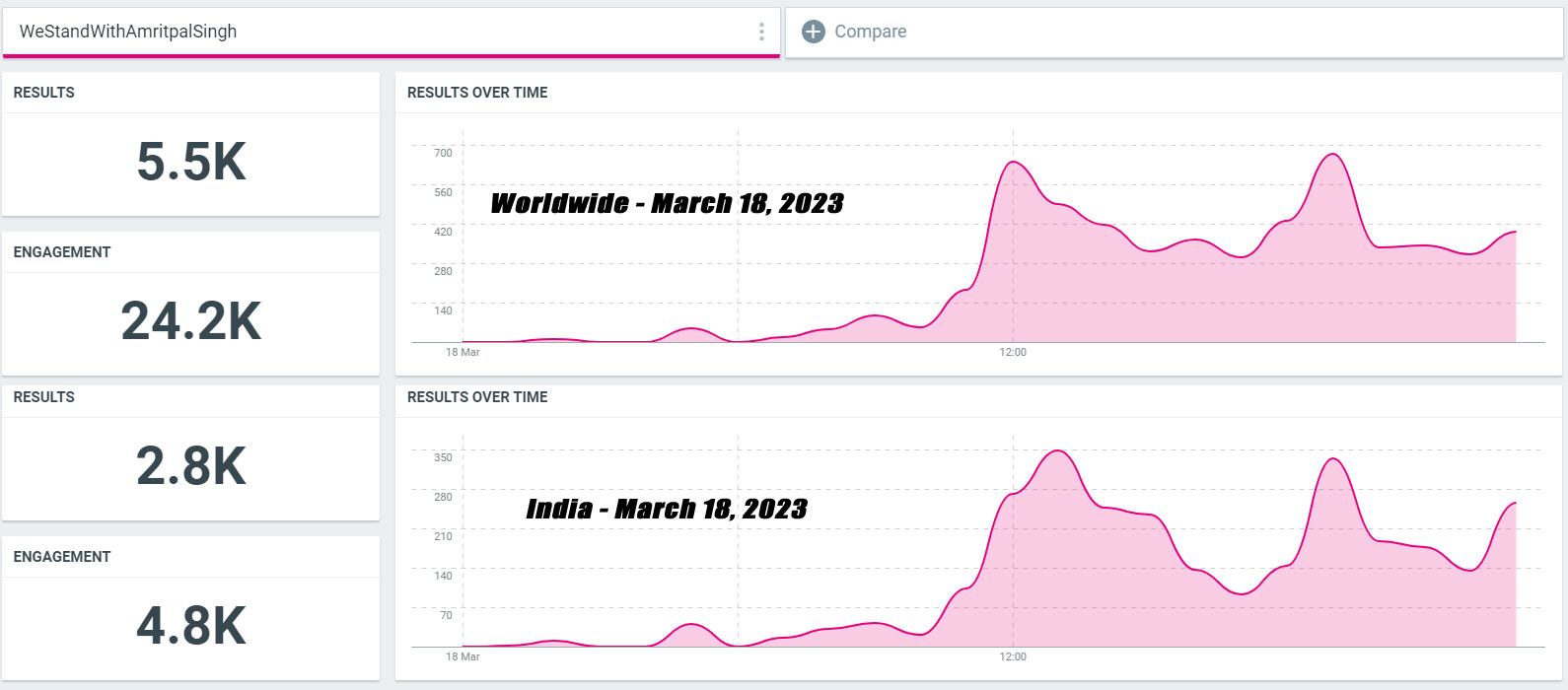
The hashtag started to appear on the social media platform Twitter on March 18, 2023, the day on which a massive crackdown by Punjab Police along with central agencies began. On the first day, around 5,500 tweets were made using the hashtag, including 2,800 tweets from India.

Source: Talkwalker

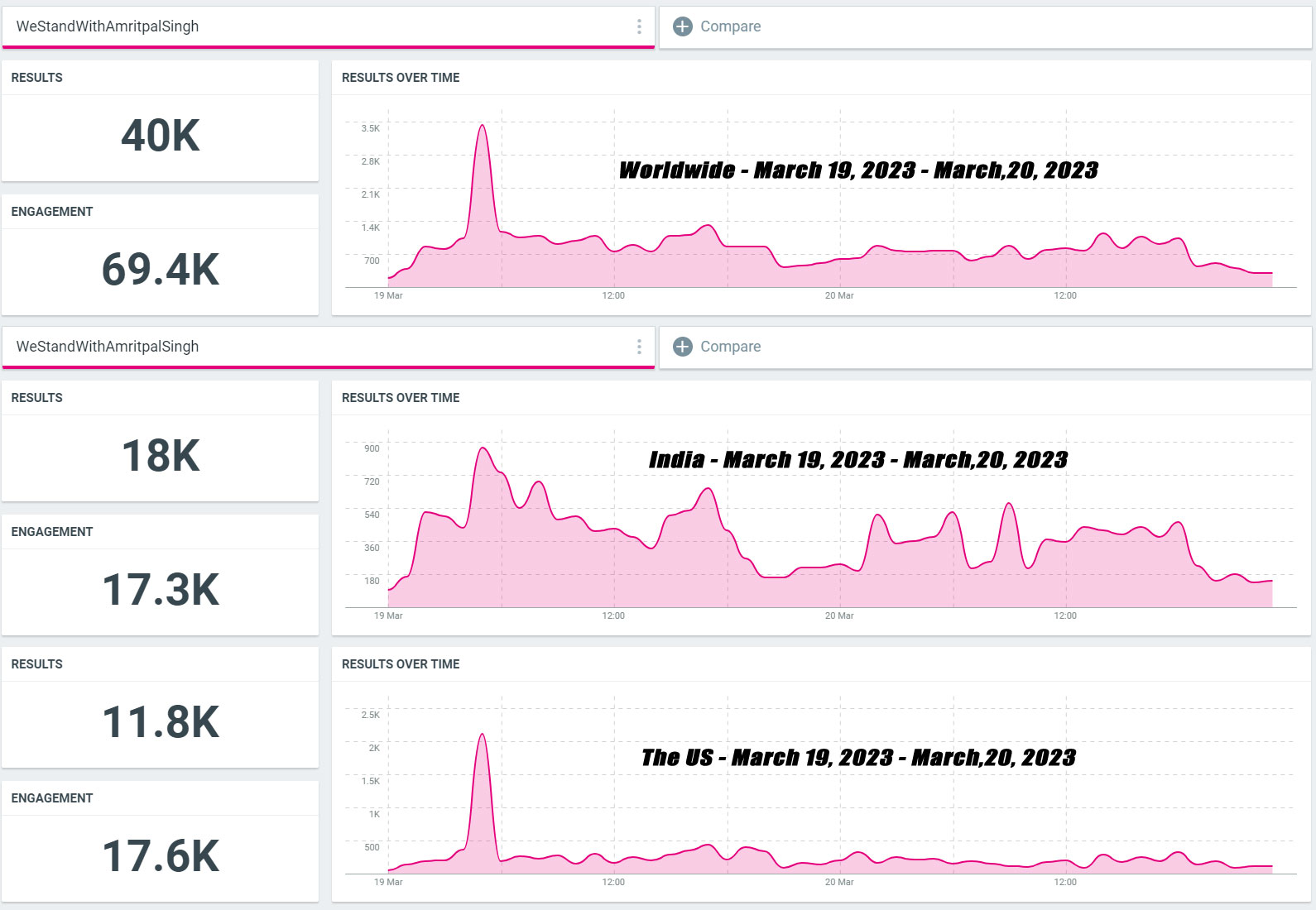
Between March 19 and March 20, the number of tweets skyrocketed to around 40,000, with 18,000 tweets from India and 11,800 from the US. 

Source: Talkwalker

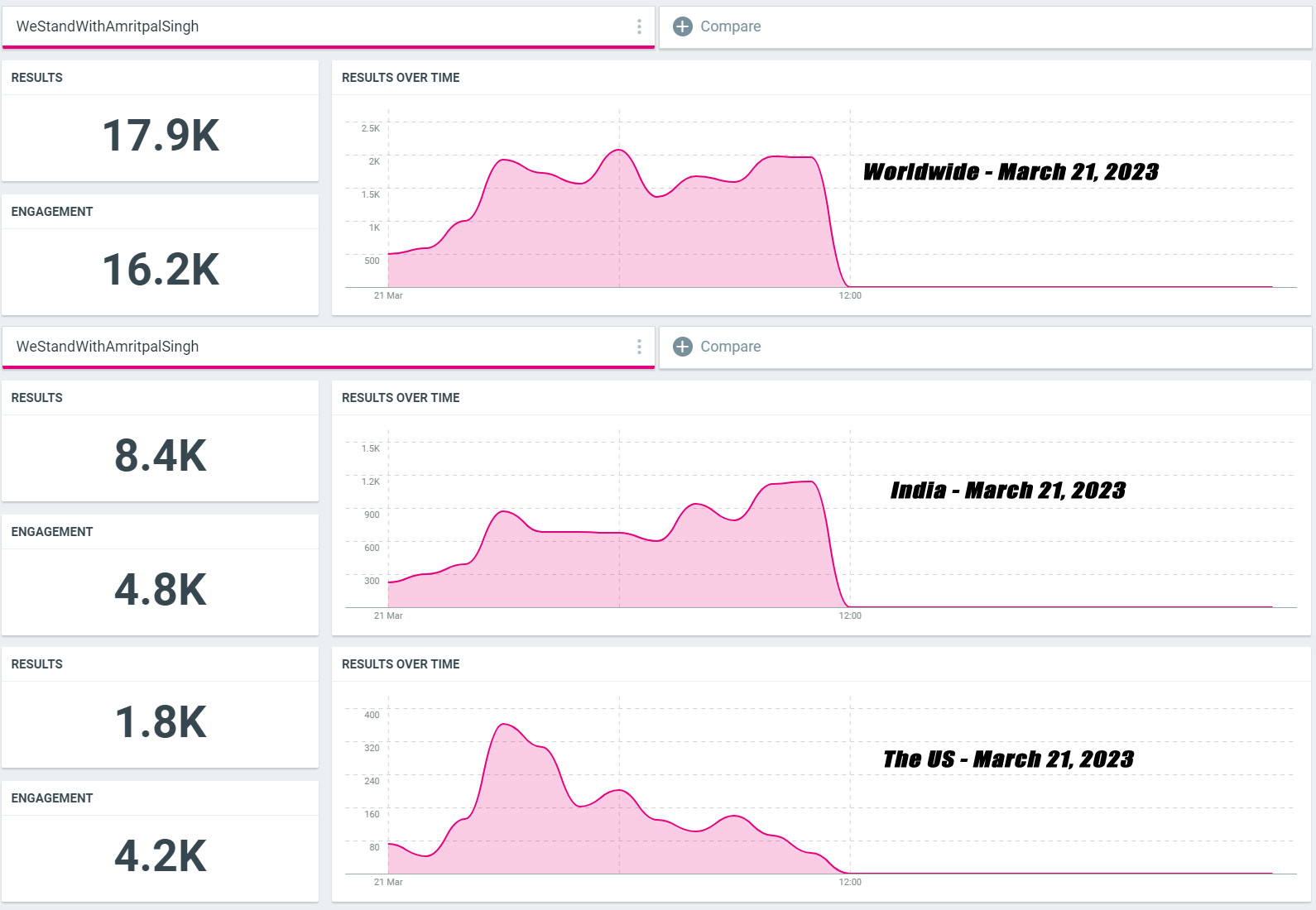
On March 21, so far, 17,900 tweets had already been made, of which 8,400 were from India and 4,900 from the US. Notably, as the internet has been restored in some parts of Punjab, a spike is seen in the number of tweets from India. Though in smaller numbers, tweets from Canada (1,800) and Pakistan (430) are also adding to the narrative.

Source: Talkwalker

Please note that the stats are based on which country the user has selected in their profile. The actual data may vary.

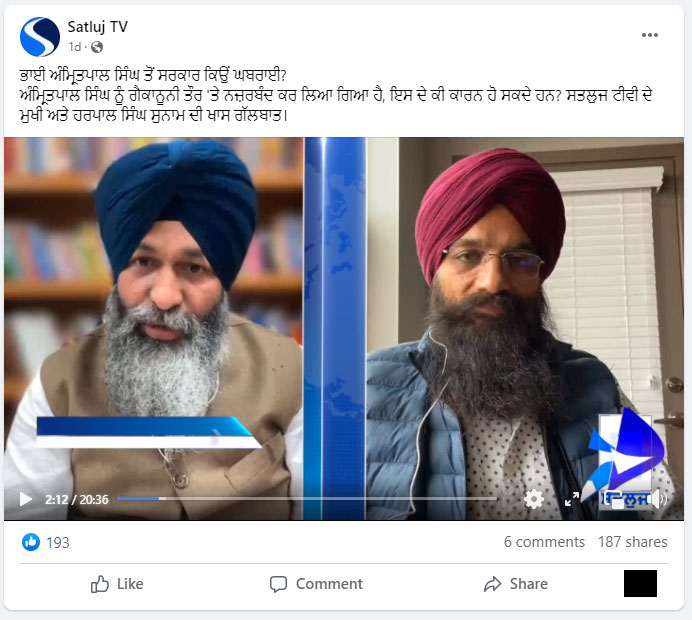
Coming to the tweets, videos of International reporters were used to set the narrative. The first video here is from Satluj Network, which Mangat Group owns. Tony Mangat is the founder of Mangat Group.

Though the video appears to be from International media, one glance at its Facebook page makes it clear that it is owned by pro-Khalistani elements living in the US. Many videos on the channel are in Punjabi. Here is a post in Punjabi in support of Amritpal Singh. In the post, the channel spreads fake news that Amritpal has been arrested.

Source: Facebook/Satluj Network.

In the second post, a reporter from TNM quoted CNN’s hitjob and talked about how the internet shutdown affected people.

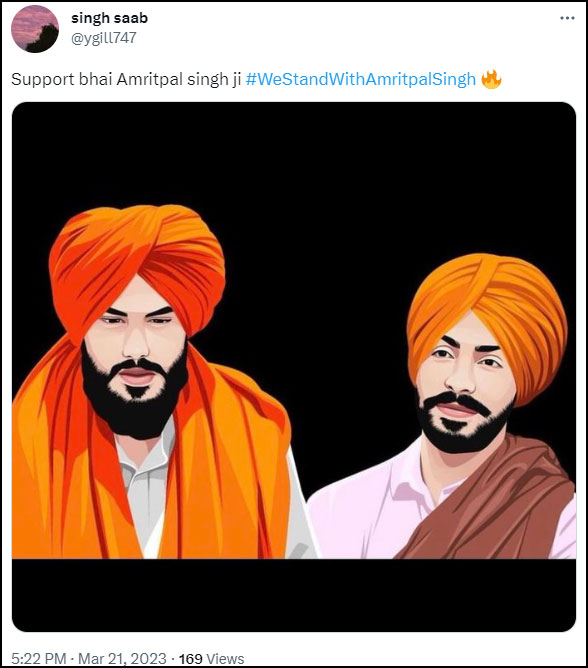
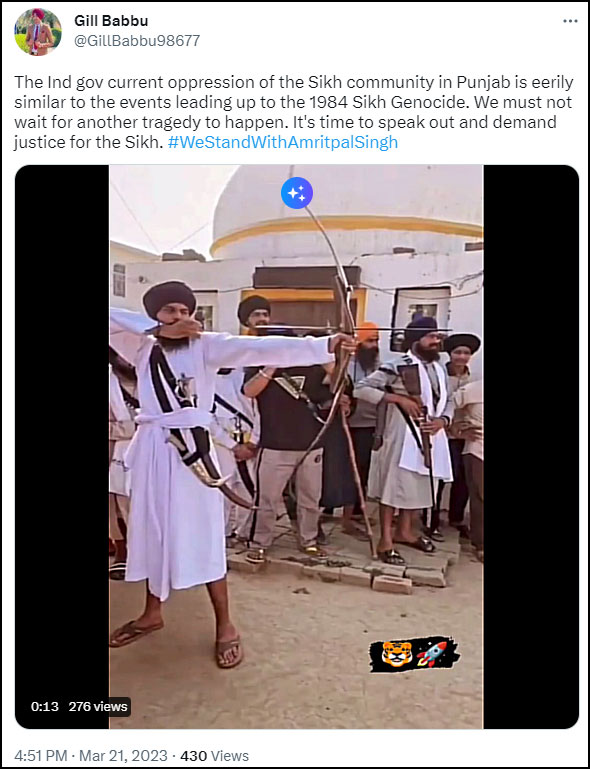
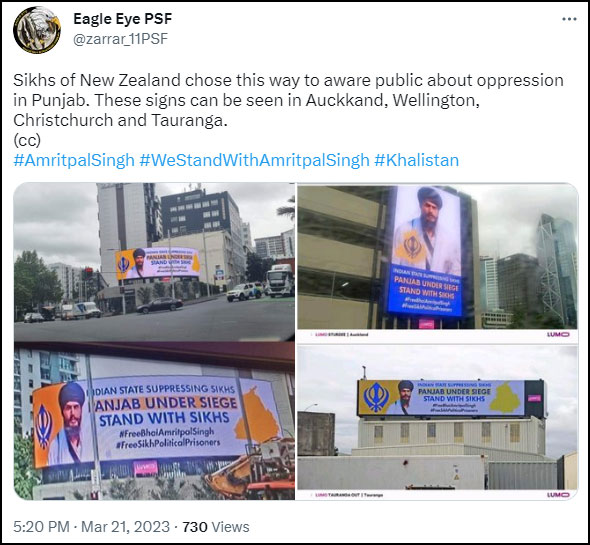
There have been thousands of such tweets posted on the microblogging platform with the said hashtag, aimed at inflaming tensions in India.

Source: Twitter
Source: Twitter
Source: Twitter

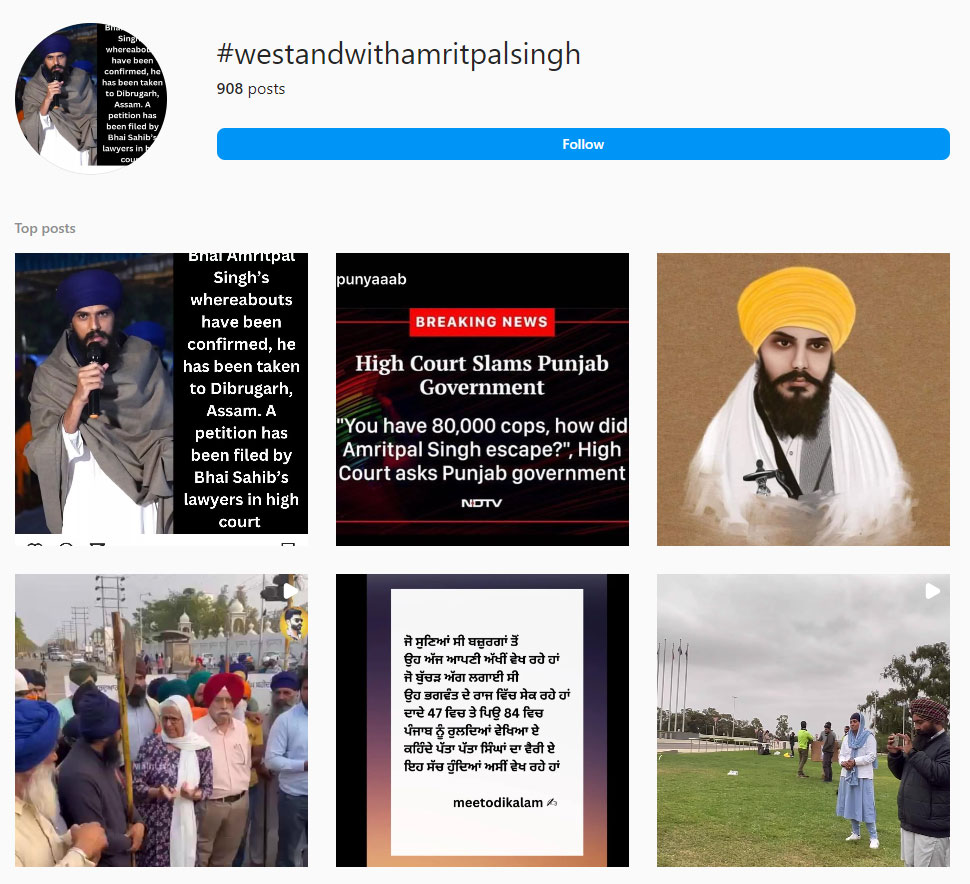
The hashtag is being shared on Instagram as well.

Hashtag was gaining traction on Instagram. Source: Instagram

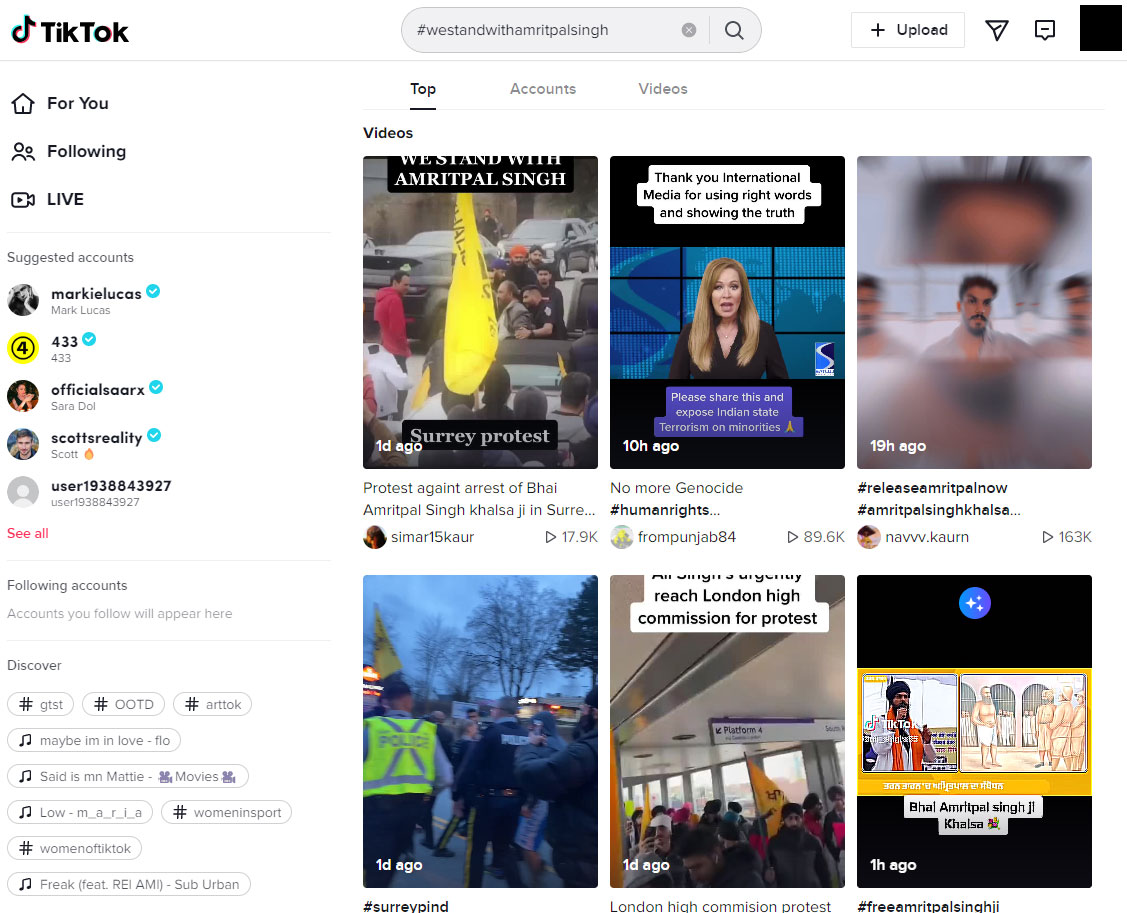
Though TikTok is banned in India, it is being used to gain traction where the platform is famous. Many videos published in favour of Amritpal Singh using this particular hashtag had over 50,000 views.

TikTok is being used to set a narrative in the Amritpal Singh case. Source: TikTok.

Crackdown on Amritpal Singh

On March 18, Punjab Police and central agencies launched a massive crackdown on pro-Khalistan separatist leader Amritpal Singh. So far, over 110 associates of Singh have been arrested. However, he is still on the run. Internet was suspended on March 18 for one day, but the suspension was extended for two more days. Internet services were resumed in some areas of Punjab on March 21.

Police have alleged that Singh was in contact with ISI and received funds from Pakistan. Furthermore, it has been reported that Singh was creating a private army in the guise of an anti-drug drive and de-addiction centre. Following the crackdown, official Indian Government establishments in London and San Francisco were attacked.

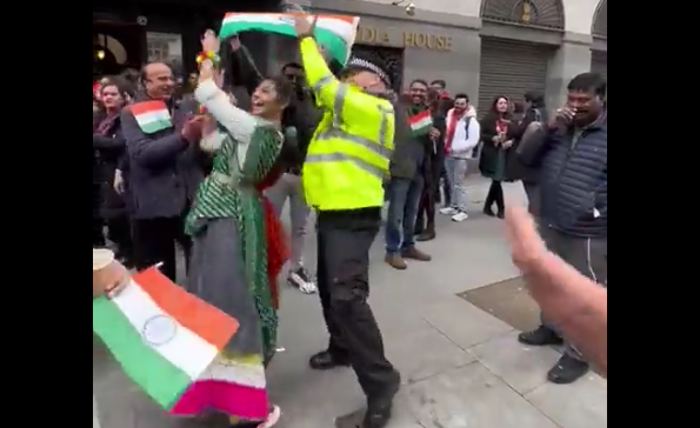
London: British Police official dances outside Indian High Commission 2 days after failing to prevent Khalistani attack on the building

0

On Sunday (March 19) evening, pro-Khalistani elements barged into the Indian High Commission in London and removed the tricolour from the premises. Following the lapse in security from the local metropolitan police in London, India demanded strict action, and in response, they got a Bollywood dance from the police in front of the High Commission building.

A couple of days after the attack on the Indian High Commission, when the Khalistanis were given a free run in London to attack India and its flag, Metropolitan Police finally appeared outside the building. However, instead of providing any security, the police turned up to do a little dancing.

If the metropolitan police hadn’t done enough damage to its image and exhibited its non-serious attitude to work by remaining absent during the attack on Indian High Commission, they compounded it by pretending that a silly dance 2 days later makes up for everything.

Attack on Indian High Commission in London

On Sunday (March 19) evening, pro-Khalistani elements barged into the Indian High Commission in London and tried to remove the tricolour from the premises.

In the video that came to light, a mob of Khalistanis could be seen staging a protest outside the Indian High Commission. Amidst chants of ‘Khalistan Zindabad’, a man sporting an orange turban was seen scaling the walls of the building and pulling down the Indian flag.

He then waved the Khalistani flag jubilantly while Indian officials at the building seized the tricolour from the man. Some of the Khalistanis were also spotted holding a poster of ‘fugitive’ Amritpal Singh.

As per a report by CNN-News 18, the local police in London were alerted about the possibility of a Khalistani ambush at the Indian High Commission building but the authorities did not send a police team.

The pro-Khalistani elements, responsible for removing the Indian tricolour, are said to be students studying in local colleges.

Following west’s financial sanctions on Russia, Indonesia to phase out Visa and Mastercard, reduce dependence on western payment systems

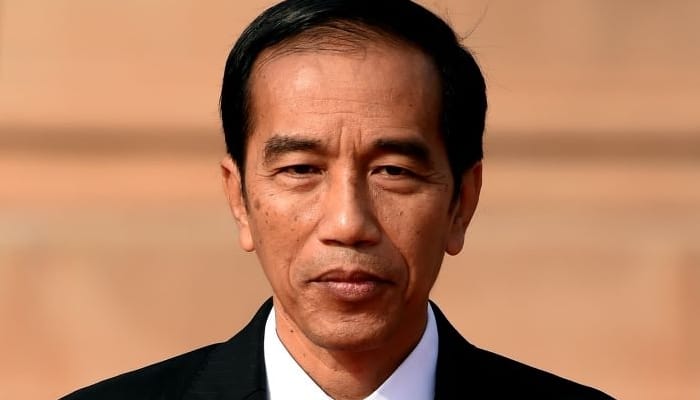
In a move that could have significant implications for businesses operating in Indonesia and the visitors there, President Joko Widodo has announced that the country will gradually phase out the use of Visa and Mastercard. President Widodo said that they are doing it after looking at the sanctions on Russia and amidst concerns over dependence on foreign payment systems.

The decision was announced on Monday, March 20, in Jakarta, where the president stated that the move was aimed at promoting the use of domestic payment systems and reducing the country’s reliance on foreign entities.

“We need to develop our own payment systems to be more independent and self-sufficient,” President Widodo said. “Be very careful. We must remember the sanctions imposed by the US on Russia. Visa and Mastercard could be a problem,” he further added.

Commenting on the initiative, Bank of Indonesia’s spokesperson, Erwin Haryono, said that the regulator was in conversation with local businesses and the progress is about 90%. He added that domestic cards will have many benefits, including lower fees. He also said, “Offshore settlements and dependence on foreign payment networks such as US Visa or Mastercard will no longer be necessary”.

The sanctions on Russia were imposed by the United States and other Western countries in response to the country’s conflict with Ukraine. As a result, many Russian banks and businesses have been cut off from the global financial system, including Visa and Mastercard.

Indonesia’s decision to phase out these payment systems is likely to be seen as a blow to the companies, which have significant market share in the country. Visa and Mastercard have been operating in Indonesia for many years, and are widely used by both consumers and businesses.

However, the move could also be seen as an opportunity for domestic payment systems to gain a larger foothold in the market. Indonesia has a number of homegrown payment systems, including GoPay, OVO, and DANA, which have been growing rapidly in popularity in recent years. The decision by Indonesia to phase out these payment systems is expected to have significant implications for the global payments industry, as Indonesia is a large and growing market.

Indonesia is not the first country to consider phasing out foreign payment systems. In recent years, countries like China and Russia have taken steps to develop their own payment systems and reduce their reliance on Visa and Mastercard.

India’s experience with foreign payment systems

The Reserve Bank of India prohibited Mastercard, Diners Club, and American Express from adding new customers in the country for nearly one year. The move came after the payment systems were found to have violated data storage rules that require all payment information to be stored on servers located in India.

The RBI had given the payment systems a deadline to comply with the data localisation norms, but the companies failed to do so. The RBI noted that it had repeatedly warned the companies about the need to comply with the rules.

The data localisation norms were introduced in India as part of the government’s efforts to protect the privacy of Indian citizens and ensure that their personal data is stored securely. The rules require all payment systems to store data on servers located within the country, rather than on servers located outside of India.

The ban on these payment systems was indicative of India’s desire to push for greater self-sufficiency in the technology sector and is seeking to reduce its dependence on foreign companies for critical services.

The rise and rise of RuPay

India rolled out its own domestic payment system, RuPay, as the country sought to reduce its reliance on international payment systems such as Visa and Mastercard.

RuPay is a card payment system similar to Visa and Mastercard. It is operated by the National Payments Corporation of India (NPCI), a non-profit organization that was established by the Reserve Bank of India and the Indian Banks’ Association.

The move to promote the use of RuPay is seen as part of the Indian government’s efforts to increase self-sufficiency and reduce dependence on foreign financial companies. It also aligns with India’s push towards a more cashless economy and its efforts to expand financial inclusion.

RuPay has already gained significant traction in India and some other countries like Bhutan, with over 600 million RuPay cards issued as of 2022. The payment system is accepted at over 3.6 million point-of-sale (POS) terminals and 1.5 million ATMs in the country.

The government also announced incentives for businesses to adopt RuPay, such as lower transaction fees compared to international payment systems. This was aimed to encourage more merchants to accept RuPay, which in turn would increase its adoption among consumers.

The promotion of RuPay has had significant implications for the payments industry in India, as it provides an alternative to international payment systems such as Visa and Mastercard. It will also support the government’s efforts to promote financial inclusion and a cashless economy.

In the case of Indonesia, it remains to be seen how quickly the phase-out of Visa and Mastercard takes place, and what the impact will be on businesses and travelers in the country. However, President Widodo stated that the government would work with banks and other stakeholders to ensure a smooth transition to the new payment systems.

“We will ensure that there is no disruption to businesses or travelers and that everyone has access to reliable and secure payment options. This is an important step for our country, and we are committed to making it a success”, he said.

Indore: Junaid and 2 others brutally assault lawyer who got a PFI spy arrested; probe underway

0

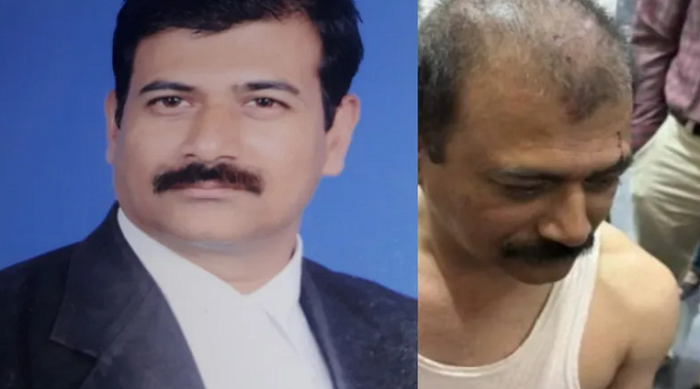
The Madhya Pradesh Police on Tuesday detained one individual named Junaid for assaulting a lawyer in the city of Indore. The lawyer who has been identified as Manish Gadakar is associated with Hindu Mahasabha. Reports mention that Manish was beaten by 3 persons, one of whom has been identified as Junaid.

According to the reports, Junaid arrived at Manish’s Tilak Nagar office to seek consultation over his brother’s bail procedure. However, Manish asked him to come in the later hours of the day as he was busy. In the evening, Junaid brought two other people to the victim’s office and threatened him from posting social media posts against Muslims.

Later, the trio assaulted the lawyer and warned him from using social media against Muslims. The men threatened Manish saying that he would be killed if he posts anything against Muslims on Facebook. The victim was immediately shifted to the local hospital where he is undergoing treatment.

Manish stated that the men came under the guise of seeking help to attain their relative’s bail but were fully prepared to launch an attack on me. “They had planned the assault well in advance and executed it in the evening at my office”, he said. Reports suggest that the accused were keeping a continuous watch on Manish’s office for the past two days and executed the attack on Tuesday.

Manish Gadkar helped police arrest PFI spy

It is important to note that Manish Gadkar is the one who helped the Police in identifying and arresting a Popular Front of India (PFI) spy in the Sadar Bazar area. Gadkar, in January this year, had complained against a ‘law student’, Sonu Mansuri, who was recording a video in the court during a case involving a Bajrang Dal leader.

Manish informed the police about Mansuri’s activities after which she was arrested and interrogated by the police. The police during the investigation also recovered a huge amount of cash from the PFI spy. The victim is associated with Hindu Mahasabha and has been active in campaigns against loudspeakers used for Azaan in Masjids.

In the current case, the Sadar Bazar Police in Madhya Pradesh has arrested Junaid for assaulting a lawyer associated with Hindu Mahasabha. Further investigations into the case are underway.

Indian embassy in touch with agencies to detain and deport fugitive Islamist hate preacher Zakir Naik from Oman: Reports

0

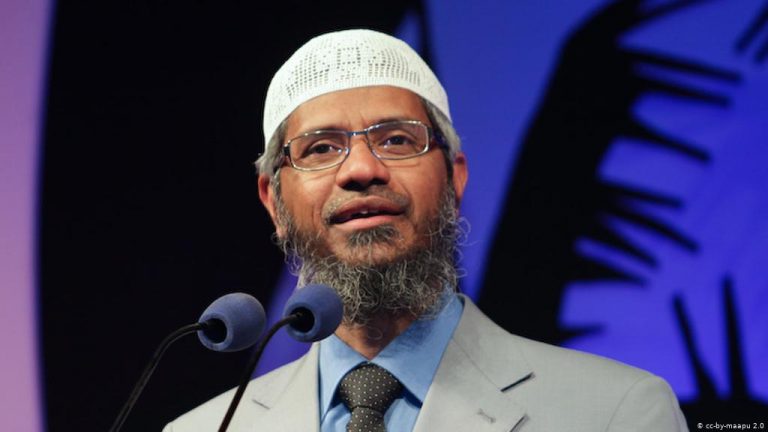
Indian fugitive and radical Islamist preacher Zakir Naik is likely to be deported from Oman. Media reports have quoted sources as saying that the Indian intelligence agencies are already in contact with Oman officials in a bid to arrest Naik during his visit to Oman on March 23. According to reports, Naik is expected to visit Oman on March 23 for delivering religious sermons. 

There is a strong possibility that Oman officials may detain the controversial preacher upon his arrival and subsequently turn him over to Indian authorities. According to reports, the Ministry of Foreign Affairs (MEA) has also raised the issue with Oman’s Ambassador.

Naik had received an invitation to deliver two religious sermons in the country– “The Quran a Global Necessity” and “Prophet Muhammad A Mercy to Humankind”. His first lecture is set for March 23, the first day of Ramadan on March 23 and the second lecture will be held on March 25 at Sultan Qaboos University.

It is not clear how the Islamist preacher is to proceed regarding his arrival in the country, considering that the news of his possible arrest is already being flashed by the Indian media. The radical preacher resides in Malaysia.

Zakir Naik has been avoiding Indian authorities ever since his name started cropping up in terror-related cases. In 2016, terrorists involved in the Dhaka blast case admitted that they were influenced by the preacher’s speeches.

In 2019, Zakir was banned from giving speeches in Malaysia after he made racist comments against Hindus and Chinese Malaysians. He was interrogated for hours in connection to the same.

Last year OpIndia reported how he had earlier joined hands with those who instigated violence in Leicester in England’s Midlands area.

In July 2021, the Middle East Media Research Institute (MEMRI) reported that Naik was seen alongside other Islamic preachers in a grand collage, fundraising for the construction of a grand mosque and Dawah (proselytism) centre in Oslo in Norway.

The Indian fugitive was spotted alongside UK-based Islamists, Ali Dawah and Mohammed Hijab, who reportedly instigated the recent spate of violence in Leicester. They were seen exhorting Muslims to contribute to the establishment of the Islamic centre by promising them a ‘house’ in Jannah (paradise).

Zakir Naik is wanted in India in cases involving money laundering. The government of India had taken his channel, Peace TV, off the air for peddling hate propaganda. He has been living in exile in Malaysia since 2017.

Now, it is being reported that the Indian embassy in Oman is working with local authorities to detain and deport him in accordance with local laws. The Indian embassy might likely send a legal team for follow-up after detention. According to reports, the local authorities are likely to oblige with requests for detention.

Qatar had invited Naik to give religious sermons at the FIFA World Cup 2022. However, after New Delhi raised concerns with Doha that it would be compelled to terminate Vice President Jagdeep Dhankar’s trip to the FIFA World Cup opening ceremony if Islamist Zakir Naik were to be formally invited to watch the event’s opening from the VVIP box, Qatar had informed India via official channels that Zakir Naik had not received any formal invitation to attend the November 20, 2022, FIFA World Cup inauguration in Doha. Qatar reportedly stated that other nations were deliberately disseminating “disinformation” to impair diplomatic ties between India and Qatar.

‘Despite 80,000 police officers, how did Amritpal Singh escape’, Punjab and Haryana HC raps Bhagwant Mann govt

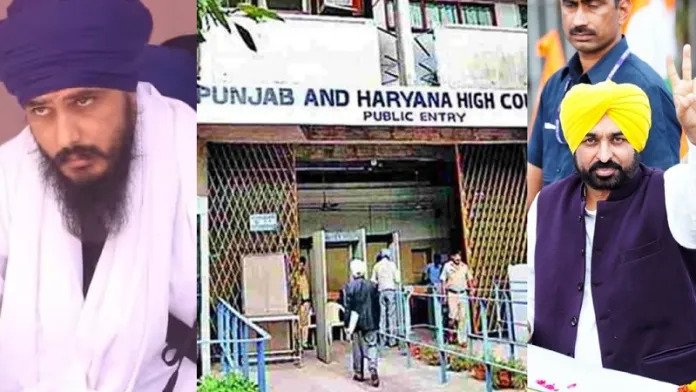
Despite the state-wide crackdown on pro-Khalistan leader Amritpal Singh and his supporters, the Bhagwant Mann-led Punjab government has failed to nab the ‘Waris Punjab De’ chief. The Punjab and Haryana High Court has reprimanded the state government for its failure to arrest Amritpal.

Amritpal Singh has been declared a ‘fugitive’ since Saturday, 18 March 2023, as Punjab Police continues to try and track him down. Following this development, the Punjab and Haryana High Court told the AAP government, “A massive search operation was launched to nab him. Despite this, he managed to escape. The intelligence system of the Punjab government has completely failed.”

“When there were 5-6 FIRs and you are saying there are 5-6 criminal cases against him, how did he manage to escape? What were 80,000 cops doing?”, the bench of justice NS Shekhawat remarked, referring to the Punjab government’s submissions.

In response, the Punjab Police said that a case has been registered against Amritpal under the NSA. Justice NS Shekhawat raised questions on the state government and asked why NSA has been imposed on Amritpal Singh. The court also asked that when the entire operation was planned, how did Amritpal escape? Doubting police story, the court asked that how is it that everyone except him was arrested.

In response, Advocate General Vinod Ghai, appearing for the Punjab government, said, “Police may have had weapons, but they were restrained from using force. Some matters are so sensitive that we cannot explain them in court. We are trying our best to arrest Amritpal.” During the hearing, Justice NS Shekhawat further said that if he escaped amidst such security, it is an intelligence failure.

Punjab CM Bhagwant Mann released a video in this regard and said that nobody will be allowed to play with Punjab’s security. Mann said, “Peace and tranquillity of Punjab and progress of the country is our priority. We will not spare any such force which may be flourishing in Punjab against the country.”

Amritpal was creating his own army

Intelligence agencies have revealed that Amritpal Singh was involved in building his own ‘private army’ by the name of ‘Anandpur Khalsa Fauj’. Inputs suggested that Amritpal Singh was using drug de-addiction centres and a gurdwara for stockpiling weapons and preparing youths to carry out suicide attacks under the name of Anandpur Khalsa Force (AKF), on the line of Khalistan Tiger Force (KTF).

With the help of this army, Amritpal and his Khalistani supporters, working at the behest of ISI, were plotting an attack in Delhi. They also received funds from Pakistan.

As Congress targets Modi govt over Mehul Choksi, here is a recap of how Congress had facilitated scams by Nirav Modi and Choksi

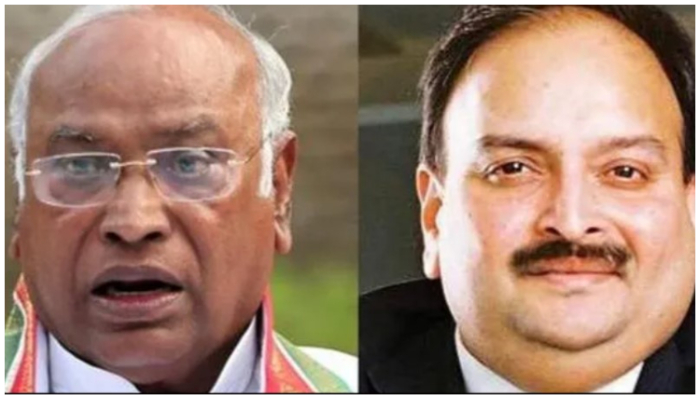
The Congress party, which has repeatedly indulged in spreading baseless allegations against Prime Minister Narendra Modi in connection with Nirav Modi and Mehul Choksi’s absconding, Tuesday once again trained its guns at the Prime Minister after Interpol dropped fugitive diamantaire Mehul Choksi‘s name from its Red Notice list.

Congress President Mallikarjun Kharge hit out at PM Modi saying that the fugitives are getting respite while the ED-CBI are busy pursuing opposition leaders.

“They are doing things to divert attention from real issues. Our embassies are being attacked. People who have run away with money from banks, Mehul Choksi, those giving protection to such people talk about patriotism, it is a joke,” the Congress president told reporters before leaving for Parliament.

“We will ask the government to clarify on this,” he added.

Continuing his veil attack, Kharge tweeted in Hindi, “ED-CBI for opposition leaders but release from Interpol for ‘our Mehul bhai’ of Modi ji. When Parliament can be stalled for ‘best friend’, then how can help for the ‘old friend ‘ be denied who absconded five years ago.”

Mallikarjun Kharge was not the only one. In fact, as soon as this news became public the entire entourage of Congress lawmakers and their sycophants went on Twitter to cast aspersions on PM Modi.

Congress’ Supriya Shrinate also chimed in, accusing PM Modi of protecting Mehul Choksi.

“Modi Govt ‘Red Faced’ India by failing to prevent Mehul Choksi’s removal from Interpol’s List of Red Corner Notices! ₹13,000 CR PNB Fraud now closed for “HAMARE BHAI MEHUL” ! People’s Money down the drain. ‘Line-Up’ of ED & CBI for Opp-Leaders, But ‘Lifeline’ to Mehul Choksi !” Congress leader Randeep Singh Surjewala tweeted.

“Modi Sarkar ke Do Bhai—ED aur CBI—pursue Opposition leaders with great vigour in furtherance of the PM’s politics of vendetta & intimidation. But they allow Interpol to give a lifesaver to Mehul Choksi!” wrote Congress’ Jairam Ramesh.

Congress National Spokesperson Shama Mohamed went so far as to suggest that the BJP government purposefully botched the investigation to benefit Choksi.

Several Congress sycophants also quickly followed suit. Troll-cum-journalist Swati Chaturvedi took to Twitter to use similar parallels to advance the Congress agenda. “Mehul Choksi, Nirav Modi & Vijay Mallya scammed Indian banks for thousands of crores & then had “assisted escapes” from India. Shameful that the Modi government claims to be tough on corruption. Prove it bring these scamsters back,” she tweeted.

Another INC loyalist Bhavika Kapoor went on to produce a so-called ‘chronology’ of events to insinuate PM Modi’s hand in deliberating Interpol to drop fugitive diamantaire Mehul Choksi’s name from its Red Notice list.

These ridiculous remarks and bizarre analogies appear to be a rehash of the unfounded claims that the Congress party, led by none other than their senior leader Rahul Gandhi, has used as one of its favourite electoral planks to attack the Prime Minister. Incidentally, soon after the news of the PNB fraud, which was perpetrated since 2011 broke, the Congress party tried to desperately link it to Narendra Modi. Congress claimed that Nirav Modi met the PM at the Davos economic summit in 2018, the year news of the massive Rs 11,000 crore financial fraud broke.

Since then, Rahul Gandhi has also peddled several lies with regard to the economic fugitive Nirav Modi and PM Modi. Rahul Gandhi has constantly blamed the Prime Minister for Nirav Modi’s absconding and has drawn strange parallels between the two.

Although we at OpIndia have several times in the past exposed Congress’ hopeless and bizarre analogies, here is a quick recap of how the party has itself facilitated the scam by the fugitive diamantaire Nirav Modi and his uncle Mehul Choksi.

Mehul Choksi’s lawyer talks about his client’s ‘loose alliance’ with the Congress

In August 2018, David Dorsett, Mehul Choksi’s lawyer stated that Choksi had a ‘loose alliance’ with the Congress which ‘inflamed’ the situation, implying the case against him is a case of a political witch hunt. In a conversation with Republic, Dorsett has claimed that there are ‘serious political elements involved’ in the case. Choksi’s lawyer also called Nirav Modi, his nephew, also an accused in the financial fraud, a ‘scapegoat’ and that the authorities are trying to pin the matter on him. He further says that a very serious political element is involved in this whole matter and the political climate in India is heated up in a very ‘serious way’, especially with the elections coming up next year. He claimed that “the politicians are in splints right now. They are trying to carry as much popular support as they can and the situation with Mr Choksi has to be seen in that context”. In this context, BJP had even cornered Congress over fielding Mehul Choksi’s lawyer as a candidate in the Karnataka Assembly elections.

Shehzad Poonawal claimed Rahul Gandhi met Nirav Modi

One must also recall that not too long ago, it was reported that the former Finance secretary Rajiv Takru, working under the erstwhile UPA government had tried to “silence” the PNB whistleblower in 2013. Incidentally, it was the same time that Shehzad Poonawalla, a rebel Congress leader who is now the BJP spokesperson, claimed that Rahul Gandhi himself had met Nirav Modi.

“Open challenge to Rahul Gandhi to deny he met Nirav Modi in September 2013 cocktail party -11th Sep if my memory serves me right! Imperial Hotel- Rahul spent a long time! Same period when loans are given to Mehul Choksi & Nirav Modi!! SPG may have records or let’s undergo a lie detector test?” Shehzad Poonawala has then said.

Besides this, it has been alleged that Finance Minister P Chidambaram himself had signed the whistleblower’s termination letter. The Rs 11,000 crores financial scam by Nirav Modi started under the Congress government itself in 2011. In fact, it was also reported that an unnamed Congress leader was involved in cash deals with Nirav Modi’s stores during the demonetisation period, raising questions over the suspicious nature of these transactions and a link between Congress leader Abhishek Manu Singhvi and Nirav Modi had also emerged.

When Congress’ P Chidambaram signed an order benefitting 13 companies, including those owned by Mehul Choksi

Interestingly, on 16th May 2014, the day election results were declared with Prime Minister Modi winning the elections, P. Chidambaram, the then finance minister, had signed an order to benefit 13 companies including Mehul Choksi, who is Nirav Modi’s uncle. The 20:80 scheme that was sanctioned by Congress leader P Chidambaram allowed 13 ‘star trading houses (STH)’ and ‘premier trading houses (PTH)’, including Choksi-led Gitanjali Gems to import gold and sell about 80 per cent of their total bullion shipment in local markets. This scheme ended up encouraging gold hoarding and aided these traders in artificially inflating the retail prices. In fact, the Jewellers Association had warned about the repercussions of this decision and had blamed the Congress government for favouring crony capitalism. The warnings had fallen on deaf ears and were ignored not only by the Congress government but also by the RBI head, Raghuram Rajan.

Essentially, the scam that was levelled by Nirav Modi and Mehul Choksi originated with the order signed by P Chidambaram encouraging crony capitalism, defended by friendly media. From the 20:80 Gold Scheme to the Congress connections and the fact that Rahul Gandhi had potentially met Nirav Modi, with every revelation, Congress’ tentacles in this scam become apparent.


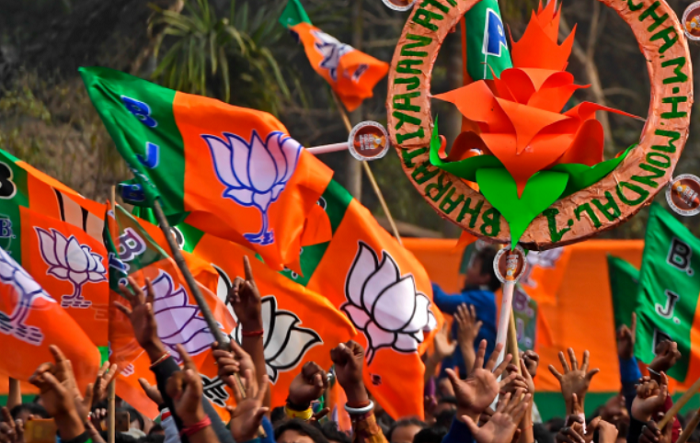
BJP sweeps cooperative societies elections in Uttar Pradesh, wins 6,200+ PACS out of 7000

On Sunday, amid accusations and denials from the leaders of the BJP and the Samajwadi Party, the elections for chairperson and vice-chairperson of 7000 Primary Agricultural Credit Cooperative Societies (PACS) in Uttar Pradesh wrapped up with BJP winning around 80% of the seats. 

The Bharatiya Janata Party Party leaders won 80% of the seats in the elementary-level societies, while the Samajwadi Party leaders succeeded in a few areas. Reports of stone-throwing, sword-waving, and gunfire emerged from several areas of Uttar Pradesh. Several individuals were injured in one such event, which was reported by Bhagwantpur Sadhan Sahkari Samiti.

Elections were only held in 76 of Lucknow’s 81 PACCs. Of these, the BJP got as many as 61 seats.

There are 84 PACC societies in Meerut, and five of those organizations’ elections were postponed for a variety of reasons. The Bharatiya Janata Party gained the majority of seats in the remaining half of the PACCs, where elections were held with no opposition, according to Maninder Pal, chairman of the Meerut DCCB. 

The 132 PACCs in Badaun held their elections for Chairman, Vice-Chairman, and Directors without any opposition. The elected PACC delegates gathered at a nearby BJP party office shortly after the polls to celebrate their success.

There are 132 PACCs in Lakhimpur Kheri, of which the elections for 2 cooperatives were cancelled. In this district, 92 societies held their elections without any opposition, while the remaining societies went to the polls. According to reports, the BJP won the majority of the seats in this district.

“In, Barabanki District, there are 123 PACCs, out of which the elections of 90 societies were held unopposed and the remaining PACCS went to the polls”, Barabanki DCCB Chairman Dhirendra Kumar Verma was quoted as saying.

Most of the PACCS in Banda had unanimous elections, and very few people showed up at the polls. The BJP won the majority of the seats. According to Prakash Dwivedi, the previous Chairman of the Uttar Pradesh Upbhokta Sahakari Sangh Limited, the elections were held without any problems or mishaps. 

There are 115 PACCs in the district of Shahjahanpur. Of them, 111 societies saw BJP representatives win the polls, while three societies had independent candidates prevail.

The BJP won 57 PACC elections in the Ambedkar Nagar district, which has 90 societies. Elections for cooperative unions and block unions would follow the primary-level co-op elections. There are 1297 co-ops, and elections for them will begin on March 22 and end on March 31 of the current year. Subsequently, from April 3 through April 13, 2023, Krya-Vikray co-ops will commence the election process for around existent 225 cooperatives.

On Sunday, out of 7148 cooperative societies, elections were held for the post of president and vice-president in 7,000 societies. Of these, BJP candidates won in more than 6200 committees. At the same time, the Samajwadi Party has registered victory on more than 500 committees.

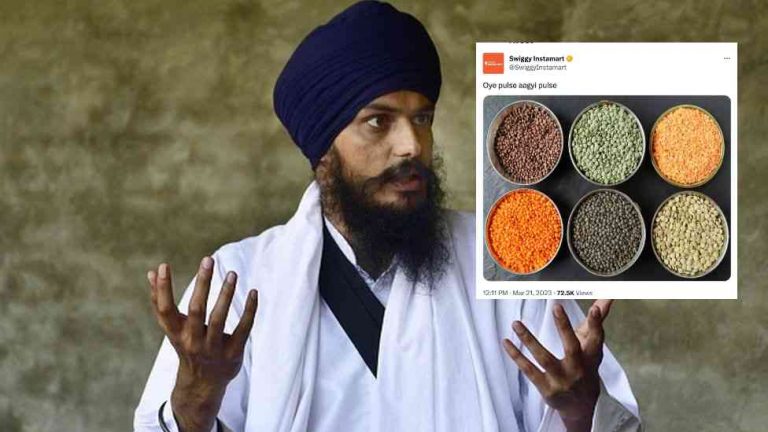
Swiggy Instamart takes a dig at Amritpal supporters with its ‘Pulse aagyi pulse’ ad campaign

Swiggy Instamart, the instant groceries delivery service of food delivery app Swiggy, took a dig at pro-Khalistan fugitive Amritpal Singh’s supporters by tweeting a fun wordplay on the ‘pols aa gayi pols’ viral meme.

Swiggy tweeted an image of various pulses with the caption ‘Oye pulse aagyi pulse’. This was a dig on the viral video of Amritpal Singh’s supporter who had gone live on social media as Punjab police closed in on him to arrest him. At some point in the video, he could be heard saying how ‘pols aa gayi pols’ (police is here, police is here) to the audience and asked them to come together.

Following the chase, netizens had taken to social media and mocked the video. However, subsequently, Punjab Police has been taking action against those who had shared the video of the chase and has been asking Twitter to take down accounts of people who are sharing the video.

Amritpal Singh on the run

On 18 March, Punjab Police launched a massive search operation to arrest pro-Khalistan separatist leader Amritpal Singh. However, following a car chase, Singh managed to escape. Over 100 of his supporters have since been detained. Reports have suggested the NIA will be taking over the investigation now.

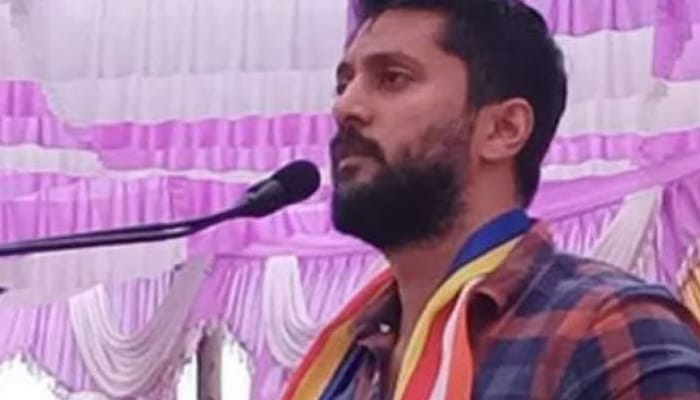
Kannada actor and ‘activist’ Chetan Kumar Ahimsa arrested for objectionable tweet against Lord Rama and Hindutva

0

In a recent development, Kannada actor Chetan Kumar Popularly known as Chetan Ahimsa has been arrested by the police for posting a derogatory tweet about Lord Rama and Hindutva on the microblogging site Twitter.

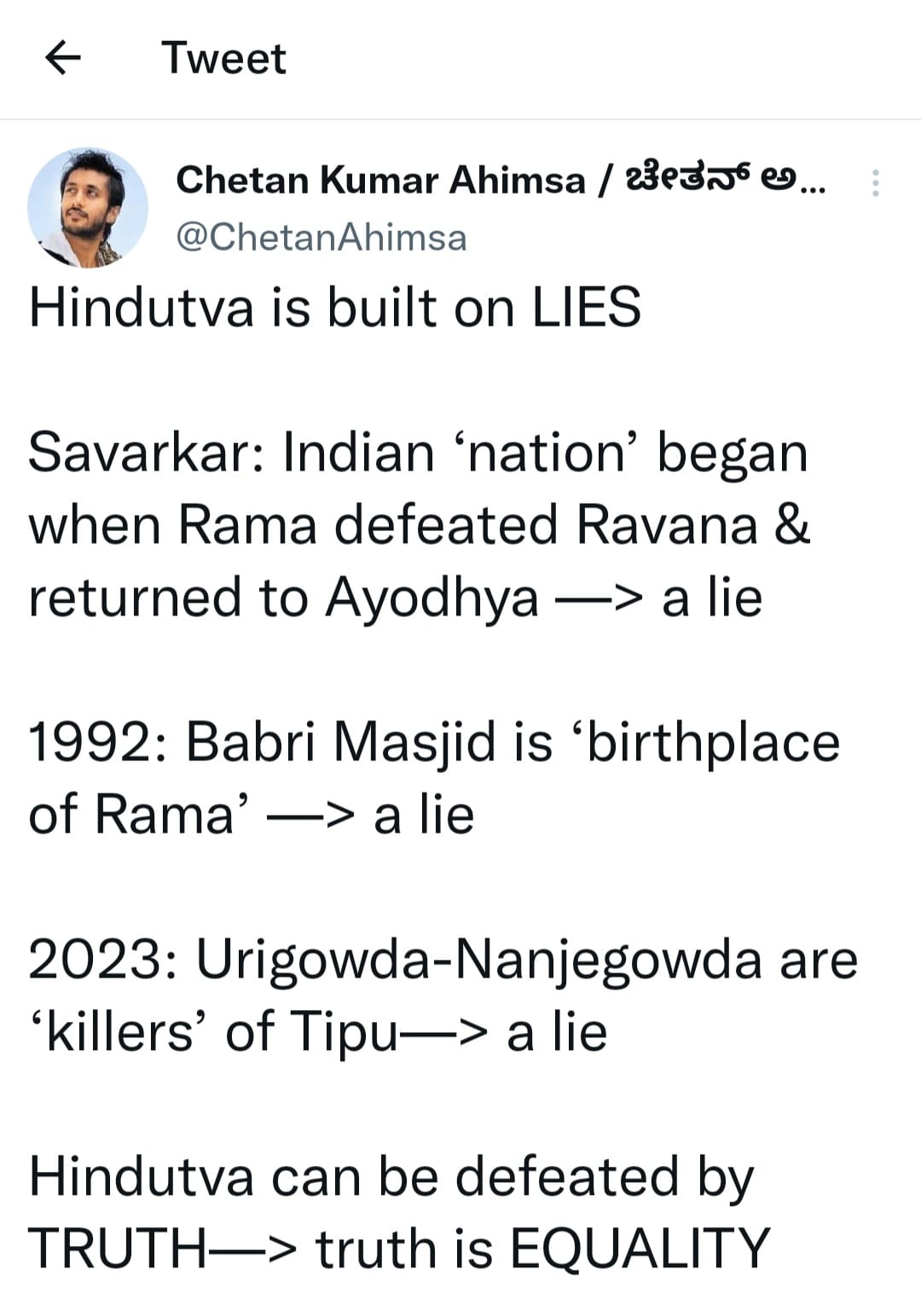
Chetan Kumar posted the tweet on his official Twitter handle on Sunday morning. In the tweet, he made objectionable remarks about Lord Rama, Veer Savarkar and Hindutva. The tweet had gone viral within minutes, and many people had expressed their outrage and anger against the actor.

A screenshot of the Tweet which Chetan Kumar Ahimsa posted on the microblogging site Twitter

This is the tweet which led to his arrest. Notably, it has become a trend among celebrities to defame Hinduism and everything that the Hindus revere.

The arrest of Chetan Kumar has sparked a heated debate on social media, with many people expressing their opinion that the actor should be held accountable for his actions and that he should be punished for his derogatory remarks.

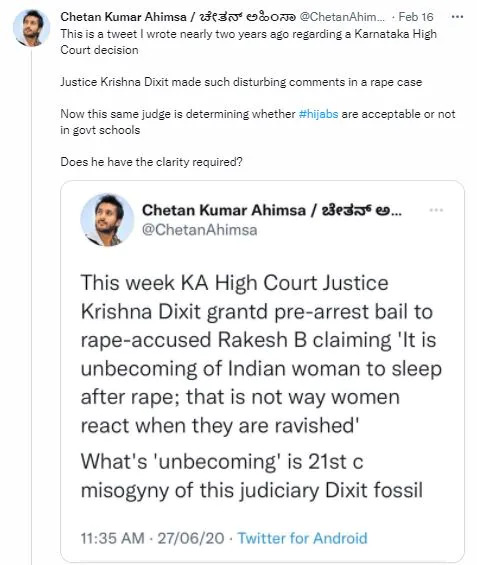
Chetan Kumar is not new to controversies, earlier he was arrested for his inappropriate remarks about the Judiciary.

MN Anucheth, the Deputy Commissioner of Police of Central Division, while talking to the media about Chetan Kumar’s arrest for objectionable tweets against the High Court had said, “Kannada film actor and activist Chetan Ahimsa has been arrested by Bengaluru City Police. An on-its-own FIR was registered on Tuesday under 505(2) and 504 of the IPC. Based on the tweet, the FIR was registered at Sheshadripuram Police Station.”

Source: Twitter

His tweet against Lord Rama and his subsequent arrest has once again highlighted the need for responsible behaviour on social media. Often Hindu symbols are taken for granted and derogatory comments are made about Hindu symbols of reverence.

The police have urged the public to refrain from posting offensive and derogatory content on social media and warned that strict action will be taken against those who violate the law.