Home Blog Page 2859

‘Students want their freedom of choice of dress to be regulated by religion’: Read what justice Hemant Gupta said upholding hijab ban in Karnataka schools

On Thursday, a two-judge bench of the Supreme Court of India delivered a split judgement in the petition filed against the Karnataka High Court order upholding the ban on hijab in schools and colleges in Karnataka. As one judge upheld the high court order while the other overturned the ban on the hijab, the bench sent the matter to the Chief Justice to send it to a larger bench.

In the judgement, Justice Hemant Gupta ruled in favour of the ban on hijab in educational institutions having prescribed dress codes, and Justice Sudhanshu Dhulia ruled in favour of the pro-hijab petitioners. Both judges issued two separate judgements, which were published in a single PDF file on the Supreme Court website.

Rejecting the petition, justice Hemant Gupta stressed upon the word ‘secular’, which has been included in the preamble of the constitution to define the nation. He said that although the concept of secularism emerged in the west, it has to be understood differently in India due to the country’s diverse nature.

“Secularism, as adopted under our Constitution, is that religion cannot be intertwined with any of the secular activities of the State. Any encroachment of religion in secular activities is not permissible”, he said. Secularism thus means treating all religions equally, respecting all religions and protecting the practices of all religions, justice Gupta added.

Coming to the plea to revoke the Karnataka High Court order upholding the Government order dated 05/02/2022 saying that students of government schools in the state have to wear uniforms in the schools. The GO had also said that Private schools also should mandate a uniform. Justice Gupta said that the state government is empowered to issue such orders under the Karnataka Education Act, 1983.

After considering the arguments made by advocates Sanjay Hegde, Devadutt Kamat, Rajeev Dhawan, Meenakshi Arora, Jayna Kothari, Salman Khurshid, A.M. Dar, Kapil Sibal, Colin Gonsalves, Aditya Sondhi, Yusuf Muchhala, Huzefa Ahmadi, Dushyant Dave, Prashant Bhushan, Kirti Singh, Rishad Ahmed Chowdhury, Shoeb Alam, Rahmatullah Kotwal, Thulasi K. Raj and Mohd. Nizamuddin Pasha, all of whom appeared for the petitioners, Justice Hemant Gupta said that he does not find any merit in the arguments raised by the appellants.

Referring to various judgements cited by the appellants to support their case, the judge said those judgements are not helpful in the hijab case as they were related to completely different matters and have no parity with the current case. Rejecting the claim of the petitioners against the formation of College Development Committees, Justice Hemant Gupta said that he finds that the State Government has the power to constitute a College Development Committee under section 143 of the Karnataka Education Act.

The advocates of petitioners had also quoted various comments from the constituent assembly debate on religion and wearing visible religious symbols, where the constituent assembly had refused to incorporate any provision on the same in the constitution. Referring to the same, justice Gupta said that the debates show the in-depth knowledge of the members of the Constituent Assembly at that relevant point in time. But more than 70 years later, with the interpretation of various provisions by the Constitutional Courts, it is not advisable to rely solely upon the views of the individual members in such debates.

The judge also rejected comparisons of hijab made with other religious symbols like Rudraksha or Cross, saying that this comparison has been made only to deal with an argument. He added that anything worn by students under their shirts cannot be said to be objectionable in terms of the Government Order.

Agreeing with the arguments made by the government’s lawyers, the judge said that the govt order was issued for all students, and it is not addressed to any particular community. “The circular was issued to the colleges to ensure compliance of norm of uniform in a non-discriminatory manner, irrespective of any religious faith of the students,” Justice Gupta said in his judgement.

He maintained that under Rule 11 of the act, educational institutions have a right to prescribe a uniform to the students, and this Rule has not been challenged. The judge cited various judgements to say that discipline is required to be maintained in schools, and govt can make rules in this regard even for minority institutions.

Justice Hemant Gupta further said that right under Article 19(1)(g) is not absolute but is subject to reasonable restrictions.

The petitioners also argued that only the hijab worn along with the prescribed uniform does not cause any issue of public disorder or disturbance, and the classroom is expected to be uniform but not homogenous. Justice Gupta dealt with the argument in detail, invoking various judgements and laws.

He said that religious freedoms guaranteed by Articles 25 and 26 are subject to restrictions provided under Article 25(1) of the Constitution. Such right is not just subject to public order, morality and health but also ‘other provisions of Part III’. The judge ruled that Government Order banning the hijab in schools comes under this provision.

Justice Gupta further rejected the claim that wearing a hijab by Muslim women is part of essential religious practice in Islam. Referring to a large number of Islamic texts and relevant judgements, he concluded that essential religious practice relates to various religious activities including the management of religious places and the right to worship. But wearing a headscarf in public is not a religious activity. Therefore, wearing a hijab inside schools is not an essential religious practice, as argued by the petitioners.

Countering the ‘choice’ argument made by both the petitioners and the left-liberal lobby, Justice Hemant Gupta said that the students actually want to subjugate their freedom of choice of dress to be regulated by religion. He said that Muslim girls are preferring to be regulated by the Islamic dress code instead of the dress code made by their schools, when they are actually students of government-run schools. It is, therefore, not a matter of choice.

“The equality before law is to treat all citizens equally, irrespective of caste, creed, sex or place of birth. Such equality cannot be breached by the State on the basis of religious faith,” the judge said.

The judgement of Justice Gupta further said that according to Article 25(2), state law will have primacy over religious rights.

Referring to arguments made by the petitioners comparing rights given to Sikhs to wear a turban with hijab, the judge said that it has been established that for Sikhs it is an essential religious practice to retain hair unshorn, keep kirpan etc. Therefore, hijab can’t be compared with exceptions granted to Sikhs. He also cited earlier orders where Muslims employed at the Indian Air Force were not allowed to keep beards.

Ruling in favour of uniforms in schools, the judge said, “The students have been given a uniform platform to grow and take quantum leap in their further pursuits. The homogeneity amongst the students in the matter of uniform would prepare them to grow without any distinction on the basis of religious symbols, if not worn during the classroom studies in a Pre-University College.”

Justice Gupta also said that he does not find any merit in the claim that if the pro-hijab girls are transferred to religious schools, they would be deprived of the opportunity to fraternize

across religious, class and gender boundaries. He said that fraternity cannot be seen from the prism of one community alone. The idea of fraternity has to be applied to the ground realities wherein some students wearing headscarf in a secular school run by the State Government would stand out and overtly appear differently, he said.

The further said, “The concept of fraternity will stand fragmented as the apparent distinction of some of the students wearing headscarf would not form a homogenous group of students in a school where education is to be imparted homogeneously and equally, irrespective of any religious identification mark. The Constitutional goal of fraternity would be defeated if the students are permitted to carry their apparent religious symbols with them to the classroom.”

As the matter relates to Pre-University Colleges, justice Gupta said that “before a student goes for higher studies in colleges, she should not grow with a specific identity, but under the umbrella of equality guaranteed under Article 14 transcending the group identity.” Stating that the Karnataka govt order does not bar students from wearing hijab outside schools, he said, “The students are free to profess their religion and carry out their religious activities other than when they are attending a classroom where religious identities should be left behind.”

Further referring to the claim that only a headscarf does not violate the uniform norms, Justice Hemant Gupta cited the meaning of the word ‘uniform’ from various dictionaries to reject that claim. The uniform prescribed would lose its meaning if the student is permitted to add or subtract any part of uniform, the judge said.

“The schools are nurseries for training the citizen for future endeavours. If, the norms of the uniform in the school are permitted to be breached, then what kind of discipline is sought to imparted to the students,” he asked. He said that the freedom of expression guaranteed under Article 19(1)(a) does not extend to the wearing of headscarf, and once the uniform is prescribed, all students are bound to follow the uniform so prescribed.

Justice Gupta further added that the argument that the wearing of a headscarf provides dignity to the girl students is also not tenable, as the students are attending girls-only schools.

He said, “the students are at liberty to carry their religious symbols outside the schools but in preuniversity college, the students should look alike, feel alike, think alike and study together in a cohesive cordial atmosphere. That is the objective behind a uniform, so as to bring about uniformity in appearances.”

Justice Gupta rejected the claim that by denying the right to wear hijab, students are denied permission to attend classes. He said that the students are admitted to the govt schools irrespective of any religion, race, caste, language etc, but they are required to follow the discipline of schools. They have no right to be in the school in violation of the mandate of the uniform prescribed under the Statute and the Rules, justice Gupta ruled.

He said that the state has not denied permission to the students to attend classes, but it is a voluntary act of students to not follow the dress code of the schools. “It is not a denial of rights by the State but instead a voluntary act of the students,” he said.

The judgement by Justice Hemant Gupta said that he does not find that the Government Order takes away any right of a student available under Article 21. “The right to education under Article 21 continues to be available but it is the choice of the student to avail such right or not. The student is not expected to put a condition, that unless she is permitted to come to a secular school wearing a headscarf, she would not attend the school. The decision is of the student and not of school when the student opts not to adhere to the uniform rules,” the judgement states.

Responding to the request that the Muslim girls be allowed to wear hijab of colour matching with the uniform, the judge said that it will amount to change of the dress code, and the same must be done as per prescribed process. According to the state’s law, any change in uniform can be affected only after serving notice to the parents and once uniform is prescribed, it cannot be changed in five years. He also said that the state has right to insist that the students wear the prescribed uniform.

Responding to the argument that Kendriya Vidyalayas allow hijab for Muslim girls and therefore the Karnataka govt also should allow it, the judge said they are separate entities and have the right to make their own rules. Just because the Kendriya Vidyalaya under the union govt or some other states allows Hijab, it does not mean that the Karnataka govt should also follow that, the judge said. It may be that some States may permit headscarves and others do not, he added.

Considering everything, Justice Hemant Gupta dismissed all appeals and writ petitions challenging the High Court order upholding the Karnataka government’s order mandating strict adherence to uniform norms in pre-university colleges.
Kerala Human Sacrifice: Mohammed Shafi inserted knife in the private parts, chopped off the breasts of the victims; was out on bail in a rape case

0

The Kerala police unearthed disturbing details in the case of human sacrifice and black magic to bring prosperity and wealth to a family in the state. Three accused were arrested by Kochi city police for kidnapping and killing two women as part of black magic rituals. Mohammed Shafi (agent), Bhagaval Singh, and his wife Laila have been identified as the three accused. Now shocking details of the horrifying crime have surfaced.

One of the victims, Roselyn Varghese, was lured by the accused Mohammed Shafi to the accused couple’s house in Pathanamthitta to act in a porn film and was reportedly offered Rs 10 lakh. Upon reaching the couple’s house, Roselyn was tied to the bed by the couple saying that it was part of the porn film shoot. Then Shafi smashed the victim’s head, inserted a knife her into her private parts, and minutes later slit the throat of the victim, who died on the spot, according to the report by the Kerala Police.

As per an India Today report, the victim’s breasts were chopped off and were kept out of the “ritual”. The victim’s blood was spilled everywhere. Later, all three accused cut the body of the victim into pieces, and buried it in multiple pits near the accused couple’s house.

Padmam, another victim was brutalized in a similar manner. Padmam was reported missing on September 26. She was lured by Shafi into acting in a porn film and was promised Rs 15,000 in return. According to the police, CCTV footage shows Padmam leaving in a car with Shafi on the same day.

An argument broke out between the victim and Shafi upon reaching the house. Shafi choked the victim using a plastic rope around her neck and after shifting her to another room as she fell unconscious, Shafi inserted a knife in the victim’s private parts and slit her throat. Later, the accused chopped her body into 56 pieces and buried it in pits. 

Notably, accused Laila has confessed to cooking and eating the flesh of the victims as they were told by Shafi that doing so will help them “preserve their youth.”

DNA tests are being conducted on the exhumed body parts, and a special investigation team has been formed to undertake an investigation into the murder in a scientific way. In a press conference on Wednesday, Kochi City Police Commissioner Nagaraju Chakilam revealed that Shafi was the main conspirator behind the heinous murder. He persuaded the couple to commit the crime for monetary gains.

Mohammed Shafi, who claimed to be an “occult practitioner,” enticed Singh and his wife Laila with an anonymous Facebook post inviting those “interested in a prosperous life.” Soon after, Singh received a friend request from a person named “Sreedevi,” who persuaded the healer to take the help of Shafi to gain wealth and prosperity. Shafi received 3 lakh rupees from the accused couple.

As a report by News18, Sreedevi, who turned out to be Shafi, developed a friendship with the couple and somehow convinced the couple that he needed to have sex with Laila in their house in presence of her husband. According to the police, Singh (Laila’s husband) watched with folded hands as if in prayer while Shafi had sex with Laila.

Police commissioner Nagaraju stated that it was a case of “human sacrifice,” but whether cannibalism was involved is yet to be proven.

The sight of blood rushing out of the wounds of victims, according to the police would excite Shafi. “He (Shafi) has now been proven to be a psychopath and a sexual pervert. He derives sexual pleasure from his actions and will go to any length, even killing, for it,” the commissioner said, adding that he is a sadist with a desire to injure, harm, and kill.

Earlier, Mohammad Shafi had raped a 75-year-old woman in 2020. He had hit the woman’s body several times, causing wounds in numerous places. He was out on bail since 2021. 

Mohammed Shafi, a resident of Perumbavoor in Ernakulam district, studied up to class 6th. He is the father of two girls and grandfather to a three-year-old girl, and he is married to Nabeesa. He was running a hotel in Kochi from where he would select his victims, mostly helpless women who had limited contact with their families.

‘If women roam around without burqas, criminal behaviour in society increases’: Samajwadi Party MP Shafiqur Rahman Barq

Earlier in the day, the two-judge bench of Justices Hemant Gupta and Sudhanshu Dhulia of the Supreme Court of India delivered a split verdict on the Karnataka hijab case. Reacting to the Supreme Court’s decision, Samajwadi Party leader Shafiqur Rahman Barq said that permitting women to walk around in public spaces without a burqa will only enhance wildness and promiscuity in men.

The Samajwadi Party leader maintained that not wearing Hijab in public is bad for society as a whole. Rahman insisted that this was strictly a religious matter and that Hijab is essential for women in public spaces in Islam.

Shafiqur Rahman accused BJP of trying to spoil the atmosphere of the country on the pretext of hijab.

In a video which has now gone viral, SP MP Shafiqur Rahman Barq is heard saying, “Honestly, this is a religious matter. It is a matter pertaining to Islam. In Islam, Hijab is mandatory for women. They have been told to remain in purdah and not roam around the markets and streets without purdah. This spoils the situation and profligacy increases. Today, if they say that Hijab is not necessary. Due to this, it will be a loss not just to Islam but to society also.”

Earlier in the day, the Supreme Court of India’s two-judge panel of Justices Hemant Gupta and Sudhanshu Dhulia issued a split judgement in the Karnataka hijab case. Justice Hemant Gupta upheld the ban by dismissing the 26 appeals filed against the judgment of the Karnataka High Court which held that hijab was not an essential practice of Islam and allowed the ban on wearing headscarves in educational institutions in the State.

Meanwhile, the second judge of the bench, Justice Sudhanshu Dhulia, expressed “divergence in opinion.” He set aside the Karnataka High Court judgment and held that the entire concept of essential religious practice was not essential to the dispute.

As a result of the split ruling, the case will now be sent to the Chief Justice of India for suitable direction. In the interim time, the order of the Karnataka High Court which held that hijab was not an essential practice of Islam and allowed the ban on wearing headscarves in educational institutions in the State, will remain applicable.

Notably, Shafiqur Rahman Barq is the same Samajwadi party leader who was seen extending his support to the Jihadist organisation, two days after the Taliban took control of Afghanistan. On Tuesday, August 17, the SP MP, who remains in news due to his controversial statements, tried to legitimise the radical Islamist outfit as he opined that the Talibanis have only recaptured the land that originally belonged to them.

Drawing an equivalence between these Jihadists and India’s freedom fighters, the Samajwadi Party leader said that like our countrymen fought for freedom from the British, the Talibanis also wants to free their country and run it.

Further heaping praises for the Jihadist outfit, Shafiqur Rahman Barq added, “Taliban is a force that did not allow even strong countries like Russia and America to settle in their country.”

A day after, however, the Yogi Adityanath government in Uttar Pradesh booked him on charges of sedition, promoting enmity and hurting religious sentiments for his open support to the Taliban. 

The Samajwadi Party leader has a track record of making extremely problematic comments. He had once said, “BJP not only tampered with Shariat but also got girls caught and raped. Mistakes like mob lynching were done with Muslims. The government is now facing the brunt of which in the form of coronavirus.”

Shafiqur Rahman Barq is the same Samajwadi leader who had also created a controversy by saying in Parliament that Vande Mataram is against Islam.

Shashi Tharoor complains of ‘uneven playing field’, Kharge says all is well in Congress as party gets set to decide its next president

On 13th October 2022, Shashi Tharoor, a candidate for the post of Congress president, claimed that he has been treated differently by party officials than his rival Mallikarjun Kharge. Notably, the campaign for the position of Congress President pits Shashi Tharoor and Mallikarjun Kharge against one another.

Addressing a press conference, Shashi Tharoor said, “We are contesting elections. There is no spirit of enmity in our party. Kharge Sahab is my senior leader and I have worked closely with him. The election is about two colleagues seeing how to work to strengthen the party.”

Clarifying more on his ‘uneven playing field’ remark, Shashi Tharoor said, “In several PCCs, leaders welcomed and met Kharge Sahab. The same was not done for me. I visited PCCs but PCC chiefs were not available. I am not complaining, but do you not see a difference in treatment?” He advised his party members to support him only if they want to see a change in Congress.

Shashi Tharoor said, “Do you want the party to go with change or are you satisfied with everything? If you think everything is fine, do not vote for me as I want such a change in the party that would bring back voters who did not remain with us in 2014 and 2019.”

In an effort to resurrect the party’s prominence in the nation, Shashi Tharoor said earlier this week that he might serve as a catalyst of change for the organisation. Tharoor said, “Some people are saying Kharge is an official candidate and I am no one. But I want to say that the Gandhi family is unbiased and no one is an official candidate as we are standing for strengthening of the Congress party. If someone is saying that delegates are asked to vote for a certain person, it is not true.”

When asked about the speculations after Shashi Tharoor’s remarks, Mallikarjun Kharge said, “See, this is an attempt to spark a fight between us. We are brothers, we work for the same party. Someone can speak in a different manner. I can do it in a different manner. So there are no differences between us. He is like a family member.”

Kharge further said, “I don’t have a complaining nature. Rather, I and Tharoor both are meant to jointly complain to the Prime Minister and Shah about inflation, unemployment, rupee falling down. We both are expected to jointly fight on the issues affecting the people. And we should take everyone along. That is important. Delegates asked me to contest the election. Now it is their responsibility to make me win.”

Earlier on Tuesday, 11th October 2022, senior leader and Congress president aspirant Shashi Tharoor claimed that several party leaders had asked Rahul Gandhi to make Tharoor withdraw his candidature. Now he has come up with a new theory of unequal playgrounds for the two contestants.

Rajasthan HC denies bail to Ajmer Dargah cleric Gauhar Chishti who raised ‘sar tan se juda’ slogans against ex-BJP spokesperson Nupur Sharma: Details

On Thursday, October 13, the Rajasthan High Court denied bail to Gauhar Chishti, the Khadim of Ajmer Dargah, who had raised slogans of beheading against former BJP spokesperson Nupur Sharma, reported Law Beat. Chishti was arrested by the police from Hyderabad on 14th July 2022.

On June 17, Gauhar Chishti raised slogans of beheading outside the Ajmer dargah. The video of his speech went viral, which allegedly led to the heinous murder of Udaipur’s Hindu tailor Kanhaiya Lal and Umesh Kolhe in Maharashtra.

Chishti was initially charged under Sections 506, 504, 188, 149, 143, and 117 of the IPC for his objectionable slogans; however, Section 115 read with Section 302 was added to the FIR in light of the cases related to the heinous Udaipur and Amravati beheading.

The bench of Justice Sameer Jain noted that Chishti’s alleged “provocative, vindictive, and motivated slogans put the law and order in jeopardy and caused communal discomfort throughout the country, including unfortunate instances at Amravati and Udaipur.”

The court further stated that the purported recovery of many mobile phones, as well as Chishti’s active arrest from Hyderabad, proved his alleged active participation in the incident.

Aside from that, the court considered the fact that prohibition orders are issued against Chishti on a yearly basis under Section 107 of the CrPC as a preventative measure.

Therefore, while considering the Additional Advocate General’s submission that the aforementioned slogan raised by the Khadim of Ajmer Dargah resulted in the beheading of Kanhaiya Lal and Umesh Kohle, the Court concluded, “it could not be ruled out that if Chisti is released on bail, he can pose a threat to the society at large and affect the law and order situation in the State”.

Notably, Chishti had applied for bail in the High Court, claiming that he is a Khadim in Ajmer and that he was simply performing ‘religious and pious’ activities before the Garib Nawaz.

He claimed that a ‘peaceful’ procession was held with due permission in protest of BJP spokeswoman Nupur Sharma’s remarks.

The AAG, however, argued that Chishti flouted the conditions of permission and raised provocative and religiously charged slogans in front of a crowd of approximately 3000 people in the said protest.

He further stated that video clips of such slogans were widely shared online, leading to the incidents in Udaipur and Amravati, where victims were beheaded because of religious hatred propagated by such slogans, and hence provisions of Section 115 read with Section 302 were added to the FIR.

Furthermore, he informed the court that Chishti is a habitual criminal and that prohibitory orders are issued against him every year as a preventative step to ensure peace and social harmony.

After hearing the arguments presented by both parties the Court observed, “It is observed that the permission was granted to raise protest by way of a ‘peaceful procession’ on the specific condition that the law and order will be maintained and that no provocative religious slogans would be raised. In spite of the same, the applicant arranged for mics and loudspeakers and raised religiously charged slogans before a crowd of 3000 people that were provocative, vindictive and motivated in hate speech”.

Court further said, “moreover, the applicant is alleged to have been actively involved in the incident as the mastermind. In contravention of the categorical directions of the police authorities, the law and order was put in jeopardy and communal discomfort was caused throughout the country, including certain unfortunate incidents at Amravati and Udaipur”.

“It cannot be ruled out that if the applicant is released on bail, he can pose a threat to society at large and affect the law and order situation in the State”, the court added while rejecting Chishti’s bail application.

Links of Khadim Gauhar Chishti of Ajmer Dargah to Kanhaiya Lal’s murderers

Days after the gruesome murder of Kanhaiya Lal, it came to light that a Khadim of Ajmer Dargah named Gauhar Chishti had met one of the killers of the Hindu tailor. Citing sources, journalist Nikhil Choudhary reported that Gauhar had called for the beheading of ex-BJP spokesperson Nupur Sharma on June 17 this year for allegedly committing ‘blasphemy’.

After making the provocative speech, he travelled to Udaipur to meet Riyaz Attari, one of the murderers of Kanhaiya Lal. Interestingly, Riyaz issued threats to Sharma and her supporters through a video on the same day. Reportedly, Khadim Gauhar Chisti had asked Riyaz to make the disturbing video after brutally beading the Hindu tailor Kanhaiya Lal in Udaipur.

It is notable that Gauhar Chishti was also arrested by the police two years ago for making a video of the CRPF camp, though he was let off at that time with a mere warning.

During the investigation into Kanhaiya Lal’s murder case, it was revealed that some people of the Pakistan-based radical outfit Daawat-e-Islami were in touch with many people in India. Among them, the names of Kanhaiya Lal’s killers Mohammad Riyaz and Gaus Mohammad as well as Khadim Gauhar Chishti of Ajmer Dargah also came up.

Efforts are being made to establish whether Chisti has links with the banned Islamic organisation PFI.

Delhi Police detain Gujarat AAP chief Gopal Italia from NCW office for questioning, AAP leaders spread old photo to make false claims

On October 13, Aam Aadmi Party’s Gujarat chief Gopal Italia was detained by Delhi Police from the National Commission of Women’s (NCW) office in the national capital. The commission had summoned Italia in connection to the video where he was seen using derogatory language against Prime Minister Narendra Modi. The AAP workers had staged a protest outside the NCW office today after the women’s body had issued the summons to him, where Italia was also present.

In a statement, Delhi Police said that they had received a complaint from NCW against him. He was taken by the police for questioning in the matter. The police said, “We received a complaint from the NCW against him and are taking him for questioning about the same.”

Speaking to the news agency ANI, NCW chief Rekha Sharma said, “He [Gopal Italia] denied getting a summon, but his reply is ready. He also denied his presence in the video, but in his reply, he accepts tweeting. He had claimed it wasn’t him in the video.”

She further added that the written statement by Italia and his statement at the commission did not match. Furthermore, Italia’s supporters attempted to enter the NCW office forcefully. She said, “He hasn’t given a proper reply. I’ve told the police, too, that action should be taken against him because he was creating an atmosphere to impact the law and order situation. His supporters attempted to enter(NCW office) forcefully.”

Sharma said there were 100-150 AAP workers outside the office who threatened her. She had to stay in the office and miss out on important meetings scheduled for the day. She said, “I had an important meeting at 2 PM, which is now delayed as I couldn’t step outside. If 100-150 people come and threaten me, what kind of a leader are they? He was supposed to come to the NCW office and only answer a few questions. Why did he have to lie and bring so many lawyers?”

AAP spreads fake image of Gopal Italia in lock-up

After Gopal Italia was detained by Delhi Police, AAP leaders circulated a photo showing the Gujarat AAP leader standing behind the iron grill of a police lock-up. It was claimed that Italia has been put in a police lock-up after he was detained.

But the AAP leaders used an old photograph to make the claim. In the visuals from the NCW office, it can clearly be seen that Italia was wearing a sleeveless jacket over a white shirt, but in the photo shared by AAP leaders, he is seen wearing a checked shirt. Therefore, it is an old photo.

Delhi Police has also refuted the claims of AAP and said that Italia has only been detained for questioning, and the AAP leaders are spreading old photos. Delhi police sources also said that lock-up seen in the photo does not belong to Delhi Police. The police may take cognizance of of the fake news spread by AAP leaders and can take appropriate actions.

‘I am Sardar Patel’s descendant’ claims Italia

Before getting detained by the Police, Italia claimed in a tweet that he was a descendant of Sardar Patel and that he would not be scared of “BJP’s tactics”. He wrote, “The NCW chief is threatening to put me in jail. What can the Modi government give to the Patel community other than jail? BJP hates Patidar society. I am a descendant of Sardar Patel. I am not afraid of your prisons. Put me in jail. She has called the police. They are threatening me.” Notably, before Italia, Deputy CM of Delhi Manish Sisodia had claimed to be a descendant of Maharana Pratap.

Quoting Italia, Delhi CM and AAP chief Kejriwal wrote, “Why is the entire BJP behind Gopal Italia?”

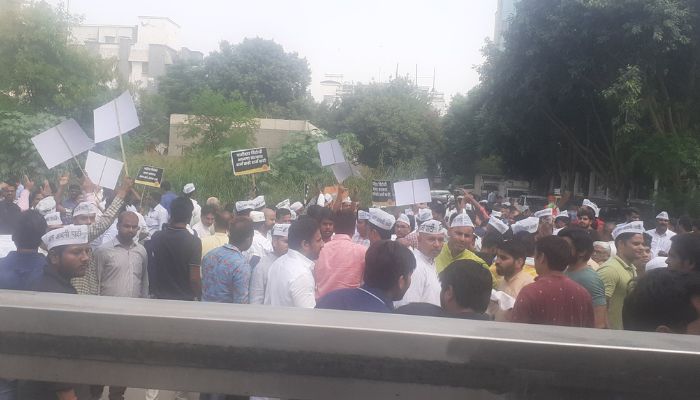
AAP workers create a ruckus outside the NCW office

A crowd of Aam Aadmi Party workers created a ruckus outside the National Commission for Women (NCW) office in Delhi. The party workers gathered outside the NCW office after the NCW served notice to Gujarat AAP chief Gopal Italia for his indecent words against PM Modi and women.

Gopal Italia was pulled up for his comments against PM Narendra Modi in which he called the Prime Minister a ‘neech’ person. Now, his other video has gone viral in which he called the temples and Dharmic gatherings of Hindus like Kathas the centres of exploitation of women. AAP workers have decided to back the abusive leader even after the NCW called these comments misogynistic and sexist in nature and summoned him to clarify the same.

Gopal Italia, the leader of the Aam Aadmi Party (AAP) in Gujarat, has received a summons from the National Commission for Women for using a derogatory term for the Prime Minister as well that is equally offensive to women. The NCW has claimed in its notice that Italia’s offensive language is sexist, discriminatory against women, and abhorrent.

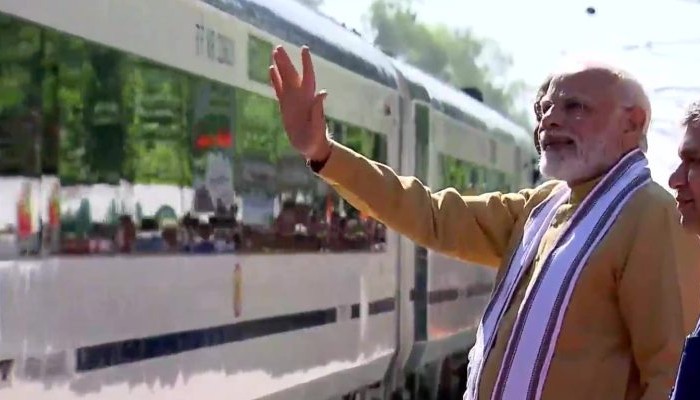
Himachal Pradesh: PM Modi flags off the Vande Bharat Express train from Una. Read details

During his visit to Himachal Pradesh today (October 13), Prime Minister Narendra Modi flagged off the fourth Vande Bharat Express train from Una. The train will run between Una and Delhi. The train will specifically run between Delhi and the Amb Andaura Railway Station in Una. Prior to this, PM Modi inaugurated the third Vande Bharat train on the Mumbai-Gandhinagar route on September 30. The launch of trains on the new route bolsters the ‘Make in India’ campaign. Moreover, it contributes to the Prime Minister’s ambition of operating 75 Vande Bharat trains across multiple railway sections.

The fourth Vande Bharat Express is an advanced version of the earlier ones and is much lighter and faster, according to the Prime Minister’s Office (PMO).

According to the Ministry of Railways, the new Vande Bharat has advanced features including reclining seats, automatic fire sensors, CCTV cameras, and an on-demand Wifi facility, every coach has 32 screens to offer information and infotainment (the previous Vande Bharat trains had 24 screens), three hours of battery backup, a GPS system and many other features in order to make the travel experience safer and comfortable.

The Vande Bharat Express 2.0 offers an aircraft-like travel experience. It is outfitted with cutting-edge safety features, including an indigenously developed Train Collision Avoidance System (KAVACH).

Notably, the Vande Bharat Express accelerates to 100 kilometres per hour in just 52 seconds with a maximum speed of 180 kilometres per hour. Vande Bharat Express apart from providing a faster and more convenient mode of travel will also boost tourism in the state.

PM Modi was welcomed by the people of Una who raised ‘Modi-Modi, Sher Aaya’ slogans with PM Modi greeting the crowd as seen in the video tweeted by ANI. 

After flagging off the Vande Bharat Express in Una, PM Modi said that the BJP government both in the state and at the centre is accomplishing the needs of the people of the state which the previous governments at the centre and state did not care to understand and fulfil.

Himachal Pradesh Chief Minister Jairam Thakur and Railways Minister Ashwini Vaishnaw and Hamirpur MP and union minister Anurag Thakur were also present at the event.

PM Modi laid the foundation stone of Bulk Drug Park in Una

PM also laid the foundation stone of a Bulk drug Park in Una with an aim to boost the pharmaceutical sector. The Drug Park will be built at a cost of about Rs 1,900 crore. The Drug Park will also play a significant role in curbing dependence on active pharmaceutical ingredient (API) imports.

It is likely to attract investment of around Rs 10,000 crores and provide employment to more than 20,000 people. It will also fillip to economic activities in the region, as ANI quoted PMO statement in its report.

Along with this PM Modi inaugurated the Indian Institute of Information Technology (IIIT) Una, the foundation stone of which was laid by PM Modi in 2017.

Notably, PM Modi had on October 5, inaugurated the All India Institute of Medical Sciences (AIIMS) in Himachal Pradesh’s Bilaspur. The foundation for the AIIMS was laid in 2017 under the Pradhan Mantri Swashthya Suraksha Yojana. 

Taxing cow farts– Everything you need to know about New Zealand’s plan to impose a tax on ‘methane-producing’ cattle and other animals

0

The farmers of New Zealand are furious as Prime Minister Jacinda Ardern has proposed to impose a tax on the cows and sheep of the country in an attempt to cut methane emissions. The proposal has attracted a sharp reaction from the farmers in the country.

If the proposal passes, New Zealand will become the first country in the world to have a tax system to charge farmers based on the level of emissions from their herds. As per reports, the payable amount will depend on the number of animals, the size of the farm, the type of fertiliser used, and any methods used that can mitigate methane production.

Cattle and sheep outnumber the New Zealand population

If we compare the number of cattle, sheep, and people in New Zealand, the country has five times as many sheep and almost twice as many cattle in the country than people. The dairy and meat industries in the country depend on these two animals. However, it is notable that they are also responsible for half of the country’s methane emissions.

There are around 6.3 million dairy cattle heads in the country. The number has increased by 82% in the last 20 years. There are around 3.8 million beef cattle, 800,000 deer, and 26.8 million heads of sheep in the country. The current population of New Zealand is approx 5.1 million.

As per 2019 stats, 50% of the country’s greenhouse gas emissions come from methane and nitrous oxide. Out of this 50% of emissions, just under 90% comes from livestock. The methane these animals generate is produced due to the ruminants’ digestion and use of synthetic nitrogen fertilisers.

The proposal’s consultation launched on October 12

On October 12, a consultation was launched in the country’s parliament to discuss the proposal. It will conclude in November. The proposal suggests a levy tax not only on the methane burped or farted by the livestock but also on the nitrous oxide found in their urine. The tax may get implemented in some form by 2025.

In July this year, when the proposal first came to light, it was said that by 2025, all farms in the country would be required to track and manage their greenhouse gas emissions. They will have to pay a tax according to how much the livestock at a particular farm pumps out. To earn credits against the emissions, the farmers can plant crops to reduce carbon emissions, including trees.

As per PM Ardern, the money collected by introducing the tax in 2025 will be used for research and incentives for the farmers who are ‘struggling to reduce the methane contribution by their herds’. Furthermore, the PM argued that the tax would put the country on the best possible footing to attain carbon-neutral meat and dairy products.

Notably, PM Ardern has pledged to reduce methane emissions by 10% by 2030 and make New Zealand a carbon-neutral country by 2050.

The agriculture community objected to the proposal

PM’s proposal did not please the agriculture community. The tax was first announced in July this year, and since then, protests have been taking place opposing the proposal. Agriculture is one of the largest industries in the country and contributes to 5% of the economy. Both dairy and meat are among the country’s largest exports.

President of the Federated Farmers of New Zealand, Andrew Hoggard told Financial Times that the move by the government would affect small-town New Zealand as the farmers will be forced to sell their land to forestry companies. He said, “We didn’t sign up for this. Our plan was to keep farmers farming. Now they’ll be selling up so fast you won’t even hear the dogs barking on the back of the ute [pick-up truck] as they drive off.”

The 2003 ‘fart tax’

Notably, the first such tax was introduced in 2003, around 20 years ago, when the Helen Clark-led government approved a similar scheme. At that time, it was dubbed a ‘fart tax’ by the opponents. The approval was withdrawn after a tractor protest comprising 400 farmers with 20 tractors outside New Zealand Parliament.

Then President of Federal Farmers Tom Lambie had said, “New Zealand farmers are completely unsubsidised, completely unprotected in a hugely distorted global market. The imposition of this unnecessary levy is just another cost we shouldn’t have to bear.”

At that time, every farmer would have ended up paying NZ$300 per year as the ‘fart tax’. In opposition, a petition gathered over 64,000 signatures, which was over half of the New Zealand farmers.

Army dog ‘Zoom’ passes away a day after surgery, had taken 2 bullets while fighting terrorists in Kashmir

0

Army dog Zoom, who was being treated in Srinagar after suffering gunshot wounds while fighting terrorists in Anantnag, Jammu and Kashmir, has passed away today. Zoom had got surgery on October 12 and was in stable condition. However, his condition suddenly deteriorated today.

Army officials have stated that Zoom was under treatment at 54 Advance Field Veterinary Hospital in Srinagar. He was responding well after surgery but at around 11.45 am he suddenly started gasping for breath and collapsed.

The canine suffered injuries during an anti-terror operation in Kokernag, Anantnag when Zoom attacked terrorists and received two bullet injuries. However, despite injuries, Zoom continued with his task, resulting in the neutralisation of two terrorists by Army officials.

Chinar Corps released a video to celebrate the bravery and unparalleled courage displayed by the dog in identifying and neutralising the terrorists. The security forces launched a cordon and search operation in the Tangpawa area of south Kashmir late on Sunday after receiving specific input about the presence of terrorists in the region. 

AAP workers create ruckus outside National Commission for Women after it serves notice to Gopal Italia for his vulgar comments

A crowd of Aam Aadmi Party workers created a ruckus outside the National Commission for Women (NCW) office in Delhi on 13th October 2022. The party workers gathered outside the NCW office after the NCW served notice to Gujarat AAP chief Gopal Italia for his indecent words against PM Modi and women.

Earlier, Gopal Italia’s videos from 2018 and 2019 went viral in which the state president of AAP’s Gujarat unit could be heard making offensive remarks.

Gopal Italia was pulled up for his comments against PM Narendra Modi in which he called the Prime Minister a ‘neech’ person. Now, his other video has gone viral in which he called the temples and Dharmic gatherings of Hindus like Kathas, the centers of exploitation of women. AAP workers have decided to back the abusive leader even after the NCW called these comments misogynistic and sexist in nature and summoned him to give a clarification on the same.

Gopal Italia, the leader of the Aam Aadmi Party (AAP) in Gujarat, has received a summons from the National Commission for Women for using a derogatory term for the Prime Minister as well that is equally offensive to women. The NCW has claimed in its notice that Italia’s offensive language is sexist, discriminatory against women, and abhorrent.

Italia has been asked by NCW to personally appear before the Commission on October 13 at 12:30 p.m. If he fails to do so, the Commission may continue to take any measures it considers appropriate. Barnali Shome, Under Secretary of NCW, has issued the notice. It is notable that Italia insulted Prime Minister Modi in his video by using “Chu” repeatedly for the PM.

As Gopal Italia was supposed to be present before the commission on 13th October at 12:30 pm, AAP workers gathered outside the NCW office and created a ruckus ahead of his hearing.