Home Blog Page 2966

Nirbhaya’s mother slams Ashok Gehlot who continues to blame capital punishment for the increase in rape and murder of minors

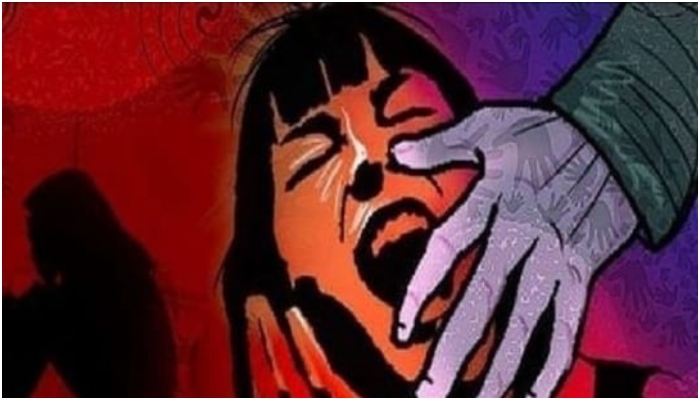
The mother of the victim (Nirbhaya) of the Delhi rape case of 2012 has slammed Rajasthan’s chief minister Ashok Gehlot for blaming the fear of capital punishment for the increase in incidents of murder of rape victims. She also said that justice was done in the Nirbhaya case because of the Bharatiya Janata Party’s government in the centre. While criticizing the mentality of Ashok Gehlot, she said that had there been a Congress government in the centre, she would not get justice.

While speaking to the Republic World, Nirbhaya’s mother said, “This is a very shameful statement. And it is a very sad thing that he is the chief minister of a state and making such statements at this age. I don’t know how these people become a minister. All I would say is that he should free all the rapists at least in his state and include them in his party and build a vote bank out of them. Because there are so many girls and women in the country who are struggling and are not getting any justice. Minor girls are raped and killed. And at that time he is saying that capital punishment causes an increase in the number of murder incidents. What does it mean? Does he mean that let the girls be raped and killed? And what about the culprits? They should be spared? I think he wants to say that, a rapist should be set free.”

She further said, “I consider myself lucky that the current government helped us. I thank this government from the bottom of my heart because we got justice in their tenure. Looking at the statement given by this leader, I don’t think we would get any justice had there been a Congress government in the centre. He should apologize to all the women in the country.”

On the other hand, Ashok Gehlot has continued to be firm on what he has said. He reiterated his statement on 7th August 2022 that capital punishment for rape is the reason for increasing crimes of rape with murder. He said, “I only said the truth. Whenever a rapist rapes a child, they then kill them for the fear of being identified & then taking action against them. So many deaths have never happened before.”

On Friday (August 5), Rajasthan Chief Minister Ashok Gehlot courted controversy after he blamed the Centre for increased murders following rapes in the country. He made the contentious remarks during a press conference. The Congress leader claimed that the Union government had passed a law, making it mandatory to award the death penalty to all rape convicts after the Nirbhaya case.

However, there is no law that makes the death penalty mandatory for all convicts of rape. Following the Kathua and Unnao rape case, the Modi government passed the Criminal Law (Amendment) Act of 2018 [pdf]. The Centre had then amended the Indian Penal Code of 1860 and the Prevention of Child Sexual Offences Act of 2012 to introduce harsher punishments for the rape convicts. One of the major highlights of the legislation was the increase of minimum punishment for rape from 7 years to 10 years. The law was made even stricter for the rape and gang rape of minor children. For instance, the punishment for rape of a girl below the age of 16 years is punishable by a minimum sentence of 20 years or a life sentence.

Death sentence has been introduced only for rape of minors below the age of 12 years, and for repeat offenders. But it is not the only punishment in such cases, death penalty has been prescribed jail sentence up to life imprisonment, and the courts decide the extent of punishment in such cases.

Petrol price hike in Bangladesh triggers chaos as China woos the nation, reignites fears that Sri Lanka crisis could repeat in India’s neighborhood

Days after hinting at an impending economic crisis, the Bangladeshi government on Friday (August 5) increased the price of petrol by 51.7% and diesel by 45.2%.

While speaking about the matter, Minister for Power, Energy, and Mineral Resources Nasrul Hamid said, “Some adjustments have to be made in view of the global situation. If the situation normalises, the fuel prices will be revised accordingly….The new prices will not seem tolerable to everyone. But we had no other choice. People have to be patient.”

The country is already reeling under high inflation. Reportedly, the inflation rate in Bangladesh has been over 6% for the past 9 months, with the annual inflation rate in July reaching a high of 7.48%.

This has put the middle class and the poor people under immense financial stress. The Russia-Ukraine war had also made things worse for Bangladesh, with the State-run Bangladesh Petroleum Corporation incurring a loss of over $85 million between February to July this year.

Despite being one of the fastest-growing economies in the world, Bangladesh has witnessed a sharp dip in its foreign exchange reserves. As of August 3, 2022, it has around $39.67 billion dollars in foreign reserves, which can sustain only 5 months of imports.

The drastic hike in fuel prices has sparked off protests, led to long queues at fuel stations, and even violent demonstrations. The earlier rise in fuel price in November last year by 23% had resulted in a 30% increase in transport costs. Bangladeshis are now anticipating similar aftermath after the government’s decision.

The high inflation has also landed a severe blow on the country’s garment industry as people are forced to prioritise essential commodities. This has also affected its exports. There has also been a dip in foreign remittances, which happens to be the 2nd largest contributor of foreign exchange reserves for Bangladesh.

Bangladesh seeks money from IMF, Asian Development Bank

Last month, Bangladesh sought $4.5 billion from the International Monetary Fund (IMF) to tide over its immediate economic woes, caused due to high imports.

While speaking about the matter, Finance Minister Mustafa Kamal said, “If the IMF conditions are in favour of the country and compatible with our development policy, we’ll go for it, otherwise not. Seeking a loan from the IMF does not mean Bangladesh’s economy is in bad shape.”

He further claimed that the macroeconomic condition of the country was firm. The IMF confirmed that Bangladesh has expressed interest in its ‘Resilience and Sustainability Facility.

In a statement, it said, “The IMF stands ready to support Bangladesh, and the staff will engage with the authorities on program design as per the established policies and procedures of the Fund. The amount of support will be part of the program design discussions.”

Reportedly, the IMF can extend a maximum of $1 billion in financial support. Bangladesh has also sought $1 billion from Asian Development Bank.

China is eyeing to exploit the economic woes of Bangladesh

With an eye to exploit the ongoing economic woes of another Indian neighbour, China is thinking of expanding duty-free access to 99% Bangladeshi goods and services. The move is likely to benefit the exporters of garments and woven products in Bangladesh.

While speaking about the development, Shahriar Alam, State Minister for Foreign Affairs, said, “It’s good news for Bangladesh as we have a thriving economy based on exports. We already had duty-free access for 98 percent of items exported to China.”

He added, ”The remaining 2 percent, like any other bilateral trade, has been important and sensitive. Now, they have offered duty-free access to 1 percent more from September 1.”

The matter was taken up for discussion during a bilateral meeting between Bangladeshi Foreign Minister AK Abdul Momen and his Chinese counterpart Wang Yi on Sunday (August 7). China is also eyeing setting up factories and providing technological support in Anowara upazila in the Chittagong district of Bangladesh.

The two countries are also likely to sign an MoU regarding Public-private cooperation, and chalk out plans for increasing aerial connectivity, and Foreign Direct Investment (FDI). China has reportedly promised to help resolve the Rohingya crisis and the internal challenges in Myanmar as well.

Earlier, four state-owned Chinese companies had expressed interest in building a ‘Smart City’ and a metro rail network in Chittagong. China is known to push developing countries under debt by lending money for building infrastructure projects with marginal or no economic returns.

While Bangladesh is relatively safe for now, things may spiral out of control if the Sheikh Hasina government fails to keep inflation and the associated unrest in check. It will then be an uphill task for India to support both Bangladesh and Sri Lanka at the same time.

The Sri Lankan crisis

Sri Lanka is experiencing its greatest economic crisis since gaining independence from Britain in 1948, with inflation hitting a record high of 54.6% in July 2022 as compared to the previous year.

The island nation’s citizens are facing severe food and cooking gas scarcity. Power outages are common, and huge lines for fuel may be seen throughout the National Capital.

The crisis was exacerbated following the coronavirus epidemic when the country began to struggle with tourism, the island nation’s main contributor to the economy, left severely damaged. Since the government lacked sufficient foreign reserves, many imports were prohibited.

This resulted in extended power outages and blackouts. In April, the Sri Lankan government declared a default on USD 51 billion in foreign debt. In the midst of Sri Lanka’s economic turmoil, India has offered assistance to the island nation.

India has provided a credit line of $1.5 billion for the purchase of 40,000 tonnes of diesel. Additionally, Sri Lanka requested an extra $1 billion credit line for necessary imports.

Jamia engineering student Mohsin Ahmed turns out to be ISIS terrorist who raised and sent funds to Syria, NIA arrests him in Batla House

On 7th August 2022, the NIA (National Investigation Agency) arrested a student named Mohsin Ahmed Khan from Johabai Extension in Delhi’s Batla House. The NIA has found that he was collecting funds for the dreaded terror outfit ISIS. He was also an active member of the terrorist organization Islamic State of Iraq and Syria, also known as the Islamic State of Iraq and the Levant or simply the Islamic State.

The NIA conducted searches at the Batla House hideout of Mohsin Khan, originally from Patna, the capital of Bihar. He was arrested for running on-ground and online campaigns for ISIS.

The central agency itself took cognizance and registered a case in this regard. The agency called Mohsin Ahmed to be a fundamentalist. Along with India, he was collecting funds from those associated with ISIS from abroad as well. After collection, he would transfer this fund to Syria and other countries through cryptocurrencies to carry out the activities of the terrorist organization. Further investigation in this regard is currently underway. The NIA is currently looking for who else was in contact with him, who else is involved in these activities, and how much money was sent to him and to Syria so far.

Earlier on July 31, the NIA had also raided 13 locations in six states. Mohsin Ahmed is an engineering student and studies in the first year of the engineering course. His family says the allegations against him are false. The family has said that they challenge the NIA’s claims in court. Mohsin Ahmed has three sisters and his father works in the Indian Railways. One of the sisters said that he himself was asking her for Rs 4000 a few days ago, so he would not have that much money and he would not be collecting funds.

His relatives portrayed him as a savior, claiming that he used to distribute food grains to the impoverished. The family refers to him as a ‘kid’ who would have no idea what he was doing. He studies at Jamia Millia Islamia University. He was arrested on Sunday, August 7, 2022. Numerous questionable objects were discovered in his home during the NIA raid. It was his classmates who provided details about him. He was in contact with 35 ISIS commanders in Syria.

‘Fact-checker’ Mohammed Zubair of Alt News tries to question PM Awaas Yojana, ends up inadvertently promoting the scheme: Read details

0

On August 7, alleged fact-checker and co-founder of propaganda website Alt News, Muhammad Zubair posted a tweet with a 2018 video of Prime Minister Narendra Modi in which PM Modi had promised houses for all under Pradhan Mantri Awaas Yojana (PMAY) by 2022. Sharing the video, he wrote, “Few days left to get this promise fulfilled.”

In 2018, addressing a rally in Rajasthan, PM Modi promised housing for all by the time India completes 75 years of Independence. He had said, “I have taken an oath. Every family in India will have a ‘pucca’ house. I have taken an oath that by the time India completes 75 years of Independence, there will no family in India that will not have a house of its own.”

Tweet by Alt News’ Mohammed Zubair. Source: Twitter.

The aim of sharing the video was to depict that the government or PM Modi failed to fulfil the promise he made in 2018. While it is true that there are many families that still do not have the ‘pucca’ houses, Zubair and his ilk may want to check the status of Pradhan Mantri Awaas Yojana for both urban and rural sectors. Something a fact-checker should have checked and mentioned before sharing the video.

In fact, Zubair’s tweet did make many people check the status of the progress under Pradhan Mantri Awaas Yojana and how Crores of people have got pucca houses under the scheme.

OpIndia checked dashboards of both Pradhan Mantri Awaas Yojana-Urban (PMAY-U) and Pradhan Mantri Awaas Yojana-Gramin (PMAY-G). Here is what we found out about the status of the projects.

Status of projects under PMAY-U

First, let’s talk about PMAY-U, which is managed by the Ministry of Urban Development. As per the information provided by the dashboard of PMAY-U, by August 1, there was an overall demand of 112.24 lakhs houses across the country. The government went above and beyond, and the total sanctioned houses are at 122.69 lakhs. So far, 61.77 lakh houses have been completed and delivered under the scheme. Sixteen lakh houses out of them were built using new technologies.

Source: PMAY-U website

Coming to the cost of the project, the government committed Rs 2.03 lakh crores (approx) for the projects under PMAY-U. So far, Rs 1.20 lakh crores have been released, out of which Rs 1.13 lakh crores have already been spent under the scheme.

Furthermore, the government has also provided Interest Subsidy under the CLSS scheme. So far, the government has contributed Rs 55,095 crores to the scheme to help economically weaker section (EWS) and low-income groups (LIG) to avail loans for housing at an affordable rate.

Status of projects under PMAY-G

PMAY-G is managed by the Ministry of Rural Development. As per the information provided by the PMAY-G dashboard, the ministry had set a target of 2,71,92,795 houses. Total 2,69,85,216 registrations were done and 2,44,64,041 houses were sanctioned under the scheme. So far, 1,93,01,073 houses have been completed and delivered. The government has spent Rs 2.57 lakh crores on the Rural housing project so far.

Source: PMAY-G website.

If we check the year-wise progress of the scheme, approx 42 lakh houses were built in 2016-17. Next year, in 2017-18, approx 31 lakh houses were built, followed by 25 lakh houses in 2018-19, approx 58 lakh houses in 2019-20, approx 43 lakh houses in 2020-21 (Covid pandemic slowed down the progress) and approx 71 lakh in 2021-22. Despite the Covid-19 pandemic and countless hurdles related to land registrations, documentation etc., the central government has built almost two crore houses in the past five years in the Rural sector.

In total, under PMAY for both Urban and Rural, the central government has delivered close to 2.54 crore houses which is definitely not a small number. Even if we consider that each household has only four members, the total number of Indian citizens who got a ‘pucca’ house under this scheme stands at around 10.16 crores. These 2.54 crore families were either living in the open or had a ‘kaccha’ house. Now, because of the housing scheme, they not only have a stable roof on their heads, but the government has also provided them with electricity connection, LPG connection, and other facilities under different schemes.

Telangana: Farmer harassed by local Sarpanch consumes pesticide to commit suicide, devastated mother also kills herself by consuming remaining poison

A shocking incident of double suicide of a farmer and his mother has come to light from the Telangana state. Jink Srisailam, a farmer from the Devlapally village of the Kowdapally taluka of the Medak district in Telangana committed suicide as he was allegedly harassed by the Sarpanch of the village and the forest officer of that area.

Srisailam was allegedly being pressurised for handing over his land to make a ‘Nature Park’. When Srisailam’s mother went to the farm and saw his son lying dead after consuming pesticide, she was shocked. Unable to bear the pain of the death of her son, she consumed the remaining pesticide in that bottle and both of them died within hours.

The incident is reported to have taken place on Saturday 6th August 2022. Srisailam shot a selfie video before committing suicide. In this video, he alleged that he was being harassed by the Sarpanch of the village and the forest officer to give his land for the “Nature Park’ project. He said that he had invested Rs 50000 to grow the chili crop on his five-acre farm.

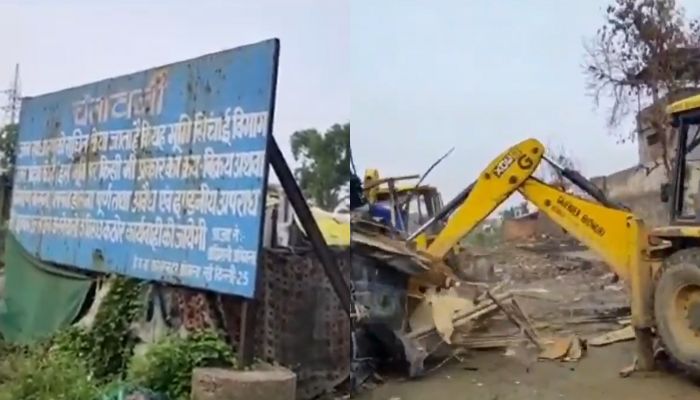
Before Srisailam could come to his farm, the JCB machines destroyed his crop. Image Source: ETV Bharat Telugu

The Sarpanch and forest officer allegedly destroyed his crop with earth-moving equipment when he was not present on the farm. According to a report by ETV Bharat Telugu, Srisailam had a heated debate with those people when he saw the JCB machine has destroyed his crop. He said in the video that he expects justice to be done to his daughter and son after his death. He said that he was deliberately being harassed by the Sarpanch and the forest officer who wanted to set up a nature park on his farmland. At the end of the video, he is seen consuming pesticides.

When his mother visited the farm, she was devastated to see her son lying down dead. She consumed the remaining pesticide in the bottle and later died. Telangana unit president of Bharatiya Janata Party Bandi Sanjay Kumar tweeted about this incident along with the video Srisailam shot before committing suicide. Bandi Sanjay Kumar wrote, “Extremely painful incident! Medak farmer Srisailam recorded a video & ended his life as Sarpanch & forest officials pressurized him to set up Prakruthi Vanam in his field. In his absence, they dug up his field & destroyed the Mirchi crop. His mother ended life unable to bear her son’s death.

The response from the Telangana government over this unfortunate incident is awaited.

‘Aurangzeb – Whitewashing Tyrant, Distorting Narrative’: New book debunks distortions around the Mughal tyrant Aurangzeb

As I was turning the pages of the book, the news of ‘Aurangabad’ – a city in Maharashtra getting its new identity as ‘Sambhajinagar’ came to the fore. This shift in the Overton window, that a modern-day Indian city should not glorify the 17th-century genocidal tyrant was a long game in narrative, eventually carved out by electoral politics. Debutant author Saurabh Lohogaonkar’s book ‘Aurangzeb: Whitewashing Tyrant, Distorting Narrative’ thus could not have come with better timing.

The book occupies an unusual space in the coterie of historical non-fiction, a genre that is ruling bestseller charts in the larger Indian literary circuits. This had a lot to do with India’s renewed sense of history, identity and assertive politics of the day. Underlined with identity politics and Muslim appeasement, the ‘secular’ class of Indian politicians continues to gloss over the tyrannies carried out by Islamic rulers like Aurangzeb whenever a debate over history is contested.

This has prompted a class of historians in turn to justify the barbarism of Islamic imperialism in India through academia – with authors like Audrey Truschke writing problematic turn-around biographies of Aurangzeb. A narrative was created that the Mughal Emperor was not as cruel as the ‘Hindu Right’ paints him, and was a mere ‘product of his times’.

While books whitewashing Aurangzeb, the tyrant, including those authored by Truschke met divisive criticism, Saurabh Lohogaonkar thought to himself that the answer to a book is another book in itself. His latest book is neither a linear biography of Aurangzeb, as he claims nor is it a rebuttal directed against any specific hagiography of the Mughal emperor.

Interestingly, Lohogaonkar calls his work a ‘fact-finding’ exercise. He picks up contested issues in the historiography of the central character including his succession war with his brother Dara Shikoh, claims around the sound representation of Hindus in his administration to absurdist assertions like ‘Aurangzeb building Hindu Temples himself’ and assesses them through diligent investigation of available sources.

Dara Shikoh’s head being presented to Aurangazeb upon his order was realised in 1659. Source: Wikimedia Commons

The author elucidates in detail why any primary source has to be dealt with seriously inside the frame of context as opposed to the consideration of the text as a definitive understanding of the times. For example, notings of Hindu chroniclers in the Mughal Court like ‘Futuhat-i-Alamgiri’ and ‘Tarikh-i-Dilkusha’ which glorify Aurangzeb’s rule are often positioned as a mark of his collaborative style of rule by his modern-day sympathizers.

While an argument in the case is made that even the Hindus in Alamgir’s administration have lauded him as a ruler of Hindustan, the author asks us to take the court propaganda with a pinch of salt. “The employment and well-being – of Hindus commissioned to write history in the Mughal Durbar, “was directly dependent on how (they) wrote about Aurangzeb and (his) Empire in general. The narratives of Hindus employed in the Mughal Administration must be taken into consideration with due diligence, as they are neither independent and a certifying authority of ‘Secularism’ and ‘Tolerance’ dispensed by Mughal Kings nor were they speaking on behalf of all Hindus of the era as we are made to believe,” notes Lohogaonkar.

The author classifies the carefully stitched myth about Aurangzeb as a ‘Protector of Temples’ as opposed to his known opposition to idolatry and the destruction of Hindu temples in three ‘phases’. From 1669-1673, the temples present in the land directly administered by the Mughals were demolished. In the second phase of Temple destruction during Aurangzeb’s reign, from 1679 to 1681, the temples present in the Hindu kingdoms which were under Mughal supremacy were demolished whereas, in the third phase, the destruction of temples by Mughal forces during Aurangzeb’s stay in Deccan is categorized. While the ‘Aurangzeb Defender Lobby (ADL)’ – as the author calls it, went ahead to suggest that the Mughal Emperor did not destroy any temples during his tenure in Deccan, the rhetoric doesn’t hold much ground. As Aurangzeb marched ahead to conquer newer territories South of the Narmada, he gave a general order to loot, ransack and demolish many Hindu temples in Maharashtra including the famous Mahalaxmi Mandir in Kolhapur and the temple of Lord Vitthal in Pandharpur.

The author’s mastery over sources, powered with data is not only reflected through his arguments but also in the detailed bibliography in the end. The book has been written with academic spirit but with simple poise, which makes it an easy read. It is a gift for amateur historians, who are fed up with everyday narratives glorifying Aurangzeb, to assess the history dispassionately. And for those, who will stop not with their whitewashing exercise, more such books, expectedly by new authors like Lohogaonkar are yet to come.

The book can be purchased from amazon.in from here.

Commonwealth Games medalist Divya Kakran once again highlights the lack of support for athletes from Arvind Kejriwal-led AAP government

On 7th August 2022, Divya Kakran, the wrestler who won a bronze medal in the ongoing Commonwealth Games 2022, has shared on Twitter how she hasn’t been given any prize money to date by the Delhi government. She shared this in response to the congratulatory tweet from Delhi chief minister Arvind Kejriwal.

Divya Kakran tweeted, “Heartfelt thanks to Hon’ble Chief Minister of Delhi for congratulating me on the medal. I have a request to you that I have been living in Delhi for the last 20 years and have been practicing my sports wrestling, but so far I have not been given any kind of reward money from the state government nor any help has been given to me.”

She wrote in the next tweet, “My only request to you is that I should be honored in the same way as other players, who despite being from Delhi play from other states, are honored.”

Divya Kakran comes from a humble background. Her mother used to sew ‘Langots’ and her father used to sell those to earn a livelihood. Rising from such difficult situations, the 23-year-old wrestler won a bronze medal in the Commonwealth Games 2018 and a gold medal in the Asian Games 2018 making India proud.

Earlier, on 6th August 2022, Delhi chief minister Arvind Kejriwal congratulated the Commonwealth Games medalist wrestlers of India in his tweet in which he said, “Bravo wrestlers. Our wrestlers have made a mark in the Commonwealth Games. In wrestling, India got a total of 6 medals in a single day, out of which 3 are gold. Many congratulations to Sakshi Malik and Deepak Punia for their gold and Divya Kakran and Mohit Grewal for bronze medals.”

Delhi government’s history of poor support to the athletes

This is not the first time that Divya has criticized the Delhi government’s negligent approach toward sportspersons. Even after winning in Asian games in 2018, she had complained about the Delhi government’s lack of support for sportspersons.

In a meeting after winning the gold medal at the Asian Games 2018, and a bronze medal in the CWG 2018, she was seen lambasting Arvind Kejriwal. She said at that time, “Didn’t we have any ‘jugaad’? And I have brought a bronze medal for the country at the age of 19 in these Commonwealth Championship matches and in the Commonwealth Games 2018 too. I have won 12 gold medals for Delhi at senior-level championships. When I won a gold medal in the Asian Games, at that time also, nothing was done for me. It is very difficult to reach where I am starting from where I come from.”

Speaking at a felicitation ceremony for the athletes, Kakran said, “It is okay that you are doing something today but please think about those players who come from a poor economic background. Today you have brought all of us together in this program and you are congratulating us. But when we need somebody’s help the most, at that time nobody comes to help us. Because I have reached here today, you are doing this. I would say that you don’t do this much for us after achievement. But help us when we need it the most. If we get help and support in those hours, we will perform even better. Had we received any support, I would have brought a gold medal for the country for sure.”

Expressing her gratitude for her coach, Kakran said, “Our coach has done so much for us. I am a very lucky girl. He left his job and ensured that I stand on the mat to wrestle. I could not afford to have a healthy diet. My coach ensured that I get good quality dry fruits. But all this was working well till he was with us. Now, things have changed. I brought a medal from the Commonwealth Games and so you invited me here and said that you will now help us. I asked you for the help we needed at the time of the Asian Games. You told us that kindly write to us about the same. I gave everything in writing. But what happened after that? Nobody received my call.”

Underlining the commitment of the athletes, she said, “Sir, we are poor, but you can’t imagine the fire within us. What more can I say? I reached here today and suddenly everyone is supporting me. But when we needed this support the most, nobody did. There are many more players like me. Please think of them. I reached here because the Gods supported me, the coach blessed me and the parents supported me.”

Comparing the sports culture of Delhi with that of Haryana, she said, “Remember that Delhi has got a very less number of medals. Go and see how many medals are there with Haryana because they got the state support. A budget of Rs 3 crore is a huge amount, Sir. Delhi has sanctioned Rs 1 crore after this win. Earlier we had Rs 20 lakhs. Look at our hard work and hardships. Nothing happens in those 20 lakhs. In Haryana, no one tells the athletes that we don’t have milk and we don’t have ghee. Even we do have milk and ghee here in Delhi and we are also equally inspired. But we lack state support. So please think and act in a way so that next time Delhi bags the maximum number of medals in the Asian Games and all of them are gold medals.”

Divya Kakran won the Bharat Kesari title in 2018. It is notable that she had secured a spot in the finals of this tournament by defeating legendary wrestler Geeta Phogat.

Infighting breaks out between the CPI and CPIM in Kerala over projecting Pinarayi Vijayan above the party

On Saturday (August 6), the Communist Party of India (CPI) lambasted its ally Communist Party of India Marxist (CPIM) for projecting the government headed by Kerala Chief Minister Pinarayi Vijayan as ‘one-man show.’

As per a report in Onmanorama, the CPI presented a political report during a recent conference held in the Pathanamthitta district of Kerala. It slammed its Communist counterpart for presenting the Left Democratic Front (LDF) Government as that of Pinarayi Vijayan’s government.

“The CPIM is deliberately trying to brand the government as Pinarayi’s government. The CPIM always refers to the Left government as the Pinarayi government. A trend that has never before been seen in the tenure of an LDF government needs to be corrected,” it emphasised.

The Communist Party of India has expressed its displeasure over the contractual appointments in the State as well as the policy of the CPIM on the issue of cooperative banks. It has also pointed out how CPIM has denied it of its due share.

“The government had to suffer the backlash over the impertinence shown in implementing the (SilverLine railway) project. Like the Sabarimala issue, this was also rendered complicated. The project should have been implemented only by convincing the public but instead, it was handled in a manner that incited public anger, ” CPI added.

The Communist party also accused its ally of bypassing employment norms and exhibiting a hostile attitude towards its student body, All India Student’s Federation (AISF). CPI alleged that it had accounted for the actions of CPIM.

The party also criticised the Kerala CM for his intolerance toward black flags. “The black flag is the mode of protest used by everyone. The intolerance for black shown by the Chief Minister, who has led numerous agitations, is not in the democratic spirit,” CPI said.

It must be mentioned that the CPI and the CPIM officially split in 1964 over the former’s support for China and the latter’s support for the USSR. CPIM was quick to replace the original Communist party in Kerala, Tripura and West Bengal.

Maharashtra: Nikhil Bhamre who was arrested for a tweet against Sharad Pawar joins Twitter with a new handle, thanks BJP and RSS for support

Nikhil Bhamre of Dindori in the Nashik district of Maharashtra who was arrested for a tweet allegedly against Sharad Pawar joined Twitter with a new handle. Nikhil Bhamre thanked the Maharashtra state unit of Bharatiya Janata Party, Rashtriya Swayamsevak Sangh, Devendra Fadnavis, and legal experts including Advocate Prakash Gade for supporting him in his difficult times.

This Twitter account of Nikhil Bhamre is created in August 2022. Advocate Prakash Gade, a member of the BJP, was one of the lawyers who supported Nikhil Bhamre. He has followed this account on Twitter and retweeted Nikhil Bhamre’s new thread of tweets.

In his tweet, Nikhil Bhamre said, “I am Nikhil Shamrao Bhamre, I am back. To thank them, who stood firmly behind me in difficult times. Honorable Devendra Fadnavis Ji, Thank you very much. I will always be indebted to you for your help. I have come back to thank everyone who directly and indirectly helped me and my family through difficult times. They make me feel stronger today than ever before.”

Nikhil Bhamre further said, “Due to studies and exams, I could not meet, talk or express anyone for the last one month. But after a long time, I have come back to express myself. Nidhi Kamdar, Sister, you were taking time out of your busy time to get an update on what happened, and what was going on at every hearing of my case and were constantly giving the necessary tips on how to move forward. I am very grateful to you for that.” Nidhi Kamdar is an officer on special duty working with Devendra Fadnavis.

Thanking Advocate Prakash Gade Nikhil Bhamre said, “Prakash Gade Dada, you stood by me and helped me like an angel. You not only gave me a lot of courage and patience during those difficult times, but you also took care of my safety. Jiten Gajaria and Pratik Karpe, you had taken utmost care that I would not have any problem in the various hearings in the court. I am also very grateful to you for that.”

Nikhil Bhamre also thanked Pradeep Bachchhav who is the Dharma Awareness Program Head of the RSS in the western Maharashtra region. Naming him, Nikhil Bhamre said, “I am forever indebted to you for your mental and emotional support.” He further wrote in his tweet, “The sister ties the rakhi and the brother protects her. But Trupti Garg is the elder sister who stood up to protect this younger brother. My heartfelt thanks to her.”

Besides, he named all other members of the legal team that fought for him in multiple cases heard at various courts in Maharashtra. He also thanked RSS, Bharatiya Janata Yuva Morcha, and his friends and followers. Before concluding the threat with ‘Jai Shri Ram’, he also said in his tweet that he will come back to share more things.

Why Nikhil Bhamre was arrested?

The 21-year-old pharmacy student shared a post on Twitter on 11th May 2022. In his tweet, Nikhil Bhamre wrote, “It is time to create a Nathuram Godse of Baramati for a ‘Gandhi’ of Baramati. Uncle, do apologize.” It is notable that Baramati in the Pune district of Maharashtra is the hometown of Sharad Pawar. The tweet by Nikhil Bhamre was probably responding to a recent incident in which Sharad Pawar quoted poetry by Marathi poet Jawahar Rathod to make derogatory remarks against Hindu deities.

He was arrested for allegedly defaming Sharad Pawar when his social media post did not mention Sharad Pawar by name. Minister in the Maha Vikas Aghadi government and Nationalist Congress Party leader Jitendra Awhad had asked police to take action against Nikhil Bhamre. Jitendra Awhad tagged in his tweet the official Twitter handles of the Mumbai police, the commissioner of the Mumbai police, Maharashtra’s director general of police, Pune city police, and Thane city police.

Multiple FIRs were lodged against him at various places in the state after Jitendra Awhad incited his party workers to do so. He was arrested from his rented accommodation in Nashik. He is from Dindori and belongs to a farmer’s family and was living in Nashik to pursue his studies. Similarly, Marathi actress Ketaki Chitale was also arrested by the police in May 2022 for an allegedly insulting post against Sharad Pawar. Ketaki Chitale was also lodged in jail for more than a month before she was granted bail by the court.

No money left to feed lions: Pakistan decides to sell the animals to save space and money

The high inflation rate and poor economic condition of Pakistan are not only affecting its people but the animals as well. As per reports, the Lahore Zoo has decided to auction its big cats, including lions and tigers, to private entities. The zoo authorities have stated it would save space and money.

At present, there are 29 lions in Lahore Zoo, and they are between the ages of 2 to 5 years. According to Deputy Director of Lahore Zoo Tanveer Ahmed Janjua, 12 of the big cats will be auctioned on August 11. He further added there are six cheetahs and two leopards in the zoo apart from lions.

The animal activists in Pakistan are against the auction. They have suggested either shifting the lions to other zoos or giving contraceptives to female lions. Activist Uzma Khan said, “Once such an auction takes place from the zoo, it will become a business that will adversely affect the conservation of wildlife.”

The minimum bid for the lion has been set at $700 by the officials. However, they expect to earn around 20 lakh Pakistani Rupees per lion. The auction will be open to everyone. Interestingly, there have been reports that goats in India have fetched more prices than the minimum bid price Lahore Zoo officials have set for the lions.

Notably, Chief Veterinary Officer Mohammad Rizwan Khan of Lahore Zoo said in a statement that the authorities attempted to sell the lions last year as well, but the process could not be completed due to the lack of necessary papers.

Pakistan is taking drastic steps to reduce expenses and increase income but in vein. Recently, the Minister of Planning and Development, Ahsan Iqbal, requested the people of Pakistan to drink less tea as it would help in reducing pressure on the foreign reserves of the country. Pakistan is the largest importer of tea. In 2020, it imported tea worth $646 million and exported tea only worth $15.2 million. The majority of its tea comes from Kenya.